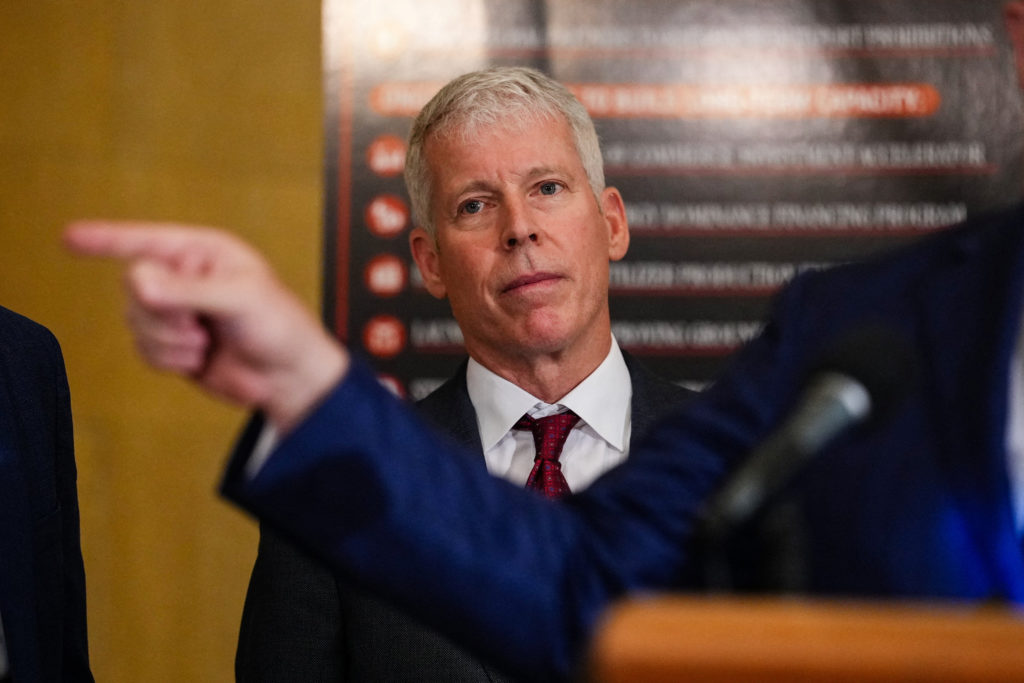
The Trump administration is putting nearly $700 million toward coal, one of the president’s favorite energy sources. President Trump announced the move during Thursday remarks in the Oval Office, saying his administration is “taking historic action to bring down the price of energy and the cost of living for all Americans with the power of...
The Trump administration is putting nearly $700 million toward coal, one of the president’s favorite energy sources. President Trump announced the move during Thursday remarks in the Oval Office, saying his administration is “taking historic action to bring down the price of energy and the cost of living for all Americans with the power of...
This lovely crochet Hexagon Rainbow Newborn Blanket pattern was given to me by one of our community members, Vicki Brandt. This pattern could be used in many different colour combinations to match any nursery. I chose the rainbow theme because I needed a blanket for a Rainbow Baby when I was crocheting this one. This blanket could […]
The post Crochet Hexagon Rainbow Newborn Blanket + Tutorial appeared first on The Crochet Crowd.
This lovely crochet Hexagon Rainbow Newborn Blanket pattern was given to me by one of our community members, Vicki Brandt. This pattern could be used in many different colour combinations to match any nursery. I chose the rainbow theme because I needed a blanket for a Rainbow Baby when I was crocheting this one. This blanket could […]
Editors’ Highlights are summaries of recent papers by AGU’s journal editors.
Source: Journal of Geophysical Research: Solid Earth
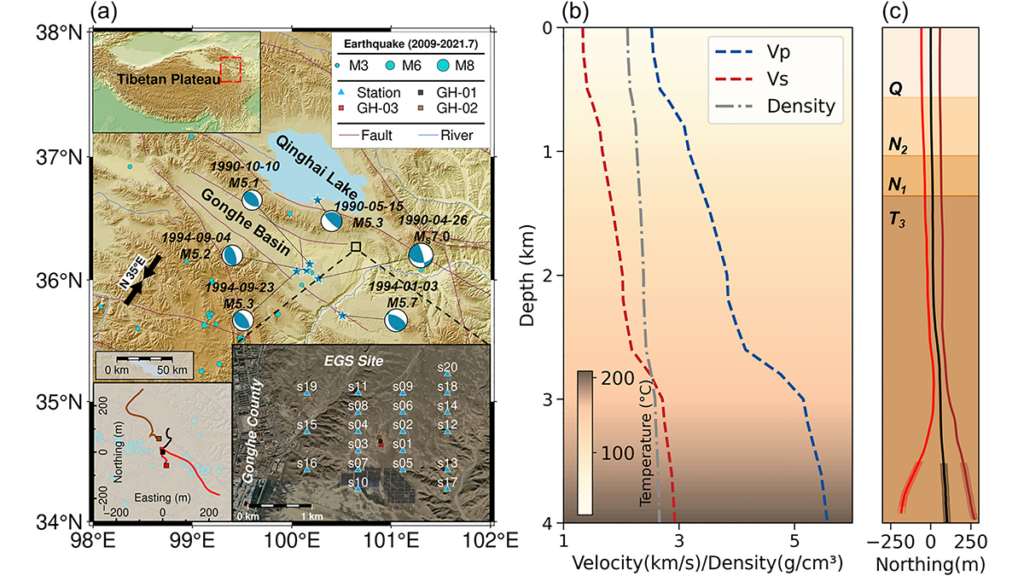
Enhanced Geothermal Systems (EGS) can expand low-carbon energy production, but fluid injection may trigger earthquakes whose locations and mechanisms are difficult to predict. Feng et al. [2026] investigate induced seismicity at China’s first EGS site in the Gonghe Basin using a comprehensive observational dataset. Machine learning processing of data from 20 su
Source: Journal of Geophysical Research: Solid Earth
Enhanced Geothermal Systems (EGS) can expand low-carbon energy production, but fluid injection may trigger earthquakes whose locations and mechanisms are difficult to predict. Feng et al. [2026] investigate induced seismicity at China’s first EGS site in the Gonghe Basin using a comprehensive observational dataset. Machine learning processing of data from 20 surface seismic stations produced a high-resolution earthquake catalog with well-constrained locations and focal mechanisms. Stress inversion and modeling, constrained by borehole stress measurements, reveal mechanically weak faults with low friction coefficients, indicating that low-to-moderate fluid overpressure can trigger seismic slip. Site-scale analysis shows that seismicity reflects shear reactivation of pre-existing natural faults, rather than the creation of new tensile fractures. Further integration with borehole image logs reveals a fine-scale relationship between the main seismogenic zones and stress heterogeneity, expressed as rotations of the principal stress axes that likely reflect localized lithological contrasts and fault-damage zones.
Together, these integrated analyses show that geothermal-induced seismicity is controlled by inherited fault architecture at the site scale and localized stress heterogeneity at the borehole scale. By linking seismic observations to borehole stress and image-log evidence, the study provides a more physically constrained framework for seismic-hazard assessment and stimulation design in enhanced geothermal reservoirs.
Citation: Feng, P., Wang, R., Zhang, H., Zhang, C., Schultz, R., & Yang, L. (2026). Pre-existing structures and stress variations jointly control the induced seismicity in enhanced geothermal system of Gonghe Basin, China. Journal of Geophysical Research: Solid Earth, 131, e2025JB033158. https://doi.org/10.1029/2025JB033158
Wind turbines are a net positive for a sustainable society, but that doesn’t mean they don’t have an environmental impact. Apart from their material requirements, those giant, spinning blades can be lethal to unsuspecting winged animals like birds and bats. Although some reports dramatically overplay wind farms’ danger to flying species, there is no denying they can unintentionally kill anywhere from two-to-six birds and four-to-seven bats per megawatt every year. That may not seem like many fat
Wind turbines are a net positive for a sustainable society, but that doesn’t mean they don’t have an environmental impact. Apart from their material requirements, those giant, spinning blades can be lethal to unsuspecting winged animals like birds and bats. Although some reports dramatically overplay wind farms’ danger to flying species, there is no denying they can unintentionally kill anywhere from two-to-six birds and four-to-seven bats per megawatt every year. That may not seem like many fatalities, but every animal counts for an endangered species.
To lower these risks, engineers are devising new ways to make wind turbines more visible and avoidable. One potential solution may involve taking a cue from some of nature’s most dangerous creatures. According to a study published in the journal Behavioral Ecology, more bats and birds will steer clear of wind turbines when their blades are painted with colors similar to animals like venomous coral snakes and poison dart frogs.
A drone photograph of a wind turbine in southern Finland, digitally modified with a biologically inspired warning pattern under natural light conditions. Credit: Eric Lehtonen
“White blades, which are the most frequently used pattern around the world, turned out to be the worst option for birds,” Johanna Mappes, a University of Helsinki environmental scientist and study co-author, said in a statement. “This suggests that a relatively simple visual change could reduce bird mortality in connection with wind power.”
To test how birds respond to various turbine designs, Mappes and her colleagues placed test subjects in front of a video screen in a controlled laboratory environment. They then played clips of wind blades with multiple color palettes spinning at different speeds. These included turbines featuring classic white blades, one blade painted black, blades with red-and-white stripes, or blades with a newly designed, biomimetic red-black-yellow pattern.
“By using a touchscreen especially designed for birds, we can use games to explore their behavior and ecology by simulating real-world scenarios, without putting the birds at risk,” explained University of Exeter ecologist and study co-author George Hancock.
In nearly every trial, the birds were far more likely to approach white blades than any of the colored options. However, the test subjects were the most avoidant of the team’s novel, biomimetic striped blades.
“We’ve known for a long time that birds change how they respond to objects with warning colors, but to see such a large effect was remarkable,” Hancock added.
There is no way to completely prevent wind turbines from ever accidentally harming or killing animals. That said, the study’s authors believe a wider industry adoption of evolutionarily inspired color schemes could be an easy, cheap way to make the technology safer. They also suggest that similar approaches be developed for other human-made avian dangers like power lines and building windows.
“If the results are repeated in practical conditions in different countries and with different bird species, it could be a significant change for the entire wind power industry,” said Mappes.
Renewable energy is the cornerstone of any sustainable society, but why limit your options to wind or solar installations? In the United States alone, over one million homes host a tiny, furry alternative power source without even realizing it. As a young YouTuber known as Flamethrower recently demonstrated, it’s time for hamsters to start pulling their weight around the house. Or, at the least, it’s time for them to start turning hamster wheels into miniature, makeshift turbines.
The idea ca
Renewable energy is the cornerstone of any sustainable society, but why limit your options to wind or solar installations? In the United States alone, over one million homes host a tiny, furry alternative power source without even realizing it. As a young YouTuber known as Flamethrower recently demonstrated, it’s time for hamsters to start pulling their weight around the house. Or, at the least, it’s time for them to start turning hamster wheels into miniature, makeshift turbines.
The idea came to Flamethrower after his brother received one of the tiny pets for his birthday. Although adorable, naturally nocturnal hamsters are often up at all hours of the night running on their little exercise accessories. While laying awake to the sound of a spinning, squeaky wheel, the amateur engineer realized how to make the best of an unexpectedly annoying situation.
“So what did I do? Exploit it for energy production, of course!” he declared in his recent video entry.
Turbines help generate most of the world’s energy, and their underlying principles are simple enough. Electricity funneled through wires to a motor will make it spin, but the reverse is also true—spin a motor, and electricity will generate through its terminals into battery storage. The fundamentals are basically the same whether a turbine spins thanks to steam, wind, or nuclear power. Or hamsters.
However, a hamster-powered turbine is not the easiest project to design. As the YouTuber explained, a 5 volt (V) DC motor hypothetically needs to spin at over 10,000 RPM to simply reach a smartphone’s standard 15 watt charging speed. Even if such a superpowered hamster existed, its speed would likely cause the motor to melt before it provided any juice to a battery—and therein lay another issue.
Batteries don’t only store energy—they are designed to provide electricity at a steady current when needed. However, a standard battery also must receive a higher voltage than it stores in order to amass any reserves.
Part of the solution came from a device known as an energy harvester module, which takes small voltages and amplifies them to an acceptable level for a battery. But the problem is that the amount of required voltage increases in direct proportion to the energy that’s being stored, meaning yet another unfeasible hurdle. The hobbyist ultimately relied on a system called maximum power point tracking (MPPT) to calculate the optimal input and output proportions for the energy harvester and a few other components.
All that potential energy is only as good as the battery that stores it, however. For this project, the YouTuber relied on lithium-ion cells salvaged from a broken electric scooter. Flamethrower hooked up his rig to the hamster wheel’s axis, then gave his brother’s pet the night to get its steps in. The next day, he attached his phone via a USB cable charging port to test the whole thing for the first time.
The initial setup worked flawlessly, although it charged at a snail’s pace. Naturally, he booted up his thermal camera nearby (who doesn’t own one?) to investigate any pain points in the system. It turns out the issue did have anything to do with the hamster wheel charger itself, but his outdated USB cable. After swapping that out with a newer replacement, phone charging sped up dramatically.
“And with that, my hamster’s life finally has a purpose,” the inventor declared.
As absurd as it appears, it’s hard to argue with such an ingenious source of free electricity. Hypothetically, the same idea could be adapted to basically anything in a house that spins mechanically, like a stationary bike. Then again, the whole point is to have the hamster do the work, not you. In any case, the YouTuber seems to be on to something here. The way Flamethrower tells it, the rodent may be more reliable than solar or wind energy.
“It’s supposed to be nocturnal but I’m starting to think it never sleeps,” he said.
In The Workshop, Popular Science highlights the ingenious, delightful, and often surprising projects people build in their spare time. If you or someone you know is working on a hobbyist project that fits the bill, we’d love to hear about it—fill out this form to tell us more.
The carmaker scaled back electric vehicle plans, but is going all in on advanced batteries, including a new sodium-ion chemistry designed for large-scale power storage.
The carmaker scaled back electric vehicle plans, but is going all in on advanced batteries, including a new sodium-ion chemistry designed for large-scale power storage.
Bogotá, Colombia – The first global summit on “Transitioning away from Fossil Fuels” kicked off today in Santa Marta, Colombia, with 50 country delegations and dozens of civil society organizations in attendance.
Unlike other climate conferences, the six-day meeting will focus on implementing measures to end dependence on oil, coal, and gas, rather than negotiating international environmental commitments.
The summit comes at a pivotal time for global energy, with conflict in the Middle Ea
Bogotá, Colombia – The first global summit on “Transitioning away from Fossil Fuels” kicked off today in Santa Marta, Colombia, with 50 country delegations and dozens of civil society organizations in attendance.
Unlike other climate conferences, the six-day meeting will focus on implementing measures to end dependence on oil, coal, and gas, rather than negotiating international environmental commitments.
The summit comes at a pivotal time for global energy, with conflict in the Middle East restricting oil and gas supplies and creating economic woes for countries reliant on fossil fuels.
Because of the ongoing oil turmoil, the conference came at the “best possible moment” to shift world opinion towards renewables, said Colombia’s environment minister Irene Vélez.
Talking to the UK’s Guardian newspaper this week, the minister, who was a prime mover of the conference, said nations were “at a fork in the road” in their choices between clean power sources such as solar or wind, or continuing to back fossil fuels that created climate crises and conflict.
It promised to be a “coalition of the willing”, said the minister, providing a road map to support nations already dedicated to transitioning from fossil fuels.
The conference organizers were combative in refusing to invite nations and organizations wedded to climate change denial.
“Whatever nations have not yet taken that decision, then this is not the space for them. We are not going to have boycotters or climate denialists at the table,” Vélez told the Guardian.
Behind the conference is the Fossil Fuel Treaty Initiative, an alliance of nation states, technical bodies, communities and individuals “working to secure a global just transition from coal, oil and gas”.
According to the initiative, globally nations were planning to extract 120% more fossil fuels by 2030 than the “amount consistent with managing the impacts of climate change” – taking warming past the point of survival.
“The science is unequivocal. For the last decade, oil, gas, and coal have been responsible for 86% of the CO2 pollution heating our planet, as well as causing one in five deaths worldwide from fossil fueled-air pollution.”
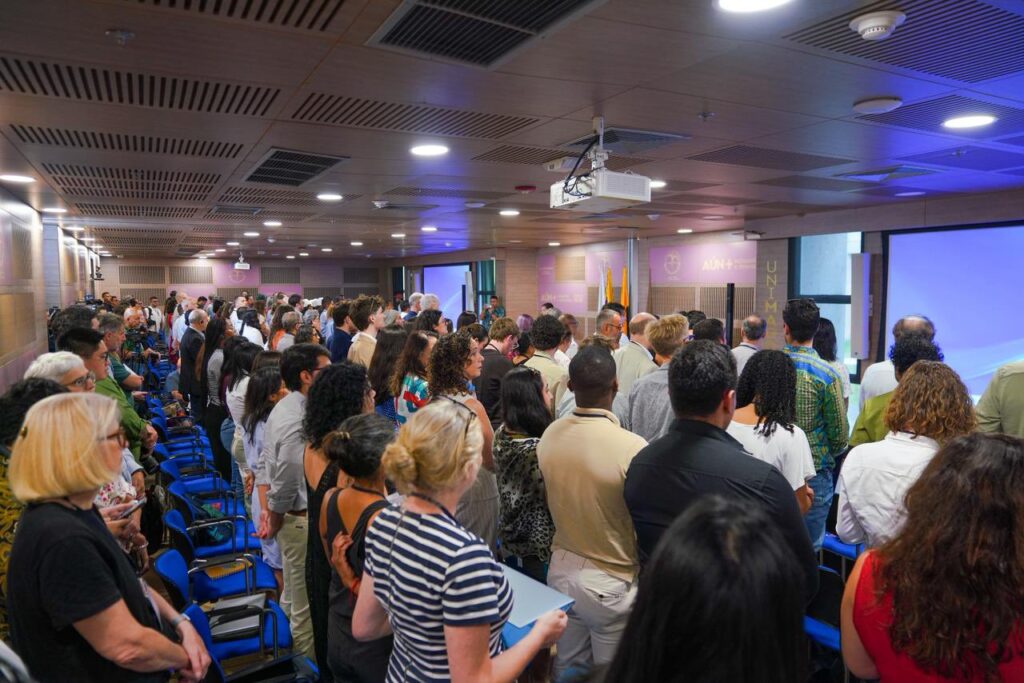
Delegates at the inauguration of the fossil fuel conference on Friday. Image credit: @MinAmbienteCo via X
For three decades global climate negotiations had focused on managing the symptoms of the crisis — fossil fuel emissions — while ignoring its root cause: the unchecked proliferation of oil, gas, and coal extraction.
This was a theme picked up by Kevin Koenig, director of climate and energy at Amazon Watch, a California-based nonprofit supporting indigenous communities attending the conference.
The last major summit, COP 30, was held last year in Brazil and saw “fossil fuel lobbyists outnumbering country delegates” he told Latin America Reports, adding that declarations at the end of that meeting “barely mentioned fossil fuels at all”.
In Santa Marta he expected things to be different: “This is the conference that is finally going to address the elephant in the room and get to the source of the climate change problem.”
Several factors were contributing to a momentum towards renewables, added Koenig, with recent data showing that cities and even whole countries have run for weeks off renewable energy as the Middle East crisis exposes the dangers of oil addiction.
“This is the moment where we are seeing both wars linked to fossil fuels politics and dependencies, but also for the first time renewables energies are not just theoretical, they are real, and decision-makers know they are scalable,” said Koenig.
This was supported by data from the Center for Energy and Clean Air, which reported that global power generation from fossil fuels fell in the first month after the U.S.- Iran conflict closed the Strait of Hormuz – a vital waterway for oil tankers – while energy generated by solar and wind power increased.
Another conference goal was to identify economic and legal barriers to transitioning to renewables, said Koenig.
An example was the hegemony of interconnected global norms feeding fossil fuel dependence, such as arbitration laws that punished small countries in international courts if they attempted to free themselves from big oil contracts. This architecture kept countries dependent, he said.
“Countries transitioning get beat up in arbitration courts or penalized by credit rating agencies. When Ecuadorians voted to keep fossil fuels in the ground, for example, their credit rating went down.”
In countries like Colombia, fossil fuels were also linked to localized conflict and armed groups, explained Koenig; over 30 years Amazon Watch has supported many indigenous communities under attack for defending their territories against drilling.
“Some countries use oil extraction as a reason to open areas, saying ‘we can militarize it and it will be safer’. In fact, oil and energy infrastructure are a magnet for armed groups, for political attacks or blackmail,” he explained.
Inga indigenous guards in Putumayo, Colombia. Their traditional lands are under threat from oil exploration and illegal mining. Photo: Steve Hide.
That dynamic was more visible than ever on the world stage.
“Fossil fuels are fueling dictatorships, violence, conflict and authoritarian regimes,” said Koenig. “The Middle East crisis underscores the urgency to transition.”
“Yes, abandoning fossil fuels is about climate – but also about security and democracy.”
Featured image description: Delegates register at the fossil fuel conference in Santa Marta on April 24, 2026.
Researchers in Australia have created the largest map of cosmic magnetic fields ever assembled, revealing the invisible forces that shape galaxies across the Universe.
[Read More]
Researchers in Australia have created the largest map of cosmic magnetic fields ever assembled, revealing the invisible forces that shape galaxies across the Universe.
Source: Water Resources Research
This is an authorized translation of an Eos article. 本文是Eos文章的授权翻译。
如果人类想要在太空生活,无论是在航天器里还是在火星上,首先要解决的一个问题就是如何获取水,来满足饮用、卫生需求以及为维持生命所需的植物提供水分。即便只是将水运送到近地轨道上的国际空间站(ISS),也需要花费数万美元。因此,找到在太空中高效、持久且可靠地获取和再利用水资源的方法,对于长期在太空居住至关重要。
目前的系统,比如国际空间站上的环境控制与生命支持系统(ECLSS),为闭合式水回收提供了蓝图,但它们还需要改进才能适应未来的应用。与此同时,近期的技术和科学进步正为在严苛环境下寻找、净化和管理水资源开辟新的途径。在一篇新的综述中,Olawade等人概述了地外水资源管理的现状,以及该领域的前景和挑战。
作者指出,太空水系统需要具备闭环、高效和持久耐用的特性,同时还要满足低能耗的要求。目前,ECLSS能耗过高,其效率可能也不足以满足长期任务的需求。未来建议采用的过

 Login
Login