Complex problems require creative solutions, and wildlife veterinarian Nielsen Donato is no stranger to what might seem like out-of-the-box problem solving. Last month, Donato and his team at Vets in Practice in the Philippines fixed temporary wheels onto an Aldabra giant tortoise (Aldabrachelys gigantea) that was struggling to walk.
More recently, they built a contraption to care for a four-year-old African spurred tortoise (Geochelone sulcata) that had been run over by a car not once but t
Complex problems require creative solutions, and wildlife veterinarian Nielsen Donato is no stranger to what might seem like out-of-the-box problem solving. Last month, Donato and his team at Vets in Practice in the Philippines fixed temporary wheels onto an Aldabra giant tortoise (Aldabrachelys gigantea) that was struggling to walk.
More recently, they built a contraption to care for a four-year-old African spurred tortoise (Geochelone sulcata) that had been run over by a car not once but twice. When the unfortunate reptile was first brought to the clinic, Donato—who is the clinic’s chief surgeon and exotic animal medicine specialist—wasn’t there.
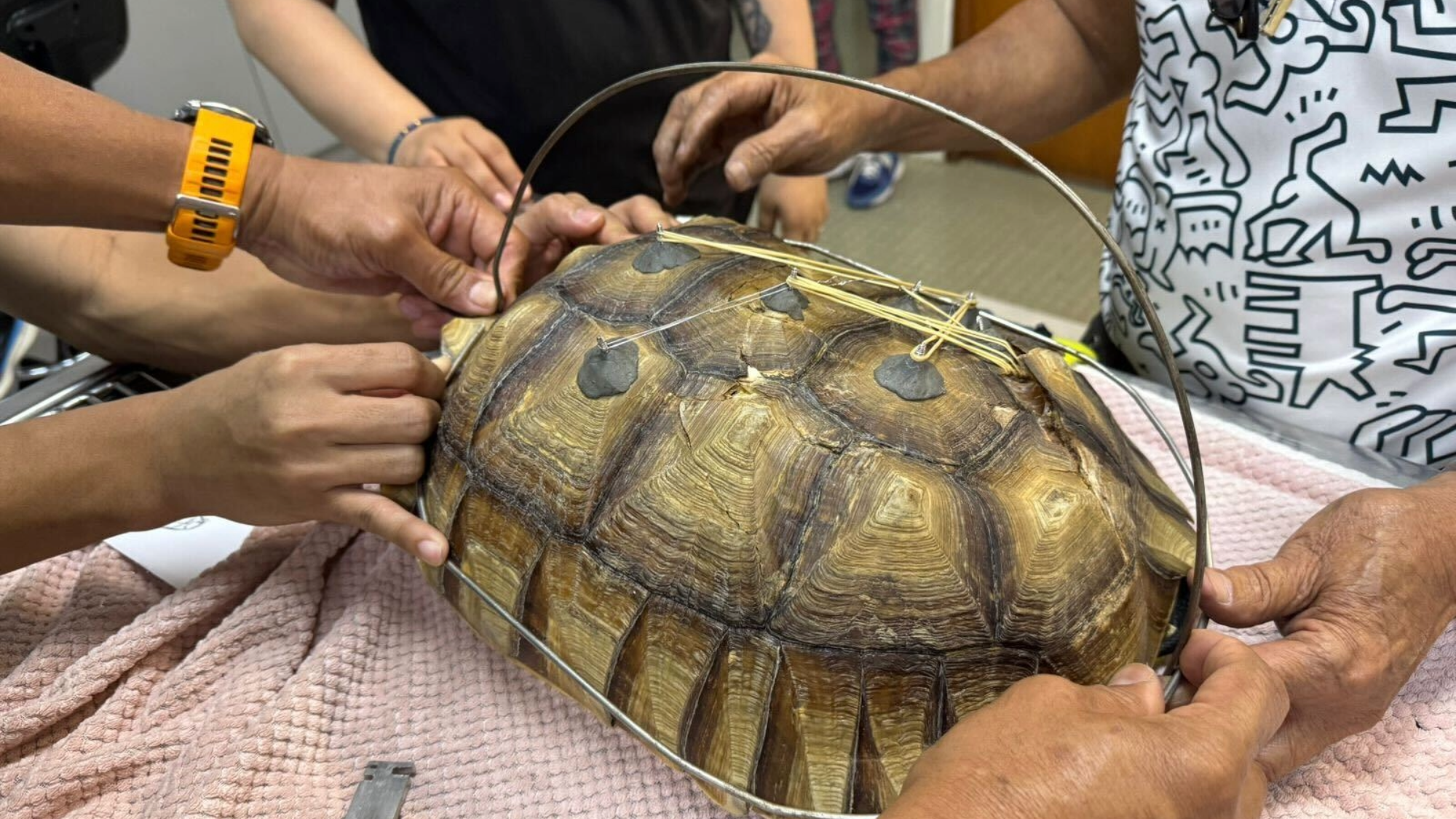
Over the phone, Donato instructed the team to keep the tortoise’s exposed soft tissue damp by rinsing the shell with saline (salt water). They also tried to stabilize the cracks, by fixing inverted screws onto various parts of the shell with epoxy putty, and then tying rubber bands around the screws.
The team sketched out their plan of action to save the tortoise’s shell. Image: Nielsen Donato.
“At this point, our main concern is to stabilize the condition of the turtle from shock, from the injury. So for the first three weeks, we made sure that there were no flies that laid eggs and turned into maggots,” Donato tells Popular Science.
They kept the tortoise hydrated, tube-fed it, kept its wound clean, basked it in the sun, and gave it antibiotics and pain medication.
The wires help keep the shell together. Image: Nielsen Donato.
“And once the tortoise, the sulcata, was more mobile and showing interest in eating on its own, we planned to repair the shell,” he says
According to Donato, the most difficult part for him was lifting the crushed parts of the shell. So he designed a frame for the shell that, with the help of wires, would pull up these shell parts. And the contraption worked.
The tortoise was hit by a car twice, but is on the road to recovery. Image: Nielsen Donato.
“When we were twisting the wire, we noticed that we were starting to align the shell and the cracks were becoming more opposed to each other,” he explains. The team sealed the cracks with dental acrylic and asked the turtle’s owner to bring it back after three weeks. By the time the tortoise was back in their clinic, the shell had become more stable. The team removed the brace, wires, screws, and putty, and sent it back home again before its next appointment.
“When it visited us lately, it started moving around more actively and the owners were not worried about its appetite because it was eating again,” Donato reports.
One thing is for certain—this tortoise went to shell and back again.
Stonehenge is so much more than just a monumental feat of ancient engineering—it’s also a logistical marvel. Multiple generations of Neolithic designers relied on communal teamwork and clever construction techniques to precisely place each of the site’s gigantic megaliths about 5,000 years ago. Two primary types of stone known as sarcens and bluestones make up the formation. Paleoarchaeologists previously traced most of the sarcens to about 15 miles away to present-day Marlborough, England, whil
Stonehenge is so much more than just a monumental feat of ancient engineering—it’s also a logistical marvel. Multiple generations of Neolithic designers relied on communal teamwork and clever construction techniques to precisely place each of the site’s gigantic megaliths about 5,000 years ago. Two primary types of stone known as sarcens and bluestones make up the formation. Paleoarchaeologists previously traced most of the sarcens to about 15 miles away to present-day Marlborough, England, while many of the bluestones originated in Wales.
The famed Altar Stone is far more perplexing, however. The central, six-ton sandstone megalith likely came from a region in Scotland about 400 miles away. How a prehistoric society managed to scoot the boulder so far without complex tools or transportation methods has perplexed researchers for years.
Many researchers have theorized that melting Ice Age glaciers likely helped passively shift the Altar Stone closer to southern England’s Salisbury Plain around 2500 BCE, shortening the transport distance for Stonehenge’s creators. But in 2024, a team at Curtin University used chemical analysis to determine that glaciers simply weren’t the only factor behind the megalith’s move. Now, that same team has combined ice-sheet modeling and mineral grain dating to more precisely locate the Altar Stone’s original home. Their findings, published today in the Journal of Quaternary Science, further underscore how humans played a huge part in getting their centerpiece to Stonehenge.
“Rather than being carried naturally by ice, the evidence points to a deliberate, carefully planned movement across a challenging and varied landscape,” Anthony Clarke, a geochemist and study co-author, said in a statement.
Although glaciers possibly transported many large rocks as far south as Dogger Bank in the North Sea, Clarke explained that geological modeling showed that “no viable glacial pathways” ever linked the Altar Stone’s source region to Stonehenge. This further underscores how Neolithic communities were necessary to move it to its final spot.
“Transporting a stone of this size over such a long distance would have required planning, coordination and a deep understanding of the landscape—not to mention tremendous determination,” he added.
While the exact methods remain a mystery, Clarke and colleagues believe the Altar Stone was almost certainly moved in stages, possibly through a combination of overland and river travel routes.
“The stone would still have needed to be moved hundreds of kilometers by people,” Clarke concluded.
Manuel Gual posted a photo:
Vintage Meccano Workshop: Mechanical Dreams in Brass and Steel
Description:
A detailed visual collection inspired by classic Meccano engineering, captured inside a warm vintage workshop filled with metal strips, brass gears, pulleys, axles, wheels, tools, blueprints, cranes, bridges, clockwork mechanisms, model vehicles and carefully organized construction parts. The series celebrates the beauty of mechanical imagination, precision assembly, old workshop craftsma
Vintage Meccano Workshop: Mechanical Dreams in Brass and Steel
Description:
A detailed visual collection inspired by classic Meccano engineering, captured inside a warm vintage workshop filled with metal strips, brass gears, pulleys, axles, wheels, tools, blueprints, cranes, bridges, clockwork mechanisms, model vehicles and carefully organized construction parts. The series celebrates the beauty of mechanical imagination, precision assembly, old workshop craftsmanship and the nostalgic charm of hands-on model engineering. Each scene evokes the atmosphere of an inventor’s bench, where miniature machines, structural frames and experimental mechanisms come together like a tribute to industrial design, educational toys and timeless creative tinkering. These images have been generated by Artificial Intelligence.
It seems like every week there’s another example of a new robot modeled after a real creature in the animal kingdom. From dogs and bats, to roaches and desert lizards, the natural world is a constant source of inspiration for engineers. But while most robotics researchers use animals as a base for their machine’s movement, an ambitious team of Duke University engineers set out to make something entirely new: a robot whose form factor and movement aren’t derived from biology, but from the univers
It seems like every week there’s another example of a new robot modeled after a real creature in the animal kingdom. From dogs and bats, to roaches and desert lizards, the natural world is a constant source of inspiration for engineers. But while most robotics researchers use animals as a base for their machine’s movement, an ambitious team of Duke University engineers set out to make something entirely new: a robot whose form factor and movement aren’t derived from biology, but from the universe’s underlying physics.
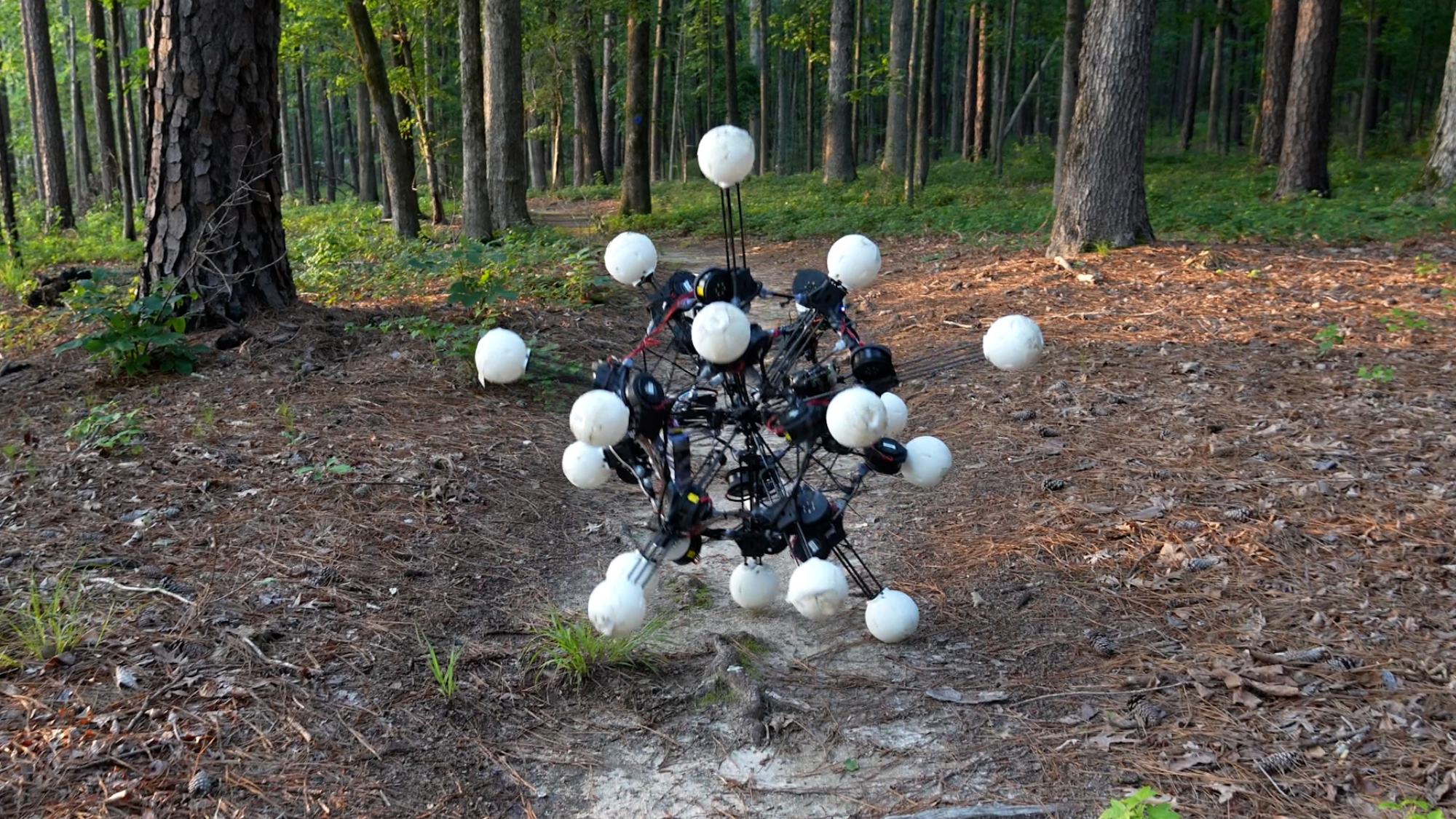
Say hello to Argus, a 20-legged, blob-looking robot capable of seeing in all directions at the same time and able to move almost instantly in any direction. The amorphous-looking sphere has no top or bottom, no left or right, and will keep trekking through sand, dirt, and gravel even when some of its legs are destroyed. It can also use its many legs to shimmy up narrow walls, a move similar to a wall jump in “Super Mario.”
The engineers behind Argus say their intriguing, if not slightly terrifying, creation isn’t just another incremental step forward in robotics. It’s the first member of a totally new category of “dynamically symmetric machines.” The findings were published this week in the journal Science Robotics.
“Watching Argus move is unlike watching any other robot we’ve worked with,” study co-author and Duke PhD student Jiaxun Liu said in a statement . “The first time we saw it navigate among trees and rough terrain, even under heavy collisions, we knew this was something different.”
Biological tradeoffs
Though somewhat human-looking, upright bipedal robots from companies like Figure and Tesla are all the rage these days, engineers have long looked to other animals to inspire their machines, because animals are simply better than Homo sapiens at certain tasks. Dogs and other quadrupeds are more agile, bats can fly, and bugs can scurry into hard-to-reach places.
However, at least in terms of movement, each of the pluses of these specific animals has also come with some minuses. Dogs and other quadrupeds are remarkably fast and nimble when moving forwards, but ask them to replicate that movement when moving backwards and you’re in for a problem.
With those inherent biological tradeoffs in mind, the team at Duke’s General Robotics Lab set out to make something completely different. Taking inspiration from underlying physics, they wanted to see if they could make a robot based around “dynamic symmetry,” which they define as the ability to generate forces and acceleration with uniform magnitude in all directions.
In other words, such a robot would take the idea of left or right and up and down and throw them out the window. Instead, it would be capable of moving in any direction, at any time, without any privilege given to one particular direction. The goal was essentially to build possibly the world’s first “omnidirectional” robot.
Argus keeps on coming—even when you break its legs
The design team eventually settled on a spherical core, or base, with a bunch of legs sticking out of it. They made multiple versions in a simulation, one with as few as eight legs and another with as many as 40. Eventually they settled on an even 20 legs for the physical build. Each of those legs is tipped with a camera that serves as one of Argus’ many eyes. Fitting, then, that it’s named after a many-eyed giant in Greek mythology. The researchers describe Argus as visually similar to a sea urchin, but even that’s selling it short. It doesn’t really look like anything in nature, which makes its uncanny movement in real-world testing all the more unsettling.
In testing, Argus could move in any direction just as quickly and comfortably as any other. The upside of that is that the blob is actually quite adaptable to different terrain despite its unusual appearance. It can easily traverse forest, wet surfaces, and sand, and could climb over certain obstacles. Argus’ ability to rapidly redistribute its weight also meant that it excelled at recovering when researchers tried to shove it off course. While Argus isn’t the first robot to right itself after getting pummeled by a researcher, what makes it unique is that it can redistribute its weight even if some of its legs get damaged or fail altogether.
In other words, you can chop off Argus’ legs and it will just keep coming.
Argus joins a family of DARPA-backed robots
The Duke researchers frame their interest in building this new category of machine as primarily motivated by pushing the boundaries of what’s possible in mechanical science. Still, it’s hard not to ignore the researchers’ most notable funder: the Pentagon’s Defense Advanced Research Projects Agency. Known for incubating some of the military’s most notorious research and development projects, DARPA is responsible for everything from Boston Dynamics’ beef Atlas humanoid to a massive, experimental manta ray inspired uncrewed underwater vehicle.
So, while it’s still not clear what exactly Argus will ever be used for, paper coauthor and postdoctoral researcher at Duke’s General Robotics Lab Boxi Xia says the experimentation and exploration was success in itself.
“Argus is an existence proof,” Xia said in a statement. “It shows that designing for dynamic symmetry isn’t just a theoretical curiosity. It produces a robot you can deploy in the wild, on uneven ground and in clutter, even in low-gravity settings. It changes what’s possible.”
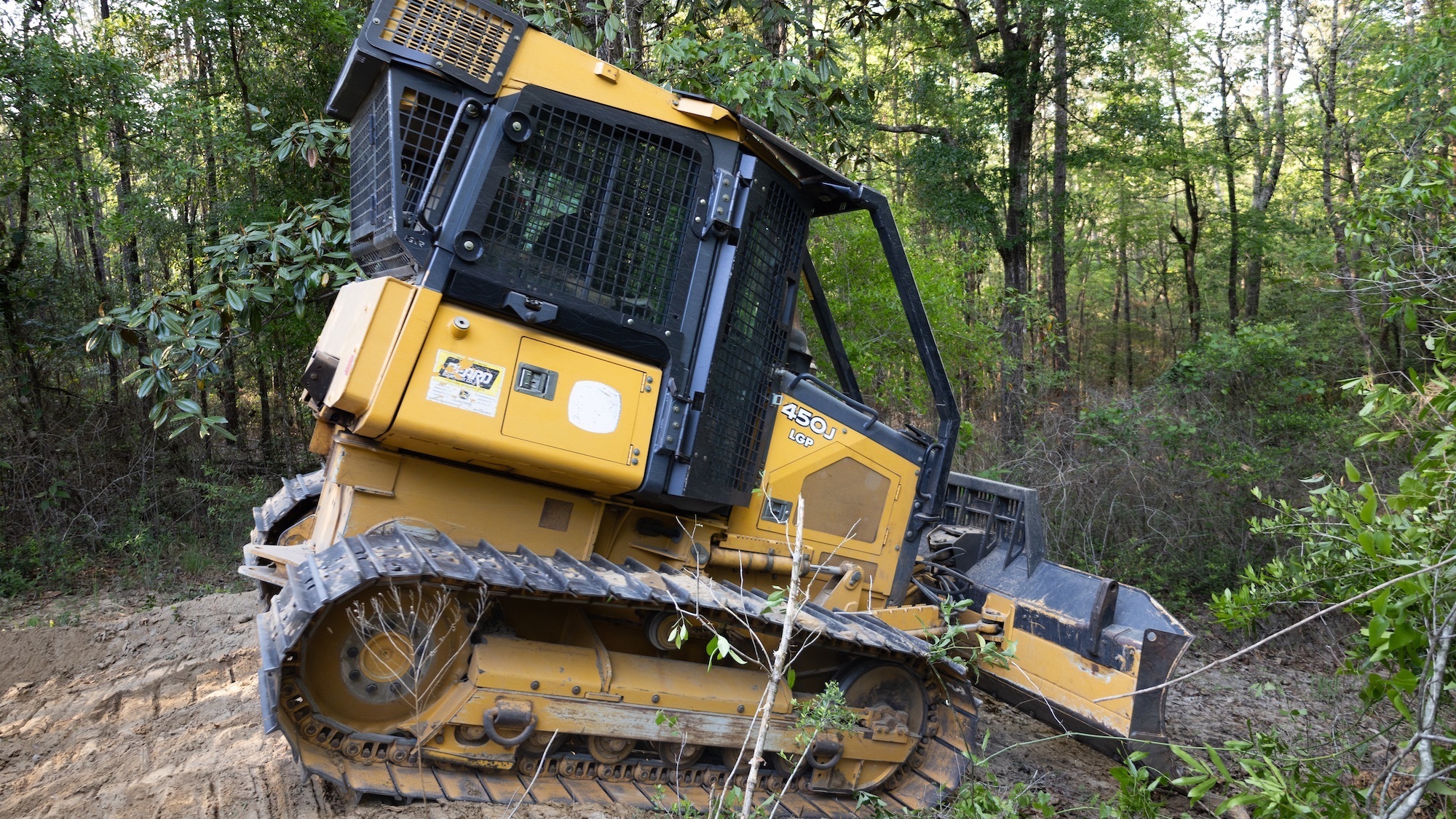
Dangerous, frontline firefighting jobs may get a bit safer thanks to new heat-sensing sensors designed by NASA. The sensors are made from commonly available household materials, and attach to the bulldozers firefighters use to clear vegetation and brush in a fire’s immediate path, triggering an alarm when temperatures reach extremely dangerous levels.
Knowing when a fire is hot might sound obvious, but many new so-called fire dozers are being outfitted with enclosures to protect their operato
Dangerous, frontline firefighting jobs may get a bit safer thanks to new heat-sensing sensors designed by NASA. The sensors are made from commonly available household materials, and attach to the bulldozers firefighters use to clear vegetation and brush in a fire’s immediate path, triggering an alarm when temperatures reach extremely dangerous levels.
Knowing when a fire is hot might sound obvious, but many new so-called fire dozers are being outfitted with enclosures to protect their operators from the flames. That’s a welcome change, but it also reduces the operator’s ability to gauge the surrounding heat. These new sensors help solve that problem, protecting the driver and helping prevent the dozers from sustaining too much damage.
The sensor setup is simple by design. It consists of a standard thermocouple similar to those found in a home oven, which is then wired to an LED light in the dozer’s cabin. If the light starts blinking, it’s time to get out of Dodge.
The entire system is powered by something that’s probably laying around your house: AA batteries. Using a simple power source like this is part of an attempt to make every aspect of the design affordable and accessible. University of Alabama, Huntsville research scientist Ryan Wade emphasized that point in a NASA blog post. He explained that during a recent trial installing the sensor in a fire dozer, his team realized that they were missing a part. Rather than waiting to hear back from NASA and having a custom piece shipped to them, they simply walked down the street to a hardware store and solved the problem.
NASA Wildland Fires Program science integration manager Jennifer Fowler holds an LED light on the dashboard of a fire dozer belonging to the Alabama Forestry Commission (AFC). The LED light is connected to a thermal sensor mounted in the window of the dozer, which turns the light on when the radiant heat from a nearby fire reaches a dangerous threshold. FireSense scientists have been working with the AFC to develop and install these thermal sensors onto these dozers, which they showcased during a stakeholder event on April 23-24, 2026 at the Solon Dixon Forestry Education Center in Andalusia, Alabama. Image: NASA/Milan Loiacono.
“NASA’s expertise in this case comes not in the novelty of the instrument itself, but in figuring out how to solve the problem quickly and integrate that technology into their existing system,” Wade said.
That flexibility is what makes the approach so valuable for firefighters. Alabama Forestry Commission fire analyst Ethan Barrett says the devices so far work “exactly as intended.” In Alabama, at least, officials are planning to outfit their entire dozer fleet with the sensors. The sensor system was developed by NASA’s FireSense project, whose interest in it was twofold. The sensors will more immediately help firefighters on the ground as fire season approaches, but the data they collect will also prove invaluable for future research. By placing sensors in the dozers, NASA will gather reams of data about fire strength and intensity straight from the front lines.
There are over 283 million cars cruising the United States, and over 90 percent of them are still guzzling gas. Apart from the obvious environmental problems, fuel prices also continue to skyrocket thanks to the ongoing war in Iran. The average price for gas is currently around 33 percent higher than it was before the crisis, and there is little sign that those numbers are going down anytime soon.
The strain is forcing many drives to reconsider how they get around—and they’re getting creative
There are over 283 million cars cruising the United States, and over 90 percent of them are still guzzling gas. Apart from the obvious environmental problems, fuel prices also continue to skyrocket thanks to the ongoing war in Iran. The average price for gas is currently around 33 percent higher than it was before the crisis, and there is little sign that those numbers are going down anytime soon.
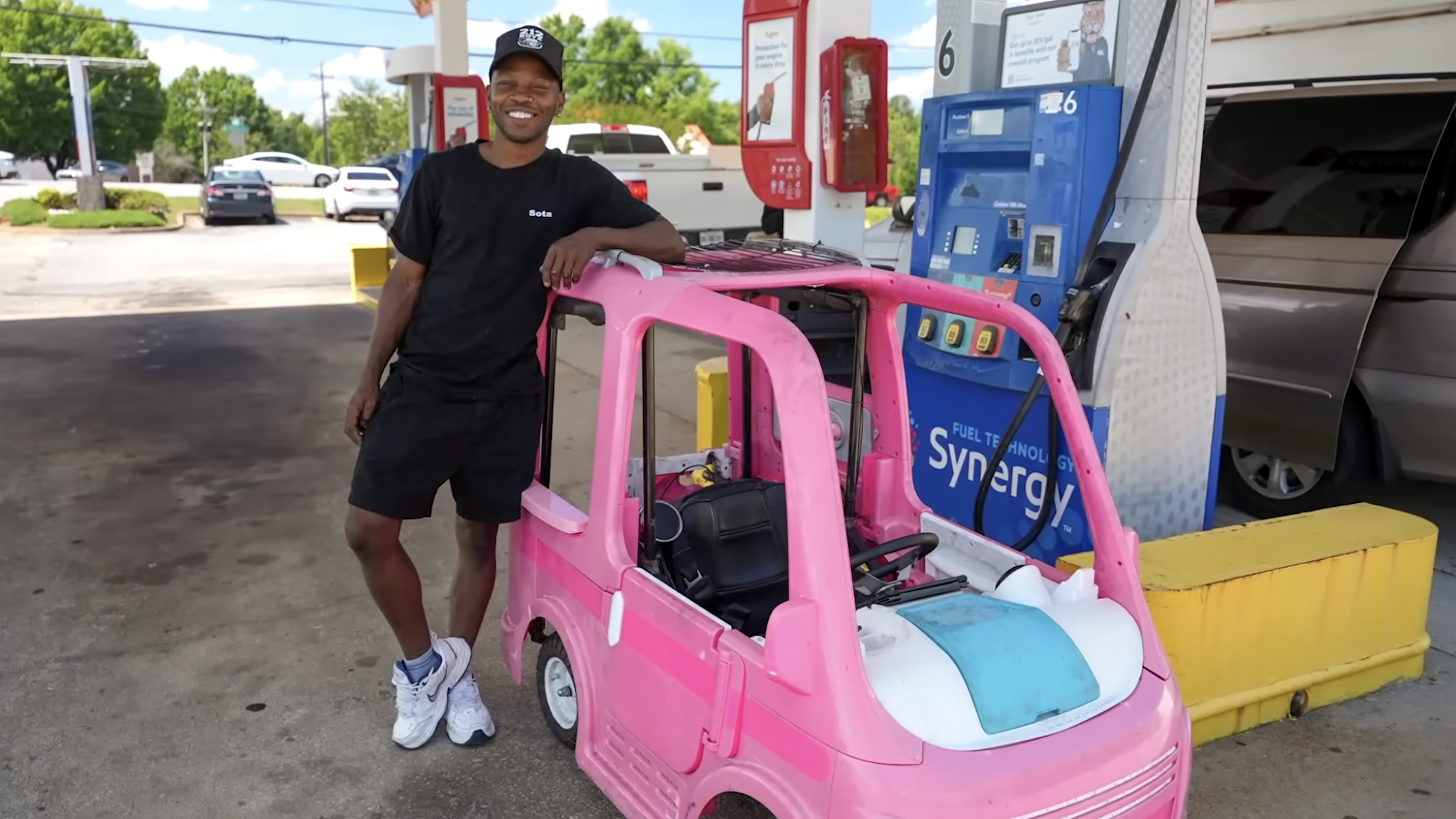
The strain is forcing many drives to reconsider how they get around—and they’re getting creative with it. In Georgia, a 30-year-old handyman is showing everyone how to properly adapt to uncertain times. According to a recent Reuters profile, Mali Hightower has retrofitted a discarded, bright pink Power Wheels Barbie Dream Camper with a two-gallon, one-piston engine for his shorter commuting needs.
“I drive this when I can,” Hightower said on May 19.
To get it going, a driver simply pulls the rip cord that’s attached to the former power washer engine. At less than four-feet-tall, the Dream Camper may not be the most comfortable ride for a full-grown adult,but it’s definitely cheaper. Hightower likely still prefers driving his 1996 Mercedes-Benz convertible, but with a full tank costing him around $90 right now, he’s more than willing to use his Power Wheels alternative for errands like grocery runs.
While somewhat surreal to see at a gas pump, the DIY solution underscores a more important issue: the need for more people to divest from fossil fuel rides in favor of public transportation and electric vehicles (EVs). Unfortunately, that’s easier said than done for many people. The U.S. is dramatically underfunded when it comes to options like commuter bus routes and trains, while EVs are still out of many people’s price ranges. The Dream Barbie Camper may be one-of-a-kind right now, but there’s a good chance that similar, intentionally constructed alternatives are on the way. At least those will be able to comfortably fit the driver.
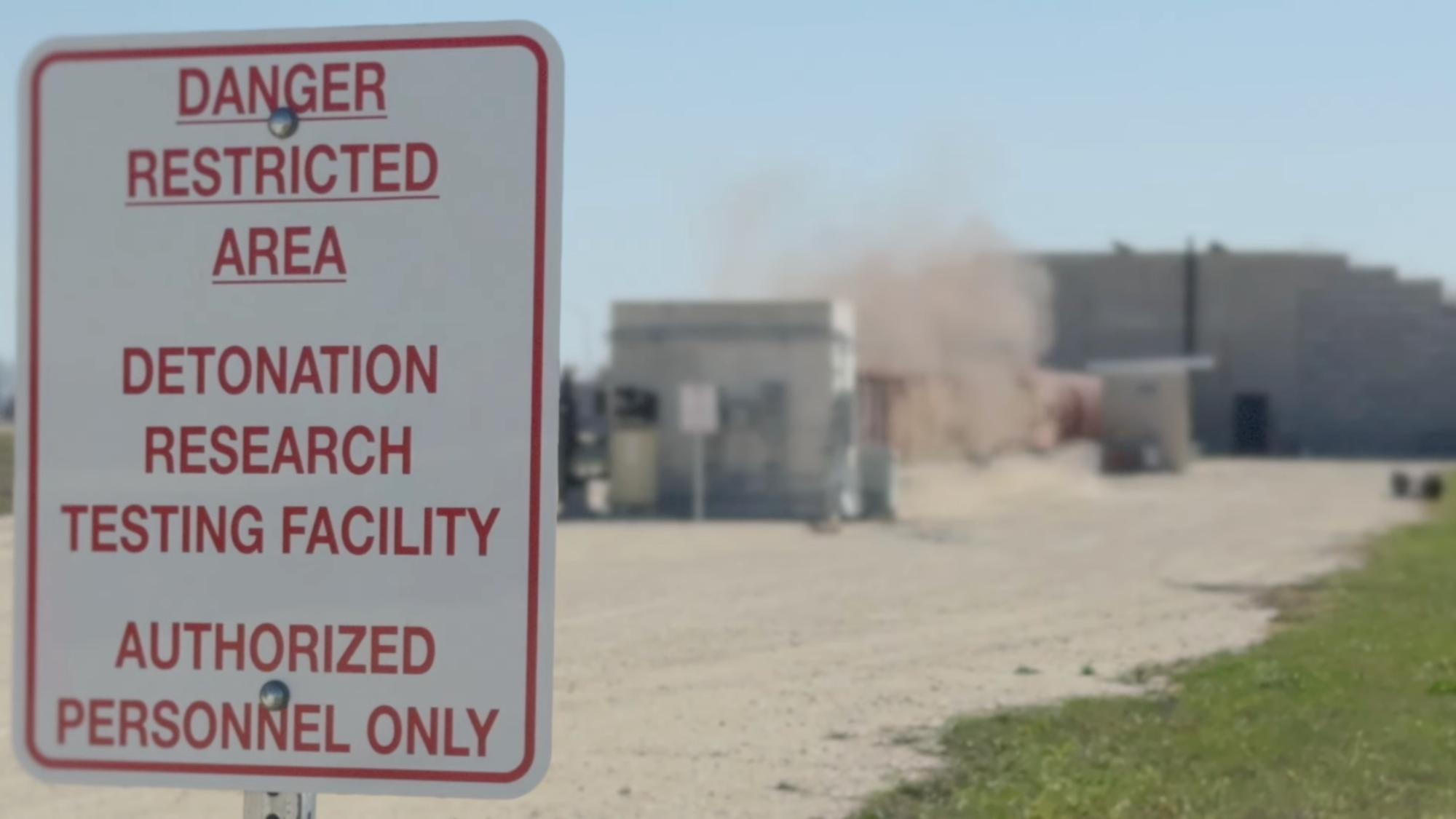
Everything is bigger in Texas, and that includes its controlled detonations. Texas A&M University recently revealed what they say is the world’s largest controlled explosion lab, where researchers can fill a nearly 500-foot metal tube with gas and ignite it in the name of science. They are calling it The Detonation Research Test Facility (DRTF). By precisely measuring what it takes to turn a simple flame into a massive, deadly detonation, researchers hope to make discoveries that could bette
Everything is bigger in Texas, and that includes its controlled detonations. Texas A&M University recently revealed what they say is the world’s largest controlled explosion lab, where researchers can fill a nearly 500-foot metal tube with gas and ignite it in the name of science. They are calling it The Detonation Research Test Facility (DRTF). By precisely measuring what it takes to turn a simple flame into a massive, deadly detonation, researchers hope to make discoveries that could better prepare engineers to prevent gas leaks, and potentially inform ways to build explosion-resistant infrastructure. And all of that will require lots and lots of yeehaw inducing bangs.
Located in Southeast Central Texas, the detonation tunnel is about six feet in diameter and stretches nearly the length of two football fields. Its metal exterior consists of three-quarter-inch steel walls and is covered in earth to muffle the sound—or try to, at least. Inside, the tube holds various sensors that can measure the explosion as it intensifies. By containing all the power within the facility, researchers can study explosions strong enough to level entire buildings. The shockwaves that form in the tunnel can apparently reach speeds of Mach 5—or roughly 3,800 miles per hour.
“The facility enables us to observe, measure and understand one of nature’s most extreme forces in ways that haven’t been scaled before, or even been possible until now,” Texas A&M Engineering professor Dr. Elaine Oran said in a statement.
Measuring a detonation, from flame to boom
The idea for the massive detonation tunnel began as an inquiry from the coal mining industry. Industry leaders sought to scientifically determine whether natural gas trapped in a coal mine could explode and detonate. The short answer is yes. It quickly became clear, however, that a facility capable of measuring that would prove useful for a number of other explosion-related questions as well.
To measure an explosion, researchers start by sending an electrical current through a long wire leading into the chamber. Eventually, the current leads to a spark, which creates a flame, not unlike a gunslinger in a Western striking a match and watching a flame trickle its way to a stick of dynamite.
Texas A&M University’s Detonation Research Test Facility is a nearly 500-foot detonation tube more than 6 feet in diameter, built with three-quarter-inch-thick steel walls and paired with a 90-meter earth-covered muffler. Image: Texas A&M University College of Engineering.
When the flame enters the chamber, it begins a violent journey. The chamber is lined with what researchers refer to as an “obstacle course” of metal beams that generate turbulence. As the flame travels, more surface area is created, which in turn causes it to burn faster and stronger.
Eventually, all of that power creates a shockwave in front of the flame. Once the shockwave is strong enough, it pushes forward and creates a second, much larger explosion. That second, earth-shaking boom is the detonation.
Video footage of the process occurring in real time is dramatic, to say the least. Everything is quiet except for a voice in the control room counting down three, two, one. That’s followed by what sounds like a muffled gunshot as the flame enters the tube’s first segment. Visually, the tunnel’s thick metal exterior quivers and soil shakes off it as each succeeding segment ignites. That all leads up to the detonation, which is a significantly larger boom that shakes the entire facility and sends earth soaring into the air. Seconds later, amid smoky air, the soil can be heard raining back down, like an artillery scene from a war film.
And even though the facility is designed to withstand massive explosion level forces safety, it still leads some to check their heart rates.
“There’s a lot of nervousness, [and] jitters,” Texas A&M Aerospace engineering student Zachary Wideman said in a video. “Because something on this scale with this type of energy, you can’t help but be nervous.”
Though the facility’s controlled explosions will likely prove most useful for industrial safety initially, engineers involved believe its scientific findings could have broader appeal. The shockwaves it creates could prove important for future testing of hypersonic plane and space shuttle propulsion. On the more conceptual side, scientists interested in the history of the cosmos could use the tube’s controlled explosions to help build models of supernovas, which undergo a similar physical process, albeit on a much, much larger scale.
Summer is quickly approaching, which means more time for summer fun like checking out amusement parks. Millions of people go to amusement parks for the thrill of riding a favorite classic ride or a new roller coaster. And this summer, dozens of new coasters are debuting, such as Falcon’s Flight, the world’s tallest and fastest roller coaster located in Six Flags Qiddiya City in Saudi Arabia.
While roller coasters and amusement rides are generally very safe—the International Association of Am
Summer is quickly approaching, which means more time for summer fun like checking out amusement parks. Millions of people go to amusement parks for the thrill of riding a favorite classic ride or a new roller coaster. And this summer, dozens of new coasters are debuting, such as Falcon’s Flight, the world’s tallest and fastest roller coaster located in Six Flags Qiddiya City in Saudi Arabia.
While roller coasters and amusement rides are generally very safe—the International Association of Amusement Parks and Attractions (IAAPA) says that the chance of being seriously injured on a fixed-site ride in the U.S. is about 1 in 15.5 million rides taken—the risk isn’t zero. And when deadly or disabling cases make the headlines, it raises legitimate questions about how to stay safe and have fun.
“People are injured or killed on amusement rides and devices. That is a harsh reality, especially in the name of fun,” says Brian Avery, a senior lecturer and roller coaster safety expert at the University of Florida. “But generally speaking, your risk or exposure to that is low.”
Here’s what you need to know about roller coasters and amusement rides, how they are assessed for safety, and how to prepare for any trips you plan to take this summer.
Falcon’s Flight is the world’s tallest and fastest roller coaster located in Six Flags Qiddiya City in Saudi Arabia. The coaster reaches speeds of 150 mph in under five seconds. Video: That SOUND?! Falcon’s Flight Cliff Drop Testing at Six Flags Qiddiya World’s Tallest Coaster, @CoasterRaccoon
How do roller coasters work?
The first thing to know about rides and coasters is that not all rides are the same.
“Roller coasters are amusement rides, but all amusement rides are not roller coasters,” says Kathryn Woodcock, a professor of occupational and public health who studies amusement ride safety at Toronto Metropolitan University.
Roller coasters are defined as a ride with an elevated railway with sharp curves and steep inclines, but even roller coasters have tons of different subtypes based on what the tracks and support structures are made of (namely wooden or steel), how the riders are positioned, and the ride’s speed.
Beyond coasters, there’s other rides, such as: drop towers, ferris wheels, bumper cars, water rides, and more, all with their own considerations for fun and safety.
But the gist is, according to amusement park ride manufacturer Sunhong, that rides use controlled inputs like motors, hydraulics, pneumatics, or gravity to shape the acceleration, centripetal force, and changes in G-force that makes rides exciting.
Just existing on the Earth, we experience a G-force of about one G, jumping and landing is about two to four G, and the most intense rides out there, according to Sunhong, hit about six G for a moment.
“It’s pushing the envelope or it gives the illusion of [riders] being in danger while they’re experiencing an amusement ride device, but in a controlled manner,” adds Avery.
How safe are roller coasters and rides, really?
The first roller coasters were invented in the late 1800s, says theme park and roller coaster historian Richard Munch. At that time, the only safety in place was a fixed metal bar and a “do not stand up” sign, he adds. “If you followed those words, you would normally return unhurt and many times happy to ride again,” he says.
This photograph of the “Loop the Loop” roller coaster was taken at Coney Island, New York, in 1903.Image: Contributor / Getty Images / Photo 12
Roller coasters and amusement rides have changed a lot since those days—including in the 1990s when Avery says there was a “roller coaster arms race” to get faster, taller, and more attractive rides out there for thrill-seeking visitors. But safety comes at every level of a ride, from engineering and manufacturing, to installing and regulating, and of course operating.
“They’re looking at everything from the track, how the footers are sunk into the ground, the forces being exerted, the station being built, the trains that will be on it, the containment system that’s going to be used, the types of harnesses, secondary restraints,” he says. “All those are factored into their design considerations.”
Once a coaster is designed, it’s tested and inspected for months and operational guidelines, policies, and training are developed by the engineers or manufacturer.
Next comes state inspections, or at least in some states that heavily regulate amusement rides. There isn’t federal government oversight of rides, except in the case of traveling carnival rides, says Amanda Demanda, an injury lawyer based in Florida.
Regulations vary greatly. Some states, like Alabama, Mississippi, Montana, Nevada, Wyoming, and Utah, don’t have state oversight at all, so take a look at the regulations in the state that you’re visiting before heading out.
Finally, it comes down to the operators and attendants. “Attendants are the first line of defense,” says Avery. “They’re going to be the ones that are adequately trained or should be. They’re enforcing the rules. They’re going through the checkpoints.”
While some rides have computer systems that can help alert attendants to potential problems, attendants are in charge of checking restraints, conducting daily maintenance and operation inspections, and dispatch rides.
They also assess riders to make sure they are an appropriate size and weight for a ride, and if a rider has a disability, ensuring that they can maintain enough postural control to stay safe for the duration of the ride, he says.
While the news stories about amusement park incidents demonstrate the worst case scenarios, most of the injuries that occur on rides are soft tissue injuries: sprains, strains, and cuts, according to one 2013 study that looked at pediatric amusement ride-related injuries between 1990 and 2010. The study demonstrated that 70 percent of the incidents occurred in the summer months with more than 20 injuries a day between May and September.
But these injuries don’t necessarily just happen because the ride itself is unsafe—operation, rider health, and rider behavior all play a factor.
“The largest theme parks in the world have 20 million visitors per year, each of whom generally experiences multiple rides during their visit,” says Woodock. “The number of serious injuries associated with ride failure is very, very low proportionate to that.”
Serious injuries, even in people who are unsuited to the ride or acting inadvisably, are still very low, she adds.
Staying safe at the amusement park is relatively straightforward: Follow the guidelines when it comes to size and health, listen carefully to loading and safety instructions, and trust your gut. In the unlikely case that something does go wrong and you do get hurt, report it to the park and seek medical care.
If you’re one of the millions of visitors heading to an amusement park this summer, just be attentive, stay hydrated, and, of course, have fun.
In Ask Us Anything, Popular Science answers your most outlandish, mind-burning questions, from the everyday things you’ve always wondered to the bizarre things you never thought to ask. Have something you’ve always wanted to know? Ask us.
College sophomore Ian Vanveen, 20, got into woodworking as a way of budget management. “I didn’t have a whole lot of money,” he says, “so I decided to build what I wanted myself.” The mostly self-taught craftsman started off making furniture, but was eventually itching to do more.
So Vanveen took a carpentry class to learn about different woods and their properties. There, he discovered things like how different kinds of wood can vary in density, and how wood’s fibers can expand or shrink de
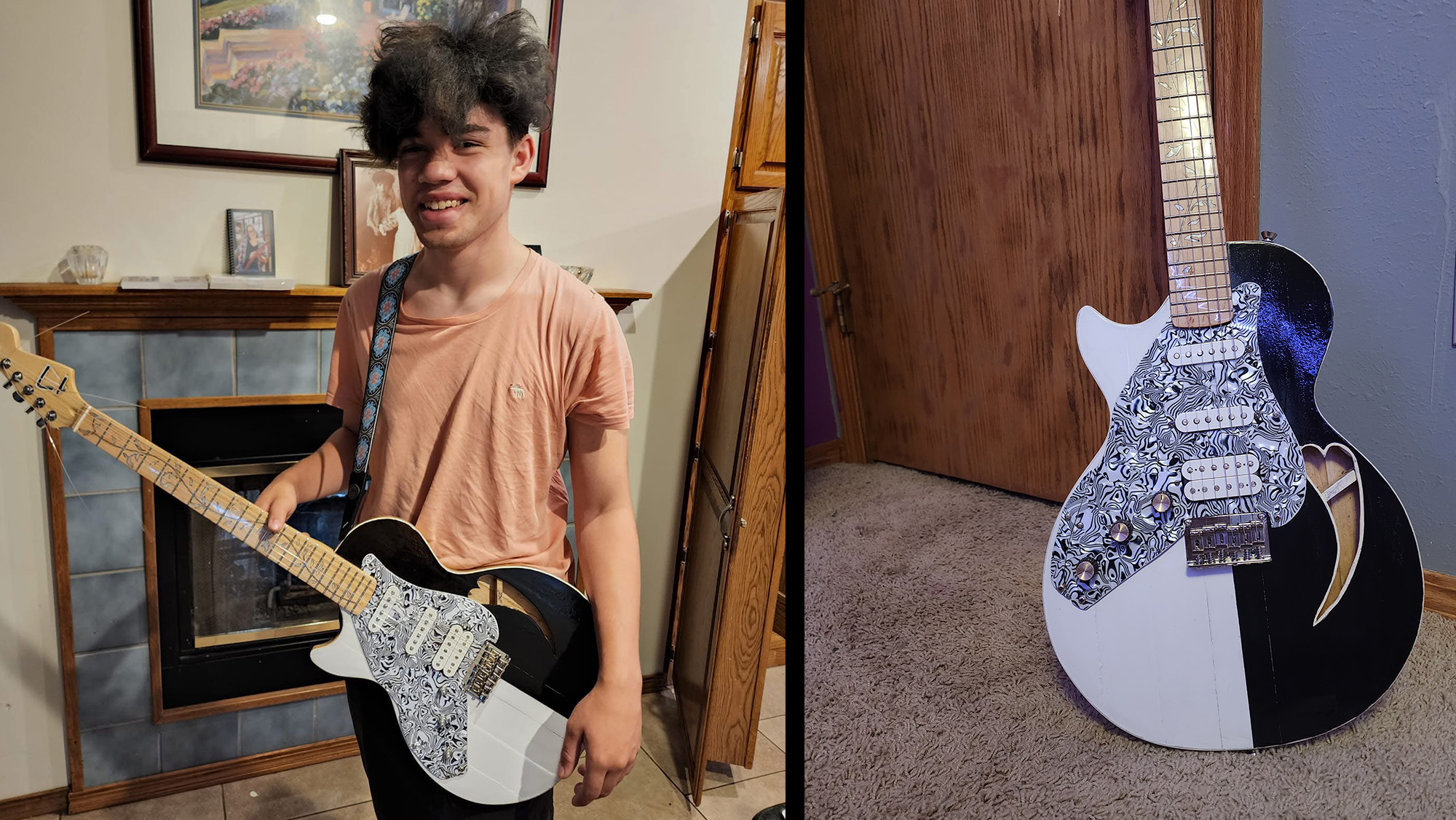
College sophomore Ian Vanveen, 20, got into woodworking as a way of budget management. “I didn’t have a whole lot of money,” he says, “so I decided to build what I wanted myself.” The mostly self-taught craftsman started off making furniture, but was eventually itching to do more.
So Vanveen took a carpentry class to learn about different woods and their properties. There, he discovered things like how different kinds of wood can vary in density, and how wood’s fibers can expand or shrink depending on humidity. He then decided to combine his newfound knowledge with his building skills and start making electric guitars.
“That’s when things got interesting,” he says.
A high schooler makes his first electric guitar, kind of
The first electric guitar that Vanveen handled was his dad’s old band guitar: a blue, semi-hollow body, Gibson ES-355. A high schooler at the time, Vanveen immediately felt a connection with the instrument, and got it in his brain to make his own custom-made six-string.
Ian Vanveen first got the itch to make a guitar after handling his dad’s blue, semi-hollow body, Gibson ES-355. Image: Ian Vanveen
So he set up shop in his family’s Wisconsin garage, and got to work building. He took a bunch of pine two-by-fours left over from a home deck project, “and just cut it up and glued all the pieces together,” he says. “It turned out really bad.”
A second attempt at a DIY guitar
Vanveen took a couple years off before he started crafting a second guitar, though this time he went in with a bit more planning and forethought. While a fan of the iconic Les Paul guitar shape—which is slightly asymmetrical with a rounded top and larger, rounded bottom—the student found it “notoriously thick, and really uncomfortable.”
He decided instead to create the thinnest guitar possible without having it warp over time (slimmer guitars are more susceptible to changes in humidity, temperatures, and high-string tension). Another non-negotiable: Vanveen wanted the instrument to sound loud when he played it even when it wasn’t plugged into an amp. “I was really adamant about this.”
His first step was sketching a model of the instrument using Adobe Illustrator. “I didn’t have any of the dimensions, really,” says Vanveen. “I just figured that out as I went.”
For this project he used maple, a stiff and dense wood that’s known for its stability. He then took a couple of weeks to test its strength and see how thin he could get it while still withstanding maximum string tension. “I got it down to an inch and an eighth,” he says. “If I went any lower than that, the whole body would bend over time.”
Vanveen made his first guitar in high school. “It turned out really bad,” he says. Image: Ian Vanveen
Vanveen used a miter saw—good for making quick and angled crosscuts—to cut individual wood boards, creating what would become the guitar’s rough shape. He then used a jigsaw power tool for hollowing out the piece and contouring, and a drill to make holes for the electronics. These include adjustable potentiometers (“pots”), which are basically electrical components that allow a musician to control the instrument’s volume and tone, and a capacitor to filter its frequency (the speed at which its strings vibrate) and shape its tone.
Since Vanveen wanted his guitar to sound loud even without plugging it in, he hollowed out the entire instrument (other than its center, where its wiring is now located) using a handheld router.
“The idea was that the sound would reflect a little bit more within the holes,” he says. As with standard acoustic guitars, the hollow chamber allows the guitar’s wood to vibrate and air to move around inside more freely. This in turn amplifies the sound.
When it came to wiring, Vanveen bought the “cheapest stuff” he could find off of eBay for about $15. The pre-assembled kit contained both potentiometers and a capacitor. It also came with a selector switch to choose guitar pickups, which are electromagnetic transducers arranged in various configurations to determine the “color” of a sound. For example, one pickup might produce a tone that’s “bright and crisp,” while another could be described as sounding “warm and gritty.” It also included all the necessary wires for the electric instrument.
The guitar features a black-and-white color scheme, which Vanveen says was inspired by a photography class he was taking at the time. It’s also specially crafted for left-handed people. “They don’t really make left-handed electric guitars,” he says, “and I’m left-handed. So this was a big moment for me.”
Vanveen plans to make more improvements to his handmade guitar. Image: Ian Vanveen
The finished product
Overall, the piece took Vanveen about five months to make. This involved two months of planning and three months of cutting, crafting, wiring, sanding, painting, and assembling. He typically put in more than 20 hours a week, working mostly on weekends. All said, Vanveen worked more than 200 hours to put the guitar together.
Although Vanveen hasn’t made any new guitars since he started college in fall 2024, he’s still looking for ways to improve his 2.0 version.
Earlier this year, he learned to use an operational amplifier (op-amp), which allows him to further manipulate and control the instrument’s tone. He’s also created a digital circuit simulator that can bypass the guitar’s capacitor, aka its frequency filter, and utilize other capacitors connected to ground.
“Most guitars have only one capacitor,” limiting the instrument’s ability to shape tones, says Vanveen. Instead, his simulator connects a variety of outside capacitors to the guitar’s potentiometers, or volume controls. Vanveen can then get a whole different tone depending on which one he chooses.
“This summer I’m gonna build a new guitar with these switches,” says Vanveen. But it has to wait until he’s home from college. “I make everything in my parents’ garage.”
In The Workshop, Popular Science highlights the ingenious, delightful, and often surprising projects people build in their spare time. If you or someone you know is working on a hobbyist project that fits the bill, we’d love to hear about it—fill out this form to tell us more.
A team of engineers at the University of California San Diego (UCSD) have developed a humidity-based image encoder that looks straight out of James Bond’s Q-Lab. The postage stamp-sized chip can store a hidden message that is only revealed when exterior humidity levels surpass 60 percent. The image can then be concealed again by bringing humidity back down. In practice, that means someone handed an object with the chip on it could simply breathe on it to unveil its secret message.
While it’s
A team of engineers at the University of California San Diego (UCSD) have developed a humidity-based image encoder that looks straight out of James Bond’s Q-Lab. The postage stamp-sized chip can store a hidden message that is only revealed when exterior humidity levels surpass 60 percent. The image can then be concealed again by bringing humidity back down. In practice, that means someone handed an object with the chip on it could simply breathe on it to unveil its secret message.
While it’s a potentially nifty tool for an undercover spy, the researchers say the encoder could also be used to reveal a security code on a credit card, or even serve as a visual indicator of climate changes in a particular area. In all of these cases, humidity essentially acts as a key. The findings were recently published in the journal Light: Science & Applications.
“You can imagine using this as a built-in security feature with the environment acting like a key that unlocks different pieces of information,” study co-author and UC San Diego electrical and computer engineering postdoctoral researcher Asad Nauman said in a statement.
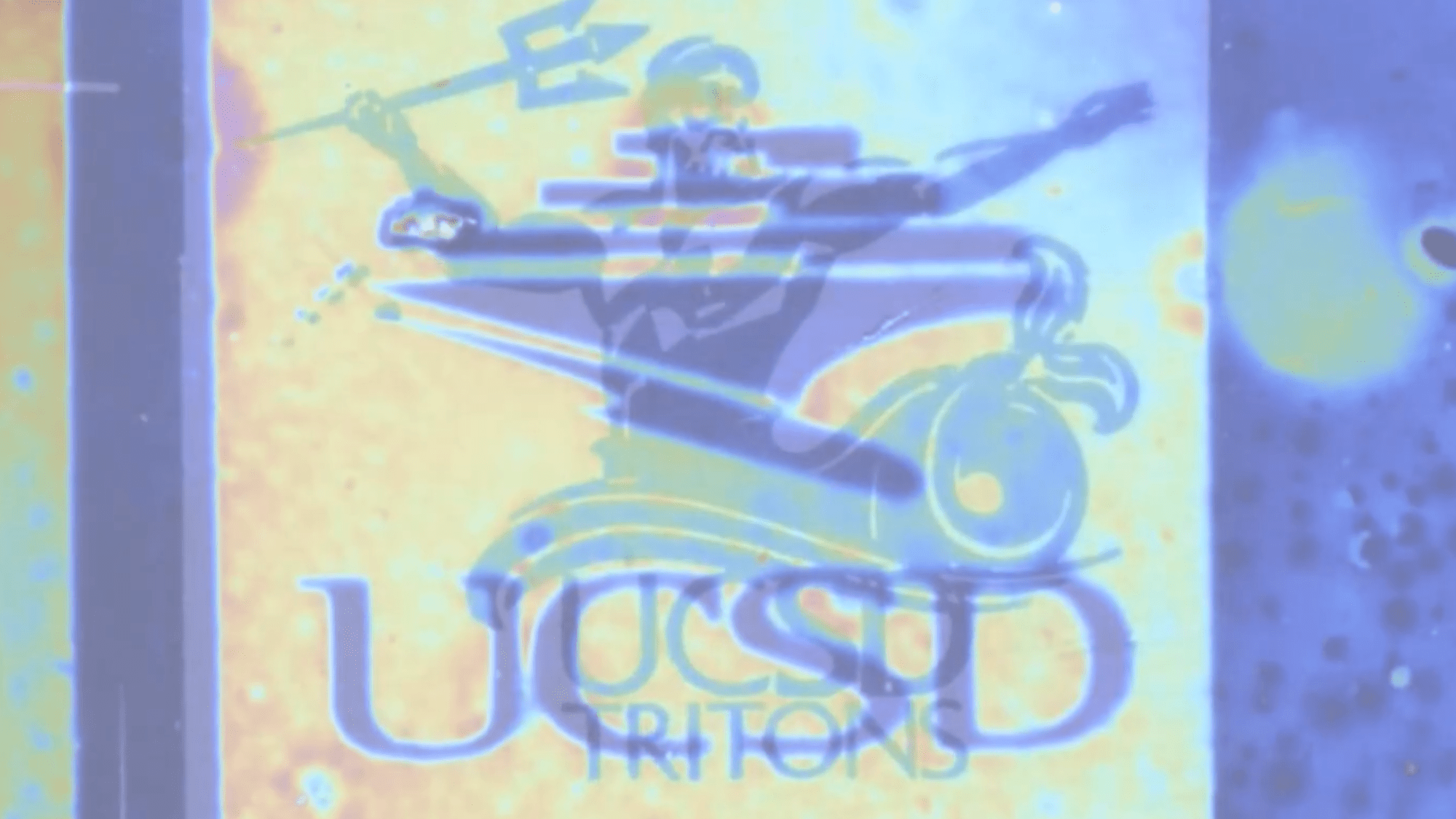
In a video demonstration, a clear blue image of a UCSD trident logo appears and then quickly begins to fade as the area around it brightens. After only a few seconds in, the UCSD library logo emerges. The image then fades back to the man with the trident before switching back once more to the library logo.
Hiding a message in plain sight
The chip consists of two separate hydrogel layers. The bottom layer, made of a phase-changing material called antimony trisulfide, essentially acts as a canvas onto which lasers can etch messages. These can be text or, as in the example above, full images. The top layer is made of a softer hydrogel material called azido-grafted carboxymethyl cellulose. This layer swells in humid conditions and shrinks in dry ones, which is why the hidden message becomes visible.
The transformation of the UCSD Triton logo to the UCSD library logo. Left to right: The UCSD Triton logo is visible at a 40% humidity level; the UCSD library logo begins to appear and overlap the Triton logo at a 60 percent humidity level; the UCSD library logo is solely visible at an 85% humidity level; and both images are overlapped at a 95 percent humidity level. Image: NDAO Lab
The first, low-humidity image or message is visible when humidity levels are at or below 40 percent. As humidity levels approach 60 percent, the hidden message starts taking shape. It is then fully visible at 80 percent humidity. The image reveal is also accompanied by a color shift due to small gaps between the two hydrogel layers. When the top layer swells and expands, the increased space between the layers alters the way light reflects off them, resulting in a shift from blue to red.
Of course, for any of this to work, a spy or other user would need to operate in an area with a predictable climate. Blowing on a message in a tropical environment where the air is already thick with moisture probably won’t do the trick. Still, in a pinch, it might beat having to write out long, intricate messages on finicky invisible ink.
The classic blanket fort is a simple structure. Entry level hideouts often only require a bedsheet and a couple of chairs, and it doesn’t take much effort to expand the floorspace to accommodate guests. Constructing an intimidatingly expansive blanket enclave is a much bigger feat of engineering, however. At least, that’s what it looks like from photos showcasing the newest Guinness World Record holder for the largest blanket fort. The current champions? Local residents and high schoolers in Las
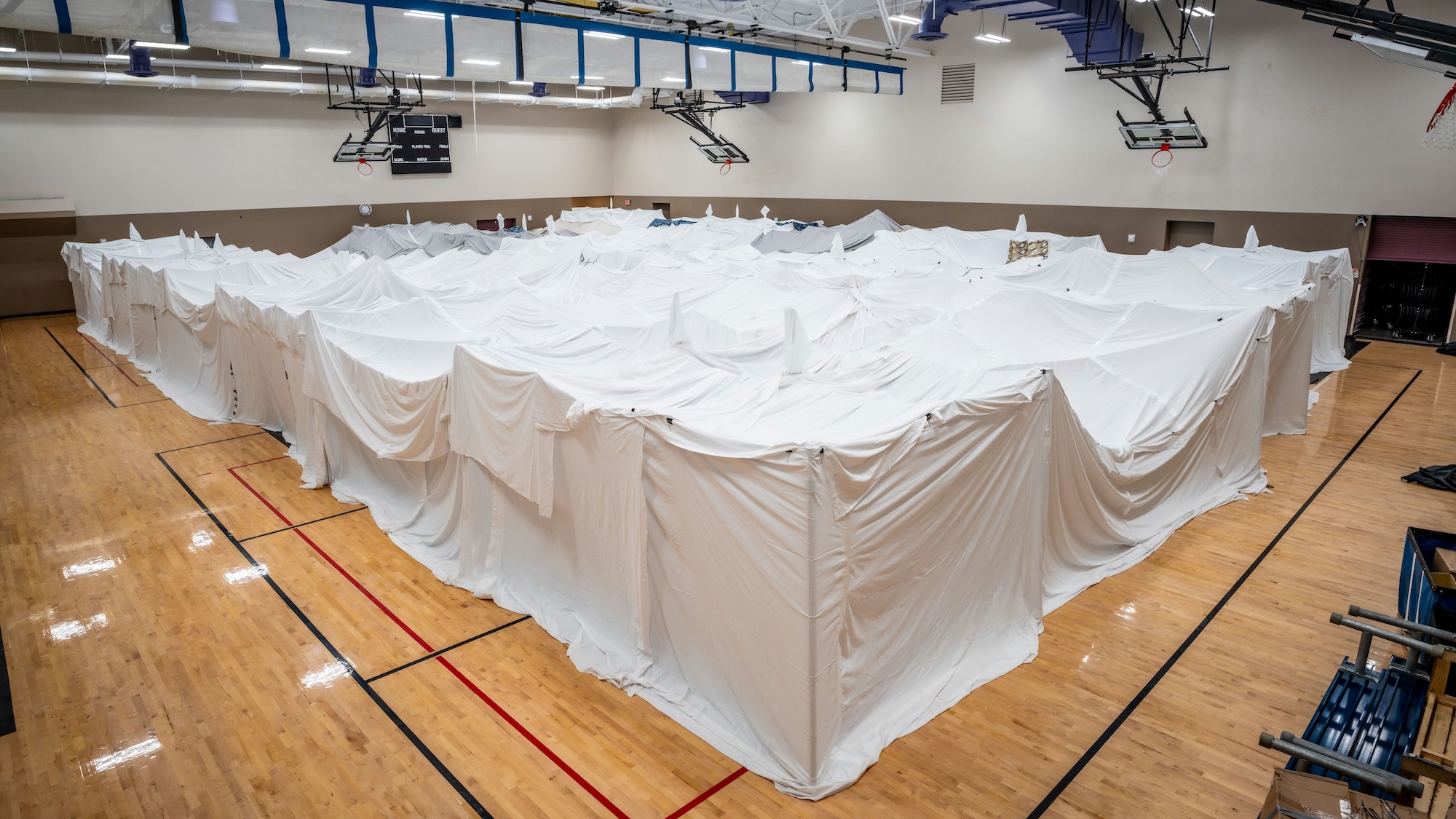
The classic blanket fort is a simple structure. Entry level hideouts often only require a bedsheet and a couple of chairs, and it doesn’t take much effort to expand the floorspace to accommodate guests. Constructing an intimidatingly expansive blanket enclave is a much bigger feat of engineering, however. At least, that’s what it looks like from photos showcasing the newest Guinness World Record holder for the largest blanket fort. The current champions? Local residents and high schoolers in Las Vegas, Nevada.
The fort needed to be tall enough to allow inhabitants to sit comfortably inside it. Credit: Robert Edward / Clark County, Nevada Robert Edward
At 14,103-square feet, the billowy project overshadows the previous record holder (12,291-square-feet) that was built in South Carolina in 2024. According to the official announcement from Nevada’s Clark County, the job necessitated a small army of volunteers and community partners using a design envisioned by engineering students at Las Vegas’ West Career & Technical Academy. All told, the blanket fort included hundreds of sheets draped over tent poles and anchored by ropes, pipes, and even binder clips.
Confirming the fort’s record breaking size required a visit from an official Guinness World Records adjudicator. The assessor didn’t simply measure the floorspace inside the Desert Breeze Community Center’s basketball court, though. Eligibility requirements included making sure there weren’t any gaps between sheets larger than one inch, ensuring all sheets touched the ground, and determining minimum height requirements that allowed a person to “sit comfortably” inside the tent.
An inspection from an official Guinness adjudicator was required before certifying the structure. Credit: Robert Edward / Clark County, Nevada
A good blanket fort’s temporary nature is part of its appeal, and the recordbreaking project has since been disassembled. After all, Desert Breeze Community Center still needs its gym for pickup basketball games.
Making espresso literally boils down to two major components: extremely hot water and high pressure. Add up the world’s espressomakers, and all those shots of caffeine make for a sneakily energy intensive industry. However, researchers at Australia’s University of New South Wales Sydney recently discovered a way to sidestep one of these brewing needs. According to their study published in the Journal of Food Engineering, firing ultrasonic soundwaves into room temperature water makes equally stro
Making espresso literally boils down to two major components: extremely hot water and high pressure. Add up the world’s espressomakers, and all those shots of caffeine make for a sneakily energy intensive industry. However, researchers at Australia’s University of New South Wales Sydney recently discovered a way to sidestep one of these brewing needs. According to their study published in the Journal of Food Engineering, firing ultrasonic soundwaves into room temperature water makes equally strong and flavorful espresso shots that are indistinguishable from the traditional morning fuel.
“It’s a different process, but you get the same richness and concentration of a normal espresso in under three minutes,” chemical engineer and study co-author Francisco Trujillo said in a university profile.
This isn’t Trujillo’s first time introducing ultrasonic frequencies to coffee. He previously patented a similar system for cold-brew coffee. However, those conditions were tailored for the popular drink’s smoother, more diluted flavor with around one-fifth of espresso’s caffeine concentration.
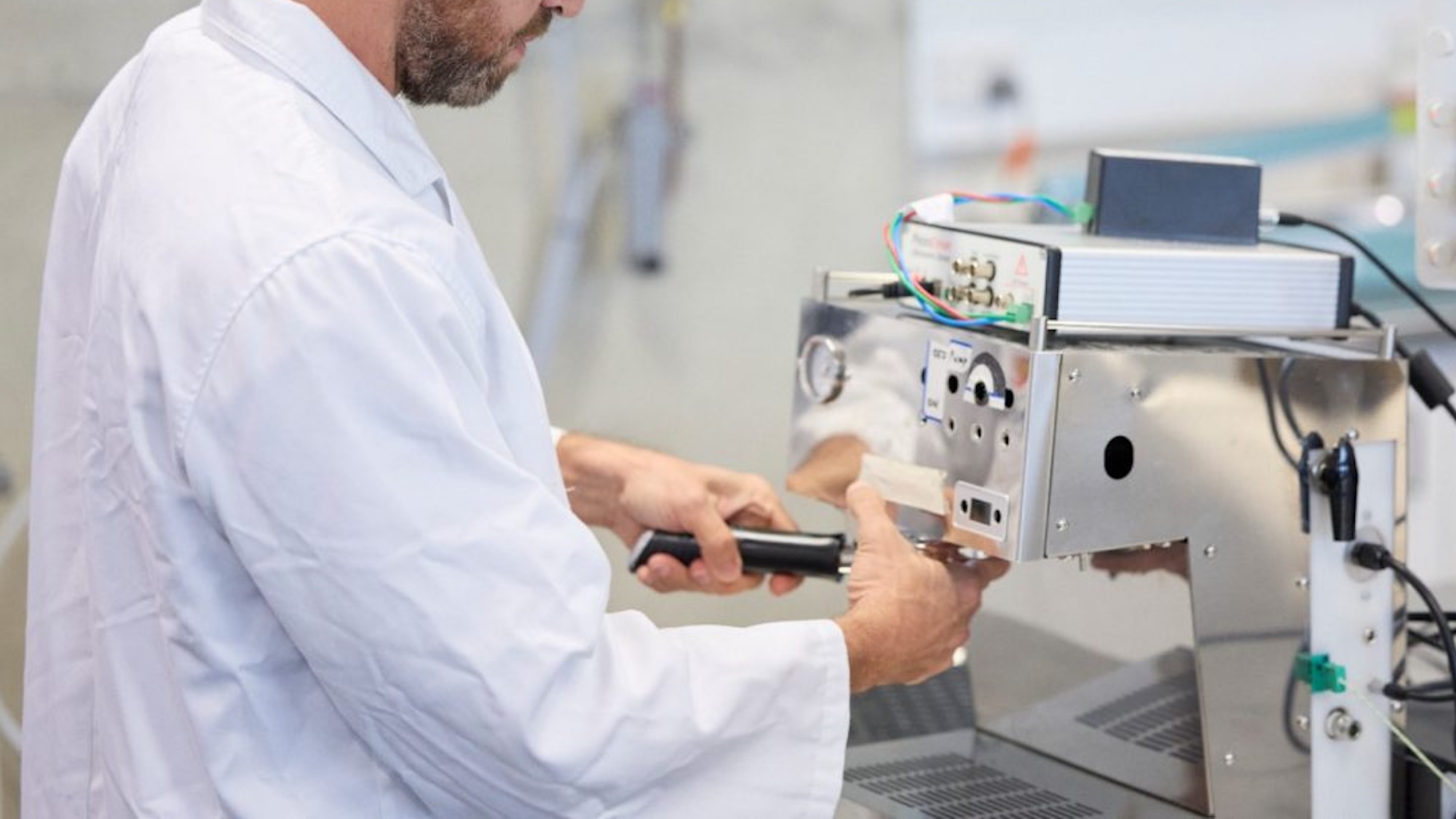
That said, the underlying principles and technology remain the same for ultrasonic espresso. Researchers converted a standard filter basket into a soundwave generator using a transducer. After placing the small metal mechanism against the basket, ultrasound soundwaves shake the container strongly enough to pass along the vibrations through both the coffee grounds and water. This generates a phenomenon called acoustic cavitation, in which microscopic bubbles quickly form and pop in the liquid. The collapsing bubbles then function like miniscule brushes whenever they come into contact with the coffee grounds, which break open to release their flavor molecules, caffeine, and oils.
“The most important [part] was the brew ratio—that is how much water is used per gram of coffee—because this helps ensure the final drink is concentrated and not too diluted,” explained Trujillo, adding that the team also tinkered with additional factors including the coffee ground’s consistency and length of exposure to soundwaves.
After settling on the optimum ingredient balance and brewing time, researchers conducted a blind taste-test with 100 coffee drinkers using traditional espresso and filter coffee, as well as their ultrasonic alternatives. The team noted that the participants could not consistently differentiate between standard and ultrasonic espressos, and actually had an even harder time assessing between filter and frequency-aided coffee.
Ultrasonic brewing machines may make their way into home kitchens, but the real promise is the technique’s scalability. Trujillo hopes mass production coffeemakers can eventually use his designs to manufacture their drinks much more quickly while using barely 25-percent of the normal energy.
“These findings showed that using ultrasound did not harm taste, and in some cases even improved it, despite brewing at room temperature and without the heat normally associated with coffee making,” said Trujillo.

 Login
Login