Manuel Gual posted a photo:
Route 66 Dreams: Classic Cars Across the American Desert
Description
A cinematic visual journey through the mythic atmosphere of Route 66, featuring vintage cars, abandoned gas stations, neon motels, desert highways, red rock landscapes, and golden sunset light. The series blends classic Americana, road trip nostalgia, open-road freedom, and a slightly surreal retro mood, evoking the timeless romance of travel across the American Southwest.
These images were g
Route 66 Dreams: Classic Cars Across the American Desert
Description
A cinematic visual journey through the mythic atmosphere of Route 66, featuring vintage cars, abandoned gas stations, neon motels, desert highways, red rock landscapes, and golden sunset light. The series blends classic Americana, road trip nostalgia, open-road freedom, and a slightly surreal retro mood, evoking the timeless romance of travel across the American Southwest.
These images were generated by Artificial Intelligence.
WASHINGTON, June 12 — US President Donald Trump yesterday named prosecutor Jay Clayton as his new intelligence chief, after a backlash from Republicans over his bid to install an inexperienced ally in the post.Trump’s naming of loyalist housing official Bill Pulte as acting Director of National Intelligence earlier this month despite having no intelligence background had sparked an uproar.Clayton is a US attorney for the Southern District of New York and a was d
WASHINGTON, June 12 — US President Donald Trump yesterday named prosecutor Jay Clayton as his new intelligence chief, after a backlash from Republicans over his bid to install an inexperienced ally in the post.
Trump’s naming of loyalist housing official Bill Pulte as acting Director of National Intelligence earlier this month despite having no intelligence background had sparked an uproar.
Clayton is a US attorney for the Southern District of New York and a was director of the Securities and Exchange Commission in Trump’s first term in office.
“I am pleased to announce the Nomination of very Highly Respected Jay Clayton... to be the next Director of National Intelligence,” Trump said on his Truth Social platform.
“I encourage the United States Senate to confirm Jay as soon as possible.”
Trump backed down in the face of a Senate rebellion over his naming of Pulte.
The row over Pulte ended up with the US House of Representatives on Thursday rejecting a short-term extension of a major warrantless surveillance program in protest.
The vote collapsed amid anger over Pulte, the head of the Federal Housing Finance Agency, who has no background in national security and has been accused by Democrats of using government databases to seek damaging information on Trump’s political enemies.
Democrats said they would not back even a temporary renewal without reforms to protect Americans’ privacy and a retreat from Pulte’s elevation.
Trump had previously appeared to double down on Pulte.
He ordered Pulte to cut jobs in the US intelligence community, saying that being only an acting director who did not need Senate approval meant he was “less shackled.”
Former intelligence director Tulsi Gabbard announced in May that she was stepping down to care for her husband as he battled cancer.
She was originally due to leave on June 30 but Trump brought the date forward to June 19. — AFP
Manuel Gual posted a photo:
A Cinematic Journey Through the History of Aviation
Description:
A wide cinematic collection celebrating the evolution of aviation, from fragile early biplanes and daring pioneer pilots to flying boats, wartime fighters, classic airliners, supersonic icons, stealth aircraft, and futuristic aerospace designs. The series combines golden hour light, dramatic skies, ocean crossings, misty runways, military silhouettes, retro travel atmosphere, and science fiction con
A Cinematic Journey Through the History of Aviation
Description:
A wide cinematic collection celebrating the evolution of aviation, from fragile early biplanes and daring pioneer pilots to flying boats, wartime fighters, classic airliners, supersonic icons, stealth aircraft, and futuristic aerospace designs. The series combines golden hour light, dramatic skies, ocean crossings, misty runways, military silhouettes, retro travel atmosphere, and science fiction concepts to create a visual timeline of flight as both engineering achievement and human dream.
These images have been generated by Artificial Intelligence.
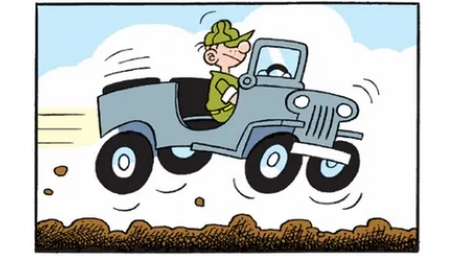
A roundup of stories tangentially connected to comic strips. A history of the Jeep that brings to mind Mort Walker’s army, a non-cartoonist barber creating comic strip promo with a.i., a real cartoonist who has moved on to using skin as his canvas, a comic stripish font for official documents, and a 1960s Saturday Morning […]
A roundup of stories tangentially connected to comic strips. A history of the Jeep that brings to mind Mort Walker’s army, a non-cartoonist barber creating comic strip promo with a.i., a real cartoonist who has moved on to using skin as his canvas, a comic stripish font for official documents, and a 1960s Saturday Morning […]
My AI Mad Libs cartoon last week on urgency without clarity in AI strategy was one of my most licensed cartoons from the last 24 years.
It got me thinking of the trickle-down effects of muddled strategy through an organization.
Whenever there’s ill-defined strategy at the top, there will be poor alignment all the way down. This is particularly true with something as consequential yet open-to-interpretation as AI.
The quickest lever of AI adoption is a mandate just to do more with less.
My AI Mad Libs cartoon last week on urgency without clarity in AI strategy was one of my most licensed cartoons from the last 24 years.
It got me thinking of the trickle-down effects of muddled strategy through an organization.
Whenever there’s ill-defined strategy at the top, there will be poor alignment all the way down. This is particularly true with something as consequential yet open-to-interpretation as AI.
The quickest lever of AI adoption is a mandate just to do more with less.
The recent 40% layoffs by Block (and 20% stock price bump in response) is catnip to companies excited about using AI primarily to justify cost-cutting. This has been criticized as “AI washing.”
But the effects of this type of AI cost-cutting carries a cost, as Kate Niederhoffer, Alexi Robichaux and Jeffrey T. Hancock have been chronicling in a series of HBR articles on the rise of “workslop” driven by unclear AI mandates:
“As companies have tightened budgets, consolidated roles, and asked employees to take on more tasks without formal role redesign, individual contributors and frontline managers are stretched more than ever. This has left employees psychologically depleted and juggling heavier workloads.
“In this context, blanket mandates to use AI—often without the training, agency, or cultural trust to thoughtfully experiment with these powerful new tools—end up encouraging people to use AI performatively. These low-effort, low-value uses demonstrate compliance with directives to experiment, even as they shift the burden of the work onto the receiver. Hence, workslop.”
Ironically some of the most interesting cases of AI adoption may come, not from organizations, but from individuals using AI to amplify side projects.
Here are a few related cartoons I’ve drawn over the years:
Manuel Gual posted a photo:
The Secret Ministry of Absurd Missions
Description
A cinematic retro spy comedy set in a fictional 1970s Spain, where secret agents, eccentric officials, nervous informants, improvised disguises, dusty archives, smoky offices, street chases, old cinemas, cheap bars, hotel lobbies, public squares, rooftops, laboratories and forgotten government corridors collide in a world of bureaucratic chaos and absurd investigation. The series blends vintage European cinema a
A cinematic retro spy comedy set in a fictional 1970s Spain, where secret agents, eccentric officials, nervous informants, improvised disguises, dusty archives, smoky offices, street chases, old cinemas, cheap bars, hotel lobbies, public squares, rooftops, laboratories and forgotten government corridors collide in a world of bureaucratic chaos and absurd investigation. The series blends vintage European cinema aesthetics with dark humor, slapstick energy and noir atmosphere: worn suits, red trousers, old telephones, typewriters, paper files, vending machines, battered cars, market stalls, taverns, secret dossiers and strange scientific experiments create a nostalgic but surreal universe. Each scene feels like a lost frame from an imaginary Spanish espionage film, mixing comedy, mystery, action and social satire with warm light, grainy textures, dramatic shadows and wide cinematic framing. The collection suggests a bizarre intelligence agency trapped between outdated technology, comic incompetence and dangerous missions that always seem to spiral out of control.
These images were generated by Artificial Intelligence.
Hiring has bounced back this year from a miserable 2025, showing unexpected strength in the face of economic uncertainty and painfully high energy prices caused by the Iran war.
Hiring has bounced back this year from a miserable 2025, showing unexpected strength in the face of economic uncertainty and painfully high energy prices caused by the Iran war.
President Trump announced his plans to nominate Jay Clayton as director of national intelligence. The choice comes as lawmakers refused to extend a key surveillance tool over stalled privacy concerns and questions about the qualifications of the interim intelligence chief. Congressional correspondent Lisa Desjardins reports.
President Trump announced his plans to nominate Jay Clayton as director of national intelligence. The choice comes as lawmakers refused to extend a key surveillance tool over stalled privacy concerns and questions about the qualifications of the interim intelligence chief. Congressional correspondent Lisa Desjardins reports.
{beacon} Technology Technology The Big Story Compute becomes lifeblood, constraint of AI boom Computing power has become the lifeblood — and a key limiting factor — of the race to develop AI, as the push to integrate the technology into daily life clashes with the finite supply of one of its most crucial inputs....
{beacon} Technology Technology The Big Story Compute becomes lifeblood, constraint of AI boom Computing power has become the lifeblood — and a key limiting factor — of the race to develop AI, as the push to integrate the technology into daily life clashes with the finite supply of one of its most crucial inputs....
Demonstrators protest a data center in Tucson, Arizona, in May 2026. | Mamta Popat/Arizona Daily Star via Getty Images
On its surface, the national revolt against data centers seems simple: They are a nuisance, and people do not want them in their proverbial backyards. But I haven’t been able to let go of the idea that there must be something much deeper driving the backlash against them, and few other subjects have confounded me more than trying to figure out what to think about it.
T
Demonstrators protest a data center in Tucson, Arizona, in May 2026. | Mamta Popat/Arizona Daily Star via Getty Images
On its surface, the national revolt against data centers seems simple: They are a nuisance, and people do not want them in their proverbial backyards. But I haven’t been able to let go of the idea that there must be something much deeper driving the backlash against them, and few other subjects have confounded me more than trying to figure out what to think about it.
These facilities — the massive suburban and exurban warehouses that power AI, along with much of what we do on the modern internet — spew noise, have been accused of guzzling electricity and water, and have a halo of generalugliness around them. And over the past year-and-a-half or so, many Americans have gone from barely knowing what a data center is to having fiercely held opinions about them. Seventy percent of Americans, according to a recent Gallup poll, now say they would oppose one being built in their area. The environment tops their list of concerns. They’re also disquietedby the idea of high-tech facilities buying up land from America’s farmers and ranchers. Anti-data center campaigns have swept communities across the country, producing dozens of local moratoria on their construction.
Inside this story
Data centers have rapidly become a flashpoint in communities across the US, with many Americans opposing their construction over concerns about noise, water use, energy use, and other nuisances.
But the backlash is probably about much more than data centers themselves — they’ve become a proxy for the public’s dread of AI and an uncertain future.
Instead of fighting data centers one by one, the US needs a broader debate and policy agenda on how AI should be regulated and how to ensure it expands rather than diminishes human agency.
These objections sound public-spirited enough. But as Vox’s Eric Levitz and many othershavewritten, many of the rationales for stopping the buildout of data centers, particularly the environmental case against them, have been overstated (more on that in a moment).
Yet grassroots anti-data center activists are hardly wrong to be worried about artificial intelligence — it is one of the most formidable policy problems we face today. AI’s ultra-wealthy makers promise a world of unprecedented progressand prosperity, but also say they might also eliminate everyone’s job and possibly annihilate humanity in the process.
If you are terrified that AI is ushering in a future that will be miserable to live in, I fully share in that feeling (and would personally prefer to go back to a world before ChatGPT). And I think this sentiment, rather than any ecological anxiety, explains much of why Americans are suddenly fighting to ban the physical infrastructure on which AI and tech more generally depends, why they’re so pessimistic about AI in general, and why college seniors graduating this spring have been booing the mere mention of AI off the commencement stage.
But it’s a problem that stopping a data center locally feels like the only policy lever that an ordinary person can pull right now to try to slow down AI, because it’s a blunt instrument that can’t give us the outcomes we really want. Canceling data center projects town by town is unlikely to meaningfully slow AI adoption, and it certainly doesn’t regulate AI use or protect us from its worst possible outcomes.
Instead, this approach traps us in a debate about relative trivialities rather than about one of our society’s most important questions: how we will manage a technological and economic transformation that’s already happening. And that dysfunction in turn prevents us from seeing any upside to AI and thinking about how we might broadly share it. It is, at bottom, a symptom of the same obstructionism that blocks us from addressing many of the biggest problems of our time, from green energy to housing and so much else, under similarly confused pretexts.
Could that ever change?
Where the data center revolt is coming from
The great US data center buildout is colliding with a national economic mood that appears to be historically, singularly bad. Americans are angry about the cost of living, afraid for their futures, increasingly mistrustful of each other, and don’t trust our institutions to solve the problems we face. They despise (it probably goes without saying) Big Tech. Majorities of the public say that AI will do more harm than good in daily life, that it will take away their economic opportunities, that government is not doing enough to regulate it. Young people are particularly fixated on the impacts of AI, and they seem positively miserable about it.
It’s little surprise Americans feel such a dread of AI; Congress has introduced dozens of bills to govern the technology but has failed to pass any comprehensive legislation. With no federal regulation apparently forthcoming that would, say, provide a measure of economic security to the tens of millions of workers who could be replaced by AI in the coming years, it’s perhaps no wonder that there’s been such vigorous backlash against the physical manifestations of the tech.
Surely, then, at least some of the reasons that data centers are being pigeonholed as an ecological issue is that people are searching for legitimate-feeling reasons to try to stop this runaway train. The tendency to fall back on reasons that can be metabolized by the policymaking processes that ordinary Americans can actually influence, like environmental review, has been inherited from the environmentalprotection laws embraced across the country beginning in the 1970s, when pollution had become a visible public crisis. But just as when environmentalism is weaponized to block new housing or high-speed rail or in support of whatever other garden-variety NIMBY cause, the ecological argument for shutting down AI mostly withers under scrutiny.
Like all economically important industries, data centers and AI certainly have real environmental impacts. These facilities use a lot of electricity, and much of it comes from fossil fuels because most US electricity is still derived from fossil fuels. Their electricity use will grow quickly as demand for AI tools increases.
But years of covering one of the world’s most underrated environmental menaces — agriculture, especiallyanimal agriculture — have taught me to be skeptical of contextless claims about how much water or energy any particular industry uses. The planetary harms of data centers aren’t radically out of proportion to what we would expect from an industry that is increasingly important to daily life and the economy; computing is far less intensive in energy and physical resources than many other things we do and many of the activities it stands to replace, AI researcher Andy Masley haspointed out repeatedly. Data centers’ water use, meanwhile, amounts to a tiny fraction of all US water use, and there is not much evidence that they’re going to cause water scarcity issues even in arid parts of the country. In cases where a data center replaces, say, farmland growing water-intensive cattle feed crops in dry regions of the US, it mighteven benefit the environment.
I never want to sound glib about the future of our planet, nor do I want to take too far a detour into the political philosophy of how we decide whether an industry’s resource use is “worth it.” But I think it’s fair to say that campaigning against data centers on ecological objections is a dead end, if we are serious about finding a policy response to this technology that addresses the true concerns around it. An environmental frame may even be a gift to the AI industry, because the industry can defend itself on that ground pretty straightforwardly. Even data centers’ dependence on fossil fuels, one could argue not entirely unreasonably, is a problem for policymakers to solve by accelerating the buildout of renewable energy.
The AI debate we’re not having
So what, then, are we to with AI concerns if not taking them, converted into gigawatts and gallons, to the local planning commission meeting?
I wrestled with that question as I read Techno-Negative: A Long History of Refusing the Machine, Thomas Dekeyser’s recent book on the long human lineage of attempting to destroy the technologies that reshape the way we live, from the ancient Greeks, who, much like contemporary dread of AI, worried that machines could eclipse human agency, to computer arsonists in the 1980s. Dekeyser, who is a lecturer on human geography at the University of Southampton, writes that technological progress has always been a “political battlefield” where the purpose of human life is contested.
How can technology be used to make our society freer and more equal, and to augment human agency, rather than diminish it?
The fight to choke off data centers represents the latest expression of that struggle to define what it means to be human in the face of technological change, of what Dekeyser calls the “tenacious, fierce urge to negate life’s technologization.” What is AI, the technology that promises to replace the human mind itself, if not the apotheosis of our fears of being made obsolete? To the median American, data centers might feel like a manifestation of the forces that want to take all their power and relevance away from them.
Yet widespread cynicism about AI, I think, doesn’t stem from any inherent property of the technology itself, but rather from our politics. The public has not been offered any credible political vision of a future where AI could be deployed to support human flourishing, nothing that can offer a satisfying answer to the most important questions about our relationship with technology. As Dekeyser writes: “Do they constitute and expand, or undermine, human subjectivity?”
In this way, political possibilities shape the way we feel about technology: Imagine if, for example, instead of the prospect of widespread economic disenfranchisement, the productivity gains from AI could be harnessed to pass a four-day (or, hell, even three-day) work week, or to finance a generous universal paid leave policy. The US, as the richest country in the world and an undisputed leader in AI, certainly has the leverage to enact such policies. We could also give workers power over how AI is deployed in their workplaces, or incentivize AI development in a direction that expands, rather than replaces, human creativity. Or, as Sen. Bernie Sanders proposed this week, give the public a direct ownership stake in the technology itself, created by a tax on AI companies.
Whatever you think of these ideas, we’d be better off debating their merits and thinking through the particulars of how they might be implemented than fixating on individual data centers. But because an ambitious national AI policy feels unimaginable right now, and so of course people see AI as all downside and no upside. But simply channeling popular sentiment into local bans on physical infrastructure forecloses debate over the most important aspects of AI before we can even have them, as Holly Buck, an associate professor of environment and sustainability at the University of Buffalo, recently argued.
The politics of local veto has produced many of America’s other major governing failures, too: We can’t decarbonize the economy, solve a structural housing shortage, or absorb a technology as big as AI when local zoning hearings are the only places where the fight is happening and actionable decisions are being made. The essential difference with AI, though, is that on housing or climate change, we already mostly know the policy solutions we need. On AI, that terrain is still much less certain. We don’t yet know what we want from a potentially existentially transformative technology. That calls for real national confrontations with the most important questions: How can technology be used to make our society freer and more equal, and to augment human agency rather than diminish it?
Maybe that future still requires more data centers, many more of them (or maybe we should build fewer of them). Whichever outcome we choose, it should be downstream of a rational and deliberative policy process, rather than a poor simulacrum of the debate we all deserve.
A robot tries painting. | Yuliia Volkovska/Getty Images
As AI continues to encroach on every aspect of our lives, there is a persistent fear or hope, depending on your angle: AI will someday take over art. The internet is full of quizzes showing that most lay people cannot tell the difference between AI-generated art (digital pictures of paintings, prose) and the real thing. Multiple studies have shown that when people are shown AI-generated art and human-made art, but are not told which
A robot tries painting. | Yuliia Volkovska/Getty Images
As AI continues to encroach on every aspect of our lives, there is a persistent fear or hope, depending on your angle: AI will someday take over art. The internet is full of quizzes showing that most lay people cannot tell the difference between AI-generated art (digital pictures of paintings, prose) and the real thing. Multiplestudieshave shown that when people are shown AI-generated art and human-made art, but are not told which is which, they tend to prefer the AI-generated art, whether it be images, poetry, or prose.
Yet what’s striking is that despite this disparity, people still consistently say that human-made art is what they want.
In one study published in 2023, participants were shown a series of images, each randomly labeled “AI-made” or “human-made.” Participants rated the images they thought were machine made as worse than the images they thought had been created by a human artist — even when those were actually human-made.
A literary scandal
A natural experiment in how difficult it can be for people to tell the difference between AI-generated art and human-made art occurred last month, when the prestigious Commonwealth Foundation awarded its short story prize to “The Serpent in the Grove,” which a bears some of the hallmarks of AI-generated prose. In a statement to New York magazine, the Commonwealth Foundation said that the prize committee does not use AI checkers, but that “all shortlisted writers have personally stated that no AI was used.”
The big “tell” for “Serpent in the Grove” was that it is riddled with metaphors that are rhythmic and evocative at first glance but fall apart when you try to figure out what they mean: “The girl smiled like sunrise over a sink”; “She had the kind of walking that made benches become men.” If art is about connecting with another human mind, we might say that “Serpent” fails if, when you read it, you find it almost impossible to tell what the mind behind that story is trying to say.
One conclusion you might draw here is that the widespread disdain for AI-generated art is empty snobbery. If human-made art were so much better, the argument goes, then people would be able to see a real difference.
This line of thinking relies on the belief that “good” art is something that many people find appealing, at least in a vacuum. At this point, AI has automated that generation fairly successfully. At some point, it may get even better at it.
But I don’t think those study participants were lying when they said they wanted human-made art, even if they couldn’t tell the difference. Even if we get to a future in which AI’s persistent glitches are ironed out, so that there are no more missing fingers and garbled sentences, and AI-generated images and music and poetry and prose and film are completely indistinguishable from the best a human can produce, even to highly trained experts — even then, I think people would still keep saying they would rather experience art made by humans. And even in such a world, I don’t think they would be lying.
The pleasure of art is specifically related to the human mind on the other side of the product. When we’re told that the mind on the other side is a machine, many of us don’t want to engage anymore.
That loss of interest matters. It is consistent. It has happened before in the history of art.
Two hundred years ago, another new technology emerged that was capable of automating the technical skills many people at the time would have considered one of art’s fundamental functions: the camera. It could capture a likeness perfectly and very quickly, in a moment when almost all of visual arts were organized around capturing a likeness.
The camera changed the way paintings were produced and ultimately valued, but it did not replace the medium entirely — and the reasons why can help explain why AI-generated art won’t replace human-made art, either.
“Art’s most mortal enemy”
In 19th-century Europe, one of the major ways people decided whether a painting was good was by asking the question, “How closely does this match what I can see with my eyes?” It was important for painters to be able to create something that we would now describe as photorealistic.
What people wanted from art at the time, says Richard Meyer, a professor of art history and director of American studies at Stanford University, was what people expect from a good Hollywood movie now: “You suspend your disbelief that you’re looking at a flat surface with pigment built up on it, and you fall into the fiction of, here are these beautiful bodies before you, or here is this landscape, or here’s this bowl of fruit.”
An artist’s skill was in large part defined by how faithfully they were able to recreate reality. Many artists were able to make a living painting relatively affordable portraits, which allowed people who weren’t aristocrats or nobility to commission a permanent record of their appearance, says Anju Lukose-Scott, a curator and master’s student at the University of Chicago.
As inventors began to develop earlyversions of photography in the middle of the 19th century, it started to seem like artists might become redundant. A camera can create an exact record of the way the world looks far faster and more easily than any painter can, no matter how skilled they are with their brush. The new technology, French poet Charles Baudelaire wrote darkly in 1859, was “art’s most mortal enemy.” By the 20th century, as it became possible to reproduce an old masterpiece on a postcard, philosopher Walter Benjamin feared that original works of art had lost their unique aura.
The immediate implications for a large class of skilled craftspeople were catastrophic. “Portraiture was a huge commercial business,” Lukose-Scott says. The camera made such work nearly obsolete. Some artists went out of business; others pivoted to making daguerreotypes for their clients instead of paintings.
But the effect on painting as a fine art form was different, Meyer says. Painters began to focus on what they could accomplish with their brushes that a camera could not. Instead of trying to capture reality, they began to use colors and textures to convey emotions.
Artists in the new impressionist movement would deliberately show their brushstrokes in their paintings, making the texture of the paint and canvas part of the artistic effect they were developing. Since photography was still a black-and-white medium, the impressionists made vivid colors more and more central to their work. They moved away from trying to duplicate the shapes and lines that cameras could record so well, and instead began to explore the way unnatural shapes and lines could provoke a visceral response from a viewer.
To the modern eye, it’s these discrepancies between paintings and reality that make these impressionist paintings so exciting and pleasurable to look at. They show us a way of perceiving the world that photography cannot.
As painting evolved, photography took over where trade portraiture left off: It was considered a craft, not an art. When people began to take photography seriously as its own medium in the 20th century, it wasn’t because of photography’s exceptional ability to capture a likeness, Meyer says. The ability to do that could now be taken for granted. Instead, the art of photography was about the choices made by the human using the camera: what to shoot, how to frame the subject, how to light it, how to edit it.
Today, almost all of us carry cameras around in our pockets. But most of us would not describe the quick, functional photographs we take with our smartphones as art, no matter how accurately they capture the world around us. People can and do make art with their phones, but doing so requires a human mind working with intention and craft behind the machine of the camera.
We no longer consider the ability to create a perfect replica of reality to be the main prerequisite to making a piece of visual art. Technology has made it easy enough to do that the skill has lost value. People still care about visual art, but we use different criteria to evaluate it than we did in 1800.
AI’s arrival may very well devalue the ability to create smoothly readable text and pleasant visual compositions, and that could mean bad things for a lot of industries, including journalism. But that doesn’t mean we’ll stop caring about whether or not a human being made a piece of art.
“Art offers us a way of looking”
I keep thinking about something Meyer told me about what happened to the 19th-century portrait painters who lost their jobs to daguerreotypists. Meyer argues that there was something about the nature of middle-class portraiture that made people willing to cede it to cameras, in a way that they didn’t feel happy to do with the types of paintings that live on in museums.
In portraiture, Meyer says, “you’re going not so much for the individual expressive perspective of the artist but for a likeness. It’s really about oneself, the person portrayed, rather than the person portraying.” In contrast, Meyer says, fine art is about the artist, and the way that the artist sees the world.
It’s worth spending a bit of time on the distinction Meyer is drawing. One thing that people who love playing with AI sometimes say is that the pleasure of prompting comes from watching a stray thought become concrete in the blink of an eye: It is a piece of your mind made external, so that you can look at it. An AI prompt is about the person prompting, in much the same way that the average hired portrait was about the person being painted.
If I consider an image or a piece of text to be a reflection of myself, I might not mind using soulless technology to create it — it’s already interesting to me, because it’s about me and for me. But when an image or a piece of text is about something else, I feel differently. I want to connect with another person, not something mechanical.
That seems to be the thing that most humans crave from art: an encounter with another human mind. Someone expresses how it feels to be alive in a human body, with a human soul, and another one sees it, reads it, hears it, and grasps at it. That is the experience that moves us.
“It’s about wanting to understand how an individual sees the world differently from how we can see it on our own,” Meyer says. “Art offers us a way of looking.”
So when we think about whether AI-generated content has the potential to be art, to replace art, the question that matters is not whether it can create entertaining or realistic images and text out of nothing. The question is whether the machine allows us to experience the way a different person lives in the world.
For Lukose-Scott, the possibility is unlikely, because today’s LLMs are trained on a corpus of existing art. ”What’s retained in the invention of photography is a kind of artistic identity. People are using the technology through their own artistic voice, which from my perspective is lacking in AI,” Lukose-Scott says. “My perception of AI art is that it’s just a self-gratifying loop, because it’s taking from what we already know, and it’s putting it back in the world.”
When a person uses ChatGPT to spit out a Studio Gibliflied replication of their family snapshots, they are not showing us a new form of subjectivity. They are mimicking the subjectivity of Hayao Miyazaki, without bringing Miyazaki’s intention or skill to bear on the finished product — and they’re able to do so because OpenAI trained its model on Miyazaki’s work without his permission. Unlike the camera, AI is built on a foundation of what is arguably intellectual theft.
This is not to say that it would be impossible for an artist to use AI as a tool to produce new artistic ideas, just as it is not impossible for an artist to use an iPhone camera as a tool to make art. But it would look different from slapping a prompt into Midjourney, for the same reason that most people’s iPhone selfies are not very artistically interesting: Because they are about and for you, not about sharing your embodied experience with the world.
The context matters enormously. The context is what tells me that when I reach out to art with my human mind — my human soul — another mind is on the other side, reaching back.

 Login
Login