PARIS, June 7 — Faced with a painful slowdown in recent years, the luxury sector is seeking to recover its mojo by juggling a back-to-basics approach with finding new ways to connect to clients.The financial performances of the heavyweights – profits amputated last year at LVMH and Kering, while Burberry posted a loss for its 2024-2025 financial year – testify to the fact the market has undergone a change.The causes are multiple, including the slowing Chinese mar
PARIS, June 7 — Faced with a painful slowdown in recent years, the luxury sector is seeking to recover its mojo by juggling a back-to-basics approach with finding new ways to connect to clients.
The financial performances of the heavyweights – profits amputated last year at LVMH and Kering, while Burberry posted a loss for its 2024-2025 financial year – testify to the fact the market has undergone a change.
The causes are multiple, including the slowing Chinese market, aspirational customers becoming more cost-conscious, and concerns about quality.
“Following the Covid pandemic the luxury market was boosted by binge buying,” said Eric Briones, a cofounder of the Paris School of Luxury who recently published a book about the transformation of the sector.
“And when the luxury sector was confronted with that strong demand, the artisanal model came under pressure,” he said, pointing to recent outsourcing scandals in Italy.
Luxury overexposed
A major part of the luxury cachet is that products are made with superior materials by skilled artisans using traditional methods, which naturally limits production.
Italian police have been investigating major luxury brands for two years over work allegedly outsourced to poorly paid Chinese workers and grim labour conditions.
The post-Covid boom in demand was accompanied by price hikes of up to 50 percent for some labels, “without improvements in quality, and sometimes a drop in quality”, Briones said.
Not only prices increased. Volumes did too.
“It is a fundamental question,” said Christophe Cais, chief executive at CXG, a consultancy that works with premium and luxury brands about customer experiences.
“How many bags can you sell globally without becoming overexposed? Exclusivity is desirable and at the same time you want sales volume, so at what point does volume undermine exclusivity?” he said.
According to the consultancy Bain & Company, the luxury market lost 20 million clients between 2024 and 2025, after having lost 50 million over the previous two years.
Consolidation
Following years of economic and geographic growth for the big luxury groups, analysts say the time has come to prune.
“A phase of recentring and bringing some coherence to portfolios is underway,” said Lea Hubsch at Kearney.
“That may include stepping back or finding another partner for certain brands that aren’t so much part of the DNA” of a group, she added.
LVMH, the world’s largest luxury conglomerate, recently sold off US label Marc Jacobs after holding it for three decades.
In January, it sold the DFS duty free shops’ activities in China.
Kering, another luxury group based in France that is undergoing a major shakeup, sold off its beauty division to L’Oreal for €4 billion (US$4.7 billion; RM18.57 billion).
“This consolidation trend is sure to continue as conglomerates clean out underperforming or strategically less important divisions, focusing on core operations,” CXG said in a recent report.
That will provide opportunities for other companies to snap brands and create new combinations.
Italy’s Versace bought its home turf rival Prada last year for €1.25 billion (RM5.8 billion).
Other deals are expected: Giorgio Armani indicated in his will that he wanted his fashion house to eventually join a luxury group like LVMH or L’Oreal.
Desirability, quality, experiences
Kering’s new CEO Luca de Meo was quite clear in his presentation of the group’s turnaround strategy last month that consolidation was coming, but he also signalled a back-to-basics approach.
He called for an upgrade in quality and efforts to restore the desirability of its leading brand Gucci, which fell victim to overexposure thanks to streetwear.
“Our priority is to make Gucci unmissable again,” de Meo said.
“In one second, you must know it’s Gucci – and it doesn’t mean covering the world with GG.”
Analysts say that in addition to returning to an emphasis on craftmanship and quality, the industry is tuning into demand for experiences and tap into the wellness trend with customer service that rivals that of luxury hotels.
“Desire has shifted to ‘experiences’: beauty, hospitality, transformative luxury,” Briones said. — AFP
KOTA BHARU, June 15 — Kelantan police have called in more than 10 courier service companies operating in the state to share information on the latest modus operandi employed by drug syndicates, which have been found using parcel delivery channels to facilitate their activities.Kelantan police chief Datuk Mohd Yusoff Mamat said the initiative was intended to heighten vigilance among courier companies and their employees after numerous drug cases were found to invo
KOTA BHARU, June 15 — Kelantan police have called in more than 10 courier service companies operating in the state to share information on the latest modus operandi employed by drug syndicates, which have been found using parcel delivery channels to facilitate their activities.
Kelantan police chief Datuk Mohd Yusoff Mamat said the initiative was intended to heighten vigilance among courier companies and their employees after numerous drug cases were found to involve courier services.
He said courier firms had been asked to keep records of senders’ particulars, including details of their identity cards and phone numbers, to aid investigations should any offences arise.
"We have urged them to remain alert, and where a parcel raises suspicion, customers may be asked to open it before courier personnel for an initial check," he said after the Kelantan Police Contingent Headquarters monthly gathering here today.
Mohd Yusoff said courier companies had been informed of a new trend involving “drop-off” deliveries, in which parcels are registered online and left at designated collection points without direct contact between senders and staff.
According to him, the method complicates efforts to identify senders because fewer details are recorded compared with over-the-counter transactions.
Mohd Yusoff said there was no evidence to suggest that any courier company had been involved in drug smuggling, although some employees had been questioned in connection with ongoing investigations.
He also urged courier firms to consider using scanning devices in the future to help identify suspicious items in parcels and enhance delivery security measures. — Bernama
BELFAST, June 10 — Anti-immigration protesters torched buildings and vehicles in Belfast on yesterday evening and blocked roads, a day after a stabbing allegedly by a Sudanese refugee, captured in a graphic video that shocked the country.Hundreds of protesters, many masked, gathered at several locations across Belfast, AFP journalists saw. A bus and several cars were set alight, while a building fringing the city centre caught fire and its residents had to be eva
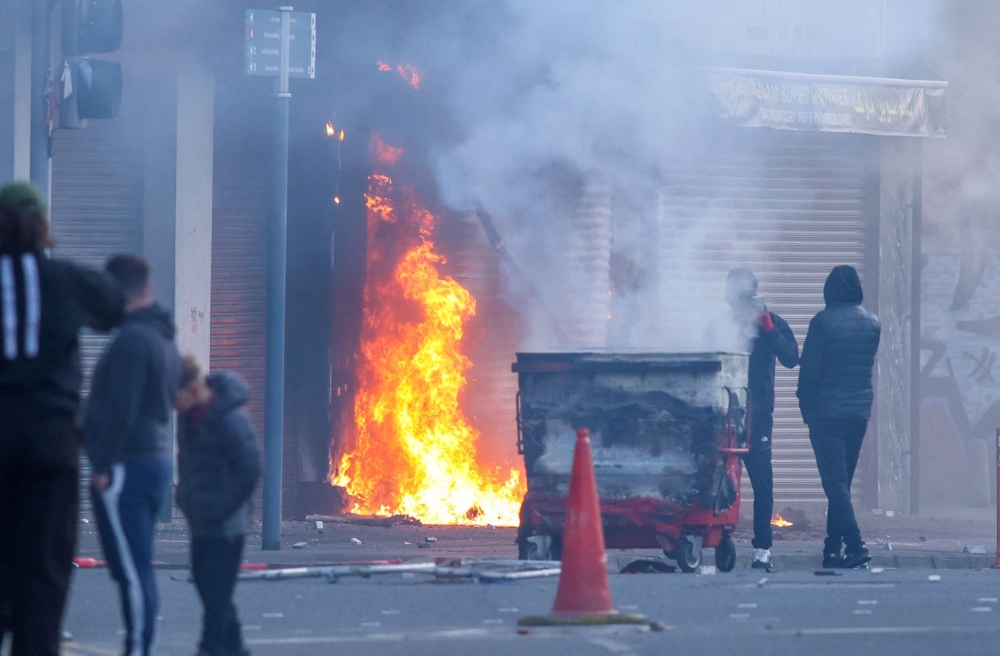
BELFAST, June 10 — Anti-immigration protesters torched buildings and vehicles in Belfast on yesterday evening and blocked roads, a day after a stabbing allegedly by a Sudanese refugee, captured in a graphic video that shocked the country.
Hundreds of protesters, many masked, gathered at several locations across Belfast, AFP journalists saw. A bus and several cars were set alight, while a building fringing the city centre caught fire and its residents had to be evacuated.
“By 7.30 pm they started (a) fire in the bins...we heard police cars and sirens,” said one resident, Eemran, an engineer of Indian origin who has been living in Belfast for slightly over a year.
“More and more people started coming, they started throwing petrol bombs. Suddenly the fire started going...we had smoke inside the building...fire people came in and they said ‘go down’,” he said in broken English.
Camila, a 36-year-old Chilean who moved to Belfast a month ago, said it was “scary”.
“Of course I’m not used to it,” she said. “I understand the people’s rage but also there are ways of discussing these things more peacefully”.
Sky television showed other buildings on fire.
Police helicopters patrolled above the city and shops were also closed early.
Michelle O’Neill, the First Minister of Northern Ireland, slammed the protests and urged calm.
“Groups of masked men burning families out of their homes is nothing less than disgusting cowardice,” she said on X.
“Racism, intimidation and violence are wrong wherever they occur. There can be no excuse and no justification for these attacks tonight. No one wants to see this on our streets and I again appeal for calm”.
Crowds also gathered in Antrim, around 25 kilometres (15 miles) west of Belfast.
US tech billionaire Elon Musk had earlier retweeted a post by anti-immigration activist Stephen Yaxley-Lennon—also known as Tommy Robinson—adding: “Only by protesting REPEATEDLY and LOUDLY will there be any change!!”.
The suspect in the knife attack, whose name has not been released, was charged late Tuesday with attempted murder, possession of a bladed weapon in a public place and making threats to kill. The 30-year-old man is due to appear in court on Wednesday.
As anti-immigration figures, including Reform party leader Nigel Farage and Restore Britain leader Rupert Lowe, demanded details about the attacker, the interior ministry confirmed he was a Sudanese refugee with a residence permit valid until 2028.
Northern Ireland police chief Jon Boutcher said he had arrived in the UK in 2023 via Paris and Dublin.
Living in fear
Tensions were already high in Britain after violent skirmishes last week in Southampton, southern England, over the police handling of the murder of a young white student stabbed to death by a British Sikh man.
Yesterday, dozens of demonstrators also gathered there outside a hotel housing asylum seekers, carrying banners reading “no racism, just patriotism” and “enough is enough”.
The video from Belfast shows a man straddling another man lying in a street and slashing him several times in the head and neck with a knife, in what far-right figures claimed was an attempted beheading.
Several people can then be seen intervening, one wielding a hurling stick, and tackling the perpetrator as police arrive.
The victim, a man in his 40s, “was taken to hospital with significant injuries to his eyes and serious slash wound injuries to his back and face,” he told reporters.
Officers recovered what is believed to be a kitchen knife at the scene, Henderson confirmed.
A 31-year-old mother-of-one who lives nearby said the incident had terrified the neighbourhood. “We’re just living in fear now,” she told AFP.
Sickening
Prime Minister Keir Starmer called the incident “horrific” and “sickening” on X.
The leaders of Northern Ireland’s five main political parties issued a joint statement condemning the incident, saying “there is no place in our society for this kind of brutality”.
The leaders and police urged people not to share the video, noting its “graphic nature would only serve to retraumatise those involved”.
But numerous social media accounts linked to so-called “patriots” were sharing the footage, urging people to “protest against mass immigration into their communities”.
The UK interior ministry confirmed the Sudanese suspect entered the country in 2023 and acquired refugee status the same year, allowing him to remain until 2028.
“There is no trace of this suspect on any of our national security databases, and he was not known to the Police Service of Northern Ireland,” police chief Boutcher said.
Immigration has become a hot-button issue in Britain, and helped fuel the rise of the hard-right Reform UK party in the polls. — AFP
KOTA BHARU, June 14 — Driven by the allure of an ‘overseas holiday,’ thousands of Malaysians have been ignoring safety warnings and queuing for hours to enter southern Thailand, especially during festive seasons and school holidays.Revealing this concerning trend, Kelantan police chief Datuk Mohd Yusoff Mamat said that daily observations at the state’s three official entry points (ICQS Complexes) — Rantau Panjang in Pasir Mas, Pengkalan Kubor in Tumpat, and Bukit
KOTA BHARU, June 14 — Driven by the allure of an ‘overseas holiday,’ thousands of Malaysians have been ignoring safety warnings and queuing for hours to enter southern Thailand, especially during festive seasons and school holidays.
Revealing this concerning trend, Kelantan police chief Datuk Mohd Yusoff Mamat said that daily observations at the state’s three official entry points (ICQS Complexes) — Rantau Panjang in Pasir Mas, Pengkalan Kubor in Tumpat, and Bukit Bunga in Tanah Merah — have recorded extremely high cross-border traffic.
He said that on normal days, an estimated 3,000 people cross the border, while the figure rises to more than 4,000 during weekends.
According to him, when school holidays arrive, the number increases significantly, reaching between 6,000 and 7,000 people per day.
“Overall, the total number of entries and exits involving border passes or passports can reach as high as 10,000 people in a single day. We continuously advise the public that the situation there (in southern Thailand) is difficult to predict.
“No one knows when or where a bombing or shooting incident might occur. The travel advisory issued by the Foreign Ministry (Wisma Putra) last year remains in effect, yet many people appear unconcerned and are still willing to queue for hours,” he told Bernama recently.
Commenting on the factors drawing visitors to the troubled region, he said that, in his personal view, Kelantan still lacks sufficiently attractive tourist destinations or family recreation spots to encourage locals to spend their holidays within the state.
He added that the public’s fascination with the notion of an overseas holiday also plays a significant role.
“Many people seem to regard any trip that earns them a passport stamp as an overseas holiday, even though the destination is just across the border and separated only by a river.
“Financial considerations are another factor behind the growing trend. The favourable exchange rate of the neighbouring country’s currency makes people feel they can spend more freely there,” he said.
He added that many locals are willing to cross the border for relatively simple reasons, such as seeking out authentic Thai cuisine, strolling through night markets, or even buying viral snacks from Thailand’s 7-Eleven stores before returning home the same day.
Meanwhile, Mohd Yusoff suggested that the state government and relevant stakeholders consider transforming border towns such as Rantau Panjang by adopting the development model used in Padang Besar, Perlis, as part of a two-pronged strategy to reduce the outflow of Malaysian currency.
He said developing a well-organised commercial complex incorporating a rest and service (R&R) concept could attract domestic tourists without requiring them to cross the border.
Citing Perlis as an example, Mohd Yusoff said the R&R shopping complex there, with its attractive retail outlets, has successfully drawn Thai traders to market utility goods, clothing and authentic food products legally on the Malaysian side of the border.
“If Kelantan can replicate this model, we can not only attract foreign tourists to visit the state, but also discourage our people from crossing the border simply to visit night markets or go shopping. After all, our culinary culture is not that different from theirs,” he said.
Mohd Yusoff also dismissed claims by certain parties that the police’s stricter border controls were to blame for the decline in business activity at the Rantau Panjang and Pengkalan Kubor Duty-Free Zones.
He stressed that the economic downturn in both border towns had begun well before the COVID-19 pandemic.
“The post-pandemic period has seen a drastic shift in consumer behaviour, with many people now preferring to purchase Thai products online,” he said.
Given that the rise of e-commerce has undermined traditional brick-and-mortar businesses, he said border towns could no longer rely on conventional retail models and instead needed to reinvent themselves. This could include developing hubs for viral products, food and popular snacks, including those commonly associated with Thailand’s 7-Eleven stores.
“Rantau Panjang should be viewed as a destination in its own right and given a new lease of life. Establish attractive retail outlets and bring in the products that people seek from Thailand. That is the best solution for revitalising the local economy,” he said. — Bernama
Investigators said the arrests were for the wilful promotion of hate, allegedly targeting the Jewish community, and dated back to demonstrations in mid-March.
Investigators said the arrests were for the wilful promotion of hate, allegedly targeting the Jewish community, and dated back to demonstrations in mid-March.
More than half of drivers who were pulled over and drug tested by Winnipeg police were said to be driving while intoxicated, according to a Winnipeg Police Board report.
More than half of drivers who were pulled over and drug tested by Winnipeg police were said to be driving while intoxicated, according to a Winnipeg Police Board report.
KUCHING, June 6 — The Independent Police Conduct Commission (IPCC) provides an alternative platform for the public to lodge complaints related to police misconduct, Deputy Inspector-General of Police Tan Sri Ayob Khan Mydin Pitchay said.He said that previously, most complaints involving police misconduct were handled by the Royal Malaysia Police’s (PDRM) Integrity and Standards Compliance Department (JIPS).“The IPCC is another channel available to the public. Pre
KUCHING, June 6 — The Independent Police Conduct Commission (IPCC) provides an alternative platform for the public to lodge complaints related to police misconduct, Deputy Inspector-General of Police Tan Sri Ayob Khan Mydin Pitchay said.
He said that previously, most complaints involving police misconduct were handled by the Royal Malaysia Police’s (PDRM) Integrity and Standards Compliance Department (JIPS).
“The IPCC is another channel available to the public. Previously, JIPS was the only avenue, and some people may have felt uncomfortable because they perceived it as the police investigating the police. However, the situation is now different.
“The IPCC operates under the Home Ministry and has its own officers to conduct investigations into complaints received,” he told reporters after attending the launch of the book Integrity: Man of Integrity, Honour and Principle here today.
The IPCC is an independent oversight body established under the Independent Police Conduct Commission Act 2022 (Act 839) and has been operational since July 1, 2023. It aims to enhance integrity within the police force, investigate misconduct involving PDRM personnel and recommend disciplinary action.
The commission handles complaints involving misconduct such as corruption and torture, while also recommending improvements to strengthen public confidence in the police force. — Bernama
Officers were called around 8 p.m. to Queen’s Plate Drive and Rexdale Boulevard for reports of the shooting; when they arrived, the found a man who was pronounced dead.
Officers were called around 8 p.m. to Queen’s Plate Drive and Rexdale Boulevard for reports of the shooting; when they arrived, the found a man who was pronounced dead.
 Login
Login