The wreck of an American submarine from World War II has been found off the coast of Matsua Island, Japan. The USS Herring (SS-233) currently rests over 300 feet down in the Pacific Ocean, where it is sitting upright and “maintains a high degree of integrity,” according to United States Naval History and Heritage Command (NHHC). The discovery was announced exactly 82 years after the vessel sank, based on evidence collected from an international team of researchers.
Herring’s final mission
The wreck of an American submarine from World War II has been found off the coast of Matsua Island, Japan. The USSHerring (SS-233) currently rests over 300 feet down in the Pacific Ocean, where it is sitting upright and “maintains a high degree of integrity,” according to United States Naval History and Heritage Command (NHHC). The discovery was announced exactly 82 years after the vessel sank, based on evidence collected from an international team of researchers.
Herring’s final mission
The Herring was first launched from Portsmouth Naval Shipyard in Maine on January 15, 1942, and officially commissioned on May 4, 1942. The vessel completed eight war patrols in both the Atlantic and Pacific Oceans during the war. Herring sank seven enemy ships, including four Japanese cargo ships during what would be the submarine’s final patrol.
Herring was last seen by the crew of the USS Barb during the evening of May 31, 1944. The submarines met to determine who would patrol areas off the Kurile Islands, an archipelago east of Japan. Early on June 1, 1944, Barb’s crew recorded hearing the sound of weapons designed to attack a submarine from a ship or aircraft called depth charges exploding in the distance.
Japanese historical records also confirm that Herring was struck in two direct hits during a counterattack by a shore battery. The strikes ultimately sank Herring and the vessel was presumed lost when Herring failed to report to Midway on July 13, 1944. The sinking killed all 83 crewmembers.
USS Herring Memorial statue at the Battleship Memorial Park in Mobile, Alabama. Image: Ron Buskirk/UCG/Universal Images Group via Getty Images Ron Buskirk
A protected final resting place
In 2017, a joint expedition between Russian Geographic Society (RGS) and the Russian Military reported a submarine wreck in the area. Based on its location and appearance, the RGS reported that the wreckage was Herring. A subsequent joint expedition returned to the wreck in 2022 to document its status and honor the lost crew. The expedition team also placed a plaque on site. The data collected and shared by the RGS was analyzed by two U.S. volunteer researchers and one researcher in Japan. NHCC confirmed the wreckage on June 1, 2026–82 years to the day after Herring is believed to have sunk.
Importantly, the wreckage shows battle damage around the submarine’s conning tower. This tower is a raised platform from which an officer can conn (conduct or control) a vessel. This damage, along with evidence of grounding at the submarine’s bow, correlates with the historical record of the Herring’s sinking.
The wreckage is currently protected by U.S. law and under the jurisdiction of the Department of the Navy. The Navy allows some non-intrusive activities on sunken military craft, but any activity that may disturb the sunken vessel must be coordinated with NHHC.
“Most importantly, the wreck represents the final resting place of Sailors who gave their lives in defense of the nation and should be respected by all parties as a war grave,” the NHHC wrote in a press release.”
Roughly nine in ten companies are yet to see a penny of financial benefit from artificial intelligence, despite a threefold rise in workplace usage over the past two years, according to the head of the world’s largest consulting firm in Britain and Ireland.
Matt Prebble, chief executive of Accenture UK and Ireland, said the disconnect between enthusiastic adoption and measurable returns now ranks as one of the most pressing strategic questions facing boardrooms on both sides of the Atlantic.
“Ov
Roughly nine in ten companies are yet to see a penny of financial benefit from artificial intelligence, despite a threefold rise in workplace usage over the past two years, according to the head of the world’s largest consulting firm in Britain and Ireland.
Matt Prebble, chief executive of Accenture UK and Ireland, said the disconnect between enthusiastic adoption and measurable returns now ranks as one of the most pressing strategic questions facing boardrooms on both sides of the Atlantic.
“Over the last two years, we’ve seen three times as many people using AI within the workplace, but that individual productivity … that’s not actually yet translating to real company performance,” he said. His verdict echoes fresh Accenture research showing that only one in ten UK organisations has successfully scaled the technology into core operations.
According to Prebble, the failure to extract value has its roots in companies treating AI as a bolt-on rather than reshaping the way they work “across people, process and technology”.
“We found that one in ten companies are really starting to get the productivity flow through to the bottom line, but on the other hand, 90 per cent of companies aren’t,” he said. He remained confident, however, that AI would yet have a “material impact” on businesses prepared to display the “confidence and the willingness to reinvent” how they operate, with the technology at the centre of the redesign.
His warning lands at a moment when chief executives and chief financial officers are sharpening their pencils over AI budgets. Businesses are increasingly questioning whether the sums they are pouring into AI tokens, the basic units used by large language models to read, remember and generate content, are delivering a defensible return. The growing scepticism mirrors a wider pattern of stalling adoption at large enterprises as doubts mount over AI returns.
Andrew Macdonald, chief operating officer at Uber, conceded last week that the ride-hailing and delivery group had yet to observe any direct productivity uplift tied to its rising AI token consumption. “That link is not there yet, right?” he said. By March, Uber had burned through its annual budget for “agentic”, or autonomous, AI, with the link between greater token spend and useful consumer features still unconvincing.
Microsoft has reportedly told some of its staff to switch to its own in-house model rather than third-party alternatives, in an effort to rein in costs. According to Axios, one unnamed company spent $500 million in a single month on Anthropic’s Claude platform after leaving employee usage uncapped.
Cultural headwinds are building too. Pope Leo has criticised the AI industry and called for tighter regulation, while graduates at several US college campuses have booed speakers championing the technology. Prebble acknowledged that AI was suffering from “a bit of a brand issue” in the West, “very different to Asia”, with anxiety over job losses and the pace of change clouding the picture.
“You have seen leaders in the market talking around the job dislocation and giving headlines around the impact on early graduate or next graduate jobs, which I think has created some of the fear out there,” he said.
He insisted, however, that equating greater AI adoption with fewer overall jobs reflected a “narrow view” of productivity. “The further we go in this cycle … things will be done differently. And therefore there’ll be different skills and different capabilities required,” he added. “There’s always been those waves of technological change that have come and it is true that it’s always created new job opportunities and over time, those job opportunities have outpaced the previous job.”
For all the gloom over returns, Prebble argued that Britain still has time to turn AI into a national growth story. The UK may have largely missed out on the spoils of building AI infrastructure, but he believes there is a credible path to capitalise on the application layer by playing to British strengths in life sciences and professional services. That view aligns with separate HSBC research suggesting AI adoption could unlock a £105bn revenue boost for UK mid-sized firms by 2030.
“If we can get our innovation swagger back to be able to then scale that across the country and globally, we’ve got some good opportunities,” Prebble said.
Accenture has begun rebranding its 800,000-strong workforce as “reinventors”, a label Prebble said reflects the group’s growing remit advising clients on how to overhaul their operating models for the AI era. Last year the consulting giant restructured its own business, folding strategy, consulting, creative, technology and operations into a single division dubbed “reinvention services”. Earlier this year, reports emerged that the Dublin-based firm had been monitoring how its own staff used AI tools as a factor in promotion decisions.
For now, though, the message from the boss of Britain’s largest professional services consulting brand is blunt: the productivity revolution promised by AI is still, for the vast majority of UK plc, a promise rather than a payslip.
Parents around the world are responding to growing research showing that excessive screen time, especially for young children, may have negative cognitive effects. But what happens when a well-meaning parent wants to introduce their child to subjects intrinsically linked to screens, like computer programming? A new learning series from Japanese public broadcaster NHK called Texico aims to help solve that dilemma by using paper, plastic toys, and everyday objects to break down the core concepts a
Parents around the world are responding to growing research showing that excessive screen time, especially for young children, may have negative cognitive effects. But what happens when a well-meaning parent wants to introduce their child to subjects intrinsically linked to screens, like computer programming? A new learning series from Japanese public broadcaster NHK called Texico aims to help solve that dilemma by using paper, plastic toys, and everyday objects to break down the core concepts and strategies essential to programming.
Each episode in the series runs about 11 minutes and focuses on key concepts including analysis, combination, abstraction, and simulation. The goal, NHK says, is to help children “learn the principles of programming without even touching a computer.”
Each 11 minute episode breaks down some of the essential strategies needed for programming. Image: Texico.
‘If you think hard enough, you can see the underlying logic,’
In one episode, a toy train on a plastic track approaches a lowered rail crossing. Viewers are asked to visualize what will happen when the train makes contact with the barrier. In this case, both the train and the lowered rail continue moving forward.
The next segment complicates the scenario: the track now forms a circle, with the train, rail, and a wooden triangle block all positioned at different points. When the rail moves, so does the block. Viewers are asked to recall what happened in the previous example and apply that logic to the new configuration, essentially practicing the kind of mental simulation that underlies real programming work.
Another episode teaches foundational logic by asking viewers to tear a sheet of paper into nine pieces. A teacher then selects one piece and instructs the viewer to write a number from one to nine and place it face down. The viewer then writes the remaining numbers on the other pieces, also face down, so the teacher can’t see it. The teacher then somehow correctly guesses which piece holds which number.
But the trick isn’t magic. Instead, it has everything to do with the geometry of tearing paper. It’s revealed that the first piece the teacher selected was the center of the sheet. When paper is torn into nine equal pieces, the center piece is the only one without any straight edges. So when the teacher went to identify it, they simply looked for the piece that didn’t look like the others.
It’s a simple but elegant demonstration of the kind of pattern recognition that programmers rely on constantly.
“If you think hard enough, you can see the underlying logic,” a voice in the video says, followed by the slightly creepy musical mantra “Texico, Texico, Texico.”
The train track can mimic what is going on inside the brain when doing real programming. Image: Texico.
The pull away from screens
Offline approaches to teaching computer concepts provide a way for newcomers of all ages interested in coding to get their feet wet without having to deal with distracting screens. For many, that’s a welcome reprieve. A recent YouGov poll found that more than half (57 percent) of adults in the United States spend at least five hours per day looking at screens. All that time starting into the digital glow has been shown to interfere with sleep and, in some cases, even contribute to anxiety and other mental health issues.
Screenless learning could also prove popular as parents and school districts push back against what many now see as an overreliance on screens. More than 35 states have enacted policies limiting smartphone use in classrooms. Districts in California and Oregon have recently gone further, adopting rules that restrict student use of laptops and tablets and prioritize pen and paper. Should that trend spread, it would mark a stark departure from the past two decades, during which “EdTech” was enthusiastically embraced and widely deployed in classrooms across the country.
“We are prioritizing developmentally appropriate learning during the most critical period for language, social, and cognitive development,” Jeanne Grazioli, a superintendent in a Southern Oregon schools district said after they moved to reduce screen time.
And while the debate over screens is far from settled, there is growing evidence that introducing concepts through analog methods pays dividends later on. In his recent book The Digital Delusion, neuroscientist and educator Dr. Jared Cooney Horvath points to research suggesting that students who learn to write by hand retain an advantage over those who move straight to typing, despite the fact handwriting has become increasingly less common in daily adult life.
”Many people believe that thinking happens entirely in the brain, as if we’re just gray matter hitching a rise inside a body,” Horvath writes. “But this misses something essential: we don’t merely have bodies—we are bodies. Learning doesn’t arise from the brain alone, it emerges from the rhythms, movements, and sensations of our entire physical selves.”
“Put simply, handwriting builds a foundation that typing cannot,” he adds.
Something similar may be at work when children learn programming basics through analog tools. And even if future research doesn’t bear that out conclusively, Texico offers something valuable on its own terms: a set of refreshing, screen-free puzzles that challenge young learners (and at least one adult tech writer) to flex their critical thinking skills.
Google launched its own email service all the way back in 2004 (remember the hype around a free 1GB of email storage space?). In the years since, it’s become the default email service for many of us—in part because of its close ties to so other Google apps, like Google Drive, Google Maps, and Google Photos.
We’ve also seen plenty of competing products launch over the last two decades, so if you’re thinking about leaving Gmail, you have plenty of other options. Apple and Microsoft are two of t
Google launched its own email service all the way back in 2004 (remember the hype around a free 1GB of email storage space?). In the years since, it’s become the default email service for many of us—in part because of its close ties to so other Google apps, like Google Drive, Google Maps, and Google Photos.
We’ve also seen plenty of competing products launch over the last two decades, so if you’re thinking about leaving Gmail, you have plenty of other options. Apple and Microsoft are two of the big names that will gladly take over the responsibility of managing your inbox.
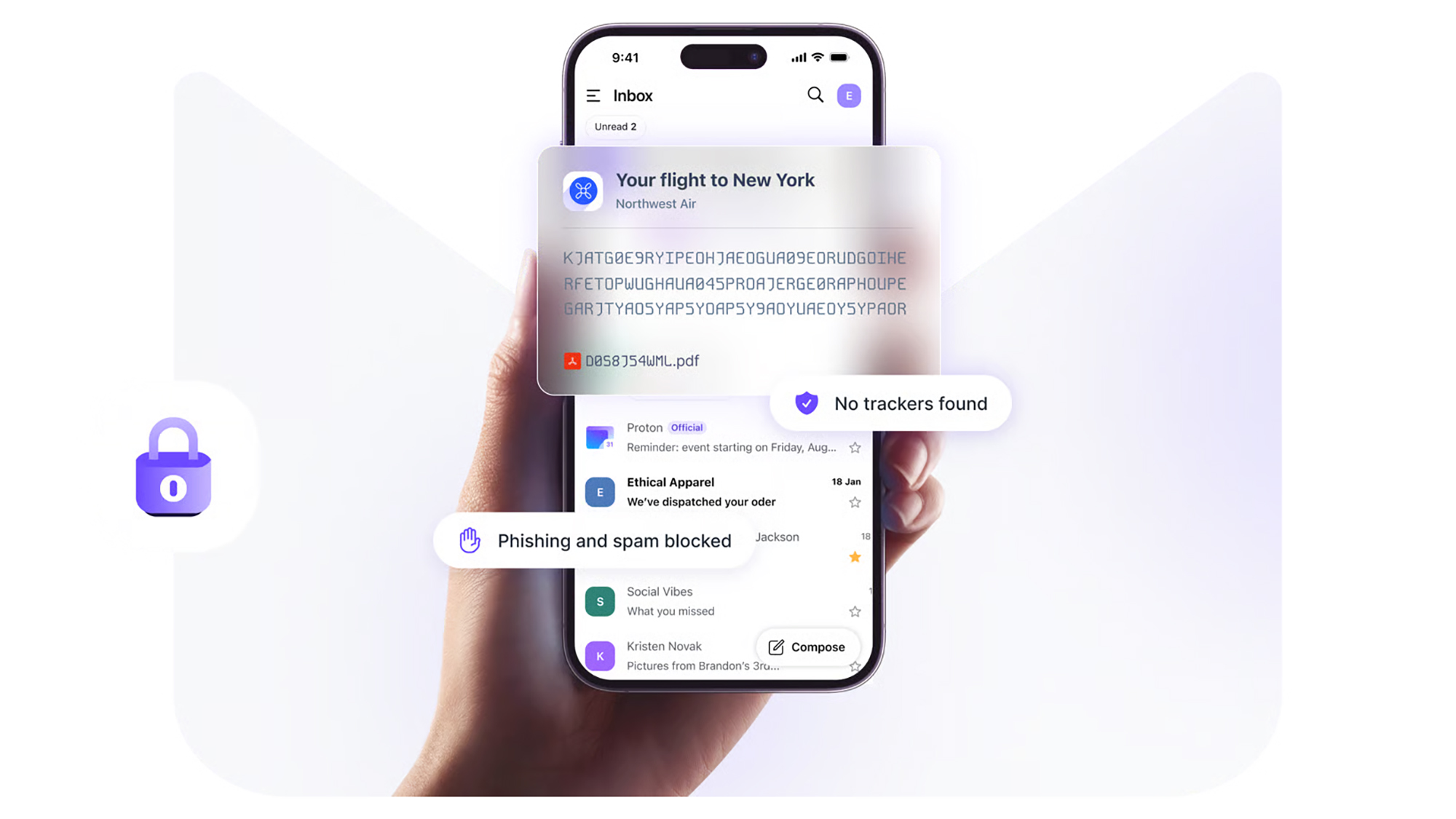
Then there’s Proton Mail, part of the Proton suite of products that prioritizes privacy and security. We’ve previously compared Proton Docs and Google Docs, and here we’re going to take a look at how Proton Mail stacks up against Gmail. It may be worth your while to switch, especially if you’re unsure about Google’s privacy policies.
Gmail vs Proton Mail: The basics
Both services are available on the web, and have dedicated apps for Android and iOS. Both have free options, with premium plans also available: Proton Mail gives you 1GB of storage for free, while Gmail gives you 15GB (though bear in mind this is also shared with Google Drive and Google Photos).
Paid plans start at $1.99 a month for Gmail and $4.99 a month for Proton Mail, but it’s hard to do a straight comparison, as a lot of other upgrades are included. Google gives you more AI features as well as more storage room, for example, while Proton gives you more usage across its VPN, Calendar, and Drive tools in addition to the extra cloud storage.
If you prefer to use a third-party email client like Apple Mail or Outlook, this is easily done on Gmail and only takes a few steps. With Proton Mail, it’s more involved: You need to sign up for a premium subscription, and use the Proton Mail Bridge app. This ensures end-to-end encryption, so not even Proton itself can read your emails (this isn’t something Gmail offers by default).
Proton Mail focuses on security and privacy. Image: Proton
Gmail vs Proton Mail: Key features
When it comes to key features, both Gmail and Proton Mail have plenty to offer, though with Proton Mail your use of labels and filters is restricted on the free plan. It supports folders though, which Gmail doesn’t. And if you pay for Proton Mail, you can set up multiple email addresses to work through one inbox, which again Gmail doesn’t support.
It’s similar with the email scheduling and snoozing features, and automatic email forwarding to another inbox. This is all free in Gmail, and requires a subscription in Proton Mail. There is also an undo send feature on both platforms, free of charge, that you can use to quickly bring back messages you’ve sent in error.
Ideally, you need to be paying for Proton Mail: Otherwise you run into restrictions on filters, folders, and labels, and the number of messages you can send (150 per day). With Gmail, all of this is supported by advertising and data collection This is the distinction Proton focuses on: You’ll never see a single advert inside Proton’s products.
Gmail vs Proton Mail: Interface
Both Gmail and Proton Mail offer a clean, modern-looking app interface that’s easy to navigate around and intuitive in the way it works. Both platforms let you customize the interface too—so you can tailor the look and feel to suit yourself (Gmail does offer more in the way of tweaks, however).
Both email platforms support keyboard shortcuts on the desktop, which can be very helpful for powering through emails and clearing out your inbox. There’s also well-done integration with the other apps offered by these companies—including Google Drive and Proton Drive, and Google Calendar and Proton Calendar.
You could argue that the Gmail app is a little bit more polished, especially on mobile, but there’s not much in it. Both platforms support conversation grouping, where emails from the same thread are bunched together for easy reference (but both also let you turn this off, if you prefer the traditional approach).
Gmail vs Proton Mail: Privacy
While Gmail may be ahead on the scorecard up to this point, it’s here that Proton Mail strikes back. The Proton offering is way ahead here, and offers full end-to-end encryption for your emails, plus password-protected emails, and expiration dates for emails.
Gmail provides some of these features in a more limited way, but they’re not enabled by default, and aren’t as comprehensive as the Proton Mail equivalent. While Google’s email servers are encrypted, Google holds the decryption keys—so messages can be accessed by Google or agencies approved by Google. The full, end-to-end encryption that Proton Mail provides means no one but you can read your emails.
Both these platforms do well in terms of anti-spam and anti-virus protection for your inbox. But on other privacy and security features, Proton Mail wins: The VPN bundled with all plans (even the free one), for instance, and the complete absence of ads.
Gmail is packed with features and functions. Image: Google
Gmail vs Proton Mail: Verdict
As you can see, the primary reason to switch to Proton Mail from Gmail is privacy and security. And if that’s what’s most important to you, then you’ll probably be okay with paying a few dollars more a month to get those features, and to make sure you’re not being tracked or advertised to in your inbox.
There’s still a lot to be said for Gmail though. It’s ubiquitous and compatible with a host of third-party apps and tools, it’s got loads of customization options and other features to play around with, and if you can stick under the 15GB storage limit then you get unlimited use of everything for free, too.
You also need to think of the inconvenience cost, of course, and it may take a while before all your contacts are right up to date with your new email address. Of course, if there are some contacts you’d rather not hear from again in the future, then switch away.
There’s a SMILE beaming down from high above Earth. On May 19, the European Space Agency (ESA) and the Chinese Academy of Sciences (CAS) launched a Vega-C rocket from Europe’s Spaceport in French Guiana with a payload representing years of international collaboration. Known as the Solar wind Magnetosphere Ionosphere Link Explorer (SMILE), the spacecraft will soon begin studying the sun’s immensely powerful solar winds and their relationship with Earth’s atmospheric safeguards.
You woul
There’s a SMILE beaming down from high above Earth. On May 19, the European Space Agency (ESA) and the Chinese Academy of Sciences (CAS) launched a Vega-C rocket from Europe’s Spaceport in French Guiana with a payload representing years of international collaboration. Known as the Solar wind Magnetosphere Ionosphere Link Explorer (SMILE), the spacecraft will soon begin studying the sun’s immensely powerful solar winds and their relationship with Earth’s atmospheric safeguards.
You wouldn’t be reading this without our magnetosphere. The protective shield generated from deep inside Earth has protected the planet from the sun’s most destructive solar winds for billions of years. Without this barrier, life could never survive on what would be a barren, irradiated rock. But while it’s clear that the magnetosphere is Earth’s natural defense system against cosmic radiation and geomagnetic storms, astronomers still aren’t sure exactly how it works.
“We are about to witness something we’ve never seen before—Earth’s invisible armor in action,” ESA director general Josef Aschbacher said in a statement.
Over the next month, SMILE will slowly increase its altitude with 11 engine burns before settling into a large elliptical orbit over the North and South Pole. Actual data collection will start in July using the spacecraft’s four tools, including a pair of X-ray and ultraviolet cameras.
SMILE is the first mission to examine the magnetosphere with X-rays, and the UV equipment will capture the northern and southern lights for up to 45 hours at a time. By combining the two data sources, astronomers hope to gain a better understanding of how the planet is affected by the sun’s constant bombardment of solar winds and frequent coronal mass ejections. The project is planned to last three years.
“The evidence that Smile collects will help us better understand planet Earth and our Solar System as a whole,” explained ESA Smile project scientist Philippe Escoubet. “And the science it uncovers will improve our models of Earth’s magnetic environment, which could ultimately help keep our astronauts and space technologies safe for decades to come.”
The U.S. has announced a new partnership with Japan on science and artificial intelligence. Energy Department Under Secretary for Science Darío Gil told reporters Thursday that each country would invest $500 million in the joint venture. “This is the defining moment for the next era of science,” he said. “We’re linking our brightest minds and...
The U.S. has announced a new partnership with Japan on science and artificial intelligence. Energy Department Under Secretary for Science Darío Gil told reporters Thursday that each country would invest $500 million in the joint venture. “This is the defining moment for the next era of science,” he said. “We’re linking our brightest minds and...
A bill aimed at regulating unauthorized AI deepfakes of a person’s likeness has been reintroduced in Congress, this time with support from Getty Images.
[Read More]
A bill aimed at regulating unauthorized AI deepfakes of a person’s likeness has been reintroduced in Congress, this time with support from Getty Images.
Agentic Coding ist der letzte Schrei im Bereich der KI-gestützten Entwicklung. In dieser Episode sprechen Eberhard Wolff und Ralf D. Müller mit Tobias Wagner und Yadullah Duman von MaibornWolff über Best Practices für Agentic Coding wie Context oder Harness Engineering - und welche Produktivitätsvorteile sich aus diesem Ansatz tatsächlich in der Praxis ergeben.
Links
Six Months of Agentic Coding in the Trenches: Lessons from a Brownfield Project
Humans and Agents in Software Engineering Loops
D
Agentic Coding ist der letzte Schrei im Bereich der KI-gestützten Entwicklung. In dieser Episode sprechen Eberhard Wolff und Ralf D. Müller mit Tobias Wagner und Yadullah Duman von MaibornWolff über Best Practices für Agentic Coding wie Context oder Harness Engineering - und welche Produktivitätsvorteile sich aus diesem Ansatz tatsächlich in der Praxis ergeben.
Agentic Coding ist der letzte Schrei im Bereich der KI-gestützten Entwicklung. In dieser Episode sprechen Eberhard Wolff und Ralf D. Müller mit Tobias Wagner und Yadullah Duman von MaibornWolff über Best Practices für Agentic Coding wie Context od...
Agentic Coding ist der letzte Schrei im Bereich der KI-gestützten Entwicklung. In dieser Episode sprechen Eberhard Wolff und Ralf D. Müller mit Tobias Wagner und Yadullah Duman von MaibornWolff über Best Practices für Agentic Coding wie Context od...
Agentic Coding ist der letzte Schrei im Bereich der KI-gestützten Entwicklung. In dieser Episode sprechen Eberhard Wolff und Ralf D. Müller mit Tobias Wagner und Yadullah Duman von MaibornWolff über Best Practices für Agentic Coding wie Context od...
Agentic Coding ist der letzte Schrei im Bereich der KI-gestützten Entwicklung. In dieser Episode sprechen Eberhard Wolff und Ralf D. Müller mit Tobias Wagner und Yadullah Duman von MaibornWolff über Best Practices für Agentic Coding wie Context od...
Agentic Coding ist der letzte Schrei im Bereich der KI-gestützten Entwicklung. In dieser Episode sprechen Eberhard Wolff und Ralf D. Müller mit Tobias Wagner und Yadullah Duman von MaibornWolff über Best Practices für Agentic Coding wie Context od...
Agentic Coding ist der letzte Schrei im Bereich der KI-gestützten Entwicklung. In dieser Episode sprechen Eberhard Wolff und Ralf D. Müller mit Tobias Wagner und Yadullah Duman von MaibornWolff über Best Practices für Agentic Coding wie Context od...
Agentic Coding ist der letzte Schrei im Bereich der KI-gestützten Entwicklung. In dieser Episode sprechen Eberhard Wolff und Ralf D. Müller mit Tobias Wagner und Yadullah Duman von MaibornWolff über Best Practices für Agentic Coding wie Context od...
Agentic Coding ist der letzte Schrei im Bereich der KI-gestützten Entwicklung. In dieser Episode sprechen Eberhard Wolff und Ralf D. Müller mit Tobias Wagner und Yadullah Duman von MaibornWolff über Best Practices für Agentic Coding wie Context od...
Agentic Coding ist der letzte Schrei im Bereich der KI-gestützten Entwicklung. In dieser Episode sprechen Eberhard Wolff und Ralf D. Müller mit Tobias Wagner und Yadullah Duman von MaibornWolff über Best Practices für Agentic Coding wie Context od...
The average person works 80,000 hours over the course of their career. Ideally, that time should be fulfilling, well-paid, and spent doing things that make the world a better place.
Of course that’s much, much easier said than done. In an increasingly fragile job market made still more fraught by AI, there’s no longer such a thing as a safe bet.
According to Benjamin Todd, most people lack a systematic approach to thinking about their career choice. Todd is the co-founder and preside
The average person works 80,000 hours over the course of their career. Ideally, that time should be fulfilling, well-paid, and spent doing things that make the world a better place.
Of course that’s much, much easier said than done. In an increasingly fragile job market made still more fraught by AI, there’s no longer such a thing as a safe bet.
According to Benjamin Todd, most people lack a systematic approach to thinking about their career choice. Todd is the co-founder and president of 80,000 Hours, a nonprofit dedicated to helping people move into careers focused on tackling the “world’s most pressing problems” — issues that include AI safety, biosecurity, global health, and animal welfare. 80,000 Hours uses the effective altruismframework of importance, neglectedness (how many resources are devoted to the problem), and tractability (or solvability) to decide which causes to prioritize.
In his new book 80,000 Hours: How to Have a Fulfilling Career That Does Good, which was released this week, Todd pulls together more than a decade of research and advising into a guide for making career decisions. It’s aimed at people just starting out as well as more experienced workers looking to make a switch, providing a framework to make career choices.
I spoke with Todd about careers and skill sets that are more resistant or adaptable to AI job disruptions, why “going with your gut” (usually) isn’t good advice, tips for landing a high-impact job offer, and other topics.
Our conversation below has been lightly edited for length and clarity.
There’s a lot of anxiety around advances in AI and job displacement, how that affects people’s job prospects and how they should think about career choices.
Yeah, I feel like when I talk to people about their careers these days, that’s the main thing that’s on their mind. … I think a lot of the simple answers about which jobs will be best [in the age of AI] are too simple.
How have the last few years — thinking about AI but also other disruptions and changes to the job market — changed your core assumptions about how people should choose their careers?
The main thing that comes to mind is we seem to be getting more and more evidence that far more capable AI will be here soon.
Then I think that just has a lot of implications for which problems are most pressing, and then potentially also which skills are most valuable. If there’s going to be a lot of change and things will be more unpredictable 10 years from now, then it makes sense to focus on shorter-term plans than to spend 10 years training to do something. Starting medical school now seems a lot more risky than it would have been 10 or 20 years ago.
When you say AI is coming and going to change things, are you talking about artificial general intelligence (AGI) specifically?
I mean there’s multiple levels. I think [where the technology is now], if it just froze here, would be kind of similar to the internet and how important it was. But the big-picture thing that seems most important is the idea that you could get to some kind of AI that can do a lot of remote work jobs at roughly a human level. That seems like it could bring the economy and science into a significantly different regime.
I’m probably a bit more skeptical than most technologists of mass near-term unemployment from AI, though I also think that most economists are still underrating how big a deal it could eventually be.
You mention in the book that managing AI agents is a skill less likely to be replaced by AI. Why is that?
I talk about four things that could make skills become more valuable in the future given technology and automation. And the second one is complementarity to AI. So it’s not that AI won’t be able to do that, it’s that it’s a skill where as AI gets better, that skill becomes more valuable. Because if AI is more useful and being used to do more things, and you can make it like 1 percent or 10 percent more efficient, then the value of that additional efficiency increases as AI becomes more useful.
Right now, AI is pretty bad at these messy, nebulous, long-horizon things where you need to coordinate between lots of people and decision-makers. I think in an intermediate future there will be a lot of the more routine work tasks that are being done by AI agents, but then there’s human managers who are needed to stitch them together.
That seems to me like that might be a very lucrative job, but that might not add up to a lot of jobs.
That comes down to how much more stuff can get done in total. And those people would be way more productive than people have been in the past, because everyone is running a team of 10 AIs. So we would want many more people doing that type of thing.
One way to think about it is that a lot of things that in the past would have been too expensive to do would become economically feasible because now you don’t need a team of 30 people to start this new nonprofit. You can do it with a team of three people and a bunch of AI. So then a lot of people could start new projects and you just get a lot more total things being done with [the aid of] AI rather than, “Oh, we have to do the same stuff as before, but with only 10 percent as many people employed.”
I think that’s maybe good for people at a mid- or senior level in their career, but it could make things harder for more entry-level people.
I think that’s a little bit too early to say. So there is some research that finds that skilled human managers are also better at managing AI agents, and there’s a kind of correlation in that skill set. There is research about the most junior software engineers, [that finds] their jobs are down 20 percent. But in some ways young people are just much more adaptable to new technology, and I find a lot of college students seem to be significantly more sophisticated at using AI.
So in some ways, and because it’s changing so fast as well, young people might be better placed to learn how to use these tools faster and adapt as they keep changing. I’m a bit less confident it’s going to be bad for the younger workers.
That’s interesting because I’ve seen quite a lot of headlines and quite a lot of anxiety from younger people around their job prospects.
I think it’s very understandable to be anxious because they’re facing far more change to the job market than any recent generation has had to face. No one really knows exactly how it’s going to shake out. I would say one point for optimism is in theory it will mean that many projects are possible that weren’t possible before. That does also open up a lot of extra opportunities for young people who I think in some ways are better placed to take on these more risky and novel things because they’re less set in their ways.
“I would say one point for optimism is in theory it will mean that many projects are possible that weren’t possible before.”
Because better or worse, AI is a force multiplier.
Totally. We were talking about this skill [at managing AI agents] being lucrative. It would also be applicable to a lot of social problems as well.
What does effective altruism get right about career choice — and wrong?
I think most people just aren’t thinking enough about the impact of their career at all, and they actually have this amazing opportunity to at a minimum save people’s lives and maybe do a lot more by helping prevent the next pandemic or being one of the only people working on AI risks.
When people are thinking about choosing a career, that should really be one of the first things they say: “The world’s facing massive problems. You could do something about them. Wouldn’t that be fulfilling and interesting? Why not do it?”
But people within effective altruism can think too much about their impact. I think people naturally compare themselves to others, but then people who get into effective altruism will tend to compare themselves based on impact. That’s better than comparing it based on how many yachts you have, but there’s still always someone who has more impact than you, and it’s easy for people to have this sense they’re not doing enough. They can potentially go into careers where they think there’s an intellectual case for being really impactful, but it’s not actually a good day-to-day lifestyle for them and they can end up getting pretty demoralized several years down the line. Those are some of the more common pitfalls.
I think you make a very compelling case that when people go with their gut, when they try to make career choices based on intuition, they aren’t always very good at that. You recommend a more systematic approach to thinking this through. Do you think people usually benefit from an outside observer acting as a sounding board?
I do encourage people to work through a systematic approach, especially when it comes to assessing personal fit. A lot of the advice is really about getting out of your head. I think oftentimes the most useful thing people can do is just apply to lots of positions and see what they get.
Often the best way to assess your fit is to speak to someone who has experience hiring in [that] area, they’re the people who’ve done the most assessing of who is going to succeed in a path.
In general, getting an outside perspective is super useful. That’s part of one of the big benefits of the one-on-one advice we offer on the 80,000 Hours website. … You can not consider enough options or factors, so getting an outside perspective is one of the best ways to help broaden your frame and make sure you haven’t missed something.
The key is to have a mixture of a more systematic approach and not do something your gut is actively worried about without understanding the reasons. There’s lots of research that shows that guts are bad at stock picking or predicting which person is going to succeed in some 10-year career path. But your gut is really good at things like, “Do I trust this person?” because that’s what we’ve evolved to be really good at guessing, and it’s something you have had a decent amount of practice about over your life. So if your gut is worried about a path, that might be picking up on something that actually you’re not excited about. The advice I give is don’t go with your gut, but do check with it. So I also wouldn’t say to totally ignore your gut either.
I think some people will chafe at the idea that some career paths are far more impactful than others. What would you say to more skeptical readers? People who would be reluctant or unable to retrain?
In the introduction, I mention this study where people were surveyed on how much they thought different charities more effectively save lives than others. They thought the best charity would be about 50 percent more effective than an average one at saving lives. Our intuitions are very bad at grasping big differences in scale. … When you ask experts in global health, they say there’s a hundred times difference between the most effective charity and the average for saving lives. It seems like no one knows about these differences even though it’s a huge deal. It means you could work for 10 years on a path and then retire and do whatever you most enjoy for the remaining 30 years and still achieve what would have taken hundreds of years working in one of the less effective charities.
I would actually advocate that people keep working rather than retire, but because there’s these huge differences in impact, it actually means it should be possible to find something that is both better for you personally and more impactful for the world.
There is a chapter in the book about what you can do that’s the most impactful thing without changing jobs if you’re already in a career. I talk about donating 10 percent of your income [to effective charities], political advocacy, and even just “slacktivism.” When most people do that they just tweet into their echo chamber … but if you’re talking about something that actually is a huge deal that no one knows about, [it can be effective.]
Another example I use is if you can help someone else find a really impactful job, then that has just as much impact as doing the job yourself. … I talk about being a multiplier.
How can people realistically transition into higher-impact careers, especially if those paths come with greater uncertainty in the age of AI?
It depends a lot where someone is starting from. … There’s more and more fellowships that are designed to help people transition [into higher-impact careers] quickly. You did the Horizon Institute for Public Service fellowship, which I would say is in this genre.
For more experienced people, if you’re an accountant or something like that, lots of organizations need people doing operations and accounting so they might sometimes hire people from outside the field pretty quickly. If that doesn’t work, it’s more of a case of thinking over one or two years, asking, “How can I best position myself to get one of these jobs?”
For that, you could look at the list of skill sets in the guide and think about whether you could learn any of these skills. There’s also a chapter on types of jobs that are really good for gaining skills quickly. One example is working at smaller, rapidly growing organizations, because you can advance faster and those roles tend to be more generalist. That type of generalist skill set is really useful in a lot of social impact organizations, and it means you can do things with AI earlier and get stuff done using those tools. Whereas if you go to a larger organization instead where the work tends to be more routine, that’s closer to something that AI is going to be able to do sooner.
What advice do you have for people with financial constraints that require them to secure a role right away, even if it may not be the highest impact or greatest fit?
I see impact as one important factor, but your own well-being matters too. You might also have dependents as well. Ultimately, you have to make your list of options and then choose the one that’s best given your goals. If money is a priority for you right now, then I think you should focus on that. There’s no shame in it.
I also talk about the idea of having a plan Z, [if your plan A and B don’t work out] that on some level you’re okay with. If you can’t do that, then you should focus on getting yourself into a stronger position first. Maybe you need to focus more on things like building skills or saving money which will mean you can take bigger risks later.
There’s this axiom that the best time to get a job is when you have a job, so you have more leverage or experience. How true do you think that is?
What most helps in getting a job is doing something as close as possible to the actual work. Obviously being in a job already is a very good way to demonstrate that you can do the work. But people who don’t have jobs already can often find ways to do that, like a portfolio project.
I talk about the “pre-interview” project, where you come to the interview with a specific proposal [to the company you’re applying] for how you would help them with some challenge the organization is facing … most jobseekers don’t have that level of understanding of a position. So you’re already standing out just by having thought about it.
Britain’s artificial intelligence sector has produced its first heavyweight league table of 2026, with Barclays placing Oxford-founded chip designer Fractile and Google DeepMind spinout Isomorphic Labs at the centre of its new AI 100 ranking, a list that crystallises just how quickly the UK’s AI economy is maturing.
The bank’s Eagle Labs division, the high-street lender’s start-up incubator network, unveiled the inaugural ranking this week to spotlight the country’s fastest-growing AI businesses
Britain’s artificial intelligence sector has produced its first heavyweight league table of 2026, with Barclays placing Oxford-founded chip designer Fractile and Google DeepMind spinout Isomorphic Labs at the centre of its new AI 100 ranking, a list that crystallises just how quickly the UK’s AI economy is maturing.
The bank’s Eagle Labs division, the high-street lender’s start-up incubator network, unveiled the inaugural ranking this week to spotlight the country’s fastest-growing AI businesses. Its publication coincides with what is shaping up to be a record year for the sector, with UK AI companies hoovering up £8.3bn of investment in 2025 alone and cementing London’s status as Europe’s most prolific AI capital.
For Britain’s policymakers, under pressure to deliver on the Prime Minister’s pledge to “mainline AI into the veins” of the economy, the league table arrives at a politically charged moment. For investors, it offers a useful shortlist of the companies global capital is now chasing hardest.
Oxford chip pioneer joins the unicorn club
Few names on the ranking have captured boardroom attention quite like Fractile. The Oxford-founded business, set up in 2022 by former university researcher Walter Goodwin, this week banked a $220m (£165m) Series B led by Peter Thiel’s Founders Fund, with Accel and Factorial Funds joining the cheque.
The round vaults Fractile into the so-called unicorn bracket and underlines a belief among Silicon Valley’s most influential investors that the next great AI bottleneck will not be cleverer algorithms, but the eye-watering cost of running them. Mr Goodwin’s firm is racing to build inference chips that promise to slash the price of deploying AI models at commercial scale, a problem that has come to dominate boardroom conversations from Wall Street to Whitehall.
Industry watchers say the deal is one of the clearest signals yet that British deep-tech, long accused of losing its champions to American buyers, can hold its own on global capital markets. It also lands at a moment when Westminster is leaning heavily on the semiconductor sector to underpin its growth narrative, having earlier expanded backing for chip start-ups through the ChipStart programme.
Isomorphic eyes a pharma revolution
If Fractile represents the picks-and-shovels end of the AI gold rush, Isomorphic Labs sits at the other extreme. The London-based drug-discovery business, spun out of Google DeepMind in 2021 under the stewardship of Sir Demis Hassabis, recently sealed a $2.1bn (£1.57bn) funding round, one of the largest AI raises seen in Europe to date.
The company is using machine learning to accelerate the early-stage development of new medicines, an area where pharmaceutical giants have spent years grappling with stubbornly long timelines and ballooning research budgets. Big Pharma is already paying attention: AstraZeneca and Eli Lilly have inked partnerships, and a maiden in-house drug candidate is expected to enter clinical trials before the end of the year.
For an industry where the average new medicine takes more than a decade and over $2bn to bring to market, the prospect of AI compressing that timeline is no longer theoretical. It is precisely the sort of productivity dividend that researchers at HSBC say could deliver a £105bn revenue uplift to Britain’s mid-sized firms by 2030 if AI adoption keeps pace.
A boom under scrutiny
Yet for all the bullish numbers, Britain’s AI investment surge is not without its sceptics. A recent investigation by the Guardian questioned whether several headline-grabbing pledges promoted by ministers — including data-centre commitments linked to Nvidia-backed groups Nscale and CoreWeave, had been overstated.
The newspaper reported that some projects billed as brand-new infrastructure were in reality expansions of existing facilities. The Department for Science, Innovation and Technology (DSIT) rejected the bulk of the claims but conceded it was “not playing an active role in auditing these commitments”.
The episode is symptomatic of a broader credibility test now facing governments worldwide as they trumpet AI as the engine of future growth. The UK has so far announced a £500m Sovereign AI Unit and additional billions of pounds in compute and infrastructure spending, but ministers are increasingly being asked to demonstrate that the eye-catching figures translate into real jobs, factories and tax receipts.
A maturing market
Even so, the trajectory looks unmistakable. With more than £8bn raised across the sector last year, five fresh unicorns minted and at least 67 exits worth a combined £4bn, the British AI ecosystem is no longer trading on potential alone. Smaller players are also benefiting: Eagle Labs’ broader incubator network, which has supported thousands of regional start-ups through schemes such as its £12m regional grant programme, is increasingly being used as a pipeline-builder for the next cohort of AI 100 candidates.
For Barclays itself, the ranking is a useful piece of brand-building among the founders it hopes to bank for years to come. For Britain, it is something rather more consequential, an early glimpse of the companies that may, within a decade, sit alongside the country’s established corporate giants.
As one venture capitalist put it this week: “Five years ago, you’d struggle to name three UK AI businesses worth backing. Today you can’t fit them on a single page.” On the strength of Barclays’ latest list, that problem is unlikely to disappear any time soon.
Fast food chain Wendy’s is giving away free limited-edition Canon PowerShot G7 X Mark III digital cameras today featuring a red design inspired by its menu.
[Read More]
Fast food chain Wendy’s is giving away free limited-edition Canon PowerShot G7 X Mark III digital cameras today featuring a red design inspired by its menu.

 Login
Login