Normal view

  • ✇Popular Science
  • 7 sciatica stretches and exercises for pain relief Jordan Burchette
    Sciatica afflicts millions of people each year—though not as many people as think they have it. A growing catchall term among the undiagnosed for all manner of back problems, sciatica is a specific lower-back nerve condition that requires specific action to address. “Early detection matters,” John Gallucci Jr. MS, ATC, PT, DPT, the CEO of JAG Physical Therapy, tells Popular Science. “If you start feeling sciatica pain, do not wait to get it treated. Prolonging the pain will only make it worse
     

7 sciatica stretches and exercises for pain relief

10 May 2026 at 17:33

Sciatica afflicts millions of people each year—though not as many people as think they have it. A growing catchall term among the undiagnosed for all manner of back problems, sciatica is a specific lower-back nerve condition that requires specific action to address.

“Early detection matters,” John Gallucci Jr. MS, ATC, PT, DPT, the CEO of JAG Physical Therapy, tells Popular Science. “If you start feeling sciatica pain, do not wait to get it treated. Prolonging the pain will only make it worse.” 

So, anyone seeking sciatica stretches and exercises should be certain they’ve received the right diagnosis for what they’re suffering before embarking on a concerted effort to relieve it. Once they do, however, they’ll find that sciatica can be improved fairly simply.

We asked Dr. Gallucci about the physical therapy exercises for sciatica he recommends, and he bent over backwards—don’t worry, it’s forward movement that triggers sciatica—to help. Learn about each below along with the symptoms, provocations, and prevention methods of sciatica.

What is sciatica? 

Sciatica refers to pain or tingling caused by irritation of the sciatic nerve, which governs much of your lower body function. It’s the body’s largest nerve, running from several roots in the lower spine, through the glutes, then down the back of the thigh and into the lower leg and foot.

“When any portion of this nerve becomes compressed or inflamed, the result can be pain or altered sensation anywhere along its long pathway,” Gallucci says.

A common misconception among amateur orthopedists mischaracterizes any lower back pain as sciatica, but that label applies strictly to pain originating from the sciatic nerve. Notably, a condition called piriformis syndrome can mimic sciatica symptoms due to the proximity to the sciatic nerve of the piriformis muscles that connect the spine and femur. Sciatica and piriformis syndrome stem from different causes and call for different remedies.

6 signs of sciatica

Sciatic pain is characterized by a sharp, shooting sensation that radiates from the low back into the buttock and leg, typically following along a discernible line. Besides pain, there are several other indicators of sciatica to watch for, according to Dr. Gallucci.

  • Numbness or tingling in the buttock, thigh, calf, and/or foot.
  • Leg or foot weakness such as difficulty lifting the toes or pushing off when walking.
  • Muscle spasms in the low back or glutes, often triggered by transitions like standing up from sitting or rolling in bed.
  • Worsened symptoms after prolonged sitting or long car rides. Many patients report “burning” or a “deep ache” after 20 to 40 minutes of sitting.
  • Pain that eases with gentle walking.

In the vast majority of cases, sciatica only affects one side of the body at a time. 

When to see a doctor

If you experience these more serious symptoms, seek immediate medical care:

  • Leg weakness that causes stumbling
  • Numbness in the groin or “saddle” area
  • Change in bowel or bladder control

What causes or worsens sciatica?

The most common cause of sciatica is a herniated or bulging lumbar disc, something only an MRI or CT scan can confirm. There are a number of factors that can contribute to both.

  • Age: Sciatica appears to peak among people in their forties.
  • Prolonged sitting: especially when combined with poor posture or deep, couch-style seats.
  • Job: Incidence of sciatica has shown to be higher for certain occupations, including machine operators, truck drivers and workers placed in awkward positions (see below).
  • Lifting with poor mechanics. Failing to use proper form when picking up even moderately heavy objects can overload the lumbar spine both acutely and chronically.
  • Smoking: Cigarette use causes blood vessels to constrict, reducing an already limited nutrient supply to spinal discs, which may degrade faster with prolonged smoking.
  • Tight hip flexors or hamstrings, which increase lumbar stress.
  • Weak core and glutes, which can increase nerve strain and decrease stabilization.

Sciatica is generally inflamed by movements involving repetitive lumbar spine flexion (think: crunching), twisting of the trunk, frequent elevation of arms above shoulder height, even coughing. Prolonged sitting while driving or working at a desk can exacerbate this by increasing load on the intervertebral discs in your lower back, which can further irritate a herniated disc.

One thing that doesn’t appear to have an impact on sciatica is gender; no greater predisposition has been shown among men or women, though men are two to three times likelier to experience sciatica owing to their greater incidence of physically demanding work.

Most cases of sciatica resolve in four to six weeks with no long-term complications, even absent medical treatment. More severe cases may be accompanied by a longer recovery time.

7 Stretches and Exercises to Help Relieve Sciatica

The answer to your back pain is likely some form of movement. This selection of glides, stretches and exercises recommended by Dr. Gallucci provides seated, standing and lying options to decompress the lumbar spine and reduce pressure on the sciatic nerve.

1. Sciatic nerve glide (or “flossing”)

So called because it’s not quite a stretch, rather this movement gently mobilizes the nerve—rather than lengthening the muscle—to decrease sensitivity and improve circulation.

  • Sit upright on the edge of a chair with both feet flat on the floor.
  • Slowly straighten your right knee while pulling your right toes upward.
  • Return to the starting position by returning your right foot to the floor while simultaneously bringing your chin toward your chest.
  • Repeat by straightening your knee and bringing your head back up to neutral.

Reps: 10 to 15 per leg, 1 to 2 times per day

Tip: This movement should feel smooth, so avoid any sharp pulling.

2. Figure-4 piriformis stretch

This more conventional seated stretch reduces tension in the piriformis, a common compression point.

  • Sit upright on the edge of a chair with both feet flat on the floor.
  • Cross the ankle of your right leg over your left thigh, just above your knee. 
  • Keeping your spine straight, gently lean forward until you feel a stretch and hold for 20 to 30 seconds.

Reps: Perform 2 to 3 rounds per leg.

Tip: Pull your knee toward the opposite shoulder for a deeper stretch.

3. Cat-cow spinal mobility

This classic yoga sequence improves spinal mobility and decreases stiffness around irritated segments.

  • Get down on the floor in tabletop position, with your hands directly under your shoulders and your knees directly under your hips.
  • Round your spine up toward the ceiling while simultaneously tucking your chin toward your chest and drawing your belly button inward.
  • Reverse the move, slowly arching your back, while lifting your chest and tailbone upward, allowing your abdomen to relax.

Reps: Perform 10 to 15 cat-cows in a slow and controlled manner.

Tip: Focus on smooth lumbar movement rather than forcing large ranges of motion.

4. Child’s pose

Another yoga-inspired stretch that gently lengthens the spine and reduces lower-back pressure.

  • Get down on the floor in tabletop position, with your hands directly under your shoulders and your knees directly under your hips.
  • Sit your hips back toward your heels, and extend your arms forward on the floor. 
  • Allow your forehead to rest on the floor and hold for 30 to 45 seconds

Tip: If your knees bother you, widen them or rest on a pillow.

5. Standing hamstring stretch

The lone standing movement on the list helps loosen hamstrings and relieve stress on your lumbar spine.

  • Stand tall with your feet hip-width apart.
  • Plant your right heel on the floor slightly in front of you with your knee straight and your toes pointing upward.
  • Keeping your back flat, gently hinge forward at your hips until you feel a stretch in the back of your thigh.
  • Hold for 20 to 30 seconds and repeat on the other leg.

Tip: Lengthen through your spine, hinging at your hips rather than rounding your back.

6. Glute bridge

This lying hip extension exercise strengthens glutes and the posterior chain, reducing load on your lumbar spine.

  • Lie on your back with your arms at your sides and your feet flat on the floor.
  • Engaging your core, drive through your heels and lift your hips toward the ceiling until your body forms a straight line from your knees to your shoulders.
  • Slowly lower your hips back to the floor.

Reps: Perform 12 to 15 bridges per set, completing 2 to 3 sets.

Tip: Avoid arching your lower back.

7. Side-lying clamshell

Reduce load on your lumbar spine by strengthening your hip abductors, piriformis muscles, and glutes with this abduction exercise.

  • Lie on your right side with your hips stacked and your knees bent 90 degrees. Rest your head on your right arm if it feels comfortable.
  • Draw your knees in toward your body until your feet are in line with your glutes.
  • Without allowing your hips to rotate, raise your top knee as far as you can and return it to the starting position.

Reps: Perform 20 to 30 clamshells per set, completing 2 to 3 sets per side.

Finally, it’s important to note that this article is intended for informational purposes only and does not constitute medical advice. You should always consult a healthcare professional before beginning a new exercise or treatment regimen.

The post 7 sciatica stretches and exercises for pain relief appeared first on Popular Science.

  • ✇Popular Science
  • Neanderthals dined on shellfish much earlier than humans Andrew Paul
    For decades, many paleoarchaeologists believed Neanderthals went extinct largely because they just weren’t intelligent enough to compete with their Homo sapien relatives. However, mounting historical evidence suggests this was far from the case. The latest discovery to help the Neanderthal’s reputation ion? The ancient hominins knew when and how to safely snack on shellfish potentially thousands of years before their human descendants. The findings published today in the Proceedings of the Na
     

Neanderthals dined on shellfish much earlier than humans

18 May 2026 at 19:00

For decades, many paleoarchaeologists believed Neanderthals went extinct largely because they just weren’t intelligent enough to compete with their Homo sapien relatives. However, mounting historical evidence suggests this was far from the case. The latest discovery to help the Neanderthal’s reputation ion? The ancient hominins knew when and how to safely snack on shellfish potentially thousands of years before their human descendants.

The findings published today in the Proceedings of the National Academy of Sciences focus on Neanderthals who lived at Los Aviones Cave in present-day Cartagena, Spain. Researchers discovered the remains of 115,000-year-old mollusks including gastropods and limpets that were clearly harvested as food. This contradicts past theories about Neanderthals, which suggested they had difficulty adapting to coastal environments and utilizing marine resources. What’s more, the Neanderthals here didn’t eat shellfish in large quantities all the time. Instead, they knew to make the most of them between November and April during the colder seasons.

Cave next to ocean water
Los Aviones Cave in Spain is a notable Neanderthal archaeological site. Credit: ICTA-UAB

“They consumed marine resources throughout the year, but with a very clear preference for winter and autumn months,” explained Asier García-Escárzaga, a study co-author and archaeologist at Spain’s Universitat Autònoma de Barcelona Institute of Environmental Science and Technology.

García-Escárzaga says this seasonal pattern often followed by more modern human populations in Europe wasn’t a coincidence. The winter reproduction cycle of many mollusks also results in higher amounts of meat as well as improved flavor and texture. Summer months increase health risks like toxic algae contamination or rapid spoiling.

But how did researchers determine exactly when these shellfish were harvested? It all has to do with the mollusks’ shell carbonate and their oxygen isotopic levels. This level fluctuates depending on seawater temperature and functions like a “prehistoric thermometer,” according to García-Escárzaga.

The findings reveal that Spain’s coastal Neanderthals relied on a diverse diet featuring high-quality oceanic proteins filled with Omega-3 and zinc, both of which aid in reproductive health and brain development. With that in mind, it’s entirely possible that humans’ closest evolutionary ancestors influenced our own love of shellfish.

“What we see at Los Aviones is a fully modern subsistence strategy,” García-Escárzaga and his colleagues wrote in their study.

The post Neanderthals dined on shellfish much earlier than humans appeared first on Popular Science.

  • ✇Popular Science
  • NASA satellite images show how a massive tsunami in Alaska changed the landscape forever Laura Baisas
    New satellite images are helping scientists understand a major tsunami that changed the landscape of a popular tourist destination in Alaska forever.  On August 10, 2025, a tsunami larger than the Eiffel Tower ripped through Tracy Arm fjord in southeast Alaska. The rapid retreat of the South Sawyer Glacier triggered a landslide that swept huge rocks down the picturesque waterway visited by millions aboard Alaskan cruises every summer. At least 64 million cubic meters of rock slid down the slo
     

NASA satellite images show how a massive tsunami in Alaska changed the landscape forever

12 May 2026 at 14:45

New satellite images are helping scientists understand a major tsunami that changed the landscape of a popular tourist destination in Alaska forever. 

On August 10, 2025, a tsunami larger than the Eiffel Tower ripped through Tracy Arm fjord in southeast Alaska. The rapid retreat of the South Sawyer Glacier triggered a landslide that swept huge rocks down the picturesque waterway visited by millions aboard Alaskan cruises every summer. At least 64 million cubic meters of rock slid down the slope of the glacier. The rocks created an enormous tsunami that stripped trees and other vegetation from the opposing fjord wall up to 1,578 feet above sea level. 

The NASA-USGS Landsat satellite images show the dramatic changes to the landscape. In one photo taken on July 26, 2025, the fjord is surrounded by green vegetation. 

a satellite image showing green vegetation on a fjord
The shores of Tracy Arm on July 26, 2025. Image: NASA Earth Observatory images by Michala Garrison, using Landsat data from the U.S. Geological Survey.

In the second image, taken nine days after the landslide on August 19, the fjord is dominated by a gray scar made by the cascading rock. 

a satellite image of a landslide
The shores of Tracy Arm on August 19, 2025. This image was taken after the tsunami and landslide. Image: NASA Earth Observatory images by Michala Garrison, using Landsat data from the U.S. Geological Survey.Image: NASA Earth Observatory images by Michala Garrison, using Landsat data from the U.S. Geological Survey.

“The bright landslide scar on the north side of the fjord is striking, as is the ‘bathtub’ ring around the fjord showing the areas where the forest was leveled by the tsunami,” said Dan Shugar, a geomorphologist at the University of Calgary.

Sawyer Island, located about 6 miles away from the landslide, also turned from green to brown. Only a few trees still stood at the island’s higher elevations.

Over the past several months, Shugar and his colleagues combined satellite, airborne, and ground-based observations with eyewitness accounts and simulations to build a complete story with how this historic event transformed. Their analysis was published May 6 in the journal Science.

Their analysis found that water continued to slosh around the fjord for more than one day. Geologists call this water-sloshing phenomenon a seiche. Both the landslide and resulting seiche produced seismic signals that were detected around the world and equivalent to a magnitude 5.4 earthquake.

a landslide scar
The landslide scar and the zone where vegetation was stripped by the resulting tsunami are both visible in this aerial photo of Tracy Arm and South Sawyer Glacier, captured on August 13, 2025. Image: U.S. Geological Survey/John Lyons

The Landsat images also show that the South Sawyer Glacier retreated significantly in less than a month. Typically, glacial retreat takes much longer. 

“Part of that occurred between the date of the first image and the date of the landslide,” Shugar said. “But part of it is from the landslide itself, which broke off a big chunk of the terminus of South Sawyer Glacier, resulting in a slurry of icebergs in the fjord.”

Fortunately, no one was injured in the event, largely because it occurred around 5:30 a.m. local time. The wave did sweep away some gear from a group of kayakers camping on Harbor Island near the fjord’s mouth. Passengers aboard a small cruise ship in neighboring Endicott Arm also reported swings in water levels and a strong current associated with the tsunami

In response to the event, at least six cruise lines have eliminated the Tracy Arm fjord from their itineraries for 2026 due to the hazards. The United States Geological Survey also warns that steep, mountainous landslide areas are “inherently unstable” and that the Tracy Arm fjord tsunami will likely continue to change the landscape.

The post NASA satellite images show how a massive tsunami in Alaska changed the landscape forever appeared first on Popular Science.

  • ✇Popular Science
  • How hackers can break into AI servers with an off-the-shelf antenna Yook JiHun
    The word ‘hacker’ comes loaded with a cliched image: A hoodie-clad loner hunched over a keyboard in a room lined with monitors. The stereotype stuck for a reason. And for decades hacking really did come down to how well a hacker could operate a computer. That trend might change. The next generation of attacker may have more in common with a cat burglar than a code monkey. They slip physically close to a target instead of typing their way in. Some of the sharpest new attacks skip the login scr
     

How hackers can break into AI servers with an off-the-shelf antenna

26 May 2026 at 13:00

The word ‘hacker’ comes loaded with a cliched image: A hoodie-clad loner hunched over a keyboard in a room lined with monitors. The stereotype stuck for a reason. And for decades hacking really did come down to how well a hacker could operate a computer.

That trend might change. The next generation of attacker may have more in common with a cat burglar than a code monkey. They slip physically close to a target instead of typing their way in. Some of the sharpest new attacks skip the login screen entirely. They reach straight into the hardware, sometimes from the other side of a wall.

The researchers behind the discovery are led by Prof. Han Jun of KAIST, working with researchers from the National University of Singapore and Zhejiang University in China. At NDSS (Network and Distributed System Security) 2026, they demonstrated that an antenna trained on a running computer can capture the faint electromagnetic leakage from its GPU. This new technique was enough to reconstruct the layer structure of the AI model inside, with up to 97.6 percent accuracy. They call the technique ModelSpy, and it works even through a wall.

If this technique fell into the wrong hands, stealing a company’s AI would hardly look like an attack. Someone could walk down the hallway with a 20-liter backpack of antenna and receiver tucked inside and walk back out with the blueprint of the AI model running on that floor. No malware, no breached server, no exposed source code, not a single line of planted code. Just the AI’s design, leaking out as electromagnetic noise. The research won the Distinguished Paper Award at NDSS 2026.

Stealing AI without touching the computer

AI has gotten valuable enough that plenty of people are now trying to figure out how to steal it. None of the usual paths are easy. You can break into the company’s network and plant malicious code. But planting anything on a hardened corporate server is hard, and getting caught is easy. What about going after the hardware directly, skipping the software entirely?

The most promising example is the side-channel attack. Instead of breaking in, an attacker just listens. Any running computer leaks signals like small flickers in the current it draws, the heat coming off the chips, the hum of its fans, the faint vibrations of its components. Read those signals carefully enough, and they can tell you what the machine is doing inside. Researchers have been chasing that idea for decades.

Some of this work has been done. Researchers have clipped sensors onto the power lines feeding a GPU, and they’ve stripped chips bare to probe their internals directly. The catch is always the same: you have to be standing next to the machine, hands on the hardware.

The KAIST researchers wanted to know if they could pull off a side-channel attack from a distance by listening to it. The idea was to reassemble the signals that leak from a computer as it runs, and work backward through them to uncover the architecture of the AI inside. But how do you reconstruct a model from a few stray waves of static? The answer comes down to what GPUs unwittingly emit while they compute.

A running GPU is electricity in constant motion, current racing through millions of circuits as they pass signals back and forth. Nothing in a GPU ever rests. The memory clocks keep the rhythm of data access, voltage regulators hold the power steady, refresh circuits rewrite the memory before it forgets itself. Each of these subsystems gives off its own electromagnetic signature as it works. Engineers call them carrier waves.

Those carrier waves are not steady. The moment a GPU starts running an AI model, its electromagnetic emissions begin to shimmer. They rise and fall as the current through the chip shifts to match whatever the model is computing and however often it needs to reach into memory. The GPU’s memory-access patterns are imprinted like traces onto the waves it gives off.

So those memory patterns ride on the carrier waves like a signature of the AI itself. A modern model is a stack of layers, each one feeding its output into the next. The final answer falls out of the top of the stack. The key is that different kinds of layers hit memory in very different ways. Some pull in huge chunks of data at once for heavy processing. Others make short repeated trips to grab a little at a time. Read the carrier waves carefully enough and in principle you can trace those memory patterns backward to reconstruct which layers ran in what order. Pulling this off in practice is another matter.

But working backward from those traces to the actual AI behind them is the hard part. The space of candidates is enormous. Models vary wildly in how many layers they have and what kinds. Each layer brings its own hyperparameters, with the possibilities multiplying until they grow unmanageably large. The researchers estimated that even under a simplified setup of just five layer types across a 100-layer network, the number of possible combinations runs to about 10 to the power of 70. For reference, the observable universe holds roughly 10 to the 24th power stars. Testing every candidate one by one is obviously off the table.

So they set out to fight AI with AI. The researchers built a separate analytical model, trained to take in electromagnetic patterns and guess at the architecture they came from. The trick was to keep the model from trying to read the whole signal in one bite. Instead it works in layers, moving from the broad shape of the waveform down to the fine grain. First the model reads the overall flow of the signal along with its surrounding context, since a single instant of waveform tells you almost nothing on its own. Then it slices the signal into thin time windows and classifies each slice by layer type. Lastly, it estimates the hyperparameters that go with each layer. All three stages were trained together as one piece rather than being bolted on top of each other.

What pushed the technique past the bar was the training data. The analytical AI needed clean and abundant examples to learn from, but real electromagnetic recordings were noisy and patchy — the kind of data it would face in an actual attack. So the researchers turned to something else. DRAM traces are time-stamped records of how a GPU’s memory is accessed while it runs an AI model. Since the GPU’s electromagnetic emissions are nothing more than DRAM activity riding on signal strength and leaking outward, the two are essentially mirror images of each other.

The catch is where they come from. DRAM traces are captured directly inside the GPU, which makes them far cleaner than anything an antenna can pick up from outside. The researchers trained the model on both sources in stages. The AI first built its foundation on clean and plentiful DRAM data, then sharpened its real-world instincts on electromagnetic signals. The electromagnetic data was harder to collect but closer to actual attack conditions.

To test the attack, the researchers ran it against five everyday Nvidia GPUs (RTX 3060, 3060 Ti, 3070, 4060, 4060 Ti). All of it is gear you can buy off the shelf. Their attack kit was equally ordinary. A 5GHz antenna and an electromagnetic receiver were the only equipment, both small enough to fit inside a 20-liter backpack. The goal was to mimic what an actual attacker would do. They had to capture the emissions from across the room with no way of touching the machine.

The DRAM trick paid off. Pretraining on DRAM traces before fine-tuning on electromagnetic recordings beat training on electromagnetic data alone by a wide margin. Layer segmentation accuracy climbed from 92.5 percent to 97.6 percent. The task is to identify which layer each point in the signal belongs to. Accuracy at estimating each layer’s hyperparameters rose from 86.2 percent to 94.2 percent. And the gains held across all five GPUs.

Distance did not kill the attack. Using an RTX 3060 Ti as the test target, the researchers backed the antenna farther and farther away and watched what happened to the numbers. At five meters, layer segmentation accuracy held at 86.7 percent. Hyperparameter estimation remained at 81.7 percent. The researchers estimate the technique stays usable out to about six meters. The signal weakens as you back away, but enough of its traces survive to keep the analysis going.

An antenna hidden inside a backpack can extract the architecture of an AI model from the other side of a wall.

The same held when they put a wall between the GPU and the antenna. The researchers ran the test through glass, then wood, then concrete. Layer segmentation accuracy stayed at roughly 96 percent in every case. The electromagnetic waves leaking from the GPU weren’t fully blocked by the walls. They passed partway through, holding on to enough signal for the model to read.

ModelSpy has clear limits though. It cannot reach an AI model’s weights, the numerical values learned during training. It cannot pull out the training data or the source code either. What it captures is the architecture, and only the architecture. That does not mean there is no cause for concern. A stolen blueprint alone can be enough for a hacker to design a dangerous attack.

Once an attacker has the layer structure and hyperparameters, they can build a model that behaves like the target. The technique is known as a surrogate model. Instead of going at the real system blind, the attacker can run any number of attacks against the surrogate first. The effective ones then get turned on the actual AI. A model that closely mimics the target’s inner workings turns any attack into something much closer to a precision strike.

Take the adversarial example attack. Imagine someone going after the traffic-sign recognition system in a self-driving car. To the human eye it looks like an ordinary stop sign. Stick a small piece of tape on its face or paint a subtle pattern across it and the AI can be tricked into reading it as a speed limit sign or a straight-ahead sign. A car that misreads its signs can accelerate through an intersection where it should stop, or turn into the wrong lane.

The researchers used ModelSpy itself to put the surrogate-model idea to the test. They built a surrogate from the architecture ModelSpy had estimated, then used it to test adversarial attacks. These are attacks designed to make an AI misjudge what it sees. Attacks built on ModelSpy’s estimate performed almost as well as attacks designed with full knowledge of the real model. The gap averaged just four percentage points.

Copying the AI itself may be on the table too. In a so-called model extraction attack the attacker hammers the target with queries to capture its outputs and trains a replica on what comes back. It is imitation learning in effect with a stolen AI as the teacher. The catch is knowing what kind of model to imitate. Without the architecture, building something that performs as well as the original takes far more data and far more compute. The result is usually off anyway. With the architecture in hand, a close replica is fast and cheap.

A copyable AI is also a leakier AI when it comes to privacy. A surrogate model also sharpens what is called a membership inference attack. This is a way of working backward from a model’s behavior to figure out who and what was in its training data. The attack rests on a simple quirk. An AI responds in subtly different ways to data it was trained on than to data it has never seen. The distribution of its outputs shifts just a little when it encounters something it has seen before. An attacker who can spot that shift can infer whether a specific piece of data was part of the training set.

Once ModelSpy hands them a surrogate that closely matches the target’s architecture, they can do that inference with far greater precision. Sensitive training data makes the threat far worse. Medical AI is the obvious example. A membership inference attack against such a model can be devastating. Imagine a hospital running a diagnostic AI that was trained on its own patients’ records. Once an attacker confirms that a specific person’s record was part of that training set, they learn more than the fact that the person was treated at that hospital. They also learn by implication that the person may have the particular condition that AI was built to diagnose.

The researchers have proposed two countermeasures. The first is electromagnetic jamming: deliberately blanket the GPU’s signal with artificial noise so the real emissions can’t be picked out. The second is an obfuscation technique that runs decoy computations alongside the real ones to mask the traces of actual AI inference. Neither is a perfect solution. Careless jamming can spill over into the Wi-Fi band and knock out office communications. Decoy computations slow the GPU down and drive up operating costs. Still, the two approaches give GPU manufacturers and AI companies a place to start.

ModelSpy suggests that safeguarding AI may have to extend well beyond the computer itself.

“This research demonstrates that AI systems can be exposed to new forms of attack even in the physical environment,” said Prof. Han. “To protect critical AI infrastructure such as autonomous driving and national facilities, it is essential to build a cyber-physical security framework that encompasses both hardware and software.”

The story was produced in partnership with our colleagues at Popular Science Korea.

The post How hackers can break into AI servers with an off-the-shelf antenna appeared first on Popular Science.

  • ✇Popular Science
  • That Costco 200-foot, inflatable lazy river is AI slop Andrew Paul
    Costco is famous for selling everyday products in large bulk quantities, be it a 40-pack of batteries or quarts of soy sauce. Then there are the not-so-common products like vending machines, coffins, and even entire barns. Knowing the retailer’s reputation, it’s understandable when people fall for hoax Costco purchases that occasionally go viral online. Recently, a video showcasing a 200-foot-long, inflatable lazy river available from Costco has spread across social media. Posted by an Instag
     

That Costco 200-foot, inflatable lazy river is AI slop

8 June 2026 at 18:39

Costco is famous for selling everyday products in large bulk quantities, be it a 40-pack of batteries or quarts of soy sauce. Then there are the not-so-common products like vending machines, coffins, and even entire barns. Knowing the retailer’s reputation, it’s understandable when people fall for hoax Costco purchases that occasionally go viral online.

Recently, a video showcasing a 200-foot-long, inflatable lazy river available from Costco has spread across social media. Posted by an Instagram page called The Inspiring Designs Net, the clip features a timelapse setup of the pool followed by a woman gleefully enjoying the circuit in her backyard. Despite the account swearing the lazy river is, “an absolute must for hot summer days,” the sad fact is that no such product exists. In reality, it’s yet another example of AI-generated clickbait that continues to flood the internet.

Many social media accounts now routinely churn out similar content solely to rack up page views, which are monetized through ad services. In this case, the faux-Costco lazy river has garnered well over 15 million views so far since it was uploaded on June 4. Many commenters were apparently fooled by the realistic scene, although others highlighted some telltale signs of AI slop. Most notably? The woman in the video looks incredibly dry despite lounging in her backyard lazy river.

Other examples to dupe unsuspecting viewers earlier this year included photos of North Carolina horses wrapped in fiberglass insulation to keep warm during a winter storm, as well as heated aboveground tunnels for dogs in Hungary. But while those are relatively absurd examples, a huge inflatable river admittedly sounds exactly like the type of thing Costco might sell. It may not exist now, but maybe it will inspire a call to action.

The post That Costco 200-foot, inflatable lazy river is AI slop appeared first on Popular Science.
  • ✇Popular Science
  • The 87+ best Memorial Day deals of 2026: Gozney, Ray-Ban Meta, Vitamix, and deals starting at $33 Stan Horaczek
    Memorial Day weekend is when the entire summer-gear calendar collapses into a five-day window, and pretty much every category we cover is at its lowest price of the season. The deepest cuts this year sit in three places. Gozney is at 20% off across pizza ovens through May 27, the deepest discount the brand runs all year. Breeo’s smokeless fire pits are 15% off sitewide. And on the tech side, Meta is running its first portfolio-wide promotion, 15% off Ray-Ban Meta and Oakley Meta smart glasses, w
     

The 87+ best Memorial Day deals of 2026: Gozney, Ray-Ban Meta, Vitamix, and deals starting at $33

21 May 2026 at 18:39

Memorial Day weekend is when the entire summer-gear calendar collapses into a five-day window, and pretty much every category we cover is at its lowest price of the season. The deepest cuts this year sit in three places. Gozney is at 20% off across pizza ovens through May 27, the deepest discount the brand runs all year. Breeo’s smokeless fire pits are 15% off sitewide. And on the tech side, Meta is running its first portfolio-wide promotion, 15% off Ray-Ban Meta and Oakley Meta smart glasses, which is the first time the Gen 2 Wayfarers have ever been discounted.

Mattresses follow their usual pattern. Amerisleep, Zoma, and Vaya are stacking discounts up to $1,000 off on king-size mattresses, with bed frames and accessories included. Brooklinen’s Luxe Sateen sheets are 25% off with code MEMORIALDAY2026. The sale windows are uneven across the rest of the post. Some end at midnight on Monday, May 25, others run through the end of the month or into the first week of June. We’ve flagged the dates where they matter.

Updated Thursday, May 21: Three new picks today. Ooni is now matching Gozney at 20% off pizza ovens, so the multi-fuel Karu 2 is in play if you’ve been cross-shopping the two brands. Backcountry’s Extra 20% Off Clearance is a Saturday deadline, the kind of weekend-only stack that lets you layer a discount on top of an already-marked-down jacket. And All-Clad’s factory-seconds outlet has the Outdoor 3-Piece Cookware Set at $79.99 from $270, a 70% cut and one of the deepest All-Clad prices the outlet has run all year.

Jump to a section: Outdoor cooking and backyard · Camping and power · Tech, TVs, and audio · Mattresses and bedding · Apparel and footwear · Kitchen and appliances · Home, air, and water · Tools and outdoor power · Fitness · Retailer-wide sales

Sales ending soonest

It’s Thursday, May 21. If you only have time to grab a couple of things before the weekend ends, these are the deadlines that hit first.

  • Saturday, May 23: iRobot Roomba Plus 505 Combo + AutoWash Dock $549.99 (was $999.99), $450 off, 45% off, plus Backcountry’s Extra 20% Off Clearance event
  • Monday, May 25: Ray-Ban Meta and Oakley Meta smart glasses 15% off, Apple AirPods Pro 3 at $229 on Amazon, ororo Heated Apparel at 25% off, KEEN Footwear at 25% off, and Amazon’s broader Memorial Day Sale
  • Tuesday, May 26: Brooklinen 25% off sitewide with code MEMORIALDAY2026, plus HOVERAir X1 Pro Max bundles

Best outdoor cooking deal

Gozney Roccbox Outdoor Pizza Oven $399.99 (was $499.99)

See It

Roccbox is the gas-and-wood-fired oven that will change the way you see homemade pizza. No more floppy crust or super-thick dough. It hits 950°F and cooks a Neapolitan pizza in 60 seconds. It’s also the most portable oven in the Gozney lineup. The brand almost never discounts its whole catalog at once, so 20% off Roccbox through May 27 is the cheapest you’ll see this oven before fall.

Best backyard deal

Breeo X Series 24 Corten Smokeless Fire Pit $509.15 (was $599)

See It

The X Series is Breeo’s flagship smokeless fire pit. A double-walled stainless steel body pulls air up through internal vents and re-burns the smoke before it ever reaches your eyes, which means you can sit downwind without smelling like a smore for three days. The X Series 24 in Corten steel fits a small patio, and the cooking ring accessory turns the whole thing into an open-fire grill. 15% off sitewide also covers the larger Y Series and every accessory in the catalog.

Best auto accessory

Wolfbox MF100 Compressed Air Duster

See It

The Wolfbox MF100 is a cordless electric air duster — basically a rechargeable replacement for canned air. A 150,000-RPM turbo fan pushes 45 m/s of airflow, with three speeds, five interchangeable nozzles, and a couple of brush heads for keyboards, camera sensors, car vents, and the rest of the dust traps in your life. USB-C charges it in about 2.5 hours and Wolfbox claims up to 100 minutes on the low setting. At roughly 10 ounces it stows in a desk drawer or camera bag, and Wolfbox rates it for 500-plus uses, so it’s a one-time buy instead of a recurring stack of disposable cans.

Best outdoor blanket deal

Rumpl Original Puffy Blanket (1-Person) $74.96 (was $99.95)

See It

The Original Puffy is Rumpl’s hero product, basically a sleeping bag stretched out and turned into a throw blanket. Recycled polyester face, synthetic insulation, and it packs down to about the size of a Nalgene bottle. The 1-Person size fits one person on a camp chair or two on a couch. 25% off sitewide also covers the bigger sizes, the Down lineup, and the printed artist-series options if you want a less-utilitarian colorway.

Best smart-glasses deal

Ray-Ban Meta Wayfarer (Gen 2) Smart Glasses $390.15 (was $459)

See It

Meta has never directly discounted the Gen 2 Ray-Ban Wayfarers before. This is the first portfolio-wide promotion the company has run, and it spans both the Ray-Ban Meta line and the newer Oakley Meta HSTN sport frames. Cameras are sharper than the first generation, and the audio is louder in open-ear mode. The on-glasses Meta AI assistant also handles basic queries without your phone in range. If you’ve been holding out on smart glasses because you didn’t want to pay full retail, this is the window. The promotion runs through May 25.

Best deal under $50

Knog Scout Travel Tracker $33 (was $65.99)

See It


Apple’s AirTag is the obvious answer if you live in iOS, but the Knog Scout Travel is the better pick for anyone who travels internationally or splits between iOS and Android. It rides on Apple’s Find My network when paired with iPhone and switches to Google’s Find My Device on Android. The battery is rechargeable rather than the AirTag’s swap-the-coin-cell setup, so a checked bag that gets lost for three weeks still pings on arrival.

Best bedding deal

Brooklinen Luxe Sateen Core Sheet Set (Queen) $156.75 (was $209)

See It


The Luxe Sateen is the sheet set that built Brooklinen’s reputation: long-staple cotton, 480-thread-count sateen weave, and the kind of weight that holds up to a hot sleeper without going limp by month three. The 25% off applies sitewide with code MEMORIALDAY2026 at checkout, and a bundled purchase of sheets, duvet, and towels stacks higher savings on the bundle total. The sale runs through May 26.

Best mattress deal

Amerisleep AS3 Hybrid Mattress (Queen) $1,349 (was $1,949)

See It


The AS3 Hybrid is the medium-feel pick in the Amerisleep lineup and the model that lands on more best-of mattress lists than any other in the brand. It pairs a pocketed coil base with a Bio-Pur memory foam top, and the feel splits the difference between back and side sleepers without committing to either. The Queen drops $600 with code MD600 at checkout. King-size mattresses across Amerisleep, Zoma, and Vaya stack discounts up to $1,000 off, and the sale also covers bed frames, sheets, toppers, and pillows.

Outdoor cooking and backyard deals

This is the deepest category of the weekend. Gozney almost never runs a full-catalog discount, Breeo’s 15% off applies across every fire pit and accessory it makes, and Dometic’s coolers are getting their biggest cuts of the season. Fontana Forni is bundling free accessories with its Italian-made outdoor ovens for a week.

Camping, power, and outdoor adventure deals

If you missed the REI Anniversary Sale window, this is the second-best weekend of the year for outdoor gear. Jackery, EcoFlow, BioLite, and Goal Zero are running parallel discounts on portable power, with the Jackery Explorer 2000 Plus at $1,300 off as the deepest cut in the category. Big Agnes and NEMO are 40% off select tents. Rumpl’s blankets are 25% off, and Mammotion’s LUBA 3 AWD robot lawn mower drops $300 plus a free Garage accessory worth $209.

Smart glasses, TVs, audio, and tech deals

The Ray-Ban Meta first-ever discount is the headline, but the rest of the AV side has serious cuts. Bose is at $130 off the mainline QuietComfort Headphones, Sonos rarely discounts the Move 2 and it’s $100 off, and AWOL Vision is taking $1,199 off its newest ultra-short-throw projector.

Mattress and bedding deals

Mattress brands run their biggest sales of the year right now, and 2026 is no exception. The Amerisleep, Zoma, and Vaya prices below all reflect Queen-size pricing, since that’s where most readers land. Tuft & Needle’s 30% off the Mint is one of the deepest discounts on the line all year, and Mellanni’s Iconic sheet set drops to $36.97 on Amazon.

Sitewide mattress promos at a glance

If you’re cross-shopping mattress brands, here are the active sitewide codes and promo tiers without the editorial picks attached.

  • Amerisleep: Up to $1,000 off mattresses with code MD600, plus discounts on bed frames, sheets, toppers, and pillows
  • Zoma: 30% off mattresses with code SLEEP30
  • Vaya: $300 off mattresses with code VAYA300
  • Brooklinen: 25% off sitewide with code MEMORIALDAY2026, sale ends May 26
  • Tuft & Needle: 30% off the Mint mattress for Memorial Day
  • Silk & Snow: Memorial Day campaign pricing live on the Hybrid lineup
  • Serta iComfort: Holiday pricing across the assortment
  • Beautyrest Black: Memorial Day pricing on the current Black Hybrid lineup

Editor’s picks: specific mattresses worth buying

Apparel and footwear deals

The apparel side is dominated by sitewide cuts at brands that don’t discount often. Columbia is up to 40% off, ororo is at 25%, and Tifosi Optics is at 20% with code MD20. Antler’s 20% off luggage sitewide is a strong tier for the start of summer travel.

Kitchen and major appliance deals

LG is taking 30 to 58% off appliances, which is the deepest cut of the season on the brand. Hisense is running parallel discounts on its refrigerators and ranges at Lowe’s. On the countertop side, Vitamix is $180 off the Propel 750 (its biggest cut of the year), Le Creuset’s Signature Round Deep Oven drops to $289.99, and Caraway is bundling its full cookware-plus-minis set at 40% off.

Home goods, air, and water deals

Dyson and iRobot are both running their deepest stick-vac and robot-vac cuts of the season. Revival Rugs just launched a washable wool line alongside its sitewide discount. AquaTru and AirDoctor are running parallel cuts for what AirDoctor is calling its Air Quality Awareness Month sale.

Tools and outdoor power equipment deals

The Home Depot and Lowe’s are both running their biggest tool sales of the season this weekend. DEWALT’s 20V MAX 6-Tool Combo Kit drops $400 at The Home Depot, the kind of pricing that justifies buying into the platform if you’ve been on the fence. EGO’s 1100 Series self-propelled mower is $200 off at Lowe’s, one of the deepest cuts on a battery mower we’ve seen this year.

Fitness deals

Ergatta’s rower rarely sees meaningful discounts, and a $500 cut on the Luxe model is the deepest price drop on the line this year. RDX Sports is running its standard 20% sitewide play.

Retailer-wide Memorial Day sales worth scanning

A few retailers run sales broad enough to merit a separate scan from the brand-specific picks above. The Home Depot and Lowe’s are the most useful for major appliances and outdoor power equipment, where most of the appliance, DEWALT, and EGO cuts are pulled from. Amazon’s Memorial Day sale runs through May 25 across nearly every category. Ace Hardware’s new Hometown Days event runs the same window with weekend-only in-store deals.

The post The 87+ best Memorial Day deals of 2026: Gozney, Ray-Ban Meta, Vitamix, and deals starting at $33 appeared first on Popular Science.

  • ✇Popular Science
  • Pigeons use their livers to sense Earth’s magnetic field Margherita Bassi
    For decades, scientists have known that Earth’s magnetic field helps migratory birds and homing pigeons navigate. Just how our feathered friends sense the invisible sphere around the Earth, however, has been less clear.  At least part of the answer appears to be hiding inside a seemingly random organ. Immune cells inside pigeon livers called macrophages are sensitive to the planet’s magnetic field. These cells function like an internal compass, according to a new study published today in the
     

Pigeons use their livers to sense Earth’s magnetic field

28 May 2026 at 18:00

For decades, scientists have known that Earth’s magnetic field helps migratory birds and homing pigeons navigate. Just how our feathered friends sense the invisible sphere around the Earth, however, has been less clear. 

At least part of the answer appears to be hiding inside a seemingly random organ. Immune cells inside pigeon livers called macrophages are sensitive to the planet’s magnetic field. These cells function like an internal compass, according to a new study published today in the journal Science

Macrophages destroy old red blood cells, which makes them accumulate iron. The iron makes the macrophages  superparamagnetic, a kind of magnetism that takes place in particular nanoparticles. The nanoparticles can then be magnetized if a magnetic field is applied to them. 

“When pigeons fly, the nanoparticles align with the magnetic field and become ‘magnetized,’” Clivia Lisowski, a co-author of the study and a post-doctoral researcher in Immunology at the University of Bonn, tells Popular Science. “Like that, pigeons can sense Earth’s magnetic field.”

Electron microscopy image of pigeon liver tissue shows hepatic macrophage (blue) in contact with nerve fiber (yellow), which enables them to transmit (“magnetic”) information to the pigeon brain. Image: Lisowski et al. (2026) Science.

To understand how these particles help the pigeons navigate, Lisowski and her team tracked down where magnetic cells are in pigeons’ bodies. Because the liver and spleen store significant quantities of iron, researchers thought these might be good candidate organs. The  liver had a significantly stronger magnetic response than any of the other tissues in the study, according to study co-author Ulf Wiedwald, an expert in nanoscience at the University of Duisburg-Essen in Germany, 

From there they homed in on macrophages, and put these important immune cells  to the test. They studied  pigeons that were trained to fly back to their aviary in Konstanz, Germany, from over 12.4 miles away. Pigeons whose macrophages had been removed got lost when the weather was overcast. But when the sun was out, the pigeons reached the aviary, probably with the aid of solar cues. 

The findings show  how the birds employ magnetic sensing to find their way, as well as the sun’s orientation. 

“Our study has implications for both the immune research landscape as well as for research on animal navigation or magnetoreception, respectively. For animal navigation it’s a new concept of how animals sense/perceive Earth’s magnetic field,” Lisowski says. “We think that this ferrimagnetic mechanism can actually explain how birds migrating at night, or sharks or bats or other animals migrating in dark environments can perceive Earth´s magnetic field.”

The team also found that the iron-rich macrophages are close to nerve fibers, indicating that magnetic information can get to the brain via this route. Ultimately, this shows how important  interdisciplinary research, involving immunologists, behavioral biologists, and physicists, carries  significance for more than just birds. 

As for the immune system, Lisowski explains that to accomplish its different fuctions—such as defending our bodies from pathogens and healing wounds—it has to sense the environment.

“Our finding that the immune system can also sense the Earth´s magnetic field is a complete new layer in this concept of ‘immuno-sensation’ and opens the door to new research,” Lisowski explains. 

The post Pigeons use their livers to sense Earth’s magnetic field appeared first on Popular Science.

  • ✇Popular Science
  • Pregnant gorillas undergo ultrasounds and the results might look familiar Margherita Bassi
    When Sachita Shah sent her cardiologist brother an ultrasound of her patient’s heart, he was very confused. The heart was huge, and the left ventricle incredibly muscular. His confusion was warranted, as the ultrasound was not of a human heart. It belonged to another primate—a gorilla. Shah, emergency physician and VP of Global Health at medical equipment manufacturer Butterfly Network, tells Popular Science that if she had shown an ultrasound of a gorilla fetus to a radiologist, they would have
     

Pregnant gorillas undergo ultrasounds and the results might look familiar

26 May 2026 at 18:30

When Sachita Shah sent her cardiologist brother an ultrasound of her patient’s heart, he was very confused. The heart was huge, and the left ventricle incredibly muscular. His confusion was warranted, as the ultrasound was not of a human heart. It belonged to another primate—a gorilla. Shah, emergency physician and VP of Global Health at medical equipment manufacturer Butterfly Network, tells Popular Science that if she had shown an ultrasound of a gorilla fetus to a radiologist, they would have assumed it was a human baby. 

Shah is on the gorilla care team currently looking after Jamani and Olympia, two western lowland gorillas (Gorilla gorilla gorilla) mothers at Woodland Park Zoo in Seattle, Washington. Jamani gave birth on Monday May 18, and Olympia is expected to deliver her new baby imminently. Shah and her colleagues’s work involves conducting ultrasounds of Jamani and Olympia’s baby bump—though now probably just Olympia’s—to keep an eye on the baby’s growth and position. 

“We got a really pretty baby face,” Shah says, speaking of the ultrasounds. “We could see nose and lips and fetal breathing movements and heartbeat and drinking fluid, opening mouth and swallowing. For all intents and purposes, it was very much the same [as a human baby].” 

The endangered gorilla mothers were trained to take part in the exams and procedures conducted by the gorilla care team, and they could choose whether to participate or not. The gorillas put their bellies against the edge of the enclosure for the scan (and received snacks), where there is a small opening through which the care team can reach through with the ultrasound probe. 

As such, the zoo needed a small and portable imaging device. That’s where Butterfly Network and their all-in-one ultrasound probe came in. 

“When you think of an ultrasound, you might think of a big cart with lots of different probes—a different probe if you wanted to do a pregnancy scan, or a heart scan, or a pediatric scan might have a tiny probe,” Shah says. 

Instead, the Butterfly probe they use at Woodland Park Zoo is a handheld ultrasound that plugs into a smart phone. It is around as big as an electric shaver, and it functions with a number of different softwares for either veterinarian or human health use. Notably, an app allows the team to use it for different types of scans—from a pregnant gorilla to a child’s lungs—that would traditionally require distinct probes and machines. 

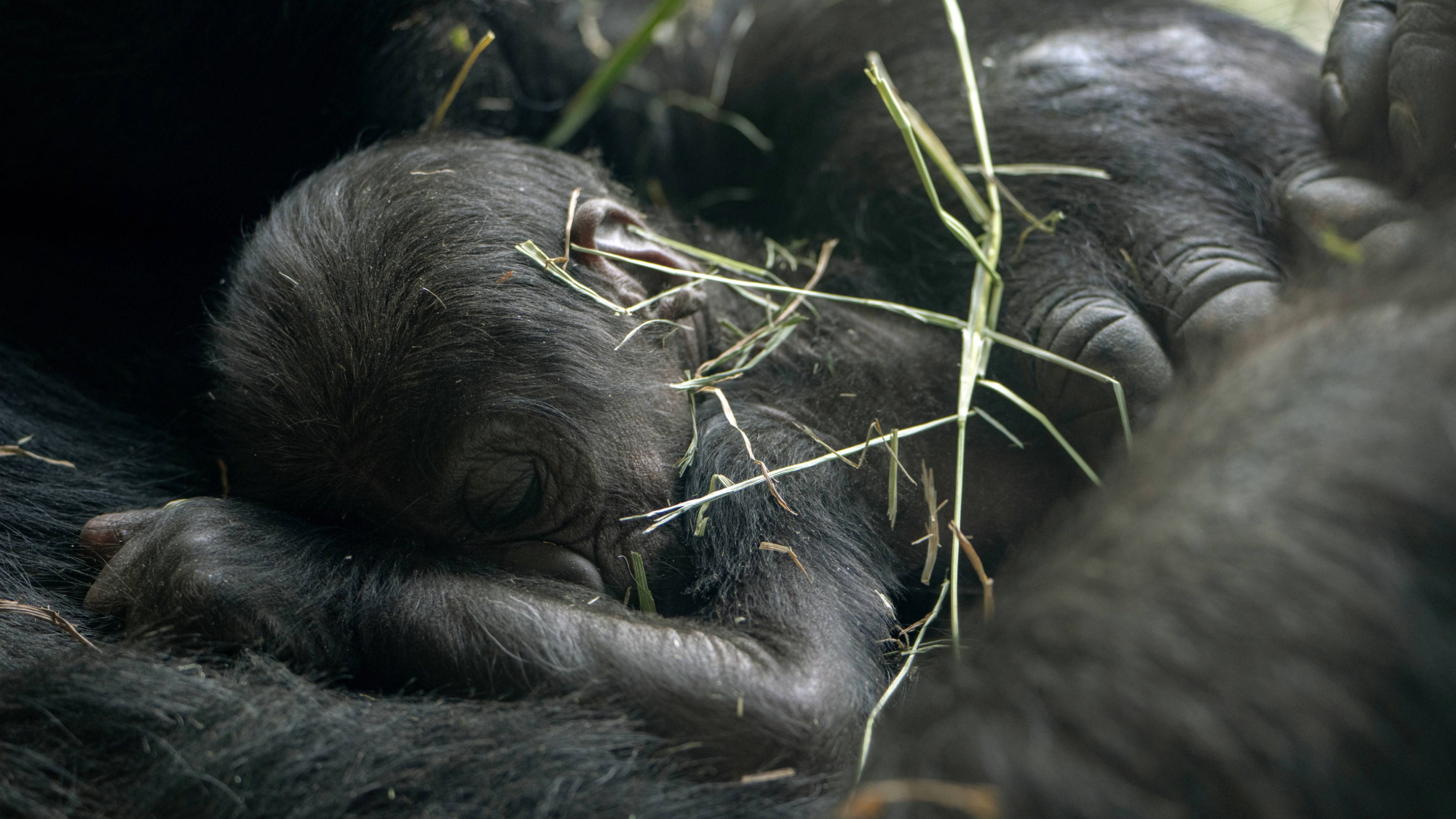
a sleeping baby gorilla
Jamani’s baby was born on May 18 at 5:50 a.m. Image: Jeremy Dwyer-Lindgren / Woodland Park Zoo.

Shah and her colleagues also used the Butterfly ultrasound device to scan the heart of Nadaya, the silverback gorilla father of both babies. In fact, the heart ultrasound Shah sent to her brother belonged to Nadaya.  They used human software for that scan, even though their vet software is optimized for fur. Fortunately, Nadaya’s chest isn’t very furry. 

Shah, who has gone through a pregnancy herself, was most moved by working with the gorilla mothers. 

“We could tell the baby’s head had dropped and we thought, ‘oh man, she must be so uncomfortable.’ And she was waddling and walking a little differently. I was like, ‘oh, I remember that, girl.’ It was just amazing to remember that we’re all connected in that way,” she says. 

Western lowland gorillas are critically endangered, so babies are always excellent news.

UPDATE May 27 8:19 a.m EDT

On Sunday, May 24, at 1:44 p.m. PDT, Olympia’s baby was delivered by an emergency C-section performed by a medical team who typically works on humans. This 5.4-pund boy is the western lowland gorilla’s second baby.

The post Pregnant gorillas undergo ultrasounds and the results might look familiar appeared first on Popular Science.

  • ✇Popular Science
  • 4 Epsom salt uses around the house (and 7 ways to never use it) Debbie Wolfe
    Most are aware of Epsom salt’s ability to soothe sore muscles. The compound itself is magnesium sulfate, a naturally occurring mineral. But while Epsom salt has become a staple in medicine cabinets, it’s also earned a reputation as a cure-all for everything from dirty grout to struggling tomato plants.  Some of those uses are grounded in science, while others are little more than persistent household myths. Before you sprinkle Epsom salt on your garden or mix it into a DIY cleaning solution,
     

4 Epsom salt uses around the house (and 7 ways to never use it)

7 June 2026 at 17:00

Most are aware of Epsom salt’s ability to soothe sore muscles. The compound itself is magnesium sulfate, a naturally occurring mineral. But while Epsom salt has become a staple in medicine cabinets, it’s also earned a reputation as a cure-all for everything from dirty grout to struggling tomato plants. 

Some of those uses are grounded in science, while others are little more than persistent household myths. Before you sprinkle Epsom salt on your garden or mix it into a DIY cleaning solution, here’s what it is actually good for and where you should skip it altogether.

Ways to use Epsom salt around the house

1. Soak away sore muscles

Epsom salt’s reputation as a post-workout recovery aid comes from its magnesium content. Magnesium plays a key role in muscle contraction, energy production, and recovery.  Intense exercise can temporarily deplete the body’s magnesium stores. 

A 2024 study found that magnesium soaks after a workout reduced muscle soreness, improved recovery, and provided protective effects against exercise-related muscle damage. To use Epsom salt safely post-workout, dissolve 1 to 2 cups in a warm bath and soak for about 15 to 20 minutes. While an Epsom salt soak is generally considered safe for most people, you should always consult your doctor before using any supplement regularly.

2. Create a mild scouring scrub

Epsom salt works as a gentle abrasive because its crystals are coarse enough to scrub without scratching surfaces. This property makes it a great alternative to steel wool or other abrasive cleaners. 

To use, mix it with dish soap or a gentle liquid cleaner to create a paste, then scrub baked-on food residue in pots and pans, grout lines between tiles, soap scum on tubs and shower walls, or dirt and mildew on plastic and metal outdoor furniture. 

3. Exfoliate rough skin

Epsom salt isn’t just useful to scrub pots and pans; it can also help smooth rough, dry skin. Research has found that Epsom salt can help remove dead skin cells and improve skin texture when used as an exfoliant. It’s naturally abrasive enough to buff away dead skin cells, yet gentle enough to use on areas like your hands, feet, and elbows. 

Skin experts suggest mixing Epsom salt with a small amount of water or a nourishing oil, such as coconut or olive oil, to create an easy DIY exfoliating scrub. For best results, exfoliate gently and follow with a moisturizer to help lock in hydration.

4. Use in crafts and décor

Epsom salt is perfect for crafting! Its crystals are easy to work with and create a frosted, glittery texture that crafters use to dress up mason jars, candle holders, and seasonal centerpieces. An easy way to frost a glass surface is to brush it with a thin layer of craft glue, roll it in dry Epsom salt, and let it dry completely. The result resembles ice or snow, making it a popular choice for winter and holiday décor. 

Ways You Definitely Shouldn’t Use Epsom Salt

1. As a miracle garden fertilizer

Social media has turned Epsom salt into a gardening cure-all, with viral posts promising lusher tomatoes, bigger blooms, and faster growth. The science doesn’t back it up. Epsom salt supplies magnesium and sulfur, nothing more. And, most garden soil already contains sufficient magnesium, especially when amended with organic matter. 

What plants need to grow and thrive are nitrogen, phosphorus, and potassium, the core nutrients that true fertilizers provide. Epsom salt delivers none of those. Correcting a magnesium deficiency and fertilizing a plant are two different jobs: the first fixes a specific problem, the second feeds the plant. Save the Epsom salt for the rare case when a soil test confirms a deficiency, and reach for a real fertilizer when your garden needs feeding.

2. To prevent blossom end rot

Blossom end rot is the dark, sunken patch that appears on the bottom of tomatoes, peppers, and eggplant. There are online claims that suggest crushed eggshells and Epsom salts will help cure this common garden issue. However, blossom end rot signals a calcium deficiency, and that deficiency is a water transport problem in the plant. Epsom salt not only fails to fix it but can also make it worse. Excess magnesium in the soil blocks calcium uptake, worsening the deficiency that caused the rot. To prevent blossom-end rot, keep soil evenly moist, protect roots from damage, and let a soil test guide fertilizer decisions.

3. As a pest repellent

Gardening blogs and social media accounts frequently recommend spraying Epsom salt solutions on roses and vegetables to repel slugs, insects, and other garden pests. According to Washington State University Extension, there is no scientific evidence to substantiate claims that Epsom salt controls any pest species. Worse, the most common application method, spraying Epsom salt solution directly on foliage, can cause leaf scorch, meaning you may end up harming your plants while doing nothing to the pests.

4. As a weed killer

Homemade weed killer recipes combining Epsom salt, vinegar, and dish soap have also spread across social media as a cheap, natural alternative to commercial herbicides. However, they don’t always work as advertised. You can apply enough to damage weeds, but that concentration comes with two serious drawbacks: the cost exceeds that of a conventional weed product, and the amount needed to harm weeds will poison the soil for other plants and soil life. If weeds are the problem, manual removal, mulch, and weed barriers are safer first steps; if you want a chemical solution, a product designed for that purpose will cost less and cause less collateral damage.

5. As a household disinfectant

Epsom salt is only magnesium sulfate. This compound does not kill bacteria, viruses, or fungi, which means no amount of Epsom salt, however concentrated, will disinfect a surface. Disinfectants work by chemically destroying pathogens, and Epsom salt simply lacks the properties to do that. 

For actual disinfection, reach for products that carry an EPA registration number, such as bleach solutions, hydrogen peroxide, and isopropyl alcohol, which are all inexpensive, widely available, and proven to kill germs.

6. To melt ice on driveways

Every winter, the same tip resurfaces on social media: sprinkle Epsom salt on icy driveways and walkways to melt the ice safely. The appeal is understandable;  Epsom salt is cheap, widely available, and feels less harsh than rock salt. The problem is that it barely works. Like all salts, magnesium sulfate does lower the freezing point of water, but it does so far less effectively than rock salt or commercial de-icers, which rely on sodium chloride, calcium chloride, or magnesium chloride, compounds specifically chosen for their ability to melt ice quickly at low temperatures. 

7. As a universal cleaning solution

Epsom salt is a useful tool when the job calls for mild abrasion, but reaching for it as a catch-all cleaner means doing half the job. What it cannot do is clean in any chemical sense. It won’t break down grease, lift stains, or kill germs. As noted earlier, neither magnesium nor sulfate has no antibacterial or antiviral properties, so using Epsom salt as a general-purpose cleaner leaves surfaces physically scrubbed but chemically untreated. 

The post 4 Epsom salt uses around the house (and 7 ways to never use it) appeared first on Popular Science.

  • ✇Popular Science
  • What’s the safest swimsuit color? Skip blue and black. Nidhi Sharma
    A pleasant swim at the beach or pool can quickly turn deadly. Every year, over 4,000 people die from unintentional drowning across the United States.  Swim safety experts say drowning is highly preventable. They recommend learning basic swimming skills, designating “water watchers” to keep an eye on children in the water, and avoiding swimming alone or under the influence. But what if your outfit could stop you from drowning? Swim safety experts say wearing the right color on your next bea
     

What’s the safest swimsuit color? Skip blue and black.

29 May 2026 at 13:01

A pleasant swim at the beach or pool can quickly turn deadly. Every year, over 4,000 people die from unintentional drowning across the United States. 

Swim safety experts say drowning is highly preventable. They recommend learning basic swimming skills, designating “water watchers” to keep an eye on children in the water, and avoiding swimming alone or under the influence.

But what if your outfit could stop you from drowning? Swim safety experts say wearing the right color on your next beach day is a good way to stay visible and out of harm’s way—especially for inexperienced swimmers and kids.

So what are the safest swimsuit colors?

Lisa Zarda, Executive Director of the U.S. Swim School Association, says people wearing bright, neon colors are easiest to spot in pools, lakes, and oceans, while blue, black, white, and gray swimsuits blend into the water. 

“When the water is moving and reflecting the sunlight, certain colors just disappear under the water,” she said. “Especially in open water, where it can be kind of murky and hard to see: The brighter the color, the better.” 

Wearing bright colors helps lifeguards and other safety officials identify and rescue people who are at risk of drowning. Vivid orange and super-bright, highlighter yellow are two standout colors for swim safety.

“Think safety vests and traffic cones,” Zarda said. “Those are bright colors also for a reason—so that they can be easily seen.”

An informal study by Alive Solutions, a public safety group, tested swimsuit visibility in three different conditions: in a pool with a standard light bottom, a pool with a dark bottom similar to dark blue ocean environments, and in an outdoor lake with brown-gray water. 

Across the board, the study identified bright, neon orange as the most visible color. But there was some slight variation of which colors stood out best in different environments. Against a dark pool bottom, neon yellow, green, and orange were the most eye-catching, while even brighter reds and pinks appeared darker, and both light and dark colors faded into the water. 

In a pool with a light bottom, most colors stood out, while light colors like white and light blue disappeared almost instantly. 

In a lake, only neon colors were visible while all other colors quickly blended. So bottom line: stick to a neon orange swimsuit if you want to be sure to be seen.

Boy in dark blue swim trunks standing on jetty on a lake.
Dark colored swimsuits can be especially hard to spot in open water. Image: mrs / Getty Images / MARTINS RUDZITIS

What makes neon stand out?

All visible color is the result of reflected light. A red apple, for instance, absorbs many wavelengths along the light spectrum, but bounces back red wavelengths. So to the human eye, an apple appears red.

Ordinary colors, like the red of an apple, only reflect the light they receive, but fluorescent pigments do more than that. They also absorb incoming nonvisible ultraviolet and some visible blue light and then re-emit part of that energy as intensely visible light. This is why fluorescent colors almost seem to glow.

Fluorescent shade’s high-contrast is why traffic safety signs, protective gear, and safety and rescue objects, like buoys, are often made with neon materials. It’s also what makes fluorescent swimsuits extra safe.

Swim safety for kids

As summer comes into full swing, Zarda says wearing a neon swimsuit is just one piece of the puzzle to prevent drowning, particularly for kids.

Children are extremely vulnerable to drowning accidents. Kids between ages one to four die from drowning more than any other cause of death, according to the Centers for Disease Control and Prevention. For children aged five to 14, drowning is the second leading cause of unintentional injury.

“Choosing the right swimsuit color doesn’t replace any of the other important layers of protection.” Zarda said. 

“Always having undistracted adult supervision, having a fence around your pool, enrolling your child in swim lessons so that they know how to swim and navigate in the water—those are all still very important.”

In Ask Us Anything, Popular Science answers your most outlandish, mind-burning questions, from the everyday things you’ve always wondered to the bizarre things you never thought to ask. Have something you’ve always wanted to know? Ask us.

Related 'Ask Us Anything' Stories

The post What’s the safest swimsuit color? Skip blue and black. appeared first on Popular Science.

  • ✇Popular Science
  • NASA wastewater system will turn human poop into plant food Mack DeGeurin
    NASA’s ambitious plan to put humans on the moon may hinge on the bathroom habits of a handful of University of North Dakota grad students. In the name of science, those researchers will test the limits of a mobile wastewater treatment system designed to convert human waste into plant nutrients and other sustainable materials. The trial will serve as a stress test of sorts, measuring how well the Divergent Deployable Wastewater Treatment Facility holds up to regular use and heavy loads in an envi
     

NASA wastewater system will turn human poop into plant food

5 June 2026 at 13:42

NASA’s ambitious plan to put humans on the moon may hinge on the bathroom habits of a handful of University of North Dakota grad students. In the name of science, those researchers will test the limits of a mobile wastewater treatment system designed to convert human waste into plant nutrients and other sustainable materials. The trial will serve as a stress test of sorts, measuring how well the Divergent Deployable Wastewater Treatment Facility holds up to regular use and heavy loads in an environment designed to mirror a lunar habitat. 

It’s not pretty work, but someone has to do it.

“The tests will help NASA evaluate real-world operation, crew training needs, system reliability, and how wastewater simulants compare with actual human metabolic waste in an analog mission environment,” Ali Alshami, University of North Dakota Chemical Engineering professor and test participant, said in a statement.

a gray trailer sits in a parking lot
The unassuming gray building could one day be an astronaut wastewater facility. Technicians prepared the Divergent Deployable Wastewater Treatment Facility for transport at NASA’s Kennedy Space Center in Florida on April 21, 2026. Image: NASA/Kim Shiflett  

Treated astronaut poop will feed lunar plants 

The mobile facility consists of three separate bioreactors, each tasked with handling a specific kind of waste. Feces, urine, and food waste are treated separately because each material contains different levels of salts, solids, carbon, nitrogen, and phosphorus. One reactor processes feces and food waste, converting it into nutrient-rich water that can feed plants. The other two handle urine and greywater from activities like showering and laundry, some of which can be filtered and recycled into  clean drinking water. From an astronauts’ perspective, the experience should feel pretty familiar to life onboard the International Space Station (ISS). They use the toilet as normal, and it automatically diverts waste at the source, routing each type to its corresponding bioreactor.

The whole process takes place in a mobile, 8.5-by-24-foot trailer. In addition to the bioreactors, the unit also houses a vertical garden maintained by the converted wastewater. The goal is to kill two birds with one stone: process waste efficiently and then use it to sustain lunar agriculture. Both are essential if astronauts want any shot at building longer-term habitats on the moon or even Mars. To that end, NASA has ambitions to start constructing a semi-permanent lunar structure or “moon base” by 2029.

Where no one has gone before 

Waste management in space has come a long way since the first moon missions. Back in the 1960s, NASA Apollo astronauts left behind 96 bags of human waste (filled with poop, urine, and vomit) on the lunar surface to save weight. Those bags are almost certainly still there. 

Thankfully, decades of research mean astronauts no longer have to relieve themselves into a bag, at least not most of the time. The most recent Artemis mission featured a fully functional space toilet, though it malfunctioned almost immediately after liftoff.

Recycling wastewater has also seen major improvements. NASA had a breakthrough in 2023 when its life support system aboard the ISS  managed to recover nearly 98 percent of all breath, sweater, and urine brought aboard by the crew. Future astronauts on prolonged spacewalks may also wear this Dune-inspired backpack that filters urine and sweat into drinking water in a single self-contained loop.

The post NASA wastewater system will turn human poop into plant food appeared first on Popular Science.

  • ✇Popular Science
  • The boat-billed heron looks fake but is very real Margherita Bassi
    When you think of a heron, chances are you imagine an elegant, long-legged bird posing majestically on the edge of a body of water. If so, it’s time to set the record straight—not all herons are swan-necked ballerinas. In fact, the boat-billed heron (Cochlearius cochlearius) looks like someone stuck the head of a large bird onto the body of a small one, and you can forget about a graceful neck.  Roger Williams Park Zoo & Carousel Village in Rhode Island is home to a boat-billed heron. Ima
     

The boat-billed heron looks fake but is very real

23 May 2026 at 14:16

When you think of a heron, chances are you imagine an elegant, long-legged bird posing majestically on the edge of a body of water. If so, it’s time to set the record straight—not all herons are swan-necked ballerinas. In fact, the boat-billed heron (Cochlearius cochlearius) looks like someone stuck the head of a large bird onto the body of a small one, and you can forget about a graceful neck. 

a bird with a blue bill and blue and brown plummate
Roger Williams Park Zoo & Carousel Village in Rhode Island is home to a boat-billed heron. Image: Roger Williams Park Zoo & Carousel Village.

As for its bill, the large and rather flat appendage explains the bird’s name, and is extremely sensitive. “These unique birds get their name from its broad bill that resembles the hull of a boat, perfect for snatching up fish, crustaceans, insects, and amphibians,” the Roger Williams Park Zoo & Carousel Village in Rhode Island writes in a social media post, with pictures of a rather judgemental-looking boat-billed heron. “[Their] large, dark eyes are also adapted for nighttime hunting.” 

The funny-looking bird doesn’t migrate and lives close to fresh or saltwater in Mexico, Central America, and parts of South America, and are usually solitary animals. They only come  together  to mate, and remain monogamous throughout the breeding season. Hatchling boat-billed herons come into this world blind and, unsurprisingly, completely rely on their parents, who feed them for between six to eight weeks before leaving. 

a bird with blue and brown plumage and a wide, blue bill
Boat-billed herons are solitary animals, but are monogamous with their mates during breeding season. Image: Shutterstock.

These birds feature a type of feather called “powder down.” Instead of molting, their tips slowly turn into waterproofing powder. Interestingly, boat-billed herons produce vocalizations that sound a bit like human hand claps. And right when you think they can’t get any weirder, adults feature a black crown that makes them look like emo queens. 

Though their population is decreasing, according to the IUCN red list, they are classified as a species of least concern, which is as good as it gets. However, not  all heron species are doing as well as the boat-billed heron. The white-bellied heron (Ardea insignis) is considered critically endangered and the great white heron (Ardea occidentalis) is endangered. 

The post The boat-billed heron looks fake but is very real appeared first on Popular Science.

❌
Popular Science