Normal view

  • ✇Marketoonist - Tom Fishburne
  • Client-Agency Creative tomfishburne
    A couple years ago, I went to the Cannes Lions, the main show for advertising. There’s a giant gallery room in the basement of the main Palais building with all the work submitted for awards. As I walked past the ads and case studies, all I could think about was how the sausage gets made. The creative “idea” usually gets all the attention and hoopla, but much of the quality of the work depends upon “process” — how the idea is brought to life. Great creative ideas plus a crappy creative
     

Client-Agency Creative

Client-Agency Creative Marketoonist cartoon

A couple years ago, I went to the Cannes Lions, the main show for advertising. There’s a giant gallery room in the basement of the main Palais building with all the work submitted for awards.

As I walked past the ads and case studies, all I could think about was how the sausage gets made.

The creative “idea” usually gets all the attention and hoopla, but much of the quality of the work depends upon “process” — how the idea is brought to life.

Great creative ideas plus a crappy creative process equals crappy creative work.

My cartoon this week on the asymmetrical way timelines get negotiated is only part of the story.

Matt Davies and Pieter-Paul von Weiler at BetterBriefs have been on a mission to improve that creative process, releasing reports to hold up the mirror on how the clients and agencies operate in practice. They started with the brief, which is too often an uninspired word salad.

Their findings included this stunning takeaway:

“78% of marketers believe their briefs provide clear strategic direction. Only 5% of agencies agree.”

They’ve since been focusing on better ideas in general and the core of the client-agency relationship itself — the “trust gap.”

“56% of marketers think the client approval process works well. Only 23% of agencies agree.”

The top words used to describe the client approval process are “inconsistent,” “slow,” “subjective,” and “painful.” It currently takes an average of five rounds of creative development to get to a signed-off idea.

One inspiring takeaway from their work in The BetterIdeas Project: “Marketers who inspire their agency to do their best work are 3X more likely to feel proud of the work they’re involved in.”

Whether working on campaigns with Cannes Lions aspirations or not, the creative friction of the client-agency relationship shapes everything that follows.

The trust gap is partly an asymmetry gap.

Here are a few related cartoons I’ve drawn over the years:

The Creative Review - March 2025

The Creative Review cartoon
Share
  • Share this Marketoon
| Read Post

the 8 types of bad creative critics - November 2006

Share
  • Share this Marketoon
| Read Post

Creative Review by Committee - September 2024

Creative Review by Committee cartoon
Share
  • Share this Marketoon
| Read Post

too many cooks in the creative review - May 2019

Share
  • Share this Marketoon
| Read Post

The post Client-Agency Creative first appeared on Marketoonist | Tom Fishburne.

  • ✇Marketoonist - Tom Fishburne
  • Advertising, Brand Recall, and Celebrities tomfishburne
    Super Bowl ads have always juggled story power and star power. But the overall swing toward celebrities has been an ongoing trend. In 2010, just 31% of Super Bowl ads included a famous face. Last year, a whopping 68% of Super Bowl ads featured celebrities and 51% featured multiple celebrities, according to iSpot.tv and EMARKETER. (I haven’t seen the final numbers for 2026, but early teasers looked like another big celebrity year.) With all the positive things that celebrities can bring
     

Advertising, Brand Recall, and Celebrities

9 February 2026 at 12:30

Advertising and Celebrities cartoon

Super Bowl ads have always juggled story power and star power. But the overall swing toward celebrities has been an ongoing trend.

In 2010, just 31% of Super Bowl ads included a famous face. Last year, a whopping 68% of Super Bowl ads featured celebrities and 51% featured multiple celebrities, according to iSpot.tv and EMARKETER.

(I haven’t seen the final numbers for 2026, but early teasers looked like another big celebrity year.)

With all the positive things that celebrities can bring to an ad (attention, humor, trust, status, etc.), the big risk has always been that celebrities overshadow the brand.

In the 80s, Robin Evans first termed this risk as the “vampire effect.”

My old friends at System1 track Super Bowl ads on a number of dimensions, including “Fluency” — the accuracy and speed of brand recognition.

System1 Head of Marketing Jess Messenger summarized their findings on celebrity and brand recall recently:

“In 2025, the average Fluency Rating for Super Bowl ads was a modest 78, meaning, on average, 22% of viewers couldn’t correctly name the brand after watching the ad.

“Of the top 10 Big Game ads for Fluency, three leveraged well-known stars and one featured a group of influencers. Meanwhile, six of the top 10 ads did not use celebrities.”

At an $8 million ad spend for 30 seconds, the stakes of poor brand recall in the Super Bowl are high. But the importance of paying attention to “Fluency” is relevant for marketers at all spend levels.

The celebrity lever is one of the easiest to pull. But too many ads use celebrities shallowly, interchangeably, and as a one-off. And when 68% of Super Bowl ads use celebrities, celebrities alone are not going the move the needle.

As I’ve written before, we can’t break through the clutter by adding to it.

Here are some of my favorite Super Bowl cartoons I’ve drawn over the years:

super bowl advertising - February 2018

Share
  • Share this Marketoon
| Read Post

the marketers superbowl party - January 2003

Share
  • Share this Marketoon
| Read Post

The Super Bowl Ad Formula - February 2025

Super Bowl Ad Formula cartoon
Share
  • Share this Marketoon
| Read Post

superbowl advertising - February 2007

Share
  • Share this Marketoon
| Read Post

The post Advertising, Brand Recall, and Celebrities first appeared on Marketoonist | Tom Fishburne.

  • ✇Marketoonist - Tom Fishburne
  • Human in the Loop tomfishburne
    I drew this week’s cartoon inspired by some of the latest growing pains of human-AI collaboration. As AI gets more autonomous, the traditional “human in the loop” oversight model is showing strain. With pressure to “10X productivity” with fleets of AI agents, how best to keep up with the avalanche and complexity of approvals? The “human in the loop” risks becoming a tick box exercise, rather than genuine oversight. Julia Zarb, founder of Blue x Blue, recently illustrated the problem in
     

Human in the Loop

30 March 2026 at 11:30

Human in the Loop cartoon

I drew this week’s cartoon inspired by some of the latest growing pains of human-AI collaboration.

As AI gets more autonomous, the traditional “human in the loop” oversight model is showing strain. With pressure to “10X productivity” with fleets of AI agents, how best to keep up with the avalanche and complexity of approvals?

The “human in the loop” risks becoming a tick box exercise, rather than genuine oversight.

Julia Zarb, founder of Blue x Blue, recently illustrated the problem in high stakes healthcare:

“Consider the busy clinician, nurse or manager asked to make a call quickly with partial context … under pressure, review can become a screen-level action rather than an informed decision.”

That AI approval bottleneck is surfacing challenge in every domain, including customer experience.

Connext released a Global AI Oversight Survey last month that found only 17% of workers believe AI is reliable without human oversight, 64% expect the need for human review to increase, and 20% said AI made customer situations worse.

The Financial Times profiled Amazon’s growing pains a few weeks ago with major website service outages caused by AI-generated code. Amazon now plans for additional human oversight.

The “human in the loop” model is hard-pressed to keep up with modern AI systems at the current speed, scale, and complexity. Organizations are experimenting with a shift from “human in the loop” to “human on the loop” (more hands-off) but it will be a bumpy ride.

And when AI makes mistakes, customers tend to blame the company, not the algorithm.

Here are a few related cartoons I’ve drawn over the years:

AI Co-Pilots and the Future of Work - April 2024

AI Co-Pilots and the Future of Work cartoon
Share
  • Share this Marketoon
| Read Post

Generative AI Adoption - August 2023

Generative AI Adoption cartoon
Share
  • Share this Marketoon
| Read Post

AI Written, AI Read - March 2023

AI Written, AI Read cartoon
Share
  • Share this Marketoon
| Read Post

AI Tidal Wave - January 2023

AI Tidal Wave cartoon
Share
  • Share this Marketoon
| Read Post

The post Human in the Loop first appeared on Marketoonist | Tom Fishburne.
  • ✇Marketoonist - Tom Fishburne
  • Human Made tomfishburne
    This week’s cartoon goes out to my friend Ann Handley, who has been putting up a valiant defense for the em dash (—). As Ann put it recently: “People are patrolling the streets, rounding up em dashes like it’s CSI: Grammar Unit. “Use one in a paragraph? That means you’re secretly AI! You’re generating your LinkedIn posts with a boiling cauldron of vibes and predictive text! You’re a fake! A phony! Cue the pitchforks! Light the torches! The mob is lurching toward you! “Meanwhile, the
     

Human Made

20 April 2026 at 11:30

Human Made Marketoonist cartoon

This week’s cartoon goes out to my friend Ann Handley, who has been putting up a valiant defense for the em dash (—).

As Ann put it recently:

“People are patrolling the streets, rounding up em dashes like it’s CSI: Grammar Unit.

“Use one in a paragraph? That means you’re secretly AI! You’re generating your LinkedIn posts with a boiling cauldron of vibes and predictive text! You’re a fake! A phony! Cue the pitchforks! Light the torches! The mob is lurching toward you!

“Meanwhile, the rest of us are just out here trying to write like actual humans—messy, rhythmic, gloriously imperfect.

“I just used an em dash in that last sentence, see? Like humans do.”

The Em Dash is just the tip of the spear for AI detection vigilanteism. In just the last few weeks, Hachette pulled a novel and The Atlantic called out a NYT column for tripping AI detection sensors.

The AI slop floodgates are wide open and the AI backlash is simultaneously underway. And as AI tools are more widely used, we’re in a murky period as a culture of figuring out where to draw the line and what to disclose.

The BBC recently counted 8 different initiatives to come up with an “AI-free,” modeled on the “Fair Trade” endorsement used for products. Claims like “Proudly Human”, “Human-made”, ‘”No A.I” and “AI-free” are popping up everywhere from films to books to marketing.

And yet, there’s no full agreement on how even to define “human made.”

As AI Research Scientist Sasha Luccioni put it:

“AI is now so ubiquitous and so integrated into different platforms and services, that it’s truly complicated to establish what ‘AI free’ means. From a technical perspective, it’s hard to implement. I think that AI is a spectrum, and we need more comprehensive certification systems, rather than a binary with AI/AI-free approach.”

In the meantime, it will likely be a bumpy ride.

Here are a few related cartoons I’ve drawn over the years:

AI Slop Fatigue and Analog Intelligence - September 2025

AI Slop Fatigue cartoon
Share
  • Share this Marketoon
| Read Post

AI Written, AI Read - March 2023

AI Written, AI Read cartoon
Share
  • Share this Marketoon
| Read Post

Content, Content, Content - August 2025

Content cartoon
Share
  • Share this Marketoon
| Read Post

optimizing content - March 2017

Share
  • Share this Marketoon
| Read Post

The post Human Made first appeared on Marketoonist | Tom Fishburne.

  • ✇Marketoonist - Tom Fishburne
  • The Marketing Plan tomfishburne
    A few year ago, Mark Ritson wrote a handy guide to creating a marketing plan and critiqued those who make “PowerPoint decks by the yard.” Mark wrote: “Most marketing plans are PowerPoint presentations. Nothing wrong with that. But they are just too damned long – 50, 100, 200 slides in a plan. This is a shithouse way to present anything. It is symptomatic of global marketing teams with no practical experience of brand planning, who are just building PowerPoint decks by the yard. And it is i
     

The Marketing Plan

23 February 2026 at 12:30

The Marketing Plan cartoon

A few year ago, Mark Ritson wrote a handy guide to creating a marketing plan and critiqued those who make “PowerPoint decks by the yard.”

Mark wrote:

“Most marketing plans are PowerPoint presentations. Nothing wrong with that. But they are just too damned long – 50, 100, 200 slides in a plan. This is a shithouse way to present anything. It is symptomatic of global marketing teams with no practical experience of brand planning, who are just building PowerPoint decks by the yard. And it is indicative of marketing managers who have not thought long or choicefully enough about their plan.”

Mark instead advised a simple “three-part structure of diagnosis feeding strategy, which drives tactical choices.”

It’s easier than ever to generated PowerPoint decks by the yard. In one of the Super Bowl ads a couple weeks ago, Matthew Broderick used AI to say “finish this slide deck” and it was done.

And yet, work productivity isn’t only a measure of the volume of outputs. And when LLMs are trained on PowerPoint decks “by the yard,” the path of least resistance is just to generate more of the same.

In the HBR, Kate Niederhoffer, Alexi Robichaux and Jeffrey T. Hancock have been cautioning businesses on the negative effects of what they call “workslop”:

“As AI tools have proliferated in workplaces and pressure to use them has mounted, employees have had to contend with the scourge of workslop, or low-effort, AI-generated work that looks plausibly polished, but ends up wasting time and effort as it offloads cognitive work onto the recipient. For the person on the receiving end, it can be a confusing and infuriating experience.”

Ian Whitworth once described AI-generated content as “infinite words nobody wants.”

In making our Marketing Plans or any other type of work presentation, we have to be careful we’re not creating “infinite slides nobody wants.”

Here are a few related cartoons I’ve drawn over the years:

How to Write a PowerPoint Pitch - September 2017

Share
  • Share this Marketoon
| Read Post

PowerPoint-itis - November 2016

Share
  • Share this Marketoon
| Read Post

gallery of management consulting - February 2009

Share
  • Share this Marketoon
| Read Post

Presenting your Ideas - October 2017

Share
  • Share this Marketoon
| Read Post

The post The Marketing Plan first appeared on Marketoonist | Tom Fishburne.
  • ✇Marketoonist - Tom Fishburne
  • Storytelling and AI tomfishburne
    LinkedIn reported that the percentage of US job postings that include the term “storyteller” doubled last year from the year before. Katie Deighton recently wrote about this in the WSJ: “Marketing and technology companies have often repurposed grandiose descriptions from other arenas to lend corporate office roles additional sparkle. While the heyday of technology gurus, developer ninjas, SEO rockstars and at least one digital prophet have long since passed, calling salaried communications
     

Storytelling and AI

6 April 2026 at 11:32

Storytelling and AI Marketoonist cartoon

LinkedIn reported that the percentage of US job postings that include the term “storyteller” doubled last year from the year before.

Katie Deighton recently wrote about this in the WSJ:

“Marketing and technology companies have often repurposed grandiose descriptions from other arenas to lend corporate office roles additional sparkle. While the heyday of technology gurus, developer ninjas, SEO rockstars and at least one digital prophet have long since passed, calling salaried communications professionals “storytellers” and the practice of storytelling appears to only have picked up in popularity.”

Of course this isn’t totally new. Storytelling in business practice goes through periods of being in vogue.

In 2014, Austrian designer Stefan Sagmeister famously pilloried the whole idea of creatives calling themselves storytellers, showing up to a conference on storytelling to tell everyone they weren’t really storytellers.

“People who actually tell stories, meaning people who write novels and make feature films don’t see themselves as storytellers. It’s all the people who are not storytellers, who kind of for strange reasons because it’s in the air suddenly now want to be storytellers.”

I find it funny that Stefan Sagmeister’s own wikipedia entry now describes him as a “graphic designer, storyteller, and typographer.”

AI is impacting storytelling in interesting ways. In some ways, AI is democratizing storytelling. It’s helping amplify and extend stories that might not otherwise get told. Yet, the path of least resistance is to use these tools to generate more of the same.

Here are a few related cartoons I’ve drawn over the years:

marketing storytelling - July 2016

Share
  • Share this Marketoon
| Read Post

branded content - September 2013

Share
  • Share this Marketoon
| Read Post

AI Slop Fatigue and Analog Intelligence - September 2025

AI Slop Fatigue cartoon
Share
  • Share this Marketoon
| Read Post

The post Storytelling and AI first appeared on Marketoonist | Tom Fishburne.

  • ✇Marketoonist - Tom Fishburne
  • Content about Content about Content tomfishburne
    I drew this week’s cartoon inspired by today’s content overload and the circular creator economy. When I left college in the 90s, I moved to Prague and found a job at Velvet, an English-language magazine for the booming but close-knit expat scene. At that strange time when Eastern Europe opened up, there were more than 20 different English-language newspapers and magazines in Prague catering to the same small audience. We used to joke that someday there would be a different English-lang
     

Content about Content about Content

Content about Content about Content Marketoonist cartoon

I drew this week’s cartoon inspired by today’s content overload and the circular creator economy.

When I left college in the 90s, I moved to Prague and found a job at Velvet, an English-language magazine for the booming but close-knit expat scene.

At that strange time when Eastern Europe opened up, there were more than 20 different English-language newspapers and magazines in Prague catering to the same small audience.

We used to joke that someday there would be a different English-language magazine for every English speaking expat. Ironically the final issue of Velvet before it folded was a guide to all the English media in Prague.

That was my first experience with content overload.

Mark Schaefer originated the concept of “Content Shock,” which he described as “the emerging marketing epoch when exponentially increasing volumes of content intersect our limited human capacity to consume it.”

Today everyone can be a creator. And the creator tools are all pushing all forms of multimedia all at once. The platform algorithms reward constant posting and repackaging content across channels. AI tools make it possible for digital avatars to pick up the slack even further.

And yet, I like the caution of how P&G Chief Brand Officer Marc Pritchard once described the situation of trying to keep up with exponentially increasing volumes of content. He said, “we fell into the content crap trap.”

Here are a few related cartoons I’ve drawn over the years:

content marketing overload - March 2017

Share
  • Share this Marketoon
| Read Post

AI Generated Marketing Content - August 2022

AI Generated Marketing Content cartoon
Share
  • Share this Marketoon
| Read Post

Content, Content, Content - August 2025

Content cartoon
Share
  • Share this Marketoon
| Read Post

The post Content about Content about Content first appeared on Marketoonist | Tom Fishburne.

  • ✇Marketoonist - Tom Fishburne
  • Planning for Uncertainty tomfishburne
    Almost exactly 6 years ago, as things started to shut down for Covid, I drew a cartoon about the challenges of planning in a time of uncertainty. An executive holds up a coin and says, “We need to update our forecast. Heads, this will blow over soon. Tails, it’s the end of the world.” At the time I shared a quote I’d heard that I found helpful: “The worst thing to do in a time of chaos is add to it.” That of course hasn’t been the only moment of uncertainty in the last six years. Uncert
     

Planning for Uncertainty

16 March 2026 at 11:30

Planning for Uncertainty cartoon

Almost exactly 6 years ago, as things started to shut down for Covid, I drew a cartoon about the challenges of planning in a time of uncertainty.

An executive holds up a coin and says, “We need to update our forecast. Heads, this will blow over soon. Tails, it’s the end of the world.”

At the time I shared a quote I’d heard that I found helpful: “The worst thing to do in a time of chaos is add to it.”

That of course hasn’t been the only moment of uncertainty in the last six years. Uncertainty makes it particularly hard to think about long-range planning.

Jim Hardison, co-founder of Character, shared some insights this week about brands in a time of uncertainty:

“For marketers, this volatility creates a specific problem: uncertainty undermines control. And control has always been central to how brands tell their stories.

“Traditional marketing assumes a relatively stable environment. Teams develop strategies months in advance, campaigns unfold in carefully sequenced phases, and brands guide audiences toward a narrative they have deliberately constructed. But when conditions change faster than plans can adapt, that narrative control begins to collapse. Strategies can be abandoned midstream. Messaging becomes reactive. Teams hesitate, waiting for clarity that never quite arrives.

“The result is often paralysis, or worse, generic behavior.”

Jim advises that brands take a cue from improvisational theater and learn to practice what he calls “disciplined adaptability.”

As he put it:

“Success depends less on executing a perfect plan and more on responding in character to changing circumstances.”

I like that framing. When things are uncertain is when we most need to “respond” instead of “react.”

Here are a few related cartoons I’ve drawn over the years:

managing uncertainty - March 2020

Share
  • Share this Marketoon
| Read Post

the new normal - May 2020

The New Normal cartoon
Share
  • Share this Marketoon
| Read Post

the five stages of missing plan - June 2008

Share
  • Share this Marketoon
| Read Post

strategic options in a recession - June 2020

Share
  • Share this Marketoon
| Read Post

The post Planning for Uncertainty first appeared on Marketoonist | Tom Fishburne.

  • ✇Marketoonist - Tom Fishburne
  • Brand Origin Stories and Faux-thenticity tomfishburne
    Fake authenticity (or “faux-thenticity”) has long plagued marketing. Authenticity is set up as a sort of holy grail in branding, marked as an objective in countless creative briefs. The “origin story” in particular is a common lever to manufacture authenticity. Yet most framing of the origin story is heavily scripted, edited, and contrived. The more that a brand tries to sound authentic, the less that it comes across as authentic. A 2020 study by Cinelli and LeBoeuf found that what driv
     

Brand Origin Stories and Faux-thenticity

Brand Origin Stories and Faux-thenticity Marketoonist cartoon

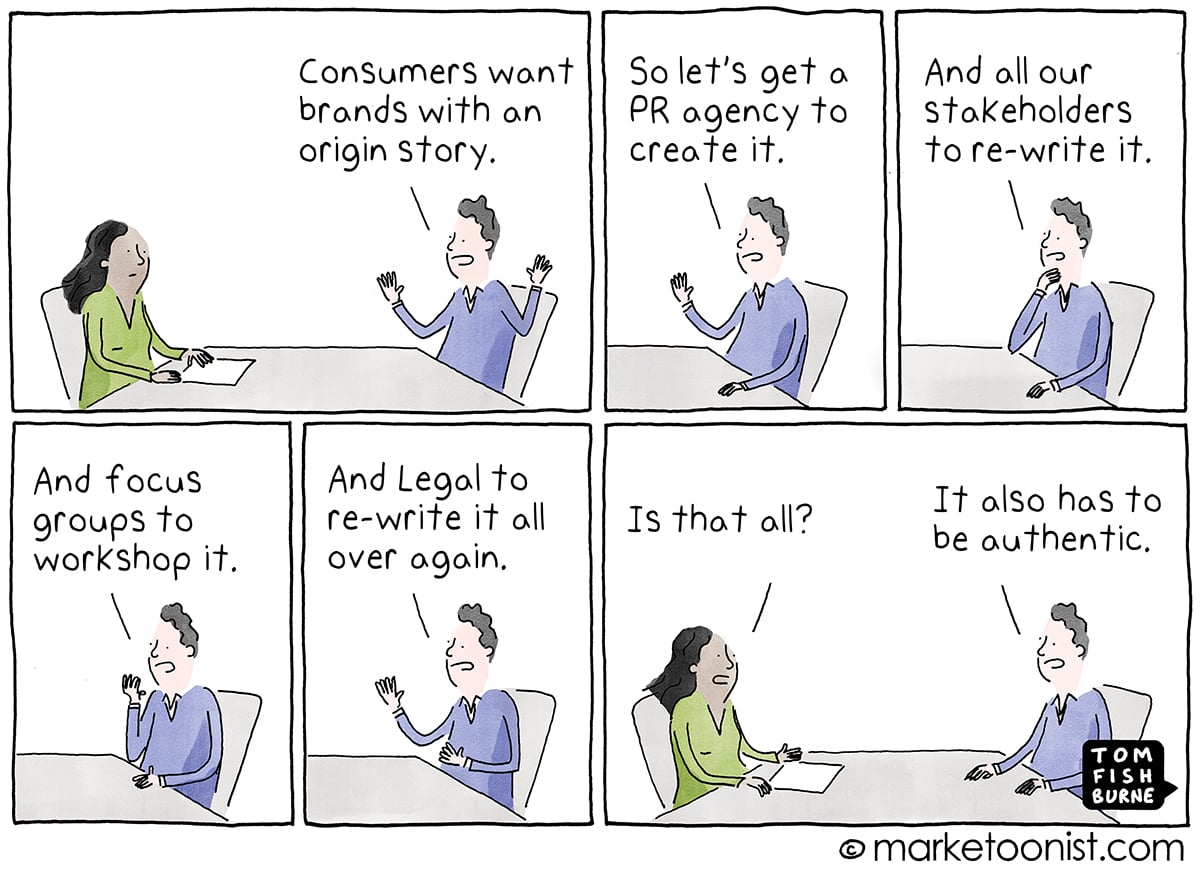
Fake authenticity (or “faux-thenticity”) has long plagued marketing.

Authenticity is set up as a sort of holy grail in branding, marked as an objective in countless creative briefs. The “origin story” in particular is a common lever to manufacture authenticity. Yet most framing of the origin story is heavily scripted, edited, and contrived.

The more that a brand tries to sound authentic, the less that it comes across as authentic.

A 2020 study by Cinelli and LeBoeuf found that what drives authenticity perception isn’t the story itself. It’s whether the brand appears genuinely motivated, or just market-motivated.

In the worst cases, fake authenticity is revealed as fraudulent. My favorite faux-thenticity brand story is the Mast Brothers chocolate scandal from 2015. The Mast Brothers (in standard issue hipster lumberjack beards) had long cultivated an authentic image of small-batch bean-to-bar craftsmanship from their Williamsburg kitchen. This allowed them to charge $10 a bar.

Then a food blogger named Scott Craig wrote a viral expose that revealed the brothers had been melting down premade Valrhona chocolate and repackaging it as original creations. In his article, titled “What Lies Beyond the Beards,” Scott called The Mast Brothers the Milli Vanilli of chocolate.

It’s a cautionary tale I think relevant for every brand. Particularly as AI tools make it easier to project an image of authenticity, what matters more than brand image is what a brand delivers over time.

Seth Godin argues that authenticity is over-rated:

“This pitch that you should be authentic is baloney. No one wants you to be authentic. They want you to be consistent.”

Here are a few related cartoons I’ve drawn over the years:

fake influence and authenticity - August 2018

Share
  • Share this Marketoon
| Read Post

marketing authenticity - August 2014

Share
  • Share this Marketoon
| Read Post

influencer marketing and authenticity - June 2021

Influencer Marketing and Authenticity cartoon
Share
  • Share this Marketoon
| Read Post

The post Brand Origin Stories and Faux-thenticity first appeared on Marketoonist | Tom Fishburne.

  • ✇Marketoonist - Tom Fishburne
  • New Self-Serving Study tomfishburne
    Byron Sharp from the Ehrenberg-Bass Institute has long been on the frontlines of debunking marketing myths, starting with “How Brands Grow: What Marketers Don’t Know” in 2010. Byron recently introduced me to the term SONK — “the Scientific-cation Of Non-Knowledge.” In an interview last year, Byron credits SONK to his mentor Andrew Ehrenberg. As Byron describes SONK: “You take trivial findings and dress them up with tortured statistics and jargon. And spread it over many pages. It’s s
     

New Self-Serving Study

15 June 2026 at 11:35

New Self-Serving Study cartoon

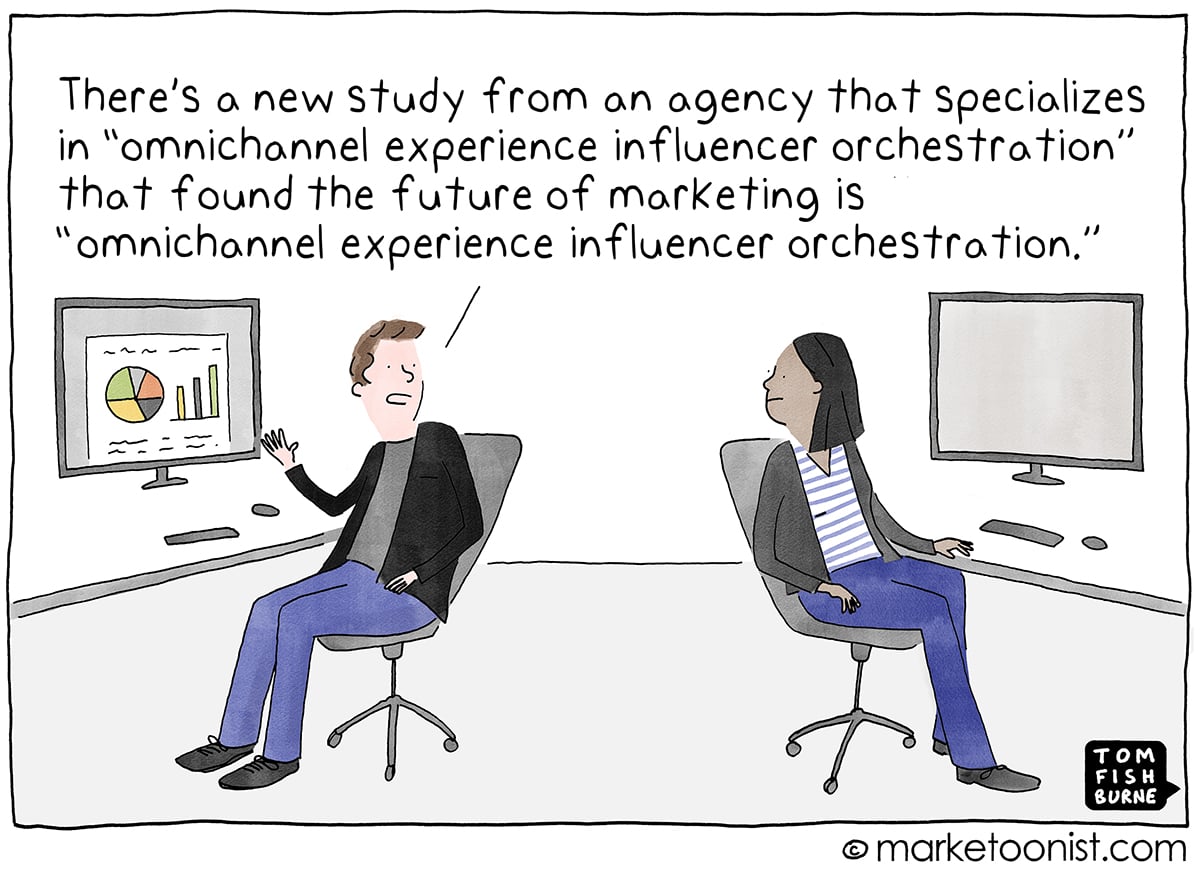
Byron Sharp from the Ehrenberg-Bass Institute has long been on the frontlines of debunking marketing myths, starting with “How Brands Grow: What Marketers Don’t Know” in 2010.

Byron recently introduced me to the term SONK — “the Scientific-cation Of Non-Knowledge.”

In an interview last year, Byron credits SONK to his mentor Andrew Ehrenberg.

As Byron describes SONK:

“You take trivial findings and dress them up with tortured statistics and jargon. And spread it over many pages. It’s style over substance.”

There’s an epidemic of SONK in marketing.

Social media feeds and marketing news sites carry an endless stream of whitepapers, studies, and reports that have nothing more than the sheen of being evidence-based. Many of these are clearly biased by the agencies or brands that commissioned the research.

Some of the takeaways are then cited in marketing decks and thought leadership as if they were carved on stone tablets.

It’s possible to justify just about any marketing approach by pointing at research somewhere, no matter how shallow.

SONK spreads when marketers can’t tell the difference between evidence and the appearance of evidence.

Here are a few related cartoons I’ve drawn over the years:

data-driven decision making - August 2015

Share
  • Share this Marketoon
| Read Post

data-driven decision making - February 2022

Data-Driven Decision Making cartoon
Share
  • Share this Marketoon
| Read Post

evidence-based marketing - September 2018

Share
  • Share this Marketoon
| Read Post

marketing data pitfalls - November 2014

Share
  • Share this Marketoon
| Read Post

big data analytics - April 2014

Share
  • Share this Marketoon
| Read Post

The post New Self-Serving Study first appeared on Marketoonist | Tom Fishburne.
  • ✇Marketoonist - Tom Fishburne
  • Unprecedented with Precedent tomfishburne
    I drew this week’s cartoon on a paradox I keep seeing in innovation. Henry Ford famously said: “I invented nothing new. I simply assembled the discoveries of other men behind whom were centuries of work.” Ford’s original motor company cribbed ideas and inspiration everywhere from Singer sewing machines to P&G to Chicago slaughterhouses. Those borrowed innovations set the stage for a whole new approach to manufacturing. Stanford GSB professor Stefanos Zenios and Ken Favaro explore
     

Unprecedented with Precedent

"Unprecedented with Precedent" Marketoonist cartoon

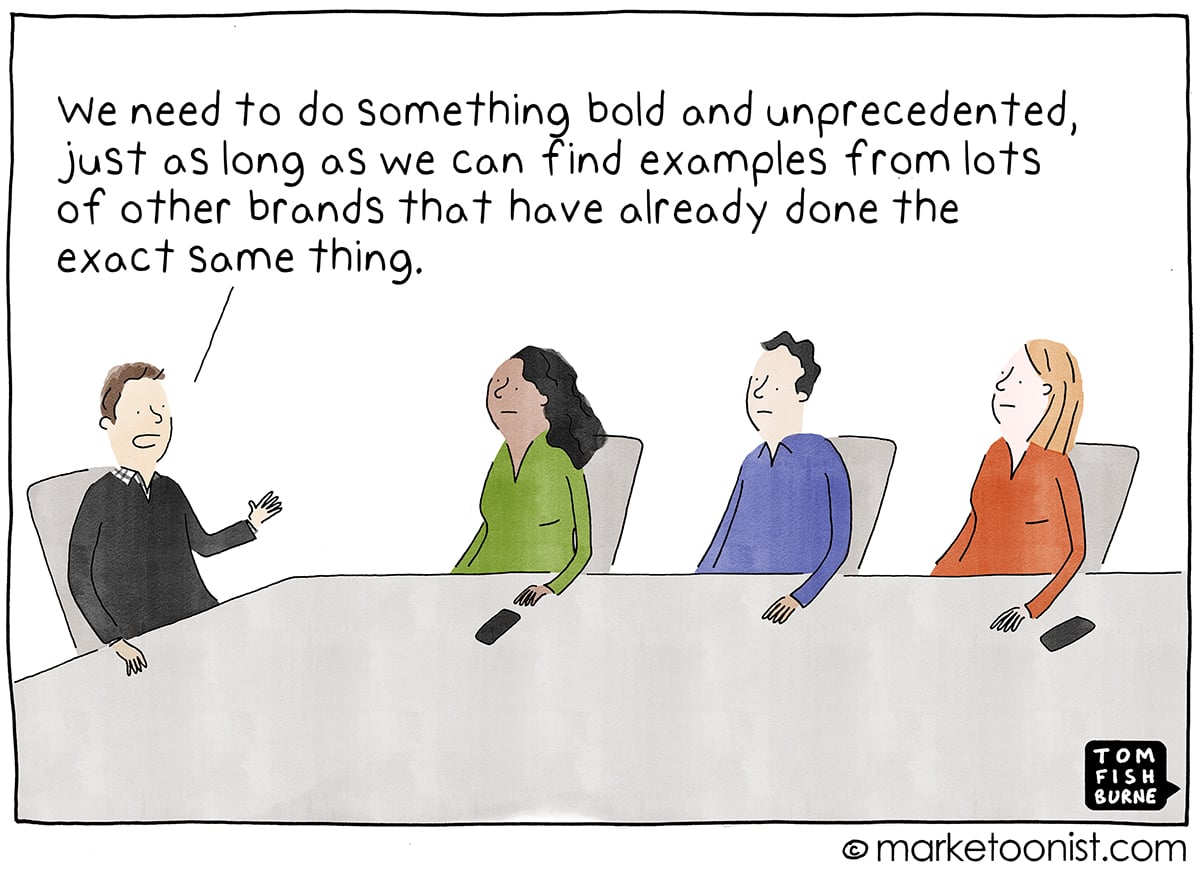
I drew this week’s cartoon on a paradox I keep seeing in innovation.

Henry Ford famously said:

“I invented nothing new. I simply assembled the discoveries of other men behind whom were centuries of work.”

Ford’s original motor company cribbed ideas and inspiration everywhere from Singer sewing machines to P&G to Chicago slaughterhouses. Those borrowed innovations set the stage for a whole new approach to manufacturing.

Stanford GSB professor Stefanos Zenios and Ken Favaro explored Ford’s approach as a case study in what they called “Precedents Thinking” in an HBR article last year.

Their key thesis is that past innovation is raw material for new innovation. Precedents show what’s possible, reduce risk, and give leaders the confidence to act.

And yet, in practice, precedents often get used less to inspire what’s possible, than as a permission slip to do anything at all. This creates a kind of innovation theater.

Relying only on precedents can lead brands to doing the same thing over and over again.

That tension to be “unprecedented with precedents” is at the heart of innovation. The best innovation borrows selectively and builds on what it finds. The worst just borrows.

Here are a few related cartoons I’ve drawn over the years:

Navigating Innovation - January 2024

Navigating Innovation cartoon
Share
  • Share this Marketoon
| Read Post

culture of innovation - January 2018

Share
  • Share this Marketoon
| Read Post

safe is risky - July 2014

Share
  • Share this Marketoon
| Read Post

The post Unprecedented with Precedent first appeared on Marketoonist | Tom Fishburne.

  • ✇Marketoonist - Tom Fishburne
  • Just Circling Back tomfishburne
    Former ad copywriter and Gaping Void cartoonist Hugh MacLeod once wrote, “If you talked to people the way advertising talked to people, they’d punch you in the face.” It’s not just advertising that can be off-putting. The way businesses talk in lead generation is generally worse, partly because there’s the illusion of personalization. AI and personalization tech have made it easy for just about anyone to mention a prospect’s local coffee shop, reference a detail scraped from their website,
     

Just Circling Back

Just Circling Back Marketoonist cartoon

Former ad copywriter and Gaping Void cartoonist Hugh MacLeod once wrote, “If you talked to people the way advertising talked to people, they’d punch you in the face.”

It’s not just advertising that can be off-putting. The way businesses talk in lead generation is generally worse, partly because there’s the illusion of personalization.

AI and personalization tech have made it easy for just about anyone to mention a prospect’s local coffee shop, reference a detail scraped from their website, or kinda sorta get an aspect of someone’s business model. (I receive a ton of outreach calling me “Mark” because of “Marketoonist.”)

But it’s often pretty shallow and generic, and still packed with the cliché phrases that have plagued cold outreach since the dawn of marketing time. AI-generated lead generation after all is trained on all the lead generation that came before it.

Paradoxically the tech for personalization has made a lot of personalized outreach feel pretty robotic. The tools designed to sound human can signal the opposite.

In 1970, a Japanese roboticist introduced the concept of the “uncanny valley.” In designing robots to be more human-like, he observed that people respond positively only up to a point.

Then there’s an “uncanny valley” where the “almost-human” design seems creepy and people experience “revulsion.”

We’re in an age of the “uncanny valley” in personalization.

Marketers have always chased the holy grail of delivering the right message to the right person at the right time. But much of today’s personalization falls flat. Bad personalization can be worse than no personalization.

It will take more than technology to bridge the uncanny valley of personalization. Applying the newest tools with an outdated mindset won’t give people what they want. At worst, marketers will just be able to annoy people more efficiently.

Here are a few related cartoons I’ve drawn over the years:

Personalization Gone Wrong - September 2023

Personalization Gone Wrong cartoon
Share
  • Share this Marketoon
| Read Post

the personalization privacy paradox - July 2021

Zero Party Data cartoon
Share
  • Share this Marketoon
| Read Post

personalization - November 2014

Share
  • Share this Marketoon
| Read Post

marketing with personal data - May 2014

Share
  • Share this Marketoon
| Read Post

The post Just Circling Back first appeared on Marketoonist | Tom Fishburne.

❌
Marketoonist - Tom Fishburne