Normal view

  • ✇Latin America Reports
  • Colombia’s Petro becomes first head of state to visit Venezuela since Maduro’s ouster Alfie Pannell
    Bogotá, Colombia – Colombian President Gustavo Petro arrived in Caracas today to meet with his counterpart in Venezuela, Interim President Delcy Rodríguez. The visit makes Petro the first world leader to visit the South American nation since the United States captured longtime strongman Nicolás Maduro in a military operation on January 3. Petro and Rodríguez are expected to discuss bilateral issues including energy and security cooperation on their more than 1,300 mile shared border.  T
     

Colombia’s Petro becomes first head of state to visit Venezuela since Maduro’s ouster

24 April 2026 at 21:50

Bogotá, Colombia – Colombian President Gustavo Petro arrived in Caracas today to meet with his counterpart in Venezuela, Interim President Delcy Rodríguez.

The visit makes Petro the first world leader to visit the South American nation since the United States captured longtime strongman Nicolás Maduro in a military operation on January 3.

Petro and Rodríguez are expected to discuss bilateral issues including energy and security cooperation on their more than 1,300 mile shared border. 

The Colombian president landed in Caracas on Friday afternoon with his Foreign Minister, Rosa Yolanda Villavicencio, and Defense Minister, Pedro Sánchez.

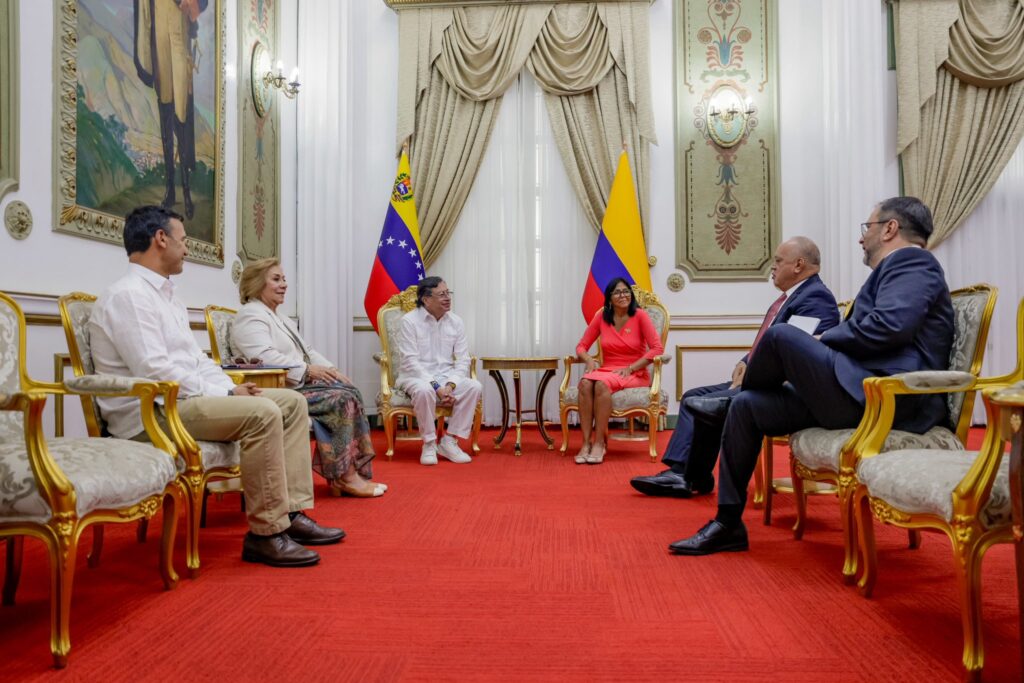
The delegation from Bogotá has been meeting with Rodríguez and her Interior Minister, Diosdado Cabello, alongside Foreign Minister Yván Gil at the Palacio de Miraflores – Venezuela’s presidential palace. 

Petro and Rodríguez were flanked by top officials at their meeting. Image courtesy of @InfoPresidencia via X

Petro and Rodríguez were scheduled to meet in Cúcuta, a Colombian city bordering Venezuela, in March but the Venezuelan president cancelled at the last minute citing security concerns.

Then last Friday, the Colombian leader announced he would head to Venezuela, saying, “If Mohammed won’t come to me, I’ll go to the mountain.”

The primary purpose of the meeting is strengthening security cooperation, according to the Petro administration.

“The aim of this meeting is for both governments to make progress on a joint plan to strengthen security and intelligence in the border area,” wrote the Office of the President in a post on X today.

The sprawling frontier is a hotbed for guerrilla activity and is largely controlled by the Colombian National Liberation Army (ELN), a rebel group involved in drug trafficking and illegal mining on both sides of the border.

The ELN was known to have ties to the Maduro regime but the Venezuelan government is under pressure from the U.S. to crack down on the rebel group, which Washington considers a “terrorist organization.”

While the Petro administration maintains the importance of strengthening bilateral cooperation, the meeting has perturbed many in the Venezuelan exile community in Colombia. 

“President Gustavo Petro’s visit to Venezuela, particularly his meeting with Delcy Rodríguez, raises serious concerns among Venezuelans,” Juan Carlos Viloria Doria, President of the Global Alliance for Human Rights and Vice-President of Venezuelans in Barranquilla, told Latin America Reports.

He noted that many Venezuelans do not consider Rodríguez to be a legitimate leader, describing her as “an extension of the regime led by Nicolás Maduro.”

“In this regard, such visits can be interpreted as a political endorsement or a form of international legitimization of a situation in Venezuela that still lacks adequate democratic guarantees,” maintained Viloria.

Petro and Rodríguez greet reporters. Image courtesy of @InfoPresidencia via X

There has also been pressure in Colombia for Petro to mediate the release of 16 Colombian citizens jailed in Venezuela.

The families of those detained allege the arrests were made “without a court order or evidence” and say their loved ones have faced human rights violations including torture. 

While there has been an easing in repression following Maduro’s ouster, Venezuela remains an authoritarian state and rights groups continue to denounce abuses.

“The least that we Venezuelans expect is that [the meeting] be used as an opportunity to demand concrete progress on human rights and democracy,” said Viloria.

“Any dialogue or rapprochement must be aimed at improving the living conditions of the Venezuelan people and fostering a genuinely democratic transition, not at consolidating contested power structures.”

Featured image description: Colombian President Gustavo Petro and Venezuelan Interim President Delcy Rodríguez at a meeting in Caracas on April 24, 2026.

Featured image credit: @InfoPresidencia via X

The post Colombia’s Petro becomes first head of state to visit Venezuela since Maduro’s ouster appeared first on Latin America Reports.
Trump expresses ‘total endorsement’ of Colombia’s far-right presidential candidate Abelardo de la Espriella

3 June 2026 at 10:03

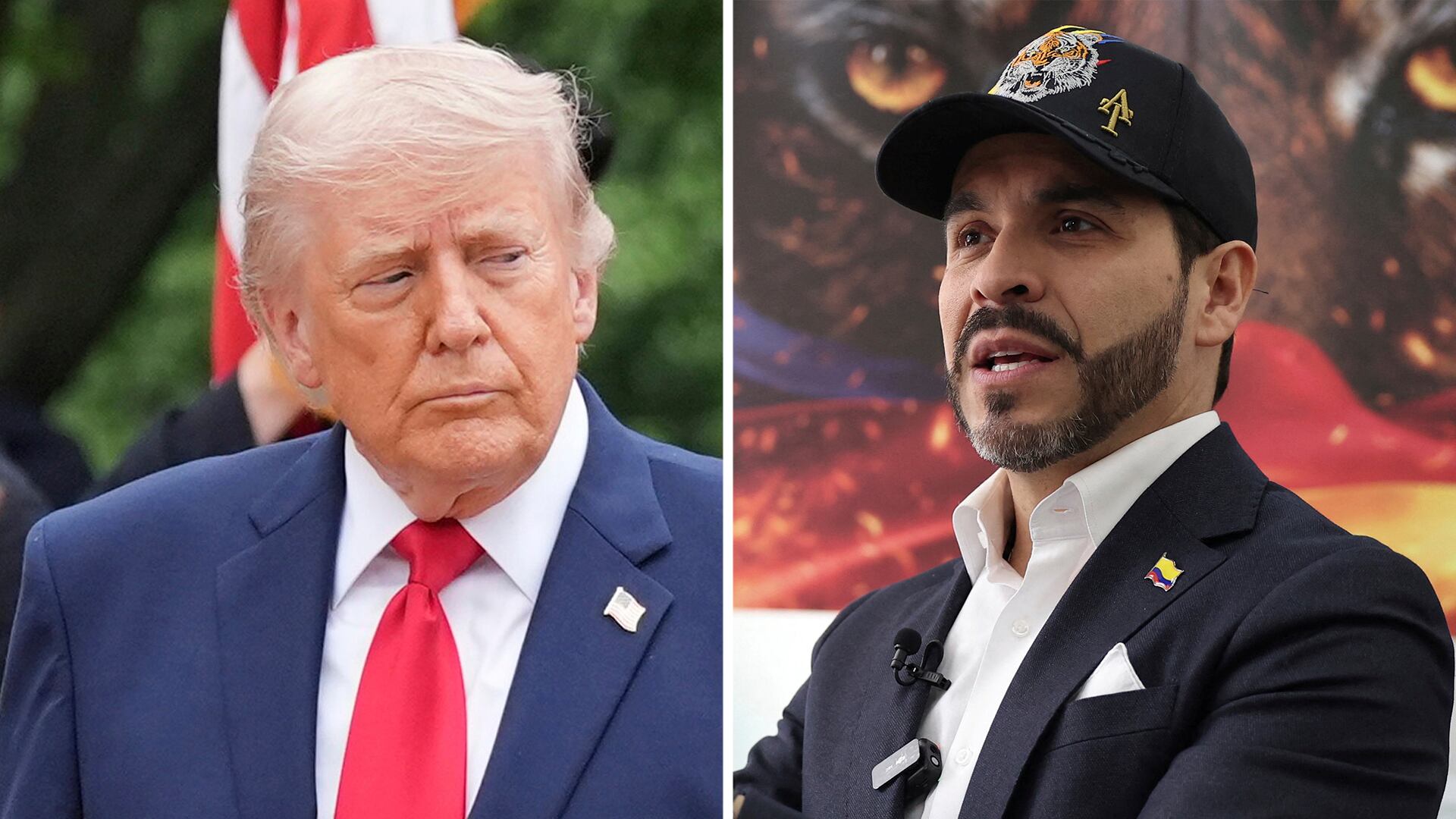
It took a while, but the endorsement that Colombia’s far-right presidential candidate Abelardo de la Espriella was most eagerly awaiting has finally arrived. U.S. President Donald Trump expressed his support for him on Tuesday via his social media platform, Truth. And he did so in the most effusive way possible: “Congratulations to Colombian presidential candidate El Tigre, Abelardo de la Espriella, a smart, strong, and tough leader, on his decisive victory in the first round of Colombia’s presidential election,” the Republican celebrated in his message.

Seguir leyendo

© AGENCIAS

Donald Trump and Abelardo de la Espriella.
  • ✇Latin America Reports
  • Bolivia dismisses Colombia ambassador after Petro comments Alfie Pannell
    Bogotá, Colombia – Bolivia’s government ordered Colombia’s ambassador to leave the country just days after Colombian President Gustavo Petro expressed support for ongoing anti-government protests. “The Bolivian government has decided to request that the Ambassador of the Republic of Colombia accredited to the country conclude her diplomatic duties in Bolivian territory,” read a statement on Wednesday morning by Bolivia’s Ministry of Foreign Relations. The ministry expressed its disapprov
     

Bolivia dismisses Colombia ambassador after Petro comments

20 May 2026 at 18:25

Bogotá, Colombia – Bolivia’s government ordered Colombia’s ambassador to leave the country just days after Colombian President Gustavo Petro expressed support for ongoing anti-government protests.

“The Bolivian government has decided to request that the Ambassador of the Republic of Colombia accredited to the country conclude her diplomatic duties in Bolivian territory,” read a statement on Wednesday morning by Bolivia’s Ministry of Foreign Relations.

The ministry expressed its disapproval of Colombia’s involvement in its domestic affairs amid mounting anti-government protests.

“Bolivia considers it essential that any external assessment or statement regarding the country’s internal situation be made with responsibility, diplomatic prudence, and full respect for… institutions,” continued the statement.

While the government did not explicitly mention Petro, the measure came just days after the Colombian president weighed in on the protest movement, describing it as a “popular insurrection” in an X post last Sunday.

In recent weeks, miners, teachers, farmers and Indigenous groups have been calling for President Rodrigo Paz to resign over economic hardships, including soaring inflation and the suspension of fuel subsidies.

Bolivia’s foreign ministry responded to Petro the same day, saying his words, “do not reflect the relation of friendship, respect and cooperation between the peoples of Bolivia and Colombia.”

Petro, whose term ends in August, did not backtrack following the Ambassador’s dismissal.

“If they expel the ambassador simply for proposing dialogue ​and mediation, it means we’re sliding toward extremism that could lead ​to a very difficult situation for the Bolivian people,” the president told Caracol radio today.

Despite the spat, Bolivia’s foreign ministry said diplomatic channels remained open and the expulsion did not count as a full-scale rupture in relations.

The government added that it had granted Ambassador Elizabeth García Carrillo “the appropriate period of time in accordance with current international standards” to leave the country.

Featured image description: President Gustavo Petro (L) and President Rodrigo Paz (R). I

Featured image credit: Wikimedia Commons

The post Bolivia dismisses Colombia ambassador after Petro comments appeared first on Latin America Reports.
In conversation with Claudia López, Colombian presidential candidate and ex-mayor of Bogotá

15 May 2026 at 18:40

Less than three weeks before Colombians head to the polls in presidential elections, centrist candidate Claudia Lopez’s odds at victory are slim, to say the least.

Since winning the primary contest to lead the Consultation of Solutions (Consulta de las Soluciones) bloc in March, the silver-haired former mayor of Bogotá has been criss-crossing the country to win over moderate voters.

But the latest polls report the 56-year-old’s share of the vote as being in the low single digits.

Dressed in her signature gilet and sipping from a mug of coffee, the former Harvard University guest lecturer says in flawless English that she wants to do the interview in Spanish – “I need to get people to vote for me,” she jokes. 

With little to lose, López speaks candidly about her time in office, her views on other politicians, and her experience on the campaign trail.

Watch the full interview here

Reflections on her mayorship

López, who steered Bogotá through the Covid-19 pandemic and a mass wave of anti-government protests, speaks proudly of her stint as mayor from 2020 to 2024.

The presidential hopeful rattles off a list of her achievements in office: her management of the Covid-19 pandemic, lifting 600,000 women out of poverty, and rolling out Bogotá’s public bicycle network.

López also speaks candidly about the problems during her mayorship, which spanned the administrations of presidents Iván Duque and Gustavo Petro.

“Interestingly, I ended up having an easier relationship with President Duque, a right-winger, than with my left-wing president, whom I voted for,” says López. 

López, who publicly backed Petro’s candidacy, describes friction between the national government and the mayor’s office.

“President Petro is an effusive leader, but he is too effusive, very machista, and I, well, I don’t agree with that; if there’s one thing I can’t stand in my life, it’s the abuse of power.”

On the campaign trail

Today, the former senator finds herself trying to carve out a place in a noisy election cycle marked by political extremes and polarization.

Her coalition’s platform is based on three pillars: security and territorial governance; equality and social justice; and regional development without corruption.

López’s shift to the center has drawn some criticism, including from voters who note the former Green Alliance member’s u-turn on key environmental issues like fracking.

Last year, she declared: “If god gave us oil, coal, and gas, that is what we will use.”

“I maintain this stance,” insists López, adding she opposes the Petro administration’s pause on all oil and gas exploration. “Stopping gas exploration means halting Colombia’s energy transition – it’s a mistake.”

López argues the policy has damaged the economy and reduced funds for investment and development. 

Instead, she backs a gradual transition: “I estimate that the transition in Colombia from fossil fuels to cleaner energy sources will take us about 25 years, give or take.”

The candidate believes in preserving biodiversity, saying she would not authorize mineral exploration in the country’s forests or protected areas, marking a softer stance than some of her opponents.

Among her rivals, López is especially critical of right-wing criminal defense attorney Abelardo de la Espriella.

“He is the only candidate – let’s put it this way – whom I would absolutely never vote for. He is a defender of mobsters. He is a shadowy character,” says López.

De la Espriella notoriously represented figures linked to paramilitary death squads, the head of the worst pyramid scheme in Colombian history, and Alex Saab, considered the frontman for corruption schemes by former Venezuelan dictator Nicolas Maduro. 

López argues that he is an Uribista – a supporter of the politics of right-wing ex-president Álvaro Uribe – but is on a different “side of the coin” to Uribe’s chosen candidate, Paloma Valencia.

“Paloma is definitely a supporter of Uribe, but she’s never exactly been a defender of mobsters,” explains López.

The ex-mayor refused to rule out voting for Valencia or for leftist candidate Ivan Cepeda, the two frontrunners alongside de la Espriella.

But López, a lesbian woman, is staunchly critical of Valencia’s stance on LGBTQ+ rights. The candidate for Uribe’s Democratic Center (Centro Democrático) party opposes adoption by same-sex couples while her party has blocked bans on conversion therapy. 

She is particularly critical of Juan Daniel Oviedo, a gay politician, for agreeing to be Valencia’s running mate in March. 

“I regret that Juan Daniel Oviedo feels compelled to play along with that anti-rights agenda. In fact, I believe he is the only person who has been told to his face that he is not considered an equal human being, that he is not considered a citizen with the same rights, and that they do not trust him to raise a child,” says López.

Despite her objections to Valencia, López says she still will not rule out voting for her in the second round, citing the improbable possibility that Paloma faces de la Espriella in a run-off.

But the former mayor maintains she would not endorse Valencia and Oviedo in any eventuality: “I wouldn’t campaign for them, ask anyone to vote for them, or endorse them.”

Looking to the future

Finally, faced with nearly impossible odds in May’s elections, López projects a springy optimism about her political future.

“I’m very happy with the campaign I’ve run, and I’m very grateful to the Colombian people,” says the candidate, stressing that it is just her first stab at the presidency.

“Ours is a new grassroots movement; we only just collected the signatures last year, so I feel grateful, happy, and very excited, and I’m going to continue in politics and continue working to build Colombian social democracy.”

This article originally appeared on The Bogotá Post and was republished with permission.

Featured image description: Claudia Lopez.

Featured image credit: Billy Ramsey.

The post In conversation with Claudia López, Colombian presidential candidate and ex-mayor of Bogotá appeared first on Latin America Reports.
  • ✇El País in English
  • Petro and Mamdani: A meeting of progressive leaders the Trump administration thwarted Diego Stacey
    Colombian President Gustavo Petro had planned to meet New York City Mayor Zohran Mamdani, a democratic socialist, during his trip to the United States this week. Petro traveled to the U.S. on Wednesday to assume the presidency of the United Nations Security Council. In the days that followed, he intended to hold a private meeting with Mamdani, a rising progressive figure who, like him, is a staunch opponent of Donald Trump. The photo of the two left-wing leaders carried great symbolic weight: fo
     

Petro and Mamdani: A meeting of progressive leaders the Trump administration thwarted

11 June 2026 at 10:58

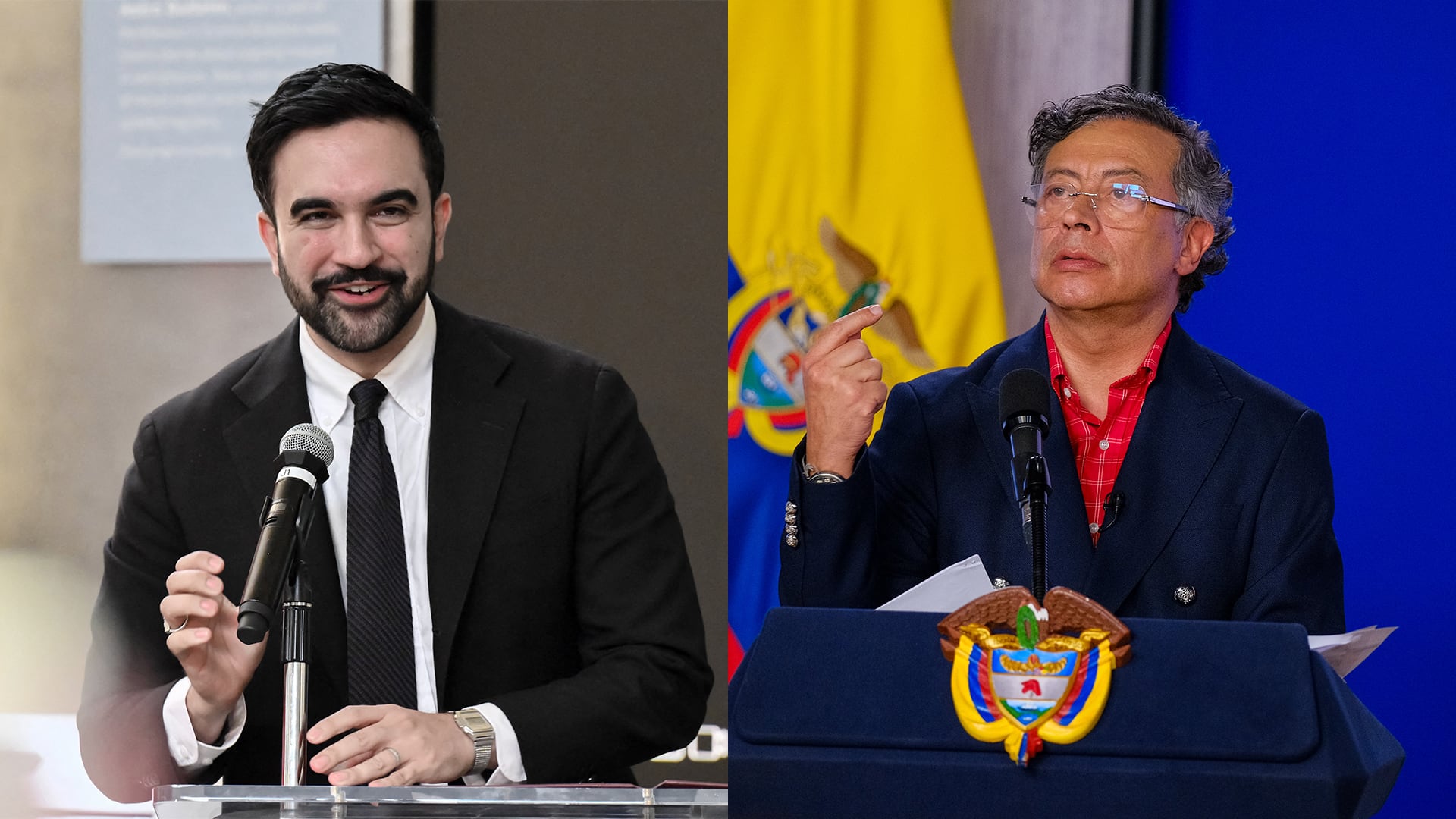
Colombian President Gustavo Petro had planned to meet New York City Mayor Zohran Mamdani, a democratic socialist, during his trip to the United States this week. Petro traveled to the U.S. on Wednesday to assume the presidency of the United Nations Security Council. In the days that followed, he intended to hold a private meeting with Mamdani, a rising progressive figure who, like him, is a staunch opponent of Donald Trump. The photo of the two left-wing leaders carried great symbolic weight: for Mamdani it would have been his first meeting with a head of state; for Petro it would have meant sealing an alliance with Democrats on the eve of decisive elections for Colombia. The meeting never took place. The reason: the White House made sure of it.

Seguir leyendo

© REUTERS/PRESIDENCIA DE COLOMBIA

Zohran Mamdani and Gustavo Petro.
  • ✇Latin America Reports
  • The ‘global far right’ in Colombia – lessons from history (Perspective)  Charlotte Eaton
    On May 24, Colombia’s President Gustavo Petro posted on X denouncing an “international alliance of the ultra-right” which was seeking to interfere in presidential elections being held this Sunday.  The so-called “Hondurasgate” responds to a series of audios leaked in late April indicating an alleged conspiracy between the United States, Israel and Argentina to destabilize left-wing governments in Latin America, including in Colombia.  Leaked recordings, first published by Diario Red, a
     

The ‘global far right’ in Colombia – lessons from history (Perspective) 

29 May 2026 at 15:20

On May 24, Colombia’s President Gustavo Petro posted on X denouncing an “international alliance of the ultra-right” which was seeking to interfere in presidential elections being held this Sunday. 

The so-called “Hondurasgate” responds to a series of audios leaked in late April indicating an alleged conspiracy between the United States, Israel and Argentina to destabilize left-wing governments in Latin America, including in Colombia. 

Leaked recordings, first published by Diario Red, allegedly tie former Honduran President Juan Orlando Hernandez to conservative actors in these countries who set out to spread disinformation about leftist governments in Mexico, Colombia and Brazil. 

Such international coordination is not new; since at least last August there have been reports of the far right in Colombia developing increasingly sophisticated ties with extremist groups in Latin America, Spain and the United States. 

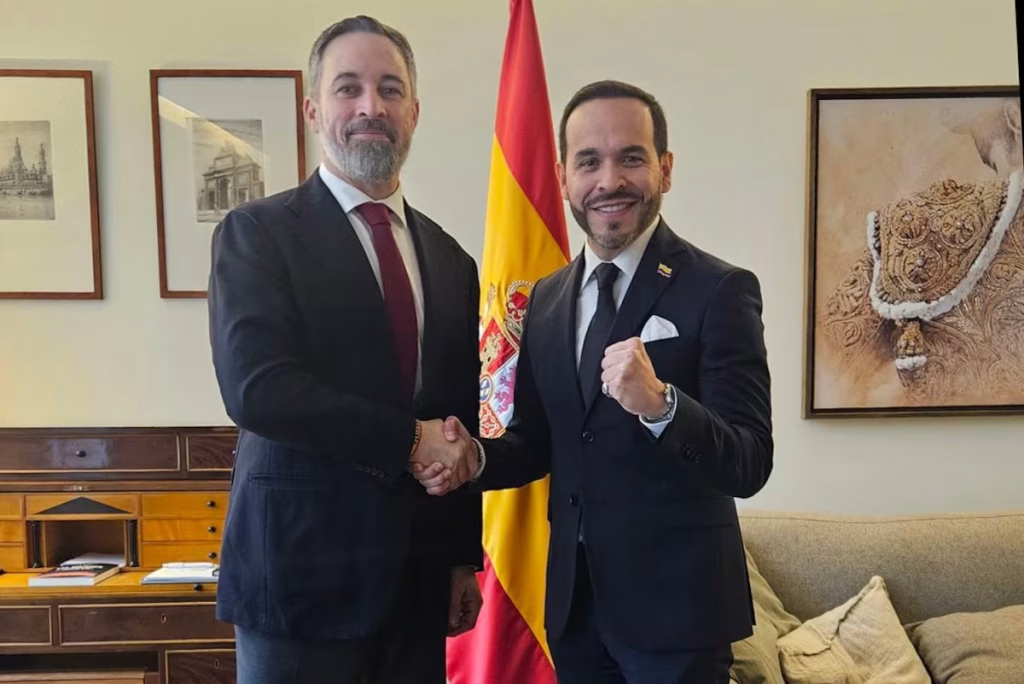
These cross-border networks include significant figures in Colombian politics. In January, presidential hopeful Abelardo de la Espriella travelled to Madrid where he met Santiago Abascal, leader of far-right Spanish Vox party, and participated in the Foro de Madrid, an alliance of right-wing leaders and groups across Europe and the Americas. 

A recent investigation by Bellingcat and Cerosetenta also connected Jorge Rodríguez, ex- congressional candidate for the Centro Democrático, to an alleged member of the global neonazi group Active Club in Bogotá. Rodríguez has been a keen supporter of another contender for the presidency, the Centro Demcrático’s Paloma Valencia.

As Petro’s post suggests, there are also more powerful influences at play. On May 20, Republican Senator Bernie Moreno told a meeting of the Atlantic Council that the United States might not recognize the result of Sunday’s elections if there is evidence of voter intimidation. 

Moreno, who is of Colombian origin and has been invited to oversee the elections as an international observer, also denounced the Petro administration and claimed it would be an “abject disaster” if the country voted in another leftist government. 

Santiago Abascal and Abelardo De La Espriella met in Spain in January 2026. Image credit: Vox

Colombia’s history with the global far right 

As a historian of 20th-century Colombia, focussing particularly on political and social developments in the mid-1900s, I am aware that Colombia’s growing entanglement in the global far right also has historical precedents.

In the late 1930s and early 1940s, various right-wing groups across the country cultivated cross-border connections with fascist-inspired groups in Europe and Latin America. 

In the context of Liberal social reformism, Conservative weakness and a growing fear of communism, several movements emerged across the country (but principally in Bogotá and Medellín) which sought inspiration from Nazism, Italian fascism and, most importantly, Spanish Catholic nationalism. 

The onset of the Spanish Civil War (1936 to 1939) allowed these groups to forge tangible links with their European counterparts in the form of fundraising campaigns for Nationalist troops in Spain, propaganda visits from representatives of General Francisco Franco and the establishment of local branches of the Falange Española, a fascist political party. 

These connections strengthened the Colombian far right financially and politically, making them a not insignificant force in the country. 

Colombia in the mid-20th century was clearly a very different political and social scene. For starters, it had a bipartisan political system and the Catholic Church played a very influential role in politics. 

However, it is worth taking note of the consequences of this previous international mobilization, particularly as the far right plays a much more significant role today. 

Firstly, the growing audacity of right-wing movements led to the halting of a reformist agenda which, although imperfect, did aim to improve the lives of many Colombians. 

It also increased political polarization in the country and infused popular and official Conservative discourse with a particular religious-based nationalism that would have disastrous consequences in the late 1940s when Colombia saw the outbreak of a more-than-decade-long informal civil war. 

Colombian President Laureano Gómez (1950-53) admired General Francisco Franco’s fascist government in Spain and in 1953 promoted a corporatist constitutional reform bill. He was deposed in a military coup that same year. Image credit: Señal Memoria

Finally, the sense that the country’s interests were better served as part of a wider conservative ideal, contributed to a constitutional reform bill in 1953 which sought to turn Colombia into a confessional corporatist state along the lines of Franco’s Spain. 

This bill failed but provoked a coup that inaugurated the country’s only 20th-century dictatorship which was succeeded by a 16-year power sharing agreement that set the scene for the emergence of guerrilla movements from the 1960s.

Of course, no one can predict the long-term impacts of the upcoming election result. However, the events of the 1930s and 1940s should give pause for thought about what the involvement of certain presidential candidates in the global far right could mean for Colombia’s future. 

The opinions and analysis expressed in this column are solely those of the author and do not necessarily reflect the views of Latin America Reports.

The post The ‘global far right’ in Colombia – lessons from history (Perspective)  appeared first on Latin America Reports.
  • ✇Latin America Reports
  • Conflict-hit regions face security concerns ahead of Colombia presidential election Catherine Ellis
    Bogotá, Colombia – Human rights defenders, analysts and social leaders in Colombia have expressed concern about the humanitarian situation in conflict-affected regions ahead of the country’s presidential elections on Sunday. Although the National Liberation Army (ELN) and several dissident groups of the now-defunct FARC rebels have announced temporary ceasefires during the election period, rights groups say fears remain high over violence, mobility restrictions and intimidation in remote area
     

Conflict-hit regions face security concerns ahead of Colombia presidential election

29 May 2026 at 21:36

Bogotá, Colombia – Human rights defenders, analysts and social leaders in Colombia have expressed concern about the humanitarian situation in conflict-affected regions ahead of the country’s presidential elections on Sunday.

Although the National Liberation Army (ELN) and several dissident groups of the now-defunct FARC rebels have announced temporary ceasefires during the election period, rights groups say fears remain high over violence, mobility restrictions and intimidation in remote areas.

Lina Mejía, coordinator at the humanitarian organization Vivamos Humanos, said there were still significant risks surrounding conditions during and after the vote.

“It’s not just a question of whether armed groups will respect the elections themselves, but also whether there will be mobility restrictions, whether electoral materials will be protected from attacks after the vote, and whether communities will be free from intimidation,” she told Latin America Reports.

Humanitarian organizations say that while armed groups often refrain from directly attacking polling stations, elections can still be affected by the broader security environment in areas where armed actors exercise territorial control and over illicit economies linked to coca production, illegal mining and extortion.

According to the Electoral Observation Mission (MOE), 386 municipalities across 31 departments have been identified as having some level of electoral risk linked to violence and the presence of armed groups. 

The organization said the number of municipalities at risk had increased compared to earlier assessments and called for stronger protections during the electoral period, especially in regions like Catatumbo and the southwest of the country, including Cauca, Meta and Guaviare.

This week, at least 50 fighters were reportedly killed in Guaviare during a three-hour battle between rival FARC dissident factions. The faction led by Iván Mordisco allegedly attacked a camp belonging to the rival Calarcá group.

Both factions rejected the 2016 peace agreement that led thousands of members of the former FARC guerrilla movement to demobilize.

In Catatumbo, a region along the border with Venezuela, clashes over the past few months between the ELN and FARC dissident faction Frente 33 have kept security conditions volatile.

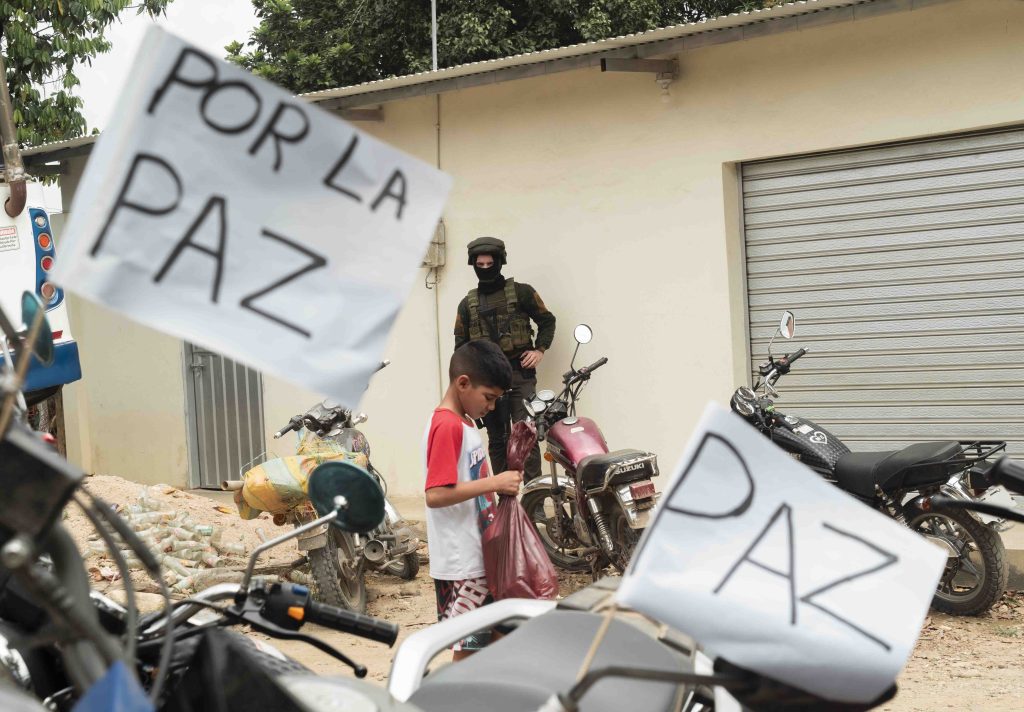
Humanitarian caravan in Catatumbo with peace signs. Credit: Lucas Molet.

Just this month, Freiman Velásquez, a social leader and member of the Association for Peasant Unity of Catatumbo (Asuncat), was assassinated in Tibú. He was killed alongside his sister and two of his bodyguards. The attack has been attributed to the ELN.

Despite the violence, Carmen Garcia, a social leader in Catatumbo, said elections can sometimes bring brief periods of calm.

“There is one positive thing in the territory: when it comes to voting, the armed actors usually respect the process,” she said.

In Catatumbo, the ELN announced a ceasefire beginning Saturday afternoon until after the elections.

But Garcia, who runs an organization rescuing young people from recruitment by armed groups, said many residents no longer trust such agreements following recent killings and security violations in the region.

“Before, the word of the ELN meant something. The word of the FARC meant something. If they said there would not be an attack, you knew there would not be one,” she told Latin America Reports. “But now people no longer truly believe in ceasefires.”

Rights groups say the violence forms part of a broader deterioration in the humanitarian situation in Colombia.

According to Vivamos Humanos, more than 350 violent incidents were recorded during the first five months of 2026.

These include homicides, mobility restrictions, and the presence of anti-personnel mines and improvised explosive devices.

“Among the main impacts are restrictions on mobility and movement, as well as homicides, and the presence of anti-personnel mines, unexploded ordnance and improvised explosive devices,” said Mejía.

Concerns have also intensified in the southern Colombian department of Caquetá. On May 12, audio messages circulated on social media by a FARC dissident group announcing an armed strike across the Caquetá and Caguán river basins, restricting river and road movement.

“We campesinos are in an extremely difficult situation. It’s so tense,” one resident of Cartagena del Chairá, Caquetá, told Latin America Reports. He and other residents were concerned that the strike might affect the ability to vote due to movement restrictions.

The resident said communities had been forced to carry identification documents issued by one armed group and threatened if they failed to do so.

While the strike ended a few days after it was announced, Colombia’s Ombudsman’s Office, the Defensoría del Pueblo, warned that the situation reflected an ongoing pattern of intimidation and territorial control by armed groups.

“This threat adds to a situation that is not new: since December 2025, communities in Putumayo, Caquetá and Amazonas have faced armed strikes and severe restrictions on movement,” the organization said in a statement published on May 15.

The Defensoría also called for “urgent measures” to guarantee the transport of electoral materials and the installation of rural polling stations in remote areas “to guarantee free and peaceful elections on May 31.”

Featured image description: Graffiti from FARC dissidents and the ELN in the city of Cucuta

Featured image credit: Lucas Molet.

The post Conflict-hit regions face security concerns ahead of Colombia presidential election appeared first on Latin America Reports.

  • ✇Latin America Reports
  • Ecuador doubles tariff on Colombia to 100% Alfie Pannell
    Bogotá, Colombia – Ecuador will impose a 100% tariff on all Colombian imports beginning on May 1, according to a statement by the Ministry of Production, Foreign Trade, and Investment today. The move ramps up tensions between the two South American neighbors, which have imposed reciprocal levies of 50% in a trade war that began in January when Ecuador announced it would charge Colombia a “security fee”. “This measure is based on national security criteria and seeks to reinforce shared resp
     

Ecuador doubles tariff on Colombia to 100%

9 April 2026 at 23:44

Bogotá, Colombia – Ecuador will impose a 100% tariff on all Colombian imports beginning on May 1, according to a statement by the Ministry of Production, Foreign Trade, and Investment today.

The move ramps up tensions between the two South American neighbors, which have imposed reciprocal levies of 50% in a trade war that began in January when Ecuador announced it would charge Colombia a “security fee”.

“This measure is based on national security criteria and seeks to reinforce shared responsibility in a task that must be undertaken jointly to address the presence of drug trafficking at the border,” read a statement by the trade ministry on Thursday announcing the tariff hike.

Bogotá and Quito have clashed over border security issues in recent months, with Ecuadorean President Daniel Noboa accusing his counterpart of failing to deter criminal groups operating in the region.

Colombian President Gustavo Petro has defended his administration’s security record and imposed reciprocal levies against Ecuador.

The two countries were due to hold talks next week to resolve the trade war but these were cancelled yesterday amid a dispute over former Ecuadorean Vice President Jorge Glas. Quito recalled its Ambassador from Bogotá after Petro suggested Glas was a political prisoner and had not been treated humanely in jail.

The tariffs threaten economic shocks on both sides of the border; Ecuador imports medicine, sugar, vehicles and coffee from Colombia and exports wood panels, canned fish, frozen seafood, palm oil, and rice.

Featured image description: Colombia-Ecuador border photographed in 2020.

Featured image credit: Burkhard Mücke via Wikimedia Commons

The post Ecuador doubles tariff on Colombia to 100% appeared first on Latin America Reports.

  • ✇Latin America Reports
  • Trump apologizes to Petro for ‘Shield of the Americas’ exclusion Alfie Pannell
    Bogotá, Colombia – United States President Donald Trump apologized today to Colombian President Gustavo Petro for not inviting him to the ‘Shield of the Americas’ summit in Miami last week, according to the Colombian government. In a post on X, the Office of the President said the two leaders spoke on the phone for roughly half an hour, during which Trump “reiterated that President Petro will always be welcome in the United States and apologized for any previous inconvenience related to an i
     

Trump apologizes to Petro for ‘Shield of the Americas’ exclusion

12 March 2026 at 21:15

Bogotá, Colombia – United States President Donald Trump apologized today to Colombian President Gustavo Petro for not inviting him to the ‘Shield of the Americas’ summit in Miami last week, according to the Colombian government.

In a post on X, the Office of the President said the two leaders spoke on the phone for roughly half an hour, during which Trump “reiterated that President Petro will always be welcome in the United States and apologized for any previous inconvenience related to an invitation to Miami.”

The apology comes days after Petro criticized Trump for sidelining Colombia in the ‘Shield of the Americas’ summit, in which Washington convened 17 Latin American and Caribbean nations to sign an anti-drug cooperation pact.

During the phone call today, the two leaders reportedly discussed a host of issues, including energy, security, and counter-narcotics operations.

The statement from Bogotá added that Petro had invited Trump to visit Cartagena, a city on Colombia’s Caribbean coast, prompting the U.S. president to apologize for having excluded the South American leader from the Miami summit.

The ‘Shield of the Americas’ summit was held last Saturday at Trump’s Miami golf club and predominantly hosted delegates from conservative governments allied to the White House, including Argentina’s Javier Milei and Ecuador’s Daniel Noboa.

Following the conference, Petro said: “With 17 small, weak countries lacking experience in dealing with cocaine, you cannot make a southern shield; it will be punctured.” He also highlighted his country’s experience in combatting drug trafficking and noted his government’s record seizures of cocaine.

Petro and Trump have had a fractious relationship over the past year, clashing on issues from deportation flights to drug control. The White House imposed sanctions on the Colombian leader in October, with the president accusing Petro of being “an illegal drug dealer.

But a call in January led to a detente, with Petro visiting the White House in February.

In the call today, Trump “expressed his gratitude for the communication and his interest in maintaining closer contact with the Colombian president, to whom he reiterated his appreciation and friendship,” according to the statement from Bogotá.

Featured image description: President Donald J. Trump meets with Colombian President Gustavo Petro at the White House in February, 2026.

Featured image credit: @WhiteHouse via X.

The post Trump apologizes to Petro for ‘Shield of the Americas’ exclusion appeared first on Latin America Reports.

  • ✇Latin America Reports
  • Colombian journalist found dead days after being reported missing Angie Acosta
    Bogotá, Colombia – Authorities in Colombia confirmed the discovery of the body of Mateo Pérez Rueda, an independent journalist and Political Science student at the National University in Medellín, who had traveled to Briceño, Antioquia, to document the security situation in that region, where the 36th Front of the dissidents of the former FARC operates. The body has been released to the family following dialogues between organized crime groups and humanitarian organizations, including the
     

Colombian journalist found dead days after being reported missing

9 May 2026 at 02:10

Bogotá, Colombia – Authorities in Colombia confirmed the discovery of the body of Mateo Pérez Rueda, an independent journalist and Political Science student at the National University in Medellín, who had traveled to Briceño, Antioquia, to document the security situation in that region, where the 36th Front of the dissidents of the former FARC operates.

The body has been released to the family following dialogues between organized crime groups and humanitarian organizations, including the ICRC. The family wasn’t allowed to enter the zone either.

“He was murdered by Jhon Edison Chalá Torrejano, from the Darío Gutiérrez front, which is a divided group from the 36th Front, fragmented into various criminal groups,” stated President Gustavo Petro through his X account.

The 25-year-old reporter had become an important voice for the communities of northern Antioquia, founding and serving as the director of the digital media outlet El Confidente de Yarumal.

In this role, he covered issues related to organized crime, administrative corruption, public order, security, and local politics in municipalities where organized crime and illegal armed groups operate actively, such as Valdivia, and Ituango. Because of this, he faced legal prosecutions, conciliation summons, and other hostile acts against him.

The country entered into an active search for Mateo following the report of his disappearance on May 5 in the rural hamlet of Palmichal, where local residents and relatives of the victim had reported that the journalist had been murdered by members of the criminal group led by alias Calarcá Córdoba.

Alias Calarcá is a guerrilla leader participating in President Gustavo Petro’s “Total Peace” negotiations, and his arrest warrant was suspended by the government to facilitate talks with the armed group.

According to local media, Mateo contacted several officials seeking someone to accompany him to a rural area to get information about the ongoing armed conflict in the region.

Reports state that authorities and neighbors reportedly recommended that he should not leave the urban center, as no one, even government officials, have guaranteed safety going into these sectors; the journalist reportedly ignored these warnings and set off on his motorcycle.

Defense Minister Pedro Sánchez initially handled the case as a disappearance, but Mateo’s loved ones pointed out that it could be a kidnapping and murder just a few hours after losing contact with him, when his vehicle, wallet, cell phone, and keys were found abandoned. 

Sánchez also offered a 300 million COP (around $80,500 USD) reward for information leading to those responsible for Mateo’s suspected murder. 

This situation also highlights the ongoing risks for those practicing journalism in Colombia, mostly in rural territories and conflict zones. 

According to the FLIP, a press freedom foundation, since 2022, armed groups have attacked the press 387 times, using threats and displacement to force silence.

Featured image: Mateo Pérez Rueda

Image credit: FLIP

The post Colombian journalist found dead days after being reported missing appeared first on Latin America Reports.

  • ✇Latin America Reports
  • Colombia president rejects preliminary election results Alfie Pannell
    Bogotá, Colombia – President Gustavo Petro rejected the results of first-round presidential elections on Sunday, alleging irregularities. Hard-right populist Abelardo de la Espriella defied pollsters’ predictions to beat the candidate representing Petro’s leftist Historic Pact party, Iván Cepeda, although neither surpassed the 50% required to win outright. “The so-called count being transmitted is not legally binding. Its data is not considered official. As president, I do not accept the r
     

Colombia president rejects preliminary election results

1 June 2026 at 01:46

Bogotá, Colombia – President Gustavo Petro rejected the results of first-round presidential elections on Sunday, alleging irregularities.

Hard-right populist Abelardo de la Espriella defied pollsters’ predictions to beat the candidate representing Petro’s leftist Historic Pact party, Iván Cepeda, although neither surpassed the 50% required to win outright.

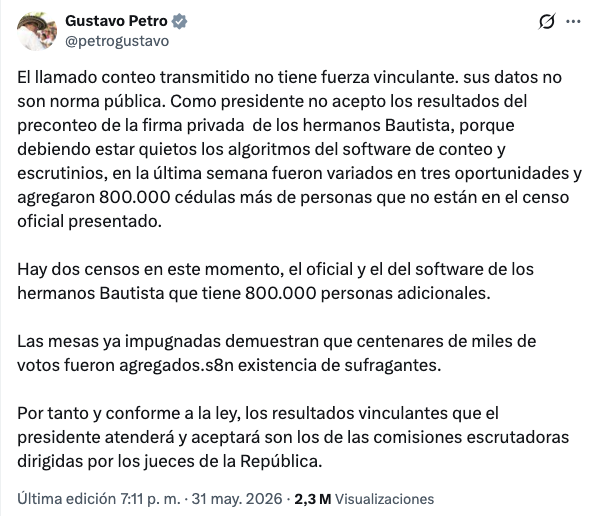
“The so-called count being transmitted is not legally binding. Its data is not considered official. As president, I do not accept the results of the preliminary count,” wrote Petro on X shortly after the election was called.

In Colombia, the “pre-conteo”, or preliminary count, is based on officials tallying the ballot sheets and entering them into an online software. But the “escrutinio”, or scrutinized results, usually take several days to be announced and are ratified by judges.

According to the Registrar’s Office, which is responsible for overseeing the voting process, the pre-count is “for informational purposes only” and has “no legal standing.”

But de la Espriella received nearly 700,000 more votes than Cepeda, a gap which is very unlikely to be closed after the scrutiny.

Delivering a speech after the results were released, Cepeda said he would not address the elections until the scrutinized count came out.

A post from President Gustavo Petro on May 31 saying he would not accept the pre-count results of Sunday’s elections.

“Only once the vote-counting committees have fully, clearly, and thoroughly clarified this matter will we comment on tonight’s results,” the senator told a crowd of supporters at the Hotel Tequendama in central Bogotá.

He also referred to historic efforts by Colombia’s traditional parties and institutions to repress the leftist movement embodied by the Historic Pact: “Our life has been a constant struggle.”

A crowd of Cepeda voters gathered nearby to watch the speech on a large screen, with some chanting the Spanish anti-fascist slogan “No Pasarán”. One pair held a sign reading “Fraud!”.

Petro has repeatedly warned that the elections may be stolen, part of a long-running dispute with Thomas Greg & Sons, a multinational company responsible for electoral logistics.

In 2022, the Historic Pact gained some 500,000 votes in legislative elections following the scrutiny.

Regardless of the final results of the election, Cepeda and de la Espriella are set to face off in a second round on June 21.

Featured image description: President Gustavo Petro at a cabinet meeting, October 22, 2025.

Featured image credit: @InfoPresidencia via X.

The post Colombia president rejects preliminary election results appeared first on Latin America Reports.

In less than a year, 1 in 5 minors in Colombia suffered online sexual violence, UNICEF, ECPAT, and INTERPOL warn

14 May 2026 at 17:52

Bogotá, Colombia – Around 21% of Colombian minors aged between 12 and 17 have been victims of online sexual abuse in the past year, according to a report published last week by UNICEF-Innocenti, ECPAT International, and INTERPOL. 

The report, “Disrupting Harm,” covered 25 countries including Colombia and examines how technology use, including new tools like artificial intelligence (AI) are helping to facilitate online abuse. 

The investigation was made between 2023 and 2025, and the results are alarming: around 860,000 Colombian adolescents experienced some type of digital sexual abuse or exploitation in just one year (2024) . 

Data also pointed to gender and economic disparities. A quarter of young women surveyed said they’d been victims of this type of abuse or exploitation while 17% of young men said the same. In poorer, rural areas of the country, 29% of minor respondents said they’d been victimized while 17% living in urban areas said they had been. 

In addition to social dynamics in Colombia, including deep-rooted “machismo”, prevalent domestic and gender based violence, and extreme wealth inequality, technology is increasingly becoming a factor in the abuse of children. 

According to a 2025 study by the Communications Regulation Commission (CRC), during the past year, 81% of teenagers between 14 and 17, and 55% of pre-adolescents aged 10 to 13, reported having their own cell phones. 

Experts say that since the pandemic, interactions among children and adolescents have increased significantly. Cell phones have become a ‘fundamental’ tool for maintaining social status and escaping reality, especially for those facing family problems.

“It is essential that children do not fear being punished or having their phones taken away for responding to a message. We saw in the study that this is one of their biggest fears: losing their connection to the rest of the world,” Camila Perera, a specialist at the Office of Research and Data for UNICEF Innocenti, told Latin America Reports.

Nearly half of the reported cases of abuse happened on social media platforms such as Facebook (80%), WhatsApp (30%), and Instagram (17%), while 14% were linked to online gaming networks.

In addition, 2% of victims reported that artificial intelligence was used to create fake explicit content using their faces – highlighting a newer phenomenon that became widely discussed last year after Elon Musk’s AI chatbot Grok began creating millions of sexualized images of people online. 

With the introduction of such technologies, regulators and parents are struggling to keep up. 

“Minors, with their superior digital skills, moved much faster than any safety measures could. While they advance, protection protocols simply cannot keep up,” Fabio González Florez, Project Leader at ECPAT International, told Latin America Reports.

“There is a serious obligation to stay informed, and that doesn’t require a postgraduate degree. Tutorials are everywhere, and every platform offers parental controls that we must learn to use,” he added.

A stranger behind a screen? The ‘real’ danger

Contrary to popular belief, the threat is not always an anonymous hacker hiding in the dark; in fact, only 30% of victims met their aggressor online.

In half of the documented cases, children were abused by someone they already knew, including family members, neighbors, and classmates. Due to this approach, some of the minors can’t recognize the abuse or feel safe enough to ask for help.

“There’s a common expression: ‘stranger danger’, the idea that we must only be looking for outsiders. However, the majority of the abusers are actually the ones close to the family,” stated González.

The findings are also exposing another difficult situation: one in five cases of online sexual abuse against a minor was made by another minor. It was found that some victims will look to target or recruit their peers to re-victimize in exchange for incentives or “freedom.”

The report also highlights that victims often suffer from severe mental health issues, including anxiety, depression and propensity to self harm. 

Even if many minors prefer to remain silent, when they decide to speak out, they usually look for their mothers, siblings, or a friend. This is a message about the importance of creating trust-based relationships with children.

“Beyond digital parenting, we must ensure the kids see their parents as sources of protection. They need to be someone they can talk to about sexuality, consent, and limits without being judged,” Perera recommended. “It is about being a source of trust so they can come to us with their doubts and curiosities.”

Despite existing channels in Colombia, such as the ICBF’s 141 line or the National Police’s “¡A Denunciar!” portal, the study found that formal reporting is almost non-existent between minor victims.

Protection measures: Are they enough?

With increased connectivity via the internet, the threat landscape for online abusers of Colombian children expands immensely. 

“Our obligation is to work with our 196 member countries; also, we have specific resolutions focused on child protection,” a member of INTERPOL, who requested anonymity because of the sensitivity of their work, told Latin America Reports. “Another critical measure is urging countries to adopt protocols to detect and block URLs containing sexual abuse and exploitation material to prevent the commercialization of such content.”

However, risks remain in an increasingly interconnected world: “A single image of a Colombian child can be reproduced globally across time and geography; therefore, the response to protect them must be a national priority”, the INTERPOL member said. 

Finally, the investigation calls on digital companies to contribute to risk reduction by incorporating prevention into platform design and improving safety measures. The research is also looking for new prevention tools for transforming both physical and digital spaces and eliminating the conditions that facilitate violence.

This issue requires concrete actions from all sectors: the protection system, families, and technology companies.

Featured image credit: UNICEF

The post In less than a year, 1 in 5 minors in Colombia suffered online sexual violence, UNICEF, ECPAT, and INTERPOL warn appeared first on Latin America Reports.

❌
Subscriptions