Normal view

  • ✇Latin America Reports
  • United Nations negotiates with US to allow fuel into Cuba Raphael McMahon
    The United Nations (UN) has entered into formal negotiations with the United States regarding the entry of fuel supplies to Cuba amid acute fuel shortages caused by a U.S. oil blockade, said Francisco Pichón, the permanent representative of the UN to Cuba. Members of the UN Office for the Coordination of Humanitarian Affairs and the Trump administration are discussing ways “to ensure that fuel can be accessed for humanitarian purposes,” according to Pichón. The UN representative clarified
     

United Nations negotiates with US to allow fuel into Cuba

11 March 2026 at 23:02

The United Nations (UN) has entered into formal negotiations with the United States regarding the entry of fuel supplies to Cuba amid acute fuel shortages caused by a U.S. oil blockade, said Francisco Pichón, the permanent representative of the UN to Cuba.

Members of the UN Office for the Coordination of Humanitarian Affairs and the Trump administration are discussing ways “to ensure that fuel can be accessed for humanitarian purposes,” according to Pichón.

The UN representative clarified that those fuel supplies would be used for “emergency response operations” and to protect the access of “vulnerable people and groups” to “vital services”. 

The recent U.S. oil blockade on oil has led to a growing nationwide humanitarian crisis: many regions are facing prolonged power outages, hospitals are facing increasing pressure as life-saving treatments are disrupted, and the economy is crumbling as schools and workplaces reduce their operational hours. 

The U.S. campaign of economic pressure is widely seen as an attempt to force the Cuban regime into collapse or make its leader grant political concessions to Washington. Senior Republicans in the U.S. have repeatedly suggested that some form of regime change in Cuba is imminent.

During the Shield of the Americas Summit on Saturday, President Trump promised that “great change” was coming to Cuba and its “bad regime that has been bad for a long time.” 

On Monday, President Trump reiterated his warning, claiming that Cuba may soon face either a “friendly” or “unfriendly” takeover by the U.S. 

Republican U.S. Senator Lindsey Graham also told Fox News on Sunday that “the liberation of Cuba is upon us. It’s just a matter of time now.” 

Although there are reports that an economic deal between Washington and Havana could soon be announced, the “unfriendly” option remains a possibility. The U.S. administration’s strikes on Iran or its operation to capture Venezuelan President Nicolás Maduro could serve as templates for a potential military operation against Cuba.

Read more: U.S. Reportedly Closing In On Economic Deal With Cuba

Ricardo Torres, a Cuban economist and research fellow at the Center for Latin American and Latino Studies at American University, spoke to Latin America Reports about the current Cuban crisis and the various iterations of regime change that could occur as a result.

“Whatever emotional and material reserves [Cuban] people once had are now largely exhausted … if the United States strictly enforces the oil embargo, a negotiated solution will likely become inevitable, given the limited support Cuba is receiving from its allies,” the economist said. 

Venezuela, Cuba’s erstwhile closest regional ally, has stopped supplying the island with oil since the capture of President Nicolás Maduro by U.S. forces and in early March an oil tanker bound for the island from Russia – a traditional ally – reversed route under suspected U.S. pressure. 

Commenting on recent revelations about UN-U.S. negotiations, Torres pointed out that the discussions between the White House and the UN will likely be limited to “aid delivery” as opposed to opening an avenue for de-escalation. 

The U.S., he argued, “would [probably] favor a full [political] transition in Cuba” and an end to Communist party rule. Failing that, “they may be prepared to support a phased agreement that starts with building a more stable economic base and proceed from there,” the research fellow concluded. 

Featured Image: A horse-drawn cart in Cuba during the Cuban ‘Período Especial’, the term used to describe the Cuban economic struggles in the 1990s after the Soviet collapse. The scale of current fuel shortages in Cuba has not been seen since the ‘Período Especial’ 

Image Credit: Nick via Wikimedia Commons 

License: Creative Commons Licenses

The post United Nations negotiates with US to allow fuel into Cuba appeared first on Latin America Reports.

  • ✇Latin America Reports
  • Cuban government confirms talks with Washington Raphael McMahon
    Cuban President Díaz-Canel confirmed earlier today that the Cuban and American governments are engaged in official negotiations with the aim of halting the recent escalation of tensions between Washington and Havana. “Cuban functionaries recently had conversations with representatives of the Government of the United States to find, by way of dialogue, the potential solution to the bilateral differences that exist between our two nations,” Díaz-Canel told journalists in a televised address.
     

Cuban government confirms talks with Washington

13 March 2026 at 16:45

Cuban President Díaz-Canel confirmed earlier today that the Cuban and American governments are engaged in official negotiations with the aim of halting the recent escalation of tensions between Washington and Havana.

“Cuban functionaries recently had conversations with representatives of the Government of the United States to find, by way of dialogue, the potential solution to the bilateral differences that exist between our two nations,” Díaz-Canel told journalists in a televised address.

His comments come amidst months of speculation about clandestine negotiations between Washington and Havana as the U.S. enforces a total oil blockade on Cuba in the hopes of forcing political regime change. 

The Cuban state had, before this morning, refused to acknowledge the existence of official dialogue with the U.S. government; Díaz-Canel cited the revolutionary government’s aversion to giving into “speculation” about a particularly “sensitive” diplomatic process.

Washington, however, has previously referred to talks with Havana but has made no guarantee regarding a diplomatic solution to the tensions between the two countries. U.S. President Donald Trump has suggested that both “friendly” and “unfriendly” options for a Cuba settlement remain on the table. 

Although the U.S. leader has not specified what these options may entail, the “friendly” deal likely refers to some kind of economic arrangement that sees the Cuban government liberalize the economy in exchange for an end to American sanctions. The “unfriendly” deal could involve regime change by military force, a method used by the Trump administration  in Venezuela and Iran

Although the breadth and full agenda of the talks remains unknown, Díaz-Canel mentioned that he had agreed to the inclusion of the Cuban diaspora, which is mainly concentrated in the United States, in economic life in Cuba proper. 

Díaz-Canel’s acknowledgement of talks follows an announcement of a prisoner release by the Cuban government late on Thursday. Although the Cuban government implied that this release had been a result of dialogue with the Vatican, its proximity to today’s statements could suggest Havana is willing to make political concessions to reach a diplomatic solution with the U.S.

The United States has reportedly proposed a deal with Cuba that would allow the Cuban leadership a peaceful political exit strategy, but Díaz-Canel has given no indication that a fundamental political change on the island is imminent.

Instead, he said that the current negotiations were being conducted with the express consent and at the direction of the “General of the Army” and “historic leader of our Revolution” Raúl Castro. Díaz-Canel also added that the negotiations would base themselves upon a mutual respect for “equality”, “the political systems of both countries, sovereignty and self-determination”.

Responding to the announcement, a functionary of the Cuban Foreign Ministry, who asked to remain anonymous, told Latin America Reports: “Our willingness to converse with the United States has always been there”. 

However, reiterating the Cuban President’s statements, they added, “we must resolve our differences through respectful dialogue between equals with respect for our sovereignty”. 

But as negotiations take place, the U.S. continues its campaign of maximum pressure.

Díaz-Canel also revealed in his address today that not a single oil tanker had reached Cuba in three months as he named the U.S.-sanctioned “energy blockade” as the biggest crisis currently facing the country. 

A Russian tanker carrying 200,000 barrels of oil was recently diverted away from the island under suspected U.S. pressure. Venezuela, Cuba’s erstwhile closest regional ally and chief oil supplier, has also been blocked by Washington from providing the island with energy supplies.

As the U.S. blockade pushes Cuba’s economic and humanitarian infrastructure towards collapse, hope for some form of peaceful negotiated settlement remains. 

Featured Image: Cuban President Miguel Díaz-Canel

Image Credit: Russian Duma via Wikimedia Commons

License: Creative Commons Licenses 

The post Cuban government confirms talks with Washington appeared first on Latin America Reports.

  • ✇Latin America Reports
  • Pentagon reportedly preparing for action against Cuba Raphael McMahon
    The United States is preparing options for a possible military operation against Cuba, according to a report today by daily newspaper USA Today.  Two sources reportedly familiar with the matter told the paper that the Pentagon is increasing its preparedness in case U.S. President Donald Trump orders the military to intervene on the island, a possibility which Trump and various other high-ranking figures in his administration have mooted.  In response, the Cuban government said that while i
     

Pentagon reportedly preparing for action against Cuba

16 April 2026 at 18:55

The United States is preparing options for a possible military operation against Cuba, according to a report today by daily newspaper USA Today

Two sources reportedly familiar with the matter told the paper that the Pentagon is increasing its preparedness in case U.S. President Donald Trump orders the military to intervene on the island, a possibility which Trump and various other high-ranking figures in his administration have mooted. 

In response, the Cuban government said that while it did not want Washington to attack, it was prepared for any possible intervention.

This year, relations between the two ideological adversaries have become more tense than at any other point since the end of the Cold War, with the U.S. removing Cuba’s closest political ally Nicolás Maduro from power in Venezuela and imposing a complete blockade on non-private fuel imports during the first three months of 2026. 

However, the commencement of high-level diplomatic talks between the two nations and the recent arrival of a Russian oil tanker in Cuba – which Trump said he had “no problem” with – suggested that mutual desire for a peaceful resolution to tensions was growing. 

But earlier this week, Trump said that the U.S. “may stop by Cuba” after the conflict with Iran reaches a resolution, which may be an indication that ongoing diplomatic talks between Cuba and the U.S. that seek to de-escalate tensions are progressing poorly.  

Nevertheless, Cuban President Díaz-Canel repeatedly expressed his desire for peace with the United States in his first interview with U.S. media last Sunday, though he warned that he and the Cuban population would be willing to fight to defend the island from any aggression by Washington. 

In January, Havana ordered its forces to prepare for war and has hosted countrywide defensive drills to prepare for a potential invasion from the north, yet its ability to defend against a Pentagon-led operation is unknown. 

Jennifer Kavanagh, a senior fellow and director of military analysis at foreign policy think tank Defense Priorities, spoke to Latin America Reports about the likelihood of a U.S. military operation in Cuba. 

She speculated that, although the leak to USA Today was likely a negotiating tactic intended to pressure the Cuban government into making greater concessions in negotiations, “there is planning going on for such a [military] operation … Rubio has made his support for regime change in Cuba clear. Trump, too, would likely welcome a distraction from Iran that he can sell as a success”. 

The expert also explained what a potential intervention might look like: “I doubt they would use exiles, as this has failed in the past. A Maduro-style approach is possible. A more complete takeover of the island which is small and weak is an alternative”.

Kavanagh also weighed in on the chances of such an operation’s success. “[Although] 

defenders always have an advantage, I imagine the United States could overpower Cuba’s defenses. Holding the island for a sustained period might be more challenging”.

The U.S. has intervened several times in Cuba, which is situated approximately 90 miles off the coast of Cuba. In the early 1900s, the U.S. invaded the island on three occasions to protect American economic interests.

In 1961, after the triumph of the Cuban Revolution, Washington also backed a failed invasion attempt of the island by anti-communist Cuban exiles, which came to be known as the Bay of Pigs. 

In a rally today, Díaz-Canel drew parallels between the latest threats and the infamous Cold War operation.

“The moment is extremely challenging and calls upon us once again, as on April 16, 1961, to be ready to confront serious threats, including military aggression. We do not want it, but it is our duty to prepare to avoid it and, if it becomes inevitable, to defeat it.”

Featured Image: The celebration of the 50th anniversary of the creation of the United States Southern Command (USSOUTHCOM) in Miami. USSOUTHCOM is the command of the U.S. military that would likely be responsible for overseeing any military operation against Cuba.  

Image Credit: Department of Defense via Wikimedia Commons License: Creative Commons Licenses

The post Pentagon reportedly preparing for action against Cuba appeared first on Latin America Reports.

  • ✇Latin America Reports
  • Cuban government pledges to release 51 prisoners after talks with Vatican Raphael McMahon
    In an unexpected move, the Cuban Foreign Ministry announced on Thursday night that the Cuban government would release 51 prisoners in the coming days “in the spirit of goodwill”.  According to the Cuban government the decision, described as “sovereign” in the statement, was taken as a result of its “close relationship” with the Vatican, suggesting that the Holy See had a significant part to play in the prisoner release. The prisoner release comes amidst severe tensions between Cuba and th
     

Cuban government pledges to release 51 prisoners after talks with Vatican

13 March 2026 at 15:38

In an unexpected move, the Cuban Foreign Ministry announced on Thursday night that the Cuban government would release 51 prisoners in the coming days “in the spirit of goodwill”. 

According to the Cuban government the decision, described as “sovereign” in the statement, was taken as a result of its “close relationship” with the Vatican, suggesting that the Holy See had a significant part to play in the prisoner release.

The prisoner release comes amidst severe tensions between Cuba and the U.S. as Washington continues its campaign of economic pressure to try to force regime change on the island. 

Although the Cuban government denies that its decisions are influenced by U.S. economic pressure, the release could be a sign of its willingness to make concessions in order to de-escalate tensions with Washington, which often criticizes its arbitrary detention of political prisoners.  

The Cuban government did not specify who it would release, but said that the prisoners selected “have all served a significant part of their sentence and have maintained good conduct in prison”. 

This is not the first time that Havana has released prisoners to soften relations with Washington. In early 2025 the Cuban government granted over 500 prisoners early release in accordance with the terms of a deal between the Miguel Díaz-Canel and Joe Biden administrations.

In return, Biden removed Cuba from the U.S. list of state sponsors of terrorism just days before his term ended. Cuba was, however, redesignated a state sponsor of terrorism immediately after Donald Trump came to power; the prisoners were released regardless. 

The 2025 deal was also brokered by the Vatican, highlighting the traditional importance of the papal state as a mediator between the two nations. 

The Vatican appears to have adopted this role of interlocutor again, as Vatican Secretary of State Cardinal Parolin stated earlier this week that the “necessary steps” had been taken to ensure a “negotiated solution” between the two adversaries. 

In the context of current tensions, Pope Leo XIV called for Cuba and the U.S. to engage in “sincere dialogue” to “avoid violence” in early February and recently held talks with Cuban Foreign Minister Bruno Rodríguez Parrilla. 

The top U.S. diplomat in Cuba – Chief of Mission Mike Hammer – also met with a representative of the Holy See to discuss the “deteriorating situation in Cuba”. 

Read more: Cuba, U.S. reportedly “talking” as Pope calls for de-escalation of tensions

“Historically, [the Vatican’s role] has been important because in Cuba the Catholic Church has remained a presence more than in most other communist countries, certainly more than in [Soviet] Russia,” Professor Massimo Faggioli, a professor of ecclesiology at Trinity College Dublin and a Vatican specialist, told Latin America Reports 

Although that “history of coexistence” has been “difficult” – religious celebrations were once banned on the island and the Cuban Communist Party seized Church property after coming to power – the Church’s continued existence in Cuba has meant that “all popes since John Paul II have had some kind of relationship with the Cuban leadership, to the dismay of the Americans”.

That relationship has become more important as the Vatican now, according to the Professor, perceives “a clearer threat” on the part of the United States “to do something about Cuba” and its communist regime in the wake of the Venezuelan and Iranian operations.

The Vatican’s “traditional approach to international relations … based on multilateralism, on the role of international organizations, on the rule of law” means that the Holy See finds itself “at odds” with the current American policy of potentially destabilizing unilateral regime change operations. This, in turn, has led it to push “to prevent the escalation” of the U.S.-Cuba tensions into a military conflict, Faggioli argued.  

The Vatican has historically been successful in mediating difficult negotiations between adversaries, the ecclesiologist pointed out, because their representatives engage in diplomacy as a “service to the Church” borne from faith and therefore tend to be less career-oriented.

Furthermore, the Vatican’s experience in mediating conflicts worldwide meansthere is a treasure of knowledge and of relationships and of connections”  within the papal diplomatic corps, which operates “in every part of the world”.  

Although Faggioli suggested that some senior figures in the American administration – such as the Catholic Marco Rubio and Trump himself – may not be the most amenable to the Vatican’s overtures, he also recognized that “there are some voices in the U.S. Department of State that are more cautious than … [those] in the cabinet of Donald Trump” and might represent “different views when they talk with the Vatican”. 

With today’s official confirmation of ongoing Cuba-U.S. negotiations by Cuban President Miguel Díaz-Canel, perhaps the Vatican will be called upon to act as intermediary between the two adversaries once again. 

Featured Image: The current Pope Leo XIV. He is the first American-born Pope and has called for de-escalation between his country of birth and Cuba. 

Image Credit: Edgar Beltrán via Wikimedia Commons

License: Creative Commons Licenses

The post Cuban government pledges to release 51 prisoners after talks with Vatican appeared first on Latin America Reports.
  • ✇Latin America Reports
  • Mounting irregularities cloud Peru’s 2026 general election as runoff remains unclear Peru Reports
    Lima, Peru — Peru’s general election, held Sunday, April 12, has been thrown into uncertainty following a series of logistical failures, contested tally sheets, and newly reported irregularities that have raised doubts about the integrity of the process—even as authorities insist there is no evidence of fraud. With partial results still being processed several days later, no clear contender has emerged to face Keiko Fujimori in the runoff, despite her leading the vote with around 17%. The tight
     

Mounting irregularities cloud Peru’s 2026 general election as runoff remains unclear

18 April 2026 at 18:40

Lima, Peru — Peru’s general election, held Sunday, April 12, has been thrown into uncertainty following a series of logistical failures, contested tally sheets, and newly reported irregularities that have raised doubts about the integrity of the process—even as authorities insist there is no evidence of fraud.

With partial results still being processed several days later, no clear contender has emerged to face Keiko Fujimori in the runoff, despite her leading the vote with around 17%. The tight race for second place—separated by a razor-thin margin—between right-wing candidate Rafael López Aliaga and leftist Roberto Sánchez could ultimately be decided by thousands of challenged votes.

Delays, missing materials, and ballots found in the trash

Election day was marked by widespread delays in the delivery of voting materials, especially in Lima, forcing authorities to extend voting into Monday in several districts.

Officials are now facing scrutiny over more troubling incidents. In one of the most widely reported cases, sealed boxes containing 1,200 ballots—distributed across four tamper-evident containers—were found discarded in the trash in the Lima district of Surco.

The National Office of Electoral Processes (ONPE) attributed the incident to negligence during the transport of ballot boxes and tally sheets to its central headquarters. It maintained, however, that the chain of custody was not compromised, noting that a coordinator, a police officer, and an electoral observer from the National Jury of Elections were present in the vehicle.

However, Roberto Burneo, president of the National Jury of Elections (JNE), told a congressional oversight committee on Friday that the ONPE’s statement was “false.”

“It is important to clarify that, regarding those boxes, contrary to what ONPE indicated, there was no observer accompanying them nor a police officer. They were transported in unregistered private vehicles, and the JNE was not present,” he said.

Burneo added that evidence has already been submitted to prosecutors.

“Serious irregularities,” but no fraud, observers say

Despite the growing list of incidents, international observers from the Organization of American States and electoral experts have drawn a distinction between administrative failures and deliberate manipulation.

“There have been serious irregularities that must be investigated and sanctioned, but this is not a fraudulent situation,” former Justice Minister Aldo Vásquez told CNN. “At least up to now, there is no evidence supporting that claim.”

Observers from international organizations echoed that assessment, noting that while “egregious irregularities” were documented, they do not amount to systemic fraud.

Still, the scale and variety of problems—from late poll openings to missing materials—have eroded public confidence.

Thousands of disputed votes could decide the runoff

At the center of the uncertainty are more than 5,000 tally sheets marked as “disputed”—representing just over one million votes—due to inconsistencies such as missing signatures, illegible figures, or arithmetic errors.

These votes are now under review by electoral authorities and, in such a close race, could determine who advances to the runoff.

“Of course they can change the outcome,” said electoral lawyer Silvia Guevara. “The difference between candidates is so small that these votes could tip the balance.”

“This is a situation that won’t be resolved tomorrow or in two or three days. Citizens will need to be patient,” she added to Canal N.

Institutional crisis and ongoing investigations

The fallout has triggered multiple investigations. The Public Ministry and the Comptroller General have launched inquiries, while the National Board of Justice—the body responsible for overseeing judicial appointments—has opened a preliminary investigation against Piero Corvetto Salinas, head of the ONPE.

According to Vásquez, the process could lead to disciplinary sanctions or even suspension, noting that “it is highly likely that a formal proceeding will be opened.”

Meanwhile, electoral authorities have confirmed that at least 85 requests to annul the election have been filed, further complicating the timeline.

With the runoff scheduled for June, the coming days will be decisive not only in determining who advances, but also in whether Peru’s electoral institutions can restore public trust after one of the most controversial elections in recent years.

The post Mounting irregularities cloud Peru’s 2026 general election as runoff remains unclear appeared first on Perú Reports.

The post Mounting irregularities cloud Peru’s 2026 general election as runoff remains unclear appeared first on Latin America Reports.

  • ✇Latin America Reports
  • Ecuador doubles tariff on Colombia to 100% Alfie Pannell
    Bogotá, Colombia – Ecuador will impose a 100% tariff on all Colombian imports beginning on May 1, according to a statement by the Ministry of Production, Foreign Trade, and Investment today. The move ramps up tensions between the two South American neighbors, which have imposed reciprocal levies of 50% in a trade war that began in January when Ecuador announced it would charge Colombia a “security fee”. “This measure is based on national security criteria and seeks to reinforce shared resp
     

Ecuador doubles tariff on Colombia to 100%

9 April 2026 at 23:44

Bogotá, Colombia – Ecuador will impose a 100% tariff on all Colombian imports beginning on May 1, according to a statement by the Ministry of Production, Foreign Trade, and Investment today.

The move ramps up tensions between the two South American neighbors, which have imposed reciprocal levies of 50% in a trade war that began in January when Ecuador announced it would charge Colombia a “security fee”.

“This measure is based on national security criteria and seeks to reinforce shared responsibility in a task that must be undertaken jointly to address the presence of drug trafficking at the border,” read a statement by the trade ministry on Thursday announcing the tariff hike.

Bogotá and Quito have clashed over border security issues in recent months, with Ecuadorean President Daniel Noboa accusing his counterpart of failing to deter criminal groups operating in the region.

Colombian President Gustavo Petro has defended his administration’s security record and imposed reciprocal levies against Ecuador.

The two countries were due to hold talks next week to resolve the trade war but these were cancelled yesterday amid a dispute over former Ecuadorean Vice President Jorge Glas. Quito recalled its Ambassador from Bogotá after Petro suggested Glas was a political prisoner and had not been treated humanely in jail.

The tariffs threaten economic shocks on both sides of the border; Ecuador imports medicine, sugar, vehicles and coffee from Colombia and exports wood panels, canned fish, frozen seafood, palm oil, and rice.

Featured image description: Colombia-Ecuador border photographed in 2020.

Featured image credit: Burkhard Mücke via Wikimedia Commons

The post Ecuador doubles tariff on Colombia to 100% appeared first on Latin America Reports.

On anniversary of military coup, Argentina’s ‘Nuremberg Trial’ prosecutor reflects on current global conflicts (Interview)

25 March 2026 at 21:59

Buenos Aires, Argentina — On the 50th anniversary of Argentina’s military coup, which led to one of the bloodiest dictatorships in South American history, the former prosecutor of Argentina’s so-called “Nuremberg Trial,” Luis Moreno Ocampo, argues that the country offers a key lesson for today’s global conflicts: violence should be confronted with justice, not war — otherwise, “it multiplies.”

In the 1970s, Argentina was battered by extreme political violence, with guerrilla groups and escalating state repression that intensified after the 1976 military coup led by General Jorge Rafael Videla. His military dictatorship carried out an illegal, nationwide campaign that included forced disappearances, torture, and the systematic theft of newborns. An estimated 30,000 people were disappeared, and around 500 babies were taken from detained parents, according to the human rights organization Grandmothers of Plaza de Mayo.

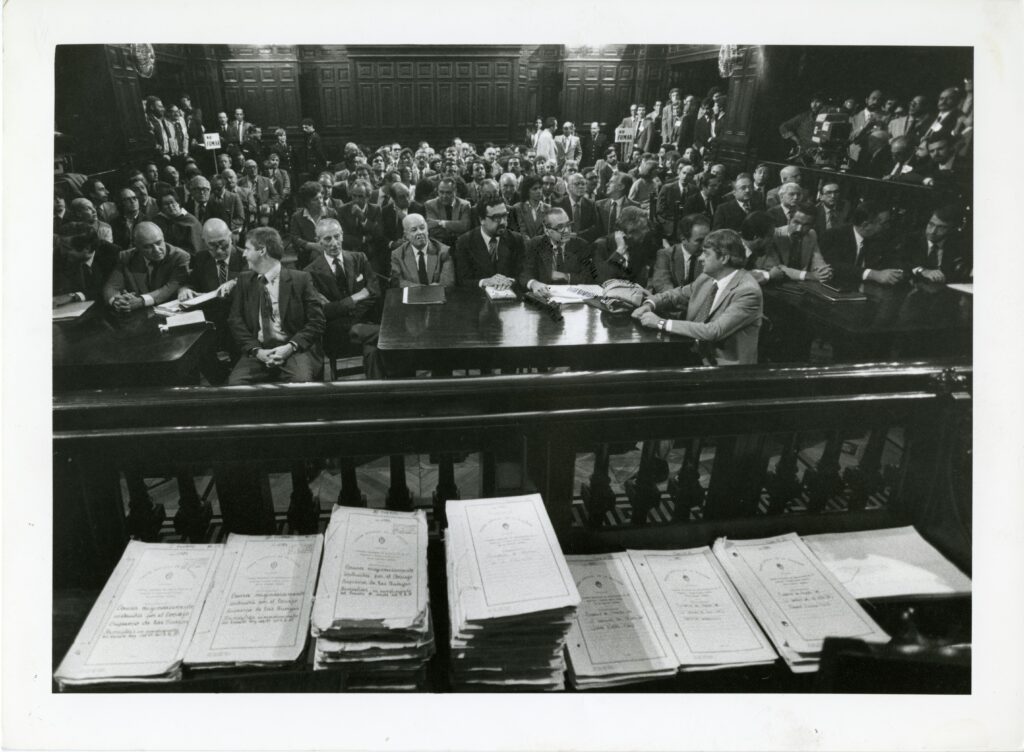
In 1985, after the fall of the dictatorship, Moreno Ocampo served as a deputy prosecutor in the Trial of the Juntas, in which Argentina’s newfound democratic government prosecuted the leaders of the military junta for crimes against humanity. 

The landmark trial set a precedent for the development of international criminal justice, later reflected in the creation of the International Criminal Court (ICC) in 2002, where Moreno Ocampo went on to serve as chief prosecutor.

In a conversation with Argentina Reports, Moreno Ocampo argues that Argentina’s experience stands as an exceptional case: a country that managed to confront violations to human rights without resorting to the logic of the “enemy” — which implies elimination without guarantees — but instead through a political consensus that led to a new method.

“Argentina showed that it is possible to confront the past with justice, not revenge,” Moreno Ocampo said.

Luis Moreno Ocampo and Chief Prosecutor of the Trial of the Juntas, Julio Strassera (1985). Image credit: FCJS UNIVERSIDAD NACIONAL DEL LITORAL

Justice, not war, protects societies from violence

The creation of the ICC, in part, was meant to provide a mechanism in which countries could avoid the political limitations of the United Nations Security Council, upon which permanent members have veto power that often leads to gridlock on pressing conflicts. 

Despite this body existing, many major global powers, including the United States, Russia and China, are not members, and increasingly, the former prosecutor laments, the world seems to be moving in the opposite direction.  

“The ICC is like a global Wi-Fi. Some countries are connected, others are not,” he said. 

In that context —marked by the fragmentation of the international order, large-scale wars such as those in Iran and Ukraine, and growing nuclear risk— war has once again become a tool to resolve conflicts.

From Afghanistan and Iraq to Ukraine, Gaza and now Iran, Moreno Ocampo argues that war is the “mother crime” that enables all others. Faced with violence that has once again become a response to terrorism and disputes between global actors, major powers are repeating a model that does not work.

“The way to protect a country against terrorist groups is not war —which generates more violence— but justice. And that is the lesson from Argentina,” he said.

For Moreno Ocampo, the problem is one of method. There are two ways to confront violence: to treat the violent actor as an enemy and eliminate them, or to investigate and judge them while respecting their rights. In 1985, Argentina chose the second path.

“It gave the military what they had not given their victims: a fair trial,” he said. 

Untitled photo. Trial of the Juntas in April, 1985.
Image credit: Eduardo Longoni via FCJS UNIVERSIDAD NACIONAL DEL LITORAL

The return of war

Moreno Ocampo traces the return of war as a tool for resolving conflicts to the aftermath of the September 11 attacks, when the United States decided to treat Al Qaeda leader Osama bin Laden not as a criminal to be prosecuted, but as a military target to be eliminated. 

The result, he argues, was counterproductive. Bin Laden remained at large for years, and the war in Afghanistan ultimately failed. 

Similar dynamics, he says, can be seen in Iraq and other conflicts.

“Every time the United States enters these wars, it loses. And yet, for different reasons, it cannot learn from that experience,” he said. 

This logic, he adds, is also visible in current conflicts in the Middle East, where opposing projects seek to eliminate each other rather than coexist.

“When projects appear that aim to exclude or eliminate the other, that inevitably leads to war.”

The persistence of war, according to Moreno Ocampo, is also linked to the limits of the current international system —and is visible in today’s conflicts.

In the Middle East, he argues, opposing sides are trapped in mutually exclusive projects that leave no room for coexistence. “When actors seek to exclude or eliminate the other, that inevitably leads to war,” he said, pointing to the dynamics between Israel and Hamas. 

After the October 7 attacks, he noted, there was broad international consensus in condemning Hamas — but the subsequent military response did not resolve the conflict and instead deepened the humanitarian crisis, while Hamas remains in power. 

For Moreno Ocampo, this reflects a broader failure of method: war continues to be used where justice mechanisms exist but are not applied.

A warning from Argentina

In a world shaped by nuclear weapons, advanced technology and growing geopolitical tensions, Moreno Ocampo warns that continuing down this path could lead to a global catastrophe.

“War is a model that humanity has used for thousands of years. But in a world with atomic bombs and cyberattacks, it is no longer viable,” he said.

Echoing Albert Einstein, he added: “I don’t know how the Third World War will be fought, but the Fourth will be fought with sticks and stones.”

For Moreno Ocampo, Argentina’s experience remains relevant not only as a historical process, but as a possible model for the future.

“The world is returning to the logic of war to resolve conflicts, and that can lead us to a catastrophe.”

Featured image: Luis Moreno Ocampo

Image credit: luismorenoocampo.com

The post On anniversary of military coup, Argentina’s ‘Nuremberg Trial’ prosecutor reflects on current global conflicts (Interview) appeared first on Argentina Reports.

The post On anniversary of military coup, Argentina’s ‘Nuremberg Trial’ prosecutor reflects on current global conflicts (Interview) appeared first on Latin America Reports.

  • ✇Latin America Reports
  • Perú’s Roberto Sánchez carries Pedro Castillo’s sombrero and his political movement Peru Reports
    Roberto Sánchez, a left-wing congressman and former minister, campaigns wearing a hulking straw hat — one that is not his own.  It once belonged to Pedro Castillo, the jailed former president of Perú, who won the 2021 election against Keiko Fujimori, the conservative daughter of former dictator Alberto Fujimori, whom Sánchez will also face in a runoff election on Sunday.  The hat, along with Castillo, has become emblematic of the grassroots political movement that Sánchez may carry on should h
     

Perú’s Roberto Sánchez carries Pedro Castillo’s sombrero and his political movement

6 June 2026 at 22:10

Roberto Sánchez, a left-wing congressman and former minister, campaigns wearing a hulking straw hat — one that is not his own. 

It once belonged to Pedro Castillo, the jailed former president of Perú, who won the 2021 election against Keiko Fujimori, the conservative daughter of former dictator Alberto Fujimori, whom Sánchez will also face in a runoff election on Sunday. 

The hat, along with Castillo, has become emblematic of the grassroots political movement that Sánchez may carry on should he win the highly polarized elections — even as he attempts to soften some of its more radical aspects. 

Born in Huaral, a coastal province north of Lima, to a barber and a housemaid, Sánchez shined shoes from age seven to 13. He went on to graduate with a psychology degree from San Marcos University and holds a master’s degree in social policy. 

His entire career was built in the public sector including as a congressman, minister of commerce under Castillo, and as president of the Juntos por el Perú (Together for Perú) political party since 2017. 

Castillismo, a political movement named for Castillo, has its roots in rural land reform, anti-elitism, and left-wing populism. Some analysts argue that despite its leader’s incarceration for attempting to dissolve Congress in 2022, the movement endures because of the social and economic realities of the country. 

“The vote for Castillo and Sánchez does have a real underlying basis. I would not describe it as a protest vote, but rather as a vote born out of desperation and abandonment. It is the vote of Perú’s extremely poor,” Hernán Garrido Lecca, an economist and former health minister (2007-2008), told Perú Reports

According to Peru’s National Institute of Statistics and Informatics (INEI), 4.7% of Perú’s population — approximately 1.6 million people — lived in extreme poverty in 2025, unable to afford even a basic food basket. 

Poverty predominantly exists in rural communities in the Andes and the Amazon regions that remain largely disconnected from the economic and political center of the capital Lima. 

“Castillismo does not respond to Castillo as a person, but to what he represents — the protest against Lima’s centralism and the abandonment of the regions,” Catherine Lanseros, a Peruvian journalist, told Perú Reports

Unlike Castillo, Sánchez has sought to present himself as a more institutional and pragmatic left-wing candidate. 

He is better educated, more articulate, and a seasoned politician; he made that distinction clear in last week’s debate, attacking Fujimori and her party, Fuerza Popular, for their role in the country’s political instability in recent years. 

In an effort to reassure moderates wary of his leftist policies, in the final days of his campaign, Sánchez presented a 114-page government plan promising macroeconomic stability, respect for the Central Bank’s autonomy, and continuity of free trade agreements. 

Whether this represents genuine moderation or a last-minute political strategy remains, for many Peruvians, a defining question. 

As Lanseros put it: “No matter how many times he rewrites his government proposal, Sánchez cannot deny his essence.” 

Featured image: Roberto Sánchez is running for president of Perú in elections on June 7, 2026.

Image credit: Roberto Sánchez via X.

The post Perú’s Roberto Sánchez carries Pedro Castillo’s sombrero and his political movement appeared first on Perú Reports.

The post Perú’s Roberto Sánchez carries Pedro Castillo’s sombrero and his political movement appeared first on Latin America Reports.

  • ✇Latin America Reports
  • Russian oil tanker arrives in Cuba in first non-private fuel shipment since January Raphael McMahon
    The Russian tanker Anatoly Kolodkin has entered Cuban waters, according to the Russian news agency Interfax.  The vessel, which is sanctioned by the European Union, United States and United Kingdom due to the ongoing Russia-Ukraine war, appears to be en route to the Cuban port of Matanzas, according to Marine Traffic.  The ship’s arrival comes after U.S. President Donald Trump told reporters late on Sunday night that he had “no problem” with Russia supplying the island with oil, having pre
     

Russian oil tanker arrives in Cuba in first non-private fuel shipment since January

30 March 2026 at 20:53

The Russian tanker Anatoly Kolodkin has entered Cuban waters, according to the Russian news agency Interfax. 

The vessel, which is sanctioned by the European Union, United States and United Kingdom due to the ongoing Russia-Ukraine war, appears to be en route to the Cuban port of Matanzas, according to Marine Traffic. 

The ship’s arrival comes after U.S. President Donald Trump told reporters late on Sunday night that he had “no problem” with Russia supplying the island with oil, having previously threatened to impose tariffs on any foreign oil supplier of the communist-run nation. 

If delivered, the 100,000 tonnes of crude oil aboard the vessel would represent the first non-private foreign shipment of oil to reach Cuba since January, when the Trump administration’s oil blockade of the island began. 

The U.S. has allowed private companies to import fuel to the island, though these supplies have been negligible for the island’s needs as a whole.

Tensions between Havana and Washington have defined bilateral relations since the Cuban Revolution of 1959 and the subsequent nationalization of U.S. assets in the Caribbean nation. But in recent months, the long-running dispute escalated after the White House forcibly removed Venezuelan President Nicolás Maduro from power and took him into U.S. custody. 

Maduro was a staunch ally of the current Cuban regime and Venezuela was its primary oil supplier. 

While the U.S. and Cuban governments are engaged in diplomatic talks, this has not stopped high-ranking officials in Washington from repeatedly threatening the Cuban communist leadership with regime change

On Friday U.S. Secretary of State Marco Rubio told reporters that, in order for Cuba’s problems to be solved, “you need to change the people in charge, you need to change the system that runs the country.” 

Rubio also blamed the Cuban government, rather than U.S. sanctions, for the island’s oil shortages, accusing the state of wanting foreign nations to supply them with oil for free; this had supposedly been the case with Maduro and the former Soviet Union. 

Though both nations provided the island with heavily subsidized oil shipments at below-market prices, Cuba supplied the Soviet Union with sugar and sent its medical professionals to Venezuela in exchange for oil. 

The Cuban government blames U.S. sanctions for the current crisis. 

Their cause notwithstanding, the shortages of fuel on the island have provoked a grave humanitarian crisis; United Nations Secretary General Antonio Guterres warned last month of impending “collapse” if no oil reached the island. 

Cuban hospitals have had to cancel emergency surgeries due to a lack of power and Cubans have resorted to burning wood to cook food. 

Featured Image: Current Russian President Vladimir Putin and former Cuban President Raúl Castro in 2015. 

Image Credit: The Presidential Press and Information Office via Wikimedia Commons 

License: Creative Commons Licenses

The post Russian oil tanker arrives in Cuba in first non-private fuel shipment since January appeared first on Latin America Reports.

❌
Subscriptions