Normal view

  • ✇Vox
  • Two ways Trump’s Cuba standoff could end Peter Balonon-Rosen · Sean Rameswaram
    Cubans rally in Havana, Cuba, on May 22, 2026, to condemn the US indictment of former President Raúl Castro. | Joaquin Hernandez/Xinhua via Getty Images The United States indicted former Cuban President Raúl Castro in federal court last week, one of its most aggressive actions against the island since the end of the Cold War. The unsealed indictment charges Castro, the 94-year-old brother of deceased Cuban leader Fidel Castro, and five others for alleged involvement in the shooting down
     

Two ways Trump’s Cuba standoff could end

27 May 2026 at 19:00
Cubans hold flags, a portrait of Raúl Castro, and a banner reading Raúl es Raúl in red text.
Cubans rally in Havana, Cuba, on May 22, 2026, to condemn the US indictment of former President Raúl Castro. | Joaquin Hernandez/Xinhua via Getty Images

The United States indicted former Cuban President Raúl Castro in federal court last week, one of its most aggressive actions against the island since the end of the Cold War.

The unsealed indictment charges Castro, the 94-year-old brother of deceased Cuban leader Fidel Castro, and five others for alleged involvement in the shooting down of two small planes over Cuba in 1996. Four people, three of them US citizens, were killed.

The indictment is the most recent in a string of US moves that have left the island in a tough spot. The US embargo on Venezuelan oil to the country has plunged Cuba into a massive energy crisis, with blackouts affecting everything from homes to hospitals. The crisis is so acute that Cuba has cut the work-week to four days for state-owned companies; school days have also been shortened, and universities have waived in-person attendance requirements.

“For the last 50 years or so, the US has ensured that no country — other than a couple that the US didn’t hold sway with, such as Venezuela — [would] export oil to Cuba,” Cécile Shea, a Cuba expert and nonresident senior fellow at the Chicago Council on Global Affairs, told Today, Explained co-host Sean Rameswaram. “Now that Venezuela is also not exporting oil to Cuba, it means that they’re out of oil, and that’s completely on us.”

With Cuba already in a vulnerable spot, the Castro indictment has resulted in a fresh round of speculation: Is the US about to invade Cuba? Is this the same playbook the Trump administration used to oust former Venezuelan President Nicolás Maduro and usher in new leadership in Venezuela?

Sean spoke with Shea to get a better sense of how the Cuban government and everyday Cubans are thinking about the US, as well as what could come next.

Below is an excerpt of their conversation, edited for length and clarity. There’s much more in the full podcast, so listen to Today, Explained wherever you get your podcasts, including Apple Podcasts, Pandora, and Spotify.

Secretary of State Marco Rubio posted a video last week about Cuba. What did he say?

He spoke Spanish; of course, he’s a Cuban American. And he said, Listen, Cuban people, it’s not the United States’ fault that you don’t have any energy, that your electricity grid is down. It’s the fault of mismanagement by your government. Don’t blame us. It’s not because of our embargo. It’s because you are badly led, and it’s time for you to pressure your government to step down.

That’s a paraphrase, but that’s generally what he said.

Is that generally true?

No. It is not generally true. 

There is truth to it in that the government has not always been a great government. But the reason that Cuba is in the current crisis — which is that there is no oil at all for consumers or businesses; they’ve reserved some for hospitals and the like — is the US is forcing Venezuela not to ship oil to Cuba.

For the last 50 years or so, the US has ensured that no country — other than a couple that the US didn’t hold sway with, such as Venezuela — [would] export oil to Cuba. Now that Venezuela is also not exporting oil to Cuba, it means that they’re out of oil, and that’s completely on us, and anyone in Cuba listening to Marco Rubio’s speech would have known that.

What makes this moment different? Is it that this administration is willing to go further than previous ones?

What could be interesting about this moment is that Cuba seems ready to deal.

If we believe the press reports, Cuba has offered to release political prisoners, which would be huge because it would create a political opposition in the country. Cuba has agreed to open its economy. Cuba has agreed to allow Cuban exiles back into Cuba. Things that we have been asking for for decades, it now appears that Cuba is willing to do. And I wish we would take the win. I wish we would accept these things and then add something to it: Promise to have a free and fair election two years from now.

That would just make so much sense, and we wouldn’t be talking about the military, and we wouldn’t be talking about going in and kidnapping 94-year-old men. And President Trump could finally be what he wants to be. He wants to do what every president since Eisenhower has wanted to do, which is to end the communist-oriented regime that we have in Cuba. 

Eisenhower tried; JFK tried. Trump was alive during the Cuban Missile Crisis, he was an adult. So was Biden. This is all very real personal history to them.

And I do think that part of what is going on is Trump wants to be the president who can accomplish what no other president has done. And I happen to think he could be, but I don’t think it’s going to be through a military method. 

He has the attention of the people in charge of Cuba. We have a lot of leverage there. The government of Cuba these days seems willing to listen to us and to do some of the things that would keep us happy. And that’s particularly true of the younger generation in Cuba: I think they would like to see the government open up relations with the US and move beyond revolutionary Cuba.

So the Cuban government is willing to concede in a way we haven’t seen in decades. Young Cubans want there to be an opening-up of Cuban society. They want the government to play ball. And yet it sounds like you’re saying it’s more than likely the Trump administration will not go for it?

Unless there’s a lot going on behind the scenes that nobody sees, it seems like there would be a lot more talking and taking the win right now, especially if the Cubans actually did offer the things that the press has been reporting. 

I don’t understand, for instance, the indictment against Raúl Castro. He wouldn’t still be alive by the time that the trial would start. He and his family are still heroes in Cuba, particularly with the older generation. So why mess with the Castros?

Can I offer a theory? 

Yeah, please do.

Is it what the diaspora wants?

That’s a good question, and is it in particular what the older diaspora wants? 

In part because of pressure from us, Cuba began allowing more people to emigrate from Cuba over the last 20 years, and a lot of them came to the US. There’s some evidence that among that million and half or so émigrés, they really want to move forward. They’re really not interested in fighting the wars of the 1960s anymore.

I think we’ve heard your best-case scenario, Cécile — that the United States takes concessions from Cuba and allows the country, on its own terms, to transition to free elections that organically replaces the Castro regime. What’s the worst-case scenario here?

The short-term worst-case scenario is that we end up with something worse than we have now. 

The long-term worst-case scenario is that we further alienate the Cuban people who have already suffered from our sanctions and our embargoes for the last 60-some years, and it harms our ability to create a close relationship with a country 90 miles away over the next 20, 30, 40 years. 

It’s hard for politicians to look past the next election. It’s one of the weaknesses in our government. But we should also be thinking about what kind of relationship we want with Cuba 15 years from now. Invading the country is not a way to make the odds of having a good relationship in the future strong.

You keep talking about this tension between the United States and Cuba as something from another generation — a holdover from, from the ’60s and ’70s, the Cold War. I feel like most Americans right now are not thinking about Venezuela nor Iran nor Cuba. They’re thinking about their gas prices and interest rates. How should Americans be feeling about this intervention that we may soon be executing on this island?

Here’s what I would say to some of those Americans: Imagine we could go two routes right now. Imagine we could start selling spare parts that Cuba desperately needs to keep their machines running. Imagine we could make an agreement with them that would allow them to begin importing American vehicles again, tariff-free. Imagine that you could take vacations to Cuba again, which are fairly inexpensive. 

Would you choose all of those things, or would you choose sending more young people into harm’s way 90 miles away from Florida? Being even more of a pariah in the world than we already are? Because if you’ve been to Europe lately or Canada lately, you know that Americans are very unpopular right now. And just imagine what will happen if we take military action in Cuba.

I think we should also talk about the morality of the situation. There are people who can’t get kidney dialysis right now because the hospitals are running out of oil. There are people who can’t get to work and therefore can’t get paid because they can’t put gas in their vehicles.

These people are just 90 miles away from us. Are we really going to let this kind of pain and suffering continue through the hottest part of the year? What will be the long-term harm not just to them and their health but to their view of the United States? We should not just be sitting by and watching this happen.

  • ✇El País in English
  • How Washington delivered the final blow to Cuba’s weakened tourism industry Juan Carlos Espinosa
    The clock keeps ticking. The United States waits patiently after its latest checkmate against Cuba. The move has shaken a country that is already held together by pins, plunged into a severe crisis that has only worsened this year as economic strangulation by Washington intensifies. And all of this is unfolding in the shadow of a possible military intervention. Adding to this climate of extreme tension is an ultimatum: Friday, June 5, 2026. That is the date when a White House executive order of
     

How Washington delivered the final blow to Cuba’s weakened tourism industry

3 June 2026 at 09:19

The clock keeps ticking. The United States waits patiently after its latest checkmate against Cuba. The move has shaken a country that is already held together by pins, plunged into a severe crisis that has only worsened this year as economic strangulation by Washington intensifies. And all of this is unfolding in the shadow of a possible military intervention. Adding to this climate of extreme tension is an ultimatum: Friday, June 5, 2026. That is the date when a White House executive order of May 1 will take effect. The order threatens to freeze the assets on U.S. soil of any foreign companies or individuals that are still doing business with the Cuban regime.

Seguir leyendo

© Ernesto Mastrascusa (EFE)

Facade of the Hotel Inglaterra this Monday, in Havana (Cuba).
  • ✇Vox
  • Is Cuba back on the menu? Cameron Peters
    President Donald Trump talks to reporters before boarding Air Force One on May 20, 2026, at Joint Base Andrews, Maryland. | Chip Somodevilla/Getty Images This story appeared in The Logoff, a daily newsletter that helps you stay informed about the Trump administration without letting political news take over your life. Subscribe here. Welcome to The Logoff: The Trump administration is indicting former Cuban President Raúl Castro as it seeks to ramp up pressure on the island.  What happe
     

Is Cuba back on the menu?

20 May 2026 at 22:10
Donald Trump, wearing a suit and tie, stands next to Air Force One and speaks into two microphones held toward him.
President Donald Trump talks to reporters before boarding Air Force One on May 20, 2026, at Joint Base Andrews, Maryland. | Chip Somodevilla/Getty Images

This story appeared in The Logoff, a daily newsletter that helps you stay informed about the Trump administration without letting political news take over your life. Subscribe here.

Welcome to The Logoff: The Trump administration is indicting former Cuban President Raúl Castro as it seeks to ramp up pressure on the island. 

What happened? The indictment against Castro and five others was unsealed in a Miami federal court on Wednesday, but it focuses on conduct from 30 years ago, when the Cuban government killed four people, three of whom were American citizens, by shooting down two small planes. It supersedes an earlier 2003 indictment, which named some of the same defendants. 

What’s the context? President Donald Trump’s pressure campaign against Cuba escalated at the beginning of this year with his removal of Venezuelan President Nicolás Maduro in January and the announcement of a hemispheric “Donroe Doctrine.” 

Since then, Cuba has been under a US oil blockade (with some exceptions), resulting in widespread blackouts and a humanitarian crisis impacting the island’s 10 million residents.

Cuba is also a particular cause of Secretary of State Marco Rubio, who has long wanted to topple the country’s communist regime. 

What’s the big picture? Trump already has one war on his hands in Iran, so it’s hard to gauge his appetite for more military adventurism at just this moment. But Wednesday’s indictment is yet another escalation, and it’s reminiscent of the superseding indictment that the Trump administration filed against Maduro after his capture earlier this year. Maduro was also indicted in a US court in 2020, and the Trump administration has framed his removal as a law enforcement operation.

Politico’s Nahal Toosi also reported this week that Trump and his advisers “have grown frustrated” with the lack of any significant concessions from Cuban leaders to date and are beginning to more seriously consider military options.

Acting Attorney General Todd Blanche said Wednesday that the Castro filing “isn’t a show indictment.” 

“There is a warrant issued for his arrest,” Blanche added. “We expect that he will show up here by his own will or by another way.”

And with that, it’s time to log off…

There’s a long list of US-specific ways in which the upcoming World Cup, hosted jointly by the US, Mexico, and Canada, is shaping up to be a mess. (NJ Transit, I’m looking at you.) But here’s one really cool benefit: It’s fueling a soccer boom in New York City, and new soccer pitches are getting built to meet that demand. You can read all about it here with a gift link.

Have a great evening, and we’ll see you back here tomorrow!

US Supreme Court paves way for companies affected by Fidel Castro’s expropriations to seek compensation from Cuba

21 May 2026 at 15:59
Boats in Havana’s port, March 24.

A new twist in the tensions between the United States and Cuba. The U.S. Supreme Court ruled on Thursday in favor of a U.S. company whose docks were confiscated by the Castro regime in 1960 after Fidel Castro came to power. The court’s decision — in a case openly supported by U.S. President Donald Trump — opens the door to future claims by other U.S. firms and citizens affected during the wave of expropriations carried out in the early years of the Cuban Revolution.

Seguir leyendo

  • ✇Latin America Reports
  • Cuban government pledges to release 51 prisoners after talks with Vatican Raphael McMahon
    In an unexpected move, the Cuban Foreign Ministry announced on Thursday night that the Cuban government would release 51 prisoners in the coming days “in the spirit of goodwill”.  According to the Cuban government the decision, described as “sovereign” in the statement, was taken as a result of its “close relationship” with the Vatican, suggesting that the Holy See had a significant part to play in the prisoner release. The prisoner release comes amidst severe tensions between Cuba and th
     

Cuban government pledges to release 51 prisoners after talks with Vatican

13 March 2026 at 15:38

In an unexpected move, the Cuban Foreign Ministry announced on Thursday night that the Cuban government would release 51 prisoners in the coming days “in the spirit of goodwill”. 

According to the Cuban government the decision, described as “sovereign” in the statement, was taken as a result of its “close relationship” with the Vatican, suggesting that the Holy See had a significant part to play in the prisoner release.

The prisoner release comes amidst severe tensions between Cuba and the U.S. as Washington continues its campaign of economic pressure to try to force regime change on the island. 

Although the Cuban government denies that its decisions are influenced by U.S. economic pressure, the release could be a sign of its willingness to make concessions in order to de-escalate tensions with Washington, which often criticizes its arbitrary detention of political prisoners.  

The Cuban government did not specify who it would release, but said that the prisoners selected “have all served a significant part of their sentence and have maintained good conduct in prison”. 

This is not the first time that Havana has released prisoners to soften relations with Washington. In early 2025 the Cuban government granted over 500 prisoners early release in accordance with the terms of a deal between the Miguel Díaz-Canel and Joe Biden administrations.

In return, Biden removed Cuba from the U.S. list of state sponsors of terrorism just days before his term ended. Cuba was, however, redesignated a state sponsor of terrorism immediately after Donald Trump came to power; the prisoners were released regardless. 

The 2025 deal was also brokered by the Vatican, highlighting the traditional importance of the papal state as a mediator between the two nations. 

The Vatican appears to have adopted this role of interlocutor again, as Vatican Secretary of State Cardinal Parolin stated earlier this week that the “necessary steps” had been taken to ensure a “negotiated solution” between the two adversaries. 

In the context of current tensions, Pope Leo XIV called for Cuba and the U.S. to engage in “sincere dialogue” to “avoid violence” in early February and recently held talks with Cuban Foreign Minister Bruno Rodríguez Parrilla. 

The top U.S. diplomat in Cuba – Chief of Mission Mike Hammer – also met with a representative of the Holy See to discuss the “deteriorating situation in Cuba”. 

Read more: Cuba, U.S. reportedly “talking” as Pope calls for de-escalation of tensions

“Historically, [the Vatican’s role] has been important because in Cuba the Catholic Church has remained a presence more than in most other communist countries, certainly more than in [Soviet] Russia,” Professor Massimo Faggioli, a professor of ecclesiology at Trinity College Dublin and a Vatican specialist, told Latin America Reports 

Although that “history of coexistence” has been “difficult” – religious celebrations were once banned on the island and the Cuban Communist Party seized Church property after coming to power – the Church’s continued existence in Cuba has meant that “all popes since John Paul II have had some kind of relationship with the Cuban leadership, to the dismay of the Americans”.

That relationship has become more important as the Vatican now, according to the Professor, perceives “a clearer threat” on the part of the United States “to do something about Cuba” and its communist regime in the wake of the Venezuelan and Iranian operations.

The Vatican’s “traditional approach to international relations … based on multilateralism, on the role of international organizations, on the rule of law” means that the Holy See finds itself “at odds” with the current American policy of potentially destabilizing unilateral regime change operations. This, in turn, has led it to push “to prevent the escalation” of the U.S.-Cuba tensions into a military conflict, Faggioli argued.  

The Vatican has historically been successful in mediating difficult negotiations between adversaries, the ecclesiologist pointed out, because their representatives engage in diplomacy as a “service to the Church” borne from faith and therefore tend to be less career-oriented.

Furthermore, the Vatican’s experience in mediating conflicts worldwide meansthere is a treasure of knowledge and of relationships and of connections”  within the papal diplomatic corps, which operates “in every part of the world”.  

Although Faggioli suggested that some senior figures in the American administration – such as the Catholic Marco Rubio and Trump himself – may not be the most amenable to the Vatican’s overtures, he also recognized that “there are some voices in the U.S. Department of State that are more cautious than … [those] in the cabinet of Donald Trump” and might represent “different views when they talk with the Vatican”. 

With today’s official confirmation of ongoing Cuba-U.S. negotiations by Cuban President Miguel Díaz-Canel, perhaps the Vatican will be called upon to act as intermediary between the two adversaries once again. 

Featured Image: The current Pope Leo XIV. He is the first American-born Pope and has called for de-escalation between his country of birth and Cuba. 

Image Credit: Edgar Beltrán via Wikimedia Commons

License: Creative Commons Licenses

The post Cuban government pledges to release 51 prisoners after talks with Vatican appeared first on Latin America Reports.

  • ✇Latin America Reports
  • US allegedly planning to indict Cuban revolutionary leader Raúl Castro Raphael McMahon
    The U.S. plans to charge the 94-year-old former President of Cuba Raúl Castro with crimes relating to Cuba’s destruction of two planes in 1996, according to anonymous officials cited by CBS News. Although a spokesperson of the U.S. Justice Department declined to comment on the matter, Florida’s Attorney General announced in March that the southern American state would reopen an investigation into Raúl Castro’s involvement in the 1996 incident.  The revelation comes amidst growing tensions
     

US allegedly planning to indict Cuban revolutionary leader Raúl Castro

15 May 2026 at 20:39

The U.S. plans to charge the 94-year-old former President of Cuba Raúl Castro with crimes relating to Cuba’s destruction of two planes in 1996, according to anonymous officials cited by CBS News.

Although a spokesperson of the U.S. Justice Department declined to comment on the matter, Florida’s Attorney General announced in March that the southern American state would reopen an investigation into Raúl Castro’s involvement in the 1996 incident. 

The revelation comes amidst growing tensions between the U.S. and Cuba, as the Trump administration continues to increase punitive sanctions against the island’s economy and threaten the leadership with political regime change. 

Castro, who is the younger brother of revolutionary icon Fidel Castro, served as president from 2008 to 2018. Although no longer head of state, Rául Castro remains an influential figure in Cuban politics: he retains the title of Army General and his grandson, Raúl Guillermo Rodríguez Castro, is allegedly a leading figure in ongoing negotiations between the U.S. and Cuba. 

Republican lawmakers, particularly those with connections to the sizable Cuban-American community in Florida such as Carlos Giménez and Mario Díaz-Balart, have repeatedly called for Castro to be indicted. A grand jury would have to issue the indictment after being presented with evidence. 

In February 1996, two planes belonging to the Miami-based group Hermanos al Rescate (Brothers to the Rescue) – an activist group which aided refugees fleeing from Cuba to the U.S. by boat – were shot down by the Cuban Air Force.

The issue of whether or not the planes were in international or Cuban airspace is still debated. 

Four people died as a result of the attack and, in March 1996, the U.S. government under President Bill Clinton signed the Helms-Burton act into law

The act strengthened economic sanctions against the Cuban government and stipulated that the U.S. commercial embargo on Cuba could only be lifted after Cuba became a democracy under non-Castro leadership. 

Although Fidel Castro was President of Cuba in 1996, several U.S. members of Congress have argued that Raúl must have been responsible for the order to shoot down the planes as he was Cuba’s defense minister at the time. 

Independent Mexico-based Cuban journalist Jorge Alfonso Pita told Latin America Reports about the potential implications of the U.S.’s supposed intention to indict. 

“I don’t believe this accusation is intended to lead to Raúl Castro being prosecuted,” argued Alfonso. “It seems like a gesture to appease the Cuban-American and Republican lobby, so that Trump and Rubio can say ‘we won’t allow impunity’ while they sit down to negotiate with El Cangrejo [Fidel Castro’s grandson] and Cuban intelligence.”

The move to indict the younger Castro may, however, not be purely symbolic; the capture and subsequent extradition of former Venezuelan President Nicolás Maduro to the U.S. in January demonstrates the Trump administration is willing to both charge foreign leaders and bring them to trial. 

Maduro is now facing federal charges related to “narco-terrorism” while in custody in New York. 

Latin America Reports reached out to Cuban officials for comment on the potential indictment, but they declined. 

Featured Image: Former U.S. President Barack Obama and then Cuban President Raúl Castro in the Estadio Latinoamericano in Havana, during the former’s historic visit to the island.  

Image Credit: White House via Wikimedia Commons

License: Creative Commons Licenses

The post US allegedly planning to indict Cuban revolutionary leader Raúl Castro appeared first on Latin America Reports.

  • ✇El País in English
  • The dilemmas over Cuba’s future: Regime change or negotiated transition David Marcial Pérez
    Between grandstanding, contradictory statements, and secret meetings, something is happening in Cuba. A path has opened that is still full of unknowns, but one that now seems hard to reverse. In recent days, events have accelerated with the unusual visit by the CIA chief to Havana, the U.S. indictment of Raúl Castro — the Cuban Revolution’s last great symbol — and the deployment of an aircraft carrier in Caribbean waters near the island.Seguir leyendo
     

The dilemmas over Cuba’s future: Regime change or negotiated transition

22 May 2026 at 09:36

Between grandstanding, contradictory statements, and secret meetings, something is happening in Cuba. A path has opened that is still full of unknowns, but one that now seems hard to reverse. In recent days, events have accelerated with the unusual visit by the CIA chief to Havana, the U.S. indictment of Raúl Castro — the Cuban Revolution’s last great symbol — and the deployment of an aircraft carrier in Caribbean waters near the island.

Seguir leyendo

© Ramon Espinosa (AP Photo/Ramon Espinosa)

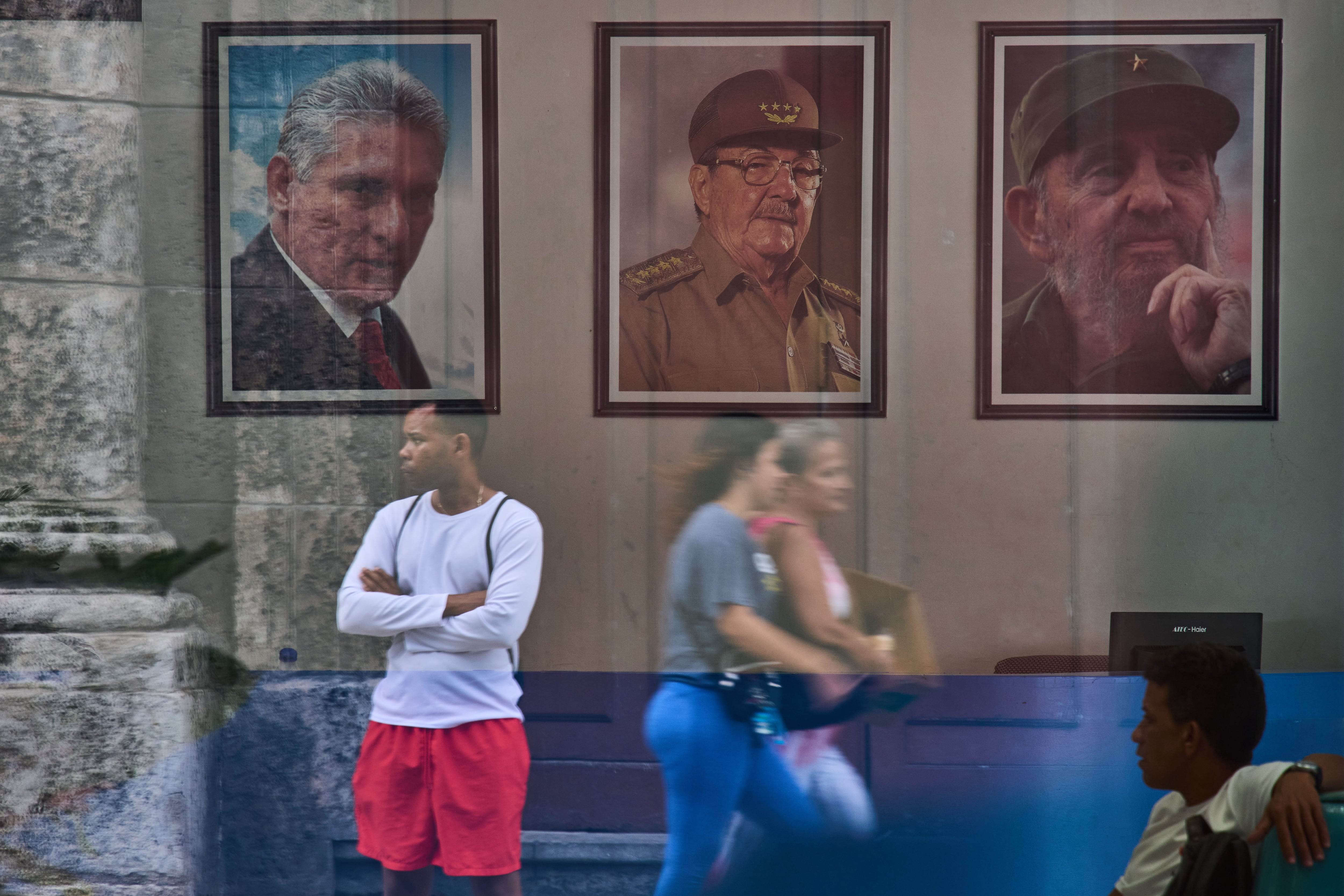
Portraits of Miguel Díaz-Canel, Raúl and Fidel Castro at Havana’s Capitol, May 20.
  • ✇El País in English
  • Obstacles at Spanish consulate in Havana hamper Cuban migrants’ legalization efforts Carmen Morán Breña
    The Cuban community in Spain is encountering particular difficulties obtaining copies of their criminal records, a requirement to be eligible for the mass migrant legalization program announced by the Spanish government earlier this year. A perfect storm has left Cubans anxious about whether the documents requested from their country will arrive in time to apply for a residence and work permit in Spain. To the hardships already facing the Caribbean nation — including routine power outages that a
     

Obstacles at Spanish consulate in Havana hamper Cuban migrants’ legalization efforts

2 June 2026 at 11:25

The Cuban community in Spain is encountering particular difficulties obtaining copies of their criminal records, a requirement to be eligible for the mass migrant legalization program announced by the Spanish government earlier this year. A perfect storm has left Cubans anxious about whether the documents requested from their country will arrive in time to apply for a residence and work permit in Spain. To the hardships already facing the Caribbean nation — including routine power outages that affect offices and agencies — is added the backlog that the consulate had already been experiencing since an earlier naturalization process opened for children and grandchildren of Spaniards. This has given rise, say some members of the Cuban community, to an underground business selling appointments at the Spanish mission in Havana for anywhere between €200 and €500.

Seguir leyendo

© GIANLUCA BATTISTA

Long lines to apply for legalization on April 20 at La Farga de L'Hospitalet (Barcelona).

What will happen to tourism in Cuba? Inside GAESA, the military conglomerate on Washington’s radar

When a Cuban person on the island wants to refer to “those in charge,” they lightly tap their shoulder with two fingers. The subtle gesture, shaped by nearly seven decades of censorship, is a reference to the epaulet of a military uniform. In Cuba, people do not speak of the government or the party (the Communist Party of Cuba, the only legal one), but rather of the “country’s leadership.” It is a euphemism that points to the real political and economic power: the Revolutionary Armed Forces (FAR).

Seguir leyendo

❌
Subscriptions