The western province of Artemisa is consolidating its energy transition strategy with the installation of photovoltaic solar parks and community modules, which supply 90 % of the territory's average electricity demand, reported the newspaper El Artemiseño.
Read More ...
The western province of Artemisa is consolidating its energy transition strategy with the installation of photovoltaic solar parks and community modules, which supply 90 % of the territory's average electricity demand, reported the newspaper El Artemiseño.
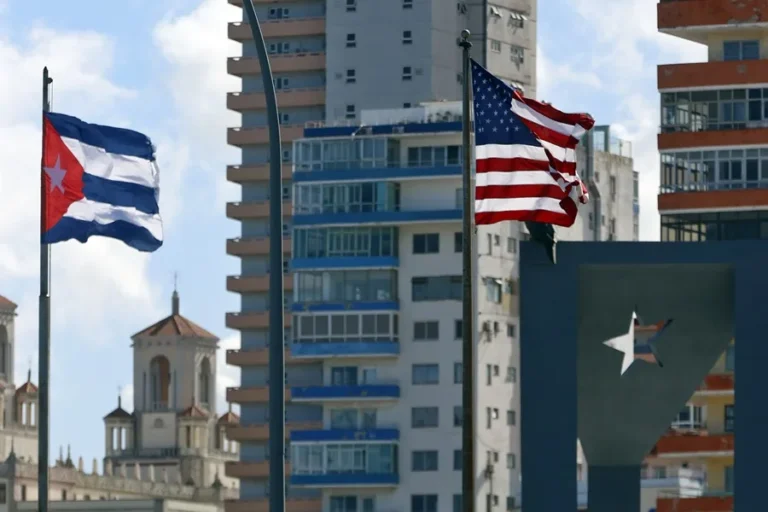
In an unexpected move, the Cuban Foreign Ministry announced on Thursday night that the Cuban government would release 51 prisoners in the coming days “in the spirit of goodwill”.
According to the Cuban government the decision, described as “sovereign” in the statement, was taken as a result of its “close relationship” with the Vatican, suggesting that the Holy See had a significant part to play in the prisoner release.
The prisoner release comes amidst severe tensions between Cuba and th
In an unexpected move, the Cuban Foreign Ministry announced on Thursday night that the Cuban government would release 51 prisoners in the coming days “in the spirit of goodwill”.
According to the Cuban government the decision, described as “sovereign” in the statement, was taken as a result of its “close relationship” with the Vatican, suggesting that the Holy See had a significant part to play in the prisoner release.
The prisoner release comes amidst severe tensions between Cuba and the U.S. as Washington continues its campaign of economic pressure to try to force regime change on the island.
Although the Cuban government denies that its decisions are influenced by U.S. economic pressure, the release could be a sign of its willingness to make concessions in order to de-escalate tensions with Washington, which often criticizes its arbitrary detention of political prisoners.
The Cuban government did not specify who it would release, but said that the prisoners selected “have all served a significant part of their sentence and have maintained good conduct in prison”.
This is not the first time that Havana has released prisoners to soften relations with Washington. In early 2025 the Cuban government granted over 500 prisoners early release in accordance with the terms of a deal between the Miguel Díaz-Canel and Joe Biden administrations.
In return, Biden removed Cuba from the U.S. list of state sponsors of terrorism just days before his term ended. Cuba was, however, redesignated a state sponsor of terrorism immediately after Donald Trump came to power; the prisoners were released regardless.
The 2025 deal was also brokered by the Vatican, highlighting the traditional importance of the papal state as a mediator between the two nations.
The Vatican appears to have adopted this role of interlocutor again, as Vatican Secretary of State Cardinal Parolin stated earlier this week that the “necessary steps” had been taken to ensure a “negotiated solution” between the two adversaries.
In the context of current tensions, Pope Leo XIV called for Cuba and the U.S. to engage in “sincere dialogue” to “avoid violence” in early February and recently held talks with Cuban Foreign Minister Bruno Rodríguez Parrilla.
The top U.S. diplomat in Cuba – Chief of Mission Mike Hammer – also met with a representative of the Holy See to discuss the “deteriorating situation in Cuba”.
“Historically, [the Vatican’s role] has been important because in Cuba the Catholic Church has remained a presence more than in most other communist countries, certainly more than in [Soviet] Russia,” Professor Massimo Faggioli, a professor of ecclesiology at Trinity College Dublin and a Vatican specialist, told Latin America Reports
Although that “history of coexistence” has been “difficult” – religious celebrations were once banned on the island and the Cuban Communist Party seized Church property after coming to power – the Church’s continued existence in Cuba has meant that “all popes since John Paul II have had some kind of relationship with the Cuban leadership, to the dismay of the Americans”.
That relationship has become more important as the Vatican now, according to the Professor, perceives “a clearer threat” on the part of the United States “to do something about Cuba” and its communist regime in the wake of the Venezuelan and Iranian operations.
The Vatican’s “traditional approach to international relations … based on multilateralism, on the role of international organizations, on the rule of law” means that the Holy See finds itself “at odds” with the current American policy of potentially destabilizing unilateral regime change operations. This, in turn, has led it to push “to prevent the escalation” of the U.S.-Cuba tensions into a military conflict, Faggioli argued.
The Vatican has historically been successful in mediating difficult negotiations between adversaries, the ecclesiologist pointed out, because their representatives engage in diplomacy as a “service to the Church” borne from faith and therefore tend to be less career-oriented.
Furthermore, the Vatican’s experience in mediating conflicts worldwide means “there is a treasure of knowledge and of relationships and of connections” within the papal diplomatic corps, which operates “in every part of the world”.
Although Faggioli suggested that some senior figures in the American administration – such as the Catholic Marco Rubio and Trump himself – may not be the most amenable to the Vatican’s overtures, he also recognized that “there are some voices in the U.S. Department of State that are more cautious than … [those] in the cabinet of Donald Trump” and might represent “different views when they talk with the Vatican”.
With today’s official confirmation of ongoing Cuba-U.S. negotiations by Cuban President Miguel Díaz-Canel, perhaps the Vatican will be called upon to act as intermediary between the two adversaries once again.
Featured Image: The current Pope Leo XIV. He is the first American-born Pope and has called for de-escalation between his country of birth and Cuba.
Bogotá, Colombia – Waiting for a vice minister on the eleventh floor of a dusty office block in downtown Caracas, a Venezuelan colleague hissed in my ear: “You can’t show that map, get rid of it”.
Surprised, I plucked the map of Venezuela out of the pile of papers that made up a project our NGO was proposing to provide health support in remote corners of the country. With economic collapse the country needed international support, but was not always open to receiving it. My job was to negotia
Bogotá, Colombia – Waiting for a vice minister on the eleventh floor of a dusty office block in downtown Caracas, a Venezuelan colleague hissed in my ear: “You can’t show that map, get rid of it”.
Surprised, I plucked the map of Venezuela out of the pile of papers that made up a project our NGO was proposing to provide health support in remote corners of the country. With economic collapse the country needed international support, but was not always open to receiving it. My job was to negotiate access to those remote corners.
Later, trudging down the gloomy stairwell (the lift wasn’t working) my colleague explained the problem: “Every Venezuelan map you show in Venezuela must include Essequibo.”
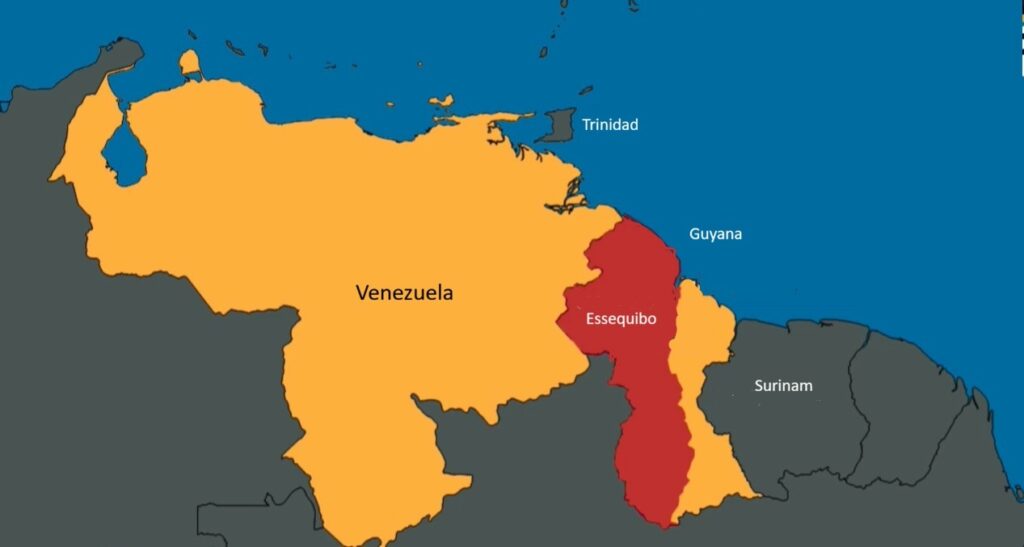
Like many newbies in Caracas, I’d never heard of Essequibo, a territory that lies in Guyana but is claimed by Venezuela. At 160,000 square kilometers (62,000 square miles) it has just 125,000 inhabitants, so is five times bigger than Belgium but with fewer people than Bruges.
I was intrigued. And grateful to my colleague: dealing with Venezuelan ministries was tricky enough without causing offense by omitting a vast tract of jungle dangling off the eastern border like a lost appendage.
But far from impotent.
To the east of Venezuela lies Essequibo, a vast tract of jungle rich in diamond and gold, as well as huge oil deposits discovered in 2015 off its coastal waters.
During his regime former president Nicolás Maduro – now facing drug charges in a U.S. court – laid claim to Essequibo and ramped up both political and military pressure for Guyana to cede the vast territory. This culminated in a legal declaration of annexation in 2023, a move sparking international condemnation.
In 2024 Maduro went further, issuing ID cards for ‘Guayana Esequiba’ as he called it, creating a phantom administrative center for the country’s “24th state”, and proposing a new governor.
Then the Venezuelan strongman sent soldiers to span the Cuyení River, close to the disputed border.
It may have been a bridge too far. In March 2025, U.S. secretary of state Marco Rubio condemned Venezuela’s moves as “illegitimate territorial claims by a narcotrafficking regime” and vowed to defend Guyana from Venezuelan incursions.
Any attacks on US oil companies exploiting oil reserves off the Essequibo coast would be a “very bad week for Maduro”, warned Rubio at a press conference in Guyana’s capital, Georgetown. In reply Maduro called the secretary of state “an imbecile”.
The rest, as they say, is history. Nine months later the Venezuelan leader would be snatched from his Caracas hideout by U.S. special forces and bundled off to a New York jail.
Map showing the disputed territory of Essequibo, which makes up most of Guyana.
Rigged arbitration
Following in her predecessor’s footsteps, Venezuela’s interim president, Delcy Rodriguez, flew to The Hague last week to argue her country’s case before the International Court of Justice (ICJ).
The case had been bumped up to the ICJ – sometimes referred to as the ‘world’s top court’ – by the UN, charged initially with untangling the misaligned borders.
First though, Rodriguez had to deal with another land grab issue: Venezuela was now the “51st State”, according to a map colored by the Stars and Stripes posted on social media by U.S. president Donald Trump.
.
Trump’s “51st State” memeAt the ICJ, journalists were quick to jump on the meme.
“We came to the court to defend our sovereignty, to defend our independence,” said Rodriguez, flustered by the irony of it all: her former boss Maduro had three years before pulled a similar stunt by declaring Essequibo – which by land mass makes up two thirds of Guyana – as a “new state of Venezuela”.
Over four days the ICJ judges heard oral arguments from both delegations, which though couched in legal jargon gave fascinating insights to centuries of colonial great games and arbitrary map-making; the case drew comparisons to centuries past when Spain, Holland, Britain and even Sweden tussled for a foothold in the jungles of northern South America.
Guyana’s position was simple: as de facto holder of Essequibo, and under aggression from Venezuela, it wanted the court to ratify the ruling of an international tribunal from 1899 – the so-called Paris Arbitral Accord – which drew the boundary largely in favor of Guyana, then a British colony.
Britain’s argument then was that they had a permanent presence in Essequibo, while both Venezuela and previous Spanish colonial administrations were largely absent.
The problem is that Venezuela never accepted the Paris accord, claiming it was a backroom deal between London and Washington, a quid pro quo where theEssequibo would remain a colony in return for regional favors.
As they put it before last week’s ICJ: “The British Empire, known throughout the world for its aggressive expansionism, negotiated with the U.S. a rigged arbitration to retain the territories usurped from Venezuela in exchange for recognizing the hegemony of the U.S.”
In some ways the Paris Accord was a problem of Venezuela’s own making. Having severed diplomatic ties with Britain, it subcontracted its 1899 negotiation to the U.S., whose delegation included no less than former president U.S. Benjamin Harrison.
Meanwhile the U.S., keen to flex its Monroe Doctrine – basically ‘keep out of our backyard’ – was happy to defend its Caribbean neighbor against old-world empires. Why they fudged the negotiation is a matter of historical debate.
This means a key question for the ICJ judges is rooted in the past: did the U.S. delegation defend Venezuela in good faith or buckle to machinations of the British Empire? And should they uphold the Paris Arbitral Accord?
Communities not consulted
While there has been much international focus on oil finds in Essequibo, there is little mention of the indigenous peoples, such as the Lokono and Warao, who have lived there since long before Europeans arrived. At least nine distinct languages are spoken within the territory.
But in 2023, at no point did Maduro consult the communities of Essequibo before declaring it annexed to Venezuela.
These communities had “moved between the borders of Venezuela and Guyana since time immemorial,” said Jean La Rose, a Lokono woman and director of the Amerindian Peoples Association of Guyana (APA), writing for Mongabay.
Those rooted in Essequibo considered it part of Guyana, she said, condemning Maduro’s announcements that had forced families to flee from the villages under threat of a military invasion.
“We are Guyanese citizens, and as such, we stand in solidarity with the Guyanese government and reject any foreign claim on this land,” said La Rose.
Warao community close to the border between Venezuela and Guyana. Indigenous people claim they were not consulted over Venezuela’s moves to annex Essequibo. Photo: S. Hide.
Rally to the flag
Though the court’s final findings are months away, most observers see it as unlikely that the ICJ will find for Venezuela.
Firstly, the geographical reality is that the troubled region makes up two thirds of Guyana’s land mass but would only add a small fraction to Venezuela’s much larger territory. Without Essequibo, Guyana shrinks off the map.
Secondly, arbitration courts often defer to the territorial status quo and self-determination of its inhabitants. ‘Possession is nine tenths of the law,’ as the saying goes.
In practical terms, U.S. oil companies are also coining it in Essequibo, also creating an economic boom in Guyana itself. So even with a foot in both camps, Washington is unlikely to back Caracas.
Any ruling in favor of Venezuela would also risk unravelling dozens of pending but stable border disputes stemming from colonial-era chicanery; most Latin American countries have at least one boundary grievance with one neighbour or another.
Such squabbles usually stay in play – a useful distraction for failing states – because leaders routinely reject international arbitration if the findings don’t go their way.
In such a vein Venezuela’s interim president Delcy Rodriguez told the court last week that her presence there “did not imply in any way a recognition of the competence of the ICJ in the territorial controversy”.
Instead any agreement, she said, had to be hammered out in direct talks between the two nations to establish “a solid and stable foundation for good neighborliness”.
Given recent history, that boat has sailed.
For guidance, Rodriguez could take a closer look at Trump’s “51st State” meme. His Venezuela map, like mine, omitted Essequibo. I doubt Caracas will correct him.
Judges hearing the Essequibo case at the International Court of Justice in The Hague last week. Photo: ICJ.
Bogotá, Colombia – Around 21% of Colombian minors aged between 12 and 17 have been victims of online sexual abuse in the past year, according to a report published last week by UNICEF-Innocenti, ECPAT International, and INTERPOL.
The report, “Disrupting Harm,” covered 25 countries including Colombia and examines how technology use, including new tools like artificial intelligence (AI) are helping to facilitate online abuse.
The investigation was made between 2023 and 2025, and the re
Bogotá, Colombia – Around 21% of Colombian minors aged between 12 and 17 have been victims of online sexual abuse in the past year, according to a report published last week by UNICEF-Innocenti, ECPAT International, and INTERPOL.
The report, “Disrupting Harm,” covered 25 countries including Colombia and examines how technology use, including new tools like artificial intelligence (AI) are helping to facilitate online abuse.
The investigation was made between 2023 and 2025, and the results are alarming: around 860,000 Colombian adolescents experienced some type of digital sexual abuse or exploitation in just one year (2024) .
Data also pointed to gender and economic disparities. A quarter of young women surveyed said they’d been victims of this type of abuse or exploitation while 17% of young men said the same. In poorer, rural areas of the country, 29% of minor respondents said they’d been victimized while 17% living in urban areas said they had been.
In addition to social dynamics in Colombia, including deep-rooted “machismo”, prevalent domestic and gender based violence, and extreme wealth inequality, technology is increasingly becoming a factor in the abuse of children.
According to a 2025 study by the Communications Regulation Commission (CRC), during the past year, 81% of teenagers between 14 and 17, and 55% of pre-adolescents aged 10 to 13, reported having their own cell phones.
Experts say that since the pandemic, interactions among children and adolescents have increased significantly. Cell phones have become a ‘fundamental’ tool for maintaining social status and escaping reality, especially for those facing family problems.
“It is essential that children do not fear being punished or having their phones taken away for responding to a message. We saw in the study that this is one of their biggest fears: losing their connection to the rest of the world,” Camila Perera, a specialist at the Office of Research and Data for UNICEF Innocenti, told Latin America Reports.
Nearly half of the reported cases of abuse happened on social media platforms such as Facebook (80%), WhatsApp (30%), and Instagram (17%), while 14% were linked to online gaming networks.
In addition, 2% of victims reported that artificial intelligence was used to create fake explicit content using their faces – highlighting a newer phenomenon that became widely discussed last year after Elon Musk’s AI chatbot Grok began creating millions of sexualized images of people online.
With the introduction of such technologies, regulators and parents are struggling to keep up.
“Minors, with their superior digital skills, moved much faster than any safety measures could. While they advance, protection protocols simply cannot keep up,” Fabio González Florez, Project Leader at ECPAT International, told Latin America Reports.
“There is a serious obligation to stay informed, and that doesn’t require a postgraduate degree. Tutorials are everywhere, and every platform offers parental controls that we must learn to use,” he added.
A stranger behind a screen? The ‘real’ danger
Contrary to popular belief, the threat is not always an anonymous hacker hiding in the dark; in fact, only 30% of victims met their aggressor online.
In half of the documented cases, children were abused by someone they already knew, including family members, neighbors, and classmates. Due to this approach, some of the minors can’t recognize the abuse or feel safe enough to ask for help.
“There’s a common expression: ‘stranger danger’, the idea that we must only be looking for outsiders. However, the majority of the abusers are actually the ones close to the family,” stated González.
The findings are also exposing another difficult situation: one in five cases of online sexual abuse against a minor was made by another minor. It was found that some victims will look to target or recruit their peers to re-victimize in exchange for incentives or “freedom.”
The report also highlights that victims often suffer from severe mental health issues, including anxiety, depression and propensity to self harm.
Even if many minors prefer to remain silent, when they decide to speak out, they usually look for their mothers, siblings, or a friend. This is a message about the importance of creating trust-based relationships with children.
“Beyond digital parenting, we must ensure the kids see their parents as sources of protection. They need to be someone they can talk to about sexuality, consent, and limits without being judged,” Perera recommended. “It is about being a source of trust so they can come to us with their doubts and curiosities.”
Despite existing channels in Colombia, such as the ICBF’s 141 line or the National Police’s “¡A Denunciar!” portal, the study found that formal reporting is almost non-existent between minor victims.
Protection measures: Are they enough?
With increased connectivity via the internet, the threat landscape for online abusers of Colombian children expands immensely.
“Our obligation is to work with our 196 member countries; also, we have specific resolutions focused on child protection,” a member of INTERPOL, who requested anonymity because of the sensitivity of their work, told Latin America Reports. “Another critical measure is urging countries to adopt protocols to detect and block URLs containing sexual abuse and exploitation material to prevent the commercialization of such content.”
However, risks remain in an increasingly interconnected world: “A single image of a Colombian child can be reproduced globally across time and geography; therefore, the response to protect them must be a national priority”, the INTERPOL member said.
Finally, the investigation calls on digital companies to contribute to risk reduction by incorporating prevention into platform design and improving safety measures. The research is also looking for new prevention tools for transforming both physical and digital spaces and eliminating the conditions that facilitate violence.
This issue requires concrete actions from all sectors: the protection system, families, and technology companies.
La Paz, Bolivia – For three weeks, Bolivia has been paralyzed by the largest wave of social unrest since President Rodrigo Paz took office in November. The Bolivian Highway Administration has reported dozens of road blockade points across the country, severing key arteries to the Peruvian and Chilean borders, Sucre, Oruro, Potosí, and Santa Cruz. There are severe food and diesel shortages in La Paz, with inflation rising fast, and hospitals being pushed to the brink due to lack of medical suppli
La Paz, Bolivia – For three weeks, Bolivia has been paralyzed by the largest wave of social unrest since President Rodrigo Paz took office in November. The Bolivian Highway Administration has reported dozens of road blockade points across the country, severing key arteries to the Peruvian and Chilean borders, Sucre, Oruro, Potosí, and Santa Cruz. There are severe food and diesel shortages in La Paz, with inflation rising fast, and hospitals being pushed to the brink due to lack of medical supplies.
The protesters, in the tens of thousands, include members of the Bolivian Workers’ Central (COB) trade union, rural teachers’ unions, mining cooperatives, coca growers’ federations, and indigenous communities from the Amazon who walked hundreds of kilometres to reach La Paz. They also include the Red Ponchos — a radical Aymara militia and social movement for indigenous rights most active in the high plains (Altiplano), gaining prominence in the 2003 Gas War. They are known for using direct action, such as blockades and clashes with state forces.
What are the root causes of the unrest?
The crisis did not appear from nowhere. Recurring fuel shortages – the same chronic problem that had contributed to the collapse of the socialist Arce government – returned to rattle an already fragile economy, along with sweeping economic cuts, including to fuel and food subsidies.
But the larger trigger was Law 17-20, a measure that would authorize reforms to indigenous land tenure arrangements, which many communities interpreted as opening the door to the privatization of communal lands.
Many of the protesters themselves voted for President Paz, and the regions most affected: La Paz, El Alto, Cochabamba, are the same ones that delivered him his electoral majority.
“We voted for change, for Capitalism for All, but we’re in the same place as before, only maybe worse,” one protester named Patricia told Latin America Reports in El Alto.
“They made promises to us, about social rights and economic progress, and then acted like they forgot we existed,” said Fernando, a member of a Cochabamba peasant federation told Latin America Reports.
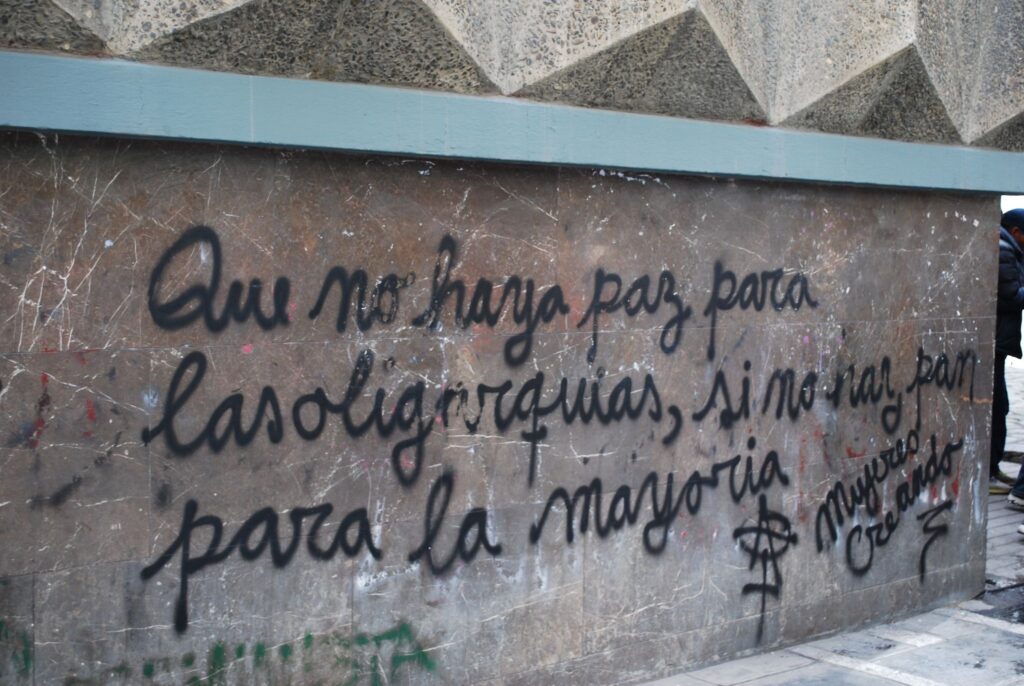
Graffiti quote inscribed by protesters reading, “May there be no peace for the oligarchies, if there is no bread for the majority.” Image credit: Joseph Bouchard
They have multiple grievances, including a cabinet with little meaningful indigenous, female or movement representation, the absence of consultation with social organizations on major legislative decisions, cuts to fuel subsidies and social services whose effects have been felt immediately in communities already stretched thin by years of economic crisis, and a failure to address the structural commercial and energy crises that preceded Paz’s election.
On a more structural level, many syndicalist and indigeneist movements that had long been associated with the Movement Towards Socialism (MAS) made a deliberate and politically costly decision to back Paz over former socialist president Evo Morales’s old party last year. They feel that they have been betrayed, and left out.
Protesters lined up by the Plaza San Francisco in downtown La Paz. Image credit: Joseph Bouchard
The government’s response
For its part, the Paz government has pursued a strategy of selective negotiation combined with escalating pressure on those who refuse to leave the streets. It has reached agreements with certain teachers’ unions and regional COB affiliates, and issued decrees guaranteeing healthcare, education, and other rights to indigenous communities.
Some factions have accepted these terms, though others have accused them of capitulating, or being co-opted by the government. One leader of the COB argued from La Paz, “They are doing the same strategy as the MAS under the previous regime, they are co-opting social movements to delegitimize our demands and our concerns, and paint us as insubordinate and ungrateful.”
Paz has promised a cabinet reshuffle, along with an economic social council, in an attempt to “listen to the people” and provide further representation for aggrieved social sectors.
The Paz government has deployed thousands of police in La Paz and El Alto to resist and dismantle blockades, using tear gas, riot gear, and rubber bullets, apprehending at least 100 according to the People’s Ombudsman, including journalists. Three have died so far, with many more injured.
Senior officials, including cabinet members, have publicly accused blockade leaders of being financed by Evo Morales and linked to drug trafficking and terrorism.
Paz himself has referred to those still demonstrating in the streets as “vandals,” and the state security apparatus has warned it will use “progressive and proportional force” — with persistent rumours, denied by the government, of authorization for live ammunition.
Human rights organizations and the COB leadership have denounced the targeting of union leaders and the harassment of the press and activists. Former president Evo Morales has alleged that the Paz government, in coordination with the DEA and US Southern Command, is planning an operation to detain or kill him.
Protesters wait to join the frontlines as tear gas accumulates near the Plurinational Assembly. Image Credit: Joseph Bouchard
The impact on Paz’s presidency
The crisis is exposing deep tensions within Paz’s own Christian Democratic Party (PDC) big tent coalition, which brought together an ideologically eclectic mix of figures — from indigeneist currents previously aligned with the MAS, and populist actors, to more conventionally conservative actors such as former president Tuto Quiroga, multimillionaire former minister Samuel Doria Medina, and prominent figures in right-wing stronghold Santa Cruz. That coalition is straining.
Vice President Edmand Lara, a populist anti-corruption figure and former police officer whom social movements had embraced and whose support is widely credited with being decisive in Paz’s election victory, has issued multiple statements breaking with the president’s handling of the crisis.
Lara condemned the use of chemical agents against elderly people, pregnant women, and children, called on security forces to respect proportionality protocols, denounced the intimidation of journalists, and invited the Inter-American Commission on Human Rights to monitor the situation. Political analysts in La Paz are openly speculating that Lara is positioning himself as the social movements’ candidate for the presidency, should Paz’s government fall.
On the more conservative flank, Paz’s allies are urging a harder line. Proposals include a state of emergency, tighter control of what they characterize as violent paid agitators, and continued carrot-and-stick approaches to willing and unwilling sectors. Which tendency wins the internal argument will likely define the character of the Paz government going forward, if it can survive it.
Protesters retreat as tear gas descends into commercial streets in downtown La Paz. Image credit: Joseph Bouchard
International response to the protests
Internationally, the crisis has also created further divisions. Leftist Colombian President Gustavo Petro, in a series of posts on social media, described the protests as “a popular insurrection” against “geopolitical arrogance” and declared that “Bolivia stands at the forefront of the struggle for Latin American dignity.” He also offered Colombian mediation for the crisis.
Bolivia’s foreign minister, Fernando Aramayo, responded by expelling Colombia’s ambassador, Elizabeth García, declaring her persona non grata for what he called “insistent public declarations of interference in Bolivia’s internal affairs.” Paz called it an “attack on democracy.”
The conservative bloc in Latin America has lined up firmly behind Paz. Among others, El Salvador, Argentina, Chile, Peru, and the United States have characterized the protests as destabilizing and linked them to drug trafficking. US Secretary of State Marco Rubio described the unrest as a “coup attempt,” adding that “we will not allow criminals and drug traffickers to overthrow democratically elected governments,” which protesters say are racist echoes of the country’s long history with the war on drugs and U.S. intervention.
Argentina, meanwhile, reportedly sent military aircraft, officially carrying food and medicine, that are alleged by protest groups to also contain tear gas and crowd-control equipment, a charge Buenos Aires has denied. The OAS Security Council has convened an emergency session on Bolivia.
Demands from protesters
The protesters’ demands range from specific sectoral issues, like better conditions for teachers, guaranteed rights for indigenous communities, to more sweeping demands including Paz’s resignation and, for Evo Morales, fresh democratic elections within 90 days. Evo Morales, the COB, and Red Ponchos have stated they will not stop fighting.
The unfolding unrest is becoming a sharp test for Paz, and Bolivia’s democracy. Based on Bolivia’s history, the social movements in the streets, as they are acutely aware, have brought down governments before, and are in no hurry to leave. For now, the blockades continue in Bolivia.
Featured Image: Red Ponchos throw stones at functionaries and police at the Judiciary building in La Paz.
Caracas, Venezuela — Nearly a month has passed since the 90-day limit on Delcy Rodríguez’s term as acting president of Venezuela expired. Now, various opposition groups are calling for presidential elections amid political uncertainty in the country.
The matter of how elections should proceed — if at all — is complicated by a number of issues including disputed results in Venezuela’s 2024 elections and the United States’ capture and arrest of President Nicolás Maduro on January 3.
Ro
Caracas, Venezuela — Nearly a month has passed since the 90-day limit on Delcy Rodríguez’s term as acting president of Venezuela expired. Now, various opposition groups are calling for presidential elections amid political uncertainty in the country.
The matter of how elections should proceed — if at all — is complicated by a number of issues including disputed results in Venezuela’s 2024 elections and the United States’ capture and arrest of President Nicolás Maduro on January 3.
Roberto Abdul, a political activist who helped organize primary elections for Venezuela’s opposition movement in 2023 and was detained by the government that same year, told Latin America Reports that the legitimacy of Maduro’s presidency plays a role in the current debate surrounding Rodríguez, who was Maduro’s vice president at the time of his capture.
He said that “While the [National Electoral Council] did not present the [voter] tally sheet” to prove Maduro’s victory in elections, the opposition did manage “to present nearly 83% of the tally sheets issued by the machines” showing their candidate, Edmundo González, won the elections.
Because Venezuelan vice presidents are not elected but rather appointed by the president, as a Maduro appointee, the question around the legitimacy of Rodríguez’s position within the government further muddies the waters.
“Therein lies the problem from a constitutional standpoint,” he said.
Further, Article 233 of the country’s Constitution distinguishes between the temporary and permanent absence of a president, while Article 234 outlines the procedure for governing the country in the president’s absence.
According to Article 234, in the event of a temporary absence, the vice president takes control of the government for a period of 90 days — a period which can be extended by the legislature for another 90 days.
However, if the president’s temporary absence lasts for more than 90 days, the National Assembly (Venezuela’s legislature) must decide by a majority vote whether the president’s absence should be considered permanent, which would initiate new elections within a 30-day period.
Abdul explained that the unprecedented circumstances surrounding Maduro’s absence are frustrating the very definition of his absence.
On January 3, U.S. special forces teams assaulted Venezuela’s capital, Caracas, and captured Maduro and his wife, Cilia Flores, and took them by sea and air to New York to face drug trafficking charges. The legality of the dictator’s rendition has been questioned by international legal experts.
Maduro’s trial could take months, if not years, far exceeding the time limit for a temporary absence (maximum 180 days) afforded by Venezuela’s Constitution.
Due to this unique circumstance, there is a debate over how to apply Articles 233 and 234 to Maduro’s absence. Furthermore, Abdul points out that, given the lack of separation of powers, the interpretations of the Supreme Court and other bodies tend to be “biased” in favor of the Chavista government, rather than strictly adhering to the spirit of Constitutional law.
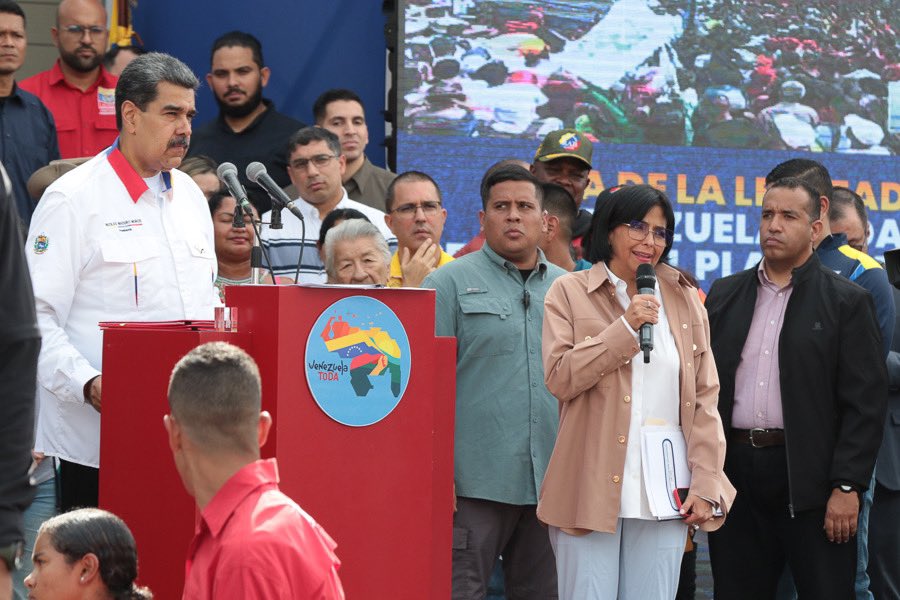
Nicolás Maduro and Delcy Rodríguez at an event in 2023. Image credit Delcy Rodríguez via X.
The National Assembly slow rolling the debate
The National Assembly, which is controlled by government loyalists, was supposed to begin debates around the expiration of Rodríguez’s first term as acting president between April 6 and 10. The debate has yet to take place, even though her term expired on April 5.
Jorge Rodríguez, president of the National Assembly and Delcy’s brother, has made comments suggesting that the legislature’s main focus is restarting Venezuela’s economy, and not new elections.
“The most important thing right now is the economy. It’s essential that the Venezuelan economy grows so dynamically that the population feels this entire process has been worthwhile,” the parliamentary leader told Spanish newspaper El País. “Furthermore, we are engaged in a profound dialogue with all opposition groups that remain within the bounds of the Constitution, including those living abroad. I couldn’t tell you exactly when, or even what the first election will be, because there’s so much to do.”
Other Maduro loyalists are also pushing back on holding elections. Diosdado Cabello, Minister of the Interior and Justice, said last week during an event, “Now they’re [the opposition] calling for elections because President Nicolás Maduro is completely absent. Well, you were telling us that Nicolás Maduro didn’t win [elections in 2024], so how is it that now you’re demanding the complete absence of someone who didn’t win?”
Even if the legislature declares Maduro’s absence permanent, Abdul argues there is much to do to ensure free and fair elections in Venezuela.
First, he said, the National Electoral Council (CNE) must appoint a new board which is the result of a bipartisan agreement. “We must try to ensure it adheres as closely as possible to the rules to generate the greatest credibility and the highest possible levels of legitimacy,” he stated.
Another important consideration, Abdul argued, is whether to hold only presidential elections, or a wider “mega-election” that would decide National Assembly seats, governorships, and mayoral offices.
Among other challenges facing any impending elections would be facilitating voting for the 4.5 to 5 million eligible Venezuelans living abroad; technical assistance from a foreign body like the United Nations to facilitate observation; and reversing political disqualifications and reinstating political parties that were banned during Maduro’s administration.
“It is a complex process, but it is achievable; it’s not like you’re sending someone to the moon out of thin air—it’s something we’ve already gone through,” Abdul concluded.
Featured image: Venezuela’s National Assembly votes on a law to streamline administrative procedures in March 2026.
The Director of International Law at the Cuban Ministry of Foreign Affairs, Yusnier Romero, denounced the recent political maneuver by the US government, accusing it of flagrantly violating the principle of sovereign equality by claiming universal jurisdiction to judge nationals of other states.
Read More ...
The Director of International Law at the Cuban Ministry of Foreign Affairs, Yusnier Romero, denounced the recent political maneuver by the US government, accusing it of flagrantly violating the principle of sovereign equality by claiming universal jurisdiction to judge nationals of other states.
The Russian tanker Anatoly Kolodkin has entered Cuban waters, according to the Russian news agency Interfax.
The vessel, which is sanctioned by the European Union, United States and United Kingdom due to the ongoing Russia-Ukraine war, appears to be en route to the Cuban port of Matanzas, according to Marine Traffic.
The ship’s arrival comes after U.S. President Donald Trump told reporters late on Sunday night that he had “no problem” with Russia supplying the island with oil, having pre
The Russian tanker Anatoly Kolodkin has entered Cuban waters, according to the Russian news agency Interfax.
The vessel, which is sanctioned by the European Union, United States and United Kingdom due to the ongoing Russia-Ukraine war, appears to be en route to the Cuban port of Matanzas, according to Marine Traffic.
The ship’s arrival comes after U.S. President Donald Trump told reporters late on Sunday night that he had “no problem” with Russia supplying the island with oil, having previously threatened to impose tariffs on any foreign oil supplier of the communist-run nation.
If delivered, the 100,000 tonnes of crude oil aboard the vessel would represent the first non-private foreign shipment of oil to reach Cuba since January, when the Trump administration’s oil blockade of the island began.
The U.S. has allowed private companies to import fuel to the island, though these supplies have been negligible for the island’s needs as a whole.
Tensions between Havana and Washington have defined bilateral relations since the Cuban Revolution of 1959 and the subsequent nationalization of U.S. assets in the Caribbean nation. But in recent months, the long-running dispute escalated after the White House forcibly removed Venezuelan President Nicolás Maduro from power and took him into U.S. custody.
Maduro was a staunch ally of the current Cuban regime and Venezuela was its primary oil supplier.
While the U.S. and Cuban governments are engaged in diplomatic talks, this has not stopped high-ranking officials in Washington from repeatedly threatening the Cuban communist leadership with regime change
On Friday U.S. Secretary of State Marco Rubio told reporters that, in order for Cuba’s problems to be solved, “you need to change the people in charge, you need to change the system that runs the country.”
Rubio also blamed the Cuban government, rather than U.S. sanctions, for the island’s oil shortages, accusing the state of wanting foreign nations to supply them with oil for free; this had supposedly been the case with Maduro and the former Soviet Union.
Though both nations provided the island with heavily subsidized oil shipments at below-market prices, Cuba supplied the Soviet Union with sugar and sent its medical professionals to Venezuela in exchange for oil.
The Cuban government blames U.S. sanctions for the current crisis.
Their cause notwithstanding, the shortages of fuel on the island have provoked a grave humanitarian crisis; United Nations Secretary General Antonio Guterres warned last month of impending “collapse” if no oil reached the island.
Cuban hospitals have had to cancel emergency surgeries due to a lack of power and Cubans have resorted to burning wood to cook food.
Featured Image: Current Russian President Vladimir Putin and former Cuban President Raúl Castro in 2015.
The Isle of Youth municipality, south to Cuba mainland, will host the Fourth “Isla Verde International Environmental Film Festival May 31-June 6. Read More ...
Medellin, Colombia — On Tuesday, a group of more than two thousand migrants, mainly of Haitian origin, reportedly left the southeastern city of Tapachula in Chiapas, on their way to cities in central and northern Mexico.
In years past, migrant caravans traversing Mexico were usually destined for the United States. But following the second Trump administration’s tightening of asylum policy, this goal has become more unrealistic, and Mexico has increasingly become a destination country for migra
Medellin, Colombia — On Tuesday, a group of more than two thousand migrants, mainly of Haitian origin, reportedly left the southeastern city of Tapachula in Chiapas, on their way to cities in central and northern Mexico.
In years past, migrant caravans traversing Mexico were usually destined for the United States. But following the second Trump administration’s tightening of asylum policy, this goal has become more unrealistic, and Mexico has increasingly become a destination country for migrants, according to the International Organization for Migration (IOM).
Some of the people who make up the “David” caravan have spent weeks or more in southern Mexico, waiting to normalize their migration status to be able to move more freely in Mexico, according to migrant news website Conexión Migrante. The process can be slow as Mexico fields more asylum requests.
According to the UNHCR, between 2020 and 2024, there were almost 500,000 asylum requests in Mexico, a number that has resulted in long delays from the Mexican Commission for Refugee Assistance (COMAR) and the National Institute of Migration (INM).
As of September 2025, there were more than 58,800 new asylum claims, and COMAR had increased its processing capacity fivefold since 2018.
Between October 1 2024 and June 30 2025, there were 142,145 requests for humanitarian visas in Mexico, but only 5,191 were granted, according to the INM Strategic Plan.
The bureaucratic problems pre-date Trump’s immigration crackdown in his second term.
In 2020, the COVID-19 pandemic forced COMAR to suspend activity, accumulating a backlog of asylum petitions. Exacerbating the issue was Trump’s January 2025 suspension of the CBP One digital asylum-seeking app in the U.S., followed by budget cuts to COMAR from the Mexican government as well as the UN Refugee Agency (UNHCR).
Via a Whatsapp group organized for the caravan, many members cited extreme delays for processing asylum applications as a motive for heading north from Mexico’s southern border. Lack of employment and cost of living were also cited, according to Conexión Migrante.
Without documentation, many foreign migrants are stuck in a legal limbo, where they run the risk of being stopped by authorities, deported or sent back to the southern border with Guatemala.
Migrants have also been targeted by criminal groups for kidnapping and extortion, with ProPublica reporting that this problem has entered a new phase in terms of scale and character. Migrants’ undefined legal status also often forces them to work long hours with lower pay, according to the International Rescue Committee.
Since Claudia Sheinbaum took office in October 2024, there have been 18 migrant caravans leaving from Tapachula, though none of them have made it further than Oaxaca, the state neighbouring Chiapas.
At the end of March, the ‘Genesis’ migrant caravan set off from Tapachula, but it was intercepted after 12 days and dissolved by the INM.
According to local news outlet Diario del Sur, on Thursday, the David caravan arrived in Escuintla, Chiapas after three days of walking, where members will rest before continuing the journey.
Many migrants were demonstrating signs of extreme physical exhaustion, and approximately thirty who fell behind the main group have been sent back to Tapachula, where they remain under the custody of the authorities, according to Reporteros del Sur.
Featured image description: David migrant caravan in Mexico
Bogotá, Colombia — President Gustavo Petro on Tuesday declared three days of national mourning in Colombia following a military plane crash on Monday which killed 69 soldiers.
The accident occurred at the Puerto Leguízamo airport in Putumayo, a region located in the southwest of the country, involving a C-130 Hercules aircraft normally used to transport troops and humanitarian aid to remote regions.
According to the latest official reports, at least 69 soldiers and crew members were k
Bogotá, Colombia — President Gustavo Petro on Tuesday declared three days of national mourning in Colombia following a military plane crash on Monday which killed 69 soldiers.
The accident occurred at the Puerto Leguízamo airport in Putumayo, a region located in the southwest of the country, involving a C-130 Hercules aircraft normally used to transport troops and humanitarian aid to remote regions.
According to the latest official reports, at least 69 soldiers and crew members were killed in the disaster. The military transport plane, belonging to the Colombian Aerospace Force (FAC), was carrying over 120 people when it smashed onto the grounds of a nearby farm just after takeoff.
During the period of national mourning, Petro confirmed that flags will fly at half-mast and military honors will be given to the victims of the tragedy and their families.
He decretado tres días de duelo en todo el territorio nacional en memoria de los 69 uniformados pertenecientes al Ejército, Fuerza Aeroespacial y la Policía Nacional que perdieron la vida en el accidente aéreo en Puerto Leguízamo – Putumayo el pasado 23 de marzo.
Many households are grieving the loss of their children, but one family in particular mourns the loss of two: brothers Santiago and Daniel Esteban Arias. Originally from Puerto Libertador, in the Caribbean department of Córdoba.
Monday’s crash is one of the worst aviation tragedies in the country’s recent history. In 2016, a plane carrying players from Brazil’s Chapecoense soccer team crashed into the mountains outside Medellín, killing over 70 people.
Lamentamos profundamente informar que, tras culminar las labores de búsqueda y rescate, hoy confirmamos con dolor los nombres de nuestros héroes que ofrendaron su vida en el accidente aéreo en Puerto Leguízamo, #Putumayo.
— Ejército Nacional de Colombia (@COL_EJERCITO) March 24, 2026
In Puerto Leguízamo, survivors of the military plane crash were transferred to specialized medical centers across the country.
Authorities are investigating the causes of the accident but have dismissed preliminary claims of an attack by guerrilla forces active in the region.
The Mayor of Puerto Leguízamo, Luis Emilio Bustos Morales, told local media, including Blu Radio and Noticias RCN, that “they have many hypotheses.”
He noted that among them, “there is talk that they were carrying too much weight” or “that the runway was too short for them.”
During the emergency, residents used their own motorcycles to evacuate the survivors before official help arrived; some of them were also injured by ammunition exploding in the flames.
The medical center known as ‘Hospital Militar Central’, located in the capital Bogotá, confirmed that a local rescue worker is among those being treated there.
President Petro expressed his gratitude through his X account, stating that “this is how a nation is built.” He thanked the local citizens who rushed to save the survivors. He also highlighted the soldiers who ran to save others during the disaster, calling their actions a “beautiful proof of love and solidarity.”
The painful moments were detailed by soldier Mauro Peñaranda, who survived and described the scene as the aircraft went down to local media outlets: “It was leaning to one side, and there was a weird noise (…) the plane was creaking,” he told RTVC. Mauro also stated that they did not receive clear instructions from the cockpit during the situation.
“I honestly don’t even know how I got out of there… I just jumped and got out,” he said.
The governments of Ecuador, Panama, France, and the United States, among others, also offered their condolences to the Colombian military forces and the victims’ families.
Featured image: Photo of Colombian military plane crash site in Puerto Leguízamo on March 23, 2026.
This article originally appeared on The Bogotá Post and was republished with permission.

 Login
Login




.jpg)