Normal view

  • ✇National Herald
  • Oracle layoffs enter final phase as thousands of employees prepare to exit NH Business Bureau
    Oracle's mass layoffs, first announced in late March and reported to affect up to 30,000 employees globally, including around 12,000 in India, are entering their final phase, with many affected workers expected to complete their exits by mid-June.The workforce reduction is among the largest in the company's history and comes despite Oracle reporting strong growth in its cloud and artificial intelligence (AI) businesses. Industry observers view the restructuring as part of the company's efforts t
     

Oracle layoffs enter final phase as thousands of employees prepare to exit

3 June 2026 at 13:30

Oracle's mass layoffs, first announced in late March and reported to affect up to 30,000 employees globally, including around 12,000 in India, are entering their final phase, with many affected workers expected to complete their exits by mid-June.

The workforce reduction is among the largest in the company's history and comes despite Oracle reporting strong growth in its cloud and artificial intelligence (AI) businesses. Industry observers view the restructuring as part of the company's efforts to redirect resources towards AI infrastructure, cloud services and large-scale data centre investments.

India has emerged as a key focus of the layoffs because of Oracle's sizeable presence in Bengaluru, Hyderabad, Mumbai, Pune, Chennai, Noida and Gurugram. While the company has not released an official country-wise breakdown, reports suggest India accounted for a significant share of the global job cuts announced earlier this year.

Many employees affected by the restructuring were informed of their departures in March and April, with final separation dates scheduled between 1 June and 15 June. The latest reports therefore relate largely to the completion of Oracle's earlier restructuring exercise rather than a newly announced round of layoffs.

Employees impacted by the cuts have reportedly been offered severance packages linked to their years of service. According to media reports, workers receive four weeks of base salary for their first year of employment and an additional week for each subsequent year, subject to a cap. Acceptance of the severance package is understood to require employees to sign agreements waiving future claims against the company.

At Oracle, Surviving the Layoffs Feels Harder Than Leaving

For many employees who kept their jobs, there was no relief — only more pain.

After Oracle’s massive cuts (up to 30,000 globally, ~12,000 in India), survivors describe:
• Crushing workloads — doing the job of… pic.twitter.com/ZGGl5YHuGW

— Rohit (@iamrohit) June 2, 2026

For many workers, however, the bigger concern has been stock-based compensation. Employees whose restricted stock units (RSUs) had not vested before their exit dates reportedly lost those benefits, resulting in significant financial losses in some cases.

One of the divisions most affected by the restructuring is Oracle Health, the healthcare technology business created following Oracle's acquisition of Cerner. Reports suggest thousands of positions have been eliminated from the unit, which serves hospitals, healthcare providers and government-linked health projects.

The layoffs come as Oracle continues to invest heavily in AI-related infrastructure. The company recently reported quarterly revenue of about $17.2 billion, with cloud services accounting for more than half of total sales. AI-related businesses have emerged as one of Oracle's fastest-growing segments, prompting increased spending on data centres and cloud capacity.

Oracle is also involved in the Stargate AI initiative alongside OpenAI and SoftBank, underscoring its ambitions to play a larger role in the rapidly expanding AI ecosystem.

For affected employees, the coming days are expected to be crucial as they review severance agreements, healthcare benefits and compensation arrangements before their departures are finalised.

With media inputs

  • ✇Vietnam+
  • Customs revenue reaches 47.7% of annual target in five months
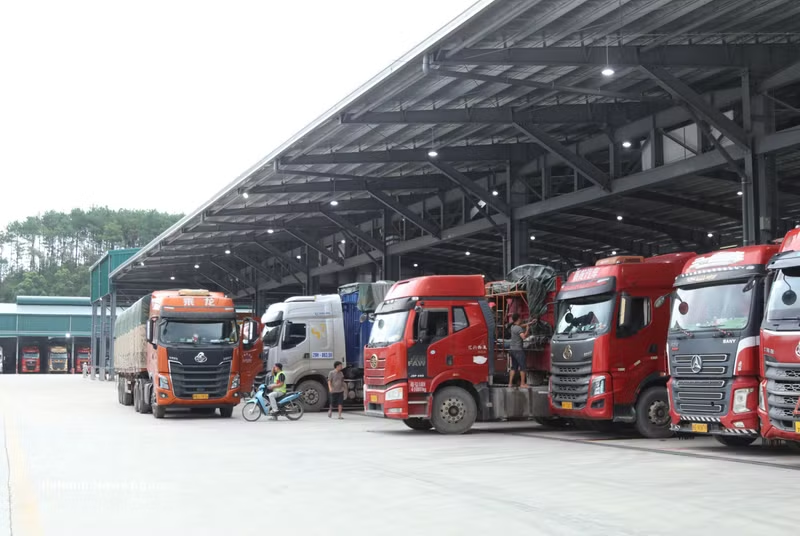
    During the January–May period, Vietnam’s exports rose 19.5% year-on-year to 215.66 billion USD, while its imports surged 30.8% to 229.46 billion USD. Total trade turnover reached 445.12 billion USD, up 25% from a year earlier.Government moves to remove bottlenecks, drive double-digit economic growth in 2026Vietnam sustains growth momentum in first five months, bolstering double-digit targetState budget revenue up 15.4% in first five months
     

Customs revenue reaches 47.7% of annual target in five months

10 June 2026 at 22:37

During the January–May period, Vietnam’s exports rose 19.5% year-on-year to 215.66 billion USD, while its imports surged 30.8% to 229.46 billion USD. Total trade turnover reached 445.12 billion USD, up 25% from a year earlier.

  • ✇Vietnam+
  • Vietnam eyes mutually beneficial economic partnership with US: Foreign Minister
    During his reception for the US Deputy Secretary of State, Foreign Minister Le Hoai Trung said Landau’s visit reflects the importance the US attaches to its relationship with Vietnam and will help maintain the positive momentum in bilateral ties.Vietnam urges US to fairly assess intellectual property enforcement efforts in wake of investigationVietnam, US foster deeper, more substantive legislative tiesVietnam, US step up parliamentary, defence cooperation
     

Vietnam eyes mutually beneficial economic partnership with US: Foreign Minister

10 June 2026 at 14:27

During his reception for the US Deputy Secretary of State, Foreign Minister Le Hoai Trung said Landau’s visit reflects the importance the US attaches to its relationship with Vietnam and will help maintain the positive momentum in bilateral ties.

  • ✇National Herald
  • Petrol, diesel prices hiked again, by 87-91 paise per litre NH Digital
    The latest round of fuel price hikes has sharpened questions over whether the government deliberately held back increases during the recent Assembly elections even as it reassured the country that energy supplies remained adequate amid the West Asia conflict.Petrol and diesel prices were raised again on Saturday, 23 May — the third increase in less than 10 days — taking the cumulative rise since 15 May to nearly Rs 5 per litre.In Delhi, petrol became dearer by 87 paise, rising from Rs 98.64 to R
     

Petrol, diesel prices hiked again, by 87-91 paise per litre

23 May 2026 at 04:55

The latest round of fuel price hikes has sharpened questions over whether the government deliberately held back increases during the recent Assembly elections even as it reassured the country that energy supplies remained adequate amid the West Asia conflict.

Petrol and diesel prices were raised again on Saturday, 23 May — the third increase in less than 10 days — taking the cumulative rise since 15 May to nearly Rs 5 per litre.

In Delhi, petrol became dearer by 87 paise, rising from Rs 98.64 to Rs 99.51 per litre, while diesel went up by 91 paise from Rs 91.58 to Rs 92.49.

State-owned oil marketing companies began revising prices on 15 May, citing elevated global energy costs triggered by tensions in West Asia. That day saw a steep Rs 3-per-litre increase, followed by another 90 paise rise on 19 May, and a further hike on Saturday.

The timing has inevitably drawn scrutiny. Through the election period in end-April, the government maintained that India had sufficient fuel supplies and that contingency arrangements were in place to manage disruptions arising from geopolitical instability. Ministers and officials repeatedly projected confidence, stressing stock adequacy and energy security.

Third petrol & diesel price hike in 10 days. Every 3 days, fuel prices go up by almost ₹1.

The Govt is unable to deal with the falling rupee so expect price hikes to continue every few days until July at least.

We don’t need the PM & Ministers to do “austerity” tamasha for… pic.twitter.com/F3QAPW8JqQ

— Saket Gokhale (@SaketGokhale) May 23, 2026

Yet the post-election pricing pattern tells a different story. If international pressures were severe enough to justify almost Rs 5 per litre in hikes within days, critics ask why consumers were insulated from those costs during the politically sensitive election period.

The calibrated manner in which oil companies are now “passing on” higher global prices also raises a larger question: were economic realities temporarily deferred to avoid voter backlash?

Fuel prices are not merely an accounting issue. They ripple through the wider economy, influencing transport costs, food inflation and household budgets. Delaying price revisions during elections may offer short-term political relief, but it distorts price signals and undermines public trust.

The government cannot simultaneously claim that supplies are comfortable and markets stable, only to permit a succession of sharp hikes once polling concludes. If global conditions demanded higher prices, candour was owed to the public before the elections, not after them.

The issue is not only the increase itself, but the opacity surrounding its timing.

With PTI inputs

  • ✇Business Matters
  • JCB succession: Lord Bamford anoints younger son George as heir to £6.5bn digger empire Jamie Young
    After years of boardroom whispers, palace-intrigue rumours and one alleged attempted coup, the question of who will inherit Britain’s most famous yellow-painted family business has finally been settled, and it is not the son the City had been quietly pencilling in. Lord Bamford, the 80-year-old chairman of JCB, has confirmed that his younger son George, not his elder son Joseph (known as Jo), will eventually take the wheel of the Staffordshire-headquartered digger maker. The disclosure, made in
     

JCB succession: Lord Bamford anoints younger son George as heir to £6.5bn digger empire

18 May 2026 at 06:15
Lord Bamford

After years of boardroom whispers, palace-intrigue rumours and one alleged attempted coup, the question of who will inherit Britain’s most famous yellow-painted family business has finally been settled, and it is not the son the City had been quietly pencilling in.

Lord Bamford, the 80-year-old chairman of JCB, has confirmed that his younger son George, not his elder son Joseph (known as Jo), will eventually take the wheel of the Staffordshire-headquartered digger maker. The disclosure, made in an interview with the Daily Telegraph, brings to an end one of the longest-running succession sagas in British family enterprise and reshapes the future of a group that turns over £6.5bn, operates 22 factories across four continents and employs 19,000 people worldwide.

“In terms of us remaining a family business, that is very important, and we do have plans,” Lord Bamford said. “I’m very lucky and highly privileged to be in charge of this business at the moment. I don’t intend to be forever. I am 80, for heaven’s sake.” Asked directly who would step into his shoes, he replied: “It will be George.”

From heir apparent to outsider

For the best part of two decades, Westminster watchers and the wider engineering community had assumed Jo Bamford was being groomed to take over. He joined the family firm in 2004, was appointed to the board in 2006 and rose through a succession of senior roles, including head of major contracts, a brief widely read in the industry as a finishing-school posting for a future chairman.

What changed, according to people familiar with the boardroom, was an episode in which Jo is said to have pressed his father to step aside. Lord Bamford, by all accounts, viewed the approach as an attempted coup rather than a constructive nudge. The fallout has been swift and unambiguous: George, the family’s third child, has since been installed as deputy chairman, a clear public signal that the line of succession had quietly been redrawn.

The succession is yet to be formally rubber-stamped at board level, but few in the sector now doubt the trajectory. For a privately held company of JCB’s scale, the choice of chairman is not merely a question of family harmony; it shapes capital allocation, factory footprints, R&D priorities and the firm’s political voice for a generation.

Who is George Bamford?

If Jo was the obvious candidate, George has been the unconventional one. Best known outside engineering circles for the Bamford watch brand, which he founded and which built a cult following customising Rolex, TAG Heuer and other luxury timepieces, he has spent the past two decades building his own commercial reputation in the lifestyle and luxury goods market.

He will retain ownership of the Bamford watch business, but JCB is now becoming his full-time job. Those who have worked with him describe a brand-builder with an instinctive grasp of design and marketing, attributes that may prove useful as the digger maker leans further into electrification, hydrogen power and the premiumisation of construction equipment.

The inheritance-tax backdrop

The Bamford succession is playing out against a tax backdrop that has rattled family businesses across the United Kingdom. From 6 April 2026, the Treasury’s reforms to agricultural and business property reliefs have introduced a £2.5m 100 per cent relief allowance, with qualifying assets above that threshold attracting an effective 20 per cent inheritance tax charge rather than full exemption.

For the United Kingdom’s 5.3 million family firms, the change has been seismic. As the House of Commons Library has set out, the reforms close what ministers regard as a loophole exploited by the ultra-wealthy, but critics argue that they catch ordinary trading businesses in the same net as estate-planning vehicles.

Speaking at a business conference in April, Jo Bamford warned that the new regime could push the family’s empire abroad. “The family tax… is a real problem,” he said. “It could quite easily become an American business. I love being in Britain. But I would say to a political party of any stripe, look, there’s only so much you can ultimately do.” Lord Bamford, a long-time Conservative donor who has also written cheques to Reform UK, has been similarly vocal about Whitehall’s direction of travel, concerns explored in our recent piece on Lord Bamford’s £300m family windfall and the wealth-tax debate.

A sector-wide reckoning

JCB is far from alone. From Dyson to Global Brands, blue-chip family-controlled firms have warned that the new regime could force restructurings, share sales or outright relocations to safeguard jobs and intergenerational ownership. Business Matters has tracked the broader fallout in its analysis of how the £2.5m cap is reshaping family-business planning, with more than half of surveyed firms already pausing investment.

For Lord Bamford, the calculation has long been about more than tax. JCB’s ownership structure, headquartered in Rocester since 1945, is the bedrock on which the company’s long-term capital expenditure programme rests — including the recent decision to double its Texas plant in response to United States tariffs. A clean succession line gives lenders, customers and 19,000 employees a clearer view of the next chapter.

The lessons for other founders

The Bamford story is unusual in scale but not in shape. Even the most polished succession plans can be derailed by sibling rivalry, mismatched ambitions and an incumbent who is reluctant to let go. As Business Matters has previously explored in our five steps to successful business succession planning, early, candid conversations with successors, ideally years before any handover, remain the single biggest predictor of whether a family firm survives the generational baton change.

For Jo Bamford, life outside the JCB chair is unlikely to be quiet. He has built a substantial second career in clean energy, founding the hydrogen fuel firm Ryze Power and stepping in to rescue Northern Ireland’s Wrightbus from collapse. Few City observers expect him to disappear from the FTSE conversation.

For George, the in-tray is daunting but enviable: a globally respected brand, a balance sheet that has weathered tariffs, war in Ukraine and a cooling construction market, and a workforce that has known only one family at the helm. The yellow JCB livery has carried the Bamford name for three generations. On the strength of his father’s words this week, it is on course to do so for a fourth.

Read more:
JCB succession: Lord Bamford anoints younger son George as heir to £6.5bn digger empire

  • ✇Vietnam+
  • Philippines earthquake death toll climbs to 53
    The latest figure exceeds the 45 fatalities previously reported by the National Disaster Risk Reduction and Management Council (NDRRMC) on June 10.Death toll from magnitude-7.8 earthquake in Philippines risesDeath toll, damage rise after strong Philippines earthquakeNo reports of Vietnamese casualties in Philippines earthquake, tsunami: Embassy
     
  • ✇Vietnam+
  • AFF 2026 - Strategic platform for shaping ASEAN’s long-term future: Malaysian scholar
    Collins Chong Yew Keat, a foreign affairs, security and strategy analyst at the University of Malaya (Malaysia), described AFF 2026 as a valuable platform for fostering long-term strategic thinking, regional trust-building and policy innovation. Vietnam proposes three Asian cooperation orientationsAFF 2026 showcases Vietnam’s leadership in charting ASEAN’s future: researcherCambodian expert hails AFF 2026 as milestone in multilateral party diplomacy
     

AFF 2026 - Strategic platform for shaping ASEAN’s long-term future: Malaysian scholar

11 June 2026 at 13:01

Collins Chong Yew Keat, a foreign affairs, security and strategy analyst at the University of Malaya (Malaysia), described AFF 2026 as a valuable platform for fostering long-term strategic thinking, regional trust-building and policy innovation.

❌
Subscriptions