This week on rabble radio, Thomas Ponniah joins rabble editor Nick Seebruch to talk about the heavy influence of the U.S. on the world stage. They break down why massive military power hasn’t led to a better quality of life in the States and how a better future is possible.
About our guest
Thomas Ponniah is a co-writer of Unholy Trinity: the IMF, World Bank, and WTO, co-editor of Another World is Possible: World Social Forum proposals for an Alternative Globalization, co-editor of The Revolution
This week on rabble radio, Thomas Ponniah joins rabble editor Nick Seebruch to talk about the heavy influence of the U.S. on the world stage. They break down why massive military power hasn’t led to a better quality of life in the States and how a better future is possible.
About our guest
Thomas Ponniah is a co-writer of Unholy Trinity: the IMF, World Bank, and WTO, co-editor of Another World is Possible: World Social Forum proposals for an Alternative Globalization, co-editor of The Revolution in Venezuela: Social and Political Change Under Chávez, and is a contributor to rabble.ca.
World weather forecasting has been "completely upended" by artificial intelligence over the past three to four years, an Oireachtas committee has heard.
World weather forecasting has been "completely upended" by artificial intelligence over the past three to four years, an Oireachtas committee has heard.
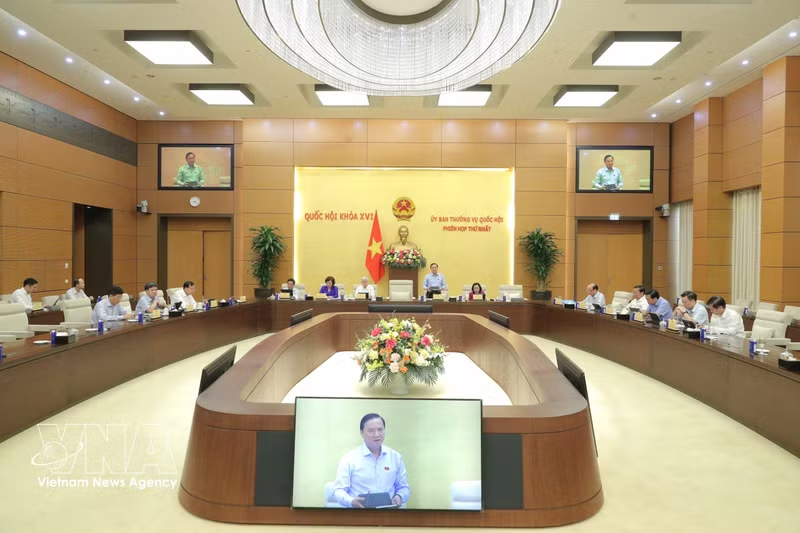
During the session, the NA Standing Committee will give opinions on a draft ordinance amending and supplementing a number of articles of the ordinance on the procedures for considering and deciding on the application of administrative sanctions at the People's Courts.NA Chairman urges Ho Chi Minh City to move faster on breakthrough reformsPeople’s Councils must be judged by public satisfaction: NA ChairmanNA Chairman calls for more substantive, accountable settlement of public aspirations
During the session, the NA Standing Committee will give opinions on a draft ordinance amending and supplementing a number of articles of the ordinance on the procedures for considering and deciding on the application of administrative sanctions at the People's Courts.
Donald Trump said that a peace agreement with Iran has been “largely negotiated” to end the war and reopen the Strait of Hormuz. The president’s announcement on Saturday lacked details, and he wrote on Truth Social that it is “subject to finalization” between “the United States of America, the Islamic Republic of Iran, and the […]
Donald Trump said that a peace agreement with Iran has been “largely negotiated” to end the war and reopen the Strait of Hormuz. The president’s announcement on Saturday lacked details, and he wrote on Truth Social that it is “subject to finalization” between “the United States of America, the Islamic Republic of Iran, and the […]
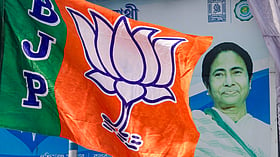
Although only 1 crore votes out of 6 crore had been counted till 1.00 pm on Monday, 4 May, the writing on the wall appeared clear enough. The BJP was leading across West Bengal. Its unexpected victory even in Muslim-dominated constituencies in Murshidabad and Malda reflected how badly minority votes had been split. Pollsters claimed over 60 per cent Hindu voters in the state had consolidated behind the BJP to end the 15-year-rule of Mamata Banerjee and Trinamool Congress.When Prime Minister Nare
Although only 1 crore votes out of 6 crore had been counted till 1.00 pm on Monday, 4 May, the writing on the wall appeared clear enough. The BJP was leading across West Bengal. Its unexpected victory even in Muslim-dominated constituencies in Murshidabad and Malda reflected how badly minority votes had been split. Pollsters claimed over 60 per cent Hindu voters in the state had consolidated behind the BJP to end the 15-year-rule of Mamata Banerjee and Trinamool Congress.
When Prime Minister Narendra Modi and Union home minister Amit Shah left the state on the last day of campaigning on 27 April, both said they would return at the swearing-in of the BJP government. West Bengal governor R.N. Ravi, brought in before the election, twice declared that change was coming to the state. The day before the counting of votes, Mumbai Police gave permission to a victory march celebrating the BJP’s win in West Bengal. They did not need exit polls to tell them the result. They knew.
In hindsight, TMC's defeat will undoubtedly be attributed to people’s restlessness for change and their belief that the BJP, which had held up Central grants, would loosen the purse strings once they came to power in the state.
Big business could barely hide its happiness. Industrialist Harsh Goenka tweeted on Monday afternoon, “Bengal’s business community is absolutely delighted with result of Bengal elections: 1. Development will be back on the agenda 2. Jobs and investments will follow 3. A stronger, more cohesive social climate will emerge. A decisive mandate for BJP is the catalyst Bengal’s economy has been waiting for”.
Both Muslims and women, it was believed, would stand by the TMC. The women’s support for and loyalty to Mamata Banerjee, it was said, was not transactional and BJP’s promise of doubling the cash transfer from Rs 1,500 to Rs 3,000, it was felt, would have no impact.
This turned out to be delusionary, as the counting trend suggested. The pillars had not entirely collapsed but had cracked just enough for the BJP to cash in. Both demography and linguistic pride, wrote columnist Swaminathan Aiyar, would ensure a victory for Mamata. West Bengal, he felt, was not yet ready to accept the hegemony of Hindi-Hindu-Hindustan. Like many other commentators, he has turned out to be wrong.
Even the anger generated by a largely senseless and illogical Special Intensive Revision (SIR) of electoral rolls does not seem to have made any difference. The large number of migrant workers, who were subjected to considerable harassment, having to travel back and forth from their places of work in BJP-ruled states, it was argued, would vote against the BJP, which supported the exercise, with a vengeance. They apparently did not. Could they have been driven to vote for the BJP to buy peace at their place of work?
Anti-incumbency, recruitment scams, women’s safety, lack of industrialisation and steady jobs, corruption and lumpenisation of TMC cadres will be cited no doubt as some of the other factors which influenced the voters in the state. However, the key reason for the defeat of the ruling party seems to be the crippling of Mamata Banerjee by the Union government and the Election Commission ever since the election was notified on 15 March.
The unprecedented transfer of several hundred officers in the state by the Election Commission — from district magistrate and SPs to police constables — would have dealt a blow to the ruling party. The chief minister was reduced to a lame duck as Central Armed Police Forces took over police stations and collectorates. Central agencies like ED and Income Tax raided the offices and the directors of I-PAC, the political consultancy firm which acted as an extension of the ruling party in the districts. While BJP retained control over the ‘machinery’, TMC lost control of it.
The CAPF accompanied BJP candidates during campaigning and warned TMC leaders to ensure that their party cadres did not disturb BJP’s campaigning. TMC overnight stopped being ‘feared’ even as BJP president Nitin Nabin was seen riding in an armoured vehicle of the CAPF.
Reports suggested that all CAPF heads were ordered to remain in the state till after the counting; and the Union home minister — not the Election Commission — declared that 750 companies would stay back in the state even after a new government is installed. Such decisions were once left to the ECI but the difference between the Union government and the election commission has got blurred.
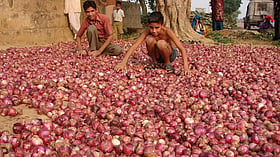
Union agriculture minister Shivraj Singh Chouhan on Thursday, 15 May, announced that NAFED would procure onions at Rs 12.35 per kg, during a programme in Maharashtra’s Satara district. However, onion farmers in the state are far from satisfied with the procurement price, arguing that it is too low considering cultivation, labour and transportation costs.Farmers are demanding a subsidy of at least Rs 1,500-2,000 per quintal and a minimum support price of Rs 30 per kg. They have also sought the im
Union agriculture minister Shivraj Singh Chouhan on Thursday, 15 May, announced that NAFED would procure onions at Rs 12.35 per kg, during a programme in Maharashtra’s Satara district. However, onion farmers in the state are far from satisfied with the procurement price, arguing that it is too low considering cultivation, labour and transportation costs.
Farmers are demanding a subsidy of at least Rs 1,500-2,000 per quintal and a minimum support price of Rs 30 per kg. They have also sought the immediate release of pending onion subsidies and financial assistance of up to Rs 10 lakh.
Farmers across Maharashtra, especially small and marginal cultivators, are deeply distressed by the ongoing price crash. In some mandis, onion prices have reportedly fallen to as low as 50 paise to Re 1 per kg. In Nashik and several other major agricultural market committees, prices have dropped to between Rs 300 and Rs 1,000 per quintal, far below production costs.
Farmers blame the Centre’s export restrictions for depressing onion prices and fuelling losses.
Maharashtra is India’s largest onion-producing state, accounting for nearly 35.45 per cent of the country’s total production. According to market reports for May, there is a significant mismatch between supply and demand in the state. Production has reportedly risen by nearly 70 per cent, but weak domestic and overseas demand, particularly from Gulf countries, has kept prices under pressure.
स्थान- महाराष्ट्र का संभाजी नगर जिला फसल--- प्याज वजन -- 1262 किलो भाव मिला 100 rs प्रति क्विंटल मतलब 1 रुपए किलो प्याज बेचने पर किसान को 1262 रुपए मिले।
हमाल, तुलाई, मंडी तक ले जाना ओर बाकी खर्चा हुआ 1263 रुपए । उल्टा 1 रुपया किसान को जेब से देकर प्याज बेचना… pic.twitter.com/p50L6QfpjQ
— suman(नरेश मीना का परिवार) (@suman_pakad) May 14, 2026
In Solapur mandi, onion prices have reportedly fallen so sharply due to bumper production and weak demand that farmers are struggling to recover even their basic costs, with some allegedly being forced to burn their crop in the fields.
Chief minister Devendra Fadnavis welcomed Chouhan’s announcement of the new procurement rate, saying farmers had been facing severe distress because of collapsing onion prices, which in some places had fallen to Rs 1-2 per kg. “Farmers were being forced to throw away their produce. This decision will provide them major relief,” Fadnavis said.
The Opposition, however, questioned the government’s policies and dismissed the announcement as an “event”, demanding that farmers receive fair compensation for their produce.
— Jai Maharashtra News (@JaiMaharashtraN) May 14, 2026
Swabhimani Shetkari Sanghatana leader Raju Shetti blamed the Centre’s policies for the sharp decline in onion prices and described the government’s assistance as inadequate.
According to Shetti, the government had failed to provide meaningful relief to farmers. He demanded that onions be removed from the Essential Commodities Act and that export restrictions be lifted completely.
Despite the procurement announcement, anger among onion farmers showed little sign of easing. Farmers staged a road blockade protest on the Nagar-Kalyan highway in Ahmednagar on Thursday and threw onions onto the roads to express their anger. In Mumbai too, protesters demonstrated outside Mantralaya and hurled onions in protest, following which police detained several demonstrators.
The onion farmers had joined a protest march led by Raju Shetti along with mango and cashew farmers. The march had the support of the Congress, Shiv Sena (UBT), Sharad Pawar-led NCP and several other Opposition parties.
Police, however, did not permit the protesters to march towards the Chief Minister’s official residence, Varsha, and stopped several senior leaders and workers at Azad Maidan.
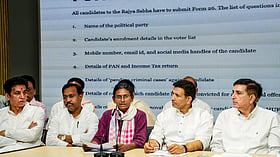
The Supreme Court’s dismissal of Congress leader Meenakshi Natarajan’s challenge to the rejection of her Rajya Sabha nomination from Madhya Pradesh marks a troubling moment in India’s electoral jurisprudence. By directing her to pursue the lengthy route of an election petition under the Representation of the People Act rather than intervening at a decisive stage of the electoral process, the Court allowed a highly contentious administrative decision to stand. The immediate consequence was signif
The Supreme Court’s dismissal of Congress leader Meenakshi Natarajan’s challenge to the rejection of her Rajya Sabha nomination from Madhya Pradesh marks a troubling moment in India’s electoral jurisprudence. By directing her to pursue the lengthy route of an election petition under the Representation of the People Act rather than intervening at a decisive stage of the electoral process, the Court allowed a highly contentious administrative decision to stand.
The immediate consequence was significant: the BJP secured all three Rajya Sabha seats from the state without facing a contest for the third seat.
At the heart of the controversy lies a fundamental question: should procedural formalities be allowed to override the broader principles of electoral fairness and democratic competition?
Natarajan’s nomination was rejected during scrutiny on 9 June on the ground that she had allegedly failed to disclose a private complaint filed in a Hyderabad court in 2025. The complaint, lodged by a former Telugu Desam Party corporator, primarily concerned allegations against another Congress leader. Natarajan, then the All India Congress Committee’s in-charge for Telangana, was implicated only on the allegation that she had failed to act on the complaint.
The legal significance of the omission appears questionable. No FIR was registered, no investigation resulted in charges, and no court framed charges against her. That distinction is critical. Section 33A of the Representation of the People Act requires disclosure of criminal cases in which charges have been framed for offences punishable with imprisonment of two years or more. The provision was intended to ensure transparency regarding serious criminal antecedents, not every private complaint or unsubstantiated allegation brought before a court.
Viewed in that light, the rejection appears less a case of material concealment than an unusually rigid interpretation of disclosure requirements. Nomination scrutiny is meant to establish eligibility and compliance with essential statutory requirements, not become a procedural trap. Election law has long recognised that returning officers should reject nominations only when defects are substantial and go to the root of a candidate’s eligibility.
The objection against Natarajan did not concern citizenship, qualification, disqualification, or any established criminal liability. It rested solely on the non-disclosure of a private complaint that had not resulted in police action or judicial determination.
Against that backdrop, the objection raised by a BJP candidate inevitably attracts political scrutiny of its own. What is presented as a defence of transparency can equally be viewed as a strategic effort to remove the Congress candidate from the contest. The result was clear: BJP candidates Tarun Chugh, Rajneesh Agarwal and Mahesh Kewat were assured victory without the uncertainty of a competitive election.
That outcome is what makes the episode particularly unsettling. The Congress maintained it had sufficient legislative support to mount a credible challenge for the third Rajya Sabha seat. What should have been a political contest decided by elected representatives was effectively settled during the scrutiny process itself.
The Election Commission’s response offered little reassurance. Despite protests and representations by the opposition, it refrained from any visible intervention as the process moved rapidly towards its conclusion.
When the matter reached the Supreme Court, there was hope that the judiciary would examine whether the rejection had crossed the line from lawful scrutiny into arbitrary exclusion. Instead, the Court chose institutional restraint. Citing Article 329(b) of the Constitution and the availability of post-election remedies, it declined to stay the process or overturn the returning officer’s decision.
From a strictly legal perspective, that reasoning may be defensible. Courts have traditionally been reluctant to interrupt ongoing electoral processes. Yet constitutional fidelity requires more than adherence to precedent. It also demands vigilance against actions that may compromise the integrity of electoral competition itself. The purpose of constitutional safeguards is not merely to protect procedures but to ensure that procedures serve democratic ends.
This case raises uncomfortable questions about the scope of discretion exercised by returning officers. Here, the decision was taken by the principal secretary of the Madhya Pradesh Assembly acting as returning officer. If such authority can be exercised on the basis of legally inconclusive complaints, future elections may witness similar attempts to sideline candidates through procedural objections rather than political contestation.
The disclosure framework was never intended to function as a mechanism for procedural ambush. Its purpose is to inform voters and legislators about genuine criminal liabilities and serious legal proceedings. Expanding it to encompass unresolved complaints lacking police cognisance or judicial findings risks distorting both the letter and spirit of the law.
The danger lies not only in the immediate outcome but in the precedent such decisions create. Once accepted, hyper-technical scrutiny can become a convenient tool for influencing electoral outcomes before voting even takes place.
By directing Natarajan to pursue an election petition, the Court preserved procedural orthodoxy but offered little practical relief. Election petitions are notoriously time-consuming. Even if a challenge ultimately succeeds, the disputed seat may remain occupied for years before any corrective action materialises.
Electoral disputes differ from ordinary litigation because the consequences are immediate and political. A delayed remedy cannot fully restore a lost opportunity to contest, nor can it undo the democratic deficit created when voters or elected representatives are denied a genuine choice.
The episode is therefore a reminder that democratic institutions must be judged not only by their adherence to rules but also by their commitment to preserving electoral fairness. Returning officers, the Election Commission and the judiciary each play a critical role in ensuring that elections remain genuinely competitive and free from arbitrary exclusion.
Clearer guidelines governing nomination scrutiny are urgently needed. The scope of mandatory disclosures must be defined with greater precision, leaving little room for subjective interpretation or partisan exploitation. Equally important are safeguards that prevent procedural technicalities from becoming instruments of political advantage.
The credibility of any electoral system rests on public confidence that the rules are applied fairly and consistently to all participants. When scrutiny appears selective and legal formalism eclipses democratic substance, that confidence begins to erode.
The Meenakshi Natarajan episode is therefore about far more than a single Rajya Sabha seat. It is a test of whether India’s electoral institutions can balance procedural compliance with democratic fairness.
If such controversies continue to be resolved through technical disqualifications rather than open political contests, exceptional departures from democratic norms risk becoming routine. And when that happens, representative democracy is weakened not by dramatic assaults, but by the quiet normalisation of institutional imbalance.
Hasnain Naqviis a former member of the history faculty at St Xavier’s College, Mumbai. More of his writing here
Trinamool Congress National General Secretary and Diamond Harbour MP Abhishek Banerjee on Saturday squarely blamed the BJP for the violent attack he faced while visiting the family of a party worker killed in alleged post-poll violence in Sonarpur.Emerging with torn clothes, broken spectacles and visible signs of assault, Banerjee accused the BJP of deliberately bringing outsiders into the area to target him and prevent him from meeting the family of slain Trinamool worker Sanju Karmakar."The pe
Trinamool Congress National General Secretary and Diamond Harbour MP Abhishek Banerjee on Saturday squarely blamed the BJP for the violent attack he faced while visiting the family of a party worker killed in alleged post-poll violence in Sonarpur.
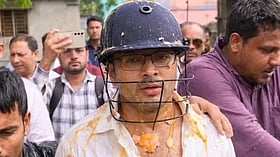
Emerging with torn clothes, broken spectacles and visible signs of assault, Banerjee accused the BJP of deliberately bringing outsiders into the area to target him and prevent him from meeting the family of slain Trinamool worker Sanju Karmakar.
"The people of Sonarpur welcomed me. None of the local residents were involved in this attack," Banerjee alleged. "The BJP had deliberately infiltrated outsiders into this area. This was planned in advance."
The Trinamool leader claimed that he had received intelligence warnings before arriving in Sonarpur that an attack was being prepared and that outsiders had been mobilised. Despite informing the authorities, he alleged that no preventive action was taken.
According to Banerjee, the attack took place as he approached Karmakar's home on a motorcycle after leaving his vehicle behind on the main road. Protesters allegedly chased the motorcycle before surrounding him. He was then subjected to a barrage of slaps and punches. His spectacles were smashed, his shirt was torn apart and the motorcycle carrying him was damaged.
Despite the attack, Banerjee pressed on.
Wearing a cricket helmet to protect himself, he walked through hostile crowds as eggs and shoes were thrown at him. Protesters shouted slogans while chanting "Thief! Thief!" as he made his way towards the deceased worker's residence.
Upon reaching the house, Banerjee held up his broken spectacles and delivered a dramatic accusation.
"They wanted to kill me," he said.
"My head was saved only because I was wearing a helmet. I have undergone seven eye surgeries. They threw bricks and stones at me. Look at the condition of my spectacles."
Speaking from inside the home of Sanju Karmakar, Banerjee repeatedly accused the BJP of being behind the violence and questioned the complete absence of police despite prior warnings.
"Who is running the administration? The Trinamool or the BJP?" he asked.
"We repeatedly informed the authorities that outsiders had entered the area. Why was no action taken? I informed the administration about my visit. I spoke to the IC. Yet not a single police officer has arrived," he asked.
TMC MP Abhishek Banerjee was beaten by a crowd, and misbehaved with him.
Banerjee alleged that neither calls nor messages sent to police officials received any response while the violence unfolded.
"The ruling party and the government cannot escape responsibility in this manner," he said. "I came here only to stand beside the family of a deceased colleague. Is that now a crime?"
As he spoke inside the house, crowds gathered outside and shouted slogans demanding that he come out. Tension remained high throughout the area.
In one emotional moment, Sanju Karmakar's mother handed Banerjee a bottle of water. Returning it to her, he reportedly said, "Please, you drink first."
Banerjee expressed concern that the same people who attacked him could target the deceased worker's elderly parents.
"I may somehow get out of here alive. But those hooligans may next turn their attention towards Sanju Karmakar's elderly parents," he said.
The Trinamool leader insisted that the attack was not a spontaneous protest but a politically motivated attempt to intimidate him and prevent him from meeting families affected by post-poll violence.
Before arriving in Sonarpur, BJP workers and supporters had gathered across several locations carrying black flags and raising "Go Back" slogans. Banerjee alleged that these demonstrations were organised in advance as part of a wider plan.
"They are trying to create unrest wherever I go. But they will not succeed," he said.
Banerjee also launched a blistering attack on BJP leaders while responding to slogans branding Trinamool leaders as thieves.
"Those who are calling Trinamool members thieves should ask themselves whether they have ever seen a Chief Minister openly accepting cash in front of cameras. Bengal has never witnessed such a situation before," he said.
Refusing to leave despite the unrest, Banerjee vowed to remain with the victim's family.
"They want to kill me. Let them kill me. I am not leaving this place. I will not abandon Sanju Karmakar's elderly parents. Until I am satisfied about their safety, I am staying here," he declared.
The Diamond Harbour MP also announced plans to seek legal intervention over the incident.
"I am drawing the attention of the High Court and the Governor. I will approach the High Court and, if necessary, the Supreme Court," he said.
The attack occurred during Banerjee's first major political programme since the Assembly election results were declared three weeks ago. Earlier in the day, he had visited the family of another slain Trinamool worker in Beliaghata before travelling to Sonarpur.
The BJP rejected the allegations levelled by Banerjee. BJP State President Samik Bhattacharya said, "I cannot explain why the police were absent; I am merely a party representative. That is a question the West Bengal government is better placed to answer." He further alleged that, during the time when Suvendu Adhikari was serving as Leader of the Opposition, there had been an attempt to burn him alive inside his vehicle in North Bengal.
Bhattacharya also claimed that the BJP had shown restraint despite what he described as repeated attacks and atrocities against its workers under Trinamool rule. "The only reason the Trinamool Congress remains unscathed today is because we exercised restraint," he said. The BJP leader went on to cite several incidents from the Trinamool government's tenure in support of his allegations.
Mohammed Salim, the CPI(M) State Secretary, commented on the incident, saying, "Abhishek Banerjee had previously issued defiant challenges while surrounded by hundreds of police personnel, daring others to confront him. Just as such behaviour is inappropriate in a democracy, today's incident is equally unacceptable."
Salim further alleged that the BJP and the RSS often seek to keep the Trinamool Congress at the centre of political attention through various means. "The BJP and RSS will continue to employ different tactics to keep the Trinamool in the spotlight. This incident, too, could be one such example," he said.
TMC supremo Mamata Banerjee condemned the attack on Abhishek Banerjee and posted on X. Congress President Mallikarjun Kharge also condemned the attack on Abhishek Banerjee. In a post on X, he denounced the violence and said that such incidents have no place in a democracy. He expressed support for Banerjee and called for those responsible to be held accountable.
Nevertheless, Banerjee remained firm in his accusation that BJP-backed elements were responsible for the attack and that the violence was intended to silence him.
Standing beside the photograph of the slain Trinamool worker, his clothes torn and spectacles shattered, Banerjee struck a defiant note.
"They attacked me because I came to stand beside a dead worker's family. No amount of intimidation will stop me from doing that," he said.

 Login
Login