Thousands attend CLC convention in Winnipeg. Comments by the leaders of the CLC, USW, PSAC, and UFCW plus NDP federal leader Avi Lewis. The LabourStart Report about union events. And Larry Rousseau singing “It’s a Wonderful World.”
RadioLabour is the international labour movement’s radio service. It reports on labour union events around the world with a focus on unions in the developing world. It partners with rabble to provide coverage of news of interest to Canadian workers.
The post CLC sets
Thousands attend CLC convention in Winnipeg. Comments by the leaders of the CLC, USW, PSAC, and UFCW plus NDP federal leader Avi Lewis. The LabourStart Report about union events. And Larry Rousseau singing “It’s a Wonderful World.”
RadioLabour is the international labour movement’s radio service. It reports on labour union events around the world with a focus on unions in the developing world. It partners with rabble to provide coverage of news of interest to Canadian workers.
Although he reinvented himself as a kingpin in the nursing home business, former Ontario premier Mike Harris used to be best known for the water contamination fiasco that killed seven people and sickened thousands more in Walkerton, ON.
That tragedy led to a dramatic decline in support for his government and was considered a key reason Harris resigned as premier in 2002.
Not surprisingly, the premiers who’ve followed Harris have steered clear of anything that smacks of weakening government
Although he reinvented himself as a kingpin in the nursing home business, former Ontario premier Mike Harris used to be best known for the water contamination fiasco that killed seven people and sickened thousands more in Walkerton, ON.
That tragedy led to a dramatic decline in support for his government and was considered a key reason Harris resigned as premier in 2002.
Not surprisingly, the premiers who’ve followed Harris have steered clear of anything that smacks of weakening government surveillance of Ontario’s water systems.
Until now, that is.
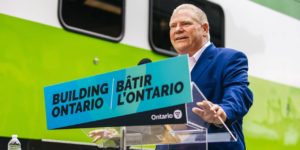
Shaking off the Walkerton bogeyman, current Ontario Premier Doug Ford is embarking on a plan that will effectively privatize aspects of the province’s water systems, with potential risks to our drinking water.
Ford is well aware of the political danger of being associated with any weakening of public management of water. This explains why he’s going out of his way to deny the label “privatization” applies to the changes in new legislation, which the government insists will keep our water “publicly owned.”
But, as law professor Joel Bakan and economist Jim Stanford noted in a piece in the Star yesterday, the new legislation creates a regime for water and wastewater services in Ontario that is effectively privatized — despite the Ford government’s attempt to deny what it’s doing amounts to privatization.
The Ford government’s keenness to put in place this new water regime — while disguising the fact that it involves privatization — raises the question: whose interests is the government serving in doing this?
Clearly, there’s no public pressure for our water systems to be redesigned to include profit-making. That’s because there would be no benefit for the public.
However, there is one group that would benefit significantly — private investors.
Indeed, private investors — particularly large global institutional investment firms that represent (among others) pension funds, insurance companies and very wealthy families — have trillions of dollars in capital and are keen to invest it in low-risk projects where they can earn returns as high as seven to nine per cent a year. And public infrastructure, including Ontario’s water system, fits that bill.
Under Ford’s legislation, water and sewage systems can be removed from the control of local governments — the plan is to start with Peel Region — and transferred to specially-created, profit-making corporations.
“Key decisions — including finances, contracts and water rates — would be made by corporate boards,” observes Meera Karunananthan, a geography professor at Carleton University.
She also says that the public would continue to be responsible for the debt from constructing the water infrastructure, while the profits would go to investors. “Simply put, the public bears the burden while shareholders capture the reward.”
The public is also potentially endangered. A 2002 public inquiry found that among the factors contributing to the Walkerton tragedy was the Harris government’s failed provincial oversight after it privatized water testing.
Harris was an unusually gung-ho privatizer, and his legacy of privatization — with all the associated risks — lives on in areas beyond water management.
He also encouraged privatization in Ontario’s long-term-care homes and then went on to benefit handsomely from the privatized nursing home industry he helped create. Shortly after retiring as premier, he became a significant shareholder and chairman of Chartwell Retirement Residences, a major private chain operating publicly-funded nursing homes.
Chartwell was among the for-profit nursing homes that were found to have higher death rates during the COVID pandemic than not-for-profit homes, according to a 2020 investigation by a team of Toronto Star reporters as well as a CBC probe. Harris retired as Chartwell chairman two years later, in 2022.
While public services and infrastructure offer lucrative opportunities for moneyed investors, there’s a reason not to hand over aspects of these vital provincial responsibilities to private interests which are, above all, focused on making profits.
Ontarians died needlessly in nursing homes and in Walkerton. Doug Ford should take note.
This article was originally published in the Toronto Star.
When U.S. trade representative Jamieson Greer met with President Claudia Sheinbaum in Mexico City on May 27 to discuss the upcoming review of the Canada–United States–Mexico Agreement (CUSMA), Canada’s chief trade negotiator Janice Charette was not at the table.
Although Canada and the U.S. have each met with Mexican officials in advance of the review, Canada’s negotiating team has not publicly met with U.S. representatives over CUSMA at all, and the Americans are becoming increasingly voca
When U.S. trade representative Jamieson Greer met with President Claudia Sheinbaum in Mexico City on May 27 to discuss the upcoming review of the Canada–United States–Mexico Agreement (CUSMA), Canada’s chief trade negotiator Janice Charette was not at the table.
Although Canada and the U.S. have each met with Mexican officials in advance of the review, Canada’s negotiating team has not publicly met with U.S. representatives over CUSMA at all, and the Americans are becoming increasingly vocal about their complaints with Canada. U.S. Commerce Secretary Howard Lutnick went so far as to directly criticize Canada’s trade strategy in April, calling out the Carney administration, and saying that, “they suck.”
Tensions around trade have steadily been escalating between the Trump and Carney administrations over a series of disagreements in recent months. With the U.S. just freezing a long-standing military board with Canada and the Trump administration remaining upset over Canada lowering tariffs on some Chinese Electric Vehicles, the July 1 CUSMA review may be the next frontier for a fight.
On June 1, U.S. Trade Representative Greer will tell the US Congress what the Trump administration’s negotiating priorities are for the CUSMA review.
“Everything matters and nothing matters at the same time,” said Flavio Volpe, president of the Automotive Parts Manufacturers’ Association (APMA), in an interview with rabble.ca. Volpe has also served on the Ontario Premier’s Council on U.S. Trade.
“Our advice to the government has been to be tactical in giving us all a chance to see what the cards are, in as much as we can see them before we decide how to play them. It’s good that [the U.S. and Mexico are] meeting, but I do know that the Canadians and the Americans are constantly talking,” he said.
“There’s really no consequence either way of them not coming to an agreement this year,” said Stuart Trew, a Senior Researcher at the Canadian Centre for Policy Alternatives.
“The only important deadline from Canada’s perspective is some certainty around the tariffs, which are slowly destroying many of our industrial sectors, as they’re intended to do, right? That’s Trump’s plan. It’s not mysterious. He wants to kill our jobs so that they move to the States.”
What should we expect from the CUSMA review?
When the original CUSMA agreement was signed six years ago, it included a “sunset clause” that the deal would face a mandatory re-assessment on July 1, 2026. The “joint review,” as it’s called, was the first of its kind in a U.S. free trade agreement, and it forces the participants to decide every six years whether to extend the existing agreement, re-negotiate it, or abandon it for separate bi-lateral agreements. Unless the parties elect to continue with CUSMA, the agreement itself expires at the end of a 16-year period.
Initially, Canada and Mexico were opposed to these “sunset clauses,” saying they create uncertainty for business and investments between the North American trade block. Chrystia Freeland, who was Global Affairs Minister at the time, called it “absolutely unnecessary,” while other critics called it a “ticking time bomb.” At the time, the U.S. argued that the review process would prevent agreements from becoming “out of date,” and to make sure it was working as intended.
But according to Abram Lutes, Senior Research Officer at the Canadian Union of Public Employees: “The sunset clause is to keep the parties on their toes, right?” Lutes continued, “Basically to keep Canada and Mexico feeling a little bit uncertain, a little bit insecure in their relationship with the United States, as a way of the U.S. being able to table concessions or rearrangements down the line.”
Canada’s trade agreements with the U.S. have always been under some form of negotiation or another, ever since the very first Canadian–American Reciprocity Treaty between British North America and the United States in 1854. The so-called “Elgin-Marcy Treaty” was designed to reduce tariffs between the two fledgling populations and facilitate trade across their borders just as it was meant to remove any cause for Canadian annexation to the U.S., providing Canada economic benefits without the “political complications” of becoming part of the United States.
Fast forward more than 170 years to the present and now the economies of Canada and the United States, along with Mexico, are so profoundly intertwined, that it would be practically impossible to
“At the end of the day, we’re going to have a trade deal within North America. There’s no doubt about that. That will look pretty much the same as it does today,” said Jim Stanford, a Canadian economist and Director for the Centre for Future Work.
“This is similar to what Trump did in 2020, where for three years before that, you had bluster and threats and unilateral tariffs imposed. Obviously not as dramatic as what he’s doing this term, but then at the end he makes a couple tweaks and claims victory,” Stanford said.
Or as author Maude Barlow, founder of the The Council of Canadians, put it: “It’s not like before when we had no trade agreement. Now we have a trade agreement and we’re so integrated that so many of our workers are so dependent on the North American Free Trade integration that the eggs got scrambled into an omelet.”
What issues might actually be on the table?
Even if the U.S. is unlikely to abandon CUSMA upon review, and despite political bluster, there are some sticking points between Canada and the U.S. that can still be expected to surface this summer.
Trump’s “Section 232 tariffs” on steel and aluminum, which the U.S. administration says are meant to protect U.S. national security, have been especially painful for the Canadian and Mexican manufacturing sectors, and have also increased production costs for American manufacturers. It can be expected that this could become a significant issue on the negotiating table.
”They’re hurting General Motors, Ford, and the American divisions of Stellantis more than they’re hurting any other major company with these national security tariffs on automobiles,” said Volpe from the APMA.
Another point of contention is likely to be centered around the United States Trade Representative office’s Section 301 investigation, in which the U.S. has been assessing Canada’s ban on importing products that were made with forced labour.
Abram Lutes from The Canadian Union of Public Employees (CUPE) is also expecting issues around digital trade and services to also become contentious, and control over digital platforms in Canada could have far-reaching effects. The U.S. has expressed irritation at the Online News Act and Online Streaming Act in advance of the CUSMA review.
“The Trump administration is really interested in advancing language around digital trade and services, and this is basically coming from the US tech industry,” said Lutes. “This would really significantly restrict Canada’s policy space around developing domestic digital technology and around regulating US platforms.”
“There’s also things like basically dismantling regulations around Canadian content, regulations around French language content in places like Quebec. And also kind of making it very difficult for the Canadian government, for example, to combat disinformation that might be targeting Canadians on US platforms.”
Lutes has been closely following the effects the CUSMA joint review could potentially have on CUPE’s members, many of which work in the healthcare and energy sectors, and he said the interdependence of the energy grid is another issue that might come up.
“There’s a huge opportunity in this time to kind of rethink our energy mix and the way we approach energy policy,” he said. “A lot of energy development in Canada is very regionally uneven and is very oriented towards that kind of north-south integration. At the time Canada was electrifying, this was a very cheap and efficient way to go about it, but obviously has made us very reliant on the United States and it sort of limited the extent to which we have a genuine national energy system.”
Pharmaceutical regulation and U.S. access to the Canadian dairy market are also issues that arise during every recent trade negotiation between Canada and the U.S. just as fair wages and expanded rights for workers in Mexico also routinely come up.
It’s unlikely that Canada’s “trade diversification agenda” will meaningfully impact CUSMA because the new agreements with Europe, India, Japan, China and the UAE, as well as bi-lateral partnerships with Mexico, are with countries that have export economies, which sell products to Canada but import very little.
Nevertheless, all of these issues combined promise to transform the July 1 deadline from a boring review of the existing agreement into a high-stakes re-negotiation opportunity in which the Trump, Carney and Sheinbaum administrations might indeed be forced into a high-stakes game of chicken with 30 per cent of the world’s economy.
And for all the political theater and policy expectations that will ensue, we shouldn’t forget the irony of why we’re even reviewing free trade at all right now.
As the economist Jim Stanford said, “I will remind readers of rabble that when the CUSMA was signed, Trump hailed it as the best trade agreement ever signed in world history, and of course now he’s back to saying it’s horrible and neglecting the point that he’s the one who negotiated it.”
On a snowy Canadian night in 1981, the athlete and coach Betty Baxter attended a mysterious meeting at a motel outside Montreal with senior administrators of the Canadian Volleyball Association. The body had made her the first woman to coach the national women’s team only a year before.
“There are rumours that you are gay, “ said one of the three men in the room sternly. “Do you deny it?” When Baxter confirmed her sexual orientation and challenged the old men convened to decide her professional
On a snowy Canadian night in 1981, the athlete and coach Betty Baxter attended a mysterious meeting at a motel outside Montreal with senior administrators of the Canadian Volleyball Association. The body had made her the first woman to coach the national women’s team only a year before.
“There are rumours that you are gay, “ said one of the three men in the room sternly. “Do you deny it?” When Baxter confirmed her sexual orientation and challenged the old men convened to decide her professional fate to justify why the question was relevant, pointing out her successes as national coach, one of them, his face contorted with rage, turned and struck the wall with his fist, shouting “You never would have been given this job if I’d known that.” Baxter became another victim of the anti-gay purges that had swept through so many dimensions of Canadian life.
Baxter left that darkly miasmic, morally squalid motel room with one chapter of her life over, and about to begin a new chapter, one that saw her become a public icon for queer communities in Canada and around the world, an eloquent spokeswoman for equality and inclusion both in sport and in civil society. She had already come a long way from her 1952 birth in small town Alberta, and was about to go even further.
Outspoken is the story of that transformation. It is also a love letter to the strenuous joys of competitive sport, and to the 2SLGBTQIA+ community that has emerged around the world in her lifetime, courageously confronting the kind of prejudice that drove her from her first love, coaching and playing competitively, and into the arena of public political advocacy.
Along the way, this remarkable book provides a brief and vivid account of what one of her book’s blurbs ( this one from former Olympian and U of T professor emeritus Bruce Kidd ) describes as “…the helter-skelter creation of the Canadian sports system in the frantic build up to the 1976 Olympics in Montreal…” . It also tells the story of her involvement in organizing the transformative civic events as Vancouver hosted the third ever Gay Games in 1990.
Although Brooks, Alberta was not a hot bed of progressive politics when Baxter grew up there, she shares one memory that prefigured the leadership role she later played in the struggle for equality. Her brother John returned from time working as a tutor in Mexico to tell stories about the 1968 Olympics held in the Mexican capitol, stories that included the striking visual of two black US competitors, Tommy Smith and John Carlos standing on the medals podium with downcast heads and fists thrust into the air in what Baxter describes as “the first televised athletes’ protest against racial inequality.”
As she listened to her brother’s stories about a city lit up by Olympic enthusiasm, Baxter knew she wanted to become an Olympian. It was only later that she realized she would need to stand up for her rights and the rights of other gay athletes in exactly the way the two black athletes had stood up for theirs.
This book is an important historic document, a first person account from one of the key players in the drama of how Canada began its long and still incomplete progress toward equality and inclusion for queer people in sports and in the public square. It is also, and this will make it more impactful, beautifully written. Baxter generously names many of her first readers, friends and editors who helped her polish her text, and the collective work on the manuscript, like the collective work organizing the Gay Games and the many other equality projects that have filled her life, has been impressively successful.
Baxter writes beautifully and movingly about the joys of athletic training and achievement, in passages that reflect her life long commitment to fitness and excellence. Anyone who has ever experienced the sublime pleasure of being “in the zone” on a long run or in the midst of a hard fought game will recognize how powerfully Baxter has captured that pleasure, and the painful price the athlete pays to achieve it. She also conveys the pleasures or solidarity and shared effort on the socio-political front. All in all, this book is both beautiful to read and powerfully instructive.
In a time when authoritarian political opportunists here and abroad have mounted the ghastly apocalyptic horses of homophobia, misogyny and transphobia and are galloping the world toward a dark cliff that may take us all into the abyss, this is an important and timely book. Highly recommended.
How many times do Liberal prime ministers have to learn that coddling Alberta gets them nowhere?
Justin Trudeau learned that bitter lesson when he tried to woo Alberta by putting up federal money to expand the Trans Mountain pipeline — after private builders refused to — ultimately leaving Canadian taxpayers on the hook for $34 billion.
The memory of that wildly expensive pipeline — and the fact that it won Trudeau no favour in Alberta — should have been enough to make his successor, Prime
How many times do Liberal prime ministers have to learn that coddling Alberta gets them nowhere?
Justin Trudeau learned that bitter lesson when he tried to woo Alberta by putting up federal money to expand the Trans Mountain pipeline — after private builders refused to — ultimately leaving Canadian taxpayers on the hook for $34 billion.
The memory of that wildly expensive pipeline — and the fact that it won Trudeau no favour in Alberta — should have been enough to make his successor, Prime Minister Mark Carney, wary.
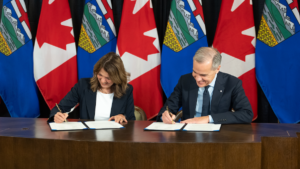
But no. Once elected, Carney abandoned his pre-election climate talk, cancelling a number of Trudeau-era climate measures and signing a deal with Alberta committing to support a whole new pipeline.
Last week, Alberta premier Danielle Smith demonstrated that all this appeasement had won Carney nothing when she announced that Alberta will hold a referendum that opens the door to a future referendum on Alberta separation.
Carney has gone too far
There’s no reasonable way to satisfy the separatist cause in Alberta and Carney has already gone dangerously far in attempting to do so, sacrificing the minimal progress we’ve made in the climate battle — all in the interests of pleasing Big Oil, which is the real driving force in Alberta politics.
The role of Big Oil has remained largely hidden in the current drama, as the media focuses on Smith’s self-serving behaviour.
But it’s important to note that the Alberta separatist movement isn’t just a natural, homegrown development. It was instigated, financed and encouraged by the fossil fuel industry, which has used it as a cudgel to resist climate action.
This began over a decade ago when the oil industry, frustrated that environmentalists were alarming the public about climate-related wildfires, decided to move beyond traditional lobbying and launch a campaign to mobilize grassroots support for the industry.
The campaign by the Canadian Association of Petroleum Producers (CAPP) was modelled on a campaign by the American Petroleum Institute. It has fostered a movement of right-wing activists — dubbed “petro-populists” or “extractive populists” — who trumpet the benefits of the fossil fuel industry and fiercely oppose climate action, writes Simon Enoch in “Briarpatch” magazine.
These petro-populists were influential in the “Freedom Convoy” that occupied Ottawa in winter 2022; convoy leader Tamara Lich highlighted her petro loyalties when she appeared in court wearing a sweatshirt that read “I love Oil and Gas.”
Central to the separatist cause — and more broadly to “Western alienation” — is the belief that Eastern elites have consistently sabotaged Alberta by undermining the fossil fuel industry.
Always ignored (along with Ottawa’s Trans Mountain financing) is the fact that Ottawa appeased Alberta in the mid-1980s by adopting the world oil price, thereby depriving Canadians of a lower, domestic price. (Some other oil-producing nations still provide a reduced price for domestic consumers.)
Costly for Canadians
This decision has been costly for Canadians, particularly when the world oil price soars — like now, due to the closing of the Strait of Hormuz.
Economist Jim Stanford notes: “The vast majority of Canadians (including those living in oil-producing provinces) will be significantly harmed by this price shock. The only clear winner is the petroleum industry.”
Indeed, the Canadian petroleum industry is collecting tens of billions of dollars in windfall profits and will continue to do so as long as the strait remains closed.
The industry pays royalties and taxes in Canada, but the bulk of its gigantic windfall will end up outside Canada — since the Canadian industry is mostly foreign-owned, as political economist Gordon Laxer has documented.
Although a Canadian windfall profits tax on the oil industry would make sense, no such idea will even be considered as the national debate focuses on how to keep Alberta happy.
But let’s be clear about what we’re appeasing. Unlike the Quebec sovereigntist movement, with its deep linguistic and cultural roots, the Alberta separatist movement has been shaped and nurtured by corporate interests — and foreign corporate interests, at that.
This article was originally posted in the Toronto Star.
The Big Thinking Summit: Inflection Point, a national academic gathering focused on the humanities and social sciences, is hoping to inspire educators and foster push back against short sighted government policies.
Students are under attack from provincial governments who are intentionally chronically underfunding elementary, secondary and post-secondary education; cutting “luxury courses” like art, music and languages; while focusing on a narrow selection of programs that do not help develo
The Big Thinking Summit: Inflection Point, a national academic gathering focused on the humanities and social sciences, is hoping to inspire educators and foster push back against short sighted government policies.
Students are under attack from provincial governments who are intentionally chronically underfunding elementary, secondary and post-secondary education; cutting “luxury courses” like art, music and languages; while focusing on a narrow selection of programs that do not help develop the entire student while fostering critical thinking skills.
They are also impacted by the rising cost of living as well as contract and gig work. However, some provinces are implementing the necessary changes to help Canadian students meet life’s challenges head-on in a world that is increasingly dependent on artificial intelligence (AI).
The recent Pan-Canadian Assessment Program (PCAP) revealed that Manitoba students consistently perform below the national average when it comes to science. That inspired the Ministry of Education to create a new kindergarten to grade 10 curriculum that will be implemented this fall.
Customized to meet student needs, the curriculum focuses on practical applications to improve science literacy and science programming that replaces a two-decades-old curriculum.
However, teachers will need support in order to successfully implement the curriculum in their classrooms.
“When it comes to curriculum change, we often think that a new document is introduced and teachers simply adopt it, but that doesn’t happen automatically because it depends on teachers’ beliefs and perspectives about the subject, and priorities for teaching, as well as the support, training and resources provided to them,” Dr. Latika Raisinghani, the project’s principal investigator, told rabble.ca.
Dr. Raisinghani and Dr. Lilian Pozzer, project collaborator, will present preliminary findings of their research based on feedback from Manitoba teachers who actually piloted the new science curriculum in their classrooms.
Additionally, Dr. Raisinghani and Dr. Pozzer plan to collect additional input through surveys and focus groups from another 100 teachers. This data will help identify gaps in the curriculum’s implementation that can then be addressed to help classroom teachers.
Curriculum integrates T&R Calls to Action
The new science curriculum reflects Manitoba’s diverse student population, including the 18 per cent who are Indigenous, and integrates Indigenous ways of knowing nature which aligns with the Truth and Reconciliation Commission’s 2015 Calls to Action 62 and 63. It also moves away from rote memorization of facts.
The goal is to foster scientific literacy and critical thinking skills so students can apply what they learn in class to real-life situations including human impacts on nature, the environment, climate change as well as health care and beyond.
“The curriculum was developed following the pandemic when a great deal of misinformation related to science was circulating,” Dr. Pozzer said. “Even beyond test scores, it became clear that we have to educate our students to use evidence-based thinking to help them better understand what is and isn’t reliable information, how they can determine which sources to trust, and how they can make decisions about their health, the environment or any other issues related to scientific knowledge,” she explained.
An added challenge is lack of time to deliver the material since science tends to be taught in 20 or 30 minute weekly chunks as opposed to math, reading and writing that are taught daily for 40 to 50 minutes. The goal is for students to understand that science is not simply a career choice, it’s a vital life skill they’ll use everyday.
Students want less technology in the classroom
Meanwhile, Dr. Mustafa Siddiqui’s pilot project is proving that the vast majority of language arts students see the benefits of tech-free classrooms. The pilot project conducted at University of Toronto Mississauga has convinced students of the benefits of a tech-free classroom.
A full 80 per cent of the participants in the pilot said they would be open to seeing technology booted from up to a quarter of classes in a semester’s course. They cited fewer distractions, better in-class focus, as well as the ability to more quickly grasp concepts.
“In today’s world where students rely on their technological devices and artificial intelligence, the feedback was both unexpected and refreshing,” said Dr. Siddiqui, an assistant professor for the Study of University Pedagogy.
As a result of the positive response, a group of language and writing studies professors at U of T Mississauga are now planning to incorporate occasional tech-free classes in their curricula for the upcoming school year as part of a larger study.
Back to the 90s
The impetus for the Back to the 90s project came from Dr. Siddiqui’s observations that in recent years students were “lazier thinkers.”
“After the AI boom, I noticed that ideas were repeating, with many students choosing similar topics for assignments and writing essays in a similar fashion to the point that their creativity and uniqueness in writing style and content were vanishing,” he explained.
Dr. Siddiqui also found students to be more distracted and less connected with their peers, with some playing games on their phones or online shopping on their laptops during class.
By introducing a tech-free class in two of his courses, Dr. Siddiqui was able to encourage the 40 participating students to generate ideas using human intelligence while boosting their interaction with each other.
Students used pen, paper and notebooks while Siddiqui brought in hard copies of books, handed out photocopies, and wrote on a whiteboard instead of using PowerPoint presentations. A Sony Discman, newspapers, analog watches, and glass coke bottles were also placed throughout the room.
“The moment I started talking, I saw students taking out their paper, notebooks, pencils and pens,” Siddiqui said. “It was the first time this happened in my class and I was elated.”
A survey completed by students found 87 per cent interacted more with peers, 83 per cent found they paid closer attention to class discussions, while 70 per cent found handwriting notes helped them better process ideas. Almost 63 per cent said they felt more focused without screens, while 60 per cent said the screenless environment enabled them to better understand class material.
Dr. Siddiqui found student creativity and engagement were significantly higher as were student mistakes – an outcome he was excited to see.
“When using AI, many students tend to check their responses before handing in assignments. Without technology, most students performed better, and once they corrected their work themselves, they seemed to better understand concepts and tasks,” Siddiqui said.
Dr. Siddiqui concluded that AI is best used as a proofreading tool once an assignment is completed rather than for idea generation and writing support. The one exception was students with accessibility needs who were permitted to use devices during this process.
Students and homelessness
Unfortunately, curriculum and AI are not the only challenges students face these days. According to Homeless Hub, at least 35,000 youth experience homelessness each year in Canada with many falling through the cracks before they turn 16. Add to that, an estimated 28 per cent of Canadian post-secondary students experiencing some form of homelessness and it’s crystal clear that Canada is in the midst of an unhoused student crisis.
Because most unhoused students hide their situation due to stigma, the issue is difficult to address and doesn’t appear to be on the radar of governments and universities.
Emily Berg, a PhD student at the University of Alberta (U of A) and lead research associate will present findings from a recent national study on student homelessness as well as strategies her team has developed to help combat the issue
Berg will share details of her group’s research based on interviews with 65 students experiencing homelessness and 54 academic staff members at six universities across Canada including U of A, Red Deer Polytechnic (RDP), Nova Scotia Community College (NSCC), University of New Brunswick (UNB), Lakehead University (LU), and University of British Columbia (UBC).
Key project researchers included principal investigator Dr. Eric Weissman (UNB), Kevin Friese (U of A), Dr. Krista Robson (RDP), and Lisa Mader (NSCC). Their work builds on an earlier national survey of 18,500 post-secondary students by UTILE that found alarming data on student housing.
The hour-long interviews conducted during the 2022-2023 academic year covered students’ experiences, impacts related to homelessness, and barriers students faced in getting help. Staff were questioned about potential solutions and obstacles to boosting university funding for basic student needs such as access to housing, rent money and food.
“Universities are seen in an elite academic way where everyone who goes there is privileged, but this isn’t the case. Institutions today are the gateway to any sort of job, so students have to go to university regardless of their economic status, even if they can’t afford to pay rent or eat,” said Berg.
Unhoused students often rely on couch-surfing, sleeping in cars, or sheltering in campus buildings, stairwells and libraries. Those band-aid solutions mean students are less visible than those “living rough” on the streets. All of these make shift solutions carry a heavy mental health toll.
All study respondents reported that institutional support was lacking, with many admitting to having reached out to numerous campus services for help without success. That ultimately impacts students’ academics and employability.
“If they’re worried about their next meal, they’re not paying attention to their exams or getting their degree because they need to feed themselves and put a roof over their head. If we can provide that, we’d have a better equipped graduating class and students who are way more prepared to enter the job force,” Berg said.
Berg’s group built a toolkit to help schools identify and approach students struggling with homelessness. Strategies included collecting data on student homelessness and raising public awareness of the issue to reduce associated stigmas; tackling food insecurity and financial precarity by reducing barriers to food bank access on campus and financial aid; providing mental health and social support; and securing low income or subsidized housing.
Since the study was released in 2024 housing support groups made up of administrators and faculty members have been established at several universities. Additionally, thousands of dollars in new government funding was recently provided to U of A and NSCC for increased emergency student housing. However, Berg points out that there’s a lot more work to be done.
The Big Thinking Summit: Inflection Point happening June 9 to 11, at the Edmonton Convention Centre, is sponsored by the Social Sciences and Humanities Research Council of Canada, University of Alberta, University Affairs, Alberta Post Secondary Network, Canada Foundation for Innovation, Sage Journals, Pierre Elliott Trudeau Foundation, Universities Canada and Athabasca University Faculty of Humanities and Social Sciences.
The United Conservative Party (UCP)’s effort to force a separation referendum onto a ballot this fall and blame it on the people who signed the pro-Canada Forever Canadian petition was unfolding according to plan in a Legislature committee meeting yesterday afternoon when Opposition House Leader Christina Gray raised a point of privilege.
Gray, who is not a member of the UCP-dominated Select Special Citizen Initiative Proposal Review Committee but could speak as the NDP MLA for Edmonton-Mill
The United Conservative Party (UCP)’s effort to force a separation referendum onto a ballot this fall and blame it on the people who signed the pro-Canada Forever Canadian petition was unfolding according to plan in a Legislature committee meeting yesterday afternoon when Opposition House Leader Christina Gray raised a point of privilege.
Gray, who is not a member of the UCP-dominated Select Special Citizen Initiative Proposal Review Committee but could speak as the NDP MLA for Edmonton-Mill Woods, explained that she had just learned the UCP Caucus had published a news release saying the motion recommending a referendum question to cabinet had passed.
It had not. Indeed, it had not even been voted on.
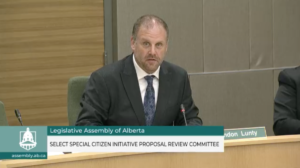
This exposed the committee’s deliberations as a sham, committee chair Brandon Lunty as something less than the sharpest knife in the UCP drawer, and the UCP of being capable of messing up spectacularly even when it holds all the cards.
The news release in question quoted Lunty spinning the circumstances hard as “following the law and respecting the expectations” of the nearly half a million Albertans who signed the Forever Canadian petition organized last year by former Progressive Conservative deputy premier Thomas Lukaszuk. According to Lunty’s version of the facts, they “signed Mr. Lukaszuk’s petition in good faith, understanding it would result in a referendum.”
The reality, of course, is that most of them just wanted to tell Smith and her separatist allies to go to hell, and even Lunty had to understand that.
Well, whatever. That was the moment the stuff hit the fan. Talk about a messy case of premature dissemination! The release was quickly pulled off the internet by the UCP, but screen shots were popping up within seconds.
It was, Gray told the committee, an obvious breach of Parliamentary privilege. Lunty looked like a deer in the headlights as Ms. Gray dropped her bombshell.
Just before that gobsmacking moment, Nate Glubish, Danielle Smith’s technology minister and the MLA for Strathcona-Sherwood Park, had moved that the committee use the Forever Canadian petition’s wording as the basis of the separation referendum the premier has been scheming for months to put before Albertans.
Rest assured, this is not because the UCP loves Forever Canadian’s wording. It’s because courts have blocked the Stay Free Alberta petition’s wording as unconstitutional and stopped verification of that petition’s signatures by Elections Alberta because First Nations were not consulted about the implications of tearing Alberta out of Canada.
Apparently the sneaky committee manoeuvre, opposed by the NDP and Lukaszuk, was the only way for a desperate separatist-dominated governing party to get the divisive separation question it wants on the ballot in October or risk completely alienating its powerful anti-Canadian faction.
Implied but not stated in the debate between the three UCP members of the committee, who favoured the motion, and its two NDP members, who opposed it, was that wording can be altered later to something more favourable to breaking up the country. The opening of the UCP news release carried the same implication.
The committee had given Lukaszuk five minutes – later extended to 10 – to make his case that his question shouldn’t be used to advance the government’s scheme. Glubish and Assisted Living Minister Jason Nixon argued aggressively and at length with Lukaszuk, obviously trying to make the preposterous case the referendum would be all his fault.
Gray called for the matter to be referred to the Speaker of the House – Ric McIver, who is capable of independent thought and is expected to retire after the next election. Obviously the UCP didn’t want to take a chance on that. She also said Lunty – who by his own words and actions had revealed the whole thing was a set-up – should recuse himself.
The committee recessed while the UCP members figured out what the hell to do. When the meeting resumed, the UCP members – Glubish, Nixon and Olds-Didsbury-Three Hills MLA Tara Sawyer – quickly voted down a motion to send the matter to McIver.
Lunty, naturally, remained in the chair.
But when he tried to move the meeting back on track to approve getting Smith’s separation question onto the ballot, the clock ran out. A fiery Rakhi Pancholi, deputy NDP leader and committee member, and Calgary-Foothills MLA Court Ellingson said no to an extension, so for the moment the matter is unresolved.
“Whatever the Premier chooses for the wording of a referendum, the UCP owns it,” Pancholi said in a statement after the meeting. “They can’t hide behind the separatists. They can’t hide behind Forever Canada. … She can say no to a referendum that she and the UCP so clearly want. Or she can go ahead with it, owning forever that she is Alberta’s first separatist premier.”
Lunty has called for the committee to meet again at 2 o’clock Thursday afternoon. Obviously, the motion will be rammed through then, just in time to save the 20 minutes of prime time TV the premier has booked for this evening to tell us all why a divisive separation referendum is a good thing for Alberta. No media questions will be permitted.
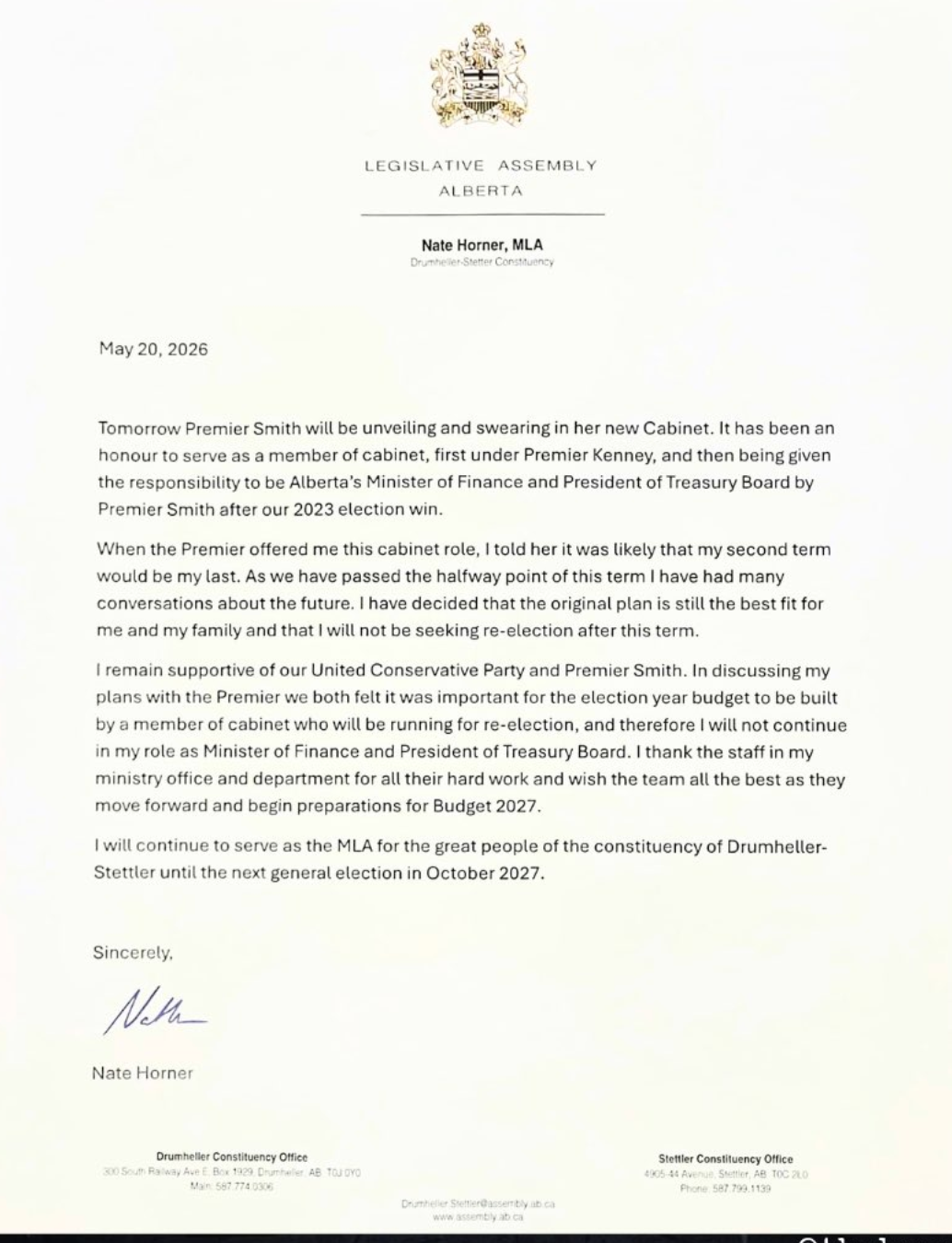
Thursday morning, new members of Smith’s cabinet will be sworn in after announcements yesterday by two of the more level-headed ministers in her current cabinet – Finance Minister Nate Horner and Hospital and Surgical Services Minister Matt Jones – that they are quitting their portfolios and not running in the next election.
Did they jump to escape the gong show Smith’s MAGA-adjacent rule has produced or were they pushed because they remain too loyal to Canada? Hard to say given the limited data available.
Horner, a scion of the Horner political clan, indicated in his resignation letter that quitting was “the best fit for me and my family.” It’s hard to argue with that from his perspective. This morning, Nixon is expected to be handed the keys to the finance minister’s office, which he occupied briefly in 2022.
Meanwhile, Smith’s manoeuvre is unlikely to do much to assuage the fury of Alberta separatists. The premier, said prominent separatist Jeffrey Rath on social media Tuesday night, “had better understand that if she puts a question forward on Independence that isn’t a constitutional question that complies with the Clarity Act that she will be betraying her base in favour of Carney as badly as when she screwed them over for Jim Prentice.”
“If she does this hundreds of thousands of Albertans will be forced to mobilize to remove her as the leader of the United Conservative Party,” he said. “We can easily do this prior to an election in 2028.”
Creation stories, or myths, that account for the origin of the universe, the Earth, the continents, mountains, rivers, life, or the first humans–these can provide a common purpose and unity.
Nation states have their own creation stories. But countries are demarcated by artificial political boundaries. Their creation stories tend to reflect history as written by the victors in politics and war. They are more likely to generate conflict, separatism, and polarization than indigenous creation storie
Creation stories, or myths, that account for the origin of the universe, the Earth, the continents, mountains, rivers, life, or the first humans–these can provide a common purpose and unity.
Nation states have their own creation stories. But countries are demarcated by artificial political boundaries. Their creation stories tend to reflect history as written by the victors in politics and war. They are more likely to generate conflict, separatism, and polarization than indigenous creation stories.
The woman who falls from the sky is a great Haudenosaunee (Iroquois) creation story. In many Indigenous creation stories, the first humans are interacting with other creatures.
Sometimes animals dive into the depths of the ocean to bring up the material that becomes the continents, like our own Turtle Island.
Sky people versus bringing up material from the depths—both are important aspects of creation.
The question isn’t whether stories are “true,” but whether they enrich our lives and cultures.
Western science has competing creation stories for the origins of life. Some scientists maintain that life came from the sky, perhaps from outside our planet, or from electrical processes in the atmosphere. Others say life came from rocks and gases in the depths of the oceans, before there was any land.
In the latter case, which increasing evidence supports, Earth is truly the mother of us all. Scientists have found signs of early life in the Earth’s oldest rocks, dating back nearly four billion years.
Back then there were no “higher organisms”: species with shells or skeletons that turned into fossils. Nonetheless, some of the first microorganisms formed sedimentary deposits that later became stone. The earliest signs of life in rocks are subtle, and a subject of scientific debate.
Creation of life was not a single point in time. Evolution has been a continuous process. For a billion years during the Proterozoic Eon, it seemed as if not much was happening. Gradually, however, the Sun’s energy, through the process of photosynthesis, was oxygenating the atmosphere. So-called “higher” life forms like fungi, plants and animals took their place alongside the microbes.
Science has given us an appreciation not only of how our world came to be, but how long it took to create the beauty we have now.
The first organisms–our most distant ancestors–appeared many kilometres deep in the oceans where Earth’s internal forces were pulling apart tectonic plates. There, under intense heat and pressure, and without sunlight or oxygen, they developed the metabolic pathways that all life forms rely on today.
While conditions in the ocean depths sound incredibly harsh to us, life still flourishes there in the absence of sunlight. Since life’s earliest days, microbes have fed upon the hydrogen and sulphur gases emitted from hydrothermal vents, providing the basis for increasingly complex food webs. Scientists continue to discover bizarre new species of fish, crabs, clams, and tube worms at the bottom of the sea.
Think of hydrothermal vents as the cradle of life–the warm womb of Mother Earth. When life originated around them, the Earth’s surface was a far more hostile environment, bombarded with cosmic radiation in the absence of a well-developed atmosphere.
Life has persisted and evolved for billions of years. Having developed the ability to tap into the Sun’s energy, our relatives and ancestors—non-human life forms–found a nearly infinite number of ways to thrive on surface lands and waters, covering them in beauty.
The good news is that this can continue for several more billion years. The Sun is only a middle-aged star.
The bad news is that we humans, mostly through excessive use of fossil fuel energy, are destroying life, reversing billions of years of evolution.
Science has given us a magnificent creation story for life itself. Wider appreciation of this story might help unify human cultures. It can serve as an overlay to the tribal and nation state creation stories that sometimes unite us, but too often pull us apart.
Prime Minister Mark Carney wants to privatize our airports, our seaports and build a lot more private gas and nuclear power plants. Ontario Premier Doug Ford is privatizing our water, our healthcare and building a lot more private gas and nuclear power plants. Carney said Canada was “not for sale,” and Ford says “that’s how we “protect Ontario.”
Both Carney and Ford are using the Trump crisis as was so brilliantly described in Naomi Klein’s book Shock Doctrine. Crisis capitalism is being u
Prime Minister Mark Carney wants to privatize our airports, our seaports and build a lot more private gas and nuclear power plants. Ontario Premier Doug Ford is privatizing our water, our healthcare and building a lot more private gas and nuclear power plants. Carney said Canada was “not for sale,” and Ford says “that’s how we “protect Ontario.”
Both Carney and Ford are using the Trump crisis as was so brilliantly described in Naomi Klein’s book Shock Doctrine. Crisis capitalism is being used to privatize our public assets and services.
When privatizing our public assets and services, we always hear the same song.
We have to “modernize, reform, increase competitiveness, innovation and increased efficiencies through alternative models of ownership.” Then we are told the same false claim: This will lead to “lower costs” which will be passed on to you. The same claim of lower rates came from Ontario Premier Mike Harris’ hydro legislation. Rates have now more than quadrupled.
Hwy 407 is now the most expensive toll way in the world. In a deal far worse than the privatization of HWY 407, the privatization of the Bruce nuclear plant in a long-term lease in the year 2000, the profits were privatized but the $34 billion debt and the risks and cleanup remained public.
The privatization of long-term care homes where many died from neglect during the COVID-19 pandemic and the higher and higher rates of Hydro privatization has left the people of Ontario with no appetite for any more privatization of public assets.
The privatization of Connaught Labs by former Prime Minister Brian Mulroney also hurt us badly during the pandemic. The record of privatization around the world is dismal. The prime example of privatization failures is in the UK where the privatization of water, electricity and rail has left that country a basket case. The record of privatization is clear, when you introduce the profit motive, private corporations benefit and we all will pay a lot more. The risk is not just higher rates,the loss of sovereignty and control is the biggest risk. There doesn’t seem to be any difference between the Conservative and Liberal parties; both are on a public asset privatization rampage.
In March, Canadian analyst Rory Johnston predicted that if the Strait of Hormuz stayed closed the price of oil could hit $200/barrel by summer. Earlier this month, executives from ExxonMobil and Chevron predicted $150 by mid-July.
For Canada, high oil prices are seen as a net positive: for energy sellers, this is true. For everyone else, it will mean crisis. The largest oil shock in history is headed our way and there is nothing we can do to stop it. Johnston warned the economic impact “wi
In March, Canadian analyst Rory Johnston predicted that if the Strait of Hormuz stayed closed the price of oil could hit $200/barrel by summer. Earlier this month, executives from ExxonMobil and Chevron predicted $150 by mid-July.
For Canada, high oil prices are seen as a net positive: for energy sellers, this is true. For everyone else, it will mean crisis. The largest oil shock in history is headed our way and there is nothing we can do to stop it. Johnston warned the economic impact “will be like the pandemic without Covid.” This time, Canada has to get the crisis response right.
My non-partisan report, Outrunning the Storm exploresrisk scenarios at $90, $150 and $200 a barrel, and sets out province-by-province policies and programs, for what can be done to harden Canada’s economy and adapt to the shock. It was crafted with maximum impact and return on investment in mind: every dollar spent now will return $10 to $15 in reduced costs or increased revenue. Even at $90 a barrel, there is no scenario where these investments do not pay back. High oil costs change the landscape of the economy, with alternative investments paying back much faster.
The most important no-cost decision is approving the extension on the Bruce Nuclear Energy licence — essential in tackling Ontario’s energy crisis. Governments should spend the summer racing to shield residents against next winter’s food, fuel and supply shocks: it will deliver a guaranteed return on investment.
The three areas at the greatest risk are: Farm and food, healthcare and Northern First Nations. Manitoba alone is facing a food shock from $500 million to $900 million, and Canadians could face food inflation of 40 per cent.
Every aspect of the agricultural supply chain depends on petrochemicals. To prevent farm failure, emergency farm finance is essential, and so are propane and fertilizer reserves. Shortline railroads must be preserved. An immediate national “Victory Garden” program, launched now, will make a meaningful dent in hunger and access to food.
Health systems face multiple serious shocks – like fuel costs that will undermine rural health. Almost all medical supplies are made from petrochemicals and imported: gowns, gloves, dressings and IV lines. Medication too — insulin, antibiotics, generics, anti-cancer medications and anesthetic. Governments must establish 180-day reserves of medications while ramping up domestic drug production. The federal government must commit to emergency health transfer payments or face preventable deaths.
Without action now, Northern First Nations and Indigenous communities reliant on diesel for energy will face humanitarian crises this winter. Eighteen to 24 months of diesel should be supplied as long-term solutions are implemented.
Alberta will also face severe risks for its non-oil and gas sector, especially agriculture.
In Ontario, car sales, manufacturing and its financial risk sector are at risk. This is industrial capacity Canada cannot lose.
The Government of Canada needs to lead the response now, starting with a critical supply emergency. The report’s solutions tackle different aspects of Canada’s polycrisis, building oil shock resilience and structurally hardening the Canadian economy against future shocks:
Mediating Canada’s current mortgage and insolvency meltdown will stabilize the economy and housing.
A national passenger rail renewal and a rail transition would create or preserve up to 358,000 jobs at risk from auto industry shocks at auto and aviation plants.
A national jobs program to secure 300,000 to 600,000 jobs for desperately needed work, in care and other sectors that are unfunded.
Converting Canada’s waste methane into turquoise hydrogen and carbon materials, would create over 100,000 jobs while reducing Canada’s greenhouse gas emissions by up to 33 per cent while ending emissions from Alberta’s 80,000 abandoned wells.
Canada and the world are already in the most serious crisis since the 1930s. The U.S. is undermining our economy with tariffs, with the stated goal of making us the 51st state. Alberta separatists are helping. Extraordinary times demand the extraordinary measures of wartime-level economic responses. The Depression-era and wartime fiscal and monetary policies of C.D. Howe, Mackenzie King and the Bank of Canada provide a Canadian example of success, as the report details.
We do not have years or months to start acting. We have days. The sooner we act, the better the outcome – and fortune favors the bold.
Consider for a moment what it would be like to be a fly on the wall at a cocktail party hosted by Marilyn Monroe and her husband, Arthur Miller, when the only guest is Norman Mailer. Now, imagine that turned into a play.
American Devotion, a fictional play by Franca Miraglia, explores the intersection of fame, politics and power in 1957 America. The play is set in Monroe and Miller’s Connecticut farmhouse just after Miller has been called to testify before the House of Un-American Activities
Consider for a moment what it would be like to be a fly on the wall at a cocktail party hosted by Marilyn Monroe and her husband, Arthur Miller, when the only guest is Norman Mailer. Now, imagine that turned into a play.
American Devotion, a fictional play by Franca Miraglia, explores the intersection of fame, politics and power in 1957 America. The play is set in Monroe and Miller’s Connecticut farmhouse just after Miller has been called to testify before the House of Un-American Activities Committee at the height of McCarthyism.
Miller was Monroe’s third husband. Monroe was Miller’s second wife. Their marriage lasted five years on paper from 1956 to 1961.
Their guest, Norman Mailer, a Pulitzer Prize writer, journalist, and filmmaker, was obsessed with Monroe’s life and death despite never having met her.
For added context, it’s helpful to note that Mailer had a total of six wives, one of which he famously stabbed with a penknife during a party at the couples’ home in 1960.
The play in reference, American Devotion, explores a fictional universe where Mailer successfully engineers a coveted invitation for cocktails with the reclusive couple.
Inspired by a passage from Miller’s 1987 autobiography, Timebends: A Life, in which Miller admits that he regrets not inviting Mailer to the couple’s home for dinner. That snub appeared to fuel Mailer’s vengeful writings about Miller, Monroe and her death.
Mailer’s bio-novel, Marilyn: A Biography (1973) was his creative interpretation of Monroe’s life. In 1980, Mailer wrote a second imagined autobiography titled, Of Women and Their Elegance. His play Strawhead, co-written with Richard Hannum, an adaptation of Women and Their Elegance, focused on imagined interviews between Monroe and Mailer during the last hours of her life. Mailer went so far as to cast his daughter, Kate Mailer, as Monroe.
American Devotion delves into the ravages of celebrity culture that’s reliant on fickle fans; the expectations placed on art and the need to remain relevant. The play also explores political paranoia and the personal cost of public loyalty.
Playwright Franca Miraglia puts two larger-than-life men together in a room. They then have to figure out how to pass the time while they wait for the notoriously late Monroe to finally make her entrance.
Eventually, the debate devolves into a battle, pitting Miller’s brains against Mailer’s brawn. This culminates in an epic, “take no prisoners” fight with Monroe as the ultimate prize. But, never underestimate a brilliant woman, because Monroe knows the dynamics stating, “Two men together in the same room. Of course it’s a competition: one wins, the other doesn’t.” And, Monroe ultimately has her own plans.
Misha Harding portrays Monroe in Miraglia’s production. It will be making its world debut June 4 in Toronto. Harding believes very few people, past or present, are as iconic as Monroe.
“Everyone carries an image in their head of who she is. A favourite movie, what she looks like, what she sounds like. It’s hard to imagine any actor living up to that blonde bombshell image. But ‘Marilyn’ was just that: an image, a persona, one carefully and consciously curated by the woman herself,” Harding told rabble.ca via email.
What struck Harding most was the conflicting duality within Monroe that’s reflected in her own writings. Despite being emotionally perceptive, fragile and deeply vulnerable, Monroe had a poetic optimism and grounded sense of humanity.
Often portrayed as the dumb blonde or the victim of circumstance, Monroe was a self-educated, self-made success in an industry dominated by powerful men. By leveraging her sharp skills as a comedian and reclaiming her sexuality, Monroe cleverly and consciously crafted an unforgettable persona while risking her career by pushing back against the studio system, demanding better roles, fair pay and creative control. In fact, Monroe even co-founded her own production company, Marilyn Monroe Productions, with Milton Greene in 1955.
Her strong moral compass and capacity for empathy meant Monroe spoke openly about the sexual abuse she experienced as a child while she used her substantial influence to give a hand-up to other women, most notably Ella Fitzgerald. In order to help Fitzgerald get a booking at the Mocambo nightclub, Monroe promised to sit in the front row each and every night.
When asked how it feels to play such an objectified and misunderstood woman as Monroe, Harding replied, “It’s a deeply exciting, and truthfully intimidating, honour. I may be depicting a fictional version of Marilyn, but she was a real person. And, given how well-known she is, I think it’s safe to say that playing her comes with certain expectations. For me, the challenge is finding the balance between giving audiences a sense of the icon they recognize and portraying a more intimate, complex interpretation of the real woman behind the persona.”
Miraglia remembers always having an outsized fascination with Monroe. “It is crazy to think that many of her contemporaries dismissed her as a “starlet” or a “sex symbol” and yet she has endured all these years. June 1st will be the 100th Anniversary of her Birthday and the number of special exhibits, events and celebrations around the world planned to honour her is amazing!” Miraglia told rabble.ca.
She remembers watching Some Like It Hot as a young woman and being enthralled with Monroe’s mix of pure sexiness and strong sense of self-worth. That confirmed for Miraglia that she did not need to fit nicely into any box “others” used to define her.
Miraglia wrote American Devotion over 12 years ago. While it had many close calls, it never got a production partially because some felt McCarthyism was a forgotten part of US history.
Miraglia had almost given up on getting American Devotion produced. Then Trump got elected for a second term and the US history of dabbling with fascism during McCarthyism suddenly seemed relevant and worth exploring.
“Suddenly the rising tide of fascism around the world with strongman political leaders that use fear fueled by social media to control populations, makes it worthwhile to take a closer look at McCarthyism and specifically how it pressured actors, screenwriters, directors and entertainers to “name names” of friends with ties (real or imagined) with communism. And if they didn’t cooperate with the House of Un-American Activities (HUAC) then they risked being blacklisted and silenced along with financial ruin,” said Miraglia.
“Speaking truth to power is something that needs to be protected – our media, our artists, our schools all need to have this fundamental right protected as the first-line of defence against the encroachment of fascism,” she added.
As a Canadian playwright, Miraglia believes we can’t look to the US and just assume that nightmare couldn’t happen here. She highlights the obligations of citizens. Those of which require each of us to be informed, stay vigilant and hold politicians responsible for delivering on social and economic policies that best serve the country and all of its citizens.
June 1, 2026 would have been Marilyn Monroe’s 100th birthday. In celebration of that momentous occasion, By the Word Productions is presenting the World Premiere of American Devotion. And, the timing couldn’t be better as America and the world slogs its way through three and a half more years of Trumpism and everyone with a social conscience or sense of social justice is being labelled a communist while women are relegated to being blonde, dumb and obedient.
“She was more than just her pain and addiction, she was funny, smart, curious, empathetic, and I want the audience to see that too. Ultimately, I hope to do her justice,” said Harding.
Maayan Ziv
Maayan Ziv.
Creator of the AccessNow app, as well as a photographer and entrepreneur, Maayan Ziv (she/her) is raising awareness for accessibility issues and standing up for the rights of disabled individuals. AccessNow was created in 2015 as a way for anyone to check the accessibility of any location, building, or restaurant. It was designed to empower people with disabilities and ensure their safety when visiting new places. From her interview with the Urban Land Toronto Insti
Creator of the AccessNowapp, as well as a photographer and entrepreneur, Maayan Ziv (she/her) is raising awareness for accessibility issues and standing up for the rights of disabled individuals. AccessNow was created in 2015 as a way for anyone to check the accessibility of any location, building, or restaurant. It was designed to empower people with disabilities and ensure their safety when visiting new places. From her interview with the Urban Land Toronto Institute, Ziv shares that the biggest challenge in the industry is this: “It is essential to recognize that accessibility is not just a compliance issue but a transformative design approach that fosters inclusion for individuals of all abilities.”
Taylor Lindsey-Noel (@accessbytay)
Taylor Lindsey-Noel.
Based in Toronto, Taylor Lindsey-Noel is a distinguished disability rights advocate, motivational speaker, and TikTok influencer. With over 150k followers on the video-sharing app, she creates content about accessibility during travel, disabled lifestyle, and her own tea brand–Cup of Té. This luxury loose-leaf tea brand was recognized on the list of Oprah’s Favourite Things, twice! Lindsey-Noel is a former gymnast. Despite the training accident that caused her disability, the renowned advocate is someone “…who believes inclusion should be a lived experience, not an afterthought.” Recently, she visited the Holland Bloorview Kids Rehabilitation Foundation to share her lived experience and celebrate the upcoming National Accessibility Week (May 31 – June 6).
Sarah Jama
Sarah Jama.
Serving as a member of Provincial Parliament for Hamilton Centre from 2023 to 2025, Sarah Jama has been an active speaker for accessibility, disabled rights, the unhoused, and the ongoing Palestine-Israel conflicts. Jama was born with cerebral palsy, a lifelong neurological disorder that affects movement, posture, and muscle tone. She is a proud wheelchair and walker user to aid in her mobility. Jama also co-founded the Disability Justice Network Ontario in September 2018, and co-founded the Hamilton Encampment Support Network in 2021, which was spearheaded to create affordable housing access.
Allison Lang
Allison Lang.
Allison Lang is a Paralympian, sitting volleyball player, model, and accessibility advocate/speaker. Born missing the lower half of her left leg, Lang has never let her disability stand in the way of doing whatever she puts her mind to. In addition to her Paralympian journey, Lang is a digital marketer and content creator, posting short-form lifestyle and disability content to her Instagram (@allisonelang, 25.7k followers). Lang also recently appeared on a pre-K educational television program, June, How We Do It. The series is scheduled for release on June 22nd. Lang shared her excitement on Instagram: “To now be part of a show where kids of all abilities get to see themselves, feel included, and learn about accessibility, friendship, big feelings, and trying new things… it means everything!”
Paige Layle
Paige Layle.
Paige Layle is a pro-ADHD and disability speaker, influencer, and content creator detailing what it’s like to be someone who lives with Attention Deficit/Hyperactivity Disorder and Autism. In 2020, she began creating content on multiple platforms, including Instagram, YouTube, and TikTok. At just 24 years old, Layle has become a published author. Layle released her book, The Mental Alchemy Workbook, as a way to share the methods she used to navigate anxiety and depression. Layle is equally candid about her experiences with autism. As she shared in her biography, But Everyone Feels this Way, “an autism diagnosis saved (her) life.”

 Login
Login