Normal view

  • ✇rabble.ca
  • Prominent Alberta separatist advocates internal UCP coup to oust Danielle Smith David J. Climenhaga
    Over the weekend prominent Alberta separatist Jeffrey Rath took to the internet appearing to advocate an internal United Conservative Party (UCP) coup to remove Premier Danielle Smith.  Her sin, in Rath’s obvious estimation, is that she’s been working too closely with Liberal Prime Minister Mark Carney and playing both sides of Independence Avenue in her efforts to keep the party’s fraying coalition of outright separatists and traditional Canadian Conservatives in one piece.  His solution
     

Prominent Alberta separatist advocates internal UCP coup to oust Danielle Smith

20 May 2026 at 20:42
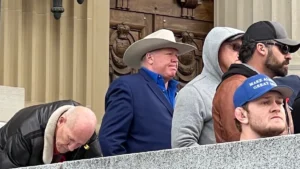
Jeffrey Rath, in cowboy hat, on the steps of the Alberta Legislature on October 25 during a separatist rally in Edmonton.

Over the weekend prominent Alberta separatist Jeffrey Rath took to the internet appearing to advocate an internal United Conservative Party (UCP) coup to remove Premier Danielle Smith. 

Her sin, in Rath’s obvious estimation, is that she’s been working too closely with Liberal Prime Minister Mark Carney and playing both sides of Independence Avenue in her efforts to keep the party’s fraying coalition of outright separatists and traditional Canadian Conservatives in one piece. 

His solution: The separatist cadres who now clearly control the UCP, but not quite yet either the government caucus or the provincial government, should dump her and replace her with a more ideologically acceptable leader and declare the party to be a separatist entity in the manner of the Parti Québécois.

Arguably, this could either be a sign of Smith’s increasing strength thanks to her latest deal with Carney, or of the separatists’ increasing strength as the holders of most of the internal power positions in the UCP party bureaucracy. Or, perhaps, a bit of both. 

Smith’s strategy, as is well understood, has been to assert that only she can successfully keep the open separatists now embedded in the party, caucus and cabinet from scaring away electors accustomed to voting Conservative without thinking too deeply about what the party nowadays represents.

Likewise, as the vessel of Preston Manning’s strategy of blackmailing the federal government into doing Alberta’s bidding by threatening to become the 51st State, she is the only politician likely to be able to get away with perpetrating this political protection racket. 

Talk of an internal party coup, though, should be taken seriously because Rath, who is legal counsel and for all practical purposes the self-appointed spokesperson for the Stay Free Alberta petition/Alberta Prosperity Project (SFA), is extremely influential within Alberta’s separatist faction. It is not clear if he has ambitions of his own in the new Alberta he hopes to create, but it is easy to assume that he must. 

So when Rath was so blunt about what he thinks should happen next in a series of social media posts, we should pay attention. He speaks for many in the UCP. 

“Premier Smith had no mandate from her membership to sign the Carbon Tax MOU with Mark Carney,” Rath posted at one point. “Danielle Smith no longer enjoys the confidence of the members of the UCP.”

If that’s not a call for a coup, I don’t know what is. 

“Enough is enough,” he said in another post. “We are a super majority of the party. Time to take it back from the Kenneyites.” (The “Kenneyites,” remember, basically purged the “Red Tories” from the UCP after former premier Jason Kenney engineered the double reverse hostile takeover of the Progressive Conservative Party and the Wildrose Party in the summer of 2017. This is an irony, since those Red Tories, had they still been around in any numbers, could have saved Kenney’s bacon in the fall of 2022.)

Here’s another, delivered Trump-style, in all caps: “DANIELLE SMITH HAS LOST HER MANDATE TO LEAD THE UCP!”

Rath’s message to the cadres in the UCP’s riding constituency associations: “MAKE SURE TO ATTEND YOUR LOCAL CA BOARD AGM AND ELECT A SLATE OF PRO-INDEPENDENCE BOARD MEMBERS. CONTACT YOUR LOCAL APP OR STAY FREE REGIONAL LEADERS FOR GUIDANCE.”

“We need to work to replace every non independence board in the province,” he said in part in another post

All these messages were posted on X, the social media platform previously known as Twitter, a place a lot of moderate Albertans nowadays sensibly eschew, if only to keep their blood pressure down. Someone has to look in there, however, and I’m willing to take the risk so that the rest of you don’t have to.

If this was more than just an anticipatory outburst of exuberance in memory of the late grandmother of Europe’s titled classes it suggests Danielle Smith’s “United Conservative” coalition could actually be starting to fracture.

It’s worth noting that the separatists on social media are also infuriated by the possibility that when the pipe gets laid, it may not follow the route most of them prefer, that is, the one most likely to annoy the most British Columbians and First Nations along the way to Prince Rupert. (The British Columbia city of that name and the terminus of the Alberta separatists’ imagined Danzig Corridor to the sea, that is, not the first governor of the late Hudson’s Bay Co., just to be clear.)

Meanwhile, speaking of Independence Avenue, a metaphor lest you tried to look it up on Google Maps, Edmonton City Councillor Michael Janz announced he had applied on behalf of many of his constituents to rename the road in front of the Alberta Legislature “Forever Canadian Avenue.”

Janz – councillor for Ward papastew, located just across the North Saskatchewan River from the Legislature – said the renaming of two blocks of 99th Ave. between 107th St. and 109th Street “will celebrate the largest non-partisan citizen movement in Alberta’s history.”

“The Forever Canadian petition collected signatures from Albertans who want Alberta to proudly remain a Canadian province,” Janz explained in a statement. “This effort was prompted as a response to Premier Danielle Smith encouraging conversations about Alberta separation. The petition gathered 456,000 signatures and motivated more than 10,000 Albertans to volunteer in support of this work.”

Janz, who is a tireless progressive activist not unprepared to be a gadfly if that’s what it takes to accomplish something, was accompanied to an outdoor news conference yesterday by Forever Canadian petition proponent Thomas Lukaszuk, a former Progressive Conservative deputy premier of Alberta. 

Janz will make application to the Edmonton Naming Committee, an independent body of volunteers appointed by the city. He pointed out that there is a precedent, when another city councillor successfully applied in 2018 to have a city road renamed Canadian Forces Trail. 

If Janz succeeds with this one, it will drive the UCP and the SFA nuts. 

The post Prominent Alberta separatist advocates internal UCP coup to oust Danielle Smith appeared first on rabble.ca.

  • ✇rabble.ca
  • Looking ahead to summer news coverage on rabble.ca rabble radio
    This week on the show, rabble editor Nick Seebruch and publisher Sarah Sahagian sit down to discuss ongoing news coverage on rabble.ca this summer, the Canada-US-Mexico Agreement (CUSMA), the war in Iran, Pride Month coverage and more.  Some pieces mentioned in this episode include: Scott Douglas Jacobsen’s on-the-ground reporting in Ukraine  The heroic life of Betty Baxter, athlete and activist by Tom Sandborn  Five Canadian 2SLGBTQIA+ books to add to your TBR list  US-Mexico start free trade
     

Looking ahead to summer news coverage on rabble.ca

12 June 2026 at 18:04

This week on the show, rabble editor Nick Seebruch and publisher Sarah Sahagian sit down to discuss ongoing news coverage on rabble.ca this summer, the Canada-US-Mexico Agreement (CUSMA), the war in Iran, Pride Month coverage and more. 

Some pieces mentioned in this episode include:

And celebrating rabble’s three summer interns: 

If you like the show please consider subscribing on Apple Podcasts, Spotify, YouTube and now: subscribe to rabble on Patreon to hear exclusive bonus episodes of rabble radio. 

The post Looking ahead to summer news coverage on rabble.ca appeared first on rabble.ca.

  • ✇rabble.ca
  • rabble Q&A with Privy Council Office on CUSMA review Evan Wexler
    The United States Trade Representative’s office announced in a press release this week that it will conduct three rounds of negotiations with Mexico about the upcoming Canada–United States–Mexico Agreement (CUSMA) review on July 1 – all of which will continue to exclude Canada from the discussions.  While Canada-U.S. Trade Minister Dominic LeBlanc has indicated he will head to Washington next week,  Canada’s Chief Trade Negotiator Janice Charette and Prime Minister Mark Carney’s Office of
     

rabble Q&A with Privy Council Office on CUSMA review

29 May 2026 at 19:46
The Langevin Block building houses the Privy Council Office.

The United States Trade Representative’s office announced in a press release this week that it will conduct three rounds of negotiations with Mexico about the upcoming Canada–United States–Mexico Agreement (CUSMA) review on July 1 – all of which will continue to exclude Canada from the discussions. 

While Canada-U.S. Trade Minister Dominic LeBlanc has indicated he will head to Washington next week

Canada’s Chief Trade Negotiator Janice Charette and Prime Minister Mark Carney’s Office of the Privy Council have remained tight-lipped about the upcoming CUSMA review. 

rabble.ca had an opportunity to do a Question and Answer with the Privy Council Office this week, to clarify some expectations about the next phase of negotiations with the United States and Mexico.  

1. What’s it like working with the USTR right now. Is it actually adversarial or confrontational? Jamieson Greer has made several remarks in the past few months indicating that it might be, so we’re trying to filter out political theatre from reality.

Canada continues to be a ready and willing trading partner, favouring durable outcomes built on comprehensive and pragmatic solutions and not short-term fixes.

The proposals Canada has advanced are serious and substantive, having the potential to generate hundreds of billions of dollars in economic value for American industries and workers in exchange for real relief from the unfair tariffs imposed on Canadian products.

As is appropriate, Canada does not negotiate publicly and will continue to engage through diplomatic channels in a manner that reflects the seriousness and importance of these discussions.

2. Can you give me an indication of how your office is working with Mexico directly at this point? Are there effects from the recent Mexican Trade missions that relate your work in any way? 

Canada recently held the latest round of its own bilateral engagements with Mexico, and those discussions were very positive and productive.

Canada remains fully prepared for any and all discussions with the U.S. and Mexico on trade issues and we are engaged in substantive and concrete discussions with both countries.  We are confident in the strength of our position.

As we near the joint review of the CUSMA, we are engaging on a continuous basis with industry and labour representatives as well as provincial and territorial governments to ensure that we can exchange relevant information and keep key partners up-to-date.

We have been clear and consistent with the United States that we are ready to launch the joint review the moment they are. There continues to be meetings between Canadian and American trade officials on a regular basis.

With respect to the upcoming U.S.-Mexico meetings, discussions between any two partners are a normal part of diplomatic engagement, as they serve to address issues particular to that bilateral relationship.

To be clear, any review or renegotiation of the core structure of CUSMA, including foundational elements such as rules of origin, cannot happen without Canada. Canada is committed to maintaining the CUSMA as a trilateral agreement, and any consideration of changes or modifications requires all three parties at the table.

Canada continues to advance its own bilateral discussions, remains in close contact with both partners, and stands ready to move forward with trilateral negotiations as soon as all three parties are prepared to engage together.

3. What are the issues that are being prioritized in the CUSMA review? 

Canada and the United States share one of the most comprehensive and mutually beneficial economic relationships in the world, and Prime Minister Carney’s remarks reflect our commitment to deepening that partnership in a way that works for both countries.

Examples of sectors where deeper integration holds the most significant potential include energy, steel and aluminum, softwood lumber, agriculture, and the automotive sector.

These are areas where our two economies are already deeply integrated, where Canadian inputs form part of high-value supply chains, and where a strengthened, rules-based trading framework can deliver real benefits for workers, farmers, businesses, and communities on both sides of the border.

It is also important to remember that more than 70 per cent of what Canada sends across the border is not finished consumer goods. They are inputs like energy, raw materials, critical minerals, aluminum, steel that go directly into American manufacturing. 

In short, Canadian exports do not displace American production but rather help make it possible and increase the ability of companies in both countries to compete globally.

That said, the Canada-U.S. relationship extends well beyond any single sector or agreement.

More broadly, Canada shares the U.S.’s concerns about unfair competition from non-market economies and has taken steps to protect our industries from unfair trade practices, for example in the steel and aluminum sectors. We are prepared to work collaboratively with the U.S. in this regard.

Canada has consistently been a strong, stable, and reliable partner in trade, in hemispheric security, in defence, and across the full range of shared interests that define our partnership.

The post rabble Q&A with Privy Council Office on CUSMA review appeared first on rabble.ca.

  • ✇rabble.ca
  • The new era of American Imperialism rabble radio
    Aggressive U.S. foreign policy has created deep instability—not only here in Canada, but globally. From the ongoing war in Iran to a devastating four-month fuel blockade in Cuba—causing medical blackouts and sanitation crises—the global impacts are severe. This week on rabble radio, we share a clip from the most recent Off the Hill political panel on American Imperialism. This webinar took place on Tuesday, May 19, 2026 and featured Gabriel De Roche, Madelaine Drohan, Thomas Ponniah and Karl Ner
     

The new era of American Imperialism

22 May 2026 at 16:15

Aggressive U.S. foreign policy has created deep instability—not only here in Canada, but globally. From the ongoing war in Iran to a devastating four-month fuel blockade in Cuba—causing medical blackouts and sanitation crises—the global impacts are severe. This week on rabble radio, we share a clip from the most recent Off the Hill political panel on American Imperialism. This webinar took place on Tuesday, May 19, 2026 and featured Gabriel De Roche, Madelaine Drohan, Thomas Ponniah and Karl Nerenberg. To watch the entire panel, visit rabbleTV or rabble’s YouTube channel.

If you like the show please consider subscribing on Apple Podcasts, Spotify, YouTube and now: subscribe to rabble on Patreon to hear exclusive bonus episodes of rabble radio. 

The post The new era of American Imperialism appeared first on rabble.ca.

  • ✇rabble.ca
  • Governments are on a privatization rampage Paul Kahnert
    Prime Minister Mark Carney wants to privatize our airports, our seaports and build a lot more private gas and nuclear power plants. Ontario Premier Doug Ford is privatizing our water, our healthcare and building a lot more private gas and nuclear power plants. Carney said Canada was “not for sale,”  and Ford says “that’s how we “protect Ontario.”  Both Carney and Ford are using the Trump crisis as was so brilliantly described in Naomi Klein’s book Shock Doctrine. Crisis capitalism is being u
     

Governments are on a privatization rampage

15 May 2026 at 20:23
Prime Minister Mark Carney and Ontario Premier Doug Ford are pursuing similar pro-business policies at the expense of public services.

Prime Minister Mark Carney wants to privatize our airports, our seaports and build a lot more private gas and nuclear power plants. Ontario Premier Doug Ford is privatizing our water, our healthcare and building a lot more private gas and nuclear power plants. Carney said Canada was “not for sale,”  and Ford says “that’s how we “protect Ontario.” 

Both Carney and Ford are using the Trump crisis as was so brilliantly described in Naomi Klein’s book Shock Doctrine. Crisis capitalism is being used to privatize our public assets and services.

When privatizing our public assets and services, we always hear the same song.

We have to “modernize, reform, increase competitiveness, innovation and increased efficiencies through alternative models of ownership.” Then we are told the same false claim: This will lead to “lower costs” which will be passed on to you. The same claim of lower rates came from Ontario Premier Mike Harris’ hydro legislation. Rates have now more than quadrupled.

 Hwy 407 is now the most expensive toll way in the world. In a deal far worse than the privatization of HWY 407, the privatization of the Bruce nuclear plant in a long-term lease in the year 2000, the profits were privatized but the $34 billion debt and the risks and cleanup remained public. 

The privatization of long-term care homes where many died from neglect during the COVID-19 pandemic and the higher and higher rates of Hydro privatization has left the people of Ontario with no appetite for any more privatization of public assets. 

The privatization of Connaught Labs by former Prime Minister Brian Mulroney also hurt us badly during the pandemic. The record of privatization around the world is dismal. The prime example of privatization failures is in the UK where the privatization of water, electricity and rail has left that country a basket case. The record of privatization is clear, when you introduce the profit motive, private corporations benefit and we all will pay a lot more. The risk is not just higher rates,the loss of sovereignty and control is the biggest risk. There doesn’t seem to be any difference between the Conservative and Liberal parties; both are on a public asset privatization rampage.

The post Governments are on a privatization rampage appeared first on rabble.ca.

  • ✇rabble.ca
  • Mark Carney and Danielle Smith have more objectives in common than they don’t David J. Climenhaga
    There’s no need to make the explanation of the carbon pricing, carbon capture and bitumen pipeline deal announced Friday in Calgary by the federal and Alberta governments too complicated. It’s actually pretty simple.  After all, notwithstanding their political differences, Prime Minister Mark Carney and Premier Danielle Smith have more objectives in common right now than they don’t, so it couldn’t have been that hard for them to reach an agreement.  Carney has served many years as an expe
     

Mark Carney and Danielle Smith have more objectives in common than they don’t

20 May 2026 at 16:06
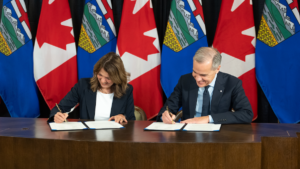
Alberta Premier Danielle Smith and Prime Minister Mark Carney signed the memorandum of understanding last fall that set the stage for Friday’s carbon pricing, carbon capture and bitumen pipeline deal.

There’s no need to make the explanation of the carbon pricing, carbon capture and bitumen pipeline deal announced Friday in Calgary by the federal and Alberta governments too complicated. It’s actually pretty simple. 

After all, notwithstanding their political differences, Prime Minister Mark Carney and Premier Danielle Smith have more objectives in common right now than they don’t, so it couldn’t have been that hard for them to reach an agreement. 

Carney has served many years as an expert in and senior representative of international finance capital, of which the oil industry remains a key component in Canada. While neither an expert nor a deep thinker, Smith has been a lobbyist for the oil industry and an effective public proponent of its preferred policies throughout her career as a journalist and politician. 

Of course they weren’t going to have all that much trouble finding ways to grant the Canadian oilpatch its wish for a pipeline to the West Coast, preferably completely paid for by taxpayers, plus slow-walked carbon taxes and big subsidies for the carbon-capture boondoggle to build social license for the pipeline. 

They may have their differences, but they are flying in formation when it comes to the oil industry. 

They have immediate parallel political needs as well. Smith must thread the needle between appearing to be an Alberta separatist and appearing to be a patriotic Canadian unifier to hold her fraying but still united voting coalition together – and, not incidentally, to hang onto her job as premier since separatists now clearly dominate her party. 

Friday’s deal lets her do that – for the moment, anyway. And the moment is all Smith ever thinks about. To give her her due, it seems to work. 

Carney needs to keep his coalition together as well. Instead of MAGA separatists on the right who would really rather be part of the United States so they could own machineguns and call people hateful names, he needs to appease moderate green voters in British Columbia and Quebec and somehow hold the country together. 

Since the contradictions of using bitumen as the glue to keep their political coalitions together will become more obvious over time, they’re in a hurry to get the deal done and some pipe laid so the doubters on both sides of the political spectrum can be told there is no alternative. For this reason, we should take seriously their promise that work on the pipeline, whatever route it takes, will start next year.

The simplicity of this political equation seems to have confused the Canadian political and business commentariat, grown used to sustained attacks on Ottawa by conservative Alberta governments. Commentators’ theories and explanations, as a result, were all over the map Friday and yesterday  – sometimes with unintentionally hilarious results.

According to Carson Jerema in The National Post, it’s all a dirty trick by Carney to “ensnare Danielle Smith in pipeline blackmail.” Ottawa’s gift of “free rein to polluters” (as Environmental Defence put it in a news release) “will give anti-energy B.C. Premier David Eby an effective veto,” according to the Post

Meanwhile, over at the environmentally inclined National Observer, Max Fawcett agreed … sort of. Carney isn’t taking a wrecking ball to Canada’s climate policies, he’s saving the country by defusing Smith’s constant carping about Canada, Fawcett asserted. “He understands the value of appearing to say yes to certain forms of economic development while creating or accelerating the conditions that will make it a non-starter.”

Postmedia’s Rick Bell – who often acts as a sort of de facto minister of propaganda for Smith’s United Conservative Party (UCP) – was enthusiastic, with mild reservations. “Carney is the prime minister and Smith says there was no choice but to meet him in the middle,” he wrote, leaving his usual breathless hyperbole to his colleague Don Braid. “She figures this deal did just that and it is a win for Alberta and a far cry from those days of ‘anger, frustration and despair’ under Trudeau.”

Well, the last time Smith said something like that, about the memorandum of understanding with Ottawa that set the stage for Friday’s deal, she was jeered at her own party convention

And then there was Braid – Postmedia’s other high-profile Alberta political columnist – who went right over the top with a panegyric to Smith that wouldn’t have seemed out of place in the pages of Pravda or the People’s Daily in the 1950s. 

“She has won every single battle with Ottawa over the past year,” said Braid, sending his hosannas heavenward. “In scope and importance, her victories against Ottawa outweigh former PC premier Peter Lougheed’s limited victory in the oil pricing crisis after 1980. … Smith may have set up this province for decades of economic gains.”

Well, if Carney is sneakily giving by a veto, British Columbia’s premier doesn’t seem to happy about it. And if Smith is saving Confederation, you have to wonder why she’s pushing ahead with her separatist referendum agenda. It seems to me that coastal British Columbians are as unhappy with this state of affairs as are Alberta separatists. And if anyone’s thinking about the constitutional requirement for consultation with First Nations, no one seems to be talking about it. 

You have to wonder if, despite Smith’s best efforts to keep the UCP united, something’s going to give as the separatists that now control the party push for it to officially declare itself to be a separatist party. Can political entropy in Alberta be far behind? 

And how comfortable will some members of Carney’s narrow majority in Parliament be in a government that appears to have completely tossed the environmental policies of the Trudeau era, unlamented though they may be here in Alberta. Steven Guilbeault, the former federal environment minister? B.C. MPs Will Greaves and Stephanie McLean? 

Is it possible that the biggest winner in this deal of the century could turn out to be … Avi Lewis?

The post Mark Carney and Danielle Smith have more objectives in common than they don’t appeared first on rabble.ca.

  • ✇rabble.ca
  • Carney’s disturbing hard right turn Paul Kahnert
    In the last election, many voted for Prime Minister Mark Carney’s calm, friendly demeanor and against Pierre Poilievre’s policies.  Since coming to power Carney has tacked hard right. He has been concentrating power in the prime minister’s office, bypassing democratically elected individual ministers and traditional cabinet authority.  Carney has made major changes to immigration and refugee asylum policy with Bill C-12.  Carney is executing the fastest rate of deportations in over a deca
     

Carney’s disturbing hard right turn

25 May 2026 at 20:28
Prime Minister Mark Carney giving a speech supporting his Build Canada Strong campaign.

In the last election, many voted for Prime Minister Mark Carney’s calm, friendly demeanor and against Pierre Poilievre’s policies. 

Since coming to power Carney has tacked hard right. He has been concentrating power in the prime minister’s office, bypassing democratically elected individual ministers and traditional cabinet authority. 

Carney has made major changes to immigration and refugee asylum policy with Bill C-12.  Carney is executing the fastest rate of deportations in over a decade totaling a record 22,500, of failed refugee claimants, including temporary foreign workers and international students. 

Carney passed Bill C-5 which is eerily similar to Ontario Premier Doug Ford’s Bill 5, giving the government the right to suspend environmental, labor laws and regulations to fast-track projects of national interest. These regulations were originally brought in to protect the environment and protect us from the excesses of the free-market system are now derided and ridiculed as red tape and barriers to prosperity.

Tax cuts and privatization  

Both premier Ford and prime minister Carney are using the crisis created by Trump to bring in tax cuts, deregulation (cutting red tape) and privatization which they present as factual claiming it will protect us and bring back prosperity which is factually false and complete bunk.

Since the 1980s, trickledown economics has repeatedly been debunked, and repeatedly failed. The only thing trickledown economics has ever done is make the fabulously wealthy wealthier. Crisis and disaster capitalism has been brilliantly outlined by Naomi Klein in her book, The Shock Doctrine, a very good read. 

Carney intends to privatize our airports and seaports claiming we have to modernize, reform, increase competitiveness and efficiencies through alternative models of ownership. Whenever you hear the words “modernize” and “reform,” alarm bells should go off.  

Using the exact same language as when Conservatives tried to bring in “right to work” legislation, Carney is attacking unions by claiming he has to “modernize” labor legislation. The right to free collective bargaining and the right to strike is a human right. A right recognized by the United Nations.

It used to be that unions had to worry about Poilievre’s threat to bring in “right to work” laws that have decimated unions in the US. Now unions have to worry about a very serious attack on bargaining rights by Carney. 

The top one per cent love their money. They also love the processes that make them even more money. These processes are tax cuts and tax avoidance, deregulation, privatization of public assets and services, weak environmental, health and safety laws and low wages. The only way to lower wages and increase profits for the wealthy is to weaken unions. 

The existence of a union at your workplace is often the difference between a good standard of living and a bad one. It means you don’t have to live in constant fear of your boss and if you are fired, you have the right to a fair hearing.

Unions have been exposing the smoke and mirror show and corporations and the wealthy don’t like it. Carney is weakening unions so they can increase profits. 

Perhaps the worst action Carney has taken is a complete reversal on the climate crisis, putting corporate profits before people and the planet. 

Carney is on bended knee to Danielle Smith’s oil oligarchs who run that province. Carney has scrapped the carbon tax, EV mandates and dropped the emissions cap on oil and gas. Carney is committing to new pipelines to the environmentally sensitive west coast as well as supporting the carbon capture and storage scheme. A scheme dreamed up by oil executives, who are worried about the increasing evidence of the climate crisis, trying to protect their profits.

There is more wealth now than there has ever been. We do not have a wealth creation problem. We do have a very serious distribution of wealth problem. Many Canadians voted against Poilievre and his hard right policies. It looks like we elected Poilievre’s hard right policies without Poilievre. Where’s the prosperity? Climate change denial and foot dragging by our current political leaders, is just letting the wealthy and their corporations continue their profit rampage. Profits must not come before people and the planet. A dead planet profits no one.

The post Carney’s disturbing hard right turn appeared first on rabble.ca.

Marking 180 Years: The Oregon Treaty, DRIPA, and the future of Indigenous-settler relations

First Nations Leadership Council representatives hold up printed copies of the UN Declaration bill tabled in B.C. on Oct 24, 2019.

One hundred eighty years ago, on June 15, 1846, representatives of the U.K. and the U.S. signed the Treaty of Oregon.

What is this treaty, and why is it important?

The B.C. and Canadian governments assert that their right to govern, to assert sovereignty over the lands now called “British Columbia,” began in 1846 with the signing of the Treaty between Her Majesty and the United States of America for the Settlement of the Oregon Boundary.

The treaty did define today’s border with the U.S. west of the Rockies but most importantly it asserted that the British and U.S. were to exercise sovereignty over the Oregon territory – present day Washington, Oregon and British Columbia. The U.K. was to have sovereignty over the territory north of the 49th parallel, and the U.S. was to control the lands south of the border.

The text of the Oregon Treaty offers no justification for this colonial assertion of sovereignty. However, publicly available minutes of the negotiations in 1845-46 starkly reveal that the U.K. believed that visits to the region by James Cook, George Vancouver, and others gave them the right to take the land.

The treaty fails to mention that First Nations lived, governed, and worked across these territories for thousands of years. At the time, the settler population was at most a few hundred. Estimates vary, but as many as 300,000 or more Indigenous peoples lived north of the border. They were never consulted and the treaty rendered the land into a fictional terra nullius.

In effect, the Treaty of Oregon, and the Crown’s right to govern, is based upon the thoroughly discredited Doctrine of Discovery that even the Vatican has repudiated.

The bitter irony is that those who effectively stole the lands in 1846, are now accusing those whose lands they took of threatening private property. Nothing could be further from the truth.

History matters

Initially First Nations often supported newcomers to their territories. But settler governments, backed by British canons, asserted control by pushing First Nations off the land and onto reserves, refusing to sign treaties, and encouraging white settlers to exploit native lands. First Nations have been organizing and fighting the dispossession and genocide that ensued ever since. Our colleagues introduced a concise account of that history a few years ago – a history that made B.C. a province like no other.

One of the recent landmarks in this ongoing fight was the 1981 Constitution Express that saw First Nations mobilize across the country and Europe to demand Indigenous title and rights be recognized in the Canadian constitution then under consideration. This led to the adoption of Section 35 of the Constitution affirming Aboriginal title and rights for the first time.

Indigenous led movements, including Idle No More, the Truth and Reconciliation Commission, and Every Child Matters continued that fight and had an impact on the consciousness of many people in the province – Indigenous and non-Indigenous alike.

Consequently, the provincial legislature unanimously passed the Declaration on the Rights of Indigenous Peoples Act (DRIPA). It affirmed the application of the United Nations Declaration on the Rights of Indigenous Peoples to the laws of B.C. It declared that “in consultation and cooperation with the Indigenous peoples in British Columbia, the government must take all measures necessary to ensure the laws of British Columbia are consistent with the Declaration.”

DRIPA was a further step in decolonization and reflected the long struggle of First Nations for recognition of Indigenous title and rights. These hard-won gains set the stage for recent court decisions, Cowichan Tribes v. Canada and Gitxaala v. British Columbia that reinforced Indigenous title and rights, emphasizing the legal imperative for the government to fully implement DRIPA.

Backlash

In the Cowichan Tribes v. Canada case last year, the BC Supreme Court declared that the Quw’utsun (Cowichan) Nation had title to Tl’uqtinus, a parcel of land on the southern arm of the Fraser River in Richmond. The NDP government reacted immediately, declaring it would appeal the ruling: “This ruling could have significant unintended consequences for fee simple private property rights in B.C. that must be reconsidered by a higher court,” stated NDP attorney-general Niki Sharma.

A few months later, the B.C. Court of Appeal decision in Gitxaala v. British Columbia reinforced the legal obligations of the B.C. government to implement DRIPA to the laws of the province. It ruled that the mineral claims system was inconsistent with DRIPA. Again, the provincial government contested the decision, announcing it would appeal the decision in the Supreme Court of Canada.

In a major speech to the B.C. Chamber of Commerce this spring, the premier criticized both decisions, saying they invite “further and endless litigation,” and were “the exact opposite of the direction we need to go.” David Eby then promised to amend or suspend DRIPA, provoking a crisis.

Over 100 First Nations publicly objected to the Eby government’s move to amend DRIPA, as did the Law Society of BC and the BC branch of the Canadian Bar Association. Over 130 civil society organizations, including the B.C. Federation of Labour and the B.C. Civil Liberties Association, publicly called on the government to stop their attempts to amend DRIPA, warning: “We are deeply troubled by the recent rise in anti-Indigenous rhetoric and fearmongering in this province that has framed the realization of the fundamental human rights of Indigenous peoples as detrimental to economic growth, security, and the interests of others. We stand united in opposition to these divisive narratives.”

Under pressure from within his caucus, David Eby was forced to shelve his plan to amend or suspend DRIPA and instead committed to engage in consultations with First Nations. Meanwhile, the Conservative Party and right-wing think tanks such as the Fraser Institute have been outspoken in their criticism of DRIPA.

Understanding the crisis

First Nations have made it clear that their title and rights are not out to dispossess property owners. The landmark Gaayhllxid • Gíhlagalgang “Rising Tide” Haida Title Lands Agreement, calls for “a staged transition to Haida jurisdiction, while protecting and maintaining private property rights and existing government services and infrastructure on Haida Gwaii.” The Cowichan Nation publicly promised that they were not seeking “to invalidate any privately held fee simple titles.”

Furthermore, many legal experts argue that Indigenous title can overlay and co-exist with fee simple private property, as does Crown title. So, what is really at stake?

Political polarization is occurring in many places in the world. In B.C., Indigenous title and rights has become the flashpoint, reflecting this province’s unique history.

Conservative forces are pushing to roll back hard-won social gains, whether it be Indigenous rights and title, women’s rights, LGBTQ rights, labour rights, or environmental regulations. 

Kerry-Lynn Findlay, recently elected as leader of the B.C. Conservatives, has a track record of anti-Indigenous activism and has reiterated the Party’s commitment to repeal DRIPA. Her election night clarion call for “family, faith, and freedom” eerily echoes the conservative right, south of the border.

However, the current crisis resonates with deep cultural differences that transcend partisan politics. The colonial world conceives of the land as being owned, and ownership translates into economic terms, monetary – the land is monetized. For the Indigenous world, it’s not about who owns the land, it’s about who is looking after that land and all life upon it.

Another layer is economic. The NDP government’s agenda focuses on fast-tracking the exploitation of LNG and critical minerals – continuing the long tradition of colonial extractive projects. Some in the government feel that Indigenous title and rights, and the courts’ recent decisions, go too far and that “free, prior, and informed consent” may impede the fast-tracking of resource projects.

Governing with a slim majority, the Eby government seems to be listening to the BC Business Council who recently released a recent survey in which 98 percent of its members were “very concerned” about the Declaration on the Rights of Indigenous People’s Act (DRIPA) applying to all laws in the province. 

The threat to the land, regardless of ownership, comes not from Indigenous peoples but from forest fires, flooding, and pollution – an ever-deepening environmental catastrophe that has arisen from unfettered growth. This has often altered the land to the point that it is unable to heal.

First Nations face huge hurdles as they struggle to re-establish relationships, among themselves and with settler society. Still, they lead in the search for renewable energy as illustrated in the series Generating Futures. Indigenous knowledge systems point to a good way to relate to the land, to overcome colonial concepts of competitiveness and hierarchy. Reinforcing Indigenous title and rights will open pathways to cooperation in which Indigenous and non-Indigenous people can work together to solve the pressing problems of our time.

The post Marking 180 Years: The Oregon Treaty, DRIPA, and the future of Indigenous-settler relations appeared first on rabble.ca.

  • ✇rabble.ca
  • Danielle Smith vows to do everything humanly possible to keep Alberta in Canada David J. Climenhaga
    In addition to blaming everyone but herself for the national unity crisis she’s been trying for months to foment, Alberta Premier Danielle Smith used a news conference in Calgary Thursday to insist repeatedly that no one’s more loyal to Canada than she is and for sure she’ll be doing everything she can to get everyone to vote to remain in Canada when the referendum almost nobody else wants to happen is held next October. That is to say, not an actual referendum on separation – which would be
     

Danielle Smith vows to do everything humanly possible to keep Alberta in Canada

25 May 2026 at 20:50
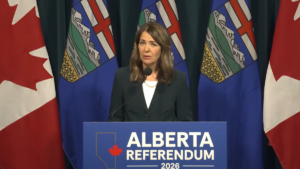
Alberta Premier Danielle Smith.

In addition to blaming everyone but herself for the national unity crisis she’s been trying for months to foment, Alberta Premier Danielle Smith used a news conference in Calgary Thursday to insist repeatedly that no one’s more loyal to Canada than she is and for sure she’ll be doing everything she can to get everyone to vote to remain in Canada when the referendum almost nobody else wants to happen is held next October.

That is to say, not an actual referendum on separation – which would be OK with the United Conservative Party’s separatist base, if no one else – but the confusing vote on whether or not to have a referendum on separation that Smith wants to hold to keep the issue alive in the face of court rulings that have blocked the Alberta Prosperity Project-approved wording she really wanted to see on the ballot. 

“I’m fiercely loyal to both Alberta and Canada,” the premier asserted in the first seconds of the newser, the motivation for which appeared simply to be to crossly roll out all the same talking points she made yesterday in her 15-minute prime-time televised message to us Albertans. 

Over the next 34 minutes according to my count, Smith repeated at least 13 times that she supported Alberta remaining in Canada and would be campaigning hard to ensure that happens. 

  • “My position is to stay”
  • “I believe Albertans should remain in Canada”
  • “I would ask that all Albertans join me in voting to remain a province of Canada”
  • “I will do everything I can to convince Albertans that the choice should be to remain”
  • “Once again, I’ll be doing everything I can to convince my fellow Albertans that the choice should be to remain”
  • “I’ll be doing town halls and meetings and telling people about why it is I think we should vote to remain”
  • “If you want to remain in Canada, as I do, vote to remain”
  • “I hope it goes the other way as well, that the remain side wins”
  • “I’ll be very clear about the position of my caucus and my government and why does it think we should vote to remain”
  • “I’ll be trying to do everything I can to convince our fellow citizens to vote to remain”
  • “I’ll be campaigning hard to try to convince my fellow Albertans of my position, which is to remain”
  • “I’ve said what side I’m on, that I want to convince my fellow Albertans to stay”
  • “I will be focusing my efforts on remain”

Of course, I may have missed a few. A lot of words were spoken during that half hour, and my note-taking’s not what it used to be. 

In addition, at least two more times Smith insisted that she’s always been working to save Canada. “Everything I have done from the moment I got elected, with the Alberta Sovereignty Within a United Canada Act, has been to work to find the issues that were causing division and resolve them,” she said at one point. “I have been actively campaigning to save our country and to resolve these issues from the moment I got elected,” she said at another. 

All of which begs the question, if this is true, why the hell is she doing everything she can to make it easy for a bunch of separatists with ties to a foreign country to break up the country? 

Look, not to be mean, but if she really sincerely believes what she’s saying, even if she only believes it when she’s saying it, then that’s a prima facie case right there for a 30-day psychiatric remand!

Or maybe she’s just gaslighting us and being obvious about it because she’s starting to realize that almost everybody in Alberta is infuriated by her antics right now. I’ll let you be the judge. 

True to form, as widely reported, Smith blamed everybody but herself for the present state of affairs. Justin Trudeau got special mention, of course, and his father probably deserved some too, although to be fair she didn’t think to mention old Pierre. 

Jagmeet Singh also populates the list of the usual Suspects, as seen by Danielle Smith. She whinged about uppity judges, of course, and the poor abused law-abiding gun owners of Wild Rose Country. 

The premier also singled out: 

  • “The 14 cowards who signed a letter to the prime minister trying to derail our MoU,” a reference to the group of Liberal MPs who wrote Mark Carney before the memorandum of understanding was signed to complain about environmental rollbacks;
  • “People like Avi Lewis, who continues to campaign to keep all of our fossil fuels in the ground;”
  • And “leadership in British Columbia who continues to try to put barriers in the way of getting our product to market” …

… “That is the reason we having this crisis right now,” she averred. “… That’s what’s created the situation we find ourselves in today!”

Smith stuck to her talking point that 700,000 Albertans who signed petitions want to hold a vote on separation, notwithstanding the fact that most of the more than 400,000 verified signatories to the pro-Canada Forever Canadian petition wanted no such thing and as far as we know none of the 300,000 signatures on the separatist petition have been verified. She said nothing about the personal information of three million Albertans now in the hands of a Trump affiliated campaign company south of the world’s longest undefended border or what role the huge data breach may have played in getting signatures on the Stay Free Alberta petition.

If you were looking for actual news from this news conference, there wasn’t much, and it wasn’t particularly good.

Will the premier step down, one reporter asked, if the vote doesn’t go her way? Forget about it. “As I’ve said, I will accept the outcome of these referendum questions,” she said. If the separatists win, “then we will commence the legal processes to get to the point of a binding referendum on it.”

Asked another: Why not just call an election and settle the matter that way? “Well, because I had until October 2027 in my mandate.” She went on to suggest that the questions she wants answers to are so important that the government needs to get direction on them – which an election would provide, but never mind that. At least not until the UCP’s province-wide gerrymander is complete. 

And how big a vote would be enough to proceed to a full separation referendum? “Fifty per cent plus one. That’s what a majority looks like. Yes.”

Judged on her actions, not her words, Smith is a separatist. Ergo, this problem isn’t going away any time soon. Leastways, not until she summons up the courage to kick the separatists out of her party like almost all Conservative Alberta premiers have done from time to time. 

The post Danielle Smith vows to do everything humanly possible to keep Alberta in Canada appeared first on rabble.ca.

  • ✇rabble.ca
  • The Oligarch Chronicles Part 4 Paul Kahnert
    Oligarch actions and influences  Around the world democracy is being deliberately dismantled, reducing the power of the people to decide their future. It is mostly happening slowly and as quietly as possible. It is happening through the consolidation of political and economic power of a very few enormously wealthy elites. They are not hidden or secret.  They are billionaires celebrated in the media.  Many of them operate through vast corporate empires, family-owned conglomerates and techn
     

The Oligarch Chronicles Part 4

9 June 2026 at 19:39

Oligarch actions and influences 

Around the world democracy is being deliberately dismantled, reducing the power of the people to decide their future. It is mostly happening slowly and as quietly as possible. It is happening through the consolidation of political and economic power of a very few enormously wealthy elites. They are not hidden or secret.  They are billionaires celebrated in the media. 

Many of them operate through vast corporate empires, family-owned conglomerates and technology platforms that now dominate most media.  Increasingly they shape and control public policy, economies, electoral outcomes, and national priorities. 

Like the Robber Barons they control politicians through campaign finance and political donations and now untraceable material presents. 

Corruption and bribery used to be old fashioned money, now they just buy you things like Trump’s 747 jet from Qatar.  They communicate and coordinate through private financial networks and the internet. Global institutions and elected leaders are secondary and just need to be controlled. Only a few billionaires control companies valued in the trillions of dollars. They now function not just as market giants, but as global power houses with direct lines into governments, militaries and central banks. These billionaires, decide on infrastructure development, defense spending, Artificial Intelligence, AI regulation and digital surveillance.  

Oligarchs like Elon Musk, Mark Zukerberg and Jensen Huang, routinely engage with heads of state, lobby for industry specific policies and in some cases get government contracts worth billions.  Their power extends far beyond shareholders and consumers. They use their power to shape which laws are made, eliminate regulations which are not favorable to them, determine how technologies are deployed and which civil liberties are allowed or are suspended in times of a declared emergency.

Canadian Oligarch influenced provinces 

Canada is often viewed as a bastion of stability but is still vulnerable to Oligarch control. 

Canada is home to 67 billionaires (Forbes 2024) who have a combined net worth of $314.4 billion. 

Several of these billionaires maintain deep and longstanding relationships with political institutions at the federal and provincial levels. One of the most prominent examples is the Weston family, owners of the Loblaws empire.  

During the COVID-19 pandemic, Loblaws received a $12 million federal grant to upgrade its refrigeration systems. The grant was given just months after company executives hosted Liberal Party fundraisers. This came after the Westons had already reported record profits. 

This begs the question, why were public funds given to a corporation with record profits and huge cash reserves?  

The relationship between corporate leaders was exposed showing how preferential access and policy making was made quietly with no public scrutiny behind closed doors. East to west in Canada.

New Brunswick and Nova Scotia 

The Irving family holds an iron grip on energy, forestry, ship building and the media. For decades they have had powerful influence over the governments of New Brunswick and Nova Scotia.  

The clearest example was the federal government’s decision in March 2025 to award a $22.2 billion contract worth $8 billion in the first 6 years to Irving ship building in Halifax to revitalize Canada’s navy.  

By not taking bids and eliminating competitors has caused public concern about fairness and transparency.  The Irving’s control most of the newspapers in this region, allowing them to shape public opinion and suppress criticism of their business activities. Their power is entrenched in provincial politics and the media. 

Quebec

The Desmarais family, which controls the Power Corporation of Canada, has played a quiet but decisive role in shaping national leadership. Former Prime Minister Jean Chrétien, former Quebec Premier Jean Charest, and former Ontario Premier Bill Davis were closely linked to the Power Corporation, either through personal associations or direct advisory roles. 

The family’s influence has often been exercised through elite networks rather than overt lobbying. Yet it has helped shape economic policy, regulatory approaches, and trade decisions. The Desmarais example illustrates how elite families can embed themselves so deeply into the political establishment that their interests become indistinguishable from national policy.

Ontario 

On Ontario Premier Doug Ford’s side, the dominant voices are the GTA land kings. 

Silvio De Gasperi’s TACC Group and Michael Rice’s Rice Group both maxed out donations almost the moment Ford quietly doubled Ontario’s contribution limit. 

Their freshly purchased Greenbelt land parcels miraculously rezoned, which created $3.2 billion in value for developers with the stroke of a pen. 

The Cortellucci and Di Poce families did the same dance around Highway 413. Big cheques were given at fundraisers followed by a provincial route that now cuts straight through their land banks. 

The Thomson clan keeps Ford’s media weather sunny through the Globe and Mail while topping up “Ontario Strong” ad campaigns. 

Westons and Sobeys quietly max their annual donations in exchange for Ottawa’s grocery profit probe dying on a dusty shelf. 

Retail property giants such as Smart Centers and the Real Estate Investment Trust lobby are there too. 

Their executives and spouses write personal cheques and in return get fast tracked eviction courts and zoning sweeteners for big box infill.

The Rogers family has long used its telecommunications empire to advance regulatory positions favorable to its business model. The family’s internal conflicts even drew national headlines, particularly after efforts to influence board decisions and executive appointments spilled into public view. While these events were covered as corporate drama, they also revealed the Rogers’ ability to affect political agendas and media narratives, given their ownership of broadcasting platforms. 

Political parties have repeatedly courted their favor, knowing that telecom legislation, spectrum allocation, and media regulation are all tied to the family’s corporate interests. Ford’s Bill 5 gives the power to the Premier to set up “special economic zones” completely regulation free zones. Free from any environmental, labor laws and regulations or municipal bylaws protecting the public interest. A free for all for Ontario’s oligarchs to increase profits. 

Alberta

Premier Danielle Smith’s ties to Alberta’s energy elite are not just ideological, they are structural. 

Her premiership is tightly entangled with oil and gas lobbyists and corporate funded think tanks like the Alberta Enterprise Group, the Manning Centre, and right-wing advocacy outfits like the Canadian Taxpayers Federation. 

Her United Conservative Party (UCP) operates as a political instrument of Alberta’s fossil fuel sector, aggressively defending oil sands development and pushing back on federal emissions standards, carbon pricing, and environmental, social, and governance frameworks. 

Danielle Smith, answers first to billionaire Murray Edwards, who chairs Canadian Natural Resources and co-owns the Calgary Flames. 

Murray hosts private, $500 a plate dinner, keeping the UCP’s quarterly filings flush. Murray, then collects a $330 million public subsidy for his new arena and tailor-made carbon capture tax credits. 

The CEOs of Cenovus, Suncor, and Imperial follow a similar pattern, executive donations and third-party ad buys that coincide with royalty breaks, methane regulations pushed to never never land, and a freeze on new renewables. 

Pipeline majors like TC Energy and Enbridge channel their influence through what insiders jokingly call the “pipeline caucus,” securing seats on “red tape” reduction panels and directive laden mandate letters for Alberta’s energy regulator.  

The attack ad ecosystem winds up with dark-money groups such as Alberta Proud and Buffalo PAC, which spread memes the party cannot legally run itself, because the corporate ban cap sits at $4,300 in Alberta. 

This amount is small enough to skirt scrutiny and big enough to keep ministers’ direct lines open. Like Jason Kenny before her, Smith has framed environmentalists and climate scientists as “enemies” of Alberta’s prosperity. Smith’s proposed Alberta Sovereignty Act, aimed at nullifying federal laws she deems hostile to Alberta’s interests, is widely seen as legal cover for refusing federal environmental regulations. 

Behind this are some of the most powerful families and energy corporations in Canada, CNRL, Suncor, Cenovus, and others who not only bankroll political campaigns but shape public messaging through slick simulated support populism and media surrogates like Rebel News.

The alignment between Smith’s rhetoric and the far-right populist ecosystem antivax, anti-Ottawa, anti-World Economic Forum is not coincidental. It mirrors a global trend where extractive industries back hyper nationalist movements to block environmental reforms and consolidate regional power under the guise of defending “working class freedom.”

A few dates tie the pattern together. In February 2021, Doug Ford doubled the individual donation ceiling. Within a year, more than 70 percent of Progressive Conservative cash came from cheques over a thousand dollars. 

By November 2022, the now infamous Greenbelt land swap leaked, and assessments on the developers’ holdings jumped eight-to-ten-fold overnight. Now again in November 2025 Ford raised the maximum yearly contribution rate from $3,400 to $5,000. This makes Ontario very much like the wild west contribution situation in Saskatchewan. 

In April 2023 Smith green-lights Edwards’s arena deal, offloading a third of a billion dollars onto Alberta taxpayers. Through the first half of 2024, almost three-quarters of United Conservative Party donations came from postal codes along the energy corridor, coinciding neatly with methane rule loopholes left untouched and yet more subsidies for carbon capture and storage. Tobacco companies worried about their profits when it became clear cigarettes were killing people by cancer, made filtered cigarettes claiming filters reduced the risks of smoking. Now, that it could not be clearer that oil is the major cause of the climate crisis, oil company executives who are very worried about their profits, came up with the carbon capture and storage propaganda campaign, ripping off the public purse to do it.

Saskatchewan

In a cast of characters across Canada who are controlled and influenced by wealthy corporations, Scott Moe, premier of Saskatchewan looks to be one of the most extreme. 

The province’s complete lack of campaign contribution regulations has made it one of the worst jurisdictions in Canada.  

Since 2018, the Saskatchewan party has raised over $6.7 million in corporate donations from corporate landlords and oil and gas companies, as well as financial firms and the largest landowner in the province. Many contributions have come from Alberta, Ontario and Manitoba.  

Saskatchewan is one of the only provinces that has no donation limits and no provincial residency rules, sending a very strong message to business that public policy is open to the highest bidder. 

In a regulatory race to the bottom, fresh disclosures show corporations kicked in $1.6 million during the 2024 election year, equal to 70 per cent of all corporate donations’ province wide. Top cheques came from heavy construction (Kelly Panteluk), equipment dealers (Redhead), and Brandt Industries, the same family empire that hosts private fundraisers for Pierre Poilievre. 

Out of province interests can double contribute, make a corporate contribution, then a personal one from every director at the same address. Reformers call it “the Wild West”; the business lobby just calls it Tuesday. 

The Moe government on behalf of his corporate supporters is pushing hard against Ottawa’s clean electricity standards and is extending the life of coal power plants to provide affordable and reliable base load power to Saskatchewan residents.  Scott Moe wants to repeal the oil and gas emissions cap to create investment certainty and secure the supply of Canadian energy products.

Next up is Part Five “World’s Biggest Oligarchies and Far Right Networks the Oligarch Infantry.”

The post The Oligarch Chronicles Part 4 appeared first on rabble.ca.

  • ✇rabble.ca
  • Off the Hill (FULL VIDEO): A new era of American Imperialism Nick Seebruch
    This year has been marked by the U.S. President Donald Trump’s aggressive approach to foreign policy. From the seizure of the Venezuelan president in January to the ongoing war in Iran, the U.S. government is unashamedly entering into a new era of American Imperialism. Political scientist Gabriel De Roche, Madelaine Drohan, senior fellow at the Graduate School of Public and International Policy, University of Ottawa, politics and philosophy professor Thomas Ponniah and rabble’s own parliamentary
     

Off the Hill (FULL VIDEO): A new era of American Imperialism

22 May 2026 at 17:54

This year has been marked by the U.S. President Donald Trump’s aggressive approach to foreign policy. From the seizure of the Venezuelan president in January to the ongoing war in Iran, the U.S. government is unashamedly entering into a new era of American Imperialism.

Political scientist Gabriel De Roche, Madelaine Drohan, senior fellow at the Graduate School of Public and International Policy, University of Ottawa, politics and philosophy professor Thomas Ponniah and rabble’s own parliamentary reporter Karl Nerenberg discuss how progressives north and south of the border can respond to the so-called Donroe Doctrine.

About our guests

Gabriel De Roche is a political scientist and public opinion survey researcher working on global, national, and local projects with a particular focus on the politics of climate change and the clean energy transition. He holds a PhD in political science from the University of California, San Diego, and currently works at The 2035 Initiative at UC Santa Barbara where he is the Director of Polling and Survey Research and a Postdoctoral Fellow. He is also the founder and principal of a public opinion consultancy, Pluriel Research. Based in Santa Barbara, California, and Toronto, Ontario, he is the co-host of the Canadian podcast, Culture Lab, a show about how the zeitgeist shapes our political culture.

Madelaine Drohan is a senior fellow at the Graduate School of Public and International Policy, University of Ottawa. She is a former Canada correspondent for The Economist, and a former foreign correspondent for The Globe and Mail. During her long journalism career, she covered politics, economics, and business in Africa, Asia, Canada, and Europe. Her latest book is: He Did Not Conquer: Benjamin Franklin’s Failure to Annex Canada. She lives in Ottawa.

Thomas Ponniah is a co-writer of Unholy Trinity: the IMF, World Bank, and WTO, co-editor of Another World is Possible: World Social Forum proposals for an Alternative Globalization, co-editor of The Revolution in Venezuela: Social and Political Change Under Chávez, and contributor of 76 articles for rabble.ca.

Karl Nerenberg is an award-winning journalist, broadcaster and filmmaker, working in both English and French languages. He is rabble’s senior parliamentary reporter.

About Off the Hill

Since 2019, Off the Hill has been rabble.ca’s live political panel. Through this series, we break down important national and international news stories through a progressive lens.

This webinar series invites a rotating roster of guest activists, politicians, researchers and more to discuss how to mobilize and bring about progressive change in national politics — on and off Parliament Hill.

Our Off the Hill series has seen some changes in recent months! Check out those changes here.

The post Off the Hill (FULL VIDEO): A new era of American Imperialism appeared first on rabble.ca.

❌
Subscriptions