Normal view

  • ✇rabble.ca
  • The Oligarch Chronicles Part 3 Paul Kahnert
    Trickledown economics sets the stage With the election of British Prime Minister Margaret Thatcher in 1979 in the UK, and President Ronald Reagan in 1980 in the US, the progressive era ended. Ushered in was the beginning of a regressive era, where both pre-war and post-war progressive laws and regulations protecting the public interest and the environment were steadily eliminated.  Enabled by their politician servants, Capitalism broke out of its cage and over the next two decades dismant
     

The Oligarch Chronicles Part 3

27 May 2026 at 20:02

Trickledown economics sets the stage

With the election of British Prime Minister Margaret Thatcher in 1979 in the UK, and President Ronald Reagan in 1980 in the US, the progressive era ended. Ushered in was the beginning of a regressive era, where both pre-war and post-war progressive laws and regulations protecting the public interest and the environment were steadily eliminated. 

Enabled by their politician servants, Capitalism broke out of its cage and over the next two decades dismantled the cage bar by bar and resumed its quest for unfettered profits and the power and control to guarantee deregulated free markets. Their narrative of tax cuts, deregulation and privatization, promised prosperity for all. 

In the UK it was called Thatcherism. In the US it was called Reaganomics. Decades of progress were dismantled and the wealthy received big tax cuts. 

Reagan cut taxes from 73 per cent to 28 per cent on the wealthy. Reagan cut the corporate tax rate from 46 per cent to 34 per cent. Thatcher cut the corporate tax from 52 per cent to 35 per cent. 

Politicians and governments of every stripe have forwarded this narrative. It was particularly Conservative politicians who promised this trio of policies would bring in prosperity for all, by incentivizing investment. 

Politicians promised the wealthy and their corporations would reinvest their profits creating more jobs. They also promised that these policies would create more competition, more innovation and lower costs through “increased efficiencies”.  It became known as “trickledown economics” on the belief that profits and money would eventually trickledown to everyone. 

Both Reagan and Thatcher championed privatization of public owned industries and assets. It was George HW Bush who called it “voodoo economics.” 

Governments in more than 100 countries were convinced to sell thousands of businesses to the private sector, including airlines, railroads, electrical utilities, water and postal services. As of 2015, the value of this transfer of public wealth to capitalist interests was valued at more than $3.3 trillion. 

The narrative of deregulation and eliminating regulations that protected the public interest and our health and the environment quickly evolved into the deliberately derogatory term “red tape.” Red tape was touted as bad and some kind of barrier to prosperity, restricting innovation and growth. It is as ridiculous as Monty Python’s “the ministry of silly walks.” In Canada there is even a national red tape office and in Ontario the “ministry of red tape reduction” with very serious consequences. 

 This set up the conditions enabling today’s oligarchs to massively increase their total wealth. 

Capitalism keeps on repeating the big lie over and over again until it is believed. This narrative put out by wealthy friendly media continues the narrative of tax cuts, cutting red tape and the increased efficiencies of private ownership continuously today. 

Out of its cage, capitalism went back to attacking and weakening unions with the narrative that unions were no longer necessary, and belonging to a union was somehow an infringement on your rights as a person who wanted to work. This resulted in the creation of “right to work” laws claiming the automatic collection of union dues from paychecks was a violation of rights and the freedom to work was being given. 

The 1990s saw an increase in right to work laws in the US. Twenty-six states have now enacted right to work laws prohibiting mandatory union membership and the payment of union dues as a condition of employment was made illegal. 

Working conditions, wages and benefits in those states have severely deteriorated. The wealthy went back to manipulating markets and even committing corporate fraud through corporations like Enron and World Com as well as banker and investor fraud. 

The elimination of banking and investor regulations caused four financial meltdowns that hurt the public and ordinary working people.  

The recession of 1981, the recession of 1991, the Savings and Loan scandal in 1989, where excessive lending, speculation deregulation, and insider fraud, caused more than 1,000 Savings and Loan institutions to fail. It cost American taxpayers $132 billion in a bailout initiated by the federal government. Capitalism went back to the same pump and dump schemes that caused the great depression in the dot com market crash in 2000. Capital markets, venture capitalists, investment banks and brokerage houses publicly hyped up and then sold shares at a profit. All backed up by the Federal Reserve. 

The 2008 financial crisis was arguably the biggest corporate fraud in history. Banks and financial institutions gave mortgages to just about everyone who applied whether they qualified or not. Thanks to financial deregulation, lenders were willing to take the risk of nonpayment because they simply packaged up these loans into an instrument they sold, passing the risk onto investors. 

These worthless instruments crashed. The 2008 financial crisis is one of the five worst financial crises the world has ever seen. It led to a loss of more than $2 trillion dollars from the world economy. “Too big to fail,” was the cry from capitalists. Support for AIG (America International Group) cost the US government approximately $182 billion.

Trickledown policies were the center piece of Ontario Premier Mike Harris’ “Common Sense Revolution” that Ontarians lived through from 1995-2003. Tax cuts for the wealthy, deregulation and privatization figured prominently. In 2000, Hwy 407 was privatized in a 99-year lease. In a far worse deal, the Bruce nuclear plant was privatized through a long-term lease. The profits were privatized but the debt, risks and pollution remained public.

In 1998, Harris turned every municipal and provincial utility from a public non-profit hydro commission into artificially created for-profit corporations. 

Today, Premier Doug Ford is strictly adhering to trickledown policies, implementing big tax cuts for corporations under the cover of small tax cuts to ordinary citizens. Ford is eliminating rules and regulations in every bill as well as deliberately cutting and underfunding public services to create privatization opportunities. 

Both Trump and Conservative leader Pierre Poilievre are presenting the “common sense” policies of tax cuts, cutting red tape, and privatization as irrefutable and indisputable facts. They continuously promise prosperity by saying things like, “all boats will be lifted by the rising tide.”  

In the UK in September of 2022, Conservative Prime Minister Liz Trust tried to bring in a 45-billion-pound unfunded tax cut for the wealthy promising it would spur economic growth. It caused stock market chaos and a huge backlash. Liz Truss was forced to drop her tax cut plan and resigned. The shortest prime minister’s term in British history.  

Even though trickledown economics has been repeatedly discredited and debunked, conservatives everywhere keep on promising more of the same. Their think tank, the Fraser Institute, even made the false claim that the Mike Harris tax cuts brought in an era of prosperity. The facts are clear:under trickledown policies, the rich got much richer and will continue to get richer while more and more people, suffer deprivation. 

Disaster capitalism

A new form of capitalism rose during the 1990’s. Disaster capitalism is where capitalism either takes advantage of natural disasters, wars, and economic crises. 

Standard operating procedure for corporate friendly governments is creating a crisis, with tax cuts and underfunding, or just claiming a fictitious crisis to privatize public assets and services. 

Disaster capitalism is also used to implement deregulation and austerity measures, drastically cutting public spending. Disaster capitalism has been brilliantly outlined by Naomi Klein in her book, The Shock Doctrine

Ontario Premier Doug Ford used the crisis of the COVID-19 pandemic to suspend the “Environmental Bill of Rights.” Former Ontario Premier Mike Harris’ education minister John Snobelen spilled the beans when he said, “first you have to create a crisis.”

In her book, Klein argues that disaster capitalism is not a natural outcome of crises, but a deliberate strategy employed by powerful corporations to reshape societies and economies, to increase profits from disaster relief, resource extraction and infrastructure development. The consequences of disaster capitalism are clear. There is an ever-widening inequality gap of haves and have nots, weakened privatized public services, and environmental damage. 

United States especially under certain Republican state administrations, have embraced versions of this strategy for decades. In places like Texas, natural disasters like Hurricane Harvey and the 2021 winter storm were met not with strengthened public infrastructure but deregulation and further privatization of the energy grid, which had already been separated from federal regulation. In education, some states have underfunded public schools to the point of crisis, then promoted voucher systems and charter schools as a lifeline with clear benefits to private operators. New Orlean’s public housing was privatized after hurricane Katrina. 

Greece offers a dramatic example, particularly during the Eurozone Crisis. When public debt spiraled, austerity measures imposed by the European Union and the International Monetary Fund demanded massive sell offs of public assets, airports, ports and energy utilities at depressed prices. These moves were justified as necessary to restore fiscal health, but in practice they gutted public control over critical infrastructure. The Greek people bore the brunt of a crisis they did not create, while multinational investors reaped the benefits.

Chile, once the original laboratory for Shock Doctrine economics under Pinochet, has continued to exhibit this logic in democratic form through successive administrations, especially regarding pensions, water rights, and education. Even after the end of the dictatorship, Chile’s deeply privatized model, particularly in healthcare and retirement has been maintained under the guise of “efficiency” and “market innovation.” Protests in 2019 revealed the social costs of this model, but Chile’s wealthy still frame any attempt to reinvest in public systems as economically reckless or unsustainable.

France, under President Emmanuel Macron, one can observe a skilled and shrewder form of crisis leverage. Pension reforms, presented as fiscally necessary amid demographic pressures, have been pushed forward even amid massive public resistance. The framing relies on the language of crisis economics, generational, or demographics to justify a weakening of public guarantees in favor of private alternatives, despite France’s strong tradition of social welfare protections.

Australia, a country very much like Canada and is seen as a stable democracy. The pandemic became an occasion for rapid expansion of surveillance technologies and the outsourcing of public functions, such as quarantine enforcement and contact tracing, to private firms with little oversight. Critics pointed out that the militarization of pandemic response and the privatization of quarantine hotels created both public health risks and transparency concerns. 

Iraq after the US invasion under false pretenses, in March of 2003, called “Operation Freedom,” Iraq’s resources were privatized. 

Turkey, after the 2016 coup attempt, President Erdogan declared an emergency and pushed through mass privatizations, weakened labor protections and redirected public funds to loyalist business conglomerates under the guise of national security. 

Britain is the closest parallel to Ontario with similar conservative governments. After the 2008 financial crisis and with increasing fury during the COVID crisis, witnessed deep cuts to public services under the justification of fiscal prudence. The National Health Service, once the crown jewel of British public infrastructure, saw creeping privatization through outsourcing, private finance initiatives like, P3’s Public Private Partnerships, and contract handovers to corporations with close ties to the governing party. During the pandemic, emergency procurement laws were used to award billions in contracts to firms with no transparency and often no relevant experience. A typical crisis capitalism maneuver. The crisis was real but the government’s response was engineered to prioritize deregulation and profits.

The Philippines, Serbia and South Africa have also used crisis capitalism to bring in tax cuts, deregulation and privatization. 

In Part 4, we discuss oligarch actions and influences as well as Canadian oligarch influenced provinces.

The post The Oligarch Chronicles Part 3 appeared first on rabble.ca.

  • ✇rabble.ca
  • The Oligarch Chronicles Part 4 Paul Kahnert
    Oligarch actions and influences  Around the world democracy is being deliberately dismantled, reducing the power of the people to decide their future. It is mostly happening slowly and as quietly as possible. It is happening through the consolidation of political and economic power of a very few enormously wealthy elites. They are not hidden or secret.  They are billionaires celebrated in the media.  Many of them operate through vast corporate empires, family-owned conglomerates and techn
     

The Oligarch Chronicles Part 4

9 June 2026 at 19:39

Oligarch actions and influences 

Around the world democracy is being deliberately dismantled, reducing the power of the people to decide their future. It is mostly happening slowly and as quietly as possible. It is happening through the consolidation of political and economic power of a very few enormously wealthy elites. They are not hidden or secret.  They are billionaires celebrated in the media. 

Many of them operate through vast corporate empires, family-owned conglomerates and technology platforms that now dominate most media.  Increasingly they shape and control public policy, economies, electoral outcomes, and national priorities. 

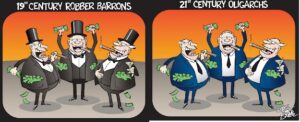
Like the Robber Barons they control politicians through campaign finance and political donations and now untraceable material presents. 

Corruption and bribery used to be old fashioned money, now they just buy you things like Trump’s 747 jet from Qatar.  They communicate and coordinate through private financial networks and the internet. Global institutions and elected leaders are secondary and just need to be controlled. Only a few billionaires control companies valued in the trillions of dollars. They now function not just as market giants, but as global power houses with direct lines into governments, militaries and central banks. These billionaires, decide on infrastructure development, defense spending, Artificial Intelligence, AI regulation and digital surveillance.  

Oligarchs like Elon Musk, Mark Zukerberg and Jensen Huang, routinely engage with heads of state, lobby for industry specific policies and in some cases get government contracts worth billions.  Their power extends far beyond shareholders and consumers. They use their power to shape which laws are made, eliminate regulations which are not favorable to them, determine how technologies are deployed and which civil liberties are allowed or are suspended in times of a declared emergency.

Canadian Oligarch influenced provinces 

Canada is often viewed as a bastion of stability but is still vulnerable to Oligarch control. 

Canada is home to 67 billionaires (Forbes 2024) who have a combined net worth of $314.4 billion. 

Several of these billionaires maintain deep and longstanding relationships with political institutions at the federal and provincial levels. One of the most prominent examples is the Weston family, owners of the Loblaws empire.  

During the COVID-19 pandemic, Loblaws received a $12 million federal grant to upgrade its refrigeration systems. The grant was given just months after company executives hosted Liberal Party fundraisers. This came after the Westons had already reported record profits. 

This begs the question, why were public funds given to a corporation with record profits and huge cash reserves?  

The relationship between corporate leaders was exposed showing how preferential access and policy making was made quietly with no public scrutiny behind closed doors. East to west in Canada.

New Brunswick and Nova Scotia 

The Irving family holds an iron grip on energy, forestry, ship building and the media. For decades they have had powerful influence over the governments of New Brunswick and Nova Scotia.  

The clearest example was the federal government’s decision in March 2025 to award a $22.2 billion contract worth $8 billion in the first 6 years to Irving ship building in Halifax to revitalize Canada’s navy.  

By not taking bids and eliminating competitors has caused public concern about fairness and transparency.  The Irving’s control most of the newspapers in this region, allowing them to shape public opinion and suppress criticism of their business activities. Their power is entrenched in provincial politics and the media. 

Quebec

The Desmarais family, which controls the Power Corporation of Canada, has played a quiet but decisive role in shaping national leadership. Former Prime Minister Jean Chrétien, former Quebec Premier Jean Charest, and former Ontario Premier Bill Davis were closely linked to the Power Corporation, either through personal associations or direct advisory roles. 

The family’s influence has often been exercised through elite networks rather than overt lobbying. Yet it has helped shape economic policy, regulatory approaches, and trade decisions. The Desmarais example illustrates how elite families can embed themselves so deeply into the political establishment that their interests become indistinguishable from national policy.

Ontario 

On Ontario Premier Doug Ford’s side, the dominant voices are the GTA land kings. 

Silvio De Gasperi’s TACC Group and Michael Rice’s Rice Group both maxed out donations almost the moment Ford quietly doubled Ontario’s contribution limit. 

Their freshly purchased Greenbelt land parcels miraculously rezoned, which created $3.2 billion in value for developers with the stroke of a pen. 

The Cortellucci and Di Poce families did the same dance around Highway 413. Big cheques were given at fundraisers followed by a provincial route that now cuts straight through their land banks. 

The Thomson clan keeps Ford’s media weather sunny through the Globe and Mail while topping up “Ontario Strong” ad campaigns. 

Westons and Sobeys quietly max their annual donations in exchange for Ottawa’s grocery profit probe dying on a dusty shelf. 

Retail property giants such as Smart Centers and the Real Estate Investment Trust lobby are there too. 

Their executives and spouses write personal cheques and in return get fast tracked eviction courts and zoning sweeteners for big box infill.

The Rogers family has long used its telecommunications empire to advance regulatory positions favorable to its business model. The family’s internal conflicts even drew national headlines, particularly after efforts to influence board decisions and executive appointments spilled into public view. While these events were covered as corporate drama, they also revealed the Rogers’ ability to affect political agendas and media narratives, given their ownership of broadcasting platforms. 

Political parties have repeatedly courted their favor, knowing that telecom legislation, spectrum allocation, and media regulation are all tied to the family’s corporate interests. Ford’s Bill 5 gives the power to the Premier to set up “special economic zones” completely regulation free zones. Free from any environmental, labor laws and regulations or municipal bylaws protecting the public interest. A free for all for Ontario’s oligarchs to increase profits. 

Alberta

Premier Danielle Smith’s ties to Alberta’s energy elite are not just ideological, they are structural. 

Her premiership is tightly entangled with oil and gas lobbyists and corporate funded think tanks like the Alberta Enterprise Group, the Manning Centre, and right-wing advocacy outfits like the Canadian Taxpayers Federation. 

Her United Conservative Party (UCP) operates as a political instrument of Alberta’s fossil fuel sector, aggressively defending oil sands development and pushing back on federal emissions standards, carbon pricing, and environmental, social, and governance frameworks. 

Danielle Smith, answers first to billionaire Murray Edwards, who chairs Canadian Natural Resources and co-owns the Calgary Flames. 

Murray hosts private, $500 a plate dinner, keeping the UCP’s quarterly filings flush. Murray, then collects a $330 million public subsidy for his new arena and tailor-made carbon capture tax credits. 

The CEOs of Cenovus, Suncor, and Imperial follow a similar pattern, executive donations and third-party ad buys that coincide with royalty breaks, methane regulations pushed to never never land, and a freeze on new renewables. 

Pipeline majors like TC Energy and Enbridge channel their influence through what insiders jokingly call the “pipeline caucus,” securing seats on “red tape” reduction panels and directive laden mandate letters for Alberta’s energy regulator.  

The attack ad ecosystem winds up with dark-money groups such as Alberta Proud and Buffalo PAC, which spread memes the party cannot legally run itself, because the corporate ban cap sits at $4,300 in Alberta. 

This amount is small enough to skirt scrutiny and big enough to keep ministers’ direct lines open. Like Jason Kenny before her, Smith has framed environmentalists and climate scientists as “enemies” of Alberta’s prosperity. Smith’s proposed Alberta Sovereignty Act, aimed at nullifying federal laws she deems hostile to Alberta’s interests, is widely seen as legal cover for refusing federal environmental regulations. 

Behind this are some of the most powerful families and energy corporations in Canada, CNRL, Suncor, Cenovus, and others who not only bankroll political campaigns but shape public messaging through slick simulated support populism and media surrogates like Rebel News.

The alignment between Smith’s rhetoric and the far-right populist ecosystem antivax, anti-Ottawa, anti-World Economic Forum is not coincidental. It mirrors a global trend where extractive industries back hyper nationalist movements to block environmental reforms and consolidate regional power under the guise of defending “working class freedom.”

A few dates tie the pattern together. In February 2021, Doug Ford doubled the individual donation ceiling. Within a year, more than 70 percent of Progressive Conservative cash came from cheques over a thousand dollars. 

By November 2022, the now infamous Greenbelt land swap leaked, and assessments on the developers’ holdings jumped eight-to-ten-fold overnight. Now again in November 2025 Ford raised the maximum yearly contribution rate from $3,400 to $5,000. This makes Ontario very much like the wild west contribution situation in Saskatchewan. 

In April 2023 Smith green-lights Edwards’s arena deal, offloading a third of a billion dollars onto Alberta taxpayers. Through the first half of 2024, almost three-quarters of United Conservative Party donations came from postal codes along the energy corridor, coinciding neatly with methane rule loopholes left untouched and yet more subsidies for carbon capture and storage. Tobacco companies worried about their profits when it became clear cigarettes were killing people by cancer, made filtered cigarettes claiming filters reduced the risks of smoking. Now, that it could not be clearer that oil is the major cause of the climate crisis, oil company executives who are very worried about their profits, came up with the carbon capture and storage propaganda campaign, ripping off the public purse to do it.

Saskatchewan

In a cast of characters across Canada who are controlled and influenced by wealthy corporations, Scott Moe, premier of Saskatchewan looks to be one of the most extreme. 

The province’s complete lack of campaign contribution regulations has made it one of the worst jurisdictions in Canada.  

Since 2018, the Saskatchewan party has raised over $6.7 million in corporate donations from corporate landlords and oil and gas companies, as well as financial firms and the largest landowner in the province. Many contributions have come from Alberta, Ontario and Manitoba.  

Saskatchewan is one of the only provinces that has no donation limits and no provincial residency rules, sending a very strong message to business that public policy is open to the highest bidder. 

In a regulatory race to the bottom, fresh disclosures show corporations kicked in $1.6 million during the 2024 election year, equal to 70 per cent of all corporate donations’ province wide. Top cheques came from heavy construction (Kelly Panteluk), equipment dealers (Redhead), and Brandt Industries, the same family empire that hosts private fundraisers for Pierre Poilievre. 

Out of province interests can double contribute, make a corporate contribution, then a personal one from every director at the same address. Reformers call it “the Wild West”; the business lobby just calls it Tuesday. 

The Moe government on behalf of his corporate supporters is pushing hard against Ottawa’s clean electricity standards and is extending the life of coal power plants to provide affordable and reliable base load power to Saskatchewan residents.  Scott Moe wants to repeal the oil and gas emissions cap to create investment certainty and secure the supply of Canadian energy products.

Next up is Part Five “World’s Biggest Oligarchies and Far Right Networks the Oligarch Infantry.”

The post The Oligarch Chronicles Part 4 appeared first on rabble.ca.

❌
Subscriptions