Brazil’s central bank on Wednesday cut the Selic benchmark rate from 15% to 14.75% a year, marking the first reduction since May 2024 and the formal start of an easing cycle that policymakers had already flagged. In its statement, the Monetary Policy Committee, or Copom, said the move was consistent with its strategy to bring inflation back to target and noted that the external environment had become “more uncertain” because of the intensification of geopolitical conflicts
Brazil’s central bank on Wednesday cut the Selic benchmark rate from 15% to 14.75% a year, marking the first reduction since May 2024 and the formal start of an easing cycle that policymakers had already flagged. In its statement, the Monetary Policy Committee, or Copom, said the move was consistent with its strategy to bring inflation back to target and noted that the external environment had become “more uncertain” because of the intensification of geopolitical conflicts in the Middle East.
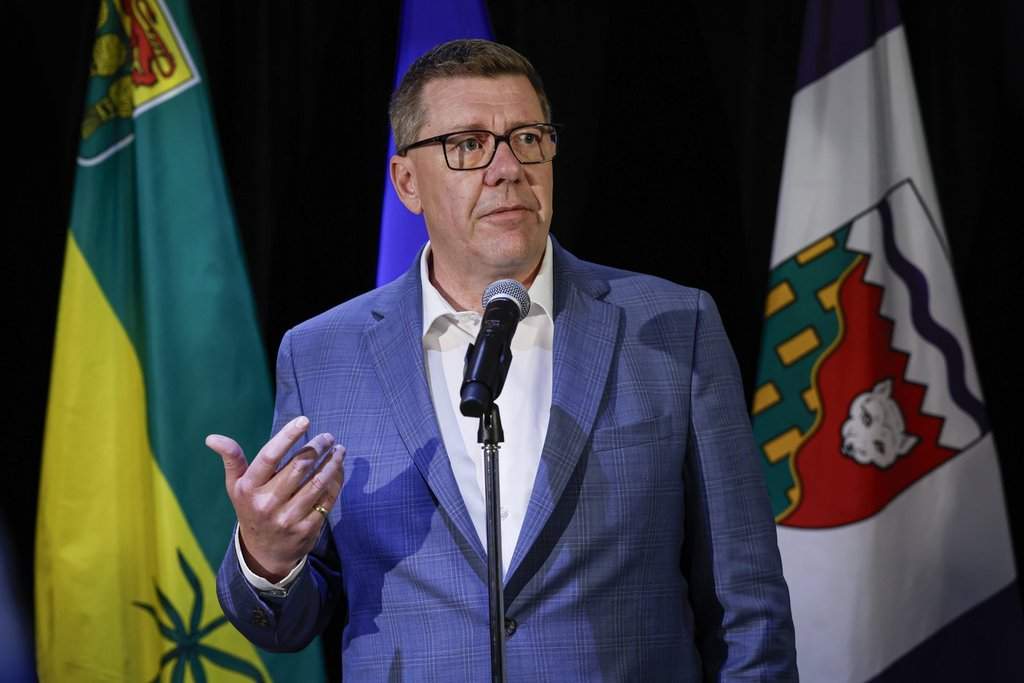
Saskatchewan's Realtors' association is reporting mounting supply pressures and all-time-high benchmark prices for cities across the province last month.
Saskatchewan's Realtors' association is reporting mounting supply pressures and all-time-high benchmark prices for cities across the province last month.
The federal government is set to release an AI strategy this week. It's expected to call for building a foundation for Canadian sovereign AI as one of its six pillars.
The federal government is set to release an AI strategy this week. It's expected to call for building a foundation for Canadian sovereign AI as one of its six pillars.
With India no longer featuring a single company among the world's top 100 firms, the Congress on Tuesday launched a sharp attack on the Narendra Modi government, alleging that foreign investors were losing faith in Indian markets and warning that continued economic weakness could deepen unemployment and hurt businesses across sectors.In a post on X, the party said the absence of any Indian company from the global top 100 reflected what it described as the impact of the Centre's economic policies
With India no longer featuring a single company among the world's top 100 firms, the Congress on Tuesday launched a sharp attack on the Narendra Modi government, alleging that foreign investors were losing faith in Indian markets and warning that continued economic weakness could deepen unemployment and hurt businesses across sectors.
In a post on X, the party said the absence of any Indian company from the global top 100 reflected what it described as the impact of the Centre's economic policies. The Congress alleged that major foreign investors were withdrawing money from Indian markets and claimed that confidence in the government's economic management had weakened.
Describing the development as “very bad news” for the economy, the party warned that if current trends continued, unemployment could worsen, companies could face mounting losses and job opportunities could decline further.
“Foreign investors have lost faith in the Indian stock market. Major foreign investors are pulling money out of the Indian market. Investors no longer trust the Modi government,” the Congress said in the post.
The party further alleged that economic and foreign policy failures had contributed to the situation and claimed that timely intervention by the government could have prevented the deterioration.
“India no longer has a single company in the world's top 100 companies,” it said, adding that the country's economic challenges reflected deeper policy shortcomings.
The government had not immediately responded to the allegations.
दुनिया की टॉप 100 कंपनियों में अब भारत की एक भी कंपनी नहीं है।
जी हां.. नरेंद्र मोदी की घटिया आर्थिक नीतियों ने अर्थव्यवस्था का ऐसा कबाड़ा किया है कि
⦿ भारतीय शेयर बाजार से विदेशी निवेशकों का भरोसा उठ चुका है ⦿ बड़े विदेशी निवेशक भारतीय बाजार से पैसा खींच रहे हैं ⦿ मोदी… pic.twitter.com/G3tmgFQ2IA
समाचार : दुनिया की सबसे बड़ी 100 कंपनियों की सूची में अब भारत की कोई भी कंपनी नहीं बची है।
ये है भाजपा की भ्रष्टाचारी आर्थिक नीतियों का दुष्प्रभाव। भाजपा की कमीशनख़ोरी ने हर कंपनी को कमज़ोर किया है, जिसकी वजह से कच्चे माल से लेकर तैयार माल तक कृषि और औद्योगिक उत्पादन बुरी तरह…
SP president and former Uttar Pradesh chief minister Akhilesh Yadav also criticised the government's economic policies, alleging that corruption and commission-based practices had weakened businesses and affected production across multiple sectors.
In a post on X, Yadav claimed that agriculture, manufacturing and industrial activity had suffered, adversely impacting sectors ranging from banking and insurance to information technology, transportation, textiles, healthcare and consumer goods.
“This is the adverse impact of the BJP's corrupt economic policies,” Yadav alleged.
He further claimed that inflation had reduced market demand, leading to slower production and job losses, while unemployment had risen sharply over the past decade.
Yadav also alleged that insufficient government recruitment, rising fuel prices and weaknesses in foreign policy had compounded economic challenges. He criticised the implementation of GST (Goods and Services Tax), alleging corruption and administrative inefficiencies.
Political sparring over economy
The remarks come amid continuing political debate over employment generation, inflation, manufacturing growth and investment trends.
While opposition parties have accused the government of failing to generate sufficient jobs and strengthen domestic industry, the Centre has repeatedly maintained that India remains one of the fastest-growing major economies in the world and has highlighted infrastructure expansion, manufacturing incentives, digitalisation initiatives and welfare programmes as key drivers of growth.
The government had not issued an immediate response to the latest allegations made by the Congress and the SP.
No Indian company in world's top 100, Congress and SP target Centre over state of economy
Speaking to members of the Indian diaspora at The Hague in mid-May, Prime Minister Modi said the war in West Asia can overturn the gains of the Indian economy in the past decade. Mass poverty could return, he warned, while listing the shocks of the COVID-19 pandemic, the ongoing wars and the global energy crisis. To meet these challenges, he continued, India needs resilient supply chains, and conservation of energy must be seen as a national duty. Readers might remember similar exhortations duri
Speaking to members of the Indian diaspora at The Hague in mid-May, Prime Minister Modi said the war in West Asia can overturn the gains of the Indian economy in the past decade. Mass poverty could return, he warned, while listing the shocks of the COVID-19 pandemic, the ongoing wars and the global energy crisis.
To meet these challenges, he continued, India needs resilient supply chains, and conservation of energy must be seen as a national duty. Readers might remember similar exhortations during the demonetisation of November 2016.
No doubt, the pandemic was not of India’s making nor the current supply shock due to the closure of the Strait of Hormuz. Both adversely impact the economy, especially the unorganised sector. But all was not well with the economy before these shocks came.
Government policies have privileged the organised sector at the expense of the unorganised sector since 2014. As a result, the capital and energy intensity of the economy has risen and so have unemployment and inequality. The health of the Indian economy has increasingly depended on the organised sector, which employs a meagre 6 per cent of the work force. Even a small change in their fortunes and actions produces a disproportionate impact on the economy.
The black economy generated by the well-off and the organised sector has resulted in poor governance and policy failure and the flight of capital has created a shortage of capital and a loss of foreign exchange leading to a weak balance of payments. The corrupt rich hold hundreds of billions of dollars abroad that are not available to the national economy — and the prime minister has to make appeals for austerity and to conserve foreign exchange.
India’s economic data is suspect. This is partly due to the black economy but also for methodological reasons. The national GDP is overestimated; inflation is underestimated. The government’s default setting is to paint a glowing picture without bothering to remedy underlying weaknesses, which gets exposed in times of crisis.
****
The supply shock due to closure of the Strait of Hormuz is aggravating the underlying weakness of the economy and impacting it hard. The unorganised sector is reeling from forced cutbacks in production, declining incomes and rising unemployment. The all-round rise in prices has hit their purchasing power. The official CPI inflation of 3.5 per cent does not reflect the reality of the poor — it fails to account for the black market, which takes effective inflation up to 30-40 per cent.
The depreciation of the rupee vis-à-vis the dollar — more than 5 per cent in 75 days and a steep annual rate of 24 per cent — also impacts the poor because it jacks up prices of imported essentials like fertilisers. The sharp decline in the rupee is related to capital leaving India, which in turn is due to waning confidence in the Indian economy.
From Rs 83.28 to a dollar in May 2024, the exchange rate is now Rs 96 and rising. The rupee has dropped 15.2 per cent in two years. Thus, the return on investment in India, measured in dollar terms, has fallen sharply. Whereas the US stock market has risen sharply on the back of technology stocks, Indian tech companies are under pressure from AI-led displacement. So, foreign capital (including NRIs) is pulling out of India.
Further, since the rupee is declining, exporters are delaying bringing back proceeds while importers are importing more. Both these reduce India’s dollar holdings. Remittances are also impacted as workers in West Asia lose jobs and return to India.
Free market economists argue that the decline in the rupee is market-driven and the RBI shouldn’t defend the rupee. This argument is flawed. Speculators take advantage and make money by beating down the currency further. Also, free markets are not really free; they are dominated by monopolies and big players.
A rapid decline in the value of the rupee can set off a chain reaction, like the Southeast Asia Contagion, which led to the collapse of the booming Thai economy in 1997-98. India also faced a similar predicament between 1988 and 1991.
The foreign investment saga
Foreign investors have been leaving India since late 2024. It is argued that they need to be lured with more concessions. But, as stated above, they are leaving because they see better returns in the US vis-à-vis India.
But why is this such a big worry? In gross terms, it is 8 per cent of the total investment in India and in net terms, less than 1 per cent. Also, if India could stop the flight of domestic capital linked to its black economy, it would have no forex shortage.
Internal investment is 99 per cent of the total, and the real cause for worry is the inadequacy on this count. Low internal investment is linked to low capacity utilisation, due to inadequate demand, triggered by growing inequality. So, action is needed to reduce inequality via redistribution of income through taxation and employment generation, rather than more concessions to capital, as business economists suggest.
For them, reform means concessions to businesses whereas what is required is more employment generation in the unorganised sector. Foreign capital will only come to the organised sector and will hardly generate new (net) employment given its use of high technology. It will further marginalise the unorganised sector and reduce employment generation.
The unorganised sector constitutes a huge potential internal market — much larger than the external markets. This sector is so poor and unemployed that if it gets work, incomes will get a boost as will demand. Whatever is exported, like textiles, leather goods, food items, could also be sold in India if people had incomes. So, a drastic rethink is required.
Advanced countries are onshoring capital to shorten supply chains and boost employment. Trump is exhorting businesses and bullying allies to invest in the US. Trade won’t solve India’s problems, given that we lack the technology to compete. India must look inwards and onshore capital. Why is Mr Ambani investing $300 billion in the US and not in India?
Need for a strategy reset
There is no escaping the impact of supply shocks on production and prices. It is uncertain how long the Strait of Hormuz will remain closed and these effects may persist or worsen. The economy will be constrained by shortages and production will take a hit. India can only plan to minimise the impact, especially on vulnerable sectors.
Essential consumption must be maintained, otherwise inflation will shoot up and there will be social disruption. Inessential consumption — unnecessary travel and tourism, the five-star life, social waste — can be curtailed.
Economically, this will be less disruptive. Reduced inessential consumption will save both forex and energy, which can be redirected towards essentials. Employment, incomes and demand will inevitably be hit, and workers in affected sectors will need support.
Investment is likely to decline due to cutbacks in production, uncertainty and excess capacity in various sectors. But public investment in essentials, the social sector and welfare for the marginalised must be maintained.
****
The government has dithered for close to 90 days since the 2026 edition of the Iran war began on 28 February. Knee-jerk policies might lead to runaway inflation and a total loss of control over the direction of the economy. Mass poverty never went away, Mr Prime Minister, but it can certainly get worse with bad policy moves. Instead of asking India’s precariat to brace for the worst and prepare to make more sacrifices, consider a targeted appeal to the 3 per cent well-off Indians with their hoards stashed abroad and a five-star lifestyle.
Arun Kumaris a renowned economist and author most recently of Indian Economy’s Greatest Crisis: Impact of the Coronavirus and the Road Ahead. Get more of his writing here
Brazil’s Central Bank following its two days meeting 28–29 April of the Monetary Policy Committee (COPOM) announced the reduction of its SELIC rate by 25 basis points to 14.50%.
Brazil’s Central Bank following its two days meeting 28–29 April of the Monetary Policy Committee (COPOM) announced the reduction of its SELIC rate by 25 basis points to 14.50%.
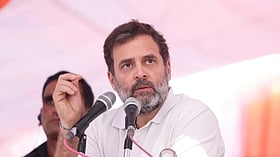
Congress leader and Leader of Opposition in the Lok Sabha Rahul Gandhi on Saturday attacked the Narendra Modi government over the economic hardships faced by autorickshaw drivers, alleging that rising inflation and stagnant incomes had pushed millions of working-class families into distress.The Congress leader made the remarks while sharing a video on X of his interaction with autorickshaw drivers in Delhi a day earlier.Quoting one of the drivers he met, Gandhi said: “‘We have been ruined and th
Congress leader and Leader of Opposition in the Lok Sabha Rahul Gandhi on Saturday attacked the Narendra Modi government over the economic hardships faced by autorickshaw drivers, alleging that rising inflation and stagnant incomes had pushed millions of working-class families into distress.
The Congress leader made the remarks while sharing a video on X of his interaction with autorickshaw drivers in Delhi a day earlier.
Quoting one of the drivers he met, Gandhi said: “‘We have been ruined and there is no one to listen.’ An auto-rickshaw driver shared this sentiment over lunch yesterday. In that single sentence lay the entire story of millions of poor people across the country.”
Using a driving metaphor, Gandhi said the economic condition of workers had deteriorated sharply.
“The income meter has ground to a halt. The brakes on inflation have failed. And the government — the very entity meant to listen — remains deaf,” he said.
The former Congress president alleged that rising costs were affecting every aspect of daily life for working families.
“From CNG to LPG, from children's education to medical treatment, and from milk to cooking oil — every rising rupee deals a direct blow to their budgets and their kitchens,” he said.
Taking aim at the Prime Minister, Gandhi said that while inflation continued to rise, people were receiving little relief.
“Amidst this soaring inflation, Modi-ji offers a piece of advice: ‘Use public transport.’ Yet, the very people who constitute the backbone of public transport are today crumbling under the crushing weight of rising prices,” he said.
He added that uncertainty over basic survival had become a daily reality for many families.
“Today, alongside the ‘roti’ and ‘dal’ on their plates, there lies a haunting question: ‘Where will tomorrow’s meal come from?’” Gandhi said.
The remarks came a day after Gandhi met a group of autorickshaw drivers at Todarmal Park in Delhi’s Bengali Market area.
During the interaction, the Congress leader listened to drivers describe the challenges of earning a livelihood amid rising costs and assured them that he would raise their concerns in Parliament.
Photographs and videos shared by the Congress showed Gandhi wearing an autorickshaw driver's uniform, interacting with drivers and their families, taking selfies with children and sharing a meal with the workers.
After the interaction, he was seen leaving the venue in an autorickshaw.
Rahul Gandhi demands Dharmendra Pradhan’s removal over NEET-UG paper leak row
Dollar General is refocusing on the price point that inspired its name. The discount retailer will offer 2,000 items for sale for $1 or less, CEO Todd Vasos said in an earnings call this month.
Dollar General is refocusing on the price point that inspired its name. The discount retailer will offer 2,000 items for sale for $1 or less, CEO Todd Vasos said in an earnings call this month.
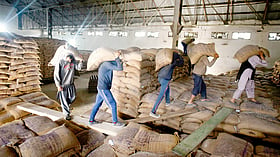
The concentration of grain storage in the hands of Adani Agri Logistics and Leap India Food & Logistics Private Ltd heralds an alarming shift for Indian agriculture, transforming it from a decentralised, largely state-run model into a corporate-run entity.By cleverly removing the anti-monopoly clause that formed an integral part of the Food Corporation of India’s (FCI) silo modernisation programme, the government has awarded 110 of 134 contracts to the two companies to store and manage Rs 16
The concentration of grain storage in the hands of Adani Agri Logistics and Leap India Food & Logistics Private Ltd heralds an alarming shift for Indian agriculture, transforming it from a decentralised, largely state-run model into a corporate-run entity.
By cleverly removing the anti-monopoly clause that formed an integral part of the Food Corporation of India’s (FCI) silo modernisation programme, the government has awarded 110 of 134 contracts to the two companies to store and manage Rs 16,500 crore worth of grain.
The enormity of this allocation can be understood from the fact that 46.5 lakh metric tonnes (LMT) out of the total planned storage of 60 LMT will now be handled by Adani and Leap India (known to be financed by powerful private equity funds including the UK-backed Neev Fund and the Danish SGD Fund).
The partnership involves the construction of 200 new steel silos, the bigger hubs connected to railway lines and the smaller ones at procurement centres near farms. The estimated cost of land is between Rs 6,000 and 8,000 crore; the cost of building the silos between Rs 15,000 and 20,000 crore.
While in the short run, the government ‘saves money’ on the price of land acquisition and construction, in the long-term, the PPP model costs the public dearly. The FCI and the government could have completed the project at a cost of Rs 45,000 crore. Under the PPP model, at the rate of Rs 4,000 crore per annum for storage and handling over a 30-year period, the damages are Rs 1.2 lakh crore.
As critics point out, under the garb of ‘modernising’ our food chain, the Modi government is now practically underwriting private profit.
What makes it all the more alarming is that FCI had initially proposed an anti-monopoly clause as a safeguard against precisely such concentration. A crucial document from the PPP Appraisal Committee (PPPAC) files shows the NITI Aayog and the department of economic affairs altered the tender architecture.
The most important change was not just the deletion of the anti-monopoly clause, it was the deliberate move towards bundled bidding. The larger the bundle, the greater the financing requirement. The practical effect of this arrangement is that a Rs 3,000-4,000 crore bundle cuts out mid-sized warehousing firms.
“This signals the end of India’s food security and the annihilation of our public distribution system (PDS) which will now be dependent on this duopoly,” warns Aflatoon, social activist and member of the Samyukta Kisan Morcha. (Under the National Food Security Act, India’s public distribution system reaches around 81.35 crore people every month, making it the largest welfare programme in the world.)
****
By taking this ‘momentous’ decision, the government has reintroduced the three contentious farm laws to privatise agricultural marketing. While the government officially claims it will continue to procure rice and wheat under Minimum Support Prices (MSP), doubts prevail.
Farmers are more than worried. They point out that controlling the storage network would enable the Adani Group — already engaged in the procurement, import and export of foodgrains — to control the supply chain. This could depress the MSP to the advantage of private players.
Farmers see this as a step toward privatising food security, echoing their earlier protests against the farm laws. With Adani and Leap India controlling nearly 80 per cent of silo capacity, farmers will have fewer options, making them vulnerable to any terms set by the duopoly.
Traditionally, the FCI procures rice and wheat directly from farmers at MSP. With private players running silos, procurement is likely to shift to them. Corporates are likely to influence procurement terms, potentially squeezing margins.
Farmer unions argue that once storage and logistics are privatised, the state’s bargaining power will weaken and may reduce FCI’s own procurement footprint, indirectly undermining MSP. FCI has a regulated system for timely payments. Private players may not be bound by the same strict rules, raising concerns about delays, disputes and dispute redressal.
****
Corporate control of Indian agriculture — driven by agribusinesses monopolising inputs, supply chains and land — poses a severe threat to food security by endangering its four pillars: availability, access, utilisation and stability. Farm leaders contend that the shift from diverse, staple-based cultivation to cash crops (like broccoli, gherkins and other ‘exotics’) combined with volatile pricing will destroy the livelihood of over 160 million farmers.
Prominent farm leader Dr Ashish Mittal, general-secretary of the All India Kisan Mazdoor Sabha, believes there are two objectives behind the 2023 amendment to the Biological Diversity Act, 2002 and the awarding of storage contracts to corporates in 2026. “One, to allow Americans to dump heavily subsidised foodstuff such as soya and corn at rates our farmers cannot compete with, and to capture agricultural land at throwaway rates and hand it over to the builders’ lobby for urbanisation.”
Dr Darshan Pal, anaesthetist by profession, social activist by choice and president of Krantikari Kisan Union in Punjab, believes the entire purpose of the recent move is to ease the way for big landlords to take over agricultural land.
“Already, over the last decade, we have lost four million hectares of farm land (of the 143 million hectares under cultivation). This has caused massive displacement, with peasantry forced to migrate to urban pockets. The government seems to forget that 68.5 per cent of our population lives in villages. The Periodic Labour Force Survey (PLFS) accounts for only those workers who have actively applied for jobs. But there is a multitude who have not applied and are therefore not included in the PLFS. Even our PDS system is based on the last Census. I believe one-third of the requirement for subsidised grain is not being met,” Dr Pal said.
Rural households consume about 14.5 kg of cereals and pulses per month, but pulse intake remains far below nutritional requirements. While a minimally nutritious diet recommends 85 g of pulses per person per day, rural households consume only 0.46 kg per month in Rajasthan and 0.35 kg per month in Manipur.
It is obvious this government has no interest in sustaining our agricultural sector. India’s corporate debt has grown to $645 billion which works out to almost 17 per cent of our GDP. But the cost of urea is something the government has done little about (apart from claiming to provide a 90 per cent subsidy for every bag of urea sold in the country.) “Buying oil from Iran would bring down the cost of urea,” maintains Dr Darshan Pal. “The price of 45 kilos of urea is Rs 265 per bag but it is not available at even Rs 400 per bag.”
Yudhvir Singh, general-secretary, Bharatiya Kisan Union, says that once corporates are allowed to buy directly from farmers, the mandi system and the support farmers received from arhtiyas (traditional commission agents) will be destroyed: “Mandis have supported farmers through centuries. Now they will have no role.”
Singh cites the example of Adani Agri Fresh practically taking over the apple market in Himachal Pradesh by forcing smaller orchard owners to accept lower rates. These apple farmers have protested against the government’s free trade pacts with countries like New Zealand and the US. If imported apples flood the domestic market, the livelihoods of over 15 lakh farming families in the state will be threatened.
“We have no choice but to fight. We are planning to meet in mid-June to see what strategy we can evolve to take on the government,” Singh added.
Vijoo Krishnan, general-secretary of the All India Kisan Sabha (AIKS) has demanded an immediate reinstatement of the ‘anti-monopoly’ clause and a cap on any single corporate group’s share of silo capacity.
The AIKS has also demanded an inquiry by a joint parliamentary committee into the role of the PPPAC in eliminating the anti-monopoly and other clauses that would have prevented market concentration. Strengthening the FCI’s own storage capacity through public investment, rather than wholesale handover to corporate monopolies is, he says, the need of the hour.
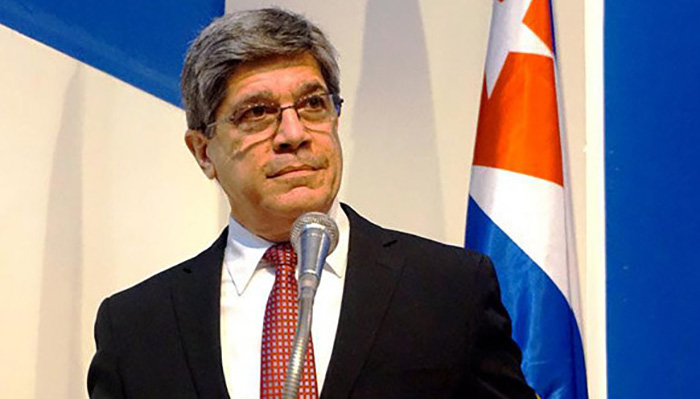
In a post on Facebook, Cuban Deputy Foreign Minister Carlos Rafael Fernández de Cossío Domínguez remarked that the rise in electricity generation and the relative reduction of power outages in recent days reveal the impact of the oil blockade imposed by the United States.
Read More ...
In a post on Facebook, Cuban Deputy Foreign Minister Carlos Rafael Fernández de Cossío Domínguez remarked that the rise in electricity generation and the relative reduction of power outages in recent days reveal the impact of the oil blockade imposed by the United States.

 Login
Login


 Brazil’s central bank on Wednesday cut the Selic benchmark rate from 15% to 14.75% a year, marking the first reduction since May 2024 and the formal start of an easing cycle that policymakers had already flagged. In its statement, the Monetary Policy Committee, or Copom, said the move was consistent with its strategy to bring inflation back to target and noted that the external environment had become “more uncertain” because of the intensification of geopolitical conflicts in the Middle East.