The global energy system is changing in two big ways: it is moving from centralized fossil-fuel generation to distributed renewables, and it is becoming more digital in how energy is measured, traded, and optimized. Steve Wilhite, Executive Vice President of Advisory Services at Schneider Electric, works at the intersection of these complementary yet challenging transitions. Schneider supports more than 40% of the Fortune 500 with energy procurement and sustainability strategies, managing over
The global energy system is changing in two big ways: it is moving from centralized fossil-fuel generation to distributed renewables, and it is becoming more digital in how energy is measured, traded, and optimized. Steve Wilhite, Executive Vice President of Advisory Services at Schneider Electric, works at the intersection of these complementary yet challenging transitions. Schneider supports more than 40% of the Fortune 500 with energy procurement and sustainability strategies, managing over $50 billion in annual energy spending. His experience shows something that pledges and press releases often miss: the biggest challenge for corporate sustainability is not money, technology, or political will. The real issue is the gap between ambition and the ability to deliver. Companies are making Science-Based Targets commitments faster than they are building the infrastructure to meet them. Scope one and two emissions are being managed better, but scope three emissions, which come from a company’s supply chain, still present a systems problem that no single company can solve alone. Schneider’s zero-carbon supplier program suggests what it takes to close this gap. When the company started its own effort to cut emissions from its top 1,000 suppliers by 50% in five years, all 1,000 signed up within two weeks. However, about 84% of them did not fully understand what they had agreed to. Achieving success meant creating measurement tools, education programs, and action plans to help the whole ecosystem, not just individual companies.
Executive Vice President of Advisory Services at Schneider Electric, is our guest on Sustainability In Your Ear.
This critical conversation explores how renewable energy is bought, including the difference between physical and virtual power purchase agreements. Steve also explains why the Power Purchase Agreement (PPA) market became more complex as it grew, and why 10% fewer renewable deals closed in 2025 compared to 2024, as tech companies used up available clean energy. He also addresses a key question in clean energy: is AI helping the environment overall, or do its energy needs still outweigh its efficiency benefits? Schneider processes over a million energy invoices each month, and about 50,000 of them had issues that took 10 to 15 business days to resolve. Now, a team of AI systems can handle these in seconds. Accurate energy consumption and billing data directly affect emissions reporting, energy efficiency, and money-saving market decisions. He describes Schnieder’s approach as “frugal AI”: using the right-sized models for each task, running them on clean energy, and choosing simple solutions over complex ones. Looking ahead, electrification is building a global digital energy network in which every meter and adjustment contributes to a new system independent of central plants. As intelligence spreads, power can shift to consumers, communities, and businesses. Schneider is enabling this shift by building a mesh grid in which each point both produces and consumes energy, coordinated by AI. These changes fundamentally reshape the global energy landscape. The central question: will we intentionally build this new, distributed system, or will we repeat centralized patterns digitally?
To learn more about Schneider Electric’s sustainability efforts, visit se.com.
Fedora Linuxhttps://fedoraproject.orgFree and open-source Linux distribution developed by the Fedora Project. It was originally developed in 2003 as a continuation of the Red Hat Linux project.#linux that I use on my laptop.#tech #technology #computer #laptop
Free and open-source Linux distribution developed by the Fedora Project. It was originally developed in 2003 as a continuation of the Red Hat Linux project.
Most school uniforms are retired while they are still perfectly wearable. Children cycle through them on a predictable annual schedule as they grow, which sends a steady stream of usable clothing toward the landfill at the same moment families on tight budgets are paying to replace what their kids have grown out of. The waste side of that equation is substantial: the EPA estimates Americans generated about 17 million tons of textiles in 2018, and roughly 11.3 million tons of it was landfilled.
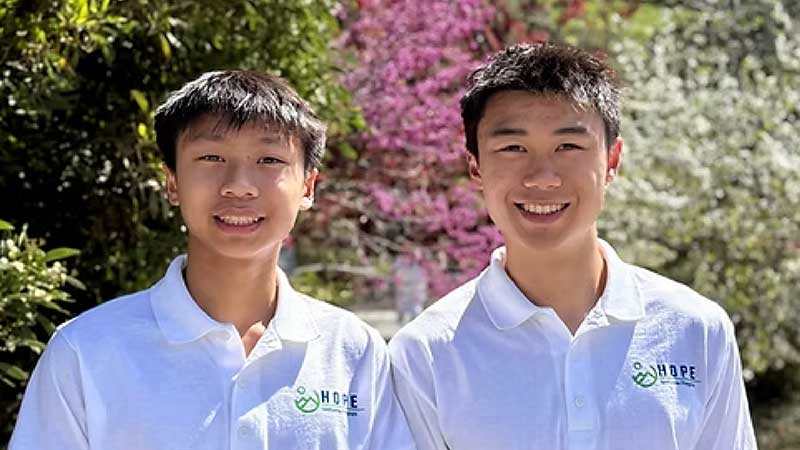
Most school uniforms are retired while they are still perfectly wearable. Children cycle through them on a predictable annual schedule as they grow, which sends a steady stream of usable clothing toward the landfill at the same moment families on tight budgets are paying to replace what their kids have grown out of. The waste side of that equation is substantial: the EPA estimates Americans generated about 17 million tons of textiles in 2018, and roughly 11.3 million tons of it was landfilled. Ethan and Desmond Hua, brothers from San Mateo, California, looked at textile waste and the cost of raising a family and saw a single solvable loop. In 2020, while they were still in middle school, they founded the HOPE Uniforms Program — HOPE stands for Help Our Planet Earth — a student-led nonprofit that collects gently used school uniforms families have outgrown and redistributes them, free, to families who need them. What began in one elementary school, run out of the family garage, now serves about 10 schools across three districts. By the brothers’ count, HOPE has kept more than 14,000 uniforms out of landfills, redistributed over 12,000 of them, and served more than 1,400 households, saving those families an estimated $141,000. On this episode of Sustainability In Your Ear, Ethan and Desmond discuss why reuse sits a rung above recycling, how two teenagers built a multilingual logistics operation with a live inventory system, and what it took to talk Costco into donating 2,000 new uniforms. Ethan’s work has earned him a 2025 Gloria Barron Prize for Young Heroes and a Samaritan House Young Samaritan Award.
Desmond and Ethan Hua, cofounders of the H.O.P.E. uniform reuse program, are our guests on Sustainability In Your Ear.
The environmental case rests on a point that’s easy to miss: the highest-value thing you can do with a garment is keep it whole and in use. What makes HOPE worth attention is the operations as much as the intent. The brothers engineered the return step directly into the model: families request uniforms through a website available in English, Spanish, and Mandarin Chinese; the uniforms are returned when kids outgrow them; and Ethan and Desmond spot-check and reissue them. That return loop, paired with a deliberate decision to treat families as repeat customers who deserve a dependable service, is what converts a one-time donation into a repeating cycle. The approach is also honest about scale — a garage operation in San Mateo County will not move the national textile-waste numbers on its own. The brothers’ wager is replication; Ethan’s dream is HOPE in another garage, and then another, and the model is plain enough for a motivated student in another district to copy. Whether thousands of small local loops can add up to a circular economy is the open question this conversation puts on the table.
Hello. Good morning, good afternoon, or good evening, wherever you are in this beautiful planet of ours. Welcome to Sustainability in Your Ear. This is the podcast conversation about accelerating the transition to a sustainable, carbon-neutral society, and I’m your host, Mitch Ratcliffe. Thanks for joining the conversation today, and it’s one I particularly enjoy — talking to a young person. Well, actually, two of them, making a positive impact.
Textile waste has become one of the most stubborn problems in the American waste stream. Americans throw away roughly 17 million tons of clothing every year, and a great majority of it ends up buried in landfills, where natural fibers slowly decompose and release methane — a greenhouse gas many times more potent than carbon dioxide. Over a century, as things break down in a landfill, clothing is uniquely wasteful, because so much of what gets discarded is still perfectly usable, and it’s simply been outgrown, or it’s gone out of style, or fallen out of someone’s rotation.
And the environmental cost we pay is paid twice: once when a still-good garment is thrown away, and again when a brand-new one is manufactured to replace it, consuming water, energy, and raw materials in the process. And nowhere is that double cost more visible than with children’s school uniforms. Kids outgrow them on a predictable annual cycle, long before the clothing wears out. And for families on a tight budget, replacing a uniform every year is a recurring expense that arrives whether the household can afford it or not.
The result is a steady stream of good clothing headed for the trash and a parallel stream of families struggling to pay for its replacement — two problems that, looked at the right way, turn out to be each other’s solution. And our guests today saw that connection when they were still in middle school.
Ethan and Desmond Hua are the founders of HOPE — H-O-P-E — the HOPE Uniforms Program. HOPE stands for Help Our Planet Earth, a student-led nonprofit that they launched in 2020 in San Mateo, California. The idea was simple: collect gently used school uniforms that families had outgrown and redistribute them for free to families who need them.
What began in a single elementary school run out of the family garage has grown into an operation serving 10 schools across three districts, and to date, HOPE has kept more than 14,000 uniforms out of landfills, redistributed over 12,000 of them back to families, and served more than 1,400 households, saving those families an estimated $141,000 in clothing costs along the way.
The spark, as Ethan has said, was a single moment: a classmate came to school in shorts on a cold day because he couldn’t afford another pair of pants to last until laundry day. And from that, Ethan and Desmond built something with real operational sophistication — an online request system with a live inventory tracker, and a website in English, Spanish, and Mandarin Chinese to reach every corner of his multilingual community. They’ve since secured a donation of 2,000 brand-new uniforms from Costco, and their work has earned Ethan a 2025 Gloria Barron Prize for Young Heroes, a Samaritan House Young Samaritan Award, and coverage on national television.
So we’re going to talk with Ethan and Desmond about what started it all, why reuse is one of the most underrated tools in the sustainability toolkit, and the environmental case for keeping a garment whole and in circulation rather than recycling or replacing it. We’ll dig into how they built a real logistics operation as teenagers and why they made the program multilingual from the start, as well as how they designed it so that asking for help feels routine rather than uncomfortable. And we’ll look ahead at what’s next for HOPE, and what they’d tell any listener sitting on an idea but waiting for money, permission, or someone else to go first.
So, to learn more, visit hopeuniformsprogram.com. That’s all one word, no space, no dash — hopeuniformsprogram.com. And if you’re a teen making a difference for the planet, check out the Barron Prize at barronprize.org. Again, all one word, no space, no dash — barronprize.org — to learn how to enter your work for recognition by the Gloria Barron Prize program.
Can a teenager with a garage, a good idea, and a little persistence really make a dent in two of our most intractable problems at once — textile waste and the cost of raising a family? Let’s find out, right after this.
Mitch Ratcliffe 4:30
Welcome to the show, Ethan and Desmond. Hey, introduce yourselves so people can recognize the difference.
Ethan Hua 4:42
Hi, I’m Ethan. I just graduated as a senior.
Desmond Hua 4:46
My name is Desmond, and I just finished my freshman year at Aragon High School.
Ethan Hua 4:51
And we’re the co-founders of the HOPE Uniforms Program, HOPE standing for Help Our Planet Earth.
Mitch Ratcliffe 4:56
You guys have done some amazing work already, and I just want to start off by — tell me about how this started. You saw a classmate come to school in shorts, and it was a cold day, and he was wearing them because they couldn’t afford a pair of pants until laundry day. What went through your mind, and how did you come to the conclusion, “I can solve that problem”?
Desmond Hua 5:13
Well, I guess what went through our minds was that when we were in elementary school, when we saw our friends, we realized that we outgrow so much clothes ourselves when we grew up, and we wondered, what do we do with them when we outgrow them? So when we went — how do…
Ethan Hua 5:27
…they go?
Desmond Hua 5:28
Yeah, like to—
Ethan Hua 5:29
Narnia. Like, some place.
Desmond Hua 5:33
Yeah. So when we went home, we talked to our parents, and we asked them, where does our clothes go? And they said we used to just throw them away, don’t usually have a better purpose. So me and my brother wanted to give them a new life, something to reuse those uniforms, and so we actually founded HOPE around five years ago.
Ethan Hua 5:54
One of the biggest travesties that we saw in these uniforms is that they’re very reusable, they’re gently used, there’s nothing wrong with them, and it’s a shame that, with this little time that we spent with the uniform, they’re going thrown away — when they’re able to be perfectly used and given a second life. In fact, we tell that these uniforms not only have a second life in them, but a third life and a fourth life as well, and because of that, it just seemed like a shame to be tossed away after one single use.
Mitch Ratcliffe 6:23
You picked the name “Help Our Planet Earth,” but this program obviously does something else. It helps families just as much as the planet. Which did you really feel like was the right focus at the time you launched?
Desmond Hua 6:34
I think the main focus at first was our community, because we, you know, grew up in the elementary school. But then at the same time our mission was also helping the earth, because this cause not only impacted the community, but also took out over 40 tons of textile waste from the landfills — 40 metric tons of textile waste, or 30, 30 metric tons of textile waste out of the landfills. So we wanted to cover both aspects while we’re doing HOPE.
Ethan Hua 7:06
So yes — when we first addressed this problem, the community, it was based on a problem that we experienced, that we witnessed from peers. However, we did act, because we’re Scouts, and we’ve been part of the Scouting program since kindergarten, so we have a lot of sustainability virtues instilled in us, like Leave No Trace principles, and we thought that there’s something we can give back to the environment.
Mitch Ratcliffe 7:33
Clothing reuse, thrift shopping, is a big deal these days. Is clothing reuse gaining traction? Is it becoming cool to say these clothes are being reused? Or is that still a point of resistance in people who you might give a uniform to?
Ethan Hua 7:48
I think that there’s, in the youth, there’s a little disparity, but I guess between the youth and the more grown-up adults. We live — me and Desmond live — 10 minutes away from San Francisco, and some people don’t know this, but San Francisco is one of the thrifting capitals of the nation, and because of that, it’s very trendy. I thrift. A lot of kids love thrifting as a hobby; it’s something fun to do on the weekends, so there’s nothing wrong with thrifting. However, there are certain stigmas surrounding getting used clothes, and it’s understandable.
However, to combat that, what we do is, once we get our donations from the community, we process them, we check them for any rips, stains, tears, make sure they’re gently used. We want these families to have — we want these uniforms to have — many, many lives, not just one life or two. We’re in for the long, the long sustainable impact, long-term impact. Because of that, we check them, and what we pride ourselves in is ensuring that our families are repeat customers.
So we get all our uniforms from families all across the community — we get them from families who no longer need to use their uniforms — so we receive them through donation bins in each of our partner schools’ offices. We drop them off in these wooden bins that we’ve built, and then once we take these uniforms back, we process them, we do the check, as I said. And on our website, a family would request, okay, I need three articles of size-medium white polo tops. And our website is multilingual, because we serve a very diverse customer base across the community, across the Bay Area.
And on these websites we see, okay, this family at so-and-so school needs this amount of uniforms at this size. Let’s go check our inventory — a spreadsheet of all the uniforms we have in our inventory. Currently, we have roughly 2,000; it’s all sitting in our garage. And then we refill this order, we put it in the bag, we drop it off to the school, and these families would receive them. And, say, it’s probably six months down the line, hopefully: they wear the uniforms, they take good care of them, and they outgrow them, and at this point they’re back at stage one. The family goes, “Hey, at least out of four, I have these uniforms that they’ve outgrown — what do I do with them?” And they send it back to us.
So because of that, we want to make sure these uniforms are kept very nice, they’ve been spot-checked, so the families are happy with their services and they will reuse us in the future, thereby forming an eco-friendly cycle — a long-term sustainability impact.
Mitch Ratcliffe 10:31
So, by getting them involved in the return process too, you’re also reinforcing the value of reuse, and that makes it feel more normal to them to get what would, in earlier generations, be described as hand-me-downs. Does that activation of their concern about the planet play a big part in that messaging?
Ethan Hua 10:49
We try to include that message — we do include that messaging in all our announcements. That’s one of our main selling points. However, it’s hard to beat the word “free” when it comes to advertising to the community, especially when it’s across different cultures or languages — Spanish, Chinese, and English. It’s a lot more direct to say, hey, we have free uniforms that are reused through our program, and it’s a really cool benefit that we prevent them from going to landfills. One of our most proud statistics, actually — Des, you might want to share the statistics. Yeah, okay. So the reason why I’m sharing this with you is that, since inception, we have diverted roughly 14,900 garments from landfills and given back out to the community roughly 12,700 uniforms. Desmond, do you want to share our most proud statistics that sprung up from that?
Desmond Hua 11:45
So I think we’ve roughly also helped around 1,400 families, and we’ve also saved families around $140,000 through uniforms, so they don’t have to keep buying uniforms over and over as they grow up. Also, the methane equivalent to carbon emissions is around 3,000 kilograms, and, as I said, the 30 metric tons is saved from the landfills through HOPE’s Uniform Program, and those are some of our proudest statistics.
Ethan Hua 12:16
When we — so this is our message to the community — when we usually talk about HOPE, we mention the 30 to 30,000 methane-equivalent carbon emissions avoided from landfill diversion. So when uniforms reach landfills, what someone might ask is, why are they so harmful to the atmosphere? The answer to that question is that when they sit in these landfills, over time they decompose — first goes the cotton, then go the poly fibers, the plastics — and throughout the years it takes for a uniform garment to decompose, it releases harmful greenhouse gases, such as methane. Especially methane: methane is 20 times more potent than carbon dioxide to our atmosphere, and throughout these many years it just releases more and more of these gases, and it builds up, adding to the greenhouse effect, warming up our planet.
Mitch Ratcliffe 13:08
Both of you have articulated a number of benefits and a number of the concerns that people should be aware of. You mentioned that “free” is the driving force in a lot of this — the messaging, and the reuse generally. When you think about how your generation is growing up in a world where it’s very difficult to be unaware of the environmental consequences of our life, are we beginning to see a change in their relationship with materials like clothing that you see as promising for a more sustainable economy?
Desmond Hua 13:42
I feel like I would say so, because — I think not just here, but around the world — there’s many ways people are trying to find ways to reuse, recycle, and, right, there’s like new methods, and, I guess, new technology now that we’re able to access, to find ways to reduce carbon emissions and make things more eco-friendly.
Ethan Hua 14:07
Just to specify your question — are you asking, is the next generation more willing to reuse?
Mitch Ratcliffe 14:13
More willing to reuse, but also, to what Desmond was just saying — are we also seeing a generation grow up that recognizes they have tools to do things with material that we weren’t able to do before? When I was growing up, there was a garbage can and there was nothing else. Now there’s a recycling bin too. How do you imagine the world will be configured to support what your generation recognizes it needs to do with regard to reuse, with creating a circular economy?
Ethan Hua 14:42
I think, of course, we’re a lot more well-equipped to deal with the climate crisis, and, more importantly, a lot of people are a lot more aware. For example, we know a lot about the textile world because we run a uniform organization. But one thing that we’ve noticed has taken on in the industry is that a lot more fabrics have been developed to become more eco-friendly, such as hemp. Hemp is a little coarse of a fabric, so… very comfortable, but it’s all plant-based. Well, it’s a lot more plant-based than just microfibers and plastics, and it’s very durable as well, and it seems like that could be a possible trend, and something that the textile industry is going towards in the future. So, trends like that — just seeing things like that — it’s very encouraging to see that there are good people concerned about our future and thinking of keeping that in mind.
Mitch Ratcliffe 15:48
So, you’ve run this out of your family’s garage, as you said, but you’ve also built an inventory management system. Tell us about how you learned to run an operation like this, because that’s another key to unlocking the potential your generation has to make a really massive difference in the way the economy runs.
Desmond Hua 16:06
I think, in the beginning, in order to talk to families and reach out to families, we actually had to do a really slow system where we just had to email back and forth. We realized, you know, if we want the operation to grow or to improve, it would require a much more mechanical process. So I think we started to use a spreadsheet, taking everything that came in, managing how much of each uniform we have, roughly, and what we’re giving out. So, like, we have a spreadsheet of our entire inventory, and even when we do orders to give out to families, we keep track of everything we give out. So I think, in order for us to have a mechanical process and to know what we have and how much we can help the families, and remove gas emissions — that’s how the spreadsheet would really help, because it just keeps everything in track.
Mitch Ratcliffe 17:11
So, how do you deliver the uniform once you have that need identified? Is it — you hand it to them, or do they pick it up?
Desmond Hua 17:21
So we actually drop it off at their school’s front office, and they can just pick it up at the school.
Ethan Hua 17:29
We send them an announcement to come pick it up, as well as the school does, to their emails.
Mitch Ratcliffe 17:33
So, is it getting easier with the new tools — the vibe-coding tools and things like that — for you to start to solve some of these problems? Have you explored them?
Ethan Hua 17:42
Oh, yeah. We have automation. We have, like, automated emails to the families that, yes, your order is in queue, it’s coming up, we’re working on it, and we have ways to let them know that, yeah, your order is ready for pickup. And social media is a very great tool for that — we use Instagram. Follow us on our HOPE Uniforms Program Instagram. It’s a very good way to let families know en masse. And one thing that I’d like to add to Desmond’s point: in our journey of collecting uniform orders from families, originally in 2020 when we started this program, we were doing it by email — literally one-on-one email chains, so we’re managing 50 email chains at once, which was very logistically challenging. On top of that, we’re receiving emails not even in English — we’re in Chinese, in Vietnamese, in Spanish — so, using Google Translate, it was just a lot of steps to take to get to the final product of getting the uniforms to the family.
Desmond Hua 18:47
Yeah.
Ethan Hua 18:47
And because of that, we set up this multilingual website to help us address the multilingual, cultural diversity in our community, which was very helpful.
Mitch Ratcliffe 18:57
I guess the question I want to get to before we take a quick commercial break is: do you think the satisfaction that both of you are expressing about the impact you’re having — as well as the satisfaction people have in participating in the program — is the catalyst for jump-starting thousands of local programs to solve thousands of different problems across the country? Like keeping uniforms in circulation, but potentially collecting a lot of other things for reuse?
Ethan Hua 19:23
Is it worth it? Is that your question?
Mitch Ratcliffe 19:24
Is this the kind of thing that can inspire people to solve local problems? Do you have a template here for a solution to jump-starting the circular economy in the many small places it needs to happen?
Ethan Hua 19:38
I think it matters — or, I think true sustainability is very hard to reach. When I hear the word “sustainability” nowadays, I think of words like gourmet and adventure. What do I mean by that? So, if you look at the Merriam-Webster definition of adventure, you see it connotes risk-taking and danger, yet when you go on adventure travel, it’s rarely ever dangerous. And for gourmet — if you eat a gourmet burger at a restaurant, sometimes it’s not even that tasty, yet it’s still labeled as gourmet. Same thing with sustainability. When you hear the word “sustainability” — sustainability buildings, for example — yes, they might be carbon-neutral, yet the process to get these net-carbon-zero buildings, it’s not sustainable, like all the building practices; it takes a lot of energy and resources to get that building to energy perfection, as you could say.
And likewise, in the real world, achieving true sustainability is very, very hard, and clothing is one of these things that we noticed could have a cyclical life cycle, and being able to be reused for these many, many life cycles. Again, we’re long-term impact; it’s something that you could reuse many times, not just one or two. So, yes, I think that we are jump-starting and inspiring a lot of grassroots efforts in achieving these reuse programs. Not everything can be reused, though. However, the idea, and getting it into people’s minds, is, I think, the biggest, most important part.
Mitch Ratcliffe 21:16
And then we’ll start to solve problems. So, this is a great conversation. I want to take a quick commercial break. Folks, we’re going to be right back to continue the conversation.
Mitch Ratcliffe 21:28
Welcome back to Sustainability in Your Ear. Let’s continue the discussion with Ethan and Desmond Hua, who created Help Our Planet Earth, or HOPE — a clothing reuse program that helps teens in need while reducing the volume of textile waste headed for landfill. And Ethan was a 2025 winner of the Gloria Barron Prize for Young Heroes. Ethan, what has that recognition — as well as the Samaritan House Young Samaritan Award that you won — done for the program? Are you getting more attention now?
Ethan Hua 21:55
Yes, we are getting more attention. The biggest thing this exposure has helped us with is that it gives us credibility to talk to new schools, and then it’s just really helpful, because when we first started this program, we started with one school — me and Desmond’s elementary school — and we started by announcing it just to the couple of families at our school, saying that we have this program available, it’d be pretty cool for the environment and for other families, if you could help out. And now, instead, with this exposure to the Gloria Barron Prize and Samaritan House, and our interviews on ABC, NBC — it just helps us a lot, because schools were like, okay, these guys are legit, they’re really in the business of helping the community, they’ll do their job, and they’ve been verified by all these organizations. And because of that, it’s all the easier to spread and make a bigger impact on the community.
Mitch Ratcliffe 22:55
So, how big can this get before you outgrow your garage, and your parents say, “Look, that’s just too many uniforms”?
Ethan Hua 23:02
Well, I would say — I’m not exactly sure about the limit, that’s a good question. Yeah, it’s certainly going to reach a limit, and I think the beauty about HOPE is that anyone can do it. Yes, me and Desmond, we do have backgrounds in scouting, and we have strong sustainability virtues, however, that does not make us that unique, and students like us could take on the program. And in the long term, what I think would be great is if we could spread HOPE to other districts — like, other districts beyond what we can manage — and we’ll have HOPE in another garage.
Desmond Hua 23:47
Yeah.
Ethan Hua 23:48
And then maybe another one. And I think that is what makes HOPE — I think that is the biggest impact that HOPE could have: it’s not, of course, only the environmental impact of diverting uniforms from landfills and saving them from decomposing into the atmosphere, but it’s also putting the idea in other kids’ minds that they could do something as well. And I see a lot of kids in the Bay Area having a lot of reuse programs, like saving food waste, or other service projects in parks. I think that’s very, very powerful — just the fact that you’re doing it, and you’re telling other people about it. It puts the idea in kids’ minds, saying, I could do something like that as well.
Mitch Ratcliffe 24:29
Well, you’re also creating new communities by connecting different lingual groups — you do English, Spanish, Mandarin on the site right now. As you think about the various communities you serve and the reuse challenges that are emerging all around you — the Bay Area being a hotspot for a variety of new trends in the world — how would you use a multilingual website and other services to help people understand what they could do together to solve some of our environmental problems?
Ethan Hua 25:00
So what we like to do is fully contextualize the problem. It’s very important for families to understand that this is an issue, in order for them to fully appreciate their usage of our services. Going back to our number-one most serious statistic — the 30 metric tons of carbon emissions prevented through uniform reuse — we tell families this. We need to fully explain what goes behind that 30 metric tons. So that 30 metric tons represents the 12,700 uniforms that we’ve given back to the community; this represents all the carbon that would have gone into making 12,700 uniforms, but was saved because they used one that was pre-existing. So this carbon waste includes — when we try to calculate a rough estimate — all the carbon used through all the land that it takes to grow the cotton for these uniforms, all the water that was used to grow the cotton, all the pesticides, all the chemical dyes used to dye the uniforms, the energy that goes into making it in the factory, and all the car emissions that are emitted through that, the transportation costs to the store. It’s a long laundry list of all the things that go into making a uniform. Although it’s a lot of carbon going into a uniform, just a rough estimate, it adds up — it does make a really sizable difference when you add up all the 12,000 uniforms. And it’s important to tell the families that, because if they don’t understand what it means to reuse the uniform, then they won’t understand the true impact of their actions, and I want them to appreciate it.
Mitch Ratcliffe 26:48
Well, so that’s really what I’m getting at. Are there other areas where you can see being able to tell that story in a variety of languages, rather than just in English, which shuts out a lot of people, that we could start to activate within many communities a lot of different circular cycles? Not just uniforms, but maybe school supplies that go unused, and so forth. Have you thought about what else HOPE could eventually manage within the circular economy?
Desmond Hua 27:16
Definitely, I think so. Actually, recently I’ve been trying to expand to some schools in San Jose. They actually do especially have a need for uniforms, and seeing that, I think it’s definitely a school that would appreciate getting free uniforms. And seeing that, I think if we showed them the true meaning of what we’re trying to aim for — which is helping, or helping Planet Earth — I think the families would be more willing to, first of all, help with the eco cycle, which is donating back to HOPE, where we can, and then we can give back to them. So it’s like a process. So, but yes, there’s definitely schools around here that would appreciate HOPE.
Mitch Ratcliffe 28:06
Now, Ethan, you’ve said that meaningful change doesn’t take a lot of resources or institutional backing — just an idea and the willingness to act. For someone who’s listening, who has an idea but assumes that they need a lot of money or some permission to get started, what would you tell them?
Ethan Hua 28:23
I remember when me and Desmond started, we were very, very scared talking to adults in that moment, but deep down, we knew what we were doing was good. It was good for the community. It was going to be a benefit for the community and the environment. We didn’t have any doubt about that. Our biggest fear was that, right now, we’re just going to say the wrong thing and embarrass ourselves, but deep down we knew that it was an ultimate good — there’s no way that it couldn’t be an ultimate good for the community. And I think most people do understand: if they’re trying to launch an initiative, and it truly is a net benefit for the community, I think people deep down know what’s good, and I would say, keep pushing on that feeling.
Mitch Ratcliffe 29:21
If a student wanted to start something like HOPE in their own district, where would you point them, so they could take a first step? What did you learn that allowed you to confidently pursue that vision you just described?
Ethan Hua 29:35
It’s like — you want to foster your idea in an environment where you know it will succeed. At first, you always want to start strong, you always want to start in a community where you understand your community 100%. So we started ours in our elementary school. We knew the principal, we spoke Chinese — it was a Chinese-immersion school — so we knew that we could address this community. And I want everyone to address their own community at first. Help your community first, make sure it survives — sorry, let me say, make sure it survives, make sure it grows — until you can expand to other areas that you know can be helped.
Mitch Ratcliffe 30:21
Knowing a community is something that a lot of brands wish they could do, and you managed to get Costco to give you 2,000 new uniforms. How did that relationship emerge, and is that potentially a pointer to the new relationships you could build in order to take HOPE to the next level?
Desmond Hua 30:40
Well, what we did with Costco is, both of us actually reached out to the CEO, Ron Vachris, and we asked him if, in our local Costco area, they had any extra uniforms they could possibly donate to us.
Mitch Ratcliffe 30:57
Wait — so you sent an email to the CEO of Costco?
Desmond Hua 31:00
So what we did is, we actually reached out to Ron Vachris, the CEO of Costco, and we told him that we had such a low supply of uniforms at that time, and for—
Ethan Hua 31:11
—the back-to-school season. Yeah, our most popular demand season is back-to-school.
Desmond Hua 31:16
Yeah, so we reached out to him asking if he had any extra uniforms he could possibly donate to HOPE’s Uniform Program, and he actually responded saying yes, he does have surplus inventory. And so—
Mitch Ratcliffe 31:31
—I think that’s a nervy move, but boy, congratulations.
Desmond Hua 31:35
Thank you. Yeah, both of us. Yeah.
Mitch Ratcliffe 31:37
That says a lot about the potential for an initiative like yours to make a difference in the world.
Desmond Hua 31:44
Yes, that actually does show — when you try to reach out, and when you have a good cause, whether it’s in the community or in the world, I think reaching out to people who could help you is definitely a thing that — it’s like an opportunity for you to expand and to improve the initiative, or your passion.
Mitch Ratcliffe 32:05
Ethan, you’ve just graduated from high school. What’s next for you?
Ethan Hua 32:10
So, in the fall, I’ll be attending Wharton at UPenn. And I think, if there’s one thing I’d like people to know about me, it’s that I enjoy addressing unmet needs in the community with self-sustaining solutions. With HOPE, I’ve done that; and in my work at the San Mateo–Foster City School District, I built a repository of Eagle Scout projects in order to create an outlet for schools to get their service projects out to the community, and to help other scouts like us find their Eagle Scout projects. By the way, an Eagle Scout project is the final step a scout can take in their scouting journey to achieve the rank of Eagle, which is the highest rank.
Mitch Ratcliffe 32:55
Desmond, what are your plans? I mean, you’ve got a couple more years of high school, but what are you thinking about doing?
Desmond Hua 33:00
Well, first of all, for HOPE, I think my mission is to keep expanding HOPE into further areas — even though I may not be as familiar with the communities, I want to reach out to as many people and families as I’m able to help, beyond the San Mateo–Foster City School District. I guess outside of HOPE, I would also love to continue Boy Scouts as the senior patrol leader this year. The senior patrol leader is basically — it’s like a CEO; not CEO, club president — yeah, the highest rank.
Ethan Hua
I’m very proud of Desmond.
Desmond Hua
Yeah, yeah. So I think — he’s been a senior patrol leader, and I’m going to be one this year, so being in that position, leading younger scouts and showing them the right path, I think that’s going to be a really fun experience. That’s what I’m looking forward to this year, too.
Mitch Ratcliffe 33:52
So, Ethan, you’re going to business school, and based on what both of you are saying, leadership is really that instigator of the change that you want to see in the world. Is business the primary lever that you see as our opportunity for change?
Ethan Hua 34:07
Yes. In fact, I think that business is going to be the discipline that helps push the world to be more sustainable. If you think about it, all too often the careers that attack the climate crisis are very siloed — for example, politicians in their chambers, engineers in their labs, or lawmakers in their courts — but all too often these disciplines are not very interconnected and working together in unity to address these issues. And I think that business is something that — its profit is what connects all these efforts together. It’s what pushes people to attempt to create a greener world: financial incentives. Okay, let me give you an example: the solar panel industry. Families would be less incentivized to purchase a solar panel for their home if they didn’t understand that it would save them money in the long term. Because they understand that solar panels will save them money on their electricity bills, they’re like, okay, not only does it save me money, but it’s also a lot greener for the planet. So because people have that — it’s an example of the power of financial incentives to motivate people to join sustainable causes. I think that’s why that cause and effect is what interests me in pursuing business.
Mitch Ratcliffe 35:31
Do you see that as the pursuit of vast wealth, or distributed prosperity?
Ethan Hua 35:38
Distributed prosperity. I think that financial incentives are what’s going to push sustainable efforts, and that’s kind of how HOPE is founded upon, too — free uniforms for families who then don’t have to go out and spend roughly $100 a year per child, with the added benefit that it saves landfill waste.
Mitch Ratcliffe 36:02
So obviously there’s a lot of opportunity in front of you, and for HOPE. What are you thinking about growing into, and where can people find out how to donate, or to request uniforms, or maybe just make a contribution to help make this bigger?
Desmond Hua 36:18
I think just helping out HOPE in general. First of all, donating to HOPE is a really big thing. Contacting HOPE — of course, we have a multilingual website, so visiting that, we have all the info on where to donate, where to request. But I think also what we’re trying to aim for is expanding into bigger schools, where we reach out with HOPE, with our mission, to help out families that, like you said, need uniforms, so they don’t have to spend that $100 to $200 every single year.
Mitch Ratcliffe 36:57
So, Ethan, how can people track what you all are doing and get involved?
Ethan Hua 37:01
Follow our Instagram, @hopeuniformsprogram. Stay on our website; we update our statistics there. You can find out a lot more about how we started this, where we are, and why we do what we do, on our website. We provide it so that families across the community, no matter what language they speak, can understand us — understand our story, understand our passion, our mission.
Mitch Ratcliffe 37:27
Congratulations, gentlemen, to both of you, for an immense good that you have brought into the world. And I wish you both the greatest success in the future. And Ethan, enjoy Wharton.
Ethan Hua 37:38
Thank you, Mitch.
Mitch Ratcliffe 37:46
Welcome back to Sustainability in Your Ear. You’ve been listening to my conversation with Ethan and Desmond Hua. They are brothers who founded the HOPE Uniforms Program. HOPE is short for Help Our Planet Earth, and that’s a student-led nonprofit that collects gently used school uniforms and redistributes them free to families who need them. You can learn more about their work at hopeuniformsprogram.com. That’s all one word, no space, no dash — hopeuniformsprogram.com.
And if you know a teenager doing this kind of work, the Gloria Barron Prize for Young Heroes is something you should point out to them. Ethan was recognized by the program last year, and you can learn more about the Gloria Barron Prize for Young Heroes at barronprize.org. Again, all one word, no space, no dash — barronprize.org, and Barron has two R’s.
The circular economy won’t be built only in boardrooms and at pilot plants; it will also grow from the grassroots, in garages like the one we’ve heard about today. That happens when people recognize human needs and take steps to address them. Ethan and Desmond started HOPE in 2020 while they were still in middle school, after a classmate showed up in shorts on a cold day. That’s a failure of material flows, in the same sense as when a species within an ecosystem struggles because something further up or down the food chain is disrupted.
Ethan kept returning to the idea that the highest-value thing you can do with a uniform is keep it whole and keep it in use, flowing through the economy. Keep the garment in circulation, and you can avoid a variety of environmental impacts, including the water used to grow the cotton, the pesticides, the oil drilled to create the synthetic textiles, the dyes, the factory energy, and the freight emissions produced simply by transporting a uniform to the store. We’ve trained a generation to feel good about the recycling bin, but reuse sits a rung above recycling, and textiles are only the clearest case for it. Americans throw away something like 17 million tons of clothing every year, most of it still wearable.
HOPE’s answer to that isn’t a new material or a chemical process; it’s a reverse-logistics system — a community solution based on a phone number and a website — that keeps uniforms in use. And you’ll note that HOPE is building a closed loop, not a one-way consumption model. That’s an important shift. Families request uniforms through the website; the uniforms come back when kids outgrow them; and the brothers spot-check and then reissue them for another use.
Ethan and Desmond built in the return mechanism, and that’s important. It’s a blocker that many big players are running into. Think back a couple of weeks ago to my conversation with Amy Fernandez and Zach Lauer of Trex, the synthetic decking company. They struggle to recapture material because contractors don’t want to separate old Trex decking from the sprues and connectors used to make the deck in the first place. HOPE started by making returns routine and building a solution for getting the material back, and then communicating about the services in three languages, so that no family is shut out. They also refuse to treat what they’re doing as charity, focusing on raising the service experience for families, which is the basis for long-term engagement and long-term behavior change.
Ethan said his goal is distributed prosperity, and that echoes the idea shared by many of our guests, that sustainability can be a profitability lever rather than a cost center, even while creating social benefits. Ethan’s pitch is that HOPE is replicable — a model that other communities can use. As he said, anyone can do it, and the dream is HOPE in another garage, and then another. And I think Desmond’s comment that the biggest impact isn’t the uniforms diverted, it’s putting the idea in another kid’s head that they could do this too — that’s an important point. We can spread this virally. We’re building the systems for the next generation, not the last.
When I was growing up, there was a garbage can, and nothing else — no recycling bin, no curbside pickup. The recycling system that we know today, the one that we take for granted, didn’t exist even within living memory. It’s going to be built again by another generation, piece by piece, by people who start small and local and don’t wait for permission to do so. And, of course, we have to acknowledge this: the scale of challenges and adverse environmental impacts faced by this generation is daunting. But every system we now treat as permanent was once somebody’s improbable idea, run out of a garage, a church, a basement, or a classroom.
What Ethan and Desmond have proven at the scale of San Mateo County is that circular economies are waiting for people willing to do the unglamorous work of moving material back to where it’s needed. Ethan heads off to Wharton this fall with a thesis already tested in the field: the belief that business is a lever for prosperity. And that’s the important point. We’ll be watching where they take HOPE, and who copies them.
And if this conversation gave you something to think about, please share it with a young person in your life who’s sitting on a great idea. You folks are the amplifiers to spread more ideas and create less waste, and I hope you’ll take a moment to share one of the more than 550 episodes in our archive to help others get up to speed on recycling, circularity, and sustainable business. Please point your friends, family, coworkers, and the people you meet on the street to Sustainability in Your Ear on Apple Podcasts, Spotify, iHeartRadio, Audible, or whatever purveyor of podcast goodness you prefer, and if you take a moment to leave a rating or review, that will go a long way toward helping others find the show.
Thanks for your support. I’m Mitch Ratcliffe. This is Sustainability in Your Ear, and we will be back with another innovator interview soon. In the meantime, folks, take care of yourself, take care of one another, and, of course, let’s all take care of this beautiful planet of ours. Have a green day.
Every year, California’s commercial and apartment buildings burn through 109 billion kilowatt-hours of electricity, guzzle 240 billion gallons of water, and release 23 million metric tons of carbon — and until now, almost none of that was easy for the public to see in one place.
That changed on May 28, when Measurabl and U.S. Green Building Council of California (UCGBC California) launched the California Building Performance Pulse, a free public dashboard that tracks how the state’s commercial a
Every year, California’s commercial and apartment buildings burn through 109 billion kilowatt-hours of electricity, guzzle 240 billion gallons of water, and release 23 million metric tons of carbon — and until now, almost none of that was easy for the public to see in one place.
That changed on May 28, when Measurabl and U.S. Green Building Council of California (UCGBC California) launched the California Building Performance Pulse, a free public dashboard that tracks how the state’s commercial and multifamily buildings perform on energy, carbon, and water. It covers more than 1.3 billion square feet of floor space across six years of utility data, one of the largest public windows into California building performance yet, and lets anyone compare buildings by city, property type, floor area, and year built.
Data for Decision-Making
The California Air Resources Board attributes roughly a quarter of the state’s greenhouse gas emissions to residential and commercial buildings once electricity use, on-site fuel combustion, and refrigerant leaks are counted together. On-site fossil gas combustion alone accounts for about 10 percent of the statewide total, and that slice has proven far harder to shrink than emissions from electricity or transportation.
The problem is partly one of visibility. Benchmarking laws have multiplied. California requires owners of larger commercial and multifamily buildings to report energy use annually under state law, and dozens of municipal ordinances layer on top, but the resulting data has been scattered, inconsistent, and hard for owners or the public to act on.
As USGBC California has noted in its compliance guidance, benchmarking by itself doesn’t cut emissions; owners have to act on what the numbers reveal. A building owner who can’t see how their property stacks up against similar ones has little basis for deciding what to fix first.
The Pulse dashboard is designed to close that gap, displaying median annual performance, percentile distributions, year-over-year trends, and geographic patterns across building types including office, multifamily, industrial, hospitality, and retail. The aim, USGBC California CEO Ben Stapleton said when announcing the tool, is to make energy, carbon, and water insights more visible and usable for the owners, operators, and policymakers working to improve performance and strengthen resilience across the state.
The Pulse is powered by Measurabl’s larger data infrastructure, which the company says tracks sustainability data across more than 23 billion square feet in 90-plus countries; the California dataset grows as more owners add their buildings.
A Hard Look at Water Usage
What sets the Pulse apart is water. Measurabl describes it as the only public California dashboard to combine energy, carbon, and water in a single platform. Water has long been the neglected leg of the building-performance stool. Most benchmarking tools and ordinances were built around energy and emissions first.
That matters because water intensity varies enormously by building type. Measurabl reports that in its dataset, hotels use roughly 7 to 10 times more water per square foot than offices. Federal benchmarking data points the same direction: the EPA ENERGY STAR Portfolio Manager shows hotels and hospitals exceed 50 gallons per square foot per year, while a typical office building uses closer to 13 to 14 gallons.
A benchmark that treats every building the same misses that an underperforming hotel and an underperforming office are different problems at very different scales.
Median water use intensity by property type
Property type
Approx. water use intensity (gal/sq ft/yr)
Senior care
~60
Hospitals
>50
Hotels
>50
Office
~13–14
Source: EPA ENERGY STAR Portfolio Manager
California’s water picture also makes the timing important. The state began the 2026 water year in unusually good shape — a wet winter pushed it out of drought entirely for the first time in 25 years by mid-January, according to the Governor’s office. But hydrologists at the California WaterBlog caution that a single wet season doesn’t resolve the state’s structural water stress, and the effects of groundwater and Colorado River overdraft will linger for years. Investments in water efficiency can pay off across both wet years and the dry ones that inevitably follow.
The Dashboard Arrives as Rules Tighten
The dashboard lands at a regulatory inflection point. Under Senate Bill 48, the California Energy Commission is developing a statewide strategy for using benchmarking data to manage building energy use and emissions, with a report due to the legislature in 2026. In February, USGBC California released model building performance standard policy guidance to help cities and counties adopt consistent rules. Building performance standards typically set emissions or efficiency targets that ratchet down over time, with financial penalties for missing them.
For owners, that means the era of simply reporting data is giving way to one when they must meet efficiency targets. Knowing how a building’s performance compares — and which peers are doing better — is the starting point for prioritizing retrofits before compliance deadlines arrive.
At launch, the dataset reflects buildings whose owners participate, and much benchmarking data is self-entered rather than independently verified. A public dashboard is a meaningful step toward transparency, not a complete or audited census of every building in the state.
What You Can Do
If you own or manage a building: Look up how your property type and city perform on the Pulse, then check your own energy and water use against the median. The gap between you and the top quartile is your retrofit roadmap.
Don’t ignore water: Especially for hotels, hospitals, multifamily, and senior care, water efficiency is often a lower-cost win than energy retrofits. Towel-and-linen reuse, efficient fixtures, and leak monitoring add up quickly in high-intensity buildings.
Get ahead of the standards: With SB 48 and local building performance standards advancing, treat current benchmarking as preparation for future targets rather than a box to check. Organizing your utility data now makes later compliance far less painful.
If you’re a tenant or resident: Ask building management how the property benchmarks and whether efficiency upgrades are planned. Demand from occupants is a real driver of building investment.
If you set policy: Public, comparable performance data is the foundation for credible standards. Tools like the Pulse make it easier to design targets grounded in data about how buildings perform rather than on estimates.
Read a transcript of this episode. Subscribe to receive transcripts.
What we call waste is really just misallocated feedstock—raw materials waiting to be cycled back into the next generation of products and packaging. According to research by the World Economic Forum and United Nations Development Programme, the circular economy could unlock $4.5 trillion in new global value by 2030, and investors are racing to capture part of that opportunity. Meet Elizabeth Blankenship-Singh, Director of Inn
What we call waste is really just misallocated feedstock—raw materials waiting to be cycled back into the next generation of products and packaging. According to research by the World Economic Forum and United Nations Development Programme, the circular economy could unlock $4.5 trillion in new global value by 2030, and investors are racing to capture part of that opportunity. Meet Elizabeth Blankenship-Singh, Director of Innovation at Overlay Capital, an Atlanta-based alternative investment firm whose Waste and Materials Fund is backing both early-stage materials innovators and later-stage recycling operations with established infrastructure. Overlay’s strategy involves investing in innovation and implementation simultaneously—in both startups and established companies—to accelerate progress across multiple layers of the circular economy. It offers a window into where smart money sees the materials transition heading.
Elizabeth Blankenship-Singh, Director of Innovation at Overlay Capital, is our guest on Sustainability In Your Ear.
Elizabeth explains that sortation is the biggest bottleneck at the materials recycling facilities (MRFs) your garbage and recycling are sent to after curbside collection. The U.S. is simultaneously the world’s leading exporter of scrap aluminum and the number one importer of finished aluminum, because we’ve lacked domestic sorting capacity. Overlay has invested in companies like AMP Robotics, which recently closed a 20-year contract with SPSA, a southeastern Virginia municipal authority, to sort all recyclables from four to five cities using AI-driven systems. When you fix sortation, she says, you trigger a domino effect: recycling rates climb, landfill life extends, and margins improve as higher-purity materials command premium prices.
Overlay’s portfolio also includes next-generation materials companies united by a common thesis: they must be better, faster, cheaper, and more sustainable than what they replace. Cruz Foam converts chitin from shrimp shells into compostable packaging foam. Simplifyber uses cellulose to create biodegradable soft goods through 3D molding, bypassing traditional textile manufacturing entirely. Terra CO2 just closed a $124 million Series B to scale low-carbon cement technology that could cut into concrete’s 8% share of annual global CO2 emissions. Each uses abundant, waste-derived feedstocks and has achieved or is on a clear path to price parity with incumbents.
How do you reduce your digital life’s environmental impact? Making changes to reduce your environmental impact around the house is straightforward — you can eat less meat, reduce your purchases of single-use plastic or turn down the thermostat by a few degrees to make a difference. But when you go online, there aren’t many obvious choices to cut your impact. Enter Ecosia.org, which has planted more than 143 million trees to offset the environmental impact of web searches. Ecosia remains a stalw
How do you reduce your digital life’s environmental impact? Making changes to reduce your environmental impact around the house is straightforward — you can eat less meat, reduce your purchases of single-use plastic or turn down the thermostat by a few degrees to make a difference. But when you go online, there aren’t many obvious choices to cut your impact. Enter Ecosia.org, which has planted more than 143 million trees to offset the environmental impact of web searches. Ecosia remains a stalwart of ecologically responsible tech four years after this interview.
Christian Kroll, founder of the tree-planting search engine Ecosia.org, is our guest on Sustainability in Your Ear.
Christian started Ecosia in 2009 after seeing the devastating impact of deforestation first-hand while traveling after graduating from college. The company was also the first B Corporation in Germany. While the search engine does produce CO2, the trees planted offset more emissions than ecosia.org creates — they estimate that the trees planted result in a net reduction of CO2 of 2.2 lbs. per search. To put that in context, Ecosia estimates that if it had the same volume of searches as Google, it could plant enough trees to remove 15% of humanity’s CO2 emissions each year. You can search, plant trees, and learn more at ecosia.org.
Every wildfire starts small. The problem is that by the time most are detected, minutes have already passed and, under increasingly common conditions driven by a warming climate, a fire can grow beyond any tanker truck’s capacity to contain. The gap between ignition and coordinated response currently averages around 40 minutes. Firefighters have long understood the math: a spoonful of water in the first second, a bucket in the first minute, a truckload in the first hour. The XPRIZE Wildfire com
Every wildfire starts small. The problem is that by the time most are detected, minutes have already passed and, under increasingly common conditions driven by a warming climate, a fire can grow beyond any tanker truck’s capacity to contain. The gap between ignition and coordinated response currently averages around 40 minutes. Firefighters have long understood the math: a spoonful of water in the first second, a bucket in the first minute, a truckload in the first hour. The XPRIZE Wildfire competition is an $11 million global effort to prove that autonomous systems, including AI-enabled drones, ground-based sensor networks, and space-based detection platforms, can collapse that window to 10 minutes. Our guest is Andrea Santy, who leads the program. She came to XPRIZE after nearly two decades at the World Wildlife Fund, where she watched conservation projects fall to wildfire. That experience sharpened her understanding of the stakes: wildfires are now the leading driver of deforestation globally, having surpassed agriculture. In places like the Amazon, the Congo Basin, and parts of tropical East Asia, a single fire can eliminate species found nowhere else on Earth. In cities, it can destroy entire neighborhoods in hours. On January 7, 2025, Santa Ana winds drove flames through Pacific Palisades and Altadena, destroying more than 16,000 structures, killing 30 people, displacing 180,000 residents, and generating between $76 billion and $130 billion in total economic losses from a single event. Annual U.S. wildfire costs, when healthcare, lost productivity, ecosystem damage, and rebuilding are included, are estimated between $394 billion and $893 billion. XPRIZE announced the five autonomous wildfire response finalists just over a year after the LA fires: Anduril, deploying its Lattice AI platform with autonomous fire sentry towers and Ghost X drones; Dryad, running solar-powered mesh sensor networks that detect fires at the smoldering stage; Fire Swarm Solutions, coordinating heavy-lift drone swarms that can deliver 100 gallons of water autonomously; Data Blanket, building rapidly deployable drone swarms for real-time perimeter mapping and suppression; and Wildfire Quest, a team of high school students from Valley Christian High School in San Jose who used multi-sensor triangulation to locate fires that can’t be seen from monitoring positions, solving the literal over-the-hill problem that any fire detection system faces.
Andrea Santy, program director of XPRIZE Wildfire, is our guest on Sustainability In Your Ear.
The conversation covers what the finalists demonstrated during semi-final trials at 40-mile-per-hour winds, why the decoy fire requirement — distinguishing a wildfire from a barbecue, a pile burn, or a flapping tarp — is one of the hardest AI classification problems in the competition, and how autonomous systems would integrate with existing incident command structures. Santy is direct about where progress is lagging: the testing is ahead of the regulations. Autonomous drones operating beyond visual line of sight and coordinating with manned aircraft in active fire emergencies require FAA frameworks that don’t yet exist at the necessary scale. There’s also the deeper ecological tension — the growing scientific consensus that many fire-adapted landscapes need more fire, not less, and that indigenous fire stewardship practices developed over millennia have a place alongside autonomous suppression technology. One XPRIZE finalist is already working with an indigenous community in Canada to pilot their heavy-lift drone system in a remote area where that community is exploring how the technology fits their land management approach. Meanwhile, the Trump administration’s FY 2026 budget proposes eliminating Forest Service state fire capacity grants, cutting vegetation and watershed management programs by 30%, and zeroing out $300 million in forest research funding — maintaining suppression spending while gutting the prevention and detection infrastructure that could reduce what there is to suppress. The engineering, Santy says, has arrived. Whether the institutions can move at the speed the crisis demands is the harder question.
Hello, good morning, good afternoon, or good evening, wherever you are on this beautiful planet of ours. Welcome to Sustainability In Your Ear. This is the podcast conversation about accelerating the transition to a sustainable, carbon-neutral society, and I’m your host, Mitch Ratcliffe. Thanks for joining the conversation today.
Fire season is coming, and we’re going to dig into how new technology may catch and contain fires in the first few minutes after ignition. There’s a saying among firefighters: you can fight fire in the first second with a spoonful of water, in the first minute with a bucket of water, and in the first hour with a truckload of water. The problem is that by the time most wildfires are detected, minutes have already passed, and in those minutes, under increasingly common conditions, a fire can grow beyond any tanker truck’s capacity.
On January 7, 2025, hurricane-force Santa Ana winds drove flames through Pacific Palisades and Altadena in Los Angeles, and in a matter of hours, more than 16,000 structures were destroyed. Thirty people were killed, and 180,000 residents were forced to flee. The total economic losses are estimated to be between $76 billion and $130 billion from a single fire event. And that was just one week in one city. In 2025, the U.S. recorded more than 61,500 wildfires that burned nearly 5 million acres, leading to annual U.S. wildfire costs of between $394 billion and $893 billion when you factor in the cost of healthcare, lost productivity, ecosystem damage, and the expensive task of rebuilding entire cities.
So there’s an identifiable gap in the current best practices, which take roughly 40 minutes from ignition to deliver a coordinated response. What if you could cut that to 10 minutes, when only a few buckets of water could extinguish a threat? And what if autonomous systems — AI-enabled drones and ground-based sensor networks — could detect a fire, distinguish it from a prescribed burn, and suppress it before getting a human on the radio?
That’s the challenge behind the XPRIZE Wildfire program, an $11 million global competition now entering its final year, and our guest today is Andrea Santy, the program director leading it. Andrea came to XPRIZE after nearly two decades at the World Wildlife Fund, and before that she spent time at the Smithsonian Institution, leading conservation and academic programs.
On January 29 — just after the one-year anniversary of those LA fires — XPRIZE announced the five finalist teams advancing in the autonomous wildfire response track of the competition. They include:
Andruil, a defense technology company deploying a Lattice AI platform with autonomous fire sentry towers and Ghost X drones that watch for fires at the moment they break out;
Dryad, a German company running solar-powered sensor networks that detect fires at the smoldering stage;
Fire Swarm Solutions, a Canadian team coordinating heavy-lift drone swarms that can carry 100 gallons of water autonomously to the point where a fire begins;
Data Blanket, building a rapidly deployable drone swarm system for real-time perimeter mapping and suppression; and
Wildfire Quest, a team of high school students from Valley Christian High School in San Jose who partnered with two aerospace companies to use multi-sensor triangulation to locate fires that cannot be seen from monitoring locations — because, after all, a lot of fires happen just over the hill.
A separate track of the competition, the space-based wildfire detection and intelligence program, includes 10 finalists from six countries who are heading to Australia in April for their own finals. Those teams will have one minute to detect all fires across an area larger than a state, and 10 minutes to deliver precise reports to firefighting decision-makers on the ground.
We’re going to talk with Andrea about what the finalists demonstrated during live trials, why the decoy fire requirement is one of the hardest AI classification problems in the competition, and how these autonomous systems would actually integrate with existing wildfire incident command structures. We’ll also dig into the tension between suppression technology and the growing scientific consensus that many landscapes need more fire, not less, and whether indigenous fire stewardship practices have a place in this conversation.
You can learn more about XPRIZE Wildfire at xprize.org/competitions/wildfire. Can autonomous drones and AI-driven sensor networks actually detect and suppress a wildfire in less than 10 minutes? Let’s find out right after this brief commercial break.
[COMMERCIAL BREAK]
Welcome to the show, Andrea. How are you doing today?
Andrea Santy 5:34
I’m doing great, Mitch. Thanks for having me.
Mitch Ratcliffe 5:34
Well, thanks for joining me. We’ve had XPRIZE leaders on the show a number of times, and you do such interesting work. You announced the finalists just at one year after the catastrophe in LA. How did that reshape the urgency and direction for the XPRIZE Wildfire competition?
Andrea Santy 5:34
It definitely focuses a more intense light on the competition and the need for these solutions. Climate change is driving more intense, more frequent wildfires all around the world, and so I think the urgency was already there. But when you have a disaster at the scale and scope of the LA fires, it absolutely changes the way that everybody thinks about wildfires.
Mitch Ratcliffe 6:04
What’s the realistic timeline for these technologies in the competition to potentially start changing the way that we fight fire and the outcomes of those fires?
Andrea Santy 6:14
So I’ll start by saying we were in LA when the fires started. XPRIZE has a lot of LA-based staff, and we’re originally LA-based, and we were having our staff meeting — so our entire staff was there. We knew from our prize that it was going to be very high risk, and so we were in touch with fire chiefs as the fires were starting. We were able to go out and see where the fires had gone through the Palisades and part of the city — basically 24 hours after it had happened.
It really, I will just say, definitely had a huge impact in terms of being able to see a landscape, communities, homes, schools, and businesses that had been devastated. A lot of the technology being integrated with these solutions can be deployed almost immediately. I think that as the fire agencies begin to get their hands on more of this technology, we’re going to have a hopefully relatively quick uptake. Cameras, sensors, satellite data — a lot of this is already being deployed. So we’re looking at how quickly and under what conditions it can help improve our detection. And then we have other components that I would say are going to have a longer timeline to full deployment.
Mitch Ratcliffe 7:56
It sounds like part of the problem, then, is just knitting all this together. Does that also apply to areas outside of major cities? Do we have the resources to do this on a nationwide basis?
Andrea Santy 8:10
Yeah, absolutely. We’re doing our testing for our space-based competition in Australia, so we’re looking at how you detect fires over vast areas from satellites as quickly as possible and deliver that information down within 10 minutes, with 15-minute updates. For our autonomous track, we’re testing in Alaska — so it will definitely be a real-world scenario where we can understand the capabilities of these technologies in forested areas, in really vast terrain, and under different environmental conditions. Part of why we’re working with these partners is because they’re great partners, but it also allows us to validate this technology under real-world, challenging conditions.
Mitch Ratcliffe 9:03
So how does the wildfire strategy change when this technology is in place? You’ve already mentioned that the climate crisis is accelerating the size and pace of these fires. Is the goal to suppress more fires earlier so that available resources can be deployed to those that actually break out? What’s the big-picture change in policy here?
Andrea Santy 9:26
XPRIZE really decided to double down on early detection and autonomous response, and we have two tracks. I’ll talk about the detection piece first because it’s digestible for everyone. Every wildfire starts small. They don’t start as a huge catastrophe — they start small, often in pretty remote areas. Sometimes they burn really fast, sometimes slower, depending on the conditions. But if you can address a wildfire at its very smallest phase, essentially post-ignition, that gives you the best chance to address it — either through autonomous suppression systems or through your fire service. If you have more eyes, ears, and noses on the landscape, the better your chance of getting that alert as soon as possible, which allows the fire service to decide how to prioritize their resources.
The second component we’re advancing is autonomous detection and response. Sensors and cameras handle the detection; the autonomous response system deploys, verifies there is a fire — that it’s not a barbecue but an actual wildfire that needs suppression — and places suppressant fully autonomously. That’s what we’re going to be testing in Alaska: can they execute this full end-to-end system? Is the technology integrated? Will it reach the scale and scope of the challenge and the geography? Because 1,000 square kilometers — which is our testing area — is roughly the size of San Antonio, Texas. The teams will have to find multiple fires and demonstrate persistent monitoring and persistent response. Imagine having a fire starting in a ravine: if you can get something out there in minutes, your chance of knocking it down — even just deterring the spread enough that firefighters can arrive — we hope will be a game changer.
Mitch Ratcliffe 12:13
We’re talking about autonomous drones. But one of the things that happened in the LA wildfire was that Santa Ana winds were so extreme, fixed-wing aircraft couldn’t fly. Can a drone perform in those conditions?
Andrea Santy 12:27
During our semi-final testing, our team traveled the world to observe these solutions in action. While not at scale, each of the five finalists was able to demonstrate that they could detect a fire, navigate to it, and suppress it fully autonomously over a small area. Coincidentally, relatively strong winds followed us — nothing like the Santa Ana winds, but we had 40-mile-per-hour winds pretty consistently during testing. It was odd, but it was helpful in terms of validating the technology.
Because you don’t have a human pilot, it’s not that helicopters and planes can’t fly — it’s that they can’t fly in that type of wind without putting a human at risk. This approach removes at least that human element. It’s going to continue to be a challenge, but many of the drones have a relatively high wind tolerance, and as the technology improves, the systems themselves are providing the input to stay balanced.
Mitch Ratcliffe 13:54
These systems are also being combined with sensor networks. Can you talk about how those are being deployed?
Andrea Santy 14:01
Some teams are really focused on ultra-early detection by deploying a sensor network — many, many sensors connected through a mesh network — allowing small, distributed sensors across a large area, which gives you great coverage. All of the different teams are competing under the same scenario, so we’ll get to see which technologies work under which conditions. There’s no single silver bullet that works in every condition, every geography, and every forest type. We’re also working on a pilot phase post-competition so the teams can continue to test and deploy, gaining even better understanding. Building trust with fire agencies — so they know what the technology can do under critical situations — is really important.
Mitch Ratcliffe 15:24
Do the fire agencies participate in these trials as well?
Andrea Santy 15:28
Absolutely. We have partners from different fire agencies in Australia — we’re doing our testing with the Rural Fire Service of New South Wales, which is a testing partner. Many of our judges come from different fire agencies across the United States and around the world. From the beginning, that was really an ethos we set forward — making sure this was done hand in hand with the fire agencies.
Mitch Ratcliffe 15:59
You’ve mentioned decoy fires. I’m curious how the trials will incorporate them. You mentioned barbecues — are you going to have people setting up small fires to lure the competition’s sensors?
Andrea Santy 16:11
I can’t say too much because testing hasn’t happened — I can’t give away the secret sauce. But yes — the teams do know they will have decoys and will need to ensure their technology ignores them. It can be anything from something flapping in the wind that resembles the color of fire all the way to barbecues or pile burns — anything that would confuse the technology.
Mitch Ratcliffe 16:52
And that could happen any day of the year. Really interesting. One of the most compelling things about the competition is the breadth of sources of ideas and the range of approaches — including even a high school team from Valley Christian High School in San Jose. What does that diversity tell us about where wildfire innovation will actually come from?
Andrea Santy 17:15
At XPRIZE, we believe that ideas can come from anyone, anywhere, and I think XPRIZE Wildfire really demonstrates what that looks like. We had teams from over 55 different countries enter the competition. We currently have six countries represented through our finals teams, and the range spans from Valley Christian — a high school team — through universities, startups, and all the way up to major industry. That truly spans the whole spectrum.
What I really love about our competition is that for many of the teams, this is both a company and a passion. Wildfires happen in so many places, and so many teams have been personally impacted. The high school team talked about growing up in areas where wildfires are a constant presence — they are very cognizant of the need for these solutions. Something remarkable: one in six Americans live in an area of wildfire risk, and 25% of Californians.
Mitch Ratcliffe 18:57
It’s a very tangible problem for so many of us, particularly in the West. And the smoke from fires in Canada is now familiar on the East Coast — it’s changed the very shape of life. This is a great place to take a quick commercial break. We’ll be right back.
[COMMERCIAL BREAK]
Welcome back to Sustainability In Your Ear. Let’s return to my discussion with Andrea Santy. She is Program Director of XPRIZE Wildfire — a competition headed into its final year with two groups of finalists vying to win shares of an $11 million prize to help commercialize their technologies.
Andrea, the autonomous competition requires teams to detect and suppress a high-risk wildfire in a 1,000-square-kilometer area — roughly the size of San Antonio — and do it within 10 minutes, while ignoring decoy fires. That’s four times faster than current best practices. Have any of the teams met that benchmark yet in the trials?
Andrea Santy 19:57
As I mentioned, the five teams advancing to finals all demonstrated they have end-to-end solutions to autonomously detect, navigate, and suppress a fire. Our semi-final testing was at a much smaller scale, and while some teams did it in less than 10 minutes, this finals competition is at a very large scale — and it is going to be challenging. Every XPRIZE is very audacious. We really want to push the limits, but we’re very confident we’re going to have a team that can do it. Still to be seen, but that is what finals is for.
Mitch Ratcliffe 20:42
Absolutely. It’s great that we’re testing in such diverse settings. Australia and Alaska seem very different. Is that actually the case, or are wildfire conditions globally roughly the same?
Andrea Santy 20:59
Very different. In Alaska, it will be wildfire season, and we’re testing in an area of much lower risk. The vegetation is different. The geography is different. The fuels — the plants and trees — are different. In Australia, the teams will be arriving as it comes out of summer and goes into fall, which means we don’t actually know exactly which specific days we’ll test, because the Rural Fire Service has to execute prescribed burns when it’s safe. We have a two-week testing window, with five planned days of testing, and approximately 20 fires of varying sizes that the teams will need to identify under different conditions and vegetation types.
Mitch Ratcliffe 22:11
Let’s talk a bit about the space-based prize. Lockheed Martin is adding a million dollars for the teams that can demonstrate the fastest and most accurate detection. Is detection turning out to be the harder technical problem — or is it the transition from detection to action, that coordination piece we talked about?
Andrea Santy 22:40
Lockheed Martin is supporting the autonomous wildfire response track — which we call Track B. The autonomous track requires teams to detect, navigate, and suppress, with all teams using drones. There’s a lot of different detection technology, from sensors that detect particulates up to cameras, and sensors and cameras mounted on drones.
Getting that detection into these autonomous response systems is really the step change — having something that communicates without human intervention, with drones that can fly under wind conditions and navigate to the right location, confirm there’s a fire, and then suppress it accurately. The teams will be testing on a moving fire — not a barrel of fire, but an actual fire that will be dynamic and small-scale but moving. That’s really challenging and requires quite a bit of system training. During semi-finals, accurately hitting the target was one of the harder challenges.
Mitch Ratcliffe 24:43
As you talk about it, it sounds like the transition from detection to addressing the fire appropriately — choosing the right suppression mechanism — is something you’ll continue to work on.
Andrea Santy 24:58
The teams are definitely still working on their systems. They have until June to have all of their systems working. Yeah, it requires a lot of different components.
Mitch Ratcliffe 25:20
And obviously that’s part of the bigger challenge — coordinating technological responses to a changing climate and acute situations like fire. As you observe the environment with these systems, are we also potentially identifying opportunities for prescribed burns in order to reduce fire risk?
Andrea Santy 25:45
Absolutely. While our competition is focused on detection and response to incipient-stage wildfires, I do think this technology can be utilized across many different scenarios — including prescribed burns, where you want to monitor large burn areas to ensure nothing escapes. That is definitely a use case, and anything that reduces our risk. Personally, I think it could provide peace of mind: if you have something on hand that can prevent a prescribed fire from spreading when weather conditions change unexpectedly, that’s enormously valuable.
Mitch Ratcliffe 26:43
Indigenous communities have managed fire for millennia using these kinds of burning practices. Have you engaged with tribal fire practitioners? Do they see autonomous technology as complementary to, or in tension with, their traditional fire stewardship programs?
Andrea Santy 27:02
We have engaged with some. I was just at a meeting where I was able to meet with a representative from an indigenous community in Canada, and they are actually going to pilot-test one of the team’s technologies — specifically a team with a heavy-lift drone. It was really exciting to talk with them and learn more about how they envision it being used. Their community is quite remote, and understanding how this technology could work within their context was a great conversation.
Mitch Ratcliffe 27:41
When I think about the swarm of drones approach to fire management, the regulatory landscape seems like a significant challenge. The FAA has been grappling with drone airspace management. Does the regulatory framework need to change significantly to accommodate these systems?
Andrea Santy 28:06
That’s an excellent question. Current regulations and protocol don’t allow drones in airspace with manned aircraft. As the technology gets better, there are definitely ways this can happen — there are pilots and tests already occurring with other partners looking at shared airspace for heavy-lift drones operating at higher altitudes. Beyond visual line of sight is one area where the testing is definitely ahead of where the regulations are.
Mitch Ratcliffe 28:55
What has your conservation career taught you about how technology deployment can shape our relationship with nature?
Andrea Santy 29:07
I got into this position in part because many of the projects I was working on at the World Wildlife Fund were being lost to wildfire, and I felt we hadn’t really understood the impact of wildfires on conservation. Wildfires are now the main driver of deforestation globally, having surpassed agriculture. In places like the Amazon, the Congo, and parts of tropical East Asia, there’s such critical biodiversity — and I think if we can use technology to monitor these areas, understand where fires are happening, and deploy appropriate responses, my hope is that we can save really, really important places. There are endemic species that only live in very, very small areas, and one fire could wipe out an entire species.
I also worked for a long time on projects where your goal was 20 to 50 years away. Being able to work with XPRIZE, where in three years we’ve seen an absolute transformation in both what the technology can do and how people understand what technology is for — I think we need more of these competitions, more technology applied to conservation problems. I’m really hopeful.
Mitch Ratcliffe 31:23
After three years with XPRIZE Wildfire, do you feel like we can turn back the rising incidence of wildfire and all the costs we’re seeing pile up when cities burn?
Andrea Santy 31:35
I think so. Communities and citizens around the world are understanding the problem at a deeper level. This is going to be all hands on deck. You need citizens and homeowners making sure they have zone zero — no vegetation around their homes. You need communities, city and state incentives, industry engagement. You need prescribed fire and better forest management policies that allow good fire on the landscape, and communities that encourage it. All of these factors together are what will get us to a new paradigm.
Mitch Ratcliffe 32:29
You mentioned raising awareness — this competition actually sounds like really good TV. Have you thought about how to tell this story of wildfire innovation so that people can get engaged with and behind this kind of activity?
Andrea Santy 32:49
We’ve discussed at length how we would be able to document some of the testing. For the autonomous wildfire response, it is a very big, vast area, and turning it into good TV is probably a step beyond us — but I think the teams have amazing stories to tell. We’re going to capture a lot of imagery to share that story out. We have a resource page that provides a lot of different information to homeowners and individuals about other really amazing organizations doing great work in the wildfire space.
Mitch Ratcliffe 33:47
How can our listeners follow along as you complete the project?
Andrea Santy 33:51
We’d love to have them follow along. The easiest way is xprize.org/wildfire — we have lots of information about the competition and the teams, lookbooks to learn about which teams are competing, social media updates, and a newsletter you can subscribe to. During the testing events we’ll be sharing quite a bit of good information. The events are in fairly remote, closed-system locations, so we can’t invite everyone there — but we’ll definitely be exploring how to make sure as many people as possible can get their eyes on what we’re doing.
Mitch Ratcliffe 34:42
Andrea, thank you very much for spending time with us today. It’s been a really interesting conversation.
Andrea Santy 34:48
Thank you so much. We hope all your listeners think deeply about wildfire and what they can do. Our goal is that collectively we can all work together to reduce this wildfire risk and keep good fire on the landscape.
[COMMERCIAL BREAK]
Mitch Ratcliffe 35:11
Welcome back to Sustainability In Your Ear. You’ve been listening to my conversation with Andrea Santy, Program Director of XPRIZE Wildfire, an $11 million global competition now in its final year. Learn more and follow the finalists at xprize.org/competitions/wildfire.
This conversation revealed, at least for me, that solutions to wildfire are arriving — but perhaps faster than the systems built to receive them can accept and use them. We’ll need more public funding to deploy these technologies, and right now we’re moving in the wrong direction. As wildfire damage grows, total federal wildfire spending is holding roughly flat at around $7 billion a year. However, the Trump administration’s FY 2026 budget proposes eliminating the Forest Service’s state fire capacity grants, cutting vegetation and watershed management programs by 30%, and zeroing out the $300 million in forest research funding that was in the budget previously. So we’re maintaining the suppression budget while cutting the prevention, detection, and research infrastructure that could reduce what we have to suppress.
Fortunately, we have XPRIZE Wildfire to take on some of the burden — but it’s not enough. Consider what Andrea said about early detection: every wildfire does start small. If autonomous systems can get suppressant on a fire quickly enough, it might not even need to be fully extinguished — just deterred enough that firefighters can arrive to finish the job. The technology to do that end-to-end and autonomously is already being demonstrated in the field. But Andrea was equally direct about what’s lagging: the testing is ahead of where the regulations are.
Consider autonomous drones operating beyond visual line of sight and coordinating with manned aircraft during active fire emergencies. For that to work, the FAA’s frameworks for widespread drone operations need to be reinvented. The recent closure of El Paso International Airport over nearby counter-drone laser testing is evidence of how unprepared we truly are for the innovations that are coming.
In short, the engineering has arrived, but institutions need support to integrate that engineering into their operations. A similar gap is evident in who’s doing the innovating: teams from over 55 countries entered this competition, and a high school team from San Jose made the finals by solving the problem of locating fires beyond ridgelines using multi-sensor triangulation — not because they had institutional backing, but because they had access to a well-defined problem and the drive to solve it, along with the incentive of XPRIZE’s $11 million award.
The XPRIZE premise that ideas can come from anyone, anywhere — it turns out — is literally true. But recognizing that changes nothing if the regulatory, procurement, and deployment systems still favor incumbents and slow-moving approval processes.
Underlying all these challenges is what Andrea brought to this work from nearly two decades at the World Wildlife Fund: wildfires are now the leading driver of deforestation globally, having surpassed agriculture. The game has changed, but policy is still anchored in now-outdated 20th-century strategies. One fire in the wrong place can drive a species to extinction, or it can burn a city to the ground.
Andrea said she’s hopeful — not because the problem is easy, but because in three years she’s watched a transformation in what technology can do and how people understand what technology is for. That hope is well earned. But it will only translate into outcomes if institutions move at the speed the crisis demands — citizens, homeowners, communities, industries, and policy, all moving together. The competition creates urgency; the systems around it need to act on and use the innovations being delivered.
So stay tuned for more conversations with people actually making sustainability happen, and I hope you’ll check out our archive of more than 540 episodes. There’s something worth sharing with anyone you know. Writing a review on your favorite podcast platform will help your neighbors find us — because, folks, you are the amplifiers that spread ideas to create less waste. Please tell your friends, your family, your co-workers, and the people you meet on the street that they can find Sustainability In Your Ear on Apple Podcasts, Spotify, iHeartRadio, Audible, or wherever they get their podcast goodness.
Thank you for your support. I’m Mitch Ratcliffe. This is Sustainability In Your Ear, and we will be back with another innovator interview soon. In the meantime, folks — take care of yourself, take care of one another, and let’s all take care of this beautiful planet of ours. Have a green day.
Three small, easily overlooked fish swimming in Valley Creek near Birmingham, Alabama, are: the Birmingham darter, the watercress darter, and the blackbanded darter. Each is about two inches long—olive-toned, banded, and built for life on the stream bottom, with large pectoral fins that let them perch among gravel and flow.
For years, they were thought to be variations of the same species. In April 2025, genomic analysis confirmed something more fragile and more important: the Birmingham darter
Three small, easily overlooked fish swimming in Valley Creek near Birmingham, Alabama, are: the Birmingham darter, the watercress darter, and the blackbanded darter. Each is about two inches long—olive-toned, banded, and built for life on the stream bottom, with large pectoral fins that let them perch among gravel and flow.
For years, they were thought to be variations of the same species. In April 2025, genomic analysis confirmed something more fragile and more important: the Birmingham darter is its own species, found nowhere else on Earth. Unlike its relatives, it does not occupy the main channel. It lives in small tributaries and headwater streams—the very places most vulnerable to drying, warming, and disturbance.
Only a handful of populations are currently known, confined to the upper Valley Creek watershed and a few adjacent tributaries—a drainage area of roughly 65 square miles. Recent surveys have extended the known range into Little Blue Creek, Nabors Branch, and Halls Creek, but at least one population is feared extirpated. It is extremely difficult to count, but all evidence suggests a species on the brink.
The Birmingham darter is not alone in its vulnerability. Endangered mussels in Valley Creek, like the upland combshell and triangular kidneyshell, depend on darters to reproduce. Their strategy is as remarkable as it is precarious.
They release mucus or fleshy lures into the current that mimics a small fish, complete with an eyespot. When a darter strikes, it gets a mouthful of microscopic larvae. These larvae clamp onto the fish’s gills—like tiny Pac-Men—where they remain attached as they develop. This relationship is obligate. Without the host fish, the larvae die within days. Without mussels, Valley Creek loses vital natural processes, water filtration, nutrient cycling, and ecosystem stability.
Valley Creek has already experienced this kind of loss. A mussel species once dependent on American eels disappeared when dams blocked eel migration. Without its host, it could not reproduce and becomes extinct.
Fish in Valley Creek, including darters and redeye bass, depend on cool, flowing water sustained by groundwater-fed baseflow, especially in late summer when rainfall is scarce.
The threat they face is more fundamental than any single pollutant or disturbance. The threat is hydrologic collapse. If groundwater recharge is reduced, if headwater streams dry, if flow becomes intermittent in August and September, the habitat disappears—not gradually, but functionally all at once. The problem is that even a resilient system, like Valley Creek, cannot survive without water.
At first glance, the risks are clear. Replacing forest with roofs, roads, and compacted ground reduces the land’s ability to absorb rain. Water that soaked into the soil and slowly fed the creek instead runs off quickly, intensifying floods in wet months and starving the creek in dry ones. The result is a more volatile system with higher peaks and lower lows.
Given the steep-sided topography of the Project Marvel site, flash flooding is not an occasional event; it is the norm. When it rains, water moves fast. Flow in Valley Creek can surge from roughly 70 cubic feet per second to over 400 cfs within hours, transforming the creek from a modest stream into a fast-moving, erosive force.
With more extreme weather events—more rain falling in shorter periods—these spikes are intensifying. More water arrives all at once, runs off more quickly, and leaves just as fast.
This is the paradox at the heart of Valley Creek: Too much water when it rains; not enough when it matters. The system is not short of water but short of storage, infiltration, and timing.
This could be the end for Valley Creek as we know it.
However, Project Marvel also introduces something the watershed has never had at this scale: control.
Data centers are not passive users of water. They are engineered systems—precise, monitored, and responsive. They require planning, storage, redundancy, and reliability. These same qualities, if directed outward, can be used not only to consume water but also to manage it.
Rather than constantly taking water from the creek, the solution is to take control and reshape when and how water is used.
Project Marvel can capture high flow during storms and store it in larger cisterns, underground vaults, or managed basins.
Make stormwater an asset, reduce peak flows, and retain water in the watershed for later use. Stormwater becomes an asset rather than a waste stream when peak flows are reduced, water is held in the watershed, and water supply is secure for later use.
The data center can rely on stored water during the hot, dry days of August and September, when the creek flow is 1 to 3 million gallons per day, and Project Marvel needs 2 million gallons per day. Leave the creek alone when the Birmingham darter is most at risk. No surface-water withdrawals during August and September. When the Birmingham darter is most at risk, let it be. Leave the creek undisturbed.
Water storage alone is not enough. The system must also restore what has been lost: the land’s ability to retain water. Bessemer has rezoned 1,600 acres along Valley Creek for a campus of 18 data center buildings. The site to be developed today supports oak-hickory-sweetgum forests and the loblolly pine and hardwood understory forests, including dogwoods, tupelo, holly, redbud, serviceberry, and witch hazel.
These forests intercept rainfall, build soil, and allow water to infiltrate and recharge groundwater. Their removal—and the compaction and grading that follows—eliminates that function.
Using approaches such as Miyawaki plantings, high species diversity and dense native forests can rapidly build soil to rejuvenate degraded industrial land, floodplain edges, and abandoned commercial sites. Over time, these forests increase water infiltration into the ground, build organic matter and humus, store more water in the ground, and release cool water slowly back into streams, especially during dry and hot periods.
With responsible, savvy control, Project Marvel becomes more than just a development. It engineers a water infrastructure for the watershed. Capturing excess water during flash flooding, storing it for dry periods, recharging groundwater through restored landscapes, and maintaining flow when it matters most, the data center becomes a marvel for the Valley Creek watershed.
This is more in keeping with what the Birmingham darter requires. Reliable, cool, flowing water in late summer is something more specific and achievable than pristine wilderness. If Project Marvel is designed with that goal in mind, it will be known as the project that learned how to keep Valley Creek flowing.
What Must Be Required
The survival of the Birmingham darter and the integrity of Valley Creek cannot depend on voluntary measures, best practices, or future promises. It must be secured through clear, enforceable standards embedded in permits, approvals, and long-term oversight.
If Project Marvel is to become a benefit rather than a liability, three things must be required: protect the creek when it is vulnerable, capture and manage water when it is abundant, and restore the land’s ability to hold water.
No surface-water withdrawals from Valley Creek during August and September, months when: streamflow is lowest, water temperature is highest, dissolved oxygen is most limited, and aquatic species are most stressed.
At this moment, even modest withdrawals can have outsized impacts. This standard must be written into permits, continuously monitored, and publicly reported. If flows fall below a defined ecological threshold, withdrawals should be restricted even outside these months.
Project Marvel must operate as a closed-loop system during dry periods, not a continuous user of streamflow. This requires stormwater capture systems sized for extreme rainfall events; cisterns or underground storage sufficient to supply August–September demand; and redundant storage capacity to ensure reliability.
A performance-based requirement could be requiring the facility to demonstrate the ability to meet all cooling water demand for at least 60 consecutive summer days without surface-water withdrawals. This shifts the burden from the creek to the project.
Traditional stormwater permits focus on peak flow reduction. That is not enough. What matters ecologically is the full flow regime—how water moves through the system over time. Project Marvel should be required to match pre-development runoff volume, maintain infiltration rates comparable to forested conditions, and limit rapid runoff that creates flash flooding. The goal is not just to prevent flooding, but to preserve the timing and distribution of water that sustains the creek.
Because 1,600 acres cannot be fully replaced onsite, restoration must extend across the watershed. A binding offset requirement should include restoration of two to five acres for every acre of effective impervious surface not fully mitigated onsite.
Priority placement is in headwater tributaries, floodplain corridors, and degraded industrial and commercial land. These restorations must do more than plant trees. They must rebuild soil structure, increase infiltration, and reconnect groundwater to streams. Performance metrics should include soil organic matter, infiltration rates, vegetation survival, and canopy development.
Streams cannot function without shade, stability, and filtration. Requirements should include wide, continuous riparian buffers along all streams and tributaries, no clearing, grading, or compaction within these zones, and active restoration where buffers are degraded. These buffers will reduce water temperature, stabilize banks, filter pollutants, and provide habitat continuity.
None of these matters without accountability. Project Marvel must include continuous monitoring of streamflow, water temperature, and withdrawal volumes. Required are public reporting of data and independent oversight. There must be clear consequences for non-compliance. Without enforcement, standards become suggestions.
The past is no longer a reliable guide. Permits must account for more intense rainfall events, longer dry periods, and increased variability. This means designing for larger storm capture, longer storage duration, and more conservative withdrawal limits.
The guiding principle should be simple and measurable. No net loss of groundwater recharge. No net increase in damaging runoff. No degradation of summer baseflow. If those conditions are met, the system holds. If they are not, the system fails.
Project Marvel will reshape the Valley Creek watershed. That is already decided. What remains undecided is whether it will be another step in a long pattern of degradation or a turning point—one where development is required not just to avoid harm but to repair what has already been lost.
The Birmingham darter does not have the ability to negotiate, adapt, or relocate. It depends entirely on the decisions made here. Those decisions must be precise. They must be enforceable. And they must be made now.
About the Author
Dr. Rob Moir is a nationally recognized and award-winning environmentalist. He is the president and executive director of the Ocean River Institute, a nonprofit based in Cambridge, MA, that provides expertise, services, resources, and information not readily available locally to support community efforts. Please visit www.oceanriver.org for more information.
Picture turning yard waste, wood scraps, and farm leftovers into something that stores carbon underground for centuries and improves soil health. That’s the idea behind biochar. While this is true, it doesn’t tell the full story.
For over twenty years, researchers, entrepreneurs, and climate advocates have promoted biochar as a top way to remove carbon dioxide from the air. Early estimates said it could take out 3.4 to 6.3 billion tons of CO₂ each year, which is huge. This excitement led to many
Picture turning yard waste, wood scraps, and farm leftovers into something that stores carbon underground for centuries and improves soil health. That’s the idea behind biochar. While this is true, it doesn’t tell the full story.
For over twenty years, researchers, entrepreneurs, and climate advocates have promoted biochar as a top way to remove carbon dioxide from the air. Early estimates said it could take out 3.4 to 6.3 billion tons of CO₂ each year, which is huge. This excitement led to many scientific papers, startup investments, and carbon credit deals.
But a new analysis in Nature Sustainability from January 2026 says we should slow down. Biochar is real, but the excitement has gotten ahead of the facts. The researchers warn that too much hype could lead to a “boom-and-bust cycle” that ends up hurting the technology.
What Is Biochar?
Biochar is charcoal, but not the kind you use at a backyard cookout. It’s made by heating organic materials such as wood chips, crop waste, or agricultural byproducts in a low-oxygen environment through a process called pyrolysis. The result is a dark, porous, carbon-rich material that resists breaking down in soil for centuries or even millennia.
The inspiration came from an unlikely source: ancient Amazonian soils. Researchers discovered that the region’s famously fertile “terra preta” (Portuguese for “dark earth”) owed its richness to charcoal that Indigenous peoples had mixed into the soil thousands of years ago. That charcoal had survived intact, still improving soil structure and fertility long after the civilization that made it passed into history.
When scientists studied terra preta, they realized that locking carbon in a solid form and burying it in soil removes it from the air for a long time. Biochar looked like a win-win: it could store carbon and help farms. This led to more funding, research, and new companies.
The Numbers That Raised Alarms
The issue isn’t that biochar doesn’t work, but it hasn’t lived up to the early high hopes. The Nature Sustainability analysis by Italian soil scientists Luciano Gristina and Riccardo Scalenghe explains the numbers in detail.
Let’s look at production. All certified biochar facilities in the world make about 350,000 tons each year. That might sound like a lot, but spread over the world’s 1.5 billion hectares of farmland, it’s tiny. The researchers found that this would raise the soil surface by less than one-tenth the width of a human hair per year. This shows how far current production is from what’s needed for climate goals.
Next is the question of carbon storage. Biochar’s actual impact is about a thousand times smaller than early estimates. Even after subtracting the emissions from making it, the net climate benefit is only a few hundred thousand tons of CO₂ at most. For comparison, global emissions are about 36 billion tons each year.
Economics make things even harder. Studies show that feedstock—the raw material for biochar—can make up as much as 75% of the total cost. So, biochar projects only make financial sense if they have free or very cheap biomass, or steady income from carbon credits. Without these, most projects aren’t profitable.
In Southeast Asia, trials showed that adding biochar to farmland produced only modest yield improvements, not nearly enough to justify the cost for smallholder farmers without a subsidy.
Too Many Papers, Not Enough Proof
The researchers have another worry: there is so much research on biochar now that it looks like a bubble.
Scientific papers on biochar have jumped from fewer than 10 a year in the early 2000s to over 1,000 a year by the 2020s. The researchers point out that biochar now gets much more attention than older topics like acid rain, which was a major environmental issue studied for decades.
Much of this increase in papers comes from a small group of very active authors. A 2023 report in Nature found that the number of scientists publishing over 60 papers a year—more than one per week—has almost quadrupled in less than ten years. Biochar is a clear example, with a few names dominating the field and shaping how mature it seems.
There are now warning signs from institutions. According to Clarivate’s Web of Science index, two major journals that published a lot of biochar research, Chemosphere and Science of the Total Environment, were removed from the index for not meeting editorial standards. Investigations found problems like peer-review manipulation, fake reviewer identities, and unusual authorship practices. This shows that the scientific community is starting to push back on a field that may be moving too quickly for the evidence.
The worry isn’t that biochar researchers are being dishonest. It’s that career incentives reward publishing quickly rather than publishing carefully. Field experiments are slow and expensive. Lab results are faster. When the pressure to publish outpaces the ability to verify, fields can develop an inflated sense of their own progress, and then crash when reality catches up. Biochar has value, but it must be scaled to the right size to make environmental and economic sense.
What Would an Effective Biochar Path Look Like?
The Nature Sustainability report doesn’t say biochar is a lost cause. Instead, it suggests the field needs a reset: fewer papers, more checking; less speed, more solid research.
Specifically, the researchers call for:
Pre-registered trial designs so that results can’t be cherry-picked after the fact
Open data and public protocols that allow independent researchers to check each other’s work
Dedicated “verification articles” that reproduce influential findings before new claims pile on top of them
Funding earmarked for confirmatory studies and even negative results — research that shows what doesn’t work, not just what does
Evaluation metrics that reward verified contributions over sheer publication counts
The acid rain parallel is instructive. In the 1980s, acid rain was a front-page environmental crisis, the subject of intense scientific and policy debate. It receded from headlines not because the problem was imaginary, but because coordinated policy — cleaner fuels, emissions standards, pollution controls — actually reduced sulfur dioxide and nitrogen oxide emissions. Evidence of ecosystem recovery followed. The field moved from alarm to action to outcome, a model worth following.
For biochar, the right approach is to be honest about what it can and can’t do. More real-world projects are now working within these limits.
Five Biochar Projects To Watch
Even with big challenges, some biochar projects around the world are finding success. They usually use local waste materials and earn money from more than just carbon credits.
Exomad Green — Bolivia
Exomad Green is currently the world’s largest biochar producer, operating two facilities that together remove about 260,000 tons of CO₂ per year. The feedstock is sawmill waste, wood residues that would otherwise be open-burned. The material is converted into biochar through pyrolysis, in other words, it is burned. That biochar is then donated to indigenous farming communities to improve degraded soils. In May 2025, Microsoft signed a 10-year agreement with Exomad Green for 1.24 million tons of CO₂ removal; the largest single biochar deal ever made. The model works because the feedstock is genuinely waste material with no better use, and the soil co-benefits for local communities are real and documented.
Pacific Biochar — California, USA
Pacific Biochar has built its model around a genuine dual benefit: it collects organic material from forests with high wildfire risk, reducing the fuel load that makes fires catastrophic, and converts that material into biochar for agricultural use. In 2024, CDR.fyi recognized Pacific Biochar as the global leader in durable carbon removal deliveries, accounting for 21% of total global certified volume. The California focus matters: the state’s wildfire crisis creates a near-endless supply of biomass that genuinely needs to be removed from the landscape, making the feedstock economics unusually solid.
Novocarbo — Germany
Novocarbo represents a different economic logic: the “Carbon Removal Park” model, where biochar production is bundled with renewable energy generation. At its flagship facility in Grevesmühlen, Germany, plant residues are converted into biochar using advanced pyrolysis units, and the waste heat from that process — about 6,600 megawatt-hours per year — is piped to roughly 1,800 nearby households for heating. Carbon credits are one revenue stream; district heating fees are another. That diversification makes the project less dependent on voluntary carbon market prices, which can be volatile. Novocarbo secured €27 million in new funding in 2025 to expand the model across Europe.
Aperam BioEnergia — Brazil
Aperam BioEnergia, certified by Puro.earth, is one of the most established biochar projects in the Global South. Operating in Minas Gerais, Brazil, it converts forestry residues into biochar, with plans to produce 30,000 tons annually by 2026. The project has sold more than 100,000 tons of carbon removal credits since 2021 and supports sustainable forest management practices alongside its production. It’s a model that pairs industrial scale with regional feedstock — the biomass inputs are produced nearby, keeping transport emissions low.
Carbonity / Airex Energy — Québec, Canada
Airex Energy’s pyrolysis technology is the backbone of Carbonity’s new facility in Port-Cartier, Québec — slated to become the largest biochar plant in North America. The project, backed by a consortium including Groupe Rémabec and SUEZ, represents roughly CAD 80 million in investment and aims to produce 10,000 tons of biochar in 2025, scaling to 30,000 by 2026. The feedstock is forest residues from the surrounding region. Microsoft has already purchased 36,000 carbon credits from an associated supply deal. The project is notable for its scale, but also carries the scrutiny that comes with large industrial operations in sensitive northern ecosystems.
Local, Small, and Real
These five projects have something important in common. The strongest ones, both economically and environmentally, use waste materials, work close to where those materials come from to cut transport emissions, and find value beyond just selling carbon credits.
That’s the conclusion the Nature Sustainability researchers point toward, even if they don’t say it quite so directly. The biochar projects most likely to survive and do genuine good are the ones that would still make sense even if the voluntary carbon market collapsed tomorrow, because their feedstock is free or nearly free, their soil benefits are real and local, and their energy co-products create additional value.
What likely won’t work is the dream of scaling biochar fast and wide enough to make a big dent in the 36 billion tons of CO₂ released each year. The numbers just don’t add up—not now, and maybe not ever—unless there are big changes in cost, feedstock supply, and how quickly the science can be checked.
That doesn’t mean we should give up on biochar. Instead, we should be clear about what it is: a useful, long-lasting, local way to turn waste into something valuable, with real benefits for farmers and soil, and a real—if small—role in removing carbon. Not everything has to save the world to be worthwhile.
The lesson from the acid rain research and responses fits here too: the goal isn’t to keep chasing new research. It’s to let the evidence catch up, support projects that stand up to close review, and build something lasting. The way forward will include many smaller, local biochar initiatives, not monolithic, world-saving programs that over-promise, threatening a valid carbon sequestration strategy.
What You Can Do
Support verified projects. If you or your organization purchases carbon offsets, look for biochar credits certified by Puro.earth or Verra with transparent feedstock sourcing and publicly available lifecycle data.
Ask about feedstock. Not all biochar is created equal. Biochar made from waste materials that would otherwise be burned or decompose has much stronger climate credentials than biochar produced from purpose-grown crops.
Look for local applications. Some municipalities and agricultural extension programs are exploring biochar for compost enhancement and soil remediation. Local applications with local feedstocks are the most ecologically sound.
Be skeptical of big numbers. If a company or project claims to sequester millions of tons of CO₂ per year through biochar alone, ask to see the verified delivery data — not just projections.
Follow the science, not the hype. The International Biochar Initiative maintains a more grounded overview of the field’s actual state of knowledge.
A federal judge removed attorneys from both sides of a lawsuit after AI-generated legal citations appeared in court filings, signaling less tolerance for AI errors in legal practice.
A federal judge removed attorneys from both sides of a lawsuit after AI-generated legal citations appeared in court filings, signaling less tolerance for AI errors in legal practice.
Instagram has introduced a new feature called “Instants”, allowing users to share temporary photos with close friends and selected followers in a move aimed at encouraging more casual and authentic interactions on the platform.The new feature, rolled out by Meta, is designed to offer a more spontaneous alternative to heavily edited posts and polished Stories. Shared photos disappear once viewed, although users can save them privately in an archive for up to a year and later repost them as recap
Instagram has introduced a new feature called “Instants”, allowing users to share temporary photos with close friends and selected followers in a move aimed at encouraging more casual and authentic interactions on the platform.
The new feature, rolled out by Meta, is designed to offer a more spontaneous alternative to heavily edited posts and polished Stories. Shared photos disappear once viewed, although users can save them privately in an archive for up to a year and later repost them as recap Stories.
Instants can be accessed directly from the Instagram inbox, where they appear as a stack of small photo previews in the bottom-right corner of the direct messages section. Unlike Instagram Stories or Reels, Instants are displayed in their original format without editing tools or filters.
Users can choose whether to share their Instants with their Close Friends list or with followers they mutually follow. Recipients can react to the images, reply to them and share their own Instants in response.
Instagram said all viewed Instants would automatically move to a private archive after 24 hours. Archived content remains visible only to the account holder and cannot be accessed by followers or friends.
The platform has also introduced an optional standalone Instants camera app in selected countries, including India, to provide faster access to capturing and sharing photos instantly.
To reduce clutter in the messaging interface, users can temporarily hide the Instants photo stack using a long-press and swipe gesture within the inbox.
A Business Today report said the feature includes the same privacy and safety protections already available across Instagram, including options to block, mute and restrict users. Teen accounts will also continue to operate under parental supervision settings.
With Instants, Instagram appears to be targeting users seeking more private and low-pressure ways to share everyday moments, as social media platforms increasingly compete to promote more personal and real-time communication.
Every year, American golfers lose an estimated 300 million golf balls, according to research by the Danish Golf Union — and that figure, dating to 2009, is almost certainly too low. A 2024 CNN investigation using updated participation data estimated the U.S. number could now exceed 1.5 billion annually, with the global total up to 3 billion. Made from synthetic rubber cores and plastic polymer covers, each of those balls can take 100 to 1,000 years to decompose, leaching microplastics and chemic
Every year, American golfers lose an estimated 300 million golf balls, according to research by the Danish Golf Union — and that figure, dating to 2009, is almost certainly too low. A 2024 CNN investigation using updated participation data estimated the U.S. number could now exceed 1.5 billion annually, with the global total up to 3 billion. Made from synthetic rubber cores and plastic polymer covers, each of those balls can take 100 to 1,000 years to decompose, leaching microplastics and chemicals into soil and water along the way.
But lost balls are just one piece of golf’s environmental footprint. The sport’s real sustainability challenge spans water consumption, chemical runoff, habitat disruption, and carbon-intensive manufacturing. The good news: a growing wave of innovations — from recovered ball resale to fully biodegradable alternatives to course-level conservation programs — is giving golfers real options for reducing their impact.
Golf’s environmental footprint: beyond the lost ball
The environmental impact of golf extends well beyond what ends up in the rough. U.S. golf courses collectively use approximately 1.5 billion gallons of water per day, with individual courses in arid regions consuming over a million gallons daily during summer months. The Golf Course Superintendents Association of America (GCSAA) reported in December 2025 that the industry has reduced total water use by 31% since 2005 — real progress, but the baseline remains enormous.
Chemical inputs compound the water problem. According to CBC reporting on golf course maintenance, more than 50 pesticides are commonly used in the industry, and when turf is mowed to the low heights golfers expect, stressed grass requires even more chemical intervention. These inputs can migrate into nearby waterways and groundwater.
Then there’s the equipment itself. Manufacturing a single golf ball involves synthesizing polybutadiene rubber for the core and ionomer or urethane plastic for the cover, with the supply chain spanning mining, polymer synthesis, and transoceanic shipping — most golf balls are manufactured in Southeast Asia. When those balls are lost to water hazards, forests, and coastal environments, marine researcher Matthew Savoca of Stanford University estimated that tens of thousands of tons of debris enter U.S. ecosystems every year from lost golf balls alone, posing ingestion risks to marine life and contributing to microplastic pollution.
The recovered ball market: reuse at scale
The simplest way to reduce golf ball waste is to keep existing balls in play. The recovered golf ball industry has grown into an estimated $200 million annual market, with professional divers and retrieval companies pulling millions of balls from water hazards each year. An estimated 100 million balls are recovered and resold annually in the U.S. alone.
Companies like LostGolfBalls.com, operated by PG Golf, a subsidiary of Titleist, sell roughly 50 million recovered balls per year. Independent testing has shown that recovered balls in good condition perform comparably to new ones — and at a fraction of the cost. A dozen quality recovered Pro V1s can sell for $10–18 versus $50+ new, making reuse both the greener and more affordable choice.
Recovered balls are still made from the same non-biodegradable materials. They’ll eventually re-enter the waste stream. But extending each ball’s useful life by one or more rounds meaningfully reduces demand for new manufacturing and keeps plastic out of ecosystems longer.
Biodegradable golf balls. Several companies are now teeing up balls designed to decompose in weeks or months rather than centuries. These products aren’t yet approved by the USGA for competitive play, and most achieve roughly 70% of the distance performance of premium conventional balls. But for practice sessions, waterfront driving ranges, and casual rounds, they eliminate the lasting environmental damage of a lost ball entirely.
Course-level conservation programs. The Audubon Cooperative Sanctuary Program (ACSP) for Golf Courses, endorsed by the U.S. Golf Association, certifies courses that demonstrate high standards in wildlife habitat management, water conservation, chemical use reduction, and environmental planning. Over 2,100 courses in 24 countries participate, though that’s still less than 2% of worldwide courses. Audubon International’s Monarchs in the Rough program is also helping hundreds of courses create habitat for endangered monarch butterflies in out-of-play areas.
Water conservation technology. The GCSAA’s December 2025 survey documented a 31% reduction in water use since 2005 across U.S. golf facilities, driven by precision irrigation systems, drought-resistant turf grass varieties, and conversion of managed turf to natural rough. Two-thirds of the reduction came from more efficient application rather than simply reducing irrigated acreage.
Five ways to reduce your impact as a golfer
Buy recovered balls. The single easiest step is to play with recovered golf balls from companies like LostGolfBalls.com. You’ll save money and reduce demand for new manufacturing. At higher handicap levels, there’s no meaningful performance difference.
Play Audubon-certified courses. Look for courses certified through the Audubon Cooperative Sanctuary Program. These facilities have demonstrated measurable commitments to water conservation, habitat protection, and chemical use reduction. If your home course isn’t certified, ask the superintendent why not.
Support Extended Producer Responsibility. EPR legislation would require golf ball manufacturers to take responsibility for end-of-life collection and recycling. Several U.S. states are expanding EPR frameworks to cover more product categories — sporting goods could be next. Contact your state legislators to advocate for including golf equipment in EPR programs.
Recycle your other golf gear. Clubs, bags, shoes, and gloves all have recycling and donation pathways. Check Earth911’s recycling search for local clothing recycling and donation options, donate usable equipment to organizations like The First Tee or Goodwill, and look for brands using recycled materials in apparel and accessories.
Golf is played across 84% of the world’s countries, though roughly 80% of courses are concentrated in just 10 nations. That concentration means targeted action by players, course operators, and manufacturers in the U.S., Japan, the U.K., Canada, and Australia, can have outsized impact.
Choosing recovered balls and playing courses that invest in conservation are all choices available to every golfer today. The sport doesn’t have to leave a permanent mark on the landscape.
About the Author
This sponsored article was written by John Cunningham, a sports writer with a journalism background and a strong passion for analytical storytelling. He breaks down matches, odds, and betting trends in a way that both newcomers and seasoned bettors can easily understand. John’s work blends data-driven insights with engaging narratives that bring sports to life.

 Login
Login