❌

Normal view

  • βœ‡Earth911
  • California Just Put Its Buildings on an Environmental Scoreboard Earth911
    Every year, California’s commercial and apartment buildings burn through 109 billion kilowatt-hours of electricity, guzzle 240 billion gallons of water, and release 23 million metric tons of carbon β€” and until now, almost none of that was easy for the public to see in one place. That changed on May 28, when Measurabl and U.S. Green Building Council of California (UCGBC California) launched the California Building Performance Pulse, a free public dashboard that tracks how the state’s commercial a
     

California Just Put Its Buildings on an Environmental Scoreboard

10 June 2026 at 11:00

Every year, California’s commercial and apartment buildings burn through 109 billion kilowatt-hours of electricity, guzzle 240 billion gallons of water, and release 23 million metric tons of carbon β€” and until now, almost none of that was easy for the public to see in one place.

That changed on May 28, when Measurabl and U.S. Green Building Council of California (UCGBC California) launched the California Building Performance Pulse, a free public dashboard that tracks how the state’s commercial and multifamily buildings perform on energy, carbon, and water. It covers more than 1.3 billion square feet of floor space across six years of utility data, one of the largest public windows into California building performance yet, and lets anyone compare buildings by city, property type, floor area, and year built.

Data for Decision-Making

The California Air Resources Board attributes roughly a quarter of the state’s greenhouse gas emissions to residential and commercial buildings once electricity use, on-site fuel combustion, and refrigerant leaks are counted together. On-site fossil gas combustion alone accounts for about 10 percent of the statewide total, and that slice has proven far harder to shrink than emissions from electricity or transportation.

The problem is partly one of visibility. Benchmarking laws have multiplied. California requires owners of larger commercial and multifamily buildings to report energy use annually under state law, and dozens of municipal ordinances layer on top, but the resulting data has been scattered, inconsistent, and hard for owners or the public to act on.

As USGBC California has noted in its compliance guidance, benchmarking by itself doesn’t cut emissions; owners have to act on what the numbers reveal. A building owner who can’t see how their property stacks up against similar ones has little basis for deciding what to fix first.

The Pulse dashboard is designed to close that gap, displaying median annual performance, percentile distributions, year-over-year trends, and geographic patterns across building types including office, multifamily, industrial, hospitality, and retail. The aim, USGBC California CEO Ben Stapleton said when announcing the tool, is to make energy, carbon, and water insights more visible and usable for the owners, operators, and policymakers working to improve performance and strengthen resilience across the state.

The Pulse is powered by Measurabl’s larger data infrastructure, which the company says tracks sustainability data across more than 23 billion square feet in 90-plus countries; the California dataset grows as more owners add their buildings.

A Hard Look at Water Usage

What sets the Pulse apart is water. Measurabl describes it as the only public California dashboard to combine energy, carbon, and water in a single platform. Water has long been the neglected leg of the building-performance stool. Most benchmarking tools and ordinances were built around energy and emissions first.

That matters because water intensity varies enormously by building type. Measurabl reports that in its dataset, hotels use roughly 7 to 10 times more water per square foot than offices. Federal benchmarking data points the same direction: the EPA ENERGY STAR Portfolio Manager shows hotels and hospitals exceed 50 gallons per square foot per year, while a typical office building uses closer to 13 to 14 gallons.

A benchmark that treats every building the same misses that an underperforming hotel and an underperforming office are different problems at very different scales.

Median water use intensity by property type

Property type Approx. water use intensity (gal/sq ft/yr)
Senior care ~60
Hospitals >50
Hotels >50
Office ~13–14
Source: EPA ENERGY STAR Portfolio Manager

California’s water picture also makes the timing important. The state began the 2026 water year in unusually good shape β€” a wet winter pushed it out of drought entirely for the first time in 25 years by mid-January, according to the Governor’s office. But hydrologists at the California WaterBlog caution that a single wet season doesn’t resolve the state’s structural water stress, and the effects of groundwater and Colorado River overdraft will linger for years. Investments in water efficiency can pay off across both wet years and the dry ones that inevitably follow.

The Dashboard Arrives as Rules Tighten

The dashboard lands at a regulatory inflection point. Under Senate Bill 48, the California Energy Commission is developing a statewide strategy for using benchmarking data to manage building energy use and emissions, with a report due to the legislature in 2026. In February, USGBC California released model building performance standard policy guidance to help cities and counties adopt consistent rules. Building performance standards typically set emissions or efficiency targets that ratchet down over time, with financial penalties for missing them.

For owners, that means the era of simply reporting data is giving way to one when they must meet efficiency targets. Knowing how a building’s performance compares β€” and which peers are doing better β€” is the starting point for prioritizing retrofits before compliance deadlines arrive.

At launch, the dataset reflects buildings whose owners participate, and much benchmarking data is self-entered rather than independently verified. A public dashboard is a meaningful step toward transparency, not a complete or audited census of every building in the state.

What You Can Do

  • If you own or manage a building: Look up how your property type and city perform on the Pulse, then check your own energy and water use against the median. The gap between you and the top quartile is your retrofit roadmap.
  • Don’t ignore water: Especially for hotels, hospitals, multifamily, and senior care, water efficiency is often a lower-cost win than energy retrofits. Towel-and-linen reuse, efficient fixtures, and leak monitoring add up quickly in high-intensity buildings.
  • Get ahead of the standards: With SB 48 and local building performance standards advancing, treat current benchmarking as preparation for future targets rather than a box to check. Organizing your utility data now makes later compliance far less painful.
  • If you’re a tenant or resident: Ask building management how the property benchmarks and whether efficiency upgrades are planned. Demand from occupants is a real driver of building investment.
  • If you set policy: Public, comparable performance data is the foundation for credible standards. Tools like the Pulse make it easier to design targets grounded in data about how buildings perform rather than on estimates.

The post California Just Put Its Buildings on an Environmental Scoreboard appeared first on Earth911.

  • βœ‡Colossal
  • Explore a Growing City of Meticulously Crafted Miniature Paper Buildings by Charles Young Kate Mothes
    From factories and barrel-roofed buildings to gabled churches and towers, Charles Young’s sprawling yet diminutive city of paper models continues to grow. Known for his miniature constructions and animations that often double as three-dimensional color studies, the sculptor and animator highlights a wide range of architectural styles with an emphasis on color pairings. Since 2020, Young has been making hundreds of miniature structures inspired by A Dictionary of Color Combinations by Japan
     

Explore a Growing City of Meticulously Crafted Miniature Paper Buildings by Charles Young

25 March 2026 at 18:39
Explore a Growing City of Meticulously Crafted Miniature Paper Buildings by Charles Young

From factories and barrel-roofed buildings to gabled churches and towers, Charles Young’s sprawling yet diminutive city of paper models continues to grow. Known for his miniature constructions and animations that often double as three-dimensional color studies, the sculptor and animator highlights a wide range of architectural styles with an emphasis on color pairings.

Since 2020, Young has been making hundreds of miniature structures inspired by A Dictionary of Color Combinations by Japanese costume designer and painter Sanzo Wada (1883-1967). (There’s even a fun, interactive website based on the book.) So far, Young has completed 258 buildings from the first volume, which focuses on two-color combinations, and there are 90 to go. But he’s created a wide array of examples featuring multiple color combinations, too.

A gif of a colorful miniature garage made of paper with a green car rolling out of it

In June, Young will display 120 three-color paper sculptures at Galerie Handwerk in Munich. And in addition to the paper models, he also creates architecturally inspired sculptures from wood and woven cane, some of which are currently on display in Scotland at Kirkcudbright Galleries and MacLaurin Gallery. See more on Young’s Instagram and Tumblr.

A colorful miniature paper model of a building by Charles Young
Colorful miniature paper models of buildings by Charles Young
A colorful miniature paper model of a building by Charles Young
Colorful miniature paper models of buildings by Charles Young
A colorful miniature paper model of a building by Charles Young
Colorful miniature paper models of buildings by Charles Young

Do stories and artists like this matter to you? Become a Colossal Member today and support independent arts publishing for as little as $7 per month. The article Explore a Growing City of Meticulously Crafted Miniature Paper Buildings by Charles Young appeared first on Colossal.

  • βœ‡The Independent SG
  • Higher energy bills drive more Singapore developers to adopt greener building solutions Nick Karean
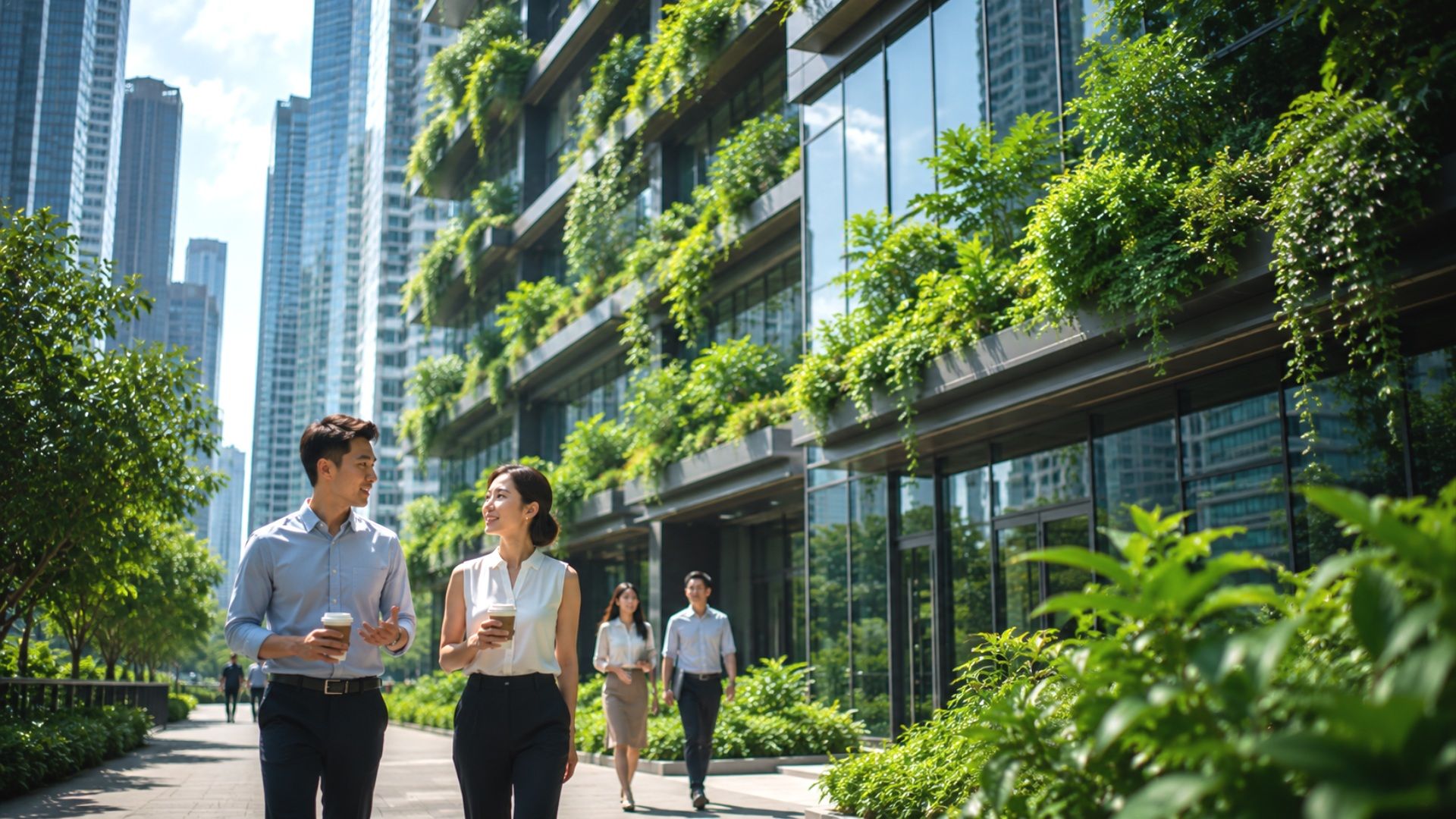
    SINGAPORE: Rising electricity bills are doing something years of sustainability campaigns struggled to achieve: convincing more private developers that green buildings make financial sense. Across Singapore, developers are increasingly adopting energy-saving designs, low-carbon materials and shared cooling systems. While environmental goals are always important, industry players say the change is now driven as much by cost savings as by sustainability targets. Developers are also moving beyond m
     

Higher energy bills drive more Singapore developers to adopt greener building solutions

14 June 2026 at 08:33

SINGAPORE: Rising electricity bills are doing something years of sustainability campaigns struggled to achieve: convincing more private developers that green buildings make financial sense.

Across Singapore, developers are increasingly adopting energy-saving designs, low-carbon materials and shared cooling systems. While environmental goals are always important, industry players say the change is now driven as much by cost savings as by sustainability targets.

Developers are also moving beyond minimum green building requirements as they seek to reduce operating expenses and attract buyers who value sustainable homes, offices, and commercial spaces. The trend comes as Singapore works towards its Green Building Masterplan, which aims for 80% of buildings to meet higher energy efficiency and sustainability standards by 2030, Channel NewsAsia (CNA) reports (June 10).

Sustainability starts at the design stage

One example is Geneo at Singapore Science Park, developed by CapitaLand Development. The first phase of the rejuvenation project spans five buildings across roughly 180,000 square metres.

Instead of treating each building as a separate development, the project was planned as a connected precinct where businesses, workers and visitors can share spaces and interact.

Jonathan Yap, Chief Executive Officer of CapitaLand Development, said that the company wanted to create an ecosystem rather than simply construct individual buildings.

A major feature is The Canopy, a 27-metre-tall communal space built using mass-engineered timber. The company estimates the structure cuts construction-related carbon emissions by up to 80% compared with steel and 60% compared with reinforced concrete.

The space also relies heavily on passive cooling. Shading, building orientation, and large, slow-moving fans help keep temperatures comfortable while reducing the need for air conditioning. According to Mr Yap, air-conditioning consumption is about 60% lower than in a fully air-conditioned space.

Cooling an entire district instead of just one building

The sustainability push is also happening on a larger scale. At Punggol Digital District, JTC Corporation has implemented a district cooling system that supplies chilled water to multiple buildings, including Punggol Coast MRT station, retail areas, business park developments and the Singapore Institute of Technology campus.

Instead of every building operating its own cooling equipment, cooling is produced centrally and distributed across the district.

David Tan, Assistant Chief Executive Officer of JTC Development Group, said the approach can reduce energy consumption by up to 30%. It also frees up rooftop and building space that would otherwise be occupied by cooling equipment, allowing more room for solar panels and other uses.

The district was planned with sustainability in mind even before construction began. Wind flow and solar radiation studies helped determine building placement to improve natural ventilation. More than 20,000 sensors now collect data on temperature, air quality and energy use to help optimise operations.

Green buildings are becoming a selling point

Industry observers say the discussion around sustainability has changed significantly over the past two decades.

Melvin Tan, Joint Managing Director of LAUD Architects and immediate past president of the Singapore Institute of Architects, said that rising energy costs have made energy efficiency a major business consideration. Buildings that use less energy are cheaper to operate and maintain over time.

Mr Tan noted that when Singapore’s Green Mark certification scheme was introduced in 2005, some developers saw it mainly as a compliance exercise. Today, many view it as a way to make properties more attractive to buyers and tenants.

While government projects must meet strict sustainability requirements, some private developers are voluntarily aiming higher. Mr Tan estimated that about 20% to 30% are pursuing standards beyond what regulations require because they see commercial value in doing so.

Buyers are increasingly interested in sustainable homes, offices and developments.

When going green becomes common sense

Environmental benefits have become increasingly important, and economics may be the stronger driver for gaining from them.

As energy prices stay elevated, efficient buildings are becoming easier to justify on a balance sheet. What was once marketed as a green choice is increasingly becoming a practical business decision.

Lower energy consumption is no longer just good for the environment. It is becoming good business for developers, architects and property buyers alike as well.

This article (Higher energy bills drive more Singapore developers to adopt greener building solutions) first appeared on The Independent Singapore News.

  • βœ‡Antiques and Vintage - flickr
  • Where Yesterday Meets the Breeze Neil. Moralee
    Neil. Moralee posted a photo: Founded in 1919 by Walter Owen Bentley in Cricklewood, London, the Bentley motor company quickly established a reputation for exceptional performance and engineering, famously dominating the 24 Hours of Le Mans throughout the 1920s with the help of the legendary 'Bentley Boys'. Following financial difficulties during the Great Depression, the company was acquired by Rolls-Royce in 1931, moving production to Derby and later to its iconic factory in Crewe, Cheshir
     

Where Yesterday Meets the Breeze

Neil. Moralee posted a photo:

Where Yesterday Meets the Breeze

Founded in 1919 by Walter Owen Bentley in Cricklewood, London, the Bentley motor company quickly established a reputation for exceptional performance and engineering, famously dominating the 24 Hours of Le Mans throughout the 1920s with the help of the legendary 'Bentley Boys'. Following financial difficulties during the Great Depression, the company was acquired by Rolls-Royce in 1931, moving production to Derby and later to its iconic factory in Crewe, Cheshire, in 1946. After decades of being closely associated with Rolls-Royce, Bentley was purchased by the Volkswagen Group in 1998, a transition that sparked a significant revitalisation of the brand's identity as a manufacturer of luxury, high-performance grand tourers that continues to define its legacy today.


Beer, Devon, UK.

  • βœ‡Antiques and Vintage - flickr
  • Smallpox Vaccination Poster – Public Health scuba_dooba
    scuba_dooba posted a photo: This smallpox vaccination poster reflects an important chapter in the history of public health, when governments and local authorities promoted vaccination to combat one of the most serious infectious diseases of the time. Smallpox was once a major cause of illness and death across Britain and the world, and widespread vaccination campaigns eventually led to its eradication in 1980. Early vaccination efforts in the 19th century were sometimes met with public susp
     

Smallpox Vaccination Poster – Public Health

15 June 2026 at 21:48

scuba_dooba posted a photo:

Smallpox Vaccination Poster – Public Health

This smallpox vaccination poster reflects an important chapter in the history of public health, when governments and local authorities promoted vaccination to combat one of the most serious infectious diseases of the time. Smallpox was once a major cause of illness and death across Britain and the world, and widespread vaccination campaigns eventually led to its eradication in 1980.

Early vaccination efforts in the 19th century were sometimes met with public suspicion and debate, despite their proven effectiveness. Over time, however, compulsory vaccination laws and improved medical understanding helped transform public attitudes. Posters like this were used to encourage participation, often displayed in public buildings, clinics and workplaces to reach as many people as possible. At Beamish Museum, such material helps illustrate how medical science and public health policy evolved alongside everyday life in industrial communities.

❌
Subscriptions