Known for his atmospheric photographs of landscapes, interiors, and urban centers that feel mysteriously locked in a not-so-distant past, Andrew Moore’s enigmatic images invite us into a slippage of time. Often—but not always—devoid of people, his scenes have a timelessness about them, as if they could have unfolded at any point over the past several decades. Sometimes it feels as though someone may have just walked by; others, it’s as if no one has viewed the scene for many years.
In his
Known for his atmospheric photographs of landscapes, interiors, and urban centers that feel mysteriously locked in a not-so-distant past, Andrew Moore’s enigmatic images invite us into a slippage of time. Often—but not always—devoid of people, his scenes have a timelessness about them, as if they could have unfolded at any point over the past several decades. Sometimes it feels as though someone may have just walked by; others, it’s as if no one has viewed the scene for many years.
In his current solo exhibition, Theater,the artist’s photographs of grand staircases, aging stages, and box office ticket booths hearken to a bygone era before screens. Additional compositions featuring a bar, art restoration studio, and grand staircase in Cuba emphasize theatricality in architecture and design. Dreamy lighting, well-worn furnishings, and varying levels of decay invoke a distinct nostalgia.
“Theater Boxes, Times Square Theater, New York” (1996), archival pigment print mounted to plexi, 50 x 40 inches“Soul Bar, Augusta, GA” (2014), archival pigment print mounted to plexi, 50 x 40 inches“Stairway to the Balcony, Opera House, Greensboro, AL” (2016), archival pigment print mounted to plexi, 60 x 50 inches“La Guarida II, Havana, Cuba” (1998), archival pigment print mounted to plexi, 50 x 40 inches“Grand Luncheonette, New York” (1996), archival pigment print mounted to plexi, 50 x 40 inches“Restoration Studio, Academy of Fine Arts, St. Petersburg, Russia” (2002), archival pigment print mounted to plexi, 50 x 60 inches“Red Chairs Selwyn Theater, Times Square, New York” (1996), archival pigment print mounted to plexi, 50 x 40 inches
Fusing elements of Persian architecture with Christian altarpieces, Arghavan Khosravi grapples with the structures and ideological strictures that shape our lives. The Iranian artist has long reckoned with women’s fight for equality, particularly amid censorship and religious dogma in her native country. Through vibrant gradients that radiate across her sculptural paintings, Khosravi entices the viewer into urgent, ongoing conversations about resistance and control.
Opening today at Uffner
Fusing elements of Persian architecture with Christian altarpieces, Arghavan Khosravi grapples with the structures and ideological strictures that shape our lives. The Iranian artist has long reckoned with women’s fight for equality, particularly amid censorship and religious dogma in her native country. Through vibrant gradients that radiate across her sculptural paintings, Khosravi entices the viewer into urgent, ongoing conversations about resistance and control.
Opening today at Uffner & Liu, What Remains presents a dynamic new body of work that captures moments of tension and strife. Figures, in Khosravi’s works, are often restricted and tethered to domestic objects and space, and critically, physically separated from one another. Complete with hinged shutters, suspended cords, and tiny visages tucked into unassuming openings, these new pieces incorporate women obscured by their surroundings, leaving only fragments of a limb or face visible.
“Suspended” (2026), acrylic on canvas mounted on wood panel, acrylic on wood cutout, acrylic on shaped wood panel, leather cord, rubber cord, plexiglass, 27 1/2 x 30 x 19 inches
While altarpieces have historically been utilized to share stories of the divine through visual depictions, Khosravi instead turns inward. She lives and works in Stamford, Connecticut, and her homesickness and longing for a changed Iran are strong. Large-scale works like “Bearing” portray a seated woman buttressing a Persian building, thick, black, oil-like liquid seeping from its foundation.
What Remains was already in progress before the U.S. war against Iran, the gallery shares. The works are therefore not in response to this particular conflict but rather a timely acknowledgment of what it means to live in a region continually in crisis. As always, Khosravi reminds us that even amid chaos, destruction, and government overreach that outlasts any singular emergency, beauty and self-empowerment can still trigger a new paradigm.
What Remains runs through July 2 in New York. Explore more of the artist’s politically attuned works on Instagram.
“The Whisper” (2026), acrylic on shaped wood panel, acrylic on canvas mounted over shaped wood panel, 70 x 85 x 7 1/4 inchesDetail of “Suspended” (2026)“Bearing” (2026), acrylic on canvas stretched over shaped wood panel, acrylic on wood panel, wood cutouts, plexi mirror, 88 x 26 1/2 x 7 3/4 inchesDetail of “Suspended” (2026)“Collision” (2026), acrylic on canvas mounted over shaped wood panel, wire mesh, 17 x 41 x 3 inchesDetail of “Collision” (2026)“The Listener” (2026), acrylic on shaped wood panel, acrylic on canvas, cord, 19 1/2 x 20 x 2 inches“Stillness” (2026), acrylic on canvas mounted over wood panel, 15 x 13 x 4 inches“Bound” (2026), acrylic on canvas mounted on wood panel, acrylic on shaped wood panel, wood cutout, 13 1/2 x 15 x 2 inches“Counting” (2026), acrylic on canvas mounted on wood panel, acrylic on shaped wood panel, styrofoam, glass beads, polyester thread, 20 1/2 x 17 1/2 x 5 1/2 inches
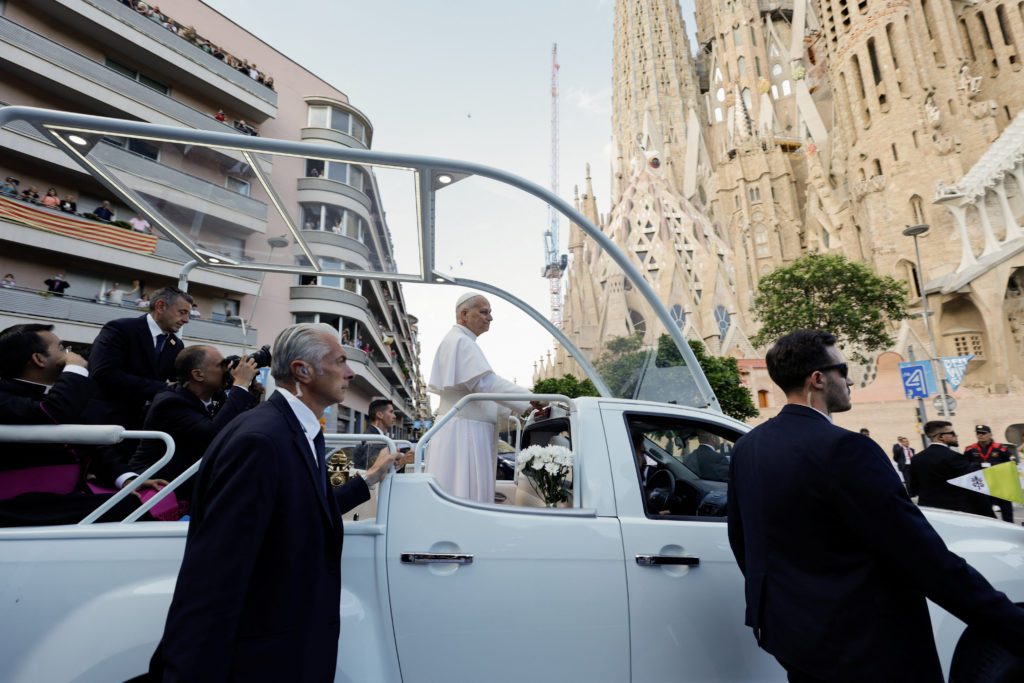
Leo called Gaudí's unfinished temple, one of the world's most visited monuments, a "sign of unity and harmony for all of Spain," an ongoing building project like the lifelong journey all Christians make to find God.
Leo called Gaudí's unfinished temple, one of the world's most visited monuments, a "sign of unity and harmony for all of Spain," an ongoing building project like the lifelong journey all Christians make to find God.
caspar40 posted a photo:
Gothic Rathaus (town hall) build in 1475.
Munich is a top European city for urban vibrancy, culture, and a fascinating, beautiful heritage ranging from the Middle Ages to the baroque and rococo periods of the 18th century and beyond. The city reflects well the massive wealth of the Bavarian nobility over the centuries. Although not captured here, I also loved the extensive neighbourhoods immediately surrounding Munich's Altstadt, with its many trendy cafes, great re
Munich is a top European city for urban vibrancy, culture, and a fascinating, beautiful heritage ranging from the Middle Ages to the baroque and rococo periods of the 18th century and beyond. The city reflects well the massive wealth of the Bavarian nobility over the centuries. Although not captured here, I also loved the extensive neighbourhoods immediately surrounding Munich's Altstadt, with its many trendy cafes, great restaurants, and young people, as well as beautiful, lively parks such as the English Garden.
For a little more than two decades, Bavarian photographer Markus Brunetti has scoured Europe for its most impressive basilicas, monasteries, duomi, and other striking ecclesiastical landmarks. Working closely with collaborator Betty Schöner, with whom he travels around the continent in a firetruck that has been converted to a photo lab, the pair snap thousands of images of each structure in meter-by-meter detail, often over the course of several years.
Through a meticulous editing process
For a little more than two decades, Bavarian photographer Markus Brunetti has scoured Europe for its most impressive basilicas, monasteries, duomi, and other striking ecclesiastical landmarks. Working closely with collaborator Betty Schöner, with whom he travels around the continent in a firetruck that has been converted to a photo lab, the pair snap thousands of images of each structure in meter-by-meter detail, often over the course of several years.
Through a meticulous editing process that includes layering and arranging each shot into composite images, Brunetti creates precise, high-resolution views of the facades that we never experience in real life. Perspective is skewed so that the ornate temples and cathedrals’ entrances are perfectly straight. Rather than the oblique view we usually get—think of how tall structures look when viewed from the street, with their base appearing wider and the top growing gradually narrower—we’re confronted with a striking one-point perspective.
“Santiago de Compostela, Catedral” (2009-2024), archival pigment print, image 83 3/4 x 54 1/4 inches
Brunetti’s current solo exhibition, Facades IV at Yossi Milo, highlights a selection of the artist’s recent portraits, several of which were completed in the last couple of years. “Roma, Basilica di San Pietro,” for example, was initiated in 2007. “Brunetti and Schöner returned to St. Peter’s Basilica seven times over nineteen years,” the gallery says. “With each survey, they grew closer to realizing this grand image—a particular challenge given that it is one of the largest and most visited churches in the world.”
Printed at an impressively large scale—up to seven-and-a-half feet tall—the photos venerate these buildings, many of which are centuries old. “The result exceeds the possibilities of any single photograph, even at the highest possible resolution, creating works that stand as monuments in and of themselves,” the gallery says.
Facades IV continues through June 20 in New York City.
“Roma, Basilica di San Pietro” (2007-2026), archival pigment print, image 58 1/4 x 58 1/4 inches“Bucuresti, Templul Coral” (2018-2019), archival pigment print, image 66 1/8 x 54 5/16 inches“Molfetta, Duomo di San Corrado” (2011-2026), archival pigment print, image 66 1/8 x 54 5/16 inches “Noyon, Cathédral Notre-Dame” (2018-2026), archival pigment print, image 83 3/4 x 54 1/4 inches“Badia Fiesolana, Fiesole” (2022-2025), archival pigment print, image 66 1/8 x 54 5/16 inches“L’Aquila, Basilica di San Bernardino” (2014-2026), archival pigment print, image 58 1/4 x 58 1/4 inches“Venezia, Il Redentore” (2012-2023), archival pigment print, image 83 3/4 x 54 1/4 inches
caspar40 posted a photo:
Alterturm and Alterhof, the medieval residences of the Holy Roman emperors and the dukes of Bavaria, dating from between the 13th and 15th centuries.
Munich is a top European city for urban vibrancy, culture, and a fascinating, beautiful heritage ranging from the Middle Ages to the baroque and rococo periods of the 18th century and beyond. The city reflects well the massive wealth of the Bavarian nobility over the centuries. Although not captured here, I also loved
Alterturm and Alterhof, the medieval residences of the Holy Roman emperors and the dukes of Bavaria, dating from between the 13th and 15th centuries.
Munich is a top European city for urban vibrancy, culture, and a fascinating, beautiful heritage ranging from the Middle Ages to the baroque and rococo periods of the 18th century and beyond. The city reflects well the massive wealth of the Bavarian nobility over the centuries. Although not captured here, I also loved the extensive neighbourhoods immediately surrounding Munich's Altstadt, with its many trendy cafes, great restaurants, and young people, as well as beautiful, lively parks such as the English Garden.

 Login
Login