Login
LoginVictory Theater
9 June 2026 at 17:36
Painted Raven photography posted a photo:

Located in Holyoke, MA, USA. Explored during a photography workshop group, with permission granted by the property owner.


Painted Raven photography posted a photo:
Located in Holyoke, MA, USA. Explored during a photography workshop group, with permission granted by the property owner.

chris murkin posted a photo:
RAF Supermarine Spitfire MkV G-AISU AB910 BBMF AE-H
Aircraft is based at RAF Coningsby and is part of the Battle of Britain Memorial Flight Collection
Photo taken at Old Warden Shuttleworth Wings & Wheels Air Show 30th May 2026
HAJ_0992


Some of the most exciting designs emerging from the world of sustainable fashion are those utilizing uncommon materials. There are gowns sculpted with grass roots, sequins made from algae, and electrical wires woven into lace. Now, researchers and designers at Aalto University can add another unusual substance to that list: the remains of a 300-year-old wooden shipwreck.
In 2019, a hotel in the Finnish city of Oulu undertook renovations that uncovered a 17th-century vessel buried beneath a parking lot. Called the Hahtiperä wreck, the finding was the oldest of its kind in this region, prompting conservators to raise the seven-by-20-meter ship for preservation. A few fragments remained, though, and researchers from Aalto’s Bioinnovation Center seized the opportunity to save these bits from the trash.
After removing the outer layers, designers shredded and dissolved the wood into pulp. They then utilized their trademarked Ioncell process—developed in collaboration with Helsinki University—which recycles materials like paper, straw, and other textile waste into silky fibers.
Lecturer Anna-Mari Leppisaari was responsible for machine-knitting the undyed yarn into a pair of seamless dresses, one of which is on display at Oulu Art Museum for an exhibition about the future of fashion. A sleek A-line shape, the garment’s marbled pattern mimics that of wood grain. It weights less than a pound.
“Of course, a shipwreck is an exceptional case, but it’s also a story that makes people pause and appreciate materials in a new way,” lead designer Pirjo Kääriäinen says. “If something this beautiful can be made from centuries-old wood, why do we keep throwing away materials that could still be circulated and reused?”
The second dress will be on view in September for the university’s Designs for a Cooler Planet exhibition. (via The History Blog)
Do stories and artists like this matter to you? Become a Colossal Member today and support independent arts publishing for as little as $7 per month. The article This Wood-Fiber Dress Was Made from a 17th-Century Shipwreck appeared first on Colossal.



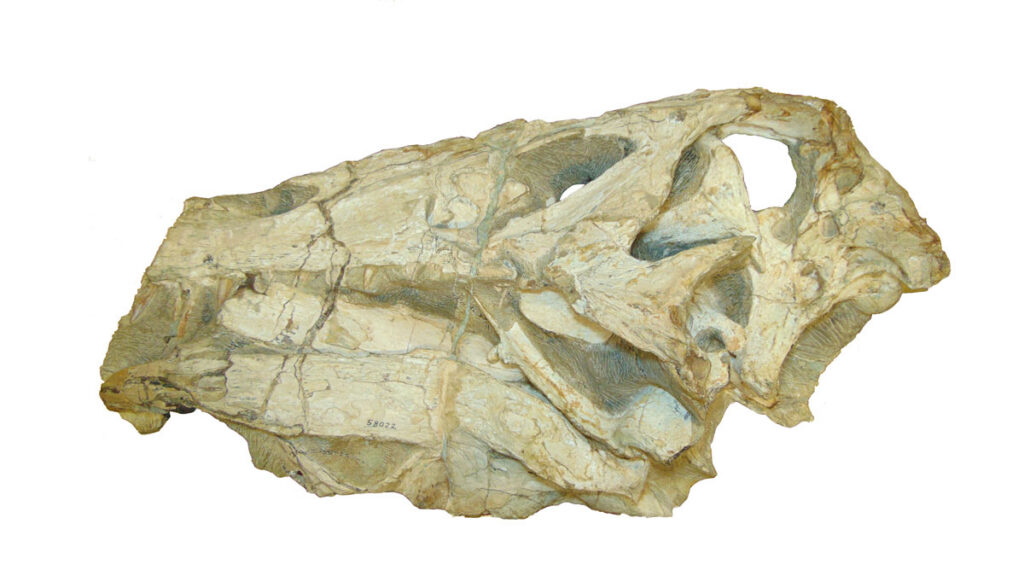
For many years a source of irritation, a fossil of the Brazilian spinosaurid Irritator challengeri is now bringing some joy to paleontologists in its homeland.
Following a successful public campaign for restitution, the piece is returning to Brazil from the collection of Germany’s State Museum of Natural History Stuttgart (SMNS), where it has been kept for the past 30 years—a situation that Brazilian paleontologists and lawmakers deemed illegal.
Representatives of both countries made the announcement last month during Brazilian President Luiz Inácio Lula da Silva’s visit to Germany. In a joint statement, they announced the German museum’s “willingness” to “hand over” the fossil to Brazil and start a new, more transparent era of international collaboration.
“It is a very expected and cherished move because it represents a huge scientific and social victory for the Global South and for Brazil.”
“Finally, the Irritator will be back to its original place,” said paleontologist Allysson Pontes Pinheiro, director of the Plácido Cidade Nuvens Paleontology Museum.
The museum, located in northeastern Brazil where the fossil was discovered in the 1990s, will host the Irritator when it returns to Brazil. “It is a very expected and cherished move because it represents a huge scientific and social victory for the Global South and for Brazil,” Pinheiro said, highlighting that the return will allow local scientists and the population to have access to a heritage that would be difficult and expensive to access abroad.
The Irritator challengeri fossil is one of many that have been illegally obtained from South America by researchers from the Global North. Considered the most complete spinosaurid skull ever described, the 110-million-year-old specimen was taken from the Araripe Basin in northeastern Brazil and described in 1995 by British paleontologist David Martill and his German colleague Eberhard “Dino” Frey. Martill and Frey worked on at least one other fossil smuggled from Brazil to Germany, an Ubirajara jubatus specimen, which was repatriated in 2023 and is currently housed at Plácido Cidade Nuvens.
Martill and Frey named the newly discovered species in reference to their irritation upon learning that the skull had been manipulated by fossil dealers to get a better price. Little did the researchers know that the fossil would irritate many other scientists, especially those from the animal’s homeland.
In 2023, triggered by the publication of a paper that acknowledged the fossil’s “problematic status,” paleontologists in South America published an open letter to the Ministry of Science, Research and Arts of Baden-Württemberg State demanding its return. The document received about 300 signatures from scientists and lawyers and was followed by a viral social media campaign involving influencers and a more recent public petition on Change.org that gathered more than 34,000 signatures.
“This campaign showed us that it is worth continuing to fight for our fossils.”
The restitution request is based on Brazilian legislation passed in 1942 that determined that fossils found in the country are the state’s property and cannot be traded or exported without explicit authorization. In addition, a more recent Brazilian ordinance (dating to 1990) mandates that any holotype (a fossil used to describe a new species, such as the contested Irritator specimen) must remain in the country. Regardless, SMNS maintained the fossil had been legally purchased from a private dealer in Germany in 1991.
“We are very happy the Brazilian law is now being respected,” said Aline Ghilardi, a paleontologist at the Federal University of Rio Grande do Norte who was at the forefront of the repatriation campaign. “This campaign showed us that it is worth continuing to fight for our fossils.”
At the time of publication, SMNS had not responded to requests for comment.
But Ghilardi is not entirely satisfied. She didn’t like the wording of the announcement, which used the expression “hand over” rather than return, repatriate, or restitute.
“The statement was a missed opportunity to demonstrate the German government’s willingness to decide in favor of a restitution process,” she explained. “It seems there is resistance to making these restitutions as actual restitutions. It appears as if it is theirs by right and that they will hand over the fossil to Brazil as part of scientific cooperation.”
Ghilardi expressed that she will believe the repatriation will actually happen only when a specific return date is announced. (As of publication, it has not.) She also hopes that the Irritator case is not an isolated incident, but part of an ongoing trend of restitutions intended to break the pattern of neocolonialism in science.
A 2025 study published by Ghilardi and colleagues in the journal Palaeontologia Electronica showed that of nearly 500 invertebrate species described from fossils found in the Araripe Basin—one of Brazil’s richest and most threatened regions of geodiversity—about half have holotypes stored in institutions across Europe, Asia, and North America, violating Brazilian law.
Most of these smuggled fossils are hosted in Germany. “Some foreign colleagues complained about our campaign, saying that it looked like we were persecuting Germany,” Ghilardi said. “But that is not the case. It is just the numbers.”
It is possible, she noted, that other countries hold even more specimens that were not described in the scientific literature and therefore could not be counted.
The same study also found that more than 200 species were described in publications that did not include any Brazilian scientists as coauthors, despite Brazilian legislation requiring foreign research on Brazilian fossil material to be conducted in partnership with local institutions.
Paleontologist Serjoscha Evers at the Universität Freiburg, who authored the 2023 study on the Irritator fossil, wrote in an email to Eos that he welcomed the news of the dinosaur’s return.
However, he also wondered whether the decision is just “a diplomatic favor that resulted from the public pressure, or foreshadowing a broader wave of repatriations based on a legal conclusion that the fossils are unlawfully in German custody.”
Paleontologists involved in the Irritator restitution efforts said that since the campaign began, they have been receiving emails from museums and institutions worldwide seeking information on the procedures for returning fossils to Brazil.
The Plácido Cidade Nuvens Paleontology Museum, the final destination of the Irritator, has received several restitutions itself, including 45 fossils originally collected from the Araripe Basin and previously held by the University of Zurich in Switzerland, the fossil of a crustacean that was in the possession of the Universidad Nacional del Nordeste in Argentina, and a fish fossil seized in Italy.
According to Pinheiro, the museum’s director, paleontologists and the Brazilian government have listed at least 90 Brazilian holotypes still held in Germany. And the Brazilian Ministry of Foreign Affairs confirmed to Eos that it is currently negotiating the return of nine fossils held in undisclosed countries.
“We have been talking with colleagues from the museums where these materials are hosted, and they seem very favorable to returning them,” Pinheiro observed. “It is a huge advancement and a great change of behavior from important museums that have been holding heritage from the Global South.”
—Sofia Moutinho (@sofiamoutinho.bsky.social), Science Writer

chris murkin posted a photo:
BAC-167 Strikermaster RSAF 1130 Royal Saudi Air Force
Photo Taken April 2026 at Warbirds over Wanaka New Zealand
HAG_1176


This post is the “flip-side” of an article I posted here a few weeks ago (The Last Five Screen Gems Cartoons 4/14/26) where I looked at transition of the outgoing Columbia’s Screen Gems releases and the incoming UPA cartoons. A real changing of the guard.
Roughly ten years later, the guard changed again. Things weren’t going well for UPA in the second half of the decade. Their satellite studios in New York and London closed; the Magoo feature was a troubled project; The Boing Boing Show was bombing; the Columbia contract for theatrical shorts had an expiration date: 1959.
The last of the 1958-59 season, released in July 1959, was Terror Faces Magoo. Produced in New York during the production crunch in Burbank on 1001 Arabian Nights, the Magoo feature.
By the end of the year UPA founder/producer Stephen Bousustow found a new financial “partner” to bail the studio out – Henry G. Saperstein – who essentially bought the studio and ultimately inched Bosustow out the door. Beginning in November, Columbia began releasing Hanna Barbera’s TV-styled Loopy DeLoop shorts as theatrical subjects (an arrangement that lasted through June 1965)!
Mr. Magoo was still extremely popular, if only as a short subjects star – and Bosustow knew that. Bosustow decided to keep making “UPA shorts” for theatrical release, and from this point on UPA itself would release them. Four new shorts were put into production.
The first one, Magoo Meets Boing Boing (The Noise Making Boy), directed by Abe Levitow, was given an Oscar qualifying release in late 1959. This cartoon was certainly a perfect idea to start with a ‘Bang-Bang’. I love how in the ‘UPA-niverse’, Magoo is on a short list of babysitters in the McCloy household. Magoo mistakes Gerald for his dog (and vice-versa) and “rescues” Gerald from a fire (actually just Gerald’s sound effects voice). The animation is no worse than the last few Columbia Magoo films – but far from the heights of greatness both characters had previously attained just a few short years earlier. Note that the theatrical title for this film was Magoo Meets Boing Boing (The Noise-Making Boy), the TV version is retitled Magoo Meets McBoing Boing.
The second Magoo cartoon, released in 1960, was likewise submitted for Academy Award consideration – I Was A Teenage Magoo – this time directed by Clyde Geronimi. It’s an odd one. The most UPA aspect of it is the background designs by Tom Yakutis, which are very cool. The animation is up the theatrical standards of the last Columbia Magoo’s – but that’s not saying too much. Told in flashback, the plot has teenage (but still nearsighted) red-headed Magoo picks up his date “Melba” (a kangaroo) from her home (in a circus) and go on a picnic. Sort of a prequel of sorts to Magoo’s Young Manhood (1958). Bosustow’s attempt to self-distribute was a huge failure. This cartoon was ultimately released as part of the TV package – albeit cut by two minutes and shown under the title Teenage Magoo.
The third short produced by Bosustow for theatrical release was Bric’s Stew – directed by Harvey Toombs – which featured a pair of new characters “Bric n’ Brac”. The negative was discovered a few years ago among film elements acquired by the Academy of Motion Picture Arts and Sciences – within unclaimed inventory from the defunct DuArt Laboratory in New York City. Why it was abandoned and forgotten no one knows. Why there is a UA-TV logo at the end – no one knows. Asifa-Hollywood funded a preservation and I wrote about it in a post about this find in January 2019. I’m happy to present the entire cartoon, for the first time, below.
A fourth Magoo short intended for theaters – Magoo Meets Frankenstein – joined the other two in the Mr. Magoo TV package (130 new cartoons made-for-TV). Below is the first half of the rare theatrical version:
Bosustow finally sold his interest in UPA in June 1960. This wasn’t the end of Magoo – he would live on in his Christmas Carol TV special (a classic), a 26 episode series of Famous Adventures, as Uncle Sam, a GE light bulb salesman, in a Saturday morning DePatie Freleng series – and a live action movie (released by Disney)!
Despite a bittersweet fade-out, UPA was a historic game changer for animation during the 1950s. It was a studio – like Walt Disney’s – that is worth exploring with deeper dives.
For more information on UPA – I highly recommend Adam Abraham’s outstanding UPA history, When Magoo Flew: The Rise and Fall of Animation Studio UPA.
SPECIAL THANKS to Al Warner and Denis-Carl Robidoux for permission to share their transfers of the first two UPA Magoo theatricals – and to ASIFA-Hollywood for letting us debut the complete “Bric’s Stew”.