One year after the Trump administration launched its tariff offensive against more than 180 countries, Latin America presents a mixed picture: some economies lost competitiveness in the U.S. market, while others redirected exports or negotiated agreements to cushion the blow.
One year after the Trump administration launched its tariff offensive against more than 180 countries, Latin America presents a mixed picture: some economies lost competitiveness in the U.S. market, while others redirected exports or negotiated agreements to cushion the blow.
On the top floor of Buffalo AKG Art Museum’s Gundlach Building, a vast body of work from 58 artists comes together for Let Us Gather In a Flourishing Way. The impressive ensemble is both a survey of contemporary Latinx painting and a lively dialogue between a spectrum of artists with diverse backgrounds, experiences, identities, languages, and creative mediums.
Let Us Gather In a Flourishing Way is a major exhibition that has slowly unfolded over the course of several years. Curator Andrea
On the top floor of Buffalo AKG Art Museum’s Gundlach Building, a vast body of work from 58 artists comes together for Let Us Gather In a Flourishing Way. The impressive ensemble is both a survey of contemporary Latinx painting and a lively dialogue between a spectrum of artists with diverse backgrounds, experiences, identities, languages, and creative mediums.
Let Us Gather In a Flourishing Way is a major exhibition that has slowly unfolded over the course of several years. Curator Andrea Alvarez—the architect and driving force behind the project—has spent much of this time immersed in research and collaborating closely with each artist throughout the process, refining every detail of the show.
Eamon Ore-Giron, “Talking Shit with Illapa (variation I)” (2023), mineral paint and Flashe on canvas, 72 inches × 96 1/8 inches. Photo by Brenda Bieger
The exhibition’s title alludes to former U.S. poet laureate Juan Felipe Herrera’s titular poem. Oscillating between English and Spanish while employing lush imagery of flora and fauna, the poem itself—like the survey—is an exuberant celebration of community and cultural convergence. He writes:
cielo de calor and wisdom to meet us where we toil siempre in the garden of our struggle and joy let us offer our hearts a saludar our águila rising freedom
The show traces this poetic rhythm in its spatial design. Herrera’s stanzas greet visitors at each entrance and throughout its galleries, establishing tone and providing context for what lies ahead.
Although the exhibition is organized into seven themes, Alvarez highlights its intrinsically flowing nature, noting that even if the collection were rearranged, the show would still hold together. In a walkthrough, it became clear that space was central to the viewing experience, leaving room for visitors to engage with the works on their own terms, much like the exhibition’s overarching focus on gathering and bolstering free-flowing conversation.
Moises Salazar Tlatenchi, “Cruising Queens” (2024), oil on canvas, glitter, yarn, 35 x 45 inches
In Moises Salazar Tlatenchi’s “Cruising Queens,” a boat of five faceless figures and an American flag sail icy waters. Reminiscent of 18th-century America, the figures wear powdered wigs and tricorne hats. Finished with a dense layer of glitter and a daintily crocheted lavender frame, the artist’s glamorous materials—and the existence of brown figures in this context—subvert American history. “Cruising Queens” is placed within the exhibition’s New Histories section, which focuses on retelling personal, cultural, and global histories.
Colossal readers might also recognize Eamon Ore-Giron’s tessellated abstractions in “Talking Shit with Ilapa (variation I),” Guadalupe Maravilla’s mixed-media techniques in “Pupusa Retablo,” and Firelei Báez’s vibrant portraits bursting with floral motifs in “Mawu-Lisa (I build my language out of rocks).” Known for deconstructing colonial structures within her work, Báez turns toward the transatlantic slave trade, invoking deity Mawu-Lisa, a critical figure in the culture and religion of the Fon people in West Africa, who were brought to the Caribbean by force.
Bodies & Figures denotes another section of the show, highlighting “representations of and by marginalized people, considering the importance of the body, and who is or isn’t seen in an image,” the catalog says. One such work is Salomón Huerta’s triptych of untitled canvases. Through the absence of figurative human subjects within the paintings, visitors experience an intimate representation of the artist’s father.
“Huerta’s father protected the family in their home in Ramona Gardens, a violent housing project in East Los Angeles,” the museum label reads. “At night, he would set his .38-caliber revolver on the bedside table and ask Huerta to bring him a snack—often a concha or a glass of milk.” Disrupting expectations of traditional portraiture, the artist evokes something that feels deeply tender and human-centered—without the presence of a body.
Salomón Huerta, “Untitled” (2024), “Untitled (2025), “Untitled” (2024), oil on canvas, 14 x 16 inches. Photo by Jackie Andres
At the same time, Let Us GatherIn a Flourishing Way begs the question: how do identity and place shape each other? Los Angeles-based artist Alfonso Gonzalez Jr. turns to the rich visual language of signage. A meticulous technique passed down from his father’s professional career in commercial sign painting, Gonzalez has developed an enduring relationship with East Los Angeles’ emblematic advertisements and billboards, often reflecting Chicano culture. In “Abogados Tierra Caliente (Billboard),” the artist underscores the inherent connection between local landscapes and one’s selfhood, and an interesting relationship emerges between public commercial objects, personal portraits, and the museum itself.
Chicago-based Yvette Mayorga’s strikingly pink composition, “The Brunette Latinx Self Portrait After Francois Boucher’s “The Brunette Odalisque” c. 1745,” is affixed to a wall in the show’s cluster of Pinturx works, which are described as “contemporary Latinx approaches to traditional painting genres like still life and portraiture.” The artist’s distinctive technique of piping acrylic paint embodies themes of labor, femininity, and memory. Mayorga’s unconventional methods are an example of newer approaches to portraiture and complement the artist’s nods to Baroque and Rococo art.
Included in this grouping of nontraditional painting methods are other artists previously featured on Colossal, such as Sarah Zapata’s textile columns, made from handwoven cloth and various fibers. Installed leaning against a wall or protruding downward from the ceiling, her structures convey instability—a reflection of the current climate we find ourselves in. Narsiso Martinez also makes an appearance with “Checker Leading the Crowd,” made with charcoal on his distinctive cardboard produce box background, calling attention to labor.
In an anchoring room of the exhibition, “Promised Land” by Patrick Martinez spans 16 feet wide, redolent of a landscape’s sweeping view. Acrylic, neon, stucco, spray paint, and ceramic tile are just some of the layers that sit atop each other in the mixed-media work. Martinez ruminates on his native Los Angeles and the facade of “paradise” amid an ever-changing cultural landscape marked by gentrification and financial marginalization. Abstracted and washed-out structures, spray-paint marks inspired by graffiti, and an archival family photo collage represent the passage of time and the act of constantly rebuilding. “Promised Land” is part of the exhibition’s Land/tierra section, which highlights “Latinx approaches to landscape and the built environment, thinking about land and tierra and their rapid change.”
“Let Us Gather in a Flourishing Way” at the Buffalo AKG Art Museum. Photo by Brenda Bieger, Buffalo AKG Art Museum
As a whole, the boundary-pushing exhibition comes together in a chorus of dialogues, mediums, backgrounds, and experiences. The Caribbean and Latin American diaspora is complex, and each artist remains distinct—resisting an external flattening into a monolithic identity. Let Us Gather In a Flourishing Way is a celebration of contrasts and connections and a necessary counterbalance in the glaring face of division.
The exhibition is on view through September 6, when it will travel to the Des Moines Art Center, the Phoenix Art Museum, and the Frye Art Museum in Seattle. Public programming—workshops, artist talks, tours with poet Juan Felipe Herrera, and more—is slated to accompany the show’s run, so keep an eye out for events on the museum’s website.
“Let Us Gather in a Flourishing Way” at the Buffalo AKG Art Museum. Photo by Brenda Bieger, Buffalo AKG Art MuseumLarry Madrigal, “Man on Trampoline” (2023), oil on linen, 90 x 76 inches. Photo by Yubo Dong, ofstudio photography, courtesy of the artist and Nicodim“Let Us Gather in a Flourishing Way” at the Buffalo AKG Art Museum. Photo by Brenda Bieger, Buffalo AKG Art MuseumYvette Mayorga, “The Brunette Latinx Self Portrait After François Boucher’s “The Brunette Odalisque” c.1745″ (2022), acrylic nails, acrylic marker, false eyelashes, collage, plastic rings, plastic nail charms, rhinestones, car wrap vinyl, and acrylic piping on panel, overall 60 x 120 x 2 inches. Photo by Robert Chase Heishman, courtesy of the artist “Let Us Gather in a Flourishing Way” at the Buffalo AKG Art Museum. Photo by Brenda Bieger, Buffalo AKG Art Museum“Let Us Gather in a Flourishing Way” at the Buffalo AKG Art Museum. Photo by Brenda Bieger, Buffalo AKG Art Museum“Let Us Gather in a Flourishing Way” at the Buffalo AKG Art Museum. Photo by Brenda Bieger, Buffalo AKG Art Museum “Let Us Gather in a Flourishing Way” at the Buffalo AKG Art Museum. Photo by Brenda Bieger, Buffalo AKG Art Museum
The Capricorn Bioceanic Corridor, one of the most ambitious infrastructure projects underway in South America, is moving through its final stretch on the border between Paraguay and Brazil, with just twenty-one metres remaining to complete the physical link of the so-called Bioceanic Bridge, according to Paraguayan government authorities cited in late May 2026. The structure, built over the Paraguay River, will connect the cities of Carmelo Peralta, in the department of
The Capricorn Bioceanic Corridor, one of the most ambitious infrastructure projects underway in South America, is moving through its final stretch on the border between Paraguay and Brazil, with just twenty-one metres remaining to complete the physical link of the so-called Bioceanic Bridge, according to Paraguayan government authorities cited in late May 2026. The structure, built over the Paraguay River, will connect the cities of Carmelo Peralta, in the department of Alto Paraguay, and Puerto Murtinho, in the Brazilian state of Mato Grosso do Sul, and constitutes one of the central pieces of a logistics corridor that will link the Atlantic Ocean with the Pacific across four South American countries.
Brazilian aircraft manufacturer Embraer unveiled on Wednesday the first F-39E Gripen fighter jet manufactured in Brazil, a milestone the country's presidency called "unprecedented in Latin America." It is the first of 15 supersonic combat aircraft Embraer will produce at its facility in Gavião Peixoto, São Paulo state, under a total contract for 36 jets ordered from Swedish firm Saab.
Brazilian aircraft manufacturer Embraer unveiled on Wednesday the first F-39E Gripen fighter jet manufactured in Brazil, a milestone the country's presidency called "unprecedented in Latin America." It is the first of 15 supersonic combat aircraft Embraer will produce at its facility in Gavião Peixoto, São Paulo state, under a total contract for 36 jets ordered from Swedish firm Saab.
Medellín, Colombia – José Antonio Kast was sworn in today as the new president of Chile, inaugurating the country’s first far-right government since the fall of Augusto Pinochet’s military dictatorship in 1990.
Kast beat Jeanette Jara from the Communist Party last December, winning 58% in second-round polls following a campaign focused on law and order and tackling illegal immigration through mass deportations.
He succeeds left-wing president Gabriel Boric, forming part of a broader right-
Medellín, Colombia – José Antonio Kast was sworn in today as the new president of Chile, inaugurating the country’s first far-right government since the fall of Augusto Pinochet’s military dictatorship in 1990.
Kast beat Jeanette Jara from the Communist Party last December, winning 58% in second-round polls following a campaign focused on law and order and tackling illegal immigration through mass deportations.
He succeeds left-wing president Gabriel Boric, forming part of a broader right-wing wave across the Americas.
Chile’s new president resembles U.S President Donald Trump in his approach to certain policy matters, such as his promises to curb illegal immigration, increase mass deportations and even build border walls.
Kast is a controversial figure: his father was a member of the Nazi party, and he was raised deeply conservative.
While studying law at the Universidad Católica, he was mentored by Jaime Guzmán, who was a trusted advisor of Pinochet.
Kast is now the first president to defend the legacy of Pinochet, and he has suggested that the dictator would have supported his candidacy. He has also appointed two ex-Pinochet lawyers, Fernando Barros and Fernando Rabat, to his cabinet as Minister of Defence and Minister of Justice and Human Rights, respectively. This move has drawn criticism from human rights groups.
Kast previously failed in a 2022 bid for the presidency, losing to Boric. Boric, however, was a deeply unpopular president, with polling from July 2025 highlighting a 66% disapproval rating.
Kast recently withdrew from transition talks with his predecessor, claiming that he had not been informed about the construction of an underwater sea cable connecting Chile and China. The spat raised concerns regarding democratic transfer of power.
Kast is part of a growing right-wing coalition across the Americas, supported by Trump, who has announced a return of the Monroe Doctrine, which maintains Washington’s dominance across the Western Hemisphere.
Before assuming office, Kast attended Trump’s “Shield of the Americas” summit on Saturday alongside other Latin American leaders, signalling his eagerness to cooperate with Washington in its invigorated counter-narcotics strategy.
His swearing-in ceremony, held in the coastal city of Valparaíso, was attended by many prominent political figures from the Americas, including conservative leaders like Ecuador’s Daniel Noboa and Argentina’s Javier Milei.
The left-wing president of Brazil, Lula Inácio da Silva, canceled at the last minute after finding out that his potential rival in the next elections, Flávio Bolsonaro – the son of jailed former president Jair Bolsonaro – would be attending.
Venezuelan opposition figure, María Corina Machado, also attended the inauguration, posting on X that she was excited to meet with Venezuelans in Chile during her visit.
Kast has singled out Venezuelan immigrants, having centered his campaign on fighting irregular migration through mass deportation with his “Border Shield” plan; it references “hundreds of thousands of illegals, bringing with them crime, narcotrafficking, human trafficking and gun smuggling, and labor exploitation”. Migrants represent almost 10% of the population in Chile, the largest group being Venezuelans – 17% of which entered irregularly, according to El País. Despite this, figures shared by the Minister of Defense, Adriano Delpiano, indicate that the number of irregular entries to Chile decreased by 54% between 2021 and 2025.
Despite Kast’s promises to restore public order amid rising crime, Chile remains one of the safest countries in Latin America.
Featured image description: José Antonio Kast in European Parliament
Jeffrey Katzenberg’s WndrCo is among investors backing Latin American microdrama platform Idilio. WndrCo joined a16z Speedrun, Goodwater Capital, Precursor Ventures and Latin American fintech leader David Vélez in a $5.5M seed funding round. Idilio is being positioned as at the intersection of popular Latin American telenovelas and the vertical video world, with an AI-powered engine […]
Jeffrey Katzenberg’s WndrCo is among investors backing Latin American microdrama platform Idilio. WndrCo joined a16z Speedrun, Goodwater Capital, Precursor Ventures and Latin American fintech leader David Vélez in a $5.5M seed funding round. Idilio is being positioned as at the intersection of popular Latin American telenovelas and the vertical video world, with an AI-powered engine […]
Brazilian group BTG Pactual, Latin America's largest investment bank, is awaiting authorisation from Uruguay's Central Bank (BCU) to begin operating in the local financial market following its $175 million acquisition of HSBC Uruguay, agreed in July 2025. Group executives expect regulatory approval to come through by mid-year, allowing them to begin operations gradually in the second half of 2026.
Brazilian group BTG Pactual, Latin America's largest investment bank, is awaiting authorisation from Uruguay's Central Bank (BCU) to begin operating in the local financial market following its $175 million acquisition of HSBC Uruguay, agreed in July 2025. Group executives expect regulatory approval to come through by mid-year, allowing them to begin operations gradually in the second half of 2026.
Brazilian President Luiz Inácio Lula da Silva has canceled a planned trip to Chile to attend José Antonio Kast’s inauguration on Wednesday and will instead be represented at the ceremony by Foreign Minister Mauro Vieira. Brazilian officials said the change was due to “scheduling reasons.”
Brazilian President Luiz Inácio Lula da Silva has canceled a planned trip to Chile to attend José Antonio Kast’s inauguration on Wednesday and will instead be represented at the ceremony by Foreign Minister Mauro Vieira. Brazilian officials said the change was due to “scheduling reasons.”
For the better part of two decades, Irina Werning has traveled throughout Latin America searching for a specific trait: incredibly long hair. In her photography series Las Pelilargas—meaning “the long-haired ones” in Spanish—she chronicles a time-honored Indigenous tradition through a visual celebration of patience, joy, and cultural pride.
In a statement, Werning shares that when she asks young women in the many small towns she’s visited why they have long hair, they respond with simple r
For the better part of two decades, Irina Werning has traveled throughout Latin America searching for a specific trait: incredibly long hair. In her photography series Las Pelilargas—meaning “the long-haired ones” in Spanish—she chronicles a time-honored Indigenous tradition through a visual celebration of patience, joy, and cultural pride.
In a statement, Werning shares that when she asks young women in the many small towns she’s visited why they have long hair, they respond with simple reasons akin to, “Because I like it.” But, Werning adds, “The true reason is invisible and passes from generation to generation. It’s the culture of Latin America, where our ancestors believed that cutting hair was cutting life, that hair is the physical manifestation of our thoughts and our souls and our connection to the land.”
Nearly 90 images are included in Werning’s new book, Las Pelilargas, published by GOST Books. The photos span 18 years, starting with the artist’s first encounter with long-haired women in 2006 in Argentina, when she was photographing members of the Indigenous Kolla community.
“Guided by her intuition, she went on to spend months in remote mountain towns putting up signs in schools, hospitals, and markets, and organising hair competitions in an effort to seek out those with long hair,” GOST says. Werning continued to make the portraits until 2024. “She found that traditions were not just surviving, but evolving with long hair symbolising both continuity and subtle rebellion.”
Chilean executive Germán Naranjo Maldini has been held since Friday 15 May at the Guarulhos prison on the outskirts of São Paulo, charged with racial slur after directing racist and homophobic insults at a flight attendant of the airline Latam during a flight between São Paulo and Frankfurt on 10 May. The Chilean fishing company Landes, where he served as commercial manager, formally and preventively removed the executive from his position following the circulation over
Chilean executive Germán Naranjo Maldini has been held since Friday 15 May at the Guarulhos prison on the outskirts of São Paulo, charged with racial slur after directing racist and homophobic insults at a flight attendant of the airline Latam during a flight between São Paulo and Frankfurt on 10 May. The Chilean fishing company Landes, where he served as commercial manager, formally and preventively removed the executive from his position following the circulation over the weekend of a video showing the verbal attacks.
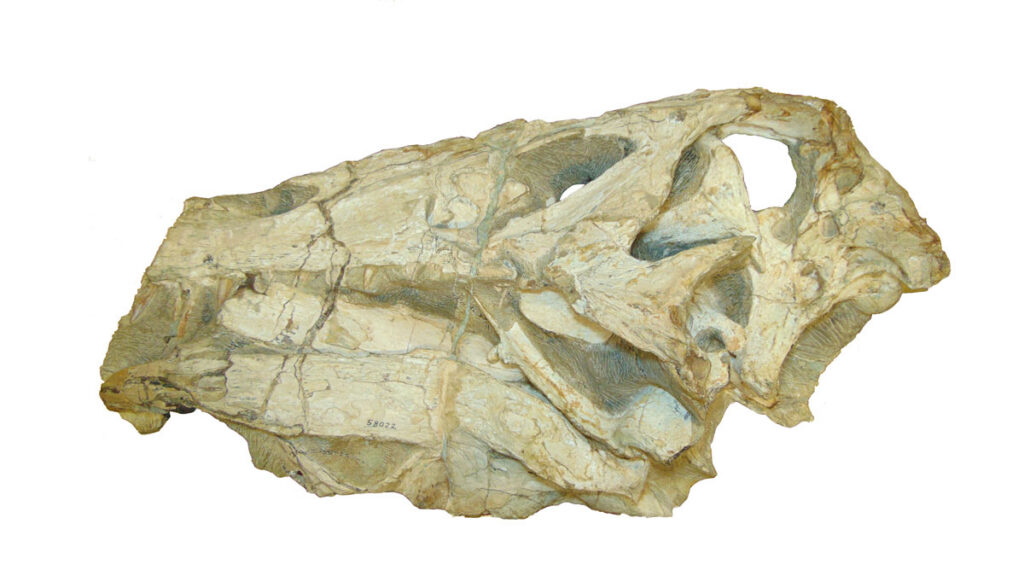
For many years a source of irritation, a fossil of the Brazilian spinosaurid Irritator challengeri is now bringing some joy to paleontologists in its homeland.
Following a successful public campaign for restitution, the piece is returning to Brazil from the collection of Germany’s State Museum of Natural History Stuttgart (SMNS), where it has been kept for the past 30 years—a situation that Brazilian paleontologists and lawmakers deemed illegal.
Representatives of both countries made the
For many years a source of irritation, a fossil of the Brazilian spinosaurid Irritatorchallengeri is now bringing some joy to paleontologists in its homeland.
Following a successful public campaign for restitution, the piece is returning to Brazil from the collection of Germany’s State Museum of Natural History Stuttgart (SMNS), where it has been kept for the past 30 years—a situation that Brazilian paleontologists and lawmakers deemed illegal.
Representatives of both countries made the announcement last month during Brazilian President Luiz Inácio Lula da Silva’s visit to Germany. In a joint statement, they announced the German museum’s “willingness” to “hand over” the fossil to Brazil and start a new, more transparent era of international collaboration.
“It is a very expected and cherished move because it represents a huge scientific and social victory for the Global South and for Brazil.”
“Finally, the Irritator will be back to its original place,” said paleontologist Allysson Pontes Pinheiro, director of the Plácido Cidade Nuvens Paleontology Museum.
The museum, located in northeastern Brazil where the fossil was discovered in the 1990s, will host the Irritator when it returns to Brazil. “It is a very expected and cherished move because it represents a huge scientific and social victory for the Global South and for Brazil,” Pinheiro said, highlighting that the return will allow local scientists and the population to have access to a heritage that would be difficult and expensive to access abroad.
Martill and Frey named the newly discovered species in reference to their irritation upon learning that the skull had been manipulated by fossil dealers to get a better price. Little did the researchers know that the fossil would irritate many other scientists, especially those from the animal’s homeland.
“This campaign showed us that it is worth continuing to fight for our fossils.”
The restitution request is based on Brazilian legislation passed in 1942 that determined that fossils found in the country are the state’s property and cannot be traded or exported without explicit authorization. In addition, a more recent Brazilian ordinance (dating to 1990) mandates that any holotype (a fossil used to describe a new species, such as the contested Irritator specimen) must remain in the country. Regardless, SMNS maintained the fossil had been legally purchased from a private dealer in Germany in 1991.
“We are very happy the Brazilian law is now being respected,” said Aline Ghilardi, a paleontologist at the Federal University of Rio Grande do Norte who was at the forefront of the repatriation campaign. “This campaign showed us that it is worth continuing to fight for our fossils.”
At the time of publication, SMNS had not responded to requests for comment.
A Long Process of Decolonization
But Ghilardi is not entirely satisfied. She didn’t like the wording of the announcement, which used the expression “hand over” rather than return, repatriate, or restitute.
“The statement was a missed opportunity to demonstrate the German government’s willingness to decide in favor of a restitution process,” she explained. “It seems there is resistance to making these restitutions as actual restitutions. It appears as if it is theirs by right and that they will hand over the fossil to Brazil as part of scientific cooperation.”
Ghilardi expressed that she will believe the repatriation will actually happen only when a specific return date is announced. (As of publication, it has not.) She also hopes that the Irritator case is not an isolated incident, but part of an ongoing trend of restitutions intended to break the pattern of neocolonialism in science.
A 2025 study published by Ghilardi and colleagues in the journal Palaeontologia Electronica showed that of nearly 500 invertebrate species described from fossils found in the Araripe Basin—one of Brazil’s richest and most threatened regions of geodiversity—about half have holotypes stored in institutions across Europe, Asia, and North America, violating Brazilian law.
Most of these smuggled fossils are hosted in Germany. “Some foreign colleagues complained about our campaign, saying that it looked like we were persecuting Germany,” Ghilardi said. “But that is not the case. It is just the numbers.”
It is possible, she noted, that other countries hold even more specimens that were not described in the scientific literature and therefore could not be counted.
The same study also found that more than 200 species were described in publications that did not include any Brazilian scientists as coauthors, despite Brazilian legislation requiring foreign research on Brazilian fossil material to be conducted in partnership with local institutions.
Wave of Repatriation
Paleontologist Serjoscha Evers at the Universität Freiburg, who authored the 2023 study on the Irritator fossil, wrote in an email to Eos that he welcomed the news of the dinosaur’s return.
However, he also wondered whether the decision is just “a diplomatic favor that resulted from the public pressure, or foreshadowing a broader wave of repatriations based on a legal conclusion that the fossils are unlawfully in German custody.”
Paleontologists involved in the Irritator restitution efforts said that since the campaign began, they have been receiving emails from museums and institutions worldwide seeking information on the procedures for returning fossils to Brazil.
Germany recently said it would “hand over” the Irritator challengeri fossil to Brazil. This illustration suggests what the dinosaur would have looked like before it was a fossil, about 110 million years ago. Credit: PaleoGeekSquared/Wikimedia Commons, CC BY-SA 4.0
The Plácido Cidade Nuvens Paleontology Museum, the final destination of the Irritator, has received several restitutions itself, including 45 fossils originally collected from the Araripe Basin and previously held by the University of Zurich in Switzerland, the fossil of a crustacean that was in the possession of the Universidad Nacional del Nordeste in Argentina, and a fish fossil seized in Italy.
According to Pinheiro, the museum’s director, paleontologists and the Brazilian government have listed at least 90 Brazilian holotypes still held in Germany. And the Brazilian Ministry of Foreign Affairs confirmed to Eos that it is currently negotiating the return of nine fossils held in undisclosed countries.
“We have been talking with colleagues from the museums where these materials are hosted, and they seem very favorable to returning them,” Pinheiro observed. “It is a huge advancement and a great change of behavior from important museums that have been holding heritage from the Global South.”
Citation: Moutinho, S. (2026), Germany to return contested dinosaur fossil to Brazil, Eos, 107, https://doi.org/10.1029/2026EO260167. Published on 22 May 2026.
Brazil consolidated its position as South America's leading defense spender during 2025, with a military budget of approximately USD 23.9 billion and a 13% year-on-year increase, while Uruguay recorded one of the steepest relative rises in the region, according to the annual report of the Stockholm International Peace Research Institute (SIPRI) released on Saturday. The region as a whole increased its military spending by 3.4% compared with 2024, in line with a global tr
Brazil consolidated its position as South America's leading defense spender during 2025, with a military budget of approximately USD 23.9 billion and a 13% year-on-year increase, while Uruguay recorded one of the steepest relative rises in the region, according to the annual report of the Stockholm International Peace Research Institute (SIPRI) released on Saturday. The region as a whole increased its military spending by 3.4% compared with 2024, in line with a global trend of armed forces modernization, open conflicts, and growing geopolitical tensions.

 Login
Login


 One year after the Trump administration launched its tariff offensive against more than 180 countries, Latin America presents a mixed picture: some economies lost competitiveness in the U.S. market, while others redirected exports or negotiated agreements to cushion the blow.