As collector Jochen Raiß (1969-2022) scoured flea markets and antique stalls for the better part of three decades for snapshots, he began to notice a running theme. Over time, he amassed a trove of photos by anonymous photographers with an unusually high number of portraits of women posing in trees. Swiss newspaper Züricher Tagesanzeiger asked, “What are they all doing up there?” And German paper Der Spiegel posited that the arbor-climbing might be a “forgotten popular sport.” Whatever the re
As collector Jochen Raiß (1969-2022) scoured flea markets and antique stalls for the better part of three decades for snapshots, he began to notice a running theme. Over time, he amassed a trove of photos by anonymous photographers with an unusually high number of portraits of women posing in trees. Swiss newspaper Züricher Tagesanzeiger asked, “What are they all doing up there?” And German paper Der Spiegel posited that the arbor-climbing might be a “forgotten popular sport.” Whatever the reason, the mystery is nearly as fun as the photos.
A hardcover edition of Women in Trees from Hatje Cantz, published in German and English, follows two titles published in 2016 and 2017 that celebrate these quirky images. Find your copy on the publisher’s website.
Photography is often touted as the most democratic and accessible medium in the visual arts. Today, the majority of us carry phones equipped with powerful, easy-to-use cameras that capture our lives and the world around us, transforming each of us into a documentarian at a moment’s notice. This omnipresence shapes our understanding of art and culture and often serves as a critical tool for political and social change.
The same is true for a forthcoming exhibition at the Mississippi Museum
Photography is often touted as the most democratic and accessible medium in the visual arts. Today, the majority of us carry phones equipped with powerful, easy-to-use cameras that capture our lives and the world around us, transforming each of us into a documentarian at a moment’s notice. This omnipresence shapes our understanding of art and culture and often serves as a critical tool for political and social change.
The same is true for a forthcoming exhibition at the Mississippi Museum of Art. Photography and the Black Arts Movement, 1955-1985 transports viewers to the mid-20th century, when the medium rose to prominence not only for artists but also for organizers, activists, and cultural icons. Featuring works by more than 100 photographers, the expansive exhibition ranges from editorial and commercial commissions to self-portraits and mixed-media social critiques. Many of the works push back against the state-sanctioned racism of the Jim Crow era and highlight the acts of protest that emerged from such discrimination.
Included is a graphic collage by Ralph Arnold titled “Above This Earth, Games, Games” that splices cut-outs of football matches with images of war and destruction. Taken that same year, 1968, was Ernest Withers’s captivating shot of Memphis sanitation workers picketing following the death of two employees. Creating a visual wall of signs declaring “I Am A Man,” the strikers in suits and hats demand both better working conditions and dignity and respect.
Cultural touchstones like the enigmatic musician and philosopher Sun Ra also appear. In a dynamic, black-and-white photo by Ming Smith, the jazz leader spins in front of the band, his glittering garb appearing like a halo of brilliant sparks.
Exhibition curators contextualize the show in a quote from Julian Bond, a civil rights leader who helped establish the Student Nonviolent Coordinating Committee: “Pictures told, for those who could not see themselves, of the strength and beauty of the people, of the hostility and anger of the opposition, and of the promise of a world free of racism.”
Photography and the Black Arts Movement, 1955-1985 is on view from July 25 to November 8 in Jackson.
Szilveszter Makó’s enigmatic photographs carry layers of mystery and introspection. Standing inside curious block-like backdrops and lain against two-dimensional fields of color and texture, his subjects seamlessly meld into stories in which every detail carries intention.
Taking inspiration from art history, the Milan-based artist references Surrealism and grotesque art through his use of chiaroscuro effects via light exploration and contrasting earth tones. Similar to 20th-century Surrea
Szilveszter Makó’s enigmatic photographs carry layers of mystery and introspection. Standing inside curious block-like backdrops and lain against two-dimensional fields of color and texture, his subjects seamlessly meld into stories in which every detail carries intention.
Taking inspiration from art history, the Milan-based artist references Surrealism and grotesque art through his use of chiaroscuro effects via light exploration and contrasting earth tones. Similar to 20th-century Surrealist paintings, Makó’s images delve into uncanny realms and evoke a dreamlike sense of unfettered imagination. It’s no surprise that the photographer was once a painter and has suggested that these impulses may be a subconscious homage to his earlier chapters.
Mystery presents itself in Makó’s photos through tactility that’s difficult to pinpoint. Subtle but moody elements—such as grain and halation surrounding moments of brightness—point to the possibility of filmic qualities achieved by chemical reaction, rather than digital manipulation. While the photographer doesn’t divulge his specific post-production techniques, he explains, “I would not call it a secret but more of an unorthodox process… those who understand the history of analog photography could probably recognize what I am doing.”
Makó’s strong sense of style can be attributed to his distinct mise en scène, consisting of handmade props made with recycled materials, carefully constructed theatrical environments, and bold yet often sculptural garments that add visual interest through elongated lines and exaggerated silhouettes. Often highlighting designer pieces by Schapiarelli, Maison Margiela, Prada, Bottega, and more, the artist has also teamed up with more commercial names, such as Zara, and most recently, Adidas.
“When we come into the studio, everything that my team and I have prepared, like the props, the costumes, and the designs, pile up in one room,” Makó shares in a conversation with Artribune. “I like to see it all collide. As what we imagine beforehand does not always want to come together in the way we planned.”
One of the most distinguishable motifs across the artist’s images is a box. This cubic element appears in many forms—a confined space that models find themselves in, the repeating shapes that make up checkered floors, house-inspired headpieces, or, more recently, its evolution into a two-dimensional compositional element in playful flat-lay photographs. “For me, the box is both a restriction and a liberation,” Makó notes. “It centralizes the host whilst simultaneously amplifying it, preventing energy from scattering across the frame.”
While the box’s formally geometric characteristics lend itself to an evolution of order, structure, and guidance, the photographer also enthusiastically welcomes spontaneous moments, explaining that “control makes images cold and calculated, leaving much without meaning. A shoot should breathe, it should evolve, it should shock even those who are making it.”
Although Makó regularly works with a slew of well-known celebrities—such as Elle Fanning, Bad Bunny, Michelle Yeoh, Willem Dafoe, Cate Blanchett, and more—he possesses a unique ability to transcend the veil of fame, artfully translating even the most recognizable faces into something entirely of his own. He shares, “I do not treat celebrities differently from anyone else. We enter the room as equals. The set is not a hierarchy, it is a space where we work together.”
See more from the photographer on Instagram, and find his images published in editions of Vogue, The Cut, Acne Paper, Vanity Fair, GQ, and more.
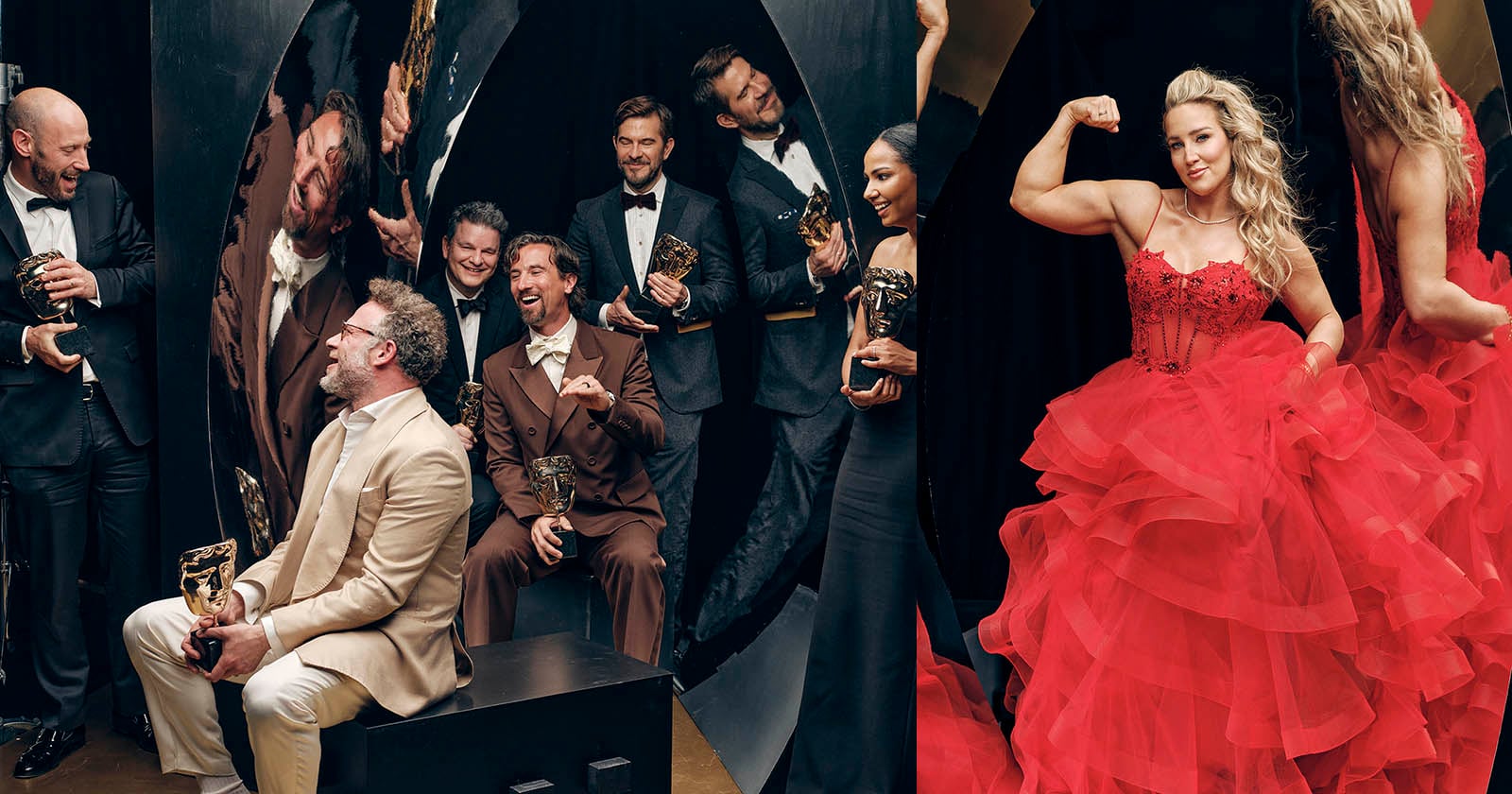
Few photographers ever get to work inside the portrait room of a major awards ceremony. Most will only ever see the finished images: the winner holding the award, the controlled lighting, the polished expression, the clean composition.
[Read More]
Few photographers ever get to work inside the portrait room of a major awards ceremony. Most will only ever see the finished images: the winner holding the award, the controlled lighting, the polished expression, the clean composition.
In ballpoint pen on found fragments of philosophical and historical texts, Habib Hajallie delves into the emotional realm of memory, connection, and loss. The Kent-based artist often celebrates Black cultural figures and beloved family members, along with examining his own personal experiences as a British man of Sierra Leonean and Lebanese heritage. In his current solo exhibition, Black & Blue at Larkin Durey, Hajallie grapples with the devastating stillbirth of his daughter and the “ind
In ballpoint pen on found fragments of philosophical and historical texts, Habib Hajallie delves into the emotional realm of memory, connection, and loss. The Kent-based artist often celebrates Black cultural figures and beloved family members, along with examining his own personal experiences as a British man of Sierra Leonean and Lebanese heritage. In his current solo exhibition, Black & Blue at Larkin Durey, Hajallie grapples with the devastating stillbirth of his daughter and the “indescribable emotions that sit beneath language,” says the gallery.
For this show, the artist deliberately switched from using black ballpoint ink to blue. As he made these works, Hajallie also reflected on the loss of his sister four years ago. Using antique maps and snippets of philosophical and sociological writings, he portrays subtle sides of what the gallery describes as “an altered sense of self.” Figures, including several self-portraits, exude feelings of despair, confusion, numbness, care, and the nuanced emotions that emerge in-between.
“Still Remain” (2026), ballpoint pen on antique texts, 11 3/8 x 16 1/2 inches
“While this series is concerned with the internal landscape of loss and what it means to endure a profoundly altered reality, each artwork has acted as an invaluable step towards healing,” the gallery says. “By drawing directly onto antique texts that explore morality, purpose, and transcendence, Hajallie’s personal pain enters into a wider conversation about finding meaning and the ways in which drawing can become a space of solace and catharsis.”
Black & Blue continues through May 22 in London. See more on the artist’s Instagram.
“A Refuge Among Reflections” (2026), ballpoint pen on antique texts, 33 1/8 x 23 1/4 inchesDetail of “A Refuge Among Reflections”“This Mind Hath Demolition Reached” (2025), ballpoint pen on antique texts, 11 3/4 x 16 1/2 inches“Nothing Else to Fear” (2026), ballpoint pen on antique texts, 33 1/8 x 23 1/4 inches“Arise and Walk Strongly and Fearlessly” (2026), ballpoint pen on antique texts, 33 1/8 x 23 1/4 inches
Alan Mays posted a photo:
The man with the fan knows that despite the heat, it'll be alright.
There's no indication where or when this snapshot was taken.
A Vintage Photos Theme Park photo of an electric fan for the theme of electric fans or sports fans (if you have both kinds of fans, please feel free to post 2 photos).
The man with the fan knows that despite the heat, it'll be alright.
There's no indication where or when this snapshot was taken.
A Vintage Photos Theme Park photo of an electric fan for the theme of electric fans or sports fans (if you have both kinds of fans, please feel free to post 2 photos).
On the top floor of Buffalo AKG Art Museum’s Gundlach Building, a vast body of work from 58 artists comes together for Let Us Gather In a Flourishing Way. The impressive ensemble is both a survey of contemporary Latinx painting and a lively dialogue between a spectrum of artists with diverse backgrounds, experiences, identities, languages, and creative mediums.
Let Us Gather In a Flourishing Way is a major exhibition that has slowly unfolded over the course of several years. Curator Andrea
On the top floor of Buffalo AKG Art Museum’s Gundlach Building, a vast body of work from 58 artists comes together for Let Us Gather In a Flourishing Way. The impressive ensemble is both a survey of contemporary Latinx painting and a lively dialogue between a spectrum of artists with diverse backgrounds, experiences, identities, languages, and creative mediums.
Let Us Gather In a Flourishing Way is a major exhibition that has slowly unfolded over the course of several years. Curator Andrea Alvarez—the architect and driving force behind the project—has spent much of this time immersed in research and collaborating closely with each artist throughout the process, refining every detail of the show.
Eamon Ore-Giron, “Talking Shit with Illapa (variation I)” (2023), mineral paint and Flashe on canvas, 72 inches × 96 1/8 inches. Photo by Brenda Bieger
The exhibition’s title alludes to former U.S. poet laureate Juan Felipe Herrera’s titular poem. Oscillating between English and Spanish while employing lush imagery of flora and fauna, the poem itself—like the survey—is an exuberant celebration of community and cultural convergence. He writes:
cielo de calor and wisdom to meet us where we toil siempre in the garden of our struggle and joy let us offer our hearts a saludar our águila rising freedom
The show traces this poetic rhythm in its spatial design. Herrera’s stanzas greet visitors at each entrance and throughout its galleries, establishing tone and providing context for what lies ahead.
Although the exhibition is organized into seven themes, Alvarez highlights its intrinsically flowing nature, noting that even if the collection were rearranged, the show would still hold together. In a walkthrough, it became clear that space was central to the viewing experience, leaving room for visitors to engage with the works on their own terms, much like the exhibition’s overarching focus on gathering and bolstering free-flowing conversation.
Moises Salazar Tlatenchi, “Cruising Queens” (2024), oil on canvas, glitter, yarn, 35 x 45 inches
In Moises Salazar Tlatenchi’s “Cruising Queens,” a boat of five faceless figures and an American flag sail icy waters. Reminiscent of 18th-century America, the figures wear powdered wigs and tricorne hats. Finished with a dense layer of glitter and a daintily crocheted lavender frame, the artist’s glamorous materials—and the existence of brown figures in this context—subvert American history. “Cruising Queens” is placed within the exhibition’s New Histories section, which focuses on retelling personal, cultural, and global histories.
Colossal readers might also recognize Eamon Ore-Giron’s tessellated abstractions in “Talking Shit with Ilapa (variation I),” Guadalupe Maravilla’s mixed-media techniques in “Pupusa Retablo,” and Firelei Báez’s vibrant portraits bursting with floral motifs in “Mawu-Lisa (I build my language out of rocks).” Known for deconstructing colonial structures within her work, Báez turns toward the transatlantic slave trade, invoking deity Mawu-Lisa, a critical figure in the culture and religion of the Fon people in West Africa, who were brought to the Caribbean by force.
Bodies & Figures denotes another section of the show, highlighting “representations of and by marginalized people, considering the importance of the body, and who is or isn’t seen in an image,” the catalog says. One such work is Salomón Huerta’s triptych of untitled canvases. Through the absence of figurative human subjects within the paintings, visitors experience an intimate representation of the artist’s father.
“Huerta’s father protected the family in their home in Ramona Gardens, a violent housing project in East Los Angeles,” the museum label reads. “At night, he would set his .38-caliber revolver on the bedside table and ask Huerta to bring him a snack—often a concha or a glass of milk.” Disrupting expectations of traditional portraiture, the artist evokes something that feels deeply tender and human-centered—without the presence of a body.
Salomón Huerta, “Untitled” (2024), “Untitled (2025), “Untitled” (2024), oil on canvas, 14 x 16 inches. Photo by Jackie Andres
At the same time, Let Us GatherIn a Flourishing Way begs the question: how do identity and place shape each other? Los Angeles-based artist Alfonso Gonzalez Jr. turns to the rich visual language of signage. A meticulous technique passed down from his father’s professional career in commercial sign painting, Gonzalez has developed an enduring relationship with East Los Angeles’ emblematic advertisements and billboards, often reflecting Chicano culture. In “Abogados Tierra Caliente (Billboard),” the artist underscores the inherent connection between local landscapes and one’s selfhood, and an interesting relationship emerges between public commercial objects, personal portraits, and the museum itself.
Chicago-based Yvette Mayorga’s strikingly pink composition, “The Brunette Latinx Self Portrait After Francois Boucher’s “The Brunette Odalisque” c. 1745,” is affixed to a wall in the show’s cluster of Pinturx works, which are described as “contemporary Latinx approaches to traditional painting genres like still life and portraiture.” The artist’s distinctive technique of piping acrylic paint embodies themes of labor, femininity, and memory. Mayorga’s unconventional methods are an example of newer approaches to portraiture and complement the artist’s nods to Baroque and Rococo art.
Included in this grouping of nontraditional painting methods are other artists previously featured on Colossal, such as Sarah Zapata’s textile columns, made from handwoven cloth and various fibers. Installed leaning against a wall or protruding downward from the ceiling, her structures convey instability—a reflection of the current climate we find ourselves in. Narsiso Martinez also makes an appearance with “Checker Leading the Crowd,” made with charcoal on his distinctive cardboard produce box background, calling attention to labor.
In an anchoring room of the exhibition, “Promised Land” by Patrick Martinez spans 16 feet wide, redolent of a landscape’s sweeping view. Acrylic, neon, stucco, spray paint, and ceramic tile are just some of the layers that sit atop each other in the mixed-media work. Martinez ruminates on his native Los Angeles and the facade of “paradise” amid an ever-changing cultural landscape marked by gentrification and financial marginalization. Abstracted and washed-out structures, spray-paint marks inspired by graffiti, and an archival family photo collage represent the passage of time and the act of constantly rebuilding. “Promised Land” is part of the exhibition’s Land/tierra section, which highlights “Latinx approaches to landscape and the built environment, thinking about land and tierra and their rapid change.”
“Let Us Gather in a Flourishing Way” at the Buffalo AKG Art Museum. Photo by Brenda Bieger, Buffalo AKG Art Museum
As a whole, the boundary-pushing exhibition comes together in a chorus of dialogues, mediums, backgrounds, and experiences. The Caribbean and Latin American diaspora is complex, and each artist remains distinct—resisting an external flattening into a monolithic identity. Let Us Gather In a Flourishing Way is a celebration of contrasts and connections and a necessary counterbalance in the glaring face of division.
The exhibition is on view through September 6, when it will travel to the Des Moines Art Center, the Phoenix Art Museum, and the Frye Art Museum in Seattle. Public programming—workshops, artist talks, tours with poet Juan Felipe Herrera, and more—is slated to accompany the show’s run, so keep an eye out for events on the museum’s website.
“Let Us Gather in a Flourishing Way” at the Buffalo AKG Art Museum. Photo by Brenda Bieger, Buffalo AKG Art MuseumLarry Madrigal, “Man on Trampoline” (2023), oil on linen, 90 x 76 inches. Photo by Yubo Dong, ofstudio photography, courtesy of the artist and Nicodim“Let Us Gather in a Flourishing Way” at the Buffalo AKG Art Museum. Photo by Brenda Bieger, Buffalo AKG Art MuseumYvette Mayorga, “The Brunette Latinx Self Portrait After François Boucher’s “The Brunette Odalisque” c.1745″ (2022), acrylic nails, acrylic marker, false eyelashes, collage, plastic rings, plastic nail charms, rhinestones, car wrap vinyl, and acrylic piping on panel, overall 60 x 120 x 2 inches. Photo by Robert Chase Heishman, courtesy of the artist “Let Us Gather in a Flourishing Way” at the Buffalo AKG Art Museum. Photo by Brenda Bieger, Buffalo AKG Art Museum“Let Us Gather in a Flourishing Way” at the Buffalo AKG Art Museum. Photo by Brenda Bieger, Buffalo AKG Art Museum“Let Us Gather in a Flourishing Way” at the Buffalo AKG Art Museum. Photo by Brenda Bieger, Buffalo AKG Art Museum “Let Us Gather in a Flourishing Way” at the Buffalo AKG Art Museum. Photo by Brenda Bieger, Buffalo AKG Art Museum
In Everything Now All At Once at the Nasher Museum of Art at Duke University, the title says it all. Dozens of works from the likes of Nick Cave, Ai Weiwei, Nina Chanel Abney, Wangechi Mutu, and many more represent a slice of the contemporary art world in which globalism and diversity are at the fore, and the lessons of the past inform how artists imagine the future.
Interestingly, the pieces are also decidedly analog, especially noteworthy as these works—alongside a few other multimedia
In Everything Now All At Once at the Nasher Museum of Art at Duke University, the title says it all. Dozens of works from the likes of Nick Cave, Ai Weiwei, Nina Chanel Abney, Wangechi Mutu, and many more represent a slice of the contemporary art world in which globalism and diversity are at the fore, and the lessons of the past inform how artists imagine the future.
Interestingly, the pieces are also decidedly analog, especially noteworthy as these works—alongside a few other multimedia and photographic additions—have been made throughout the era of light-speed technological advances. Painting and sculpture, in particular, have long been treated as the nexus of “high art” in the Western canon. The Nasher’s focus on these genres is paired with representations of global cultures and people of color, spotlighting how these depictions have been manifestly omitted from art during the last several centuries. Importantly, the collection prioritizes expressions of joy, resilience, and individuality.
All of the works in Everything Now All At Once are part of the Nasher’s permanent collection, highlighting its accession strategy over the past twenty years with a focus on iconic pieces by artists from historically marginalized backgrounds. From Jeffrey Gibson’s landmark beaded punching bag series to Amy Sherald’s brightly backgrounded portraits, visitors can glimpse incredible creativity by dozens of artists in a show that highlights voices that have been drastically underrepresented in the canon.
Ongoing since August 2025, Everything Now All At Once will rotate new pieces into the exhibition next month and continue through November 1 in Durham, North Carolina.
Tensely contorted or standing pin straight, Ben Zank’s signature faceless subjects evoke ineffable yet familiar emotions.
The New York City-based photographer has a knack for turning ordinary settings and unaccompanied figures into strangely perplexing sights. Mismatched socks, bold garments, and awkward poses go a long way in evoking a visceral response through his lens, tapping into a sort of uncanny realism.
Zank’s work traveled to Festival Cargo Les Photographiques—a.k.a. The C
Tensely contorted or standing pin straight, Ben Zank’s signature faceless subjects evoke ineffable yet familiar emotions.
The New York City-based photographer has a knack for turning ordinary settings and unaccompanied figures into strangely perplexing sights. Mismatched socks, bold garments, and awkward poses go a long way in evoking a visceral response through his lens, tapping into a sort of uncanny realism.
Zank’s work traveled to Festival Cargo Les Photographiques—a.k.a. The Cargo Festival—in Saint-Nazaire, France last summer. Since its debut in 2022, the annual event typically features several outdoor exhibition areas, highlighting contemporary photographers.
The artist’s plein air installation for the festival included large reproductions of images affixed to leaning wooden pallets and covering brick walls. The minimalist, Earth-toned portraits complemented their surroundings, scattered across sparse grounds.
Zank is currently working on a series that is focused on capturing strangers in their own homes, rather than the constructed settings he typically employs. Find more from the artist on Instagram.
“I started doing photography as a way to express things I don’t understand or to convey a message I’m having a hard time explaining,” Austn Fischer says. “I often work in quite a backwards way, knowing exactly what I want to arrange in front of the camera but struggling to understand the significance in my life until I am able to reflect on it after.”
The Wisconsin-born, London-based photographer taps into fashion as performance, considering how our garments, style, and gestures convey par
“I started doing photography as a way to express things I don’t understand or to convey a message I’m having a hard time explaining,” Austn Fischer says. “I often work in quite a backwards way, knowing exactly what I want to arrange in front of the camera but struggling to understand the significance in my life until I am able to reflect on it after.”
The Wisconsin-born, London-based photographer taps into fashion as performance, considering how our garments, style, and gestures convey parts of our identities. Contrast is key in Fischer’s work, and it emerges through unusual pairings like lace ruffs atop athletic garb or an angular, black gown with a dainty, horse-shaped wire armature. Whether a portrait or a more conceptual composition, each work harnesses an exuberant sense of play and homes in on our ability to remake ourselves anew.
David Byrne
“Growing up, I had a lot of questions around my sexuality and my own experience as a man. I naturally gravitated towards fashion because of the story clothing can convey in an image,” he adds. “The colours, shape, fabric, and the way clothing wraps around a model create a unique conversation around identity and the body.”
Fischer has collaborated with a range of editorial and commercial clients, shooting Ai Weiwei with a milkshake for The New Statesman, for example, and David Byrne seemingly under oath for Crack Magazine. Whether working on a personal project or a commissioned series, the photographer transforms a largely black-and-white palette that could appear harsh into scenes exuding warmth and softness.
Better understanding his own emotions is Fischer’s priority at the moment, following a series of painful experiences, both personal and professional, that have influenced what and how he’s creating. “Recently, I spent two weeks from 8 a.m. to 5 p.m. painting a wall in a church white over and over to understand patience and reflect on myself. I’m working a lot on understanding emotion and myself through putting my body through different tasks or challenges,” he tells Colossal.
For the better part of two decades, Irina Werning has traveled throughout Latin America searching for a specific trait: incredibly long hair. In her photography series Las Pelilargas—meaning “the long-haired ones” in Spanish—she chronicles a time-honored Indigenous tradition through a visual celebration of patience, joy, and cultural pride.
In a statement, Werning shares that when she asks young women in the many small towns she’s visited why they have long hair, they respond with simple r
For the better part of two decades, Irina Werning has traveled throughout Latin America searching for a specific trait: incredibly long hair. In her photography series Las Pelilargas—meaning “the long-haired ones” in Spanish—she chronicles a time-honored Indigenous tradition through a visual celebration of patience, joy, and cultural pride.
In a statement, Werning shares that when she asks young women in the many small towns she’s visited why they have long hair, they respond with simple reasons akin to, “Because I like it.” But, Werning adds, “The true reason is invisible and passes from generation to generation. It’s the culture of Latin America, where our ancestors believed that cutting hair was cutting life, that hair is the physical manifestation of our thoughts and our souls and our connection to the land.”
Nearly 90 images are included in Werning’s new book, Las Pelilargas, published by GOST Books. The photos span 18 years, starting with the artist’s first encounter with long-haired women in 2006 in Argentina, when she was photographing members of the Indigenous Kolla community.
“Guided by her intuition, she went on to spend months in remote mountain towns putting up signs in schools, hospitals, and markets, and organising hair competitions in an effort to seek out those with long hair,” GOST says. Werning continued to make the portraits until 2024. “She found that traditions were not just surviving, but evolving with long hair symbolising both continuity and subtle rebellion.”
The expression “wherever you go, there you are” is often wielded to describe futile attempts to escape hangups, anxieties, and a variety of unwanted emotions. Although this truism is typically offered as a negative, it can also be read as a positive that provides comfort and stability amid new environments.
In I Bring Home with Me, Ghanaian artist Amoako Boafo recreates his Accra studio in an architectural reproduction within Roberts Projects’ Los Angeles gallery. Boafo is known for his st
The expression “wherever you go, there you are” is often wielded to describe futile attempts to escape hangups, anxieties, and a variety of unwanted emotions. Although this truism is typically offered as a negative, it can also be read as a positive that provides comfort and stability amid new environments.
In I Bring Home with Me, Ghanaian artist Amoako Boafo recreates his Accra studio in an architectural reproduction within Roberts Projects’ Los Angeles gallery. Boafo is known for his stylized portraiture of Black people, whose skin the artist renders in swirling gestures made with his fingers. This exhibition presents a collection of paintings embedded within the life-sized replica, created in collaboration with architect and designer Glenn DeRoche.
“Floral Shirt” (2025), oil on canvas, 39.125 x 39.125 x 1 inches
According to a statement from the gallery, Boafo wanted to reflect both the “images, sounds, people, stories, and events that shape his sense of place” and how community gatherings in his studio are essential to his process. While some portraits depict imagined subjects, many portray friends, family, and public figures.
Monstera wallpaper, porous wall dividers, and floral seat covers add color and texture to the largely black, wooden structure and echo Boafo’s use of paper transfers, embroidered details, and thick impasto. Paired with his portraiture, these architectural details guide viewers through the space and capture how presence and memories shape our inner and outer environments.
I Bring Home with Me is on view through March 21. Find more on the artist’s Instagram.
“Bouquet of White Roses” (2025), oil on canvas, 81 x 66 inchesInstallation view of ‘I Bring Home with Me’“Self Portrait – Ivy Leaf Sofa” (2025), oil and paper transfer on canvas, 65 x 59 inches“Black Cycle”“Pink Dial” (2025), oil on canvas, 35.5 x 39.125 x 1 inchesDetail of “Black Cycle”Installation view of ‘I Bring Home with Me’

 Login
Login