Normal view

  • ✇Cartoon Research
  • The 50th Anniversary of Rankin/Bass “The First Easter Rabbit” Michael Lyons
    If you celebrate the 50th anniversary of The First Easter Rabbit this spring, prepare for an “earworm.” The song “There’s That Rabbit” (written by Jules Bass and Maury Laws) will play in your head on repeat. It opens the special from Rankin/Bass, the Studio synonymous with beloved TV Christmas specials. Following in the footsteps of favorites like Rudolph, the Red-Nosed Reindeer and Frosty the Snowman, The First Easter Rabbit, directed by Arthur Rankin, Jr. and Jules Bass, shares many familia
     

The 50th Anniversary of Rankin/Bass “The First Easter Rabbit”

27 March 2026 at 07:01

If you celebrate the 50th anniversary of The First Easter Rabbit this spring, prepare for an “earworm.” The song “There’s That Rabbit” (written by Jules Bass and Maury Laws) will play in your head on repeat. It opens the special from Rankin/Bass, the Studio synonymous with beloved TV Christmas specials.

Following in the footsteps of favorites like Rudolph, the Red-Nosed Reindeer and Frosty the Snowman, The First Easter Rabbit, directed by Arthur Rankin, Jr. and Jules Bass, shares many familiar plot elements. Just as those specials tell the story of how a holiday legend came to be, so too does this one, highlighting the Easter Rabbit. The special features an appropriately themed song, a narrator, and even an appearance by Santa Claus, making it instantly recognizable as a Rankin/Bass production.

Instead of their usual stop-motion “Animagic,” Rankin/Bass uses traditional 2D animation here.

Though telling an Easter story, the special opens at Christmas. The narrator, G.B., a well-dressed rabbit, introduces Stuffy, a stuffed rabbit gifted to a young girl named Glinda. When Glinda contracts Scarlet Fever, her family must destroy her toys to stop the disease’s spread.

Happiness returns as Calliope, a sprite, saves Stuffy, bringing him to life and assigning him a mission: to become the First Easter Rabbit. Stuffy travels to Easter Valley—a North Pole section warmed by the magical Golden Easter Lily—where he meets Santa Claus, who assists him.

Actor Robert Morse

Three other rabbits—Spats, Flops, and Whiskers—help Stuffy reach Easter Valley and assist him there.

Zero, the evil ice wizard, and his sidekick Bruce, a snowball, aim to stop Easter. Zero wants to create a blizzard in Easter Valley and steal the Golden Easter Lily. With his friends and Santa, Stuffy sets out to save Easter.

The main character of Stuffy is voiced by Tony Award-winning Broadway musical veteran Robert Morse. “Robert appeared in three Rankin/Bass TV specials,” said Rick Goldschmidt, official Rankin/Bass historian/biographer and author of such books as The Enchanted World of Rankin/Bass. “Jack Frost is probably his best-known appearance. He was ecstatic to get my 15th-anniversary edition of The Enchanted World of Rankin/Bass, so much so that he called me on Christmas morning. He said the memories of working with Arthur and Jules were great. I think he understood the magic in the specials; that extra something that really can’t be described.”

Don Messick voices Whiskers and Bruce; Stan Freberg plays Flops; Joan Gardner is Calliope; and Paul Frees gives voice to Zero, Spats, and Santa Claus.

The cover of the rare sheet music.

Continuing the tradition of memorable narrators, none other than Burl Ives returns to a Rankin/Bass special to provide the voice of G.B., who guides the audience through the story of The First Easter Rabbit. “I became great friends with Burl’s widow, and she was proud of his work in this as G.B.,” noted Rick. “I also thought it was cool that he returned in the vest, watch, et cetera. – a nod to his appearance as Sam in Rudolph.”

The animation showcases Paul Coker, Jr.’s distinctive design, familiar from the Studio’s other specials like Frosty the Snowman (1969). Coker, a Mad magazine and Hallmark contributor, gave the special a style reminiscent of vintage greeting cards.

In addition to “There’s That Rabbit,” the special also includes “Easter Parade,” the familiar holiday standard by Irving Berlin, which features in the finale and is complemented nicely by springtime color.

The First Easter Rabbit aired on NBC on April 9, 1976. It was written by Julian P. Gardner (a pseudonym for Jules Bass) and based loosely on the popular book, The Velveteen Rabbit by Margery Williams. With their take on the story, Rankin/Bass continues the tradition established by their other holiday specials. Here, they not only provide an “origin story” for another iconic holiday figure, but with “There’s That Rabbit,” they offer an earworm of a song that may linger with you through Mother’s Day.

For more about the music in this special – check Greg Ehrbar’s post about that by Clicking Here! Another Rankin/Bass Easter special celebrates a milestone this year and will be featured next week.

  • ✇Cartoon Research
  • The Last Days of UPA’s Mr. Magoo – 1959-1960 Jerry Beck
    This post is the “flip-side” of an article I posted here a few weeks ago (The Last Five Screen Gems Cartoons 4/14/26) where I looked at transition of the outgoing Columbia’s Screen Gems releases and the incoming UPA cartoons. A real changing of the guard. Roughly ten years later, the guard changed again. Things weren’t going well for UPA in the second half of the decade. Their satellite studios in New York and London closed; the Magoo feature was a troubled project; The Boing Boing Show was bom
     

The Last Days of UPA’s Mr. Magoo – 1959-1960

5 May 2026 at 07:01

This post is the “flip-side” of an article I posted here a few weeks ago (The Last Five Screen Gems Cartoons 4/14/26) where I looked at transition of the outgoing Columbia’s Screen Gems releases and the incoming UPA cartoons. A real changing of the guard.

Roughly ten years later, the guard changed again. Things weren’t going well for UPA in the second half of the decade. Their satellite studios in New York and London closed; the Magoo feature was a troubled project; The Boing Boing Show was bombing; the Columbia contract for theatrical shorts had an expiration date: 1959.

The last of the 1958-59 season, released in July 1959, was Terror Faces Magoo. Produced in New York during the production crunch in Burbank on 1001 Arabian Nights, the Magoo feature.

By the end of the year UPA founder/producer Stephen Bousustow found a new financial “partner” to bail the studio out – Henry G. Saperstein – who essentially bought the studio and ultimately inched Bosustow out the door. Beginning in November, Columbia began releasing Hanna Barbera’s TV-styled Loopy DeLoop shorts as theatrical subjects (an arrangement that lasted through June 1965)!

Mr. Magoo was still extremely popular, if only as a short subjects star – and Bosustow knew that. Bosustow decided to keep making “UPA shorts” for theatrical release, and from this point on UPA itself would release them. Four new shorts were put into production.

The first one, Magoo Meets Boing Boing (The Noise Making Boy), directed by Abe Levitow, was given an Oscar qualifying release in late 1959. This cartoon was certainly a perfect idea to start with a ‘Bang-Bang’. I love how in the ‘UPA-niverse’, Magoo is on a short list of babysitters in the McCloy household. Magoo mistakes Gerald for his dog (and vice-versa) and “rescues” Gerald from a fire (actually just Gerald’s sound effects voice). The animation is no worse than the last few Columbia Magoo films – but far from the heights of greatness both characters had previously attained just a few short years earlier. Note that the theatrical title for this film was Magoo Meets Boing Boing (The Noise-Making Boy), the TV version is retitled Magoo Meets McBoing Boing.


The second Magoo cartoon, released in 1960, was likewise submitted for Academy Award consideration – I Was A Teenage Magoo – this time directed by Clyde Geronimi. It’s an odd one. The most UPA aspect of it is the background designs by Tom Yakutis, which are very cool. The animation is up the theatrical standards of the last Columbia Magoo’s – but that’s not saying too much. Told in flashback, the plot has teenage (but still nearsighted) red-headed Magoo picks up his date “Melba” (a kangaroo) from her home (in a circus) and go on a picnic. Sort of a prequel of sorts to Magoo’s Young Manhood (1958). Bosustow’s attempt to self-distribute was a huge failure. This cartoon was ultimately released as part of the TV package – albeit cut by two minutes and shown under the title Teenage Magoo.


The third short produced by Bosustow for theatrical release was Bric’s Stew – directed by Harvey Toombs – which featured a pair of new characters “Bric n’ Brac”. The negative was discovered a few years ago among film elements acquired by the Academy of Motion Picture Arts and Sciences – within unclaimed inventory from the defunct DuArt Laboratory in New York City. Why it was abandoned and forgotten no one knows. Why there is a UA-TV logo at the end – no one knows. Asifa-Hollywood funded a preservation and I wrote about it in a post about this find in January 2019. I’m happy to present the entire cartoon, for the first time, below.


A fourth Magoo short intended for theaters – Magoo Meets Frankenstein – joined the other two in the Mr. Magoo TV package (130 new cartoons made-for-TV). Below is the first half of the rare theatrical version:

Bosustow finally sold his interest in UPA in June 1960. This wasn’t the end of Magoo – he would live on in his Christmas Carol TV special (a classic), a 26 episode series of Famous Adventures, as Uncle Sam, a GE light bulb salesman, in a Saturday morning DePatie Freleng series – and a live action movie (released by Disney)!

Despite a bittersweet fade-out, UPA was a historic game changer for animation during the 1950s. It was a studio – like Walt Disney’s – that is worth exploring with deeper dives.

For more information on UPA – I highly recommend Adam Abraham’s outstanding UPA history, When Magoo Flew: The Rise and Fall of Animation Studio UPA.

SPECIAL THANKS to Al Warner and Denis-Carl Robidoux for permission to share their transfers of the first two UPA Magoo theatricals – and to ASIFA-Hollywood for letting us debut the complete “Bric’s Stew”.

  • ✇Cartoon Research
  • “Snow White” in Nazi Germany Kris Reyes
    Have you ever wondered about how Walt Disney’s Snow White and the Seven Dwarves was brought to Germany? After all, the film is based on a German fairy tale, and it was released on the cusp of World War II. Surely, there would have been a German version. Well, it turns out there was a German dub that was intended to release in Germany in 1939. Unbeknownst to many, including the good folks at Disney, the cast they hired for the German dub had consisted entirely of Jewish exiles living in Amsterda
     

“Snow White” in Nazi Germany

2 June 2026 at 07:01

Have you ever wondered about how Walt Disney’s Snow White and the Seven Dwarves was brought to Germany?

After all, the film is based on a German fairy tale, and it was released on the cusp of World War II. Surely, there would have been a German version. Well, it turns out there was a German dub that was intended to release in Germany in 1939. Unbeknownst to many, including the good folks at Disney, the cast they hired for the German dub had consisted entirely of Jewish exiles living in Amsterdam. Not only that, but these actors had been some of the biggest names in the German film industry before the rise of the Nazis.

After Snow White and the Seven Dwarves premiered in the United States in 1937, Disney quickly moved to create 12 international versions of the film. It wasn’t difficult to secure distribution deals in most countries, but Germany proved to be a tough nut to crack. By 1938, all of the American owned studios had pulled up stakes and left the country due to rising political tensions. American movies could still be released in Germany, but they had to go through UFA, which was the German state-owned film distributor.

Nazi leader Adolf Hitler, and Propaganda Minister Joseph Goebbels, who directly controlled the movie industry in Germany, worked with Disney through UFA to try and secure a deal for Snow White. Hitler was a big fan of Disney, and Snow White was based on a German fairy tale, so he knew they had to show the movie in Germany. To Hitler, having the great Walt Disney adapt a German fairy tale as a feature length animated film was a great national honor. For Disney, going through the government of Germany took a lot more time than negotiating a deal with a traditional, privately owned studio. While they worked out a deal, Roy Disney flew to Amsterdam to oversee the production of the Dutch version of Snow White.

In Amsterdam, Roy Disney worked with local Dutch producer Max Tak, who hired director, actor, and comedian Kurt Gerron to direct the Dutch dub of Snow White. Since Gerron was fluent in German, he was asked if he could also direct a German dub of the film. Gerron was more than happy to take the job offer, as he was part of a community of German speaking actors who had recently moved to Amsterdam. There was one little detail that likely went unnoticed, however. Gerron and his community of actors were Jews from Germany who had fled to Amsterdam after Jews were banned from working in the German film industry.

Dora Gerson

From May 1938 to July 1938, Gerron directed both the Dutch and German dubs of the film. Featured in the cast for the German version were Dora Gerson as the Queen, Otto Wallburg as Doc, Kurt Lillien as Grumpy and Sneezy, Siegfried Arno as Happy, and Gerron himself played the Magic Mirror and Bashful. Each of these actors had been prominent in both film and live performances.

Dora Gerson was a German-Jewish actress who appeared in films alongside Bela Lugosi during the silent era. She had been married to film director Veit Harlan briefly in the 1920s, he would later go on to direct the antisemitic propaganda film Jud Süss in 1940. Gerson fled Germany for the Netherlands in 1936, and would eventually be caught and sent to Auschwitz with her husband and two children. The family was murdered at Auschwitz on February 14th, 1943.

Otto Wallburg was a prominent comedian and actor who performed in dozens of movies in the 1920s and 1930s. He appeared alongside Kurt Gerron in the 1931 comedy Bombs on Monte Carlo, also in 1931 he appeared in The Congress Dances, which was an international sensation. He escaped Germany for Austria in 1933, where he continued working in film until fleeing to France, and then finally the Netherlands. After the German invasion of the Netherlands in 1940, Wallburg was arrested and sent to the Westerbork transit camp, before he was killed at Auschwitz on October 29th, 1944.

Kurt Lilien was an actor who was most active between 1927 and 1933. During this time he appeared in a number of films, including Two Hearts Beat as One starring Lilian Harvey. Lilien also performed in the 1927 silent film The Most Beautiful Legs of Berlin alongside Kurt Gerron. He was killed at the Sobibor Concentration Camp in Poland on May 28th, 1943.

Of those who performed in Snow White, there is no one more historically significant than Kurt Gerron, himself. Unbeknownst to Disney at the time, Gerron had a reputation with the regime. To international audiences, Gerron was Marlene Dietrich’s manager in The Blue Angel, an UFA produced film about a professor who falls in love with a burlesque dancer. To the Nazis, Gerron represented the personification of Jewish excess. In his films, Gerron commonly played the part of the Jewish banker, lawyer, or any sort of greedy businessman. His appearance inspired many of the anti-semitic cartoons published in right-wing newspapers of the 1930s, and in 1940 his image would be used disparagingly in the propaganda film The Eternal Jew. Gerron was the image most German people had in their heads of what a Jew looked like.

Kurt Gernon

The final film directed by Kurt Gerron, long after his work on Snow White was behind him, was a propaganda film “praising” the conditions of the concentration camps. The film was called Thereseinstadt, and it was finished but never released. The Reich had intended to use his international fame to show the world that Jews weren’t being mistreated in concentration camps. Gerron believed producing the film would save him and his wife, but after the film was finished, the two were sent to Auschwitz where they were murdered on October 28th, 1944.

In late 1938, German filmmaker Leni Riefenstahl made a now-infamous trip to Hollywood to promote her documentary Olympia, about the 1936 Berlin Olympics. Riefenstahl was notorious for producing propaganda films for the Nazi party, so you could imagine her presence in Hollywood was about as welcome as a joke in an article about the Holocaust. Walt Disney was the only person in town willing to see her. He even gave her a tour of the Disney studios, showing her concept art and production materials from Fantasia, which was in production at the time. Riefenstahl had hoped to show Disney Olympia, but Disney’s projectionist had refused to screen it, as the projectionist union had taken a vocal stance against Riefenstahl.

It must be noted that Disney only welcomed her as part of negotiations for Snow White, and not because he had any positive feelings toward the Nazi regime. This didn’t matter to the rest of Hollywood, who decided that Walt Disney was an antisemite as a result. Whatever beliefs Disney privately held, this incident was purely business. Germany had the second biggest film market in the world at the time, so when you’re gambling your fortune on a film project, you want to make sure it gets seen in Germany.

Leni Riefenstahl directing

This was the absolute last chance Walt Disney had to sell Snow White to the Germans, but after Riefenstahl returned to Germany having felt slighted by Hollywood, the German government banned American films entirely. Goebbels was willing to make an exception for Snow White, but unfortunately, Kristallnacht, a nationwide pogrom against Jewish people, had occurred at the same time as Riefenstahl’s trip. Disney felt it better to abandon the sale altogether. Tensions in Europe were at a boiling point, and it just wasn’t worth the trouble.

While the German dub of Snow White and the Seven Dwarves wouldn’t see release in Germany, it would premiere in Switzerland in December 1938, as well as Hungary. It wouldn’t be shown publicly anywhere else until after the war, but when the Soviets raided the Reich’s film archive, they found four copies of Snow White. The English version was present, along with the French and Dutch versions, but curiously enough, they also had the German version. It’s been said that Hitler was a fan of the movie, even if they couldn’t show it in Germany, he certainly enjoyed watching it privately. There is no evidence that Hitler knew who starred in the German version, but as Hitler and Goebbels were both avid movie buffs, it wouldn’t be hard for them to pick out Gerron’s voice specifically.

After the war, the film would premiere in Austria in 1948, and finally make its way to Germany in 1950. Through the 1950s and 1960s, German audiences would become familiar with the 1938 version of Snow White, however, in 1966 Disney decided to create a new dub for Germany. This dub would then be replaced by another one in 1992 for the film’s home video release. Both the 1938 and 1966 versions would be sealed away in the Disney vault, not for any reason other than practicality. The latest dub in each language is typically the default version, and there’s no point in giving attention to earlier versions, unless there’s substantial fan outcry to see them.

Disney isn’t necessarily hiding some dark secret, in all likelihood they probably weren’t aware at the time. Had Roy Disney realized the cast he hired was made up of Jews, he most likely would have pulled the plug on the project. Not due to any antisemitism on his part, but because he was trying to sell this movie directly to Hitler. It’s not likely the Disney company were even aware of who dubbed the film in the years following the war when it started to be screened publicly. It was a one and done job where a group of actors were plucked off the streets and paid for a few days’ work.

So, how do we know who starred in the German dub? German-Jewish journalist Paul Marcus, otherwise known as PEM, had fled Germany early on in the 1930s and had started a personal newsletter reporting on Jewish actors and entertainers living in exile. One of these newsletters from 1938 detailed the production of both the Dutch and German dubs of Snow White. This newsletter is backed up by articles from local Amsterdam-based newspapers. It’s because of the underground resistance movement that we have this information today.

Sources

• “Walt Disney’s European Tour in 1935: Germany, Austria, and Switzerland.” The German Way, 4 May 2020, www.german-way.com/walt-disneys-european-tour-in-1935-germany-austria-and-switzerland.
• Giesen, Rolf, and J. P. Storm. Animation Under the Swastika. Jefferson, North Carolina, McFarland, 2012.
• Prisoner of Paradise. Directed by Malcolm Clarke and Stuart Sender. Menemsha Entertainment, 2002.
• “De Nederlandsche Versie van Walt Disney’s Sneeuwwitje.” Nieuwsblad van Het Noorden, 7 May 1938. ·“Hollands Sneeuwwitje Vóór de Zomer Klaar.” Zaans Volksbad, 19 May 1938, p. 14.
• Snow White Archive. “1938 German Dub of Snow White.” Filmic Light, 19 Nov. 2017, filmic-light.blogspot.com/2017/11/1938-german-dub-of-snow-white.html.
• Doherty, Thomas. “When Leni Riefenstahl Came to Hollywood.” The Hollywood Reporter, 23 Aug. 2021, www.hollywoodreporter.com/movies/movie-features/leni-riefenstahl-hollywood-1235001606.

  • ✇Cartoon Research
  • “The Crystal Gazer” (1941) Steve Stanchfield
    Columbia really made some bizarre cartoons! This week’s selection in no exception. But first — in brief Thunderbean news: This is “reviews” week at CCS, the College for Creative Studies, where I teach. It’s a crazy busy week where we look at every students work, in teams of professors. My brain in generally mush afterwords, but watching a Columbia cartoon and talking a little about it was a nice break. I can’t wait to get some quality time over some days just concentrating on Thunderbean thin
     

“The Crystal Gazer” (1941)

7 May 2026 at 07:01

Columbia really made some bizarre cartoons! This week’s selection in no exception.

But first — in brief Thunderbean news:

This is “reviews” week at CCS, the College for Creative Studies, where I teach. It’s a crazy busy week where we look at every students work, in teams of professors. My brain in generally mush afterwords, but watching a Columbia cartoon and talking a little about it was a nice break.

I can’t wait to get some quality time over some days just concentrating on Thunderbean things. “Cartoons for Victory” is the title getting the most attention at the moment here as we get it closer to finish. We’ll be talking about that title more in the coming weeks, along with some other projects that are coming together.

The last of a big batch of special discs just went out today, and the next ones are getting prepared. I’m especially happy with this batch of stuff, and the next ones are pretty enjoyable too. We’ve launched two new ones today, but I’m not sure how much longer we’ll do them. We’ve also opened ‘The Vault’ of the older special discs for a week. It’s been a lot of fun doing them.


Now– this week’s cartoon!

The Crystal Gazer (1941) is a Columbia I hadn’t seen before scanning a print. It’s a spoof of live “Psychic” prediction shows, with Mel Blanc lending his voice (and some sound effects). The plot of cartoon consists of a show featuring “Famous Astrologist Professor Ja Ja Rajah”, who is almost the same character in design and demeanor that stars in the all time classic Columbia Cartoon The Cuckoo I.Q. My favorite summery of *that* cartoon comes from a review in the old Mindrot ‘zine that said a better title for it would be “Seven Minutes of Color Film”.

An audience member asks the question “Should I put Whipped Cream in My Potato Salad?” prompting the professor to go through a series of fairly uninspired convulsions until he gazes into a Crystal Ball, leading to a vision that is a much more interesting cartoon that it looked like it would be.

For some reason, his vision starts with him riding a camel in Egypt. They arrive at a tomb where mummies sing, play checkers, dance and make telephone calls. Mummies are hard to screw up, and this section of the cartoon makes the whole venture worth while, or at least makes it close to worth while. Please let me know if you agree or disagree!

Sadly, after that vision we return back to the original plot of the cartoon- but knowing Columbia it wouldn’t have been unlikely that they didn’t return to it.

All of that said, I’m glad Columbia kept making cartoons, even if they’re not on anyone’s favorite list. Heck, maybe this one is someone’s favorite.

Have a good week all!

  • ✇Cartoon Research
  • Frankly, I Don’t Give a Dam (Part 4) Charles Gardner
    Walter Lantz, Terrytoons, Famous, and Warner Brothers all contribute entries today to the saga of the beaver’s development in the animated cartoon, today sticking to theatrical short subjects. Let’s “cut” right to the chase, sink our teeth into the subject, and see what the audiences of the ‘40’s, ‘50’s, and early ‘60’s “saw”. Scrappy Birthday (Lantz/UA, Andy Panda, 2/11/49 – Dick Lundy, dir.) – The final of only two theatrical appearances for Buck Beaver, and also the swan song for Andy P
     

Frankly, I Don’t Give a Dam (Part 4)

13 May 2026 at 07:01

Walter Lantz, Terrytoons, Famous, and Warner Brothers all contribute entries today to the saga of the beaver’s development in the animated cartoon, today sticking to theatrical short subjects. Let’s “cut” right to the chase, sink our teeth into the subject, and see what the audiences of the ‘40’s, ‘50’s, and early ‘60’s “saw”.

Scrappy Birthday (Lantz/UA, Andy Panda, 2/11/49 – Dick Lundy, dir.) – The final of only two theatrical appearances for Buck Beaver, and also the swan song for Andy Panda as a star as well. A pity, as by this time, Andy had never looked so good. His flexibility of movement and character posing were at this point in his career sterling and flawless, and, when given the right plot material, such as here and in “The Playful Pelican”, Andy could be said to have finally achieved the ability to rival Mickey Mouse. Indeed, the concept of rivaling such icon seems to be prime in the minds of the studio in this production, as it also introduces to the screen a spirited girlfriend for Andy, Miranda Panda, who can easily be paralleled as the Minnie to Mickey or the Daisy to Donald. Given the right push by the creators, this duo might have gone places. But, alas, it was not in the cards. The United Artists’ distribution deal was about to run out, Lantz would lose the services of Dick Lundy, and himself wind up without contractual commitments save for commercial films for almost a year and a half. When the studio regrouped in 1951, no one seemed to feel comfortable about picking up the reins for the Panda’s productions. Paul J. Smith was handed a storyboard for “The Dog Who Cried Wolf” in 1953, boarded as a comeback script for Andy and his dog Dizzy. But Smith, while retaining Dizzy, crossed Andy out of the production, replacing his part with that of a generic farmer, and releasing the film as a one-shot instead of as part of any regular series. Andy would thus have only three more chances to appear on the screen for Lantz, as a bit player. He shared the screen with a redesigned Oswald Rabbit in an odd pairing for an early 1950’s theatrical automotive commercial (voice I believe provided by Dick Beals). He and Miranda Panda (in her only other screen appearance) walk into a barn dance (actually, about three Andys and three Mirandas, in a repeated cycle of animation) in “The Woody Woodpecker Polka”. And he makes a brief speaking appearance (voiced in Daws Butler’s Augie Doggie/Elroy Jetson voice) in the special television all-star episode, “Spook-a-Nanny” for the Woody Woodpecker show. He has since appeared on TV as one of several passengers in Woody’s car in a new opening credits sequence for a syndicated package of the Lantz cartoons in the late ‘90’s or early 2000’s, and in 2018 made some sporadic appearances in new Woody episodes, though his personality has become so un-Andy-like and his animation so poor that they really don’t count.

It’s Miranda’s birthday. Andy arrives at her door, graciously presenting her with candy and flowers. But this is what he does for her on every birthday, and Miranda is bored with it. Why can’t he get her something different – something that all girls (at least of that era) want – a fur coat? Andy nearly keels over at the thought, proclaiming that he can’t afford a fur coat. Well, as far as Miranda is concerned, this means “You can’t afford a girlfriend, either.” She leaves Andy at the doorstep, stuffing the floral bouquet in his mouth, and smashing the candy box over his head. Enter the enterprising Buck Beaver, who can’t help just having overhead the squabble, and as usual has an instant solution – if the price is right. He jumps to the self-serving conclusion that Miranda will adore a fox fur – and just happens to have a run-down foxhound (Dizzy) for sale, at not one, not two, but a cost of five dollars. Andy becomes a dog owner without ever being able to utter a peep in protest.

If you’re going to hunt fox, you might as well look the part. Andy thus joins the local fox hunting club, and appears in red coat and hat and with hunting horn. Dizzy caddies his rifles in a golf bag, as Andy tries to sound a blast on the horn to commence the hunt. The horn seems to be plugged up with something, and it takes several blows before Andy is able to dislodge what’s inside – the fox himself, curled up for a siesta. The fox ducks into the trunk of a hollow and leafless tree. Andy inserts the end of his horn into the hole at the trunk base and attempts to blow the fox out with one prolonged blow. The force of his lung power propels out of the tree’s limbs a full covering of leafy green foliage, and this year’s entire crop of apples – all of which fall upon Andy. When Andy pops his head out of the apple pile, one fruit remains upon his head – causing the fox to perform a William Tell shot upon it with bow and arrow.

The fox eventually resorts to subterfuge, entering another tree trunk as a fox, but emerging with the appearance of – a skunk! Andy investigates the tree hole, and finds inside a paintbrush, and a can of Special Skunk Paint manufactured by the Stinko Paint Company. Andy thus continues the chase, and after some gags in which the fox uses Dizzy as a living vacuum cleaner, the fox disappears into another stump, a sign outside declaring it to be the home of J. Primrose Skunk. When what appears to be the same “skunk” emerges again, Andy presumes it to be the still-painted fox, and charges after the creature, engaging in a battle with him in a whirlwind of action. Unseen by Andy, now emerging from the doorway of the stump comes the fox, with all paint removed, and wearing a clothespin on his nose! Back at the whirlwind, and without viewing the violence it takes to create it, Andy calls for a fur box from Dizzy, and packages up a ready-made fur coat, complete with black and white stripes. He presents the box to Miranda, surprising her completely. Without looking, she has Andy slip the garment on her – then wrinkles her nose several times at the odd smell. A scream of realization has her dart back into the house, tossing away the fur, and tossing every available object in her kitchen at Andy to give him the clear message that his presence isn’t wanted. The last object to his Andy is a frying pan – then J. Primrose Skunk appears, wearing a barrel and suspenders to cover his person. Primrose recovers his fur, zippers himself into it, then concludes the cartoon by smacking Andy another blow on the head with the frying pan, leaving a head-lump from Andy’s brow bulging from the metal bottom of the skillet.


Woodman, Spare That Tree (Terrytoons/Fox, 12/28/50 – Eddie Donnelly, dir.) – A fairly weak outing with little in the way of plot material, that seems to exist only for the sole purpose of meeting annual production commitments. It is the kind of early-Silly Symphony knock-off that might have passed muster at some studios in the 1930’s – but in 1950? Spring is dawning, taking the form of a whirlwind sprite descending from the heavens, to thaw out the forest trees from the ice and snow, melt the river, and wake up the various creatures of the forest with their new offspring. One of the first families to be awakened is the beavers, where the tail of one adult serves as the blanket for three baby beavers. The sprite thaws out the river around their den, allowing all to dive in for a swim. All others in the forest are awakened, and a pageant and concert in honor of the season begins, including a mama and papa tree and a small new baby tree swaying to the music. Enter a burly lumberjack, looking for an easy mark for his axe. He singles out the baby tree, and prepares for a backswing to land the first chop. The animals, and even the elements, come to the rescue, in another of those “give him the works” scenarios. Daddy beaver is among the first to run interference to keep the axe blow from landing, spanking on the lumberjack’s rear end with his tail. A bird lands upon the axe handle, and pecks away at the wood, until the axe head falls off. Lack of a basic tool won’t stop the woodsman, who plants a lit stick of dynamite at the base of the little tree’s roots, despite the drill-shaped stinging formation of a swarm of mosquitoes. A centipede divides in sections, each segment separately ringing a string of bluebells as an alarm call to the Spring sprite. Hearing the ringing, the sprite zooms into the sky, getting behind a small cloud and giving it a strong push into another cloud, creating a rainfall and lightning storm. The rain puts out the dynamite fuse in the nick of time, while the lightning blasts reduce the lumberjack to his red flannel underwear, and chase him out of the forest. In a shot obviously intended to mimic the finale scenes of Disney’s “Flowers and Trees”, a ring of flowers dance around the little tree, for the fade out.


Beaver Trouble (Terrytoons/Fox, 9/2/51 – Connie Rasinski, dir.) – The opening art card and design for the dog in this picture make the film look like it will star Dimwit. But in fact, the dog must be his distant relation, as he does not talk – only howl and bark. Two beavers are busy constructing a den, with no particular standout gag in their opening action. Much as the beavers in Andy Panda’s “Nutty Pine Cabin”, they spot a log cabin under construction, and decide its wood is just what they need for their project. The site, however, is being guarded by a watchdog, whose doghouse is itself a miniature of the larger cabin in progress. The two beavers take hold of a large log, and begin casually skipping back toward their den with it, each supporting one end of the log as they skip side by side. The dog catches sight of them, but, not wanting to be a total bully, tries to scare them rather than chomp them, following at close range behind the beavers and barking angrily. When they fail to take the hint, the dog chomps upon the open-stretch of log between their shoulders, attempting to yank the wood away. Instead, the dog’s false teeth remain embedded in the wood, and are pulled out of the dog’s jaws as the beavers continue skipping forward without missing a beat. Now the dog makes himself even more visible, jumping ahead of the beavers, and running back and forth in front of them while barking. The beavers still ignore his woofs, and back him up with the log until the dog reaches the riverbank. Then SPLASH, as the dog falls in the river, while the beavers merrily toss the log over his head and onto their den in the center of the river.

Somehow, the dog will get the beavers’ attention – or perhaps die trying. Scrambling back to the construction site ahead of the beavers, the dog seats himself on the top log of a pyramid-shaped pile of cut logs, positioned as guardian of the woodpile and holding a small uncarved stick as a weapon to threaten intruders. The beavers still could care less about his presence, and reach directly into the center of the lumber pile, pulling out the central log upon which the pile is supported. The whole pile falls apart, and the remaining logs roll down a hill, taking the dog with them, who crashes with the lumber into an uncut tree. By the time the dog turns around, he views his doghouse – with its structure two-thirds dismantled, as one of the beavers walks off with a piece of its lumber. He stops the beaver’s progress by stepping on its tail. The second beaver comes to his friend’s rescue, calling the dog a bully and advising him to pick on someone his own size, then whacks the dog’s foot with his tail. The tricky twosome dash inside a hollow tree, but the dog lights and inserts a stick of dynamite in after them. From a hole in the tree above, one beaver spots the dog’s booby-trap, and turns the tables by sawing off the top half of the tree from within, with his teeth. The upper section of tree falls, knocking the dog inside the hollow lower half. As the dog gets jammed within the trunk, the beavers pop out the top of the lower tree half and escape, followed by the dog’s head emerging, with the lit stick of dynamite atop it. BOOM!! The hollow stump is blasted free of its roots, but remains an imprisonment for the dog’s arms, causing him to stumble about while wearing the trunk, in a mock-Charlie Chaplin walk. In a rare instance of political incorrectness, the two beavers join forces, entwining their tails to create the makeshift rotor blade of a helicopter, then spin them together to lift the dog out of the stump, and drop him down the chimney of the log cabin. The dog falls through a soot-filled fireplace, and upsets a dog dish with bone in the living room before it. When the dust clears, the bone is tied in the dog’s hair, and the dog appears in blackface as a canine African warrior.

The beavers return to the doghouse, pulling out its structural support corner-logs one by one. The dog rushes in to replace each post with the bracing of his own paws – but when post number four is removed, the dog is literally left without a leg to stand on, and the roof collapses upon him. At this point, this film (which has already been a bit pokey in its timing) more or less runs out of plot ideas. The dog throws a lasso around the beavers, then marches them to a place to do them in with a shotgun. But, as often happens to many an animated character (such as Donald Duck in “Donald’s Penguin”, or Fox in “A-Hunting We Won’t Go”), one look at those sympathetic eyes and fuzzy faces, and the dog doesn’t have the nerve to pull the trigger. Dropping the gun and shedding a few tears, the dog slowly trods back to the site of his doghouse – now nothing more than a pile of loose roof logs – and settles down to shiver as the first winter snow begins to fall. The beavers realize that the dog has no home, so do the charitable thing – invite the dog to their own cozy den to spend the winter. To make him one of the family, the beavers tie a tennis racquet to the dog’s tail, and insert a pair of wood chips to protrude from the dog’s upper lip, providing him with the dentures and tail of a beaver. They all end the film hopping off together into the distance toward the comfortable den, for the fade out.


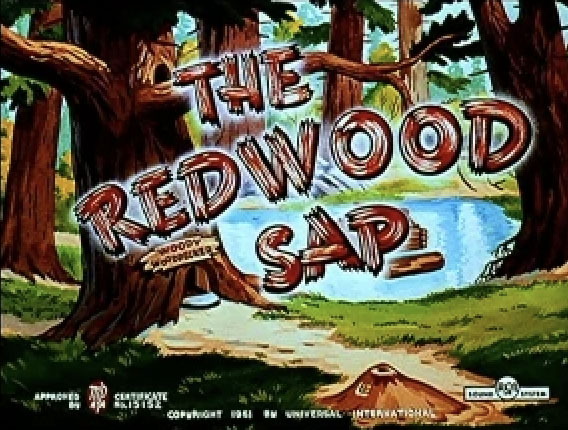
The Redwood Sap (Lantz/Universal, Woody Woodpecker, 10/1/51 – Walter Lantz, dir.) – Woody lives in an apartment in the hollow trunk of a tree, amidst a bustling community of ants, squirrels, and beavers. While all the other critters work busily in preparation for the oncoming winter season, Woody reclines in bed, enjoying some reading material suitably appropriate to his character – a volume entitled, “Work, and How to Avoid It”, by Hans Doolittle. The only thing that will interrupt Woody from his R&R is the chiming of his patented meal wristwatch, so frequently seen through his early 1950’s episode, ringing an alarm bell when its hands (shaped like a knife and fork) point to pictures of breakfast, lunch, dinner, and tea. Where does Woody get his meals? From his neighbors, of course. Zipping out his front door, he raids the contents of Dagwood-style sandwiches from the beavers, swallowing all the sliced goodies in one gulp. As the ants carry a full cob of corn, Woody sprinkles salt on the kernels, then pops them all of the cob into his own mouth by heating them with a blow torch. As the squirrel struggles to roll a towering stack of walnuts into a hole in the tree above Woody’s apartment, Woody appears on the branch above him, devouring each nut as it reaches the level of the hole. In fact, he keeps on chewing when the squirrel’s head also reaches branch level, and almost swallows the angry squirrel’s head. Woody then sails back into his apartment, floating into a reclining position on the bed with stomach bloated from his heavy meal. Woody looks up at a sampler-style sign on the wall, bearing his motto: “Why worry about tomorrow? It will be gone the day after.”

This routine continues until the first light sprinkling of snow begins to hit the woods. The beavers disappear underwater into their den, where they sit in a parlor full of food watching TV. The ants clamber into their underground burrow, enjoying card games amidst tunnels lined with walls of corn kernels. The squirrel admires his storeroom, lined with alternating columns of walnuts and tin cans, with signs reading, “soup to nuts to soup to nuts to soup to…” All other birds in the woods pack their bags for fall migration, and one takes the time to knock on Woody’s door to suggest that he join them. But Woody is as usual too lazy to fly, envisioning only the negative sides of any suggested destination (hurricanes in Florida, and smog in sunny Hollywood). Settling down to sleep again, Woody awakens next morning, when the snow has grown to a depth of three or four feet everywhere. As his watch chimes, Woody prepares to zoom out the door – only to be buried in an avalanche of snow from the doorway. He clambers out of the ice, which has formed into the shape of an igloo inside his door, and seeks another way out through a window. Another column of ice slides in through the opening, extends over Woody’s head, then clunks him. The mercury in a wall thermometer drops to bottom, turns blue, and icicles form around the bottom of the glass barrel of the instrument, while a miniature snowstorm occurs within the glass. Woody looks down at himself, and discovers his torso is encased in an ice block – which he quickly pecks away with his beak. He opens his empty cupboard, and meets his old pal Starvation squarely in the face.

Woody’s had enough of his indoor confinement, and bores his way through the snow in his doorway, popping up outside. But where are his food sources? All holed up in their snuggly dens. All Woody can do is swallow his pride (if he ever had any), and show up at their doorsteps to beg for food. But his “pals” have been mooched from many times too often, and are out for revenge. The ants present Woody with a corn cob – cob only, devoid of corn, smacked over his head. The squirrel provides Woody with nuts – of the metal variety that fit a screw. The beavers are the most merciless, presenting Woody with a yummy-looking cake, complete with candle. However, its insides consist of ice cubes from the refrigerator, with a layer of frosting consisting of snow scooped up from outside the beaver den. Woody swallows the “cake” whole – then turns blue all over, as a cutaway view inside his stomach reveals it is so cold, even the fire on the candle goes out. Woody spends the entire winter frozen inside an ice block outside his home.

When spring thaw comes, the local animals emerge from their homes and exchange greetings, and the migrating birds return. The bird seen earlier is the first to notice Woody, whose ice block has not yet melted. The animals put their heads together to finally rescue the trapped nuisance, by tilting the block over so that Woody’s rear is facing one side, then attacking the ice with the heat of Woody’s own blow torch. The bird revives, and zooms out of the ice through a hole he bursts through from the side opposite the torch, pausing to look at his now-sizzled tail feathers. Before Woody can even think about any lesson to be learned, his alarm watch goes off again. Reflexively, Woody returns to all the mooching activities he had utilized in the previous year, filling himself with the last stored food from each of his neighbors – and it is obvious as the cartoon ends that Woody, as usual, hasn’t learned anything, and will go on being – Woody.

• “The Redwood Sap” is viewable on Archive.org.


Dick Lundy moved on to greener pastures – and possibly greener dollar bills – at MGM, producing in the Barney Bear series Busybody Bear (12/20/52). Good neighbor week has been declared in the morning papers, and Barney is determined to get into the spirit of helping his neighbor, who just happens to be Buck Beaver (no, not the Lantz character Lundy had left behind), just erecting signs announcing a beaver dam under construction. Another sign warns of falling trees, with the added note, “Watch your konk, neighbor”. Barney pays no heed of it as he approaches the site, and gets beaned by three different trees of varying sizes as they are felled by Buck. As Buck goes for the next one, Barney pushes him aside, pulling out his own axe to show the beaver just how it’s done. The beaver tries to yank the axe handle away, but Barney insistently gets in his chop – felling the tree upon himself before he can finish yelling “Timber”.

The beaver is next seen flinging mud upon logs with his tail to secure them into the dam. Barney tries doing the same thing with a shovel, them gets clever, inserting the shovel handle under the belt of his trousers, to operate it like a giant beaver tail. The beaver begins to get frustrated with Barney’s intrusions, and bends the shovel handle to whack Barney in the rear and up a sandy bank, where the entire front side of Barney becomes smoothly sandblasted. Next, the beaver begins cutting a log into segments with his teeth, but can’t make progress upon a stubborn outgrowth in the middle. Barney borrows an idea from Chuck Jones’s “The Eager Beaver”, placing Buck atop a block of ice until his teeth chatter, then uses him as a power saw to cut the tree, leaving Buck’s buck teeth loosely swaying from his upper lip.

Buck moves on to using a two-handled saw on another section of a log, though he is operating it single-handedly from one side. Barney climbs atop the log and grabs the other handle. He makes cutting progress, but bashes Buck repeatedly into a tree stump on Buck’s end of the saw. Buck retaliates, by sliding the whole log until one end overhangs the drop-off of a cliff. As Barney saws through, he and his end of the log fall into the canyon. Barney wisely lets the log end fall away, and removes his trousers, allowing them to billow out in the wind and float him down as a parachute, suspended from the suspender straps. Buck isn’t going to let him have a graceful landing, and pushes the other end of the log over the cliff. Barney lands lightly on one toe – then is crushed into a pancake by the falling log.

Buck finally gets the final log in place atop the project, then changes his signage from “under construction” to “completed”. However, as he turns around, he finds to his dismay the sight of Barney, adding a new log to the pile. Buck pushes the log away, and clears off the mud base with his tail, then finally speaks up to Barney. He tells the bear in no uncertain terms to mind his own business, and that the project is completed and just right the way it is. “I only want a little one”, he protests. Barney stubbornly insists that what he really needs is a great big one, which the bear intends to supply. To keep the complaining beaver from interfering, Barney ties him to a tree stump, then sets about his own appointed task. Scaling a hilly slope on one side of the valley, Barney chops two thirds of the way through the trunk of every tree. At the top of the hill, he yells, “Timber”, and pushes at the topmost trunk. Like a line of dominoes, one tree’s fall fells another, and another, until all the trees on the hillside are keeling over. Barney zooms back to the dam, and flings layer upon layer of mud with his shovel atop each log as it lands on the dam. Within seconds, he has constructed a dam rising nearly to the top of the valley walls. He releases the beaver, pats him on the head, and returns to his own cabin. Within moments, the beaver’s feet are being immersed in water – as the new dam is holding back all the water in the river, flooding the entire valley. Barney receives a knock on his front door. When he opens it, the beaver enters, emerging out of a wall of water, which blasts into Barney’s home in delayed reaction, thrusting the bear out the chimney top and into the flooded valley. Underwater in the bedroom, the beaver takes occupancy of Barney’s bed, pulling the covers over himself to rest up from the exhausting day, while Barney looks in from the submerged bedroom window, drumming his fingers on the windowsill in frustration, for the iris out.

You will note in the course of the cartoon that Scott Bradley was not one to miss appropriate opportunity for re-use of his own musical compositions. The main theme from Barney’s The Bear and the Beavers score receives healthy repetition here, underscoring many of the beaver’s activities.


By the Old Mill Scream (Famous/Paramount, Casper, 7/3/53 – Seymour Kneitel, dir.) – A by-the numbers Casper script. Casper flops out at a ghost town amateur night performance in an abandoned Opry House, the spooks not appreciating his vocal rendition of his own theme song. Casper goes out into the world to make friends again. His travels take him to a beaver dam, where the smallest beaver, Little Shorttail, makes a similar flop trying to help with dam construction. Reason why? His tail is only a fraction of the size of those of the others, and only big enough to carry a tiny wad of mud for packing the logs together – in fact, just enough mud to accidentally flip into the foreman’s eyes. While the beaver cries by himself off in a corner, Casper shows up to offer any assistance in the construction. The other beavers depart in totem-pole formation. Casper finds Shorttail, the only one not afraid of him, and learns of his problem. He attempts to build confidence in Shorttail, telling him his tail is probably strong enough to carry a log – but invisibly lifting the log himself as Shorttail walks along. The dam springs a small leak, the water running right through the palms of Casper’s ghostly hands. Shorttail again can’t carry enough mud to plug the hole, leaving Casper to do it himself, piling the mud onto the beaver’s tail just as he returns to the dam, so as to allow Shorttail to claim the credit for the repair. As Shorttail goes for more wood, we get a late cameo appearance by Wolfie, who is hunting beavers with the aid of a plumber’s helper tied to a rope. He corners Shorttail in a hollow tree, and uses his plunger’s suction to pull Shorttail out of the tree’s hole. Casper shows up, scaring Wolfie out of his clothing, his outfit running away faster than himself. Shorttail shows up again at the dam along with Casper, the beaver clan now accepting Casper as their hero. Now Shorttail can carry and fling all the mud he wants for the dam – because Casper has installed a large frying pan tied to his own tail, as a prosthetic substitute.


Unnatural History (Warner, 11/14/59 – Abe Levitow, dir.) is one of a few late returns to the Tex Avery spot gag cartoon style of the 1940’s, featuring random gag sequences involving various species of wild and domesticated animals or insects. Some of its most memorable highlights include the act of Cal the Chameleon, who can instantly match any color background inserted behind him – but draws the line at plaid, bawling in a tantrum, “I can’t do it!”. And a talking dog act, which strikes out at the booking agency when everything he says sounds like a dog bark, including his naming of “Ruth” as the greatest baseball player. As he and his owner are thrown out, the dog confides to his owner, “Maybe I shoulda said, Di Maggio”?” One of its last gags includes a beaver, repeating Chuck Jones’ gag from “The Eager Beaver” of actually “damming” a river, when the center of his dam construction falls apart from the water flow. He of course angrily shouts audible but unintelligible swear words at the water.

• “Unnatural History” is in a good print at DailyMotion.


Beavers again get a mention – but no appearance onscreen, in Bugs Bunny’s Wet Hare (Warner, 1/20/62 – Robert McKimson, dir.). Bugs is taking his morning shower under a river waterfall, doing his best vocal impression of Al Jolson singing “April Showers”. Suddenly, the flow of water runs dry. Bugs knows he paid his water bill – then remembers what happens every year. Those pesky beavers upstream must be building a dam again. Bugs is about to investigate, then goes through a series of over-dramatic speculations, as to what might happen if it’s not the beavers, and the water has just dried up. He envisions his carrots shriveling, himself dying of thirst, and begins to gasp for water. Then just as suddenly, he changes mood entirely to his usual casual cool, remarking, “Nah, it’s gotta be them pesky beavers”.

Both of Bugs’s theories are wrong. At the top of the waterfall stands Blaque Jacque Shellaque (McKmson’s answer to Yosemite Sam, in a return appearance following his debut in “Bonanza Bunny”), who has just completed constructing a dam out of stray stones. He chuckles to himself that he fees just like a “pesky little beaver”. Bugs arrives at the top, learning from Jacque of his intention to keep the river water for himself, based on riparian rights consisting of a loaded pistol for anyone who defies him. Bugs claims to have no protest, but speculates as to how secure the dam is. What if one stone here or there were to fall out of place. He gets Jacque to remove a central stone, as a demonstration of “What could happen?” POW!! The whole thing falls apart, the water sweeping Jacque away.

Bugs returns to his bathing, but the water dries up again (a shot we will see several times too often in this film, instead of varying things up by reanimating the angle or the flow of water differently each time the event recurs). Shellaque has built a stronger dam. A shark fin appears in the water, which Jacque thinks to be a trick, as there are no sharks in a trout stream. Apparently, however, Bugs has farmed this one in specially, leaving Jacque atop the dam, trying to bat off the shark and calling for help. Bugs comes charging to the rescue, floating on a log, but deliberately slams it right through the dam stones. “This is being saved?” shouts Jacque, once again falling into the water.

Another shower, another dam. Much larger, with neat squared-off stone wedges. Jacque wonders if the rabbit will try to blow up the dam. A small raft carrying a single stick of dynamite floats up to the dam wall. Jacque scoops it up in a net, then attempts to run with it off the dam. It blows up in his face, leaving him staggering, while a much larger raft holding crates full of dynamite floats in. BLAM!!

Jacque is through fooling around. He climbs down into the valley, and blasts with a shotgun at the location behind the waterfall from which he hears singing, until the voice is silenced. Of course, Bugs is really off to one side of the river, tending his carrot patch, and the voice heard was nothing but a gramophone and record he placed behind the falls. Back at the top of the waterfall, Jacque has now constructed his masterpiece – a dam of solid metal and rivets (hopefully rust-proof). But instead of attacking the dam, Bugs changes tactics – rendering Jacque’s dam useless, by building another dam of rocks further upstream. “Sacre bleu”, utters Jacque at the insane determination of this rabbit. With a cannon, Jacque approaches Bugs’s dam, and blasts it away. But yet another dam stands behind it. Another cannon shot – and another dam upstream is revealed. Bugs continues to lure Jacque further and further upstream, blasting away dam after dam, until Jacque comes face to face with the towering edifice of the all-concrete Grand Cooler Dam. Reflexively, he loads his cannon, and blasts once again. The cannon ball merely bounces off the concrete structure, ricocheting back to catch Jacque in the belly, and knocks him into the waiting entrance doors of a police paddy wagon, which rolls him away to make the arrest for an assault upon public property. From the top of the dam, Bugs mutters that Jacque is not fooling him. “He’ll be back – like, in about 20 years.” Though a late entry in the series that could have had better animation and tighter timing in places, this one did have some clever ideas, and remains reasonably memorable.

• “Wet Hare” is on Facebook or on Toontales.

NEXT WEEK: Some feature work, and some television outings, next time.

  • ✇Cartoon Research
  • The Disney Studio During WWII: “Donald Duck Joins Up” by Richard Shale Orrin Scott
    It’s Memorial Day in the United States as we pause to remember those who have lost their lives in the armed services and reflect upon the sacrifices they made. I was recently discussing with my Mom, my paternal Grandfather, Bill, who served in the Navy aboard the USS Gettysburg and USS Saratoga. He was stationed throughout the world serving as a ham radio operator and spent time in Trinidad, where he and my grandmother had my Father, and the South Pole amongst other stations during the Vietnam W
     

The Disney Studio During WWII: “Donald Duck Joins Up” by Richard Shale

25 May 2026 at 07:01

It’s Memorial Day in the United States as we pause to remember those who have lost their lives in the armed services and reflect upon the sacrifices they made.

I was recently discussing with my Mom, my paternal Grandfather, Bill, who served in the Navy aboard the USS Gettysburg and USS Saratoga. He was stationed throughout the world serving as a ham radio operator and spent time in Trinidad, where he and my grandmother had my Father, and the South Pole amongst other stations during the Vietnam War. He was one of my early childhood animation influences, memorably winning me a large Foghorn Leghorn stuffed animal at a family auction when I was quite little and we miss him.

Donald Duck Joins Up

A look at The Walt Disney Studio During WWII by Richard Shale

The Disney Studio famously became an extension of the American wartime effort in World War II creating educational and propaganda films for domestic and foreign distribution. In 1982, Richard Shale would publish an in-depth account for the productions made during the war effort in, “Donald Duck Joins Up: The Walt Disney Studio During World War II”.

Shale opens the book with a brief history of animation leading up to WWII, noting that Walt Disney was the catalyst for the development of the art form notably for both for sound, then Technicolor’s application. The success of early Disney shorts and “Snow White” allowed for Walt to became the public face of the development of the animation and in so doing secured himself as a trustworthy individual in the eyes of the public.

Leading up the war, the Disney Company was struggling. The war caused foreign markets to collapse leading to the loss of not only potential revenue, but already made investments in those now nonexistent markets. These problems, in addition to a costly strike – both in terms of lost personnel, cash, and ego – didn’t make the situation any easier.

While Walt had some experience with educational films back in Kansas, only as anti-Nazi sentiment began influencing Hollywood would Walt turn to The Lockheed Aircraft Corporation to co-produce Four Methods of Flush Riveting (1942) an educational film about the process of riveting. As the opening text scroll of the film lays out, “The following film uses a simplified technique developed by the Walt Disney Studio to demonstrate the quickest & cheapest method whereby the animation medium can be applied to national defense training.”

With film in hand, Walt Disney would meet with Canada’s National Film Board founder, John Grierson, who understood what Walt was attempting to accomplish. The two worked out a contract for four short films promoting audiences to invest in war bonds using The Seven Dwarves, The Three Little Pigs, and Donald Duck.

Shale describes the most widely seen film from this era as Donald’s The New Spirit (1942) in which Donald shows audiences how income taxes are paid and effect the war effort. This film was a product of the Walt Disney Studio and the US Treasury Department. Throughout the book, between correspondences between bookkeeper and brother, Roy Disney, we see a resistance to ensure that when dealing with the government to ensure that payroll was nearly and squarely no for profit. However, the use of any public taxes for any type of film became a subsequent public political squabble that resulted in much political fuss and hang wrong but littlensubstance. Regardless of any blowback that occurred it didn’t deter the US Secretary of Agriculture to enquire and develop a film about the importance of farmer for the war effort, and the Navy requesting their own educational films thereafter that.

A whole chapter is devoted to Disney’s trip to South America for a sponsored peace trip with the Office of the Coordinator of Inter-American Affairs, which serves as a fantastic primer to Ted Thomas, J.B. Kaufman and Didier Ghez’ Walt Disney & El Grupo in Latin America. Shale later discusses how this trip resulted in the successful Three Caballeros in 1944.

Shale discusses at length both Alexander Procofieff de Seversky’s book, Victory Through Air Power, and its influence over public discourse about the means to end the war, and also the uniqueness of Walt Disney adaptation of the book to film. Even amongst the pantheon of Disney adaptations it still stands out for it’s timeliness of its adaptation from print to film.

A further chapter talks on the challenges in attempting to develop a Gremlins film based off the first book by renowned writer Roald Dahl, which is wonderfully chronicled in Gremlin Trouble!: The Cursed Roald Dahl Film Disney Never Made by the late, Jim Korkis. The Disney Studios work designing various military branches insignia is also briefly touched on, but relative to the labor involved in animation, production history is summarized in a page or two.

The tenth and last chapter reflects on the unique position that the Disney Studio and the US Government served during the war and the financial stability that granted the studio to whether through the war and their prior financial woes. Time is also taken to analyze why the propaganda stands out amongst Disney’s peers, especially what was being produced at Warner Bros.

If there is one complaint about this book it’s that there is only one chapter dedicated to the titular topic, but the ongoing wartime output of theatrical shorts was, like the book points out, the least of concerns happening at the studio.

If you can track down a copy of this fairly difficult to find book, it’s worth it. The above review only covers the first half as the second half is full of footnotes, sources cited, filmographies of films published for public and military distribution, and a bibliographical reference for further study.

Please dive in and enjoy the complete Animation History Bibliography section of the Cartoon Research website. See you next month with another round up of animation book news and reviews!

  • ✇Cartoon Research
  • The 60th Anniversary of “Charlie Brown’s All-Stars!” Michael Lyons
    The opening of Charlie Brown’s All-Stars! sums up the title character perfectly. Charlie Brown is on the pitcher’s mound. He pitches the ball, and the batter hits it. In an attempt to catch the ball, Charlie Brown runs into the outfield, has to hop a fence, runs up and down the bleachers, through someone’s backyard, past some of the girls playing jump rope (he stops and jumps rope himself), he runs into a house, up to the second floor, then finally winds up running out to the backyard and when
     

The 60th Anniversary of “Charlie Brown’s All-Stars!”

5 June 2026 at 07:01

The opening of Charlie Brown’s All-Stars! sums up the title character perfectly.

Charlie Brown is on the pitcher’s mound. He pitches the ball, and the batter hits it. In an attempt to catch the ball, Charlie Brown runs into the outfield, has to hop a fence, runs up and down the bleachers, through someone’s backyard, past some of the girls playing jump rope (he stops and jumps rope himself), he runs into a house, up to the second floor, then finally winds up running out to the backyard and when he finally tries to catch the ball, it drops onto the grass and he misses it.

The whole Peanuts gang then gathers round and yells, “You blockhead, Charlie Brown!”

Poor Charlie Brown. He tries so hard, always just misses, and his friends don’t give him a break. That’s at the center of Charlie Brown’s All-Stars!, celebrating its 60th anniversary this summer. The second prime time Peanuts TV special, following A Charlie Brown Christmas, and the first special not themed to a holiday.

Set during the summer, and based around Charlie Brown’s favorite sport of baseball, Charlie Brown’s All-Stars! centers on Charlie Brown’s baseball team, which is not doing well. In fact, the whole team quits, but Linus comes to the rescue. He gets Mr. Hennessey, who owns the local hardware store, to sponsor uniforms for the team.

Charlie Brown (Peter Robbins) is so excited that he tells the team, and Lucy (Sally Dryer) says that if he can really get the uniforms, they will all give him another chance and rejoin the team.

However, after this, Mr. Hennessey calls and lets Charlie Brown know that it’s against league rules to have a dog or girls on the team and tells Charlie Brown that if he can get the girls and the dog to leave, he will support the team and get the uniforms. But Charlie Brown stands his ground and refuses this, telling Mr. Hennessey thanks, but no thanks.

Charlie Brown elects not to tell the team about this, but he confides in Linus (Christopher Shea). Thinking that if he doesn’t tell them, Charlie Brown hopes their spirits will still be lifted, and they might win their next game. Sadly, they don’t, and it’s Charlie Brown who loses it for them by getting tagged out at home.

It’s after this that Charlie Brown confesses to the team what Mr. Hennessey said, and that the deal with them playing in the league and the uniforms is off.

Everyone is furious with Charlie Brown, and they all storm off. After, Linus tells the team why Charlie Brown did this, and the team feels bad.

Searching for a way to make it up to Charlie Brown, they create a managers uniform using Linus’ blanket.

They present Charlie Brown with the special uniform bearing the words “Our Manager,” and he is so touched that he sheds a tear.

He tells his team he knows that they’ll win the game the next day. But it rains, and the game is canceled. Charlie Brown, dressed in his new manager uniform, goes out to the field anyway and stands on the mound, in the pouring rain.

Linus comes out to the field to tell Charlie Brown that no one will be coming and reveals that the manager’s uniform was made using his blanket. So, Charlie Brown gives him a corner of the uniform. Holding a portion of the blanket and sucking his thumb, Linus stands there, alongside Charlie Brown, rain coming down on the baseball field, as the special ends.

Directed by Bill Melendez and written by Charles M. Schulz, with animation by Ed Love, Bill Littlejohn, and others, Charlie Brown’s All-Stars!, like the Christmas special that preceded it, does perfect work of melding Schulz’s comic strip panels with the world of animation.

Of note is the gag where Charlie Brown, as the pitcher, finds himself flipped in the air, his clothes flying off, as the ball hit by the batter soars past him with such force. This had been used by Schulz in the comic strip, over the course of several panels, and segues perfectly to a cartoon sight gag.

Schulz also brings his pointed humor, which is peppered nicely throughout All-Stars. There are subtle moments, such as Charlie Brown wondering if he should resign as manager, followed by Snoopy (Melendez) appearing to hand him a pencil and paper.

This is coupled with sharp dialogue, such as Charlie Brown saying, “For one brief moment victory was within our grasp,” to which Linus replies, “And then the game started.”

Charlie Brown’s All-Stars! also features the familiar, comforting music of Vince Guaraldi (for more about the soundtrack, read Greg Ehrbar’s 2017 article). For the fiftieth anniversary, the score was recently re-released.

Essentially a summer-themed remake of A Charlie Brown Christmas (Charlie Brown attempts to be a leader for his friends, who turn on him, and Linus steps in to make them all aware of Charlie Brown’s good intentions), Charlie Brown’s All-Stars! is still an entertaining half-hour filled with all the hallmarks audiences have come to love and expect from Peanuts specials. Snoopy even gets his moment, as he fantasizes about being a great surfer.

Originally airing on June 8, 1966, on CBS, the special may not have had the staying power of the Peanuts holiday outings, but sixty years later, Charlie Brown’s All-Stars! most definitely has its fans who, like Linus, would stand out in the rain alongside Charlie Brown.

  • ✇Cartoon Research
  • Thunderbean Preview Steve Stanchfield
    Teaching full-time has one big perk: A summer of a lot less commitments and time to work a lot more without interruption on all sorts of things. With me, it’s career-related in that I get to work on the Thunderbean stuff in a more full-time way. Tomorrow I’m off the Columbus Moving Picture Show in Columbus, Ohio. I’ll be there for a handful of days, so if you come to the show, say hi! I love chatting all things animation as well as talking about the stuff in progress for Thunderbean. Informat
     

Thunderbean Preview

21 May 2026 at 07:01

Teaching full-time has one big perk: A summer of a lot less commitments and time to work a lot more without interruption on all sorts of things. With me, it’s career-related in that I get to work on the Thunderbean stuff in a more full-time way.

Tomorrow I’m off the Columbus Moving Picture Show in Columbus, Ohio. I’ll be there for a handful of days, so if you come to the show, say hi! I love chatting all things animation as well as talking about the stuff in progress for Thunderbean. Information on the event is HERE.


There’s a handful of major projects on the plate here that are making major progress right now while on their way to being an actual finished set. Here is the status of the eight that are most on my mind, daily:

Rainbow Parades, Volume 2: The set is done and will be starting to ship within a month or so. This is one of my favorite projects we’ve ever done, and I’m glad to have given these films the best treatment possible. Here’s the first sneak preview of the cover art by Mike Kazaleh with background by Jesse Smith:


Lantz Studio Treasures: Another upgrade from the DVD we released some years back, with even more things included. This one is waiting for just a few films to get finished.

Cartoons For Victory: This set just rounded another corner right at the end of the school year. There’s a few films left to clean up, several bonus things to upgrade to HD from the previous DVD sets (from 2005 and 2012). The propaganda poster section is something I especially love. I’ve shown it for years in my animation history class at CCS, and have heard from other folks teaching animation history how useful the DVD sets are for an overview of propaganda. My idea is that the sets (and the Blu-ray now) help to fill in the gaps between the Disney and Warners sets. For the Blu-ray, we’ve upgraded across the board in materials, and after working many years off and on in getting it finished, I’m happy that there’s such a broad representation of countries on the set. The material ranges in quality somewhat in the release, from acceptable to spectacular. This one is the closest next to the finish line right now. We’ll have it out over the summer along with others.

The Comi-Color cartoons: *easily* the hardest project here right now. Our hope is to have one of the two sets out at the end of the summer and both by year’s end if we’re able. The work involves scanning all the negatives that exist. Cleanup isn’t as hard since the material is beautiful- newer scanner technology has made all the difference. We have quite a few done already and I’ll be sharing as we get closer on the first set (I’ve been holding the cards close on this one). Everything exists in 35mm, with only a few titles not having their camera negative or black and white separations. It’s been a long road on all the Iwerks stuff to the finish line, but we’re finally getting there. Looking forward to getting a few of the other titles done so this gets first place in production.

A Spooky Cartoony Halloween: This title is finished, just waiting for replication as soon as we’re able. We sent a ‘tide-me-over’ for last Halloween to the folks that pre-ordered this. If you ordered it, I think you’ll like the surprises we’ve included.

American Animated Cartoons, 1929 and American Animated Cartoons, 1930: These two are getting closer to the finish line as well, and have been so much fun to work on. They’re a mix of 35mm and 16mm material, and a pretty fun overview if you want to introduce someone to the early sound era of American animation.

Lou Bunin’s Magic Puppet Animation, Featuring Alice in Wonderland: This is the project most wrapped up in things out of my control but *almost*. Let’s hope they’re back in control soon. There’s some material that we really *need* to utilize to make this set what I really want it to be— and that it *needs* to be. More on that soon. If I walked into a famous building with 5k right now, the whole thing would move forward much faster. Working on that. Also, with all that said, what we do have done looks lovely on this title. Trying to finish by summer’s end, and that’s looking possible.

I’ll give an honorable mention to Toby the Pup, who isn’t properly dressed at the moment, yet.

It’s off to Columbus for me now. Thanks to all for keeping the faith and keeping the lights on for this tiny business. Hopefully it has been and continues to be worth it for everyone.

Have a good week all!

  • ✇Cartoon Research
  • Checking Out Three Volumes of UCLA’s Animation Journal, “Animatrix” Orrin Scott
    Writings from the Alumni and Graduate Students from the UCLA Animation Workshop. I hope the spring weather has begun to blossom in your neck of the woods as it has here in south-western Michigan! This month’s Card Catalog is the result of polishing up one of the criticisms from the first edition of the Animation History Bibliography, mainly that I had neglected to pull out individually authored chapters in edited compilations. And this has been an area that has proved to be a lot of fun to fix
     

Checking Out Three Volumes of UCLA’s Animation Journal, “Animatrix”

30 March 2026 at 07:01

Writings from the Alumni and Graduate Students from the UCLA Animation Workshop.

I hope the spring weather has begun to blossom in your neck of the woods as it has here in south-western Michigan! This month’s Card Catalog is the result of polishing up one of the criticisms from the first edition of the Animation History Bibliography, mainly that I had neglected to pull out individually authored chapters in edited compilations. And this has been an area that has proved to be a lot of fun to fix. Not only are there a lot of books with chapters written by many professionals across the world and notable animation historians, but there have been quite a few student journals with a focus on animation at Universities across the United States. The most successful of those journals comes from the Animation Workshop at UCLA called Animatrix. The journal was originally founded in 1984 and has published issues all the way up until 2016 where, apparently, it has been on hiatus since. The journals are published through the print on demand service, Lulu, where their three latest issues are still available to buy. I did, so today, let’s check out those issues:

The earliest issue still available is Volume 20 published in June of 2013 and was coedited by Valerie Giuili and Kelly Lake. This issue’s theme takes an optimistic but tempered look at the future of animation and tries not to replicate the unadulterated optimism that we saw in the 1960s, the inspiration for their cover. The issue has three features. The first is a deep dive into the body of work of Lewis Klahr by Veronkia Ferdman. Ferdman zeroes in on the ways that Klahr uses stop motion and magazine clippings to have audiences contemplate some of Klahr’s larger contemplations on the passage of time and the presence of pain throughout our existence. In “Diving into the Uncanny Valley” by George Fleming, Fleming explores the history of the uncanny valley and argues how its presence in a multitude of 3D animated films throughout the last three decades are a result of attempting to reach various forms of idealized photorealism. Lastly, Alex Rosenberg looks at 13 Goofy shorts from 1940-2007 in “How To: Establishing a Star: The Goofy “How to” Shorts and the Evolution of a Character” and explores how Goofy became a stand-in for the present day everyman.

This issue shines, though, with three interviews; one with Peter de Seve by Alex Wong, another with Joe Murray by Kelly Lake, and the last with Craig Bartlett by Alex Rosenberg. In each interview each artist opens up, at length, about their own backgrounds, their methods and philosophies, and the way they see animation continue to change and evolve for the better and for the worse. Education, industry, and their personal histories are major topics throughout each interview and since this issue was published over a decade ago, it’s fascinating to see what has happened in the time since the interviews and today. As an example, Craig Bartlett explains his excitement to work on a potential new series at PBS called Dinosaur Train, and the strange ways and time it took to develop the pitch, which would not only be greenlit but would go on to have five seasons and a movie ending in 2021. Or how Murray discusses the potential and paradigm shift of the Internet’s effect on classical television distribution, even shouting out the work of then new Internet personalities like Egoraptor (Arin of GameGrumps), and the difficulties in launching a digital distribution network.

Volume 21 was released in March of 2016 and co-edited by Tenaya Anue and Graciela Sarabia. Innovation is the theme for the issue as without it we don’t have animation that continues to inspire or even to exist.

In “Mechanical Mod-sters: The Battle Between Realism and Surrealism at Fleischer Studios”, author Kynan Dias argues that the Fleischer Brothers’ relentless pursuit of mechanical innovation would result in their studio often creating stories that fit within the surrealist movement, ironic for the duo that invented the device that captures realistic movement in a very non-realistic medium. Building off of a quote of the Fleischer’s love of the surreal from Richard Fleischer’s Out of the Inkwell, Dias contrasts Robert Wiene’s The Cabinet of Dr. Caligari, the work of Luis Buñuel, and Salvador Dali’s Un Chien Andalou with Fleischer’s artistic output and finds quite a few similarities between not just the art but the artists.

Other articles include Kate Isenberg giving a quick biography of Bob Kurtz, highlighting notable milestones throughout his life and the ways in which his commercials pushed the medium forward. Rebecca Olson scrutinizes five pre-Snow White Silly Symphonies and the ways in which they experiment with realistic feminine movement that would eventually result in what is seen in the feature film. “From Monte Cristo to Gankutsuou: Externalizing Essence Through the Use of Animation”, Latoya Raveneau explains how the anime and the original Alexandre Dumas novel work in tandem to both elevate each artistic work as a collective whole. Lastly, Rasoul Azadani is interviewed by Rocco Pucillo and discuss, briefly, his background in animation, the meaning of and purpose of layout, and the power and success of 2D animation over the last century – success that gave Disney the power to be as big of a corporation as it was in 2013 (and is today, too).

The last issue, hopefully just for the time being, came out in May 2016 and was edited by Zia Adsit-Metts. This time the theme is Animation for Television. Ben Greenwalk opens the issue with an exploration of the history and demise of the Saturday Morning Cartoon block, how captured young audiences and marketing opportunities that that provided while also exploring how that allowed for more creative endeavors throughout the decades. Greenwalk ends with a thought on the impact of today’s video game market and digital distribution as the final nails in the morning marathon coffin.

Four fantastic interviews are present in this issue, one by Sarah White interviewing Julia Vickerman, another by Kim Ngyuen with Richard Zimmerman, a third with Jasmin Lai by Julia Meng, and the last with Mia Resella with Van Partible. Vickerman’s interview is a great time capsule as at this point in time, Vickerman had been working on the Powerpuff Girls reboot and describes the process of pitching Twelve Forever which would eventually come out in 2019. Ngyuen’s interview with Zimmerman is super fun as it’s mostly an exploration of the way that Zimmerman animated various projects from the original Gumby series to the then new episodes of Robot Chicken. Jasmin Lai gives a background of their experience at the Rhode Island School of Design and the ways that helped get her career started. The interview ends with Lai lamenting that they’re not the greatest at background work – Lai’s most recent work was designing the backgrounds for Pixar’s Elemental. I think I enjoy every interview Partible gives. As he explains in the interview, he became a showrunner so early in life and at such a unique point in Hanna Barbera’s history that it’s hard not to find any of his answers interesting.

I really appreciate these volumes because their authors are full of excitement and hope for the future of animation and the ways it is changing. Today we know that the world these issues described is a bit more complicated with old methods changing, new technologies always redefining what has come before and what is coming next, and new institutions that are combining and redefining. But, like these journal issues point out, there are always new things born out of the old and independent and entrepreneurial enterprises are underway today that will continue to change the rules of the game in the future. Like Craig Bartlett said in his interview, the industry is constantly under revolutionary changes, distribution is a constantly changing game, but the role of the animator and storyteller stays the same.

As mentioned at the top, you can order each of these issues through Lulu, but the UCLA Animation Workshop website also has their interviews and the first ten issues available online and for free. And as always you can enjoy the complete Animation History Bibliography section of the Cartoon Research website. See you next month with another round up of animation book news and reviews!

  • ✇Cartoon Research
  • Nine (Lives) Is Enough: The Dreadful Sequel To “Fritz The Cat” Martin Goodman
    This entry continues my well-deserved punishment for offering to detail two of the worst animated cat films ever inflicted upon audiences. Last time out, it was Felix the Cat: The Movie. This time, I’ll take the blame for detailing the R-rated 1974 abomination called The Nine Lives of Fritz the Cat. The 1972 film Fritz the Cat, directed by Ralph Bakshi, made dubious history by earning the first X rating for a wide-release animated film. While the movie had many flaws and was obviously the work
     

Nine (Lives) Is Enough: The Dreadful Sequel To “Fritz The Cat”

12 May 2026 at 07:01

This entry continues my well-deserved punishment for offering to detail two of the worst animated cat films ever inflicted upon audiences. Last time out, it was Felix the Cat: The Movie. This time, I’ll take the blame for detailing the R-rated 1974 abomination called The Nine Lives of Fritz the Cat.

The 1972 film Fritz the Cat, directed by Ralph Bakshi, made dubious history by earning the first X rating for a wide-release animated film. While the movie had many flaws and was obviously the work of a first-time director (Bakshi began with shorts for Terrytoons), it is a masterwork compared to its sequel.

There are only so many ways The Nine Lives of Fritz the Cat can be worse than its predecessor, and the movie manages to hit them all. Ralph Bakshi and Steve Krantz, the producer of Fritz, had a falling-out, and Bakshi had nothing to do with the sequel. Robert Crumb, who created the character of Fritz, ignored the film completely and was so disdainful of the first film that he had Fritz murdered in his final comic appearance in 1972.

Krantz hired Robert Taylor (an assistant animator on the first Fritz film and collaborator with Bakshi on The Mighty Heroes TV show) to helm the project. Fred Halliday and Eric Monte assisted on the disjointed screenplay. There is a loose theme of Fritz, a stoned, unemployed, and heckled husband, imagining himself in different life scenarios, each one ending badly for the titular cat.

Before addressing that, the differences between the Bakshi and Taylor films merit some discussion. First, Bakshi’s film is linear, whereas Taylor’s film is hallucinatory and less concerned with narrative cohesion. Bakshi tended to treat racism and class warfare with sharp, sometimes nasty satiric humor. Taylor treats these issues gratuitously and with a clumsy hand, edging close to and often erupting into actual racism.

One example is when Fritz imagines he is sent to deliver a message into “New Africa” (formerly New Jersey), run by stereotypical blacks (again depicted as crows), all of whom seem to embody the worst stereotypes of blacks as violent, switchblade-wielding thugs and prostitutes incapable of governing themselves save through acts of violence and assassinations.

Bakshi’s Fritz film is far more sophisticated in its approach to social commentary, depicting urban life as a decaying corpse of a lost American Dream. Taylor’s film is a copy of Bakshi’s, even using the dirty watercolors, canted angles, and extreme down shots evident in the first film. Taylor’s environment, however, does not convey the same utter hopelessness as Bakshi’s, possibly because the scenarios change too often. Taylor’s landscape is dirty and gritty enough, but Bakshi’s (he did grow up in a gang-ridden slum) is more authentic.

Bakshi’s Fritz is much more economical than Taylor’s. Bakshi’s Fritz the Cat runs for 77 (or 78 minutes, depending on the source), and so does the sequel. However, considerable filler mars the sequel’s narrative: Fritz’s fantasy of high life in the 1930’s consists largely of photographic montages and an endless repeating pattern of lights. A scene representing a mutually destructive war between blacks and whites (a crow and a pig, respectively) is one of the few scenes that makes its point, but the exchange of fire goes on for far too long.

Some other differences: Bakshi and Taylor both depict blacks as crows, but while Bakshi depicted Jews as lions, Taylor uses a Jewish lizard. Adolph Hitler appears to be a scrawny lion (he rather looks like Itchy Brother in the Linus the Lionhearted cartoon, disguised as Hitler). There’s a twist!

Oh, the movie: As we open, Fritz (voiced again by Skip Hinnant) is unemployed, perpetually stoned, married to nagging harridan Gabrielle (shout out to Reva Rose), and is burdened with a masturbating, chain-smoking toddler named Ralphie (a dig from Steve Krantz?). Fritz escapes by sending his incorporeal self out into the street while Gabrille rants on.

From here, we follow Fritz into nine imagined lives (the transitions are not always clear, or whether imagined or not). In Life One, Fritz seduces the sister of his Puerto Rican pal Chita (a camel?) with pot; her hallucinatory high is one of the better scenes in the film. Chita’s father shoots Fritz to death.

Life Two sees Fritz encounter a drunken bum who says he is God. This scene is exceedingly gross and unpleasant, but that’s where Taylor shows his weaknesses. Life Three finds Fritz in Nazi Germany as Hitler’s horny orderly and psychotherapist. Hitler attempts to rape Fritz before having his sole testicle (the major joke in the segment) blown off. American tanks kill Fritz.

Life Four has Fritz trying to sell a used condom to a bartender, whose wife caught gonorrhea from Fritz. Bakshi would never have used this gratuitous scene. Life Five, the flashback to the 1930s referred to above, is nothing but filler. It ends with Fritz broke and despondent.

Are we up to life Six? Fritz trades a toilet to the stereotypical Jewish pawnshop owner, Morris, for a space helmet after the lizard refuses to cash Fritz’s welfare check. We go into Life Seven, where astronaut Fritz bangs a black female reporter in space until the rocket explodes.

In Life Eight, the ghost of Fritz’s buddy from the first film, Duke, leads the cat into the future, where President Kissinger (depicted as a rat) has him deliver a message to President Jackson of New Africa (formerly New Jersey). The dark racism of this segment, discussed above, is barely even satirical. It ends with Fritz framed for Jackson’s assassination and executed.

Now relaxing in the underground sewers of New York, Fritz encounters the characters of his final life, an incomprehensible Indian guru, and an effeminate Lucifer (Lucifer is a faggot!) before we see Fritz at home once more, shortly before Gabriella throws him out into the street. Fritz declares that this current life is the worst of all of them before strutting down the street into the coda.

The Nine Lives of Fritz the Cat is, overall, a tasteless and unimaginative follow-up to Ralph Bakshi’s take on the character. The movie was universally panned, and Fritz was never seen again. Was anything about this woebegone sequel worthwhile?

Well, there was a great cast of notable animators toiling in vain. Cosmo Anzilloti, Milton Gray, Jim Davis (no, not THAT Jim Davis), John Gentilella, Volus Jones, Martin Taras, and Manny Perez returned from the first Fritz movie and worked with newcomers to approximate the feel of the first film.

Complete voice credits are hard to come by: Certain roles, such as Fritz (Skip Hinnant) and Gabrielle (Reva Rosa), are credited, but only a few of the listed voice artists correspond to characters in the movie. In fairness, this episodic film has many secondary and one-shot characters. We do know that Robert Ridgely, Pat Harrington Jr., and other notables appear (Side note: Skip Hinnant voiced the Easter Bunny for Rankin-Bass and was also a fixture on the kids’ show The Electric Company. He was also the star of the first X-rated AND R-rated animated films produced! It has been said that The Nine Lives of Fritz the Cat has now become a “cult classic.” I suppose that’s a matter of taste.

  • ✇Cartoon Research
  • Frankly, I Don’t Give a Dam (Part 5) Charles Gardner
    Today, we cover nearly 30 years of television in one fell swoop. Beavers didn’t make a shattering impact upon the small screen in general during this period, their participation in the medium being sporadic at best. One memorable feature project would also debut at the outset of this chronology, which is probably the best remembered of all of today’s entries. Other contributions include possibly their only appearances in claymation and stop-motion, a television ad campaign, and items from J
     

Frankly, I Don’t Give a Dam (Part 5)

20 May 2026 at 07:01

Today, we cover nearly 30 years of television in one fell swoop. Beavers didn’t make a shattering impact upon the small screen in general during this period, their participation in the medium being sporadic at best. One memorable feature project would also debut at the outset of this chronology, which is probably the best remembered of all of today’s entries. Other contributions include possibly their only appearances in claymation and stop-motion, a television ad campaign, and items from Jay Ward, King Features, Hanna-Barbera, and Film Roman.

One of the better-remembered of cartoon beavers was a well-animated and notably-voiced member of the species, nameless on the screen but among studio records affectionately known as Mr. Busy, who appeared as a featured co-star in a popular sequence from Disney’s Lady and the Tramp (6/22/55). He becomes the unlikely answer to an otherwise unsolvable dilemma for Lady, starting when Aunt Sarah, believing that Lady has attacked her pet Siamese cats Si and Am (although the whole thing is a frame up by the felines), takes Lady to a pet shop and has her fitted with a “good, strong muzzle”. Poor Lady can’t tolerate the cruel device, and reflexively runs from the shop, the muzzle and its trailing leash still fastened around her head. She immediately encounters more difficulty when the leash snags loose objects that clank loudly behind her upon the pavement, calling attention to herself, and the unwanted following of a pack of menacing stray dogs from the bad part of town. But Lady has an ally who also knows these dark streets like the back of his paw – the devil-may-care Tramp, another stray who knows how to handle any tough mutt that crosses his path. Hearing Lady’s plight, Tramp follows the progress of the chase, then doubles back by way of a shortcut to come up on the back side of a fence, just as Lady reaches the fence from the opposite side, finding her path blocked and herself cornered. With a mighty leap, Tramp vaults over the fence, landing directly between Lady and her vicious pursuers, and in canine fashion, snarls his most intimidating snarl at the pack, ready to take on three at one time to save the fair damsel. A violent battle of tooth and claw follows, some of its action denoted artistically through clashing shadows against the fence. When the rough stuff subsides, it is the three toughs who have turned tail and run, and a panting but defiant Tramp stands victorious.

But there’s still the problem of this confounded contraption strapped to Lady’s face. It’s beyond Tramp’s abilities to know how to remove it – but he thinks he knows of a place where they likely can find someone who can – the municipal Zoo. Going through the place from A to Z, Tramp quickly rules out the apes for assistance: “Too closely related to humans.” Alligators might perform the task, but there’s just too much teeth to dodge at the same time. “If anybody ever need a muzzle, it’s him.” Suddenly, a call of “Timber!” is heard, as a large tree falls around Tramp, narrowly missing direct impact from its branches. The cause is Mr. Busy, a zoo beaver constructing a dam within his own habitat. (Kind of advanced for most zoos. I don’t recall seeing any other where there is enough stream and lumber for a beaver to do the same kind of natural thing it does in the wild.) Well, “B” is the next letter of the alphabet (though in correct alphabetical order, Tramp should have checked out the bears first). So Tramp tries to get the toothy-fellow’s attention. “This will only take a second of your time”, proposes Tramp. But the beaver sees things from a different viewpoint. “Do you realize every second, seventy centimeters of water is wasted over that spillway?” (The beaver, voiced by Stan Freberg, is the first rodent of Disney’s to display a pronounced whistling lisp upon uttering “S” sounds, due to his buck teeth – allowing Freberg to have his fun with the read of this “S”-loaded line, much as “R”s provided audio-fuel for the dialogue of Elmer Fudd. Disney would remember this comical “speech impediment”, allowing it to be later inherited by Gopher for the production of “Winnie the Pooh and the Honey Tree”.) So the beaver is to busy to be bothered, insisting that the felled tree has got to be moved for use on the dam. “T’ain’t the cuttin’ takes the time – It’s the dog-gone hauling”, he complains. This gives the observant and prone-to-con-games Tramp an instant idea. What the beaver needs is “the new, improved, patented handy-dandy never-fail little giant log puller!” In delayed reaction, the beaver’s attention is finally aroused. “Did you say log puller?”

Tramp, instantly adapting to the role of a super salesman, draws Lady into the scheme, calling upon the beaver to observe the product, “modeled by the lovely little Lady”. He also prompts the slow-to-understand Lady to go along with the gag, giving her instructions in hawker’s spiel, “Turn around, sister, and show the customer the merchandise.” Then, the irresistible hook: “And it cuts log hauling time sixty-six percent!” Now the beaver can’t wait to see how it works. Tramp simply slips a loop of the leash around a tree limb, and indicates it is now ready to haul off. The beaver now asks to slip it on for size – but is stumped when he encounters the leather straps holding the device in place on Lady’s head. “How d’ya get the consarned thing off, Sonny?” asks the beaver. Simple. Place the strap between your teeth, and bite hard. One chomp, and Lady is free. Now Tramp is ready to depart, but the beaver still wants to talk business. “I’ll have to make certain it’s satisfactory before we settle on a price.” To the beaver’s surprise, Tramp has no interest in being mercenary – and tells him he can keep it. “I can?” reacts the beaver in surprise. Even more surprising is Lady’s response. Some of Tramp’s tactics are finally rubbing off upon her, and in spite of her ladylike ways, she chimes in, “Uh huh. It’s a free sample!” Tramp shoots her a glance with a beaming smile across his face, recognizing that this new kid to the shell game has got possibilities and potential. The beaver begins to thank the two – but never finishes his sentence, as one tug on the leash sends the fallen tree rolling down the slope of a hill, dragging the beaver along by the leash end. Down and down the lumber rolls, splashing into the stream and dunking the beaver, then floating slowly in the water to lodge directly within the last remaining hole in the dam, stopping the flow of water. Lady and Tramp watch from the hill crest, wondering what the reaction of their hapless patsy will be to this development. The beaver’s head rises from below the water, then turns to see his dam completed. He glances back at the dogs, and with a stream of water gushing from between his front teeth, joyfully remarks, “Say, it works swell!”


Likely the earliest animated beaver to be created for television was Bucky Beaver, the spokes-critter for Ipana Toothpaste (which sponsor, nearly two decades after its abandonment of the full-length theatrical commercial film, “Boy Meets Dog” at Walter Lantz, finally found its niche in animation spots). Produced by Walt Disney’s commercial animation division in conjunction with the run of “The Mickey Mouse Club”, these spots were particularly aimed at the kiddies, and featured the familiar voice of Jimmie Dodd, master of ceremonies of the Mouseketeers, as both narrator and in speeded-up form as the voice of Bucky. Dodd is definitely not among the ranks of fine animation voice actors, and hams up his role considerably. What’s more, despite changing for every commercial the locale and Bucky’s occupation, the spots suffer from what might be called the “Casper” syndrome – they are all the same, written in the same formula pattern, and never with any zingy or surprise punchlines. Bucky sings his signature jingle (composed no-doubt by Dodd), “Brusha, Brusha, Brusha”, and points as his bright-and-shiny buck teeth. A villainous human called Decay Germ appears, and threatens menacing cavities. A fight ensues, with Germ seeming to get the upper hand over Bucky. But Bucky pulls out an oversized tube of Ipana Toothpaste. Without even being brushed or sprayed with the stuff, and before Bucky can even remove cap from tube, Germ withdraws with the shout, “Oh, no, not Ipana!”, and ends up in whatever trap or immobilization Bucky wants for him. Bucky sings his jingle again, and the commercial ends. A string of three such commercials is presented below. It is unlikely you will want to see any more of them on the same day.


Tree Trouble (aka “Eager Beavers”) (Gumby, 10/26/56 – Art Clokey, dir.) – With the help of an excavation machine fresh out of the box from Tonka toys, Gumby and Pokey follow a treasure map they have stumbled across into the deep woods, in search of the third tree on the riverbank, indicated on the map to conceal an undisclosed treasure buried below. Their big digger soon begins chomping at the base of the tree, and lifts the whole trunk onto its conveyor belt – disturbing the slumber of Mr. Wise Owl in the branches above. “Who [or is it “Hoo”?] ever gave you permission to tear up my tree?”, the owl asks. Gumby is forced to admit, “Nobody”, and Pokey blurts out their following of the map to find treasure. “What is this forest coming to?” the owl mutters, and declares that what these two need is a good fable. He begins to relate the tale with a moral of Benjamin Beaver and his two cousins, Flory and Zeb. One day, the three decide to build a dam, with Ben drawing up the plans and acting as head engineer, while his cousins handle the manual labor of cutting the logs, positioning them in the dam, and tamping them down firmly with their tails. The owl asks if they obtained permission from anyone downstream for the project, but Ben tells him not to be such a fuddy-duddy. “I’m a beaver, and I know how to build this sort of thing.” The logs thus keep coming, as the project nears completion.

Downstream, Gumby (who just happens to show up as a player in the owl’s narrative) is hiking through the woods, and encounters a racoon “washing out a few things” from a limb of his tree home overlooking the river, and a rabbit in a nearby hole just to one side of the riverbed. Gumby asks if he can go swimming, and the racoon invites him to enjoy himself. But when Gumby enters the river, he notices something strange, just as the racoon asks his opinion of the stream. How come the water is disappearing? Within a few seconds, the water drops to below Gumby’s indented ankles, and the riverbed becomes bone dry. The racoon goes into a panic, wondering how he is ever going to keep up with his washing. Of course, it is no mystery to us why this strange phenomenon is occurring – Ben’s dam has just been completed. However, Ben’s design should have called for more mud to fasten the logs together securely. A swell builds up in the river, and the force of the water’s wave blasts through the center of the dam, sending a flash flood winding as a torrent downstream. “Wow-ee!”, utters a shocked Ben, his hat spinning around atop his head as he watches the disaster. The rabbit’s hole is flooded out. The racoon’s tree is swept away in the water, ending up toppled upon the opposite riverbank. And confused Gumby can only remark that this is the craziest river he’s ever seen. Spotting a rustic hand-carved rowboat also washed up on the banks by the flood, Gumby and the two dispossessed animals decide to row upstream to see what the cause of the chaos was. But before they get too far, the water level begins to fall once again, and dwindles to zero, leaving their boat beached in the mud, as its bow encounters the new cause – Ben and the boys have gone ahead and built another dam, to make things as good as new for themselves all over again.

Before Gumby and his two animal friends can raise a protest, another voice comes to their rescue. Ben’s father has come out looking for the three beavers. Asking what that thing is in the river, he is informed by the boys that it’s the dam they just built. Papa knows his ethics, and scolds them that they had no right to do such a thing without obtaining the other animals’ permission, and orders them to tear the thing down immediately, and be home in time for supper, or there’ll be a spanking for the three of them. So the fable closes, as the owl observes that the beaver boys were just a little too eager – eager beavers, you might say. Gumby and Pokey see the point of the story, and admit they got too eager themselves. “But what’s this about buried treasure?”, asks the owl. Pokey shows him the map, then notices that the tree trunk has not been replaced precisely in its original position, revealing a hollow area at its base. Pokey trots over to investigate its contents, but after a pause, dejectedly informs Gumby, “Nuts! It’s just a lot of walnuts!” From nowhere, a squirrel appears, angrily announcing, “It may be just nuts to you, but it’s MY treasure! Now go away!” Gumby and the owl begin to laugh, Gumby closing with the remark, “I guess the joke’s on us, Pokey.”


The Frogs and the Beaver (Jay Ward, Aesop and Son (from “Rocky and his Friends”) – date unknown) – You might call this one sort of a latter-day remake of Columbia’s “The House That Jack Built”. Aesop (Charlie Ruggles) spins a tale to go with his latest moral, “Honesty Is the Best Policy” – a moral prompted by his witnessing of the horrendous act of a baseball player “stealing” second base. An industrious beaver has built a stone and mortar resort house on the banks of a river. Two shiftless frogs (Romeo and Julius) decide they are tired of beavers always having it easy, while frogs have to settle for life on a lily pad, and conspire to take over the beaver’s home. With a can of the beaver’s yellow paint, Romeo splatters Julius with spots, then carries Julius inside, claiming Julius is a victim of frog pox. When Julius pretends to go into fits, the beaver, fearing Julius may be contagious, runs away, abandoning the house. The two frogs are as destructive home residents as the Columbia film’s uninvited house guests, and reduce the house to a shambles within a week. Meanwhile, at another spot on the river, the beaver has hastily constructed a new abode made of wood. With their present place in ruins, the frogs opt for comfortable rustic living, with a new plan. The beaver is observed smoking a pipe, so Julius poses as forest ranger Smokey the Frog, stomping upon and busting the pipe, then stomping upon the beaver when he discovers the beaver also carries a book of matches. The beaver again runs off, and in three days the frogs have reduced the cabin to another wreck.

Three days is all the beaver needs to build a Spanish-style hacienda of dried mud. The frogs show up right on cue, but before they can spring plan number 3, the beaver stomps out his own pipe, displays a coat of painted frog pox he has applied to himself under his shirt, and announces that he can no longer be intimidated. In fact, there is no further reason for intimidation – as he has not built this house for himself, but for the frogs! The frogs are shocked, but not so much that they don’t immediately take occupancy – which is just what the beaver has been waiting for. As a rainstorm moves in, the frogs discover that a structure made of dried mud can quickly change to one made of wet mud when not weatherproofed, causing the whole home to sag and slide off the banks into the river. The frogs are swept away with it in the current, and never seen again. Aesop Jr. has his own idea of a closing moral – Grime does not pay. Aesop chooses to stick to his own line, and carries off to the ball park a gift-wrapped base pad to replace the one stolen last week. Junior wonders what will happen if there is another game played, and someone steals home.


Beaver or Not (Rembrandt Films/King Features, Popeye, circa 1960 – Gene Deitch, dir.) – As frequently happened in the rushed production schedule and with the low budgets allocated to the King Features Popeyes, this episode is loaded with technical flaws. Poor animation (Popeye’s mouth painted on separate cels from his head, resulting in his speaking often giving the impression that his lips have been surgically disconnected from his jaw line), missed sound-effect cues (Popeye remarking that there must be a saw mill in the area, though we’ve heard no audible buzzing), overlapping tracks (obliterating some dialogue with music or effects), and even a credits sequence where, for possibly the only time in the series, the shots are spliced together in reverse order, revealing the title of the cartoon before the director or producer credits. Plotwise, it bears a resemblance to the later Bugs Bunny “Wet Hare”, while borrowing an ending from Andy Panda’s “Nutty Pine Cabin”.

Popeye is on vacation (or is that shore leave?) in backwoods country, paddling a canoe to a small dock at one end of a path leading up to his mountain cabin. The first thing he wants to do is take a swim. (Honestly, being a sailor, shouldn’t getting drenched in water be classified as something of a busman’s holiday?) He runs up to his cabin to change into bathing trunks (though continuing to wear his sailor hat), then runs down again to perform a cannonball dive into the river. In the short time that he has been away from the stream, he quickly learns that there ain’t no stream no more, diving face first into a muddy but empty river bottom. The sound of laughter, at the speed of the voices of Alvin and the Chipmunks, is heard from further upstream. Two beavers have just completed work upon a dam blocking up the river water, and are laughing themselves silly observing Popeye.

Popeye addresses the beavers, telling them they’ve had their fun, but this dam had got to go, as it is ruining Popeye’s vacation. Popeye begins tugging at a central log. Before he can dislodge it, one beaver chews through the log’s middle, detaching Popeye’s end of the wood. Popeye stumbles backwards, getting another dip in the mud. He makes another attempt to yank logs away, but the beavers add to their stack by felling a new tree, right upon Popeye’s head. Popeye tries a two-handled saw across the dam’s middle, but the beavers swim underwater on their side, grab the other handle, and hold it fast. Popeye’s end of the saw bunches up, then propels him backwards with the force of a coiled spring. Popeye falls with his head inside a hollow tree stump, disturbing an owl roosting within. Popeye turns to dynamite. The beavers are able to yank out the stick just in time, launching it upon one of the beaver’s tails back at Popeye. Popeye shoots into the air, then crashes through the bottom of his beached canoe on the way down. There’s only one thing to be done, and Popeye is going to do it. Eat spinach

Returning to the dam, he picks up the top log with the beavers still upon it, and tosses them off to one side. He is then able to lift the whole dam out of the river as a unit, allowing the river water to rush back into place, and Popeye’s swim to finally commence. On the banks, the beavers find themselves sitting on the ground, in close proximity to Popeye’s food knapsack from the canoe, and the empty spinach can. “What happened?” asks beaver #1. “He ate some of this stuff – and WOW!”, responds beaver #2, pointing to the can. Investigating the knapsack, another can is discovered – so the beavers decide to try it out themselves, one using his teeth as a can opener to get at the contents. They both chow down, and suddenly, one of the beavers is able to pick up the log upon his feet and juggle it, remarking at how that “stuff” makes you strong. Popeye spots the display of strength, and knows he’s in for trouble.

The beavers race up the hill toward Popeye’s cabin, and both of them gnaw at the largest tree adjacent to the cabin, until 90% of its base in eaten away, aimed to tip right upon Popeye’s residence. Popeye sees the disaster in the making, and zooms up the hill, taking his place in the notch carved by the beavers to keep the tree from falling. But this is just what the beavers wanted to keep Popeye occupied. They position themselves under the porch of Popeye’s cabin, and gnaw away the supporting pillars. The house slides down the hillside, landing with a thud tight in the river bed, creating a new ready-made dam just as Andy Panda’s beavers did. Popeye runs down the hill to survey the irreparable damage. (In a continuity inconsistency that seems more calculated to save on animation budget rather than to be a mere error, the tree Popeye has been supporting does not fall.) The beavers emerge out of the water on their side of the new “dam”, and invite Popeye to “Come on in. This is fun.” Popeye decides when you can’t beat them, join them, and ends the film by challenging the beavers to a swimming race to reach the opposite shore.


The Ballad of Smokey the Bear (Rankin-Bass, 11/24/66 – Larry Roemer, dir.), seems to be among the least-remembered, Rankin-Bass projects, despite following upon the heels of the success of “Rudolph, the Red-Nosed Reindeer” and using the same script writer and musical composer. Its primary problems seem to boil down to a lead character with minimal personality traits, and a more somber mood for its storyline. It would receive no return network screenings, and would take decades before receiving any occasional airing as a one-shot rerun on some small local station.

The film creates a new origin story for our hero, failing to follow any of the reputed reality of a ranger allegedly rescuing the cub from a fire and giving him his name and identity. It takes quite a bit of time to get to the point, following him as a young cub, exploring his first honey tree and first dose of bee stings, flirting with a girl cub named Delilah, and accidentally battering a beaver dam at her persuasion. The beavers (Joe, and his southern-accented wife Bea) display a bit of personality inconsistency in the course of the production. Bea begins the film more interested in picking berries than in Joe’s preoccupation of constructing a dam. Joe declares that she might be the first lazy beaver in history (if we don’t count the one who co-starred with Mighty Mouse). Along come Smokey and Delilah, with Delilah insisting she wants to go swimming. When Smokey is hesitant, Delilah pushes him in, then jumps in herself. The wave resulting from their splashing breaks off half the dam, sending it drifting downstream. The angry beavers (years before the series of the same name) pitch wood and rocks at the bears until they leave. Bea attempts to console Joe with the thought that they can start rebuilding tomorrow. But Joe reminds her of what they learned in beaver school – never put off until tomorrow what you can do today. Suddenly, Bea seems to become reformed, and begins actively assisting Joe in resuming construction, by gathering raw materials and passing them to him as he busily attaches them to the remaining half of the dam.

Dallying in returning to his cave, Smokey (not yet named, by the way), smells the unfamiliar scent of smoke, and sees the animals of the community running for cover. He is caught in a raging forest fire alone, and remembers his mother’s warnings to climb a tree when danger threatens. When his larger brother (voiced by James Cagney) searches the woods for him, he is forced to duck under rocks while the blaze passes, then emerges to find the trees charred and leafless, with one holding the singed but still very much alive Smokey clinging to its topmost limbs. Smokey (named by his brother for the smell left in his fur) is in shock, will at first not talk, and has to be carried home by his brother – only to find that Mom also went out looking for Smokey, and was lost in the conflagration. (Shades of Bambi!)

The mood of the tale thus remains definitely dark, with Smokey growing to young bearhood while keeping largely to himself, and only exchanging minimal words with his brother alone. One day, a new menace stomps into the forest – an escaped zoo gorilla, who stupidly leaves a path of destruction in his wake. The beaver dam is one of his first targets for senseless battering, leaving the beavers to discover the center third of their dam smashed and scattered within the river. Others also lose their homes or get brutally shoved around by the beast. The animals follow the beast’s tracks to locate him. Joe Beaver is reluctant to join the searching party, fearsome of what he might encounter and making excuses to work on the dam first and search tomorrow. Bea, who again seems to have seen the light, throws Joe’s own words back at him about not putting off things until tomorrow, in perhaps the best song of the show, a lively number delivered in her Southern twang entitled “Don’t Wait”. (It should be noted that by this point in the show, the presence of each of the songs seems almost an intrusion upon the story-telling, clashing notably with the otherwise serious mood of the plot, and feeling like they could only belong in an entirely-different light-hearted musical comedy. This is perhaps another key factor in why this special didn’t capture audiences.)

The beavers are featured in one more sequence, in which, after the ape is tracked to a deserted hunter’s cabin (where he recklessly dumps waste into the stream and even dabbles in smoking, presenting the danger of setting the regrown forest ablaze again), each of the animals of the forest are invited at a group protest meeting to work on their own ideas to capture the ape, in the hopes that if one idea fails, another will work. Of course, not only do many fail, but others cross-up each other. The beavers gnaw a large tree’s trunk to the near snapping point, then set out a smelly dead fish as bait, tied to one of the branches. Their hope is that the ape will pull at the rope to which the fish is tied, tugging the tree down atop himself. The ape, however, is repulsed by the smell of the fish (though Joe believed the smell would either make him hungry or resemble his own scent so much, he’d think it was a visiting relative), and leans against the tree trunk instead of pulling at it. The tree falls upon the dam, smashing it again. Ultimately, when everyone’s plans fail, loner Smokey becomes convinced in his worries over the possible fate of the trees to take matters into his own hands, and batters down the door and front wall of the cabin. The collapse of the structure sets off a fire from the fireplace wood within, and traps the gorilla under fallen logs of the roof. Smokey forms a bucket brigade from the other animals, succeeds in having the fire doused, and uses a spade found in the cabin’s rubble to bury and stamp out the final embers. He also frees the gorilla from his log imprisonment, and becomes friends with him without a spoken word, coaxing the ape to walk with him paw in paw, and be led back to the zoo. Upon learning of his heroic battling of the beast and the fire, the Forest Service sends him his signature hat and shovel, and appoints him chief animal ranger of the forest. And thus, the legend is forged.


Hanna-Barbera’s Wacky Races included one of the rare beavers to score a regular berth in a TV series – Sawtooth, a beaver in a yellow racing helmet, who served as assistant to driver Rufus Ruffcut, a burly lumberjack who piloted The Buzzwagon (#10), a makeshift hot rod constructed of lumber and an ample supply of sawblades. Unfortunately, Sawtooth possessed negligible personality and almost as minimal screen time, serving more as a riding mascot rather than an assistant (just as Blubber Bear did in the competing Arkansas Chugabug) and having no dialog script. Most of the time he would just facially react if he was lucky. Once in a blue moon, he would get to do something, like industriously hammer back together loose boards on the Buzzwagon (accidentally hammering a nail into Rufus’s rear end), or gnawing Rufus a custom-made baseball bat out of a whole tree (lifting a gag from “Baseball Bugs”). He and Rufus did not “make the cut” for the Wacky Races reboot of 2017.


After what seems to be a long hiatus for the species, we get Garfield in the Rough (Film Roman, 10/26/84). This may not be an ideal Garfield special. Perhaps a few too many tunes. Perhaps overly-dramatic in places. But it was trying for something a little different – and still manages to deliver a goodly share of laughs and memorable verbal zingers. It begins in Wizard of Oz fashion, with black-and-white imagery, and a disclaimer not to adjust your TV set, as all the color has temporarily gone out of Garfield’s life. That goes for Jon too, who is so bored, he collapses on his face at the breakfast table. With his face still plastered on the tabletop, he mumbles that maybe it’s time they take a vacation. Garfield brightens, pulls up the windowshade, and the world turns to color once again. But where? Garfield fantasizes about jaunts to a tropical island, or maybe Mexico – each dream featuring a beautiful feline native or Senorita to woo. Then Jon drops the bombshell – they’re going camping. Not bad – if you’re in the mood for tolerating the insects, the dampness, the poor food, lack of a litter box – which Garfield definitely isn’t.

Garfield wants to pack half the house for the trip, including the TV set and a 200 mile extension cord. Jon leaves it all behind. The Arbuckle caravan of Jon, Garfield, and Odie arrives at the park grounds of Lake Wobegon. A ranger at the gate asks, “Is this your cat?’, then responds to Jon’s affirmative, “My condolences.” Garfield claws at the ranger from out the car window. Jon asks if there are any bears, and is informed that the park’s most ferocious animal is a beaver with a bad disposition. Our trio set up camp, with a waterproof tent guaranteed to sleep 3 – however, it looked much larger in the photo, and is barely large enough for Jon alone to shimmy into, as tight a fit as toothpaste in a tube. To make matters worse, our heroes hear an announcement on the radio of the escape from the zoo of a vicious black panther – scaring the life out of Garfield, but not Jon, who jumps to the conclusion that the panther has to be miles from here. Unaware, or course, that the beast is lurking in the shadows, eyeing them with its glowing yellow eyes.

Overnight, the food supply Jon has packed for a week’s rationing disappears. Garfield has declared it his midnight snack – except for the eggs, which dirty old egg-sucking dog Odie beat him to. Garfield dashes into the woods to lay low until Jon’s wrath dies down. He is finally struck with a begrudging admiration of the beauty of nature in the wild, but then remembers that wild things also live in the forest, and begins to imagine himself as next target for being eaten. Thus, when he chances to encounter a harmless rabbit, Garfield shrieks, flops on the ground, and begs for his life. A beaver walks up from the other direction. “What do you make of it, Dicky?”, asks the rabbit to the beaver. “Beats me, Billy”, responds the beaver. “Maybe he’s gotten into some fermented jujubeans or somethin’.” Garfield finally figures out, with some embarrassment, that these supposed-hostile animals are herbivores, and brushes himself off, declaring that you can’t be too careful in the wild. The rabbit suggests he’s been watching too many jungle pictures. But Garfield mentions the report about the panther – which sends both of his forest friends ducking for cover behind a log at his very mention. The beaver is the only one who’s seen it, just for a moment, as it turned its yellow eyes upon him while he was in the stream – and stared right through his soul. Now a rustling in the brush is heard. Garfield prepares to face the beast in a unifed front with his new friends – until he looks back to find they have deserted him and vanished. Garfield jumps into a hollow stump, and feels a tongue making contact with his fur. But panthers don’t lick. It is only Odie, slurping him through a knothole. Garfield tells Odie they’ve got to go back to camp and warn Jon.

Jon is still in camper’s euphoria, and fails to heed Garfield’s desperate efforts to tug him away, back to the car. Suddenly, with slow stealth, the panther makes its move from out of the brush, closing in with deliberate paces. Jon shouts to his pets to scatter. Garfield scrambles to climb up a tree. Jon ducks into his miniature tent, but the panther tears apart the canvas with one slash of its paw. Jon runs, gathering up Odie, and races for the car, locking the door. But he can’t leave without Garfield. The panther appears at the window, first clawing at the glass, then attacking it with powerful swipes of his paw, finally breaking through. The panther reaches a paw inside, slicing away a large portion of Jon’s shirt. Garfield watches in horror from the limb above – then, something snaps inside him. Garfield’s teeth clench in a jagged snarl. His claws emerge. And he leaps down upon the back of the big cat. The panther jumps around with an unwanted passenger clinging fast to his back, but finally succeeds in throwing Garfield like a bucking bronco. Garfield lies on his back, pinned against a rock face, as the panther’s attention switches to him, and he slowly moves in for the kill. At that moment, a shot rings out. The rangers have tracked the beast, scoring a direct hit upon him with a tranquilizer dart. The panther seems to collapse, inches short of his target – then opens his eyes again, placing his mighty paw atop Garfield’s chest – only to fade again, and pass out in a deep sleep. Garfield turns to the camera, and comments, “Nice touch.” The rangers are happy to find everyone is okay, and remark that it was a good thing they didn’t show up a second later. Garfield, in his silent pantomime and unheard dialog, attempts to boast to blow up out of proportion his own unexpected instinctive heroism, claiming that he simply would have turned on his inner ferocity to finish off the beast. “When the tough get going, the going gets tough…” Well, something like that, as Garfield spends the whole trip home trying to work out the correct words to the phrase.

• “Garfield in the Rough” is on Dailymotion.

NEXT TIME: We should be able to find material to “chew” upon for at least one more week.

  • ✇Cartoon Research
  • Van Beuren’s “A Cat-Fish Romance” (1932) Steve Stanchfield
    When I’m super tired, there’s sometimes nothing better than an old PRC film or maybe even a good Pre-code Warners, preferably with Cagney if possible, but I’ll take a Van Beuren if there’s one laying around… A Cat-Fish Romance (1932) is a cartoon we haven’t cleaned up yet for the new Aesop’s Fables, Volume 2 Blu-ray set. It’s about to go into the restoration pipeline though, and as I looked at the main print we’re using I thought it would be a fun one to post. Of course, the best Van Beuren sh
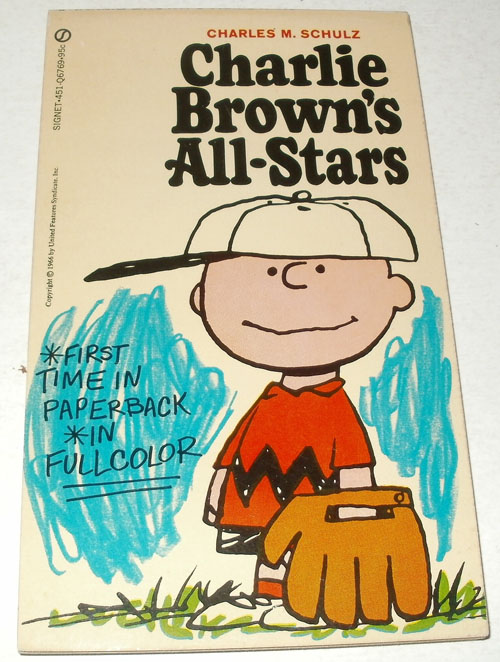
     

Van Beuren’s “A Cat-Fish Romance” (1932)

11 June 2026 at 07:01

When I’m super tired, there’s sometimes nothing better than an old PRC film or maybe even a good Pre-code Warners, preferably with Cagney if possible, but I’ll take a Van Beuren if there’s one laying around…

A Cat-Fish Romance (1932) is a cartoon we haven’t cleaned up yet for the new Aesop’s Fables, Volume 2 Blu-ray set. It’s about to go into the restoration pipeline though, and as I looked at the main print we’re using I thought it would be a fun one to post.

Of course, the best Van Beuren shorts keep things moving right along throughout, while the not-as-good ones tend to meander around the idea while this or that musical interlude interrupts things. Sometimes if there’s enough of those musical interludes you can end up with a pretty solid little musical short. I don’t know if they were particularly worried about how the mix of the elements would come together in the end, honestly. Perhaps a basic outline was good enough, then the layout would basically be the storyboards.

Mannie Davis and his solid rubber characters start things off in this short with a cat fisher-man bouncing along happily as Mexican fish play a mean guitar. A mermaid cat (voiced by Margie Hines, who by this point was the majority of the female characters in Van Beuren films) sees our hero on her sunken-submarine house Television, and within moments she manages to pull his fishing pole and him underwater. Happily, he has no trouble changing from breathing to whatever underwater (this is never explained — am I wrong to find this odd?). They sing and swoon together as Margie (uh, I mean the mermaid cat) sings “I Can’t Give You Anything But Love”. This also allows the studio to reuse animation from past underwater cartoons, including an extended sequence from The Haunted Ship (1930) and scenes from Rocketeers (1931).

For the conclusion (and a little conflict) at the end of the picture, a big spider (?) shows up and takes our Mer-cat-girl away. A fight ensues, with our cat-boy hero stabbing the spider with a sword. He meekly cries “Mammy!” As he floats up out of the scene at the end in a strange moment of silence. Doesn’t it seem like a sea creature would’ve been a better idea? All is well in Cat-love land again as our heroes ride a fish while singing. Somehow our hero cat never loses his hat throughout.

Manny’s well-drawn animation really dominates this film, and brings the quality up of the studio in all the pictures he works on. Even though there’s a lot of reuse here, it works just fine, and of course the audience would never know or care. As a rising animation star, I find it surprising that he didn’t end up over at Fleischer’s during this period. After It makes some sense they would trust him to carry the Cubby Bear series soon after this. Davis of course would spend a good amount of his career at Terrytoons after Van Beuren. I wonder if his brother, Art, ever visited the Van Beuren studio during this period. There’s way too little documentation of the Van Beuren Studio in general, compared to other shops.

While this picture will never make the AFI’s top cartoon list, it’s a solid little picture, and a great example of where Davis was going in terms of character animation, especially in appealing action and drawing.

Have a good week everyone!

❌
Cartoon Research