On average, each American throws away about 81 pounds of clothing, shoes, and household textiles every year. That’s roughly a hamper full every month for each person. For a family of four, this adds up to over 320 pounds of textiles tossed or donated each year. Most people don’t realize how much they discard until they actually weigh it over a year.
The number comes from EPA’s most recent, 2018 sustainable-materials accounting, which puts U.S. post-consumer textile generation at roughly 17 milli
On average, each American throws away about 81 pounds of clothing, shoes, and household textiles every year. That’s roughly a hamper full every month for each person. For a family of four, this adds up to over 320 pounds of textiles tossed or donated each year. Most people don’t realize how much they discard until they actually weigh it over a year.
The number comes from EPA’s most recent, 2018 sustainable-materials accounting, which puts U.S. post-consumer textile generation at roughly 17 million tons and the recovery rate at 14.7 percent. While the EPA has discontinued its reporting, ThredUp’s 2025 Resale Report and the Apparel Impact Institute updates suggest per-capita generation has continued rising. Most of what falls inside that 14.7 percent is downcycled into industrial wiping rags or insulation, not turned into new clothing.
What “donating” actually does
The mental model in most American closets is that the donation bin is the recycling bin. It isn’t. Goodwill, Salvation Army, and the secondhand chains sell what they can on the resale floor, typically only 10 to 30 percent of the clothing they accept as donations. The rest is sold by the pound to textile graders, who export the higher grades to wholesale markets in West Africa, Eastern Europe, and Central America, bale the remainder as wiping rags or insulation feedstock, and landfill the rest.
That export pipeline is under pressure. Ghana, Kenya, and Chile have moved to restrict or refuse low-grade used-clothing imports, citing the volume of unsellable fast-fashion synthetics arriving contaminated and culturally mismatched. The January 2025 GAO report on textile recovery flagged the offshore-disposal pathway as structurally fragile and quietly subsidized by U.S. consumers who treat donation as absolution.
The amount of clothing waste is closely tied to price. Since 1995, clothing prices in the U.S. have dropped by over 30 percent, even as other costs have gone up. This is mainly due to ultra-fast-fashion brands like Shein and Temu. Many clothes, especially those made from polyester-spandex blends, aren’t made to last, be repaired, or recycled. They’re often thrown out after just six wears. According to McKinsey’s State of Fashion report, the average piece of clothing is now worn only seven to ten times before being discarded, much less than in the past.
The household bill
The value of clothing can change a lot, so it’s harder to put an exact dollar amount on waste compared to food. Still, the Bureau of Labor Statistics says the average U.S. household spends about $1,900 a year on clothes. If 30 to 40 percent of those clothes are thrown out within two seasons, that means a household is tossing $570 to $760 worth of new clothing every year.
The environmental impact of clothing is even bigger before it reaches your closet. The UN Environment Programme says fashion is responsible for 2 to 8 percent of global greenhouse gas emissions and 20 percent of industrial water pollution. Making just one cotton t-shirt uses about 2,700 liters of water, which is as much as one person drinks in two and a half years.
The policy lever finally arriving
For years, there were no rules holding clothing producers responsible for textile waste in the U.S. That changed with California’s SB 707, the Responsible Textile Recovery Act of 2024, which is the first law of its kind in the country. CalRecycle chose Landbell USA to run the program starting February 27, 2026. Brands selling clothes and household textiles in California will have to help pay for collection and processing, with requirements rolling out through 2030. Other states like New York, Massachusetts, and Washington are considering similar laws that would make clothing manufacturers cover the costs of fast fashion waste.
Fiber-to-fiber recycling — the missing technology piece — is moving, slowly. Circ, Syre, and Reju are at pilot or first-commercial scale. Renewcell, the most visible name in cellulosic recycling, filed for bankruptcy in early 2024 and has since been acquired and restarted as Circulose. Textile recycling technology is real, but the economics of the business still depend on virgin-fiber prices going higher, the development of a sorting infrastructure, and the kind of policy support SB 707 is now beginning to provide.
What You Can Do
At home and while shopping:
Focus on slowing down how often you buy new clothes, not just buying less. Choose better quality items and wear them for longer. If you double how long you wear each garment, you can cut its total emissions by about half.
Try to fix your clothes before replacing them. Local tailors, Repair Cafés, and repair programs from brands like Patagonia, Nudie Jeans, and Eileen Fisher can help you get more use out of what you already have.
Be honest when sorting your donations. Clean, up-to-date, and resaleable items should go to local thrift stores. Items that are stained or torn should go to textile-specific takeback bins at places like H&M or Madewell, where they can be properly processed.
Before putting anything in your curbside bin, use Earth911’s recycling search to find local textile drop-off locations by ZIP Code. Most curbside bins don’t accept clothing or textiles.
In your community:
Support textile extended producer responsibility (EPR) laws in your state. SB 707 is the example to follow, and the next few states to pass similar laws will help decide if this approach can grow.
Ask retailers to clearly label fiber content and recyclability. The EU will require digital product passports by 2027, and U.S. brands selling overseas will have to comply. Whether these labels appear in the U.S. depends on consumer demand.
Support and volunteer at local repair and reuse programs. Repair Cafés, Buy Nothing groups, and clothing swaps help reduce waste before it starts, which is the most effective way to make a difference.
Project Repat, founded by Ross Lohr and Nathan Rothstein, had prevented more than 11 million T-shirts from landfills while bringing some sewing work back to the United States when we talked with them in 2019. They’re still going strong. Tune into a classic conversation as Earth911’s Mitch Ratcliffe talks with Rothstein about the inspiration behind Project Repat and the massive changes in U.S. T-shirt manufacturing over the past 30 years. After migrating to Mexico, T-shirt printing jobs have gon
Project Repat, founded by Ross Lohr and Nathan Rothstein, had prevented more than 11 million T-shirts from landfills while bringing some sewing work back to the United States when we talked with them in 2019. They’re still going strong. Tune into a classic conversation as Earth911’s Mitch Ratcliffe talks with Rothstein about the inspiration behind Project Repat and the massive changes in U.S. T-shirt manufacturing over the past 30 years. After migrating to Mexico, T-shirt printing jobs have gone overseas and few American companies still make them.
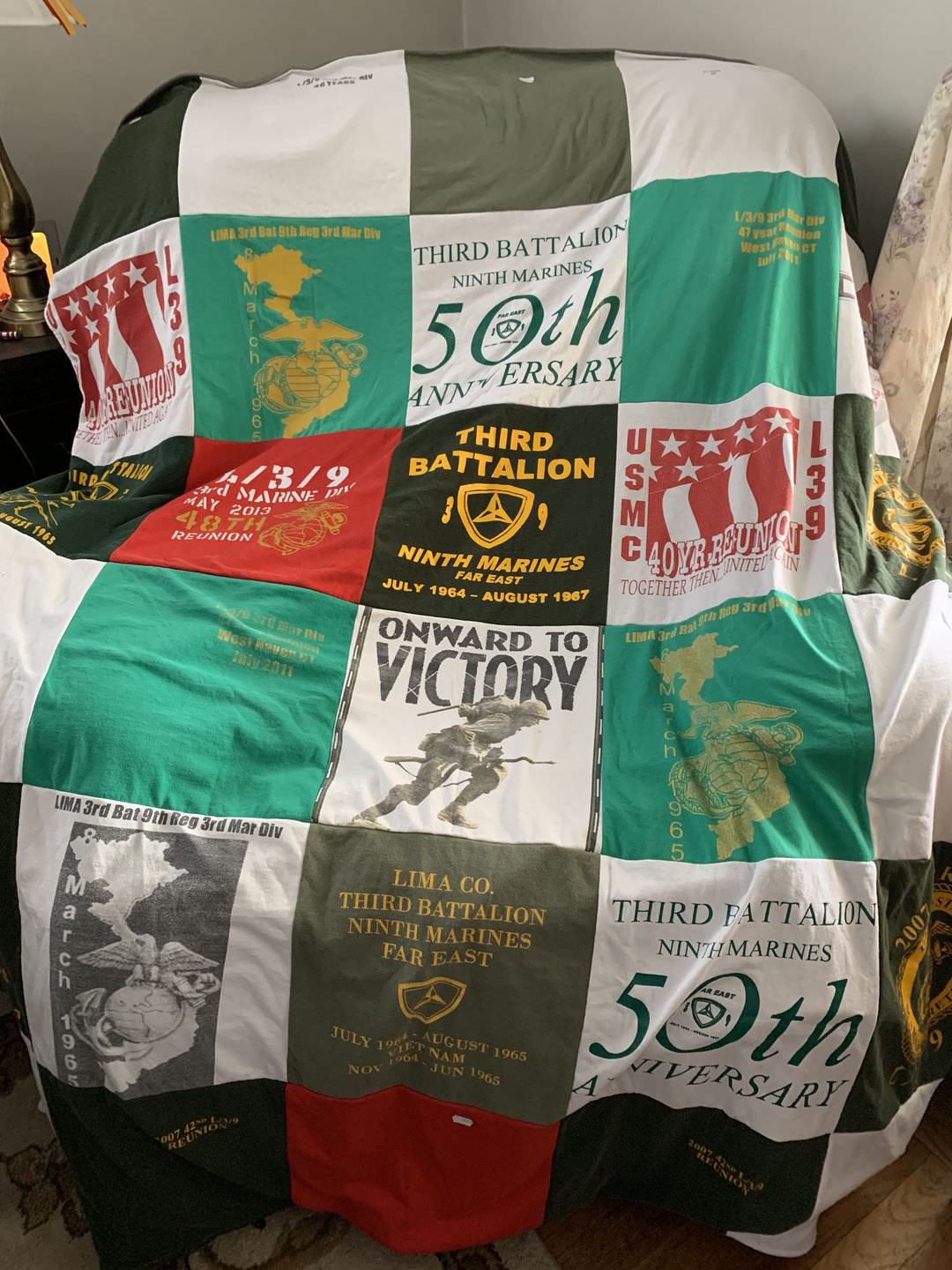
A Project Repat quilt memorializes a soldier’s tours of duty.
Project Repat has a better idea: turn old shirts into keepsake quilts hand-sewn using T-shirts sent by customers. Instead of tossing a T-shirt in the donation bin, it can be turned into a part of a memorable and snug quilt. Love a sports team? Make a quilt of the team T-shirts and jerseys you’ve purchased over the years. Want to remember a school or a company where you worked? In all likelihood, you have the makings of a Project Repat quilt. Reasonably priced based on the size, Project Repat takes your order and receives your shirts by mail, then turns them into fleece-backed quilt.
Americans throw out 81.5 pounds of clothing a year; two-thirds of it ends up in landfills. That’s no accident—it’s a fast fashion design principle that many have embraced.
A December 2024 U.S. Government Accountability Office report found that textile waste grew by more than 50 percent from 2000 to 2018, while federal agencies still lack a coordinated strategy. As a result, consumers seeking sustainable options carry the burden of finding responsible brands.
Look good and reduce your footprint—y
Americans throw out 81.5 pounds of clothing a year; two-thirds of it ends up in landfills. That’s no accident—it’s a fast fashion design principle that many have embraced.
A December 2024 U.S. Government Accountability Office report found that textile waste grew by more than 50 percent from 2000 to 2018, while federal agencies still lack a coordinated strategy. As a result, consumers seeking sustainable options carry the burden of finding responsible brands.
Look good and reduce your footprint—you don’t have to choose. The brands below carry recognized certifications, use lower-impact materials, and often sell via Amazon. We’ve updated this list since 2021 to reflect brands still delivering and those raising the bar.
Throughout this list, you’ll see references to GOTS (Global Organic Textile Standard), Fair Trade Certified, and SA8000. GOTS covers the entire supply chain from farm to finished garment, requiring organic fibers and strict environmental and social standards. Fair Trade and SA8000 focus on worker wages, safety, and conditions. These aren’t marketing claims, they require third-party audits.
This article contains affiliate links. If you make a purchase through these links, we may receive a small commission at no additional cost to you. This supports our independent work but does not influence our recommendations or coverage.
1. Pact — GOTS-Certified Organic Cotton Basics and Dresses
Pact offers women a strong foundation for building a sustainable wardrobe. Each garment is crafted from GOTS-certified organic cotton in Fair Trade Certified factories, with certifications updated as recently as 2025. The brand partners with SimpliZero to measure and offset the carbon footprint of individual products, investing in reforestation and renewable energy.
Their organic cotton process uses 81% less water and 62% less energy than conventional cotton farming, a meaningful difference given that a single conventional cotton T-shirt typically requires around 2,700 liters of water to produce.
2. Girlfriend Collective — Recycled Activewear with Radical Transparency
Seattle-based Girlfriend Collective leads in sustainable activewear. Its fabrics are made from post-consumer plastic bottles, fishing nets, and fabric scraps. They are OEKO-TEX Standard 100 certified and BPA-free, making them safer if they end up in a landfill. The brand uses eco-friendly dyes and provides washing bags with each purchase to help reduce microfiber pollution.
On the labor side, Girlfriend Collective holds SA8000 certification, which independently verifies safe working conditions and fair wages. They also run ReGirlfriend, a take-back and recycling program that gives you store credit for returning worn-out pieces. That circular loop — buy, wear, return, recycle — is still rare in activewear.
The brand carries sizes XXS to 6XL and has an Amazon storefront with frequently updated inventory.
Standout picks:
Girlfriend Collective High-Rise Skort is crafted from recycled polyester sourced from certified post-consumer plastic bottles and features useful hidden pockets.
Browse Girlfriend Collective’s full Amazon store for leggings, sports bras, and shorts.
3. Eileen Fisher — Circular Fashion and B Corp Commitment
If any brand embodies “timeless,” it’s Eileen Fisher. Since 2013, the company has championed circularity through its Renew take-back program—one of the longest-running garment recycling efforts in American fashion. Send back your worn Eileen Fisher pieces, and they’re cleaned, repaired, and resold or upcycled into new textiles.
As of 2025, 75% of Eileen Fisher’s products use lower-emissions or certified materials, including organic linen, organic cotton, regenerative wool, TENCEL lyocell, and deadstock fabric. The brand holds certifications from GOTS, GRS (Global Recycled Standard), RWS (Responsible Wool Standard), Bluesign, and FSC. It’s also a certified B Corp with published emissions targets.
Eileen Fisher acknowledges it is not currently on track to hit its science-based emissions reduction targets. That’s a candid admission that distinguishes genuine transparency from greenwashing. Their organic linen and TENCEL pieces are particularly durable and environmentally benign: linen requires no irrigation in most growing conditions and generates roughly a quarter of the carbon emissions per pound of fiber as conventional cotton.
Eileen Fisher sells direct at eileenfisher.com with free shipping on U.S. orders.
4. Reformation — Carbon-Tracked Dresses and Recycled Cashmere
Los Angeles-based Reformation publishes quarterly sustainability reports that break down water, energy, and carbon footprint per product — a level of granularity that almost no other fashion brand offers. Their key fabrics include TENCEL™ Lyocell, produced in a closed-loop system that recycles 99% of its non-toxic solvent, low-irrigation linen, and Forest Stewardship Council-certified viscose.
In late 2024, Reformation launched its first 100% recycled cashmere sweater line — a blend of 95% recycled cashmere and 5% recycled wool. The brand reports these sweaters produce 96% less carbon and require 89% less water than conventional cashmere. That’s a significant claim, and the brand backs it with third-party verification.
Reformation also partners with ThredUp and Poshmark so you can resell verified purchases directly through those platforms. It also offers a take-back program for Ref sweaters, shoes, denim, and outerwear.
5. Amour Vert — Made in California, Plant a Tree With Every Tee
Amour Vert (“green love” in French) produces 97% of its garments in California, collaborating with mills to create signature sustainable fabrics such as beechwood modal, GOTS-certified cotton, OEKO-TEX silk, TENCEL, and cupro from cotton waste. The brand recycles nearly all byproducts at its factories.
For every T-shirt purchased, Amour Vert plants a tree in North America through its partnership with American Forests, and has planted more than 220,000 trees to date. Products are made in small batches to limit overproduction, and the brand offers an upcycled clothing collection that transforms discarded materials into new pieces.
Key pieces for the Spring and Summer of 2026 include:
Victoire Wide Leg Pants feature organic cotton and a TENCEL blend, a versatile year-round foundation for your look.
The Verona Blazer is made from organic cotton and TENCEL to deliver an office-appropriate, seasonless look.
The Sloan Skirt uses TENCEL from sustainably sourced wood pulp to provide moisture-wicking comfort.
6. Warp + Weft — Size-Inclusive Denim Under $100
A traditional pair of jeans takes roughly 1,500 gallons of water to produce. Warp + Weft, a family-owned brand, produces jeans using less than 10 gallons of water. By operating a vertically integrated denim mill, Warp + Weft controls every step: utilizing onsite solar panels, a heat recovery system, recycling and treating 98% of water used, and employing dry ozone technology instead of chemical bleaching.
The brand is fully size-inclusive (through 3X for women), and prices stay under $100. Their compliance with International Social and Environmental & Quality Standards is auditable, not self-reported. Warp + Weft has expanded from denim into matching sets, tops, and jackets, making it easier to build a full outfit around their sustainable denim base.
7. Karen Kane — Ethical Production and TENCEL Chambray
Karen Kane stands out for its transparent, energy-efficient operations, including LA-based manufacturing, hangar reuse, and sustainable fabric initiatives. The Asymmetric Hem Wrap Top, a signature design, is crafted from 100% TENCEL soft chambray made with FSC-certified wood pulp. This closed-loop process recaptures and reuses solvents, greatly reducing chemical waste compared to traditional rayon methods.
Karen Kane offers a broader range of wardrobe essentials beyond the wrap top, and its women’s collection is available on itssite and select Amazon listings.
8. Mango — Organic Denim and a Declared Sustainability Road Map
Mango is a larger brand, which warrants more scrutiny, but it can also make a positive impact through its environmental commitments. The brand publicly committed to using 100% organic cotton and 50% recycled polyester by 2025, and 100% cellulose fibers with verified sustainable origins by 2030. Their organic cotton pieces, including several denim options, are genuinely certified organic, meaning no synthetic pesticides or fertilizers are used in cultivation.
Mango describes its sustainability journey as ongoing, and it is. Organic cotton still requires significant water input, and a large global retailer faces supply chain complexity that smaller brands avoid. Good On You rates the brand as making progress but “Not Good Enough.” That said, Mango’s organic denim line is worth considering for shoppers who want accessible price points alongside high-quality materials. Organic Mango pieces are available through mango.com.
What You Can Do To Lower Your Impact
Individual purchasing choices alone won’t fix a 17-million-ton textile waste problem. But they shape markets, and markets respond. Here’s how to shop with more impact:
Look for GOTS, Fair Trade Certified, or B Corp status. These require third-party audits, not just brand claims.
Prioritize longevity. A $90 Eileen Fisher linen shirt, worn 200 times, has a far lower footprint than a $20 fast-fashion top, worn 7.
When you’re done with clothes, resell on ThredUP, Poshmark, or TheRealReal before donating. Secondhand marketplaces keep clothing in circulation longer.
Use Earth911’s recycling search to find textile recycling options in your area. Only about 15% of U.S. textiles are currently recycled.
Check takeback programs before you throw anything out. Eileen Fisher Renew, Girlfriend Collective’s ReGirlfriend, and Reformation’s takeback initiative all exist for exactly this reason.
Every pair of jeans you buy took roughly 2,000 gallons of water to produce. Every cotton t-shirt, about 700 more. The clothes you wear are the second-largest consumer of water among all industries, and fashion as a whole generates as much carbon as international aviation and maritime shipping combined. Where and how you shop makes a big difference for the planet that you want to get outside, into nature, and enjoy.
Men’s clothing brands are making the moves to reduce damage to the nature. They’r
Every pair of jeans you buy took roughly 2,000 gallons of water to produce. Every cotton t-shirt, about 700 more. The clothes you wear are the second-largest consumer of water among all industries, and fashion as a whole generates as much carbon as international aviation and maritime shipping combined. Where and how you shop makes a big difference for the planet that you want to get outside, into nature, and enjoy.
Men’s clothing brands are making the moves to reduce damage to the nature. They’re using organic and recycled fibers, paying fair wages, publishing their supply chains, repairing garments for free, and planting trees. Some are even rethinking what fabric itself can be made from.
Still, fast fashion is growing by more than 10% each year and could double to $291 billion by 2032. Only 0.3% of textile fiber worldwide is recycled, and 85% of discarded clothing in the U.S. goes to landfills. The brands here are working hard to change that, which is why they deserve your support.
The Ellen MacArthur Foundation’s A New Textiles Economy report says that if we doubled how often we wear each piece of clothing, greenhouse gas emissions from clothing would drop by 44%. The best way to help is to use what you already have. After that, buying from brands that are truly making an effort is the next best step. Here are 12 such brands.
This article contains affiliate links. If you purchase an item through the Amazon links below, Earth911 receives a small commission that helps fund our Recycling Directory. If you don’t return an item, Amazon shipping is typically more efficient than retail shopping.
The Brands
1. Nudie Jeans
Nudie Jeans has built one of the most honest sustainability programs in denim. Their 2024 report shows that 93% of fiber usage is organic, Fairtrade, or recycled cotton, and in 2024 they finalized their first garments made from regenerative organic cotton—farming that doesn’t just avoid harm but actively rebuilds soil health. They also run 33 free-for-life repair shops across 20 cities, repaired 68,342 pairs of jeans in 2024, and sell pre-owned jeans directly on their site. If you want denim that’s designed to be worn, repaired, and worn again rather than replaced, this is the brand.
Current Pick: Gritty Jackson Jeans
The Gritty Jackson is Nudie’s main men’s jean, with a regular straight fit made from 100% organic cotton. It now comes in styles that use the new regenerative organic cotton. Buy directly from Nudie to use their repair program, or find them on Amazon.
2. Asket
Asket operates on a simple premise, that the most sustainable garment is one you already own. So, the Swedish brand makes a permanent, no-new-seasons collection and publishes the full CO₂ impact and material traceability of every single product on its website. No other brand in this guide is more transparent about what your clothes are made of and what it cost the planet to make them.
Current Pick: Oxford Shirt
The Oxford Shirt comes in seven colors, is made from 100% yarn-dyed cotton, and carries a disclosed CO₂ impact of 5.5 kg per shirt. It’s the kind of shirt you buy once and wear for a decade. Asket ships directly to the U.S and offers full transparency data for your purchase.
3. prAna
prAna is a great choice for men who want clothes that work for hiking, yoga, or a night out. The brand uses recycled and organic fibers, supports Fair Trade, and shares full supply chain details, including factory names and conditions. Since being bought by Columbia Sportswear in 2014, prAna has kept its focus on sustainability and uses bluesign® certified fabrics.
Current Pick: Stretch Zion Pant II
The Stretch Zion Pant II is prAna’s top men’s pant, made from recycled nylon and bluesign® certified. It’s built for climbing and hiking but comfortable enough for travel. You can find it on Amazon.
4. tentree
tentree has planted over 120 million trees in 13 countries and aims to reach one billion by 2030. That’s ten trees for every item sold. The brand is a certified B Corp, has been carbon-neutral since 2022, and uses organic cotton, TENCEL™ lyocell, hemp, and recycled polyester. They also run a Circularity program that takes back clothes from any brand for resale or recycling. In 2024, they funded 100 beehives at planting sites in Kenya to help support local communities after reforestation projects end.
Current Pick: Juniper Classic Hoodie
The Juniper Classic Hoodieis made from recycled polyester and organic cotton. It’s a simple, versatile layer that comes with tentree’s tree-planting promise. You can find it on Amazon.
5. Warp + Weft
Warp + Weft might be the most underrated brand here. While regular jeans use about 1,500 gallons of water to make, Warp + Weft jeans use less than 10. They treat and recycle 98% of their water, power their mill with solar panels, and use Dry Ozone technology instead of chemical bleaching. All their pieces cost under $100 and come in sizes up to 3X, making sustainable denim more accessible. Their Fall 2024 collection added stretch corduroy, knit denim, and a new relaxed-fit men’s jean.
Current Pick: GRR Relaxed Jean
The GRR Relaxed Jean has a mid-rise and loose leg, made from Warp + Weft’s low-water denim. You can find them on Amazon.
6. Everlane
Everlane ranked first in Remake’s 2024 Fashion Accountability Report, beating 52 other brands and earning its highest score ever. Their 2024 impact report shows that 90% of their materials now meet lower-impact standards, and they have cut Scope 1–3 emissions by 52% since 2019. The ReNew collection, made from recycled plastic bottles and fishing nets, has grown, and 95% of the cotton Everlane uses is certified organic, regenerative, recycled, or farm-traceable. A 2020 labor scandal still affects their “radical transparency” claims, and their goal of 100% preferred materials by the end of 2025 is still in progress. Still, the data shows real improvement.
Current Pick: The ReNew Fleece Jacket
Made from 100% recycled materials and bluesign®-approved dyes, the ReNew Fleece Jacket is the updated staple of the ReNew collection. It’s versatile enough for layering in spring and fall.
7. Nau
Nau started in Portland in 2005 with the goal of proving that business could be a force for environmental good. Now owned by South Korean outdoor company Black Yak, the brand continues to make versatile performance-lifestyle clothing from recycled polyester, organic cotton, TENCEL, and ethically sourced Merino wool, using PFC-free coatings instead of the persistent chemical water repellents most outdoor brands still rely on.
Current Pick: Latitude Crew Pullover
The Aeroshell Hooded Shirt is made from recycled nylon and works well for both city commutes and weekend hikes. You can find Nau on Amazon.
8. Thought Clothing
Thought Clothing, formerly Braintree, is a UK brand built on natural, traceable fibers: hemp, organic cotton, TENCEL, bamboo, recycled polyester, and Merino wool. Their packaging is compostable cornstarch or recycled paper. Hemp is the standout material here—it requires roughly 300–500 liters of water per kilogram to grow, compared to nearly 10,000 liters for conventional cotton. If you’re looking for warm-weather shirts that wear well and wash easy, Thought is worth the international order.
Current Pick: Golf Socks with Panache
The Kinley Golf Course Bamboo Socks in Cobalt Blue are a standout from Thought’s men’s sock line — a golf-course-ready pattern built from a blend of 53% bamboo-derived viscose, 28% recycled polyester, 16% organic cotton, and 3% elastane. Bamboo is one of the fastest-growing renewable crops on the planet, and in fabric form, it delivers genuine performance benefits: the material is naturally breathable, antibacterial, and antifungal, with zero plastic packaging. £7.95 direct from thoughtsocks.com, with international shipping available.
9. Pact
Pact is the easiest brand to start with on this list. They use GOTS-certified organic cotton, Fair Trade Certified™ factories, offer optional carbon offsets at checkout, and use 100% post-consumer recycled packaging. Their prices are much lower than most sustainable brands. Pact covers the basics: underwear, t-shirts, socks, and pants. If you’re just starting to move away from fast fashion and don’t want to spend $100 on a hoodie, this is a good place to begin.
Current Pick: Daily Twill Midweight Pant
The Daily Twill Midweight Pant is an organic cotton trouser with an elastic waistband and drawcord—equally at home at a desk or on a trail. Their Backyard Collection adds organic cotton shorts and button-ups for summer. Find Pact on Amazon.
10. PANGAIA
PANGAIA has moved well beyond the recycled cashmere hoodie it was known for in 2021. The brand now functions as a material science company developing fibers from seaweed (C-FIBER™), fruit waste (FRUTFIBER™), nettles (PANettle™ Denim), and plant-based nylon ((gaia)PLNT). Their PPRMINT™ natural peppermint oil treatment discourages odor-causing bacteria, which means you wash less, and every wash avoided is microplastics not released into waterways. If you want to wear something genuinely on the frontier of what sustainable textiles can be, this is your brand.
Current Pick: Men’s DNA Hoodie
The DNA Hoodie is made from 50% organic cotton and 50% recycled cotton, with an oversized fit and PPRMINT™ treatment. It’s PANGAIA’s most accessible men’s item and a highlight of their collection. Also consider the 365 Hoodie, which comes in C-FIBER™ and recycled cotton blends.
11. Outerknown
Outerknown was co-founded by 11-time world surfing champion Kelly Slater in 2015 and has become one of the most respected men’s sustainable brands in the U.S. Its reputation comes from its supply chain, not just its founder. The brand claims to be the first built on a full commitment to sustainability, using Regenerative Organic Certified® cotton, Fair Trade Certified™ factories, and full transparency about where products are made. Outerknown also has a Pre-Loved resale program for used items.
Current Pick: The Blanket Shirt
The Blanket Shirt is Outerknown’s most iconic piece and deserves its reputation. Made from 100% organic cotton BlanketWeave™ twill with buttons from nuts, it’s built to be the shirt you reach for constantly and wear for years. Available in more than 20 colors and patterns. Also worth considering: the S.E.A. Jeans made from organic cotton denim in a Fair Trade Certified factory. Find Outerknown on Amazon.
No brand on this list is perfect. Every piece of clothing has some environmental impact, and “sustainable” is a spectrum, not a certification. Still, all 12 of these brands are making real, documented efforts to improve: better materials, better factories, more transparency, and in some cases, taking back clothes when you’re done with them.
Buy less and wear your clothes longer. When you do shop, choose brands that can show where their products come from and what their impact is on the planet. That’s the whole approach.
Editor’s Note: Originally published on March 19, 2021, this article was updated in March 2026.
Fashion is a major sustainability challenge in the global economy, and for most of the last decade, it has faced little regulation. That is starting to change. In the past eighteen months, California passed the first U.S. law for extended producer responsibility (EPR) for textiles, France approved strict anti-fast-fashion laws, and the EU set a 2027 deadline for all member states to have a textile EPR program.
Every second, a garbage truck’s worth of clothing ends up in a landfill or is burned s
Fashion is a major sustainability challenge in the global economy, and for most of the last decade, it has faced little regulation. That is starting to change. In the past eighteen months, California passed the first U.S. law for extended producer responsibility (EPR) for textiles, France approved strict anti-fast-fashion laws, and the EU set a 2027 deadline for all member states to have a textile EPR program.
Every second, a garbage truck’s worth of clothing ends up in a landfill or is burned somewhere in the world. This isn’t just a figure of speech. The fashion industry produces about 92 million metric tons of waste each year, and if nothing changes, that number could reach 148 million metric tons by 2030.
Meanwhile, the resale market is growing about three times faster than traditional retail. The industry still has a long way to go, but for the first time, there are real systems in place to hold it accountable.
The Scale of the Problem
How big is fashion’s impact? It’s large, debated, and still growing. The fashion industry is responsible for 8 to 10 percent of global greenhouse gas emissions, according to the UN Environment Programme. While experts debate the exact numbers, everyone agrees the problem is getting worse.
The Apparel Impact Institute, a nonprofit supported by brands like H&M, Target, PVH, and Lululemon, reported that apparel sector emissions rose by 7.5 percent in 2023. This was the first yearly increase since 2019, and the group linked it to overproduction, ultra-fast fashion, and more use of virgin polyester, which now accounts for 57 percent of global fiber production.
No matter which numbers you believe, the trend is troubling. Each year, 80 to 100 billion new garments are made. Clothing production has doubled since 2000, and people now wear each item 36 percent fewer times before throwing it away. Synthetic fibers, mostly polyester made from fossil fuels, make up about 57 percent of global fiber production and are expected to increase.
The amount of water used in fashion is huge, even by industrial standards. Making one cotton T-shirt takes about 2,700 liters of water, which could provide drinking water for one person for 900 days. Producing a pair of jeans uses about 7,500 liters. Textile dyeing and treatment is the world’s second-largest source of water pollution, causing about 20 percent of industrial water pollution. ic clothing also sheds microplastics every time it’s washed. The IUCN has estimated that about 35 percent of primary microplastics in the ocean originate from synthetic textiles like polyester, nylon, and acrylic, though the total volume keeps rising as synthetic usage increases.
After technology manufacturing, garment production is still one of the industries most affected by modern slavery and child labor, according to International Labour Organization data. These problems are most common in the early stages of production, such as cotton farms, dye houses, and fabric mills, which are less visible than the brand-name factories.
Fast Fashion, Faster: The Shein and Temu Problem
In the last five years, a new category called ultra-fast fashion has emerged, making older models like Zara and H&M seem slow by comparison. Platforms such as Shein and Temu add thousands of new styles daily, produce items on demand in Chinese factories, and ship directly to customers around the world.
The environmental impact is severe. Shein’s own reports show its greenhouse gas emissions nearly doubled from 2022 to 2023, reaching 16.7 million metric tons of CO₂ equivalent. That’s almost as much as Inditex, Zara’s parent company, which is five times bigger by revenue. In 2024, Shein’s transportation emissions alone were over 8.5 million metric tons, more than three times Inditex’s. Temu hasn’t shared its emissions data, but third-party estimates put its yearly footprint between 4 and 6 million metric tons of CO₂e, mostly from shipping over a million air-freight parcels each day.
These business models not only pass environmental costs onto others, they rely on it. This is the main reason behind the push for new regulations.
The New Regulatory Landscape
For most of modern fashion history, sustainability promises have been voluntary, hard to verify, and mostly ineffective. That is finally starting to change. Three recent developments in the past eighteen months are especially important to watch..
Governor Gavin Newsom signed SB 707 into law in September 2024, making California the first U.S. state with extended producer responsibility for textiles. The law shifts responsibility for end-of-use management of apparel, footwear, and household textiles from consumers and municipalities to the companies that put the products on the market. Producers with less than $1 million in annual global revenue are exempt; everyone else must join a state-approved Producer Responsibility Organization (PRO) that will finance collection, repair, reuse, sorting, and recycling.
Implementation is staged. On February 27, 2026, CalRecycle selected Landbell USA as California’s textile PRO. Producers must register with the PRO by July 1, 2026. A statewide needs assessment runs through 2027, final implementing regulations are due by July 2028, and full enforcement begins July 1, 2030, with fines of up to $50,000 per day for noncompliance.
France’s Anti–Fast Fashion Law
In June 2025, the French Senate passed the most aggressive anti-fast-fashion legislation in the world by a vote of 337 to 1. The law imposes a per-item eco-tax starting at €5 and rising to €10 by 2030 (capped at 50 percent of retail price), bans advertising and influencer marketing of ultra-fast-fashion brands, requires point-of-sale environmental disclosures including carbon footprint and durability data, and carries fines of up to €100,000 for violating the ad ban. Revenue is directed to French sustainable-fashion producers.
The law is clearly aimed at Shein and Temu. In November 2025, French authorities requested that Shein’s fast-fashion platform be suspended for three months over the sale of illicit products — days after Shein opened its first physical retail store in Paris. The European Commission issued a detailed opinion on the French law in September 2025; other EU member states are watching.
The EU Waste Framework Directive
Under revisions to the EU Waste Framework Directive, every member state was required to have separate textile waste collection in place by January 2025 and must have a fully operational textile EPR scheme by 2027. France’s EPR program, which has been operating since 2008, and the Netherlands (2023) are already live. Italy, Spain, and others have draft decrees in public consultation. Outside the EU, Switzerland, Australia, and Chile are developing national frameworks.
In the U.S., beyond California, New York’s Fashion Sustainability and Social Accountability Act (A4631) and Senate Bill S3217A both carried into the 2026 session. Washington State introduced HB 1420 in January 2025; as of March 2026, it remains in committee. None of these have passed.
The Resale Market Is Doing What Regulation Hasn’t
While policymakers work on new rules, consumers are already changing their habits. ThredUp’s 2025 Resale Report says the U.S. secondhand clothing market grew by 14 percent in 2024, five times faster than traditional retail. It’s expected to reach $74 billion by 2029. Globally, the secondhand market could hit $367 billion by 2029, growing 2.7 times faster than the overall apparel market.
There is a clear generational divide. In 2024, 58 percent of U.S. consumers bought secondhand clothing. Among those aged 18 to 44, 48 percent now choose secondhand first when shopping for clothes. Thirty-nine percent of younger shoppers have bought secondhand items through social platforms like Instagram or TikTok Shop.
Resale alone won’t solve fashion’s environmental impact. Extending a garment’s life only helps if it replaces a new purchase. Still, this is the biggest shift in consumer behavior the industry has seen in a generation.
What Sustainable Fashion Actually Means
Sustainable fashion means having a supply chain that is responsible for both the environment and people at every stage. In practice, this includes using fibers that need less water, fewer chemicals, and create lower emissions; manufacturing with renewable energy; ensuring fair wages and safe working conditions; making products that last and can be repaired; and recycling materials into new clothes instead of turning them into insulation or sending them to landfills in places like Ghana or Chile.
It’s a long list, and no brand meets every standard. Still, more brands are making real progress. Patagonia, Eileen Fisher, and Pangaia share detailed impact reports that are checked by outside experts. Brands using leftover fabrics, made-to-order production, and closed-loop recycling are slowly growing. Certifications like Global Organic Textile Standard (GOTS) for organic fibers, Fair Trade Certified for labor, and bluesign for chemical management are meaningful when you see them on a label.
Fashion is still the most greenwashed part of the consumer goods industry. Words like “conscious,” “eco,” and “sustainable” aren’t regulated in the U.S. What really matters are specific certifications, published supply-chain data, and third-party audits—not marketing slogans.
Take Action At Home
Individual choices won’t fix fashion’s big problems, but they do influence demand. That demand can drive companies and lawmakers to make changes. Here are some practical steps, ranked by impact:
Buy less, buy better. The single most impactful choice is reducing the amount of new clothing entering your closet. A capsule wardrobe of durable, versatile pieces worn many times beats any “sustainable” label on a fast-fashion cycle.
Shop secondhand first. ThredUp, Poshmark, Depop, The RealReal, Vinted, and local thrift and consignment stores now offer selection and convenience comparable to traditional retail.
Get familiar with clothing materials. Natural fibers like organic cotton, linen, hemp, and wool usually have a smaller environmental impact at the end of their life than synthetics. Recycled polyester is better than new polyester, but it still releases microfibers.
Use a microfiber filter. Tools like the Guppyfriend wash bag or washing machine filters can catch a lot of synthetic microfibers before they enter the water system.
Repair before replacing. Visible mending, basic tailoring, and simple patches can extend a garment’s life by years.
Take care of your clothes so they last longer. Wash them in cold water, air-dry when you can, and avoid the dry cleaner unless it’s necessary. These steps help reduce emissions and wear on your clothes.
Recycle clothes instead of throwing them away. When something can’t be worn anymore, look for textile recycling options using Earth911’s recycling locator or a store take-back program. Sending clothes to a landfill should be the last resort.
Support new policies. Laws about textile EPR, supply-chain transparency, and anti-greenwashing are being considered in many states. These laws are more likely to pass when people contact their representatives.
Fashion is one of the most obvious ways the global economy affects our daily lives. Because it’s so visible, everyone is part of the problem—but it also means that when change happens, it’s easy to notice.
Editor’ Note: Originally written by Gemma Alexander on April 8, 2022, this article was substantially updated in April 2026.
Every year, Americans toss out about 17 million tons of textiles, and most items left in donation bins don’t find a new home. Now, more mail-in programs are stepping in to take your old clothes, keep them out of landfills, and reward you—often with store credit or cash-like rewards you can use at familiar brands.
The programs listed here include options that take any brand or condition—even socks and stained T-shirts—as well as brand-specific trade-ins that give you real money for quality items.
Every year, Americans toss out about 17 million tons of textiles, and most items left in donation bins don’t find a new home. Now, more mail-in programs are stepping in to take your old clothes, keep them out of landfills, and reward you—often with store credit or cash-like rewards you can use at familiar brands.
The programs listed here include options that take any brand or condition—even socks and stained T-shirts—as well as brand-specific trade-ins that give you real money for quality items. While none of these fully solves fashion’s waste problem, and some have fees or important details to check, each offers a more responsible choice than tossing clothes in the curbside bin. With the right program, your rewards can even cover your costs or more.
1. Trashie Take Back Bag — The Any-Brand, Any-Condition Option
Trashie ships a prepaid, prepackaged bag that holds up to 15 pounds of clothing, shoes, accessories, and home textiles from any brand, in any condition, including single socks, worn-through T-shirts, and bedsheets. A single Take Back Bag runs $20, though they are frequently on sale, and earns $5 in TrashieCash redeemable for deals at partners including Sephora, Nike, Starbucks, Allbirds, and Cozy Earth.
If you want to recycle often, Trashie Unlimited costs $68 a year and gives you unlimited bags, plus bigger rewards as you go. You get $5 for your first bag, $15 more at your fifth bag (for a total of $26), and by your tenth bag, you’ve earned back your membership with $68 in TrashieCash. After that, every bag earns you extra. Trashie reports that 95% of what they receive is repurposed, reused, or recycled, sorted into over 600 categories.
Best for: that pile of clothes you’ve been meaning to deal with for months, especially items too worn out to donate.
2. Retold Recycling — Subscription Bags With Curated Partner Rewards
Retold Recycling uses a subscription model. Their annual plan costs $99 and comes with six pre-labeled, prepaid bags—three to start, then one each quarter—each holds about five pounds of textiles. You earn Retold Rewards worth about $15 per bag, which you can use at partners like Dropps, Allyoos, Me Mother Earth, and Plaine Products. There’s also a quarterly plan for $24.75 every three months, with the same rewards per bag.
Retold accepts all textiles, including clothing, household linens, and fabric scraps, from any brand. Its recycling partners sort items by fiber content, quality, and style, with the company stating that items are kept out of landfill except when materials like leather, coated textiles, or neoprene can’t be processed. Consumer Reports said only Retold subscribers earn the rewards credits; one-time bag buyers don’t.
Best for: people who want to recycle regularly and like getting discounts at smaller sustainable brands instead of big retailers.
3. Patagonia Worn Wear — Real Trade-In Value for Well-Made Gear
Patagonia’s Worn Wear offers the best payouts if you have Patagonia items. Go to their website, take a quick quiz to check if your items qualify, print a shipping label, and send in your clean, working Patagonia jackets, fleece, pants, packs, and more. You’ll get credit as a gift card to use online or in Patagonia stores.
Trade-in values are usually about 20% of the original price. According to Patagonia’s FAQ, credits can go up to $180 for high-value items, with jackets earning between $10 and $200, and wheeled bags between $45 and $90. Sometimes, they run promotions that double your credit, so keep an eye out for those.
Keep in mind, Worn Wear only takes Patagonia-branded gear that’s still in good, usable shape. They don’t accept underwear, swimwear, or wetsuits. If your items don’t qualify, they’ll either send them back or recycle them for free.
Best for: people clearing out Patagonia gear they no longer need and who already shop at Patagonia.
4. ThredUp Clean Out Kit — Cash or Credit for What Actually Sells
ThredUp is a consignment service, not recycling: the company pays you for items it can resell, and routes the rest to donation or recycling partners. Order a Clean Out Kit, fill it with women’s or kids’ clothing in excellent or like-new condition, and ship it in. Payouts scale with listing price, from low single-digit percentages on inexpensive items to as much as 80% on premium and designer brands like Lululemon or Gucci.
You can get paid in cash or as store credit at ThredUp or partner brands like Gap, Banana Republic, Athleta, Madewell, Janie and Jack, and Reformation. If you pick store credit, you usually get a 15–20% bonus. Be aware that ThredUp takes a $14.99 processing fee from your earnings per bag, and if you want any rejected items sent back, there’s a $10.99 fee. This program isn’t for fast fashion—items from those brands or heavily worn clothes are usually rejected.
Best for: closets with name-brand, current-season women’s and kids’ clothes in good shape—not for stained T-shirts.
5. ReGirlfriend — Closed-Loop Recycling for Activewear
Girlfriend Collective, an athleisure brand, offers ReGirlfriend—a mail-in program run with SuperCircle. You can send in clean clothes from any brand and get $10 in store credit for each Girlfriend item or $5 for each non-Girlfriend item, up to 10 pieces per shipment. There’s a $15 deposit to print your shipping label, but you get it back if you make a purchase within 30 days.
You’ll get personalized discount codes for up to 30% off your next Girlfriend order. For example, a $30 credit needs at least a $100 purchase to use the full amount. Items are sorted for reuse when possible, or they’re recycled, upcycled into new yarn or fabric, or downcycled for industrial uses if they can’t be resold.
Best for: people who already shop at Girlfriend and want a mail-in option for activewear and basics from different brands.
Quick Comparison
Accepts any brand in any condition: Trashie, Retold, ReGirlfriend
Highest potential payout: Patagonia Worn Wear for premium Patagonia items; ThredUp for current-season designer women’s clothing
Get Ready for Mail-In Recycling Success
Sort your clothes before sending them. Items in good enough shape to resell or donate are worth more on ThredUp, Patagonia Worn Wear, or at a local consignment shop. Clothes that are worn out or off-brand are better suited for Trashie, Retold, or ReGirlfriend.
Consider whether a subscription makes sense for you. Trashie Unlimited is worth it if you send about 10 bags a year. Retold’s annual plan can earn you up to $90 in partner rewards. If you won’t fill several bags, it’s better to skip the subscription.
Pick store credit if you already shop at that brand. ThredUp’s 15–20% credit bonus and Patagonia’s double-credit promotions can boost your payout, but only if you were planning to spend there anyway.
Don’t mail clothes that your city already recycles. Many places offer curbside textile pickup or special drop-off bins. Use the Earth911 Recycling Search to find local options before paying to ship clothes out of state.
Check the details on fees. ThredUp charges a $14.99 processing fee, Patagonia deducts $7 for shipping, and ReGirlfriend requires a $15 refundable deposit. Make sure to consider these costs before you decide.
Try to buy less in the first place. No mail-in program can make up for the impact of owning lots of fast fashion. The best thing you can do is choose fewer, longer-lasting clothes.
About 2.4 billion bottles of nail polish are sold around the world each year, with more than 600 million bought in the U.S. alone. Most Americans who use nail polish have eight to twelve bottles at home. When a color is no longer wanted, almost none of these bottles can go in the recycling or regular trash.
Nail polish contains solvents, plasticizers, and resins that are considered household hazardous waste (HHW), just like oil-based paints and pesticides. State and local rules, based on feder
About 2.4 billion bottles of nail polish are sold around the world each year, with more than 600 million bought in the U.S. alone. Most Americans who use nail polish have eight to twelve bottles at home. When a color is no longer wanted, almost none of these bottles can go in the recycling or regular trash.
Nail polish contains solvents, plasticizers, and resins that are considered household hazardous waste (HHW), just like oil-based paints and pesticides. State and local rules, based on federal law, decide how it should be handled. The good news is that by 2026, more brand take-back programs and beauty recyclers are giving people better options than waiting for a rare HHW collection day.
Why That Little Bottle Counts as Hazardous Waste
A regular bottle of nail polish is about 70% solvents, usually ethyl acetate, butyl acetate, and sometimes toluene, mixed with film-formers, plasticizers, and pigments. These solvents are flammable, and some plasticizers are linked to reproductive harm. Dried polish acts like a thin layer of car paint. The U.S. EPA says household hazardous waste includes products that are ignitable, corrosive, reactive, or toxic. Nail polish burns easily and is toxic, so many local programs, from Sonoma County to the City of London, list it as hazardous waste.
Three ingredients in nail polish have raised the most concern and are called the toxic trio: toluene, which can harm development and the nervous system; formaldehyde, which is a known cancer risk; and dibutyl phthalate (DBP), which can affect reproduction. The European Union banned DBP in cosmetics in 2004. The U.S. does not have a similar federal ban, but most big brands have changed their formulas. In 2023, California took an extra step by regulating toluene in nail products.
Changing the formula does not always remove all harmful chemicals. A 2026 study in Science of the Total Environment, using tests from the California Department of Toxic Substances Control, looked at 178 nail products of different types. The researchers found 29 different chemicals, including toluene, formaldehyde, and methyl methacrylate. In 92% of the products, chemicals were found that were not listed on the label. Products for children had the same chemical levels as those for adults.
A separate study by California’s Department of Toxic Substances Control in 2012 found that 10 out of 12 products labeled as “toluene-free” still contained toluene, with levels ranging from 42 ppm to 177,000 ppm. Five out of seven products claiming to be free of the toxic trio actually contained at least one of those chemicals. Labels like “3-free,” “5-free,” and “10-free” are now common. These labels are not regulated by the federal government and often do not match what is found in lab tests.
Gel polish has its own set of chemical issues. In September 2025, the EU banned trimethylbenzoyl diphenylphosphine oxide (TPO), which helps gel polish harden under UV light, because it was classified as a category 1B reproductive toxicant. This ban stops both the sale and professional use of gels with TPO in all 27 EU countries. However, TPO is still legal in the U.S.
What Not to Do With Old Polish
Never pour leftover polish or remover down the sink, tub, or storm drain. The solvents can harm septic systems, damage wastewater treatment plants, and end up in rivers or lakes. Do not put liquid polish in your regular trash or recycling, since it can leak and harm sanitation workers or contaminate other materials. Also, do not try to burn polish to dry it out faster, because the solvents catch fire easily and the fumes are toxic.
Programs Worth Knowing About
Some brands and salon companies now have special take-back programs for nail polish. Most of these programs accept bottles from any brand, not just their own. While they do not cover every U.S. zip code and often require shipping, they are a better option than throwing polish in the landfill.
Côte Beauty Recycling Program. The Los Angeles-based clean-beauty brand partners with PACT Collective, a nonprofit focused on hard-to-recycle beauty packaging, to accept nail polish bottles from any brand by mail. Côte instructs consumers not to rinse the bottles because the polish is upcycled into industrial paint. Ship bottles to Côte Beauty Recycling Program, 11601 Wilshire Blvd, Suite 1750, Los Angeles, CA 90025. The brand offers loyalty discounts on future purchases for participants.
Zoya Earth Month Exchange. Zoya, a New Jersey-based 10-free nail polish brand, runs an annual nail polish exchange each year around Earth Day. Recycling customers can order Zoya shades at a discount and mail in their unwanted polishes from any brand. Zoya disposes of the returned bottles through a commercial hazardous-waste handler and, in some years, donates usable polishes to local causes. Outside the promotion window, the exchange is not active, so timing matters.
Tenoverten. The clean-beauty nail salon Tenoverten partners with Chemwise, a chemical recycling and disposal company, to take old polish bottles of any brand at its salon locations. Chemwise stores the collected polish in temperature-controlled facilities and aggregates it into batches that are reformulated as paint for industrial equipment. Bottles, caps, and brushes are recovered separately.
PACT Collective beauty drop-offs. PACT Collective, founded in 2021 by Credo Beauty and MOB Beauty, now operates more than 3,300 drop-off bins at retailers including Ulta Beauty (about 1,350 U.S. stores), Credo Beauty, Sephora, and partner brand locations. Important caveat: PACT bins accept hard-to-recycle beauty packaging — pumps, tubes, caps, lipstick bullets — but explicitly exclude liquid nail polish and polish remover because they are hazardous. Empty, rinsed polish bottles may or may not be accepted depending on local rules. For full bottles, route through Côte’s mail-in program (which uses PACT infrastructure on the back end) or a municipal HHW facility.
Beauty packaging is one of the hardest types of waste to recycle. PACT says that over 120 billion beauty packages are made worldwide each year, but only about 9% get recycled. Most are too small, made of mixed materials, or too dirty for regular recycling. Liquid nail polish is especially tough to recycle, which is why special brand programs are important.
The Local HHW Route Still Works
If a mail-in program isn’t a fit, every U.S. county has some form of household hazardous waste handling — though access varies dramatically. Some counties operate year-round permanent facilities; others run one-day collection events two or three times a year; rural areas may require appointments or shared regional sites. Earth911’s recycling search directory is the most comprehensive U.S. database, listing more than 100,000 collection points across 350+ material categories. Enter a ZIP code and “nail polish” to find the nearest option.
Before driving over, call ahead. HHW facilities almost always restrict drop-offs to residents of the county or city that funds them, and they often limit the quantity accepted per visit. Some charge a small fee; many do not. Bring polish in its original bottle, sealed tight, and place bottles inside a sturdy box or bag in case of leaks. While there, it’s a sensible trip to combine: leftover paint, motor oil, garden chemicals, expired medications, and old batteries are typically accepted on the same visit.
Reducing the Waste Upstream
Throwing away polish should be the last resort. A better solution is to buy less polish and pick formulas with fewer hazardous ingredients from the start. Earth911 has a guide to safer nail polish alternatives, including water-based and lower-chemical brands. There are a few trends to keep in mind.
Mini-bottle subscriptions and seasonal color trends encourage people to buy and throw away polish more often. In the U.S., about 600 million bottles are sold each year, even though most polish users already have eight to twelve bottles at home. This demand adds up and increases waste.
Water-based polishes have much fewer solvents and are easier to take off without acetone, but they do not last as long and cannot fully replace gel polish. “10-free” or higher polishes are better than regular ones, but DTSC studies warn that the label does not tell the whole story. Ingredients can vary by brand, and unwanted chemicals may still be present even after reformulation.
Nail polish remover should be handled with the same care as nail polish. Most removers with acetone are flammable and are also considered hazardous waste. Let cotton balls and pads soaked with remover dry out completely in a well-ventilated area before throwing them away. Any leftover remover should be taken to the HHW facility with your old polish.
What You Can Do
See if a brand-run program works for you. Côte Beauty takes bottles from any brand by mail all year. Zoya has an Earth Month exchange in April. Tenoverten salons accept walk-in drop-offs at their locations.
Find the closest HHW collection site. Use Earth911’s recycling search to look up a household hazardous waste facility or event. Call first to check residency rules and how much you can bring.
Try to buy less polish in the first place. If you already have ten bottles, adding a new color is more likely to become waste than a useful addition. Finish what you have before opening new bottles.
Be skeptical when reading labels. Terms like “non-toxic,” “clean,” and “X-free” are not defined by the federal government. The Environmental Working Group’s Skin Deep database gives hazard scores for individual products and offers more detailed comparisons than marketing claims.
Do not pour polish or remover down the drain. The solvents can harm wastewater treatment systems, damage septic fields, and end up in rivers or lakes.
Editor’s Note: Originally published on February 21, 2015, this article was updated in May 2026.
Most school uniforms are retired while they are still perfectly wearable. Children cycle through them on a predictable annual schedule as they grow, which sends a steady stream of usable clothing toward the landfill at the same moment families on tight budgets are paying to replace what their kids have grown out of. The waste side of that equation is substantial: the EPA estimates Americans generated about 17 million tons of textiles in 2018, and roughly 11.3 million tons of it was landfilled.
Most school uniforms are retired while they are still perfectly wearable. Children cycle through them on a predictable annual schedule as they grow, which sends a steady stream of usable clothing toward the landfill at the same moment families on tight budgets are paying to replace what their kids have grown out of. The waste side of that equation is substantial: the EPA estimates Americans generated about 17 million tons of textiles in 2018, and roughly 11.3 million tons of it was landfilled. Ethan and Desmond Hua, brothers from San Mateo, California, looked at textile waste and the cost of raising a family and saw a single solvable loop. In 2020, while they were still in middle school, they founded the HOPE Uniforms Program — HOPE stands for Help Our Planet Earth — a student-led nonprofit that collects gently used school uniforms families have outgrown and redistributes them, free, to families who need them. What began in one elementary school, run out of the family garage, now serves about 10 schools across three districts. By the brothers’ count, HOPE has kept more than 14,000 uniforms out of landfills, redistributed over 12,000 of them, and served more than 1,400 households, saving those families an estimated $141,000. On this episode of Sustainability In Your Ear, Ethan and Desmond discuss why reuse sits a rung above recycling, how two teenagers built a multilingual logistics operation with a live inventory system, and what it took to talk Costco into donating 2,000 new uniforms. Ethan’s work has earned him a 2025 Gloria Barron Prize for Young Heroes and a Samaritan House Young Samaritan Award.
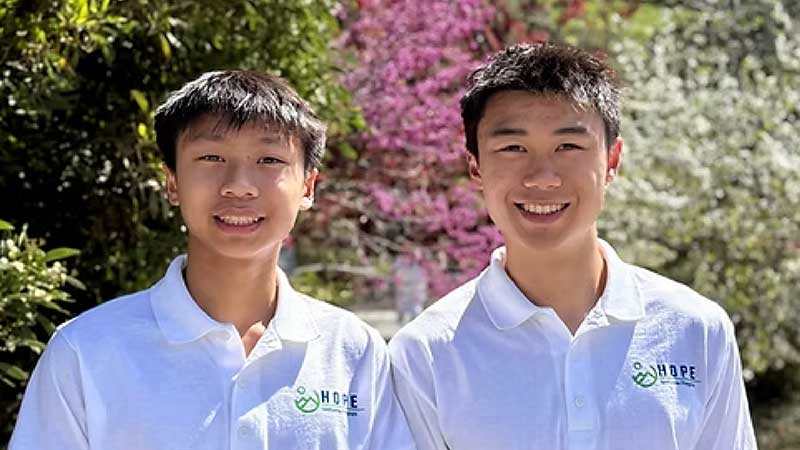
Desmond and Ethan Hua, cofounders of the H.O.P.E. uniform reuse program, are our guests on Sustainability In Your Ear.
The environmental case rests on a point that’s easy to miss: the highest-value thing you can do with a garment is keep it whole and in use. What makes HOPE worth attention is the operations as much as the intent. The brothers engineered the return step directly into the model: families request uniforms through a website available in English, Spanish, and Mandarin Chinese; the uniforms are returned when kids outgrow them; and Ethan and Desmond spot-check and reissue them. That return loop, paired with a deliberate decision to treat families as repeat customers who deserve a dependable service, is what converts a one-time donation into a repeating cycle. The approach is also honest about scale — a garage operation in San Mateo County will not move the national textile-waste numbers on its own. The brothers’ wager is replication; Ethan’s dream is HOPE in another garage, and then another, and the model is plain enough for a motivated student in another district to copy. Whether thousands of small local loops can add up to a circular economy is the open question this conversation puts on the table.
Hello. Good morning, good afternoon, or good evening, wherever you are in this beautiful planet of ours. Welcome to Sustainability in Your Ear. This is the podcast conversation about accelerating the transition to a sustainable, carbon-neutral society, and I’m your host, Mitch Ratcliffe. Thanks for joining the conversation today, and it’s one I particularly enjoy — talking to a young person. Well, actually, two of them, making a positive impact.
Textile waste has become one of the most stubborn problems in the American waste stream. Americans throw away roughly 17 million tons of clothing every year, and a great majority of it ends up buried in landfills, where natural fibers slowly decompose and release methane — a greenhouse gas many times more potent than carbon dioxide. Over a century, as things break down in a landfill, clothing is uniquely wasteful, because so much of what gets discarded is still perfectly usable, and it’s simply been outgrown, or it’s gone out of style, or fallen out of someone’s rotation.
And the environmental cost we pay is paid twice: once when a still-good garment is thrown away, and again when a brand-new one is manufactured to replace it, consuming water, energy, and raw materials in the process. And nowhere is that double cost more visible than with children’s school uniforms. Kids outgrow them on a predictable annual cycle, long before the clothing wears out. And for families on a tight budget, replacing a uniform every year is a recurring expense that arrives whether the household can afford it or not.
The result is a steady stream of good clothing headed for the trash and a parallel stream of families struggling to pay for its replacement — two problems that, looked at the right way, turn out to be each other’s solution. And our guests today saw that connection when they were still in middle school.
Ethan and Desmond Hua are the founders of HOPE — H-O-P-E — the HOPE Uniforms Program. HOPE stands for Help Our Planet Earth, a student-led nonprofit that they launched in 2020 in San Mateo, California. The idea was simple: collect gently used school uniforms that families had outgrown and redistribute them for free to families who need them.
What began in a single elementary school run out of the family garage has grown into an operation serving 10 schools across three districts, and to date, HOPE has kept more than 14,000 uniforms out of landfills, redistributed over 12,000 of them back to families, and served more than 1,400 households, saving those families an estimated $141,000 in clothing costs along the way.
The spark, as Ethan has said, was a single moment: a classmate came to school in shorts on a cold day because he couldn’t afford another pair of pants to last until laundry day. And from that, Ethan and Desmond built something with real operational sophistication — an online request system with a live inventory tracker, and a website in English, Spanish, and Mandarin Chinese to reach every corner of his multilingual community. They’ve since secured a donation of 2,000 brand-new uniforms from Costco, and their work has earned Ethan a 2025 Gloria Barron Prize for Young Heroes, a Samaritan House Young Samaritan Award, and coverage on national television.
So we’re going to talk with Ethan and Desmond about what started it all, why reuse is one of the most underrated tools in the sustainability toolkit, and the environmental case for keeping a garment whole and in circulation rather than recycling or replacing it. We’ll dig into how they built a real logistics operation as teenagers and why they made the program multilingual from the start, as well as how they designed it so that asking for help feels routine rather than uncomfortable. And we’ll look ahead at what’s next for HOPE, and what they’d tell any listener sitting on an idea but waiting for money, permission, or someone else to go first.
So, to learn more, visit hopeuniformsprogram.com. That’s all one word, no space, no dash — hopeuniformsprogram.com. And if you’re a teen making a difference for the planet, check out the Barron Prize at barronprize.org. Again, all one word, no space, no dash — barronprize.org — to learn how to enter your work for recognition by the Gloria Barron Prize program.
Can a teenager with a garage, a good idea, and a little persistence really make a dent in two of our most intractable problems at once — textile waste and the cost of raising a family? Let’s find out, right after this.
Mitch Ratcliffe 4:30
Welcome to the show, Ethan and Desmond. Hey, introduce yourselves so people can recognize the difference.
Ethan Hua 4:42
Hi, I’m Ethan. I just graduated as a senior.
Desmond Hua 4:46
My name is Desmond, and I just finished my freshman year at Aragon High School.
Ethan Hua 4:51
And we’re the co-founders of the HOPE Uniforms Program, HOPE standing for Help Our Planet Earth.
Mitch Ratcliffe 4:56
You guys have done some amazing work already, and I just want to start off by — tell me about how this started. You saw a classmate come to school in shorts, and it was a cold day, and he was wearing them because they couldn’t afford a pair of pants until laundry day. What went through your mind, and how did you come to the conclusion, “I can solve that problem”?
Desmond Hua 5:13
Well, I guess what went through our minds was that when we were in elementary school, when we saw our friends, we realized that we outgrow so much clothes ourselves when we grew up, and we wondered, what do we do with them when we outgrow them? So when we went — how do…
Ethan Hua 5:27
…they go?
Desmond Hua 5:28
Yeah, like to—
Ethan Hua 5:29
Narnia. Like, some place.
Desmond Hua 5:33
Yeah. So when we went home, we talked to our parents, and we asked them, where does our clothes go? And they said we used to just throw them away, don’t usually have a better purpose. So me and my brother wanted to give them a new life, something to reuse those uniforms, and so we actually founded HOPE around five years ago.
Ethan Hua 5:54
One of the biggest travesties that we saw in these uniforms is that they’re very reusable, they’re gently used, there’s nothing wrong with them, and it’s a shame that, with this little time that we spent with the uniform, they’re going thrown away — when they’re able to be perfectly used and given a second life. In fact, we tell that these uniforms not only have a second life in them, but a third life and a fourth life as well, and because of that, it just seemed like a shame to be tossed away after one single use.
Mitch Ratcliffe 6:23
You picked the name “Help Our Planet Earth,” but this program obviously does something else. It helps families just as much as the planet. Which did you really feel like was the right focus at the time you launched?
Desmond Hua 6:34
I think the main focus at first was our community, because we, you know, grew up in the elementary school. But then at the same time our mission was also helping the earth, because this cause not only impacted the community, but also took out over 40 tons of textile waste from the landfills — 40 metric tons of textile waste, or 30, 30 metric tons of textile waste out of the landfills. So we wanted to cover both aspects while we’re doing HOPE.
Ethan Hua 7:06
So yes — when we first addressed this problem, the community, it was based on a problem that we experienced, that we witnessed from peers. However, we did act, because we’re Scouts, and we’ve been part of the Scouting program since kindergarten, so we have a lot of sustainability virtues instilled in us, like Leave No Trace principles, and we thought that there’s something we can give back to the environment.
Mitch Ratcliffe 7:33
Clothing reuse, thrift shopping, is a big deal these days. Is clothing reuse gaining traction? Is it becoming cool to say these clothes are being reused? Or is that still a point of resistance in people who you might give a uniform to?
Ethan Hua 7:48
I think that there’s, in the youth, there’s a little disparity, but I guess between the youth and the more grown-up adults. We live — me and Desmond live — 10 minutes away from San Francisco, and some people don’t know this, but San Francisco is one of the thrifting capitals of the nation, and because of that, it’s very trendy. I thrift. A lot of kids love thrifting as a hobby; it’s something fun to do on the weekends, so there’s nothing wrong with thrifting. However, there are certain stigmas surrounding getting used clothes, and it’s understandable.
However, to combat that, what we do is, once we get our donations from the community, we process them, we check them for any rips, stains, tears, make sure they’re gently used. We want these families to have — we want these uniforms to have — many, many lives, not just one life or two. We’re in for the long, the long sustainable impact, long-term impact. Because of that, we check them, and what we pride ourselves in is ensuring that our families are repeat customers.
So we get all our uniforms from families all across the community — we get them from families who no longer need to use their uniforms — so we receive them through donation bins in each of our partner schools’ offices. We drop them off in these wooden bins that we’ve built, and then once we take these uniforms back, we process them, we do the check, as I said. And on our website, a family would request, okay, I need three articles of size-medium white polo tops. And our website is multilingual, because we serve a very diverse customer base across the community, across the Bay Area.
And on these websites we see, okay, this family at so-and-so school needs this amount of uniforms at this size. Let’s go check our inventory — a spreadsheet of all the uniforms we have in our inventory. Currently, we have roughly 2,000; it’s all sitting in our garage. And then we refill this order, we put it in the bag, we drop it off to the school, and these families would receive them. And, say, it’s probably six months down the line, hopefully: they wear the uniforms, they take good care of them, and they outgrow them, and at this point they’re back at stage one. The family goes, “Hey, at least out of four, I have these uniforms that they’ve outgrown — what do I do with them?” And they send it back to us.
So because of that, we want to make sure these uniforms are kept very nice, they’ve been spot-checked, so the families are happy with their services and they will reuse us in the future, thereby forming an eco-friendly cycle — a long-term sustainability impact.
Mitch Ratcliffe 10:31
So, by getting them involved in the return process too, you’re also reinforcing the value of reuse, and that makes it feel more normal to them to get what would, in earlier generations, be described as hand-me-downs. Does that activation of their concern about the planet play a big part in that messaging?
Ethan Hua 10:49
We try to include that message — we do include that messaging in all our announcements. That’s one of our main selling points. However, it’s hard to beat the word “free” when it comes to advertising to the community, especially when it’s across different cultures or languages — Spanish, Chinese, and English. It’s a lot more direct to say, hey, we have free uniforms that are reused through our program, and it’s a really cool benefit that we prevent them from going to landfills. One of our most proud statistics, actually — Des, you might want to share the statistics. Yeah, okay. So the reason why I’m sharing this with you is that, since inception, we have diverted roughly 14,900 garments from landfills and given back out to the community roughly 12,700 uniforms. Desmond, do you want to share our most proud statistics that sprung up from that?
Desmond Hua 11:45
So I think we’ve roughly also helped around 1,400 families, and we’ve also saved families around $140,000 through uniforms, so they don’t have to keep buying uniforms over and over as they grow up. Also, the methane equivalent to carbon emissions is around 3,000 kilograms, and, as I said, the 30 metric tons is saved from the landfills through HOPE’s Uniform Program, and those are some of our proudest statistics.
Ethan Hua 12:16
When we — so this is our message to the community — when we usually talk about HOPE, we mention the 30 to 30,000 methane-equivalent carbon emissions avoided from landfill diversion. So when uniforms reach landfills, what someone might ask is, why are they so harmful to the atmosphere? The answer to that question is that when they sit in these landfills, over time they decompose — first goes the cotton, then go the poly fibers, the plastics — and throughout the years it takes for a uniform garment to decompose, it releases harmful greenhouse gases, such as methane. Especially methane: methane is 20 times more potent than carbon dioxide to our atmosphere, and throughout these many years it just releases more and more of these gases, and it builds up, adding to the greenhouse effect, warming up our planet.
Mitch Ratcliffe 13:08
Both of you have articulated a number of benefits and a number of the concerns that people should be aware of. You mentioned that “free” is the driving force in a lot of this — the messaging, and the reuse generally. When you think about how your generation is growing up in a world where it’s very difficult to be unaware of the environmental consequences of our life, are we beginning to see a change in their relationship with materials like clothing that you see as promising for a more sustainable economy?
Desmond Hua 13:42
I feel like I would say so, because — I think not just here, but around the world — there’s many ways people are trying to find ways to reuse, recycle, and, right, there’s like new methods, and, I guess, new technology now that we’re able to access, to find ways to reduce carbon emissions and make things more eco-friendly.
Ethan Hua 14:07
Just to specify your question — are you asking, is the next generation more willing to reuse?
Mitch Ratcliffe 14:13
More willing to reuse, but also, to what Desmond was just saying — are we also seeing a generation grow up that recognizes they have tools to do things with material that we weren’t able to do before? When I was growing up, there was a garbage can and there was nothing else. Now there’s a recycling bin too. How do you imagine the world will be configured to support what your generation recognizes it needs to do with regard to reuse, with creating a circular economy?
Ethan Hua 14:42
I think, of course, we’re a lot more well-equipped to deal with the climate crisis, and, more importantly, a lot of people are a lot more aware. For example, we know a lot about the textile world because we run a uniform organization. But one thing that we’ve noticed has taken on in the industry is that a lot more fabrics have been developed to become more eco-friendly, such as hemp. Hemp is a little coarse of a fabric, so… very comfortable, but it’s all plant-based. Well, it’s a lot more plant-based than just microfibers and plastics, and it’s very durable as well, and it seems like that could be a possible trend, and something that the textile industry is going towards in the future. So, trends like that — just seeing things like that — it’s very encouraging to see that there are good people concerned about our future and thinking of keeping that in mind.
Mitch Ratcliffe 15:48
So, you’ve run this out of your family’s garage, as you said, but you’ve also built an inventory management system. Tell us about how you learned to run an operation like this, because that’s another key to unlocking the potential your generation has to make a really massive difference in the way the economy runs.
Desmond Hua 16:06
I think, in the beginning, in order to talk to families and reach out to families, we actually had to do a really slow system where we just had to email back and forth. We realized, you know, if we want the operation to grow or to improve, it would require a much more mechanical process. So I think we started to use a spreadsheet, taking everything that came in, managing how much of each uniform we have, roughly, and what we’re giving out. So, like, we have a spreadsheet of our entire inventory, and even when we do orders to give out to families, we keep track of everything we give out. So I think, in order for us to have a mechanical process and to know what we have and how much we can help the families, and remove gas emissions — that’s how the spreadsheet would really help, because it just keeps everything in track.
Mitch Ratcliffe 17:11
So, how do you deliver the uniform once you have that need identified? Is it — you hand it to them, or do they pick it up?
Desmond Hua 17:21
So we actually drop it off at their school’s front office, and they can just pick it up at the school.
Ethan Hua 17:29
We send them an announcement to come pick it up, as well as the school does, to their emails.
Mitch Ratcliffe 17:33
So, is it getting easier with the new tools — the vibe-coding tools and things like that — for you to start to solve some of these problems? Have you explored them?
Ethan Hua 17:42
Oh, yeah. We have automation. We have, like, automated emails to the families that, yes, your order is in queue, it’s coming up, we’re working on it, and we have ways to let them know that, yeah, your order is ready for pickup. And social media is a very great tool for that — we use Instagram. Follow us on our HOPE Uniforms Program Instagram. It’s a very good way to let families know en masse. And one thing that I’d like to add to Desmond’s point: in our journey of collecting uniform orders from families, originally in 2020 when we started this program, we were doing it by email — literally one-on-one email chains, so we’re managing 50 email chains at once, which was very logistically challenging. On top of that, we’re receiving emails not even in English — we’re in Chinese, in Vietnamese, in Spanish — so, using Google Translate, it was just a lot of steps to take to get to the final product of getting the uniforms to the family.
Desmond Hua 18:47
Yeah.
Ethan Hua 18:47
And because of that, we set up this multilingual website to help us address the multilingual, cultural diversity in our community, which was very helpful.
Mitch Ratcliffe 18:57
I guess the question I want to get to before we take a quick commercial break is: do you think the satisfaction that both of you are expressing about the impact you’re having — as well as the satisfaction people have in participating in the program — is the catalyst for jump-starting thousands of local programs to solve thousands of different problems across the country? Like keeping uniforms in circulation, but potentially collecting a lot of other things for reuse?
Ethan Hua 19:23
Is it worth it? Is that your question?
Mitch Ratcliffe 19:24
Is this the kind of thing that can inspire people to solve local problems? Do you have a template here for a solution to jump-starting the circular economy in the many small places it needs to happen?
Ethan Hua 19:38
I think it matters — or, I think true sustainability is very hard to reach. When I hear the word “sustainability” nowadays, I think of words like gourmet and adventure. What do I mean by that? So, if you look at the Merriam-Webster definition of adventure, you see it connotes risk-taking and danger, yet when you go on adventure travel, it’s rarely ever dangerous. And for gourmet — if you eat a gourmet burger at a restaurant, sometimes it’s not even that tasty, yet it’s still labeled as gourmet. Same thing with sustainability. When you hear the word “sustainability” — sustainability buildings, for example — yes, they might be carbon-neutral, yet the process to get these net-carbon-zero buildings, it’s not sustainable, like all the building practices; it takes a lot of energy and resources to get that building to energy perfection, as you could say.
And likewise, in the real world, achieving true sustainability is very, very hard, and clothing is one of these things that we noticed could have a cyclical life cycle, and being able to be reused for these many, many life cycles. Again, we’re long-term impact; it’s something that you could reuse many times, not just one or two. So, yes, I think that we are jump-starting and inspiring a lot of grassroots efforts in achieving these reuse programs. Not everything can be reused, though. However, the idea, and getting it into people’s minds, is, I think, the biggest, most important part.
Mitch Ratcliffe 21:16
And then we’ll start to solve problems. So, this is a great conversation. I want to take a quick commercial break. Folks, we’re going to be right back to continue the conversation.
Mitch Ratcliffe 21:28
Welcome back to Sustainability in Your Ear. Let’s continue the discussion with Ethan and Desmond Hua, who created Help Our Planet Earth, or HOPE — a clothing reuse program that helps teens in need while reducing the volume of textile waste headed for landfill. And Ethan was a 2025 winner of the Gloria Barron Prize for Young Heroes. Ethan, what has that recognition — as well as the Samaritan House Young Samaritan Award that you won — done for the program? Are you getting more attention now?
Ethan Hua 21:55
Yes, we are getting more attention. The biggest thing this exposure has helped us with is that it gives us credibility to talk to new schools, and then it’s just really helpful, because when we first started this program, we started with one school — me and Desmond’s elementary school — and we started by announcing it just to the couple of families at our school, saying that we have this program available, it’d be pretty cool for the environment and for other families, if you could help out. And now, instead, with this exposure to the Gloria Barron Prize and Samaritan House, and our interviews on ABC, NBC — it just helps us a lot, because schools were like, okay, these guys are legit, they’re really in the business of helping the community, they’ll do their job, and they’ve been verified by all these organizations. And because of that, it’s all the easier to spread and make a bigger impact on the community.
Mitch Ratcliffe 22:55
So, how big can this get before you outgrow your garage, and your parents say, “Look, that’s just too many uniforms”?
Ethan Hua 23:02
Well, I would say — I’m not exactly sure about the limit, that’s a good question. Yeah, it’s certainly going to reach a limit, and I think the beauty about HOPE is that anyone can do it. Yes, me and Desmond, we do have backgrounds in scouting, and we have strong sustainability virtues, however, that does not make us that unique, and students like us could take on the program. And in the long term, what I think would be great is if we could spread HOPE to other districts — like, other districts beyond what we can manage — and we’ll have HOPE in another garage.
Desmond Hua 23:47
Yeah.
Ethan Hua 23:48
And then maybe another one. And I think that is what makes HOPE — I think that is the biggest impact that HOPE could have: it’s not, of course, only the environmental impact of diverting uniforms from landfills and saving them from decomposing into the atmosphere, but it’s also putting the idea in other kids’ minds that they could do something as well. And I see a lot of kids in the Bay Area having a lot of reuse programs, like saving food waste, or other service projects in parks. I think that’s very, very powerful — just the fact that you’re doing it, and you’re telling other people about it. It puts the idea in kids’ minds, saying, I could do something like that as well.
Mitch Ratcliffe 24:29
Well, you’re also creating new communities by connecting different lingual groups — you do English, Spanish, Mandarin on the site right now. As you think about the various communities you serve and the reuse challenges that are emerging all around you — the Bay Area being a hotspot for a variety of new trends in the world — how would you use a multilingual website and other services to help people understand what they could do together to solve some of our environmental problems?
Ethan Hua 25:00
So what we like to do is fully contextualize the problem. It’s very important for families to understand that this is an issue, in order for them to fully appreciate their usage of our services. Going back to our number-one most serious statistic — the 30 metric tons of carbon emissions prevented through uniform reuse — we tell families this. We need to fully explain what goes behind that 30 metric tons. So that 30 metric tons represents the 12,700 uniforms that we’ve given back to the community; this represents all the carbon that would have gone into making 12,700 uniforms, but was saved because they used one that was pre-existing. So this carbon waste includes — when we try to calculate a rough estimate — all the carbon used through all the land that it takes to grow the cotton for these uniforms, all the water that was used to grow the cotton, all the pesticides, all the chemical dyes used to dye the uniforms, the energy that goes into making it in the factory, and all the car emissions that are emitted through that, the transportation costs to the store. It’s a long laundry list of all the things that go into making a uniform. Although it’s a lot of carbon going into a uniform, just a rough estimate, it adds up — it does make a really sizable difference when you add up all the 12,000 uniforms. And it’s important to tell the families that, because if they don’t understand what it means to reuse the uniform, then they won’t understand the true impact of their actions, and I want them to appreciate it.
Mitch Ratcliffe 26:48
Well, so that’s really what I’m getting at. Are there other areas where you can see being able to tell that story in a variety of languages, rather than just in English, which shuts out a lot of people, that we could start to activate within many communities a lot of different circular cycles? Not just uniforms, but maybe school supplies that go unused, and so forth. Have you thought about what else HOPE could eventually manage within the circular economy?
Desmond Hua 27:16
Definitely, I think so. Actually, recently I’ve been trying to expand to some schools in San Jose. They actually do especially have a need for uniforms, and seeing that, I think it’s definitely a school that would appreciate getting free uniforms. And seeing that, I think if we showed them the true meaning of what we’re trying to aim for — which is helping, or helping Planet Earth — I think the families would be more willing to, first of all, help with the eco cycle, which is donating back to HOPE, where we can, and then we can give back to them. So it’s like a process. So, but yes, there’s definitely schools around here that would appreciate HOPE.
Mitch Ratcliffe 28:06
Now, Ethan, you’ve said that meaningful change doesn’t take a lot of resources or institutional backing — just an idea and the willingness to act. For someone who’s listening, who has an idea but assumes that they need a lot of money or some permission to get started, what would you tell them?
Ethan Hua 28:23
I remember when me and Desmond started, we were very, very scared talking to adults in that moment, but deep down, we knew what we were doing was good. It was good for the community. It was going to be a benefit for the community and the environment. We didn’t have any doubt about that. Our biggest fear was that, right now, we’re just going to say the wrong thing and embarrass ourselves, but deep down we knew that it was an ultimate good — there’s no way that it couldn’t be an ultimate good for the community. And I think most people do understand: if they’re trying to launch an initiative, and it truly is a net benefit for the community, I think people deep down know what’s good, and I would say, keep pushing on that feeling.
Mitch Ratcliffe 29:21
If a student wanted to start something like HOPE in their own district, where would you point them, so they could take a first step? What did you learn that allowed you to confidently pursue that vision you just described?
Ethan Hua 29:35
It’s like — you want to foster your idea in an environment where you know it will succeed. At first, you always want to start strong, you always want to start in a community where you understand your community 100%. So we started ours in our elementary school. We knew the principal, we spoke Chinese — it was a Chinese-immersion school — so we knew that we could address this community. And I want everyone to address their own community at first. Help your community first, make sure it survives — sorry, let me say, make sure it survives, make sure it grows — until you can expand to other areas that you know can be helped.
Mitch Ratcliffe 30:21
Knowing a community is something that a lot of brands wish they could do, and you managed to get Costco to give you 2,000 new uniforms. How did that relationship emerge, and is that potentially a pointer to the new relationships you could build in order to take HOPE to the next level?
Desmond Hua 30:40
Well, what we did with Costco is, both of us actually reached out to the CEO, Ron Vachris, and we asked him if, in our local Costco area, they had any extra uniforms they could possibly donate to us.
Mitch Ratcliffe 30:57
Wait — so you sent an email to the CEO of Costco?
Desmond Hua 31:00
So what we did is, we actually reached out to Ron Vachris, the CEO of Costco, and we told him that we had such a low supply of uniforms at that time, and for—
Ethan Hua 31:11
—the back-to-school season. Yeah, our most popular demand season is back-to-school.
Desmond Hua 31:16
Yeah, so we reached out to him asking if he had any extra uniforms he could possibly donate to HOPE’s Uniform Program, and he actually responded saying yes, he does have surplus inventory. And so—
Mitch Ratcliffe 31:31
—I think that’s a nervy move, but boy, congratulations.
Desmond Hua 31:35
Thank you. Yeah, both of us. Yeah.
Mitch Ratcliffe 31:37
That says a lot about the potential for an initiative like yours to make a difference in the world.
Desmond Hua 31:44
Yes, that actually does show — when you try to reach out, and when you have a good cause, whether it’s in the community or in the world, I think reaching out to people who could help you is definitely a thing that — it’s like an opportunity for you to expand and to improve the initiative, or your passion.
Mitch Ratcliffe 32:05
Ethan, you’ve just graduated from high school. What’s next for you?
Ethan Hua 32:10
So, in the fall, I’ll be attending Wharton at UPenn. And I think, if there’s one thing I’d like people to know about me, it’s that I enjoy addressing unmet needs in the community with self-sustaining solutions. With HOPE, I’ve done that; and in my work at the San Mateo–Foster City School District, I built a repository of Eagle Scout projects in order to create an outlet for schools to get their service projects out to the community, and to help other scouts like us find their Eagle Scout projects. By the way, an Eagle Scout project is the final step a scout can take in their scouting journey to achieve the rank of Eagle, which is the highest rank.
Mitch Ratcliffe 32:55
Desmond, what are your plans? I mean, you’ve got a couple more years of high school, but what are you thinking about doing?
Desmond Hua 33:00
Well, first of all, for HOPE, I think my mission is to keep expanding HOPE into further areas — even though I may not be as familiar with the communities, I want to reach out to as many people and families as I’m able to help, beyond the San Mateo–Foster City School District. I guess outside of HOPE, I would also love to continue Boy Scouts as the senior patrol leader this year. The senior patrol leader is basically — it’s like a CEO; not CEO, club president — yeah, the highest rank.
Ethan Hua
I’m very proud of Desmond.
Desmond Hua
Yeah, yeah. So I think — he’s been a senior patrol leader, and I’m going to be one this year, so being in that position, leading younger scouts and showing them the right path, I think that’s going to be a really fun experience. That’s what I’m looking forward to this year, too.
Mitch Ratcliffe 33:52
So, Ethan, you’re going to business school, and based on what both of you are saying, leadership is really that instigator of the change that you want to see in the world. Is business the primary lever that you see as our opportunity for change?
Ethan Hua 34:07
Yes. In fact, I think that business is going to be the discipline that helps push the world to be more sustainable. If you think about it, all too often the careers that attack the climate crisis are very siloed — for example, politicians in their chambers, engineers in their labs, or lawmakers in their courts — but all too often these disciplines are not very interconnected and working together in unity to address these issues. And I think that business is something that — its profit is what connects all these efforts together. It’s what pushes people to attempt to create a greener world: financial incentives. Okay, let me give you an example: the solar panel industry. Families would be less incentivized to purchase a solar panel for their home if they didn’t understand that it would save them money in the long term. Because they understand that solar panels will save them money on their electricity bills, they’re like, okay, not only does it save me money, but it’s also a lot greener for the planet. So because people have that — it’s an example of the power of financial incentives to motivate people to join sustainable causes. I think that’s why that cause and effect is what interests me in pursuing business.
Mitch Ratcliffe 35:31
Do you see that as the pursuit of vast wealth, or distributed prosperity?
Ethan Hua 35:38
Distributed prosperity. I think that financial incentives are what’s going to push sustainable efforts, and that’s kind of how HOPE is founded upon, too — free uniforms for families who then don’t have to go out and spend roughly $100 a year per child, with the added benefit that it saves landfill waste.
Mitch Ratcliffe 36:02
So obviously there’s a lot of opportunity in front of you, and for HOPE. What are you thinking about growing into, and where can people find out how to donate, or to request uniforms, or maybe just make a contribution to help make this bigger?
Desmond Hua 36:18
I think just helping out HOPE in general. First of all, donating to HOPE is a really big thing. Contacting HOPE — of course, we have a multilingual website, so visiting that, we have all the info on where to donate, where to request. But I think also what we’re trying to aim for is expanding into bigger schools, where we reach out with HOPE, with our mission, to help out families that, like you said, need uniforms, so they don’t have to spend that $100 to $200 every single year.
Mitch Ratcliffe 36:57
So, Ethan, how can people track what you all are doing and get involved?
Ethan Hua 37:01
Follow our Instagram, @hopeuniformsprogram. Stay on our website; we update our statistics there. You can find out a lot more about how we started this, where we are, and why we do what we do, on our website. We provide it so that families across the community, no matter what language they speak, can understand us — understand our story, understand our passion, our mission.
Mitch Ratcliffe 37:27
Congratulations, gentlemen, to both of you, for an immense good that you have brought into the world. And I wish you both the greatest success in the future. And Ethan, enjoy Wharton.
Ethan Hua 37:38
Thank you, Mitch.
Mitch Ratcliffe 37:46
Welcome back to Sustainability in Your Ear. You’ve been listening to my conversation with Ethan and Desmond Hua. They are brothers who founded the HOPE Uniforms Program. HOPE is short for Help Our Planet Earth, and that’s a student-led nonprofit that collects gently used school uniforms and redistributes them free to families who need them. You can learn more about their work at hopeuniformsprogram.com. That’s all one word, no space, no dash — hopeuniformsprogram.com.
And if you know a teenager doing this kind of work, the Gloria Barron Prize for Young Heroes is something you should point out to them. Ethan was recognized by the program last year, and you can learn more about the Gloria Barron Prize for Young Heroes at barronprize.org. Again, all one word, no space, no dash — barronprize.org, and Barron has two R’s.
The circular economy won’t be built only in boardrooms and at pilot plants; it will also grow from the grassroots, in garages like the one we’ve heard about today. That happens when people recognize human needs and take steps to address them. Ethan and Desmond started HOPE in 2020 while they were still in middle school, after a classmate showed up in shorts on a cold day. That’s a failure of material flows, in the same sense as when a species within an ecosystem struggles because something further up or down the food chain is disrupted.
Ethan kept returning to the idea that the highest-value thing you can do with a uniform is keep it whole and keep it in use, flowing through the economy. Keep the garment in circulation, and you can avoid a variety of environmental impacts, including the water used to grow the cotton, the pesticides, the oil drilled to create the synthetic textiles, the dyes, the factory energy, and the freight emissions produced simply by transporting a uniform to the store. We’ve trained a generation to feel good about the recycling bin, but reuse sits a rung above recycling, and textiles are only the clearest case for it. Americans throw away something like 17 million tons of clothing every year, most of it still wearable.
HOPE’s answer to that isn’t a new material or a chemical process; it’s a reverse-logistics system — a community solution based on a phone number and a website — that keeps uniforms in use. And you’ll note that HOPE is building a closed loop, not a one-way consumption model. That’s an important shift. Families request uniforms through the website; the uniforms come back when kids outgrow them; and the brothers spot-check and then reissue them for another use.
Ethan and Desmond built in the return mechanism, and that’s important. It’s a blocker that many big players are running into. Think back a couple of weeks ago to my conversation with Amy Fernandez and Zach Lauer of Trex, the synthetic decking company. They struggle to recapture material because contractors don’t want to separate old Trex decking from the sprues and connectors used to make the deck in the first place. HOPE started by making returns routine and building a solution for getting the material back, and then communicating about the services in three languages, so that no family is shut out. They also refuse to treat what they’re doing as charity, focusing on raising the service experience for families, which is the basis for long-term engagement and long-term behavior change.
Ethan said his goal is distributed prosperity, and that echoes the idea shared by many of our guests, that sustainability can be a profitability lever rather than a cost center, even while creating social benefits. Ethan’s pitch is that HOPE is replicable — a model that other communities can use. As he said, anyone can do it, and the dream is HOPE in another garage, and then another. And I think Desmond’s comment that the biggest impact isn’t the uniforms diverted, it’s putting the idea in another kid’s head that they could do this too — that’s an important point. We can spread this virally. We’re building the systems for the next generation, not the last.
When I was growing up, there was a garbage can, and nothing else — no recycling bin, no curbside pickup. The recycling system that we know today, the one that we take for granted, didn’t exist even within living memory. It’s going to be built again by another generation, piece by piece, by people who start small and local and don’t wait for permission to do so. And, of course, we have to acknowledge this: the scale of challenges and adverse environmental impacts faced by this generation is daunting. But every system we now treat as permanent was once somebody’s improbable idea, run out of a garage, a church, a basement, or a classroom.
What Ethan and Desmond have proven at the scale of San Mateo County is that circular economies are waiting for people willing to do the unglamorous work of moving material back to where it’s needed. Ethan heads off to Wharton this fall with a thesis already tested in the field: the belief that business is a lever for prosperity. And that’s the important point. We’ll be watching where they take HOPE, and who copies them.
And if this conversation gave you something to think about, please share it with a young person in your life who’s sitting on a great idea. You folks are the amplifiers to spread more ideas and create less waste, and I hope you’ll take a moment to share one of the more than 550 episodes in our archive to help others get up to speed on recycling, circularity, and sustainable business. Please point your friends, family, coworkers, and the people you meet on the street to Sustainability in Your Ear on Apple Podcasts, Spotify, iHeartRadio, Audible, or whatever purveyor of podcast goodness you prefer, and if you take a moment to leave a rating or review, that will go a long way toward helping others find the show.
Thanks for your support. I’m Mitch Ratcliffe. This is Sustainability in Your Ear, and we will be back with another innovator interview soon. In the meantime, folks, take care of yourself, take care of one another, and, of course, let’s all take care of this beautiful planet of ours. Have a green day.

 Login
Login