Normal view

  • ✇Eos
  • A Swarm of Earthquakes in South Africa’s Karoo Basin Poses Questions for Oil and Gas Development Ray Mwareya
    Roughly the size of Texas, the Karoo Basin of central western South Africa is brutally dry, sparsely populated, and known in part for its potentially “massive” hydrocarbon deposits. South Africa, which consumes more energy than any other country in sub-Saharan Africa, has shown a growing interest in commercial fracking for shale gas and oil across the Karoo hinterland, with the country moving in late 2025 to lift a 13-year ban on shale gas exploration in the area. However, a recent study
     

A Swarm of Earthquakes in South Africa’s Karoo Basin Poses Questions for Oil and Gas Development

20 May 2026 at 12:26
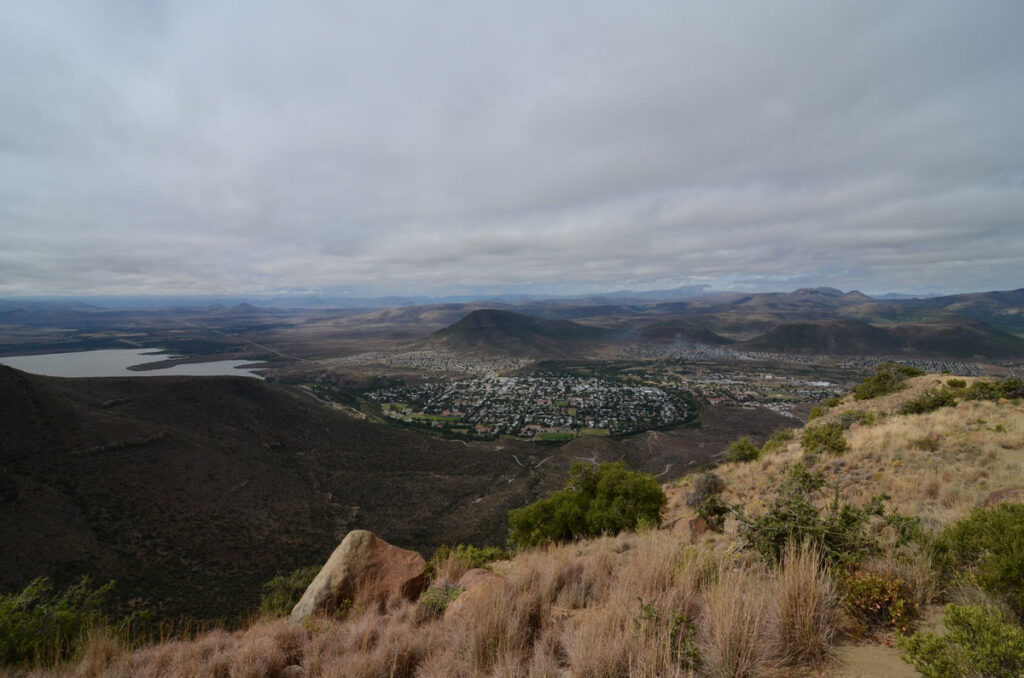
A photo taken from on a hill shows a populated valley surrounded by brown mountains on a cloudy day.

Roughly the size of Texas, the Karoo Basin of central western South Africa is brutally dry, sparsely populated, and known in part for its potentially “massive” hydrocarbon deposits.

South Africa, which consumes more energy than any other country in sub-Saharan Africa, has shown a growing interest in commercial fracking for shale gas and oil across the Karoo hinterland, with the country moving in late 2025 to lift a 13-year ban on shale gas exploration in the area.

However, a recent study from the University of Cape Town, published in Seismological Research Letters, cautioned that the Karoo might not be as seismologically calm as it appears, meaning fracking efforts could have the potential to induce earthquakes in the region.

A Swarm of Earthquakes

The researchers observed 66 earthquakes in this cluster between 2007 and 2022, ranging from 0.7 to 4.8 in magnitude.

The researchers investigated what they call a sudden swarm of earthquakes that occurred in the Leeu Gamka cluster, a region of the Karoo that was previously considered seismically stable. They observed 66 earthquakes in this cluster between 2007 and 2022, ranging from 0.7 to 4.8 in magnitude.

“The individual earthquakes here are very small,” said Alastair Sloan, a tectonics and structural geologist at the University of Cape Town.

Using ambient noise tomography, previous geophysical surveys, and information about the locations of past earthquakes, the researchers identified a critically stressed fault underlying the region. The fault appears to extend for at least 30 kilometers roughly west-northwest to east-northeast.

Looking at South Africa more generally, there are other places where there have been “fairly large” earthquakes with a similar orientation, Sloan said. He cited a series of large earthquakes in the early 20th century in a place called Koffiefontein, north of the study area, and the disastrous 1969 Tulbagh earthquake, west of the team’s study area.

Both of those earthquakes occurred in regions that are geologically similar to the Karoo, though they’re outside of the area being considered for shale gas exploration, Sloan said.

Fracking Risks?

In other parts of the globe, such as Oklahoma in the United States, processes related to oil and gas extraction have led to “induced earthquakes.” Most of these earthquakes have been triggered by wastewater disposal associated with oil production, not by fracking directly.

Researchers are unsure if industrial fluid injection in the Karoo, as is applied in shale gas fracking processes, could trigger significant seismic action in the region’s existing faults.

“Some locations which undergo shale gas development don’t see very much seismicity, and there is a catalog of things which need to be present for [seismicity] to be something that you would particularly worry about,” Sloan said.

For instance, if faults are only within the crystalline basement and therefore separated from the sedimentary layers where the fracking occurs, then it’s not likely they’ll be reactivated, because there’s no way for the fracking fluid to get down to the fault zone itself. Another factor, Sloan added, is that for significant earthquakes to occur, large faults that are already critically stressed need to be present in the region undergoing fracking.

The new study showed that both of these conditions may be met in the Karoo: Microseismicity does extend to the depths at which the carbonaceous shale is present. And this microseismicity is occurring on a reasonably extensive structure with a similar orientation to larger earthquakes that have already occurred in the region.

However, Sloan stressed, this isn’t a cause for immediate panic.

“I don’t want to be too alarmist; the size of the structure revealed by the microseismicity is not huge, and so we do not have evidence to expect an earthquake much larger than the damaging historical earthquakes that we have already seen in the wider region,” he said. “Globally, large earthquakes triggered by fracking (rather than associated deep wastewater exposure) are very rare, but the study suggests the necessary preconditions are present. And so the possibility needs to be considered and monitored carefully.”

Not Unique

Raymond Durrheim, a geoscientist and the South African Research Chair in Exploration, Earthquake and Mining Seismology at the University of the Witwatersrand, and who also examined the Ph.D. thesis on which the new study is based, said no area is perfectly seismically quiet.

“We know the way seismicity works in this whole area of southern Africa is that swarms occur,” he said. “They’ll last for years or even decades, and then they’ll die away. This is not a unique occurrence.”

This study was “useful,” though, Durrheim added, especially with the possibility of shale gas development in the Karoo. “It’s very important that we understand this because we know that when you inject fluid under high pressure, there’s always a chance you could trigger an earthquake,” he said, noting examples of fluid injection triggering earthquakes in places such as Canada. “It’s always a risk.”

To mitigate risks, Sloan suggested it would be useful to have a much denser network of seismometers within this region of South Africa.

—Ray Mwareya (@RMwareya), Science Writer
Citation: Mwareya, R. (2026), A swarm of earthquakes in South Africa’s Karoo Basin poses questions for oil and gas development, Eos, 107, https://doi.org/10.1029/2026EO260159. Published on 20 May 2026.
Text © 2026. The authors. CC BY-NC-ND 3.0
Except where otherwise noted, images are subject to copyright. Any reuse without express permission from the copyright owner is prohibited.
  • ✇Eos
  • Eastern Africa Is Splitting Apart, but Not Where We Expected Kimberly M. S. Cartier
    For roughly 45 million years, the eastern section of the African continental plate has been slowly pulling apart. Like a giant zipper extending from the Red Sea to Mozambique, the East African Rift System will likely be home to new oceanic crust that will well up from the widening split in Earth’s surface. While most of the rifts in that system are still zipped shut, the Afar region in northern Ethiopia has already partially unzipped and may be starting to create a future ocean basin. Most m
     

Eastern Africa Is Splitting Apart, but Not Where We Expected

12 May 2026 at 13:08
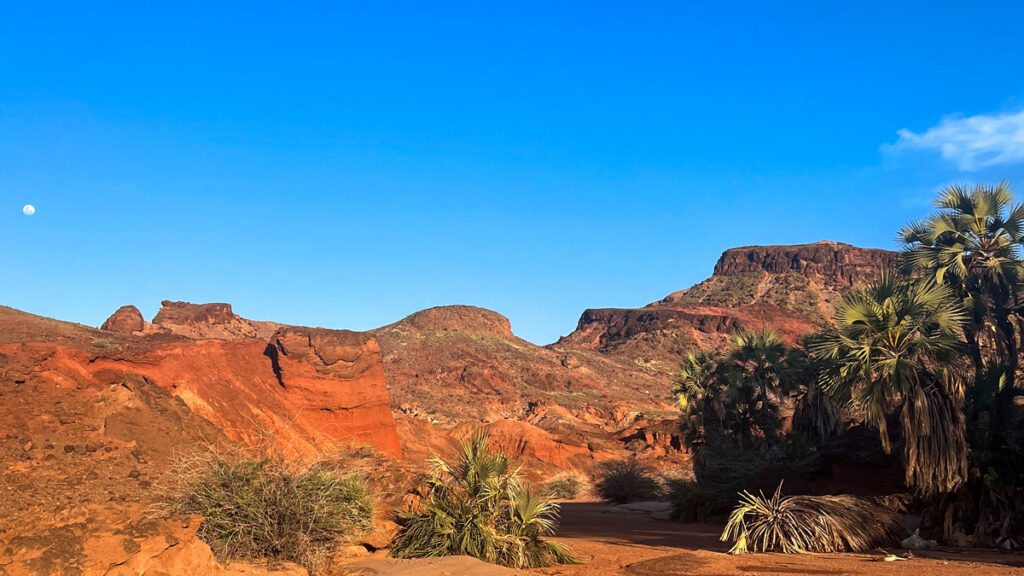
A mountainous desert on a clear day. Red-orange dirt and rocks dominate the near ground, along with palms and desert plants, with a clear blue sky and gibbous Moon above.

For roughly 45 million years, the eastern section of the African continental plate has been slowly pulling apart. Like a giant zipper extending from the Red Sea to Mozambique, the East African Rift System will likely be home to new oceanic crust that will well up from the widening split in Earth’s surface. While most of the rifts in that system are still zipped shut, the Afar region in northern Ethiopia has already partially unzipped and may be starting to create a future ocean basin.

Most models of this rift system suggest that it should continue to unzip sequentially from north to south. However, new research suggests that a region in the middle of the zipper is on the verge of splitting open.

High-resolution seismic reflection data show that the crust near Kenya’s Lake Turkana is only 13 kilometers thick. This suggests that the region has entered the second stage of rifting, called necking, and is one step closer to breaking apart. It is the only rift zone on Earth currently undergoing this short-lived tectonic process.

A panorama image showcases the hills, mountains, and valleys in the Turkana Rift Zone. Most of the landscape is a tan brown, and a red-orange streak of sediment cuts through the center of the image.
The Lothagam site in the Turkana Rift Zone contains tilted sediments from the late Miocene (about 7 million years ago), just before the necking phase of rifting commenced. Credit: Christian Rowan

Breaking Up Is Hard to Do

Just like mid-ocean ridges on the seafloor, sections of Earth’s crust on land also stretch apart as tectonic plates separate. This process, called rifting, takes place in three stages. First, the crust stretches, creating tension. Then it rapidly thins like pulled taffy—this is the necking stage. Finally, magma wells up from the lithospheric mantle, which creates new seafloor and breaks the continental plate apart.

“This is one of the unique places on Earth where you can see a continental rift.”

Not every rift makes it that far. Some remain stuck in the stretching phase with crust more than 20 kilometers thick. But northern sections of the East African Rift System (EARS), specifically the Afar Rift and the Red Sea, are already undergoing the final stage, oceanization.

“This is one of the unique places on Earth where you can see a continental rift,” said Anne Bécel, a geophysicist at Lamont-Doherty Earth Observatory of Columbia University in Palisades, N.Y., and coauthor of new research published in Nature Communications in April. “The East African Rift System has been studied for a very long time by geologists to really learn about our planet and how continents break apart, and then transpose that to mid-ocean ridges where oceanic plates spread apart.”

The team suspected that the Turkana Rift Zone, located at a critical triple junction in northern Kenya, was behaving differently from other areas of the rift system. It is home to an unusually large and continuous hominin fossil record dating back about 4 million years. Past research has also shown that the bottom of the crust, called the Moho, is unusually shallow in the Turkana Basin, just 20 kilometers deep compared with the average depth of 39 kilometers farther away from the rift.

During several field expeditions to Lake Turkana in partnership with local industries, the team mapped the top of the continental crust using borehole measurements and seismic reflection—sending seismic waves into the ground and measuring how the waves bounce back, like sonar. They combined those measurements with past research into Moho depths to calculate the crustal thickness near Lake Turkana.

That map showed that far away from the rift, the crust is more than 35 kilometers thick, but in the Turkana Rift Zone it is a mere 13 kilometers thick, below the threshold for necking.

“If you look at the modern day topography, the whole East African Rift is in this really low, broad land between two big plateaus, one to the north in Ethiopia and one towards the south,” said lead researcher Christian Rowan, a geologist and doctoral candidate at Columbia University. “It’s this very strange topographic feature, and part of that low-lying topography is actually how thin the crust is there.”

“The oldest rocks that record the initiation of the East Africa Rift System are also in the Turkana Rift,” said coauthor Folarin Kolawole, a Columbia University geologist. Geochemical analysis of those rocks suggests that necking in the Turkana Rift Zone began about 4 million years ago.

A scientist in desert gear points to a reddish patch of rock in a brown rock face.
Christian Rowan measures a fault in the Turkana Rift. Credit: Christian Rowan

About to Break?

“Any time you have a place on the planet that is rare in the modern but seen in the past, it is compelling,” said Erik Klemetti Gonzalez, a volcanologist at Denison University in Granville, Ohio, who was not involved with this research. “The data does show that the Turkana Rift is the home of anomalously thin continental crust, so if you are looking for a location that meets criteria for necking, it seems to be the case.”

The team suspects that Turkana might have been primed to split apart more easily because another rifting event took place there a mere 17 million years before the present rift began. The Turkana Basin inherited a weaker section of crust that didn’t have time to fully heal in the (geologically) short time between rifting events. There was also an extended period of magmatic activity throughout much of the past 45 million years.

“Magmatism is well known to be a significant weakening factor in rifting,” Rowan said. “I think the two compounding effects of this inheritance and then magnetism is why the Turkana rift is so much more mature than other segments.”

“I would hope that more collaboration with African geoscientists could create the ability to collect data from places that have been more inaccessible over the past half century.”

“There are many ‘failed rifts’ in the geologic record, so the question of whether the EARS is actually leading to a continental break up, albeit a small one, is still very much up in the air,” Klemetti Gonzalez said. These new results tip the scales toward breakup, but he noted that more of the rift system still needs to be mapped to really understand the fate of this region.

“I would hope that more collaboration with African geoscientists could create the ability to collect data from places that have been more inaccessible over the past half century,” he added.

Rowan and his team are working toward that end by continuing to map crustal thicknesses in other nearby rift zones.

“This was the only known rift that was undergoing necking along the entire East African Rift System, or in the world,” said Kolawole. “But based on ongoing work, there is evidence that there are other segments that are at the onset of necking in the East African Rift System.”

—Kimberly M. S. Cartier (@astrokimcartier.bsky.social), Staff Writer

Citation: Cartier, K. M. S. (2026), Eastern Africa is splitting apart, but not where we expected, Eos, 107, https://doi.org/10.1029/2026EO260148. Published on 12 May 2026.
Text © 2026. AGU. CC BY-NC-ND 3.0
Except where otherwise noted, images are subject to copyright. Any reuse without express permission from the copyright owner is prohibited.
  • ✇Eos
  • Seismic Attenuation Techniques Reveal What Lies Beneath Taiwan Nathaniel Scharping
    Source: Geophysical Research Letters As seismic waves travel through Earth, they gradually lose energy, a process called attenuation. That energy loss doesn’t happen uniformly—some features in the crust sap far more energy from seismic waves than others. Researchers can map underground features by watching where seismic waves lose more or less energy. The Southern Array for the Lithosphere and Uplift of Taiwan Experiment (SALUTE) is doing just that, providing information that could lead to i
     

Seismic Attenuation Techniques Reveal What Lies Beneath Taiwan

11 May 2026 at 13:16
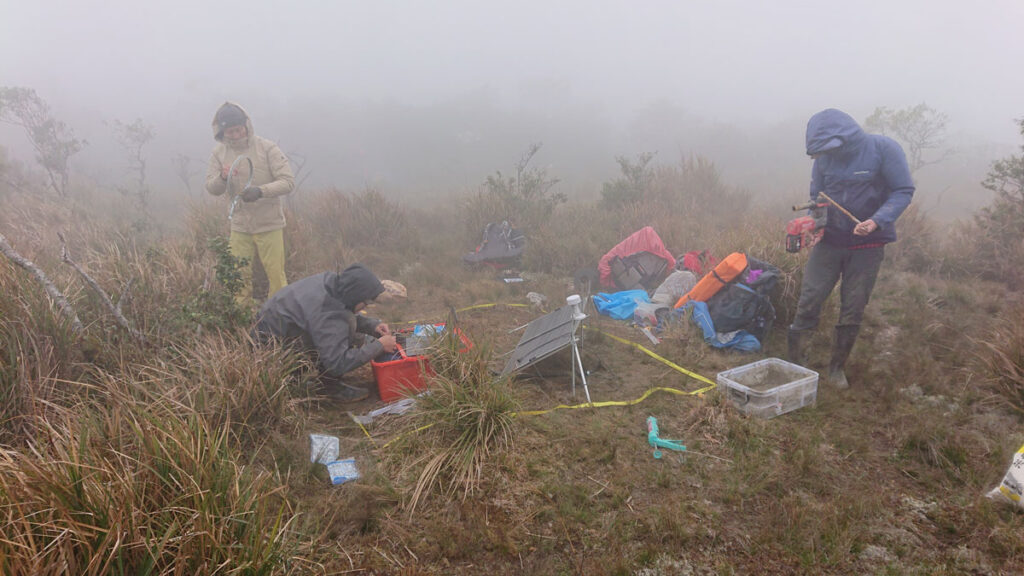
Three researchers huddle around camping equipment and scientific instruments in a grassy area on a foggy day.
Source: Geophysical Research Letters

As seismic waves travel through Earth, they gradually lose energy, a process called attenuation. That energy loss doesn’t happen uniformly—some features in the crust sap far more energy from seismic waves than others. Researchers can map underground features by watching where seismic waves lose more or less energy. The Southern Array for the Lithosphere and Uplift of Taiwan Experiment (SALUTE) is doing just that, providing information that could lead to improved seismic hazard planning in the country.

Lin et al. report attenuation results from SALUTE focused on the convergence between the Eurasian plate and the Luzon Arc, an understudied, geologically dynamic area where Earth’s crust is deforming. Using the overall attenuation rate and relative attenuation rates of P and S seismic waves, the authors imaged active faults, identified distinct lithologies, and better resolved the Luzon forearc block that sits just offshore of Taiwan.

The authors used data from the SALUTE high-density seismographic network, spanning December 2020 to December 2023, to construct both 2D and 3D attenuation models. They found clear changes in attenuation associated with major faults, as well as areas of high attenuation associated with fluid-rich, ductile zones in the lower crust that cause tectonic tremors. Their attenuation imaging additionally revealed that the Luzon forearc block, which had been poorly imaged in the past, dips northward and narrows as it nears the convergence zone.

The authors say their results agree well with previous velocity-based seismic imaging studies and show that attenuation can image features, such as transition zones, that were previously difficult to capture. Their data could also be useful for better understanding seismic hazard throughout the region, they note. (Geophysical Research Letters, https://doi.org/10.1029/2025GL121583, 2026)

—Nathaniel Scharping (@nathanielscharp), Science Writer

A photo of a telescope array appears in a circle over a field of blue along with the Eos logo and the following text: Support Eos’s mission to broadly share science news and research. Below the text is a darker blue button that reads “donate today.”
Citation: Scharping, N. (2026), Seismic attenuation techniques reveal what lies beneath Taiwan, Eos, 107, https://doi.org/10.1029/2026EO260150. Published on 11 May 2026.
Text © 2026. AGU. CC BY-NC-ND 3.0
Except where otherwise noted, images are subject to copyright. Any reuse without express permission from the copyright owner is prohibited.
  • ✇Eos
  • Scientists Find Thousands of Cubic Kilometers of Magma Hiding Beneath Tuscany Nathaniel Scharping
    It’s long been clear that Italy’s Larderello region is supplied with abundant heat from Earth’s interior. The area, located in the center of Tuscany, is home to the world’s very first geothermal power plant and once bore the nickname “Devil’s Valley” for the steam vents that dot the rolling landscape. The source of all of that heat has never been clear because the region has little volcanic activity. But now, new research points to the existence of a massive reservoir of magma, thousands of
     

Scientists Find Thousands of Cubic Kilometers of Magma Hiding Beneath Tuscany

18 May 2026 at 12:57
Italy’s Larderello region

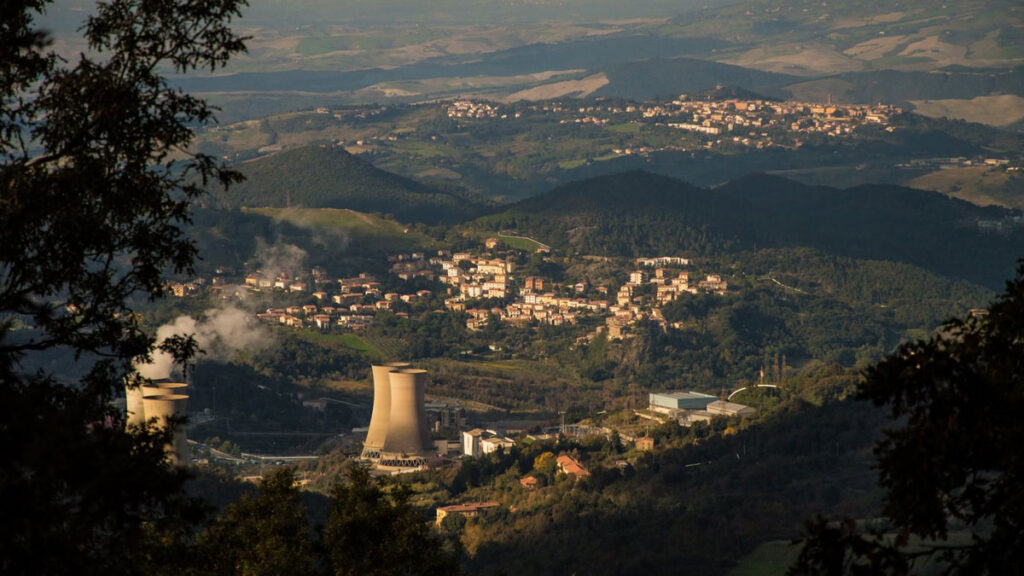
It’s long been clear that Italy’s Larderello region is supplied with abundant heat from Earth’s interior. The area, located in the center of Tuscany, is home to the world’s very first geothermal power plant and once bore the nickname “Devil’s Valley” for the steam vents that dot the rolling landscape.

The source of all of that heat has never been clear because the region has little volcanic activity. But now, new research points to the existence of a massive reservoir of magma, thousands of cubic kilometers in volume, hiding beneath Larderello.

“It’s beautiful to think that in a few hundred thousand years, we might find a supervolcano in there.”

The reservoir was discovered by University of Geneva geophysicist Matteo Lupi and his colleagues using a relatively new technique called ambient noise tomography (ANT). With ANT, the researchers peered deeper beneath the crust in the region, discovering anomalies that pointed to large volumes of magma.

The reservoir sits about 10 kilometers beneath the surface and is around 20 kilometers in diameter, the authors reported in a paper published in Communications Earth and Environment. Those dimensions make the reservoir comparable in size to those underlying so-called supervolcanoes like Yellowstone and Toba, though Lupi said there’s no apparent danger of an eruption anytime soon.

“I don’t think that, in human time frames, we should change the way we perceive the area,” he said. “Nevertheless, it’s beautiful to think that in a few hundred thousand years, we might find a supervolcano in there as well.”

Listening for Magma

Previous studies had posited the existence of large amounts of magma somewhere beneath Tuscany but never provided definitive evidence. A borehole project that concluded in 2018 revealed sudden temperature increases several kilometers down. Other studies using seismic vibrations to infer the structure of the crust in the region hinted at the presence of magma.

Lupi, along with colleagues in Italy, has been working to expand the use of ANT in Tuscany and elsewhere to make new and better images of structures deep underground. The technique involves using a network of seismometers to pick up on surface waves traveling through Earth that record a kind of background noise created by wind, ocean waves, and other subtle forces. Then, statistical algorithms help scientists find relevant seismic signals amid the static.

“Surface waves are sensitive to the shear properties of the rock,” said Brandon Schmandt, a geophysicist at Rice University who wasn’t affiliated with the research. “If you heat something or introduce a little melt, the shear properties weaken a lot. And so it’s a good way to find a big magma reservoir [in Earth’s crust].”

Using more than 60 seismometers spread across Tuscany and islands just offshore, Lupi and his team cross correlated surface wave data to produce a map of seismic velocities beneath Larderello. That map contains a large blob where seismic signals travel markedly slower than in other places. Those speeds align with a body of partially melted rock, Lupi said, surrounded by a region of slightly cooler and more solid “crystal mush.”

The researchers estimate the reservoir is about 5,000 cubic kilometers in volume, with molten rock making up about 80% of its innermost contents and about 20% of the surrounding crystal region.

A Missing Supervolcano?

The magma reservoir’s existence provides an explanation for the abundant geothermal activity in the Larderello region while simultaneously raising another question. The quantity of magma discovered could fuel a massive eruption on the scale of other supervolcanoes worldwide—yet no supervolcano exists in Tuscany.

Why Tuscany doesn’t host a caldera similar to Yellowstone in the United States is still an open question. There are several nonexclusive possibilities for the lack of eruptivity, said Federico Farina, a geologist and professor of geochemistry at the University of Milan who was also an author of the study. The magma under Larderello might be drier and therefore less eruptive, or it could have been produced, and therefore intruded into the crust, more slowly. Additionally, the structure of the crust in the region could have helped to trap the magma and prevent it from getting out.

Another clue to the region’s geological history comes from dating zircons, small crystals formed when magma cools and hardens. Farina has found zircons with different ages very close to each other in the rock matrix, which he said indicates a long-lived system where magma moves through different reservoirs as it cools. He said these zircons may also enable the researchers to model the size of the reservoir and better understand the speed and amount of magma accumulation there.

More to Come

Discovering so much magma underneath Tuscany is a surprise, but Lupi thinks it’s likely to be far from the only large magma reservoir hiding beneath a volcanically quiet region. He noted that research he carried out in the Andes around a decade ago also suggested, though not conclusively, the existence of a large, hidden magma reservoir. That experience was, in part, what convinced him to use ANT’s deep imaging capabilities elsewhere.

“This is good momentum to encourage people to look at it from a magmatic system standpoint and not just focus on the vents at the surface.”

Schmandt agreed that large reservoirs are likely to exist in other places even when there’s little for human eyes to see. “This is good momentum in that direction to encourage people to look at it from a magmatic system standpoint and not just focus on the vents at the surface,” he said.

Lupi may not have to go far to discover his next massive pool of molten rock. He said his data indicated there may be another reservoir buried under nearby Mount Amiata that’s twice as big as the one beneath Larderello. That area was just at the edge of their seismometer network, meaning the team couldn’t fully resolve it.

—Nathaniel Scharping (@nathanielscharp), Science Writer

Citation: Scharping, N. (2026), Scientists find thousands of cubic kilometers of magma hiding beneath Tuscany, Eos, 107, https://doi.org/10.1029/2026EO260157. Published on 18 May 2026.
Text © 2026. The authors. CC BY-NC-ND 3.0
Except where otherwise noted, images are subject to copyright. Any reuse without express permission from the copyright owner is prohibited.
  • ✇Eos
  • Multi-Scale Fault Roughness Encapsulated in a Friction Law Yajing Liu
    Editors’ Highlights are summaries of recent papers by AGU’s journal editors. Source: Journal of Geophysical Research: Solid Earth Earthquakes release energy and result in source properties defined across a wide range of scales that are not represented in conventional frictional laws. Norisugi and Noda [2026] introduce a new rate- and roughness-dependent friction (RRF) law which incorporates both effects from fault slip rate and multi-scale variation in fault topography. By limiting the nu
     

Multi-Scale Fault Roughness Encapsulated in a Friction Law

11 June 2026 at 17:33
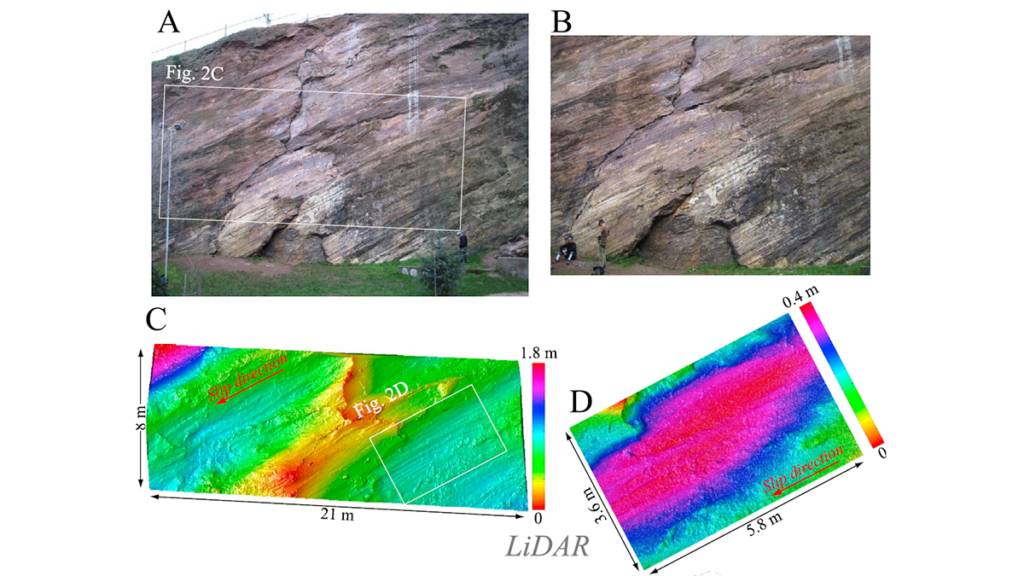
Photos of a rock outcrop and maps of the fault surface.
Editors’ Highlights are summaries of recent papers by AGU’s journal editors.
Source: Journal of Geophysical Research: Solid Earth

Earthquakes release energy and result in source properties defined across a wide range of scales that are not represented in conventional frictional laws. Norisugi and Noda [2026] introduce a new rate- and roughness-dependent friction (RRF) law which incorporates both effects from fault slip rate and multi-scale variation in fault topography. By limiting the number of state variables in the RRF formulation, the authors show with efficient earthquake cycle simulation that this multi-scale approach can reproduce a key observed relationship between fracture energy and fault slip.

Although further refinement is needed to better represent roughness evolution, this study marks a major advance in earthquake modeling by demonstrating the necessity and feasibility of incorporating multi-scale fault topography in the characterization of earthquake source process.  

Citation: Norisugi, R., & Noda, H. (2026). Multi-scale rate- and roughness-dependent frictional constitutive law and dynamic earthquake sequence simulation. Journal of Geophysical Research: Solid Earth, 131, e2025JB033580. https://doi.org/10.1029/2025JB033580

—Yajing Liu, Associate Editor, JGR: Solid Earth

Text © 2026. The authors. CC BY-NC-ND 3.0
Except where otherwise noted, images are subject to copyright. Any reuse without express permission from the copyright owner is prohibited.
  • ✇Eos
  • Pre-Existing Structure and Stress Shape Geothermal-Induced Seismicity Xiaowei Chen
    Editors’ Highlights are summaries of recent papers by AGU’s journal editors. Source: Journal of Geophysical Research: Solid Earth Enhanced Geothermal Systems (EGS) can expand low-carbon energy production, but fluid injection may trigger earthquakes whose locations and mechanisms are difficult to predict. Feng et al. [2026] investigate induced seismicity at China’s first EGS site in the Gonghe Basin using a comprehensive observational dataset. Machine learning processing of data from 20 su
     

Pre-Existing Structure and Stress Shape Geothermal-Induced Seismicity

2 June 2026 at 12:00
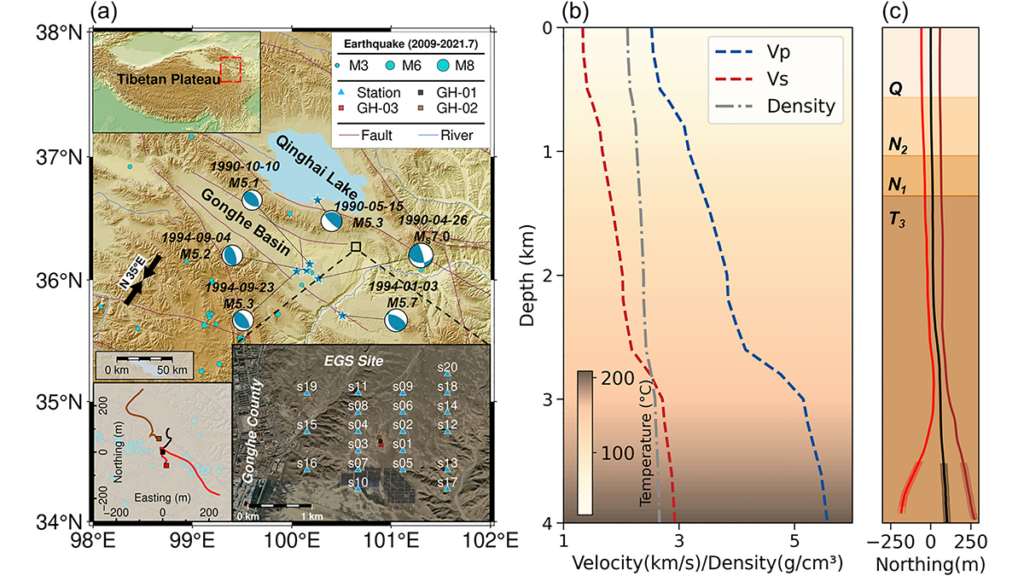
Map of the study region and 2 graphs from the study.
Editors’ Highlights are summaries of recent papers by AGU’s journal editors.
Source: Journal of Geophysical Research: Solid Earth

Enhanced Geothermal Systems (EGS) can expand low-carbon energy production, but fluid injection may trigger earthquakes whose locations and mechanisms are difficult to predict. Feng et al. [2026] investigate induced seismicity at China’s first EGS site in the Gonghe Basin using a comprehensive observational dataset. Machine learning processing of data from 20 surface seismic stations produced a high-resolution earthquake catalog with well-constrained locations and focal mechanisms. Stress inversion and modeling, constrained by borehole stress measurements, reveal mechanically weak faults with low friction coefficients, indicating that low-to-moderate fluid overpressure can trigger seismic slip. Site-scale analysis shows that seismicity reflects shear reactivation of pre-existing natural faults, rather than the creation of new tensile fractures. Further integration with borehole image logs reveals a fine-scale relationship between the main seismogenic zones and stress heterogeneity, expressed as rotations of the principal stress axes that likely reflect localized lithological contrasts and fault-damage zones.

Together, these integrated analyses show that geothermal-induced seismicity is controlled by inherited fault architecture at the site scale and localized stress heterogeneity at the borehole scale. By linking seismic observations to borehole stress and image-log evidence, the study provides a more physically constrained framework for seismic-hazard assessment and stimulation design in enhanced geothermal reservoirs.

Citation: Feng, P., Wang, R., Zhang, H., Zhang, C., Schultz, R., & Yang, L. (2026). Pre-existing structures and stress variations jointly control the induced seismicity in enhanced geothermal system of Gonghe Basin, China. Journal of Geophysical Research: Solid Earth, 131, e2025JB033158. https://doi.org/10.1029/2025JB033158  

—Xiaowei Chen, Associate Editor, JGR: Solid Earth

Text © 2026. The authors. CC BY-NC-ND 3.0
Except where otherwise noted, images are subject to copyright. Any reuse without express permission from the copyright owner is prohibited.
  • ✇Eos
  • On the Seattle Fault, the Biggest Quakes Aren’t the Most Likely Rebecca Dzombak
    In the winter of 923, a magnitude 7.5 earthquake struck the heart of Puget Sound. Shorelines slid into the water, the seafloor rose up, and a tsunami swept through the region. The Seattle fault zone, actually a mesh of faults that runs right under its eponymous city, was responsible for this quake. The fault continues to pose one of the deadliest threats to the Pacific Northwest; if a similar quake were to hit today, it would threaten millions of lives and cause billions of dollars in damage
     

On the Seattle Fault, the Biggest Quakes Aren’t the Most Likely

14 April 2026 at 13:02
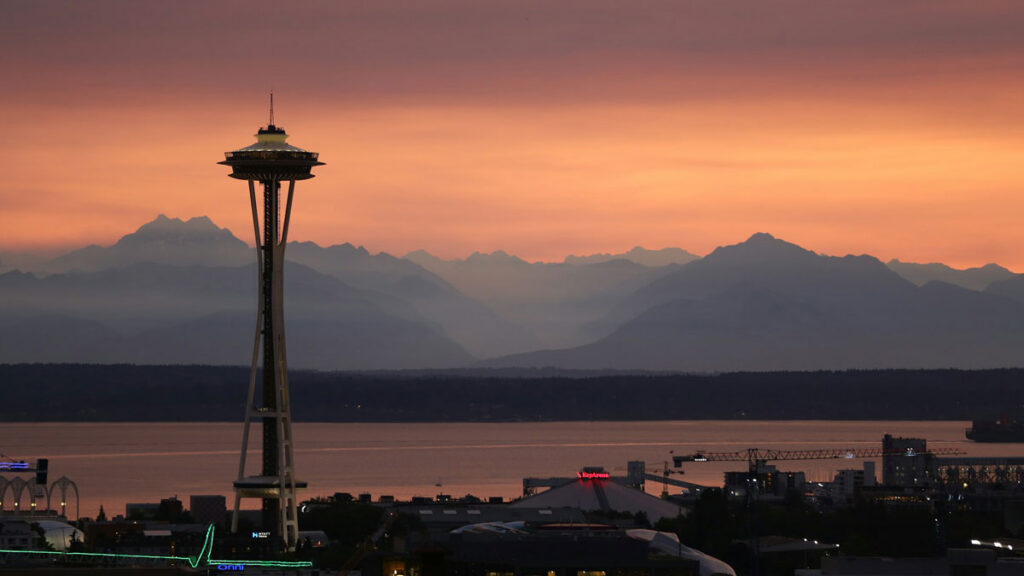
Seattle’s Space Needle is seen at dusk, with mountains and an orange sky in the background.

In the winter of 923, a magnitude 7.5 earthquake struck the heart of Puget Sound. Shorelines slid into the water, the seafloor rose up, and a tsunami swept through the region.

The Seattle fault zone, actually a mesh of faults that runs right under its eponymous city, was responsible for this quake. The fault continues to pose one of the deadliest threats to the Pacific Northwest; if a similar quake were to hit today, it would threaten millions of lives and cause billions of dollars in damage.

Two new papers dig into recurrence intervals, or the quiescent periods between earthquakes, for the Seattle fault zone. They offer good news and bad news: One study, published in Geology, found that in the past 11,000 years, the massive 923 event was the only quake of magnitude 7.5 or greater. The other study, published in GSA Bulletin, found that smaller, but still damaging, quakes occur more frequently than previously thought.

A map of the Seattle fault, which runs east–west under the city
The Seattle fault zone runs east-west under the city and the surrounding Puget Sound. Credit: Washington Geological Survey (Washington Department of Natural Resources)

The new research indicates the worst-case scenario of frequent 923-style events is less likely than some scientists thought, said Harold Tobin, a geophysicist at the University of Washington and head of the Pacific Northwest Seismic Network, who was not involved in either study. But researchers also found that “the less worse, but still bad scenarios” are more likely than previously thought.

Meet the Seattle Fault

“For a fault that has had so much attention, there’s so much we still don’t know.”

The Seattle fault zone is a thrust fault system that stretches about 75 kilometers (46 miles) from the foothills of the Cascades east of Seattle to the Hood Canal, which runs along the shores of the Olympic Peninsula to the city’s west, passing under Seattle along the way.

Geologists began rigorously exploring the fault system in the early 1990s, intrigued by gravitational anomalies, uplifted marine terraces (stair-step geological formations along coastlines), and evidence of a roughly 1,000-year-old tsunami. All these features hinted at a major, shallow earthquake on a local fault zone—likely the 923 event.

But “for a fault that has had so much attention, there’s so much we still don’t know,” said Elizabeth Davis, an earthquake geologist at the University of Washington who led the Geology study.

The most pressing questions are how big quakes on the fault get, how often they hit, and, ultimately, what risks the fault poses to people who live in the Puget Sound area.

“It takes some real geologic sleuthing to get at those tough questions,” Tobin said.

Biggest Seattle Fault Quakes Are Rare

Davis focused on the activity of the main fault, which can generate the biggest quakes in the Seattle fault zone complex. It was responsible for the 923 quake. But the existing record went back only about 5,000 years.

“We just don’t know what the recurrence interval for these big quakes is,” Davis said. “We wanted to lengthen the record.”

To do so, Davis and her collaborators turned to marine terraces, the oldest of which date back to the end of the last ice age about 11,000 years ago. The quake in 923 raised terraces by about 8 meters (26 feet), and scientists wanted to look for similar-scale uplift in terraces all around the sound.

The researchers mapped more than 150 terraces around Puget Sound and measured their depths. After accounting for regional slopes, they estimated uplift over time that could have been caused by quakes.

They found that in that 11,000-year period, only the 923 event generated significant uplift. Thick sediment mantles could mask smaller events but not 923-scale quakes, Davis said.

Estimating true recurrence intervals requires knowing the timing of multiple events. But the finding is “not bad news,” she said. It provides some evidence that the recurrence interval is likely not shorter than about 5,000 years.

“That could give us more of a buffer between now and when the next big one like that will happen,” said Stephen Angster, a U.S. Geological Survey geologist who led the GSA Bulletin study.

Smaller, Damaging Quakes Are More Frequent

Angster’s work focused on Seattle’s secondary faults, which are smaller, mostly blind faults (those not visible at the surface) capable of generating damaging earthquakes. Previous work had shown that one of these secondary faults generated a magnitude 6.7 earthquake, highlighting the risk they pose. Angster wanted to explore rupture histories of these secondary faults, particularly whether they could rupture independently from the main fault.

The researchers used a suite of paleoseismic tools, including magnetic data, field and lidar mapping, trenches dug across faults, and geochronology. They studied two newly identified secondary faults that have orientations similar to the main fault.

They found three new earthquakes to add to the region’s seismic history, including the oldest and youngest events in the known record, which were around 11,000 years ago and in the early 1800s, respectively. The earthquakes appear to be evidence of ruptures that occurred independently of the main fault, suggesting that the smaller—but still dangerous—secondary faults should be considered in hazard modeling.

With that lengthened record and the addition of three quakes, the recurrence interval the researchers found was about every 350 years over the past 2,500 years. This timing refined the previous estimate of every several hundred years.

There also appears to be an increase in activity over the past 2,000 years.

“Maybe we should be paying attention to that,” Angster said.

What Happens Next

“There are other earthquakes that aren’t as big but that occur more frequently. Those might not be as catastrophic, but it would be a very bad scenario for Seattle” if such events occurred.

“These are both carefully done studies,” Tobin said. “We now have evidence that the 923 event was the biggest in 11,000 years. But there are other earthquakes that aren’t as big but that occur more frequently. Those might not be as catastrophic, but it would be a very bad scenario for Seattle” if such events occurred.

It’s still to be determined whether the risk from secondary faults will be incorporated into the National Seismic Hazard Model, which includes the 923 quake but not smaller ones along the Seattle fault zone. The secondary faults were left out in previous efforts because they are shorter than the minimum length required to be included and because of uncertainties in their potential rupture magnitude.

—Rebecca Dzombak (@rdzombak.bsky.social), Science Writer

Citation: Dzombak, R. (2026), On the Seattle Fault, the biggest quakes aren’t the most likely, Eos, 107, https://doi.org/10.1029/2026EO260114. Published on 14 April 2026.
Text © 2026. The authors. CC BY-NC-ND 3.0
Except where otherwise noted, images are subject to copyright. Any reuse without express permission from the copyright owner is prohibited.
❌
Subscriptions