Normal view

  • ✇Hong Kong Free Press HKFP
  • Pentagon chief Pete Hegseth says US seeks ‘stable equilibrium’ with China in Asia AFP
    By Matthew Walsh and Ludovic Ehret Pentagon chief Pete Hegseth struck a measured tone towards China at a major defence forum on Saturday, noting “rightful alarm” over Beijing’s military build-up but saying the United States sought a “stable equilibrium” in Asia. US Secretary of Defence Pete Hegseth speaks during the 23rd Shangri-La Dialogue summit in Singapore on May 30, 2026. Photo: Jam Sta Rosa/AFP. Hegseth’s headline speech at Singapore’s Shangri-La Dialogue, which brings together t
     

Pentagon chief Pete Hegseth says US seeks ‘stable equilibrium’ with China in Asia

By: AFP
30 May 2026 at 04:56
Pete Hegseth featured image

By Matthew Walsh and Ludovic Ehret

Pentagon chief Pete Hegseth struck a measured tone towards China at a major defence forum on Saturday, noting “rightful alarm” over Beijing’s military build-up but saying the United States sought a “stable equilibrium” in Asia.

US Secretary of Defence Pete Hegseth speaks during the 23rd Shangri-La Dialogue summit in Singapore on May 30, 2026. Photo: Jam Sta Rosa/AFP.

Hegseth’s headline speech at Singapore’s Shangri-La Dialogue, which brings together top defence officials and experts from around 45 countries, contrasted with his strongly confrontational remarks on China at last year’s gathering.

Unlike Beijing, which has sent a panel of military experts and scholars instead of defence minister Dong Jun for the second year running, Hegseth is leading a bumper US delegation to the event that provides chances for both open debate and behind-closed-doors diplomacy.

“When we look across the region today, there is rightful alarm regarding China’s historic military build-up and the expansion of its military activities in the region and beyond,” Hegseth said.

Washington does not seek “needless confrontation in the region”, but rather “a genuinely stable equilibrium (in Asia) that works for Americans as well as our allies”, he said.

That means “a favourable but durable balance of power in which no state, including China, can impose its hegemony and hold the security or prosperity of our nation and our allies in question”, he added.

China's Major General Meng Xiangqing of the National Defense University, the head of the Chinese delegation, attends the 23rd Shangri-La Dialogue summit in Singapore on May 29, 2026. Photo: Jam Sta Rosa/AFP.
China’s Major General Meng Xiangqing of the National Defense University, the head of the Chinese delegation, attends the 23rd Shangri-La Dialogue summit in Singapore on May 29, 2026. Photo: Jam Sta Rosa/AFP.

He said the United States sought “respectful” and “good-faith” engagement with Beijing, adding: “I wish my counterpart was here at this conference, but I look forward to other options when we can cross paths.”

Trump visited China this month, talking up “fantastic” trade deals but giving few details and later suggesting Washington could use its arms sales to self-ruled Taiwan as a bargaining chip with Beijing.

There had been “no change” in Washington’s stance towards Taiwan, but “any decision about future Taiwan arms sales… will rest with” US President Donald Trump, Hegseth said.

Vibe shift

The remarks contrasted sharply with last year’s event, when Hegseth painted China as a potentially “imminent” threat to security and outlined a swaggering vision of muscular American deterrence.

That day, he also took potshots at Beijing’s absent minister, saying: “We are here this morning, and somebody else isn’t.”

Chinese delegate Da Wei, director of the Center for International Security and Strategy at Beijing’s Tsinghua University, said this year’s address was “much more moderate”.

However, he found Hegseth’s depiction of China “ironic”, adding: “Everyone in the room must have been thinking: who is really hegemonic?

“Given what the US is doing in Iran and has done in Venezuela, I think it’s clear to everyone,” Da said.

US delegate Tammy Duckworth, a Democratic senator and strong Trump critic, said she was “somewhat disturbed” by Hegseth’s remarks, viewing them as overly conciliatory towards China.

US Senator Tammy Duckworth is seen during the 23rd Shangri-La Dialogue summit in Singapore on May 30, 2026. Photo: Mohd Rasfan/AFP.

“I worry that this administration is being distracted into wars that they’ve started in other parts of the world at the expense of our commitment here in the Indo-Pacific,” she told reporters.

Instead of Dong, China has sent experts and scholars from its army’s academic institutions, led by Major General Meng Xiangqing of the National Defense University.

Analysts have said Dong’s no-show reflects Beijing’s confidence as an established power with little inclination to answer publicly for its assertive moves in the region.

But some argue that China is also running the risk of having no senior policymaker present if two major security issues come up: reopening the Strait of Hormuz, and Beijing’s claim to Taiwan.

Hegseth again urged US allies to spend more on their own defence, singling out South Korea, Japan, Australia and the Philippines for praise while threatening consequences for nations that “free-ride on the generosity of the American taxpayer”.

“Those days are over. Allies who refuse to step up and carry their own weight for our collective defense will face a clear shift in how we do business.”

Iran threat

Hegseth’s remarks came as a peace deal between the United States and Iran to end their war remained elusive.

US Secretary of Defence Pete Hegseth speaks during the 23rd Shangri-La Dialogue summit in Singapore on May 30, 2026. The International Institute for Strategic Studies, via Flickr.

A White House official told AFP on Friday that Trump, who is weighing a final decision on a potential accord, would only commit if Iran met all his conditions.

But Iran has said “no final agreement” is in place, and its state media has rebutted parts of Trump’s characterisation of the deal.

Hegseth said Washington was “more than capable” of restarting the war if it wanted.

The head of the Pentagon is also due to meet his British and Australian counterparts as part of the AUKUS security alliance.

Australian media outlets have reported, citing unnamed sources, that the AUKUS nations are expected to announce a major project, perhaps involving uncrewed underwater vehicles.

  • ✇Hong Kong Free Press HKFP
  • Chinese dissident flees to South Korea on rubber boat AFP
    By Kang Jin-kyu A Chinese dissident who has long been a thorn in Beijing’s side has escaped to South Korea on a rubber boat, his lawyer confirmed on Wednesday, after repeated attempts to flee China. Chinese dissident Dong Guangping. Photo: Front Line Defenders. Dong Guangping, a former policeman who was imprisoned for his activism, was found by South Korean authorities on Monday night drifting off the country’s west coast on a 3.3-metre (11-foot) rubber boat with a 9.9-horsepower engin
     

Chinese dissident flees to South Korea on rubber boat

By: AFP
28 May 2026 at 04:03
Dong Guangping featured image

By Kang Jin-kyu

A Chinese dissident who has long been a thorn in Beijing’s side has escaped to South Korea on a rubber boat, his lawyer confirmed on Wednesday, after repeated attempts to flee China.

Chinese dissident Dong Guangping. Photo: Front Line Defenders.

Dong Guangping, a former policeman who was imprisoned for his activism, was found by South Korean authorities on Monday night drifting off the country’s west coast on a 3.3-metre (11-foot) rubber boat with a 9.9-horsepower engine, according to police.

He was taken to shore for questioning on suspicion of violating immigration laws.

The man’s lawyer, Kim Joo-kwang, confirmed his identity to AFP.

Dong, 68, is known for his opposition to the Chinese Communist Party (CCP) and his advocacy for political reform and human rights.

He was dismissed from his work as a policeman after signing a petition a decade after Beijing’s 1989 Tiananmen Square crackdown, according to US-based advocacy group Human Rights in China.

He later spent about three years in prison from 2001 for “inciting subversion of state power”, United Nations experts said, and was detained again in 2014 over Tiananmen-related activities.

Dong fled to Thailand with his family, who later resettled in Canada as refugees, but Thai authorities handed him over to Chinese police in 2015 despite his UN-recognised refugee status.

He was released from prison after completing his sentence in 2019.

But faced with constant police surveillance, harassment and a lack of access to housing, work and financial resources, he decided to flee again in an attempt to reunite with his family, according to a UN report from 2022.

Before arriving in South Korea, Dong made several failed attempts to flee China.

In 2019, he tried to swim to the Kinmen archipelago, a Taiwanese territory, but nearly drowned at sea. In 2020, he crossed into Vietnam, but was detained by Vietnamese police.

Dong’s attorney told AFP his client’s current situation is “highly likely to be a political asylum case”.

Full protection

Chinese-Canadian journalist and human rights activist Sheng Xue, who described Dong as a friend, said in a post on X Wednesday that Dong set off from Weihai, in China’s Shandong province, after “meticulous inspection and preparation”.

Chinese-Canadian human rights activist Sheng Xue. Photo: Sheng Xue, via X.

“Last night, I spoke with him on the phone… He hadn’t slept for over fifty hours and had been at sea for more than thirty hours,” she said.

His rubber boat was spotted by the captain of a fishing boat at 9:30 pm (1230 GMT) on Monday, about 18 kilometres (11 miles) northwest of Taean County, South Chungcheong province, who then alerted the police, according to Sheng.

The Coast Guard dispatched a patrol vessel that arrived at the scene about an hour later, and Dong was detained, she added.

South Korea has granted political asylum to a relatively small number of applicants since it began formally processing refugee claims in 1994, with an overall recognition rate in the low single digits despite tens of thousands of applications.

Critics say the low approval rate reflects strict screening and lengthy procedures, while the government maintains that decisions are made on a case-by-case basis and take security considerations into account.

Seoul’s foreign ministry did not respond to a request for comment.

The opposition People Power Party has called on the government to offer Dong “full protection”.

“It should take swift humanitarian measures to ensure that he can safely travel to Canada, where his family is anxiously awaiting him,” party spokesman Choo Hyun-chul said in a statement to AFP.

“This is a matter of a fundamental responsibility as a liberal democratic state.”

In August 2023, Kwon Pyong, a Chinese dissident, fled China on a jet ski to South Korea, where he was later convicted of illegal entry and given a suspended prison sentence.

  • ✇Hong Kong Free Press HKFP
  • Taiwan launches website to collect intelligence from Chinese nationals AFP
    Taiwan has launched a website for Chinese citizens to leak intelligence, inviting those “who share the same values of democracy” to collaborate on reporting on Beijing. China claims democratic Taiwan is part of its territory and has threatened to use force to take it, while Taipei accuses Beijing of using espionage and infiltration to weaken its defences. The headquarters of Taiwan’s National Security Bureau in Taipei. Photo: Taiwan’s National Security Bureau. Taiwan’s National Securit
     

Taiwan launches website to collect intelligence from Chinese nationals

By: AFP
15 June 2026 at 06:33
Taiwan National Security Bureau featured image

Taiwan has launched a website for Chinese citizens to leak intelligence, inviting those “who share the same values of democracy” to collaborate on reporting on Beijing.

China claims democratic Taiwan is part of its territory and has threatened to use force to take it, while Taipei accuses Beijing of using espionage and infiltration to weaken its defences.

The headquarters of Taiwan's National Security Bureau in Taipei.
The headquarters of Taiwan’s National Security Bureau in Taipei. Photo: Taiwan’s National Security Bureau.

Taiwan’s National Security Bureau (NSB) introduced the platform with a one-minute AI-generated video showing a Chinese civil servant witnessing colleagues being removed and investigated, “reflecting a pervasive atmosphere that everyone is on edge under China’s totalitarian regime”, it said in a statement.

An “increasing number” of people have approached agencies in Taiwan “wishing to provide various types of information”, it said.

It added the reporting channel was based on “practices adopted by intelligence agencies in the United States, the United Kingdom, and Israel”.

The NSB said it would “rigorously filter”, evaluate and follow up submissions to the platform using technology.

The bureau did not immediately respond to AFP’s request for further comment on Monday.

  • ✇Hong Kong Free Press HKFP
  • Taiwan’s President Lai says ‘happy’ to talk to Trump AFP
    Taiwan’s President Lai Ching-te said Thursday he would be “happy” to talk to US leader Donald Trump — a conversation that would break more than four decades of diplomatic protocol and risk angering China. Taiwan President Lai Ching-te delivers a speech to mark his second anniversary in office on May 20, 2026. File photo: Taiwan’s Presidential Office, via Flickr. Trump told reporters on Wednesday that he would speak to Lai, as the White House weighs arms sales to the democratic island.
     

Taiwan’s President Lai says ‘happy’ to talk to Trump

By: AFP
21 May 2026 at 06:59
Lai Ching-te Donald Trump featured image

Taiwan’s President Lai Ching-te said Thursday he would be “happy” to talk to US leader Donald Trump — a conversation that would break more than four decades of diplomatic protocol and risk angering China.

Taiwan President Lai Ching-te delivers a speech to mark his second anniversary in office on May 20, 2026. File photo: Taiwan's Presidential Office, via Flickr.
Taiwan President Lai Ching-te delivers a speech to mark his second anniversary in office on May 20, 2026. File photo: Taiwan’s Presidential Office, via Flickr.

Trump told reporters on Wednesday that he would speak to Lai, as the White House weighs arms sales to the democratic island.

It was the second time since a summit in Beijing last week that Trump has said he would call the Taiwanese leader.

Such communication would be the first time since Washington switched diplomatic relations from Taipei to Beijing in 1979 that serving presidents of Taiwan and the United States would speak to each other.

Lai said Taiwan was “committed to maintaining the stable status quo in the Taiwan Strait” and that “China is the disruptor of peace and stability”, the Taiwanese foreign ministry said in a statement.

China ‘firmly opposes’ call

Lai would be “happy to discuss these matters with President Trump”, the statement said.

“I’ll speak to him. I speak to everybody,” Trump said, adding that he had a great meeting with Chinese President Xi Jinping during his state visit to Beijing last week.

US President Donald Trump addresses the nation on the shooting of two National Guard soldiers in Washington, DC, on November 26, 2025, from his residence in Mar-a-Lago in Palm Beach, Florida. Photo: White House, via Flickr.

“We’ll work on that, the Taiwan problem,” Trump said.

China’s foreign ministry said Thursday it “firmly opposes official exchanges” between the United States and Taiwan, as well as US arms sales to the island.

“China urges the United States to implement the important consensus reached during the meeting between the Chinese and US heads of state, honour its commitments and statements, handle the Taiwan question with the utmost prudence,” ministry spokesman Guo Jiakun told a press briefing.

He added that Washington should “stop sending wrong signals” to Taiwan.

After wrapping up his trip to Beijing, Trump suggested arms sales to Taiwan could be used as a bargaining chip with China, which claims the island is part of its territory and has threatened to seize it by force.

Since then, Lai’s government has been on the offensive, insisting that US policy on Taiwan has not changed and that Trump made no commitments to China on arms sales to the island.

Taiwan relies heavily on US support to deter any potential Chinese attack, and has been under intense pressure to increase its spending through investment in American firms.

In 2016, shortly after his first election victory, president-elect Trump accepted a phone call from then Taiwanese president Tsai Ing-wen, angering Beijing and stunning diplomats, world leaders and China watchers.

  • ✇Hong Kong Free Press HKFP
  • ‘Hard to win’: Taiwanese react to uncertainty over US arms sales AFP
    President Donald Trump’s suggestion that US arms sales to Taiwan could be a bargaining chip with China has set off alarms across the world, but in Taipei, people told AFP the situation was beyond their control. A person walking by Taiwan flag installation. File Photo: Walid Berrazeg/HKFP. A week on from Trump’s remarks to Fox News and aboard Air Force One, feverish speculation bubbled over whether decades of US policy on the democratic island has been upended. While the United States s
     

‘Hard to win’: Taiwanese react to uncertainty over US arms sales

By: AFP
25 May 2026 at 00:26
taiwan flag

President Donald Trump’s suggestion that US arms sales to Taiwan could be a bargaining chip with China has set off alarms across the world, but in Taipei, people told AFP the situation was beyond their control.

Taipei Taiwan flag ROC Republic of China
A person walking by Taiwan flag installation. File Photo: Walid Berrazeg/HKFP.

A week on from Trump’s remarks to Fox News and aboard Air Force One, feverish speculation bubbled over whether decades of US policy on the democratic island has been upended.

While the United States switched official diplomatic relations from Taipei to Beijing nearly 50 years ago, Washington is Taipei’s most important security backer.

Though Taiwanese government officials have been anxiously waiting for Trump’s decision on the latest arms package, people on the streets of Taipei were calm.

Nicole Lee, a 46-year-old nurse, said she didn’t put much stock in Taiwan’s military hardware in a war against China, which claims Taiwan is part of its territory and has threatened to use force to seize it.

“Even if they give us weapons, if we really had to use force against (China), I don’t think there would be much we could do,” she said.

US President Donald Trump and Chinese President Xi Jinping tour the Hall of Prayer of Good Harvest at the Temple of Heaven in Beijing on May 14, 2026. Photo: The White House, via Flickr.

Delivery driver Ben Wu, 41, echoed those comments, likening US arms sales to Taiwan to a “protection fee” and noting that even with the “best weapons it would still be very hard to win” against China.

Taiwan has spent many billions of dollars buying fighter jets, high-tech missiles and drones from the United States to bolster its defences against a potential attack from China.

Trump ‘totally untrustworthy’

Still, Taipei has been at pains to remind Trump of US commitments under the Taiwan Relations Act, which was passed by the US Congress in 1979 and requires the United States to provide weapons to Taiwan.

US officials, including Secretary of State Marco Rubio and Trade Representative Jamieson Greer, have insisted nothing about US policy on Taiwan has changed.

Cynthia Kuo, a 29-year-old elementary school teacher, said Trump was the “kind of person who just says whatever pops into his head.”

“So I feel like whatever decisions he makes, he only makes them if he thinks they’re good for the United States,” she said.

US President Donald Trump and Chinese President Xi Jinping pose for a photo at Zhongnanhai in Beijing on May 15, 2026. Photo: The White House, via Flickr.

“He’s not going to take other countries into account.”

A 78-year-old retiree, who spoke on condition that her name not be used, said the one thing that was certain is that Trump can’t be relied upon.

“He’s totally untrustworthy,” the woman said. “I often feel that Trump is a hooligan in international politics.”

In any case, Washington’s conclusion on the weapons and Beijing’s next steps on Taiwan will be decided far from Tapei.

“I’m not that worried,” 22-year-old university student Matt told AFP. “Whether we worry or not doesn’t really change anything.”

  • ✇Malay Mail - All
  • Taiwanese BTS fans praying for god of love to matchmake them with…concert tickets
    TAIPEI, June 1 — Taiwanese fans of ‌K-pop boy band BTS are turning to Yue Lao, the Taoist god of love and marriage, in the hope ‌that divine matchmaking will connect them with seats for their upcoming shows in the southern Taiwanese city of Kaohsiung.“It’s really hard to get tickets for BTS concerts, so everyone says praying to the God of Love is the most efficient. After all, it’s another kind of matchmaking,” said fan Jessie Chuang, 26.Over the weekend, a group
     

Taiwanese BTS fans praying for god of love to matchmake them with…concert tickets

1 June 2026 at 08:06

Malay Mail

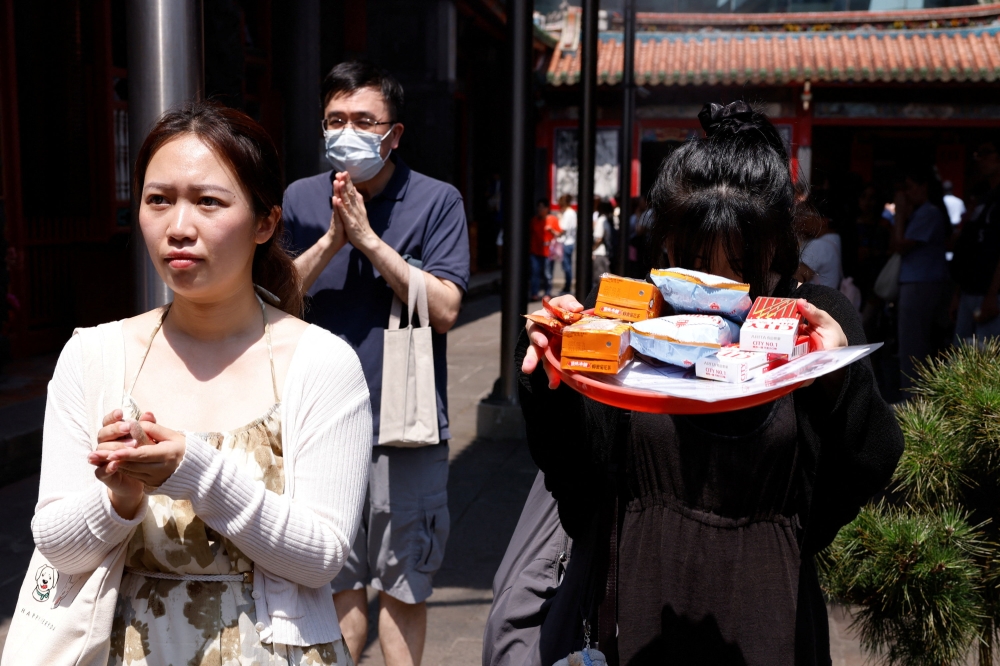
TAIPEI, June 1 — Taiwanese fans of ‌K-pop boy band BTS are turning to Yue Lao, the Taoist god of love and marriage, in the hope ‌that divine matchmaking will connect them with seats for their upcoming shows in the southern Taiwanese city of Kaohsiung.

“It’s really hard to get tickets for BTS concerts, so everyone says praying to the God of Love is the most efficient. After all, it’s another kind of matchmaking,” said fan Jessie Chuang, 26.

Over the weekend, a group of ‌K-pop fans, mostly BTS fans, laid out snacks ⁠in purple packaging - the ⁠official BTS group colour - along with ⁠group merchandise, concert seat ⁠maps and wish ⁠lists on an altar table at Taipei’s Bangka Longshan Temple.

BTS fans prepare snacks, group merchandise, concert seat maps and wish lists to be placed on an altar table as they pray to Yue Lao, the god of love in Chinese mythology who oversees relationships and marriage, at Taipei’s Bangka Lungshan Temple, in hopes of securing a concert ticket, in Taipei, Taiwan, May 30, 2026. — Reuters pic

The trend started on social media ⁠a couple of years ago. Taiwanese K-pop fans believe Yue Lao will use his red thread of fate to connect those destined to meet - in this case, connecting fans with a concert seat.

“If ⁠you truly believe in it, your wish will come true,” said university student Ye Yu-ting, ⁠22.

The last time BTS performed with all their members ⁠in ⁠Taiwan was in 2018.

The group announced their long-awaited world tour in early 2026 and will perform three shows in ‌Kaohsiung on November 19, 21 and 22. — Reuters


  • ✇Hong Kong Free Press HKFP
  • US-China summit: Trump says made ‘fantastic trade deals’ with Xi AFP
    President Donald Trump said he had made “fantastic trade deals” with China’s Xi Jinping, as the pair met on Friday at final talks of a superpower summit that according to the US leader has also reaped a Chinese offer to help open the Strait of Hormuz. US President Donald Trump (left) poses for photos with Chinese President Xi Jinping during a visit to Zhongnanhai Garden in Beijing on May 15, 2026. Photo: Evan Vucci/Pool/AFP. Trump had arrived in Beijing seeking to seal deals in sectors in
     

US-China summit: Trump says made ‘fantastic trade deals’ with Xi

By: AFP
15 May 2026 at 06:07
Xi Trump featured image

President Donald Trump said he had made “fantastic trade deals” with China’s Xi Jinping, as the pair met on Friday at final talks of a superpower summit that according to the US leader has also reaped a Chinese offer to help open the Strait of Hormuz.

US President Donald Trump (left) poses for photos with Chinese President Xi Jinping during a visit to Zhongnanhai Garden in Beijing on May 15, 2026.
US President Donald Trump (left) poses for photos with Chinese President Xi Jinping during a visit to Zhongnanhai Garden in Beijing on May 15, 2026. Photo: Evan Vucci/Pool/AFP.

Trump had arrived in Beijing seeking to seal deals in sectors including agriculture, aviation and artificial intelligence, as well as to contain differences between the two sides in a number of tense geostrategic areas — not least the Middle East war.

Trump’s overtures to Xi, whom he described as a “great leader” and “friend”, have so far been met with more muted tones by the Chinese leader.

But the US leader said “a lot of good” has come out of the visit.

“We’ve made some fantastic trade deals, great for both countries,” he said after a walk with Xi among the rosebushes in the gardens of Zhongnanhai, a central leadership compound next to Beijing’s Forbidden City.

“We’ve settled a lot of different problems that other people wouldn’t have been able to solve,” he added, without providing details.

Xi said it was a “milestone visit”, and that the two sides had to date established “a new bilateral relationship, which is a relationship of constructive strategic stability”.

He promised to send Trump seeds for the White House Rose Garden.

‘Help on Hormuz’

In an interview with Fox News after the first day of the summit wrapped, Trump said Xi had agreed to several US wishlist points.

China's President Xi Jinping (right) and US President Donald Trump at the Great Hall of the People in Beijing on May 14, 2026. Photo: Mao Ning Chinese Foreign Ministry Spokesperson, via Facebook.
China’s President Xi Jinping (right) and US President Donald Trump at the Great Hall of the People in Beijing on May 14, 2026. Photo: Mao Ning Chinese Foreign Ministry Spokesperson, via Facebook.

On the topic of the war in Iran, the US president said Xi had effectively assured his counterpart that China was not preparing to militarily aid Tehran, which has essentially closed the Strait of Hormuz.

“He said he’s not going to give military equipment… he said that strongly,” Trump told Fox.

“He’d like to see the Hormuz Strait open, and said ‘if I can be of any help whatsoever, I would like to help,'” Trump added.

Asked whether the two leaders had discussed Iran, the Chinese foreign ministry on Friday released a statement calling for “a comprehensive and lasting ceasefire”.

“Shipping lanes should be reopened as soon as possible in response to the calls of the international community,” it added.

Taiwan policy ‘unchanged’

The warm handshakes and pomp on Thursday were somewhat overshadowed by a blunt warning from Xi on a much longer standing geopolitical flashpoint, Taiwan.

Taiwan flag aboard the island's coast guard vessel. Photo: Kuan Bi-ling, via Facebook.
Taiwan flag aboard the island’s coast guard vessel. Photo: Kuan Bi-ling, via Facebook.

Shortly after talks started, Chinese state media reported Xi had told Trump that missteps on the sensitive issue of Taiwan could push their two countries into “conflict”.

The Fox News interview did not touch upon Taiwan, and Trump did not comment to reporters when asked about the matter on Thursday.

US Treasury Secretary Scott Bessent told CNBC the president would say more “in the coming days”.

Secretary of State Marco Rubio told NBC on Thursday though that “US policy on the issue of Taiwan is unchanged… as of the meeting”.

Beijing had raised the topic, he said, but “we always make clear our position, and we move on to the other topics”.

Taipei responded Friday thanking Washington “for repeatedly expressing its support”.

Boeing, oil, soybeans

Trump did not spell out on Friday the trade agreements that he said had been sealed with China.

Chinese President Xi Jinping and US President Donald Trump attend talks with high-ranking officials in Beijing on May 14, 2026. Photo: Mao Ning Chinese Foreign Ministry Spokesperson, via Facebook.

However, in the Fox interview, Trump said one big business deal struck involved Xi agreeing to purchase “200 big” Boeing jets.

Shares of the US aviation giant fell after Trump’s comments, in a sign the market had expected a more robust purchase from China.

The US president also said Beijing had also voiced interest in buying US oil and soybeans.

China, which is the key foreign customer of Iranian oil, bought small amounts of US oil before Trump imposed tariffs last year.

It has sharply slowed down purchases of US soybeans, turning instead to Brazil.

Bessent told CNBC that Trump and Xi were talking about setting up “guardrails” for the use of artificial intelligence.

Bessent said the world’s “two AI superpowers are going to start talking”, though US export controls on the advanced technology to China remain a sore point in relations.

  • ✇Hong Kong Free Press HKFP
  • Taiwan says it is an ‘independent’ nation, after Trump’s warning AFP
    By Allison Jackson and Joy Chiang Taiwan said Saturday it is an “independent” nation, hours after US President Donald Trump warned the democratic island against declaring formal independence. Taiwan’s flag. Photo: Walid Berrazeg/HKFP. Trump wrapped up a state visit to Beijing on Friday where Chinese President Xi Jinping had pressed him not to support Taiwan, which China claims is part of its territory. Taiwan depends heavily on US security backing to deter China from carrying out it
     

Taiwan says it is an ‘independent’ nation, after Trump’s warning

By: AFP
17 May 2026 at 03:06
Taiwan flag featured image

By Allison Jackson and Joy Chiang

Taiwan said Saturday it is an “independent” nation, hours after US President Donald Trump warned the democratic island against declaring formal independence.

Taiwan Republic of China ROC flag
Taiwan’s flag. Photo: Walid Berrazeg/HKFP.

Trump wrapped up a state visit to Beijing on Friday where Chinese President Xi Jinping had pressed him not to support Taiwan, which China claims is part of its territory.

Taiwan depends heavily on US security backing to deter China from carrying out its threat to annex the island by force.

Taiwan “is a sovereign and independent democratic nation, and is not subordinate to the People’s Republic of China”, Taiwan’s foreign ministry said in a statement.

The ministry also insisted that US arms sales were part of Washington’s security commitment to Taiwan, after Trump said it “depends on China” and was a “very good negotiating chip for us”.

Taiwan’s statements came after Trump issued a warning to the island against making a declaration of independence.

“I’m not looking to have somebody go independent. And, you know, we’re supposed to travel 9,500 miles to fight a war. I’m not looking for that,” he told Fox News’ “Special Report with Bret Baier”.

“I want them to cool down. I want China to cool down,” Trump said.

“We’re not looking to have wars, and if you kept it the way it is, I think China’s going to be OK with that.”

But Trump added that “nothing’s changed” on US policy towards Taiwan.

The United States recognises only Beijing and does not support formal independence by Taiwan, but historically has stopped short of explicitly saying it opposes independence.

Under US law, the United States is required to provide weapons to Taiwan for its defence, but it has been ambiguous on whether US forces would come to the island’s aid.

Xi had begun the summit with a warning on Taiwan, whose President Lai Ching-te considers the island already independent, making a declaration unnecessary.

The Chinese leader told Trump that missteps on the sensitive issue could cause “conflict”.

US President Donald Trump and Chinese President Xi Jinping attend a welcome ceremony at the Great Hall of the People in Beijing on May 14, 2026. Photo: The White House, via Flickr.

Taiwan’s Presidential Office noted Saturday the “multiple reaffirmations from the US side, including President Trump and Secretary of State Marco Rubio, that the consistent US policy and position toward Taiwan remain unchanged”.

“Taiwan looks forward to continuing to work with the US under the firm commitments of the Taiwan Relations Act,” spokeswoman Karen Kuo said in a statement.

US weapon sales

Ahead of the summit, Trump had said he would speak to Xi about US arms sales to Taiwan, a departure from Washington’s previous insistence that it would not consult Beijing on the matter.

Taiwan’s parliament recently approved a US$25 billion defence spending bill that will be used for US weapons.

Lawmakers have said the funds will cover nearly US$9 billion of the US$11.1 billion arms package announced by Washington in December and a second phase of arms sales — not yet approved by the United States — worth more than US$15 billion.

Speaking to reporters on Friday en route to Washington, Trump said on arms sales: “I’ll make a determination over the next fairly short period of time.”

Taiwan’s foreign ministry said arms were “not only a US security commitment to Taiwan clearly stipulated in the Taiwan Relations Act, but also a form of joint deterrence against regional threats”.

Tzeng Wei-feng of the National Chengchi University’s Institute of International Relations in Taipei said the Trump administration was “leaning to China’s position” on Taiwan in order to have better relations with Beijing and could “change the arms sale package a little bit to show their goodwill”.

Trump “overtly stating that arms are a bargaining chip is exactly what Taiwan didn’t want to hear,” Lev Nachman, a political science professor at National Taiwan University, told AFP.

“The hope is that arm sales were non-negotiable, because it’s part of the six assurances, and what Donald Trump is essentially saying is that one of those assurances no longer matters.”

  • ✇Hong Kong Free Press HKFP
  • Taiwan coast guard says deploys vessels in response to China operation AFP
    Taiwan’s coast guard said Sunday it has deployed vessels “to respond appropriately” to a Chinese operation in waters east of the island democracy, which it said “violates international law”. File Photo: Taiwan Presidential Office via Flickr. It comes after Chinese state media reported Saturday that the “law enforcement operation” was in response to talks between Japan and the Philippines to draw a boundary in the affected waters. China, which asserts Taiwan is part of its territory, c
     

Taiwan coast guard says deploys vessels in response to China operation

By: AFP
7 June 2026 at 04:33
taiwan

Taiwan’s coast guard said Sunday it has deployed vessels “to respond appropriately” to a Chinese operation in waters east of the island democracy, which it said “violates international law”.

taiwan flag presidential office sunrise dawn
File Photo: Taiwan Presidential Office via Flickr.

It comes after Chinese state media reported Saturday that the “law enforcement operation” was in response to talks between Japan and the Philippines to draw a boundary in the affected waters.

China, which asserts Taiwan is part of its territory, called the talks “illegal” and has claimed exclusive control over the waters.

The Chinese ships have been monitored “throughout the entire process” and Taiwan “has deployed the necessary vessels to respond appropriately,” the Taiwanese coast guard said in a statement.

Taiwan said it had detected four Chinese government vessels departing from Xiamen port which had sailed outside Taiwanese restricted waters southwest of the island.

Taiwan’s coast guard dispatched more than five vessels “to assist with surveillance”.

The Chinese vessels were expected to arrive “in the relevant waters” on Sunday, the statement said, adding that “China does not enjoy any sovereign rights in the waters east of Taiwan”.

Tokyo and Manila said last month they would start formal talks “to delimit the maritime boundary” of an economic zone and continental shelf between them, angering Beijing.

On Saturday, Beijing’s transport ministry organised maritime police from coastal provinces Fujian and Guangdong to “conduct a special maritime traffic law enforcement operation in waters east of Taiwan Island”, state news agency Xinhua said.

The report did not give details on the operation, including how long it lasted or whether it was still ongoing, and it did not say whether maritime police dispatched ships to the area.

The Philippines
The Philippines flag. Photo: iSawRed/Unsplash.

The operation was “a necessary action taken against Japan and the Philippines’ unilateral announcement they would start ‘negotiations on delimiting a maritime boundary'” near Taiwan, Xinhua added.

Taiwan said Wednesday it should be consulted on the Japan-Philippines talks.

Manila and Tokyo’s shared grievances over Chinese maritime territorial claims have seen them draw increasingly close in recent years.

Japan and China are in territorial and economic disputes in the East China Sea, where coast guard ships from both sides routinely stage tense standoffs.

Beijing has meanwhile deployed navy and coast guard vessels in the South China Sea, in a bid to bar the Philippines from strategically important reefs and islands, leading to a string of confrontations.

Taiwan’s coast guard said Saturday that a Chinese survey vessel had joined a coast guard ship in waters around Pratas Island in the northern part of the South China Sea.

Territorial claims in the South China Sea
Territorial claims in the South China Sea. Photo: Wikicommons.

The Taiwanese coast guard said it was “the first observed instance of Chinese coast guard and survey vessels acting in coordination to provoke Taiwan”.

Taiwan controls Pratas but Beijing also claims the island, along with most of the strategic waterway.

  • ✇Hong Kong Free Press HKFP
  • Taiwanese drone exports soar on Ukraine war AFP
    By Allison Jackson and Joy Chiang Taiwan’s drone exports are taking off, fuelled by the war in Ukraine, as Taiwanese companies seek a stake in the fast-growing global market for unmanned aerial vehicles. A bomb-dropping unmanned aerial vehicle (UAV) is displayed at the headquarters of Taiwanese drone manufacturer Thunder Tiger Group in Taichung on April 21, 2026. Photo: I-Hwa Cheng/AFP. Low-cost drones used for reconnaissance and strikes are in high demand as governments around the wor
     

Taiwanese drone exports soar on Ukraine war

By: AFP
31 May 2026 at 02:30
Taiwan drone maker featured image

By Allison Jackson and Joy Chiang

Taiwan’s drone exports are taking off, fuelled by the war in Ukraine, as Taiwanese companies seek a stake in the fast-growing global market for unmanned aerial vehicles.

A bomb-dropping unmanned aerial vehicle (UAV) is displayed at the headquarters of Taiwanese drone manufacturer Thunder Tiger Group in Taichung on April 21, 2026. Photo: I-Hwa Cheng/AFP.

Low-cost drones used for reconnaissance and strikes are in high demand as governments around the world boost defence spending in the face of intensifying conflicts.

A relatively new player in the increasingly competitive industry, Taiwan’s pitch is to be an “Asian hub” for the production of UAVs and components free of Chinese materials, or “non-red”.

That means its UAVs can be up to three times more expensive than their Chinese competitors, like the world’s biggest manufacturer DJI, which benefit from their massive scale.

Nevertheless, Taiwanese companies have recorded a surge in sales as Russia’s full-scale invasion of Ukraine, where drones have been used extensively by both sides, drives demand.

China’s export restrictions on drones in recent years have also opened up an opportunity for Taiwanese firms, which have been struggling to secure sufficient sales at home.

“Domestically there’s not enough demand,” said Samara Duerr, a policy analyst at the Research Institute for Democracy, Society and Emerging Technology (DSET), a Taiwan government-backed think tank.

“So it’s reaching internationally to help bring scale and experience so that it has this capacity and knows how to have a surge ability later on.”

Taiwan’s drone exports soared to 181,159 units in the first four months of this year, nearly 20 times higher than the same period of 2025, and more than the entire year, official trade data show.

The vast majority went to the Czech Republic, followed by Poland. DSET believes most units are bought or funded by charitable organisations and donated to Ukraine.

Max Lo, chairman of AeroSoarX, which makes military and dual-use drones, said Taiwanese companies had to look abroad to stay viable.

Although Taiwan is trying to build a domestic drone industry, budget hold-ups in the opposition-controlled parliament mean government orders are not keeping pace.

“If we don’t have the local demand, government support or budget, how can we sustain the production line?” said Lo.

“That’s the reason I visit Ukraine, I visit Poland. I let them know, okay, we have this or that; we have production still available.”

‘Drone shield’

Taiwan is a global powerhouse in AI technology and semiconductor chip manufacturing, and hopes to build on that experience in the drone industry.

A Taiwanese soldier operates an unmanned aerial vehicle or drone during an annual military exercise ahead of the Lunar New Year in Kaohsiung, Taiwan, on January 29, 2026. Photo: Taiwan's Ministry of National Defense, via X.
A Taiwanese soldier operates an unmanned aerial vehicle or drone during an annual military exercise ahead of the Lunar New Year in Kaohsiung, Taiwan, on January 29, 2026. Photo: Taiwan’s Ministry of National Defense, via X.

The island aims to have a monthly production capacity of 100,000 drones by 2030, compared with its previous target of 15,000 by 2028.

Chiou Chyou-huey, director general of the Industrial Development Administration, said the “vast majority” of Taiwan’s drone exports were non-red, but several industry insiders told AFP that they suspect most of them are not.

Taiwan wants to be able to produce enough drones on its own to repel a potential attack from China, which claims the island is part of its territory, and embed itself into global UAV supply chains, like it has done with chips.

“We call it the drone shield,” said Lo. “That will become another protection (for Taiwan).”

But the government’s plan to procure more than 200,000 Taiwanese-made drones as part of a nearly US$40 billion defence spending proposal has been blocked in parliament, hindering progress.

Taiwanese companies also face challenges breaking into a market already dominated by China — and their drones and components lack battlefield experience.

“Even though it is hard to question Taiwan’s industrial prowess, it is all about this question of practical application,” said Marcin Jerzewski, head of the Taiwan office of the European Values Center for Security Policy.

“Would Taiwanese drones be combat-ready?”

Cut-throat competition

Another issue is that Ukraine, which has become one of the most advanced UAV manufacturing hubs in the world, could stop needing Taiwanese drones once the conflict is over and flood the market with its own units.

A Ukrainian drone crew member handles an unmanned aerial vehicle (UAV). Photo: Ukraine Defence, via Facebook.

Competition is “cut-throat” and growing fast, said Collin Koh, a military expert at the S. Rajaratnam School of International Studies in Singapore.

“Taiwan will have to find its niche,” Koh told AFP.

Where Taiwan can compete against China is in “micro components” such as lithium-ion cells, said Artur Savchii, an analyst at Snake Island Institute, a Ukrainian think tank.

“That’s where Taiwan can replace China and I think this is a big area for cooperation,” Savchii told AFP.

Ultimately every region is striving for “maximum localisation” of supply chains, Yaroslav Azhnyuk, founder of Ukrainian drone company The Fourth Law, said.

Taiwanese drone makers are increasingly partnering with companies abroad, as they carve out a place in the non-red market.

Among them is Thunder Tiger, which has a joint venture to make drone motors in the US state of Ohio.

General manager Gene Su said he sees the biggest opportunities in the United States where concerns over Chinese security threats are driving demand for non-red drones and components.

Thunder Tiger also wants to set up production lines in Europe but countries there are more price sensitive, Su said.

“Once we’re getting bigger, our costs are lower, and then we can compete with the Chinese,” he said.

  • ✇Hong Kong Free Press HKFP
  • 2 pilots dead in Taiwan’s military training plane crash AFP
    Taiwan’s air force suspended training flights on T-34 planes after one aircraft crashed during a simulated engine failure exercise on Tuesday, killing the two pilots on board. A T-34 trainer aircraft, with tail number 3414, has crashed at Gangshan Air Base in Kaohsiung, Taiwan’s air force says on June 2, 2026. File photo: IDF 經國號 , via Facebook. The single-engine propeller plane went down at 8:08 am (0008 GMT) at the northern end of the runway at Gangshan Air Base in the island’s southern
     

2 pilots dead in Taiwan’s military training plane crash

By: AFP
2 June 2026 at 13:16
T-34 trainer aircraft crash featured image

Taiwan’s air force suspended training flights on T-34 planes after one aircraft crashed during a simulated engine failure exercise on Tuesday, killing the two pilots on board.

T-34 trainer aircraft, with tail number 3414.
A T-34 trainer aircraft, with tail number 3414, has crashed at Gangshan Air Base in Kaohsiung, Taiwan’s air force says on June 2, 2026. File photo: IDF 經國號 , via Facebook.

The single-engine propeller plane went down at 8:08 am (0008 GMT) at the northern end of the runway at Gangshan Air Base in the island’s southern port city of Kaohsiung, the air force said.

A task force has been set up to investigate the cause of the crash, which took place about 20 minutes after takeoff.

The pilots, both lieutenant colonels and aged 41 and 45, had not reported any problems with the aircraft in the moments leading up to the crash, said the air force’s inspector general, Major General Chiang Yi-cheng.

“Throughout the entire flight there were no abnormal radio communications before the accident occurred,” Chiang told a news conference.

President Lai Ching-te said he was “deeply saddened” at the loss of life, describing the pilots as “heroic” and thanking them for their “sacrifice and dedication” to Taiwan.

Crash site at Gangshan Air Base in Kaohsiung, Taiwan, on June 2, 2026. Photo: TVBS Screenshot.

The Taiwanese air force uses Beechcraft single-engine propeller planes as the primary trainer aircraft for its pilots, according to the defence ministry’s website.

The planes were first delivered to Taiwan in 1984.

In January, an F-16 fighter jet crashed into the sea off eastern Taiwan during a routine training mission. The pilot is believed to have ejected from the aircraft but has not been found.

  • ✇Hong Kong Free Press HKFP
  • Taiwan’s opposition leader hopes to ‘gain deeper trust’ from US AFP
    Taiwan’s main opposition leader said Monday she hopes to “gain deeper trust” from the United States, before departing for the country where she is expected to be grilled over her party’s stance on China and defence spending. Kuomintang chairwoman Cheng Li-wun’s trip comes two months after her “peace” visit to Beijing, where she met Chinese President Xi Jinping — the first such meeting in a decade — and weeks after US President Donald Trump’s summit with Xi in the Chinese capital. Kuominta
     

Taiwan’s opposition leader hopes to ‘gain deeper trust’ from US

By: AFP
1 June 2026 at 09:42
Cheng Li-wun featured image

Taiwan’s main opposition leader said Monday she hopes to “gain deeper trust” from the United States, before departing for the country where she is expected to be grilled over her party’s stance on China and defence spending.

Kuomintang chairwoman Cheng Li-wun’s trip comes two months after her “peace” visit to Beijing, where she met Chinese President Xi Jinping — the first such meeting in a decade — and weeks after US President Donald Trump’s summit with Xi in the Chinese capital.

Kuomintang chairperson Cheng Li-wun speaks during a press conference in Taipei on June 1, 2026, ahead of her visit to the United States. Photo: Yu Chen Cheng/AFP.

It also comes after the KMT recently thwarted the Taiwanese government’s plan to spend nearly US$40 billion on critical weapons, including US arms and domestically produced drones.

Speaking to reporters before departing for the United States — Taiwan’s most important security backer — Cheng said she hopes her party can play a key role in regional peace efforts and “gain deeper trust from the US”.

“Only the KMT is truly serious and responsible in taking on the most important role of maintaining peace and stability across the Taiwan Strait,” Cheng told a press conference.

Cheng has rocked Taiwanese politics since her unexpected rise to the top of the party last year and drawn criticism for being too pro-China.

The KMT has long advocated closer relations with China, which claims Taiwan is part of its territory and has threatened to use force to seize it.

But Cheng’s cross-strait rhetoric has gone beyond the comfort zone of many people in her own party and caused unease among foreign partners, including Washington.

‘Sharper questions’

Over the next two weeks, Cheng will visit San Francisco, Boston, New York, Washington and Los Angeles. She plans to meet with US lawmakers, government officials, think tanks and supporters, according to her itinerary.

Analysts told AFP that US government officials and lawmakers are likely to interrogate Cheng on the KMT’s position on China and its decision to slash the government’s special defence budget.

Kuomintang chairperson Cheng Li-wun (left) shakes hands with Chinese President Xi Jinping at the Great Hall of the People in Beijing on April 10, 2026. Photo: Kuomintang.

While Taiwan has its own defence industry, it remains heavily reliant on the United States for weapons to deter a potential attack by China.

But there are concerns in Taipei over Washington’s commitment after Trump recently suggested arms sales to the island could be a bargaining chip with China.

Compared with her trip to China, Cheng can expect “far less pomp and far sharper questions” in the United States, said Ryan Hass, an expert on China and Taiwan at the Washington-based Brookings Institution.

“Her challenge will be to persuade Washington that the KMT’s engagement with China can coexist with strong deterrence,” Hass wrote in a recent opinion piece in the Taipei Times newspaper.

Jason Hsu, senior fellow at the Hudson Institute think tank and former KMT lawmaker, said Cheng will face “a lot of serious questioning from the administration and Congress for KMT’s leaning toward Beijing”.

The KMT and Taiwan People’s Party, which together control parliament, recently passed a US$25 billion defence spending bill limited to US weapons.

It excluded the procurement of drones made in Taiwan, which the government has said is critical for developing domestic production capacity to sustain its forces during a war.

❌
Subscriptions