China expressed strong opposition on Friday to a decision by Japan and the Philippines to start maritime border negotiations, calling the talks “illegal” and claiming exclusive control over the waters concerned.
Philippine President Ferdinand Marcos Jr (left) and Japanese Prime Minister Sanae Takaichi at the Akasaka Palace Guest House in Tokyo on May 29. 2026. Photo: Bongbong Marcos, via Facebook.
The two island nations announced on Thursday they would start formal talks “to delimit the m
China expressed strong opposition on Friday to a decision by Japan and the Philippines to start maritime border negotiations, calling the talks “illegal” and claiming exclusive control over the waters concerned.
Philippine President Ferdinand Marcos Jr (left) and Japanese Prime Minister Sanae Takaichi at the Akasaka Palace Guest House in Tokyo on May 29. 2026. Photo: Bongbong Marcos, via Facebook.
The two island nations announced on Thursday they would start formal talks “to delimit the maritime boundary” of an economic zone and continental shelf between them, as Philippine President Ferdinand Marcos met Japanese Prime Minister Sanae Takaichi on a visit to Tokyo.
But Beijing again asserted on Friday that it has an “exclusive economic zone and continental shelf” in the waters to the east of Taiwan.
“China is strongly dissatisfied with and firmly opposed to this,” foreign ministry spokeswoman Mao Ning told a regular news conference when asked about the delimitation talks between Tokyo and Manila.
“China solemnly declares that the so-called delimitation negotiations between Japan and the Philippines are entirely illegal and invalid,” Mao said.
Beijing has “lodged solemn representations” with both countries, she added.
Manila and Tokyo’s shared grievances over Chinese maritime territorial claims have seen them draw increasingly close in recent years.
Japan and China are in territorial and economic disputes in the East China Sea, where coastguard ships from both sides routinely stage dangerous standoffs.
Beijing has meanwhile deployed navy and coast guard vessels in the South China Sea, in a bid to bar the Philippines from strategically important reefs and islands, leading to a string of confrontations.
Initial analyses suggest that the earthquake this morning has the potential to have triggered significant numbers of landslides and areas of liquefaction.
At the time of writing, the impacts of the M=7.8 earthquake that occurred offshore the south coast of Mindanao in the Philippines remain unclear. Initial reports in the local press suggest 15 fatalities so far, but as always it could be the case that there is no information from those areas most seriously impacted.
The USGS Pager s
Initial analyses suggest that the earthquake this morning has the potential to have triggered significant numbers of landslides and areas of liquefaction.
At the time of writing, the impacts of the M=7.8 earthquake that occurred offshore the south coast of Mindanao in the Philippines remain unclear. Initial reports in the local press suggest 15 fatalities so far, but as always it could be the case that there is no information from those areas most seriously impacted.
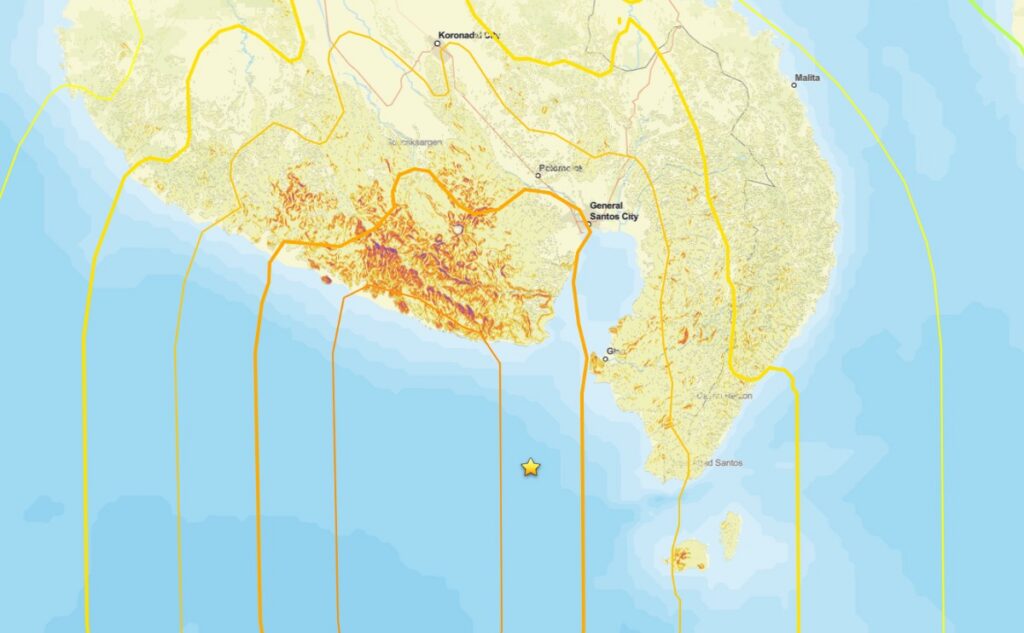
The USGS Pager site is the best source of information about potential landslide impacts, bearing in mind there is a high level of uncertainty. This estimates that the area exposed to landslides is at the high end of the “significant” scale and that the population exposed to landslides lies in the 1,000 to 10,000 people range. This is the Pager landslide hazard map:-
Initial Pager map of landslide hazard from the 8 June 2026 earthquake offshore Mindanao in the Philippines. Source: USGS.
The area with the highest level of landslide hazard is remote and rural, so we may not get good information from this area for a while.
The potential for liquefaction may be even more serious, with a broad swathe having a high level of hazard:-
Initial Pager map of liquefaction hazard from the 8 June 2026 earthquake offshore Mindanao in the Philippines. Source: USGS.
One final point to note is that the Philippines is just entering the typhoon season. Fortunately, Mindanao is sufficiently far south to be away from the main typhoon zone. However, these storms are so large that they can bring very heavy rainfall – see for example Typhoon Bopha in 2012. A similar event this year could have very significant consequences.
BEIJING, June 7 — China held a “law enforcement operation” in waters east of Taiwan following recent talks between Japan and the Philippines to draw a boundary there, state media reported yesterday.Tokyo and Manila said last month they would start formal talks “to delimit the maritime boundary” of an economic zone and continental shelf between them, angering Beijing.China, which asserts Taiwan is part of its territory, called the talks “illegal” and has claimed e
BEIJING, June 7 — China held a “law enforcement operation” in waters east of Taiwan following recent talks between Japan and the Philippines to draw a boundary there, state media reported yesterday.
Tokyo and Manila said last month they would start formal talks “to delimit the maritime boundary” of an economic zone and continental shelf between them, angering Beijing.
China, which asserts Taiwan is part of its territory, called the talks “illegal” and has claimed exclusive control over the waters concerned.
Yesterday, Beijing’s transport ministry organised maritime police from coastal provinces Fujian and Guangdong to “conduct a special maritime traffic law enforcement operation in waters east of Taiwan Island”, state news agency Xinhua said.
The report did not give details on the operation, including how long it lasted or whether it was still ongoing, and it did not say whether maritime police dispatched ships to the area.
The operation was “a necessary action taken against Japan and the Philippines’ unilateral announcement they would start ‘negotiations on delimiting a maritime boundary’” near Taiwan, Xinhua added.
Taiwan said Wednesday it should be consulted on the Japan-Philippines talks.
Manila and Tokyo’s shared grievances over Chinese maritime territorial claims have seen them draw increasingly close in recent years.
Japan and China are in territorial and economic disputes in the East China Sea, where coast guard ships from both sides routinely stage tense standoffs.
Beijing has meanwhile deployed navy and coast guard vessels in the South China Sea, in a bid to bar the Philippines from strategically important reefs and islands, leading to a string of confrontations. — AFP
It is now clear that more than half the fatalities from last week’s earthquake in the Philippines were caused by landslides.
In the areas of the Philippines affected by the 8 June 2026 M=7.8 earthquake offshore Mindanao, operations have shifted from rescue to recovery. Inquirer has an interesting report about information provided by an official from the Office of Civil Defense (OCD) today. The death toll has risen to 65, but a further 36 people are missing. There is now no prospect of t
It is now clear that more than half the fatalities from last week’s earthquake in the Philippines were caused by landslides.
In the areas of the Philippines affected by the 8 June 2026 M=7.8 earthquake offshore Mindanao, operations have shifted from rescue to recovery. Inquirer has an interesting report about information provided by an official from the Office of Civil Defense (OCD) today. The death toll has risen to 65, but a further 36 people are missing. There is now no prospect of their having survived. The report notes that:
The people reported to be missing were likewise due to earthquake-induced landslides, he further noted.
Asked whether there were still any signs of life among the locations of the reported missing persons, Alejandro pointed to Jose Abad Santos town in Davao Occidental.
“One of the areas there, I think, the team has already pulled out or called off the search and rescue because it’s immense. It was a mountain that really came down, so it’s very hard,” he explained.
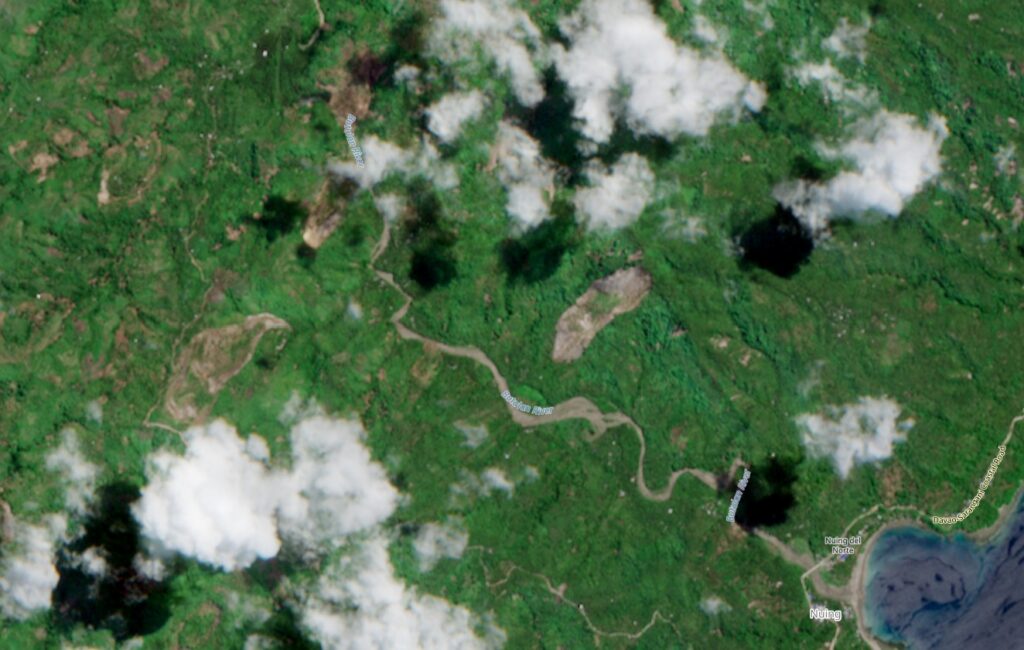
There is now a good Sentinel 2 image, collected on 14 June 2026, showing the area affected by the earthquake. There are some fascinating areas. Thus, for example, this image is centred on [5.63777, 125.45305]:-
Sentinel 2 image dated 14 June 2026 showing landslides triggered by the Mindanao earthquake.
There are at least two, and maybe three, large (>500 m long) landslides in this image, and a host of other failures too. Meanwhile, to the north, centred on [5.75674, 125.55459] we have this:-
Sentinel 2 image dated 14 June 2026 showing landslides triggered by the Mindanao earthquake.
To date, I have seen reports of 17 confirmed fatalities in landslides, plus the 36 missing, so at least 53 of the 101 fatalities are from landslides. However, it is likely that there are some that I have yet to track down.
A green fireball that came from space was captured on camera, briefly illuminating an erupting volcano in the Philippines -- making for spectacular footage.
[Read More]
A green fireball that came from space was captured on camera, briefly illuminating an erupting volcano in the Philippines -- making for spectacular footage.
Leo Cloma posted a photo:
FERNANDO AMORSOLO (1892 - 1972)
Baguio Trail
signed and dated 1940 (lower left)
oil on canvas
18" x 23" (46 cm x 58 cm)
PROVENANCE
Acquired directly from the artist
Indeed, Baguio Trail showcases another remarkable feature of Fernando Amorsolo’s oeuvre: the painstakingly detailed foreground, where every element receives meticulous attention. Simultaneously, the background appears shrouded in a thick mist, with each feature blending with the shadows. With his mast
signed and dated 1940 (lower left)
oil on canvas
18" x 23" (46 cm x 58 cm)
PROVENANCE
Acquired directly from the artist
Indeed, Baguio Trail showcases another remarkable feature of Fernando Amorsolo’s oeuvre: the painstakingly detailed foreground, where every element receives meticulous attention. Simultaneously, the background appears shrouded in a thick mist, with each feature blending with the shadows. With his masterful strokes and exemplary use of color, this piece breathes with life. The distinct mountain air permeates the scene, almost palpable and perceptible to viewers, as if they were looking out a window.
Amorsolo’s masterpieces capture the light and colors he observed during his travels to far-flung provinces. Witnessing the grandeur of the Philippine landscape with his own eyes enabled him to capture its hues and tonal variations with precision in his canvases, as well as to create authentic representations of Philippine topography, people, and daily life. Moreover, his deep understanding of color placement, shadows, and highlights further enhances the realism of his work.
The Cordilleras, especially Baguio City, served as both a favorite retreat and a frequent subject for Amorsolo. The mountain scenery, often depicted in his paintings, not only showcases its natural beauty but also provides a picturesque backdrop for the hardworking rural folk he often portrayed, emphasizing the harmony between nature and Filipino life.
This 1940 piece, painted a few years before the Japanese occupation, undeniably captured the essence of a peaceful Philippines, a time of simplicity and grace. The maestro depicted a group of people, perhaps a family, on a mountain trek. They were carrying big baskets containing their belongings–or products to sell–as they traversed the rocky and steep mountainside. The sun is high up in the sky, but the altitude and the trees around neutralize the heat.
The rise of modernism posed as one of the greatest threats to Amorsolo’s career. As many artists shifted to abstraction and abandoned the Amorsolo school of art, collectors’ tastes also changed, and his market gradually declined. Subsequently, many people criticized and made harsh remarks about him and his work. Still, the maestro persisted in his artmaking and stayed true to his light and palette for as long as he could hold a paintbrush, a testament to his perennial artistic prowess and dedication to the arts. (Jessica Magno)
STARTING BID: ₱ 4,600,000
Lot 105 of the Leon Gallery's
Spectacular Mid Year Auction 2026
Saturday, June 13, 2026
G/F Eurovilla 1, Rufino corner Legazpi Street, Makati City
For more information and to place an online bid, please see leon-gallery.com and leonexchange.com
Nancy, a Filipino domestic worker in Hong Kong, squints her eyes for the camera as her right arm holds her employers’ younger daughter tight. The toddler beams, legs thrown around her nanny’s hips. “My baby,” Nancy sobs as she scrolls through old pictures with one hand, while dabbing her wrinkled face with a crumpled white tissue with the other.
Migrant domestic worker Nancy says she lost her job after having a heart attack. Photo: Raquel Carvalho/HKFP.
When she started working for the fa
Nancy, a Filipino domestic worker in Hong Kong, squints her eyes for the camera as her right arm holds her employers’ younger daughter tight. The toddler beams, legs thrown around her nanny’s hips. “My baby,” Nancy sobs as she scrolls through old pictures with one hand, while dabbing her wrinkled face with a crumpled white tissue with the other.
Migrant domestic worker Nancy says she lost her job after having a heart attack. Photo: Raquel Carvalho/HKFP.
When she started working for the family, the girl in the photo had not yet been born. Nancy was there for every milestone – from her first tentative steps to the day she left for university in England.
💡HKFP grants anonymity to known sources under tightly controlled, limited circumstances defined in our Ethics Code. Among the reasons senior editors may approve the use of anonymity for sources are threats to safety, job security or fears of reprisals.
“I couldn’t take longer holidays because she would often get sick while I was away,” recalled Nancy, whose name has been changed due to ongoing legal claims. “I sometimes even put her before my own children.”
In Hong Kong, workers like Nancy are legally required to live in their employers’ homes, where they often work excessive hours and only have one day off per week. But for the most part, Nancy said, she was treated “like family.”
Nancy, a domestic worker from the Philippines, worked for her Hong Kong employers for over two decades. Photo: Raquel Carvalho/HKFP.
Everything changed in 2024. While helping to fold a bed, she felt a sudden pressure around her chest. Nancy stopped for a few seconds, massaged it, and carried on working: “I wasn’t feeling good, but I tried to ignore it.”
A few days later, after cleaning up piles of dust and hanging fresh curtains, Nancy started to feel more pain and found it hard to breathe.
It seemed as if an invisible hand was squeezing her heart. She finished work and took the subway to Admiralty, then a taxi to a public hospital in Wan Chai, where tests revealed that she had suffered a heart attack.
After telling Nancy she needed surgery, doctors contacted her employer, who claimed she no longer worked for them, and there was nothing they could do for her. Under the harsh light of her hospital room, Nancy was stunned. “I cried so much that day,” she said, noting that she had not even been served with a termination letter.
Hong Kong is home to over 377,000 migrant domestic workers – most of whom are from the Philippines and Indonesia. Photo: Raquel Carvalho/HKFP.
Interviews with 14 migrant domestic workers from the Philippines and Indonesia diagnosed with critical illnesses in Hong Kong, Singapore, Taiwan, and Malaysia show how sick migrant women are often fired – sometimes illegally – or coerced into resigning.
While some are pushed into shelters or face salary cuts, most are forced to return home. For many, that means losing access to public medical care in the countries where they worked, cutting them off from more sophisticated treatments that could prolong and even save their lives. Three of the women we interviewed have passed away in recent months.
‘Almost like a death sentence’
While comprehensive data is scarce, HKFP compiled official records along with statistics from five non-profits and informal support groups in Hong Kong, shedding light on an underreported issue that has rarely been addressed by authorities either in the destination or countries of origin. Analysed data suggests that, in Hong Kong alone, over 700 migrant women faced serious illnesses such as cancer and heart disease in the past five years. At least 245 have died during the same period.
“[A] lot of workers who are diagnosed with a serious illness are terminated by their employer. Technically, it’s illegal, it’s potentially disability discrimination.”
Rachel Li, Help for Domestic Workers
A stocky woman with thick, short hair, Nancy fights back tears when she recalls that the couple who employed her, a wealthy businessman and a banker, never visited her or showed any concern during the five nights she was hospitalised. According to a spokesperson for Hong Kong’s Labour Department, employers have the obligation to provide free medical treatment to their foreign domestic workers, irrespective of whether the illness or injury is work-related.
Nancy left the hospital with a warning that she should undergo immediate surgery, as a blood clot could trigger another heart attack. More vulnerable than ever, she felt that she could not return to her home of two decades. Instead, Nancy went to a boarding house – cheap accommodation used by migrant workers – in Wan Chai and then to the Labour Department to file a claim against her employer.
Rachel Li, head of case management and research at the Hong Kong charity HELP for Domestic Workers, says that many domestic workers are wrongfully fired after receiving a serious diagnosis. Photo: Raquel Carvalho/HKFP.
In Hong Kong, wrongfully dismissed migrant women have legal recourse, but it can be an uphill battle. “The issue we see is that a lot of workers who are diagnosed with a serious illness are terminated by their employer[s]. Technically, it’s illegal, it’s potentially disability discrimination,” said Rachel Li, head of case management and research at the Hong Kong charity HELP for Domestic Workers.
According to the city’s regulations, an employer is prohibited from terminating the contract of an employee on their paid sick day, unless it involves serious misconduct. In cases where such protection does not apply, the only other piece of legislation migrant workers can turn to is Hong Kong’s Disability Discrimination Ordinance, which states that it is unlawful to fire an employee on the grounds of their disability, including an illness.
While labour claims cover only contract breaches such as unpaid wages and sick leave, a successful discrimination case can yield higher compensation. “But filing a disability claim is an extremely long process,” Li noted, and eventual compensation may take years.
Driven by poverty and lack of job opportunities back home, thousands of women from Indonesia and the Philippines arrive every year in Hong Kong. Photo: Raquel Carvalho/HKFP.
Even if a worker is wrongfully dismissed and their claim is legitimate, they lose their visa status as well as discounted access to public health care in the city. Exceptions are made on a case-by-case basis. “We’ve had so many clients [with] heart problems or cancer or other forms of serious illness who are stuck in Hong Kong because they have a claim, but then they cannot access health care,” Li said. “Then their situation deteriorates. It’s almost like a death sentence.”
Fired over diagnosis
From January 2019 to August 2025, HELP, one of the local non-profits that contributed to HKFP’s database, supported 62 women facing a range of health problems. At least 13 women were wrongfully dismissed or fired as a consequence of their diagnosis.
According to records, only five filed discrimination complaints. Li said that, even when workers are unlawfully terminated, a significant number settle their cases out of court and many choose not to pursue claims due to financial reasons.
Chloe Martin is a programme manager at the non-profit Stop Trafficking of People (STOP). Photo: Raquel Carvalho/HKFP.
Chloe Martin, programme manager at local non-profit Stop Trafficking of People (STOP), agreed that “the process of seeking redress can come at a high personal cost.”
Martin said the cases involving medical care support were too many to count, adding that STOP was “regularly approached by migrant domestic workers for advice [about] not being allowed to take time off when sick, having their wages unpaid or deducted more than the permitted 20 per cent for sick leave.”
In May last year, Siti Kodijah, a domestic worker from Indonesia in Hong Kong, could barely move her hands or legs. She did not know where the pain was coming from. Siti asked her employer to see a doctor, but instead of comforting words, she claimed she got scolded.
Siti Kodijah returned to Indonesia last year, after being diagnosed with Lupus in Hong Kong. Photo: Raquel Carvalho/HKFP.
With the help of one of her employer’s relatives, the 43-year-old was sent to the hospital in an ambulance the following day. After being diagnosed with Lupus – an autoimmune disease that can cause fatigue, joint pain, skin issues, and affect major organs – she lost her job.
Forced into a shelter, Siti filed a labour claim against her employer. By August, she was on a plane back home, having settled her case for HK$7,000. “It basically just covered my return ticket, but I could not get more medical care in Hong Kong,” she said.
Her husband, daughter, sister, and nephew collected her at Jakarta’s airport, where she arrived in a wheelchair. “I’m so happy that she is here with us now,” said Siti’s 17-year-old daughter, who dreams of becoming a mechanical engineer.
Siti Kodijah (right) and her daughter meet at Soekarno-Hatta International Airport, near Jakarta, in August 2025. Photo: Raquel Carvalho/HKFP.
Siti Kodijah (in a wheelchair) arrives from Hong Kong at Soekarno-Hatta International Airport, near Jakarta, Indonesia, in August 2025. Photo: Raquel Carvalho/HKFP.
With her husband only working as a part-time delivery driver, Siti worries about her health and her daughter’s future. “Perhaps she will get a job in Japan as a factory worker,” Siti said. “But if it’s as a helper, I won’t let her go.”
Begging to remain employed
Some domestic workers reach private agreements with their employers. HKFP spoke with one Filipino woman who received chemotherapy treatments for breast cancer while continuing to work without a salary for more than three years. “It’s OK because I was allowed to stay in Hong Kong,” the 52-year-old said. “If I chose to leave, who was going to employ me with this problem?”
Others in Hong Kong reported not being allowed to attend medical appointments during weekdays or take sick leave, which led in some cases to postponing and even forgoing medical tests and treatments.
For migrant domestic workers in Hong Kong, Sunday is often their only weekly day off. Photo: Raquel Carvalho/HKFP.
Nicole, a 42-year-old Filipino migrant woman who was diagnosed with breast cancer in 2024, said that her employer attempted to break her contract while she was undergoing treatment. “I knelt down, begging her not to cancel my visa,” she recalled.
A soft-spoken woman who requested that her real name be withheld for fear of losing her job, Nicole has tried to hide the toll that the illness has taken on her from everyone, including her employer and her family back home. Concealing the traces of eight cycles of chemotherapy, she often wears a short, light-brown wig that frames her small face. In all her Facebook photos, Nicole poses with a grin.
“I knelt down, begging her not to cancel my visa.. Our family is so poor, I would not be able to afford treatment, even in the Philippines.”
NICOLE, DOMESTIC WORKER
She has been able to maintain her contract by doing all her work chores as usual, sometimes with no food provided. She has also attended her medical appointments and treatments alone.
On a late winter afternoon, HKFP accompanied Nicole to a clinic in Kowloon, where she was due for a breast scan. Nicole was wearing a red sweatshirt and tracksuit bottoms, with a knit black beanie covering her wig. After elbowing her way into a commercial building, she patiently waited for the lift that took her to a clinic with a bright white reception counter. The hardest part, Nicole said – eyes fixed on her hands – was not having to bear it all by herself, but her employer’s constant negative comments.
On her way out of the clinic, all she could think about was rushing back home. “I really need to keep my job,” she explained. “Our family is so poor, I would not be able to afford treatment, even in the Philippines.”
Dozens of sick domestic workers in the city have turned to the Filipino Migrants Cancer Support Society, a community group in Hong Kong that organises sharing sessions, provides food, and other forms of support. They handled 211 cases from January 2012 to May 2026 – most of which were recorded in the past five years. According to their estimates, less than 10 per cent received full support from employers during diagnosis and treatment, and at least 55 women have died since reaching out.
Janice Valencia (second from the right) is a domestic worker and chairperson of the community group Filipino Migrants Cancer Support Society in Hong Kong. Photo: Raquel Carvalho/HKFP.
“Not all employers are bad. But we see many workers getting fired or being treated unfairly when they are very desperate,” said Janice Valencia, a domestic worker and chairperson of the group.
Research suggests that employers in Hong Kong support the idea that migrant domestic workers should have the same social services as residents. In a recent study by social enterprise Migrasia, only 27 per cent of employers disagreed or strongly disagreed with that.
The group said it received help requests from more than 70 migrant workers across Asia and the Gulf, who faced serious illnesses or injuries, over the past five years.
Employers struggle for alternatives
Some employers do want to support their domestic workers, but they often have a hard time finding workable solutions.
Mary, whose name has been changed, said that when she was diagnosed with stage 3 Hodgkin’s lymphoma in 2022, a form of blood cancer, her employers worried about how to support her while both worked full-time and had a nine-year-old boy to look after.
“They felt very sorry for me, but of course they were concerned about their child too,” she said.
Mary said that her Hong Kong employers tried to support her and let her stay in the city to receive treatment before returning to the Philippines. Photo: Raquel Carvalho/HKFP.
After reaching out to a church-run organisation in the city, she suggested moving to a shelter. Her employers agreed to let her live outside, which is illegal in Hong Kong, and they kept her work contract, so she could continue receiving medical health care in the city. “They made a big decision with their heart… I know it was also hard for them,” she said.
While going through treatment in Hong Kong, Mary once met her employer near an MTR exit and saw how much she was struggling. “I used to be the one reminding her to brush her hair before leaving for work,” she said, smiling affectionately.
By the end of the year, Mary had 12 rounds of chemotherapy and five scans. She then agreed to break her contract and returned to the Philippines.
Speaking from the kitchen of her uncle’s house in a quiet neighbourhood in Davao City, Mindanao, Mary said she got about 20,000 Philippine pesos (HK$2,540) from the Philippine government. Although she was supported by various relatives, Mary went for months last year without receiving the treatment she needed, due to financial reasons.
“My chemo drugs are not available in [Davao City’s public hospital], and if I buy those drugs outside, it’s very expensive. I can’t afford it,” she said in November. Each vial costs about 9,800 Philippine pesos (HK$1,245). Doctors ordered six rounds of chemo, with two vials per session, which corresponded to about HK$14,940 in total.
Mary received treatment in Davao City, Mindanao, after returning to her home country. Photo: Raquel Carvalho/HKFP.
Mary, a former migrant domestic worker, holds the phone she used in Hong Kong, where she was diagnosed with cancer. Photo: Raquel Carvalho/HKFP.
Mary eventually moved to a boarding house to be near the hospital while receiving radiation therapy, but her condition started worsening. “I lost weight and can’t eat properly… I don’t have a taste for any food,” she said in a text message in February. She also described an episode when she only remembered falling asleep for an afternoon nap and then waking up in an emergency room.
On April 6 this year, she passed away. Her family printed a large poster of Mary in a white blazer, short-haired and with a broad smile, her bust framed by white and purple orchids, a candle and a dove, announcing her “sudden passing”. The funeral service took place 10 days later.
Despite the challenges she faced, Mary never once blamed her Hong Kong employers. “[They] did what they could,” the 48-year-old said.
Indonesian domestic workers gather on their day off in a park. File photo: Robert Godden.
“Migrants often have poorer outcomes in terms of recovery from cancer,” scholars Margo Turnbull and Ivy Wu wrote in a paper published last year. In places like Hong Kong, they added, “relatively little is known about the long-term health needs of these women as they age or if they are diagnosed with serious illnesses.”
There were 377,200 migrant domestic workers in Hong Kong as of the end of October, according to an Immigration Department spokesperson. About 55 per cent hailed from the Philippines, 43 per cent from Indonesia, and the rest from countries including India, Thailand, and Sri Lanka.
Zivya Syifa Husnayain, vice-consul for information and sociocultural affairs at the Indonesian Consulate General in Hong Kong, said that, from 2021 to 2025, the consulate received over 100 reports annually of domestic workers facing illness. About 40 passed away annually due to “various causes while working as a foreign domestic worker.”
A domestic worker protest. File photo: Tom Grundy/HKFP.
She noted that the consulate regularly organises events to explain their rights. “Our foreign domestic workers in Hong Kong are relatively better protected in terms of healthcare compared to their counterparts in other parts of the world,” she said.
The Filipino authorities did not respond to repeated requests for comment.
Singapore: Sent home at a moment’s notice
Long working hours in dual-salary households, limited child care options and ageing populations have exacerbated the need for migrant workers. But despite providing essential care, foreign domestic workers in cities such as Hong Kong and Singapore still lack the protection afforded to other residents. They remain legally tethered to a single employer, and barred from gaining permanent residence.
Singapore. File photo: Tom Grundy/HKFP.
In Singapore, one of the world’s wealthiest cities, migrant domestic workers who face critical illnesses are often fired with no way to fight back.
“Employers are able to cancel their work permits and send them home at a moment’s notice,” said Jaya Kumar, senior manager of research and advocacy at Singapore-based charity Humanitarian Organisation for Migration Economics. “Migrant domestic workers do not have recourse if they have been dismissed because they are sick,” she noted.
As of June 2025, official figures showed there were 308,700 foreign domestic workers in the city-state. Most of them were from Indonesia, the Philippines, and Myanmar. For these women, usually their families’ sole breadwinners, recruitment debts and low pay often leave little room to save. Singapore does not have a minimum wage for foreign domestic workers, while Hong Kong has recently increased it to HK$5,100 per month.
Catherine Ventic, 47, worked for a family living in a penthouse in Singapore for over a year. She felt the first symptoms in August 2022, when she started having what she thought was “heavy menstruation”. After seeing two doctors who said it was a hormonal issue, she was advised to get a Pap smear, a test used to screen for cervical cancer.
Catherine Ventic, a former domestic worker in Singapore, has struggled to make ends meet since returning to the Philippines. Photo: Raquel Carvalho/HKFP.
During a medical examination in 2023, she was sent to the emergency services of the Singapore General Hospital. In three days, she was diagnosed with cervical cancer.
“I was heartbroken. I knew that Singapore is a bit advanced and [thought] I would have been taken care of if I stayed there.”
CATHERINE Ventic, DOMESTIC WORKER
Ventic said that her employers worried about the medical costs they would have to incur, despite having medical insurance. Employers in Singapore are required to purchase hospitalisation insurance for foreign domestic workers that covers at least S$60,000 (HK$370,000) per year. But without medical subsidies, this ceiling can be quickly breached, and outpatient costs such as chemotherapy are not covered.
Catherine Ventic was forced to return to Cebu Island, in the Philippines, after being diagnosed with cervical cancer in Singapore. Former migrant women often face long journeys to reach large hospitals. Photo: Raquel Carvalho/HKFP.
Ventic was given 7,000 Singaporean dollars (HK$42,586) and a plane ticket back home. “I’m lucky that my employer gave me some money because there are others who are sent home without even a cent,” the single mother of two said. But “I was heartbroken. I knew that Singapore is a bit advanced and [thought] I would have been taken care of if I stayed there.”
Explore the immersive 360-degree video on YouTube.
Without any savings, Ventic knew that the amount of money she was given would not be enough to cover her treatment and expenses back home. “I respected her decision to send me home, but in the back of my mind, I was so worried.”
Catherine Ventic. Photo: Raquel Carvalho/HKFP.
Catherine Ventic still has cash and cards from her time as a domestic worker in Singapore. Photo: Raquel Carvalho/HKFP.
With the support of friends from Singapore, together with assistance from the Filipino government and a local congressman, Ventic was treated in Cebu City, more than a four-hour drive from her home on the island’s southeastern coast. Her latest biopsy came back negative, but she did not finish the six-month course of oral chemotherapy prescribed by doctors due to financial reasons.
Ventic now lives with her daughter, granddaughter and other relatives in her family home in Cebu, where she runs a small corner shop from her patio, while juggling a job as a social media manager. She also has a small online ticketing business, takes occasional food orders, and makes bouquets.
Catherine Ventic, a single mother of two, holds a photo of her eldest daughter taken to mark her university graduation in 2017. Photo: Raquel Carvalho/HKFP.
In recent months, Ventic noticed bleeding again. Already stretched from paying her youngest daughter’s university fees, she has put off a medical appointment until she has saved enough. “There are so many bills to pay,” Ventic said.
Robina Navato, from the Philippines, was also diagnosed with cervical cancer while working in Singapore in 2023. When she realised that she had no option but to return home after nearly three decades, Navato feared she could not sustain herself. “I didn’t think that my employers would look after me, and I also wanted to be close to my family,” she said. But “I hadn’t saved enough and, in the Philippines, cancer is for rich people because the treatment is very expensive.”
Robina Navato, from the Philippines, was diagnosed with cervical cancer while working in Singapore in 2023. Photo: Raquel Carvalho/HKFP.
Navato, who has recently gone through another cycle of chemotherapy treatments, has received support from fundraising initiatives and friends in Singapore. She also runs a small corner shop, which covers her daily expenses. But she worries about others who return home critically ill.
Explore the immersive 360-degree video on YouTube.
Migrant women are often from rural parts of their home countries, facing journeys of hours or days to reach large hospitals. Many cannot afford transport, accommodation, or food. Even when they have access to public healthcare and qualify for discounted rates, former migrant workers are then left to navigate strained systems that sometimes lack the medication and specialists they need.
Robina Navato runs a small corner shop to cover her daily expenses while she undergoes treatment. Photo: Raquel Carvalho/HKFP.
Robina Navato used to volunteer on her days off in Singapore, helping other domestic workers, and now runs TikTok live sessions. Photo: Raquel Carvalho/HKFP.
“[The government] always says that migrant domestic workers are the modern heroes of the Philippines, but when we get sick, we don’t know where to get help,” Navato said, adding that she only received 20,000 pesos (HK$2,540) in financial assistance from the government. Her initial radiation and chemotherapy treatment cost over 500,000 pesos (HK$63,554).
Unless their case goes viral, Navato said that most sick migrant workers are on their own. “I can go to the mayor’s office, but the queue will start at 4am. How many people are waiting for that help? Then they might give 1,000 (HK$127) or 2,000 pesos (HK$254). It happened to my sister.”
Explore the immersive 360-degree video on YouTube.
Back in the single-storey house that she shares with her 11-year-old grandson and a small dog, Navato is navigating physical pain while missing the life she left behind in Singapore, where she used to spend her days off volunteering in support of fellow workers.
Despite her illness, she has remained active within the community. When she has the energy, Navato goes live on TikTok and takes questions from domestic workers scattered across the globe. “I did not expect to come home like this,” she said. But “I try to respond and help as much as I can.”
What can be done?
The real number of domestic workers who get sick while working overseas and face infringements on their rights is impossible to ascertain, and the numbers available are only conservative estimates.
Many women never report their cases to the authorities or seek help from support groups due to fear of losing their jobs, lack of knowledge, language barriers, and even shame.
Data analysed by HKFP largely involved Filipino and Indonesian domestic workers, whereas cases involving smaller minorities in Hong Kong are even more likely to go unreported.
A group of individuals in Singapore launched the Criticare Fund for Migrant Workers to support those facing critical illness. “[It] provides immediate relief, but that in itself is not enough,” said Vincent Ng, the fund’s secretariat lead. “There needs to be some kind of policy reform that has subsidised rates for domestic workers.”
Migrant domestic workers in Singapore meet at Orchard Road’s Lucky Plaza shopping mall. Photo: Raquel Carvalho/HKFP.
Ng’s group, which estimates that over 400 female migrant workers under 49 years old develop cancer every year in Singapore, calls for improved insurance. They also advocate for the city-state to create an endowment fund for migrant workers.
Kumar said that “sometimes, employers step in to try and raise funds to cover medical costs, but this can only go so far.” She argued that “given the extensive contributions that migrant workers make to Singapore, they should be entitled to subsidies so that they have the chance to seek treatment – or part of it – in Singapore.”
A spokeswoman for Singapore’s Ministry of Manpower said the mandatory insurance provisions, which were increased in 2023, covered 99 per cent of inpatient and day surgery bills of migrant domestic workers in public healthcare institutions.
“We will continue to review this periodically as needs evolve,” she said, adding that it collaborates with local organisations to ensure affordable healthcare for foreign domestic workers.
Cynthia Abdon-Tellez is the founder of Bethune House, a shelter that has supported dozens of women facing critical illnesses and injuries. Photo: Raquel Carvalho/HKFP.
In Hong Kong, Cynthia Abdon-Tellez, the founder of Bethune House, a shelter that has supported dozens of women facing critical illness and injuries, urged authorities to ensure continued healthcare coverage for migrant workers while labour and legal disputes are pending.
More comprehensive insurance is also needed, as the current mandatory policy only covers work-related injuries. “It’s something for the government to consider whether they can subsidise employers because I don’t think it’s fair to shift the burden entirely on [them],” case manager Li said.
She noted there is a lack of alternatives for low and mid-income families in Hong Kong. When domestic workers face critical illness, Li said, “there’s absolutely no policy, no support for employers and workers… This is a policy-level issue that needs to be addressed.”
PathFinders, which supports migrant mothers in the city, released a report last year that suggested allowing employers to hire a temporary replacement while their original worker is on maternity leave. This idea, CEO Catherine Gurtin said, could also help to address some of the challenges faced by employers whose workers are seriously ill and need treatment.
A spokesperson for the Labour Department said the “government is firmly committed to protecting the rights and benefits of foreign domestic workers in Hong Kong.”
The spokesperson noted that there is a 24-hour hotline available to them and that they may seek free advice from the department’s branches across the city. Those “who suspect they have been denied or deprived of statutory entitlements are strongly encouraged to report their cases to the Labour Department,” he said.
Nancy has filed labour and discrimination claims against her employer after losing her job in Hong Kong. Photo: Raquel Carvalho/HKFP.
Nancy’s employer is currently being investigated by the Hong Kong authorities, while her labour and discrimination claims are still ongoing. Since having a heart attack, she has lived in two shelters run by non-profits and has yet to receive the surgery she needs. “I am so tired, I just want to go home,” she said from the airport before leaving Hong Kong this spring. Advocates in the city are continuing to pursue her cases.
After 22 years working for the same household, Nancy did not expect to be abandoned in her hour of need and so close to retirement. She flew out of the city with a small beige backpack sitting at her feet and countless memories from her time with her former employers.
Nancy, who is now looking after her husband, also struggling with chronic illness, has yet to come to terms with the fact that she lost a family: “Sometimes I still cry thinking about them.”
Reporting was supported by the International Women’s Media Foundation’s Kim Wall Memorial Fund. A shorter version of this piece was published in The Telegraph.
The Film Academy of the Philippines is being revamped to strengthen its core missions of campaigning for Philippine cinema at the Oscars and other awards ceremonies, as well as protecting film workers’ rights. Headed by filmmaker Paolo Villaluna, the academy was in Cannes last week to meet with film agencies, festivals, awards organisations and campaign […]
The Film Academy of the Philippines is being revamped to strengthen its core missions of campaigning for Philippine cinema at the Oscars and other awards ceremonies, as well as protecting film workers’ rights. Headed by filmmaker Paolo Villaluna, the academy was in Cannes last week to meet with film agencies, festivals, awards organisations and campaign […]
The Philippines defence minister was defiant on Friday after Beijing sanctioned him for what it termed “irresponsible remarks” as the two nations grapple over the disputed South China Sea.
Gilberto Teodoro as well as his spouse and child will be banned from entering China’s mainland, Hong Kong and Macau, an unnamed foreign ministry spokesperson said in an online statement on Thursday.
Philippines’ Secretary of National Defense Gilberto Teodoro delivers a speech as he attends the 23rd Shan
The Philippines defence minister was defiant on Friday after Beijing sanctioned him for what it termed “irresponsible remarks” as the two nations grapple over the disputed South China Sea.
Gilberto Teodoro as well as his spouse and child will be banned from entering China’s mainland, Hong Kong and Macau, an unnamed foreign ministry spokesperson said in an online statement on Thursday.
Philippines’ Secretary of National Defense Gilberto Teodoro delivers a speech as he attends the 23rd Shangri-La Dialogue summit in Singapore on May 31, 2026. Photo: Philippines’ Department of National Defense, via X.
It added that “organisations and individuals in China” will not be allowed to “engage in any transaction, cooperation or other activities with him and his spouse and child”.
The two countries have in recent years regularly dealt with flare-ups in tensions over the disputed South China Sea.
Beijing claims the strategic waterway nearly in its entirety, despite an international ruling that said its assertions are baseless.
In a statement early Friday, Teodoro said he had been sanctioned for “speaking truth”.
“Their own countrymen and the others under their control suffer far worse,” he said. “I will just keep doing my duty and uphold our nation in the face of the wickedness they are committing here and even in our seas.”
Manila reacted to the sanctions late Thursday by saying that “the Philippines views it as an unfriendly act that further complicates the bilateral relations”.
China regularly deploys navy and coast guard vessels to bar the Philippines from important reefs and islands in the area.
The Chinese statement said Teodoro’s rhetoric “undermines China’s legitimate interests and sabotages China-Philippines relations”, without specifying to which remarks it referred.
To date news reports suggest two fatal landslides with a combined toll of 17 people.
There are various news reports trickling in about the landslides triggered by the 8 June 2026 M=7.8 earthquake offshore Mindanao in the Philippines. As usual, the remote locations of many of the landslides means that the information is a bit hit and miss at this point.
To date, the most serious event appears to have occurred at a community called New Aklan, located in Glan, Sarangani. It appears that
To date news reports suggest two fatal landslides with a combined toll of 17 people.
There are various news reports trickling in about the landslides triggered by the 8 June 2026 M=7.8 earthquake offshore Mindanao in the Philippines. As usual, the remote locations of many of the landslides means that the information is a bit hit and miss at this point.
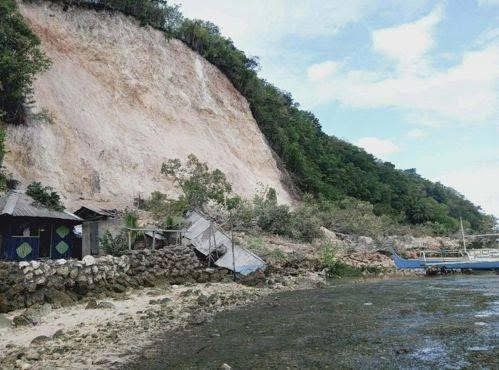
To date, the most serious event appears to have occurred at a community called New Aklan, located in Glan, Sarangani. It appears that New Aklan is at: [5.7705 N, 125.3356]. News reports indicate that 13 people were killed, although there are also indications of additional fatalities in this area.
A failure in a coastal cliff at Sitio Buhangin, Barangay Patuco, Sarangani following the 8 June 2026 earthquake near Mindanao. Image tweeted by Radyo Pilipinas.
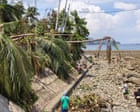
‘Coastal uplift’ exposes coral and kills marine life, as residents say shorelines extended by up to 200 metresA powerful earthquake that killed at least 61 people in the Philippines this week raised the seabed by as much as 2 metres (6.6ft), exposing coral and harming marine life, the country’s environment department has said.At least 40 people are still missing after the 7.8-magnitude quake off southern Mindanao island on Monday, according to updated tolls from the disaster agency. Continue rea
‘Coastal uplift’ exposes coral and kills marine life, as residents say shorelines extended by up to 200 metres
A powerful earthquake that killed at least 61 people in the Philippines this week raised the seabed by as much as 2 metres (6.6ft), exposing coral and harming marine life, the country’s environment department has said.
At least 40 people are still missing after the 7.8-magnitude quake off southern Mindanao island on Monday, according to updated tolls from the disaster agency.
Taiwan’s coast guard said Sunday it has deployed vessels “to respond appropriately” to a Chinese operation in waters east of the island democracy, which it said “violates international law”.
File Photo: Taiwan Presidential Office via Flickr.
It comes after Chinese state media reported Saturday that the “law enforcement operation” was in response to talks between Japan and the Philippines to draw a boundary in the affected waters.
China, which asserts Taiwan is part of its territory, c
Taiwan’s coast guard said Sunday it has deployed vessels “to respond appropriately” to a Chinese operation in waters east of the island democracy, which it said “violates international law”.
File Photo: Taiwan Presidential Office via Flickr.
It comes after Chinese state media reported Saturday that the “law enforcement operation” was in response to talks between Japan and the Philippines to draw a boundary in the affected waters.
China, which asserts Taiwan is part of its territory, called the talks “illegal” and has claimed exclusive control over the waters.
The Chinese ships have been monitored “throughout the entire process” and Taiwan “has deployed the necessary vessels to respond appropriately,” the Taiwanese coast guard said in a statement.
Taiwan said it had detected four Chinese government vessels departing from Xiamen port which had sailed outside Taiwanese restricted waters southwest of the island.
Taiwan’s coast guard dispatched more than five vessels “to assist with surveillance”.
The Chinese vessels were expected to arrive “in the relevant waters” on Sunday, the statement said, adding that “China does not enjoy any sovereign rights in the waters east of Taiwan”.
Tokyo and Manila said last month they would start formal talks “to delimit the maritime boundary” of an economic zone and continental shelf between them, angering Beijing.
On Saturday, Beijing’s transport ministry organised maritime police from coastal provinces Fujian and Guangdong to “conduct a special maritime traffic law enforcement operation in waters east of Taiwan Island”, state news agency Xinhua said.
The report did not give details on the operation, including how long it lasted or whether it was still ongoing, and it did not say whether maritime police dispatched ships to the area.
The Philippines flag. Photo: iSawRed/Unsplash.
The operation was “a necessary action taken against Japan and the Philippines’ unilateral announcement they would start ‘negotiations on delimiting a maritime boundary'” near Taiwan, Xinhua added.
Taiwan said Wednesday it should be consulted on the Japan-Philippines talks.
Manila and Tokyo’s shared grievances over Chinese maritime territorial claims have seen them draw increasingly close in recent years.
Japan and China are in territorial and economic disputes in the East China Sea, where coast guard ships from both sides routinely stage tense standoffs.
Beijing has meanwhile deployed navy and coast guard vessels in the South China Sea, in a bid to bar the Philippines from strategically important reefs and islands, leading to a string of confrontations.
Taiwan’s coast guard said Saturday that a Chinese survey vessel had joined a coast guard ship in waters around Pratas Island in the northern part of the South China Sea.
Territorial claims in the South China Sea. Photo: Wikicommons.
The Taiwanese coast guard said it was “the first observed instance of Chinese coast guard and survey vessels acting in coordination to provoke Taiwan”.
Taiwan controls Pratas but Beijing also claims the island, along with most of the strategic waterway.

 Login
Login