Normal view

  • ✇Eos
  • The 9 April 2026 landslide at Lamarain in Papua New Guinea Dave Petley
    Ten people were killed in a large landslide in Papua New Guinea triggered by heavy rainfall associated with Tropical Cyclone Maila. On 9 April 2026, a large landslide occurred at Lamarain in the Inland Baining LLG of Gazelle District in Papua New Guinea. The landslide was triggered by heavy rainfall associated with the passage of Tropical Cyclone Maila. Media reports indicate that ten people were killed by the landslide and that a further 18 people were injured. Baining is located at
     

The 9 April 2026 landslide at Lamarain in Papua New Guinea

17 April 2026 at 07:47
The landslide at Lamarain in Papua New Guinea

Ten people were killed in a large landslide in Papua New Guinea triggered by heavy rainfall associated with Tropical Cyclone Maila.

Image of a landslide partially covered with a transparent sand-colored overlay and the words “The Landslide Blog,” centered, in white

On 9 April 2026, a large landslide occurred at Lamarain in the Inland Baining LLG of Gazelle District in Papua New Guinea. The landslide was triggered by heavy rainfall associated with the passage of Tropical Cyclone Maila.

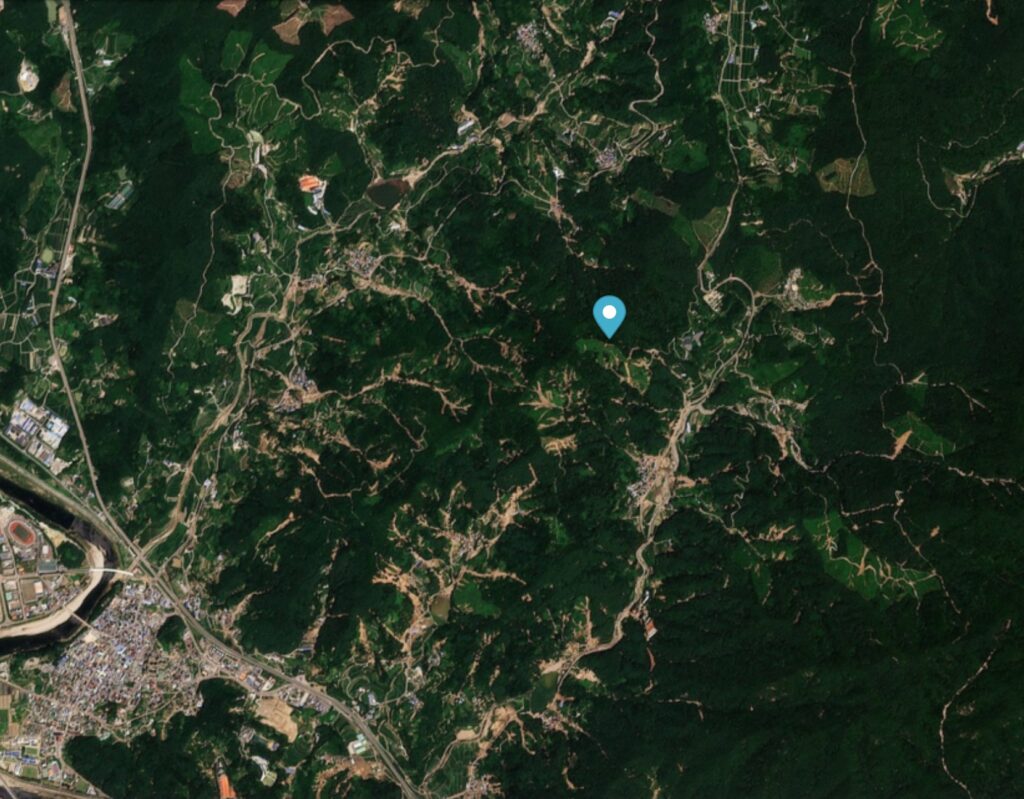
Media reports indicate that ten people were killed by the landslide and that a further 18 people were injured. Baining is located at [-4.2548, 151.7811], so I assume that this is the general area.

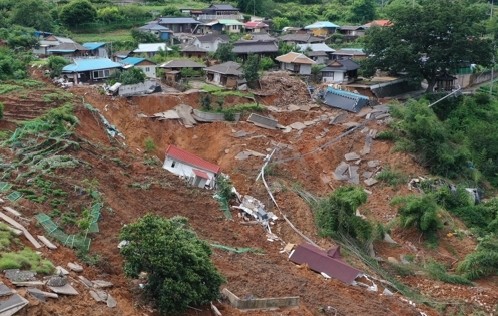
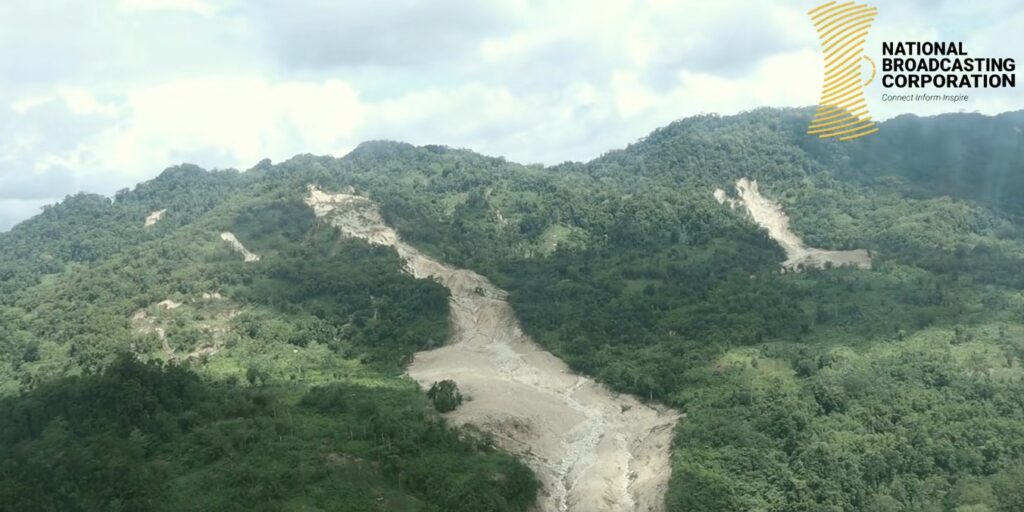
Gaining information about landslides in the remote areas of Papua New Guinea is very challenging – the terrain is rugged and there is a high level of civil turmoil. But the best source of information is on the Facebook page of NBC East Britain, which has posted a helicopter video of the aftermath. This is a still from that video:-

The landslide at Lamarain in Papua New Guinea
The landslide at Lamarain in Papua New Guinea. Still from a video posted to Facebook by NBC East New Britain.

There are several interesting aspects of this landslide. First, the failure appears to have initiated high on the hillslope in an area that has a mix of forestry and cleared areas. The source appear to be quite large and deep-seated. This has transitioned into a disrupted debris slide / avalanche with a substantial amount of entrainment.

Note also the multiple other landslides in that area, all fresh, suggesting that the intense rainfall was sufficient to drive widespread failures. It is interesting to note though that is event did not involve multiple shallow landslides that combined to create a channelised debris flow.

The Post Courier reports that the Lamerain landslide occurred in two phases, the first at 6 am on 9 April 2026 and the second 24 hours later. However, other reports suggest that it occurred on 12 April 2026, underlying the challenges of properly understanding landslides in Papua New Guinea.

Text © 2026. The authors. CC BY-NC-ND 3.0
Except where otherwise noted, images are subject to copyright. Any reuse without express permission from the copyright owner is prohibited.
  • ✇Eos
  • On the growth of research in landslides Dave Petley
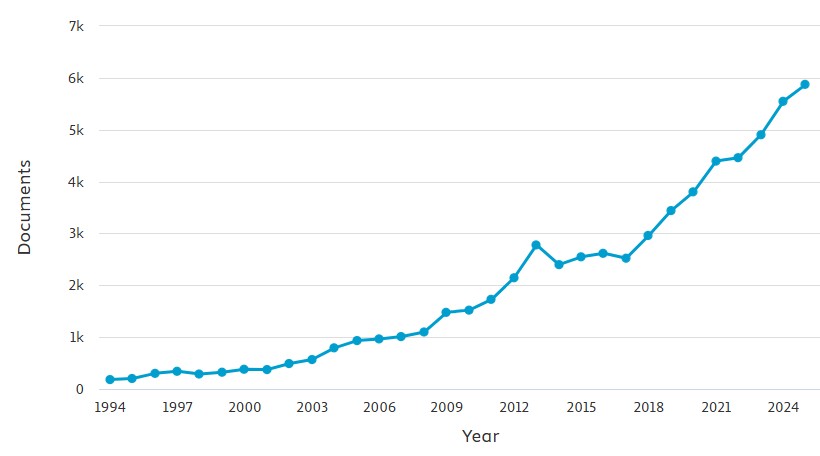
    Since 1994 there has been a 32 times increase in the number of research outputs with the keyword “landslide”. In a couple of weeks time, I have the pleasure of being one of the invited speakers at the Landslide Risk and Geoengineering (LaRGE) Conference in Queenstown, New Zealand. Ahead of that presentation, I’ve been using Scopus to look at the growth of research in landslides since 1994, the year that I submitted my PhD thesis. This graph, from Scopus, shows the number of research
     

On the growth of research in landslides

16 April 2026 at 06:57
The number of outputs using the keyword "landslide" in the period 1994 to 2025 inclusive, via Scopus.

Since 1994 there has been a 32 times increase in the number of research outputs with the keyword “landslide”.

Image of a landslide partially covered with a transparent sand-colored overlay and the words “The Landslide Blog,” centered, in white

In a couple of weeks time, I have the pleasure of being one of the invited speakers at the Landslide Risk and Geoengineering (LaRGE) Conference in Queenstown, New Zealand. Ahead of that presentation, I’ve been using Scopus to look at the growth of research in landslides since 1994, the year that I submitted my PhD thesis.

This graph, from Scopus, shows the number of research outputs per year that use the keyword “landslide”. It is simple and unfiltered:-

The number of outputs using the keyword "landslide" in the period 1994 to 2025 inclusive, via Scopus.
The number of outputs using the keyword “landslide” in the period 1994 to 2025 inclusive, via Scopus.

The extraordinary growth in productivity is clear – to put it into context, in 1994 the number of outputs was 182; in 2025, it was 5,875, a 32x increase. This is a remarkable improvement in the volume of our understanding of landslides, although it does not say anything about paradigm change.

It is interesting to look at some of the key publications for landslide research:-

The number of outputs using the keyword "landslide" for selected key publications in the period 1994 to 2025 inclusive, via Scopus.
The number of outputs using the keyword “landslide” for selected key publications in the period 1994 to 2025 inclusive, via Scopus.

The journal Landslides started in 2004 and has shown remarkable growth (although note it still represents a tiny proportion of the total outputs per year). There are also large increases in the journals Natural Hazards and Engineering Geology, and a smaller increase for journal Geomorphology. On the other hand, those journals that traditionally would have been associated with landslide research, such as QJEGH, Canadian Geotechnical Journal and Geotechnique, have remained essentially static over time.

I suspect that this represents a growth in the academic areas researching landslides, and in particular a diversification from geotechnical engineering to a much more broader range of research that encompasses people with an interest in geomorphology, remote sensing, geophysics and natural hazards.

There is one other element that is important here too, which is the growth of landslide research in China. This graph shows the same data as above but with China as the national affiliation of one or more author:-

The number of outputs using the keyword "landslide" and with an affiliation from China in the period 1994 to 2025 inclusive, via Scopus.
The number of outputs using the keyword “landslide” and with an affiliation from China in the period 1994 to 2025 inclusive, via Scopus.

The growth in landslide research productivity in China is explosive over the last ten years, and with 2,616 outputs in 2025, Chinese affiliated authors are now producing over 55% of the world’s landslide research. There is no doubt as to where the centre of gravity now lies in landslide science.

Text © 2026. The authors. CC BY-NC-ND 3.0
Except where otherwise noted, images are subject to copyright. Any reuse without express permission from the copyright owner is prohibited.

Landslides in Art Part 36:  The Great Landslide of 1664 of Runswick Bay on The day Village That Slipped into the Sea by “Jotter”

15 April 2026 at 07:10
The Great Landslide of 1664 of Runswick Bay on The day Village That Slipped into the Sea by "Jotter"

The Landslide Blog is written by Dave Petley, who is widely recognized as a world leader in the study and management of landslides.

Image of a landslide partially covered with a transparent sand-colored overlay and the words “The Landslide Blog,” centered, in white

I’ve not posted about Landslides in Art much in recent years – the most recent edition was almost two years ago – but loyal readers will know that this is a long running series of posts.

Anyway, I came across a page recently about the major landslide that struck the village of Runswick Bay in North Yorkshire. It includes a painting of the village with the above name, by an artist who signed themselves as “Jotter”. The painting is now in the collection of the Kirkleatham Museum:-

The Great Landslide of 1664 of Runswick Bay on The day Village That Slipped into the Sea by "Jotter"
The Great Landslide of 1664 of Runswick Bay on The day Village That Slipped into the Sea by “Jotter”. The painting is held by the Kirkleatham Museum.

Now, there is a twist in that the landslide actually occurred in 1662, not 1664!

Runswick Bay is a picture postcard village in North Yorkshire of the UK, located at [54.53356, -0.75015]. The coastal part of the village is built on landslide debris, and there has been some movement in recent decades. In the late 1990s a very large scheme was put in place to mitigate the ongoing movement.

This is a Google Earth view of the village:-

Google Earth view of Runswick Bay.

The Tees Valley Museums site describes the landslide of 1662, noting that there were two major failure events. It is very fortunate that no-one was killed. The village was essentially destroyed and then rebuilt to the south of the original site.

It is probably true to say that the painting by Jotter is not a classic, but it does capture some interesting aspects of the site. First, it appears that the morphology is that of an existing landslide mass – this was probably a reactivation rather than a first time failure. Second, the toe was actively eroding, so maybe the two phase failure involved a collapse at the toe, which then destabilised the mass upslope? This would fit the eyewitness reports. Finally, note the mass in the background, which is also the result of a series of failure events.

There are many other major landslides along this section of coast – it is a classic area of UK mass movement geology. And it is truly beautiful too – visit if you can.

Text © 2026. The authors. CC BY-NC-ND 3.0
Except where otherwise noted, images are subject to copyright. Any reuse without express permission from the copyright owner is prohibited.
  • ✇Eos
  • Wealth and land-cover change govern landslide fatalities on world’s mountains Dave Petley
    A new paper Fidan et al. (2026) demonstrates that wealth and the rate of land-cover change play a key role in determining the occurrence of fatal landslides in mountain areas. These factors are statistically more significant that precipitation and topography. A fascinating new paper (Fidan et al. 2026 – this paper is both open access and published under a Creative Commons licence – hurrah!) has just been published in the journal Science Advances that explores rates of land-cover (in the
     

Wealth and land-cover change govern landslide fatalities on world’s mountains

14 April 2026 at 07:12
The relationship between the land use - land cover change rate and the density of fatal landslides for mountain areas around the world.

A new paper Fidan et al. (2026) demonstrates that wealth and the rate of land-cover change play a key role in determining the occurrence of fatal landslides in mountain areas. These factors are statistically more significant that precipitation and topography.

Image of a landslide partially covered with a transparent sand-colored overlay and the words “The Landslide Blog,” centered, in white

A fascinating new paper (Fidan et al. 2026 – this paper is both open access and published under a Creative Commons licence – hurrah!) has just been published in the journal Science Advances that explores rates of land-cover (in the paper, the authors use the term land-use – land-cover) change as a factor in determining fatal landslides in mountains globally. I must admit to some degree of personal interest in this paper, although I am neither an autor nor a reviewer, as it brilliantly uses the dataset that Melanie Froude and I collated on global landslide fatalities (see Froude and Petley 2018). I’m delighted to see our data being used in this way (and please do contact me if you want a copy of the spreadsheet).

Fidan et al. (2026) explores a range of factors that might influence the occurrence of fatal landslides from the perspective of either increased vulnerability (poorer people may live in more vulnerable locations for example) or increased landslide likelihood (land-cover change might increase the likelihood of a landslide being triggered, for example).

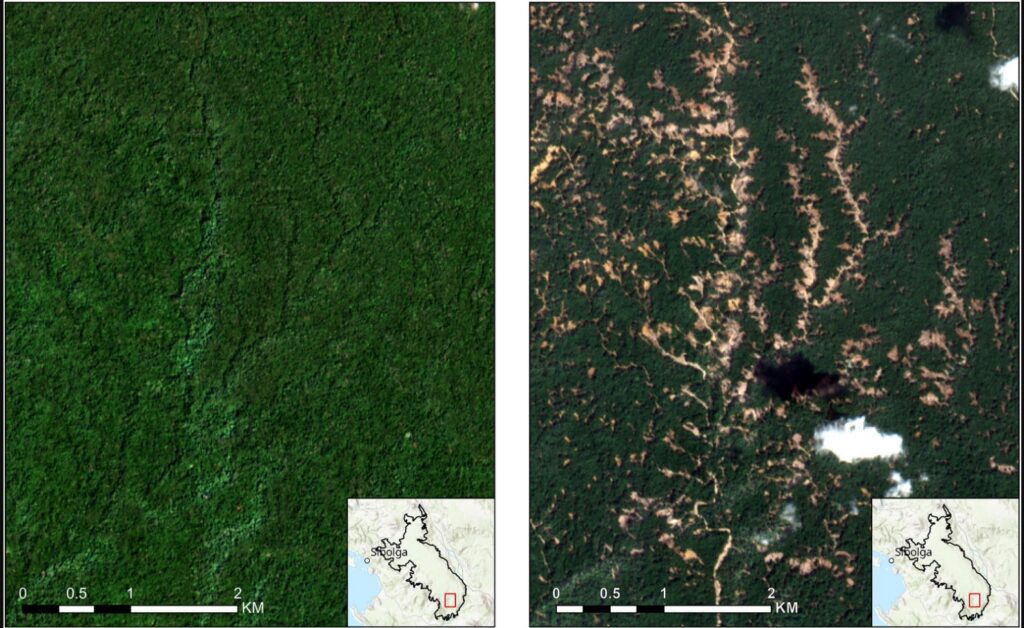
The fascinating result lies in land-cover change. The authors have looked at  approximately 60 years of land-cover changes in mountainous areas across 46 countries. Unsurprisingly, there is substantial change, especially in low- and lower-middle–income countries, often involving the loss of forest (which as a first order estimation, may buffer against slope failures), although the pattern is far more complex of course. Fidan et al. (2026) find that a key metric is the rate of change of land-cover, and that this is linked to the rate of population growth (perhaps unsurprisingly). Countries with high rates of population growth also show high rates of change of land-cover.

In many ways, the most interesting figure in this study is in the Supplementary Information. It is a complex diagram, but it’s worth more detailed analysis:-

The relationship between the land use - land cover change rate and the density of fatal landslides for mountain areas around the world.
The relationship between the land-cover change rate and the density of fatal landslides for mountain areas around the world. Figure from Fidan et al. (2026), published under a Creative Commons Licence.

The main map (A) shows mountain areas with high rates of land-cover change (orange), high density of fatal landslides (blue) or both (black). The left hand graph (B) shows the relationship between the landslide density and the rate of change of land-cover – here, higher rates of land-cover change are associated with a higher density of fatal landslides. The right hand graph is the same data as in (B), but with each point coloured according to the income level of the country. High income countries have a lower fatal landslide density. Thus, as the authors conclude, wealth and land-cover change appear to control fatal landslide density.

There is a really surprising element to this study, which I think requires more consideration. I think I should allow the authors themselves to express this finding, from the abstract:-

“Our statistical analyses show that land-use – land-cover changes have a substantially greater influence on the density of fatal landslides and landslide fatalities than physical factors such as topography and precipitation, especially in lower-income countries.”

As landslide researchers, we almost always default to topography and precipitation as being key in landslide occurrence. There are sound reasons for doing so. But statistically, the rate of land-cover change plays a more important role in mountain areas, especially in poorer countries.

This has (or should have) major implications for the way that we consider and manage landslide risk in such areas.

References

Fidan, S. et al. 2026. Wealth and land-cover change govern landslide fatalities on world’s mountains. Science Advances 12, eaec2739. DOI: 10.1126/sciadv.aec2739.

Froude M.J. and Petley D.N. 2018. Global fatal landslide occurrence from 2004 to 2016Natural Hazards and Earth System Science 18, 2161-2181. DOI: 10.5194/nhess-18-2161-2018.

Text © 2026. The authors. CC BY-NC-ND 3.0
Except where otherwise noted, images are subject to copyright. Any reuse without express permission from the copyright owner is prohibited.
❌