Even in the best case scenario, Canadians are set to pay $12 billion over the next 12 months due higher oil prices, a report by the Centre for future Work shows. Economist Jim Stanford said in the report that Canadians should fight the dominant narrative that these increased price pressures are a natural and inevitable side effect of the war in Iran.
“This is a lie intended to prevent Canadians from asking hard questions about why their living standards are being undermined by a far-off war
Even in the best case scenario, Canadians are set to pay $12 billion over the next 12 months due higher oil prices, a report by the Centre for future Work shows. Economist Jim Stanford said in the report that Canadians should fight the dominant narrative that these increased price pressures are a natural and inevitable side effect of the war in Iran.
“This is a lie intended to prevent Canadians from asking hard questions about why their living standards are being undermined by a far-off war that does not involve them,” he wrote in the report. “Prices for petroleum products have not shot up because of natural market forces. Events in the Persian Gulf are dramatically affecting our economy because of a policy choice, not laws of economic nature.”
The report projected that a lack of proper policy interventions will force Canadians to pay billions. The U.S. and Israel’s attacks on Iran led to the closing of the Strait of Hormuz which remains closed as of May 21.
Even if the Strait reopened immediately, Canadian consumers would pay an additional $12 billion over 12 months in direct higher fuel costs. If the Strait remains closed for three more months – approximately the amount of time it has been closed so far – Canadians would pay $30.6 billion in higher costs. Six more months, and Canadians pay $41.8 billion.
Canada is a net exporter of oil. As such, Stanford argues that Canadian oil prices don’t need to follow global trends too closely. However, these price shocks are occurring to line the pockets of big oil companies.
“They never waste a crisis,” Stanford said in an April webinar on oil prices. “Whatever the crisis of the moment is, it’s another reason to build a pipeline.”
Harnessing the profitability of the current crisis will increase profit margins for oil companies with devastating consequences for Canadian workers. In 2022, oil prices spiked in response to the Russian invasion of Ukraine. These price spikes were also criticized for being driven by profiteering rather than genuine market pressures.
In the subsequent years after the 2022 spike, the Bank of Canada raised interest rates to try and reign in inflation caused by higher oil prices. These measures pushed unemployment higher.
Labour and environmental groups are calling for a tax on the profits gleaned from rising oil prices to combat profiteering and serve the average Canadian. The Council of Canadians, 350.org Canada and the Alberta Federation of Labour have all called for a tax on oil companies’ war profits with the income being used to support Canadian households affected by the cost of living crisis.
Revenue from a tax on oil profits could also fund other forms of energy in Canada, Stanford noted in his report.
“Ultimately, the most certain way to reduce Canadians’ exposure to future volatility in oil prices will be to reduce the role of those products in the national energy system,” he wrote. “There are many reasons to support and accelerate the coming transition toward renewable and non-emitting sources of energy, including fulfilling Canada’s climate commitments and reducing energy costs. The consequences of the current oil price shock reinforce those motivations.”
A Guardian analysis reveals how most of 39 countries facing US entry restrictions are most vulnerable environmentally‘Every day it’s more barriers’: how the US is shutting out climate refugeesDonald Trump’s immigration crackdown is largely targeting people from the countries most vulnerable to displacement from climate-driven disasters, a Guardian analysis shows.As the Trump administration pushes policies to boost planet-heating fossil fuels, millions of people are being forced to flee their hom
Donald Trump’s immigration crackdown is largely targeting people from the countries most vulnerable to displacement from climate-driven disasters, a Guardian analysis shows.
As the Trump administration pushes policies to boost planet-heating fossil fuels, millions of people are being forced to flee their homelands due to storms, floods and droughts worsened by the climate crisis.
President Donald Trump is again seeking to boost the struggling U.S. coal industry, with an announcement expected Thursday to spend nearly $700 million to support coal-fired power plants and coal exports.
President Donald Trump is again seeking to boost the struggling U.S. coal industry, with an announcement expected Thursday to spend nearly $700 million to support coal-fired power plants and coal exports.
Research & Developments is a blog for brief updates that provide context for the flurry of news that impacts science and scientists today.
After more than half a century of Earth Days, one planetary challenge—climate change—threatens our planet more than ever.
In 1970, the year Sen. Gaylord Nelson (D-Wisc.) organized the first Earth Day events, the annual average concentration of carbon dioxide in the atmosphere was 326 parts per million. In 2025, it was 31% higher, at 427 parts p
“It may sound small, but it’s reshaping daily life.”
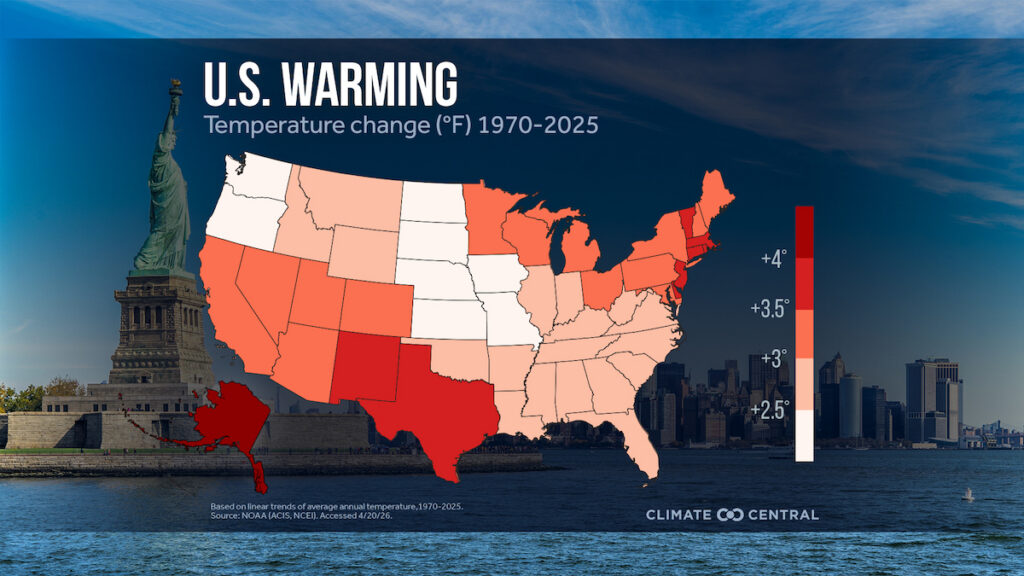
Changes in average annual temperatures in U.S. cities and states show the powerful effects of this increase in heat-trapping carbon dioxide. A new analysis, published today by climate research and communications nonprofit Climate Central, found that since 1970, all 50 states and 99% of major U.S. cities have warmed, with an average city-level increase of 1.6°C (2.9°F).
“It may sound small, but it’s reshaping daily life,” Shel Winkley, a meteorologist at Climate Central, said in a video released alongside the report.
On average, the 49 U.S. states analyzed in the report have warmed by 1.7°C (3.0°F) since 1970. The six states that have warmed the fastest since the first Earth Day are Alaska with a 2.4°C (4.4°F) increase, New Jersey and New Mexico with a 2.1°C (3.7°F) increase, and Delaware, Massachusetts, and Vermont with a 2°C (3.6°F). Trends for Hawaii, which were analyzed separately and not included in the national average, also showed statewide warming.
In 2025, the United States was on average 1.4°C (2.6°F) warmer than the 20th century average. The Paris Agreement, a legally binding global treaty, sets a goal to limit warming to 1.5°C (2.7°F) above preindustrial levels, though some scientists expect that the world has already entered the period of time during which this limit will be breached.
Warming is occurring much faster in some cities than in their respective states, or than the United States as a whole. Check out your city’s data in the Climate Central report. Credit: Climate Central, CC BY 4.0
Warming trends in the United States are most pronounced in the Southwest, where cities have warmed an average of 1.9°C (3.5°F) since 1970. And in some cases, cities are warming much faster than whole states. Three of the five cities that have warmed the fastest since 1970 are in the Southwest: Reno, Nev., with an increase of 4.4°C (7.9°F), Las Vegas, with an increase of 3.3°C (6.0°F), and El Paso, Texas, with an increase of 3.3°C (5.9°F).
The effects are evident at the national, state, and local levels. Temperatures have warmed in 240 of the 242 cities analyzed by Climate Central. Harrisonburg, VA and Monterey, CA were the only two cities analyzed that have not warmed since 1970.
The report highlights some good Earth Day news, however, and points out that solar and wind power generation is at an all-time high in the United States, accounting for 19% of the electricity generated in the country in 2025 despite those industries facing recent headwinds from the federal administration.
“Every fraction of a degree [of warming] that we prevent does matter, for our health, for our communities, and for the world that we’re passing on to the next generations,” Winkley said.
These updates are made possible through information from the scientific community. Do you have a story about science or scientists? Send us a tip at eos@agu.org.
There are over 283 million cars cruising the United States, and over 90 percent of them are still guzzling gas. Apart from the obvious environmental problems, fuel prices also continue to skyrocket thanks to the ongoing war in Iran. The average price for gas is currently around 33 percent higher than it was before the crisis, and there is little sign that those numbers are going down anytime soon.
The strain is forcing many drives to reconsider how they get around—and they’re getting creative
There are over 283 million cars cruising the United States, and over 90 percent of them are still guzzling gas. Apart from the obvious environmental problems, fuel prices also continue to skyrocket thanks to the ongoing war in Iran. The average price for gas is currently around 33 percent higher than it was before the crisis, and there is little sign that those numbers are going down anytime soon.
The strain is forcing many drives to reconsider how they get around—and they’re getting creative with it. In Georgia, a 30-year-old handyman is showing everyone how to properly adapt to uncertain times. According to a recent Reuters profile, Mali Hightower has retrofitted a discarded, bright pink Power Wheels Barbie Dream Camper with a two-gallon, one-piston engine for his shorter commuting needs.
“I drive this when I can,” Hightower said on May 19.
To get it going, a driver simply pulls the rip cord that’s attached to the former power washer engine. At less than four-feet-tall, the Dream Camper may not be the most comfortable ride for a full-grown adult,but it’s definitely cheaper. Hightower likely still prefers driving his 1996 Mercedes-Benz convertible, but with a full tank costing him around $90 right now, he’s more than willing to use his Power Wheels alternative for errands like grocery runs.
While somewhat surreal to see at a gas pump, the DIY solution underscores a more important issue: the need for more people to divest from fossil fuel rides in favor of public transportation and electric vehicles (EVs). Unfortunately, that’s easier said than done for many people. The U.S. is dramatically underfunded when it comes to options like commuter bus routes and trains, while EVs are still out of many people’s price ranges. The Dream Barbie Camper may be one-of-a-kind right now, but there’s a good chance that similar, intentionally constructed alternatives are on the way. At least those will be able to comfortably fit the driver.
Want to see more reporting from Eos in your Google search results? Click the button below to make Eos a preferred source.
Go to Google
The coal industry can damage human health in myriad ways via dangerous working conditions and harmful pollution. But the income opportunities offered by the industry can also provide much-needed stability for certain communities, such as those in Appalachia’s coal country.
“Being employed is good for your health, but environm
The coal industry can damage human health in myriad ways via dangerous working conditions and harmful pollution. But the income opportunities offered by the industry can also provide much-needed stability for certain communities, such as those in Appalachia’s coal country.
“Being employed is good for your health, but environmental pollution is bad for your health, and these two things are operating at the same time in some communities,” said Mary Willis, an epidemiologist at Boston University.
The industry, though, is changing. Total coal production in the United States peaked in 2008, and the number of miners has steadily dropped since then.
Total coal production peaked in the United States in 2008, after which the number of coal miners declined, too. Credit: Thombs et al.,2026, https://doi.org/10.1111/ruso.70034, CC BY 4.0
A new study coauthored by Willis and published in Rural Sociology delves into the effects of this decline on life expectancies across the United States and in Appalachia in particular. The results show that a disappearing coal mining industry has mixed effects on health, highlighting the importance of a “just transition”—a shift away from coal mining and toward clean energy that also prioritizes decent work opportunities for those left without a job.
“How do we balance these two conflicting priorities?” Willis said.
Delving into the Decline
Coal production and consumption are linked to many human health harms, including heart disease, asthma, lung cancer, mental illness, and more. But how those health impacts intersect with the broader economic effects of mining has not been well studied.
In the new study, the research team analyzed the effects of the declining industry through the lens of the social determinants of health, or how social structures influence health outcomes.
Researchers analyzed how coal mining impacts life expectancies via three pathways: production, mining labor time, and employment. Credit: Thombs et al., 2026, https://doi.org/10.1111/ruso.70034, CC BY 4.0
To study these effects, the team compared coal mining data from the U.S. Energy Information Administration to life expectancy data from the Institute for Health Metrics and Evaluation at the University of Washington from 2012 to 2019. Life expectancy is a metric that can be responsive to subtle changes in the environment, Willis explained. For example, the decommissioning of a coal-fired power plant a few miles away from a community may not affect residents’ day-to-day life but probably affects the scale of life expectancy across the population.
In coal-producing counties across the United States, the average life expectancy was 1.6 years lower than that in non-coal-producing counties. But the declining coal industry had more nuanced impacts on health in Appalachian communities, the researchers found. As coal production fell and miner labor hours decreased, life expectancy increased. But as the number of jobs available decreased, life expectancy decreased, too.
The findings suggest that the employment and associated economic impacts of a waning coal industry harm health. Previous studies documented similar increases in mortality in other regions where the fossil fuel industry has declined. Such research has indicated that these increased mortality rates may be partially driven by “deaths of despair” from drug and alcohol use and suicide related to economic distress. The association of these factors with mortality rates in coal country, the authors suggest, may be an area for future study.
Understanding that coal mining is associated with some positive economic and health effects is “an important perspective for understanding the sector as a whole,” said Lucas Henneman, an environmental engineer at George Mason University who was not involved in the new study. “It’s a really interesting piece of work.”
“This is just a really complex story that hasn’t been told yet—putting health into the context of these just energy transitions,” Willis said.
The complex reality of the coal industry extends beyond Appalachia. Most of the pollution related to the coal industry consists of toxins released when coal is burned, meaning those who bear the brunt of coal’s health impacts may not be located where coal is mined, Henneman said.
In fact, a 2023 study by Henneman and others found that before 2009, a quarter of all air pollution–related deaths of people on Medicare were attributable to coal burning. From 2013 to 2020, that number dropped to 7%, alongside a drop in coal consumption. A complete picture of how the coal industry affects health should also consider how pollution travels beyond coal country—where it’s burned, how it’s transported in the air, and who ultimately breathes it in, he said.
A Just Transition
“The question is how to provide [jobs] in a way that provides the same level of stability, same kind of income benefits, and isn’t too much of a shock to [communities’] way of life or sense of identity.”
The economic activity of a mine, through direct employment as well as businesses reliant on the mine and miners, “chases away other opportunities,” making the mine the economic backbone of the area, said Jonathan Buonocore, an environmental health scientist at Boston University and a coauthor of the new study. The concept of a just transition aims to ensure that employment opportunities in the wake of the coal industry’s decline reach these communities.
“The question is how to provide [jobs] in a way that provides the same level of stability, same kind of income benefits, and isn’t too much of a shock to [communities’] way of life or sense of identity,” Buonocore said.
Citation: van Deelen, G. (2026), As the coal industry fades, life expectancies in coal country shift, Eos, 107, https://doi.org/10.1029/2026EO260134. Published on 30 April 2026.
Fifty-seven countries representing roughly a third of the global economy walked into a coal port and agreed it was time to leave coal, oil, and gas behind. This is not the beginning of a joke. They did it without the United States, China, India, Russia, or Saudi Arabia in the room; and that was the point.
The First Conference on Transitioning Away from Fossil Fuels, co-hosted by Colombia and the Netherlands in Santa Marta, Colombia, from April 24 to 29, was conceived as an end-run petrostates th
Fifty-seven countries representing roughly a third of the global economy walked into a coal port and agreed it was time to leave coal, oil, and gas behind. This is not the beginning of a joke. They did it without the United States, China, India, Russia, or Saudi Arabia in the room; and that was the point.
The First Conference on Transitioning Away from Fossil Fuels, co-hosted by Colombia and the Netherlands in Santa Marta, Colombia, from April 24 to 29, was conceived as an end-run petrostates that have stalled U.N. climate talks for three decades. It opened against the backdrop of the Iran war, the largest oil supply disruption in history, and a growing sense in capitals from Manila to Madrid that fossil fuel dependence is no longer just a climate problem, it is a national security concern.
Whether Santa Marta marks a genuine inflection point or another diplomatic detour will depend on what the participating governments do in the next 18 months. But the debate has shifted, and that matters to the climate and U.S. energy policy.
A Coalition of the Willing, Sitting in a Circle
The Santa Marta format was deliberately unlike a United Nations Conference of Parties, or COP. Instead of plenary speeches and bracketed text, ministers and envoys sat in small circles, discussing issues with civil society and Indigenous representatives in the room. Officials, according to Carbon Brief’s on-site reporting, described the conversations as “refreshing,” “highly successful,” and “groundbreaking.”
The guest list was as much a statement as the agenda. Colombia and the Netherlands invited countries that had backed a roadmap for a fossil fuel phase-out at COP30 in Belém last year. China, India, Russia, the United States, and the Gulf states were not on the list. Co-host Irene Vélez Torres, Colombia’s environment minister, told reporters the goal was to avoid “a rehashing” of Belém and to gather a “coalition of the willing.” Among those willing were several major fossil fuel producers, including Australia, Norway, Canada, Colombia itself, and Nigeria, which acknowledged the contradictions in their own economies but committed to the conversation.
Panama’s special climate representative, Juan Carlos Monterrey Gómez, speaking at the opening plenary, captured the mood: “For 34 years, we have negotiated the symptoms of the climate crisis and bulletproofed its cause. Thirty-four years of pledges. And where are we now? Economies built on fossil fuels are unraveling in real time. Fossil fuels are not just dirty. They are unreliable, they are dangerous, and they must end.”
The Iran War Changed the Game
The conference happened in the long shadow of the Iran war. The closure of the Strait of Hormuz, through which roughly 20 percent of global oil and significant LNG volumes pass, triggered what the International Energy Agency (IEA) has called the largest supply disruption in the history of the global oil market. Brent crude hit $144 per barrel earlier this spring. U.S. gasoline averaged $4.10 a gallon. The Philippines declared an energy emergency. Pakistan moved to a four-day public sector workweek to conserve fuel.
Those disruptions reframed the energy transition argument. UK climate envoy Rachel Kyte told Santa Marta delegates it “would be irresponsible to ignore the second fossil-fuel crisis in five years,” referring to the war in Ukraine and now Iran.
“Price volatility and dependence on imports are structurally and unacceptably impacting our economies,” Dutch climate minister Stientje van Veldhoven told the attendees. “We need to move away from fossil fuels not only because it is good for the climate, but because it strengthens our energy security.”
U.N. climate chief Simon Stiell made the same point earlier this spring at a meeting with the IEA in Paris, telling reporters that the war is “supercharging” the energy transition. The IEA reports that the Iran war has “thoroughly upended” the global outlook for oil consumption, with global demand now projected to contract by 80,000 barrels per day in 2026, the first annual decline since the 2020 pandemic. The IEA had projected growth of 730,000 barrels per day before the war began.
The shift is showing up in trade flows. Chinese exports of solar panels, batteries, and electric vehicles rose 70 percent year over year in March, according to energy think tank Ember, with EV exports up 140 percent.
“The era of fossil fuel security is over,” U.K. Energy Secretary Ed Miliband said in a statement that week. “the era of clean energy security must come of age.”
What Santa Marta Produced
Santa Marta wasn’t a treaty negotiation, and the co-hosts were clear that it would not produce binding commitments. What it did produce was a structure for making progress. The closing plenary on April 29 announced four concrete deliverables:
A second conference in 2027, co-hosted by Tuvalu and Ireland—an explicit pairing of a small island state and a high-income country to signal the coalition’s membership.
A workstream to develop national fossil fuel transition roadmaps, supported by a new global science panel. France and Colombia each released their own roadmaps during the conference.
A financial reform project focused on identifying fossil fuel subsidies and addressing the debt traps that constrain developing countries. Supported by the International Institute for Sustainable Development.
An effort to decarbonize trade, supported by the OECD, with the goal of building toward a “fossil fuel–free trade system.”
The new Science Panel for Global Energy Transition was launched at the academic pre-conference. It will be based at the University of São Paulo and will involve 50 to 100 scientists. Unlike the U.N.’s seven-year assessment cycle, the panel intends to produce annual updates and country-specific analysis on request. Johan Rockström of the Potsdam Institute and Carlos Nobre of the University of São Paulo, who launched it, framed the panel as deliberately independent of government line-by-line approval, which is a major change from the U.N. model.
A science pre-conference also produced a synthesis report from roughly 400 scientists with 12 “action insights,” including explicit recommendations to halt all new fossil fuel expansion and to prohibit fossil fuel advertising on the grounds that fossil fuels are health-harming products. A separate roadmap, led by Professor Piers Forster of the University of Leeds, outlined how Colombia could cut energy emissions to 90 percent below 2015 levels by 2050, with net economy-wide savings of about $23 billion annually by mid-century.
The Brazilian COP30 presidency has committed to building these inputs into an “informal” fossil fuel roadmap to be presented at COP31 in Turkey this November. That handoff is the test. Santa Marta produced a process; COP31 will reveal whether the process has political weight.
The Limits Of Cooperation
It would be easy to oversell this. Santa Marta gathered representatives of roughly a third of the global economy. The other two-thirds, including the world’s top two emitters and its largest oil producer, the United States, were absent. Tuvalu’s climate minister Maina Talia, who will co-host the 2027 conference, told Climate Home News that the criteria for invitations would have to change “If we are missing out the main players in the discussion, then we are moving in a loop, he said. “We need to find somehow how we can engage with [them], because there is no point in talking to ourselves.”
The Fossil Fuel Treaty initiative, a binding legal instrument that 18 nations have backed, did not appear in the final report. None of the workstreams has enforcement mechanisms. And the same Iran war that is accelerating renewable adoption is also being used by some governments, including the Trump administration, as justification to roll back climate policy and expand domestic fossil fuel production. Energy security can be argued in either direction. Which argument wins is a political fight, not a technical one.
Canada’s opening statement at the conference was widely noted for managing to avoid the words “fossil fuels” entirely—a reminder that even among the willing, willingness varies.
And outside the venue, Colombian mining unions protested the conference, holding signs that read “More oil, less Petro.” Colombia heads into a presidential election in late May, and President Gustavo Petro’s successor is not guaranteed. The durability of the Santa Marta process depends on a level of continuity that no single host country can guarantee.
Why It Still Matters
Santa Marta is not the moment fossil fuels ended. It is the moment a critical mass of governments stopped pretending the COP process alone could end them. That is a meaningful diplomatic shift. For three decades, the industry’s biggest structural advantage at U.N. talks has been the consensus rule: any single petrostate could block any binding language on production. Santa Marta is the first serious attempt to route around that veto.
The Strait of Hormuz crisis made it impossible for finance ministers, defense ministers, and central bankers to keep treating fossil fuel dependence as a separate file from national security. The IEA’s Fatih Birol called the situation the “greatest global energy security challenge in history.” Solar and battery costs that have fallen 80 percent and 90 percent, respectively, over the last decade made the alternative real. Santa Marta gave that combination a forum.
Whether the world is actually pivoting away from fossil fuels faster is something we will measure in pipeline cancellations, capital flows, and emissions curves over the next several years—not in conference communiqués. But the rhetorical floor moved in Santa Marta. “Fossil fuel” went from a phrase carefully edited out of negotiated text to the title of a conference that 57 governments showed up to. Coalitions of the doers tend to start small and either grow or fade. This one is worth watching.
What You Can Do
Individual action alone will not phase out fossil fuels. But the policy decisions that will, especially over the next 18 months heading into COP31, are shaped by sustained public pressure and personal choices that signal demand:
Track the workstreams. Santa Marta’s three workstreams (national roadmaps, finance, trade) and the Brazilian COP30 presidency’s informal fossil fuel roadmap will be the substantive deliverables to watch ahead of COP31. Climate Home News, Carbon Brief, and the Fossil Fuel Treaty initiative all publish detailed updates.
Ask your representatives where they stand. In the U.S., neither party invited Santa Marta participants. State and city governments, however, can join subnational coalitions like the Beyond Oil and Gas Alliance. Local action remains the most practical lever.
Reduce your own exposure to oil price volatility. Heat pumps, EVs, and rooftop or community solar are the household-scale equivalent of energy security policy. Federal tax credits remain available for many of these in 2026, though the IRA framework is under active threat—worth acting before that changes.
Support utilities and pension funds that are divesting from fossil fuels. Where you have a vote, whether as a customer, a shareholder, or a pension participant, ask whether the organization is screening for fossil fuel transition risk.
Donate or volunteer with groups doing transition work. The Fossil Fuel Non-Proliferation Treaty Initiative, Climate Action Network, and Indigenous-led organizations like the Organisation of Indigenous Peoples of the Colombian Amazon were central to making Santa Marta happen.
Climate minister Chris Bowen says country must prepare for changing world and can play bigger role in reducing emissionsAustralia will find exporting fossil fuels increasingly difficult but can switch to exporting clean energy products, the president of the next UN climate negotiations has declared.Speaking at a climate conference in Bonn, Germany, Chris Bowen, Australia’s minister for climate change and energy, argued his country had led the global push to “transition away from fossil fuels” –
Climate minister Chris Bowen says country must prepare for changing world and can play bigger role in reducing emissions
Australia will find exporting fossil fuels increasingly difficult but can switch to exporting clean energy products, the president of the next UN climate negotiations has declared.
Speaking at a climate conference in Bonn, Germany, Chris Bowen, Australia’s minister for climate change and energy, argued his country had led the global push to “transition away from fossil fuels” – based on the rapid growth of renewable energy and batteries in its domestic power grids – and that its economy could manage the switch.
Federal environment department says Black Mountain Energy has provided insufficient data as it seeks to drill 20 gas wells in the Kimberley regionFollow our Australia news live blog for latest updatesGet our breaking news email, free app or daily news podcastThe federal government has repeatedly raised concerns about an American company’s bid to frack for gas in Western Australia’s Kimberley region, part of the world’s largest and most intact tropical savanna.Texas-based Black Mountain Energy, t
The federal government has repeatedly raised concerns about an American company’s bid to frack for gas in Western Australia’s Kimberley region, part of the world’s largest and most intact tropical savanna.
Texas-based Black Mountain Energy, through its subsidiary Bennett Resources, is seeking federal approval to drill 20 gas wells for its Valhalla project west of Fitzroy Crossing.

 Login
Login