Normal view

  • ✇Eos
  • 2026 Has Already Broken Climate Records. El Niño Could Break More. Grace van Deelen
    Research & Developments is a blog for brief updates that provide context for the flurry of news that impacts science and scientists today. As the midpoint of the year approaches, several climate records have already been broken. Arctic winter sea ice extent reached a record low. Several countries saw record-breaking winter heat waves. And more than 150 million hectares have already burned globally in wildfires.  The increasingly likely emergence of an El Niño this summer will like
     

2026 Has Already Broken Climate Records. El Niño Could Break More.

12 May 2026 at 04:02
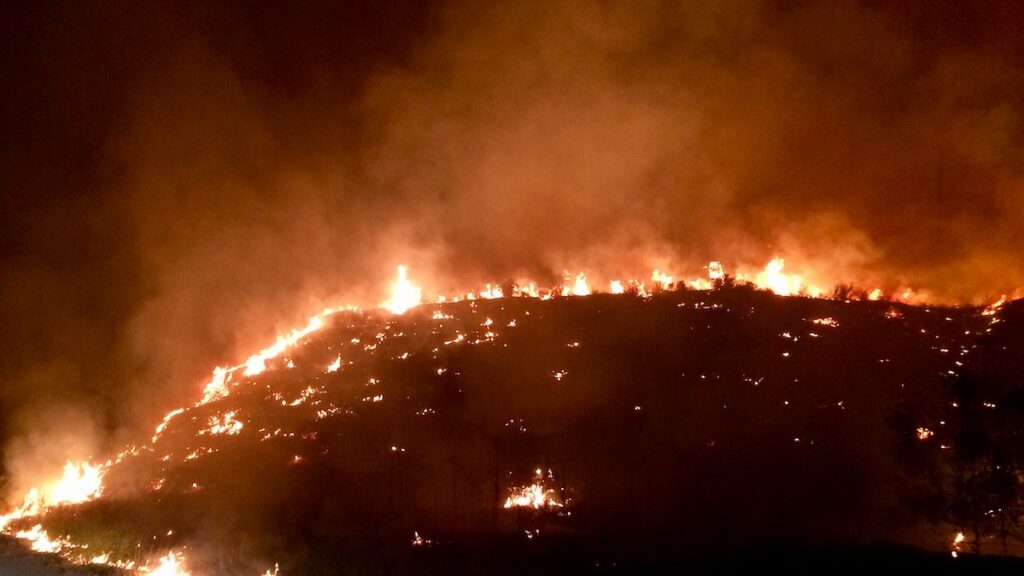
A wildfire on a hillside burns at night.

Research & Developments is a blog for brief updates that provide context for the flurry of news that impacts science and scientists today.

As the midpoint of the year approaches, several climate records have already been broken. Arctic winter sea ice extent reached a record low. Several countries saw record-breaking winter heat waves. And more than 150 million hectares have already burned globally in wildfires. 

The increasingly likely emergence of an El Niño this summer will likely continue the year’s record-breaking weather trends and could lead to “an unprecedented year of global fire,” according to a statement from World Weather Attribution, a climate research collaboration. 

“In modern human history, we’ve never experienced a strong or very strong El Niño event amid pre-existing conditions that were this warm globally.”

NOAA’s Climate Prediction Center predicts there is a 61% chance of El Niño—a natural climate pattern that involves warming waters in the Pacific Ocean—emerging by July 2026 and persisting through the end of the year. El Niño typically temporarily boosts global temperatures. 

At a press briefing on 11 May hosted by World Weather Attribution, climate scientists outlined the potential risks of this emerging El Niño against the backdrop of human-caused climate change, including intensifying wildfire seasons, extreme heat waves, and worsening droughts.

In the press briefing, Frederike Otto, a climate scientist at World Weather Attribution and Imperial College London, emphasized that climate change will likely play a larger role in the rest of this year’s extreme weather events than El Niño will, pointing to more than 100 analyses done by World Weather Attribution that have controlled for the effects of the El Niño Southern Oscillation (ENSO), the broader climate phenomenon that produces El Niño and its sister condition, La Niña. 

 
Related

•  Read About the 2024 El Niño: Record-Breaking Temperatures Likely as El Niño Persists
 

“We find that human-induced climate change has a much greater influence on the likelihood and intensity of extreme weather events than ENSO,” she said. 

Still, El Niño could push average global temperatures to extremes. The effects of El Niño will “be amplified considerably by the now nearly 1.5°C [(2.7°F)] of global warming experienced as of 2026,” Daniel Swain, a climate scientist at the University of California, Los Angeles and the California Institute for Water Resources, said in a statement. “In modern human history, we’ve never experienced a strong or very strong El Niño event amid pre-existing conditions that were this warm globally.”

The global fire season has “got off to a very fast start,” particularly in the African savanna, Southeast Asia, and northeastern China, Theodore Keeping, who studies extreme weather and wildfires at Imperial College London and World Weather Attribution, said in the briefing. Though El Niño may have mixed effects on the U.S. wildfire season, much of the U.S. is expected to face elevated wildfire risk, and a strong El Niño could worsen wildfires elsewhere in the world, particularly in the Amazon rainforest and Australia, Keeping said. 

More than 150 million hectares have burned in wildfires so far this year. Credit: Our World in Data, CC BY

“This rapid start [to the wildfire season], in combination with the forecast El Niño, means that we’re looking at a particularly severe year materializing,” Keeping said. “The likelihood of harmful, extreme fires potentially could be the highest we’ve seen in recent history.”

—Grace van Deelen (@gvd.bsky.social), Staff Writer

These updates are made possible through information from the scientific community. Do you have a story about science or scientists? Send us a tip at eos@agu.org.
A photo of a hand holding a copy of an issue of Eos appears in a circle over a field of blue along with the Eos logo and the following text: Support Eos’s mission to broadly share science news and research. Below the text is a darker blue button that reads “donate today.”
Text © 2026. AGU. CC BY-NC-ND 3.0
Except where otherwise noted, images are subject to copyright. Any reuse without express permission from the copyright owner is prohibited.
  • ✇Eos
  • Drivers of Day-to-Day Temperature Swings Across Continents Yun Qian
    Editors’ Highlights are summaries of recent papers by AGU’s journal editors. Source: Journal of Geophysical Research: Atmospheres Abrupt temperature swings between consecutive days, referred to as day-to-day temperature variability, have far-reaching impacts on human health, ecosystems, and economic activity. However, how these fluctuations vary from year to year, and what drives them, has remained unclear. Using observations, reanalysis, and CMIP6 simulations from 1961 to 2014, Liu an
     

Drivers of Day-to-Day Temperature Swings Across Continents

1 May 2026 at 17:42
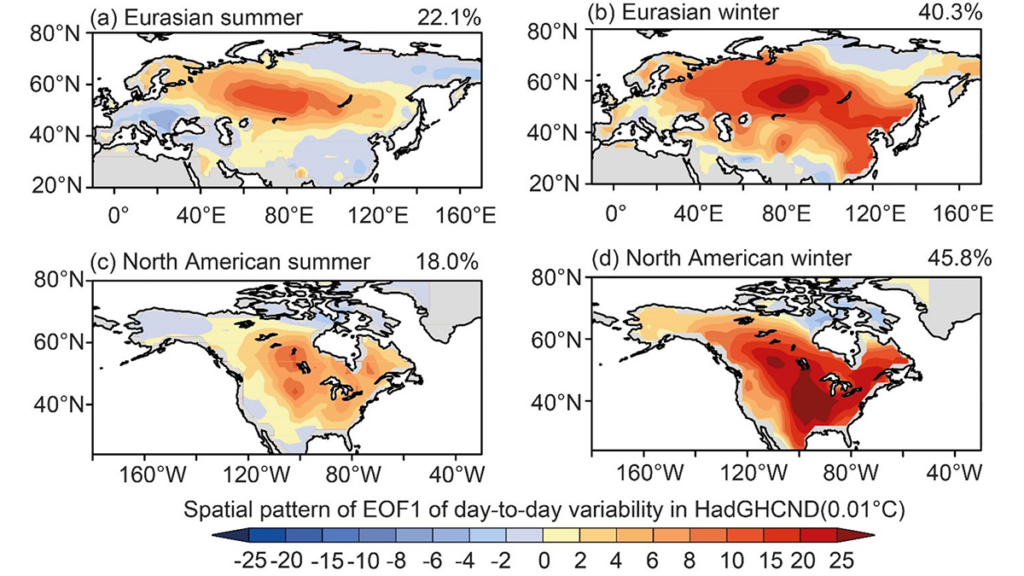
Maps from the article.
Editors’ Highlights are summaries of recent papers by AGU’s journal editors.
Source: Journal of Geophysical Research: Atmospheres

Abrupt temperature swings between consecutive days, referred to as day-to-day temperature variability, have far-reaching impacts on human health, ecosystems, and economic activity. However, how these fluctuations vary from year to year, and what drives them, has remained unclear.

Using observations, reanalysis, and CMIP6 simulations from 1961 to 2014, Liu and Fu [2026] identify a coherent large-scale pattern of variability across Eurasia and North America. This variability is primarily driven by the north–south movement of warm and cold air masses.

The dominant drivers also vary by season: large-scale meteorological patterns prevail in winter, whereas local land–atmosphere feedbacks become more influential in summer. Together, these processes reshape temperature gradients and modulate storm activity and broader weather systems.

Overall, the findings provide new insights into the mechanisms of temperature variability and offer a scientific basis for improving seasonal climate risk prediction and adaptation strategies.

Citation: Liu, Q., & Fu, C. (2026). Interannual variations in the day-to-day temperature variability in the northern hemisphere and possible causalities. Journal of Geophysical Research: Atmospheres, 131, e2025JD045754. https://doi.org/10.1029/2025JD045754

—Yun Qian, Editor, JGR: Atmospheres

Text © 2026. The authors. CC BY-NC-ND 3.0
Except where otherwise noted, images are subject to copyright. Any reuse without express permission from the copyright owner is prohibited.

Hottest day of the year ushers in 9 days of rain, as Hong Kong logs over 6,000 instances of lightning on Friday

6 June 2026 at 02:48
hko

Hongkongers sweated through the hottest day of the year on Friday, with the Observatory (HKO) recording a maximum temperature of 34.6 degrees Celsius at its headquarters.

Yung Shue Wan, Lamma Island on Friday, June 5.
Yung Shue Wan, Lamma Island on Friday, June 5, 2026. Photo: HKFP.

The mercury neared 37 degrees Celsius in the northern part of the territory.

Maximum temperatures in Hong Kong on June 5, 2026.
Maximum temperatures in Hong Kong on June 5, 2026. Photo: HKO.

Meanwhile, the Observatory noted 1,263 instances of cloud-to-ground lightning on Friday, and 4,859 cases of cloud-to-cloud lightning.

The city is now set to see nine days of rain, the weather service predicts.

See also: How Hong Kong’s elderly face deadly heat inside cramped cage homes

Cloud-to-ground lightning count distribution.
Cloud-to-ground lightning count distribution on June 6, 2026. Photo: HKO.

“A broad trough of low pressure will linger over the vicinity of the coast of southern China to the northern part of the South China Sea during the weekend to midweek next week,” the Observatory said.

The amber rainstorm warning was raised at 10am on Saturday as violent gusts swept into the territory, raising the risk of flooding.

See also: NGO warns hot weather can worsen air quality, urges gov’t action on pollutants and cooling measures in hot districts

Climate crisis

Friday marked the hottest “Grain in Ear” solar term ever documented. The ninth traditional solar term, known in Chinese as Mangzhong, signifies a period when awny crops like wheat are ready to harvest.

This week, environmental NGO Friends of the Earth urged the Hong Kong government to prioritise the climate crisis and strengthen its climate adaptation policies, with the city expected to endure an extremely hot summer.

A heatwave in Hong Kong in late May 2026. Photo: Kyle Lam/HKFP.

The Intergovernmental Panel on Climate Change has warned that the intensity and frequency of heatwaves have continued to increase since the 1950s due to human-caused climate change. The prevalence of greenhouse gases like carbon dioxide – which trap heat in the atmosphere – raises the planet’s surface temperature, with hotter, longer heatwaves putting lives at risk.

See also: How extreme heat became the deadliest silent killer among world weather disasters

Hong Kong has already warmed by 1.7 degrees Celsius since the Industrial Revolution, research NGO Berkeley Earth says. Heat and humidity may reach lethal levels for protracted periods by the end of the century, according to a 2023 study, making it impossible to stay outdoors in some parts of the world.

Sun

29 May 2026 at 13:12
I draw the sun like this, but i decided to make a vector graphic out of it.

  • ✇Eos
  • The 50-Hour Livestream That Aims to #SaveAmericasForecasts Emily Gardner
    Research & Developments is a blog for brief updates that provide context for the flurry of news that impacts science and scientists today. This week, a parade of scientists will spend 50 hours straight speaking about the importance of weather and climate research in the United States. Now in its second year, the Weather & Climate Livestream will feature hundreds of scientists describing their work and why it matters. Last year’s event, which lasted 100 hours, saw more than 180
     

The 50-Hour Livestream That Aims to #SaveAmericasForecasts

1 June 2026 at 12:08
Illustration of a blue television with the words “The Weather & Climate Livestream” on the screen.

Research & Developments is a blog for brief updates that provide context for the flurry of news that impacts science and scientists today.

This week, a parade of scientists will spend 50 hours straight speaking about the importance of weather and climate research in the United States.

Now in its second year, the Weather & Climate Livestream will feature hundreds of scientists describing their work and why it matters. Last year’s event, which lasted 100 hours, saw more than 180,000 views and led to 30,000 phone calls to Congress to #SaveAmericasForecasts.

“The first aspect of it is just communicating science,” said Haley Crim, a climate literacy researcher at MIT and the founder of Climateliteracy.earth. “The second half of it is to inspire people to call their representatives in support of funding for climate and weather science, and science more broadly.”  

Last year, Crim was an “avid watcher” of the livestream, so she was happy to help when a friend asked her to pitch in for the second iteration. But it’s also more personal this year, as she has since lost her position as a contractor with NOAA.

“It has a whole new meaning now, this year,” she said.

The livestream begins at 4 p.m. ET on Monday, 1 June, ending at 6 p.m. ET on Wednesday, 3 June. Speakers include meteorologist Jeff Masters and climate scientists Adam Sobel of Columbia University and Kim Cobb of Brown University. AGU President Brandon Jones and president-elect Benjamin Zaitchik will also speak from 2 p.m. to 2:40 p.m. ET on Wednesday, 3 June.

Science Under Attack

Since Donald Trump began his second presidential term in 2025, federal science funding has faced extensive cuts, with more proposed. In June 2025, for instance, a budget document proposed eliminating NOAA’s Office of Oceanic and Atmospheric Research. In December 2025, the administration announced plans to break up the National Center for Atmospheric Research.

“This is really a full-frontal attack on climate science.”

“This is really a full-frontal attack on climate science,” said Andrew Williams, a climate scientist at Scripps Institution of Oceanography who is helping to organize the livestream and will speak during it.

He added that even though Congress pushed back against the most drastic cuts proposed last year, leaving key science program budgets mostly intact, many agencies haven’t yet seen the money they’ve been granted in the budget. For instance, according to the organization Grant Witness, 112 grants have been awarded in the NSF Directorate for Geosciences so far this year, compared with 948 in total in Fiscal Year (FY) 2025. The average total number of grants awarded between FY21 and FY24 was 1,418.

Both Crim and Williams said they hope the livestream provides the public with a better understanding of how climate and weather research affects us all, from allowing for timely evacuation warnings to affecting insurance rates. Williams offered the example of the Geophysical Fluid Dynamics Laboratory, a federally funded NOAA research lab that would be eliminated under the president’s proposed FY2027 budget.

“It builds the engine of the U.S. weather forecasting model, which is what tells you day to day what the weather is going to be,” he said. “We’ve all been able to take for granted that these things are happening because the U.S. has for decades, for 60 or 70 years, had strong and stable federal funding for weather and climate science.”

—Emily Gardner (@emfurd.bsky.social), Associate Editor

These updates are made possible through information from the scientific community. Do you have a story about science or scientists? Send us a tip at eos@agu.org.

A photo of a hand holding a copy of an issue of Eos appears in a circle over a field of blue along with the Eos logo and the following text: Support Eos’s mission to broadly share science news and research. Below the text is a darker blue button that reads “donate today.”
Text © 2026. AGU. CC BY-NC-ND 3.0
Except where otherwise noted, images are subject to copyright. Any reuse without express permission from the copyright owner is prohibited.

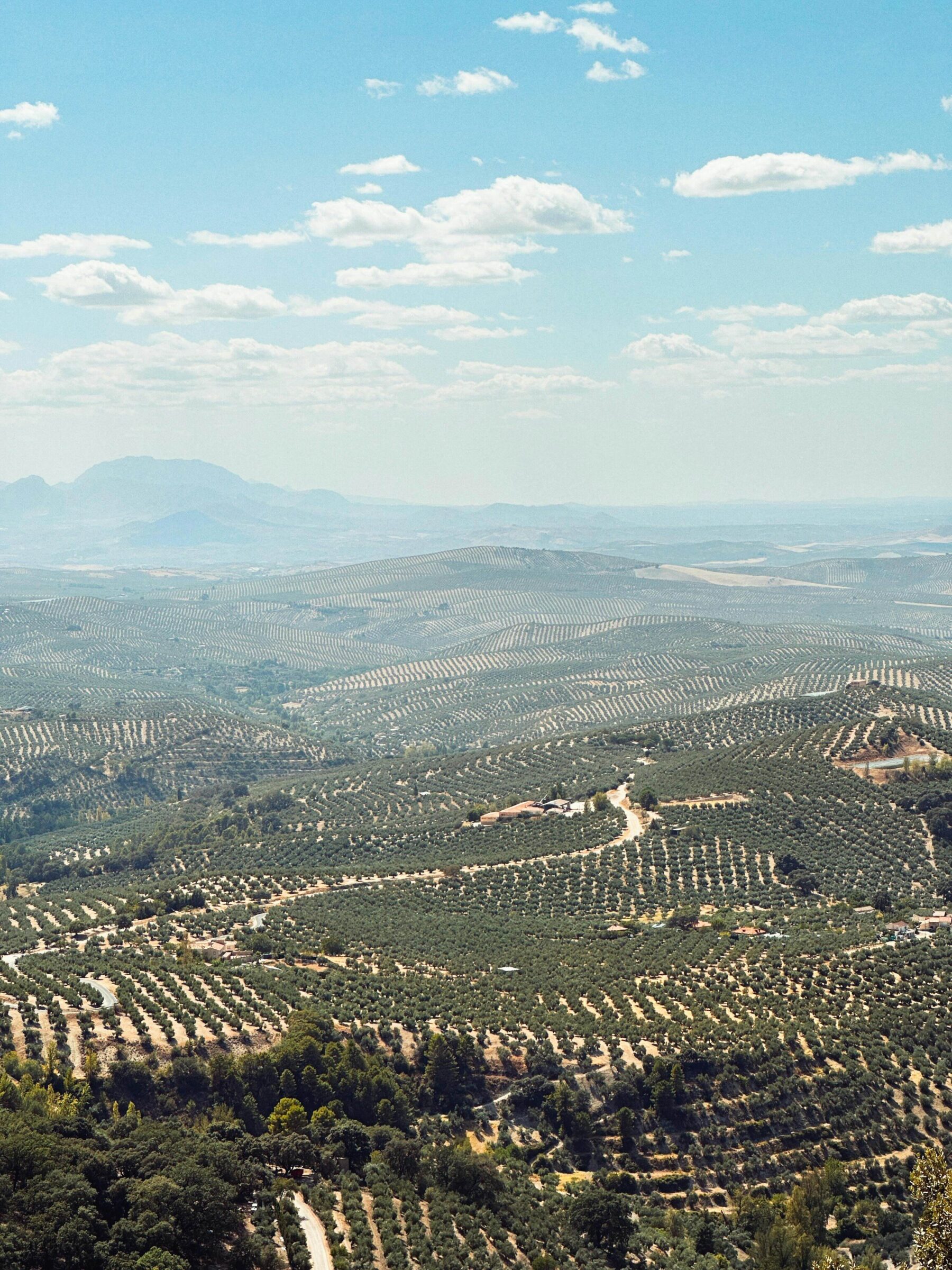
As Climate Change Exacerbates Extreme Weather, Olive Oil Feels the Squeeze

By: Guest
24 March 2026 at 20:01
Intensifying droughts and extreme heatwaves are having a profound impact on olive quality, quantity and price, according to recent research.

  • ✇The Guardian World news
  • Weather tracker: heat, humidity and thunderstorms a danger at World Cup Brendan Wood for MetDesk
    With matches in 16 cities across the US, Mexico and Canada, players and fans face an array of weather-related challengesWith the 2026 World Cup now under way, all 48 teams face a common opposition: summer weather across North America. Matches will be played in 16 cities, from southern Mexico to Canada, with a range of weather risks possible at each venue.Thunderstorms disrupted play before the tournament had even begun. England’s warm-up against Costa Rica in Orlando was delayed by about an hour
     

Weather tracker: heat, humidity and thunderstorms a danger at World Cup

With matches in 16 cities across the US, Mexico and Canada, players and fans face an array of weather-related challenges

With the 2026 World Cup now under way, all 48 teams face a common opposition: summer weather across North America. Matches will be played in 16 cities, from southern Mexico to Canada, with a range of weather risks possible at each venue.

Thunderstorms disrupted play before the tournament had even begun. England’s warm-up against Costa Rica in Orlando was delayed by about an hour after storms brought lightning and heavy rain that waterlogged the pitch. Safety regulations at US venues mean play is suspended when lightning is recorded within roughly 8 miles of a stadium, not resuming until 30 minutes after the last strike.

Continue reading...

© Photograph: Anadolu/Getty Images

© Photograph: Anadolu/Getty Images

© Photograph: Anadolu/Getty Images

  • ✇The Guardian World news
  • Trump targeting immigrants from countries hit most by climate shocks Oliver Milman
    A Guardian analysis reveals how most of 39 countries facing US entry restrictions are most vulnerable environmentally‘Every day it’s more barriers’: how the US is shutting out climate refugeesDonald Trump’s immigration crackdown is largely targeting people from the countries most vulnerable to displacement from climate-driven disasters, a Guardian analysis shows.As the Trump administration pushes policies to boost planet-heating fossil fuels, millions of people are being forced to flee their hom
     

Trump targeting immigrants from countries hit most by climate shocks

10 June 2026 at 13:00

A Guardian analysis reveals how most of 39 countries facing US entry restrictions are most vulnerable environmentally

Donald Trump’s immigration crackdown is largely targeting people from the countries most vulnerable to displacement from climate-driven disasters, a Guardian analysis shows.

As the Trump administration pushes policies to boost planet-heating fossil fuels, millions of people are being forced to flee their homelands due to storms, floods and droughts worsened by the climate crisis.

Continue reading...

© Composite: The Guardian, AFP via Getty Images

© Composite: The Guardian, AFP via Getty Images

© Composite: The Guardian, AFP via Getty Images

NGO warns hot weather can worsen air quality, urges gov’t action on pollutants and cooling measures in hot districts

1 June 2026 at 04:45
hot weather

NGO Green Power has urged the Hong Kong government to better regulate ozone precursors as hot weather exacerbates air pollution across the city.

A heatwave in Hong Kong in late May 2026. Photo: Kyle Lam/HKFP.

Chemical compounds – such as nitrogen oxides, methane, Volatile Organic Compounds (VOC) and carbon monoxide – form ground-level ozone by reacting in the lower atmosphere in the presence of sunlight. Ground-level ozone attacks and inflames lung tissue, but reducing underlying pollutants prevents harmful smog.

According to a Sunday press release, Green Power’s director, Cheng Luk-ki, said VOCs – which are emitted through oil and gas operations, petrol evaporation and chemical solvents – should be better regulated.

See also: How extreme heat became the deadliest silent killer among world weather disasters

“In the future, the public’s health may be affected by both high temperatures and air quality at the same time,” the press release said.

Last week, Hong Kong sweltered amid a days-long heatwave. Whilst rain brought some respite over the weekend, the Observatory predicts highs of 35 degrees Celsius by the end of this week.

Cooling measures for hottest areas

Green Power’s review of Hong Kong’s air quality situation in 2025 found that 15 air quality monitoring stations recorded “a total of 2,080 hours at High, Very High and Serious levels – collectively referred to as ‘High Risk (HR) hours.'”

See also: How Hong Kong’s elderly face deadly heat inside cramped cage homes

Cheng said Hong Kong was affected by a northern Chinese dust storm last April, pushing up the statistics. However, the NGO also noted that overall air quality has been improving thanks to the city’s diversification away from coal towards natural gas, as well as efforts to tighten emission standards for fuel-powered vehicles.

air pollution Hong Kong
Air pollution in Hong Kong. File Photo: GovHK.

The director said he had analysed last summer’s Air Quality Health Index data, and found that the nine days ranked as “high risk” all saw temperatures exceeding 29 degrees Celsius, “demonstrating a strong connection between heat and air quality.”

He warned that hot weather will become more frequent, as he urged the authorities to take action in the territory’s hottest districts.

The NGO recommended cooling measures in Tuen Mun, Tai Po, North District, Yuen Long and Tung Chung, “such as increasing greenery coverage, revitalising local rivers, and incorporating more ventilation corridor designs.”

See also: How extreme heat became the deadliest silent killer among world weather disasters

Hong Kong has already warmed by 1.7 degrees Celsius since the Industrial Revolution, research NGO Berkeley Earth says. Heat and humidity may reach lethal levels for protracted periods by the end of the century, according to a 2023 study, making it impossible to stay outdoors in some parts of the world.

  • ✇Variety
  • Fox Weather Gains Distribution on SiriusXM Brian Steinberg
    SiriusXM will begin distributing Fox Weather across its satellite-radio service starting June 3, a move aimed at making more weather news available as hurricane season starts along the Atlantic coast. The channel will be offered to listeners across North America via the SiriusXM app (ch. 799) and in vehicles equipped with SiriusXM with 360L. Access […]
     

Fox Weather Gains Distribution on SiriusXM

1 June 2026 at 15:00
SiriusXM will begin distributing Fox Weather across its satellite-radio service starting June 3, a move aimed at making more weather news available as hurricane season starts along the Atlantic coast. The channel will be offered to listeners across North America via the SiriusXM app (ch. 799) and in vehicles equipped with SiriusXM with 360L. Access […]

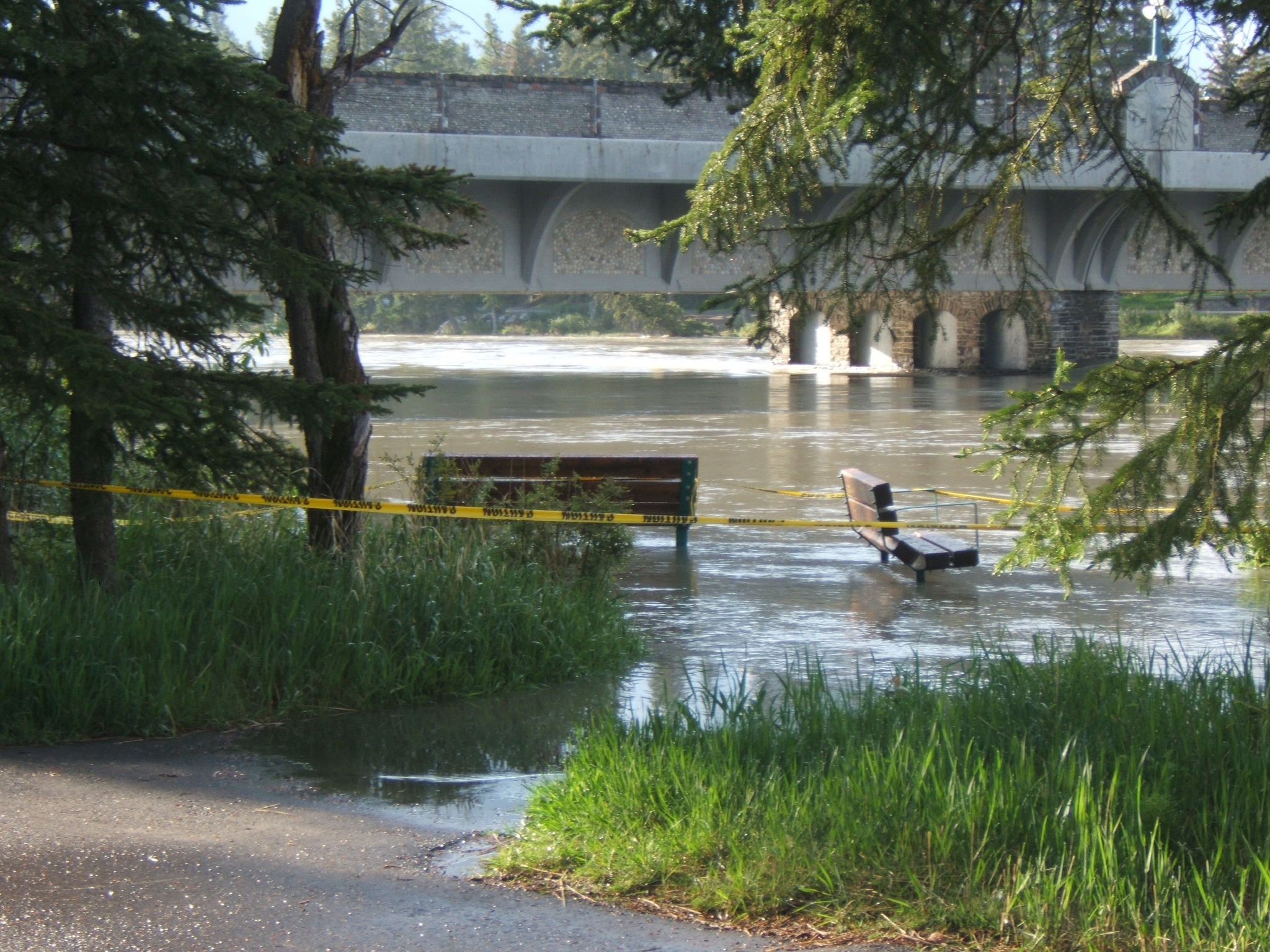
Flood watch, high streamflow advisories issued in Banff National Park

29 May 2026 at 00:04
Rising waters, caused by unseasonably warm temperatures, has prompted a high streamflow advisory to be issued for the Bow River in Banff National Park.

Popular hiking area west of Canmore, Alta. closed because of rockslide danger

11 June 2026 at 23:30
Alberta Parks has shut down a large area around a series of popular hiking trails just west of Canmore because of the dangers caused by a recent rockslide.

❌
Subscriptions