Login
LoginThe Backside
10 June 2026 at 17:11
KyleB06 posted a photo:

HESR 2107 brings an IMRR transfer under the signal gantry at Wesley and into the TZPR East Peoria Yard.


KyleB06 posted a photo:
HESR 2107 brings an IMRR transfer under the signal gantry at Wesley and into the TZPR East Peoria Yard.




Plus some surprising extra requirements, like having to say “thank you” at least 10 times a day.
Every school in Japan has its own set of rules, and while many of these guidelines are perfectly understandable, there are some that are baffling, to say the least.
This topic of nonsensical school rules was recently explored by Jukusen, one of Japan’s largest online directory and comparison platforms for cram schools, in a survey that targeted 104 high school students nationwide.
More than half (56.7 percent) of the respondents said there were rules at their school that they did not agree with, and out of these, about 70 percent said they hadn’t been given an explanation as to why those rules are necessary.
So what were the rules that made no sense to students? Let’s take a look at the top 12 responses below – totals exceed 100 percent as students were allowed to give multiple responses – starting with a brief rundown from 12 to six.
12. No stopping anywhere on the way home after school (27.9 percent)
11. Limits on the number of keychains students can carry (30.8 percent)
10. Ban on sunscreen and lip balm (31.7 percent)
9. Restrictions on winter clothing such as coats and scarves (34.6 percent)
8. Restrictions on sweaters and cardigans (34.6 percent)
7. Rules specifying the type and colour of school bags (34.6 percent)
6. Restrictions on underwear colour (36.5 percent)
▼ The question put to students for the survey was: “Which school rules honestly make no sense to you?“
Taking a closer look at the top five revealed the following results:
5. Restrictions on smartphones (36.5 percent)
Many respondents accepted bans during class but thought prohibitions during breaks or school events were unreasonable as students want to communicate and take photos at those times.
4. Restrictions on the colour, length, and design of socks (39.4 percent)
Students questioned why schools sought to regulate such a minor detail, saying it felt pointless to regulate tiny fashion issues.
3. Restrictions on how to wear the uniform (42.3 percent)
Students complained that uniform rules were excessively detailed and inconsistently enforced, with one student saying she was pulled up by teachers for folding up the waist of her skirt, even though she was only doing it as it was uncomfortably loose.
▼ Low socks and a high skirt is a no-no at schools.
2. Ban on eyebrow grooming (48.1 percent)
Students argued that not being allowed to care for your eyebrows actually makes people look less presentable. They also expressed concern for people who feel insecure about their brows, as they’re not allowed to tend to them.
1. Restrictions on hairstyles and hair colour (54.8 percent)
Students strongly questioned why schools regulate hair at all, with many saying they felt these rules weren’t in line with the times as they prioritise conformity over individuality.
The survey also revealed some unusual rules that exist at some schools:
While “light music” originally referred to lighter orchestral pieces, it now involves popular music like punk, rock and J-Pop, and some schools fear these clubs might “increase the number of delinquent and misbehaving students”.
Though students are quick to complain about these “incomprehensible” school rules, saying they have little to do with academic performance, in the end, they mostly put up with them, with approximately 70 percent of current respondents indicating that they abide by the rules despite their dissatisfaction.
The remaining 30 percent are likely plucking an eyebrow hair every now and then, and holding out hope for their school to rethink some of its requirements. With some schools now easing up on black-only hair rules and abolishing underwear checks, change may very well be on the horizon.
Source: Press release
Featured image: Press release
Insert images: Press release, Pakutaso (1, 2, 3)
● Want to hear about SoraNews24’s latest articles as soon as they’re published? Follow us on Facebook and Twitter!




KANGAR, June 5 — The long-delayed Perlis Malaysia Sports School project in Bukit Chabang near Padang Besar is expected to be completed by January 2027, according to Menteri Besar Abu Bakar Hamzah.
He said the construction progress of the project has reached about 60 per cent and remains on track for completion within the projected timeline, with the federal government demonstrating a strong commitment to ensuring the project’s successful implementation.
“I met the Prime Minister, Datuk Seri Anwar Ibrahim, last March, and he was very committed to helping Perlis and resolving the issue involving the Perlis Sports School.
“I sought his assistance, and the very next day he informed me that instructions had been issued to expedite the construction and completion of the sports school,” he told reporters after the State Assembly sitting today.
Abu Bakar said the sports school, named after the Raja Muda of Perlis, Tuanku Syed Faizuddin Putra Jamalullail, is expected to serve as a catalyst for the development of sports in the state and help produce more talented athletes in the future.
On April 27 last year, Prime Minister Datuk Seri Anwar Ibrahim, in a Facebook post, stated that the Perlis Malaysia Sports School project, which had been abandoned for the past 12 years, should be handed over immediately to a capable government-linked company to ensure its completion. — Bernama

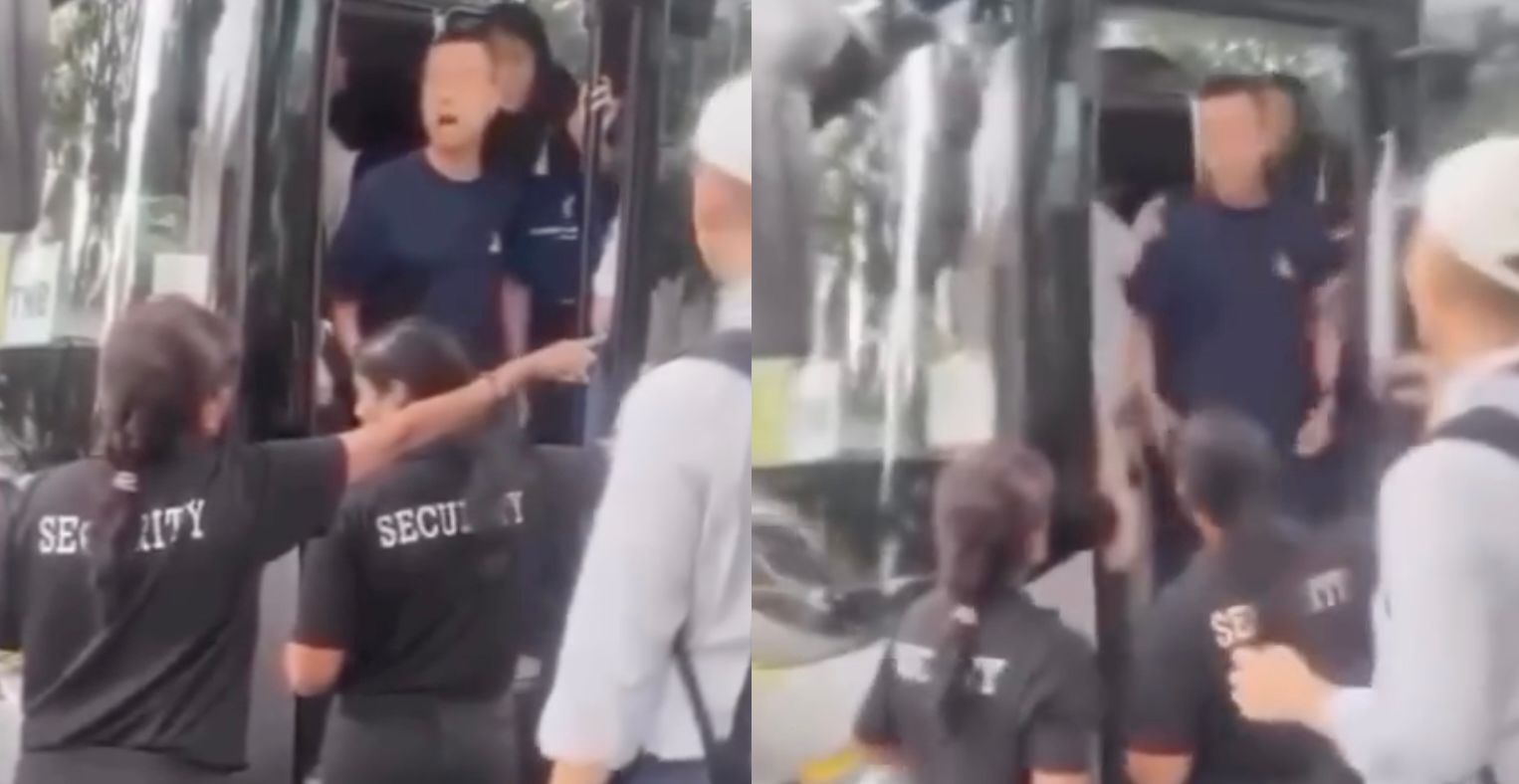
SINGAPORE: After the principal of a secondary school from Hong Kong was caught in a viral video where he behaved rudely toward two security guards during a trip to Singapore, reports say that he has been suspended.
San Wui Commercial Society Secondary School in Tuen Mun has apologised for the incident, which is now under investigation by the authorities in Singapore, according to the South China Morning Post.
“The school expresses its deepest apologies regarding this matter. The school and its sponsoring body have always placed the utmost importance on the professional conduct of our faculty and staff,” the statement from the school reads.
Meanwhile, SCMP also said that a debate emerged online in Hong Kong after the incident, over whether racism or poor behaviour was a factor in the principal’s actions.
The incident
A video was spread on Threads last week showing Lee Cheuk-hing, the school principal, standing in the doorway of a bus having a heated discussion with two female guards. He then proceeded to taunt and shout at them, despite efforts from at least three onlookers to get him to calm down.
The incident, which allegedly occurred over a parking dispute, is said to have occurred on May 22 at a location in Jurong.
Hours after it was announced that Singapore would be investigating the incident, the manager of the school, Edmund Wong Chun-sek, said that Mr Lee had been suspended as his conduct during the incident did not meet public expectations. Moreover, Mr Wong, a former lawmaker, added that the school’s board wished to show that they were resolved to address the matter.
“Though he said he wanted to protect the students, his actions did not meet what the public expects of a school principal,” SCMP quoted Mr Wong as saying.
Online debate
A debate among Hong Kong’s netizens ensued after the video was widely shared and news of the principal’s behaviour was reported on, especially as the guards that Mr Lee had shouted at are South Asian women. Commenters have pointed to the difference between how the principal interacted with the women, as opposed to a female Chinese passerby.
While the principal had shouted “You shut up!” to the guards, he told the other woman that he would listen to her as she was “very polite.”
“I like you,” he told her.
That interaction may be found here.
A commenter on r/HongKong wrote, “You just know he’s speaking to them that way because of their race. As soon as he has to interact with the local Singaporeans of Chinese ethnicity, he changes his tactics completely.”
“The moment a Chinese woman says the same thing the Malay security guards are trying to get him to do, he listens,” pointed out another.
Others, however, focused on how the principal’s bad behaviour was a poor example for the school’s students.
“If you are a school principal, regardless of the situation (unless life threatening), it makes most sense you ‘take the high road’ and lead by example as a good role model in front of your students,” one pointed out.
“When visiting another country, respect the laws of the country. What is he teaching the students? A principal should be a role model, and yet he isn’t acting as a role model. Every time someone lands in another country, he represents his country of their passport. Funny how he represents his country and his school behaving like he is at home,” another chimed in. /TISG
This article (Hong Kong principal who swore at 2 guards in Singapore suspended; online debate on racism, bad behaviour ensues) first appeared on The Independent Singapore News.