The amnesiac format in psychological thrillers is always a fun one: an unreliable narrator thrown into a dizzying world where they don't know who to trust, not even themselves, as secrets are slowly uncovered. In 2022, Apple TV gave us another rendition of this classic trope that was sorely overlooked, even though it had all the thrills and charm of the genre. Surfaceis a perfect escapist weekend binge, one that'll have you playing the guessing game right until the end while you are enthralled b
The amnesiac format in psychological thrillers is always a fun one: an unreliable narrator thrown into a dizzying world where they don't know who to trust, not even themselves, as secrets are slowly uncovered. In 2022, Apple TV gave us another rendition of this classic trope that was sorely overlooked, even though it had all the thrills and charm of the genre. Surfaceis a perfect escapist weekend binge, one that'll have you playing the guessing game right until the end while you are enthralled by the lavish costumes and designs of San Francisco high society. On top of that, with psychological thriller veteran Gugu Mbatha-Raw leading the way, we're in safe hands as we enter this emotional and paranoid spiral.
Editors’ Highlights are summaries of recent papers by AGU’s journal editors.
Source: Journal of Geophysical Research: Earth Surface
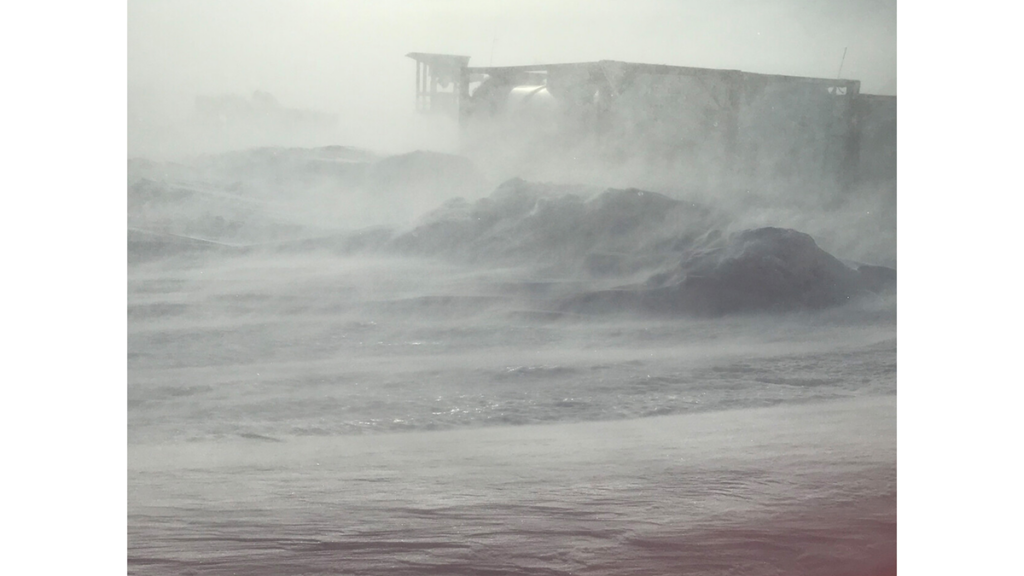
Antarctica’s snow and ice surfaces play a key role in how the continent exchanges heat and moisture with the atmosphere. A key property controlling this exchange is aerodynamic roughness length (zo), which measures how “bumpy” the surface is. Rougher surfaces, such as snow sastrugi (wind-formed ridges and grooves), interact more strongly with the air above, a
Source: Journal of Geophysical Research: Earth Surface
Antarctica’s snow and ice surfaces play a key role in how the continent exchanges heat and moisture with the atmosphere. A key property controlling this exchange is aerodynamic roughness length (zo), which measures how “bumpy” the surface is. Rougher surfaces, such as snow sastrugi (wind-formed ridges and grooves), interact more strongly with the air above, affecting snow movement, melting, and local environmental conditions. Despite its importance, zo is often treated as a single, constant value over large areas in Earth system models because it is difficult to measure.
Zheng et al. [2026] use a multi-temporal Unmanned Aerial Vehicle (UAV) oblique photogrammetry to map fine scale zo variability at Qinling Station in East Antarctica. The results show that zo can vary substantially depending on surface type, measurement scale, model choice, and meteorological conditions. The complex response of surface microtopography to meteorological events is a noteworthy new finding. For example, in snow sastrugi areas, zo can vary by an order of magnitude over time, increasing after snowfall and decreasing under strong winds. These findings highlight that capturing fine-scale surface roughness is essential for accurately modeling snow–atmosphere interactions in Antarctica and could help improve current weather and climate models for polar regions.
Citation: Zheng, Z., Zheng, L., Wang, K., Clow, G. D., & Cheng, X. (2026). UAV oblique imagery reveals order-of-magnitude changes in snow aerodynamic roughness length under shifting meteorological regimes at Qinling Station, East Antarctica. Journal of Geophysical Research: Earth Surface, 131, e2025JF008781. https://doi.org/10.1029/2025JF008781
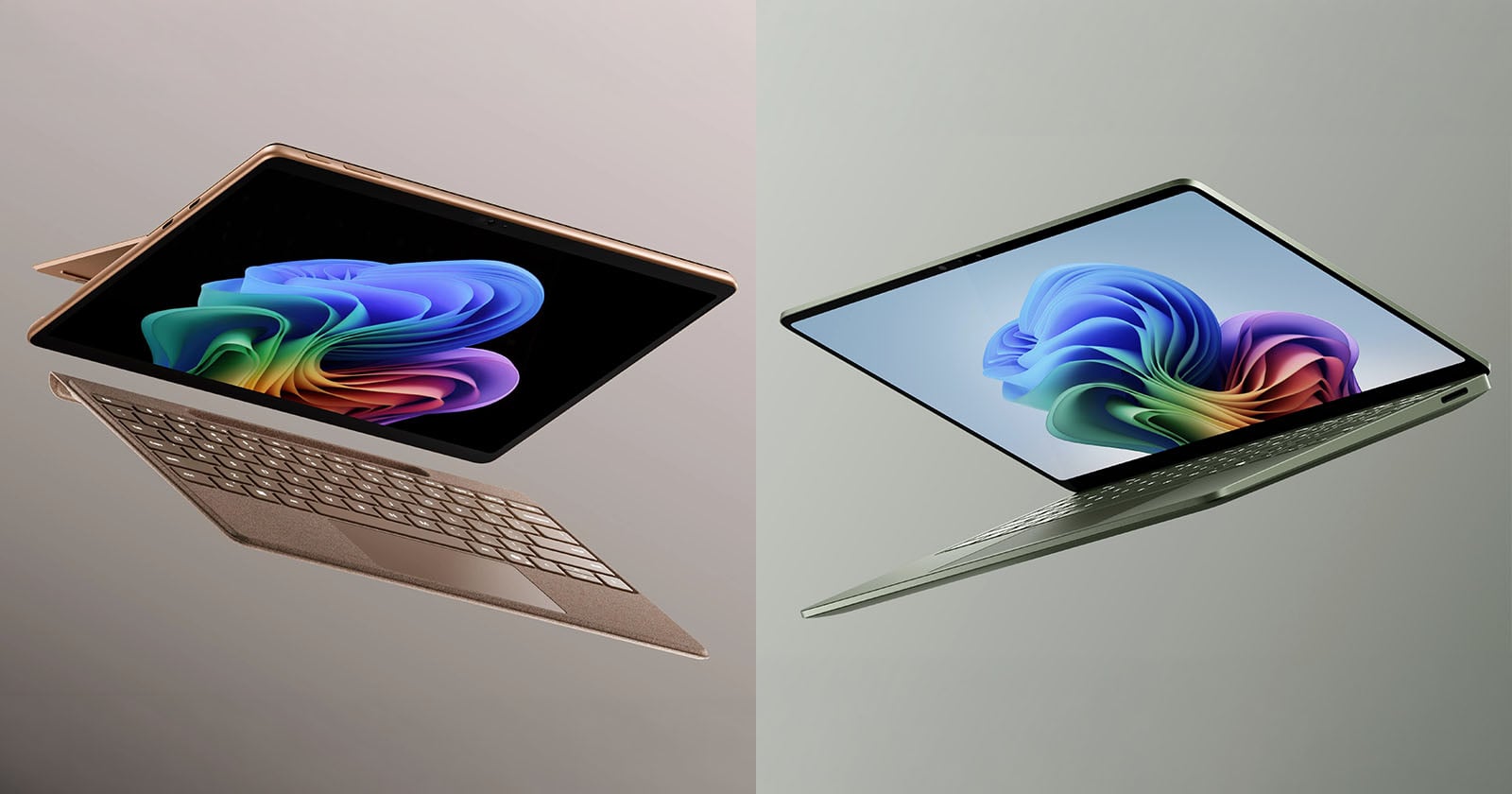
Earlier this month, Nvidia unveiled its new RTX Spark "superchip," and Microsoft took the opportunity to show off its most powerful Surface laptop ever, the Surface Ultra. Now Microsoft is back with new versions of its existing standard Surface and Surface Pro machines. They're powered by a Snapdragon processor and arrive with significant price bumps.
[Read More]
Earlier this month, Nvidia unveiled its new RTX Spark "superchip," and Microsoft took the opportunity to show off its most powerful Surface laptop ever, the Surface Ultra. Now Microsoft is back with new versions of its existing standard Surface and Surface Pro machines. They're powered by a Snapdragon processor and arrive with significant price bumps.
₳lexandre ️ De Cyriac aka Joker Melodie posted a photo:
Sublime - Crown of the Dragons
A metalic crown
Fully texturable with hud
Availlable @Vintage Fair
maps.secondlife.com/secondlife/Elysian%20Veil/128/128/68
[CIRCA] - Skylines - Retro Chair Set PG
New Retro Collection @ Vintage Fair 2026
Event runs from June 5th - 15th
New items are marked 50% Off
Find our booth here (North side of sim / top level)
maps.secondlife.com/secondlife/Elysian%20Veil/103/220/94
.WOODHAUS. - Mellow Backdrop 🌼
[CIRCA] - Skylines - Retro Chair Set PG
New Retro Collection @ Vintage Fair 2026
Event runs from June 5th - 15th
New items are marked 50% Off
Find our booth here (North side of sim / top level) maps.secondlife.com/secondlife/Elysian%20Veil/103/220/94
Muho - Primor ♥
✨ Highlights:
✔ Compatible with Legacy, Jake, Gianni, and Kario
✔ Sold by vest color interactive HUD
✔ 20 customizable color options
✔ high-quality textures
✔ Available in single packs, fatpack, and megapack maps.secondlife.com/secondlife/Magic%20Sky/156/106/2022
Can you please pass the soy sauce, No Face?
Explicit exposition has never really been Studio Ghibli’s thing, but even by their standards, No Face’s character arc is an impressive case. Without saying a single word of dialogue, we watch the Spirited Away scene-stealer go from covetous to considerate over the course of the film, learning that there’s more to life than a cycle of gorging and coercing people with regurgitated pricy baubles.
By the time the movie ends, No Face has become a sympathe
Explicit exposition has never really been Studio Ghibli’s thing, but even by their standards, No Face’s character arc is an impressive case. Without saying a single word of dialogue, we watch the Spirited Away scene-stealer go from covetous to considerate over the course of the film, learning that there’s more to life than a cycle of gorging and coercing people with regurgitated pricy baubles.
By the time the movie ends, No Face has become a sympathetic, even heartwarming character, and his new life as a generous, helpful sort can continue in your kitchen in the form of a cute and classy No Face soy sauce dispenser.
The porcelain bottle stands 10.8 centimeters (4.3 inches) tall, with its glaze catching the light in a hazy way evocative of the indistinct nature of No Face’s physical form within the anime.
Instead of pouring from the very top of the bottle, the soy sauce comes out of No Face’s extended arm, which is crafted to bring to mind his on-screen posing.
A silicone seal helps keep the connection between the two parts of the bottle snug and secure, and separating them also makes for easy cleaning of the inside.
While this is technically classified as a soy sauce dispenser by Ghibli specialty shop Donguri Kyowakoku, you could use it to hold whatever liquid you want (although the modest diameter of the opening means that thick condiments or lotions probably won’t flow too easily through it). And if your diet isn’t all that saucy, there’s always the option of using the bottle for decorative purposes like a very unique anime figure.
While the No Face soy sauce dish shown in the above photo is sold out, the soy sauce dispenser is back at Donguri Kyowakoku following a recent restock, and can be ordered through the chain’s online store here, priced at 2,640 yen (US$17). Just be careful not to spill any sauce on your new Totoro necktie.
Editors’ Highlights are summaries of recent papers by AGU’s journal editors.
Source: Journal of Geophysical Research: Earth Surface
Sediment transport shapes the Earth surface in different ways, by forming desert dunes and by sculpting the topography of rivers, but the physics of sediment transport initiation is still incompletely understood. For decades, models have generally assumed two basic entrainment mechanisms: a grain resting on the sediment bed is either lifted directly by fluid
Source: Journal of Geophysical Research: Earth Surface
Sediment transport shapes the Earth surface in different ways, by forming desert dunes and by sculpting the topography of rivers, but the physics of sediment transport initiation is still incompletely understood. For decades, models have generally assumed two basic entrainment mechanisms: a grain resting on the sediment bed is either lifted directly by fluid forces, or it is emitted from the soil indirectly, as product of a granular splash caused by the heavy impact of another grain.
However, recent breakthroughs in grain-based simulations and high-speed visualization have been offering a much clearer look at the processes that trigger grain motion. Insights from these recent advances have revealed a rather broad spectrum of indirect particle-particle and particle-fluid interactions driving entrainment, including the rearrangement of surface grains after splash and changes in near‐bed flow structure due to moving grains. These interactions exert non-local influences on transport thresholds, giving rise to a dynamic process known as collective particle entrainment—a mechanism that remains poorly understood at a fundamental level.
In a new study, Chartrand [2026] shows that collective particle entrainment is size-dependent: large grains interact primarily with their peers, while smaller grains are mobilized by both large and similar-sized particles. This distinction leads to divergent transport signatures, with a new stochastic model predicting temporally correlated motion for small grains and uncorrelated, white-noise entrainment statistics for larger particles.
Although theoretical modeling will be required to shed further light on the physics of collective entrainment, the author’s study is a step toward a quantitative model of sediment transport from a probabilistic perspective. Looking ahead, Chartrand’s ideas could now be extended to other environments, potentially transforming our understanding of entrainment in other contexts such as wind-blown transport and extraterrestrial atmospheric processes.
Citation: Chartrand, S. M. (2026). Collective particle entrainment explored with experimental data and coupled transfer functions. Journal of Geophysical Research: Earth Surface, 131, e2025JF008657. https://doi.org/10.1029/2025JF008657
Microsoft and Nvidia made joint announcements today. Microsoft is launching a brand-new Surface Laptop Ultra, the most powerful Surface Laptop ever built, and it is powered by Nvidia's new RTX Spark system-on-a-chip, a "new superchip that reinvents Windows PCs for the era of personal AI agents."
[Read More]
Microsoft and Nvidia made joint announcements today. Microsoft is launching a brand-new Surface Laptop Ultra, the most powerful Surface Laptop ever built, and it is powered by Nvidia's new RTX Spark system-on-a-chip, a "new superchip that reinvents Windows PCs for the era of personal AI agents."
Totoro and friends want to keep you cool and smiling this summer with these traditional non-folding fans.
Summer presents a bit of a conundrum in Japan. On the one hand, it’s not a matter of if the weather will be hot and humid, but whether it’ll be extremely or just very hot and humid. At the same time, summer is full of festivals, fireworks shows, pop culture events, and even beautifully blossoming flowers, so there’s tons of fun to be had if you can find a way to cope with the heat.
And if
Totoro and friends want to keep you cool and smiling this summer with these traditional non-folding fans.
Summer presents a bit of a conundrum in Japan. On the one hand, it’s not a matter of if the weather will be hot and humid, but whether it’ll be extremely or just very hot and humid. At the same time, summer is full of festivals, fireworks shows, pop culture events, and even beautifully blossoming flowers, so there’s tons of fun to be had if you can find a way to cope with the heat.
And if you have a fun way to do so, all the better, right?
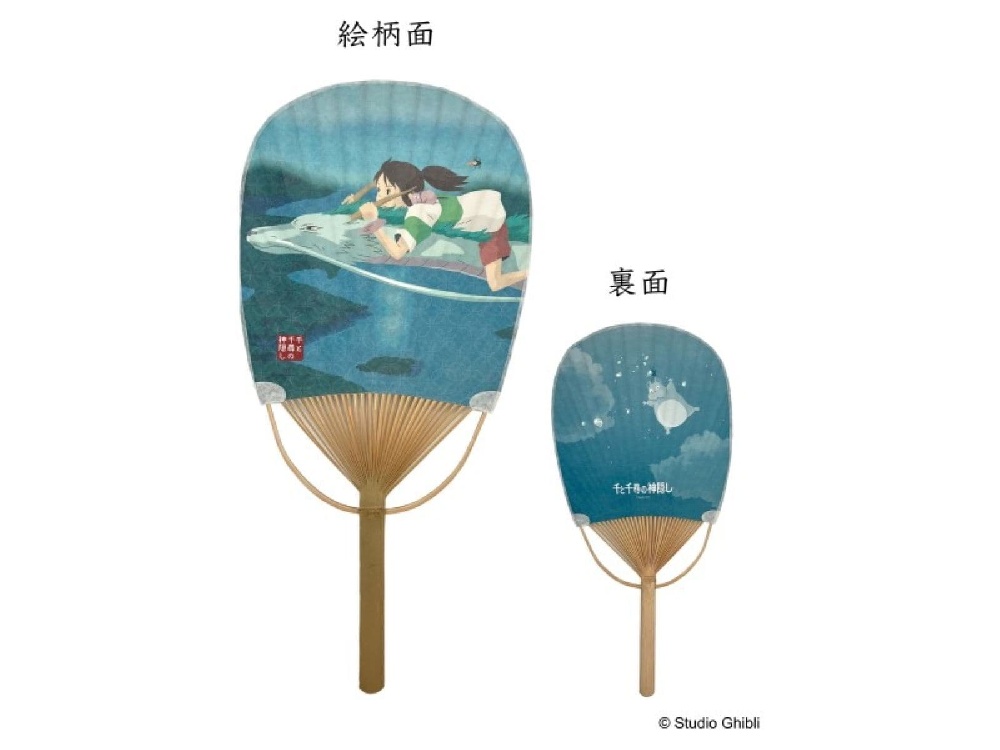
Filling that role nicely are these fans from Studio Ghibli specialty store Donguri Kyowakoku. This type of fan is called an uchiwa, and because they have an easy-to-grip handle, it’s easier to generate a cooling breeze with uchiwa than with than sensu (folding fans), making them a classical summer lifesaver.
The Ghibli uchiwa are made from bamboo frames and textured paper. A total of four designs are available, representing two of Ghibli’s greatest hits and with unique artwork on each side. On the fan above, we see Spirited Away’s Chihiro riding through the sky on Haku in his dragon form on the front, and when you flip the fan over, you can see Mouse Boh and Haedori having a somewhat less elegant flight.
Also here from Ghibli’s Oscar-winner is No Face, which is fitting since uchiwa are said to be shaped like koban, Japan’s traditional oval gold coins. The back of the No Face fan bares the kanji for Abura, as in the Aburaya bathhouse of the gods where most of the movie takes place, along with illustrations of some of the establishment’s more prominent patrons.
No Ghibli movie captures the vibes of a carefree summer day like My Neighbor Totoro, though, and so it’s also part of the lineup, with one of its designs featuring sisters Mei and Satsuki along with the Catbus.
▼ The back of the fan reveals that the Catbus leaves adorable pawprints behind as it scampers around the countryside.
And finally, the fourth fan shows a gathering of all three Totoros, big, medium. And small, with them dancing under fireworks and the kanji for matsuri (“festival”) on the back.
The fans are all 17 centimeters (6.7 inches) in width and 37 centimeters in length, with the exception of the Catbus uchiwa which is just a bit longer at 37.5 centimeters. The long handles make them easy to tuck into a tote bag or slide into the sash of a summer kimono, and since uchiwa don’t fold up, they also work great as interior decorations, since they’re essentially little mini posters that you can also use to make a breeze. All four of the fans are priced at 880 yen (US$5.70) and recently restocked at Donguri Kyowakou, with online orders available here.
Editors’ Highlights are summaries of recent papers by AGU’s journal editors.
Source: Journal of Geophysical Research: Earth Surface
Turbidity currents are underwater currents that transport sediment on the sea floor. They were first observed in the late 1800s in Lake Geneva, Switzerland. The cable break following the 1929 Grand Banks earthquake offshore Canada revealed how massive and destructive these fluxes can be.
Turbidity currents move downslope because they have a higher density
Source: Journal of Geophysical Research: Earth Surface
Turbidity currents are underwater currents that transport sediment on the sea floor. They were first observed in the late 1800s in Lake Geneva, Switzerland. The cable break following the 1929 Grand Banks earthquake offshore Canada revealed how massive and destructive these fluxes can be.
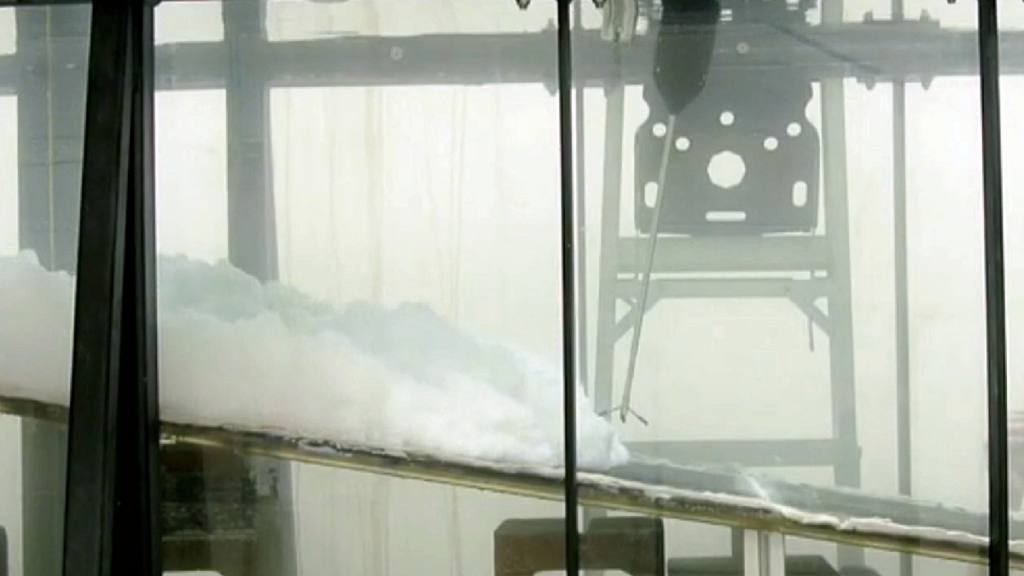
Turbidity currents move downslope because they have a higher density than the surrounding water due to the presence of sediment in suspension. It is critical to keep in mind that suspended sediment concentration in these flows is low, meaning that the fluid is Newtonian and the flow is turbulent.
Notwithstanding recent advances in field monitoring, measuring turbidity current thickness, velocity, suspended sediment concentration, and grain size distribution remains difficult not only for the high-water depths and the destructive nature of some events, but also because these flows are often infrequent. Laboratory experiments and mathematical modeling have been used extensively to understand nature and some aspects of these flows, but questions remain on, for example, how turbidity currents interact with ocean waves, if they do.
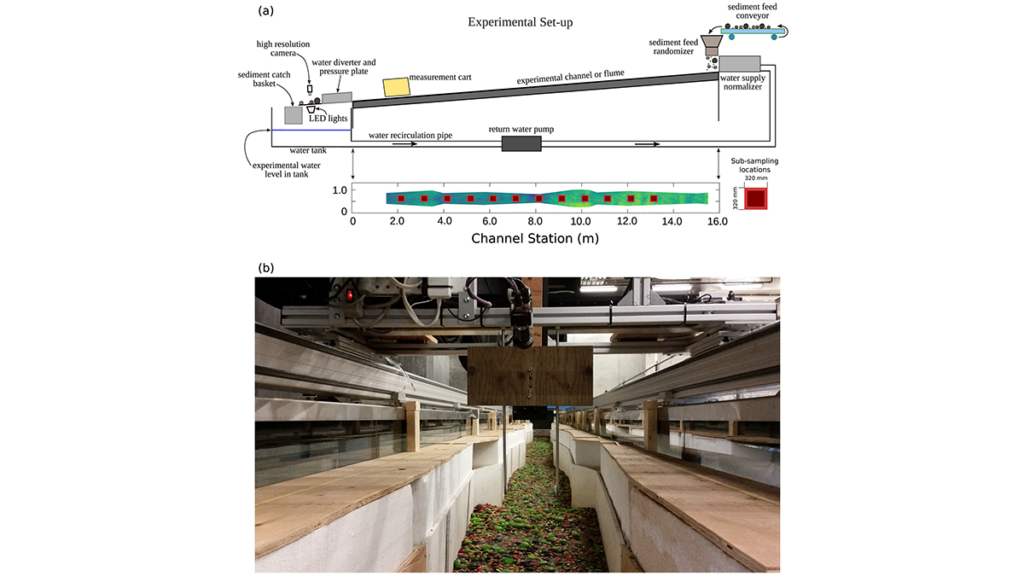
Daniller-Verghese et al. [2026] performed laboratory experiments to determine if and how turbidity currents interact with ocean gravity waves. Experimental flows were released in an 11-meter-long, 1.2-meter-deep, and 0.61-meter-wide flume in the Experimental Sedimentation Laboratory of the Jackson School of Geoscience at the University of Texas. A motored wave maker was installed at the downstream end of the facility to generate the wave field. During the experiments, detailed velocity measurements were conducted to characterize the flow field and the fine details of the turbulent fluctuations. At the end of each experiment, high-resolution measurements of changes in bed elevations allowed the quantification of the net depositional fluxes.
The results show that, in presence of a superimposed wave field, the center of deposition volume shifted downstream compared to experiments conducted with the same inflow but in absence of waves. In addition, velocity measurements indicate that the wave signal is stronger in presence of turbidity currents compared to the “clear water” case. In other words, current velocity was larger when waves were present, enhancing downslope sediment transport and causing the observed downstream shift of the center of deposition.
Although the physical mechanism responsible for the observed increase of sediment transport rates in presence of a superimposed wave field still needs to be resolved, these results provide novel insight for the interpretation of storm and turbidity current deposits in the rock record. They also highlight the importance of considering wave-turbidity current interactions to constrain sediment budgets on continental shelves, which are essential to preserve and manage coastlines worldwide.
Citation: Daniller-Varghese, M., Smith, E., Mohrig, D., & Myrow, P. (2026). Wave-signal entrainment into combined flows: Consequences for sediment transport, signal dislocation, and turbulence. Journal of Geophysical Research: Earth Surface, 131, e2025JF008497. https://doi.org/10.1029/2025JF008497
Maono has introduced its new P Series Hybrid Audio Interface range, designed for modern creators working across multiple platforms and devices, including laptops, smartphones, tablets, cameras, and livestreaming setups. The lineup includes the Maono P1 and P2, both built to simplify multi-device audio workflows while delivering high-resolution recording and low-noise performance.
[Read More]
Maono has introduced its new P Series Hybrid Audio Interface range, designed for modern creators working across multiple platforms and devices, including laptops, smartphones, tablets, cameras, and livestreaming setups. The lineup includes the Maono P1 and P2, both built to simplify multi-device audio workflows while delivering high-resolution recording and low-noise performance.

 Login
Login