Welcome to Night City. In 2077, it's going to be voted the worst place to live in America. Violence levels are through the roof, with more people living in poverty than anywhere else in the world. So why does everyone want to live there? Because the city comes with a promise. The anime series Cyberpunk: Edgerunners, inspired by Mike Pondsmith's tabletop RPG Cyberpunk, is a standalone prequel to CD Projekt Red's (CDPR) smash-hit video game, Cyberpunk 2077. CDPR, together with the animators at Stu
Welcome to Night City. In 2077, it's going to be voted the worst place to live in America. Violence levels are through the roof, with more people living in poverty than anywhere else in the world. So why does everyone want to live there? Because the city comes with a promise. The anime series Cyberpunk: Edgerunners, inspired by Mike Pondsmith's tabletop RPG Cyberpunk, is a standalone prequel to CD Projekt Red's (CDPR) smash-hit video game, Cyberpunk 2077. CDPR, together with the animators at Studio Trigger, crafts a tragic, bittersweet sci-fi story about pursuing your dream in the most unforgiving city on the planet.
A research study published on Science magazine suggests the administration of Complex B vitamins during the treatment of Parkinson, a neurodegenerative condition affecting over 10 million people in today’s world. Read More ...
A research study published on Science magazine suggests the administration of Complex B vitamins during the treatment of Parkinson, a neurodegenerative condition affecting over 10 million people in today’s world.
ShutterNut... posted a photo:
Please be aware... ALL Photos are purely for entertainment. I am no expert. Titles are from recognition - what I was told - or a quick search. Polite comments or corrections are welcome.
Please be aware... ALL Photos are purely for entertainment. I am no expert. Titles are from recognition - what I was told - or a quick search. Polite comments or corrections are welcome.
A donation of skimmed milk powder from Mexico is being distributed starting today in the eastern province of Holguin, as part of the humanitarian aid sent by that nation to benefit priority population groups.
Read More ...
A donation of skimmed milk powder from Mexico is being distributed starting today in the eastern province of Holguin, as part of the humanitarian aid sent by that nation to benefit priority population groups.
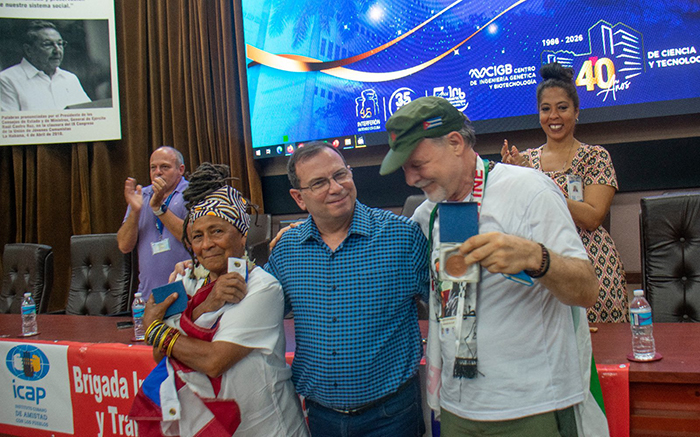
More than 250 friends from the May 1rst Solidarity Brigades, from 20 nations, and from the Canadian Che Guevara Brigade, were received on Monday by the Cuban Friendship Institute (ICAP by its Spanish acronym), which expressed its gratitude for their resolute support in the face of imperialist threats.
Read More ...
More than 250 friends from the May 1rst Solidarity Brigades, from 20 nations, and from the Canadian Che Guevara Brigade, were received on Monday by the Cuban Friendship Institute (ICAP by its Spanish acronym), which expressed its gratitude for their resolute support in the face of imperialist threats.
Medellin, Colombia — On Tuesday, a group of more than two thousand migrants, mainly of Haitian origin, reportedly left the southeastern city of Tapachula in Chiapas, on their way to cities in central and northern Mexico.
In years past, migrant caravans traversing Mexico were usually destined for the United States. But following the second Trump administration’s tightening of asylum policy, this goal has become more unrealistic, and Mexico has increasingly become a destination country for migra
Medellin, Colombia — On Tuesday, a group of more than two thousand migrants, mainly of Haitian origin, reportedly left the southeastern city of Tapachula in Chiapas, on their way to cities in central and northern Mexico.
In years past, migrant caravans traversing Mexico were usually destined for the United States. But following the second Trump administration’s tightening of asylum policy, this goal has become more unrealistic, and Mexico has increasingly become a destination country for migrants, according to the International Organization for Migration (IOM).
Some of the people who make up the “David” caravan have spent weeks or more in southern Mexico, waiting to normalize their migration status to be able to move more freely in Mexico, according to migrant news website Conexión Migrante. The process can be slow as Mexico fields more asylum requests.
According to the UNHCR, between 2020 and 2024, there were almost 500,000 asylum requests in Mexico, a number that has resulted in long delays from the Mexican Commission for Refugee Assistance (COMAR) and the National Institute of Migration (INM).
As of September 2025, there were more than 58,800 new asylum claims, and COMAR had increased its processing capacity fivefold since 2018.
Between October 1 2024 and June 30 2025, there were 142,145 requests for humanitarian visas in Mexico, but only 5,191 were granted, according to the INM Strategic Plan.
The bureaucratic problems pre-date Trump’s immigration crackdown in his second term.
In 2020, the COVID-19 pandemic forced COMAR to suspend activity, accumulating a backlog of asylum petitions. Exacerbating the issue was Trump’s January 2025 suspension of the CBP One digital asylum-seeking app in the U.S., followed by budget cuts to COMAR from the Mexican government as well as the UN Refugee Agency (UNHCR).
Via a Whatsapp group organized for the caravan, many members cited extreme delays for processing asylum applications as a motive for heading north from Mexico’s southern border. Lack of employment and cost of living were also cited, according to Conexión Migrante.
Without documentation, many foreign migrants are stuck in a legal limbo, where they run the risk of being stopped by authorities, deported or sent back to the southern border with Guatemala.
Migrants have also been targeted by criminal groups for kidnapping and extortion, with ProPublica reporting that this problem has entered a new phase in terms of scale and character. Migrants’ undefined legal status also often forces them to work long hours with lower pay, according to the International Rescue Committee.
Since Claudia Sheinbaum took office in October 2024, there have been 18 migrant caravans leaving from Tapachula, though none of them have made it further than Oaxaca, the state neighbouring Chiapas.
At the end of March, the ‘Genesis’ migrant caravan set off from Tapachula, but it was intercepted after 12 days and dissolved by the INM.
According to local news outlet Diario del Sur, on Thursday, the David caravan arrived in Escuintla, Chiapas after three days of walking, where members will rest before continuing the journey.
Many migrants were demonstrating signs of extreme physical exhaustion, and approximately thirty who fell behind the main group have been sent back to Tapachula, where they remain under the custody of the authorities, according to Reporteros del Sur.
Featured image description: David migrant caravan in Mexico
Medellín, Colombia – President Gustavo Petro has accused Ecuador of dropping bombs on Colombian territory, adding that 27 “charred bodies” were discovered near their shared border.
“We’re going to thoroughly investigate the circumstances—it happened very close to the border with Ecuador—which somewhat confirms my suspicion, but we need to investigate thoroughly: they’re bombing us from Ecuador, and it’s not the armed groups,” said Petro in a cabinet meeting on Monday evening.
The accusati
Medellín, Colombia – President Gustavo Petro has accused Ecuador of dropping bombs on Colombian territory, adding that 27 “charred bodies” were discovered near their shared border.
“We’re going to thoroughly investigate the circumstances—it happened very close to the border with Ecuador—which somewhat confirms my suspicion, but we need to investigate thoroughly: they’re bombing us from Ecuador, and it’s not the armed groups,” said Petro in a cabinet meeting on Monday evening.
The accusation marks an escalation in recent tensions between the two neighbors, with president Daniel Noboa swiftly denouncing the claims as false, insisting that his country’s anti-drug operations only hit targets within Ecuador.
In response to Petro’s claims, Noboa said on Tuesday that “with international cooperation, we continue the fight by bombing the hideouts used by these groups, who are mainly Colombians whom their own government allowed to infiltrate our country due to lax border controls.”
But Petro doubled down on his accusations, claiming that “there are 27 charred bodies and the explanation is not credible” the president said via X this Tuesday.
Pedro Sánchez, Colombian Minister of Defense, announced that Colombian forces have been deployed to the border to investigate the matter and carry out a controlled destruction of an alleged Ecuadoran bomb.
Earlier this month, the United States and Ecuador announced a joint military campaign to target criminal groups active in the South American country. Last Sunday, Ecuador began a 15-day joint operation with the U.S., deploying thousands of military and police officers throughout the provinces worst-affected by crime and declaring a nighttime curfew.
Noboa has repeatedly accused Bogotá of failing to address transnational organized crime and police its side of the border.
In February, Ecuador slapped 30% tariffs on Colombia which it labeled a “security fee”. Since then, the tit-for-tat dispute has seen mutual import levies reach 50%, drawing criticism from business owners and workers on both sides of the border.
Despite this, at the start of this month the neighbors joined forces to combat crime on their 600km border. Noboa, an ally of president Trump, also agreed to collaborate with U.S. forces in military operations against organized crime groups in March.
Noboa was also one of the 17 leaders from across Latin America and the Caribbean invited to join Trump’s ‘Shield of the Americas’ last week. The alliance, from which Colombia was excluded, promises to use full military force against drug traffickers. Last week, the FBI also opened its first office in Ecuador.
Featured image credit: Colombian President’s Office.
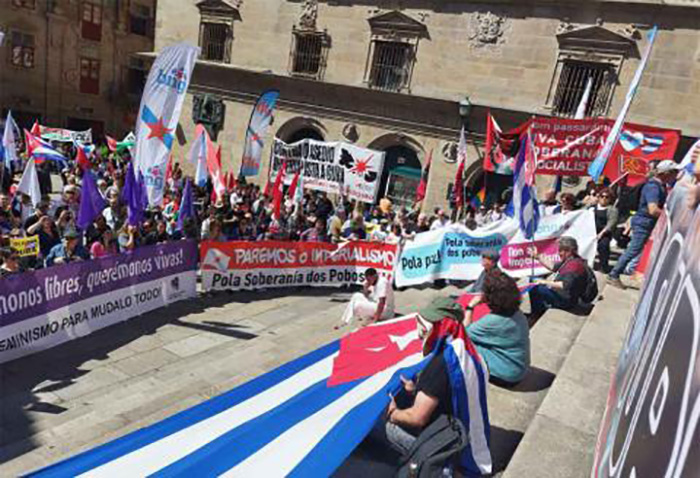
Residents of Galicia, Spain, joined the actions in support of Cuba with a demonstration in Santiago de Compostela organized by more than 30 political, labor, and social organizations, according to the Cuban Ministry of Foreign Affairs.
Read More ...
Residents of Galicia, Spain, joined the actions in support of Cuba with a demonstration in Santiago de Compostela organized by more than 30 political, labor, and social organizations, according to the Cuban Ministry of Foreign Affairs.
La Paz, Bolivia – For three weeks, Bolivia has been paralyzed by the largest wave of social unrest since President Rodrigo Paz took office in November. The Bolivian Highway Administration has reported dozens of road blockade points across the country, severing key arteries to the Peruvian and Chilean borders, Sucre, Oruro, Potosí, and Santa Cruz. There are severe food and diesel shortages in La Paz, with inflation rising fast, and hospitals being pushed to the brink due to lack of medical suppli
La Paz, Bolivia – For three weeks, Bolivia has been paralyzed by the largest wave of social unrest since President Rodrigo Paz took office in November. The Bolivian Highway Administration has reported dozens of road blockade points across the country, severing key arteries to the Peruvian and Chilean borders, Sucre, Oruro, Potosí, and Santa Cruz. There are severe food and diesel shortages in La Paz, with inflation rising fast, and hospitals being pushed to the brink due to lack of medical supplies.
The protesters, in the tens of thousands, include members of the Bolivian Workers’ Central (COB) trade union, rural teachers’ unions, mining cooperatives, coca growers’ federations, and indigenous communities from the Amazon who walked hundreds of kilometres to reach La Paz. They also include the Red Ponchos — a radical Aymara militia and social movement for indigenous rights most active in the high plains (Altiplano), gaining prominence in the 2003 Gas War. They are known for using direct action, such as blockades and clashes with state forces.
What are the root causes of the unrest?
The crisis did not appear from nowhere. Recurring fuel shortages – the same chronic problem that had contributed to the collapse of the socialist Arce government – returned to rattle an already fragile economy, along with sweeping economic cuts, including to fuel and food subsidies.
But the larger trigger was Law 17-20, a measure that would authorize reforms to indigenous land tenure arrangements, which many communities interpreted as opening the door to the privatization of communal lands.
Many of the protesters themselves voted for President Paz, and the regions most affected: La Paz, El Alto, Cochabamba, are the same ones that delivered him his electoral majority.
“We voted for change, for Capitalism for All, but we’re in the same place as before, only maybe worse,” one protester named Patricia told Latin America Reports in El Alto.
“They made promises to us, about social rights and economic progress, and then acted like they forgot we existed,” said Fernando, a member of a Cochabamba peasant federation told Latin America Reports.
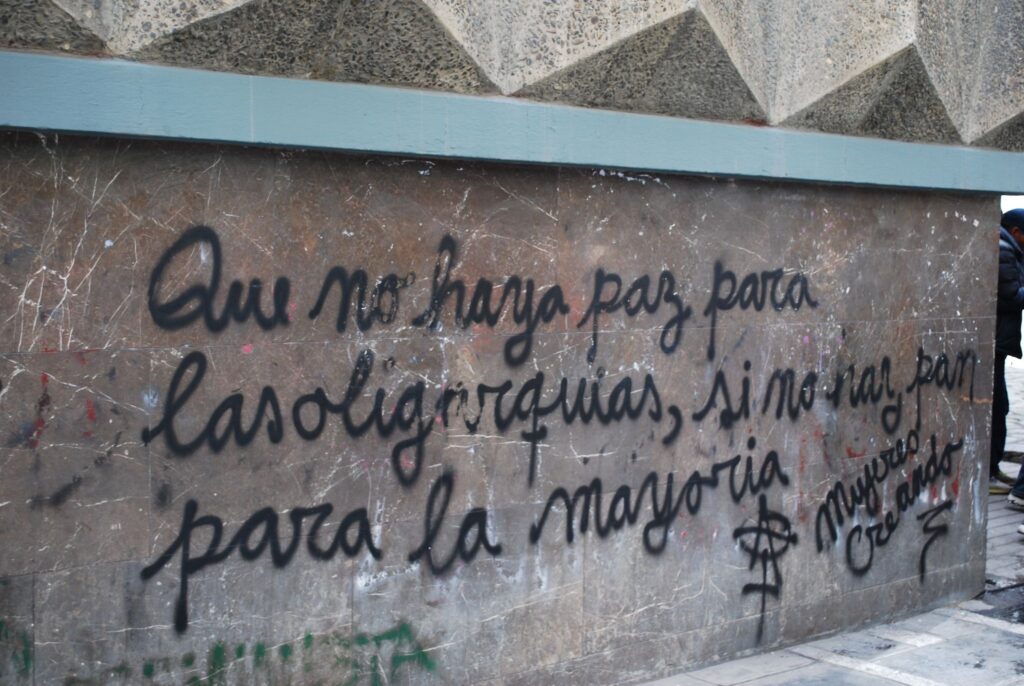
Graffiti quote inscribed by protesters reading, “May there be no peace for the oligarchies, if there is no bread for the majority.” Image credit: Joseph Bouchard
They have multiple grievances, including a cabinet with little meaningful indigenous, female or movement representation, the absence of consultation with social organizations on major legislative decisions, cuts to fuel subsidies and social services whose effects have been felt immediately in communities already stretched thin by years of economic crisis, and a failure to address the structural commercial and energy crises that preceded Paz’s election.
On a more structural level, many syndicalist and indigeneist movements that had long been associated with the Movement Towards Socialism (MAS) made a deliberate and politically costly decision to back Paz over former socialist president Evo Morales’s old party last year. They feel that they have been betrayed, and left out.
Protesters lined up by the Plaza San Francisco in downtown La Paz. Image credit: Joseph Bouchard
The government’s response
For its part, the Paz government has pursued a strategy of selective negotiation combined with escalating pressure on those who refuse to leave the streets. It has reached agreements with certain teachers’ unions and regional COB affiliates, and issued decrees guaranteeing healthcare, education, and other rights to indigenous communities.
Some factions have accepted these terms, though others have accused them of capitulating, or being co-opted by the government. One leader of the COB argued from La Paz, “They are doing the same strategy as the MAS under the previous regime, they are co-opting social movements to delegitimize our demands and our concerns, and paint us as insubordinate and ungrateful.”
Paz has promised a cabinet reshuffle, along with an economic social council, in an attempt to “listen to the people” and provide further representation for aggrieved social sectors.
The Paz government has deployed thousands of police in La Paz and El Alto to resist and dismantle blockades, using tear gas, riot gear, and rubber bullets, apprehending at least 100 according to the People’s Ombudsman, including journalists. Three have died so far, with many more injured.
Senior officials, including cabinet members, have publicly accused blockade leaders of being financed by Evo Morales and linked to drug trafficking and terrorism.
Paz himself has referred to those still demonstrating in the streets as “vandals,” and the state security apparatus has warned it will use “progressive and proportional force” — with persistent rumours, denied by the government, of authorization for live ammunition.
Human rights organizations and the COB leadership have denounced the targeting of union leaders and the harassment of the press and activists. Former president Evo Morales has alleged that the Paz government, in coordination with the DEA and US Southern Command, is planning an operation to detain or kill him.
Protesters wait to join the frontlines as tear gas accumulates near the Plurinational Assembly. Image Credit: Joseph Bouchard
The impact on Paz’s presidency
The crisis is exposing deep tensions within Paz’s own Christian Democratic Party (PDC) big tent coalition, which brought together an ideologically eclectic mix of figures — from indigeneist currents previously aligned with the MAS, and populist actors, to more conventionally conservative actors such as former president Tuto Quiroga, multimillionaire former minister Samuel Doria Medina, and prominent figures in right-wing stronghold Santa Cruz. That coalition is straining.
Vice President Edmand Lara, a populist anti-corruption figure and former police officer whom social movements had embraced and whose support is widely credited with being decisive in Paz’s election victory, has issued multiple statements breaking with the president’s handling of the crisis.
Lara condemned the use of chemical agents against elderly people, pregnant women, and children, called on security forces to respect proportionality protocols, denounced the intimidation of journalists, and invited the Inter-American Commission on Human Rights to monitor the situation. Political analysts in La Paz are openly speculating that Lara is positioning himself as the social movements’ candidate for the presidency, should Paz’s government fall.
On the more conservative flank, Paz’s allies are urging a harder line. Proposals include a state of emergency, tighter control of what they characterize as violent paid agitators, and continued carrot-and-stick approaches to willing and unwilling sectors. Which tendency wins the internal argument will likely define the character of the Paz government going forward, if it can survive it.
Protesters retreat as tear gas descends into commercial streets in downtown La Paz. Image credit: Joseph Bouchard
International response to the protests
Internationally, the crisis has also created further divisions. Leftist Colombian President Gustavo Petro, in a series of posts on social media, described the protests as “a popular insurrection” against “geopolitical arrogance” and declared that “Bolivia stands at the forefront of the struggle for Latin American dignity.” He also offered Colombian mediation for the crisis.
Bolivia’s foreign minister, Fernando Aramayo, responded by expelling Colombia’s ambassador, Elizabeth García, declaring her persona non grata for what he called “insistent public declarations of interference in Bolivia’s internal affairs.” Paz called it an “attack on democracy.”
The conservative bloc in Latin America has lined up firmly behind Paz. Among others, El Salvador, Argentina, Chile, Peru, and the United States have characterized the protests as destabilizing and linked them to drug trafficking. US Secretary of State Marco Rubio described the unrest as a “coup attempt,” adding that “we will not allow criminals and drug traffickers to overthrow democratically elected governments,” which protesters say are racist echoes of the country’s long history with the war on drugs and U.S. intervention.
Argentina, meanwhile, reportedly sent military aircraft, officially carrying food and medicine, that are alleged by protest groups to also contain tear gas and crowd-control equipment, a charge Buenos Aires has denied. The OAS Security Council has convened an emergency session on Bolivia.
Demands from protesters
The protesters’ demands range from specific sectoral issues, like better conditions for teachers, guaranteed rights for indigenous communities, to more sweeping demands including Paz’s resignation and, for Evo Morales, fresh democratic elections within 90 days. Evo Morales, the COB, and Red Ponchos have stated they will not stop fighting.
The unfolding unrest is becoming a sharp test for Paz, and Bolivia’s democracy. Based on Bolivia’s history, the social movements in the streets, as they are acutely aware, have brought down governments before, and are in no hurry to leave. For now, the blockades continue in Bolivia.
Featured Image: Red Ponchos throw stones at functionaries and police at the Judiciary building in La Paz.
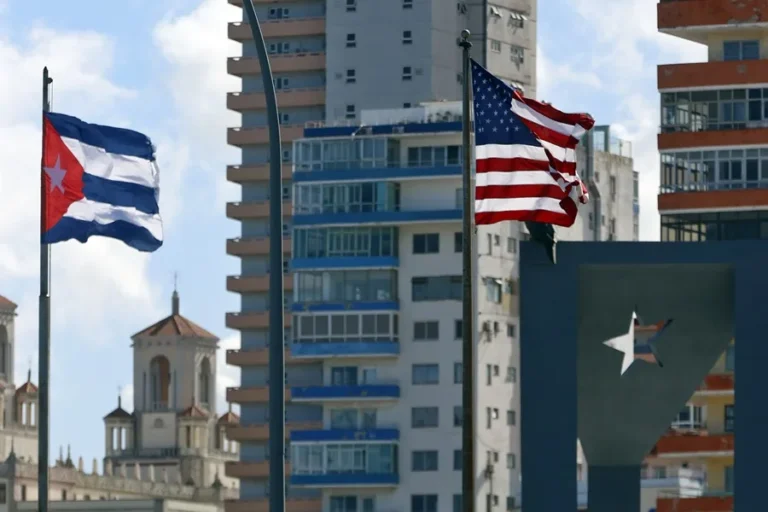
The Director of International Law at the Cuban Ministry of Foreign Affairs, Yusnier Romero, denounced the recent political maneuver by the US government, accusing it of flagrantly violating the principle of sovereign equality by claiming universal jurisdiction to judge nationals of other states.
Read More ...
The Director of International Law at the Cuban Ministry of Foreign Affairs, Yusnier Romero, denounced the recent political maneuver by the US government, accusing it of flagrantly violating the principle of sovereign equality by claiming universal jurisdiction to judge nationals of other states.

 Login
Login