Flower illustration found in a <i>Design</i> magazine from ca. 1935. This was a magazine for potters and decorators edited by Keramic Studio Publishing Co.
Flower illustration found in a <i>Design</i> magazine from ca. 1935. This was a magazine for potters and decorators edited by Keramic Studio Publishing Co.
From recognizable scenes around her home in Scotland to delicately rendered snapshots of places she visits, Laura K. Sayers’ meticulously crafted postage stamps nod to connections from afar. The artist, who also illustrates children’s books and is commissioned for special projects like greeting cards, incorporates itty-bitty cuts of colorful paper into tiny tableaux that can fit in the palm of a hand.
Much of the work seen here is currently on view solo in Sayers’ solo exhibition of miniat
From recognizable scenes around her home in Scotland to delicately rendered snapshots of places she visits, Laura K. Sayers’ meticulously crafted postage stamps nod to connections from afar. The artist, who also illustrates children’s books and is commissioned for special projects like greeting cards, incorporates itty-bitty cuts of colorful paper into tiny tableaux that can fit in the palm of a hand.
Much of the work seen here is currently on view solo in Sayers’ solo exhibition of miniatures titled The Wee Small Hours at N. atelier. An array of everyday scenes is chronicled in a format we typically associate with significant events and remembrance, documenting fleeting moments like little treasures. Some of her recent pieces are inspired by the Finnish landscape that emerged during the artist’s stay at the Fiskars Artist-in-Residence program, organized by Onoma.
The Wee Small Hours continues through this weekend in Glasgow. And keep an eye out for a joint update from Tiny Art Show. Find more on Sayers’ Instagram.
Two sleek ladies in Art Déco style rescued from the cover of a <i>Design</i> magazine from 1934. This was a magazine for potters and decorators edited by Keramic Studio Publishing Co.
I modified the original illustration to make it look less elongated and irregular than it was originally.
Two sleek ladies in Art Déco style rescued from the cover of a <i>Design</i> magazine from 1934. This was a magazine for potters and decorators edited by Keramic Studio Publishing Co.
I modified the original illustration to make it look less elongated and irregular than it was originally.
Yuko Shimizu is a New York-based illustrator, whose bold manga lines depict intimate narrative scenes from myth, science fiction, and pop iconography, creating a visual genre all her own. Read the full article by Harrison Cook clicking above!
The post Yuko Shimizu depicts intimate narrative scenes from myth, science fiction, and pop iconography, creating a visual genre all her own. first appeared on Hi-Fructose Magazine.
Yuko Shimizu is a New York-based illustrator, whose bold manga lines depict intimate narrative scenes from myth, science fiction, and pop iconography, creating a visual genre all her own. Read the full article by Harrison Cook clicking above!
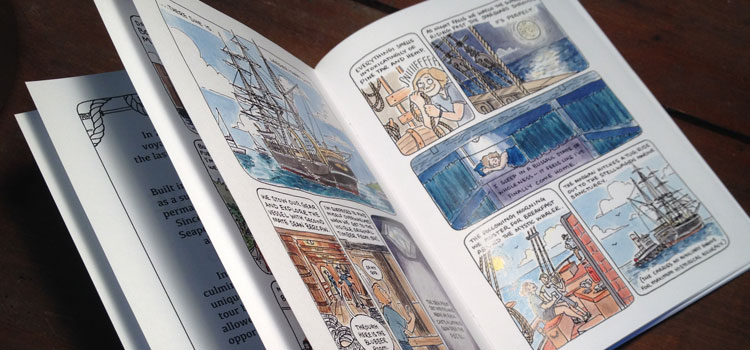
A number of fantastic ducks lined up in the month of June and I want to talk about all of them, but there isn’t time to do it in one giant post. One duck, however, took the form of appearing at the 14th International Melville Society Conference to speak about my time aboard the Charles W. Morgan eleven years ago. (You can read the comic about that trip here.)
I read Moby-Dick for the first time a handful of years ago and loved it, but I wouldn’t call myself a Melville scholar. However, at
A number of fantastic ducks lined up in the month of June and I want to talk about all of them, but there isn’t time to do it in one giant post. One duck, however, took the form of appearing at the 14th International Melville Society Conference to speak about my time aboard the Charles W. Morgan eleven years ago. (You can read the comic about that trip here.)
I read Moby-Dick for the first time a handful of years ago and loved it, but I wouldn’t call myself a Melville scholar. However, attending this conference felt like a great chance to scratch the academic itch without, say, going to grad school.
I ended up spending the whole week taking visual notes, which allowed me to drop into a type of weightless, fixated attention that I’ve really missed in my caregiving life. It also helped give me something to do during panels where I felt a little, uh, out of my depth.
When I’m drawing, words just wash over me. I can pluck the ones that resonate in the moment, then step back at the end of the hour and get a picture of what I took away from the talk. I particularly loved the freedom to just wander into panels where I had no idea what the speakers were talking about, only to come away newly-enthused about some niche avenue into Melville’s work.
Time and time again the attendees emphasized how unique this conference is in its warmth and intellectual diversity. I met scientists and art historians and medievalists and printmakers and disability scholars and tall ship sailors and filmmakers and many, many professors. It was a dreamy, albeit intense, four days.
Here are the notes from every talk I attended, all drawn straight to ink during the speakers’ presentations (usually about 20 minutes per person).
The biggest takeaway was that we need embedded cartoonists at all sorts of academic conferences—and the demand is there! People were so thrilled to see this kind of work coming out of the event, and there are lots of journals hungry to publish unusual creative content alongside academic papers.
Something to pursue…eventually. Got a couple things* to wrap up first.
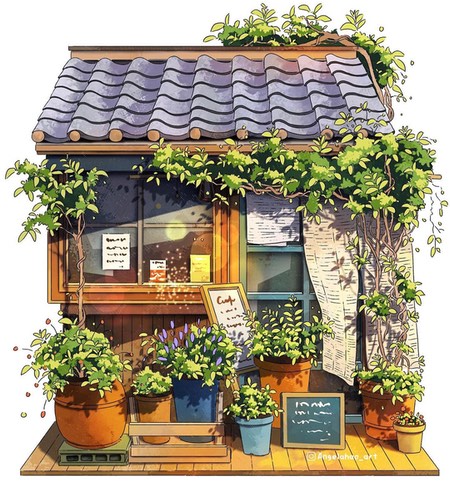
Angela Hao lives and works in the U.S., but makes virtual visits to Japan via Google Street view, capturing the charm of small, quirky storefronts in digital ink and watercolor style illustrations she creates in Procreate.
These are delightlfully whimsical and take note of the small details that give each little store its own personality.
She has prints available on inPrint.
Via My Modern Met
Angela Hao lives and works in the U.S., but makes virtual visits to Japan via Google Street view, capturing the charm of small, quirky storefronts in digital ink and watercolor style illustrations she creates in Procreate.
These are delightlfully whimsical and take note of the small details that give each little store its own personality.
The realities that Hattie Stewart manifests have a carnival quality—gleaming, trashy fun with a slightly sinister undertone like golden midway tokens that rust and then jingle in your hand like they are laughing at you for believing the gold was real anyway. “Nothing brings me more joy,” Stewart says, “than taking a clean blank page and filling every inch of it with colors and imagined worlds.” Read Clayton Schuster's full article on the artist by clicking above.
The post Violently Happy: Hattie
The realities that Hattie Stewart manifests have a carnival quality—gleaming, trashy fun with a slightly sinister undertone like golden midway tokens that rust and then jingle in your hand like they are laughing at you for believing the gold was real anyway. “Nothing brings me more joy,” Stewart says, “than taking a clean blank page and filling every inch of it with colors and imagined worlds.” Read Clayton Schuster's full article on the artist by clicking above.
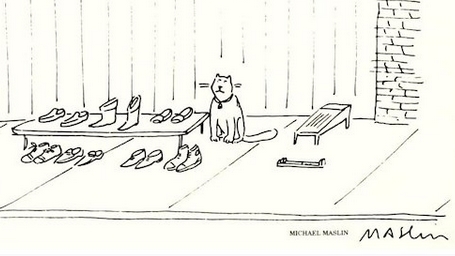
Mustered cartoonists: Peter Kuper, Justin Eisinger, Michael Maslin, Art Sloggatt, Nicole Hollander, Ham Fisher. Ohio Book Awards A couple of graphic novels are finalists in the non-fiction category of the Ohio Book Awards. Insectopolis is by Peter Kuper who lived in Ohio during his school years, and It Rhymes With Takei is by George Takei, […]
Mustered cartoonists: Peter Kuper, Justin Eisinger, Michael Maslin, Art Sloggatt, Nicole Hollander, Ham Fisher. Ohio Book Awards A couple of graphic novels are finalists in the non-fiction category of the Ohio Book Awards. Insectopolis is by Peter Kuper who lived in Ohio during his school years, and It Rhymes With Takei is by George Takei, […]
When we think of tarot cards, there’s a standout that probably pops to mind right away: the Rider-Waite-Smith deck. It was illustrated by British occultist and artist Pamela Coleman Smith, and more than 100 years after its publication, it remains the most widely used deck by readers. But the cards are far from being the first. Later this month, The Morgan Library & Museum presents Tarot! Renaissance Symbols, Modern Visions, which delves into this centuries-old tradition of divination.
When we think of tarot cards, there’s a standout that probably pops to mind right away: the Rider-Waite-Smith deck. It was illustrated by British occultist and artist Pamela Coleman Smith, and more than 100 years after its publication, it remains the most widely used deck by readers. But the cards are far from being the first. Later this month, The Morgan Library & Museum presents Tarot! Renaissance Symbols, Modern Visions, which delves into this centuries-old tradition of divination.
The exhibition celebrates some of the earliest examples alongside modern artists’ versions. Three surviving decks from the 15th century, commissioned by the Dukes of Milan, tap into the lively Italian court culture that produced the cards, plus how the imagery evolved and laid the groundwork for fortune-telling practices.
A complementary display emphasizes how artists throughout the 20th century reimagined the imagery, including Smith’s iconic deck from 1909, plus iterations by Surrealists André Breton, Victor Brauner, and Remedios Varo. The connection isn’t coincidental; Leonora Carrington devised a gilded deck in the 1950s, and Salvador Dalí also contributed his own version.
Tarot! Renaissance Symbols, Modern Visions highlights how artists have turned to the practice to explore what the museum describes as “an alternative to the strictures of modernist aesthetics, allowing them to explore other universes and imaginative possibilities.” The show is accompanied by a catalog, which you can order from The Morgan’s shop. See the exhibition from June 26 through October 4 in New York.
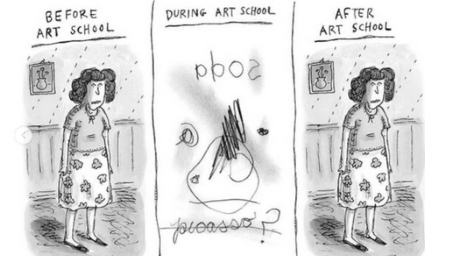
Roz Chast, Rhode Island School of Design ’77 PT, is honored with an honorary doctorate from her alma mater. From Roz: Very excited to have received an Honorary Doctorate of Fine Arts from RISD, my alma mater, today. I had a complicated feeling about art school but absolutely no regrets about going there. I met […]
Roz Chast, Rhode Island School of Design ’77 PT, is honored with an honorary doctorate from her alma mater. From Roz: Very excited to have received an Honorary Doctorate of Fine Arts from RISD, my alma mater, today. I had a complicated feeling about art school but absolutely no regrets about going there. I met […]
During the Victorian era, innovators made huge leaps with optical technologies. It was the period of the stereoscope and an early projector known as the magic lantern, not to mention that eyeglasses became more affordable and entered the mainstream. These advances also influenced scientific inquiry, making microscopes more powerful, and the pursuit of microscopy enabled researchers and enthusiasts to discover creatures invisible to the naked eye.
One of these enthusiasts was London-based e
During the Victorian era, innovators made huge leaps with optical technologies. It was the period of the stereoscope and an early projector known as the magic lantern, not to mention that eyeglasses became more affordable and entered the mainstream. These advances also influenced scientific inquiry, making microscopes more powerful, and the pursuit of microscopy enabled researchers and enthusiasts to discover creatures invisible to the naked eye.
One of these enthusiasts was London-based educator and amateur scientist Charles Thomas Hudson. Along with other scholars and aficionados, he participated in interest groups. “As President of the Royal Microscopical Society and a Fellow of the Royal Society, Hudson was a leading figure in this growing scientific community,” says a statement from Osh Gallery, which is currently exhibiting a collection of unique illustrations in The Hudson Transparencies.
Sea slugs
Curated by Luke Powell and Jody Hudson-Powell of design firm Pentagram, which runs Osh Gallery, the exhibition literally brings to light a number of colorful transparencies that Hudson used during his lectures. While they appear dark and even unfinished in a typical setting, “when lit from behind these intricate works transform into magical visions of life previously only glimpsed when viewed under a microscope,” the gallery says.
The Hudson Transparencies includes 58 original transparencies that measure a surprisingly large 37.8 by 29.5 inches. Each of the graphics’ proportions are “the equivalent of drawing ants the size of elephants,” says a statement. The animals and botanicals emerge through a combination of painted paper and perforations, which are made with lines and clusters of pinholes.
Hudson was particularly fascinated by rotifers, a phylum of zooplankton named for their so-called “wheel-bearing” characteristics. He also catalogued algae, protozoa, and larvae—such as that of the mayfly with its feather-like tail. Microscopic marine organisms were a particular favorite, though, and these back-lit images highlight the convergence of science and spectacular visuals that not only brought these creatures to life in a unique way for 19th-century viewers but continue to awe us today.
Where the blue sky breaks through the tree canopy or light reflects onto the surface of a pond, illustrator Masha Foya summons moments of joy and surprise. The Kyiv-based artist’s dreamlike illustrations often portray spaces and individuals in emotional or experiential states, as if the entire environment morphs into a single living being. Hands clasp over the arc of a foliage tunnel, for example, and a plane sails through an aperture shaped like a bird in flight. Seemingly enclosed spaces of
Where the blue sky breaks through the tree canopy or light reflects onto the surface of a pond, illustrator Masha Foya summons moments of joy and surprise. The Kyiv-based artist’s dreamlike illustrations often portray spaces and individuals in emotional or experiential states, as if the entire environment morphs into a single living being. Hands clasp over the arc of a foliage tunnel, for example, and a plane sails through an aperture shaped like a bird in flight. Seemingly enclosed spaces often converge with the sky or the cosmos, alluding to the boundlessness of imagination and feeling.
The work shown here comprises both personal and commissioned projects. Foya is currently working on developing a number of book covers for Ukrainian publishing houses, and she is also collaborating with Scientific American and the German newspaper DIE ZEIT. Her work is also included in two exhibitions, Illustroteka and Everything Is Translation, organized by Pictoric. See more on Foya’s Behance and Instagram.
“One Summer Morning”“Tunnel of Love”An illustration for ‘Business Insider’Postcard design for Global Wind DayA piece representing the letter “X” for ‘Illustroteka’“Whispering of the Ionian Sea”“Reflection”“Dreaming in Blue and Green Colors”“The Stork”
 Login
Login