“I feel the answer to your question will always exist outside the world as it presents itself, beyond the matters of the day, distinct from the temporal. It will be found within the mysterious, the unsettled, and the sacred, that faraway and intangible place where truth and music and your father reside.”
— The Red Hand Files, Issue #323
“I feel the answer to your question will always exist outside the world as it presents itself, beyond the matters of the day, distinct from the temporal. It will be found within the mysterious, the unsettled, and the sacred, that faraway and intangible place where truth and music and your father reside.”
“It is maybe not functionally possible to design social networked technology geared towards listening. I don’t know, I’m not that smart. But the fact that the internet doesn’t have a mechanism for listening means that we’ve invented these kludgy quantification mechanisms to try and detect attention, and it is easy, so incredibly easy there are multiple books written about this, to confuse the thing you’re measuring for the metric itself.
I want to know who is visiting my site and whether the
“It is maybe not functionally possible to design social networked technology geared towards listening. I don’t know, I’m not that smart. But the fact that the internet doesn’t have a mechanism for listening means that we’ve invented these kludgy quantification mechanisms to try and detect attention, and it is easy, so incredibly easy there are multiple books written about this, to confuse the thing you’re measuring for the metric itself.
I want to know who is visiting my site and whether they’re returning visitors and what pages they clicked through and for how long because it gives me the illusion of knowledge and control. Maybe I’ll know my project is connecting with people if I just hit some arbitrary threshold of pageviews, subscribers, conversion rate.
But none of that will tell me the thing I actually want to know, which is: am I making a difference?”
Hey I loved this. It also reminded me to go check up on the phone line and see if there were any messages that needed witnessing. I keep them close to the chest because that’s part of the project, but I will say that there were and they moved me to tears. Maybe that’s what it’s all about.
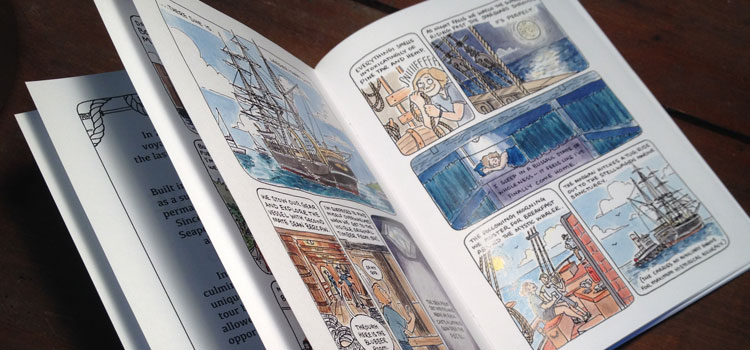
A number of fantastic ducks lined up in the month of June and I want to talk about all of them, but there isn’t time to do it in one giant post. One duck, however, took the form of appearing at the 14th International Melville Society Conference to speak about my time aboard the Charles W. Morgan eleven years ago. (You can read the comic about that trip here.)
I read Moby-Dick for the first time a handful of years ago and loved it, but I wouldn’t call myself a Melville scholar. However, at
A number of fantastic ducks lined up in the month of June and I want to talk about all of them, but there isn’t time to do it in one giant post. One duck, however, took the form of appearing at the 14th International Melville Society Conference to speak about my time aboard the Charles W. Morgan eleven years ago. (You can read the comic about that trip here.)
I read Moby-Dick for the first time a handful of years ago and loved it, but I wouldn’t call myself a Melville scholar. However, attending this conference felt like a great chance to scratch the academic itch without, say, going to grad school.
I ended up spending the whole week taking visual notes, which allowed me to drop into a type of weightless, fixated attention that I’ve really missed in my caregiving life. It also helped give me something to do during panels where I felt a little, uh, out of my depth.
When I’m drawing, words just wash over me. I can pluck the ones that resonate in the moment, then step back at the end of the hour and get a picture of what I took away from the talk. I particularly loved the freedom to just wander into panels where I had no idea what the speakers were talking about, only to come away newly-enthused about some niche avenue into Melville’s work.
Time and time again the attendees emphasized how unique this conference is in its warmth and intellectual diversity. I met scientists and art historians and medievalists and printmakers and disability scholars and tall ship sailors and filmmakers and many, many professors. It was a dreamy, albeit intense, four days.
Here are the notes from every talk I attended, all drawn straight to ink during the speakers’ presentations (usually about 20 minutes per person).
The biggest takeaway was that we need embedded cartoonists at all sorts of academic conferences—and the demand is there! People were so thrilled to see this kind of work coming out of the event, and there are lots of journals hungry to publish unusual creative content alongside academic papers.
Something to pursue…eventually. Got a couple things* to wrap up first.
A quick one to say I’ve been thinking a lot about the different subtitles they’ve slapped on Lewis Hyde’s The Gift through the years, mostly because it was only this year I learned that the original 1983 edition looked like this:
I LOVE IT. WHY DID THEY CHANGE IT. WHAT GIVES.
The whole thing is a far cry from 2019’s:
As well as the copy I first encountered (published in 2007), which features a third option:
Which is…fine? It’s fine.
BUT WHO BURIED THE LEDE ON THE E
A quick one to say I’ve been thinking a lot about the different subtitles they’ve slapped on Lewis Hyde’s The Gift through the years, mostly because it was only this year I learned that the original 1983 edition looked like this:
I LOVE IT. WHY DID THEY CHANGE IT. WHAT GIVES.
The whole thing is a far cry from 2019’s:
As well as the copy I first encountered (published in 2007), which features a third option:
Which is…fine? It’s fine.
BUT WHO BURIED THE LEDE ON THE EROTIC LIFE OF PROPERTY?!
Audre Lorde originally presented “Uses of the Erotic: The Erotic as Power” as a paper in 1978, but it wasn’t published in Sister Outsider until 1984—just one year after the first edition of The Gift came out.
(There’s a nice write-up of this design on Fonts in Use, if you’re into that sort of thing, *cough*ROBIN*cough*)
I wonder about this post-70s literary landscape, everything still reverberating with the energy of the 60s, the explosive visibility of sexuality in American youth culture, the rising tide of queer voices—but also the broader definition of eroticism.
I just re-read Katherine Angel’s Unmastered: a Book on Desire, Most Difficult to Tell, which I picked up after Tomorrow Sex Will Be Good Again. Her exploration of eroticism veers more towards the question of what to do with desire that resists being codified, named, and negotiated in explicit terms. How do we reckon with consent culture alongside the lure of the unknown? What of discovery? What of the secret third thing?
Kate Wagner coming in at the right moment here with this essay:
A situational eroticism is what is needed now, in our literalist times. […] Arousal is a matter of the self, which takes place within the body, a space no one can see into. It is often a mystery, a surprise, a discovery. It can happen at a small scale, say, the frisson of two sets of fingers in one’s hair at once. It is beautiful, unplanned and does not judge itself because it is an inert sensation, unimbued with premeditated meaning. This should liberate rather than frighten us. Maybe what it means doesn’t matter. Maybe we don’t have to justify it even to ourselves.
This draft has been languishing because I don’t have a neat bow to slap on the end of this. If there’s anything I’m thinking of, though, it’s that Hyde (or his publisher) wasn’t wrong to foreground eroticism in that first edition of the book. Eroticism is creativity, and neither are as much work as they are play.

 Login
Login