Seasonal fruit gets a Japanese makeover, but only for a very limited time.
When it comes to high-value, affordable sweets, Japanese chain Chateraise is one of the true champions of the dessert world. Known for low prices and a wide range of goods, covering everything from Western sweets, to Japanese confections, ice cream, bread, and even alcohol, Chateraise represents great value for money, and is incredibly popular throughout the country.
Right now the chain has become even more popular, th
Seasonal fruit gets a Japanese makeover, but only for a very limited time.
When it comes to high-value, affordable sweets, Japanese chain Chateraise is one of the true champions of the dessert world. Known for low prices and a wide range of goods, covering everything from Western sweets, to Japanese confections, ice cream, bread, and even alcohol, Chateraise represents great value for money, and is incredibly popular throughout the country.
Right now the chain has become even more popular, thanks to a limited-time June-only treat called “Sakuranbo Mochi” (“Cherry Mochi”). After Chateraise announced the release on Twitter, the post received over 2,000 likes in around two days, which is a far greater response than other product announcements, which generally garner around 700 likes.
▼ It’s since received over 23,000 likes and around 3.7 million views, as of this writing.
After running a search on the product it turns out that, unbeknownst to us, Chateraise’s Cherry Mochi is a seasonal item that comes out every year, and this time it will be in stores from 3-23 June. Priced at 518 yen (US$3.23) for a pack of four, this is slightly on the premium side for Chateraise, but when we saw it in store we knew the cost would be worth it, because…
▼ …look how pretty they are!
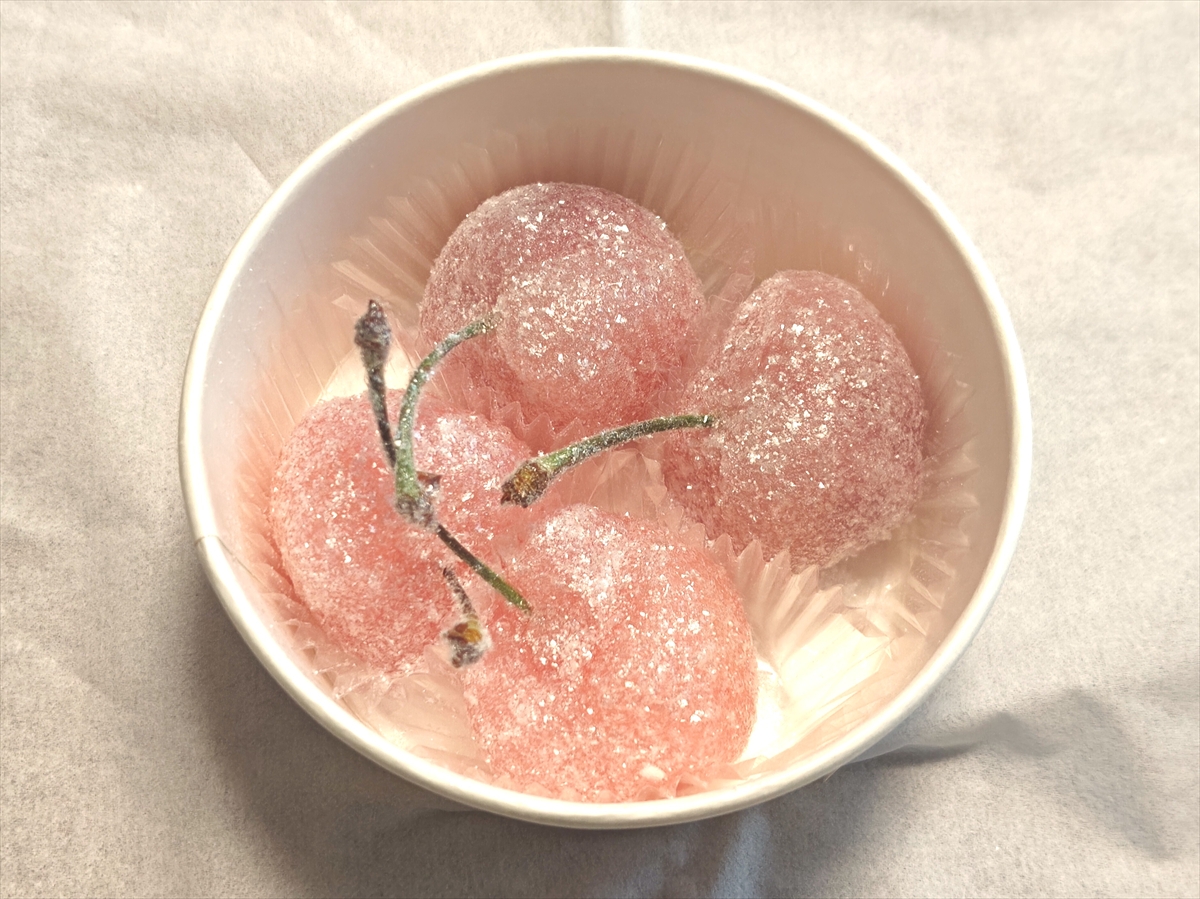
As soon as we took them home and opened the lid of the tub they came in, we couldn’t help but gasp in surprise. With four perfectly round, neatly arranged sweets inside, and shimmery, powdered starch dusted over the pale pink gyuhi coating, the sweets sparkled like jewels in a jewellery box, catching the light in ways that created a mesmerising beauty.
The way the cherry appearance is kept intact with the stems still attached gave these an added air of beauty – so much so that we had a strange urge to display them rather than eat them.
Still, with only a two-day shelf life, these freshly made sweets are too good not to be eaten, especially as the combination of fresh cherry and plump gyuhi is such a rare find.
▼ Despite being called “Cherry Mochi”, there’s no actual mochi here, as the term is often used colloquially to describe chewy, rice-based sweets.
Like mochi, gyuhi is also made from glutinous rice, but it’s a softer, sweeter version with a more melt-in-the-mouth texture, making it ideal for wrapping Japanese confectionery. The gyuhi layer here looked delightfully plump, and as we gazed at it, the sweet and tangy aroma of the cherry overtook our senses, drawing us in for a bite.
The gyuhi was the first element to meet our taste buds, nudging them awake with a gentle sweetness and a soft, chewy texture, before giving way to a burst of cherry, followed by a rush of juice across the palate. The generously sized domestically grown cherry was clearly high-quality, displaying a fragrance and sweet-tart flavour that was strong enough to stand up to the sweetness of the gyuhi. Though the fruit would have tasted delicious on its own, the gyuhi wrap elevated it into something much more refined, allowing us to enjoy the seasonal fruit in an elegant way.
▼ A sweet that deserves all the viral attention it’s been getting.
The sweets were so good we couldn’t quite believe they hadn’t reached a worldwide level of fame, but that’s likely only because social media influencers don’t know about them yet. That’s definitely a good thing, though, because otherwise we wouldn’t be able to enjoy them, and these are sweets that definitely need to be enjoyed by as many people as possible during their too-short three-week run.
A person scrolls through the social media app X on a phone. | Jaap Arriens/NurPhoto via Getty Images
Our social media feeds are being inundated by clips. Big names like Justin Bieber, reality shows like RuPaul’s Drag Race, and even AI companies like Perplexity — they’re all using bite-sized video segments to advertise themselves on social media. And they’re not just posting from their own accounts; they’re paying thousands of anonymous people to do it for them.
This practice, a marketi
A person scrolls through the social media app X on a phone. | Jaap Arriens/NurPhoto via Getty Images
Our social media feeds are being inundated by clips. Big names like Justin Bieber, reality shows like RuPaul’s Drag Race, and even AI companies like Perplexity — they’re all using bite-sized video segments to advertise themselves on social media. And they’re not just posting from their own accounts; they’re paying thousands of anonymous people to do it for them.
This practice, a marketing tactic known as clipping, is everywhere — and still spreading. The Verge’s Mia Sato recently wrote a piece breaking down how the practice works and how it might be an existential threat to more nuanced, full-length content.
Sato spoke with Today, Explained co-host Sean Rameswaram about why everything is a clip now, the companies behind it, and what comes next.
Below is an excerpt of their conversation, edited for length and clarity. There’s much more in the full podcast, so listen to Today, Explained wherever you get your podcasts, including Apple Podcasts, Pandora, and Spotify.
How would you describe what’s happening on our Instagram feeds?
It’s basically the TL;DR-ification of the entire internet. It truncates everything we make and it all goes down to “We need a way for people to discover our content.” And right now, the way to get people to discover the content is to make clips of it, no matter what it is.
Think about the politics videos. You see Trump giving a speech that Aaron Rupar is posting. Or sports highlights from the game the night before. You see this with sort of every podcast becoming a video. A major reason that happened was because they needed something to put on TikTok, to put on Reels, to put on YouTube Shorts.
What made you want to write about this now?
The reason I felt like we needed to have a conversation about it is because of Clavicular.
Clavicular is really a great example where the point of his online existence is clips rather than the full live streams. They know him through these disembodied short videos of this other thing that exists, but nobody is seeing. And you have this person who comes from obscurity into getting a 60 Minutes interview.
I wanted to take this one example to illustrate a larger point about the nature of content on the internet and how people are working to go viral.
Is there a difference between the podcast clips that we talked about at the top of the show and what Clavicular is doing?
Clavicular is basically the industrialized version of a podcast that is just posting its own clips organically. The difference is that there’s an ecosystem under it that is paid.
For the month between March and April, I believe there were something like 1,600 clippers working on his behalf, generating tens of thousands of videos, billions of views, and all of that is paid. People are paid to post this content and paid based on how many views the clips get. And so it is completely a scale game. It’s a hundred percent trying to take advantage of the algorithms of social platforms. These pseudo-anonymous accounts are profiting based on how much these clips are showing up on all of our feeds.
How much money is there to be made here?
[Clavicular] oversees 62,000 clippers on his platform. Some people are making tens of thousands of dollars a month. He claims the average is around $3,000 a month. It’s not nothing. Is it enough to support a family? Can you support a family on clips? Maybe not. But brands are paying companies like this clipping platform; [they] basically say, here’s $10,000, make us go viral.
What kinds of companies are paying for this service?
I was kind of surprised by how many household names were using this type of service. RuPaul’s Drag Race. There were clip campaigns for AI companies like Perplexity. Dan Bongino, former second in command at the FBI, who has now gone back to being a full-time podcaster. I found clipping campaigns that appeared to be for Call of Duty, the video game. Political candidates, which really gets weird. So it really spans different industries. There’s definitely a variety.
When I’m scrolling through, say, Twitter, I know when something being put in front of me is an ad because it’ll say ad, but I don’t know when I’m seeing something organically or when I’m seeing something that’s been paid to be elevated into my feed. And I imagine it’s the same on Instagram or TikTok? That you’re seeing things that have been sort of pushed upon you alongside things that maybe have organically entered into your feed?
Yeah, and I think one of the things that clippers do is they make content that looks like it could blend in with organic content.
One rule of thumb that I like to share is, you can probably picture it now, you’re scrolling and you see a clip of the Joe Rogan podcast. The background is black, and on the black background there will be a caption that’s like, “I can’t believe bro said that. Shocked emoji.” You know what I mean?
I’ve seen that before. And then watch the video. And then nothing shocking is said, and I’m just like, “I hate the internet.”
There’s a really good chance that you were seeing paid clips. One of the campaigns that I found was promoting Perplexity via Joe Rogan’s podcast because Perplexity is a sponsor of the podcast. And so these clippers were hired to pump out a bunch of clips of Joe Rogan talking about Perplexity, and it would be hard, unless you checked the hashtags, to see that it was a paid piece of content. Buried in the hashtags, it says ‘Powered by Perplexity’, ‘hashtag sponsored’.
Even that is a better example of a disclosure. A lot of this content has zero disclosure whatsoever. You would have no way of knowing if the account was paid to post it or not, including, like I mentioned, I had found some political candidates hiring clippers. There was a candidate in Florida, a GOP congressional candidate who was running a clipping campaign with zero disclosure, which is, from my understanding, against the law.
It is really the Wild West because a lot of these companies are not disclosing that they’re paying these accounts.
Can I read you the most depressing pair of sentences in your piece that you wrote? That I sent to many people to be like, how depressing is this?
Yes, please.
“But overindexing on the clipped version means eventually, the full-length content is a means to an end. If clips really are the present and future of media and reach online, one begins to wonder what justifies making the unclipped, complete content in the first place.”
That is really sad.
Whoever wrote that.
That’s crazy.
It is so brutal because some of these things that are being clipped are, like, artful.
Yeah. I will say, I wrote those really depressing sentences because I feel this.
I’m a features writer. I write long things that are thousands of words long and are often behind a paywall. I make clips of my stories. I do the short-form video thing. I talk in front of my phone and explain my stories to audiences, and I know that very, very few people who watch that video will actually go and seek out my story and read it.
I wonder if you think — from having written this piece on “The Clippening,” as you call it — if this is just our moment or if this is our forever,
For me, it’s really hard to see an exit from vertical video because it is so dominant right now. At the same time, I don’t think anyone should completely put their trust into the TikTok algorithm or the Instagram Reels algorithm because you don’t want to put your trust into a tech platform that can change things on a dime and you will have no control over it.
I think the balance is, if you’re someone who wants new people to find out about your show or your story or whatever, you maybe need to be on short-form video. But how do you make it so the sad sentences that I wrote in my story do not become the reality, where the clips are the justification rather than creating the longer version, the real art or the real journalism or whatever? How do you avoid that as much as possible?
Site takes no action over hate posts against UK politicians including Kemi Badenock, Shabana Mahmood and Zia Yusuf X has refused to take down dozens of social media posts reported as “hate, abuse or harassment” in which prominent UK politicians, including Kemi Badenoch, have been racially abused.In May, researchers from the social inclusion thinktank British Future reported 30 posts from this year in which the Conservative party leader was called the N-word. In each case the researchers used th
Site takes no action over hate posts against UK politicians including Kemi Badenock, Shabana Mahmood and Zia Yusuf
X has refused to take down dozens of social media posts reported as “hate, abuse or harassment” in which prominent UK politicians, including Kemi Badenoch, have been racially abused.
In May, researchers from the social inclusion thinktank British Future reported 30 posts from this year in which the Conservative party leader was called the N-word. In each case the researchers used the platform’s “hate, abuse or harassment” reporting option. X refused to act in the majority of cases, despite repeated requests.
We find out why Japanese social media has gone crazy for this cake.
Starbucks might be famous for its Frappuccinos, but fans of the chain will tell you its cakes are where it’s at. That’s what’s happening right now on Japanese social media, where sweet tooths are raving about the chain’s chocolate terrine. At 540 yen (US$3.40) apiece, this is no cheap slice, but fans say it’s worth the investment, and the calories, so we picked one up to find out if it was worth the hype.
We were immediately
We find out why Japanese social media has gone crazy for this cake.
Starbucks might be famous for its Frappuccinos, but fans of the chain will tell you its cakes are where it’s at. That’s what’s happening right now on Japanese social media, where sweet tooths are raving about the chain’s chocolate terrine. At 540 yen (US$3.40) apiece, this is no cheap slice, but fans say it’s worth the investment, and the calories, so we picked one up to find out if it was worth the hype.
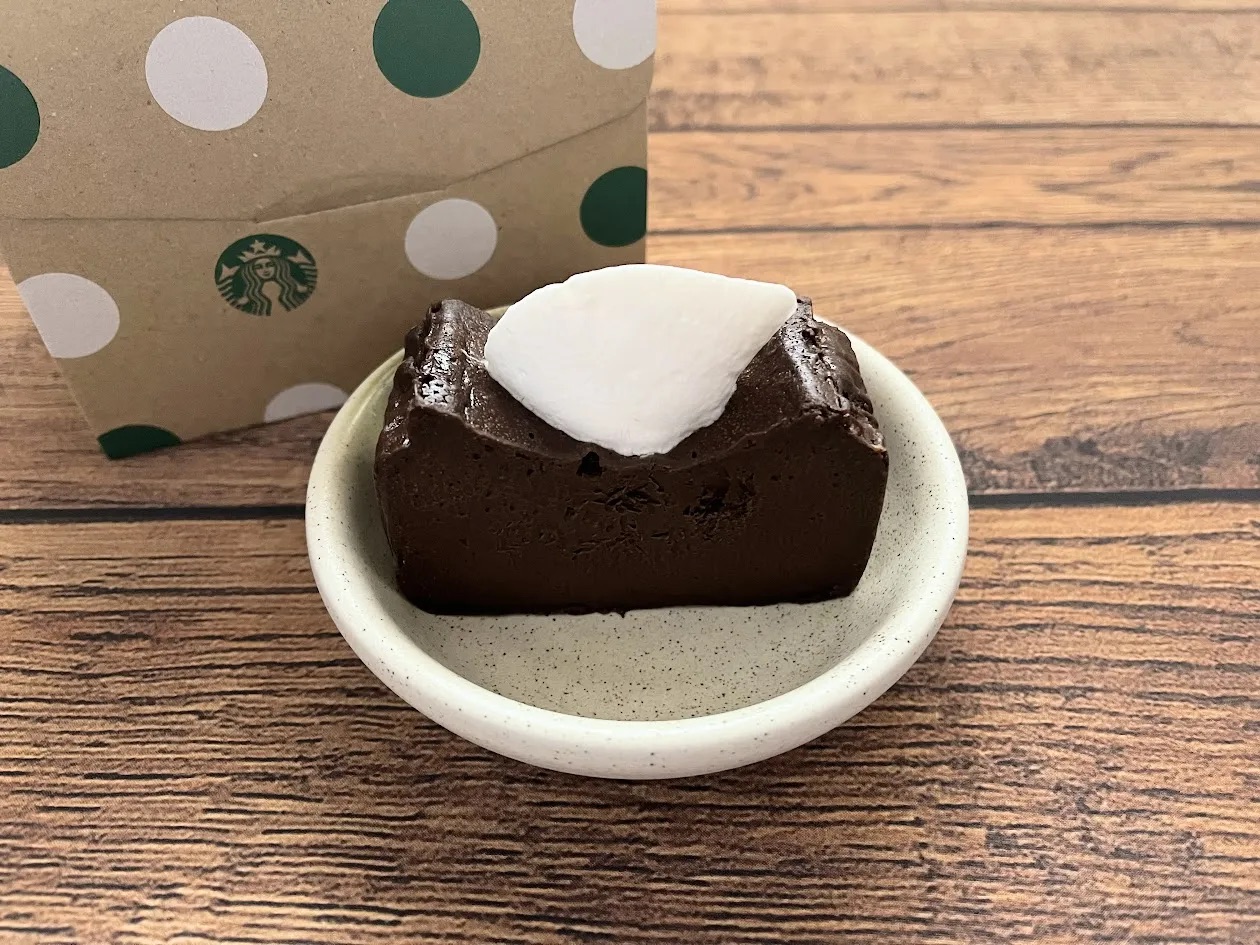
We were immediately captivated by the cake’s decadent appearance, and impressed by how well the thick cream topping sat perfectly atop the slice, even after the 10-minute journey home.
Taking a bite, our fascination deepened, much like the intense chocolate flavour that washed over the palate upon first contact. It was incredibly rich and smooth, melting on the tongue with a deep, lingering taste, and although it wasn’t too sweet it imparted a satisfying feeling of having eaten something sweet, which was a very fine feat.
The mellow aroma of cocoa was deeply present in every mouthful, and we were amazed at how rich and decadent it was without being cloying. Perhaps because of the light aftertaste, it felt substantial yet not too heavy, making it ideal for summer.
According to the rave reviews, what makes the Starbucks chocolate terrine so popular is the way it has a light, melt-in-your-mouth texture that’s pleasant to enjoy, even in summer, and after trying it, we finally understood what that meant.
▼ In this case, the rave reviews are warranted.
Even when we were buying our terrine at Starbucks, we saw a number of other people ordering it as well, so word of its deliciousness is spreading rapidly around Japan.
For a cake that’s gone viral on social media, the chocolate terrine really is worthy of all the praise and attention, so keep an eye out for it next time you’re at Starbucks. It’ll make the perfect partner for this year’s chunky and milky strawberry Frappuccino.
Theme park prohibition strangely opens the door to a new kind of creative freedom.
When you visit Ghibli Park in Nagakute City, Aichi Prefecture, you’ll find a vast array of attractions, including life-sized buildings that look like they’ve jumped straight out of a Studio Ghibli film. However, if you research the park beforehand to see what the rooms inside these buildings look like, you’ll notice something else: there isn’t a wide variety of interior photos on social media.
That might sound
Theme park prohibition strangely opens the door to a new kind of creative freedom.
When you visit Ghibli Park in Nagakute City, Aichi Prefecture, you’ll find a vast array of attractions, including life-sized buildings that look like they’ve jumped straight out of a Studio Ghibli film. However, if you research the park beforehand to see what the rooms inside these buildings look like, you’ll notice something else: there isn’t a wide variety of interior photos on social media.
That might sound odd, given Ghibli’s worldwide fame and loyal fanbase, but the lack of photos doesn’t mean there’s no desire to share them online. Rather, it’s because photography is strictly prohibited inside most of the buildings. Instead, the park limits interior photos to the Becoming Characters in Memorable Ghibli Scenes exhibit inside Ghibli’s Grand Warehouse, where visitors can step into life-sized dioramas depicting 14 famous film scenes.
All of this came as a surprise to our Japanese-language reporter Saya Togashi when she visited the park for the first time recently. Unaware of the photography ban in the large majority of the buildings, her initial disappointment turned into an eye-opening experience both literally and figuratively, so she decided to share some thoughts on the ban and the surprising effect it had on her visit.
▼ Saya with her Ghibli Park entry band.
1. People don’t linger to take photos
The most obvious benefit to come from the ban is the fact that it prevents people from lingering too long in an area while trying to capture the perfect shot. Every exhibit presents a perfect photo opportunity, as each display creates an ideal backdrop that makes visitors look as though they’ve stepped into an anime world, and the attention to detail in the objects inside the buildings is so impressive that you could take hundreds of photos and it still wouldn’t be enough, which is why the ban feels necessary.
With so many small rooms inside, there isn’t much space to move around – even if one person stopped to take a picture it would cause a huge holdup for visitors. The photography ban ensures the crowds move smoothly through the exhibits, creating a more pleasant environment for everyone to enjoy what they’re seeing.
Another advantage is the absence of live video streamers. Even when they aren’t being intentionally disruptive, live streaming can cause anxiety for people nearby, as not everyone wants their face broadcast around the world without consent. In a country like Japan, where publishing identifiable photos of people without permission may violate privacy or image rights, the absence of cameras creates a sense of ease and safety that allows everyone to relax.
2. Visitors can concentrate on what’s in front of them
When you can’t take pictures, or when you don’t have your smartphone in your hand, something beautiful happens: you naturally start to focus on what’s in front of you. Though photography may be prohibited, visitors are allowed to touch many of the exhibits, engaging the sense of touch and creating a multi-sensory experience that benefits from full attention. This gesture of goodwill by the park, which prioritises the visitor experience over concerns about theft or damage, helps nurture an environment of care and respect that you might not find in other amusement parks.
In Mei and Satsuki’s House, for instance, opening a closet door reveals bedding and pyjamas belonging to the Kusakabe family, who star in the film My Neighbour Totoro. The dresser contains the father’s clothes, which carry a faint smell of mothballs. You can search for the stairs leading to the second floor, just like in the movie, and even find Mei’s hat. It’s a continuous stream of discoveries that gives you a great sense of satisfaction in finding things for yourself.
Without the scrutiny of a smartphone screen, our senses become sharper. The small size of Mei’s clothes and the way they feel in your hand, the creaking of the closet, the sense of everyday life emanating from the old dishes in the kitchen – these are now vividly etched into Saya’s memory as real lived experiences.
In the documentary Until Ghibli Park is Finished, director Goro Miyazaki told his staff, “It’s good to touch the house as much as possible, like refolding clothes as if you were actually living there.” That sense of bringing the house to life is clearly evident, and it allows visitors to appreciate just how impressive it is that Satsuki and Mei’s House is built to be fully functional, with features such as a wood-fired stove for boiling water and a hearth for cooking rice. If God is in the details, so is Studio Ghibli.
3. There are no spoilers
In this era where everyone is a photographer, any place and any event can be easily experienced virtually through the Internet. Although we might know there are things that can only be understood by being there and experiencing them firsthand, videos and images can have a huge impact on our perception.
At Ghibli Park, however, very little prior information is available beyond officially released details about the different rooms and exhibits. Since photography is prohibited indoors in many areas of the park, visitors experience the spaces with almost no spoilers beforehand.
Because you encounter the actual settings and objects without prior exposure, everything feels fresh and surprising. Saya felt this especially strongly in Howl’s Moving Castle, where she had goosebumps after stepping into the dimly lit castle from the bright outdoors. Once your eyes adjust, you’re overwhelmed by the sheer volume of cluttered everyday objects and magical items laid out in front of you, appearing just as it was in the movie.
Although it’s an area visitors can’t touch, Howl’s bedroom, meticulously recreated with small objects, sounds, lights, and movements, is a must-see. It’s truly moving to witness something you’ve only ever seen in the 2-D anime world come to life before your eyes, complete with weight, scent, and texture.
Sure, Ghibli Park might not have big rides with elaborate special effects or dazzling shows, but that’s actually its charm. The dedication to creating special spaces and the sheer scale of its construction surpasses those of many world-class theme parks, and it’s something you can sense in every area.
After visiting the park, Saya came to realise the merits and demerits of modern theme parks that rely on social media sharing. Keen to update their operational policies to keep pace with the times, theme parks are shifting from being places where visitors immerse themselves in carefully crafted worlds and becoming platforms for sharing experiences, primarily through social media.
Saya has felt the tide turn firsthand at Disney Resorts, where she used to attend the New Year’s Eve countdown event every year. Although getting tickets was always a bit of a struggle, once you were inside the park, you could easily enjoy all the events, like watching shows, enjoying limited-edition food and drinks, and buying New Year’s items, without the need for any special strategy or plan. Of course, there were lines, but as long as visitors waited patiently, they could achieve their theme park goals, especially as visitors wandered the grounds discovering things along the way.
However, one year things changed. Even immediately after opening, the shelves for New Year’s items were empty, special menu items were all sold out, and the atmosphere at events became tense, with staff shouting to control crowds as people scrambled to secure prime viewing spots. This was around the time when the social media culture of sharing one’s own experiences and the business of profiting from reselling began. It created a world of competition and anxiety, where people have to work harder to buy the things they want and experience the things they want to experience — things that once felt much simpler before the age of social media.
This isn’t necessarily a bad thing for the theme parks themselves; the spread of information on social media and the increased rarity of merchandise are simply the result of fans’ enthusiasm. However, it does have an impact on the visitor experience, and after visiting Ghibli Park, Saya walked away with her eyes opened to what can be possible when visitors are prioritised over financial profit. By creating sensory worlds that can’t be fully captured in photographs, Ghibli Park encourages visitors to engage with the world around them, fostering face-to-face communication and a sense of adventure that lies at the heart of every Ghibli film.
The owner of Facebook and Instagram has taken the UK’s media regulator to the high court, opening a fresh front in the increasingly fractious relationship between Silicon Valley and Britain’s online safety regime.
Meta has filed for a judicial review of Ofcom’s methodology for setting fees and penalties under the Online Safety Act, arguing that pegging charges to a company’s qualifying worldwide revenue (QWR) is disproportionate and out of step with the geographic scope of the regulator’s remit.
The owner of Facebook and Instagram has taken the UK’s media regulator to the high court, opening a fresh front in the increasingly fractious relationship between Silicon Valley and Britain’s online safety regime.
Meta has filed for a judicial review of Ofcom’s methodology for setting fees and penalties under the Online Safety Act, arguing that pegging charges to a company’s qualifying worldwide revenue (QWR) is disproportionate and out of step with the geographic scope of the regulator’s remit. A hearing has been scheduled for 13 and 14 October.
The stakes are considerable. Under the Act, Ofcom can levy fines of up to 10 per cent of QWR or £18m, whichever is higher. Given that Meta reported global revenues of roughly $201bn last year, the regulator could in theory issue a penalty of around $20bn, a sum that would dwarf the largest fines in UK corporate history. The fee regime introduced last September applies the same QWR principle to annual tariffs, capturing companies whose user-generated content, search or adult-content services in the UK generate more than £250m a year.
Meta contends that liability should be determined by activity within the jurisdiction doing the regulating. “We and others in the tech industry believe its decisions on the methodology to calculate fees and potential fines are disproportionate,” a company spokesperson said. “We believe fees and penalties should be based on the services being regulated in the countries they’re being regulated in. This would still allow Ofcom to impose the largest fines in UK corporate history.”
Court documents filed on Meta’s behalf by Monica Carss-Frisk KC describe Ofcom’s approach as “troubling”, warning that it would result in a handful of large platforms shouldering the bulk of the regulator’s costs even though the Act covers a much broader sweep of internet services. The barrister noted that QWR is not pegged to revenue generated by any particular service in the UK; rather, once a service is offered to British users, the entirety of its global turnover is counted.
Ofcom, for its part, is preparing to dig in. The regulator said its fees and fines framework reflected “a plain reading of the law” and pledged to “robustly defend our reasoning and decisions”.
Meta is not alone in pushing back. The US online forum 4chan has refused to pay penalties imposed under the Act, and Ofcom is facing separate litigation from the operators of both 4chan and Kiwi Farms. The regime has also drawn criticism from Donald Trump’s White House, which has signalled growing impatience with European digital rules that it sees as targeting American firms.
The financial significance of the new system for Ofcom itself is hard to overstate. Once the preserve of broadcasters and telecoms operators paying for spectrum and licence fees, the regulator now expects the bulk of its £233m budget for the year to come from online safety tariffs, which are forecast to bring in £164m. That marks one of the most substantial shifts in Ofcom’s funding base in its two-decade history.
For SME founders watching from the sidelines, the case is more than a transatlantic skirmish between Big Tech and a British quango. The threshold of £250m in qualifying turnover means most smaller platforms sit outside the fee net, but the principles being tested in October, how revenue is attributed across borders, and how proportionality is measured for global digital businesses, will shape the regulatory environment for any UK-based scale-up that one day finds itself trading internationally on the back of user-generated content. The judgment, when it comes, will be read closely well beyond Menlo Park.
Casual mention elicits enthusiastic response from commonly overlooked tourist destination.
Japan has become one of the world’s top tourist destinations, welcoming a record-breaking 42.7 million international visitors in 2025, a 15.8-percent increase from 2024, and on track to break the record this year. While this is great news for big cities like Tokyo, Kyoto and Osaka, where tourists tend to spend most of their time and money, there are 44 other prefectures in Japan that are crying out for i
Casual mention elicits enthusiastic response from commonly overlooked tourist destination.
Japan has become one of the world’s top tourist destinations, welcoming a record-breaking 42.7 million international visitors in 2025, a 15.8-percent increase from 2024, and on track to break the record this year. While this is great news for big cities like Tokyo, Kyoto and Osaka, where tourists tend to spend most of their time and money, there are 44 other prefectures in Japan that are crying out for international visitors, and one of the most in need is Tottori Prefecture.
▼ No hoardes of tourists here.
Home to roughly 530,000-540,000 people, Tottori is the least populous prefecture in Japan. Compared to Tokyo’s roughly 14 million residents, Tottori has about 4 percent of Tokyo’s population, and given its distance from major urban centres, it ranks in the bottom tier for international tourist numbers.
▼ The trip to Tottori takes over five hours by train from Tokyo, using the fastest Shinkansen on the initial leg of the journey.
▼ Alternatively, it’s about three hours by train from Kyoto Station.
Despite the lack of tourists, Tottori has a wealth of tourist attractions, and one person who knows about its charms is Hollywood actress Anne Hathaway. On a recent trip to Japan to promote her new film, The Devil Wears Prada 2, released here on 1 May, Hathaway appeared on the popular weekend morning television program King’s Brunch, where she was asked where in Japan she would like to visit. She replied by saying she would like to visit Tottori, mentioning that she likes the sea, the beaches and the sand dunes.
▼ These are three things Tottori is famous for.
After the show aired on 6 May, it didn’t take long for news of Hathaway’s comments to reach Tottori. Within days, official Tottori-based government sites jumped on the PR opportunity, posting photos, videos and messages on social media.
On 9 May, the governor of Tottori, Shinji Hirai, extended an official invitation for Hathaway to visit, promising that a sand dune sculpture would be made in her likeness if she were to take them up on the offer.
If there was an Academy Award for Best Social Media Post, it would go to Yonago City, who went all out with its invitation, creating a clever skit inspired by The Devil Wears Prada franchise, complete with lookalike characters.
While Hathaway is yet to respond to the invitations, we have our fingers crossed that she’ll make the journey to Tottori sometime in the near future. If she needs advice on how to get there, she could always call on former U.S. late-night talk show host Conan O’Brien, who put Tottori on the map back in 2018, when he visited Conan Town to collect 3 trillion yen from the mayor.
Any official reprimand will come from regulator Ofcom, but not for at least two monthsUK politics live – latest updatesElon Musk’s X will face no action to remove a mass of posts inciting violence in Northern Ireland for at least two months, despite widespread condemnation of the platform and its billionaire owner.Concern over the role social media played in spreading disturbing images and fuelling anger continued to grow on Wednesday as police and community leaders urged calm. Continue reading.
Elon Musk’s X will face no action to remove a mass of posts inciting violence in Northern Ireland for at least two months, despite widespread condemnation of the platform and its billionaire owner.
Concern over the role social media played in spreading disturbing images and fuelling anger continued to grow on Wednesday as police and community leaders urged calm.
No 10 is worried about retaliation from White House over restrictions on under-16s’ internet useMinisters have embarked on a concerted lobbying operation to prevent a backlash from the Trump administration to the under-16s social media ban announced by Keir Starmer.Officials said they had spent weeks trying to reassure senior Trump officials and the US president himself that the restrictions were not specifically aimed at US technology companies. Continue reading...
No 10 is worried about retaliation from White House over restrictions on under-16s’ internet use
Ministers have embarked on a concerted lobbying operation to prevent a backlash from the Trump administration to the under-16s social media ban announced by Keir Starmer.
Officials said they had spent weeks trying to reassure senior Trump officials and the US president himself that the restrictions were not specifically aimed at US technology companies.

 Login
Login