Measures to include restrictions on ‘safe’ social media apps, with some fearing banning some platforms and not others will lead to legal challengesTeenagers under the age of 16 are to be banned from accessing “high-risk” social media apps while safer platforms will be subjected to restrictions, under a sweeping government crackdown.Under-18s will also be banned from using romantic or sexual AI chatbots after a consultation on keeping children safe online. Continue reading...
Measures to include restrictions on ‘safe’ social media apps, with some fearing banning some platforms and not others will lead to legal challenges
Teenagers under the age of 16 are to be banned from accessing “high-risk” social media apps while safer platforms will be subjected to restrictions, under a sweeping government crackdown.
Prime minister announces ban, saying social media is making children unhappy and unsafeSocial media to be banned in UK for under-16s, Starmer announcesStarmer acknowledges some teenagers will get round these restrictons. But that does not make the rules pointless, he says.Will it mean that no child ever looks at social media again? No.But look, this might shock you, but it doesn’t shock parents of teenagers; they get around other laws too.Some technology companies want us to think that social me
The British government is banning access to social media for children under 16, joining just a few countries across the globe trying to protect kids online through a strict age-based restriction on certain applications and platforms. The move, announced Monday by Prime Minister Keir Starmer, makes the United Kingdom the fifth nation to pursue an...
The British government is banning access to social media for children under 16, joining just a few countries across the globe trying to protect kids online through a strict age-based restriction on certain applications and platforms. The move, announced Monday by Prime Minister Keir Starmer, makes the United Kingdom the fifth nation to pursue an...
The U.K.'s policy comes after the Canadian government introduced online harms legislation that would require social media companies to restrict children under 16 years from use.
The U.K.'s policy comes after the Canadian government introduced online harms legislation that would require social media companies to restrict children under 16 years from use.
UK says tech firms must stop underage nude imagesTimes says Starmer may ban harmful social media platformsGovernment could introduce fines or even criminal liability for tech bossesLONDON, June 8 — Big tech firms operating in Britain must stop children circulating nude images on their phones or they will face legislation forcing them to do so, Prime Minister Keir Starmer said today.The announcement is Starmer’s latest effort to protect children from the harmful
Times says Starmer may ban harmful social media platforms
Government could introduce fines or even criminal liability for tech bosses
LONDON, June 8 — Big tech firms operating in Britain must stop children circulating nude images on their phones or they will face legislation forcing them to do so, Prime Minister Keir Starmer said today.
The announcement is Starmer’s latest effort to protect children from the harmful impacts of technology. It comes as the Times reported that he is also planning to announce a ban on some social media platforms for those aged under 16.
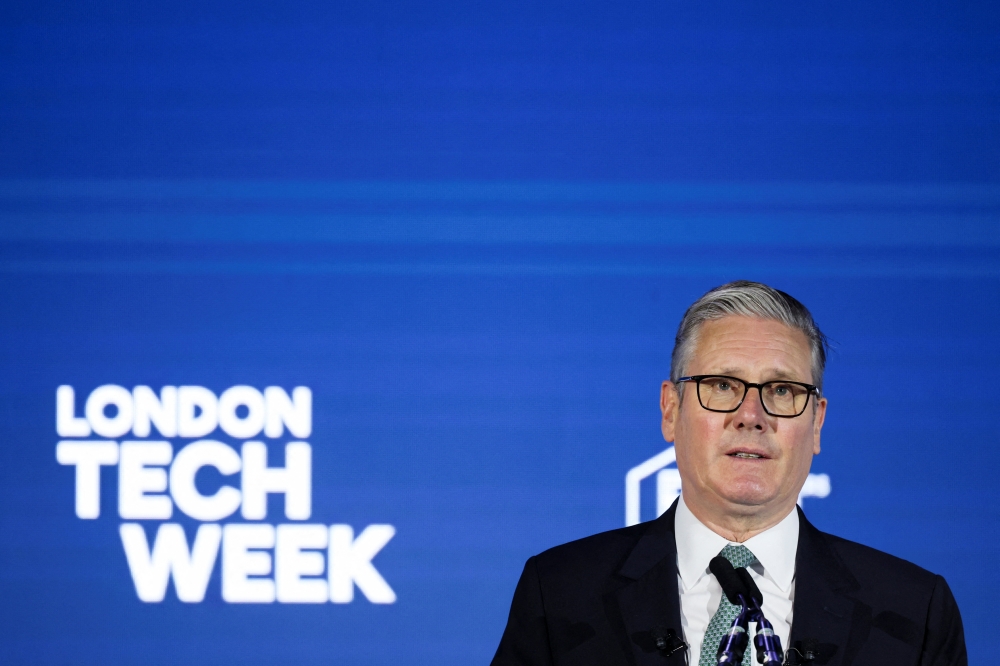
“Today I’m calling on tech companies operating in this country to introduce device controls that prevent children from sending and receiving sexually explicit images,” Starmer said in a speech at London Tech Week. “This is not an impossible challenge.”
Under the new plans, firms like Apple and Google would have to build or activate technical solutions on smartphones and tablets to detect and block nude images for children. Adults would still be able to take, share or view nude content through an age verification process.
If companies did not act within three months, the government said it would bring forward legislation to force them to do so or risk facing fines or, as a last resort, the threat of criminal liability for bosses.
Google said it was deeply committed to protecting children online.
“We are working constructively with UK partners to find effective, privacy-preserving solutions that deter the spread of harmful content while ensuring a safe digital environment for young people,” a Google spokesperson said.
Apple did not comment. The company has tools designed to limit children’s exposure to explicit content, including a feature that warns when nudity is detected in images sent or received.
Social media ban coming soon, report says
The British authorities said blocking nudity was key, saying it would disrupt much of the grooming and sextortion model of gangs and predators who share nude images with others or use them to blackmail minors. They argue it is technically achievable and can be done quickly.
Currently a child sex abuse referral is made about every five minutes, with 91 per cent of images self-generated. Investigators say they deal with cases where predators groomed victims and encouraged them towards self-harming or suicide, forced them into bestiality and other sadistic live-streamed content.
The government said it wanted to work with industry and that age checks recently introduced by Apple were a significant step forward. But it wanted more action by both Apple and Google to block nudity by default and across third-party apps.
Britain has separately been considering whether to ban children from accessing social media in response to widespread concern about its overall safety and the impact it has on mental health. A public consultation on the issue closed in May.
Australia last year blocked children under 16 from platforms including TikTok, Alphabet’s YouTube and Meta’s Instagram and Facebook.
France, Denmark and Poland are also considering tightening rules around social media use for children, while Greece in April announced it would ban access to those under the age of 15 from January 2027.
The Times reported Starmer was set to announce a ban for children under 16 on online platforms determined to be harmful while maintaining access to some safer forms of social media.
Asked about the report, a source at Downing Street said: “The prime minister is not afraid about taking on the tech companies and their bosses to protect young people.”
A source close to the matter said a formal ban was unlikely to come this week. Experts are divided on how effective a total ban would be, while a group of young people in London recently told Reuters they were opposed to restrictions. — Reuters
LONDON, June 15 — British Prime Minister Keir Starmer said today he would ban social media sites for under-16s and impose restrictions on gaming and livestreaming platforms, in some of the world’s most far-reaching online restrictions to date. The sweeping changes will reflect Britain’s values, helping to protect children online while pushing back against the power of big technology companies, Starmer told a press conference. ”It is clear to me a full ban is th
LONDON, June 15 — British Prime Minister Keir Starmer said today he would ban social media sites for under-16s and impose restrictions on gaming and livestreaming platforms, in some of the world’s most far-reaching online restrictions to date.
The sweeping changes will reflect Britain’s values, helping to protect children online while pushing back against the power of big technology companies, Starmer told a press conference.
”It is clear to me a full ban is the right choice,” he said. “This will change the conversations that parents have and the expectations of children over time. It will make a huge difference, it will make our children safer, it will make our children happier, it will give them more time, more security, more freedom to grow up, more opportunity”.
As well as a ban on sites such as TikTok, Snapchat and Instagram, he said he would take action against gaming and livestreaming services which allow children to talk to strangers. “Is there a situation in the offline world where you would just let your child pair up with a stranger, an adult that you don’t know anything about? No, so we’re taking action on that,” Starmer said.
Ban in place by next spring?
The government already has the powers to take the first steps in any ban, he said, with regulation to follow by the end of the year and a prohibition in place around next spring.
Britain has increasingly toughened its approach to tech companies in recent years, urging or forcing them to impose age verification, adapt their algorithms and, most recently, prevent children from circulating nude images taken on mobile phones.
But with a growing awareness of the mental health risks posed by children spending too much time online, Starmer has decided to go further after speaking to parents and considering evidence from Australia, which brought in a ban for under-16s last year.
Starmer, who is likely to face a leadership challenge in the coming weeks, said people rightly expected action. Australia was the first country to ban social media for children under 16, blocking them last December from platforms including TikTok, Alphabet’s YouTube and Meta’s Instagram and Facebook. Since then a raft of countries have said they are looking to regulate access to social media amid mounting concerns over the impact on children’s health and safety.
Extensive consultations
Britain has consulted teachers, parents and young people on new restrictions, including a possible ban for under-16s, as well as curfews, app time limits and curbs on what the government has described as addictive design features.
It received more than 116,000 responses from parents, industry and young people. More than 83 per cent of parents who responded said risks from social media outweighed benefits, while 90 per cent backed a minimum age of 16 to access social media platforms. While many parents and politicians back a ban, some psychologists and researchers have said there is no proof that it would work, and a group of school children in London told Reuters they had a conflicted relationship with the technology. — Reuters
Sources say hardline measures will also prevent young users from being able to talk to strangers on gaming appsWhy is the UK launching an ‘Australia plus’ social media ban and how will it work?Keir Starmer is to ban under-16s from major social media apps such as TikTok, Instagram and X in sweeping restrictions described as “Australia plus”, the Guardian understands.In a major policy shift far tougher than previously briefed, the prime minister will announce that teenagers will be banned from all
Keir Starmer is to ban under-16s from major social media apps such as TikTok, Instagram and X in sweeping restrictions described as “Australia plus”, the Guardian understands.
In a major policy shift far tougher than previously briefed, the prime minister will announce that teenagers will be banned from all the main social platforms. Online products that are not covered by the ban – such as gaming apps – will face new restrictions such as having the option to chat to strangers removed.
Government wants to back parents against tech companies though some feel the process has been rushedKeir Starmer is expected to announce sweeping “Australia-plus” restrictions on under-16s accessing harmful social media apps, a move the government has framed as taking the side of parents against the big technology companies.A consultation on online safety closed on 26 May, giving ministers just weeks to come up with policies after receiving more than 116,000 responses. Industry sources and child
Government wants to back parents against tech companies though some feel the process has been rushed
Keir Starmer is expected to announce sweeping “Australia-plus” restrictions on under-16s accessing harmful social media apps, a move the government has framed as taking the side of parents against the big technology companies.
A consultation on online safety closed on 26 May, giving ministers just weeks to come up with policies after receiving more than 116,000 responses. Industry sources and child safety advocates have described the process as “rushed” and driven by a political timeline. It is not clear when the ban could come into force.
State’s attorney general alleges TikTok exposed children to harmful sexual content and addictive featuresFlorida became the latest state to sue TikTok on Monday after the attorney general accused the company of violating a state law that limits social media access for teenagers.In a press conference, Republican James Uthmeier said TikTok exposed children to harmful sexual content and addictive features, such as unlimited scrolling and push notifications. “It’s designed to keep kids stuck on thos
State’s attorney general alleges TikTok exposed children to harmful sexual content and addictive features
Florida became the latest state to sue TikTok on Monday after the attorney general accused the company of violating a state law that limits social media access for teenagers.
In a press conference, Republican James Uthmeier said TikTok exposed children to harmful sexual content and addictive features, such as unlimited scrolling and push notifications. “It’s designed to keep kids stuck on those screens for hours,” Uthemeier said at a press conference. “Our evidence suggests that so many kids are on TikTok for upwards of six, seven, eight or more hours a day. We are going to get our kids their lives back.”
 Login
Login