Normal view

  • ✇SoraNews24 Japan
  • Tokyo’s insane Garlic Ramen is a meal, and an aroma, you’ll never forget[Taste test] Casey Baseel
    There aren’t enough breath mints in the world to save us, but we’re going in anyway. Japanese folk wisdom holds that garlic is a food that boosts physical stamina, and it’s supposed to be helpful in dealing with the adverse effects of hot weather too. The actual science behind those claims gets a little indistinct, but for garlic lovers, we’re getting into a time of year that provides ample excuses to load up on the seasoning. Today that leads us to Yoshioka, a ramen restaurant in downtown Tok
     

Tokyo’s insane Garlic Ramen is a meal, and an aroma, you’ll never forget[Taste test]

27 May 2026 at 14:00

There aren’t enough breath mints in the world to save us, but we’re going in anyway.

Japanese folk wisdom holds that garlic is a food that boosts physical stamina, and it’s supposed to be helpful in dealing with the adverse effects of hot weather too. The actual science behind those claims gets a little indistinct, but for garlic lovers, we’re getting into a time of year that provides ample excuses to load up on the seasoning. Today that leads us to Yoshioka, a ramen restaurant in downtown Tokyo’s Mejiro neighborhood.

You might have a little trouble spotting Yoshioka, because it actually shares space with a branch of the izakaya (Japanese pub) chain Torimero, with Yoshioka operating in the hours when Torimero isn’t and vice-versa.

▼ The Yoshioka (吉岡) and Torimero (鳥メロ) signs, and the stairway that leads up into the hybrid eatery.

Making the place a little easier to find for us on this day, though, was the sign that was placed at the bottom of the stairs advertising Yoshioka’s Garlic Ramen (“Ninniku Ramen” in Japanese), which included the bold statement:

“Try it once, and you’ll never be able to go back.”

We weren’t sure if this open-ended prophecy was meant to imply that we would never be able to go back to less garlicky versions of ramen, or whether we’d have such strong garlic fumes coming out of ourselves that we’d never be allowed back into regular society. That second possibility might sound a little overly dramatic, but consider this: Yoshioka boasts that it uses 200 grams (7.05 ounces) of garlic in every bowl of its Garlic Ramen. To put that in perspective, an average-sized clove of garlic weighs about 5 grams, meaning that eating a bowl of the Garlic Ramen should be the equivalent of eating roughly 20 cloves of garlic.

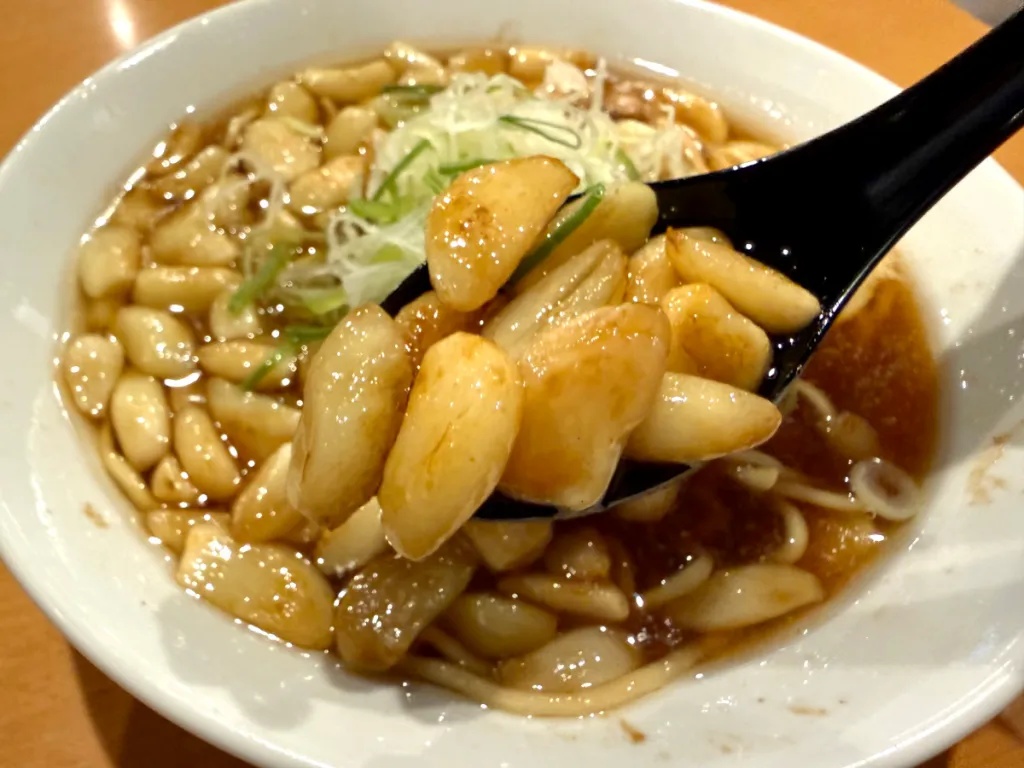
And yet, when the restaurant staff set our bowl down in front of us, it had what looked like even more garlic than that.

This is an insane amount of garlic. Like, there’re enough cloves that you could eat them by the spoonful, like the world’s most powerfully pungent cereal.

Oh, and in addition to the dozens of cloves of garlic, you get a sizeable squirt of garlic paste waiting to be mixed it into the salty soy sauce-based broth too.

And the taste? Pretty much the fiercest punch of garlic we could imagine. This is an edible declaration of the idea that one can never have too much garlic, and if that’s a conviction you share, you’ll fall in love with this instantly.

The seasoning is so powerful that by the second bite of noodles it was no longer shocking, either because of the bliss we were wrapped up in or because we’d already consumed so much garlic that we were transitioning into a clove of garlic ourselves, and so the flavor now felt natural.

Speaking of the noodles, they’re of excellent quality, with a smooth and slippery surface and firm consistency. Actually, even the broth has a noteworthy texture, as there’s so much garlic in it that the liquid takes on some fluffy, sticky characteristics.

At 1,500 yen (US$9.70), Yoshioka’s Garlic Ramen is on the pricier side, but with how much garlic you get, it doesn’t feel like a bad deal at all, especially when you take into account that you’re allowed one refill of noodles for no additional charge.

All in all, the Garlic Ramen is an unforgettable food experience, but there is one potentially negative aspect to it. Remember how we said Yoshioka shares its space with another restaurant? Because of that, Yoshioka is only open for lunch, meaning you’re going to have to eat this garlicky-loaded bowl of noodles in the early afternoon, or maybe even the late morning, and there is no imaginable way that you won’t smell have the smell of garlic emanating from you wherever you go for the rest of the day. Still, if you’re a garlic lover, it’s worth it, and if you’d rather have some super-salty ramen, we can show you where to find that too.

Restaurant information
Yoshioka (Mejiro main branch) / 吉岡(目白総本店)
Address: Tokyo-to, Toshima-ku, Mejiro 35-13, Fujiya Building 2nd floor
東京都豊島区目白3-5-13 フジヤビルM2F
Open 11 a.m.-2 p.m.

Photos ©SoraNews24
● Want to hear about SoraNews24’s latest articles as soon as they’re published? Follow us on Facebook and Twitter!
  • ✇SoraNews24 Japan
  • Godiva melts minds by releasing a new corn chocolate drink in Japan Oona McGee
    We find out if this new limited-edition Chocolixir really tastes like corn potage soup. With summer now upon us, stores all over Japan are releasing limited-edition seasonal products to keep us feeling cool and refreshed. Over at Godiva, though, the focus is more on seasonal produce, with a new release that’s like nothing we’ve ever seen before. Called the Sweet Corn Chocolixir, this new take on the chain’s signature chocolate-based Chocolixir drink is said to taste like sweet corn potage sou
     

Godiva melts minds by releasing a new corn chocolate drink in Japan

9 June 2026 at 03:00

We find out if this new limited-edition Chocolixir really tastes like corn potage soup.

With summer now upon us, stores all over Japan are releasing limited-edition seasonal products to keep us feeling cool and refreshed. Over at Godiva, though, the focus is more on seasonal produce, with a new release that’s like nothing we’ve ever seen before.

Called the Sweet Corn Chocolixir, this new take on the chain’s signature chocolate-based Chocolixir drink is said to taste like sweet corn potage soup. Although corn potage is incredibly popular throughout Japan, it’s more commonly associated with the colder months, as you can buy the soup hot in cans at vending machines.

Corn is actually harvested in summer, though, so Godiva’s new Chocolixir celebrates the new harvest, and while the flavour sounds intriguing enough on its own, what’s even more surprising is the unusual topping.

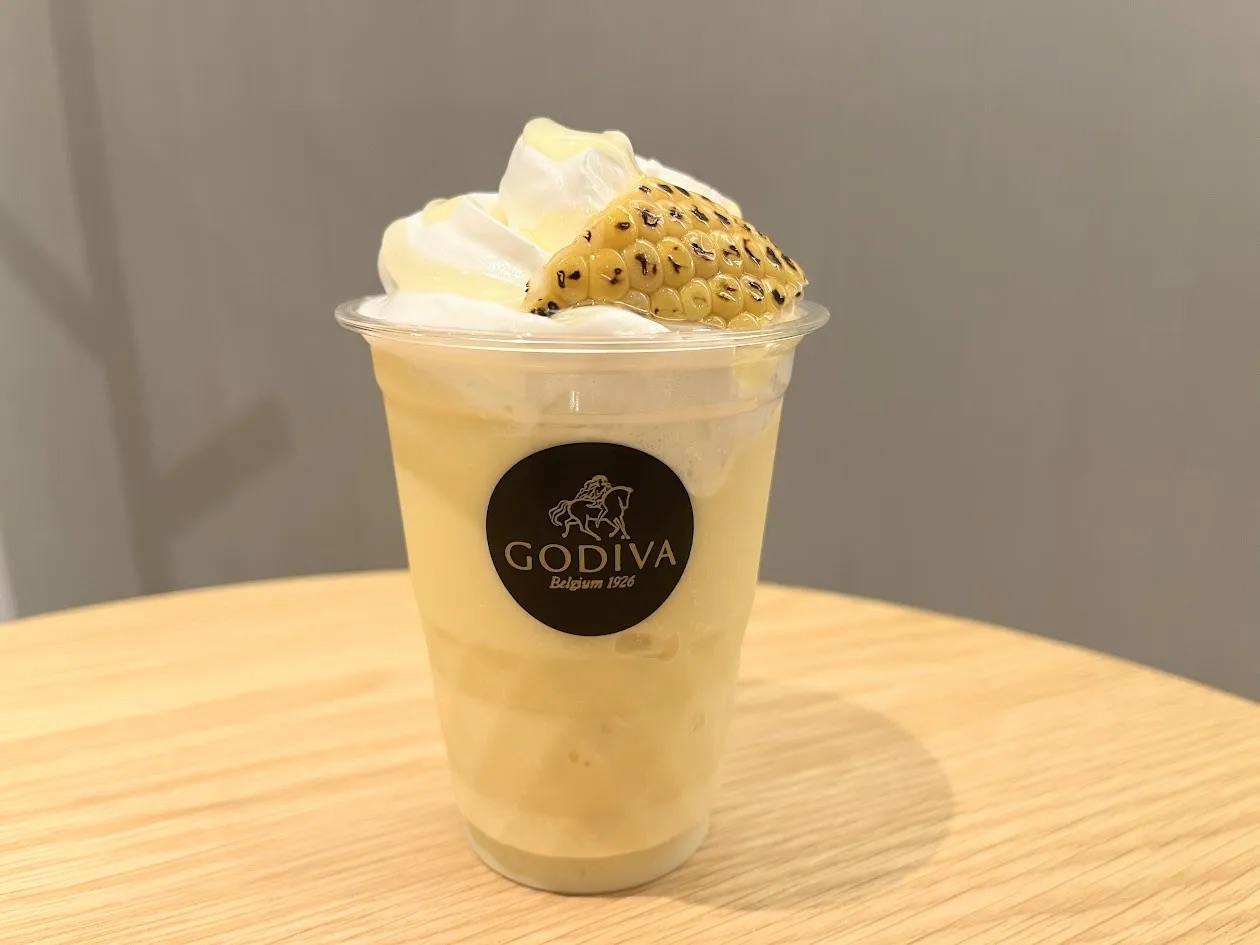
▼ It’s not every day you see whole corn kernels sitting on top of a chocolate drink.

According to Godiva, the new Chocolixer combines the natural sweetness of sweet corn with white chocolate and honey butter sauce. It’s then topped with a generous swirl of whipped cream and finished with roasted corn.

▼ Released on 29 May, the drink is on the menu from 830 yen (US$5.18) for a regular size and 940 yen for a large.

It took us a long time to tear our eyes away from the corn topping when we bought the new drink to try it, but when we did, we were able to appreciate the finer details. Nibbling on the corn revealed it to be wonderfully fresh, sweet and juicy, making it a lovely entree for the drink to follow, while the rich yet light and fluffy cream accompaniment was a fun accent, easing our palate into the deeper flavour combinations. The first sip highlighted the deliciousness of the corn, and we instantly likened it to a slightly sweet chilled corn potage, where you could taste the natural sweetness and subtle saltiness of the ingredients.

Delving further, the combination of white chocolate and rich honey butter sauce was absolutely delicious. This is where the drink truly shines, as the white chocolate brings the whole drink together and elevates the flavour, showcasing the skill of Godiva and reminding us of its chocolate prowess.

Though we’d been slightly cautious about the corn drink at first, by the end we were seriously impressed. Godiva’s cold chocolate take on corn potage is bursting with sweetness, and the refreshing crunch of ice is a delightful addition, making it the perfect summer beverage.

The only problem is finding a store where you can buy it, as the drink is so popular it was sold out at every participating branch we visited when we first went on the hunt for it. As a general rule, if it’s not listed on the menu at a participating store (see link below for locations) it’s likely to be sold out, but from our experience it would be best to visit a branch as soon as it opens, and a store that’s large but still slightly out of the way, like the one we visited in Tokyo’s Hibiya, will give you a better chance of finding it.

Related: Godiva Cafe store list
Images ©SoraNews24

● Want to hear about SoraNews24’s latest articles as soon as they’re published? Follow us on Facebook and Twitter!
  • ✇SoraNews24 Japan
  • Bizarre Japanese vending machine sells “Peace and Equality” and “Angels and Demons” Oona McGee
    We find out just how devilish and angelic these 100-yen surprises are. Our reporter Natsuno Futon was strolling the streets of Oyama City in Tochigi Prefecture the other day when she came across an unusual vending machine. The first thing that caught her eye was the huge “100 yen” (US$0.63) sign on the front, but then, as she stepped closer, she became even more intrigued. There, in the window display, were the words “いろんなおもちゃ” (“various toys“), and beneath them: “Contains items worth between
     

Bizarre Japanese vending machine sells “Peace and Equality” and “Angels and Demons”

23 May 2026 at 13:00

We find out just how devilish and angelic these 100-yen surprises are.

Our reporter Natsuno Futon was strolling the streets of Oyama City in Tochigi Prefecture the other day when she came across an unusual vending machine. The first thing that caught her eye was the huge “100 yen” (US$0.63) sign on the front, but then, as she stepped closer, she became even more intrigued.

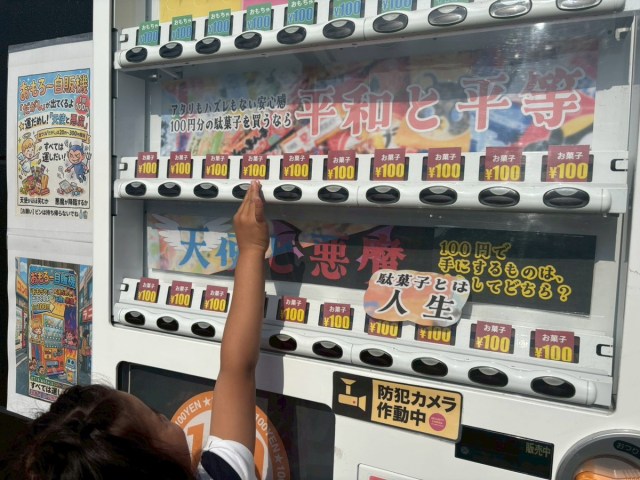
There, in the window display, were the words “いろんなおもちゃ” (“various toys“), and beneath them: “Contains items worth between 20 and 300 yen“.

As her eyes moved down to scan the second row, she read the words: “平和と平等(“Peace and Equality”) and then, on the third row, “天使と悪魔(“Angels and Demons”).

Natsuno had never encountered a vending machine stocked with Peace and Equality and Angels and Demons before, and neither had her children who were with her on this outing. Needless to say, her children were excited to find out what these mystery items were, so Natsuno found herself reaching into her pocket for some 100-yen coins.

With a machine like this, part of the fun is randomly selecting a button to press, and her daughter started by pushing one of the buttons on the top row, which were marked “おもちゃ” (“toys“).

▼ A long cylinder immediately popped out into the tray at the bottom of the machine, and this is what came out of it.

A toy car and five toy coins. From Natsuno’s point-of-view, this was a bit of a disappointment, particularly as her daughter doesn’t have any interest in toy cars or fake coins.

▼ Hoping for something better, her daughter popped a real coin into the machine and pressed a button on the “Peace and Equality“row.

The buttons on the second and third rows read “お菓子” (“sweets“), so they knew this would be something edible. What that would be, however, remained a mystery until they popped the lid on the canister they received.

▼ Oh! That looks like Mochitaro.

Mochitaro is a classic Japanese “dagashi” (cheap snack) consisting of crunchy rice cracker chunks. It wasn’t the only thing in the canister, as it also contained some mango jelly and a small bag of Haribo gummy candies.

For 100 yen (US$0.63), this was a decent deal, and it gave Natsuno and her daughter hope that they might be able to encounter an angel on their next try.

▼ Time to press a button on the “Angels and Demons” row.

What came out, however, appeared to be neither an angel nor a demon, as the canister was ambiguous.

Even after looking inside, they weren’t sure whether they’d been visited by a demon or an angel, as they received six cheap candies that might’ve been worth around 100 yen. The dark hues on some of the packs, including the iconic Black Thunder chocolate, hinted at a devilish selection, but on the other hand, it was a pretty good deal.

▼ Curious to give it another try, Natsuno’s daughter pressed another button…

▼ …and out popped a canister with the word “Devil” printed on it in big red characters.

▼ What was inside?

▼ One puffed wheat snack.

This was definitely devilish – paying 100 yen to receive just one cheap puffed rice snack was a merciless move, and now they were more determined than ever to meet an angel.

One more try.

Success!

The progression from ambiguous canister through to devil and then angel was such a great progression that Natsuno felt it was almost as if there was someone inside the machine, reading the atmosphere and doling out excitement in increasing levels.

The word “アタリ!” (“win!“) was also printed on the canister, adding to the sense of joy.

So…let’s see what the angel delivered.

This was definitely a win, as it was the best result so far, with Natsuno estimating the total value to be more than 100 yen. Emboldened by this result, Natsuno and her daughter went for another try on the toy line, which seemed to present a better deal than the sweet options.

If there’s a chance of winning something worth up to 300 yen, this is where they might get lucky.

▼ They were rewarded with two fun erasers from respected company Iwako, and a dinosaur egg.

Natsuno figured this bundle was worth over 200 yen. It wasn’t bad, but to be honest, she wouldn’t say it was worth 300 yen.

▼ After a total of six tries, here’s everything they received.

It may not have been a huge deal, but the real draw of the machine wasn’t a tangible product visible to the human eye. The real takeaway here was the fun and excitement of wondering what might come out of the machine, and that was worth way more than every deposit of 100 yen.

▼ There aren’t really any other places in the world where you can buy “peace and equality” for 100 yen.

▼ Judging by the containers in the return spot for reuse, there weren’t many angels that day either, so they felt extra blessed to have received one.

If you’d like to try your luck at the vending machine, it’s located under a sign for “NPO Aoringo” on a black building that reads “Ad Promote Co., Ltd.”and we’ve included the address for you below.

Ad Promote operates and stocks these machines, and according to its online shop, “Omoro Shokai” (“Fun Trading Company”), the Omoro vending machines ceased operations in January this year. That means this machine, which we visited in May, is the last of its kind in the country, so if you’re like us and love visiting weird and unusual machines, this is a stop worth putting on your itinerary.

Location information
Omoro Vending Machine / おもろー自販機
Address: Tochigi-ken, Oyama-shi, Awamiya 1-13-41
栃木県小山市粟宮1-13-41
Website

Photos ©SoraNews24
● Want to hear about SoraNews24’s latest articles as soon as they’re published? Follow us on Facebook and Twitter!
  • ✇SoraNews24 Japan
  • 7-Eleven Japan now sells canned water, but does funky packaging mean funky flavor?[Taste test] Casey Baseel
    Lotte’s canned water makes its convenience store debut. The first time you take a look at the drink section in a Japanese convenance store, you might be surprised by some of the packaging, specifically the things that you can buy in cans. Canned coffee and cocktails can be found in pretty much every convenience store in the country, and while not as common, canned teas aren’t all that shocking to see here either. But even we were surprised to find out that 7-Eleven Japan now sells canned water
     

7-Eleven Japan now sells canned water, but does funky packaging mean funky flavor?[Taste test]

16 May 2026 at 23:30

Lotte’s canned water makes its convenience store debut.

The first time you take a look at the drink section in a Japanese convenance store, you might be surprised by some of the packaging, specifically the things that you can buy in cans. Canned coffee and cocktails can be found in pretty much every convenience store in the country, and while not as common, canned teas aren’t all that shocking to see here either.

But even we were surprised to find out that 7-Eleven Japan now sells canned water.

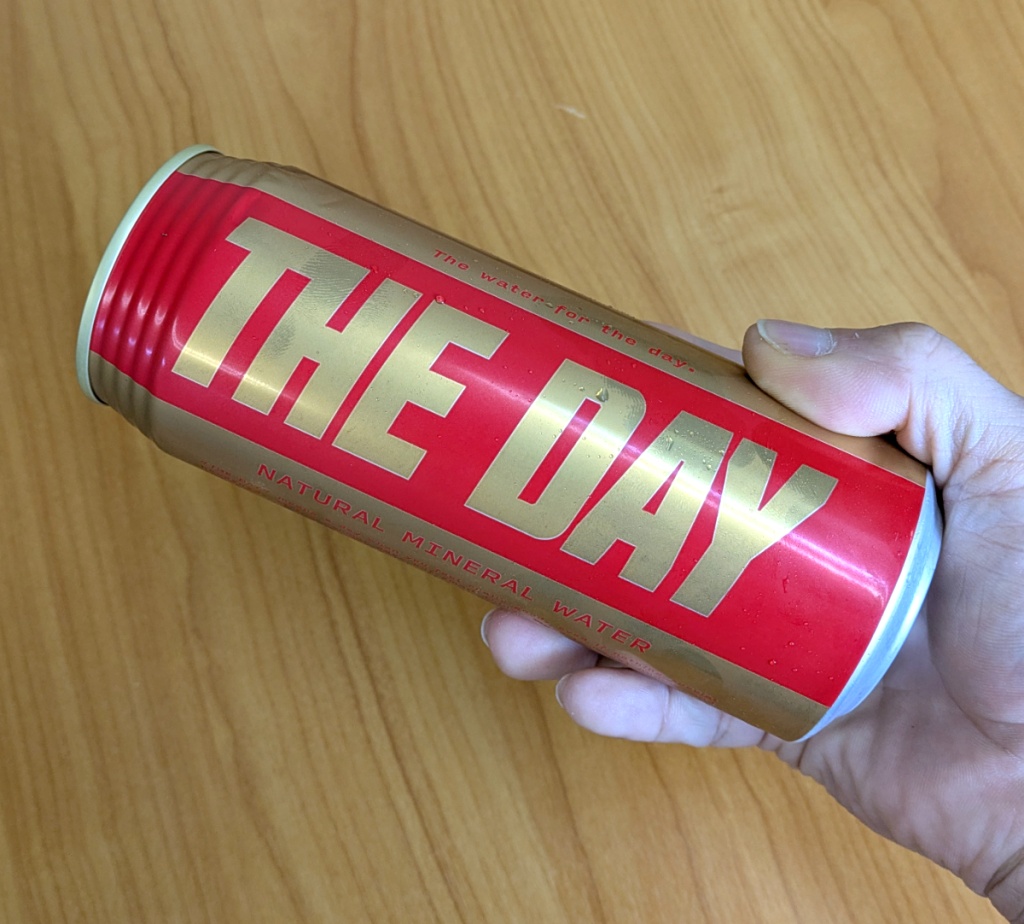
The Day is a brand of canned water from Lotte, who’s best known as a candy and snack food maker. They’re now in the water game too, though, and while the black-can The Day is carbonated, the red version isn’t.

▼ The Day went on sale through online shops and discount retailers in September, but just made its convenience store debut at 7-Eleven on May 5.

The visual design looks more like something you’d see for an energy drink or beer, and the contrast feels even more pronounced when you see The Day next to other brands of water, which tend to go with nature imagery and transparencies as their main visual motifs.

Lotte says they chose The Day’s name to symbolize its concept as “a water that lifts your spirts” and will give you a great day. There are no additional energy boosting chemicals or supplements added, though. The Day is simply canned natural mineral water, sourced from the town of Yaizu in Shizuoka Prefecture, according to the can’s text.

▼ And yes, we did accidentally drop this can on our way back from 7-Eleven, leading to the first time in our lives that we can say that we dented our water.

Once back in our taste-testing center, we cracked open the non-sparkling The Day for a comparison with Suntory’s Tennensui, one of Japan’s most popular bottled water brands.

Oddly enough, while the red-can The Day is supposed to be the non-sparkling variety, after we poured some into a glass we did still see some air bubbles. Not so many that we’d call it a full-on carbonated beverage, and this might just be a side-effect of the canning process, as opposed to an intentional design choice, but still, the water wasn’t completely still.

Taste-testing duties fell to our ace reporter Mr. Sato, and he says The Day’s mouthfeel is smooth, imparting a refreshing sensation as it glides down your throat. He reports no unpleasant metallic taste or aroma either, so while it feels unusual to be drinking water from a can, the flavor isn’t funny, and is perfectly satisfying.

But why has Lotte chosen to put The Day in cans, and not the plastic bottles that are the industry norm? In its press release, the company says it sees the day as “One answer to the needs of a new age of wellness,” and the choice of more easily recyclable aluminum seems to be an extension of that philosophy. The uniqueness factor probably doesn’t hurt either, as the packaging and design really do stand out against other brands of water. Lotte might also be hoping that the more substantial feel of a can helps position The Day as a premium product, and at a price of 158 yen (US$1) for a 480-mililiter (16.2-ounce) can, it is a little on the pricy side, as most other water brands are 140 yen or less for a 500-miiliter bottle.

There is one clear drawback to The Day being in a can, though, which is that once you pop the top, there’s no way to close it back up again. This isn’t an issue for coffee or alcoholic beverages, since they tend to be things where people drink the entire can shortly after opening it. Regardless of whether it started out hot or iced, coffee tends to taste significantly worse once it gets to room temperature, and beer and cocktails aren’t the kind of drinks most people go walking around with. A lot of people, though, buy a bottle of water while commuting to work or out on a walk, take a few sips, then put the cap back on so they can toss the bottle in their bag and have some more when they feel thirsty again a little later on.

By nature of being in a can, The Day doesn’t lend itself to that “I’ll have a little now, and then the rest later on” style of consumption, making it a much less convenient choice than its competitors. On the other hand, being locked into drinking the whole can once you’ve opened it does promote taking the time to mindfully hydrate, and with Japan’s cruelly hot kokushobi-level summer weather on the way, maybe that’s not such a bad thing.

Photos ©SoraNews24
● Want to hear about SoraNews24’s latest articles as soon as they’re published? Follow us on Facebook and Twitter!
Retro fashion magazines from Tokyo’s street market remind Mr. Sato of a special gift from his dad

9 June 2026 at 05:00

Mr. Sato is filled with appreciation for the other Mr. Sato.

Tokyo has a number of neighborhoods, such as Shibuya and Harajuku, that celebrate trendy, youthful fashions and culture. There’s also a part of the city, though, with a focus on a more mature clientele.

Located part-way between Ikebukuro and Ueno on the Yamanote loop line that encircles the city center, Sugamo is a gathering place for Tokyo’s senior citizens, and while it’s an interesting spot to check out on any day, our ace reporter Mr. Sato timed his most recent visit for June 4.

That’s because Sugamo Jizo-dori, the main shopping street in the neighborhood, has a special street market on the 4th, 14th, and 24th of every month. This being Sugamo, it’s not a wild, invasively loud block party, but various merchants set up stalls on the street selling items at especially attractive prices.

Many of the stalls sell snacks, and Mr. Sato found himself tempted by bags of dried fruit for 200 yen (US$1.25) each if you bought five at a time and bundles of three bags of senbei for 500 yen.

He also got his fortune told by a streetside diviner, a kindly older gentleman who read Mr. Sato’s palm and face for 2,000 yen. According to the fortune teller, there are no proverbial dark clouds looming on Mr. Sato’s horizon, though he expressed some concern over the “sun line” on his right hand not being very distinct. Apparently this is an indication that he’ll need to continue working hard to be successful, but our reporter has never backed away from a challenge, and with the fortune teller adding that though he isn’t destined to be rich, he won’t end up being poor either, Mr. Sato was happy with the overall-good forecast of his future.

▼ Mr. Sato having his fortune told

But the highlight of Mr. Sato’s visit to Sugamo’s street market was a pair of vintage fashion magazines he picked up for 100 yen each.

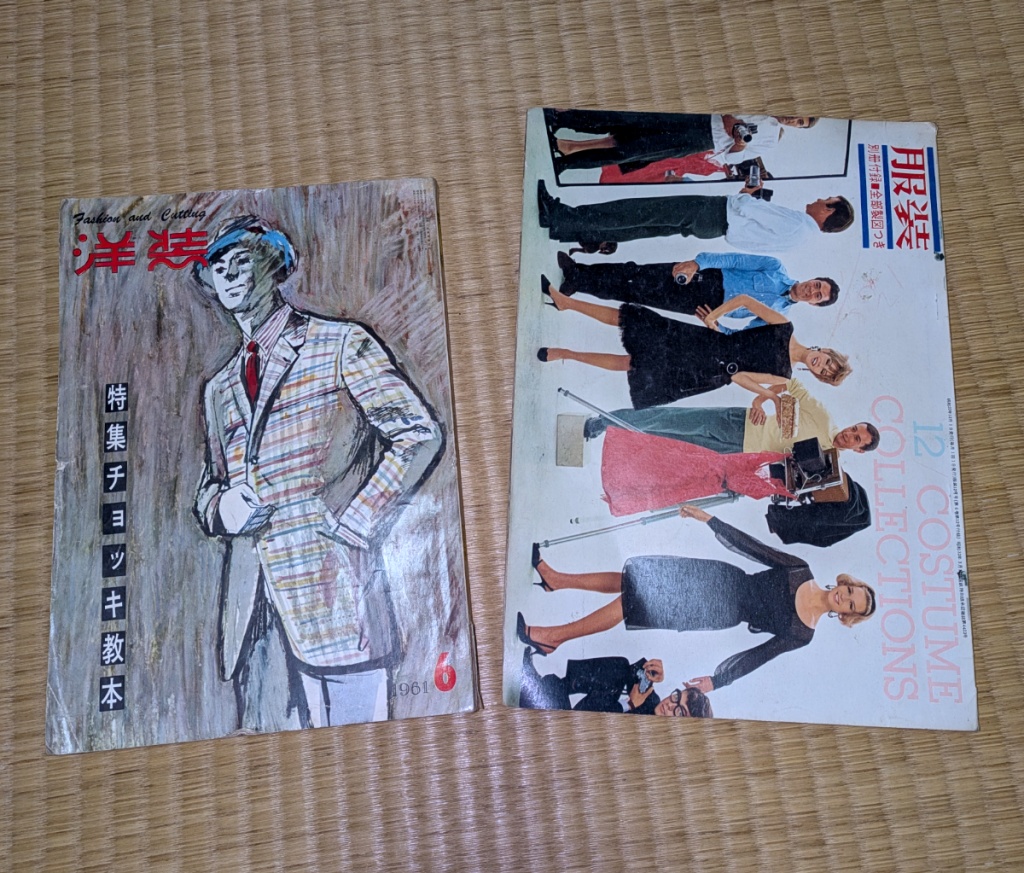
To illustrate just how classic of publications we’re talking about here, one of them is simply titled Fukuso, which means “clothing” in Japanese, and the other is Yoso (“western clothing”).

Fukuso was started by Chiho Tanaka, who was born in 1906 and became one of Japan’s first famous designers of Western-style clothing. The issue Mr. Sato purchased is from December of 1962, quite a bit before Mr. Sato was born, and leafing through it he was stuck by the distinctly charming analog feel to its layout and illustrations.

Yoso has an impressive pedigree too, with its editor being Tetsunosuke Hirukawa, the head of the Japan Western Clothing Academy.

▼ Mr. Sato’s issue is from 1961

Yoso in particular was aimed at people working within the apparel industry, highlighting not just new fashions but also effective ways to tailor and produce clothing for clients.

As a matter of fact, looking through the two magazines, Mr. Sato realized that this was his first time to be reading fashion magazines that predate not only the fast fashion era of store like Uniqlo and Gap, but even easy access to department stores for most Japanese people. This was a time when many people still made their own clothing at home, or else splurged for custom-made pieces from a dressmaker or tailer. As such, issues of Fukuso contained a section with patterns for self-sewn garments

…and information to help readers choose the best sewing machine for their needs.

Yoso, being a more professionals industry-focused magazine, instead has advertisements for tailoring services and supplies, some with what very stylish designs.

▼ One of the ads here is for Okadaya (オカダヤ), a sewing supply shop in Tokyo’s Shinjuku neighborhood that’s still in business today.

It all left Mr. Sato with a new, direct-feeling sense of how treasured articles of clothing were before you could just, say, dash over to the nearest convenience store and pick up a shirt. And that, in turn, got him thinking again about this velvet sports jacket he owns.

Notice we say “he owns,” not “he bought,” because this jacket originally belonged to Mr. Sato’s dad. With the jacket having been originally purchased around the time that these issues of Yoso and Fukuso were on newsstands, Mr. Sato’s dad wouldn’t have just bought it off the rack, and as further proof of its tailor-made status, “Sato” is embroidered on the inside of the lapel.

Granted, Mr. Sato’s dad gave him the jacket because it no longer fit him, but still, this would not have been a cheap piece of clothing, or one bought without a lot of thought going into the design, material, and its other aspects. And yet, Mr. Sato’s dad wanted him to have it, and several decades after the handover, it’s still in excellent condition.

There’s a bittersweet footnote to this, which is that this month marks one year since Mr. Sato’s dad passed away. When autumn comes, though, he’ll once again take the jacket out of the closet and slip it on, and it’ll feel extra special after his look back on the era in which it was made.

Photos ©SoraNews24
● Want to hear about SoraNews24’s latest articles as soon as they’re published? Follow us on Facebook and Twitter!
  • ✇SoraNews24 Japan
  • Family Mart commits “reverse fraud” in new Giant All-Star Festival, and we couldn’t be happier Oona McGee
    At this Japanese convenience store chain, big is an understatement.  It’s been a great few months for convenience store fans in Japan, with chains like 7-Eleven and Lawson upsizing a number of their products with special limited-time campaigns. ▼ Now, Family Mart is bringing joy to its customers with a “Giant All-Star Festival“. With 14 items in the lineup, covering products like coffee, sweets and sandwiches, there’s something here for everyone. However, unlike 7-Eleven and Lawson, where pro
     

Family Mart commits “reverse fraud” in new Giant All-Star Festival, and we couldn’t be happier

9 June 2026 at 13:00

At this Japanese convenience store chain, big is an understatement. 

It’s been a great few months for convenience store fans in Japan, with chains like 7-Eleven and Lawson upsizing a number of their products with special limited-time campaigns.

▼ Now, Family Mart is bringing joy to its customers with a “Giant All-Star Festival“.

With 14 items in the lineup, covering products like coffee, sweets and sandwiches, there’s something here for everyone. However, unlike 7-Eleven and Lawson, where products were upsized at no extra cost to customers, the products in Family Mart’s campaign come with higher price tags, so customers will want to be more discerning with their choices.

Here to help in that regard is our own discerning reporter P.K. Sanjun, who flatly says that the sandwiches, eclairs, and coffee jelly weren’t as impressive as he’d hoped. While they might resonate with other customers, for him the size upgrade wasn’t giant enough to make him do a double-take, which is the high bar he sets for campaigns like this one.

There were, however, two items in the range that did make P.K. do a double-take.

▼ The Big Financier

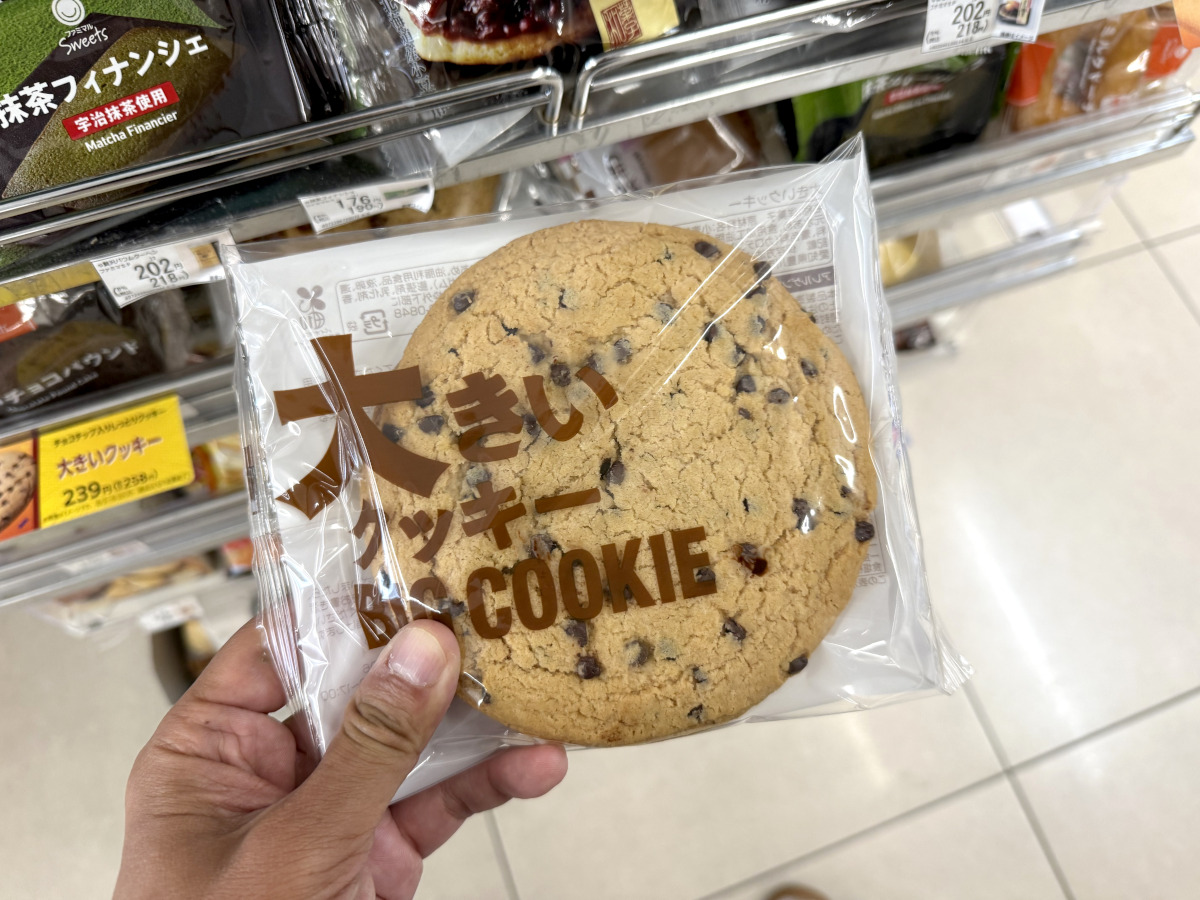
▼ … and the Big Cookie.

These were two products P.K. didn’t mind paying extra for, as the sheer size of them made them seem like great value for money, even with the price increase. To give you an idea of how big the Big Financier is, P.K. says it’s about the size of an iPhone 16 Pro.

▼ P.K., modelling the financier phone.

Placing it next to the chain’s standard financier, P.K. had a hunch that the giant version was more than twice its size. Checking the website, he learned that the Big Financier is said to have 2.9 times the surface area of the standard version.

The official website also claims that the Big Cookie is about twice the weight of the chain’s regular chocolate macadamia cookie.

Sensing it was even larger, P.K. whipped out his scales to weigh both cookies. The regular chocolate macadamia cookie weighed in at 60 grams (2.1 ounces), while the large cookie was…

▼ …172 grams!

At almost three times the weight, the increase was way bigger than advertised, and with the price difference being 203 yen (US$1.27) for the regular version and 258 yen for the large, this was fantastic value for money.

▼ In Japan, giving customers more than they bargained for is colloquially known as gyaku sagi (“reverse fraud“).

▼ The giant financier was another good deal, with the regular being 150 yen and the large 238 yen.

Compared to everything else in the range, the financier and cookie are outstanding in terms of both size and cost-effectiveness. The upgrade didn’t affect the quality either, as both were as delicious as their smaller versions.

According to P.K., these are the two aces of the Giant All-Star Festival, but they’re only available in limited quantities so keep an eye out for them next time you pop in for a change of clothes during the rainy season.

Insert image: Family Mart Japan
Photos
©SoraNews24 
● Want to hear about SoraNews24’s latest articles as soon as they’re published? Follow us on Facebook and Twitter!
  • ✇SoraNews24 Japan
  • Starbucks adds new Fruit Gummy sweets to stores in Japan Oona McGee
    Sure, Starbucks knows how to make a good Frappucino, but do they have what it takes to make good gummies?  Starbucks is known around the world for being a coffeehouse chain that specialises in drinks like the Frappuccino, but here in Japan you can come across some other unique surprises. Right now, the biggest surprise of all is that the chain is branching out into the sweet world of gummies, with a new release called Fruit Gummy. We came across this new discovery when we spotted the sweets n
     

Starbucks adds new Fruit Gummy sweets to stores in Japan

10 June 2026 at 03:00

Sure, Starbucks knows how to make a good Frappucino, but do they have what it takes to make good gummies? 

Starbucks is known around the world for being a coffeehouse chain that specialises in drinks like the Frappuccino, but here in Japan you can come across some other unique surprises. Right now, the biggest surprise of all is that the chain is branching out into the sweet world of gummies, with a new release called Fruit Gummy.

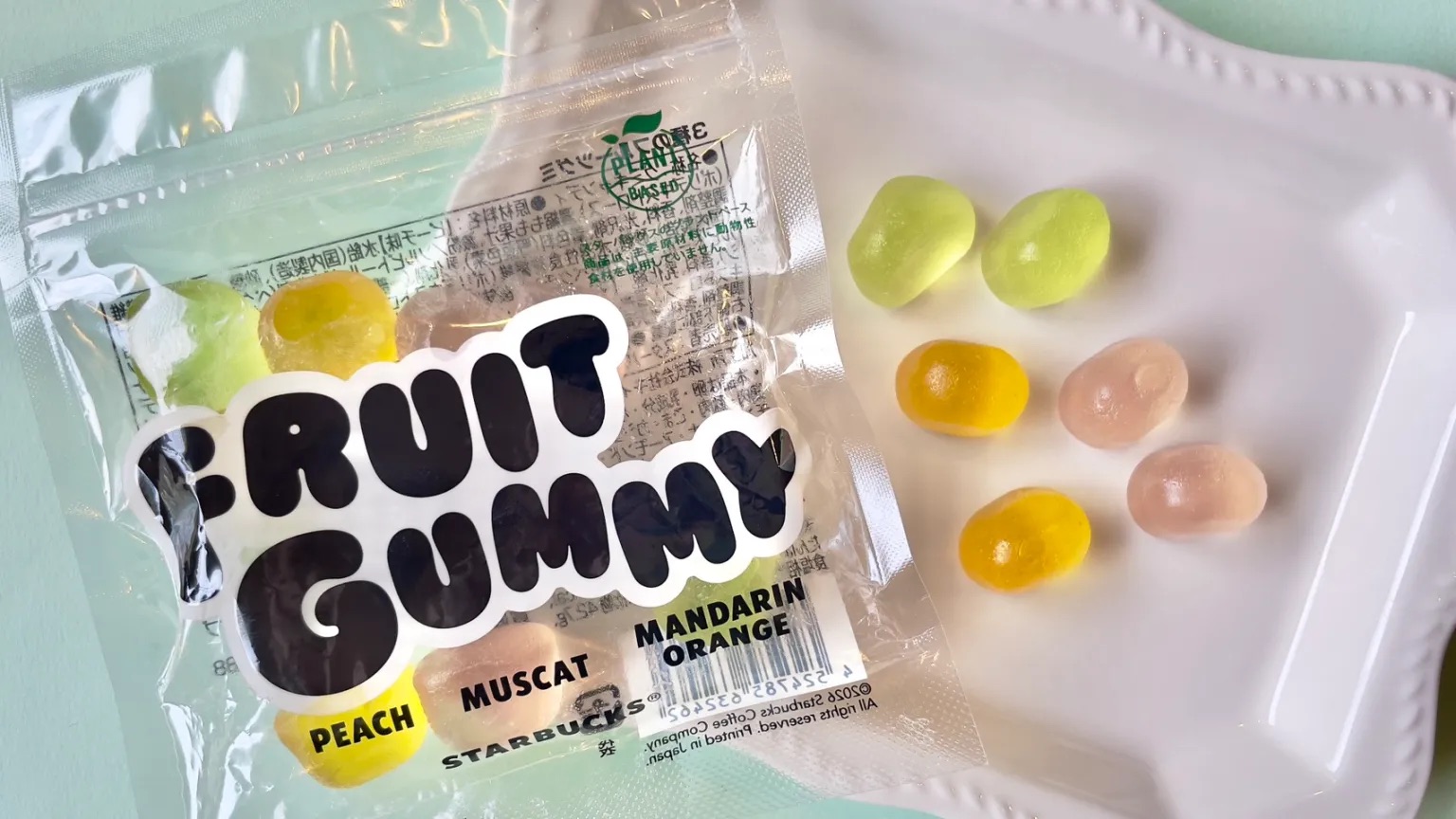
We came across this new discovery when we spotted the sweets next to the register on a recent Starbucks visit, with the simple graphic bubble font catching our eye. Upon closer inspection, we saw that these were plant-based gummies that don’t use animal ingredients, making them suitable for a wide range of customers.

Each pack contains three gummy flavours: muscat, mandarin orange, and peach. From the moment you open the package, you can smell the sweet smell of soft fruit, which is apt for Starbucks, given its history of whipping up delicious fruit-based beverages.

Placing them on a plate, we were able to appreciate the true beauty of the gummies. Glistening in the light like jewels with a soft sheen and semi-transparency, each gummy was well portioned, with just the right amount of give between the fingers.

With five-out-of-five stars for looks, we popped one of the gummies onto our tongue, instantly treating our taste buds to a fruity sweetness. Biting down on the soft gummy was a wonderfully satisfying experience as the texture was plumper and chewier than expected, giving us more time to enjoy the richness of the fruit.

After trying all three, our favourite was the mandarin, which had a subtle tartness that played against the fruity sweetness in a way that was both juicy and refreshing. The other two flavours erred more on the sweet side but were equally delicious, and with a total of 15 gummies in our pack for 270 yen (US$1.69), this was great value for money.

The small size makes them easy to pop into your bag for those times when you need a fruity boost, and we reckon they might actually go well with a bitter coffee, for added sweetness.

Whether you buy them for yourself or as a gift for a friend, these are high-quality gummies that’ll put a smile on your dial, and a clever reminder from Starbucks that they can do more than just Frappuccinos.

Images©SoraNews24
● Want to hear about SoraNews24’s latest articles as soon as they’re published? Follow us on Facebook and Twitter!
  • ✇SoraNews24 Japan
  • Another side of Kyoto – The prefecture’s top 10 “road stations” for traveling foodies SoraNews24
    We’re headed to Kyoto today, but not to see the temples or shrines. Temples and shrines are the first things that come to mind when travelers think of Kyoto, but the prefecture is also a treasure trove of outstanding michi no eki, or “road stations.” These combination roadside shops/rest areas offer a variety of unique local products, from foods and drinks to handicrafts, and with Kyoto Prefecture’s rich culinary legacies, its road stations include ones in famous green tea-growing regions and
     

Another side of Kyoto – The prefecture’s top 10 “road stations” for traveling foodies

28 May 2026 at 14:00

We’re headed to Kyoto today, but not to see the temples or shrines.

Temples and shrines are the first things that come to mind when travelers think of Kyoto, but the prefecture is also a treasure trove of outstanding michi no eki, or “road stations.” These combination roadside shops/rest areas offer a variety of unique local products, from foods and drinks to handicrafts, and with Kyoto Prefecture’s rich culinary legacies, its road stations include ones in famous green tea-growing regions and fishing ports on the coast of the Sea of Japan.

Today we’re asking our Japanese-language correspondent Susan, a native of Chiba Prefecture who’s travelled to 850 michi no eki, including all of the ones in Kyoto, for his list of 10 best Kyoto road stations, presented in no particular order.

1. Ocha no Kyoto Minami Yamashiro-mura (Minami Yamashiro Village)
Website

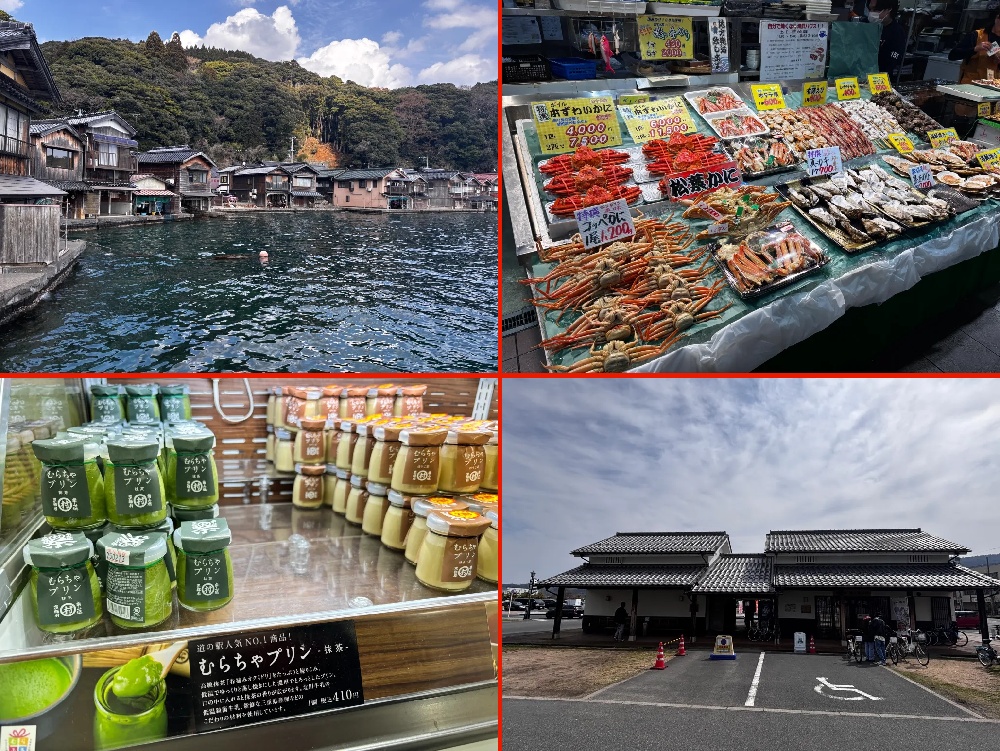
Minami Yamashiro is the only town in Kyoto Prefecture that’s legally classified as a “village” (mura in Japanese), and that alone brings a lot of travelers to this road station. Locally grown tea is the star attraction here, and in the attached restaurant you can dine on soba noodles with green tea mixed into their buckwheat flour. Looking for something sweeter? The Muracha (“Village Tea”) Pudding is not to be missed, with a deep, direct delivery of green tea flavor in every bite.

2. Michi no Eki Miyama Fureai Hiroba (Nantan City)
Website

You’ll find this road station on the way to Kayabuki no Sato, a beautifully preserved historic neighborhood with traditional thatched roof Japanese farmhouse architecture. The thing you’ve got to try if you come here is the Miyama Milk from the local dairy, or at least the ice cream, frozen yogurt, or cheese made with it.

The gelato is Susan’s personal favorite, rich but with a clean finish, and the lines get long for it on the weekends, but it’s worth the wait.

3. Michi no Eki Funaya no Sato Ine (Yosa)
Website

On its north side, Kyoto Prefecture stretches all the way to the coast of the Sea of Japan, and that’s where you’ll find the town of Yosa and Ine, a neighborhood of traditional fishermen boathouse homes built out over the water.

The refreshments on offer here include locally made soba and small-batch sake, but Susan also gives a special mention the hisuku, skewers of dried fish that you can buy from the outdoor Umyado stand to snack on while you admire the scenery.

4. Michi no Eki Nagomi (Funai)
Website

Heading back into the more mountainous inland, we come to this michi no eki in the town of Funai, situated next to the Yuragawa River. This is a tranquil spot befitting its Nagomi name (which means “harmony”), and your heart will feel even more at ease if you’re indulging in a cup of Mont Blanc pudding at the attached Nagomi Cafe.

Seasonal highlights include spring strawberries, autumn chestnuts, winter mochi, and in summer, a special “ayu garden” where you can experience catching ayu (a kind of river fish) by hand, then having it grilled up by the staff for you to enjoy at its freshest flavor.

5. Michi no Eki Mizuho no Sato Sarabiki (Funai)
Website

We’re still in Funai for this easy-to-access road station off the the Kyoto Expressway, near where travelers enter the lush countryside of the Tamba Highlands. The Mizuho district is famous for its buckwheat farms, and also for the soba noodles made from the grain, so naturally you can enjoy a bowl of them here, and the hiratake mushrooms, gathered in the local mountains, are delicious too.

This road station’s most unique feature, though, is its mini field hockey court. The Mizuho district hosted national field hockey championships during a sports event back in 1988, and the game has remained popular in the area ever since.

6. Michi no Eki Umi no Kyoto Miyazu (Miyazu City)
Website

Yes, the building itself looks cool, but this one is primarily on the list because it offers a great vantage point for seeing Amanohashidate. Considered one of the three most beautiful views in Japan, Amanohashidate is pine tree-covered sandbar that stretches across Miyazu Bay and is supposed to look like a bridge climbing into the heavens, especially so if you bend over and view it through your legs so that it’s upside down.

▼ Susan and a friend in front of Amanohashidate

The road station here has an attached shop with local sake and other souvenirs, but the main appeal really is the view, so make this one a daytime visit.

7. Michi no Eki Tango Okoku Shoku no Miyako (Kyotango City)
Website

Shoku no Miyako translates to “Capital of Food,” and the scale of this road station certainly warrants that distinction, as its approximately eight times the size of Japan’s famed Koshien baseball stadium. Whether you’re in the mood for Kyoto Tanba Kurowagyu steak or wood-fired pizza, there are restaurants here that are happy to oblige, and big eaters will enjoy the noodle shop with all-you-can-eat udon.

With so much to eat, you might want to have two meals here, and there are go-karts, a petting zoo, and even a hotel if you need something to do or somewhere to relax between chow-down sessions.

8. Michi no Eki Springs Hiyoshi (Nantan City)
Website

Aside from being valuable parts of public infrastructure, many dams in Japan have become tourist attractions in and of themselves. This road station is situated next to the Hiyoshi Dam, and fatures facilities such as an onsen hot spring bath, heated swimming pool, sauna, and outdoor BBQ spaces.

If you need provisions, the souvenir shop sells locally sourced mushrooms and eggs, and there’s even a campground with cottages for overnight guests.

9. Michi no Eki Kyoto Shinkoestumura (Nantan City)
Website

This road station is right off the Kyoto Jukan Expressway’s Sonobe Interchange, making it super-easy to access while driving across or around Kyoto Prefecture. Locally grown Onshin rice is the pride of the place, and aside from sacks of the rice itself you can taste it in the mochi rice cakes and senbei rice crackers sold in the souvenir shop.

This michi no eki also has a good selection of nama yatsuhashi, Kyoto’s representative sweet treat of a folded triangle of soft mochi with sweet red bean paste inside. Granted, you can find nama yatsuhashi at plenty of other places in Kyoto, but this road station’s easy expressway access makes it a very convenient place to pick up an extra box or two on your way home.

10. Michi no Eki Maizuruko Toretore Center (Maizuru City)
Website

And last, we’re back on the north coast of Kyoto Prefecture to stop at Maizuru Port, one of the largest seafood markets along the Sea of Japan. As soon as you step inside, you’ll be surrounded by the bustling energy of merchants hawking fresh catches of fish, crab, and oysters, among other saltwater delicacies.

This is basically the Tsukiji of road stations, with delicious snow crab in winter, iwagaki oysters in summer, and buri (yellowtail) in autumn, no matter when you visit, you’ll find something great to eat.

Photos ©SoraNews24
● Want to hear about SoraNews24’s latest articles as soon as they’re published? Follow us on Facebook and Twitter!
  • ✇SoraNews24 Japan
  • Tourists brave Typhoon Jangmi to queue at two famous sites in Tokyo Oona McGee
    The spots people queue for despite bad weather might surprise you. When you live and work in a city, you tend to move through it in different ways to a tourist who might be seeing it with fresh eyes. So when Typhoon Jangmi approached Tokyo on 3 June, bringing strong winds and heavy rain to the capital, locals who could work from home did just that, while others took earlier trains on their morning commute to avoid being late for work. For many tourists, though, sightseeing was still on the age
     

Tourists brave Typhoon Jangmi to queue at two famous sites in Tokyo

3 June 2026 at 15:00

The spots people queue for despite bad weather might surprise you.

When you live and work in a city, you tend to move through it in different ways to a tourist who might be seeing it with fresh eyes. So when Typhoon Jangmi approached Tokyo on 3 June, bringing strong winds and heavy rain to the capital, locals who could work from home did just that, while others took earlier trains on their morning commute to avoid being late for work. For many tourists, though, sightseeing was still on the agenda.

Our reporter Seiji Nakazawa, who lives in Shibuya, could’ve worked from home on the day of the typhoon but decided to stick to his usual routine of catching the subway to the office in Shinjuku. That meant he was able to get a feel for what Shibuya was like, and to his surprise, it was much, much emptier than usual.

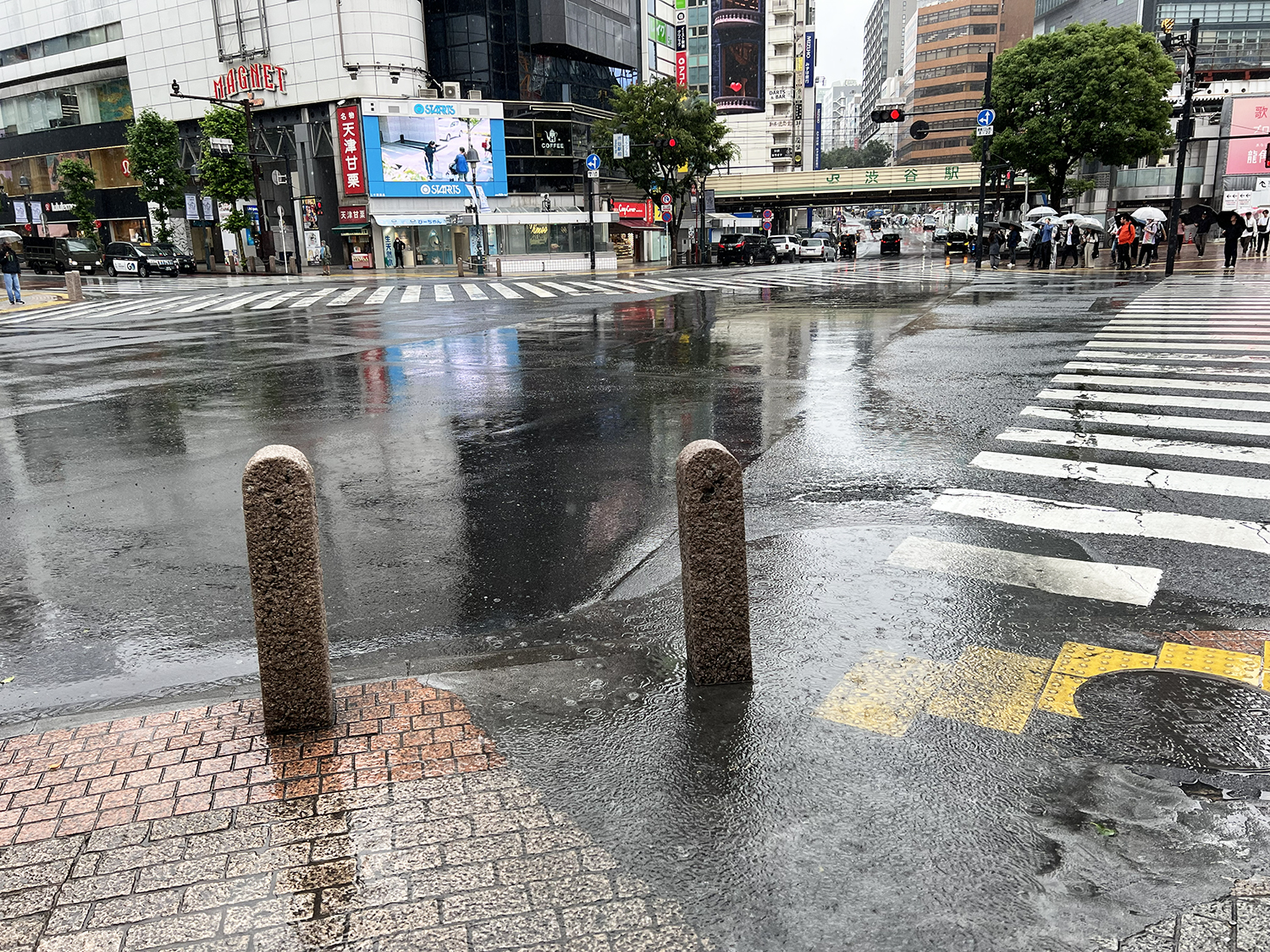
▼ The typhoon was eventually downgraded to a tropical storm, but the rain remained heavy throughout the day.

▼ In some areas there was more water than people.

Shops, streets, and even the area around the station felt strangely deserted, but there were two places where people gathered, with the first being the Dotonbori Theater.

Though most people will associate the word “Dotonbori” with the lively theatre and entertainment district of the same name in Osaka, this theatre is located in Shibuya’s Dogenzaka district, a short walk away from the station.

The retro, lantern-style sign out front is evocative of Dotonbori’s exciting atmosphere, and that excitement continues inside because this is a Japanese strip club. Popular with older locals and curious tourists, this live adult entertainment venue is restricted to adults aged 18 and over.

Bemused at the realisation that people will brave extreme weather conditions to watch an erotic performance, Seiji wondered what else might have the power to draw crowds in a typhoon-turned-tropical-storm. That’s when he saw another gathering of umbrellas right outside the station.

▼ What were they queuing for?

▼ The Hachiko statue.


Seiji was surprised to see so many people taking commemorative photos with Hachiko in the pouring rain, and what’s more, they were all foreign tourists with big smiles on their faces. As a local, Seiji usually walks by the statue of Shibuya’s famously loyal dog without giving it a second thought, but seeing the joy it brought these tourists made him appreciate its significance. It also made him realise how these people in the queue might be visiting Japan only once in their lives, and this might be their only day to see Hachiko, so his appreciation for the statue, and the tourists who braved the weather to see it, grew exponentially.

As he walked by, Seiji was struck by another surprise – the vibe of the queue. Usually, lines like these have a sense of tension to them that can make you feel a little on edge, but this one gave off a sense of warmth, due to the joy and passion of everyone in line. It was as if everyone here was living life with no regrets, and as he thought about it, that’s kind of what he felt outside the strip club too.

The pure warmth, free from negativity at the weather, transferred itself onto Seiji as he walked past the strip club and the line of Hachiko admirers. It was as if everyone’s emotions had intensified in the rain, and the energy he felt buoyed his own spirits as he dodged puddles on his way to work. He soon found himself smiling like the tourists, and as he did he realised that’s the power of Shibuya, a place that never loses its magical charm, even in the pouring rain.

Images©SoraNews24
● Want to hear about SoraNews24’s latest articles as soon as they’re published? Follow us on Facebook and Twitter!
  • ✇SoraNews24 Japan
  • Shochu maker on remote Japanese island plays music as its spirits age, flavor varies by genre Casey Baseel
    Rock shochu and reggae shochu really do taste different from each other. The island of Amami Oshima is part of Kagoshima Prefecture, and Kagoshima is usually pictured as making up the southwest tip of the island of Kyushu, one of Japan’s four main islands. Amami Oshima, though, is far, far away from the Kyushu coastline, so far away that the ferry from Kagoshima City takes 13 hours to get there. ▼ The route from Kagoshima City to Amami Oshima, which can alternatively be reached by plane from T
     

Shochu maker on remote Japanese island plays music as its spirits age, flavor varies by genre

18 May 2026 at 01:00

Rock shochu and reggae shochu really do taste different from each other.

The island of Amami Oshima is part of Kagoshima Prefecture, and Kagoshima is usually pictured as making up the southwest tip of the island of Kyushu, one of Japan’s four main islands. Amami Oshima, though, is far, far away from the Kyushu coastline, so far away that the ferry from Kagoshima City takes 13 hours to get there.

▼ The route from Kagoshima City to Amami Oshima, which can alternatively be reached by plane from Tokyo in two and a half hours.

With its remote location, Amami Oshima is famous for its lush mangrove forests, beautiful beaches, and clear, sparkling ocean waters.

Oh, and it’s also famous for shochu, a distilled spirit with longstanding cultural connections to southwest Japan. Specifically, Awaji Oshima’s kokuto shochu, made with rice and brown sugar, is highly prized, and so on our recent visit to the island we didn’t just want to drink some, but also see how it’s made.

We lucked out when we contacted Nishihira Shuzo, an Amami Oshima shochu maker that’s been in business for 99 years, and they said they could offer us a tour of the facility, and a tasting too, with some very unique beverages to sample.

▼ The rustic exterior of the Nishihira Shuzo distillery

Despite being around for nearly a century, Nishihira Shuzo is still a family-run operation, and we were told that the fourth-generation owner of the business would be our guide. With shochu being a high-alcohol drink with an old-school vibe, our mental knee-jerk reaction was to expect a stern-looking, silver-bearded gentleman, but instead we were warmly greeted by Serena Nishihira and her friendly smile.

▼ Serena Nishihira

In addition to being a skilled shochu distiller and businesswoman, Nishihira is also a musician, which is something that’ll come into play later on. To start, though, she led us into the distillery’s production area.

As mentioned above, Nishihira Shuzo’s shochu is made from rice, so steaming the grains is the first step in making it. The distillery has a gigantic cylinder-shaped apparatus that’s used for washing and steaming, with a typical batch using about 400 kilograms (882 pounds) of rice.

Once the rice is cooked, it’s taken out of the drum and sprinkled with koji, a fermentation-triggering type of mold that’s also used in making sake. The rice is then put on racks in a temperature-controlled environment for its initial fermentation.

The next morning, the rice is put into jars with yeast and water to ferment for an additional five days. This isn’t a step that all shochu makers include in their process, but Nishihira Shuzo says it’s a key element of theirs.

After its time in the pot, the mixture is transferred into tanks and combined with liquified brown sugar, then given another two weeks to ferment.

That produces the fermented mash which is then distilled.

But that doesn’t mean Nishihira Shuzo can whip up a whole batch of kokuto shochu, start to finish, in just three weeks, because the final step (before bottling) is to age the shochu in tanks for at least one full year.

From a 400-kilogram load of rice, Nishihira Shuzo can produce roughly 800 1.8-liter (60.9-ounce) bottles of shochu. Luckily for us, some of those bottles end up in the distillery’s tasting room, which was the next place that Nishihira led us to.

The tasting room has chairs, a projector, and a screen set up for use for group events or musical performances, but we had the place to ourselves on this day.

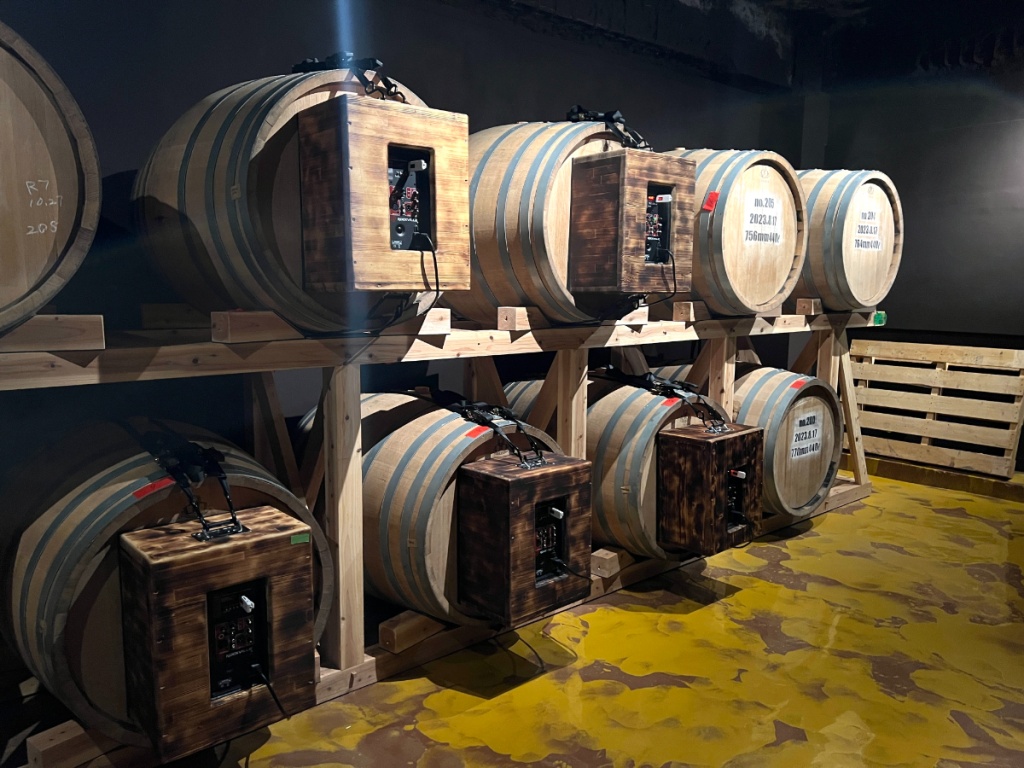
Nishira poured us a selection of the company’s products, and we found them all extremely enjoyable. But just when we thought things couldn’t get any better, she led us through a door at the back of the room where we saw this.

Those are shochu barrels with speakers attached to them. And not some little mini speakers that you might have set up in your kitchen to listen to tunes while you cook, but concert-size amps!

This is where the Nishihira’s Sonic Aging Project takes place. While the speakers were quiet as we looked at them, Nishihira turns all of them on when the distillery starts its shift for the day, and has them play for eight hours. Different amps play different genres of music, with a total of six styles: house, reggae, hip-hop, Latin, rock, and shima uta, or Japanese southern island folk songs.

“We play the music at high volumes,” Nishihira explained, “Depending on the genre, the music produces different vibrations within the barrels, and we want to see how that affects the shochu.”

▼ The shima uta barrel

Like we said, Nishihira is a musician, so at first the idea of playing music for the shochu sounded like a whimsical, creative, but ultimately inconsequential idea. Nishihira, says, though, that with the barrels being music-treated for roughly 2,000 hours in a year, it really does make a difference.

Genres with more bass produce stronger vibrations in the barrel, and also with the shochu itself. That increased interplay between the container and its contents causes the wood to have a more significant influence on the color and flavor of the shochu that’s aging inside.

To prove this, Nishihira ushered us up to the second floor of the tasting area to try some of the Sonic Aging Project series.

Out of the six music genres, Nishihira says that reggae produces the strongest vibrations, and shima uta the softest. So we definitely wanted to taste those two, and she also poured us some of the rock shochu, which is somewhere between the other two in the spectrum.

And you know what? We really could taste the difference! The reggae shochu was darker in color and had a rich flavor with some notable bitter notes from the wood. The shima uta shochu, meanwhile, was lighter in color and sharper in taste, with a more pronounced sensation of alcohol. The rock shochu, sure enough, was a mid-point between the more distinct characteristics of the reggae and shima uta.

So which of the Sonic Aging Project shochu styles is the best? There’s actually no answer to that, Nishihira says. Just like your favorite musical genre is a matter of personal taste, so too will different people have different rankings for how much they like the different types Sonic Aging Project shochu, and they’ve all got their own unique charms.

Reservations for Nishihira Shuzo tours can be made through their website here, but if you can’t make it all the down to Amami Oshima, they also offer their shochu, including the Sonic Aging series, through their online store here.

Related: Nishihira Shuzo official website
Photos ©SoraNews24
● Want to hear about SoraNews24’s latest articles as soon as they’re published? Follow us on Facebook and Twitter!

  • ✇SoraNews24 Japan
  • Pump yourself up with Yokohama’s new extravagant Cool Fuel ice cream Krista Rogers
    With its slogan “Melt the Rule,” Cool Fuel offers a new kind of five-layered ice cream-eating experience centered on Mascarpone cheese flavor. New ice cream brand Cool Fuel opened on May 29 in the Yokohama Hammerhead shopping complex. We’d heard rumblings that it was supposed to be an ultra-luxurious dessert experience, far different than eating regular ice cream. Never ones to resist an icy sweet treat, we paid the new shop a visit on the morning of the fourth day it was open. ▼ Yokohama Hamm
     

Pump yourself up with Yokohama’s new extravagant Cool Fuel ice cream

10 June 2026 at 17:30

With its slogan “Melt the Rule,” Cool Fuel offers a new kind of five-layered ice cream-eating experience centered on Mascarpone cheese flavor.

New ice cream brand Cool Fuel opened on May 29 in the Yokohama Hammerhead shopping complex. We’d heard rumblings that it was supposed to be an ultra-luxurious dessert experience, far different than eating regular ice cream. Never ones to resist an icy sweet treat, we paid the new shop a visit on the morning of the fourth day it was open.

▼ Yokohama Hammerhead shopping complex

Lots of new stores had opened in the mall recently so it was bustling with people as we made our way through the space.

We made a beeline to our goal and were greeted by the cool blue tones of the new store. There was a little bit of a line, which was a little surprising since it was a weekday–but we weren’t in a rush.

We asked the staff which flavors were the most popular and they replied that the chocolate and caramel ones were selling well.

We decided to spring for chocolate (called Velvet Chocolate in English on the menu) this time for 780 yen (US$4.90). The menu explained that each cup was structured with five layers, which we were curious to see with our own eyes.

Upon placing our order, we received a numbered ticket and stood off to the side until our number was called.

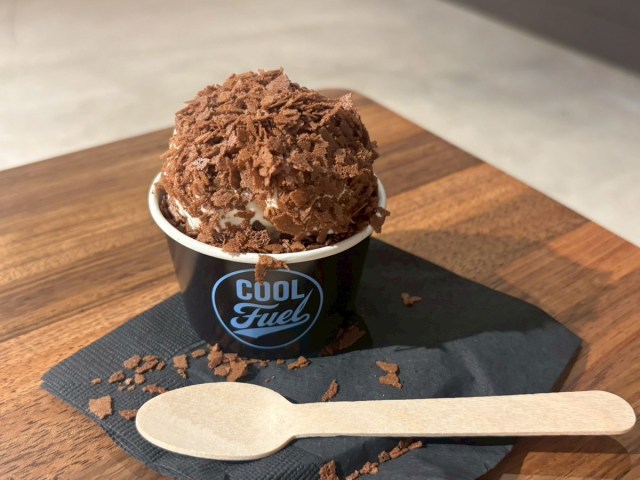
The concoction handed to us was very round, top-heavy, and had an overflowing flaky topping! We quickly sought out a place to sit before there was any spillage.

Here’s the ice cream’s glamor shot. It sure looked like a work of art while posing.

The very top of the cup was a Mascarpone-based soft serve covered with crispy chocolate corn flakes.

Taking a large spoonful off the top revealed the interior cross-section. We could see what the menu meant by five layers–the inside was filled with a rich chocolate sauce and crunchy chocolate cookie bites, which made for a tantalizing texture.

▼ If only high school science classes offered ice cream dissections…

As we dug deeper, layers of freshly whipped cream also appeared from the bottom, giving the whole thing the impression of a very rich parfait or sundae. It was definitely decadent and we could see how people who enjoy “lighter” desserts like kakigori shaved ice might reach their limit very quickly. We, however, had absolutely no problem downing the entire thing in true form.

In conclusion, Cool Fuel ice cream is incredibly rich, delicious, and has found a formula to perfect the balance of taste and texture. At 780 yen it also feels more like a special reward than a routine dessert, so we recommend saving your visit for a very special occasion.

Now that the days are getting hotter, we’ve definitely got ice cream on the brain. Check out Mr. Sato’s recent visit to classic American/Japanese ice cream brand Blue Seal if you just can’t get enough brain freeze this month.

Store information
COOL Fuel Yokohama Hammerhead store / COOL Fuel 横浜ハンマーヘッド店
Address: Kanagawa-ken, Yokohama-shi, Naka-ku, Shinko 2-14-1 Yokohama Hammerhead, 2nd floor
神奈川県横浜市中区新港 2-14-1 横浜ハンマーヘッド 2F
Open 11 a.m.-9 p.m. (weekdays), 10 a.m.-9 p.m. (weekends)
Website

All images © SoraNews24
● Want to hear about SoraNews24’s latest articles as soon as they’re published? Follow us on Facebook and Twitter!

  • ✇SoraNews24 Japan
  • Do Bare Feet of a Gorilla slides really make your legs slimmer? Oona McGee
    These bizarre sandals have gone viral on Japanese social media, so we put them to the test. If you’re interested in Japan, your timeline and explore pages are likely filled with photos and videos of influencers promoting the country’s latest finds. A lot of the time, though, these influencers miss the true hidden gems that circulate on Japanese social media, and right now there’s one product that locals are raving about: Bare Feet of a Gorilla. Produced by Osaka-based company Doshisha, as part
     

Do Bare Feet of a Gorilla slides really make your legs slimmer?

20 May 2026 at 05:00

These bizarre sandals have gone viral on Japanese social media, so we put them to the test.

If you’re interested in Japan, your timeline and explore pages are likely filled with photos and videos of influencers promoting the country’s latest finds. A lot of the time, though, these influencers miss the true hidden gems that circulate on Japanese social media, and right now there’s one product that locals are raving about: Bare Feet of a Gorilla.

Produced by Osaka-based company Doshisha, as part of its Gorilla Series of quirky lifestyle products, Bare Feet of a Gorilla are acupressure sandals designed to provide a pleasant stimulation to the soles of the feet every time you walk in them.

Ever since their release in late April, users have been heaping praise on the sandals, adoring them not only for their cute similarities to a cloud, but the effect they have on the feet and legs.

▼ Look closer and you’ll find hidden gorillas within the puffy surface of each sandal.

According to Doshisha, these slides were created in response to the growing popularity of so-called “recovery sandals”, which are particularly popular with young people in summer to relieve tired legs. The pleasant stimulation provided by the puffy surface, and the gorillas hidden within them, are said to combat swelling in the legs, an assertion backed by many users of the product, who say their legs look slimmer after wearing them.

From our experience, acupressure sandals tend to have a breaking-in period, where you have to put up with a certain amount of pain before getting used to the stimulation on the soles of your feet. However, when we slid into the Bare Feet of a Gorilla, we were surprised to find that we barely felt any pain.

Although there was a feeling of unevenness, the sensation was soft on the feet, thanks to the EVA material, which had excellent give. The stimulation was moderate, and after just a short period we felt the sluggishness disappear from our legs.

They were wonderfully lightweight, making them very easy to walk in, and we were able to walk about the house for a couple of hours while doing chores before we felt it was time to step out of them. They’re comfortable enough that you could even wear them when ducking out to a nearby convenience store, but they do have an acupressure effect that’s hard on the feet after an extended period of time.

As for the slimming effect, well, we didn’t notice any differences there, but they did help to stimulate the soles of the feet and they also reduced fatigue so they certainly delivered on that promise.

They do look fantatstic, though, and will definitely turn the heads of passersby if you go out in them. Available in black, grey, white, and mint green, the slides come in small, medium and large sizes (22-23 centimetres [8.7–9.1 inches],  23-24 centimetres, and 24-25 centimetres respectively). They can be purchased at Don Quijote stores and affiliated retail chains like Apita and Piago nationwide, priced at 2,189 yen (US$13.76).

Related: Doshisha, Don Quijote
Images ©SoraNews24

● Want to hear about SoraNews24’s latest articles as soon as they’re published? Follow us on Facebook and Twitter!

❌
Subscriptions