Research & Developments is a blog for brief updates that provide context for the flurry of news regarding law and policy changes that impact science and scientists today.
More U.S. scientists are running for state and federal office in the U.S. midterm elections than ever before, Nature reports. Scientist-candidates represent an array of parties, although most profiled in Nature identify as Democrats.
314 Action, an organization focused on getting Democrats with scientific backgro
Research & Developments is a blog for brief updates that provide context for the flurry of news regarding law and policy changes that impact science and scientists today.
More U.S. scientists are running for state and federal office in the U.S. midterm elections than ever before, Nature reports. Scientist-candidates represent an array of parties, although most profiled in Nature identify as Democrats.
314 Action, an organization focused on getting Democrats with scientific backgrounds elected to public office, offers financial support and training to candidates who apply for it. This year, the organization told Nature, they’ve received nearly three times as many applications as usual.
Sam Wang, a neuroscientist at Princeton and director of the Princeton Gerrymandering Project, is running to represent New Jersey’s 12th Congressional District.
“Usually, scientists stick with a specialized field,” Wang, a Democrat, wrote in an opinion for The Daily Princetonian. “However, I am deeply unhappy with how unequally power is divided in our society. So I have used my statistical abilities to level one part of democracy’s playing field: by repairing unfair elections.”
Why Now?
This year, Democratic candidates appear to be motivated by cuts to federal science programs, grants, and agencies, Nature reports, while Republican candidates like Jeff Wilson, who is running to represent the 13th district of Illinois, cite the pursuit of energy independence. Third-party scientist-candidates have also run, and scientists are entering local and municipal arenas, too.
Specifically, with the recent repeal of the Endangerment Finding, loosened restrictions on pollution, and plans to break up the National Center for Atmospheric Research, some candidates and their supporters think science needs a more prominent position in public policy.
The rise in scientist candidates may also be part of an ongoing trend. More than 200 STEM professionals ran for office in the 2024 election, as Eos reported in October 2024.
“There are a lot of people who believe that science can help us live better lives and that science really does need to be front and center when we’re making public policy,” Jess Phoenix, a volcanologist, science advocate, and former Democratic candidate for the U.S. House of Representatives told Eos at the time.
In March, thousands of people attended Stand Up for Science rallies across the country to protest the misuse of science in federal policy and extensive staffing and funding cuts to scientific agencies. Since President Trump took office in 2025, more than 10,000 PhD-level scientists have left the federal workforce, Science reported in January.
Pew research data shows that public trust in scientists has declined since the COVID-19 pandemic, but it has seen modest improvements since 2023. The latest poll, released in January, found that 77% of adults in the United States have a great deal or a fair amount of confidence in scientists to act in the public’s best interest, compared to 73% in 2023. The percentage is consistently higher among Democrats than Republicans: 90% versus 65%, in 2026. In contrast, only 27% of respondents reported at least a fair amount of confidence in elected officials.
“The last thing I want [is] to become a politician,” wrote one Redditor in response to the Nature story. “But at this rate I may not have a choice if current politicians keep screwing it up.”
These updates are made possible through information from the scientific community. Do you have a story about how changes in law or policy are affecting scientists or research? Send us a tip at eos@agu.org.
Editors’ Vox is a blog from AGU’s Publications Department.
Often times when we think “scientist,” we picture a white lab coat, a pipette. Or, a marine biologist covered in seaweed samples. A geologist with dusty knees and hands full of rock fragments. Endless blue gloves. What we may not always picture is our favorite professors, colleagues, or even students advocating for science to policy makers.
Federal policy decisions have a direct impact on science funding, research priorities, and
Often times when we think “scientist,” we picture a white lab coat, a pipette. Or, a marine biologist covered in seaweed samples. A geologist with dusty knees and hands full of rock fragments. Endless blue gloves. What we may not always picture is our favorite professors, colleagues, or even students advocating for science to policy makers.
Federal policy decisions have a direct impact on science funding, research priorities, and the role of science in society.
Federal policy decisions have a direct impact on science funding, research priorities, and the role of science in society, and the AGU community has a critical role to play in those conversations. Each year, AGU’s Science Policy and Government Relations (SPGR) team organizes and hosts Congressional Visit Days to connect Earth and space scientists to their elected officials. As a member of AGU’s scientific publications team, I joined the April 21-22 Days of Action to learn about the bills currently impacting our workforce and research, how to craft messages that both speak to our personal experiences, and to ask our elected officials to advocate with and for us.
As a D.C. native, I grew up in close proximity to the power of science, the alphabet agencies, NOAA, NASA, NIH, and USDA. Institutions where the best and brightest were given the resources and support to learn, record, and disseminate knowledge on behalf of our country. In my current role with AGU as a non-profit publisher, I took to the Hill to share my experiences on the publishing and academic peer-review landscape. My role allows me to see first-hand how budget cuts and shifting attitudes have impacted critical programs at the agencies named above. This Days of Action event brought together 58 participants with one goal: to share personal stories that related to four bills:
KEEP STEM Talent Act (H.R. 2627, S.1233)- strengthens the U.S. scientific workforce by making it easier for skilled international STEM graduates from U.S. universities to stay in the U.S.
Protect America’s Workforce Act (H.R.2550 passed House, S.2837)- seeks to protect the U.S. federal scientific workforce by restoring collective bargaining (union) rights.
Scientific Integrity Act (H.R.1106)- protects the rights of U.S. federal scientists and researchers by safeguarding scientific integrity in federal research and decision-making.
Two participants spoke on their experiences meeting with elected representatives and uniquely captured just how closely the Earth and spaces sciences touch all of our lives.
Sheila Baber, an early career scientist with The University of Maryland, felt compelled to join due to “the uncertain future for myself, my peers, and the American scientific enterprise.” She noted, “It has been especially difficult to witness the deteriorating relationship between scientists, decision makers, and the public. This past year, with its rapidly changing federal landscape, has been a wakeup call to re-engage and remind the public of how science research gives back to the community.”
Ryan Haupt, long-time AGU member and the Executive Director at National Youth Science Academy, with a 10-year track record of geoscience advocacy, emphasized the importance of building relationships with elected officials. “Regardless of party affiliation, I want those staffers to know that when they meet with me or any other AGU member, they will get honest and informed feedback from folks who are truly passionate about our fields,” Ryan told me. “[Experts who can speak to how current bills] impact issues like improved financial support for graduate students, helping international students stay in the US to join the STEM workforce, and protecting funding for federal science agencies and the folks who work for them.”
As a participant myself, I joined the Maryland group to meet with Senator Chris Van Hollen’s office. Van Hollen and I met briefly at the Stand Up for Science March in 2025. His voting track record indicates a long-standing commitment to the scientific community, and he champions bills that support funding federal agencies like NOAA.
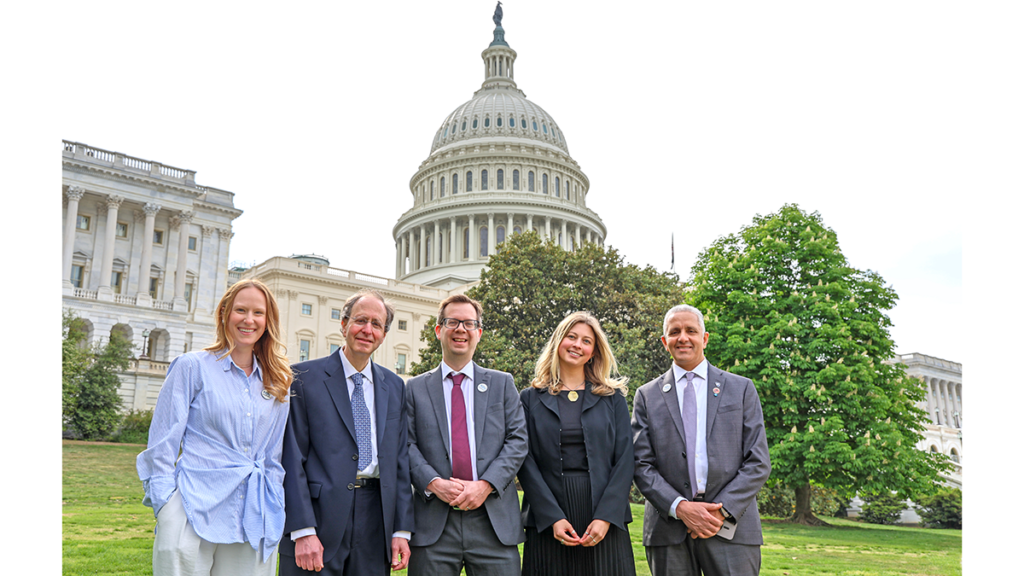
(left to right) The Maryland group, McKay Porter, Andrew Inglis, Nour Rawafi, Stephen Jascourt, and Emille Beller met with Senator Chris Van Hollen’s staffer, Leo Confalone. Credit: Beth Bagley, AGU
Finding and discovering the best and the brightest means funding, protecting, and supporting the best and the brightest.
Working in scientific publishing has allowed me to peer behind lab doors, into research vessels sailing through the Arctic, and into the entire ecosystem that is peer-reviewed research. A system that relies on incoming eager students, federal grant funding, consortium agreements between the biggest institutional libraries and the biggest publishing houses in the country, scientific integrity, and future, stable career opportunities. Finding and discovering the best and the brightest means funding, protecting, and supporting the best and the brightest.
Open, accessible science builds and supports both public trust and future scientific advancements. As the world widens and we are all met with increased access to studies, content, and news, scientific storytelling and literacy have never been more important for ensuring public trust. Transparency from the lab and from the field to published output allows for data to be discussed, fact-checked, and reused to support future scientific discovery. Days of Action demonstrates that we have a unique role to play in supporting the health, safety, and future of our country. If you feel called to get involved, please see resources available from SPGR.
Ryan reminds us, “There are lots of ways to participate in our democracy… find where you can best serve as a leader…don’t try to do it all, but try to do something.”
Citation: Beller, E. (2026), The impact of advocacy: American Geophysical Union’s Days of Action, Eos, 107, https://doi.org/10.1029/2026EO265020. Published on 14 May 2026.
This article does not represent the opinion of AGU, Eos, or any of its affiliates. It is solely the opinion of the author(s).
Research & Developments is a blog for brief updates that provide context for the flurry of news regarding law and policy changes that impact science and scientists today.
The number of peer-reviewed scientific studies authored by scientists at the EPA has declined since the beginning of Donald Trump’s second administration, according to a new analysis.
The analysis was published by Public Employees for Environmental Responsibility (PEER), a nonprofit organization that advocates fo
Research & Developments is a blog for brief updates that provide context for the flurry of news regarding law and policy changes that impact science and scientists today.
The number of peer-reviewed scientific studies authored by scientists at the EPA has declined since the beginning of Donald Trump’s second administration, according to a new analysis.
The analysis was published by Public Employees for Environmental Responsibility (PEER), a nonprofit organization that advocates for public employees in the natural resource and environmental professions. The report tracks the number of peer-reviewed scientific studies authored by EPA scientists since 1977.
According to PEER’s analysis, 61 peer-reviewed publications by EPA scientists have been published so far this year, putting the agency on track to publish 183 articles by the end of 2026. That would be 67% of the number of articles published the previous year and 54% of the number of articles published in 2024.
“These numbers represent a diminution of scientific contributions from the fewer, remaining EPA scientists,” Kyla Bennett, a science policy director at PEER and a former EPA attorney, said in a statement. “The net result is that the scientific contribution of EPA to a greater understanding of what affects human health and the environment will be diminished.”
The number of peer-reviewed publications authored by EPA scientists in 2026 will be just over half of the number published in 2024, if current publication rates continue. As of 5 May, 2026, EPA authors have published 61 peer-reviewed articles for the year. Credit: PEER, Grace van Deelen
Peer-reviewed publications can take years to review and publish, meaning the work for a publication may have occurred during a previous administration. But the decline in publications may indicate a shift away from long-term basic research at the agency, according to PEER.
Since Trump took office, hundreds of scientists have been terminated from the EPA or have chosen to resign, and scientists working within at least one of its research office have been told to pause efforts to publish research, representing “millions of dollars of research, potentially, that’s now being stopped,” one EPA employee told The Washington Post anonymously.
In February, the EPA took final steps to eliminate the Office of Research and Development, the arm of the agency responsible for conducting research. In its place, Administrator Lee Zeldin announced that a new office, called the Office of Applied Science and Environmental Solutions, would be formed but would not operate as a separate division.
Six EPA scientists who signed an open letter expressing frustration about changes to the agency, including the elimination of the Office of Research and Development, were terminated and have filed claims with the federal government arguing that their terminations were illegal retaliation.
These updates are made possible through information from the scientific community. Do you have a story about how changes in law or policy are affecting scientists or research? Send us a tip at eos@agu.org.
On 31 March 2026, the U.S. Department of Agriculture announced the closure of 57 of its 77 U.S. Forest Service research facilities. The scientific community’s response was warranted: Save the science, restore the funding, protect the researchers.
All of that is correct. But it misses a structural problem inherent in agency governance, one that will recur at every reorganization until the Earth science community builds an instrument to prevent it.
In massive reorganizations like the ones f
All of that is correct. But it misses a structural problem inherent in agency governance, one that will recur at every reorganization until the Earth science community builds an instrument to prevent it.
In massive reorganizations like the ones federal agencies are currently experiencing, the threat to long-term research facilities is not primarily a lack of funding. The true threat is an oversight of administrative architecture. There appears to be no general federal requirement to have a successor stewardship plan in place before reducing the output or outreach of a long-term research facility—or closing it entirely.
The Physical Archive Is Not a Digital File
Hubbard Brook Experimental Forest in New Hampshire was among the sites under review during the Forest Service restructuring but has since received a public reprieve. The future of Bartlett Experimental Forest, also in New Hampshire, remains unresolved. The governance problem, however, extends beyond either site.
Hubbard Brook’s physical archive holds more than 60,000 barcoded and cataloged samples: water, soils, plant material, and physical cores spanning 7 decades of continuous collection and stored under active environmental controls in a dedicated building on site.
These samples cannot be digitized. They cannot be migrated to a remote server, backed up to cloud storage, or emailed to a university partner. The samples require a functioning building, active temperature management, and a named human steward responsible for their integrity.
The physical archive at Hubbard Brook holds more than 60,000 barcoded and cataloged samples stretching back to the founding of the facility in 1955. Credit: Anthony Veltri
The archive includes core samples of trees dating to long before the experimental forest was established, and the archive maintains each as a managed scientific record with continuity of custody. Credit: Anthony Veltri
Core samples like these document the watershed at Hubbard Brook and anchor long-term understanding of system processes. Credit: Anthony Veltri
The archive at Hubbard Brook is impressive, but a governed record is defined by continuity, provenance, and stewardship, not by the number of observations it contains: Data volume is not data value. A 70-year unbroken record of watershed chemistry, maintained by named stewards who documented what they were measuring and why, is a governed product. Without that stewardship and physical anchor, volume can become noise.
The failure to maintain archives like this is likely not malicious; it is an example of administrative indifference or perhaps a lack of awareness or understanding. Environmental controls, for example, get zeroed out of a budget line item, and nobody notices until the temperature in the facility drifts. By then, the sample record has degraded in ways that cannot be reversed.
This Is Not a Hubbard Brook Problem
Many physical archives, calibration sites, and long-duration sampling programs operate without a formal requirement for stewardship continuity.
Hubbard Brook is the most visible instance of a pattern—the lack of a successor stewardship plan—that runs across the entire 84-site federal Experimental Forests, Ranges, and Watersheds network. The March order that identified Bartlett Experimental Forest and 56 other research facilities across 31 states for closure was executed without a mandatory requirement to identify successor stewards for what gets left behind.
Nor is the pattern unique to experimental forests. The Long Term Ecological Research network spans 28 core sites. AmeriFlux includes more than 500 monitoring locations across North America.
Throughout all these systems, many physical archives, calibration sites, and long-duration sampling programs operate without a formal requirement for stewardship continuity under agency reorganization.
What We Stand to Lose
Long-term physical archives provide scientists and other stakeholders the ability to ask future questions of past reality. Nobody collecting water samples at Hubbard Brook in 1963 was thinking about PFAS (per- and polyfluoroalkyl substances), for instance, but the baseline its site samples provide is why we can track the chemicals today. The same continuous record was central to the regulatory science behind the Clean Air Act amendments of 1990.
Archival value compounds silently and becomes visible only when someone needs it.
Archival value compounds silently for decades and becomes visible only when someone needs it.
When these archives fail, the loss is not historical. It is operational. Regulatory agencies rely on long-baseline records to determine whether interventions are working. Without a continuous physical reference, observed changes cannot be distinguished from measurement drift, instrumentation bias, or natural variability. The results are policy decisions made without a defensible scientific baseline.
Federal investment in continuous collection at a site like Hubbard Brook runs to tens of millions of dollars over decades. That investment is not recoverable once continuity is broken.
Unlike a paused research grant, a degraded physical archive cannot be restarted. You can photograph a sample, but you cannot rerun its chemistry 40 years from now if the physical sample has degraded.
In 2017, a double mechanical failure at the University of Alberta destroyed 12.8% of the Canadian Ice Core Archive over a single weekend, permanently erasing records dating back 12,000 years. That incident was accidental. A mechanical malfunction is a failure of equipment. Administrative disposal without a named successor steward is a failure of governance. One arrives without warning. The other can be prevented.
The Community Already Knows How to Do This
The Earth observation community has already built the governance model we need. We are not yet applying it to long-term ecological research infrastructure.
GRUAN, the Global Climate Observing System (GCOS) Reference Upper-Air Network, operates under the World Meteorological Organization and GCOS, with explicit named stewardship obligations. Upper-air observations—measurements of temperature, humidity, and wind through the atmosphere—are foundational inputs to weather forecasting and climate monitoring. Each GRUAN station has a designated principal investigator with a documented succession obligation.
ICOS, the Integrated Carbon Observation System operating across Europe, applies the same logic to terrestrial ecosystem observations through formal site-level stewardship agreements and named succession requirements.
In the United States, the National Ecological Observatory Network is funded by the National Science Foundation (NSF) and operated by Battelle, a science and technology nonprofit, under a contract that includes explicit data continuity obligations.
These systems did not emerge by accident. They were explicitly designed to solve a known failure mode: Distributed observational networks cannot maintain their own calibration integrity without a separately governed reference layer. That design decision is documented, enforced, and funded. The absence of an equivalent requirement in long-term ecological research infrastructure is not a technical limitation. It is a governance omission.
The pattern is consistent across every network that has solved this problem: Named continuity obligations must be written into the governance structure before the need becomes acute.
The Governance Instrument
The best outcome is the continued, uninterrupted operation of facilities like Hubbard Brook.
Any federal agency action that would reduce operational support for a long-term research facility should require a formal continuity plan before the action takes effect.
If reductions move forward, however, the proposed fix is specific and not novel: Any federal agency action that would reduce or eliminate operational support for a long-term research facility should require a formal continuity plan before the action takes effect. That plan must name a successor steward for each active long-term dataset and for each physical archive under active environmental control.
In practice this means specificity: the name and institutional affiliation of the successor, a funded maintenance budget sufficient to sustain environmental controls and sample integrity, documented protocols for custody transfer, and a timeline for uninterrupted handoff. The plan must demonstrate that the successor steward has the operational capacity and funded mandate to preserve the archive’s physical integrity and continuity.
This instrument prepares plant samples collected at Hubbard Brook using standardized methods. Consistent preparation is what makes results comparable across time and labs and why continued stewardship is so important. Credit: Anthony Veltri
The default should be continued stewardship by the responsible federal entity. If a change in custody is legally permitted and genuinely unavoidable, any successor steward, whether another federal unit, a university partner, a consortium, or another entity, must have a funded mandate, demonstrated technical capacity, enforceable continuity obligations, and the ability to maintain the archive without interruption.
Protocol demands that if the agency cannot name a viable successor steward, the agency cannot execute the closure. This requirement does not prohibit closure; it prohibits closure without continuity of custody.
The instrument requiring a research facility to have a formal continuity plan should be applied not on a site-by-site basis, but uniformly across networks. A limitation narrowly written to protect a named facility invites the agency to execute the same administrative disposal at adjacent sites while technically complying with the specific requirement. The governance is structurally sound only if it applies across the network.
How This Actually Happens
The pathways that would make such an instrument possible already exist.
Agencies can impose continuity requirements through policy directives, appropriations language, or funding conditions. The federal Office of Science and Technology Policy and the Office of Management and Budget have coordinated interagency data management guidance before, and a directive requiring named successor stewardship before any facility reduction does not require legislation. Sen. Jeanne Shaheen (D-NH) has already secured fiscal year 2026 language directing the Forest Service to prioritize staffing at long-standing experimental forests; attaching successor stewardship language is the logical next step. NSF, the Department of Energy, and NOAA could require stewardship continuity guarantees from partner agencies as a condition of incorporating facility data into federally funded continental-scale products.
Scientists recognize that agencies reorganize and funding for facilities can be downgraded. That is why preserving a continued record of any long-term research facility must be part of the facility’s governance structure from the outset. Credit: Anthony Veltri
What is missing is the requirement itself—and the strategic initiative to establish it. The Earth science community has the standing, the documented models, and the mechanisms to close those gaps.
This is not an argument against reorganization. Agencies reorganize. Budgets shift. Research priorities evolve.
The argument is that reorganization cannot be permitted to destroy multigenerational scientific infrastructure through administrative indifference when a specific, enforceable governance requirement can prevent it. The Earth observation community built GRUAN because it recognized that no federation of climate datasets can be a substitute for a governed anchor point. Long-term ecological research infrastructure needs the same recognition applied to the administrative layer that governs its continuity.
The scientific enterprise already knows how to do this. The governance has not caught up yet.
Author Information
Anthony Veltri (anthony@anthonyveltri.com) is an independent practitioner and former physical scientist and senior policy analyst with the USDA Forest Service Washington Office, where he worked on enterprise architecture and governance in federal programs, including those supporting scientific research.
Citation: Veltri, A. (2026), The governance gap threatening long-term ecological archives, Eos, 107, https://doi.org/10.1029/2026EO260172. Published on 27 May 2026.
This article does not represent the opinion of AGU, Eos, or any of its affiliates. It is solely the opinion of the author(s).
Research & Developments is a blog for brief updates that provide context for the flurry of news regarding law and policy changes that impact science and scientists today.
The Office of Management and Budget (OMB) proposed a new rule on 28 May that, if finalized, would give political appointees approval power over scientific grants, reduce support for international collaboration, limit funding for publication fees, and make other extensive alterations to the federal government’s fundi
Research & Developments is a blog for brief updates that provide context for the flurry of news regarding law and policy changes that impact science and scientists today.
The Office of Management and Budget (OMB) proposed a new rule on 28 May that, if finalized, would give political appointees approval power over scientific grants, reduce support for international collaboration, limit funding for publication fees, and make other extensive alterations to the federal government’s funding review process.
The proposed “Guidance for Federal Financial Assistance” would require senior political appointees to conduct reviews of each grant, and would not allow those appointees to defer to peer reviewers for grantmaking decisions. Scientific peer review “remains advisory and does not replace agency discretion,” according to the proposal.
“It replaces expertise with political appointees, globally decouples the U.S. and completely guts our scientific ecosystem.”
The proposed rule would further codify an executive order from last August, titled “Improving Oversight of Federal Grantmaking,” in which the White House ordered federal agency heads to award grants that “advance the President’s policy priorities” and align with its criteria for “Gold Standard Science.”
The proposal states that the OMB made the suggested revisions in response to a lack of “transparency, accountability, and proper oversight” between 2021 and 2024. “Federal awards were often used during those years to promote a ‘woke’ policy agenda that did not reflect the values of the vast majority of the American public,” the proposal claims, referencing “unlawful DEI [Diversity, Equity, and Inclusion] practices, various anti-American ideologies in American education,” and “non-replicable and highly misleading studies” as examples.
“We warned of this exact form of government overreach in science a year ago,” Colette Delawalla, founder of Stand Up for Science, told Scientific American in reference to the administration’s proposed rule. “It replaces expertise with political appointees, globally decouples the U.S. and completely guts our scientific ecosystem.”
In addition to elevating government oversight of the grantmaking process, the proposed rule would, among other changes:
Allow federal agencies to terminate active grants at any time if they are deemed “inconsistent with program goals or agency priorities.”
Prohibit the use of federal funds for research collaborations with foreign entities affiliated with countries under sanction by the United States, unless exceptions are authorized by federal law or the head of a federal agency.
Disallow federal grants from being used for most publication costs and open access fees.
Require that grant recipients obtain pre-approval from federal agencies to use their funding to attend conferences or obtain professional memberships related to the scientific work covered by their grant.
Allow federal agencies to receive exemptions from the requirement to publicly advertise grant competitions when “publicly announcing an opportunity would pose a risk to national security or is in the national interest of the United States.”
Ban federal funds from being used to “fund, promote, encourage, subsidize, or facilitate” any activities related to DEI or “gender ideology,” defined as “theories or ideologies that deny the biological reality of sex or the sex binary in humans.”
“Congress has repeatedly appropriated funds for science agencies with the expectation that those funds would be administered through merit-based, expert-driven processes insulated from political interference,” Elizabeth Ginexi, a former official at the National Institutes of Health, wrote in a blog post. “This rule attempts to override that expectation.”
Stand Up for Science will host an online meeting with scientist speakers on Tuesday, 2 June at 4 p.m. ET to review the proposed rule. The Office of Management and Budget is accepting public comments on it until 13 July.
AGU President Brandon Jones released a statement about the rule on 3 June, urging the AGU community to submit public comment via AGU’s Action Center.
“This is not a routine regulatory update,” he wrote. “What it actually does is restructure the foundational rules of U.S. science funding—with cascading impact for global collaborators—to serve political priorities rather than the public good. We have seen executive orders, budget cuts, and terminations take aim at the scientific enterprise one by one. This proposed rule would codify that agenda into federal regulation, making it far harder to reverse.”
These updates are made possible through information from the scientific community. Do you have a story about how changes in law or policy are affecting scientists or research? Send us a tip at eos@agu.org.
Since the beginning of the 20th century, global sea level has risen by about 20 centimeters (roughly 8 inches) [Fox-Kemper et al., 2021]. As a result, coastal and island communities around the world are experiencing more frequent high-tide flooding, worsening storm surges, and increasing damage to homes and infrastructure. In the United States, for example, human-caused sea level rise alone increased damages from 2012’s Hurricane Sandy by about $8 billion [Strauss et al., 2021].
The United S
Since the beginning of the 20th century, global sea level has risen by about 20 centimeters (roughly 8 inches) [Fox-Kemper et al., 2021]. As a result, coastal and island communities around the world are experiencing more frequent high-tide flooding, worsening storm surges, and increasing damage to homes and infrastructure. In the United States, for example, human-caused sea level rise alone increased damages from 2012’s Hurricane Sandy by about $8 billion [Strauss et al., 2021].
The United States has long been a key member of the global climate research community. However, that role is now threatened.
Scientific understanding of the magnitudes and rates of sea level rise, of how they vary around the planet, and of why the ocean is rising is based on a body of rigorous research that, for decades, has tracked past and present sea levels and projected future rise.
The United States has long been a key member of the global climate research community, including in producing the wealth of sea level research that has informed countries, states, and communities of what lies ahead for their shorelines. However, that role is now threatened by the Trump administration’s attacks on the country’s scientific research enterprise broadly and on climate research especially.
Analysis of the evolution of sea level rise projection science [Garner et al., 2018] underscores both the country’s prominent past role in the field and how the ongoing attacks may undermine progress in our understanding of sea level change. It also points to the urgency of acting across multiple fronts to preserve scientific knowledge and prevent further harm to the capacity to measure and project how much and how fast rising seas will affect global coastlines.
Four Decades of Advancing Sea Level Science
By the late 1970s, scientists around the world had begun to recognize the growing threat that climate change posed to the Greenland and Antarctic ice sheets and the danger their melting presented to coastal regions [Mercer, 1978]. The first global mean sea level (GMSL) projections were published in 1982 [Gornitz et al., 1982], and the first planning-oriented sea level scenarios were published just a few years later [e.g., National Research Council, 1987].
Since 1982, 103 studies have produced GMSL projections [Garner et al., 2018]. About one third of the studies (33 in total), including the first five, were published by teams led by scientists at U.S. institutions (Figure 1). Thirty-three studies (some, but not all, of which were also led by U.S.-based scientists) have also benefited from U.S. federal funding, sometimes from multiple agencies (Figure 2), including the National Science Foundation (NSF; 16 studies), NASA (10 studies), NOAA (8 studies), the U.S. Department of Energy (DOE; 6 studies), the U.S. Department of Defense (3 studies), the U.S. Geological Survey (2 studies), and the EPA (2 studies).
Fig. 1. This time series shows the total number of sea level rise projection studies published each year from 1982 to 2025 (gray bars) and the number of studies each year that were led by scientists based at U.S. institutions (purple bars). The text at top left tabulates the total number of studies led by authors in each country or region listed.Fig. 2. The total number of sea level rise projection studies published each year from 1982 to 2025 is shown again here (gray bars), this time beside the number of studies each year that were supported by funding from various U.S. federal science agencies (stacked colored bars). Note that some studies were supported by more than one U.S. federal agency.
U.S. scientists have further played critical roles in developing GMSL projections for Intergovernmental Panel on Climate Change (IPCC) assessments. For example, chapters producing sea level projections for the IPCC Fifth Assessment Report [Church et al., 2013], the IPCC Special Report on the Ocean and Cryosphere in a Changing Climate [Oppenheimer et al., 2019], and the IPCC Sixth Assessment Report (AR6) [Fox-Kemper et al., 2021] were all coled by U.S.-based scientists.
Meanwhile, U.S. funding has been essential to the IPCC, constituting more than 25% of the nearly $207 million invested globally in the organization from 1989 to 2024 [IPCC, 2025]. NASA also played a key role in making IPCC AR6 sea level projections more accessible and usable through the NASA/IPCC Sea Level Projection Tool [Kopp et al., 2023; Fox-Kemper et al., 2021; Garner et al., 2021], which supports local assessments of sea level change around the world and has about 400,000 users annually.
U.S. institutions have been vital in developing, hosting, and maintaining critical sea level datasets.
Beyond direct contributions of U.S. scientists and federal funding to the global scientific community’s sea level projection research, U.S. institutions have been vital in developing, hosting, and maintaining critical sea level datasets. For example, the University of Hawai‘i Sea Level Center is a crucial part of the Global Sea Level Observing System, operating a network of more than 90 tide gauge stations and supporting global real-time oceanographic operations and long-term climate studies. NASA satellite missions, including TOPEX/Poseidon and the Gravity Recovery and Climate Experiment (GRACE and GRACE-FO), have been instrumental in helping to measure changes in GMSL and ice sheets, providing new ways to assess the accuracy of global sea level projections [Törnqvist et al., 2025]. And the Sea Level Research Group at the University of Colorado has consistently processed such datasets, providing critical data access for the broader research community.
Efforts to apply climate science in U.S. policy have been hindered not only by political polarization and proposed funding cuts but also by deliberate suppression of data and research.
Efforts to apply climate science in U.S. policy have been hindered not only by political polarization and proposed funding cuts but also by deliberate suppression of data and research. Broadly, the current U.S. administration has removed more than 2,000 datasets from federal platforms, and more specifically, it has systematically scrubbed climate-related content from agency websites. Such erasures disrupt public access to critical information and undermine scientific transparency.
Furthermore, the DOE published a report that without conducting any statistical analysis, denied the scientific evidence for sea level acceleration. It similarly claimed, without any analysis of the numerous sea level projection studies documented here, that sea level is “rising at a lower rate than predicted.” The EPA went further, falsely claiming that “aggregate sea level rise has been minimal.” In fact, the most recent IPCC sea level projections are in good agreement with observations [Törnqvist et al., 2025; Dessler and Kopp, 2025].
The U.S. scientific community now stands at a precipice. Efforts to dismantle federal scientific agencies and diminish research are eroding the United States’ foundational contributions to our knowledge of global change and sea level rise.
The Path to Preserving Critical Science
As we plummet toward a loss of data, expertise, and innovation, we face a future that would not only further damage the United States’ reputation for scientific excellence and transparency but also cripple the global sea level research community at a time when the risks from sea level rise are rapidly increasing [Fox-Kemper et al., 2021].
While some U.S.-based sea level scientists could move to countries more committed to climate science, there are not enough positions in the world nor enough mobility for the vast majority to relocate. Grassroots archiving efforts have helped preserve some critical datasets, but this is a temporary and often insufficient stopgap. An urgent need remains for resilient and transparent scientific infrastructure, so that U.S. taxpayer–funded research findings and datasets are, and remain, publicly accessible.
Historically, federally funded scientific initiatives have enjoyed strong support across the political spectrum in the United States.
Historically, federally funded scientific initiatives have enjoyed strong support across the political spectrum in the United States. However, the unprecedented hostility facing science in the country today has revealed that new institutional safeguards and legal protections to prevent political interference are critically needed.
Expanding collaborations between U.S. universities and private foundations and donors provides one potential route to providing some protection and improving long-term stability for sea level science data and initiatives. Climate Central’s Surging Seas project offers one model to emulate. However, philanthropic efforts are far from sufficient to preserve the U.S. scientific enterprise.
Another avenue to protect federally funded science from political pressure is through bipartisan legislation. Bills such as the Scientific Integrity Act (which aims to ensure that scientific findings are not influenced or altered by political pressure) and the Protect America’s Workforce Act (which aims to restore collective bargaining rights for unionized federal employees) represent such opportunities.
Yet the effectiveness of such legislative efforts hinges on the critical caveat that the people holding authority in government recognize and abide by enacted legislation. Under an executive who does not abide by the rule of law, such legislative efforts, even if they are passed successfully, will offer little actual protection. The path to preserving U.S. climate and sea level science, therefore, cannot be separated from the path to restoring the rule of law within the U.S. government.
Progressing on this front requires the scientific community to advocate for its priorities more vocally and to build coalitions that include both academics and the stakeholders who benefit from scientific climate projections. It also requires making use of tools and levers that many scientists are unaccustomed to, such as the court system. AGU and other institutions have modeled this approach over the past year, joining legal efforts to protect federal workers, for example, and speaking up against the dismantling of valued science agencies.
Restoring the rule of law also requires electoral organizing to reestablish Congress as an independent and coequal branch of government that wields, rather than abdicates, lawful oversight of administration officials and federal agencies.
Scientific understanding of sea level processes and projections of future changes inform local, national, and international decisionmaking and provide a pathway to resilience against the risks of rising coastal waters. Safeguarding the long-standing leadership, integrity, and continuity of U.S. climate and sea level science is both a national and global imperative—one that many scientists are already stepping up to support. Now we need the rest of the scientific community—and its allies in academia, philanthropy, industry, and the public—to join in.
Acknowledgments
The authors thank Amy Appollina and Jessica Slotter for their assistance in curating a database of global sea level rise projections.
References
Church, J. A., et al. (2013), Sea level change, in Climate Change 2013: The Physical Science Basis. Contribution of Working Group I to the Fifth Assessment Report of the Intergovernmental Panel on Climate Change, edited by T. F. Stocker et al., pp. 1,137–1,216, Cambridge Univ. Press, Cambridge, U.K., https://doi.org/10.1017/CBO9781107415324.026.
Fox-Kemper, B., et al. (2021), Ocean, cryosphere and sea level change, in Climate Change 2021: The Physical Science Basis. Contribution of Working Group I to the Sixth Assessment Report of the Intergovernmental Panel on Climate Change, edited by V. Masson-Delmotte et al., pp. 1,211–1,362, Cambridge Univ. Press, Cambridge, U.K., https://doi.org/10.1017/9781009157896.011.
Garner, A. J., et al. (2018), Evolution of 21st century sea level rise projections, Earth’s Future, 6, 1,603–1,615, https://doi.org/10.1029/2018EF000991.
Garner, G. G., et al. (2021), IPCC AR6 Sea Level Projection Tool, NASA Sea Level Change Portal, sealevel.nasa.gov/data_tools/17.
Kopp, R. E., et al. (2023), The Framework for Assessing Changes To Sea-level (FACTS) v1.0: A platform for characterizing parametric and structural uncertainty in future global, relative, and extreme sea-level change, Geosci. Model Dev., 16, 7,461–7,489, https://doi.org/10.5194/gmd-16-7461-2023.
Mercer, J. (1978), West Antarctic ice sheet and CO2 greenhouse effect: A threat of disaster, Nature, 271, 321–325, https://doi.org/10.1038/271321a0.
National Research Council (1987), Responding to Changes in Sea Level: Engineering Implications, Natl. Acad. Press, Washington, D.C.
Oppenheimer, M., et al. (2019), Sea level rise and implications for low-lying islands, coasts and communities, in IPCC Special Report on the Ocean and Cryosphere in a Changing Climate, edited by H.-O. Pörtner et al., pp. 321–445, Cambridge Univ. Press, Cambridge, U.K., https://doi.org/10.1017/9781009157964.006.
Strauss, B. H., et al. (2021), Economic damages from Hurricane Sandy attributable to sea level rise caused by anthropogenic climate change, Nat. Commun., 12, 2720, https://doi.org/10.1038/s41467-021-22838-1.
Törnqvist, T. E., et al. (2025), Evaluating IPCC projections of global sea-level change from the pre-satellite era, Earth’s Future, 13, e2025EF006533, https://doi.org/10.1029/2025EF006533.
Author Information
Andra J. Garner (garnera@rowan.edu), Department of Environmental Science, Rowan University, Glassboro, N.J.; Robert E. Kopp, Department of Earth and Planetary Sciences and Rutgers Climate and Energy Institute, Rutgers University, New Brunswick, N.J.; Gregory G. Garner, Glassboro, N.J.; Aimée B. A. Slangen, Department of Estuarine and Delta Systems, Royal Netherlands Institute for Sea Research, Yerseke; and Benjamin P. Horton, School of Energy and Environment, City University of Hong Kong
Citation: Garner, A. J., R. E. Kopp, G. G. Garner, A. B. A. Slangen, and B. P. Horton (2026), The global impact of losing U.S. sea level science, Eos, 107, https://doi.org/10.1029/2026EO260156. Published on 15 May 2026.
This article does not represent the opinion of AGU, Eos, or any of its affiliates. It is solely the opinion of the author(s).
Seeking Solutions to PFAS Pollution
Chemical Companies Are Churning Out New PFAS. Where in the World Are They Ending Up?
The Persistence of PFAS
A Peculiar Polymer Paired with Sunlight Could Remove PFAS
Tracing the Path of PFAS Across Antarctica
Pollution Is Rampant. We Might As Well Make Use of It.
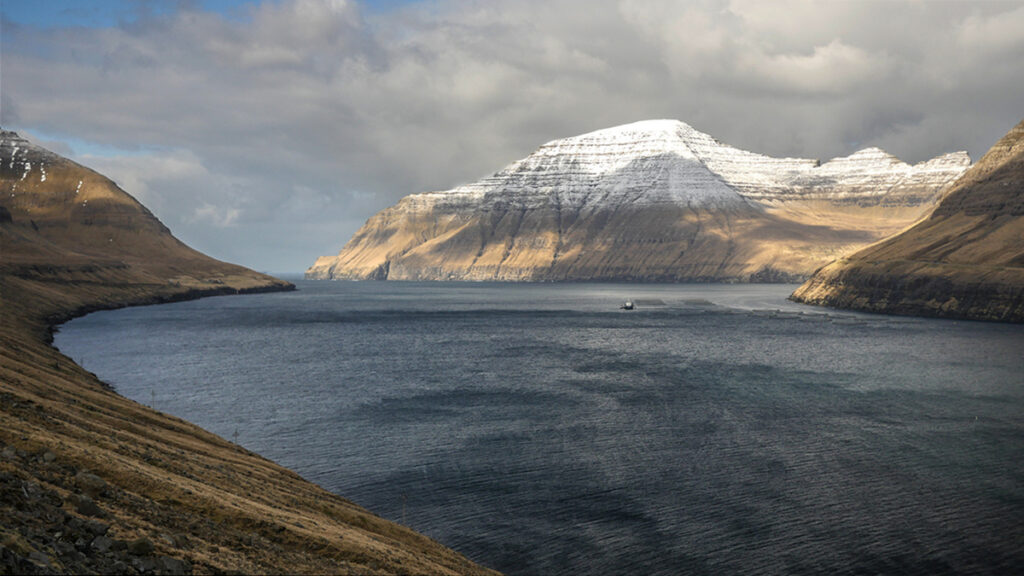
On a rocky archipelago in the North Atlantic Ocean, staff at the Faroese Environment Agency and the Faroe Marine Research Institute regularly sample tissues from the North At
On a rocky archipelago in the North Atlantic Ocean, staff at the Faroese Environment Agency and the Faroe Marine Research Institute regularly sample tissues from the North Atlantic long-finned pilot whales that roam the waters around the islands. The archive of these samples stretches back to the 1980s and has helped researchers determine the reach of human-made contaminants in the remote marine environment.
Jennifer Sun is one of those researchers. Sun studies PFAS—per- and polyfluoroalkyl substances, commonly known as “forever chemicals”—at Harvard University and is the lead author of a recently published study that analyzed how these toxic chemicals have accumulated in pilot whale tissue over the past 2 decades.
Using samples of whale tissue collected between 2001 and 2023, Sun and her colleagues measured a parameter called bulk extractable organofluorine, which shows the overall amount of organofluorine-containing chemicals (including PFAS) in the tissue. They then used a more targeted analysis able to confirm the identity of 28 specific chemicals out of thousands of possible PFAS formulations.
The pilot whale tissue showed an expected decrease in the concentrations of older PFAS but an unexpected scarcity of newer PFAS chemicals. Credit: Jennifer Sun
The study’s results showed an expected decrease in the concentrations of older PFAS but an unexpected absence of newer PFAS chemicals. This anomaly could be indicative of an emerging question in PFAS research: Where are the newest PFAS going?
Prolific PFAS
There are two general categories of PFAS. The first includes legacy PFAS such as perfluorooctanoic acid (PFOA) and perfluorooctane sulfonic acid (PFOS). Chemical manufacturers produced these compounds in the 1970s, 1980s, and 1990s for products including nonstick cookware and food packaging and in industries such as fabric waterproofing, industrial manufacturing, and firefighting.
Legacy PFAS were phased out in the early 2000s, and novel PFAS were made to replace them. The term “novel” is independent of chemical properties and instead refers to when the chemicals’ production began, though novel PFAS typically have formulations meant to reduce their persistence in the environment. For example, many novel PFAS molecules have shorter chains of fluorinated carbons than their legacy counterparts.
Novel PFAS include possibly millions of different chemical structures, and their production and use are increasing globally.
A generic PFAS molecule includes a compound head connected to a tail of fluorinated carbons. Older PFAS generally have longer tails (seven or eight carbons) than newer ones. Credit: Mary Heinrichs/AGU, after https://bit.ly/pennstate-ext-pfas
In the United States and elsewhere, regulatory structures that limit PFAS production target specific chemicals, such that every new formulation by a company must be tested individually before restrictions are put in place. With companies continually conjuring new PFAS formulations—which environmental advocates often call “regrettable substitutions” for their sometimes harmful effects—understanding the fate and transport of novel PFAS is difficult and time-consuming. Research on the behavior of specific PFAS may be a drop in the bucket when millions of potential PFAS, with millions of potential behaviors, pose current and future risks to people and the environment.
Scientists like Sun are determined to untangle how the fate of these new chemicals differs from their predecessors. As Sun expected, the phaseout of legacy PFAS was reflected in the pilot whale tissue she tested. These results are good news; they clearly show that the bans on legacy PFAS are working.
“We’re still finding [older] compounds, but clearly, they are no longer as abundant in the environment as they used to be, which is a positive,” said Bridger Ruyle, an environmental engineer at New York University who studies PFAS and assisted Sun and her coauthors in deciding which methods to use for the new study.
But Sun and her colleagues also expected an overall increase in concentrations of novel PFAS—after all, production of these chemicals is higher than ever, and researchers finally had the analytical tools to catch them.
“The inference is, if it’s not in the whales, and it’s not in the ocean…where is it?”
That wasn’t what they found. Instead, all but two of the emerging PFAS they tested for were virtually nowhere to be seen in the whale tissue, leaving the scientists leading the study to wonder where novel PFAS were accumulating or if instrumentation was limiting their detection.
“We do know that the novel PFAS are being produced, which means they’re going somewhere. Where they are, and how exposed people and other wildlife are, is not as clear,” Sun said.
“The inference is, if it’s not in the whales, and it’s not in the ocean…where is it?” asked Elsie Sunderland, an environmental scientist at Harvard University and coauthor of the new study.
Sun and Sunderland’s question—asking where novel PFAS are going—is one scientists are probing from multiple angles. Those who study particle transport are asking how novel PFAS might travel through Earth’s water and air. Those on the chemistry side of the investigation are deducing how novel PFAS might break down. And those who monitor environments are looking for traces of novel PFAS in various corners of Earth.
The answers to their questions have direct, practical implications for human and environmental health and could indicate whether a growing proportion of harmful PFAS may be ending up in close proximity to humans—where we work and eat and breathe.
A Toxic Legacy
The chemical properties of PFAS have made the chemicals useful since the 1940s. These same properties also make them highly persistent—the most durable types may not break down in the environment for several thousand years.
PFAS are linked to certain cancers and other human health harms. Much of the available data linking PFAS to poor health come from analyses of legacy PFOA and PFOS. They show an association between increased exposure to these chemicals and altered immune and thyroid function, liver and kidney disease, reproductive system disruptions, and more.
Chemical manufacturers phased out production of legacy PFAS after scientific evidence emerged associating PFAS and human health harms, businesses began to lose money in massive lawsuits, and regulations tightened. Novel PFAS were intended to show properties similar to legacy PFAS but were meant to break down more easily in the environment (lower persistence) and accumulate less easily in living tissue (lower bioaccumulative ability), though studies have shown mixed results about whether novel PFAS are actually safer for humans or break down more easily.
Because PFAS production data are often proprietary, scientists who study PFAS, like Sun, must rely on partial inventories of PFAS production or reverse-engineer those numbers from observations in the environment.
“We call it chemical Whac-A-Mole.”
Without a clear list of the chemical structures of novel PFAS, scientists don’t always have the analytical standards necessary for routine detection. And once scientists do understand the behavior of a PFAS chemical, it may be quickly replaced by another, unknown alternative. “We call it chemical Whac-A-Mole,” Sunderland said.
Legacy PFAS tend to have a high affinity for water and typically end up in the ocean, the place scientists refer to as the chemicals’ “terminal sink.” Many legacy PFAS also entered the ocean through atmospheric transport such as rain or snow. But because of the sheer number of chemical formulas and the chemical differences between legacy and novel PFAS, the pathways that novel PFAS take through the environment are less clear.
Tracking the movement and accumulation of novel PFAS in the environment is crucial for understanding how these chemicals may affect ecological and human health.
Still, the science is inconclusive about whether novel PFAS are moving or accumulating differently than their legacy counterparts, whether they have a different terminal sink, and where that terminal sink may be.
Close to Home
One possible answer to the question of the missing novel PFAS may have to do with geography. The chemicals may not have reached pilot whales in the Faroes because something about the new chemistry has led them elsewhere in the environment. To Sun, evidence suggests “that a lot of these novel PFAS, which we know are being produced, may not be transporting out into this more remote environment either at all or as quickly.”
Novel PFAS might be accumulating closer to their sources—and closer to us. “It may simply be that some of the replacement PFAS don’t make it all the way out into the open ocean. But if they are still in the terrestrial environment and the near-coastal environment, then wildlife and people who live close to the sources can be exposed, said Frank Wania, an environmental chemist at the University of Toronto Scarborough.
For example, one study monitored PFAS in coastal beluga whales in Canada’s St. Lawrence Estuary, relatively close to human communities and PFAS manufacturing sources. The study showed increasing concentrations of unregulated novel PFAS in whale tissue from 2000 to 2017, while concentrations of legacy PFAS declined.
The suggestion that novel PFAS are accumulating close to human communities is supported by measurements of PFAS in human tissue, too. Studies show that a high proportion of detectable organofluorine chemicals in human tissue are increasingly unidentifiable, suggesting that some of the novel PFAS production “is in us,” Sunderland said.
Far and Away
Though there are some indications that novel PFAS may be retained closer to human communities, there are also reasons to think some novel PFAS chemistries have resulted in substances that can actually travel farther and more easily than their legacy counterparts.
Anna Kärrman, an environmental chemist at Örebro University in Sweden, said that some novel PFAS may be more easily transported in the environment: “The more novel chemistries are increasing the properties of being very mobile in water, very mobile in the atmosphere, and not necessarily very bioaccumulative.”
The mobility of novel PFAS was on full display in a 2020 study that Sunderland coauthored, in which researchers reported detecting hexafluoropropylene oxide-dimer acid, a novel PFAS chemical more commonly known as GenX, in the Arctic for the first time. GenX, produced by chemical manufacturer Chemours, was meant to replace the legacy compound PFOA. The 2020 study suggested GenX “has already moved quite a bit,” said Rainer Lohmann, a marine geochemist who leads the STEEP (Sources, Transport, Exposure and Effects of PFAS) Center at the University of Rhode Island.
A pulley system mounted on a red beam pulls a small envelope filled with water along a string. Credit: Thomas Soltwedel
The 2020 study also found higher concentrations of PFAS in the Arctic Ocean’s surface water, suggesting that the atmosphere was a particularly important transport pathway for chemical transport. This idea is supported by studies of High Arctic ice caps, which experience contamination only from atmospheric sources, and polar bear tissue. Atmospheric transport of novel PFAS is a subject “at the edge” of PFAS research, Sunderland said.
Wherever researchers look, they’re finding that atmospheric transport is an important pathway by which some PFAS, especially PFAS precursors—chemicals that break down in the environment and become PFAS (either novel or legacy)—move. One idea called the PAART (precursor atmospheric and reaction transport) theory was developed by Scott Mabury, an environmental chemist at the University of Toronto, and others. The PAART theory proposes that many of the harmful PFAS that end up in the most remote parts of Earth are the result of the breakdown of volatile precursor PFAS that have traveled in the atmosphere.
According to Lohmann, atmospheric transport means the ocean remains a terminal sink because many novel PFAS transported in rain or snow will ultimately be deposited in the ocean.
In this scenario, the question of why novel PFAS are not bioaccumulating in Faroese pilot whales remains a mystery. While Lohmann suggests the novel compounds simply don’t accumulate in living tissue, Sunderland isn’t sure that’s the whole story: “As apex predators, the whales are sentinels for what is available and being taken up from the ocean,” she wrote in an email. “Since we don’t see [novel PFAS], it seems unlikely there are large quantities of these chemicals present.”
Profuse PFAS
Another possible explanation for the surprising results of Sun’s whale study could be that there’s just a lag; that is, novel PFAS will end up in Faroe Island pilot whales someday but haven’t yet. Chemicals that could eventually end up in the ocean may be temporarily trapped in soils or recycled back into terrestrial ecosystems via sea spray aerosols, for example.
“The delay we are seeing in the ocean response may in fact be [PFAS] precursors being retained in source zones,” Sunderland wrote in an email. These chemicals may be “taking a really long time to be transformed into more mobile compounds.”
In their pilot whale study, Sun and her colleagues modeled the transport of PFAS to the subarctic and found a 10- to 20-year lag existed between the production of a legacy PFAS compound and its detection in whale tissue. We’re still within that range for many novel PFAS. Sun said she would have expected them to show up in pilot whale tissue by now if they behaved like their legacy counterparts, though it’s possible that it has taken time for the volume of novel PFAS production to ramp up, increasing the time it would take for the substances to be detected in tissues.
The anomaly documented in the pilot whale study has led researchers to call for more investigation (and perhaps greater regulation) of novel PFAS. Credit: Bjarni Mikkelson
Still, the number of possible novel PFAS chemistries—again, there could be several million different compounds—makes it difficult to generalize how these new substances are, as a group, moving through the environment. “Because the exact structures of all [novel] PFAS remain unknown, some compounds may simply not be captured by the methods used,” Heidi Pickard, an environmental engineer at the consulting firm Ramboll and coauthor on the new whale study, wrote in an email.
Another reason novel PFAS are harder to study is that companies release lower concentrations of more kinds of the chemicals, rather than the “monstrously high” emissions of some legacy PFAS in the 1970s–1990s, noted Mabury, who was not involved in the new pilot whale study.
A New Regulatory Approach
According to Sun and Sunderland, cataloging differences between novel and legacy PFAS misses the broader point: We simply need to produce less PFAS. We’ve known for decades that PFAS harm human health, and some scientists have even argued that humans’ continual production and release of novel chemical compounds could drive Earth beyond a “safe operating space.”
“Researchers are critical for exposing the problem. But that, to me, is not the central issue here. The central issue here is a societal issue.”
Where scientists probe next may be less urgent than how policymakers decide to tackle the PFAS problem, Sunderland said: “Researchers are critical for exposing the problem. But that, to me, is not the central issue here. The central issue here is a societal issue.”
Chemical manufacturers are actively creating novel PFAS all the time. Kärrman, for example, has noticed patent applications for PFAS compounds with chemistries that “are nothing like we have seen before” that may start entering our environment in 5 or 10 years.
To Kärrman, that’s a reason for governments to push for chemical regulation based on properties such as persistence and bioaccumulation, rather than the chemical-by-chemical formula used in most countries, including the United States.
Such an approach has gotten traction in Europe via a proposal by the European Chemicals Agency to restrict the entire class of PFAS chemicals. The proposal is still under evaluation, and a final decision is expected by the end of the year.
In the United States, PFAS regulation and remediation are a key aspect of the Trump administration’s Make America Healthy Again movement, according to the EPA, and the federal government and some states already limit the concentrations of individual PFAS in drinking water. However, the EPA also said it planned to weaken some of those limits last year.
“We’re in a cycle of picking these regrettable alternatives [to legacy PFAS] and then figuring out that it was regrettable decades later,” Sunderland said. “We’re never going to catch up using this chemical-by-chemical approach.”
Citation: van Deelen, G. (2026), Chemical companies are churning out new PFAS. Where in the world are they ending up?, Eos, 107, https://doi.org/10.1029/2026EO260136. Published on 30 April 2026.
Research & Developments is a blog for brief updates that provide context for the flurry of news that impacts science and scientists today.
The Intergovernmental Panel on Climate Change (IPCC), the United Nations body whose mission is to “provide governments at all levels with scientific information that they can use to develop climate policies” will likely update the emissions and land use scenarios used in the models it considers in its bellwether assessment reports.
The IPCC has
Research & Developmentsis a blog for brief updates that provide context for the flurry of news that impacts science and scientists today.
The Intergovernmental Panel on Climate Change (IPCC), the United Nations body whose mission is to “provide governments at all levels with scientific information that they can use to develop climate policies” will likely update the emissions and land use scenarios used in the models it considers in its bellwether assessment reports.
The IPCC has used these scenarios, known as Shared Socioeconomic Pathways (SSPs) or Representative Concentration Pathways (RCPs), in its two most recent assessment reports (AR), AR5 released in 2014 and AR6 released in 2023. The upcoming AR7 will be informed by a new set of scenarios, as described in a paper published last month in Geoscientific Model Development.
The paper is drawing widespread attention—both within the scientific community and in wider discourse—for its statement regarding one current scenario that has become familiar to anyone following climate science and policy. The scientists said the emissions levels associated with the most extreme, worst-case scenario, SSP5-8.5 (and its predecessor, RCP8.5), “have become implausible.”
Even President Donald Trump weighed in with a post on Truth Social on 17 May, where he wrote “GOOD RIDDANCE,” and “the United Nations TOP Climate Committee just admitted that its own projections (RCP8.5) were WRONG! WRONG! WRONG!”
But as scientists have pointed out for years, RCP8.5 was never meant to represent a likely emissions scenario or a forecast of humanity’s future. Some scientists questioned whether it’s even possible for RCP8.5 to play out in real life.
RCP8.5 is one of four hypothetical emissions scenarios developed in 2011 for climate modeling experiments. When RCP8.5 was created, it was meant to represent a “very high baseline emission scenario” that would warm the world nearly 5°C (9°F) compared with preindustrial temperatures by 2100. Parallel scenarios (SSPs) were presented in 2017. SSP5-8.5 is the worst-case scenario in that framework, representing a world in which fossil fuels are widely exploited and more of the world adopts energy-intensive lifestyles alongside the warming projected by RCP8.5.
“The scenarios we create today are different than the scenarios we created 15 years ago, because the world is different today than 15 years ago.”
The authors of the new paper wrote that “trends in the costs of renewables, the emergence of climate policy and recent emissions trends” justify the implausibility of the highest-emissions scenarios such as RCP8.5 and SSP5-8.5.
For scientists, the idea of dropping these scenarios is neither new nor controversial. As three climate scientists (Zeke Hausfather of Berkeley Earth, Glen Peters of the CICERO Center for International Climate Research, and Piers Forster at the University of Leeds) wrote in a blog post: “[RCP8.5] was never a likely outcome even in a world that did not address climate change; rather it was always intended to represent a worst case scenario that pushed fossil fuel expansion to the max.”
The new scenarios presented in Geoscientific Model Development include a high-emissions scenario in which clean energy policy is rolled back, and the world warms about 3.5°C (6.3°F) by 2100—still a level at which humanity can expect very severe impacts, from worsening weather extremes to rapidly rising sea levels.
The IPCC’s likely elimination of RCP8.5, even if it was never a plausible scenario, is a small sign of improvement in global climate change mitigation efforts, Hausfather, Peters, and Forster wrote: “Rapid declines in clean energy costs have bent the curve of future emissions downward, with new scenarios designed to reflect current policies notably lower than most baseline scenarios in the literature.”
“Of course, we still have a long way to go to get emissions down to (net) zero and stabilize global temperatures,” they noted.
The new paper captures the difficult road ahead for climate action: The new scenarios are based on a reduced projection for the increase in emissions, not for the overall amount of emissions—those are still increasing. Unlike before, none of the new emissions scenarios keep the world below 1.5°C (2.7°F) of warming, the limit originally set by the Paris Agreement in 2016. That’s no surprise to scientists, who suggest Earth is already in the 20-year period in which warming will formally surpass this benchmark.
“The scenarios we create today are different than the scenarios we created 15 years ago, because the world is different today than 15 years ago,” Hausfather told the Washington Post.
These updates are made possible through information from the scientific community. Do you have a story about science or scientists? Send us a tip at eos@agu.org.
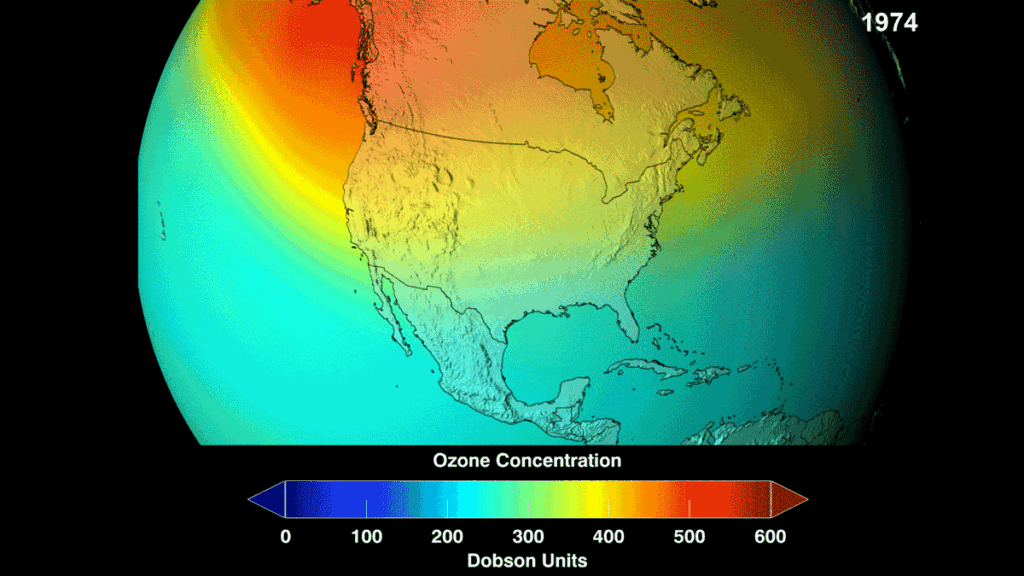
A hole in the Montreal Protocol could delay the recovery of Earth’s ozone layer by about 7 years. New research found that the use of ozone-depleting substances used as feedstocks—chemicals used in the making of other chemicals—has not waned over time. In fact, their use has increased since the treaty’s adoption in 1987.
“The Montreal Protocol is such a success story that these ozone-harming sources are becoming relevant. A few decades ago, they were drowned out.”
“The Montreal Protocol is
A hole in the Montreal Protocol could delay the recovery of Earth’s ozone layer by about 7 years. New research found that the use of ozone-depleting substances used as feedstocks—chemicals used in the making of other chemicals—has not waned over time. In fact, their use has increased since the treaty’s adoption in 1987.
“The Montreal Protocol is such a success story that these ozone-harming sources are becoming relevant. A few decades ago, they were drowned out.”
“The Montreal Protocol is such a success story that these ozone-harming sources are becoming relevant. A few decades ago, they were drowned out,” said Luke Western, who researches greenhouse gases and ozone-depleting substances at the Massachusetts Institute of Technology. Western is a coauthor of a new study on the findings published in Nature Communications.
Almost 40 years ago, the Montreal Protocol banned the production and consumption of almost 100 long-lived gases that harm Earth’s ozone layer, such as chlorofluorocarbons (CFCs) and hydrochlorofluorocarbons (HCFCs), then largely used as coolants in refrigerators and air conditioners. These uses were the primary problem that needed to be solved and were the Montreal Protocol’s main target, Western explained.
However, ozone-depleting substances used in the production of other chemicals—including CFCs themselves—had so little impact at the time that they were not included in the ban. Only about 0.5% of feedstock chemicals, such as carbon tetrachloride (used in the making of some CFCs and a by-product of the manufacture of plastics like polyvinyl chloride, or PVC), were emitted into the atmosphere. With the production and use of the most prevalent ozone-harming gases banned, scientists thought the use of feedstocks such as carbon tetrachloride would die out over time.
However, not only did the die-out not happen, but the use of ozone-depleting substances as feedstock actually increased by 163% between 2000 and 2024. Western and his team found that associated emissions increased as well: Now, about 3.6% of these ozone-depleting feedstock chemicals are leaking into the atmosphere. The increase comes partly from their use in producing the non-ozone-depleting gases that replaced HCFCs and CFCs after the Montreal Protocol went into force.
“It’s almost the same as charging your electric car with fossil fuel–based energy.”
“This is quite ironic,” Western said. “It’s almost the same as charging your electric car with fossil fuel–based energy.”
If maintained at current levels, these emissions could delay full recovery of Earth’s ozone layer by anywhere from 6 to 11 years. Currently, recovery to 1980 levels is expected by 2040 for most of the world, by 2045 over the Arctic, and by 2066 over Antarctica, according to the World Meteorological Organization.
Filling a Gap
To estimate feedstock emissions, the researchers used datasets from the Advanced Global Atmospheric Gases Experiment (AGAGE) and NOAA containing information on about 50 chemicals from 1978 to 2023. The team used these data to model feedstock production and consumption between 2025 and 2034 and then between 2035 and 2100 for business-as-usual and low-emission scenarios.
When measured from now until the end of this century, feedstock emissions in the models tended to stabilize, but the real problem could be in the short and medium terms, the study suggested. Under a business-as-usual scenario, the production of some chemicals, such as methyl chloroform (used in solvents and found in household cleaners), is projected to decrease by 6% per year until 2050. But others, such as halon 1301 (used in the making of insecticides and pharmaceuticals), are set to increase (in halon 1301’s case, by 4% a year until 2050). With the estimates at hand, the team modeled feedstock emissions and their potential effect on the ozone layer.
“This is a very important study because it addresses several questions that remained open not just in the Montreal Protocol, but in research on the ozone layer recovery in general,” said Marco Aurélio Franco, an atmospheric sciences researcher at the University of São Paulo in Brazil.
Franco, who did not take part in the study, said research like this is fundamental to improving estimates for atmospheric chemistry and physics models. After all, some feedstock chemicals, including carbon tetrachloride—whose production is set to increase by 4% a year through 2034—are also greenhouse gases.
Carbon tetrachloride, Franco pointed out, acts differently depending on where it is in the atmosphere. In the troposphere, Earth’s lowest atmospheric layer, the substance traps heat by reflecting infrared radiation back to Earth. At this level, carbon tetrachloride is still stable. But any amount of the substance that reaches the atmosphere’s next layer, the stratosphere, wreaks havoc on the ozone layer. “Ultraviolet radiation is able to break carbon tetrachloride, liberating chlorine,” Franco said. “Chlorine then breaks ozone molecules in a chain reaction. It’s the same mechanism as CFCs.”
The world, said Franco, needs to walk the last mile in refraining from producing and using ozone-depleting substances as feedstock, as we still need to understand their long-term effects. “These [feedstock emission] estimates could be appended to the Montreal Protocol, which proved to be a great success. We need to incorporate them into emission reports and atmospheric models. These emissions should not be neglected,” he said.
Citation: Rodrigues, M. (2026), Repairing the ozone layer may take longer than expected, Eos, 107, https://doi.org/10.1029/2026EO260175. Published on 29 May 2026.
Research & Developments is a blog for brief updates that provide context for the flurry of news regarding law and policy changes that impact science and scientists today.
The Trump Administration has terminated the positions of every member of an independent board meant to govern the National Science Foundation (NSF).
The National Science Board directs and approves large funding decisions for NSF’s approximately $9 billion basic science research budget. It is meant to function ind
Research & Developments is a blog for brief updates that provide context for the flurry of news regarding law and policy changes that impact science and scientists today.
The Trump Administration has terminated the positions of every member of an independent board meant to govern the National Science Foundation (NSF).
The National Science Board directs and approves large funding decisions for NSF’s approximately $9 billion basic science research budget. It is meant to function independently from the federal administration to keep science funding insulated from political pressure and budget cycles.
“I have watched the systematic dismantling of the scientific advisory infrastructure of this government with growing alarm, and the National Science Board is simply the latest casualty.”
In a 24 April notice from the Presidential Personnel Office, all the scientists serving on the board were informed their positions had been eliminated. The emails dismissing board members provided no reason for the termination.
“I am deeply disappointed, though I cannot say I am entirely surprised,” Willie E. May, one of the terminated board members and vice president of research and economic development at Morgan State University in Maryland, told The New York Times.
“I have watched the systematic dismantling of the scientific advisory infrastructure of this government with growing alarm, and the National Science Board is simply the latest casualty,” he said.
Ranking member of the House Committee on Science, Space, and Technology Zoe Lofgren (D-CA) called the terminations “the latest stupid move made by a president who continues to harm science and American innovation.”
“Without a functional National Science Board in the near term, the agency is left without the guidance and oversight of independent experts, and the public is left without information on how NSF is carrying out its mission,” Gretchen Goldman, president and CEO of the Union of Concerned Scientists, wrote in a blog post about the terminations.
These updates are made possible through information from the scientific community. Do you have a story about how changes in law or policy are affecting scientists or research? Send us a tip at eos@agu.org.
Research & Developments is a blog for brief updates that provide context for the flurry of news that impacts science and scientists today.
Sand is the most exploited solid natural resource on Earth. It has been integrated into how we build homes, roads, buildings, and bridges as well as how we protect coastal infrastructure from rising seas. Sand underpins nearly every aspect of modern infrastructure and economics, plays crucial roles in supporting ecosystem biodiversity, and literal
Research & Developments is a blog for brief updates that provide context for the flurry of news that impacts science and scientists today.
Sand is the most exploited solid natural resource on Earth. It has been integrated into how we build homes, roads, buildings, and bridges as well as how we protect coastal infrastructure from rising seas. Sand underpins nearly every aspect of modern infrastructure and economics, plays crucial roles in supporting ecosystem biodiversity, and literally shores up rivers and coasts.
A new report from the United Nations Environment Programme (UNEP) found that we are using 50 billion metric tons (50 trillion kilograms) of sand per year. As global development and industrialization expand, demand for sand in the building sector is expected to rise 45% by the year 2060, outpacing current efforts to sustainably harvest it. The report’s authors urge countries to establish sand as a strategic national asset and develop policies for sustainable extraction.
“Sand is sometimes referred as the unrecognized hero of development, but its essential role in sustaining the natural services on which we depend is even more overlooked,” Pascal Peduzzi, director of the UNEP Global Resource Information Database Geneva, said in a press release about the report. “Sand is our first line of defence against sea level rise, storm surges, and salination of coastal aquifers—all hazards exacerbated by climate change.”
Sand Wanted: Dead or Alive
Dead sand, or sand that has been extracted from its natural environment, is a key component in building materials like concrete and asphalt. Communities around the world use sand in water filtration systems, providing clean water for drinking and agricultural use. And although a transition to clean energy sources is necessary to curb the effects of climate change, many of those sources also depend on sand: solar panels require glass made from high-purity silica sand, and wind turbines, hydroelectric dams, and nuclear power plants all require concrete.
Mangroves, one of the most important coastal trees, can grow in sand. Credit: Diego Parra
Sand also plays a critical role in natural ecosystems. It is home to a wide array of critters from crabs, sharks, and turtles to microorganisms like bacteria and fungi. It supports the growth of corals, mangroves, and seagrasses that in turn support even more marine creatures. It is a key component of healthy soil and aids in surface drainage. It guides river evolution and acts as flood buffer and storm barrier. It also provides local economic benefits via tourism.
These are among the values of sand when it is left alone and unused, called “alive” sand. The UN report notes that these benefits are typically of greater value over time than if sand is dredged and used. But because these benefits are hard to see, they are often overlooked when nations calculate the value of their sand resources.
A Sustainable Sand Future
Despite sand’s importance whether dead or alive, the report notes that few countries have established sand as a strategic national asset or have developed strategies for sustainable extraction. At the current pace, humans are extracting sand from the natural environment at a faster pace than it is being replenished by geologic processes.
What’s more, the UNEP’s Marine Sand Watch tool shows that about half of sand dredging companies are operating within marine protected areas, accounting for about 15% of the volume of dredged sand. This practice, the report notes, is potentially trading in sand’s long-term benefits for short-term gains.
The UN report recommends a few actions to protect the long-term availability of sand as a natural resource, including:
Recognizing sand as strategic national asset, establishing national inventories, and creating long-term regional planning groups that consider sand as an essential resource for resilience;
Establishing circularity and recycling of building materials, especially in areas of conflict and natural disasters;
Strengthening environmental protection practices, and codifying international frameworks to strengthen accountability along the supply chain, including increased transparency about extraction; and
Integrating sand-related biodiversity and social risks into financial decisionmaking and governance.
“Over-reliance on short-term economic metrics risks obscuring, and further impacting, the geological and ecological processes that take centuries to form and may not be restored once critical thresholds are crossed,” the report states. “What is hardest to measure may be precisely what sustains both nature and human societies over the long term. The challenge ahead is not only to manage extraction, but to recognise and balance the full spectrum of sand’s values.”
These updates are made possible through information from the scientific community. Do you have a story about science or scientists? Send us a tip at eos@agu.org.
This story was produced by Grist and the Food & Environment Reporting Network, a nonprofit news organization. Sign up for Grist’s weekly newsletter here.
Will Runion’s 736-acre cattle and hay farm is tucked into a horseshoe bend of the Nolichucky River in northeast Tennessee. On the morning of Friday, September 27, 2024, he was in the middle of two big projects: building a riverfront campground on his land to bring in tourists and income, and cutting the last of the season’s hay. Hurrica
Will Runion’s 736-acre cattle and hay farm is tucked into a horseshoe bend of the Nolichucky River in northeast Tennessee. On the morning of Friday, September 27, 2024, he was in the middle of two big projects: building a riverfront campground on his land to bring in tourists and income, and cutting the last of the season’s hay. Hurricane Helene had been arcing up from Florida toward the Appalachian Mountains, carrying heavy rain, and the river was high. Even though the banks seemed to be holding, he decided to move some of his cows and equipment to higher ground.
But the river kept rising. At about 11 a.m., the brown water topped its banks. He and his fiancée, his son-in-law’s parents, and neighbors scrambled to salvage what farm equipment they could, but they were nearly trapped when the quickly expanding river flowed into a low-lying area behind where they were working, cutting them off from dry land.
By afternoon, the river had swollen to some 1,200 feet wide—nearly 10 times its usual size. It “looked just like a lake,” Runion said. Trees snapped in the swift current and neighbors’ barns, roofs, hay bales, and household debris swirled by. The water swallowed Runion’s hay equipment and sent the little white house he’d planned to use as the new campground’s office sailing across a field.
At around 8 p.m., the Nolichucky finally crested and started to recede. Runion found a third of his fields covered in debris, dead fish, and tomatoes from upstream vegetable growers. The flood had gouged two holes the size of football fields in his hay pastures, down to a depth of 12 feet. Other sections of the farm were buried in up to 8 feet of sand or silt.
Flooding from Hurricane Helene brought massive damage to Will Runion’s farm, eroding the land in some places and washing up feet of sand on agricultural fields in other sections. Courtesy of Bryan LeBarre, via Grist
Helene dropped up to 30 inches of rain on southern Appalachia, causing historic flooding and landslides in parts of North Carolina, South Carolina, Tennessee, Georgia, Kentucky, and Virginia—a largely rural region where agriculture is a vital economic driver and cultural cornerstone. The mountains make it hard to spread out here, so farms tend to be small, and many growers use flood-prone bottomland because it is flat and fertile. But floods of this magnitude hadn’t hit here in generations. In North Carolina alone, Helene caused an estimated $4.9 billion in damage to the state’s agriculture sector. In Tennessee, agricultural losses were estimated at $1.3 billion. Thousands of farmers lost crops, tools, machinery, barns, buildings, animals, and fences.
“When you see 4 feet of sandy soils on top of your topsoil, you know that’s going to be a challenge. That was overwhelming.”
More than a year later, growers are also contending with the loss of something more vital, and more difficult to replace: their soil.
Runion knew immediately that his livelihood was ravaged. Without good soil, a farmer can’t farm. “When you see 4 feet of sandy soils on top of your topsoil, you know that’s going to be a challenge,” he said. “That was overwhelming.”
He sent drone footage of the damage to Forbes Walker, an environmental soil specialist with University of Tennessee Extension. “How do you fix this?” he asked.
“I don’t know,” Walker recalled thinking when he got Runion’s email. “How do we fix this?”
Over millennia, floods helped build the fertile land that farmers depend on. But today, climate change is driving more powerful and unpredictable storms. One study found that rainfall associated with Helene was 10 percent heavier due to man-made climate change. Research by the U.S. National Science Foundation suggests that what scientists call “100-year storms” will become three times more likely, and 20 percent more severe, over the next 50 years. What’s more, there’s little solid information about what happens to soil during a flood, or what to do when a farm’s soil is eroded or covered with material from elsewhere—its nutrients washed away and microbial communities disrupted. It’s a blind spot that is becoming more of a liability as storms like Helene become more common.
“None of us had ever seen anything like this before or responded to an emergency like that,” said Stephanie Kulesza, a nutrient and soil scientist at North Carolina State University. “And so we weren’t really prepared for recommendations to provide to producers.”
Soil can take thousands of years to form. Rock is weathered and slowly dissolves into smaller and smaller pieces. As dead leaves, animals, trees, and other plants decompose, they add organic matter and nutrients to the rock. Microorganisms establish themselves in the mix, driving nutrient cycling, aiding with decomposition, and stimulating plant growth; then worms and bugs, like beetles and ants, burrow in the mixture, aerating it. For soils to work well for agriculture, they need the right structure—airy enough to allow water to enter and move through, but not too quickly or too slowly—and sufficient biological and chemical richness, including nutrients like nitrogen, phosphorous, and potassium, to nourish crops.
Farmers use synthetic or natural fertilizers to ensure their soil has enough nutrients. They can also introduce practices like no-till—farming without plowing up the ground—to maintain the physical properties of their dirt. Topsoil, the rich, uppermost layer with the most available nutrients for crops, tends to make up less than a foot of the entire soil profile, but it’s crucial for agriculture.
Soil scientist Forbes Walker visits Will Runion’s farm in 2025, examining the deep sandy deposits left behind by Hurricane Helene. Credit: Raffe Lazarian/University of Tennessee Institute of Agriculture via Grist
Helene’s floodwaters either washed away significant topsoil or deposited new sediment on top of it on thousands of farms. Some, including one of Runion’s neighbors, saw their fields stripped down to bedrock, or river rock. Runion and others woke to pastures blanketed by feet of sand or stone.
When topsoil is washed away, the necessary nutrients for growing go with it. And when topsoil is covered with sand, farmers can’t get to it. Both scenarios can significantly alter the land’s usability. Topsoil can take decades or centuries to develop, and sand lacks both organic matter and the physical structure to hold water and nutrients. “These aren’t soils yet,” said Kulesza of what Helene left on Runion’s and other farmers’ land. “They are in their infancy now. The clock has been reset.”
Runion had cared for his soils, working to eliminate weeds, adding fertilizer to keep nutrient levels ideal, and lime to control pH. “They were our way of life,” Runion said. “They were our income.”
After the storm, from October to April, he removed debris, bulldozed sand off his fields to get closer to the topsoil, filled holes, and graded uneven land. Crews from the Federal Emergency Management Agency removed and shredded downed trees. He applied for government relief and received close to $1 million in state and federal aid. Runion said he could have easily used all of that money replacing equipment and paying for cleanup labor, fertilizer, and fuel, but he’s trying to stretch the money as much as possible.
By June, it was time to mow the fields that hadn’t flooded. He managed to put up enough bales of hay to feed his herd of 125 cattle, but not enough to sell. In a normal year, hay sales made up about a third of the farm’s income. With months of work behind him and his flooded land still too sandy and generally depleted, he realized the recovery would be a slog.
Runion returned to work on the campground, which he hoped would diversify the family’s earnings. The longer-term plan included a music venue and some hiking trails, and to host weddings and corporate events. After the storm, finishing it took on new urgency. He chose a new spot, about 450 feet upland from the river, and began clearing enough land for 45 camping sites.
One environmental soil specialist described the academic literature on flood-damaged soils as “thin.”
Runion also prepared a parcel of land for Walker, the extension soil specialist, to run tests that could guide his recovery. Last November, soon after the one-year anniversary of Helene, Walker showed me around Runion’s farm.
Working with students, Walker established four experiments over about 300 test plots. He’s looking at how different soil amendments—hay, wood chips, poultry litter, and a charcoal called biochar, to help the soil hold water and fertilizer; and Triple 19, a common plant food with equal parts nitrogen, phosphorous, and potassium—affect the growth of wheat and fescue grasses.
When I visited, some of the plots remained mostly bare while, in others, tufts of green had sprouted. “We actually got some stuff to grow,” Walker said.
He described the academic literature on flood-damaged soils as “thin.” While some research and case studies exist on how agricultural soil recovers after a flood, there are few systematic investigations like the one Walker is conducting—on what works, and what does not—particularly in Appalachia, where floods of this magnitude have been historically rare.
When so-called atmospheric rivers spawned devastating floods in the Pacific Northwest and southwestern British Columbia in 2021, Aimé Messiga, a Canadian soil research scientist at the Agassiz Research and Development Centre, found a similar “scarcity of data.” He conducted a detailed review of the existing research and concluded that there was limited long-term monitoring, little understanding of how floods affect nutrients and microorganism communities in the soil, and uncertainties about what the actual impacts of floods on agriculture and crops are. Complicating everything is the variability between different farms, soils, and crops.
“You need decades of accumulated data in order to be able to predict what will happen. We don’t have those data.”
“You need decades of accumulated data in order to be able to predict what will happen,” Messiga said. “We don’t have those data.”
Today, some researchers are attempting to replicate flood conditions in labs to better understand, but field work is rare, Messiga said. There’s little money for it—and in the U.S., the Trump administration has cut funding for climate-related research. In addition, “many among us still look at these events as random,” Messiga said. “They’re not random. They will keep occurring.”
Since 1980, 45 flooding events have caused damages over $1 billion each in the U.S., with more than half of those occurring in the past 15 years. In 2024, flooding in the upper Midwest drowned crops. Repeat events in central California damaged agricultural operations from winter 2022 to spring 2023. Flooding along the Mississippi River in 2019 reduced crop planting by millions of acres. There also have been numerous smaller or more localized floods. One study found nearly 75,000 flash floods in the contiguous U.S. from 1996 to 2017, with increasing frequency in the past 22 years. Flooding frequency and strength is predicted to rise in the years to come due to climate change—a warmer atmosphere holds more moisture and leads to stronger rain events—and poor land-use management.
Scientists are also starting to study a new type of event, called “weather whiplash,” when sudden changes occur from one extreme to another, amplifying the effects of the disaster. In Texas in 2025, a flood came after prolonged drought, causing widespread destruction.
For farmers, the effects of flooding on soil may linger for years after the disaster. In 2011, the Missouri River flooded states in the Upper Midwest, including thousands of acres of farmland. Fields were swamped for months with up to 20 feet of water. When the water finally receded, those fields were covered with anywhere from 2 to 20 feet of sand; other fields had washed out holes up to 70 feet deep. It looked like the surface of the moon, said John Wilson, a now-retired educator and agricultural expert who served Burt County, Nebraska, which was particularly hard-hit. “It was just bare soil,” he said. “There was no crop residue whatsoever.”
Wilson led teams that sampled the soil and helped farmers build back. He found that levels of nitrogen and organic matter were low in flooded soils, and fertility suffered when farmers planted their crops. Over about five years, fertility generally improved, but not everywhere. “If you went out today and did a yield map, you could still tell exactly where the erosion was because those areas are not as productive,” Wilson said.
Yield is money for farmers, who already navigate thin margins and, often, years without any profit at all. North Carolina’s strategic plan for agriculture recently enumerated just how thin: Of the state’s “42,500 farms, only 8,000 produce annual gross sales that exceed $100,000 annually. The overwhelming majority … some 23,400, gross less than $10,000 in sales, with only around 40 percent of the farms in the state having a positive net income in 2022.”
As floods increasingly wreck farmland, more researchers are starting to focus on understanding the effects of the floods and how to address them. Most of that work is happening in Asia, Messiga said. But a study in coastal North Carolina, where hurricanes regularly land, found that after a storm there was less organic matter in the soil, including carbon, and a disruption of microbial activity and nutrient cycling. The ground also absorbed water less readily.
Coastal flooding is also driving saltwater into the soil of farmland, making it more saline and unable to sustain crops. A North Carolina State University team has been developing test kits for farmers to sample the salinity of their soils, as well as a set of recommendations for keeping their soil viable. Such local work is important because soils vary greatly from place to place, and findings are not often easily transferable.
Nicole DelCogliano’s farm near Asheville, North Carolina, was wiped out almost entirely by floods from Hurricane Helene in 2024. Courtesy of Nicole DelCogliano via Grist
For now, in the wake of Helene, farmers are relying largely on trial and error to build back what was lost. Nicole DelCogliano has been farming vegetables, flowers, and livestock with her husband on 50 acres on the South Toe River, near Asheville, North Carolina, for 25 years. Helene washed away her barn, tractor, and other infrastructure. Of her 6 acres of vegetable fields, one was covered with several feet of sand, another got a foot, and a third field suffered extensive erosion.
“Our entire operation was wiped out, essentially,” she said.
“It’s not something that can be fixed overnight. This is a long process.”
With the help of some friends with tractors, DelCogliano cleared her main field and spread compost and lime on everything. “There was a mix of guidance about what you should do, like should you disturb the soil, should you not?” she said. “At an instinctual level, we just felt like we got to get the soil covered, we got to get something in the ground.” They sowed rye, a dependable cool season grass, as a cover crop, to protect the soil from erosion and add nutrients.
Karen Blaedow, an agricultural educator in Henderson County, North Carolina, said farmers should expect to put in at least three years of cover cropping before they see results in their soil. “It’s not something that can be fixed overnight,” she said. “This is a long process.”
In the spring following the flood, DelCogliano spread various amendments on her least-damaged field, including compost, lime, biochar, and blood and bone meal, which provide nitrogen and phosphorus, respectively. After all that, she and her husband seeded crops.
Their new vegetables came in about two weeks later than normal, but the season was more productive than ever, even though they grew on just 4 instead of 6 acres—“which is pretty amazing,” she said. “When we first started harvesting crops [after Helene], we didn’t yet have power at the farm. I had to dig one of our sinks out of a bank and bleach it and clean it and drag it up to the new barn—that we barely got a roof on—to wash and pack for that first [farmers] market.”
She doesn’t really know what made the year so productive. They planted more intensively to account for the smaller acreage and were able to harness their years of expertise to restart their operation basically from scratch. She also attributes the relative health of her soil to years of organic practices. “We’re dirt farmers,” she said. “Our primary job is to tend the dirt. Because that’s the basis of everything.”
Some farmers who’ve seen good harvests may have gotten a little lucky. Rather than sand, floods dumped silt. Even Runion got silt deposits in one section of his farm. Unlike the sand, the silty layers carry nutrients and create a positive growing environment. “We have a producer we work with and he said it’s the most fertile soil that he’s had in decades,” said Emine Fidan, a biosystems engineering and soil science researcher at the University of Tennessee, who’s also working on Runion’s farm. “And he said it grew the sweetest corn he’s ever had. It was growing just beautifully.”
Runion didn’t plant anything until this past fall. He prepared about 65 acres of the 220 that were underwater. It was slow going; he used a disking machine to till his land but had to stop often to clear sticks and trash and to grade out low spots. He mixed in mulch and planted oats, wheat, and fescue. Walker drove me past one of the fields and it still looked sandy, the grasses just a pale green shadow on the tan land. Runion said the greenery was “struggling to have any vigor about it.” He won’t know for sure how well or poorly the grasses do until spring, their peak growing season.
He considered planting more acreage but decided to wait and see what he learned from Walker’s trials. “It’s a process, and the knowledge we’re gaining there will help on the whole rest of it, too,” Runion said.
This spring, Walker’s team will measure the biomass in each plot as well as the quality of the crop, including how much protein it has and its digestibility. They’ll also be evaluating the soil itself, including its ability to hold water, to determine if any of the treatments improved the structure of the sandy dirt.
One farmer thinks the hay he’ll get in the coming years will be lower-yielding, lower-quality, and will cost more to produce due to the extra prep time, new seeds, and fertilizers.
Preliminary results suggest that, in plots where they put down mulch, the grasses are growing better than in plots with other amendments. The woody debris is reducing erosion and seeds are germinating well and standing up in the rough matrix. Spreading this kind of mulch isn’t an obvious solution, Walker said: Wood chips are a carbon-rich material, but as they break down in the soil they consume nitrogen, which can lead to a deficiency for the crops. But this mulch had sat in piles and started to decompose before it was applied to Runion’s fields, which made it less likely to cause these problems.
Runion had asked FEMA to leave the piles of wood chips on his farm rather than remove them like they normally would. Walker is looking for solutions to the soil problem that not only work but are also accessible. Have a mountain of mulch? Put it to work. Have nearby chicken houses? Maybe their nitrogen-rich manure can help revive flooded fields. His hope is that his team’s research can provide some guidance to farmers who find themselves in similar situations in the future. “I think it will have broad implications for a number of different crops,” including vegetables, Walker said.
Meanwhile, Runion is coming to terms with his situation. He thinks the hay he’ll get in the coming years will be lower-yielding, lower-quality, and will cost more to produce due to the extra prep time, new seeds, and fertilizers. He used to sell a lot of square bales, which tend to contain high-quality grasses and fetch a higher price, but he doesn’t expect to be doing that for a while. He’d initially hoped to have his land back in shape in a year or two. “Now it’s a four- to five-year [plan], I think,” Runion said. “It has been frustrating, and exhausting, too.”
He’s still optimistic, though. On my visit, I watched him grade out the new campground in a large dump truck. Freshly exposed red soil lay open to the sky. He thinks he can get the campground open by late summer or early fall. Over time, he hopes, it will be a more lucrative, and more sustainable, source of income. “The farm is really beautiful,” Runion said. “It still has a lot to offer.”

 Login
Login