Research & Developments is a blog for brief updates that provide context for the flurry of news regarding law and policy changes that impact science and scientists today.
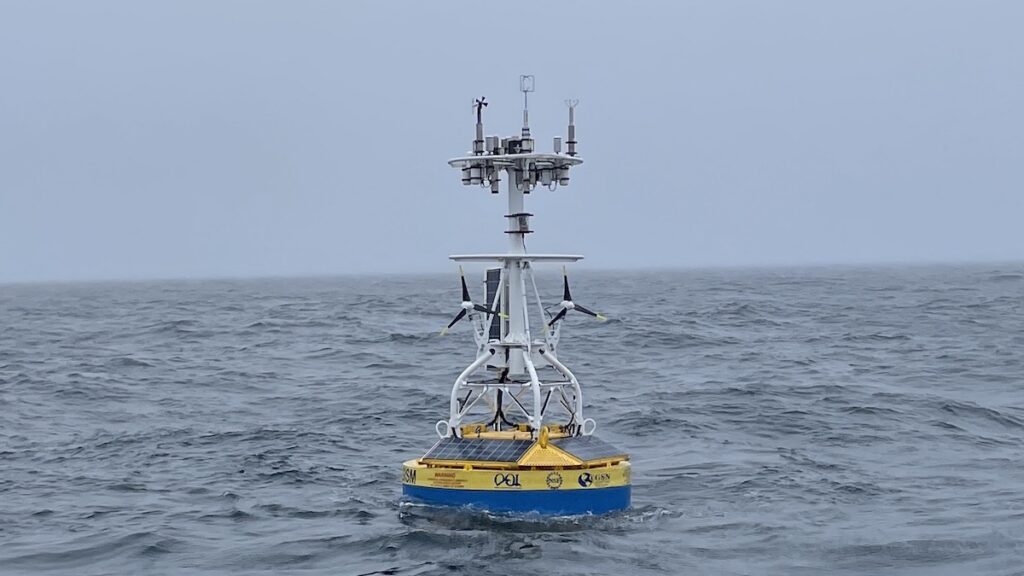
The Trump administration’s National Science Foundation (NSF) has begun dismantling the infrastructure of a $368 million deep-ocean observing program critical to monitoring marine ecosystems, global currents, marine heat waves, and more, according to a 21 May announcement.
The Ocean Observatories Initiative (OOI), funded by the NSF, has been collecting long-term oceanographic data at multiple deep-ocean sites since 2016. The information about ocean temperature, chemistry, currents, biological conditions, and more is used by scientists to understand a multitude of marine research questions including the activity of the Atlantic Meridional Overturning Circulation (AMOC), a critical ocean current.
“I worry that … we’ll be losing this enormously valuable site where we could really contextualize and detect these changes going forward.”
“There’s a real danger that we lose the ability to keep looking for long-term changes [in the ocean]” as climate change alters Earth systems, said Hilary Palevsky, a marine biogeochemist who has used OOI data for a decade to study how the ocean absorbs carbon dioxide. “I worry that … we’ll be losing this enormously valuable site where we could really contextualize and detect these changes going forward.”
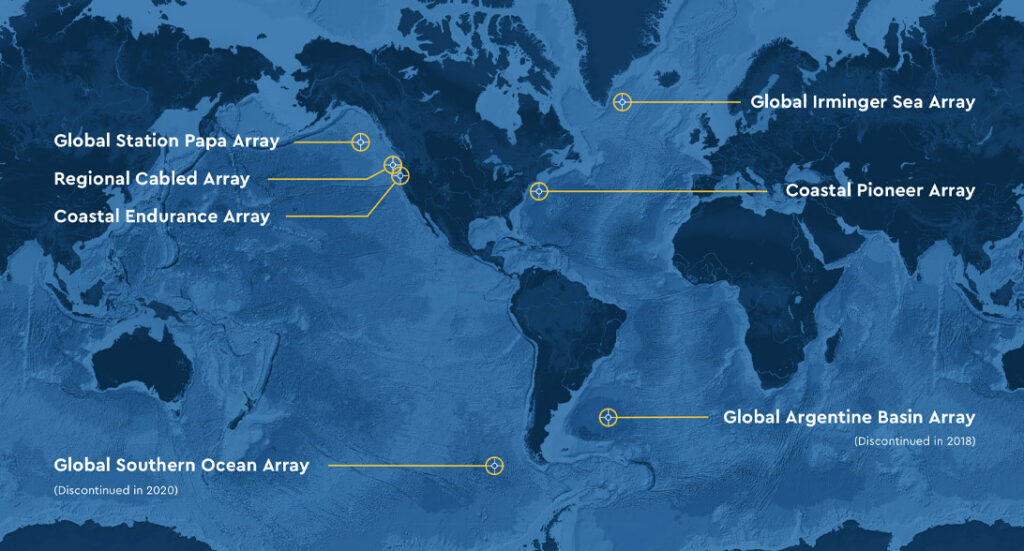
The NSF plans to remove all in-water arrays and infrastructure—including hundreds of deep-sea instruments—from four of the five currently-operating sites within the project: the Global Station Papa Array (in the Gulf of Alaska), Coastal Endurance Array (off the coasts of Oregon and Washington), Global Irminger Sea Array (southeast of Greenland), and Coastal Pioneer Array (off the coast of North Carolina). The removal is expected to occur over the next 15 months, though the process has already begun at the Endurance Array.
The National Science Foundation’s planned descoping of the Ocean Observatories Initiative will include dismantling four of the five currently operating arrays of equipment. Credit: NSF/OOI
The Trump administration attempted previously to downscale OOI operations, proposing to cut its funding in 2025 and 2026, though Congress never approved the cuts.
The administration’s decision to dismantle the arrays “aligns with NSF’s wider strategy to have a nimbler approach to prioritizing support for evolving scientific priorities and emerging technologies as well as a deliberate approach to smart life cycle management within its portfolio of research infrastructure,” Michael England, an NSF spokesman, told the New York Times.
A Dearth of Data
As each array is dismantled, data streams will end, though all previously collected data from OOI networks will remain accessible, Jim Edson, principal investigator for the OOI, wrote in a letter to the oceanographic community.
Palevsky said there’s “a lot of real concern” among the oceanographic community that the Endurance Array is being dismantled just as an intense El Niño event—and associated marine heat wave—is expected this summer. “It would be especially important to be able to document the effect that [El Niño] is having on coastal physical circulation and ecosystems,” she said.
“We encourage the community to use the ten-plus years of OOI data by including it in proposals, publications, presentations, and conversations with colleagues. Continued engagement demonstrates the scientific impact and wide-ranging applications enabled by the OOI and its data, underscoring its importance as a resource for the oceanographic community,” the 21 May announcement stated.
There are other sources of data that researchers like Palevsky can use. But oceanographic research often requires stitching together different data sets, including OOI observations, satellite observations and observations from the U.S. research fleet. Many of these other sources of data are also facing uncertain futures.
Palevsky also worries about the loss of expertise that will occur as the program scales down. Installing these deep-sea observing networks was a huge achievement for U.S. science that will not be easy to replicate, she said. “If, in five years, we as a community decide we want to again be able to deploy this kind of complicated infrastructure in places that have really difficult oceanographic conditions … it’s going to be a lot of reinventing the wheel to figure out how to put things out again.”
“The complete cessation without community input or a community conversation about what’s going to happen to all this equipment and what’s going to happen with all of the expertise,” she said, “feels like a huge loss.”
These updates are made possible through information from the scientific community. Do you have a story about how changes in law or policy are affecting scientists or research? Send us a tip at eos@agu.org.
Research & Developments is a blog for brief updates that provide context for the flurry of news regarding law and policy changes that impact science and scientists today.
Today, NASA announced an agencywide realignment that includes combining related mission directorates to sharpen the agency’s focus on human spaceflight.
“This initiative reflects NASA’s extreme focus on executing the mission in direct support of the National Space Policy,” NASA Administrator Jared Isaacman said in a press release about the realignment.
The National Space Policy refers to Executive Order 14369: Ensuring American Space Superiority, which was released by the Trump administration in December 2025. The order sets national priorities of returning Americans to the Moon, establishing a lunar base, developing a nuclear reactor in space, developing the commercial space economy, and enhancing the United States’ national security space architecture.
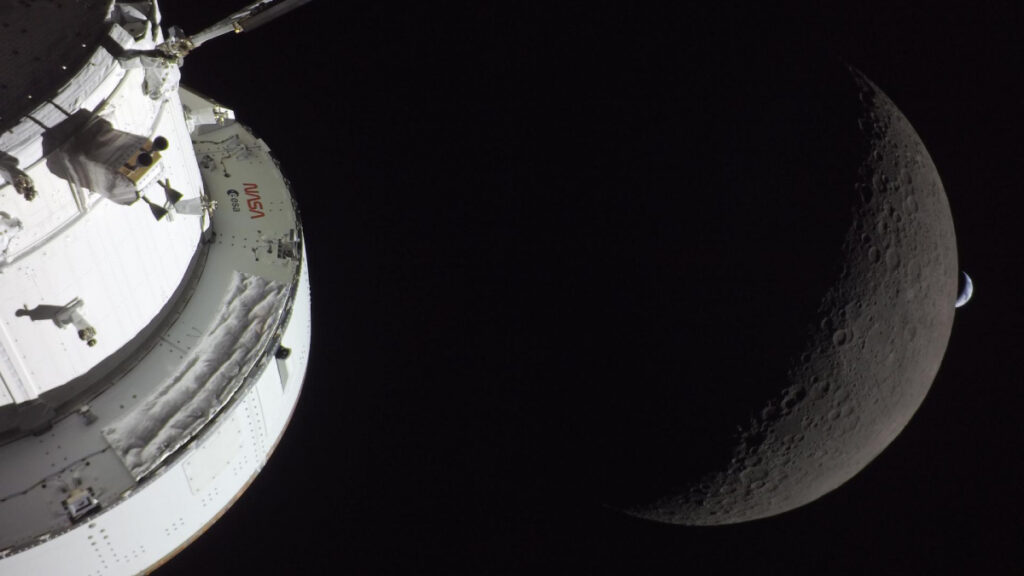
NASA’s Artemis II crew captured this image of the Moon eclipsing the Sun during their flyby of the Moon on 6 April 2026. Credit: NASA
NASA’s six existing mission directorates will be slimmed down to four. Exploration Systems Development and Space Operations will be combined into a new Human Spaceflight Mission Directorate and will facilitate human spaceflight in low-Earth and lunar space environments. Aeronautics Research and Space Technology will be folded into a new Research and Technology Mission Directorate, tasked with researching and developing nuclear power and propulsion. The structure of the Science Mission Directorate (SMD) and Mission Support Directorate remain unchanged at the time of publication. All directorate leaders will now report directly to the NASA Administrator (Isaacman) to ensure that each remains focused on their directorate’s new mission.
“There will be no reduction in force, no program cancellations, no closures, but we will achieve cost savings through more efficient execution and taking an active role in delivering the outcomes the world has been waiting for from NASA,” Isaacman said.
More Efficient?
At first glance, it is hard to see how combining four mission directorates into two, refocusing the missions of each, and pushing for increased efficiency and cost reduction will not result in some loss of talent either through positions being eliminated or individuals finding themselves in jobs they do not want to hold.
In a letter to NASA employees, Isaacman went into more detail about the specifics of this realignment and described how it will shift the agency’s internal bureaucratic authority away from directorates and toward NASA’s field centers. Prior to this, centers like Goddard Space Flight Center in Greenbelt, Md., and Johnson Space Center in Houston would need to compete for funding that had been appropriated to directorates based on the programs or missions they were tasked with.
A NASA source based in Houston told Ars Technica that the competition for funding “has been an absolute disaster.”
This new realignment “will adjust the funding distribution, so Centers have the financial support needed to sustain the baseline critical capabilities independent of near-term mission assignment,” Isaacman stated. “This shift will allow Center Directors to focus on maintaining the infrastructure, workforce, and capabilities required for current and future missions.”
Isaacman was unclear about when these changes will take effect, and policy analysts are unsure whether the realignment will be recognized by Congress through its appropriations process. The most recent Fiscal Year 2027 appropriations bill for NASA, which advanced out of the House Committee on Commerce, Justice, and Science on 13 May, allocates funding for six mission directorates, not four. The Senate appropriations committee is expected to release its proposed budget for NASA in the coming weeks, and the two bills must still undergo a lengthy reconciliation process.
In fiscal year 2026, Congress broke with the president’s budgetary priorities for NASA and passed a budget that ignored several of the administration’s proposed financial and mission cuts. Whether Congress will do the same this year and maintain the prior breakdown of directorates will become clear in the coming months.
These updates are made possible through information from the scientific community. Do you have a story about how changes in law or policy are affecting scientists or research? Send us a tip at eos@agu.org.
Research & Developments is a blog for brief updates that provide context for the flurry of news regarding law and policy changes that impact science and scientists today.
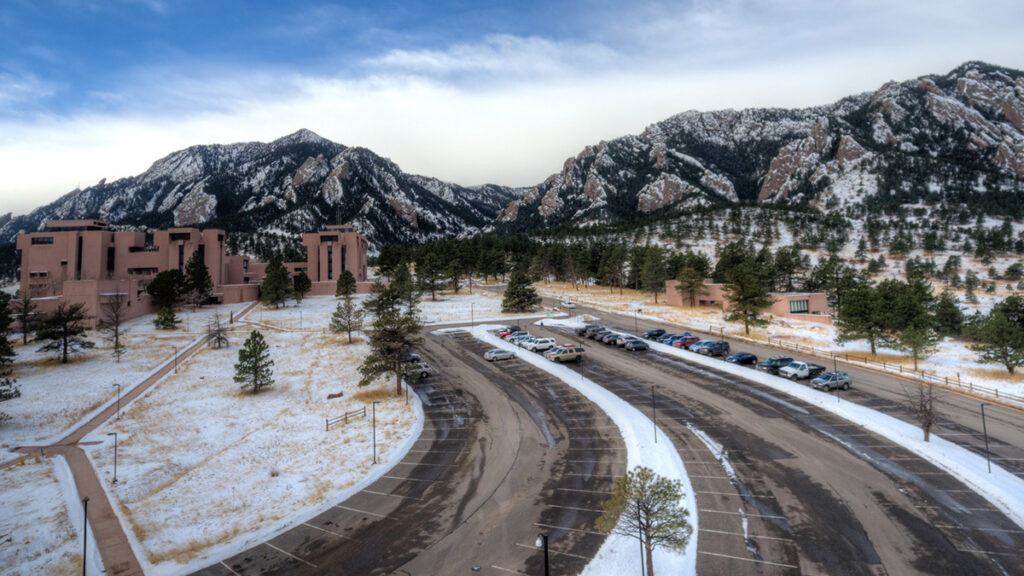
A Colorado judge has granted a preliminary injunction to the University Corporation for Atmospheric Research (UCAR). The move temporarily blocks the federal government from moving forward with one part of its effort to dismantle UCAR’s National Center for Atmospheric Research (NCAR) by transferring stewardship of a state-of-the-art supercomputing facility.
Together, UCAR—a nonprofit consortium of universities and colleges—and the National Science Foundation (NSF) operate and maintain the NCAR-Wyoming Supercomputing Center (NWSC) in Cheyenne, Wyo. The facility provides scientists with enormous computational power necessary to run sophisticated analyses of weather, climate, and other Earth systems.
In February, as another step in a chain of actions taken to dismantle NCAR, the NSF informed UCAR and NCAR that it would transfer management and operations of NWSC to a third-party operator.
In turn, UCAR filed a lawsuitalleging that the action violated federal law under the Administrative Procedure Act (APA). To halt NSF’s action under the act, the agency’s attempt to remove UCAR’s stewardship of the facility must be shown to be “arbitrary, capricious, an abuse of discretion, or otherwise not in accordance with law.”
Judge Richard Brooke Jackson of the U.S. District Court for the District of Colorado wrote in a 1 June court order that the action was both arbitrary and capricious “for at least two reasons.” First, NSF didn’t offer an explanation for its decision, and second, it didn’t follow an outlined process to consider public feedback.
The decision means that UCAR will temporarily retain its stewardship of NWSC.
“NSF’s failure to provide any explanation for its decision—let alone a reasonable one—thwarts meaningful judicial review and renders the challenged action arbitrary and capricious,” Jackson wrote.
He went on to note that efforts to transfer stewardship of UCAR assets, including the supercomputing center, to other institutions, pose the risk of “irreparable harm” to UCAR. One of the chief harms would be brain drain, the judge noted multiple times, writing that “UCAR cannot easily replace employees with the level of education, specialized training, and institutional knowledge necessary to operate and maintain the NWSC’s ‘highly integrated, high-performance supercomputing system.'”
In addition to brain drain, Jackson cited financial injuries to UCAR that would be “difficult, if not impossible” to quantify, as well as an overall threat to the consortium’s mission.
“Any degradation in forecasting, modeling, or related scientific capabilities carries real-world consequences, including potential harm to property and human life. Given those stakes, the public interest strongly favors maintaining the status quo unless and until NSF demonstrates that its transfer decision complies with the APA,” he concluded.
In a statement posted to the UCAR website, the consortium’s interim president, Eric Barron, said UCAR was pleased that Judge Jackson recognized how harmful the proposed transfer would be for the the nation’s scientific enterprise.
“UCAR’s top priority is to advance Earth system science in service to society,” he wrote. “Today’s decision ensures that the NWSC will be able to continue its vital work on behalf of the United States and its stakeholders without interruption.”
These updates are made possible through information from the scientific community. Do you have a story about how changes in law or policy are affecting scientists or research? Send us a tip at eos@agu.org.
Greenhouse gas emissions are heating our atmosphere and oceans, and turning seawater more acidic. One of the myriad expected impacts of these conditions is a reduction in farming yields of shellfish, such as oysters and mussels. Coastal communities worldwide rely on these organisms for their economies and as a major food supply. However, exactly how climate change will affect oyster and mussel farming is not yet clear.
Using a novel experimental setup, Pernetet al. report new projected yields of oyster and mussel farming in the Mediterranean Sea for the years 2050, 2075, and 2100. Their results suggest that by 2050, yields of both shellfish will drop dramatically, with mussel production perhaps collapsing altogether.
Most prior studies have assessed shellfish in tank experiments under fairly idealized conditions that do not adequately reflect real-world aquaculture settings. This research team took a different approach. They developed a novel system for exposing oysters and mussels in tanks to realistic conditions using water pumped in from the sea, meaning the animals would experience fluctuations in acidity, temperature, and nutrients similar to those experienced by shellfish on nearby farms.
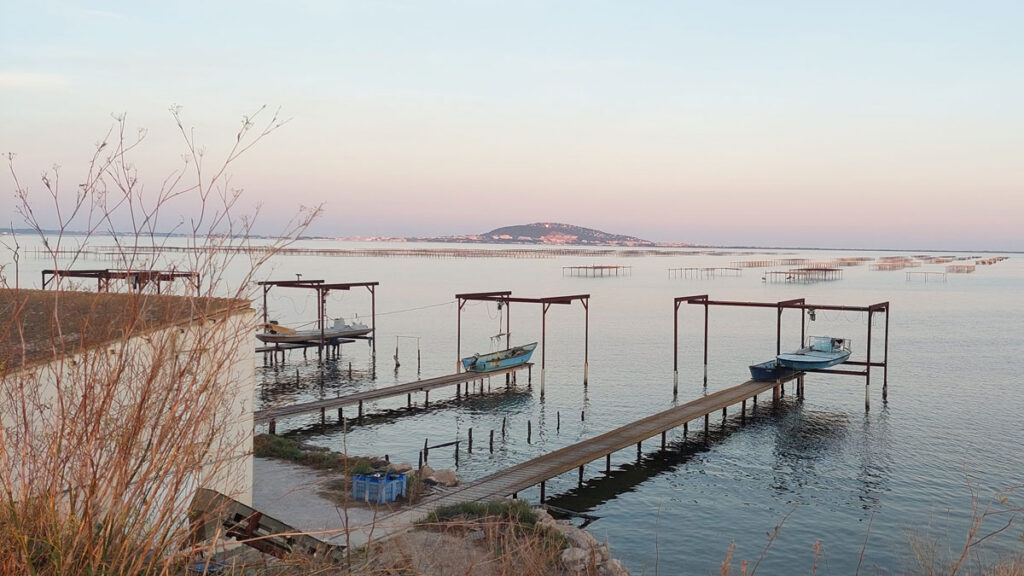
The researchers set up 12 experimental tanks on the French Mediterranean coast in the Thau lagoon, where shellfish farming is key for the local economy. In three tanks, oysters and mussels were exposed directly to pumped-in seawater under present, ambient conditions. The rest of the tanks received seawater that was first warmed and acidified in accordance with widely accepted climate projections for 2050, 2075, and 2100, with three tanks for each year.
The survival rate of oysters in the tanks with predicted 2100 conditions dropped by 7% compared to present rates, and their growth rate dropped by 40%. These results suggest that yields of farmed oysters in the Mediterranean could drop severely over the next several decades.
The mussels fared even worse. In fact, compared to oysters, mussels have a lower range of water temperatures in which they can survive, and the upper limit is already being exceeded in some summertime Mediterranean waters, leading to mass-mortality events. In the experimental tanks under present conditions, mussel mortality was about 40%, and nearly all mussels died under predicted 2050 conditions.
On the basis of these findings, the researchers call for the urgent development of strategies to protect Mediterranean shellfish farming, such as relocating mussel-farming operations to the cooler waters of open seas or developing cofarming with algae to increase resilience to climate change. (Earth’s Future, https://doi.org/10.1029/2025EF005992, 2025)
—Sarah Stanley, Science Writer
Citation: Stanley, S. (2026), Mediterranean mussel farming could collapse by 2050, Eos, 107, https://doi.org/10.1029/2026EO260121. Published on 17 April 2026.
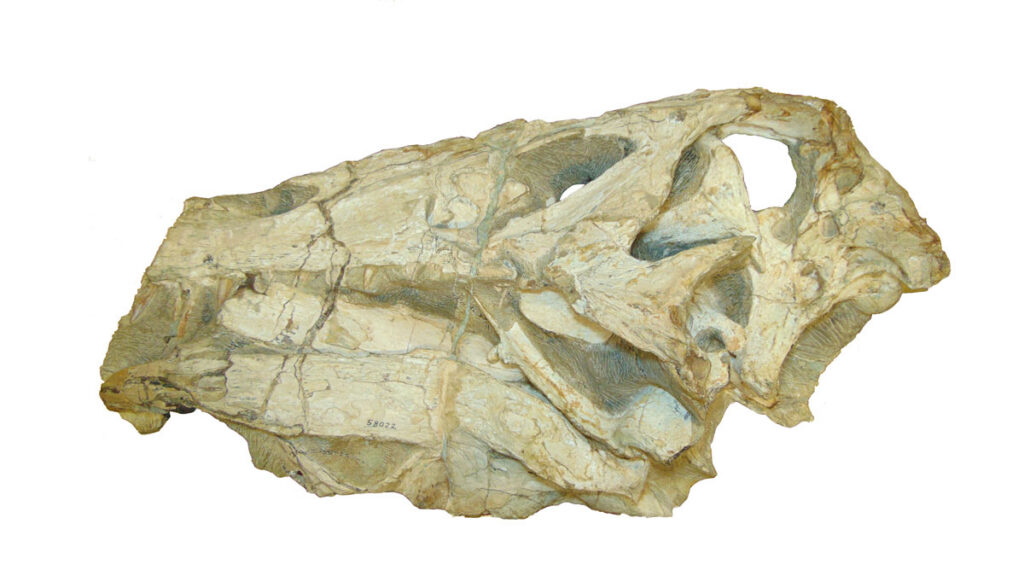
For many years a source of irritation, a fossil of the Brazilian spinosaurid Irritatorchallengeri is now bringing some joy to paleontologists in its homeland.
Following a successful public campaign for restitution, the piece is returning to Brazil from the collection of Germany’s State Museum of Natural History Stuttgart (SMNS), where it has been kept for the past 30 years—a situation that Brazilian paleontologists and lawmakers deemed illegal.
Representatives of both countries made the announcement last month during Brazilian President Luiz Inácio Lula da Silva’s visit to Germany. In a joint statement, they announced the German museum’s “willingness” to “hand over” the fossil to Brazil and start a new, more transparent era of international collaboration.
“It is a very expected and cherished move because it represents a huge scientific and social victory for the Global South and for Brazil.”
“Finally, the Irritator will be back to its original place,” said paleontologist Allysson Pontes Pinheiro, director of the Plácido Cidade Nuvens Paleontology Museum.
The museum, located in northeastern Brazil where the fossil was discovered in the 1990s, will host the Irritator when it returns to Brazil. “It is a very expected and cherished move because it represents a huge scientific and social victory for the Global South and for Brazil,” Pinheiro said, highlighting that the return will allow local scientists and the population to have access to a heritage that would be difficult and expensive to access abroad.
Martill and Frey named the newly discovered species in reference to their irritation upon learning that the skull had been manipulated by fossil dealers to get a better price. Little did the researchers know that the fossil would irritate many other scientists, especially those from the animal’s homeland.
“This campaign showed us that it is worth continuing to fight for our fossils.”
The restitution request is based on Brazilian legislation passed in 1942 that determined that fossils found in the country are the state’s property and cannot be traded or exported without explicit authorization. In addition, a more recent Brazilian ordinance (dating to 1990) mandates that any holotype (a fossil used to describe a new species, such as the contested Irritator specimen) must remain in the country. Regardless, SMNS maintained the fossil had been legally purchased from a private dealer in Germany in 1991.
“We are very happy the Brazilian law is now being respected,” said Aline Ghilardi, a paleontologist at the Federal University of Rio Grande do Norte who was at the forefront of the repatriation campaign. “This campaign showed us that it is worth continuing to fight for our fossils.”
At the time of publication, SMNS had not responded to requests for comment.
A Long Process of Decolonization
But Ghilardi is not entirely satisfied. She didn’t like the wording of the announcement, which used the expression “hand over” rather than return, repatriate, or restitute.
“The statement was a missed opportunity to demonstrate the German government’s willingness to decide in favor of a restitution process,” she explained. “It seems there is resistance to making these restitutions as actual restitutions. It appears as if it is theirs by right and that they will hand over the fossil to Brazil as part of scientific cooperation.”
Ghilardi expressed that she will believe the repatriation will actually happen only when a specific return date is announced. (As of publication, it has not.) She also hopes that the Irritator case is not an isolated incident, but part of an ongoing trend of restitutions intended to break the pattern of neocolonialism in science.
A 2025 study published by Ghilardi and colleagues in the journal Palaeontologia Electronica showed that of nearly 500 invertebrate species described from fossils found in the Araripe Basin—one of Brazil’s richest and most threatened regions of geodiversity—about half have holotypes stored in institutions across Europe, Asia, and North America, violating Brazilian law.
Most of these smuggled fossils are hosted in Germany. “Some foreign colleagues complained about our campaign, saying that it looked like we were persecuting Germany,” Ghilardi said. “But that is not the case. It is just the numbers.”
It is possible, she noted, that other countries hold even more specimens that were not described in the scientific literature and therefore could not be counted.
The same study also found that more than 200 species were described in publications that did not include any Brazilian scientists as coauthors, despite Brazilian legislation requiring foreign research on Brazilian fossil material to be conducted in partnership with local institutions.
Wave of Repatriation
Paleontologist Serjoscha Evers at the Universität Freiburg, who authored the 2023 study on the Irritator fossil, wrote in an email to Eos that he welcomed the news of the dinosaur’s return.
However, he also wondered whether the decision is just “a diplomatic favor that resulted from the public pressure, or foreshadowing a broader wave of repatriations based on a legal conclusion that the fossils are unlawfully in German custody.”
Paleontologists involved in the Irritator restitution efforts said that since the campaign began, they have been receiving emails from museums and institutions worldwide seeking information on the procedures for returning fossils to Brazil.
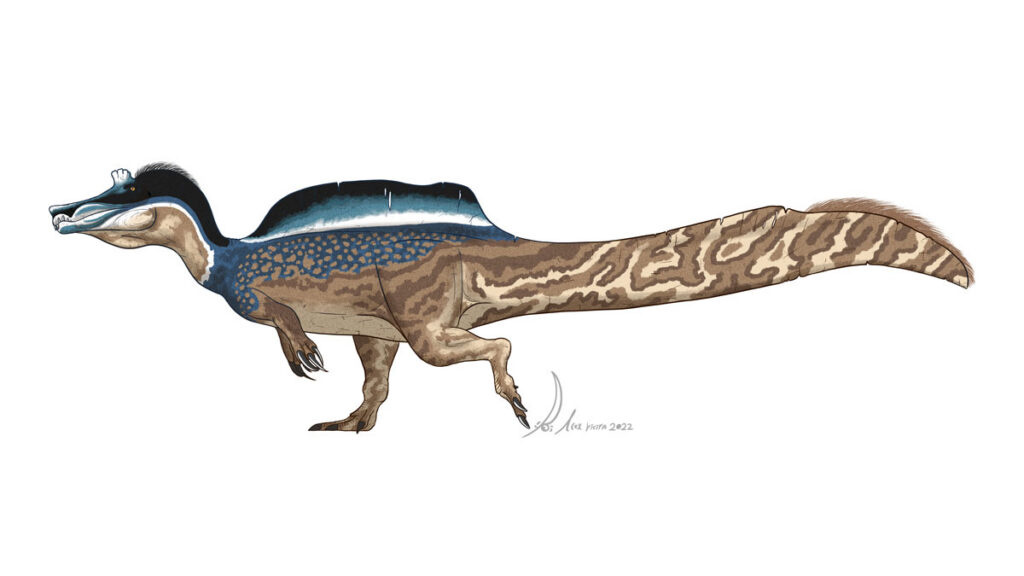
Germany recently said it would “hand over” the Irritator challengeri fossil to Brazil. This illustration suggests what the dinosaur would have looked like before it was a fossil, about 110 million years ago. Credit: PaleoGeekSquared/Wikimedia Commons, CC BY-SA 4.0
The Plácido Cidade Nuvens Paleontology Museum, the final destination of the Irritator, has received several restitutions itself, including 45 fossils originally collected from the Araripe Basin and previously held by the University of Zurich in Switzerland, the fossil of a crustacean that was in the possession of the Universidad Nacional del Nordeste in Argentina, and a fish fossil seized in Italy.
According to Pinheiro, the museum’s director, paleontologists and the Brazilian government have listed at least 90 Brazilian holotypes still held in Germany. And the Brazilian Ministry of Foreign Affairs confirmed to Eos that it is currently negotiating the return of nine fossils held in undisclosed countries.
“We have been talking with colleagues from the museums where these materials are hosted, and they seem very favorable to returning them,” Pinheiro observed. “It is a huge advancement and a great change of behavior from important museums that have been holding heritage from the Global South.”
Citation: Moutinho, S. (2026), Germany to return contested dinosaur fossil to Brazil, Eos, 107, https://doi.org/10.1029/2026EO260167. Published on 22 May 2026.
Research & Developments is a blog for brief updates that provide context for the flurry of news regarding law and policy changes that impact science and scientists today.
The Trump Administration has terminated the positions of every member of an independent board meant to govern the National Science Foundation (NSF).
The National Science Board directs and approves large funding decisions for NSF’s approximately $9 billion basic science research budget. It is meant to function independently from the federal administration to keep science funding insulated from political pressure and budget cycles.
“I have watched the systematic dismantling of the scientific advisory infrastructure of this government with growing alarm, and the National Science Board is simply the latest casualty.”
In a 24 April notice from the Presidential Personnel Office, all the scientists serving on the board were informed their positions had been eliminated. The emails dismissing board members provided no reason for the termination.
“I am deeply disappointed, though I cannot say I am entirely surprised,” Willie E. May, one of the terminated board members and vice president of research and economic development at Morgan State University in Maryland, told The New York Times.
“I have watched the systematic dismantling of the scientific advisory infrastructure of this government with growing alarm, and the National Science Board is simply the latest casualty,” he said.
Ranking member of the House Committee on Science, Space, and Technology Zoe Lofgren (D-CA) called the terminations “the latest stupid move made by a president who continues to harm science and American innovation.”
“Without a functional National Science Board in the near term, the agency is left without the guidance and oversight of independent experts, and the public is left without information on how NSF is carrying out its mission,” Gretchen Goldman, president and CEO of the Union of Concerned Scientists, wrote in a blog post about the terminations.
These updates are made possible through information from the scientific community. Do you have a story about how changes in law or policy are affecting scientists or research? Send us a tip at eos@agu.org.
Often times when we think “scientist,” we picture a white lab coat, a pipette. Or, a marine biologist covered in seaweed samples. A geologist with dusty knees and hands full of rock fragments. Endless blue gloves. What we may not always picture is our favorite professors, colleagues, or even students advocating for science to policy makers.
Federal policy decisions have a direct impact on science funding, research priorities, and the role of science in society.
Federal policy decisions have a direct impact on science funding, research priorities, and the role of science in society, and the AGU community has a critical role to play in those conversations. Each year, AGU’s Science Policy and Government Relations (SPGR) team organizes and hosts Congressional Visit Days to connect Earth and space scientists to their elected officials. As a member of AGU’s scientific publications team, I joined the April 21-22 Days of Action to learn about the bills currently impacting our workforce and research, how to craft messages that both speak to our personal experiences, and to ask our elected officials to advocate with and for us.
As a D.C. native, I grew up in close proximity to the power of science, the alphabet agencies, NOAA, NASA, NIH, and USDA. Institutions where the best and brightest were given the resources and support to learn, record, and disseminate knowledge on behalf of our country. In my current role with AGU as a non-profit publisher, I took to the Hill to share my experiences on the publishing and academic peer-review landscape. My role allows me to see first-hand how budget cuts and shifting attitudes have impacted critical programs at the agencies named above. This Days of Action event brought together 58 participants with one goal: to share personal stories that related to four bills:
KEEP STEM Talent Act (H.R. 2627, S.1233)- strengthens the U.S. scientific workforce by making it easier for skilled international STEM graduates from U.S. universities to stay in the U.S.
Protect America’s Workforce Act (H.R.2550 passed House, S.2837)- seeks to protect the U.S. federal scientific workforce by restoring collective bargaining (union) rights.
Scientific Integrity Act (H.R.1106)- protects the rights of U.S. federal scientists and researchers by safeguarding scientific integrity in federal research and decision-making.
Two participants spoke on their experiences meeting with elected representatives and uniquely captured just how closely the Earth and spaces sciences touch all of our lives.
Sheila Baber, an early career scientist with The University of Maryland, felt compelled to join due to “the uncertain future for myself, my peers, and the American scientific enterprise.” She noted, “It has been especially difficult to witness the deteriorating relationship between scientists, decision makers, and the public. This past year, with its rapidly changing federal landscape, has been a wakeup call to re-engage and remind the public of how science research gives back to the community.”
Ryan Haupt, long-time AGU member and the Executive Director at National Youth Science Academy, with a 10-year track record of geoscience advocacy, emphasized the importance of building relationships with elected officials. “Regardless of party affiliation, I want those staffers to know that when they meet with me or any other AGU member, they will get honest and informed feedback from folks who are truly passionate about our fields,” Ryan told me. “[Experts who can speak to how current bills] impact issues like improved financial support for graduate students, helping international students stay in the US to join the STEM workforce, and protecting funding for federal science agencies and the folks who work for them.”
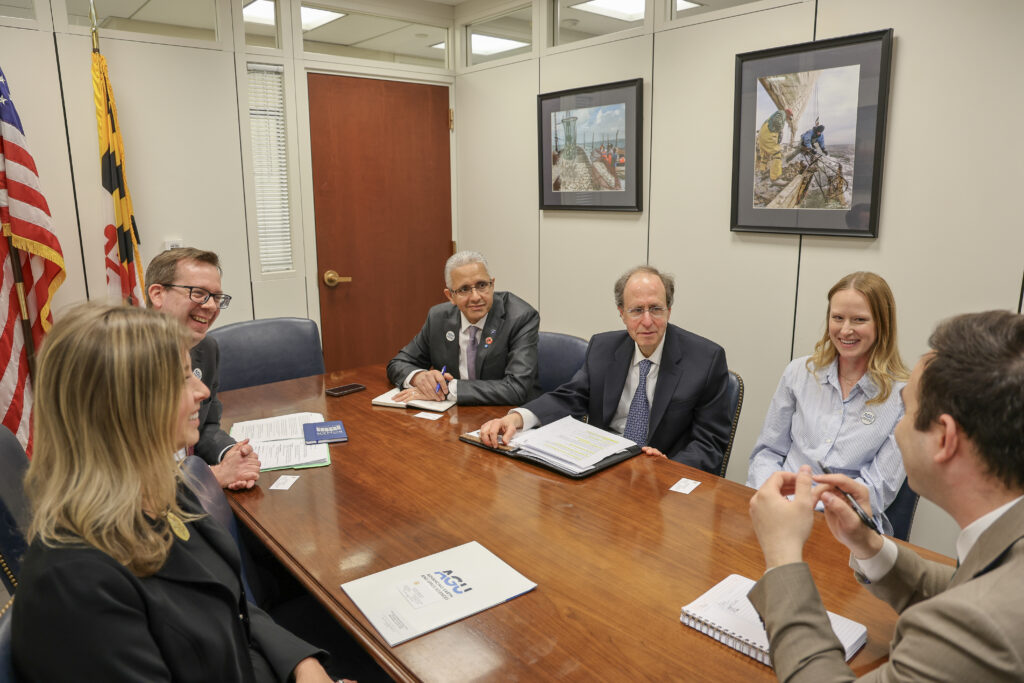
As a participant myself, I joined the Maryland group to meet with Senator Chris Van Hollen’s office. Van Hollen and I met briefly at the Stand Up for Science March in 2025. His voting track record indicates a long-standing commitment to the scientific community, and he champions bills that support funding federal agencies like NOAA.
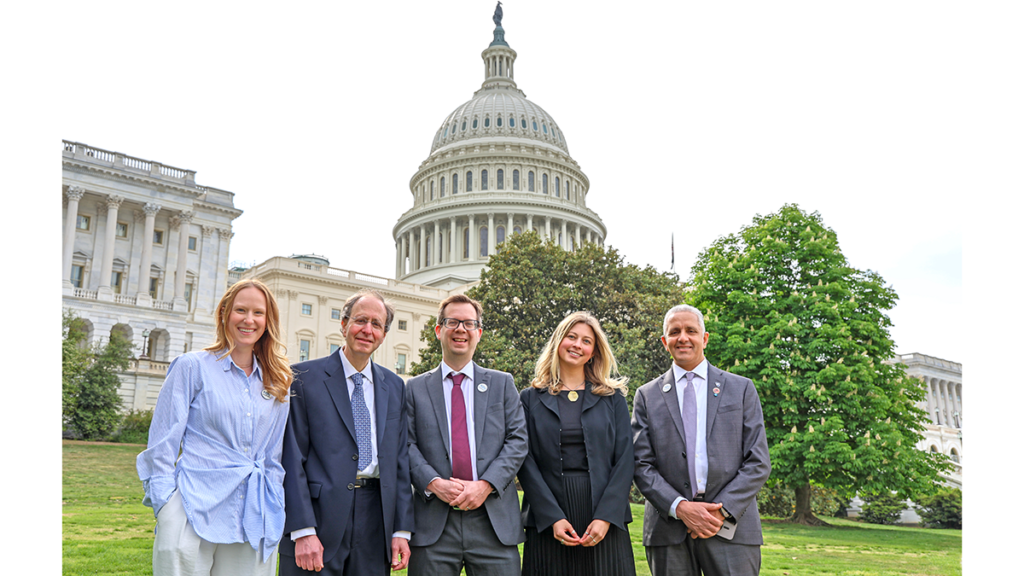
(left to right) The Maryland group, McKay Porter, Andrew Inglis, Nour Rawafi, Stephen Jascourt, and Emille Beller met with Senator Chris Van Hollen’s staffer, Leo Confalone. Credit: Beth Bagley, AGU
Finding and discovering the best and the brightest means funding, protecting, and supporting the best and the brightest.
Working in scientific publishing has allowed me to peer behind lab doors, into research vessels sailing through the Arctic, and into the entire ecosystem that is peer-reviewed research. A system that relies on incoming eager students, federal grant funding, consortium agreements between the biggest institutional libraries and the biggest publishing houses in the country, scientific integrity, and future, stable career opportunities. Finding and discovering the best and the brightest means funding, protecting, and supporting the best and the brightest.
Open, accessible science builds and supports both public trust and future scientific advancements. As the world widens and we are all met with increased access to studies, content, and news, scientific storytelling and literacy have never been more important for ensuring public trust. Transparency from the lab and from the field to published output allows for data to be discussed, fact-checked, and reused to support future scientific discovery. Days of Action demonstrates that we have a unique role to play in supporting the health, safety, and future of our country. If you feel called to get involved, please see resources available from SPGR.
Ryan reminds us, “There are lots of ways to participate in our democracy… find where you can best serve as a leader…don’t try to do it all, but try to do something.”
Citation: Beller, E. (2026), The impact of advocacy: American Geophysical Union’s Days of Action, Eos, 107, https://doi.org/10.1029/2026EO265020. Published on 14 May 2026.
This article does not represent the opinion of AGU, Eos, or any of its affiliates. It is solely the opinion of the author(s).
Research & Developments is a blog for brief updates that provide context for the flurry of news regarding law and policy changes that impact science and scientists today.
The Office of Management and Budget (OMB) proposed a new rule on 28 May that, if finalized, would give political appointees approval power over scientific grants, reduce support for international collaboration, limit funding for publication fees, and make other extensive alterations to the federal government’s funding review process.
The proposed “Guidance for Federal Financial Assistance” would require senior political appointees to conduct reviews of each grant, and would not allow those appointees to defer to peer reviewers for grantmaking decisions. Scientific peer review “remains advisory and does not replace agency discretion,” according to the proposal.
“It replaces expertise with political appointees, globally decouples the U.S. and completely guts our scientific ecosystem.”
The proposed rule would further codify an executive order from last August, titled “Improving Oversight of Federal Grantmaking,” in which the White House ordered federal agency heads to award grants that “advance the President’s policy priorities” and align with its criteria for “Gold Standard Science.”
The proposal states that the OMB made the suggested revisions in response to a lack of “transparency, accountability, and proper oversight” between 2021 and 2024. “Federal awards were often used during those years to promote a ‘woke’ policy agenda that did not reflect the values of the vast majority of the American public,” the proposal claims, referencing “unlawful DEI [Diversity, Equity, and Inclusion] practices, various anti-American ideologies in American education,” and “non-replicable and highly misleading studies” as examples.
“We warned of this exact form of government overreach in science a year ago,” Colette Delawalla, founder of Stand Up for Science, told Scientific American in reference to the administration’s proposed rule. “It replaces expertise with political appointees, globally decouples the U.S. and completely guts our scientific ecosystem.”
In addition to elevating government oversight of the grantmaking process, the proposed rule would, among other changes:
Allow federal agencies to terminate active grants at any time if they are deemed “inconsistent with program goals or agency priorities.”
Prohibit the use of federal funds for research collaborations with foreign entities affiliated with countries under sanction by the United States, unless exceptions are authorized by federal law or the head of a federal agency.
Disallow federal grants from being used for most publication costs and open access fees.
Require that grant recipients obtain pre-approval from federal agencies to use their funding to attend conferences or obtain professional memberships related to the scientific work covered by their grant.
Allow federal agencies to receive exemptions from the requirement to publicly advertise grant competitions when “publicly announcing an opportunity would pose a risk to national security or is in the national interest of the United States.”
Ban federal funds from being used to “fund, promote, encourage, subsidize, or facilitate” any activities related to DEI or “gender ideology,” defined as “theories or ideologies that deny the biological reality of sex or the sex binary in humans.”
“Congress has repeatedly appropriated funds for science agencies with the expectation that those funds would be administered through merit-based, expert-driven processes insulated from political interference,” Elizabeth Ginexi, a former official at the National Institutes of Health, wrote in a blog post. “This rule attempts to override that expectation.”
Stand Up for Science will host an online meeting with scientist speakers on Tuesday, 2 June at 4 p.m. ET to review the proposed rule. The Office of Management and Budget is accepting public comments on it until 13 July.
AGU President Brandon Jones released a statement about the rule on 3 June, urging the AGU community to submit public comment via AGU’s Action Center.
“This is not a routine regulatory update,” he wrote. “What it actually does is restructure the foundational rules of U.S. science funding—with cascading impact for global collaborators—to serve political priorities rather than the public good. We have seen executive orders, budget cuts, and terminations take aim at the scientific enterprise one by one. This proposed rule would codify that agenda into federal regulation, making it far harder to reverse.”
These updates are made possible through information from the scientific community. Do you have a story about how changes in law or policy are affecting scientists or research? Send us a tip at eos@agu.org.
Every chip fabricated in a semiconductor plant needs ultrapure water. Most nuclear reactors need water as a coolant and neutron moderator. Every artificial intelligence (AI) data center drinks between 1 million and 5 million gallons of water a day, with thirst often peaking during drought.
Water runs through every technology priority the United States has named, yet the word does not appear once in “Launching the Genesis Mission,” an executive order (EO) released in November 2025. As described in the EO, the Genesis Mission is a “dedicated, coordinated national effort to unleash a new age of AI-accelerated innovation and discovery that can solve the most challenging problems of this century.”
Led by the Department of Energy (DOE), the initiative aims to build an integrated AI framework that would harness federal scientific datasets to accelerate breakthroughs in advanced manufacturing, biotechnology, critical materials, nuclear fission and fusion energy, quantum information science, and semiconductor development. The scope of the mission is comparable to that of the Manhattan Project.
Since the announcement, the DOE has listed “Predicting U.S. Water for Energy” among its 26 Genesis Mission Science and Technology Challenges. The project is also soliciting proposals in three water-related focus areas.
This framework provides a foothold for hydrology in the Genesis Mission, but it is scoped narrowly around water as a supply variable for energy production.
In reality, water is a crosscutting constraint that will help determine whether the mission’s priorities translate into deployable outcomes. The hydrology community now has a seat at the table, and if it moves first and positions water security as one of the “most challenging problems of this century,” the Genesis Mission can become the sandbox in which AI reshapes how the country measures, models, and manages water.
Making this happen will require that the DOE and the Office of Science and Technology Policy charter a hydrology workstream inside the Genesis Mission, with interagency delivery involving the U.S. Geological Survey (USGS), NOAA, the Bureau of Reclamation, the EPA, and partners at state, regional, and community levels. Here is what we think that workstream should look like:
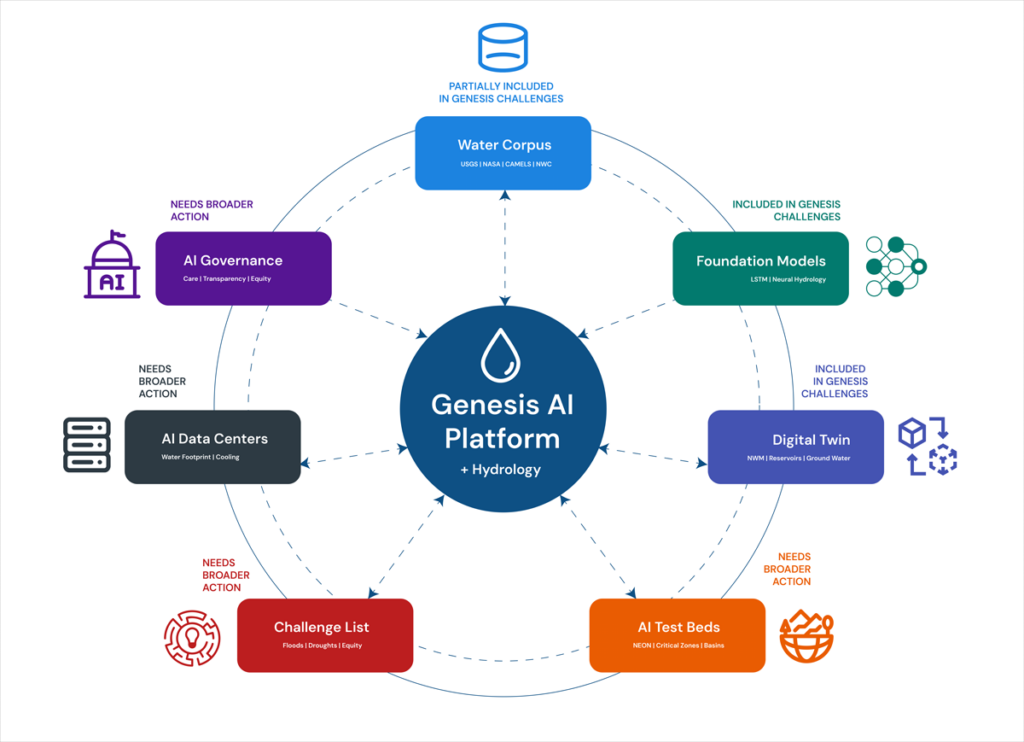
A water-centric Genesis Mission architecture supports seven hydrological components that both feed into and receive decisions from the Genesis AI platform. Each component maps to a section of this article. Credit: Amobichukwu C. Amanambu. Click image for larger version.
While the existing challenges reflect some of these components, others will require coordinated effort from the hydrology community to bring into the Genesis Mission’s scope.
Build the Water Corpus Genesis Will Need
The Genesis Mission EO instructs the DOE to create an American Science and Security Platform to provide the public, scientists, agencies, and policymakers access to crucial scientific datasets.
The good news is that accessible water data systems already exist across several federal agencies and academic research centers. The USGS National Water Information System tracks real-time and historical water quality and use across the country. NASA’s Earth Science Data Systems Program provides open access to Earth science observations. NOAA’s National Water Center, the first federal facility dedicated to national water resource forecasting, operates the National Water Model, which continuously forecasts flows on 2.7 million stream reaches across the continental United States. The Catchment Attributes and Meteorology for Large-Sample Studies (CAMELS) dataset, currently hosted by the National Center for Atmospheric Research, provides data tailored for hydrological research on hundreds of river basins, and the Caravan framework pulls together multiple large-sample meteorological and hydrological datasets at a global scale.
What is missing is a unified, AI-ready repository that brings federal, state, and community data together.
What is missing is a unified, AI-ready repository that brings federal, state, and community data together. Building one is hard. Water data are fragmented, inconsistent, and often entirely absent. Consistent, reliable data for groundwater, withdrawals, reservoir operations, and water quality are especially difficult to obtain.
Local resistance to sharing data is real. In Texas, for example, landowners hold private property rights over groundwater and have opposed metering and reporting requirements imposed by groundwater conservation districts. In California, agricultural well owners fought metering mandates for years before the Sustainable Groundwater Management Act compelled local agencies to begin tracking withdrawals. Tribal nations face a different concern: Water data collected on Indigenous lands has been misrepresented in federal datasets that were modeled without accounting for Indian country, leading many nations to restrict access to their data as an exercise of sovereignty.
Practical steps toward building a unified AI-ready repository include tiered access and licensing for different stakeholders, clear provenance tracking for all data reported, financial and educational incentives for stakeholders for reporting, and targeted gap filling. Where measurements are missing, AI can fuse remote sensing with gauged records and operational logs—but only if the results carry honest uncertainty estimates tied to real decisions.
Get the corpus right, and it will outlive any single program name. It becomes infrastructure the country can lean on.
Develop Shared Hydrologic Foundation Models
The Genesis Mission EO directs the DOE to provide “domain-specific foundation models across the range of scientific domains covered.”
Hydrology has a head start. Long short-term memory (LSTM) networks are a key type of neural network designed to last thousands of time steps. Hydrology LSTMs trained on CAMELS data have already matched traditional conceptual models for daily streamflow discharge prediction. Open-source Neural Hydrology tools serve as baselines for regional runoff prediction. These predictions may serve as precursors to the foundation models the Genesis Mission envisions and building blocks from which they could be developed.
The process of scaling up these tools is not straightforward, however. A hydrologic investigation of snowmelt-driven streams in Colorado will not require the same spatiotemporal data as tile-drained fields in Iowa, for example. A hydrology-specific foundation model must take nuanced requirements into consideration and provide a clear path for managing and exploiting a variety of datasets.
Google’s Flood Hub shows what is possible: Its AI-enabled flood forecasts now cover more than 80 countries. However, Flood Hub’s core model code and trained weights remain proprietary, meaning researchers can use the forecasts but cannot rebuild or adapt the underlying models. Genesis, if well positioned, can fill that accessibility gap by producing foundation models for water that are reusable, reliable, and openly governed.
Build a National Water Digital Twin
The EO prescribes an integrated AI platform combining foundation models with simulation tools to stimulate AI-enabled innovations.
That architecture is exactly what a digital twin requires. Europe’s Destination Earth initiative is already building digital twins for weather extremes and nonstationary conditions on the Large Unified Modern Infrastructure (LUMI) supercomputer. The United Nations–led AI for Good initiative has prioritized water applications, warning that fragmented national efforts risk duplicating work.
If the United States aims for global strategic leadership in AI-accelerated science, water infrastructure cannot be an afterthought.
A water digital twin earns its keep when it makes the consequences of choices visible, in terms of flows, levels, temperatures, and risks to people and ecosystems.
Rather than starting from scratch, a water-centric Genesis Mission would unite existing federal models—the National Water Model, reservoir simulators, and groundwater codes—in a single digital twin. AI can become the thread that stitches them together, correcting biases and providing numerical solvers to enforce mass and energy balance.
What should this twin actually do? Help a dam operator decide whether to release water ahead of a storm. Tell planners where a new data center can draw cooling water without drying up a stream. Flag which coastal defenses will fail first under rising seas.
A water digital twin earns its keep when it makes the consequences of choices visible, in terms of flows, levels, temperatures, and risks to people and ecosystems.
Turn Basins into AI Test Beds
The Genesis Mission promotes AI-directed experimentation and directs the DOE to keep a record of robotic laboratories and production facilities in which such experimentation could be conducted. Hydrological field sites belong in that inventory. The National Ecological Observatory Network already operates 81 sites with standardized measurements of meteorology, surface water, groundwater, and biodiversity. The Critical Zone Collaborative Network instruments catchments to track water-soil-vegetation interactions over decades.
Formalizing these networks as AI test beds would link field observations back into the water digital twin so that experiments and models continually sharpen each other. Imagine mobile sensors steered by AI agents during a storm or aquifer recharge experiments designed by algorithms and verified in real time. That feedback loop is what separates a useful model from a decorative one.
Expand Water Challenges on the Genesis Mission List
The Exchange and What’s at Stake
Allowing water security to flow through the diverse components of the Genesis Mission would benefit both the policies championed by the mission itself and the hydrology community.
The Genesis Mission gets real-world, noisy test beds where AI proves value beyond benchmarks, a domain to stress test climate and infrastructure investments, and scientists trained in both AI and the stubborn realities of rivers, aquifers, and pipes.
Hydrology gets resources for shared data infrastructure, foundation models and instrumented basins no single lab can support, a seat when rules for AI and national scientific infrastructure are negotiated, and a chance to reset practices around openness, collaboration, and equity.
Earlier this year, the DOE released 26 Genesis Mission Science and Technology Challenges, and “Predicting U.S. Water for Energy” was among them. The accompanying funding call (DE-FOA-0003612) solicits proposals on cloud microphysics, coupled surface water–groundwater modeling, and seasonal to multiyear prediction, all framed around energy needs and flood resilience.
These inclusions are a significant win for a hydrology component to Genesis, but several urgent challenges sit outside their scope. Can AI close the gap between a flood forecast issued 12 hours out and the 48 hours emergency managers actually need? Can it map compound extremes, in which drought, heat, and infrastructure failure collide in the same week? Can it redesign monitoring networks so that coverage follows risk rather than where gauges happened to be installed a century ago? Integrating energy and water systems is equally urgent: Floods have caused 80% of major U.S. grid outages since 2000, while drought-driven water stress curtails cooling at thermoelectric plants and reduces hydropower output, exposing how deeply energy infrastructure depends on hydrologic extremes.
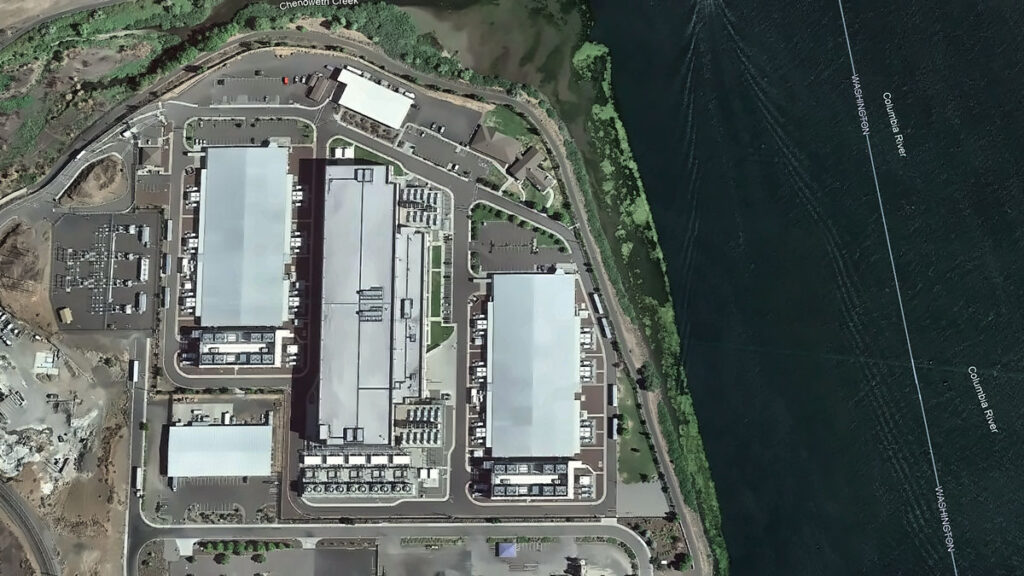
The water footprint of new AI infrastructure deserves a place on that list. A separate executive order (14318, “Accelerating Federal Permitting of Data Center Infrastructure”) is already fast-tracking expansion of data center construction, and a single hyperscale facility can consume 1 million to 5 million gallons of water daily. Emerging research shows how withdrawals at that scale can push streams below ecological thresholds during low flows.
Make Hydrology the Conscience of AI Governance
The EO directs the DOE to set data access rules and clarify policies for ownership, licensing, trade secret protections, and commercialization of products and tools associated with it.
Three principles should anchor such policies for AI use in water security.
First, Indigenous and community data rights must be embedded in every major AI water security effort, in line with the collective benefit, authority to control, responsibility, and ethics (CARE) principles for Indigenous data governance.
Second, AI’s own water footprint, through electricity generation and cooling, must be treated as a design constraint. Transparent reporting, stress-based siting, and efficiency targets will prevent hydrology in Genesis from being self-defeating.
Third, the DOE should define what failure looks like. Missing a flood crest portends loss of lives and livelihoods and breaches of treaties. Accountability standards must be measurable, and they must ask not just how accurate the forecast was on average, but who bore the cost when it was wrong.
A single executive order will not solve the country’s water security problems, and a single challenge topic will not either.
But the Genesis Mission has provided a seat at a table that did not exist 6 months ago. Whether the hydrology community treats it as a ceiling or a foundation depends on what happens next. Europe’s Destination Earth and the United Nations’ AI for Good water initiatives are already moving.
American hydrology now has a seat at the table. We should take it.
Kratzert, F., et al. (2019), Toward improved predictions in ungauged basins: Exploiting the power of machine learning, Water Resour. Res., 55, 11,344–11,354, https://doi.org/10.1029/2019WR026065.
Xiao, T., et al. (2025), Environmental impact and net-zero pathways for sustainable artificial intelligence servers in the USA, Nat. Sustainability, 8, 1,541–1,553, https://doi.org/10.1038/s41893-025-01681-y.
Zhang, L., et al. (2025), Foundation models as assistive tools in hydrometeorology: Opportunities, challenges, and perspectives, Water Resour. Res., 61, e2024WR039553, https://doi.org/10.1029/2024WR039553.
Author Information
Amobichukwu C. Amanambu (acamanambu@ua.edu), Department of Geography and the Environment, The University of Alabama, Tuscaloosa; and Jonathan Frame (jmframe@ua.edu), Department of Geological Sciences, The University of Alabama, Tuscaloosa
Citation: Amanambu, A. C., and J. Frame (2026), The Genesis Mission needs hydrology: Here’s how to incorporate it, Eos, 107, https://doi.org/10.1029/2026EO260131. Published on 28 April 2026.
This article does not represent the opinion of AGU, Eos, or any of its affiliates. It is solely the opinion of the author(s).
Research & Developments is a blog for brief updates that provide context for the flurry of news that impacts science and scientists today.
This week, a parade of scientists will spend 50 hours straight speaking about the importance of weather and climate research in the United States.
Now in its second year, the Weather & Climate Livestream will feature hundreds of scientists describing their work and why it matters. Last year’s event, which lasted 100 hours, saw more than 180,000 views and led to 30,000 phone calls to Congress to #SaveAmericasForecasts.
“The first aspect of it is just communicating science,” said Haley Crim, a climate literacy researcher at MIT and the founder of Climateliteracy.earth. “The second half of it is to inspire people to call their representatives in support of funding for climate and weather science, and science more broadly.”
Last year, Crim was an “avid watcher” of the livestream, so she was happy to help when a friend asked her to pitch in for the second iteration. But it’s also more personal this year, as she has since lost her position as a contractor with NOAA.
“It has a whole new meaning now, this year,” she said.
The livestream begins at 4 p.m. ET on Monday, 1 June, ending at 6 p.m. ET on Wednesday, 3 June. Speakers include meteorologist Jeff Masters and climate scientists Adam Sobel of Columbia University and Kim Cobb of Brown University. AGU President Brandon Jones and president-elect Benjamin Zaitchik will also speak from 2 p.m. to 2:40 p.m. ET on Wednesday, 3 June.
Science Under Attack
Since Donald Trump began his second presidential term in 2025, federal science funding has faced extensive cuts, with more proposed. In June 2025, for instance, a budget document proposed eliminating NOAA’s Office of Oceanic and Atmospheric Research. In December 2025, the administration announced plans to break up the National Center for Atmospheric Research.
“This is really a full-frontal attack on climate science.”
“This is really a full-frontal attack on climate science,” said Andrew Williams, a climate scientist at Scripps Institution of Oceanography who is helping to organize the livestream and will speak during it.
He added that even though Congress pushed back against the most drastic cuts proposed last year, leaving key science program budgets mostly intact, many agencies haven’t yet seen the money they’ve been granted in the budget. For instance, according to the organization Grant Witness, 112 grants have been awarded in the NSF Directorate for Geosciences so far this year, compared with 948 in total in Fiscal Year (FY) 2025. The average total number of grants awarded between FY21 and FY24 was 1,418.
Both Crim and Williams said they hope the livestream provides the public with a better understanding of how climate and weather research affects us all, from allowing for timely evacuation warnings to affecting insurance rates. Williams offered the example of the Geophysical Fluid Dynamics Laboratory, a federally funded NOAA research lab that would be eliminated under the president’s proposed FY2027 budget.
“It builds the engine of the U.S. weather forecasting model, which is what tells you day to day what the weather is going to be,” he said. “We’ve all been able to take for granted that these things are happening because the U.S. has for decades, for 60 or 70 years, had strong and stable federal funding for weather and climate science.”
These updates are made possible through information from the scientific community. Do you have a story about science or scientists? Send us a tip at eos@agu.org.
Emissions from urban areas account for about a tenth of the global methane budget, according to a new analysis of satellite data published in the Proceedings of the National Academy of Sciences of the United States of America. And those emissions grew by about 10% from 2020 to 2023, despite cities’ pledges to slash them.
Methane is a potent greenhouse gas, and it’s shorter lived in the atmosphere than carbon dioxide. That means cutting methane emissions would have great benefits for the climate over the short term. Oil and gas operations and agriculture are major sources of methane, but so are cities and their infrastructure.
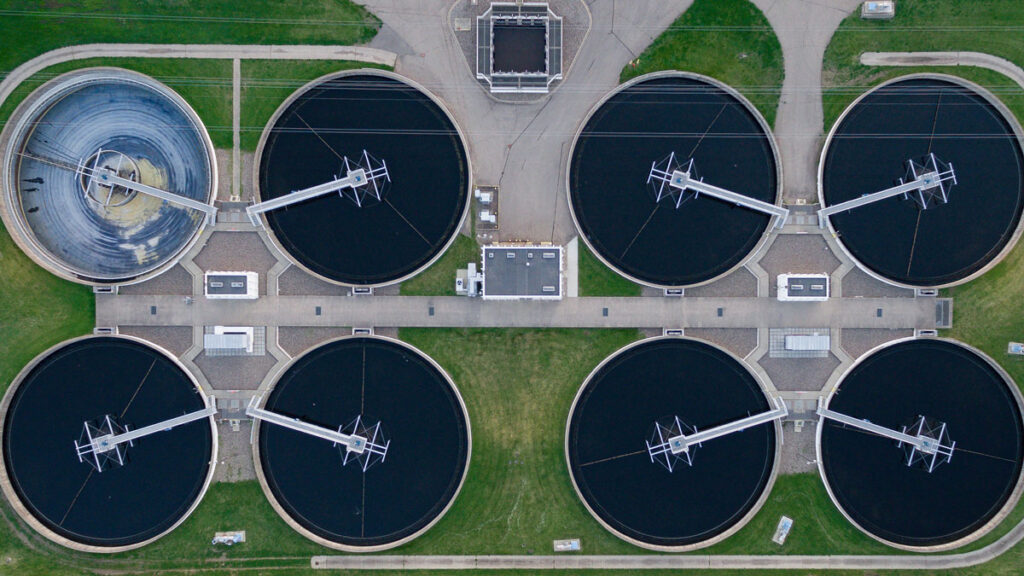
“Cities have started attempting to reduce their methane emissions, and we hope to be able to monitor this,” said Erica Whiting, a graduate student in climate and space science at the University of Michigan. Most efforts to account for urban methane emissions—from wastewater treatment plants, landfills, leaky natural gas infrastructure, and other sources—have relied on ground-based measurements and on inventories that estimate emissions on the basis of activities, said Whiting. Most of these studies have looked at a handful of cities, typically in North America and Europe.
In contrast, Whiting said her team’s study is one of the first to use satellite data to monitor urban methane emissions over time. Satellite monitoring offers long-term, often global, measurements and can provide a clearer picture of how mitigation efforts are developing.
Falling Short
A growing number of cities are aiming to reduce carbon emissions, and the new data show many of them are not on track.
A growing number of cities are aiming to reduce carbon emissions, and the new data show many of them are not on track. Whiting’s study included 92 cities around the world, including 51 members of a coalition called C40, which was founded in 2005. This 96-country coalition is working toward the goal of cutting greenhouse gas emissions by half by 2030, including a 34% decrease in methane emissions. These numbers are aligned with the goal of limiting global warming to 1.5°C over preindustrial levels.
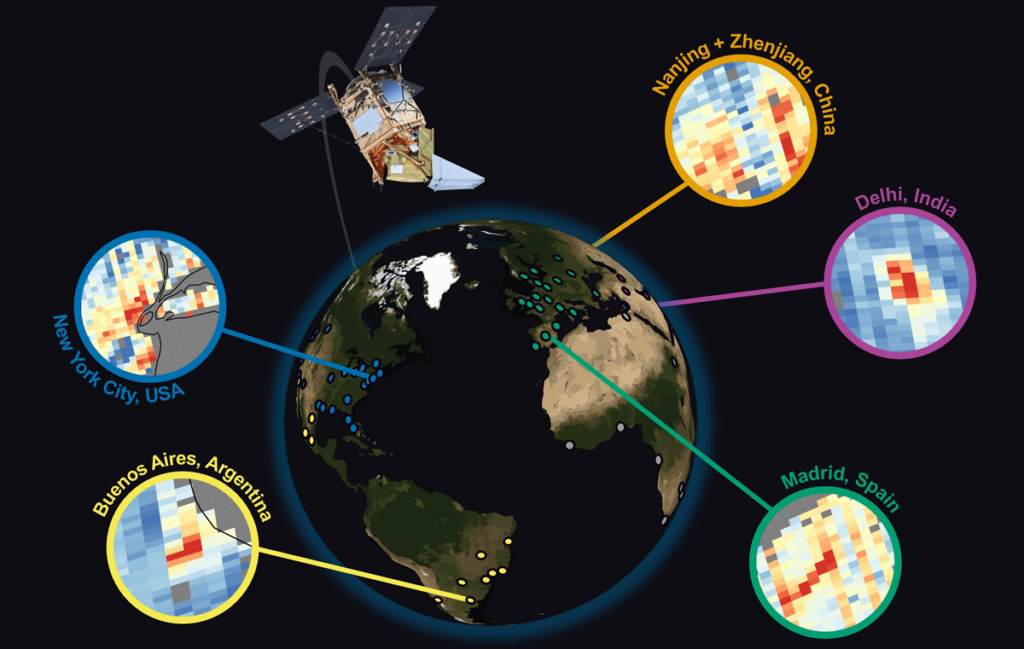
Whiting’s team analyzed methane data from the satellite-based TROPOMI (Tropospheric Monitoring Instrument) from 2019 to 2023. TROPOMI launched in 2017, making it possible to continuously monitor methane and other gas concentrations around the world. TROPOMI data showed that from 2019 to 2020, urban methane levels fell. But from 2020 to 2023, emissions grew 10% in C40 cities and 12% in non-C40 cities. The study focuses not just on urban centers but also on their outlying areas, where known methane sources such as landfills and wastewater treatment plants are often located.
The Tropospheric Monitoring Instrument (TROPOMI) aboard the Sentinel-5P satellite measures the potent greenhouse gas methane. In snapshots over urban areas, higher methane concentrations are depicted in warmer colors. Credit: Erica Whiting
The current study can’t point to what accounts for these trends, said Whiting. However, she said, urban populations grew during the study period, which could be a contributor to the cities’ growing emissions.
“In most regions of the world, there is no evidence that methane emissions from cities are decreasing at all.”
Rob Jackson, an Earth system scientist at Stanford University and chair of the Global Carbon Project, noted that it’s hard to know how to interpret the increase in emissions because the study period includes the era of the COVID-19 pandemic lockdowns, which caused major changes in people’s behavior and associated drops in anthropogenic emissions in 2020. (However, counterintuitively, the early 2020s actually saw a spike in overall methane emissions, which some scientists attribute to wetlands and changes in atmospheric chemistry.) Nevertheless, he said the data show that the world is not on track to decrease urban methane emissions. “In most regions of the world, there is no evidence that methane emissions from cities are decreasing at all,” he said.
“This work clearly shows that major cities worldwide are not reducing methane emissions at a rate consistent with the Global Methane Pledge,” Jackson said. This international agreement, made in 2021, has reduction goals that align with those of the C40 coalition: decrease global methane emissions by at least 30% relative to 2020 levels by 2030. The European Commission and 159 countries are participating in the pledge.
Whiting hopes better data will help. City and regional governments can use data from satellites to support and monitor ongoing efforts to lower methane emissions. “We’re excited to have this approach to monitor changes, and it should be useful for urban planning,” she said.
Zachary Tofias, director of food and waste at C40 Cities, noted via email that the organization was not involved with the design of the study. He pointed to several recent large-scale composting and other waste management facilities recently commissioned by member cities that should help bring down methane emissions going forward. The increasing availability of satellite and aerial monitoring data, he said, “provides an amazing additional tool for cities and facility managers to understand and address methane leaks from waste-disposal sites.”
Citation: Bourzac, K. (2026), Urban methane emissions are rising, despite cities’ pledges, Eos, 107, https://doi.org/10.1029/2026EO260143. Published on 8 May 2026.
“I’ve just always felt like art and science are flip sides of the same coin.”
Scientists use tools ranging from models to microscopes to make sense of the world around them. Some might say artists do the same thing using tools such as paintbrushes and musical instruments.
“I’ve just always felt like art and science are flip sides of the same coin, with maybe different outcomes or different processes, but they’re both just getting at the truth of the world,” said Sara Bouchard, a sound artist and composer and adjunct faculty member in the Department of Kinetic Imaging at Virginia Commonwealth University’s (VCU) School of Art.
A recent National Science Foundation–funded collaboration between scientists and artists brought this principle to life.
In fluxART, artists partnered with scientists from FLUXNET, an international network of researchers using eddy covariance techniques to measure how gases move between ecosystems and the atmosphere.
Researchers and artists collaborated on art projects based on data collected at FLUXNET towers. A view from the top of one such tower near Sisters, Ore., is seen here. Credit: Alexander Irving
The scientist-artist pairs worked together in yearlong residencies and produced art pieces—ranging from music compositions and video installations to ceramic works and paintings—that they presented at the Patricia Valian Reser Center for the Creative Arts in Corvalis, Ore., in early 2026.
“Part of the framing of the residency was around flux as this metaphor for connection and belonging and relationships.”
“The metaphor that people use to describe what this science network measures, or does, is that it’s monitoring the breath of the biosphere,” said Maoya Bassiouni, an environmental scientist at the University of California, Berkeley, who directed and developed the residency. “Those fluxes are sort of this giving and receiving between the land and the atmosphere, and it’s exactly what the scientists are doing in the community. So, part of the framing of the residency was around flux as this metaphor for connection and belonging and relationships.”
Bassiouni, who also created artworks in the residency, presented a lecture about the series alongside two other fluxART artists in late May at the National Center for Atmospheric Research’s (NCAR) Mesa Lab in Boulder, Colo.
An installation at NCAR’s Mesa Lab Library featuring all four fluxART projects also opened on 27 May and will be on display through the end of 2026.
En Masse
Bouchard, the sound artist, was paired with Chris Gough, a biogeochemist who serves as the executive director of the Rice Rivers Center at VCU.
Gough studies how factors such as climate and disturbances affect ecosystems, particularly forests and wetlands. Bouchard learned more about Gough’s work by spending a year in his lab.
Virginia Commonwealth University’s Rice Rivers Center Marsh, an AmeriFlux site whose data were used in this project, is located along the James River, seen here. Credit: Megan May Photography
The result was a composition for choir and percussion called En Masse, which explores the connections between communities and ecosystems in a time of climate crisis. The piece’s five movements represent the movement of carbon through the environment: “Air,” “Wood,” “Soil,” “Fire,” and “Breath.”
In addition to vocals and instruments, the composition features birdsong, recordings from a compost pile, sonified data from Gough’s lab, and spoken words gathered from real people sharing their climate anxieties. An excerpt from the “Fire” movement reads,
Future! / Heavy weight on my ribcage / dusty, fragmented Fire! / Clenched jaw, copper taste in my mouth / stark, shifted Fire! / I worry about my kids / desperate, unbreathable Fire! / and their future / squeezed, extreme Future! Fire! Fire! Fire!
Both Bouchard and Gough said they were moved by the piece as it was performed in Corvalis and by seeing the mix of artists and scientists who attended, many traveling from other states.
“I was struck by how engaged both the scientific and artistic communities were,” Gough said. “We walked out, and it was a full room of people. It was energizing, and I think it felt meaningful in a way that stepping up on a conference stage to deliver the traditional convention talk [isn’t].”
September: Orange
In another pairing, video artist Julia Oldham partnered with Christopher Still, a plant ecophysiologist at Oregon State University.
The partnership started with Oldham visiting a 175-foot-tall (53-meter-tall) FLUXNET tower near Sisters, Ore., that Still and his team monitor.
Video artist Julia Oldham visited a FLUXNET tower near Sisters, Ore., with scientist Christopher Still in preparation for creating an art piece based on data gathered at the tower. Credit: Alex Irving
At the top of the tower, a PhenoCam takes photos of the surrounding Deschutes National Forest every half hour. Still uses data from these images to examine how the greenness of the canopy changes over time because such changes can provide information about fluxes in carbon, water, and energy.
“I learned more about what Chris uses the PhenoCam for and got superexcited about the fact that Chris is using color data to understand forests,” Oldham said. “I thought that that was a really beautiful point of overlap for us as a scientist and an artist, to think about color and forests and what we can learn from color as a scientific tool.”
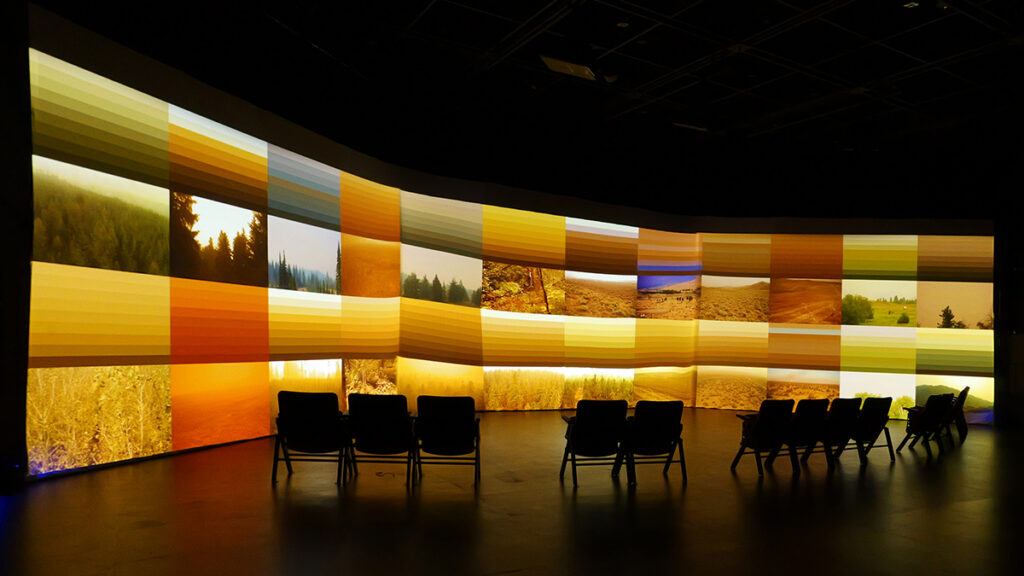
The pair created two pieces. 18//Flux shows how the colors and light from one PhenoCam site changed from 4 a.m. to 9 p.m. throughout the year for 13 years. Each frame is divided into 13 strips, with each strip representing 1 hour of the monitoring period.
The two had conversations throughout the duration of the project about the growing role of wildfires in the area. In fact, one of the FLUXNET towers they were using in the project burned down.
Their conversations led to September: Orange, a three-channel video showing footage from 24 different PhenoCams in the northwestern United States and Canada. When all of the landscapes are the same shade, the video briefly pauses. In September, when wildfires sweep through Cascadia, orange becomes the dominant color. The piece is accompanied by field recordings from Oregon forests and sonified canopy greenness data.
“I think the installation was a wild success, and I had a lot of people tell me how much they enjoyed it and appreciated it,” Still said. “Most people don’t respond to a 2D graph of data…whereas I think almost everyone responds to images, and photographs are really meaningful to people. So I think that is a really brilliant way to draw people into the science.”
Citation: Gardner, E. (2026), Artists and scientists partner to bring atmospheric data to life, Eos, 107, https://doi.org/10.1029/2026EO260178. Published on 3 June 2026.

 Login
Login