How Museums Became the Backdrop for Some of NYC’s Buzziest Restaurants


![]()
Gelato Pique’s spinoff cafes pique our interest with adorable ice cream and mochi treats.
From its name, you might assume that Gelato Pique is an ice cream brand, but it’s actually a Japanese apparel company that specializes in cute and cozy roomwear (including Pokémon designs). The company describes its aesthetic as being “inspired by sweet indulgences,” hence the “Gelato” part of its name.
However, there’s a lot of crossover between fans of comfy pajamas and relaxing cafes, so while it wasn’t Gelato Pique’s original plan, the brand has also been spun off into a Gelato Pique Cafe chain. This is where the brand’s linguistic atmosphere starts wrapping back on itself. Gelato Pique’s clothing has to be extra-cute in order to match the sweetness of its name, but that then means Gelato Pique Cafe’s customers are going to expect food and drinks on a higher level of photogenic cuteness than at other restaurants.
That’s a bar Gelato Pique Cafe is easily clearing, though with its Sea Animals sweets series.
![]()
Leading the way in this fresh wave of adorable eats is Gelato Pique’s original marine mammal crepe, the Mochimochi (“Chewy”) Seal Crepe, returning following its initial stint on the menu last summer. Wrapped inside the crepe are whipped cream, tiramisu cream, sliced mango, sliced almonds, and caramel sauce, and sitting atop it is a scoop of black sesame ice cream wrapped in mochi, with chocolate pieces to make the adorable seal’s facial features.
![]()
Joining the seal is the new Pukapuka (“Floating”) Otter Gelato, looking like a sea otter happily drifting about in the waves. Here too you get black sesame ice cream with chocolate pieces, and the critter’s hands are formed from black sesame-infused whipped cream.
![]()
There’s also the new Hinyari (“Chilly”) Walrus Crepe. Instead of black sesame, the ice cream topping here is a chocolate banana flavor, with chocolate for the eyes, nose and whiskers, and marshmallows serving as the tusks. Inside the crepe are tiramisu cream, sliced bananas, and caramel sauce.
![]()
And last, if you’re thirsty but still want something sweet, there’s the Purupuru (“Jiggly”) Penguin Soda Float. The base here is Ramune (an apple/citrus cider that’s a perennial summertime favorite in Japan) with fish-shaped pineapple gelatin pieces added. Floating atop the drink is a scoop of milk gelato, and standing on top of that is a penguin-shaped monaka wafer.
The Pukapuka Otter gelato cone is priced at 840 yen (US$5.40), the Purupuru Penguin soda at 890, and the crepes 1,290 yen each. They’ll all be available at Gelato Pique Cafe branches between now and July 1.
Related: Gelato Pique Cafe location list
Source, images: PR Times
● Want to hear about SoraNews24’s latest articles as soon as they’re published? Follow us on Facebook and Twitter!

When it comes to dessert, I maintain that the highest compliment is simple: it’s good and not too sweet. Of course, there’s a time and place for something rich and sugary. But for the everyday, I’m drawn to desserts that feel a little more balanced—just sweet enough to satisfy without tipping into overdone. This orange almond loaf cake is exactly that. It delivers on flavor and texture, but leans on healthy-ish ingredients that make it feel as good as it tastes.
It’s the kind of cake that works just as well with your morning coffee as it does as a late-night treat.

Sweet potato. The secret ingredient. It adds moisture and structure without relying on butter, and its natural sweetness pairs perfectly with the almond and orange.
Olive oil. Use a good-quality one—it brings richness and a subtle depth of flavor.
Maple syrup. Just enough sweetness, with a little warmth.
Coconut sugar. Adds a deeper, more caramel-like note. Brown sugar works here, too.
Orange zest. This is where the brightness comes from. Don’t hold back.
Eggs. Three, to bind everything together and give the loaf structure.
Almond extract. A small detail that makes a big difference—it enhances the flavor and gives the cake that signature almond depth.
Almond flour. The base of the cake. It adds moisture and a tender crumb.
Oat flour. Just enough to help everything hold together.
Baking powder + baking soda. For lift.
Salt. Essential for balance.
Sliced almonds (optional). For a little texture on top.
Demerara sugar (optional). Adds a subtle crunch and a lightly caramelized finish.
This cake comes together easily, but a few small details make all the difference.

This cake is just as good on its own, but a few simple additions can make it feel a little more special.
A generous swirl of whipped cream or full-fat vanilla yogurt adds richness, while a scoop of ice cream leans more dessert-forward. The orange flavor really shines here, so a spoonful of jam or fresh fruit works beautifully, especially with a drizzle of honey to finish.
PrintA citrusy orange almond loaf that hits that sweet spot and works any time of day.
Keywords: almond, loaf
The post This Orange Almond Cake Is My Latest Excuse to Eat Dessert for Breakfast appeared first on Camille Styles.

![]()
Says he did it for the social media views, but the police didn’t like what they saw.
A lot of things in Japan rely on the country’s ability to trust that people will be considerate and respectful. Perhaps nowhere is this more clearly displayed than in the existence of conveyor belt sushi restaurants, in which automated delivery of food to customers is carried out under the assumption that no one will do anything disruptive or unsanitary along the way.
In other words, one of Japan’s most popular restaurant genres is dependent on people refraining from behavior within the “jerk” and “jackass ” sections of the societal spectrum. Unfortunately that proved to be too tall a task for one man, who’s now been arrested after posting a disgusting video of his recent visit to Hama Sushi, one of Japan’s biggest conveyor belt sushi chains.
![]()
In the video, which the man posted to TikTok, he can be seen squirting liquid from a dish soap container, which he had brought to the restaurant with him, onto a plate of sushi. The video was recorded at a Hama Sushi branch in Saitama Prefecture and posted on May 27.
One week later, the Saitama Prefectural Police have not only identified the man who posted the video as an unemployed 43-year-old resident of the Saitama town of Moroyama, they’ve also arrested him on charges of forced obstruction of business.
There are a couple of aspects of the incident that warrant further discussion. To start with, the man did not squirt the liquid on sushi that was eaten by another customer. In recent years, in order to improve efficiency and provide fresher food, many conveyor belt sushi restaurants in Japan have done away with the old system of pre-making sushi pieces and sending them on plates down the belt to be grabbed by whoever wants them. Instead, the vast majority of the food, and at many conveyor belt sushi restaurants all of it, is made after the customer places an order, then sent down the belt and automatically stops at the table of the diner who ordered it. That was the case with the sushi the 43-year-old man squirted the liquid onto, as in the video he uploaded the plate has stopped on the belt at his table, and in the video he can be seen taking the plate off the belt and placing it on his table.
However, the plate was still on the lane when he squirted it, opening up the possibility of whatever the liquid was splashing onto other plates or parts of the restaurant where it could come into contact with other diners’ food. The man, who has admitted to recording and posting the video and said his motive was “to get a lot of views on social media,” claims that he had emptied the dishwashing liquid container and refilled it with water prior to squirting it on the sushi, though this isn’t something that can be easily confirmed after the fact.
One could, perhaps, make the argument that regardless of whether the liquid was dish soap, water, or something else, as long as the man ate the sushi himself, or simply left it uneaten so that it would be thrown out when the restaurant staff cleaned the table, that he didn’t do anything wrong, just something weird and potentially damaging to his own stomach. However, by posting the video online, his actions could be seen as damaging to the reputation of Hama Sushi. Any suggestion of unsanitary conditions is extremely damaging to a conveyor belt sushi restaurant, and by extension the chain and even the entire industry.
A rash of conveyor belt sushi “prank” videos occurred in 2023, but though things have quieted down since then, the Moroyama man’s actions are definitely not the sort of thing businesses, the police, or the general public have any patience for anymore. “[His] actions are utterly unacceptable” said Hama Sushi’s parent company Zensho in a statement, while promising to provide all possible cooperation in the investigation and legal procedures.
Source: Livedoor News/Kyodo, Nitele News, FNN Prime Online
Top image: Pakutaso
Insert image ©SoraNews24
● Want to hear about SoraNews24’s latest articles as soon as they’re published? Follow us on Facebook and Twitter!
:max_bytes(150000):strip_icc():format(jpeg)/Popeyes-Big-Box-060126-55b6e32c2fb3475ca4c671ebbc0beda7.jpg)

© <p>Courtesy of Popeyes</p>

By the time spring arrives, I’m ready to move on from the heavier meals of winter and into something that feels a little lighter, a little brighter, and a lot more energizing. Enter: spring salad recipes that will actually keep you full and energized,
Because the best salads aren’t just a pile of greens—they’re layered with texture, flavor, and enough substance to carry you through your day. Think crisp vegetables, fresh herbs, and protein-forward ingredients that make these feel like real meals, not an afterthought.
Below, I’ve rounded up my favorite fresh spring salads—from light, citrusy bowls to hearty, grain-based options—all designed to celebrate the season and leave you feeling your best.
This salad hits that perfect balance of fresh and deeply satisfying. Juicy, garlicky steak layered over crisp, colorful vegetables and tossed in a sharp shallot vinaigrette. It’s hearty, protein-rich, and exactly what you want when you’re craving something substantial without feeling heavy.
Golden, seared halloumi adds that perfect salty bite against fresh greens and seasonal vegetables. It’s warm-meets-crisp, with enough richness to turn a simple salad into something memorable.
Earthy lentils meet crisp vegetables and a sharp vinaigrette for a salad that feels grounded but not heavy. It’s packed with plant-based protein and holds up beautifully.
Salty feta, creamy beans, and a punchy lemon relish come together in a way that feels both simple and special. It’s bright, bold, and filling enough to stand on its own.
A little crunchy, a little creamy, and deeply satisfying, this is kale at its best. The white beans add substance, while the dressing softens everything just enough. Trust me, it’s crave-worthy.
This is the kind of pantry-friendly salad that somehow tastes far more elevated than it should. Creamy white beans and olive oil-packed tuna create a satisfying base, while herbs and acid keep everything feeling vibrant and fresh.
Flaky salmon, crisp greens, and a bright, citrusy finish make this one feel equal parts light and grounding. It’s rich in protein and healthy fats, so you get that fresh, springy energy—without the mid-afternoon crash.
Peppery radish, crisp fennel, and juicy grapefruit strike that perfect balance of sharp and refreshing. Each bite wakes up your palate, making this one feel like spring in its purest form.
Shaved zucchini feels delicate but holds its own with a bright, zippy dressing and just the right amount of texture layered in. It’s elegant without trying too hard—perfect for when you want something fresh but a little elevated.
Sweet snap peas bring that unmistakable spring crunch, paired with fresh herbs and a light dressing that lets everything shine. It’s simple, crisp, and exactly what you want on a warm afternoon.
Cool cucumbers and golden, crunchy rice create an endlessly satisfying texture contrast. Tossed in a punchy, flavor-packed dressing, this is the kind of salad you keep going back to for “just one more bite.”
Sweet peas and fresh mint are a natural pairing that never gets old. Light, bright, and just a little nostalgic, this one captures everything we love about spring in a single bowl.
Thinly shaved fennel brings a subtle sweetness and crunch, lifted by citrus and herbs. It’s clean, understated, and the perfect reset alongside richer dishes.
This is your everyday green salad, reimagined. The sesame dressing adds depth and richness, turning a bowl of greens into something craveable.
Grilling romaine transforms it completely—adding a subtle smokiness that makes this feel unexpectedly indulgent. Finished with a bright dressing, it’s simple but far from basic.
Chewy farro, sweet tomatoes, and plenty of herbs make for a salad that feels effortless but incredibly well-balanced—equally suited for dinner parties or weekday lunches.
Earthy beets and nutty farro create a deeply satisfying base, while fresh herbs and acidity keep it from feeling too heavy.
A mix of crisp greens and peak-season fruit makes this feel endlessly adaptable. It’s the kind of salad that works with whatever you have on hand.
Creamy avocado meets tart grapefruit for a combination that’s both refreshing and satisfying. It’s bright and clean, with just enough richness to keep you coming back for another forkful.
Juicy strawberries and creamy burrata are a pairing that feels almost too easy—until you taste it. With a hit of herbs and acid, it’s sweet, savory, and unmistakably seasonal.
This post was last updated on April 22, 2026, to include new insights.
The post 20 Spring Salads That Actually Fill You Up (Yes, Really) appeared first on Camille Styles.

![]()
KFC set out to recreate the image of three parts of the U.S. in sandwich form, and it looks like they hit at least one bullseye.
People in Japan are well aware that KFC originated in the U.S. Seeing as how Kentucky doesn’t get a lot of international tourists or pop culture attention, though, very few Japanese people have any strong impression of Kentucky Fried Chicken’s home state, to the extent that most Japanese people call KFC itself simply “Kentucky.”
So for the trio of sandwiches KFC Japan is adding to its menu, collectively named “The American Burgers,” they’re picked three other parts of the U.S. for their themes, saying that they want for them to be edible expressions of the image of America. That might sound like a challengingly abstract goal, but they might have nailed it with their Las Vegas “burger.”
![]()
I’ve put “burger” in quotes since it usually implies a sandwich with a either a ground meat patty or a bun, but the Las Vegas Style Double Down Fillet Burger has neither. Instead, it’s a pair of boneless fried chicken pieces being used to sandwich onion rings, a cheddar cheese slice, what appears to be a large dollop of mayonnaise, and a drizzle of barbecue glaze. KFC Japan describes the combined effect as “a guilty flavor,” and it absolutely looks like the sort of extravagant decadence one would wallow in while visiting Vegas, right down to the inevitable soul-searching self-questioning “Should I really have done that?” afterwards.
![]()
The other two members of the The American Burgers trio are less likely to trigger a review of your life choices, though they’re both definitely heavyweight meal options too. Picture above, the New York Style Onion Ring Fillet Burger scales itself back to one piece of boneless fried chicken and has a bun, but does keep the onion rings and cheddar cheese. The other key ingredient here is a garlic sauce which KFC boasts combines the umami properties of bacon and onion, with the goal of the sandwich, KFC Japan says, being to to deliver a hearty meal evocative of a New York diner.
And last, there’s the Texas Style Spicy Avocado Filet Burger. This one ditches the New York sandwich’s onion rings and garlic sauce, and instead gives you a diced avocado filling. This is sort of an unusual choice, linguistically/geographically speaking, since in America a burger with avocado is usually called a “California burger.” KFC Japan says the avocado filling is inspired by guacamole, but with an extra spicy kick added to it, and that Texas was chosen for the name as a symbol of guacamole’s popularity across the southern U.S.
![]()
With guacamole being at least as popular in California as it is in Texas, and having been introduced to the U.S. via Mexico, the “Texas” theming still feels a little off, and while New York is famous for its delis, it’s not necessarily any more known for diners than other large American city. Still, full marks to KFC Japan for capturing the excitement-to-potential-regret roller coaster of a Vegas bender in sandwich form.
The New York and Texas American Burgers are both priced at 580 yen (US$3.75), while the Vegas one is for higher-rollers at 790 yen. They’ll all be on sale for a limited time at KFC Japan branches starting May 27.
Source: KFC Japan via Shokuhin Sangyo Shimbunsha via Kinisoku
Images: KFC Japan
● Want to hear about SoraNews24’s latest articles as soon as they’re published? Follow us on Facebook and Twitter!

![]()
Combination of factors is dimming the shine of one of the stars of Japanese restaurant culture.
Izakaya are a unique part of Japanese food culture. Their closest analogy would be pubs, since izakaya serve a wide variety of alcoholic drinks and food meant to be paired with such beverages. Their menus are much more extensive than just basic bar munchies, though, with things such as yakitori chicken skewers, grilled onigiri rice balls, and plates of sliced sashimi being long-standing favorites. As a matter of fact, unlike with a pub, the expectation is that izakaya customers will always order some kind of food too, though there’s still a greater focus on drinks than at a regular restaurant.
However, izakaya are in a tough spot in Japan these days, and since the start of the year have been going bankrupt at a faster rate than at any time in nearly the past 40 years, according to a new study.
Data from Tokyo Shoko Research, a commerce and industry research organization, shows that between January and April of 2026, 88 izakaya have declared bankruptcy with debts of 10 million yen (US$65,000) or more. That’s 54.3 percent more than for the same period last year, and the highest number Tokyo Shoko Research has observed for the first quarter of the year since it began tracking such statistics in 1989, significantly more than the previous high of 59 in 2024.
So what’s causing the closures? A mix of factors, but one of the biggest is rising prices. Japan is experiencing by far its worst inflation in a generation, and costs for not just ingredients, but also for utilities, are hitting izakaya hard. Many are responding by reducing portion sizes, reworking recipes to make use of cheaper ingredients, or raising the prices they charge their own customers to make up the increased expenses. There are limits to how much of those tactics diners will put up with, though.
![]()
Facing rising costs for their own necessities such as rent, groceries, transportation, and home utilities, many consumers are becoming much more sensitive to the value they’re getting with the reduced amount of money they have left over for discretionary spending, and izakaya are looking a lot less appealing to many people than they used to. In particular, Tokyo Shoko Research points out that izakaya offers that include a full meal’s worth of food plus unlimited drinks for a period of time (usually 90 or 120 minutes), traditionally some of their most attractive deals, have gotten more expensive and now often cost more than 5,000 yen, a price point that many diners are balking at.
The study also highlights recent changes in dining/drinking patterns in Japan. Traditionally, izakaya have gotten much of their business from groups of coworkers coming in together, either as part of a pre-planned event such as a welcome party for new employees or an end-of-the-year celebration, or as spontaneous excursions to grab a drink after clocking out, sometimes after doing overtime and being too hungry/thirsty to wait until they can commute back home. However, those gatherings largely went away during the pandemic, and while many izakaya weathered that economic storm due to financial support from the government, the custom of coworkers going to drink together hasn’t rebounded to its previous level.
Part of that is due to more people working from home, something that was extremely rare in Japan prior to the pandemic. Many jobs now offer at least some telecommuting flexibility, meaning fewer people in the office, and so fewer people to go grab a cold Asahi with on the way to the station at the end of the day. There’s also been a gradual increase in desire for a more even work/life balance in Japanese society. Even many in management positions are now more aware that constant overtime chips away at morale and the company’s ability to retain workers, and have come to accept that many employees feel that, when overtime does have to be done, having to go drinking with your boss afterward doesn’t make up for it, but actually makes the situation even worse.
So when you combine higher prices, freedom from the obligation to go to izakaya with coworkers, and the possibility of already being at home when you clock out from work, having a drink in the comfort of your living room, and one you purchased at the supermarket for half of what an izakaya would have charged you, becomes a very compelling alternative.
▼ Especially when stores in Japan have not just beer, but a wide variety of canned cocktails too.
![]()
Ah, but what about inbound foreign tourists? Japanese cuisine is one of the top reasons travelers from overseas come to Japan, and with the yen remaining so weak, many visitors still feel like dining out here is a bargain compared to their home countries. Tokyo Shoko Research, though, says that izakaya aren’t drawing in foreign tourists to the same extent that other restaurants in Japan are.
The report doesn’t offer any theories as to why this is, but it likely has something to do with international foodies’ passion for Japanese food being strongly focused on specific dishes, such as ramen, sushi, or curry rice. While many izakaya do have tasty food, their broader menu makes them a little less likely to hook a traveler’s attention than, for instance, a restaurant whose storefront is plastered with signage featuring photo after photo of steaming hot bowls of ramen. Ordering at izakaya is also a little trickier to navigate. There aren’t any vending machines at the entrance to purchase a meal ticket from, and it can be hard for newbies to estimate how many plates of food to order for a filling spread. There’s also the whole otoshi custom of unasked-for appetizers that you still have to pay for, but aren’t told the price of in advance, which can be an unpleasant bit of culinary culture shock.
Izakaya, like all pubs, are about more than just base sustenance. In a sense, they’re a form of entertainment, and much like certain genres of music or movies fluctuate in popularity, there’s a chance that izakaya will bounce back. For now, though, the situation isn’t very rosy, so if you see one that looks intriguing, they’d probably really appreciate it if you came in for a drink and a bite to eat.
Source: Tokyo Shoko Research via Yahoo! Japan News via Jin
Top image: Pakutaso
Insert images: Pakutaso (1, 2)
● Want to hear about SoraNews24’s latest articles as soon as they’re published? Follow us on Facebook and Twitter!

A pressure cooker quickly transforms canned chickpeas, infusing them with Indian flavors and turning their texture from firm to irresistibly creamy. The vegan dinner gets the right amount of sauciness by draining one can of tomatoes and leaving one can undrained, plus tons of flavor from a finishing splash of canned full-fat coconut milk. To keep things quick and easy, pick up precooked rice — either frozen or in a shelf-stable pouch.
Ingredients
Directions
Set the Instant Pot to sauté and allow it to preheat for 2 minutes. Add the olive oil and swirl to coat. Add the onion and garlic and sauté for 4 minutes. Stir in the garam masala and cayenne pepper and cook, stirring constantly, for about 30 seconds, or until fragrant.
Drain the juice from one can of tomatoes. Stir both cans of tomatoes into the pot along with the chickpeas and salt.
Cover and lock the lid, setting the steam valve to sealing. Cook on high pressure for 10 minutes (the pot will take about 15–20 minutes to come to pressure).
When cooking is complete, carefully quick-release the pressure by turning the steam valve to venting. Remove the lid and stir in the coconut milk.
Serve the chickpea mixture over the cooked quinoa and garnish with cilantro, if desired.
Serves: 6 | Serving Size: 1/2 cup quinoa and about 1 cup chickpea mixture
Nutrition (per serving): Calories: 363; Total Fat: 12g; Saturated Fat: 6g; Monounsaturated Fat: 2g; Polyunsaturated Fat: 1g; Cholesterol: 0mg; Sodium: 585mg; Carbohydrate: 52g; Dietary Fiber: 10g; Sugar: 10g; Protein: 13g
Nutrition Bonus: Potassium: 771mg; Iron: 17%; Vitamin A: 1%; Vitamin C: 5%; Calcium: 5%
Originally published: February 23, 2020; Updated May 2026
The post Pressure Cooker Chickpea Tikka Masala appeared first on MyFitnessPal Blog.

![]()
Beefy gauntlet has been thrown down once again by Burger King Japan.
Burger King Japan understands that there are times when a regular-size hamburger just won’t cut it, which is why they offer what they call the One Pounder series, a line of sandwiches with four patties. Sometimes, though, a person’s bottomless well of burger love equals the infinite capacity of their stomach, and so for them, later this month Burger King Japan is offering all-you-can eat One Pounders.
![]()
First, let’s take a look at the exact kind of One Pounder that’s being served in the One Pounder Challenge, as the promotion is called. This is the Smoke House The One Pounder. Linguists might take the position that it really should be called the “The Smoke House One-Pounder,” but apparently all that beef leaves no room for such minute syntax or punctuation quibbles. In addition to four all-beef patties and cheddar cheese, the burger has both smoked bacon and a smoked bacon sauce. It looks like there might be some pickles in there too, but they appear to be the only things between the buns that aren’t meat, cheese, or sauce.
A single Smoke House The One Pounder weighs 545 grams, which converts to roughly 1.2 pounds, so its name is actually a bit of an understatement. It also packs 1,615 calories, so you may be questioning how many a person could possibly eat. Well, back in the spring, Burger King Japan also ran an all-you-can-eat Smoke House The One Pounder promotion, and the customer who ate the most put away 11 of them, which works out to 5,973 grams, or approximately 13.17 pounds, of burgers.
![]()
If you’re wondering where the break-even point is, Burger King Japan is charging 4,900 yen (US$31) for a 45-minute all-you-can-eat session, and with the Smoke House The One Pounder costing 2,790 yen when ordered off the menu normally, that would mean you’ll need to eat 1.75 of them to get your money’s worth. That calculation doesn’t take into account that the One Pounder Challenge also includes unlimited refills of French fries and soft drinks, though, so if you do manage to get to the 1.75-burger mark, you could say you’re actually coming out ahead. All entrants also receive a One Pounder Challenge 2026 T-shirt, Burger King Towel, and two stickers.
![]()
![]()
The One Pounder Challenge will take place daily from June 19 to June 26 at 80 Burger King Japan branches, with seatings at 2:30, 4, 5:30, and 7 p.m. Advance reservations must be made through the event’s website here, and seating is limited. Should you miss out on this chance, though, take heart that this is the second of three planned One Pounder Challenges for 2026, and they’ll be followed by a fourth promotion, the One Pounder Challenge 2026 Final, in December, with free tickets to the Final being given as prizes to the three customers who eat the most burgers at each of the first three One Pounder Challenges.
Source, images: PR Times
● Want to hear about SoraNews24’s latest articles as soon as they’re published? Follow us on Facebook and Twitter!

![]()
Watch the competition or sample multiple burgers in the sales area during this weekend celebration of gourmet burgers from around the world.
Although burgers are often associated with the U.S., we’ve got beef with anyone who says that a quality burger can’t be found in Japan. In fact, finding one is about to get even easier with the return of the prestigious Japan Burger Championship next month in its fifth edition. The event has attracted a total of 170,000 attendees over the past four years and promises to be a bun-believable showdown once again.
From June 12 through 14 at Yokohama’s landmark Akarenga Soko–otherwise known as the Red Brick Warehouse–visitors can enjoy a variety of festivities related to gourmet burger appreciation, which includes watching the competition, sampling a variety of burgers, and voting on which burger should be crowned the inaugural winner of the new Sales Division Award for the best gourmet burger being sold in the sales area. Entrance to the event is free, though individual food and drink purchases are not.
![]()
For the competition portion of the event, 12 competitors from around Japan who have already passed an initial screening round will take part in the semifinals on June 12 and 13, after which the top six will proceed to the finals on June 14. This year’s theme for the finals is “Energy Burger,” and competitors will be expected to concoct a gourmet burger that can be eaten for stamina in the hot summer. The overall winner of the competition earns the honor of becoming the Japanese representative to compete in the Hamburger Category for the World Food Championships to be held in the U.S. in October.
▼ Flow of the competition
![]()
At the same time as the competition, 27 gourmet burger shops will be in full operation in the sales area for visitors to conduct their own taste tests. The representatives include a mix of international gourmet burger chefs, past competition winners, famous steakhouses, and Japanese chefs making use of local and regional ingredients from their areas of origin. Some will even offer burgers crafted exclusively for this event.
While we’ve never encountered a burger that we couldn’t topple, we also understand that visitors will likely want to sample as many burgers as possible. Thankfully, the event has designed a system for visitors to request cutting a full burger into either halves or quarters or a half-burger into halves for a small additional fee. This makes for the perfect solution to share with family and friends so everyone doesn’t fill up on one shop’s burger alone. Anyone who is really up for the full undertaking, however, can participate in a social media challenge by taking a photo of a burger (full or half-sized OK) from every single shop and posting it on social media with a special hashtag. Anyone who clears this test will receive a limited prize–and as a bonus, the profound respect of the SoraNews24 writing team.
▼ A variety of ways to share burgers for a small additional fee (an extra 200 yen for a full burger cut into quarters, or 100 yen for the other options)
![]()
For a sneak peek of what you may want to taste test, pictured below are two previous Japan Burger Championship winners that will be selling their culinary crafts in the sales area. The 2024 champion, Harry’s Junction from Miyagi Prefecture, has a burger that combines the local zunda (sweetened, mashed edamame) specialty with sour cream (it’s also one of the 12 semifinalists competing in this year’s championship!). Meanwhile, the 2025 champion Brisk Stand from Hyogo Prefecture is offering a double cheeseburger with alternating layers of cheddar cheese and onions.
▼ Burgers from Harry’s Junction (top) and Brisk Stand (bottom)
![]()
A handful of gourmet burger shops from abroad will also be on site, including:
● One More The Burger House Dubai (UAE): Making its Japanese debut, the shop that previously won first place in the World Food Championships offers a burger featuring Japanese-style milk buns infused with truffle fragrance and wild arugula.
● Melting Soul (South Korea): This shop won the 2023 Korean Championship with its two smash patties, thick cheese, and bacon skirt gourmet burger.
● Zesty Saloon (South Korea): This shop won the 2026 Korean Championship with its smash patty, double cheese, and bacon skirt gourmet burger.
▼ Burgers from One More The Burger House Dubai (top), Melting Soul (middle), and Zesty Saloon (bottom)
![]()
For anyone who reaches their burger limit (if such a state of satiation is even possible), the event will also have plenty of fries, sweets, and drinks for you to order while you give your stomach a burger break.
![]()
Finally, food isn’t the only thing on the menu as several forms of entertainment will also be available to enjoy. For instance, Yokohama-based rock band Aonowa will hold a live performance on June 13 at 10:30 am at the venue.
▼ Aonowa
![]()
Other family-friendly activities will be the chance to see the elite, all-female White Angels police motorcycle unit and a performance by the 35-member Kanagawa Prefectural Police Band.
![]()
This isn’t the first time that the Akarenga Red Brick Warehouse has hosted a large-scale gastronomic event, and we certainly hope that it won’t be the last. We’re certain that the Japan Burger Championship 2026 is going to be well done, too.
Event information
Japan Burger Championship 2026 / グルメバーガー日本一決定戦
Address: Kanagawa-ken, Yokohama-shi, Naka-ku, Shinko 1-1-1, Red Brick Warehouse (Event Plaza A/B)
神奈川県横浜市中区新港 1-1-1 横浜赤レンガ倉庫(イベント広場A/B)
Duration: June 12-14, 2026
● Friday, June 12: 11 a.m.-9 p.m. (food last orders at 8 p.m., drink last orders at 8:30 p.m.)
● Saturday, June 13: 10 a.m.-9 p.m. (food last orders at 8 p.m., drink last orders at 8:30 p.m.)
● Sunday, June 14: 10 a.m.-8 p.m. (food last orders at 7 p.m., drink last orders at 7:30 p.m.)
Website
Source, images: PR Times
● Want to hear about SoraNews24’s latest articles as soon as they’re published? Follow us on Facebook and Twitter!.

If there’s one thing Italians do best, it’s embracing the simple pleasures of the season—and in summer, that means pastas bursting with sun-ripened flavors that are meant to be savored slowly. This collection of veggie-forward recipes captures the carefree spirit of an Italian estate: juicy burst tomatoes, tender zucchini, creamy lemon-scented ricotta, and market-fresh roasted vegetables that take center stage. They light pasta recipes are unfussy and come together with just a few ingredients—perfect for long lunches or spontaneous dinners at golden hour. Light and satisfying, these are the pastas you’ll have on repeat all summer long.
We love how this recipe takes pantry staples and turns them into something that feels instantly vacation-worthy. With juicy cherry tomatoes, briny sun-dried tomatoes, and plenty of basil, it’s a low-lift pasta that captures the best of warm-weather cooking.
When zucchini is everywhere, this is exactly how we want to use it. It’s simple, vibrant, and made for twirling up on the patio while pretending you’re somewhere along the Italian coast.
Creamy but never heavy, this pasta strikes the perfect warm-weather balance. The ricotta creates that silky texture, while lemon and greens bring the fresh, summer energy we’re always craving.
We love this recipe for that late-summer moment when the produce drawer is overflowing, and dinner needs to feel simple and satisfying. Everything roasts on one sheet pan, then gets tossed with pasta, parmesan, and basil for an easy bowl that still feels special.
This recipe is proof that great pasta doesn’t need a long ingredient list. With blistered broccolini, thinly sliced garlic, bright lemon, and a shower of parmesan, it’s the kind of low-effort dinner that tastes like you did far more than you actually did.
This pasta salad is everything we want from an Italian summer lunch: juicy tomatoes, creamy mozzarella, fresh basil, and a sun-dried tomato dressing that ties it all together. It’s simple, colorful, and made for serving chilled with something sparkling nearby.
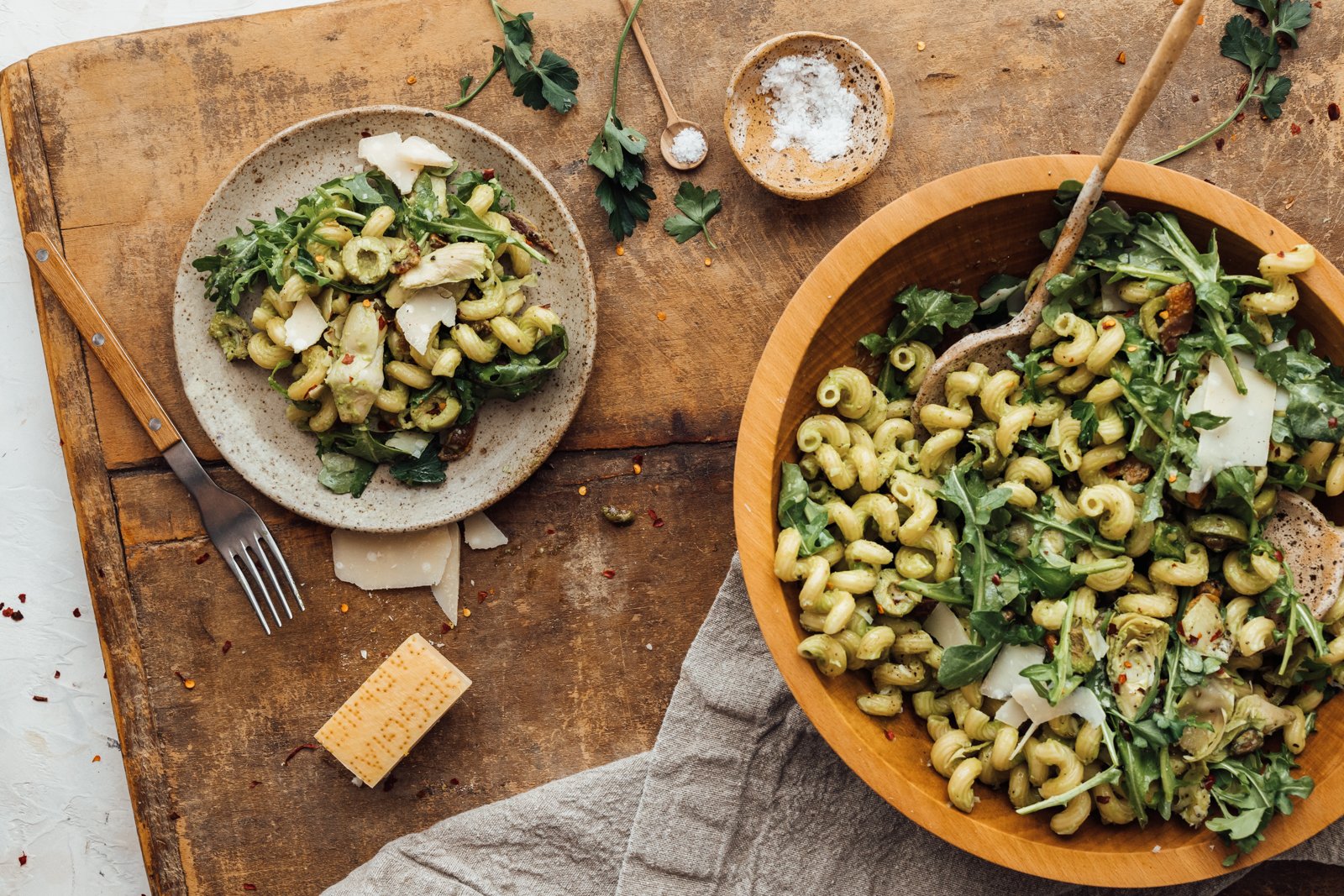
Equal parts easy lunch and crowd-ready side, this pasta salad does it all. The mix of artichokes, olives, parmesan, and herbs gives it that effortless Italian-inspired flavor we crave as soon as the weather warms up.
Think of this as the lighter, brighter cousin of mac and cheese. Parmesan and cream bring the comfort, while asparagus, peas, kale, and zucchini add color, freshness, and enough substance to make it a full meal.
A bowl of green pasta has never felt so comforting. With parmesan, pine nuts, olive oil, and a little heat from red pepper flakes, this broccoli pesto pasta turns a humble vegetable into something rich, vibrant, and totally family-friendly.
This dish proves that a healthy pasta can still feel completely indulgent. It’s loaded with greens and cruciferous veg, but the garlic, parmesan, olive oil, and walnuts make it taste like something you’d order at a cozy neighborhood trattoria.
This one-pot pasta brings all the cozy, savory flavor of sausage and mushroom pizza into a weeknight-friendly bowl. Crispy mushrooms, garlicky Italian sausage, peppery arugula, parmesan, and lemon come together in a light sauce that feels rich without being too heavy.
This post was last updated on May 26, 2026, to include new insights.
The post Summer Pasta, the Italian Way: 11 Recipes Worth Slowing Down For appeared first on Camille Styles.