Taylor Swift and Travis Kelce’s wedding venue is still a mystery. Read our best guesses for where they might get married, from Rhode Island to New York City.
Taylor Swift and Travis Kelce’s wedding venue is still a mystery. Read our best guesses for where they might get married, from Rhode Island to New York City.
About 14.7 million American children under age 6 have all their parents working, so most spend their days outside the home, usually in child care. These settings have an environmental impact that many parents never notice, including diapers, food waste, cleaning products, art supplies, packaging, and the indoor air children breathe for hours each day.
Daycare is one of the most important places in a young child’s life. The habits children learn there, like how they deal with waste, connect with
About 14.7 million American children under age 6 have all their parents working, so most spend their days outside the home, usually in child care. These settings have an environmental impact that many parents never notice, including diapers, food waste, cleaning products, art supplies, packaging, and the indoor air children breathe for hours each day.
Daycare is one of the most important places in a young child’s life. The habits children learn there, like how they deal with waste, connect with nature, and what they expect from their food, often come home with them. This means a daycare’s approach to sustainability matters for families, not just for the center itself. The good news is that about 70% of a typical preschool’s waste can be reused, recycled, or composted, so most centers can make big improvements without spending a lot.
This guide explains what to look for in a daycare, how to encourage changes at your child’s current center, and which areas—like diapers, food, indoor air, and outdoor time—parents can influence most.
The Footprint Nobody Talks About
Diapers are a huge part of the problem. Americans throw away about 20 billion disposable diapers each year, adding up to around 3.5 million tons of landfill waste. They are the third most common consumer item in U.S. landfills. The EPA says each diaper can take up to 500 years to break down and releases methane as it decomposes.
Food waste is also a big issue in early childhood settings. One U.S. study found that childcare programs throw away about 43% of the food they serve. A Finnish study showed that childcare centers waste more food per meal than restaurants or schools. When you add this up across thousands of centers, the loss of resources like carbon, water, and money is huge.
The largest U.S. study to measure environmental contaminants in childcare facilities found formaldehyde levels exceeded California’s chronic exposure guideline in 87% of centers tested, and indoor particulate matter exceeded 24-hour standards in nearly half. Sources include cleaning products, air fresheners, off-gassing furniture, art supplies, and pesticides used inside the building. Children, who breathe more air per pound of body weight than adults do, absorb more of the toxins they inhale. Most daycares have limited budgets and staff who are already busy. Still, small changes across many centers can make a big difference. Parents who notice these problems can help centers that want to improve but need support.ds an ally.
If You’re Still Choosing a Center
A center’s commitment to sustainability during licensing often shows how they operate every day. When you visit, ask clear questions. For example, “Do you compost food scraps?” gives you more information than asking, “Are you eco-friendly?”
Questions worth asking on a tour:
How is food waste handled — composted, donated, or trashed?
What cleaning products do you use, and are they third-party certified?
How much time do children spend each day outdoors, and in what conditions?
How are art supplies, books, and toys sourced — new each year, or rotated and shared?
Do you have a recycling system the children participate in?
What’s your policy on pest control and air freshening?
One credible signal to look for is the Eco-Healthy Child Care endorsement, a national program from the Children’s Environmental Health Network that has endorsed more than 1,500 facilities across the U.S., Canada, and Australia. Endorsed centers comply with at least 24 of 30 best practices covering pesticides, lead, art supplies, plastics, cleaning chemicals, and outdoor exposure. The program’s standards have been adopted by the National Association for the Education of Young Children as part of its accreditation criteria, and several states (Maryland, Pennsylvania, Utah) recognize it within their quality rating systems.
If a center can’t give specific answers to your sustainability questions, that tells you something. It doesn’t mean you should rule them out, but it suggests that any green changes may need to start with parents.
If Your Child Is Already Enrolled
Begin by talking to the director, not the classroom teacher. Directors make decisions about purchases, vendors, and staff training. Bring specific suggestions instead of general concerns. For example, asking, “Would you consider switching to a third-party-certified cleaning product?” is helpful, while “Can you be greener?” is too vague.
It helps to assume the director wants to improve but faces real limits. Offer to help with the work. Most centers will accept support that they don’t have time to organize on their own.
Rethinking the Diaper Question
If your center only allows disposable diapers, ask for the reason. Some states have strict rules about cloth diapers in group care, but many centers use disposables simply out of habit, not because of regulations.
Cloth diaper services, which handle laundry and delivery in bulk, address most of the staffing and hygiene worries that make centers choose disposables. More centers now accept plant-based or biodegradable disposables, which use less plastic but still go to landfills. These are better, but not a complete solution.
If your center won’t change its diaper policy, try suggesting a diaper recycling program if one is available nearby. Industrial diaper recycling is still uncommon in the U.S., but it exists in some parts of Europe and is growing.
Food Waste and What Kids Actually Eat
Food waste reduction is the single most effective change centers can make. It saves money, lowers methane emissions from food in landfills, and, when done openly, teaches children about food sources and the meaning of waste. Centers usually overestimate how much children eat and underestimate how much is thrown away. Simply starting to measure food wasted each day alone tends to drive a 20–30% reduction. A few tips can help:
Serve family-style. Children who serve themselves take less and eat more of what they take, compared to pre-portioned meals.
Compost on-site or partner with a local hauler. Many municipalities now have small-business composting service.
Source from local farms when seasonal and affordable. CACFP-funded programs have flexibility here that many directors don’t realize.
When packing food from home, stick to the basics: whole fruit is better than packaged slices, reusable containers are better than single-use bags, and a thermos of water is better than a juice box. The goal isn’t perfection, but to cut down on single-use packaging, which makes up a big part of a center’s daily waste.
The Indoor Air Conversation
Improving indoor air is where parent advocacy can make the biggest difference for children’s health. Most directors are open to change once they understand the issue. Children spend over 90% of their time indoors, and the air quality depends on choices about cleaning products, furniture, art supplies, and pest control.
Concrete requests that work:
Switch to Green Seal- or EPA Safer Choice-certified cleaning products. They cost roughly the same as conventional products and dramatically reduce exposure to volatile organic compounds.
Eliminate air fresheners and scented plug-ins. “Fragrance” can include hundreds of undisclosed chemicals, and the underlying odor problem is almost always solved better by ventilation.
Adopt integrated pest management instead of routine pesticide spraying. IPM uses traps, sealing, and sanitation first; pesticides are a last resort.
Choose water-based, low-VOC paints and finishes during any renovation.
Open windows when the weather allows. Mechanical ventilation in older buildings is often inadequate; outdoor air, even in mild urban areas, is usually cleaner than indoor air, which is often laden with cleaning residues and off-gassing from furniture.
These changes are inexpensive, easy to implement, and directly improve children’s breathing health. They also usually lower the number of sick days, which directors appreciate.
The case for getting children outside has shifted from a wellness argument to a developmental one. A 2022 review of nature-based early childhood education found consistent positive associations with self-regulation, social-emotional development, nature-relatedness, and play interaction. A 2024 study at the University of Minnesota Duluth found that nature-based preschool practices supported self-regulation development, particularly for children from lower socio-economic backgrounds.
This is important because outdoor time is often the first thing dropped when schedules get busy. Speaking up for outdoor time and helping make it easier for the center supports both sustainability and better education.
Practical contributions parents can make:
Help build raised garden beds. Children who grow food eat more of it and waste less.
Donate weather gear. Many centers cite “the kids don’t have rain boots” as a real barrier.
Organize a parent work day. Remove invasive plants and add native species to outdoor play areas.
Source loose parts for playgrounds. Logs, stumps, and large stones support unstructured nature play.
What You Can Pack from Home
What you do as a parent may not have as much impact as center-wide changes, but you can control it. The goal is to reduce single-use packaging in your child’s daily routine.
Stainless steel or silicone snack containers. They survive being dropped, kicked, and chewed.
A reusable water bottle. The juice-box equivalent in landfill waste over a daycare year is striking.
Whole fruit instead of pre-cut packaged fruit cups.
Cloth napkins or beeswax wraps in lunchboxes.
Send clearly labeled hand-me-down clothes. Daycares go through clothing faster than almost anywhere else.
Helping the Center Help Itself
Most U.S. daycares are small, independent, and have limited funding. The average child care worker earns about $14.60 an hour. Free help and materials are not just appreciated; they are often the only way a center can start a sustainability project.
Donations that make the biggest difference include:
Children’s books about nature, recycling, and food systems for the classroom library.
Clean recyclable materials — cardboard tubes, egg cartons, glass jars — for art projects and sorting activities.
Compost bins, indoor recycling stations, or rain barrels.
Native plant starts from your own garden in spring.
But don’t forget to donate time:
A Saturday building or repairing outdoor play structures.
Running a parent fundraiser specifically for a sustainability upgrades, such as air purifiers, a compost system, and raised beds.
Connecting the director with your municipal recycling or composting program.
When the Center Pushes Back
Some directors will see your interest as helpful, while others may feel it questions their judgment. Both responses are understandable. How you frame the conversation often decides whether it is productive or not. What tends to work is an offer, not a demand: “I’d love to help with this — what would make it easier for you?
If a center keeps refusing to discuss sustainability and it’s important to your family, that tells you something about whether it’s the right fit. Choosing a daycare is a major decision about your values, so it’s worth careful thought.
No single parent or center can solve the issue of daycare sustainability alone. But when parents ask good questions, offer real help, and choose centers that care, it adds up. This is already changing the industry.
Editor’s Note: Originally published on May 21, 2021, this article was substantially updated in May 2026.
Checking In is Coveteur's insider review series of the best, buzziest, most fashionable hotels and properties around the world.
If you're even moderately online, there's a good chance you caught the celebrity "christening cocktail" posts from Luminara, a Ritz-Carlton superyacht, last June: Martha Stewart, drink in hand, in a bright-yellow Dianna Singh caftan; Kendall Jenner smiling next to Nina Dobrev and Kate Hudson; Alix Earle posting about chipping her veneer as she films a GRWM for that nig
Checking In is Coveteur's insider review series of the best, buzziest, most fashionable hotels and properties around the world.
If you're even moderately online, there's a good chance you caught the celebrity "christening cocktail" posts from Luminara, a Ritz-Carlton superyacht, last June: Martha Stewart, drink in hand, in a bright-yellow Dianna Singh caftan; Kendall Jenner smiling next to Nina Dobrev and Kate Hudson; Alix Earle posting about chipping her veneer as she films a GRWM for that night's white party. It was the yacht party seen around the world. So, when the Ritz-Carlton Yacht Collection invited me for a three-night voyage on the Ilma, Luminara’s equally glamorous sister vessel, I packed my bags and flew to San Juan, just a quick four-hour flight away from New York.
I was on board the Ilma for three nights, and by day two I had already mentally rearranged my entire travel calendar to figure out how to get back as fast as humanly possible. By day three, I had stopped checking my phone. There was too much to look at: the sun sinking below the pink horizon at golden hour, Johanna Ortiz's cheery prints splashed across Decks 9 and 10, my second Coconut Veil cocktail sweating gently in my hand. Physically, I'm writing this back in New York as the city struggles to break 70 degrees. Mentally, I'm still on my private deck, book open, afternoon sun warm on my face, slowly lulling me to a half-asleep state.
It's no coincidence that Ilma is designed to leave you wanting more. "Luxury travel today is increasingly defined by intention, authenticity, and emotional resonance," Gaby Aiguesvives, Chief Marketing Officer of The Ritz-Carlton Yacht Collection, tells me. Jet-setting travelers aren't just chasing grandness or glitz anymore—they want their vacation to make them feel something. I certainly did, as I explored every inch of the 790-foot yacht, ate to my heart's content, and felt my shoulders—perpetually tight and hunched from staring at a screen in my Greenwich Village apartment—fully unknot for the first time in recent memory.
The Insider Intel:
Location: San Juan (departure point), with stops across the Caribbean—St. Barths, St. Lucia, and other low-key luxe islands without the mega-ship chaos
Vibe: Quiet luxury at sea
Best For: Couples, friends, solo travelers
Rooms: 224 all-suite rooms, all with private terraces
Photo spot: The front deck pool at golden hour
What to pack: Chic resortwear, bikinis and cover-ups, sandals and small heels if you want to dress up for dinner
The Rooms
My suite, like all of Ilma's 224, was quite roomy and came with a private terrace overlooking the sea. I have been on “luxury” cruises before, but this room was in a whole other league—more like staying on your billionaire friend’s private yacht than anything resembling a typical cruise ship. First of all: every room comes with its own dedicated butler. I never thought of myself as someone who required butler service for my day-to-day going-ons, but I fear the experience has ruined me. I will miss having someone on speed dial, who appears within seconds, ready to at my beck and call, whether I need an extra towel or a steamer. Beyond that, the Ritz-Carlton-level service translated seamlessly, where everything from the pristine turndown service to my morning coffee order arrived without a hiccup. The bed was cloud-soft. The bathroom, with its black and white marble walls and a deep soaking tub, was honestly one of the most photogenic spaces on the entire yacht.
I didn’t expect how meaningful it would feel to have a private terrace on the water. Waking up, stepping outside in a fluffy robe, and having nothing in front of you except miles of open sea is an experience that simply doesn't translate to a land-based hotel, no matter how good the hotel is. It's the single most special thing about the Ilma.
The Johanna Ortiz Touch
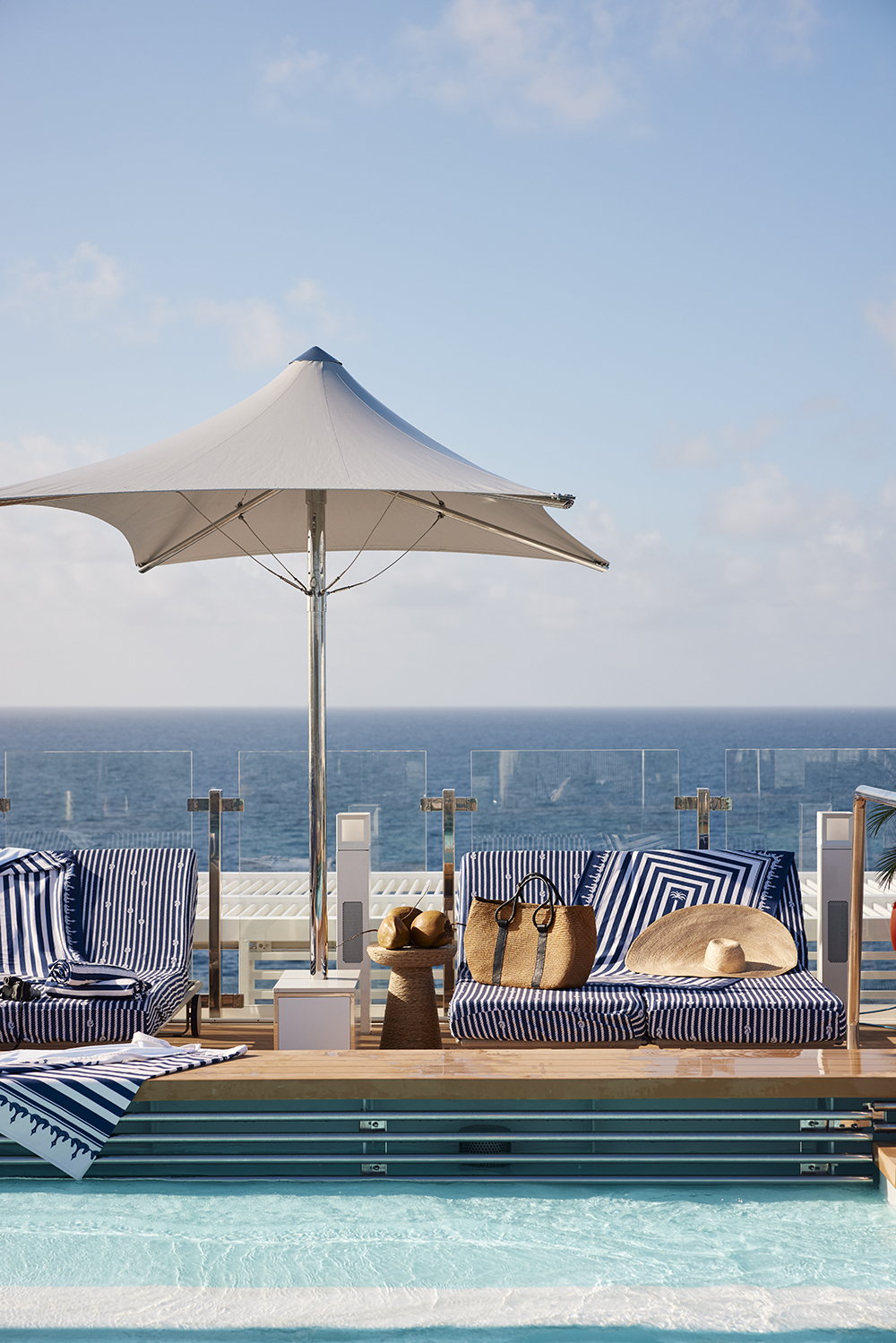
Fashion and hospitality have been increasingly intertwined (see: the Jacquemus takeover at the Monte Carlo Hotel), and Ritz-Carlton Yacht Collection has joined in the designer takeover trend by outfitting Decks 9 and 10 with custom prints from Colombian designer Johanna Ortiz. Ortiz, best known for her bold tropical prints and breezy designs that are just begging to be worn to sip a Mai Tai on a beach somewhere warm, was tasked by the Ritz-Carlton Yacht Collection team to add a touch of style and whimsy to the Ilma. The result is a custom print series, which weaves Ortiz's signature sailing rope knot motif through Caribbean-inspired flora: " “feels immersive yet effortless," was the goal, according to Ortiz.
Her La Rumba print lives on Deck 10's Pool Deck, rendered in layered deep blue, while La Siesta takes over Deck 9's Observation Terrace in rich tropical green. "[They] reflect two moods I am always drawn to when I travel," Ortiz says. "Moments of celebration and moments of pause. Both are deeply connected to nature, craftsmanship, and the joy of living."
The Food & Drink
The Ilma casually boasts five dining venues and seven bars. There’s also a wine vault (!) on board.The food program was developed in collaboration with James Beard Award-winning chefs Fabio Trabocchi and Michael Mina. Thus, it's clear the food is a priority, not an afterthought.
Our trip kicked off on embarkation night with the Ritz-Carlton Yacht Collection x Johanna Ortiz welcome dinner at Beach House on Deck 5. The airy restaurant has an outdoor space overlooking the back deck (this ended up being our favorite place to get lunch on the yacht—don’t skip the soft shell crab burger), but dinner was served indoors and consisted of a fragrant black cod and a chocolate mousse. Dinner the first full night at sea was at Memorī on Deck 4, which became one of my favorite dining locations. As a devoted sushi person, I was immediately won over by the sashimi, which is sliced fresh at the counter in front of you, and stayed for the most decadent and rich slice of black sesame cake, which has haunted my thoughts ever since.
The final night's dinner was at Seta su Ilma on Deck 3, the most formal of Ilma's venues and the only one with an added fee (and worth every penny). Designed with Trabocchi, the menu is Italian at its core: we started with a 24-karat gold-encrusted caviar bite, moved through a perfect lobster ravioli, and finished with the most delicate slice of wagyu. Each course also came with its own pairing, explained thoughtfully by our knowledgable sommelier. Overall, the food was stunning from start to finish, and the service was impeccable—as in, the waiters will remember your exact coffee order the next morning at breakfast, or the specific brand of hot sauce you prefer with your eggs.
The Spa
The Ritz-Carlton Spa on board is everything you'd expect, with the added bonus that you're at sea when you're inside it. I had a deep muscle massage mid-morning on our St. John day and emerged looking like someone who has recently made very good life choices. Don't skip the steam room after your treatment—you’ll practically float back to your room.
The Activities
If you're nervous about spending extended time on a boat, I'll say this: get over it, and also, Ilma is large enough that you'll never feel cramped. But for the adventurous, the yacht docks each day, and the shore excursions are genuinely exceptional.
On the first day, we went on a Maho Bay National Park Turtle Snorkel Sail: a three-hour catamaran excursion aboard the 65-foot Lady Lynsey II through the Virgin Islands National Park, culminating in snorkeling alongside green and hawksbill sea turtles in improbably turquoise water. We ended with a glass of champagne sailing back to Cruz Bay, which felt like exactly the right conclusion.
There’s also the Virgin Gorda Speed Boat Experience, where you’ll spend hours cruising, swimming, and snorkeling through the British Virgin Islands. If Maho Bay was serene, Virgin Gorda is more exhilarating. Both days left plenty of afternoon time on board, which I spent sunbathing (SPF on, always) on the front deck, happily horizontal.
The Secret Spot
My favorite tucked-away space on the Ilma—and, it turns out, Aiguesvives' as well—was the Observation Terrace on Deck 9, where Ortiz's La Siesta print lives. "It's a quieter, more understated area of the yacht and an ideal place to pause and unwind, whether for a mid-day nap or to watch the sunset," she told me. "There's a natural sense of stillness there, where the sea feels endless and time slows down."
On our last evening, the farewell cocktail hour was held right there—and I watched the sky turn every shade of pink and orange before finally going dark, cocktail in hand, thinking: nothing bad can happen to anyone here.
Final Thoughts
Would I go back? Without hesitation, immediately, on the next available sailing. Ilma runs through the Caribbean for the rest of winter 2026 and pivots to the Mediterranean for summer. If you find yourself on the Observation Terrace at golden hour, order the Coconut Veil and stay until the sky fades to pink. It’ll just be you and miles and miles of open ocean as far as your eyes can see. That feeling alone is worth the trip.
The Ritz-Carlton Yacht Collection's Ilma is currently sailing Caribbean itineraries through winter 2026, with Mediterranean sailings beginning summer 2026. The Johanna Ortiz takeover of Decks 9 and 10 continues through the summer season.
SINGAPORE: Does earning two or three times Singapore’s median income make life feel easy?
That was the question one Redditor posed online after wondering what life is really like for people bringing home around two to three times the median take-home pay in Singapore.
“What’s life like in Singapore? Do you also feel the inflation, or does everything feel easy? Would SG feel like Utopia at this point?” the Redditor asked, inviting others to share their experiences.
Many commenters were quick to p
SINGAPORE: Does earning two or three times Singapore’s median income make life feel easy?
That was the question one Redditor posed online after wondering what life is really like for people bringing home around two to three times the median take-home pay in Singapore.
“What’s life like in Singapore? Do you also feel the inflation, or does everything feel easy? Would SG feel like Utopia at this point?” the Redditor asked, inviting others to share their experiences.
Many commenters were quick to point out that earning two or three times the median income does not make someone “crazy rich.”
Instead, they described it as being financially comfortable, with more flexibility in daily life but not complete freedom from money worries.
One commenter said that regardless of how much people earn, many eventually adjust their lifestyles to match their income.
“Earnings increase, lifestyle choices become more premium,” the commenter wrote.
Others said the key is not necessarily how much a person earns, but how much they spend.
One Redditor argued that learning to live below one’s means brings a greater sense of security, adding that even high earners can feel stressed if they spend everything they make.
Another commenter who said they earn around three times the median income shared that they still do not feel rich.
“You don’t have to think so hard about the money you spend. Upgrade. More expensive restaurants. Can afford more extra activities for children. More holidays. Can give parents more,” the commenter wrote.
“That being said, we still count our pennies and live within our means. Money can come in and go the next day. Stay humble and be grateful.”
If you’ve had a bulb syringe in your hand and been unsure about putting it up your baby’s nose – you’re not alone! Even though it is a simple tool, it can cause a lot of anxiety for parents. Concerns about causing discomfort, doing it wrong, or hurting their noses are quite common. But it’s
The post Helping Baby’s Congestion: Tips for Using Bulb Syringes appeared first on Cincinnati Children's Blog.
If you’ve had a bulb syringe in your hand and been unsure about putting it up your baby’s nose – you’re not alone! Even though it is a simple tool, it can cause a lot of anxiety for parents. Concerns about causing discomfort, doing it wrong, or hurting their noses are quite common. But it’s
The bride wore the Kate Middleton-favored designer complete with an almost 10-foot train for a wedding that gathered the breadth of the royal family in the English countryside.
The bride wore the Kate Middleton-favored designer complete with an almost 10-foot train for a wedding that gathered the breadth of the royal family in the English countryside.
For the royal wedding of Harriet Sperling and Peter Phillips in Gloucestershire, Catherine, Princess of Wales, wore a blush-toned dress by Roland Mouret.
For the royal wedding of Harriet Sperling and Peter Phillips in Gloucestershire, Catherine, Princess of Wales, wore a blush-toned dress by Roland Mouret.
Your baby’s first visit with a pediatrician will happen soon after birth. You may have a lot of questions about this first appointment, including what will take place and what you should bring. As a pediatrician who sees many infants for their first newborn visit, I get a lot of questions about this appointment. Read
The post Your Newborn’s First Pediatrician Appointment: What to Expect appeared first on Cincinnati Children's Blog.
Your baby’s first visit with a pediatrician will happen soon after birth. You may have a lot of questions about this first appointment, including what will take place and what you should bring. As a pediatrician who sees many infants for their first newborn visit, I get a lot of questions about this appointment. Read
 Login
Login