RIO DE JANEIRO, June 6 — Global airline chiefs open their annual summit in Rio de Janeiro on Saturday facing a sharper test of the industry’s post-pandemic recovery, as the Iran war drives up fuel costs and disrupts airspace while carriers try to cushion the blow with higher fares and tighter capacity.The June 6-8 annual meeting of the International Air Transport Association (IATA) comes as that fuel shock collides with another problem airlines cannot quickly fi
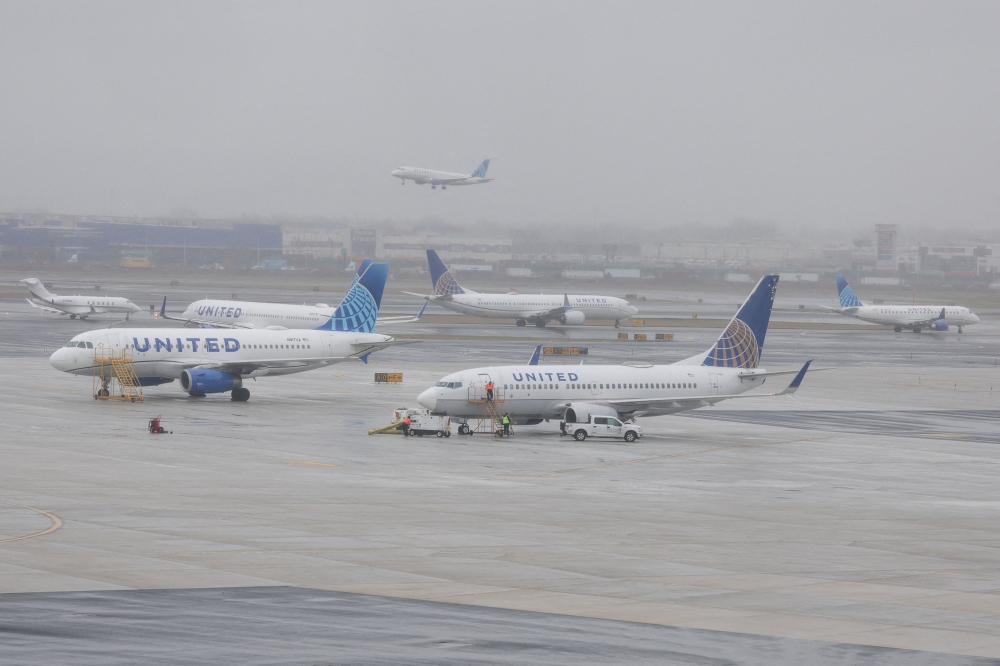
RIO DE JANEIRO, June 6 — Global airline chiefs open their annual summit in Rio de Janeiro on Saturday facing a sharper test of the industry’s post-pandemic recovery, as the Iran war drives up fuel costs and disrupts airspace while carriers try to cushion the blow with higher fares and tighter capacity.
The June 6-8 annual meeting of the International Air Transport Association (IATA) comes as that fuel shock collides with another problem airlines cannot quickly fix: a shortage of new aircraft.
Boeing and Airbus delivery delays have forced many carriers to keep older, less fuel-efficient jets in service for longer, raising maintenance and fuel bills just as oil prices have climbed. IATA, which represents more than 370 airlines accounting for about 85 per cent of global air traffic, had forecast a record US$41 billion in net profit this year for the industry before the war. Industry executives and analysts expect that outlook to be lowered at the meeting.
A Deloitte survey of 21 global airline CEOs published this week found that fuel price volatility and inflation sit at the top of the industry’s risk agenda, pushing carriers to focus more heavily on cost control and financial health.
“Together, they’ve turned what was supposed to be a record year into a fight for margin,” the survey said.
Airlines have two primary costs: fuel and labour. Sudden increases in fuel are hard to absorb because many tickets are sold weeks or months before travel. Longer routes also burn more fuel and make aircraft and crews less efficient.
The challenge is how much of the latest fuel hit can be passed on to travellers before higher fares start to weaken demand.
Fare power
So far, travel demand has held up in several large markets, especially among premium and corporate travelers, giving carriers more room to raise fares.
In the United States, domestic published fares as of May 25 showed robust demand and successful pass-through of higher fuel costs, with one-week-out fares up 35.8 per cent year-on-year and four-week-out fares up 39.4 per cent, according to Raymond James.
“The willingness to pay over the past few years, crisis and no crisis, from the premium side has been really strong, and we see that strength continuing,” Alexandre Lefevre, Air Canada’s vice president of network planning and global sales, told Reuters.
Still, there are limits. Higher fares can help airlines recover part of their fuel bill, but they also risk pushing out travellers with tighter budgets. That risk is greater in regions where currencies are weak, consumer spending is under pressure or airlines lack the pricing power of large network carriers. Some carriers are still planning for growth. Singapore Airlines is in talks for at least 50 large wide-body jets, while Qantas is weighing an order for about 20 Airbus or Boeing wide-body aircraft, Reuters reported this week. — Reuters
The Washington Star sues The Star, Stars and Stripes sues The Pentagon, and the suits at The Salt Lake Tribune drop the paywall. The Star v. The Washington Star Back in April we were told Washington D.C. was about to once more get a news outlet called The Star. That may take a bit longer […]
The Washington Star sues The Star, Stars and Stripes sues The Pentagon, and the suits at The Salt Lake Tribune drop the paywall. The Star v. The Washington Star Back in April we were told Washington D.C. was about to once more get a news outlet called The Star. That may take a bit longer […]
Research & Developments is a blog for brief updates that provide context for the flurry of news that impacts science and scientists today.
Sand is the most exploited solid natural resource on Earth. It has been integrated into how we build homes, roads, buildings, and bridges as well as how we protect coastal infrastructure from rising seas. Sand underpins nearly every aspect of modern infrastructure and economics, plays crucial roles in supporting ecosystem biodiversity, and literal
Research & Developments is a blog for brief updates that provide context for the flurry of news that impacts science and scientists today.
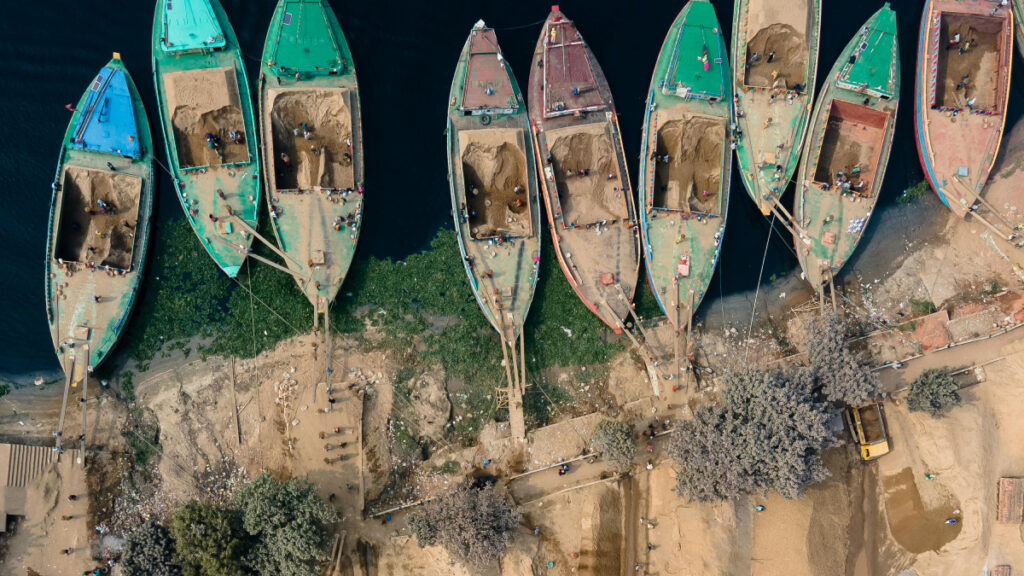
Sand is the most exploited solid natural resource on Earth. It has been integrated into how we build homes, roads, buildings, and bridges as well as how we protect coastal infrastructure from rising seas. Sand underpins nearly every aspect of modern infrastructure and economics, plays crucial roles in supporting ecosystem biodiversity, and literally shores up rivers and coasts.
A new report from the United Nations Environment Programme (UNEP) found that we are using 50 billion metric tons (50 trillion kilograms) of sand per year. As global development and industrialization expand, demand for sand in the building sector is expected to rise 45% by the year 2060, outpacing current efforts to sustainably harvest it. The report’s authors urge countries to establish sand as a strategic national asset and develop policies for sustainable extraction.
“Sand is sometimes referred as the unrecognized hero of development, but its essential role in sustaining the natural services on which we depend is even more overlooked,” Pascal Peduzzi, director of the UNEP Global Resource Information Database Geneva, said in a press release about the report. “Sand is our first line of defence against sea level rise, storm surges, and salination of coastal aquifers—all hazards exacerbated by climate change.”
Sand Wanted: Dead or Alive
Dead sand, or sand that has been extracted from its natural environment, is a key component in building materials like concrete and asphalt. Communities around the world use sand in water filtration systems, providing clean water for drinking and agricultural use. And although a transition to clean energy sources is necessary to curb the effects of climate change, many of those sources also depend on sand: solar panels require glass made from high-purity silica sand, and wind turbines, hydroelectric dams, and nuclear power plants all require concrete.
Mangroves, one of the most important coastal trees, can grow in sand. Credit: Diego Parra
Sand also plays a critical role in natural ecosystems. It is home to a wide array of critters from crabs, sharks, and turtles to microorganisms like bacteria and fungi. It supports the growth of corals, mangroves, and seagrasses that in turn support even more marine creatures. It is a key component of healthy soil and aids in surface drainage. It guides river evolution and acts as flood buffer and storm barrier. It also provides local economic benefits via tourism.
These are among the values of sand when it is left alone and unused, called “alive” sand. The UN report notes that these benefits are typically of greater value over time than if sand is dredged and used. But because these benefits are hard to see, they are often overlooked when nations calculate the value of their sand resources.
A Sustainable Sand Future
Despite sand’s importance whether dead or alive, the report notes that few countries have established sand as a strategic national asset or have developed strategies for sustainable extraction. At the current pace, humans are extracting sand from the natural environment at a faster pace than it is being replenished by geologic processes.
What’s more, the UNEP’s Marine Sand Watch tool shows that about half of sand dredging companies are operating within marine protected areas, accounting for about 15% of the volume of dredged sand. This practice, the report notes, is potentially trading in sand’s long-term benefits for short-term gains.
The UN report recommends a few actions to protect the long-term availability of sand as a natural resource, including:
Recognizing sand as strategic national asset, establishing national inventories, and creating long-term regional planning groups that consider sand as an essential resource for resilience;
Establishing circularity and recycling of building materials, especially in areas of conflict and natural disasters;
Strengthening environmental protection practices, and codifying international frameworks to strengthen accountability along the supply chain, including increased transparency about extraction; and
Integrating sand-related biodiversity and social risks into financial decisionmaking and governance.
“Over-reliance on short-term economic metrics risks obscuring, and further impacting, the geological and ecological processes that take centuries to form and may not be restored once critical thresholds are crossed,” the report states. “What is hardest to measure may be precisely what sustains both nature and human societies over the long term. The challenge ahead is not only to manage extraction, but to recognise and balance the full spectrum of sand’s values.”
These updates are made possible through information from the scientific community. Do you have a story about science or scientists? Send us a tip at eos@agu.org.
This story was produced by Grist and the Food & Environment Reporting Network, a nonprofit news organization. Sign up for Grist’s weekly newsletter here.
Will Runion’s 736-acre cattle and hay farm is tucked into a horseshoe bend of the Nolichucky River in northeast Tennessee. On the morning of Friday, September 27, 2024, he was in the middle of two big projects: building a riverfront campground on his land to bring in tourists and income, and cutting the last of the season’s hay. Hurrica
Will Runion’s 736-acre cattle and hay farm is tucked into a horseshoe bend of the Nolichucky River in northeast Tennessee. On the morning of Friday, September 27, 2024, he was in the middle of two big projects: building a riverfront campground on his land to bring in tourists and income, and cutting the last of the season’s hay. Hurricane Helene had been arcing up from Florida toward the Appalachian Mountains, carrying heavy rain, and the river was high. Even though the banks seemed to be holding, he decided to move some of his cows and equipment to higher ground.
But the river kept rising. At about 11 a.m., the brown water topped its banks. He and his fiancée, his son-in-law’s parents, and neighbors scrambled to salvage what farm equipment they could, but they were nearly trapped when the quickly expanding river flowed into a low-lying area behind where they were working, cutting them off from dry land.
By afternoon, the river had swollen to some 1,200 feet wide—nearly 10 times its usual size. It “looked just like a lake,” Runion said. Trees snapped in the swift current and neighbors’ barns, roofs, hay bales, and household debris swirled by. The water swallowed Runion’s hay equipment and sent the little white house he’d planned to use as the new campground’s office sailing across a field.
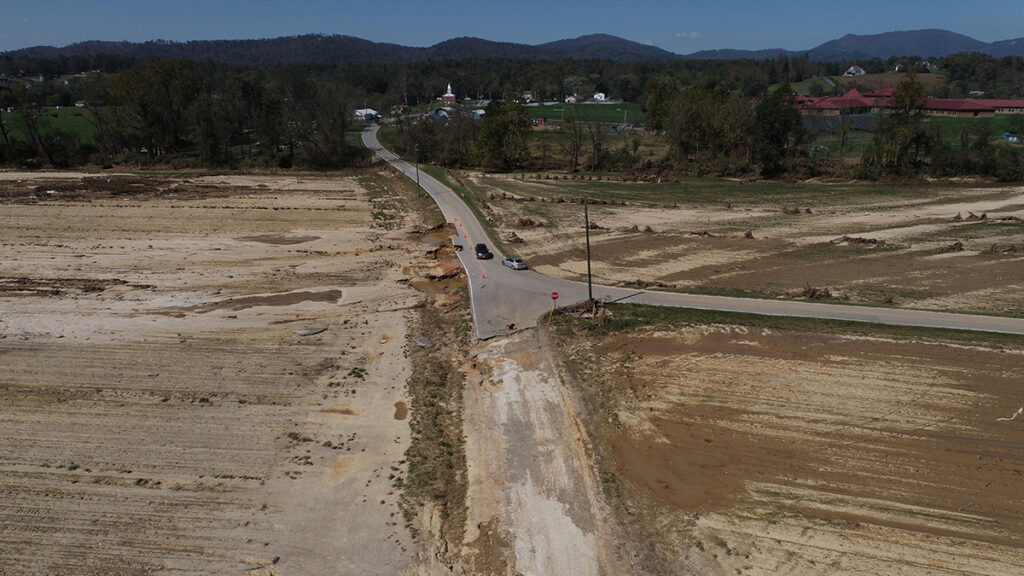
At around 8 p.m., the Nolichucky finally crested and started to recede. Runion found a third of his fields covered in debris, dead fish, and tomatoes from upstream vegetable growers. The flood had gouged two holes the size of football fields in his hay pastures, down to a depth of 12 feet. Other sections of the farm were buried in up to 8 feet of sand or silt.
Flooding from Hurricane Helene brought massive damage to Will Runion’s farm, eroding the land in some places and washing up feet of sand on agricultural fields in other sections. Courtesy of Bryan LeBarre, via Grist
Helene dropped up to 30 inches of rain on southern Appalachia, causing historic flooding and landslides in parts of North Carolina, South Carolina, Tennessee, Georgia, Kentucky, and Virginia—a largely rural region where agriculture is a vital economic driver and cultural cornerstone. The mountains make it hard to spread out here, so farms tend to be small, and many growers use flood-prone bottomland because it is flat and fertile. But floods of this magnitude hadn’t hit here in generations. In North Carolina alone, Helene caused an estimated $4.9 billion in damage to the state’s agriculture sector. In Tennessee, agricultural losses were estimated at $1.3 billion. Thousands of farmers lost crops, tools, machinery, barns, buildings, animals, and fences.
“When you see 4 feet of sandy soils on top of your topsoil, you know that’s going to be a challenge. That was overwhelming.”
More than a year later, growers are also contending with the loss of something more vital, and more difficult to replace: their soil.
Runion knew immediately that his livelihood was ravaged. Without good soil, a farmer can’t farm. “When you see 4 feet of sandy soils on top of your topsoil, you know that’s going to be a challenge,” he said. “That was overwhelming.”
He sent drone footage of the damage to Forbes Walker, an environmental soil specialist with University of Tennessee Extension. “How do you fix this?” he asked.
“I don’t know,” Walker recalled thinking when he got Runion’s email. “How do we fix this?”
Over millennia, floods helped build the fertile land that farmers depend on. But today, climate change is driving more powerful and unpredictable storms. One study found that rainfall associated with Helene was 10 percent heavier due to man-made climate change. Research by the U.S. National Science Foundation suggests that what scientists call “100-year storms” will become three times more likely, and 20 percent more severe, over the next 50 years. What’s more, there’s little solid information about what happens to soil during a flood, or what to do when a farm’s soil is eroded or covered with material from elsewhere—its nutrients washed away and microbial communities disrupted. It’s a blind spot that is becoming more of a liability as storms like Helene become more common.
“None of us had ever seen anything like this before or responded to an emergency like that,” said Stephanie Kulesza, a nutrient and soil scientist at North Carolina State University. “And so we weren’t really prepared for recommendations to provide to producers.”
Soil can take thousands of years to form. Rock is weathered and slowly dissolves into smaller and smaller pieces. As dead leaves, animals, trees, and other plants decompose, they add organic matter and nutrients to the rock. Microorganisms establish themselves in the mix, driving nutrient cycling, aiding with decomposition, and stimulating plant growth; then worms and bugs, like beetles and ants, burrow in the mixture, aerating it. For soils to work well for agriculture, they need the right structure—airy enough to allow water to enter and move through, but not too quickly or too slowly—and sufficient biological and chemical richness, including nutrients like nitrogen, phosphorous, and potassium, to nourish crops.
Farmers use synthetic or natural fertilizers to ensure their soil has enough nutrients. They can also introduce practices like no-till—farming without plowing up the ground—to maintain the physical properties of their dirt. Topsoil, the rich, uppermost layer with the most available nutrients for crops, tends to make up less than a foot of the entire soil profile, but it’s crucial for agriculture.
Soil scientist Forbes Walker visits Will Runion’s farm in 2025, examining the deep sandy deposits left behind by Hurricane Helene. Credit: Raffe Lazarian/University of Tennessee Institute of Agriculture via Grist
Helene’s floodwaters either washed away significant topsoil or deposited new sediment on top of it on thousands of farms. Some, including one of Runion’s neighbors, saw their fields stripped down to bedrock, or river rock. Runion and others woke to pastures blanketed by feet of sand or stone.
When topsoil is washed away, the necessary nutrients for growing go with it. And when topsoil is covered with sand, farmers can’t get to it. Both scenarios can significantly alter the land’s usability. Topsoil can take decades or centuries to develop, and sand lacks both organic matter and the physical structure to hold water and nutrients. “These aren’t soils yet,” said Kulesza of what Helene left on Runion’s and other farmers’ land. “They are in their infancy now. The clock has been reset.”
Runion had cared for his soils, working to eliminate weeds, adding fertilizer to keep nutrient levels ideal, and lime to control pH. “They were our way of life,” Runion said. “They were our income.”
After the storm, from October to April, he removed debris, bulldozed sand off his fields to get closer to the topsoil, filled holes, and graded uneven land. Crews from the Federal Emergency Management Agency removed and shredded downed trees. He applied for government relief and received close to $1 million in state and federal aid. Runion said he could have easily used all of that money replacing equipment and paying for cleanup labor, fertilizer, and fuel, but he’s trying to stretch the money as much as possible.
By June, it was time to mow the fields that hadn’t flooded. He managed to put up enough bales of hay to feed his herd of 125 cattle, but not enough to sell. In a normal year, hay sales made up about a third of the farm’s income. With months of work behind him and his flooded land still too sandy and generally depleted, he realized the recovery would be a slog.
Runion returned to work on the campground, which he hoped would diversify the family’s earnings. The longer-term plan included a music venue and some hiking trails, and to host weddings and corporate events. After the storm, finishing it took on new urgency. He chose a new spot, about 450 feet upland from the river, and began clearing enough land for 45 camping sites.
One environmental soil specialist described the academic literature on flood-damaged soils as “thin.”
Runion also prepared a parcel of land for Walker, the extension soil specialist, to run tests that could guide his recovery. Last November, soon after the one-year anniversary of Helene, Walker showed me around Runion’s farm.
Working with students, Walker established four experiments over about 300 test plots. He’s looking at how different soil amendments—hay, wood chips, poultry litter, and a charcoal called biochar, to help the soil hold water and fertilizer; and Triple 19, a common plant food with equal parts nitrogen, phosphorous, and potassium—affect the growth of wheat and fescue grasses.
When I visited, some of the plots remained mostly bare while, in others, tufts of green had sprouted. “We actually got some stuff to grow,” Walker said.
He described the academic literature on flood-damaged soils as “thin.” While some research and case studies exist on how agricultural soil recovers after a flood, there are few systematic investigations like the one Walker is conducting—on what works, and what does not—particularly in Appalachia, where floods of this magnitude have been historically rare.
When so-called atmospheric rivers spawned devastating floods in the Pacific Northwest and southwestern British Columbia in 2021, Aimé Messiga, a Canadian soil research scientist at the Agassiz Research and Development Centre, found a similar “scarcity of data.” He conducted a detailed review of the existing research and concluded that there was limited long-term monitoring, little understanding of how floods affect nutrients and microorganism communities in the soil, and uncertainties about what the actual impacts of floods on agriculture and crops are. Complicating everything is the variability between different farms, soils, and crops.
“You need decades of accumulated data in order to be able to predict what will happen. We don’t have those data.”
“You need decades of accumulated data in order to be able to predict what will happen,” Messiga said. “We don’t have those data.”
Today, some researchers are attempting to replicate flood conditions in labs to better understand, but field work is rare, Messiga said. There’s little money for it—and in the U.S., the Trump administration has cut funding for climate-related research. In addition, “many among us still look at these events as random,” Messiga said. “They’re not random. They will keep occurring.”
Since 1980, 45 flooding events have caused damages over $1 billion each in the U.S., with more than half of those occurring in the past 15 years. In 2024, flooding in the upper Midwest drowned crops. Repeat events in central California damaged agricultural operations from winter 2022 to spring 2023. Flooding along the Mississippi River in 2019 reduced crop planting by millions of acres. There also have been numerous smaller or more localized floods. One study found nearly 75,000 flash floods in the contiguous U.S. from 1996 to 2017, with increasing frequency in the past 22 years. Flooding frequency and strength is predicted to rise in the years to come due to climate change—a warmer atmosphere holds more moisture and leads to stronger rain events—and poor land-use management.
Scientists are also starting to study a new type of event, called “weather whiplash,” when sudden changes occur from one extreme to another, amplifying the effects of the disaster. In Texas in 2025, a flood came after prolonged drought, causing widespread destruction.
For farmers, the effects of flooding on soil may linger for years after the disaster. In 2011, the Missouri River flooded states in the Upper Midwest, including thousands of acres of farmland. Fields were swamped for months with up to 20 feet of water. When the water finally receded, those fields were covered with anywhere from 2 to 20 feet of sand; other fields had washed out holes up to 70 feet deep. It looked like the surface of the moon, said John Wilson, a now-retired educator and agricultural expert who served Burt County, Nebraska, which was particularly hard-hit. “It was just bare soil,” he said. “There was no crop residue whatsoever.”
Wilson led teams that sampled the soil and helped farmers build back. He found that levels of nitrogen and organic matter were low in flooded soils, and fertility suffered when farmers planted their crops. Over about five years, fertility generally improved, but not everywhere. “If you went out today and did a yield map, you could still tell exactly where the erosion was because those areas are not as productive,” Wilson said.
Yield is money for farmers, who already navigate thin margins and, often, years without any profit at all. North Carolina’s strategic plan for agriculture recently enumerated just how thin: Of the state’s “42,500 farms, only 8,000 produce annual gross sales that exceed $100,000 annually. The overwhelming majority … some 23,400, gross less than $10,000 in sales, with only around 40 percent of the farms in the state having a positive net income in 2022.”
As floods increasingly wreck farmland, more researchers are starting to focus on understanding the effects of the floods and how to address them. Most of that work is happening in Asia, Messiga said. But a study in coastal North Carolina, where hurricanes regularly land, found that after a storm there was less organic matter in the soil, including carbon, and a disruption of microbial activity and nutrient cycling. The ground also absorbed water less readily.
Coastal flooding is also driving saltwater into the soil of farmland, making it more saline and unable to sustain crops. A North Carolina State University team has been developing test kits for farmers to sample the salinity of their soils, as well as a set of recommendations for keeping their soil viable. Such local work is important because soils vary greatly from place to place, and findings are not often easily transferable.
Nicole DelCogliano’s farm near Asheville, North Carolina, was wiped out almost entirely by floods from Hurricane Helene in 2024. Courtesy of Nicole DelCogliano via Grist
For now, in the wake of Helene, farmers are relying largely on trial and error to build back what was lost. Nicole DelCogliano has been farming vegetables, flowers, and livestock with her husband on 50 acres on the South Toe River, near Asheville, North Carolina, for 25 years. Helene washed away her barn, tractor, and other infrastructure. Of her 6 acres of vegetable fields, one was covered with several feet of sand, another got a foot, and a third field suffered extensive erosion.
“Our entire operation was wiped out, essentially,” she said.
“It’s not something that can be fixed overnight. This is a long process.”
With the help of some friends with tractors, DelCogliano cleared her main field and spread compost and lime on everything. “There was a mix of guidance about what you should do, like should you disturb the soil, should you not?” she said. “At an instinctual level, we just felt like we got to get the soil covered, we got to get something in the ground.” They sowed rye, a dependable cool season grass, as a cover crop, to protect the soil from erosion and add nutrients.
Karen Blaedow, an agricultural educator in Henderson County, North Carolina, said farmers should expect to put in at least three years of cover cropping before they see results in their soil. “It’s not something that can be fixed overnight,” she said. “This is a long process.”
In the spring following the flood, DelCogliano spread various amendments on her least-damaged field, including compost, lime, biochar, and blood and bone meal, which provide nitrogen and phosphorus, respectively. After all that, she and her husband seeded crops.
Their new vegetables came in about two weeks later than normal, but the season was more productive than ever, even though they grew on just 4 instead of 6 acres—“which is pretty amazing,” she said. “When we first started harvesting crops [after Helene], we didn’t yet have power at the farm. I had to dig one of our sinks out of a bank and bleach it and clean it and drag it up to the new barn—that we barely got a roof on—to wash and pack for that first [farmers] market.”
She doesn’t really know what made the year so productive. They planted more intensively to account for the smaller acreage and were able to harness their years of expertise to restart their operation basically from scratch. She also attributes the relative health of her soil to years of organic practices. “We’re dirt farmers,” she said. “Our primary job is to tend the dirt. Because that’s the basis of everything.”
Some farmers who’ve seen good harvests may have gotten a little lucky. Rather than sand, floods dumped silt. Even Runion got silt deposits in one section of his farm. Unlike the sand, the silty layers carry nutrients and create a positive growing environment. “We have a producer we work with and he said it’s the most fertile soil that he’s had in decades,” said Emine Fidan, a biosystems engineering and soil science researcher at the University of Tennessee, who’s also working on Runion’s farm. “And he said it grew the sweetest corn he’s ever had. It was growing just beautifully.”
Runion didn’t plant anything until this past fall. He prepared about 65 acres of the 220 that were underwater. It was slow going; he used a disking machine to till his land but had to stop often to clear sticks and trash and to grade out low spots. He mixed in mulch and planted oats, wheat, and fescue. Walker drove me past one of the fields and it still looked sandy, the grasses just a pale green shadow on the tan land. Runion said the greenery was “struggling to have any vigor about it.” He won’t know for sure how well or poorly the grasses do until spring, their peak growing season.
He considered planting more acreage but decided to wait and see what he learned from Walker’s trials. “It’s a process, and the knowledge we’re gaining there will help on the whole rest of it, too,” Runion said.
This spring, Walker’s team will measure the biomass in each plot as well as the quality of the crop, including how much protein it has and its digestibility. They’ll also be evaluating the soil itself, including its ability to hold water, to determine if any of the treatments improved the structure of the sandy dirt.
One farmer thinks the hay he’ll get in the coming years will be lower-yielding, lower-quality, and will cost more to produce due to the extra prep time, new seeds, and fertilizers.
Preliminary results suggest that, in plots where they put down mulch, the grasses are growing better than in plots with other amendments. The woody debris is reducing erosion and seeds are germinating well and standing up in the rough matrix. Spreading this kind of mulch isn’t an obvious solution, Walker said: Wood chips are a carbon-rich material, but as they break down in the soil they consume nitrogen, which can lead to a deficiency for the crops. But this mulch had sat in piles and started to decompose before it was applied to Runion’s fields, which made it less likely to cause these problems.
Runion had asked FEMA to leave the piles of wood chips on his farm rather than remove them like they normally would. Walker is looking for solutions to the soil problem that not only work but are also accessible. Have a mountain of mulch? Put it to work. Have nearby chicken houses? Maybe their nitrogen-rich manure can help revive flooded fields. His hope is that his team’s research can provide some guidance to farmers who find themselves in similar situations in the future. “I think it will have broad implications for a number of different crops,” including vegetables, Walker said.
Meanwhile, Runion is coming to terms with his situation. He thinks the hay he’ll get in the coming years will be lower-yielding, lower-quality, and will cost more to produce due to the extra prep time, new seeds, and fertilizers. He used to sell a lot of square bales, which tend to contain high-quality grasses and fetch a higher price, but he doesn’t expect to be doing that for a while. He’d initially hoped to have his land back in shape in a year or two. “Now it’s a four- to five-year [plan], I think,” Runion said. “It has been frustrating, and exhausting, too.”
He’s still optimistic, though. On my visit, I watched him grade out the new campground in a large dump truck. Freshly exposed red soil lay open to the sky. He thinks he can get the campground open by late summer or early fall. Over time, he hopes, it will be a more lucrative, and more sustainable, source of income. “The farm is really beautiful,” Runion said. “It still has a lot to offer.”
Reports suggest that Axcel, the Nordic private equity firm that has owned Capture One since 2019, is working to sell the photography software company via auction.
[Read More]
Reports suggest that Axcel, the Nordic private equity firm that has owned Capture One since 2019, is working to sell the photography software company via auction.
The intoxicating hemp industry and its allies are quickly running out of time to convince Congress to delay or stop a looming ban on their products. Without action, a ban on hemp-derived intoxicants will take effect in November. There's bipartisan interest in disrupting the ban — which was championed by Sen. Mitch McConnell (R-Ky.) and included the last fall's government funding...
The intoxicating hemp industry and its allies are quickly running out of time to convince Congress to delay or stop a looming ban on their products. Without action, a ban on hemp-derived intoxicants will take effect in November. There's bipartisan interest in disrupting the ban — which was championed by Sen. Mitch McConnell (R-Ky.) and included the last fall's government funding...
“New comics to start in June” When I saw the headline for The Sharon (Pa.) Herald article about their comics pages I thought it just the first of what will be a number of newspapers explaining why Big Nate will no longer be appearing daily. Turns out it was something else. From The Sharon Herald […]
“New comics to start in June” When I saw the headline for The Sharon (Pa.) Herald article about their comics pages I thought it just the first of what will be a number of newspapers explaining why Big Nate will no longer be appearing daily. Turns out it was something else. From The Sharon Herald […]
Retailer plans to shut unprofitable stores as falling US airport traffic due to Middle East conflict hits trading Business live – latest updatesWH Smith has issued a profit warning after shopper numbers at its stores in US airports fell as a result of the war in the Middle East, prompting the company to raise fresh capital from investors.The retailer, which operates 1,200 outlets globally in airports, railway stations and hospitals, raised £102m through a share sale on Wednesday to strengthen it
WH Smith has issued a profit warning after shopper numbers at its stores in US airports fell as a result of the war in the Middle East, prompting the company to raise fresh capital from investors.
The retailer, which operates 1,200 outlets globally in airports, railway stations and hospitals, raised £102m through a share sale on Wednesday to strengthen its balance sheet, pay down debt, invest in technology and shut down unprofitable stores after “a downturn in trading conditions”.
Nikon lost a lot of money last fiscal year. In fact, Nikon lost a record-breaking amount of money, a whopping 86 billion yen, or more than $542 million at current exchange rates. Nikon's largest shareholder, EssilorLuxottica, is reportedly weighing a major acquisition of the company, sending its stock soaring.
[Read More]
Nikon lost a lot of money last fiscal year. In fact, Nikon lost a record-breaking amount of money, a whopping 86 billion yen, or more than $542 million at current exchange rates. Nikon's largest shareholder, EssilorLuxottica, is reportedly weighing a major acquisition of the company, sending its stock soaring.
Fashion is a major sustainability challenge in the global economy, and for most of the last decade, it has faced little regulation. That is starting to change. In the past eighteen months, California passed the first U.S. law for extended producer responsibility (EPR) for textiles, France approved strict anti-fast-fashion laws, and the EU set a 2027 deadline for all member states to have a textile EPR program.
Every second, a garbage truck’s worth of clothing ends up in a landfill or is burned s
Fashion is a major sustainability challenge in the global economy, and for most of the last decade, it has faced little regulation. That is starting to change. In the past eighteen months, California passed the first U.S. law for extended producer responsibility (EPR) for textiles, France approved strict anti-fast-fashion laws, and the EU set a 2027 deadline for all member states to have a textile EPR program.
Every second, a garbage truck’s worth of clothing ends up in a landfill or is burned somewhere in the world. This isn’t just a figure of speech. The fashion industry produces about 92 million metric tons of waste each year, and if nothing changes, that number could reach 148 million metric tons by 2030.
Meanwhile, the resale market is growing about three times faster than traditional retail. The industry still has a long way to go, but for the first time, there are real systems in place to hold it accountable.
The Scale of the Problem
How big is fashion’s impact? It’s large, debated, and still growing. The fashion industry is responsible for 8 to 10 percent of global greenhouse gas emissions, according to the UN Environment Programme. While experts debate the exact numbers, everyone agrees the problem is getting worse.
The Apparel Impact Institute, a nonprofit supported by brands like H&M, Target, PVH, and Lululemon, reported that apparel sector emissions rose by 7.5 percent in 2023. This was the first yearly increase since 2019, and the group linked it to overproduction, ultra-fast fashion, and more use of virgin polyester, which now accounts for 57 percent of global fiber production.
No matter which numbers you believe, the trend is troubling. Each year, 80 to 100 billion new garments are made. Clothing production has doubled since 2000, and people now wear each item 36 percent fewer times before throwing it away. Synthetic fibers, mostly polyester made from fossil fuels, make up about 57 percent of global fiber production and are expected to increase.
The amount of water used in fashion is huge, even by industrial standards. Making one cotton T-shirt takes about 2,700 liters of water, which could provide drinking water for one person for 900 days. Producing a pair of jeans uses about 7,500 liters. Textile dyeing and treatment is the world’s second-largest source of water pollution, causing about 20 percent of industrial water pollution. ic clothing also sheds microplastics every time it’s washed. The IUCN has estimated that about 35 percent of primary microplastics in the ocean originate from synthetic textiles like polyester, nylon, and acrylic, though the total volume keeps rising as synthetic usage increases.
After technology manufacturing, garment production is still one of the industries most affected by modern slavery and child labor, according to International Labour Organization data. These problems are most common in the early stages of production, such as cotton farms, dye houses, and fabric mills, which are less visible than the brand-name factories.
Fast Fashion, Faster: The Shein and Temu Problem
In the last five years, a new category called ultra-fast fashion has emerged, making older models like Zara and H&M seem slow by comparison. Platforms such as Shein and Temu add thousands of new styles daily, produce items on demand in Chinese factories, and ship directly to customers around the world.
The environmental impact is severe. Shein’s own reports show its greenhouse gas emissions nearly doubled from 2022 to 2023, reaching 16.7 million metric tons of CO₂ equivalent. That’s almost as much as Inditex, Zara’s parent company, which is five times bigger by revenue. In 2024, Shein’s transportation emissions alone were over 8.5 million metric tons, more than three times Inditex’s. Temu hasn’t shared its emissions data, but third-party estimates put its yearly footprint between 4 and 6 million metric tons of CO₂e, mostly from shipping over a million air-freight parcels each day.
These business models not only pass environmental costs onto others, they rely on it. This is the main reason behind the push for new regulations.
The New Regulatory Landscape
For most of modern fashion history, sustainability promises have been voluntary, hard to verify, and mostly ineffective. That is finally starting to change. Three recent developments in the past eighteen months are especially important to watch..
Governor Gavin Newsom signed SB 707 into law in September 2024, making California the first U.S. state with extended producer responsibility for textiles. The law shifts responsibility for end-of-use management of apparel, footwear, and household textiles from consumers and municipalities to the companies that put the products on the market. Producers with less than $1 million in annual global revenue are exempt; everyone else must join a state-approved Producer Responsibility Organization (PRO) that will finance collection, repair, reuse, sorting, and recycling.
Implementation is staged. On February 27, 2026, CalRecycle selected Landbell USA as California’s textile PRO. Producers must register with the PRO by July 1, 2026. A statewide needs assessment runs through 2027, final implementing regulations are due by July 2028, and full enforcement begins July 1, 2030, with fines of up to $50,000 per day for noncompliance.
France’s Anti–Fast Fashion Law
In June 2025, the French Senate passed the most aggressive anti-fast-fashion legislation in the world by a vote of 337 to 1. The law imposes a per-item eco-tax starting at €5 and rising to €10 by 2030 (capped at 50 percent of retail price), bans advertising and influencer marketing of ultra-fast-fashion brands, requires point-of-sale environmental disclosures including carbon footprint and durability data, and carries fines of up to €100,000 for violating the ad ban. Revenue is directed to French sustainable-fashion producers.
The law is clearly aimed at Shein and Temu. In November 2025, French authorities requested that Shein’s fast-fashion platform be suspended for three months over the sale of illicit products — days after Shein opened its first physical retail store in Paris. The European Commission issued a detailed opinion on the French law in September 2025; other EU member states are watching.
The EU Waste Framework Directive
Under revisions to the EU Waste Framework Directive, every member state was required to have separate textile waste collection in place by January 2025 and must have a fully operational textile EPR scheme by 2027. France’s EPR program, which has been operating since 2008, and the Netherlands (2023) are already live. Italy, Spain, and others have draft decrees in public consultation. Outside the EU, Switzerland, Australia, and Chile are developing national frameworks.
In the U.S., beyond California, New York’s Fashion Sustainability and Social Accountability Act (A4631) and Senate Bill S3217A both carried into the 2026 session. Washington State introduced HB 1420 in January 2025; as of March 2026, it remains in committee. None of these have passed.
The Resale Market Is Doing What Regulation Hasn’t
While policymakers work on new rules, consumers are already changing their habits. ThredUp’s 2025 Resale Report says the U.S. secondhand clothing market grew by 14 percent in 2024, five times faster than traditional retail. It’s expected to reach $74 billion by 2029. Globally, the secondhand market could hit $367 billion by 2029, growing 2.7 times faster than the overall apparel market.
There is a clear generational divide. In 2024, 58 percent of U.S. consumers bought secondhand clothing. Among those aged 18 to 44, 48 percent now choose secondhand first when shopping for clothes. Thirty-nine percent of younger shoppers have bought secondhand items through social platforms like Instagram or TikTok Shop.
Resale alone won’t solve fashion’s environmental impact. Extending a garment’s life only helps if it replaces a new purchase. Still, this is the biggest shift in consumer behavior the industry has seen in a generation.
What Sustainable Fashion Actually Means
Sustainable fashion means having a supply chain that is responsible for both the environment and people at every stage. In practice, this includes using fibers that need less water, fewer chemicals, and create lower emissions; manufacturing with renewable energy; ensuring fair wages and safe working conditions; making products that last and can be repaired; and recycling materials into new clothes instead of turning them into insulation or sending them to landfills in places like Ghana or Chile.
It’s a long list, and no brand meets every standard. Still, more brands are making real progress. Patagonia, Eileen Fisher, and Pangaia share detailed impact reports that are checked by outside experts. Brands using leftover fabrics, made-to-order production, and closed-loop recycling are slowly growing. Certifications like Global Organic Textile Standard (GOTS) for organic fibers, Fair Trade Certified for labor, and bluesign for chemical management are meaningful when you see them on a label.
Fashion is still the most greenwashed part of the consumer goods industry. Words like “conscious,” “eco,” and “sustainable” aren’t regulated in the U.S. What really matters are specific certifications, published supply-chain data, and third-party audits—not marketing slogans.
Take Action At Home
Individual choices won’t fix fashion’s big problems, but they do influence demand. That demand can drive companies and lawmakers to make changes. Here are some practical steps, ranked by impact:
Buy less, buy better. The single most impactful choice is reducing the amount of new clothing entering your closet. A capsule wardrobe of durable, versatile pieces worn many times beats any “sustainable” label on a fast-fashion cycle.
Shop secondhand first. ThredUp, Poshmark, Depop, The RealReal, Vinted, and local thrift and consignment stores now offer selection and convenience comparable to traditional retail.
Get familiar with clothing materials. Natural fibers like organic cotton, linen, hemp, and wool usually have a smaller environmental impact at the end of their life than synthetics. Recycled polyester is better than new polyester, but it still releases microfibers.
Use a microfiber filter. Tools like the Guppyfriend wash bag or washing machine filters can catch a lot of synthetic microfibers before they enter the water system.
Repair before replacing. Visible mending, basic tailoring, and simple patches can extend a garment’s life by years.
Take care of your clothes so they last longer. Wash them in cold water, air-dry when you can, and avoid the dry cleaner unless it’s necessary. These steps help reduce emissions and wear on your clothes.
Recycle clothes instead of throwing them away. When something can’t be worn anymore, look for textile recycling options using Earth911’s recycling locator or a store take-back program. Sending clothes to a landfill should be the last resort.
Support new policies. Laws about textile EPR, supply-chain transparency, and anti-greenwashing are being considered in many states. These laws are more likely to pass when people contact their representatives.
Fashion is one of the most obvious ways the global economy affects our daily lives. Because it’s so visible, everyone is part of the problem—but it also means that when change happens, it’s easy to notice.
Editor’ Note: Originally written by Gemma Alexander on April 8, 2022, this article was substantially updated in April 2026.
SINGAPORE: Some Singaporeans online have raised concerns over a growing trend of homegrown food and beverage manufacturers shifting production across the Causeway, after companies such as Yeo’s, Tiger Beer, and most recently Gardenia announced job cuts alongside moves to relocate production there to cut costs and streamline operations.
Analysts, however, said that such moves by Singapore firms are not new, but the trend is accelerating amid global pressures.
Rising costs triggered by the Middle
Analysts, however, said that such moves by Singapore firms are not new, but the trend is accelerating amid global pressures.
Rising costs triggered by the Middle East conflict, as well as generous tax incentives tied to the Johor-Singapore Special Economic Zone (JS-SEZ), are influencing company decisions on where they want to produce goods.
According to Singapore Manufacturing Federation (SMF) president Lennon Tan, the trend of Singapore firms shifting manufacturing to Malaysia is part of “Singapore companies right-sizing their geography” and is “not a vote of no-confidence in Singapore.”
Olive Tree Property Consultants CEO and founder Samuel Tan also told Channel News Asia (CNA) that “Moving operations to Johor makes strong commercial sense given the changing economics of manufacturing in Southeast Asia”, as companies no longer need to produce goods in the same place where they sell them.
Citing Gardenia’s perishable bread as an example, he said that having the production side in Johor allows the company to produce at a lower cost while still delivering fresh products into Singapore every day.
Experts, however, warned that the influx of companies across the Causeway could intensify competition for labour, industrial land, and other limited resources there.
At the same time, shifting too much production there would risk “weakening” the “Made in Singapore” identity over time, People’s Action Party’s Government Parliamentary Committee for Finance, and Trade and Industry Saktiandi Supaat told CNA. /TISG
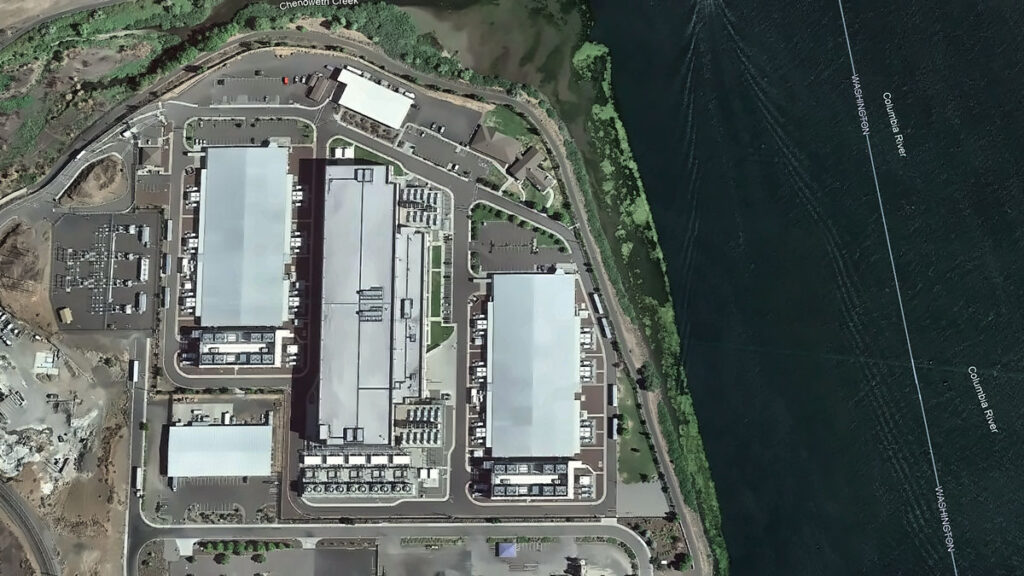
Every chip fabricated in a semiconductor plant needs ultrapure water. Most nuclear reactors need water as a coolant and neutron moderator. Every artificial intelligence (AI) data center drinks between 1 million and 5 million gallons of water a day, with thirst often peaking during drought.
Water runs through every technology priority the United States has named, yet the word does not appear once in “Launching the Genesis Mission,” an executive order (EO) released in November 2025. As describ
Every chip fabricated in a semiconductor plant needs ultrapure water. Most nuclear reactors need water as a coolant and neutron moderator. Every artificial intelligence (AI) data center drinks between 1 million and 5 million gallons of water a day, with thirst often peaking during drought.
Water runs through every technology priority the United States has named, yet the word does not appear once in “Launching the Genesis Mission,” an executive order (EO) released in November 2025. As described in the EO, the Genesis Mission is a “dedicated, coordinated national effort to unleash a new age of AI-accelerated innovation and discovery that can solve the most challenging problems of this century.”
Led by the Department of Energy (DOE), the initiative aims to build an integrated AI framework that would harness federal scientific datasets to accelerate breakthroughs in advanced manufacturing, biotechnology, critical materials, nuclear fission and fusion energy, quantum information science, and semiconductor development. The scope of the mission is comparable to that of the Manhattan Project.
Since the announcement, the DOE has listed “Predicting U.S. Water for Energy” among its 26 Genesis Mission Science and Technology Challenges. The project is also soliciting proposals in three water-related focus areas.
This framework provides a foothold for hydrology in the Genesis Mission, but it is scoped narrowly around water as a supply variable for energy production.
In reality, water is a crosscutting constraint that will help determine whether the mission’s priorities translate into deployable outcomes. The hydrology community now has a seat at the table, and if it moves first and positions water security as one of the “most challenging problems of this century,” the Genesis Mission can become the sandbox in which AI reshapes how the country measures, models, and manages water.
Making this happen will require that the DOE and the Office of Science and Technology Policy charter a hydrology workstream inside the Genesis Mission, with interagency delivery involving the U.S. Geological Survey (USGS), NOAA, the Bureau of Reclamation, the EPA, and partners at state, regional, and community levels. Here is what we think that workstream should look like:
A water-centric Genesis Mission architecture supports seven hydrological components that both feed into and receive decisions from the Genesis AI platform. Each component maps to a section of this article. Credit: Amobichukwu C. Amanambu. Click image for larger version.
While the existing challenges reflect some of these components, others will require coordinated effort from the hydrology community to bring into the Genesis Mission’s scope.
Build the Water Corpus Genesis Will Need
The Genesis Mission EO instructs the DOE to create an American Science and Security Platform to provide the public, scientists, agencies, and policymakers access to crucial scientific datasets.
The good news is that accessible water data systems already exist across several federal agencies and academic research centers. The USGS National Water Information System tracks real-time and historical water quality and use across the country. NASA’s Earth Science Data Systems Program provides open access to Earth science observations. NOAA’s National Water Center, the first federal facility dedicated to national water resource forecasting, operates the National Water Model, which continuously forecasts flows on 2.7 million stream reaches across the continental United States. The Catchment Attributes and Meteorology for Large-Sample Studies (CAMELS) dataset, currently hosted by the National Center for Atmospheric Research, provides data tailored for hydrological research on hundreds of river basins, and the Caravan framework pulls together multiple large-sample meteorological and hydrological datasets at a global scale.
What is missing is a unified, AI-ready repository that brings federal, state, and community data together.
What is missing is a unified, AI-ready repository that brings federal, state, and community data together. Building one is hard. Water data are fragmented, inconsistent, and often entirely absent. Consistent, reliable data for groundwater, withdrawals, reservoir operations, and water quality are especially difficult to obtain.
Local resistance to sharing data is real. In Texas, for example, landowners hold private property rights over groundwater and have opposed metering and reporting requirements imposed by groundwater conservation districts. In California, agricultural well owners fought metering mandates for years before the Sustainable Groundwater Management Act compelled local agencies to begin tracking withdrawals. Tribal nations face a different concern: Water data collected on Indigenous lands has been misrepresented in federal datasets that were modeled without accounting for Indian country, leading many nations to restrict access to their data as an exercise of sovereignty.
Practical steps toward building a unified AI-ready repository include tiered access and licensing for different stakeholders, clear provenance tracking for all data reported, financial and educational incentives for stakeholders for reporting, and targeted gap filling. Where measurements are missing, AI can fuse remote sensing with gauged records and operational logs—but only if the results carry honest uncertainty estimates tied to real decisions.
Get the corpus right, and it will outlive any single program name. It becomes infrastructure the country can lean on.
Develop Shared Hydrologic Foundation Models
The Genesis Mission EO directs the DOE to provide “domain-specific foundation models across the range of scientific domains covered.”
Hydrology has a head start. Long short-term memory (LSTM) networks are a key type of neural network designed to last thousands of time steps. Hydrology LSTMs trained on CAMELS data have already matched traditional conceptual models for daily streamflow discharge prediction. Open-source Neural Hydrology tools serve as baselines for regional runoff prediction. These predictions may serve as precursors to the foundation models the Genesis Mission envisions and building blocks from which they could be developed.
The process of scaling up these tools is not straightforward, however. A hydrologic investigation of snowmelt-driven streams in Colorado will not require the same spatiotemporal data as tile-drained fields in Iowa, for example. A hydrology-specific foundation model must take nuanced requirements into consideration and provide a clear path for managing and exploiting a variety of datasets.
Google’s Flood Hub shows what is possible: Its AI-enabled flood forecasts now cover more than 80 countries. However, Flood Hub’s core model code and trained weights remain proprietary, meaning researchers can use the forecasts but cannot rebuild or adapt the underlying models. Genesis, if well positioned, can fill that accessibility gap by producing foundation models for water that are reusable, reliable, and openly governed.
Build a National Water Digital Twin
The EO prescribes an integrated AI platform combining foundation models with simulation tools to stimulate AI-enabled innovations.
That architecture is exactly what a digital twin requires. Europe’s Destination Earth initiative is already building digital twins for weather extremes and nonstationary conditions on the Large Unified Modern Infrastructure (LUMI) supercomputer. The United Nations–led AI for Good initiative has prioritized water applications, warning that fragmented national efforts risk duplicating work.
If the United States aims for global strategic leadership in AI-accelerated science, water infrastructure cannot be an afterthought.
A water digital twin earns its keep when it makes the consequences of choices visible, in terms of flows, levels, temperatures, and risks to people and ecosystems.
Rather than starting from scratch, a water-centric Genesis Mission would unite existing federal models—the National Water Model, reservoir simulators, and groundwater codes—in a single digital twin. AI can become the thread that stitches them together, correcting biases and providing numerical solvers to enforce mass and energy balance.
What should this twin actually do? Help a dam operator decide whether to release water ahead of a storm. Tell planners where a new data center can draw cooling water without drying up a stream. Flag which coastal defenses will fail first under rising seas.
A water digital twin earns its keep when it makes the consequences of choices visible, in terms of flows, levels, temperatures, and risks to people and ecosystems.
Turn Basins into AI Test Beds
The Genesis Mission promotes AI-directed experimentation and directs the DOE to keep a record of robotic laboratories and production facilities in which such experimentation could be conducted. Hydrological field sites belong in that inventory. The National Ecological Observatory Network already operates 81 sites with standardized measurements of meteorology, surface water, groundwater, and biodiversity. The Critical Zone Collaborative Network instruments catchments to track water-soil-vegetation interactions over decades.
Formalizing these networks as AI test beds would link field observations back into the water digital twin so that experiments and models continually sharpen each other. Imagine mobile sensors steered by AI agents during a storm or aquifer recharge experiments designed by algorithms and verified in real time. That feedback loop is what separates a useful model from a decorative one.
Expand Water Challenges on the Genesis Mission List
The Exchange and What’s at Stake
Allowing water security to flow through the diverse components of the Genesis Mission would benefit both the policies championed by the mission itself and the hydrology community.
The Genesis Mission gets real-world, noisy test beds where AI proves value beyond benchmarks, a domain to stress test climate and infrastructure investments, and scientists trained in both AI and the stubborn realities of rivers, aquifers, and pipes.
Hydrology gets resources for shared data infrastructure, foundation models and instrumented basins no single lab can support, a seat when rules for AI and national scientific infrastructure are negotiated, and a chance to reset practices around openness, collaboration, and equity.
Earlier this year, the DOE released 26 Genesis Mission Science and Technology Challenges, and “Predicting U.S. Water for Energy” was among them. The accompanying funding call (DE-FOA-0003612) solicits proposals on cloud microphysics, coupled surface water–groundwater modeling, and seasonal to multiyear prediction, all framed around energy needs and flood resilience.
These inclusions are a significant win for a hydrology component to Genesis, but several urgent challenges sit outside their scope. Can AI close the gap between a flood forecast issued 12 hours out and the 48 hours emergency managers actually need? Can it map compound extremes, in which drought, heat, and infrastructure failure collide in the same week? Can it redesign monitoring networks so that coverage follows risk rather than where gauges happened to be installed a century ago? Integrating energy and water systems is equally urgent: Floods have caused 80% of major U.S. grid outages since 2000, while drought-driven water stress curtails cooling at thermoelectric plants and reduces hydropower output, exposing how deeply energy infrastructure depends on hydrologic extremes.
The water footprint of new AI infrastructure deserves a place on that list. A separate executive order (14318, “Accelerating Federal Permitting of Data Center Infrastructure”) is already fast-tracking expansion of data center construction, and a single hyperscale facility can consume 1 million to 5 million gallons of water daily. Emerging research shows how withdrawals at that scale can push streams below ecological thresholds during low flows.
Make Hydrology the Conscience of AI Governance
The EO directs the DOE to set data access rules and clarify policies for ownership, licensing, trade secret protections, and commercialization of products and tools associated with it.
Three principles should anchor such policies for AI use in water security.
First, Indigenous and community data rights must be embedded in every major AI water security effort, in line with the collective benefit, authority to control, responsibility, and ethics (CARE) principles for Indigenous data governance.
Second, AI’s own water footprint, through electricity generation and cooling, must be treated as a design constraint. Transparent reporting, stress-based siting, and efficiency targets will prevent hydrology in Genesis from being self-defeating.
Third, the DOE should define what failure looks like. Missing a flood crest portends loss of lives and livelihoods and breaches of treaties. Accountability standards must be measurable, and they must ask not just how accurate the forecast was on average, but who bore the cost when it was wrong.
A single executive order will not solve the country’s water security problems, and a single challenge topic will not either.
But the Genesis Mission has provided a seat at a table that did not exist 6 months ago. Whether the hydrology community treats it as a ceiling or a foundation depends on what happens next. Europe’s Destination Earth and the United Nations’ AI for Good water initiatives are already moving.
American hydrology now has a seat at the table. We should take it.
Kratzert, F., et al. (2019), Toward improved predictions in ungauged basins: Exploiting the power of machine learning, Water Resour. Res., 55, 11,344–11,354, https://doi.org/10.1029/2019WR026065.
Xiao, T., et al. (2025), Environmental impact and net-zero pathways for sustainable artificial intelligence servers in the USA, Nat. Sustainability, 8, 1,541–1,553, https://doi.org/10.1038/s41893-025-01681-y.
Zhang, L., et al. (2025), Foundation models as assistive tools in hydrometeorology: Opportunities, challenges, and perspectives, Water Resour. Res., 61, e2024WR039553, https://doi.org/10.1029/2024WR039553.
Author Information
Amobichukwu C. Amanambu (acamanambu@ua.edu), Department of Geography and the Environment, The University of Alabama, Tuscaloosa; and Jonathan Frame (jmframe@ua.edu), Department of Geological Sciences, The University of Alabama, Tuscaloosa
Citation: Amanambu, A. C., and J. Frame (2026), The Genesis Mission needs hydrology: Here’s how to incorporate it, Eos, 107, https://doi.org/10.1029/2026EO260131. Published on 28 April 2026.
This article does not represent the opinion of AGU, Eos, or any of its affiliates. It is solely the opinion of the author(s).

 Login
Login