The 2026 Beaker Street Science Photography Prize has unveiled its finalists, and they are a spectacular collection of beautiful, scientifically valuable images captured by photographers and scientists around the world.
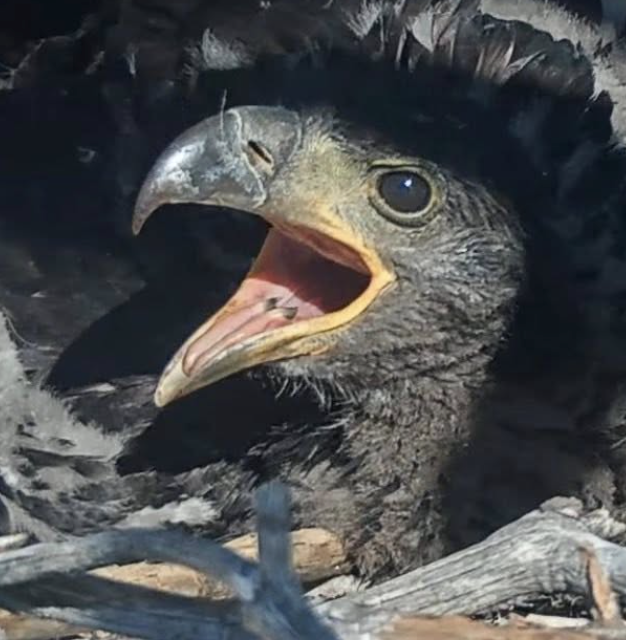
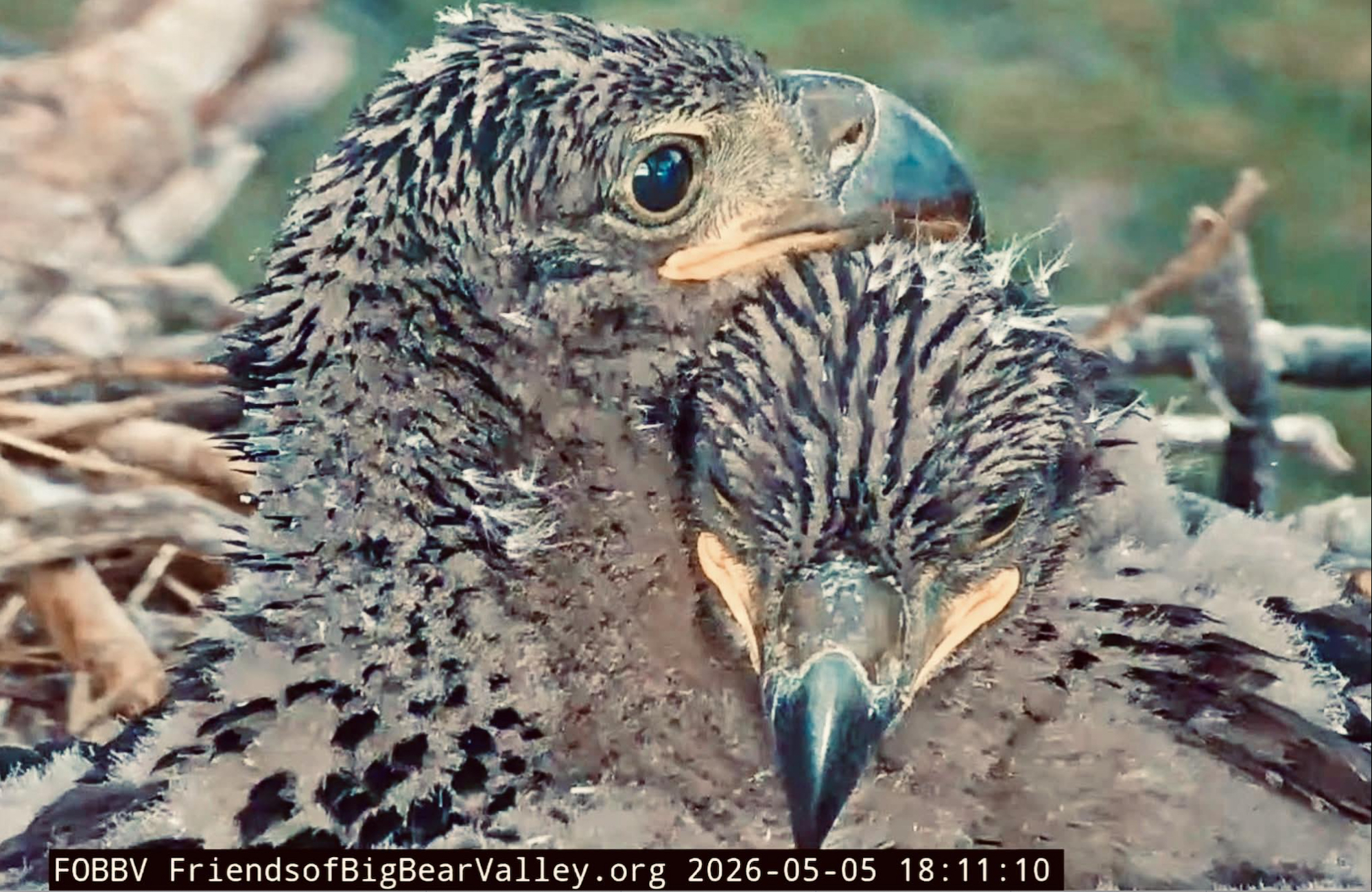
High above Big Bear Lake in southern California, a pair of eaglets’ eyesight is coming into focus. Sandy and Luna, the 2026 chicks of internet-famous bald eagles Jackie and Shadow, now boast vision abilities nearly equal to that of adult birds.
According the Friends of Big Bear Valley (FOBBV), the non-profit organization responsible for the 24/7 live cam, the bald eagle chicks can now track objects like squirrels and airplanes in the distance. Viewers can spot Sandy and Luna bobbing their heads as they watch things move. “This ‘bobbing’ helps them calculate the exact distance and speed of moving objects,” FOBBV explains.
This vision maturation typically occurs around 35 days old. The physical changes to their eyes take a bit longer—about five years. You’ll notice that Sandy and Luna have black-looking eyes while their parents’ eyes appear as a lighter, creamy yellow. The eyes lighten as they age, evolving from extremely dark brown to a lighter brown to a creamy brown to yellow.
A lot will change for Sandy and Luna. Images: FOBBV
Maturing eyesight isn’t the only physical change the chicks have undergone. At around 35 days old, eaglets’ leg bones also harden. So while their feet remain comically large, their leg bones have reached their full length, allowing Sandy and Luna to walk around the nest with more confidence in their steps.
It’s been another roller coaster nesting season for Jackie and Shadow, a pair of internet-famous bald eagle parents living in San Bernardino National Forest in Southern California. After two of their eggs were destroyed by ravens in January, Jackie and Shadow laid two new eggs that have successfully hatched.
Chick 1 hatched on April 4 at 9:33 p.m. PDT, while Chick 2 followed on April 5 at 8:30 a.m. Their large nest in Big Bear Valley east of Los Angeles is livestreamed 24 hours a day by nonprofit Friends of Big Bear Valley (FOBBV) and has captivated millions.
On May 1, FOBBV announced the chicks’ names: Sandy and Luna.
Before leaving the nest, the chicks face threats from other birds of prey, including hawks, ravens, other eagles, and owls. Inclement weather can also present challenges for the chicks. In 2025, a March snowstorm resulted in the death of one of Jackie and Shadow’s three chicks.
During fledging, only 70 percent of eaglets survive. One of the greatest threats is from cars that can injure or kill the birds while they scavenge for food on roadkill.
Who are Jackie and Shadow?
The pair first got together in 2018 and successfully raised chicks in 2019 and 2022. However, their eggs failed to hatch in 2023 and 2024. Only 50 percent of eagle eggs successfully hatch, so this pair has already beaten the odds.
What happened to Jackie and Shadow’s 2025 eaglets?
In 2025, Jackie laid three eggs that all hatched in early March. On March 13, a strong snowstorm dumped up to two feet of snow and battered the nest with strong winds. Only two of the chicks were visible on the live cam when the storm passed by the next morning. FOBBV later confirmed the passing of one of the chicks. The two surviving chicks were later named Sunny and Gizmo after 54,000 names were submitted by fans.
What happens after chicks fledge?
Young eagles usually fledge–or leave the nest and fly–when they can flatten their wings and have feathers capable of flight. This typically occurs when the birds hit 10 to 14 weeks of age. Males also tend to take their first flight a little sooner than females.
According to FOBBV, fledglings from Southern California have been spotted as far south as Baja California, as far north as British Columbia, and as far east as Yellowstone National Park.
About 70 percent of bald eagles survive the fledgling stage. FOBBV does not tag their eagles, so it’s not possible to follow the chicks’ journeys after they flee the nest.
After decades of families performing small miracles to afford childcare and sitting for years on waitlists, politicians are finally treating early childhood education like the essential economic infrastructure it is. | Celia Jacobs for Vox
After decades of families performing small miracles to afford childcare and sitting for years on waitlists, politicians are finally treating early childhood education like the essential economic infrastructure it is. Around the country, states and cities are pursuing universal preschool and childcare programs. It’s exactly the kind of bold, life-changing social policy that those of us in this field, like myself, have spent our careers fighting for.
If it’s done right.
Key takeaways
New Mexico is embarking on the nation’s most ambitious plan to provide universal childcare by providing parents with vouchers for free enrollment.
But the program is struggling to make good on its promise, because the state isn’t increasing the supply of childcare services fast enough to meet the new demand from parents.
Other countries, like Canada and South Korea, ran into these problems years ago when they tried similar programs. But they also showed how to fix these mistakes, and places like New York City are incorporating their lessons into more recent childcare rollouts.
Unfortunately, the most ambitious new attempt at universal childcare in America right now is in danger of making a mistake that has derailed past efforts: throwing money at parents without providing enough care for them to spend it on.
New Mexico has touted itself as the first state to offer universal no-cost childcare, thanks to a long, 15-year fight led by parents, childcare providers, advocates, and voters. In 2022, they achieved an iconic, grassroots win, unlocking unprecedented, permanent funding for early education through a ballot initiative. This financing victory accounted for the vast majority of the 130 percent growth in the state’s early childhood budget since 2019, enabling the state to more than double the number of children served in its childcare and prekindergarten programs and to make these programs free for families using them.
But the decisions about how to implement the state’s Universal Child Care program have continued to dig New Mexico deeper into policies that have proven elsewhere to fail. In the rush to claim victory, the state has prioritized expanding demand-side subsidies, giving parents vouchers for free childcare. However, by flooding the market with demand without sufficiently increasing the number of actual places for families to bring their children, or by paying educators enough to stay in the field, the state is creating a textbook policy failure.
And if New Mexico stumbles, it could drag down similar efforts around the country.
Childcare doesn’t just have an affordability problem; it’s also hard to find, primarily because of high staff turnover and high operating costs. To create a universal system where all families who need care can find it, afford it, and benefit from it, policy must address supply and quality alongside cost.
In most markets, making a service more affordable for consumers and more profitable for producers should trigger an immediate surge in supply. Logic suggests that offering free childcare for New Mexico families would cause new slots to rapidly open as providers look for ways to capture those dollars.
But as Mildred Warner, a Cornell University professor and leading expert on childcare as economic infrastructure, argues, this sector is defined by a fundamental “market failure to generate sufficient market supply.” Warner’s comparative research across three countries — the United States, Australia, and the Netherlands — found the same pattern: The typical way of funding childcare through vouchers boosts parent demand but doesn’t increase the number of slots available. And in rural and low-income areas, it has been shown to shrink it.
“Although it’s universal, it really isn’t accessible across the board.”
Colleen Roan, early childhood education leader
The reason, says Taryn Morrissey, a professor of public policy and childcare researcher at American University, is that childcare can’t scale like other industries. “You cannot have 100 babies in a lecture hall with one adult,” she told me. States regulate how many children a single adult can care for to ensure safety and the warmth and consistency that young children need from adults. This means that every new slot requires a proportional investment in trained staff and physical space.
This “market failure” is playing out in real time across New Mexico. While the state has successfully opened the floodgates of demand, increasing the number of children receiving childcare assistance vouchers by 78% from 2019 to 2025, the physical infrastructure has not kept pace. In the same six-year period, the state’s total childcare capacity in regulated care (which includes neighbors and relatives and daycare homes and centers) grew by just 1.9 percent, from 70,108 slots in 2019 to 71,455 in 2025. A spokesperson for New Mexico Early Childhood Education and Care Department (ECECD) noted that within this subset, licensed care had grown significantly but was offset by a decrease in home-based care that officials are trying to address.
The early childhood agency’s own estimates, announced alongside the Universal Child Care rollout as targets the state would need to meet, identify a shortfall of nearly 16,000 physical childcare slots and require at least 5,000 new professionals to staff them. Those targets remain unmet.
For families in rural areas like Gallup and the Navajo Nation, this shortfall is particularly acute. Colleen Roan, an early childhood leader in McKinley County, said that the sheer cost of upgrading older buildings to meet licensing codes makes opening new centers nearly impossible.
“There is universal childcare, but at the same time, there are not enough providers,” Roan said. “Although it’s universal, it really isn’t accessible across the board. … I hear about individuals being denied, mainly because they are not able to move on with becoming a registered in-home childcare provider.”
Roan’s last point highlights that even the avenue meant to be a lower barrier to entry — registering to serve a few children in your own home — isn’t working in her region. It’s not because safety regulations, like requiring background checks, training, and basic inspections, are too strict. Research suggests lowering standards does not increase supply. The bigger issue is raising the startup capital, the cost of meeting basic zoning and licensing standards, and a lack of help to navigate the process.
Vouchers come with structural problems for providers
ECECD secretary Elizabeth Groginsky disputed this framing, arguing that the state’s vouchers and broadened eligibility are “explicitly a supply-side strategy” that boosts public investment into the overall childcare sector. Her agency pointed to recent increases in the total number of workers and facilities available as evidence of progress.
“New Mexico’s policies have demonstrably increased the state’s licensed childcare supply and have led to the nation’s steepest gains in child care compensation and workforce growth,” Groginsky said in a statement.
It’s true that the money invested has made a difference, but the question is how to stretch scarce funding far enough to tackle the problems it’s meant to solve.
Vouchers put money in families’ hands, but they don’t build buildings, train teachers, or navigate the process of licensing and opening a new business, and the uncertainty around how many parents will utilize them makes providers more reluctant to invest in new capacity.
Policy experts have long warned about this mechanical failure, which is made worse by unpredictable revenue. A 2020 report from the Center for American Progress explicitly outlined why vouchers fail to build supply: Because vouchers are tied to individual children rather than to seats, a provider’s revenue rises and falls with each family’s eligibility, enrollment, and the ability to navigate approval processes. When a child leaves, the funding leaves with them. What providers need instead is fixed operating support that the state can guarantee as a backstop. If states want to increase the supply of care, they must swap vouchers for direct grants and contracts that pay for classroom enrollment, guaranteeing the revenue needed to provide high-quality care to families and wages to educators.
And rather than build around this problem, New Mexico wrote it into law. The 2026 Child Care Assistance Program Act, or Senate Bill 241, codifies the statutory framework for the state’s expanded voucher program and unlocks $700 million for the state’s Early Childhood Trust Fund over the coming years. But the bill contains no parallel provisions for direct facility grants, capital investment, or contracts for classroom enrollment. Instead, it offers a few supply-side levers — a small revolving loan fund for facilities, capital outlay for higher-education-based centers, scholarships for educators — at the margins, rather than as part of the state’s central funding mechanism.
The infant and toddler bottleneck
A lack of supply doesn’t just leave more frustrated families; it creates a competition that the most vulnerable families are least equipped to win.
When the state made childcare free for everyone but didn’t build more of it, it invited thousands of new families to compete for the same scarce slots. The families who come out ahead are often the ones who can get on a waitlist months before their child is born, who know which providers to call, and who have a car to tour many programs in one day or to tour those programs during business hours. The families who lose are disproportionately the ones the policy was meant to help: lower-income parents working hourly jobs with less flexibility, less access to information, and fewer backup options when the waitlist doesn’t move.
Infants require more adults to care for them, making them the most expensive slots to provide.
This crisis is most acute for families with the youngest children, where slots were the scarcest to begin with. Catron Allred, the executive director of the Early Childhood Center of Excellence at Santa Fe Community College, currently has a waitlist of 600 to 700 children, with the greatest demand for infant and toddler care. She said that her biggest hurdle is finding capital to build more classrooms and people to staff them who are properly credentialed and can cover their 10-hour days.
“We are competing with public schools who get out at 3 pm and don’t work in the summer,” Allred told me. “This has been sold as not a profession for so long.”
Groginsky, the ECECD commissioner, noted that infant and toddler care was a problem nationwide and not just in New Mexico and that the state has put “unprecedented public investment” into the childcare sector.
But the data also makes clear that the failure of vouchers to build supply is having the biggest impact on these youngest children. While the absolute number of infants and toddlers in the program has grown alongside overall enrollment, the gains are far below those of older children. According to the Legislative Finance Committee, the proportion of children under age 2 enrolled in the state’s assistance program has nearly been cut in half, dropping from 21.3 percent in 2020 to just 11.6 percent in 2025.
Allred’s experience explains why: Infants require more adults to care for them, making them the most expensive slots to provide.
Other countries have struggled through these problems
We know exactly how New Mexico’s path ends, because Quebec and South Korea made the exact same mistakes decades ago.
To quickly implement universal systems, they took a path that sounds familiar. In 1997, Quebec rapidly expanded subsidies to more providers to meet its bold “$5-a-day” promise for childcare costs. In 2012, South Korea invested billions in demand-side vouchers. In both cases, they prioritized the speed of the expansion over building the supply and workforce to support children.
The consequences of outsourcing universal care to the path of least resistance were severe. In South Korea, the flood of state funds into the private market created a two-tiered system, leaving parents on years-long waitlists for the few high-quality public centers.
In Quebec, the result was equally cautionary. While the 1997 rollout successfully boosted maternal workforce participation, it took nearly a decade for landmark longitudinal research by economists to empirically prove the developmental cost of that rushed expansion. Because the province scaled up so quickly, relying heavily on lower-quality, hastily assembled care settings to absorb the massive surge in parent demand, researchers tracked lasting negative impacts on children’s non-cognitive development, including increased anxiety and aggression.
To be clear, this data does not suggest that universal childcare is inherently harmful. Rather, it shows that treating childcare merely as a demand-side affordability issue can actively harm the children the policy is meant to serve. Quebec has since become an example of what can work by course-correcting: raising educators’ wages, tightening quality requirements, and heavily prioritizing the expansion of its public education system through non-profit childcare centers.
Treating childcare like essential public infrastructure works
The good news is that we don’t need to study abroad to see the benefits of well-implemented universal childcare.
Jurisdictions like New York City, Vermont, and San Francisco are proving that, when robust financing meets well-planned policy, children and families win. By treating early childhood education not as a private consumer transaction, but as essential public infrastructure, these governments are building systems that actually deliver on the promise of access.
In Vermont, where Act 76 was passed in 2023 to establish a payroll tax to fund childcare, the state has begun shifting to predictable, stable funding through contracts with childcare providers. The bill officially set the stage for state-mandated minimum pay standards for early childhood educators and created clear career pathways to elevate what is often maligned as “babysitting” into a respected profession. When Vermont’s governor attempted to veto the bill, the state legislature successfully overrode him , recognizing that, without stabilizing the workforce, the entire system would collapse.
San Francisco has also taken a different approach, investing in the workforce first and expanding second. In 2018, voters passed “Baby Prop C,” a commercial rent tax dedicated to early childhood. Rather than immediately using that funding to subsidize more families, the city’s Department of Early Childhood spent years building the supply side, including offering educators a stipend of $4,000 to $39,100 annually to raise wages to that of K-12 public school teachers. Only after years of stabilizing the workforce did the city announce, in early 2026, a massive expansion that guarantees free childcare for families earning up to $230,000 a year.
Finally, New York City is demonstrating how to phase in universal childcare intentionally. Rather than flooding an unprepared market with vouchers, the city treated expansion like a public works project. They rolled out by age, starting with Universal pre-K for 4-year-olds, then expanding to 3-year-olds. Now, the city and state are methodically rolling out “2K” starting in 2026, with 2,000 seats strategically placed in high-need neighborhoods to ensure the physical supply is in place before expanding citywide. Crucially, the state is backing this up with over $150 million in direct capital funding to build new classrooms.
States looking to make the universal childcare moment work for children can learn from these lessons and from the hard-fought financing victory in New Mexico. But funding is only the first step. Until policymakers stop relying on expanding the limited systems we have and start directly funding the facilities and the educators required to do the work, universal childcare will remain a brilliant promise that benefits only some.
The spires of the historic Salt Lake Temple in Salt Lake City, Utah in 2016. | George Frey/Getty Images
Over the weekend, the Department of Defense stepped into one of the more delicate questions in American religiosity: who gets to be called “Christian.”
More specifically, does the Church of Jesus Christ of Latter-day Saints (commonly called the Mormon Church), fit the bill?
The brouhaha started with Secretary Pete Hegseth’s plan to simplify and reform the work of military chaplains — those religious and spiritual advisers who tend to the faithful within the military’s ranks.
A Pentagon spokesperson on Friday posted a new list of categories of religious affiliation for military service members, which had shrunken from over 200 to 31 labels. In previewing this reform, Hegseth had argued that it was part of the Trump administration’s fight against secular humanism and for the role of religion in public life. By narrowing the number of religions, and excluding some prior identity groups Hegseth’s Pentagon found objectionable, officials argued it would be easier to assign chaplains to units.
“This brings the codes in line with its original purpose, giving chaplains clear, usable information so they can minister to service members in a way that aligns with that service member’s faith background and religious practice,” Hegseth said in a video statement in March.
Gone were “atheist” and “Wicca” from the new list — and though the Church of Jesus Christ of Latter-day Saints was included as a religion, it was not labeled “Christian.”
That set off an explosive reaction from Mormon elected officials, including some normally aligned with the administration. To them, the government seemed to be saying that Mormons are not Christians — a highly offensive statement for LDS Church members, who see Jesus Christ as the center of their faith.
It does seem that the LDS are being unfairly singled out here. If the essential criterion for Christianity is Trinitarian theology, why do the Jehovah’s Witnesses, Christian Scientists, Oneness Pentecostals, and even Quakers (in some instances) get a pass here? https://t.co/3NKPBsDFaw
“I can say confidently that the U.S. government has no business recognizing the Christianity of literally every other religious sect that worships Jesus Christ — with one exception,” Sen. Mike Lee (R-UT) posted on X, one of many complaints he raised over multiple days.
On Monday, the Pentagon said the move was unintentional — and amended the original document that blew open this controversy. “The Pentagon’s job is not to adjudicate theological debates, but instead to ensure sincerely-held faith is respected and encouraged in our ranks,” an official statement read. Lee said he was “thrilled” with Trump’s response after he discussed the issue with the president in a phone call.
But the fiery response spoke both to the LDS church’s long battle for acceptance in America’s faith community, and to deeper tensions within the religious right in President Donald Trump’s second term. Even as the administration tries to privilege Christianity in America, its coalition is suspicious about which kind is taking the lead.
A history of exclusion
Mormons have often faced a hostilereception in mainstream religious life since their church’s founding in the 19th century, a wound that the Pentagon decision reopened.
Despite a tense history between the Church of Jesus Christ of Latter-day Saints and both the American state and other religious groups, there’s been a kind of detente in the 21st century.
Mitt Romney’s 2012 presidential campaign was widely seen as a watershed moment for Mormonism’s mainstream acceptance, especially within the Republican Party’s conservative Christian electorate, even as his faith was a sensitive topic at points during the race.
“It’s not like those theological concerns about Mormonism disappeared in 2012, but by the time we got to 2012, the issue wasn’t Romney’s Mormonism anymore,” David Campbell, a professor of American politics and religion at the University of Notre Dame, told me. “And so a lot of members of the LDS church thought, well, this issue’s over now.”
As Campbell noted, however, there were still major doctrinal differences between LDS and major branches of Christianity. For example, LDS theology does not accept the Trinity — the idea that God is both one being and manifested in three essences (the Father, the Son, and the Holy Spirit). Roughly, LDS believers view Jesus Christ as the Son of God and a distinct entity to God the Father, who has a separate physical body.
More simply, the LDS Church rejects the Nicene Creed — the statements of faith that have united most Catholic, Orthodox, and mainline Protestant churches for more than a thousand years as well as the Apostles Creed (which most western Christians accept). For these reasons, manyCatholics and Protestants would not call Mormons Christians, even if they believe in a God and follow Jesus Christ.
The Pentagon dust-up brought these divides rushing back to the front of mind.
“When Mormons have come into the public square and have sought to build bridges politically, that has been acceptable,” Campbell said. “But when that theological question comes up, maybe some have been won over, but not very many. And this is just yet another reminder of that.”
One example of this submerged tension came up during Romney’s 2012 run, when a prominent Texas evangelical pastor, Robert Jeffress, called Mormonism a “cult” and argued Romney “is not a Christian.” But Jeffress also endorsed Romney in the general election, citing their shared values apart from theology — and he is now a prominent Trump supporter.
Some LDS voices on the left argued that Mormon Republicans had been too naive in thinking that a White House that elevated figures like Hegseth, an evangelical who has pushed boundaries with his Christian rhetoric in public duties, would protect religious freedom rather than elevate political allies. Some linked the Pentagon list to the administration’s embrace of “Christian nationalist” evangelical leaders who have called for tearing down walls between church and state.
“For us on the left, it’s like, yeah, of course the Trump administration doesn’t believe in our version of Christianity,” Eric Biggart, chair of the LDS Dems Caucus, told ABC4, a Salt Lake City news station. “That’s been clear to us for 10 years now.”
Republican lawmakers who protested the Pentagon’s decision did not make this argument themselves and appeared to accept the official explanation on Monday. But it’s also noticeable that they did not give Hegseth the benefit of the doubt when the story first emerged — the response to the Pentagon’s list was immediate and public, rather than delivered quietly behind the scenes. Loyal Republican politicians like Sens. Mike Lee and John Curtis immediately criticized the decision and spent the weekend debating theology, engaging other Christians, and calling out the Department of Defense.
This episode is probably not going to be a turning point, Campbell told me, but it is another crack in the religious right’s coalition. Many LDS members already view Trump and MAGA with suspicion in comparison to other conservative religious communities, although he’s made inroads with LDS voters since his first election. To some, the episode was a sign that members of the faith should be suspicious about tying their religion to a political coalition.
“I say this with love to my fellow Latter-day Saints: the sooner you give up trying to convince the religious right to validate your faith, the sooner you’ll know peace,” McKay Coppins, an LDS journalist who has written extensively about the church, posted on X.
“Are we real Christians? Only one opinion matters — and it’s not Pete Hegseth’s.”
We are almost halfway through 2026—oh, how time flies. And as the seasons change, so do we. The cosmos is closing out a phase of exploration and ideation, urging the stars to help us make the most of our time and energy. The shift from spring to summer means the stars encourage us to think about what seeds we’ve planted and how we plan to grow a bountiful harvest.
All month long, your mind will be fixated on what you need to feel fulfilled. The movement of the planets this month reveals a path back to the heart’s center, and puts a spotlight on what’s necessary to keep your mind at ease and your emotions regulated. Are the flames of your creativity being stoked? Is the work you do evolving into more than just a paycheck? Are the people you surround yourself with draining or invigorating your spirit? Aside from a pesky Mercury retrograde at the end of the month, June promises clear skies, green grass, and the chance to return to yourself.
Here’s what to expect:
On June 1, Mercury enters Cancer. The mind becomes like a crab while Mercury is in Cancer—hard shelled with a soft interior. The claws could come out while you navigate conflict, but behind the sharp pincers is a desire to be seen, heard, and validated in your emotions. There is plenty to learn from these next few weeks about how to blend the head and the heart, especially because on June 29, Mercury stations retrograde in Cancer. That means we will have over two months of the planet of communication, tools, and technology in the sign of home, family, and emotions. What better time than now to dust off your favorite journal and reflect on the ways you can speak clearly about matters of the heart?
On June 13, Venus enters Leo. Your heart will be set ablaze with the planet of passion and creativity in the fierceness of Leo’s domain. Relationships become celebratory. Those who are pack of the pack are given their time to shine, and if someone has an issue with that, they’re existing in the selfish shadow of Leo. Our creative pursuits become a raw expression of childlike joy. Carve out time to indulge and play like a child who isn’t worried about bills to pay, it’ll be healing. And finally, because Venus rules our wallets, err on the side of caution if you’re looking to splurge. Treat yourself, within reason!
On June 14, there’s a new moon in Gemini. The gist of this new moon is making the ideas material. No longer will you talk endlessly about your Nobel prize-winning ideas—no, ma’am, you’re going to make sure you act on them. The beauty is that curiosity won’tkill the cat under this new moon. You have complete permission to explore these ideas, and the freedom to make adjustments as they materialize. This is your last chance to try before you buy—commit to a goal for the next six months. What will you allow yourself to explore?
On June 21, Cancer season arrives. This is a time to reflect on our home lives, family relations, and emotional core. Will the next four weeks be more sensitive? Sure. Will you have moments where the pinchers come out because your softness was taken for weakness? Absolutely. You will also find these weeks are the most important for helping you stand more confidently in what you needto keep your emotions regulated. Today also marks the summer solstice, one of the four major astrological shifts of the year. The sun is in the sky longer than any other day of the year, which symbolizes the light that exists within all of us. Although the days are getting shorter, today is a celebration of everything that makes us whole.
On June 28, Mars enters Gemini. These next two months may feel like the universe is holding a laser pointer and you are a scruffy little kitten doing your best to keep up with all the ways it is darting across the wall. Mars, the planet of action, aggression, and motivation, finds inspiration in every shiny new thing during its tenure in Gemini. Whip out the schedule, prep the task reminders, set timers, and have a to-do list, because you might find yourself sailing into uncharted waters. This is a great time to try new ways of working, just don’t fly off the handle.
On June 29, there’s a full moon in Capricorn. This one might feel like a doozy, because it is also the beginning of Mercury retrograde. Full moons are the culmination points of the lunar cycle, so awareness, energy, and emotions are all heightened. The Capricorn influence over this full moon will feel like a stern but rewarding professor who wants you to succeed. Expect to see more clearly the beauty mark you wish to leave on the face of this world, and what pores need a deep cleansing in order for that beauty mark to be the focus.
On June 30, Jupiter enters Leo. This is the last major planetary shift of the year, and Jupiter is here to heat things up. Jupiter, the planet of good fortune, optimism, and expansion, is the last link to a revolutionary summer of change and empowerment. Jupiter has spent the past year in Cancer, which grew our hearts immensely. Our understanding of what it takes to make a house a home—both IRL and in our souls—is much clearer now. So what will you do about it? Jupiter in Leo takes us from steam engine to solar power. This next year will renew our energy, and fuel our desire to bring joy to the world. Expect the next year to highlight a chapter in your life where you’ll be celebrating individuality, not using it to separate yourself from others.
The next month will influence everyone a bit differently, depending on your rising sign. Below are you monthly rising-sign readings—take what resonates and use that as your reflective guide all month long!
Aries
The majority of the month has you living in the material world, focusing on how you can build secure spaces to not just survive but thrive. All your resources should tie back to your non-negotiables—if not, why are you wasting your precious time and energy? As the month progresses, you might notice your emotions are on the fritz; you could be feeling a bit of frustration at home and with family. Again, this is a reminder to do your part in creating safe spaces. Be honest, but don’t let your needs lead to burned bridges.
Taurus
Taurus, your month is split between finding joy in the everyday and reconnecting with your heart’s center. June will feel buzzy for a while, taking you around town and pulled to new spaces that have a familiar sense of comfort. This will make it easier for you to identify and communicate your needs. As the month moves along, you’ll notice that you’re spending more time at home, and with your inner child. Put in the effort to find spaces for that younger self to play and keep the fire in your heart burning bright.
Gemini
Gemini season is still in full swing during June, which means you can still exist in your love-thyself, main-character energy. That said, you should keep a close eye on your finances this month. The upcoming Mercury retrograde could reveal some frivolousness or a need to revise your approach to financial planning. There could also be a wave of emotions that have you questioning yourself. Rather than beating yourself up, ask yourself, “If I’m to celebrate me, why should I put my energy into things I don’t value or bring me down?”
Cancer
Summer is upon us, which means it is your time to shine! Are you ready to emerge from your cocoon? Are you feeling the itch to reintroduce yourself? June marks a month of releasing anything that keeps you from being you. These next few weeks are your permission slip to to step into the spotlight. Start that personal blog. Get the new wardrobe. Take yourself out on a spa day. Trust and believe, you’ll be grateful if you do—because if you don’t, Mercury retrograde at the end of the month will force your hand to prioritize number one, whether you like it or not.
Leo
June is the last phase of a slow burn building up to a new era of you. You’re shedding the last bit of fear that’s putting a barrier between you and the person you want to become. Your social circles will reveal many answers as to why you might still be reserved. Are you in spaces where you are performing 24/7, or can you be your authentic self, stress-free? Toward the end of the month, you’ll have more conclusive answers on what you need to let go, so you can make space for yourself to grow. Celebrate the good times, but look ahead to a new experience that will teach you so much about who you are.
Virgo
Virgo, June is a reminder that when you work hard, all your wildest dreams can come true. All month long, you’ll continue striving toward those big, lofty goals you’ve set for yourself and finding support within a perfectly curated social circle. You can expect to feel a sense of achievement if you've been sticking to a routine that helps you progress a little bit every day. That said, you are your own worst critic, and you are the only one who whether or not things went to plan. So if you need to reassess your direct, or take a short vacation, don't view it as a failure but just a side quest on this long journey we call life.
Libra
June is going to feel a bit like a work hard, play hard kind of month. You'll feel a rush of excitement earlier in the month as new business projects and opportunities to learn fall into your lap. While you could easily go off to the races with these new endeavors, you might want to consider the big picture and whether or not jumping ship is just a fleeting emotion or something that will course correct some past mishaps. Don't make any big decisions just yet, let this month be a continued exploration of where you want to end up. That way you can still enjoy the summer sun and rooftop festivities with your favorite people, stress free.
Scorpio
June is a month of reconnection. Reconnection to yourself, and your people. There might be some tension, but your task is to get deep, find common ground, and do your part to create a path to resolution. Be patient with yourself and others, the only way to uncover the answers to any issues you might have is to acknowledge the root of the problem. Doing so will help you realize what's still stuck deep in your heart that is preventing you from a full phoenix from the ashes level transformation. As the month progresses, be careful not to run away from any conflict. You can take a step back, but don't bury anything under the rug.
Sagittarius
The question you need to answer this June is who do you want to spend the rest of the summer with? Are there any relationships that feel like they need a bit more nurturing at the moment? Is there a special someone who's caught your eye and putting butterflies in your stomach? The month wants you to share your authentic self, but don't let your free & open nature cause you to flit from one surface level connection to the next. Focus on building lasting connections that allow you to transform the way you hold space for others.
Capricorn
Capricorn, this month could be the month where you realize what you need from your more intimate connections. Focus on your one on one relationships, the ones that uplift you and make you feel like the weight of the world doesn't rest solely on your shoulders. The lesson this month is learning to communicate your needs to those you rely on. It's easy to fly solo, but don't let fear of vulnerability stop you from asking for a helping hand. Don't bottle up any emotions that could help you create a stronger bond with your loved ones, business partners, and friends. The bravest thing you can do this month is be honest about what you need.
Aquarius
June is sure to be a wild ride, Aquarius. The majority of the month will be filled with passionate love affairs, endless hours of hobbies, and a wave of joy to wash away your worries. What excites you to your core? And why would you limit yourself from indulging in that excitement? Sure, moderation is key, but there will be plenty of lessons for you to learn how to find the perfect balance of work and play. So let yourself play, and during your down time make sure you follow up with that to-do list so you don't fall behind on all the summer bucket list plans.
Pisces
Pisces, June is going to heal that inner child, if you take the time to walk hand in hand with them. You might feel a bit of apprehension toward the end of the month, so use the first chunk of June to start building those habits that will support your younger self. This means slowing down, just a bit, to listen to what your body is asking of you. What do you need to feel safe enough to create, to play, to explore? Does it mean you have to refresh your home to make it more like a sanctuary to revive your spirit after a long day? Try new ways to tend to your emotions, and let that inspire you to create a life that your younger self would be so excited to know they're living.
Love them or hate them, documentaries take themselves seriously when they dive deep into hefty material. From a jaunt through history to a grim true crime investigation, it might seem like a difficult genre to parody, but then came a character perfectly suited to mock through satire: Philomena Cunk. Before Netflix got its hold on Diane Morgan’s impeccable character, she had been lovingly terrorized British audiences for years. Then, Cunk on Earth arrived with a 100% Rotten Tomatoes score, and the world has never been the same.
For decades, scientists have known that Earth’s magnetic field helps migratory birds and homing pigeons navigate. Just how our feathered friends sense the invisible sphere around the Earth, however, has been less clear.
At least part of the answer appears to be hiding inside a seemingly random organ. Immune cells inside pigeon livers called macrophages are sensitive to the planet’s magnetic field. These cells function like an internal compass, according to a new study published today in the journal Science.
Macrophages destroy old red blood cells, which makes them accumulate iron. The iron makes the macrophages superparamagnetic, a kind of magnetism that takes place in particular nanoparticles. The nanoparticles can then be magnetized if a magnetic field is applied to them.
“When pigeons fly, the nanoparticles align with the magnetic field and become ‘magnetized,’” Clivia Lisowski, a co-author of the study and a post-doctoral researcher in Immunology at the University of Bonn, tells Popular Science. “Like that, pigeons can sense Earth’s magnetic field.”
Electron microscopy image of pigeon liver tissue shows hepatic macrophage (blue) in contact with nerve fiber (yellow), which enables them to transmit (“magnetic”) information to the pigeon brain. Image: Lisowski et al. (2026) Science.
To understand how these particles help the pigeons navigate, Lisowski and her team tracked down where magnetic cells are in pigeons’ bodies. Because the liver and spleen store significant quantities of iron, researchers thought these might be good candidate organs. The liver had a significantly stronger magnetic response than any of the other tissues in the study, according to study co-author Ulf Wiedwald, an expert in nanoscience at the University of Duisburg-Essen in Germany,
From there they homed in on macrophages, and put these important immune cells to the test. They studied pigeons that were trained to fly back to their aviary in Konstanz, Germany, from over 12.4 miles away. Pigeons whose macrophages had been removed got lost when the weather was overcast. But when the sun was out, the pigeons reached the aviary, probably with the aid of solar cues.
The findings show how the birds employ magnetic sensing to find their way, as well as the sun’s orientation.
“Our study has implications for both the immune research landscape as well as for research on animal navigation or magnetoreception, respectively. For animal navigation it’s a new concept of how animals sense/perceive Earth’s magnetic field,” Lisowski says. “We think that this ferrimagnetic mechanism can actually explain how birds migrating at night, or sharks or bats or other animals migrating in dark environments can perceive Earth´s magnetic field.”
The team also found that the iron-rich macrophages are close to nerve fibers, indicating that magnetic information can get to the brain via this route. Ultimately, this shows how important interdisciplinary research, involving immunologists, behavioral biologists, and physicists, carries significance for more than just birds.
As for the immune system, Lisowski explains that to accomplish its different fuctions—such as defending our bodies from pathogens and healing wounds—it has to sense the environment.
“Our finding that the immune system can also sense the Earth´s magnetic field is a complete new layer in this concept of ‘immuno-sensation’ and opens the door to new research,” Lisowski explains.
 Login
Login



:max_bytes(150000):strip_icc():format(jpeg)/kevin-jonas-michael-buble-060426-341a238b990c4f958b6b898e80e33b7e.jpg "<p>Gary Gershoff/Getty; Taylor Hill/Getty</p>")