As completion of 144-year basilica nears, questions swirl over resemblance of church to architect’s original plansIt has been a long wait but 144 years after work began, Pope Leo XIV has blessed the recently completed central tower of Antoni Gaudí’s Sagrada Família church in the presence of members of the Spanish royal family, the prime minister and hundreds of bishops.With the completion of the Jesus Christ tower, the tallest of 18 in the temple, the basilica has reached its full height of 172.
As completion of 144-year basilica nears, questions swirl over resemblance of church to architect’s original plans
It has been a long wait but 144 years after work began, Pope Leo XIV has blessed the recently completed central tower of Antoni Gaudí’s Sagrada Família church in the presence of members of the Spanish royal family, the prime minister and hundreds of bishops.
With the completion of the Jesus Christ tower, the tallest of 18 in the temple, the basilica has reached its full height of 172.5 metres. It is now not only the world’s tallest church but Barcelona’s tallest building. It was consecrated in 2010 by Pope Benedict XVI.
Utah U.S. Senators Mike Lee and John Curtis, both Republicans and Latter-day Saints, challenged the Pentagon's exclusion of their faith from its list of Christian religions.
Utah U.S. Senators Mike Lee and John Curtis, both Republicans and Latter-day Saints, challenged the Pentagon's exclusion of their faith from its list of Christian religions.
Pope Leo XIV gestures as he addresses the crowd during the weekly general audience at St Peter's Square in the Vatican on May 20, 2026. | Tiziana Fabi/AFP via Getty Images
Monday morning, the Roman Catholic Church made its biggest foray yet into the discourse on artificial intelligence and the role it should play in human life as the technology develops.
In the first encyclical of his papacy, titled Magnifica humanitas (Latin for “magnificent humanity”), Pope Leo XIV argued that AI is n
Pope Leo XIV gestures as he addresses the crowd during the weekly general audience at St Peter's Square in the Vatican on May 20, 2026. | Tiziana Fabi/AFP via Getty Images
Monday morning, the Roman Catholic Church made its biggest foray yet into the discourse on artificial intelligence and the role it should play in human life as the technology develops.
In the first encyclical of his papacy, titled Magnifica humanitas (Latin for “magnificent humanity”), Pope Leo XIV argued that AI is not intrinsically immoral, but that its adoption needed to be slowed in order to build moral guardrails, to establish better social safety nets for those displaced by economic and labor disruptions, and to create democratic processes that will ensure the public remains in control of these developments, rather than a small subset of tech oligarchs. The document also contended that the “intelligence” in artificial intelligence was a misnomer: Intelligence is something only human persons possess, and technology will never be human.
Key takeaways
The first encyclical, or official teaching letter, of Leo XIV’s papacy, dropped Monday.
It centers the uniqueness of humanity, the dignity of work, and the challenges that artificial intelligence poses to the world order and humans’ relationships with each other and God.
The Catholic Church has a long tradition of reasserting authority in the modern era, starting with the current pope’s namesake, Leo XIII, who confronted the rise of the Industrial Revolution and changing global economies.
There are deeper spiritual and material reasons the pope, and the church, are so concerned with AI now.
Encyclicals are official teaching documents of the Catholic Church: letters issued by popes to bishops after consultation with theologians, historians, and experts on pressing matters that affect humanity or the church, with the expectation that all people, faithful or secular, can learn from them and help shape their consciences and lives. Magnifica humanitas is Leo’s first encyclical since becoming pope last year, and its release now underscores the focus the new pope is putting on AI and technology. Notably, Leo also used the occasion to make a historic formal apology for the Church’s previous defense and justification of slavery — a reminder that the Catholic Church has not always been on the right side of social ills.
Though popes are traditionally not present during the release of these documents, which first began in the 18th century, Leo XIV was in attendance at its presentation, and delivered his own comments — something Vatican observers indicated reflected his desire to make sure the Church’s stance was properly understood. The Chicago-born pontiff spoke in English and was joined by AI experts and industry leaders, including Anthropic co-founder Chris Olah, who consulted on the document.
So how should the public process and think about this new document? It’s helpful to first understand the context in which the Church is speaking up about this at all.
Why the Catholic Church cares so much about AI’s development
Magnifica humanitas is dropping more than a week after Pope Leo XIV actually signed it on May 15. The timing matters.
That day marked 135 years since the release of Rerum Novarum, the seminal work of Pope Leo XIII, the current pope’s namesake, who was leading the church during the late stages of the Industrial Revolution. As they are today, the faithful, and the clergy, were facing a rapidly changing world. And the Church, the world’s leading moral authority at the time, had yet to establish its place in it.
That 19th-century document made philosophical arguments about the relationship between labor and capital, warning about the perils of communism. But it also redefined the church’s relationship to the modern world, with the papacy reasserting itself as both a source of power and a moral authority in an era of rapid change. The encyclical set a template for how a 2,000-year-old institution could still remain relevant in a modern age.
In presenting this encyclical, Pope Leo XIV made this parallel clear. He sees the rise of artificial intelligence as the defining global challenge of the day, and of his pontificate: “Like the earlier Leo, I feel entrusted to look upon another huge transformation with eyes of faith, with lucidity of reason, with openness to mystery and with cries of the poor and the earth resounding in my heart,” the pope said while presenting his encyclical.
The newer encyclical builds off his predecessor’s tradition, and the various arguments popes have made about the importance of preserving the dignity of the human person and valuing modern technology only so long as it benefits everyone, not just its creators or the rich.
In 2015, Pope Francis, for example, wrote about “the technocratic paradigm” that has taken root in modern capitalism: the sense that technological progress is unstoppable, that it will demand unlimited concessions from nature and from people, and that the world had no choice but to submit to change.
“Leo is concerned that we don’t just submit to inevitability on questions of AI, but ask critical questions and push back in ways that are necessary before it’s too late to push back, before damage is done that can’t easily be undone,” Dan Rober, an associate professor of Catholic Studies at Sacred Heart University, told me.
That role of questioning, pausing, and coming to consensus has defined the Catholic Church’s leadership and operation for the last two papacies: the notion of synodality, or teaching and making decisions based on consensus. Before AI and the technologists who have created it become the sole determinants of how politics, the economy, and society operates, the Church is asserting itself as a counterweight — even as it includes some of those leaders in the process.
“Pope Leo is trying to clearly walk in those footsteps, and I think he’s very concerned, as are a lot of people, about the possible implications, particularly for job markets and for people’s lifestyles being sustainable day to day with the rise of AI systems that may render a certain significant amount of jobs able to be automated very rapidly,” Rober said.
This kind of reflection has become standard procedure for the Vatican. Since at least the turn of the century, the Church has found itself increasingly weighing in on the crises of the day, albeit oftena bit too late.
As the Catholic writer Christopher Hale has noted, “Francis took up the climate fight with Laudato Si in 2015, after decades of scientific consensus had been ignored. Benedict XVI took up the global economic order with Caritas in Veritate in 2009, after the financial system had already collapsed. Both documents arrived in the long shadow of the crises they addressed.”
In Magnifica humanitas, Pope Leo XIV may be seeking to intervene early in the development or takeover of a new technology this time, and show that the Church wants to both work with Silicon Valley and assert itself as a powerful defender of modern values, as it has done in its defense of the liberal international order and aspects of humanism, like human autonomy and reason.
In the background, there’s also a more sci-fi element: the notion that AI could end up coming between the Church and the people — serving as a filter or layer between regular people and God, and perhaps even usurping the role of the Church itself. The Catholic Church, famously, is concerned with the proper interpretation of scripture, Biblical truths, ethics, and God. Bloody wars waged and hard-fought reformations turned on this central question of who and how one can commune with God. Now, AI enters as another middleman.
“That’s closely related to the question of people using AI as a therapist,” Rober told me. “You could see a way in which AI becomes its own kind of religion, and certainly the way a lot of the Silicon Valley founders talk about it, it does have religious overtones to it. You listen to the Google founders talk about the singularity, and that sounds a lot like religion.”
It’s in this context that this document, and its specific teachings, lands.
What the Church is teaching about AI
Magnifica Humanitas is not the Vatican’s first examination of the role of AI in modern life.
Just last year, in the twilight of Pope Francis’s pontificate, the Vatican released a teaching note, Antiqua et nova, that laid the groundwork for Leo’s encyclical. That 2025 document established that the Church is not opposed to the development of AI: technological progress and scientific discoveries are part of the natural way that humans are meant to honor God, his creation of humanity in his image, and the natural outpouring of God’s gift of reason and rationality.
But it also established a distinction between human intelligence and machines that analyze data and perform processes. It insisted that artificial intelligence, like all technology, should serve humanity, not the other way around. And it emphasized the risk that new technology poses to the ability to, right to, and dignity of work, especially for the least well off in society.
In the encyclical, Leo uses the biblical parable of the Tower of Babel — a warning about human hubris — to make this case: “We must, then, avoid the ‘Babel syndrome,’ namely the idolatry of profit that sacrifices the weak,” he writes. “The risk of dehumanization — of building a future that excludes God and reduces the other to a means — is an ancient and ever-new temptation that today takes on a technical guise.”
This builds off of a long tradition of focusing on not just the dignity of work and workers, but also more recent concerns that modern capitalism facilitates a “throwaway culture” that views people and things as, at best, cogs in the service of a greater machine.
“He wants to talk about the idea that our humanity is meaningful in and of itself and that work is part of that, even if AI systems are able to allow for more leisure and even if something like universal basic income were to be made available, people need to find to have work of some kind to have meaning in their lives,” Rober said.
The encyclical’s teachings can be broken up into three broad categories: regulations on how AI is developed and how individuals adopt it, the responses required to handle the economic effects of AI, and limits on AI’s usage in war.
The practical recommendations and concerns Leo outlines include:
The need for a “more active” democratic process for people to decide how AI will develop, “that is capable of slowing things down when everything is accelerating, and of protecting the opportunities for communities still to be able to participate and ask questions.”
Regulation of how companies collect and use personal data, which “should not be treated as something to be sold off or entrusted to a select few.”
Better education of adults, teachers, and young people for using AI in their daily lives, specifically to avoid sexual exploitation, blackmail, grooming, and disinformation.
Environmental regulations, given AI infrastructure’s impact on the natural world.
A duty for governments to protect access to, and the dignity of, work, to provide job training and professional help to workers affected by AI disruptions, and to redistribute the wealth and value created by AI to those it displaces.
Flexibility from labor unions and organizations to “be open to new types of employment and the corresponding needs of workers, in order to represent and defend them.”
New rules of war and accountability for AI usage in combat, given that “just war” theory is being made obsolete by the growing automation of warfare. “When a decision to strike becomes automated or opaque, the risk of abdicating responsibility increases,” the encyclical says. “For this reason, the chain of responsibility must be identifiable and verifiable; those who design, train, authorize and employ technology must be held accountable for their decisions.”
A new international compact on how AI should be used to avoid “the technological arms race and ensure robust protection for civilians and the infrastructures necessary for their survival.”
From an eagle-eye view, the document is fairly wonky and detailed: concerned with very practical matters and specific recommendations that could have come from academia, or a secular background — underscoring just how much Leo may hope it can provide guidance for leaders and individuals, as opposed to remaining siloed to the intellectual class. So as this technology continues to develop, the pope and the church want to help shape it. They want the faithful to be reminded that whatever AI offers is not reality, not personhood, and not God. It is a tool that should not dominate or determine the lives of its users. And it should not replace the role of the Church in teaching morality and ethics.
For the greater secular world, the Church wants to remind the public that they should have a say in how AI shapes their world; they should not allow business and tech leaders to define the terms of existence through their machines; and that they have a powerful ally in the Roman Catholic Church in the effort to preserve human dignity in the face of unprecedented technological change.
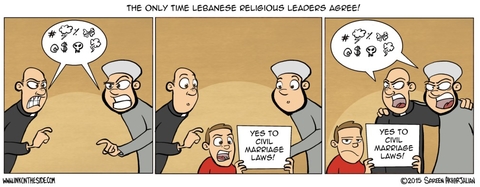
For all the foreigners reading, yes…we do NOT have civil marriage laws. The only way to get married without a religious organization is to travel to other countries (Cyprus being the most viable and cheap option) to get it done. And apparently it’s the ONLY thing religious figures agree on preventing! P.S there is one [...]
For all the foreigners reading, yes…we do NOT have civil marriage laws. The only way to get married without a religious organization is to travel to other countries (Cyprus being the most viable and cheap option) to get it done. And apparently it’s the ONLY thing religious figures agree on preventing! P.S there is one [...]
A religious sign held up above fans outside of the stadium before a football game between Penn State and University of Michigan on October 19, 2019, in University Park, Pennsylvania. | Brett Carlsen/Getty Images
In case you didn’t notice, the Antichrist is back.
All right, forgive the hyperbole — this biblical agent of Satan hasn’t actually returned to lead a rebellion against God before Christ’s second coming. But in the year of our Lord 2026, a curious surge in chatter about this hera
A religious sign held up above fans outside of the stadium before a football game between Penn State and University of Michigan on October 19, 2019, in University Park, Pennsylvania. | Brett Carlsen/Getty Images
In case you didn’t notice, the Antichrist is back.
All right, forgive the hyperbole — this biblical agent of Satan hasn’t actually returned to lead a rebellion against God before Christ’s second coming. But in the year of our Lord 2026, a curious surge in chatter about this herald of the apocalypse seems to be underway.
A number of far-right dissidents, from Marjorie Taylor Greene to Nick Fuentes, are asking questions about whether President Donald Trump is more than he seems. “Could this be the Antichrist?” Tucker Carlson asked on his podcast. “Well, who knows?” It didn’t help when Trump posted an AI-slop image of himself as the Messiah, which he later claimed was meant to be a doctor. “Not saying Trump is the Antichrist,” conservative Rod Dreher told the Wall Street Journal. “But he’s radiating the spirit of Antichrist, no question.”
The antichrist talk is also taking off in the politics-adjacent tech world in a different context, where Palantir founder and conservative tech billionaire Peter Thiel has been leading a series of closed-door lectures on the Antichrist (and garnering the disapproving attention of the Vatican). In a wild coincidence, his hypothetical Antichrist appears to be anti-tech people who annoy him.
Key takeaways
The Antichrist or antichrist figures have long been a fixture in the minds of religious Americans and secular culture. This biblical figure is supposed to precede Jesus Christ’s second coming, near the end times.
Historically, many figures have been called antichrists, from the Middle Ages to modern times. There tend to be preexisting societal conditions that accompany these perennial panics.
We may be living through one now (as some on the right refer to Trump as such), but there are unique aspects to the modern American obsession with antichrists.
It’s the most the end times have saturated our political culture since the aughts, when the new millennium brought an explosion of renewed interest, spurred on by the apocalyptic Left Behind novels and related Christian media depicting a “realistic” modern Antichrist. Later on, former President Barack Obama became a fixation of related theories on the religious right depicting him as the Antichrist.
Scholars and experts on biblical writing and apocalyptic history say there’s a long history of perceived antichrist figures popping upin moments of collective crisis or despair in the western world. And there are certain traits that tend to supercharge these narratives — the presence of war (especially in the Middle East), economic or public health crises, political or societal instability, and the appearance of an unusually charismatic leader.
Needless to say, we were probably due for a revival.
Yet just like in past periods of panic and perturbation over the centuries, there’s a lot of uncertainty in these discussions over who or what the Antichrist is, when this figure is to return, or even if this biblical character is supposed to be a real thing.
So it’s a good time to ask: Where did the idea of the Antichrist come from in the first place? How does it tend to manifest in politics? And what is it about our current moment that’s driving such renewed interest in the concept?
The biblical roots of the Antichrist
It’s probably helpful to start off with actually defining what the Antichrist is, and what the signs are that believers in his arrival are looking for.
Definitions vary across various Christian denominations and traditions, but they are rooted in the interpretation of a relatively small number of biblical passages that either use this term explicitly or get linked to the same figure.
Surprisingly, the term “antichrist” only appears five times in the New Testament. These explicit mentions in the letters of the disciple John refer to “deceivers” who come to confuse Christians by denying Jesus Christ’s divinity and preaching other heresies. Scripture suggests that there can be (and have been) multiple antichrists, whose aim is to derail the faithful from achieving salvation.
Whether this is a symbolic or literal figure depends on Christian traditions, and how close you link these passages to references to other beasts and deceivers written about in other parts of the New Testament. For example: The apostle Paul writes of a “man of lawlessness” in his second letter to the Thessalonians, who “will oppose and will exalt himself over everything that is called God or is worshiped, so that he sets himself up in God’s temple, proclaiming himself to be God.”
Then you have horror-movie, apocalyptic visions from the Book of Revelations about the chaotic period before the second coming of Christ, which includes reference toa seven-headed “beast coming out of the sea,” who bears a fatal wound, “but the fatal wound had been healed.” This beast is empowered by a dragon, understood to be Satan, and the people of the world stand in awe and worship this beast, asking “Who is like the beast? Who can wage war against it?”
Catholics and mainline Protestants have less literal interpretations of these passages.
Many mainline Protestant denominations teach that these figures are more symbolic manifestations of unholy traits and un-Christianlike beliefs and behavior, not an actual being who is due to appear at some point in the future.
Catholics are called to view the “antichrist” as a period of intense prosecution, testing of the church, and the rise of false prophets; “a final trial” before Christ returns in which believers face a “supreme religious deception” and are faced with a choice to believe in a “pseudo-messianism by which man glorifies himself in place of God and of his Messiah” or stay true to their faith.
But the Catholic Church also cautions against believing claims that an antichrist figure is imminently coming. And the explicit characters in the Bible have been understood by many scholars to be references to Roman leaders who persecuted Christians during early church history.
More fundamentalist and evangelical believers, however, view all these textual clues as actual signposts and steps in the process toward the apocalypse and Christ’s return. That’s been the main entry point for the Antichrist’s place in American culture.
The long history of the Antichrist in the Western imagination
Because of the detail and color of these symbols and characters in the Bible, it has been enticing for believers and readers to draw firm connections between the text and the real world.
“They read the Bible like it’s a secret code book, and that if they can unlock the code, then they can understand what’s going to happen in the end times,” Matthew A. Sutton, a historian of American apocalypticism at Washington State University, told me. “It’s a very modern way to read the Bible compared to what you would’ve seen through much of church history.”
“So wars, political changes, religious revolutions, and the rise and fall of empires — these sorts of political and religious events can create a moment.”
Brett Whalen, assistant professor of history at the University of North Carolina at Chapel Hill
Sutton and other historians differentiate between the modern (and by that they mean in the last century) antichrist discourse and historical beliefs. But there tend to be some preconditions necessary for this chatter to rise that go back even further in time: war in the Middle East, the rise of charismatic or terrifying leaders, and environmental, political, or economic catastrophe.
For example, the turn of the first millennium was one of the earliest surges in interest in the figure of the Antichrist, given explicit references in the Bible to thousand-year periods (as in Christ’s thousand-year kingdom on Earth, from the Book of Revelations) and the violent and unstable nature of life in the early Middle Ages, Brett Whalen, an assistant professor of history at the University of North Carolina at Chapel Hill, told me. In the same century, the First Crusade sparked another of these waves, as crusaders captured Jerusalem from Islamic rule. And the Middle Ages were rife with antichrist talk, primarily by critics of the papacy.
“You can always call the pope ‘Antichrist,’” Whalen said. “Historically, they’re probably the No. 1 candidate for being Antichrist, or kings or emperors. You had a limited cast.”
Various secular rulers have been labeled as such too: Frederick II, a Holy Roman emperor around the turn of the 12th century, was called Antichrist by the pope with whom he regularly feuded. The Muslim sultan Saladin, who retook Jerusalem around this time, was similarly described as such.
“Martin Luther was called Antichrist when the Protestant Reformation happened,”Whalen said.“So wars, political changes, religious revolutions, and the rise and fall of empires — these sorts of political and religious events can create a moment.”
What makes modern iterations of the Antichrist different
So how did these historical waves of antichrist panic lead us to Donald Trump and Peter Thiel?
Blame America, in this case. In the modern era, antichrists became democratized, as US-based evangelical movements picked up steam, literal readings of the Bible spread, and end-times theories were solidified.
“Obsessing over everyday news and trying to align that with biblical prophecy — that is a modern American phenomenon,” Sutton told me. “And by modern, that begins in the 1880s, 1890s, and that really is what gives birth to fundamentalism, [another] uniquely American phenomenon. And then fundamentalism morphs into today’s evangelicalism.”
Certainly, the news seemed to confirm their suspicions: Even for secular Americans, it’s easy to feel like a particular moment is a time of struggle, or that we’re headed toward some violent catharsis, or are being engulfed by a personality cult.
And the 20th century, marked by two World Wars, the rise and fall of new totalitarian governments, and the threat of nuclear annihilation, was especially fertile ground for this kind of thinking.Figures like Mussolini, Hitler, and Stalin were all labeled Antichrists; President Franklin D. Roosevelt also faced accusations.
In the postwar period, the establishment of the state of Israel in 1948 was another crucial development in today’s antichrist theology. Many of the apocalyptic biblical stories center on the Holy Land, the return of Jewish people to it, and a period of tribulation for them; there, this antichrist figure will allow the Jewish people to rebuild a temple, then betray them, demand worship, and assemble global armies under his command for a final battle in the valley of Armageddon (which historically is located in the Jezreel Valley in northern Israel).
Now, these narratives have become central to dispensationalist evangelical theology: Israel’s unity and existence must be preserved in order for these phases to take shape, and for the eventual rapture to occur. Consequently, “anything that involves Israel or the Middle East is going to trigger speculation” of end-times prophesies, Sutton said, especially when there’s instability or war in the region.
These literal biblical interpretations also suggest a period of global domination by the Antichrist — governments submit to this figure and turn over their armies to him.
“Part of what has driven concerns about the Antichrist is the idea that they’re going to sacrifice American sovereignty through a global organization,” Sutton said. “And so this is why religious conservatives are so suspicious of groups like NATO and especially the United Nations, because they believe ultimately we’re moving towards one world government, and it’s the Antichrist. He’s going to prevail over that one world.”
Combined with the expectation thatthe antichrist figure will be a charismatic leader, you get the more recent panics: Saddam Hussein faced antichrist allegations during the Gulf War. Hillary Clinton was called the Antichrist. But nobody drew more scrutiny in recent times than Barack Obama, whose meteoric political rise on a message of greater international cooperation and outreach to the Muslim world made him a magnet for antichrist talk.
This speculation broke into the mainstream in 2008, when some Democrats accused former Sen. John McCain’s presidential campaign of deliberately referencing it with a web video mocking Obama’s celebrity by depicting him as a Moses-like religious figure.
The McCain campaign denied it was a dogwhistle, but the discussion around the topic grew so heated that Tim LaHaye and Jerry Jenkins, co-authors of the Left Behind novels about the Antichrist, stepped in to publicly reassure their Christian readers that Obama was not the figure they had in mind.
Which brings us to 2026. The latest panics fit neatly into these traditions: Peter Thiel’s antichrist lectures seem to boil down to a fear over technological stagnation and growing opposition to artificial intelligence. He warns that efforts to regulate AI, in the name of fighting some future existential risk, could bring about the conditions for a central power to seize global authoritarian control — the Antichrist.
Sutton, who has written about these lectures before, argues that it’s not the most novel approach, but it is dangerous: “Dressing political theory in apocalyptic robes carries risks. When powerful actors reframe ordinary policy debates such as about guardrails for AI as a battle against the antichrist, they raise anxieties, delegitimize compromise and insinuate that democratic deliberation is spiritually suspect.”
The recent Trump panic, however, is a bit of an inversion: Trump is typically championed by the same right-wing religious figures who are most attuned to literal interpretations of the Antichrist and the end times. It’s surprising that figures like Carlson and Fuentes would break the seal on this front. But, historically speaking, Trump also fits the mold of prior antichrist hunts: He is surely a charismatic leader; he’s launched civilizational wars in the Middle East; he’s survived assassination attempts, mimicking the fatal, but healed, wound of the beast of Revelations; and he’s blasphemed and used the trappings of religion to advance his personal brand.
But to focus on any one person or movement as antichrist is to miss the broader point, Robert Fuller, a religious studies professor at Bradley University, told me. The concept, applied politically, risks taking an already polarized time and raising the stakes of elections and policy debates even further.
“This image sustains a crisis mentality,” Fuller said. “It summons out hatred and resentment that can fuel long-term grudges. It makes compromise unthinkable since no one compromises with the devil. It justifies hatred and violence, recasting these traits as virtues.”
In that vein, it’s inevitable that antichrist narratives persist; such a flexible idea can adapt regardless of century. It’s likely we’ll see many recurring returns of the Antichrist, at least until the world does actually end.
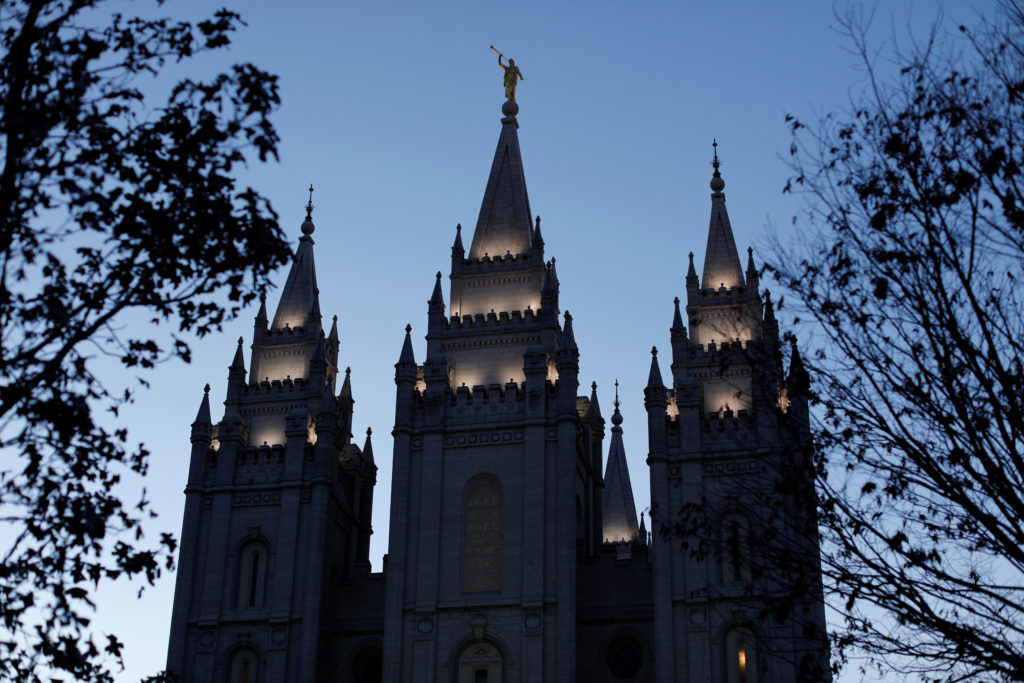
The spires of the historic Salt Lake Temple in Salt Lake City, Utah in 2016. | George Frey/Getty Images
Over the weekend, the Department of Defense stepped into one of the more delicate questions in American religiosity: who gets to be called “Christian.”
More specifically, does the Church of Jesus Christ of Latter-day Saints (commonly called the Mormon Church), fit the bill?
The brouhaha started with Secretary Pete Hegseth’s plan to simplify and reform the work of military chaplains
The spires of the historic Salt Lake Temple in Salt Lake City, Utah in 2016. | George Frey/Getty Images
Over the weekend, the Department of Defense stepped into one of the more delicate questions in American religiosity: who gets to be called “Christian.”
More specifically, does the Church of Jesus Christ of Latter-day Saints (commonly called the Mormon Church), fit the bill?
The brouhaha started with Secretary Pete Hegseth’s plan to simplify and reform the work of military chaplains — those religious and spiritual advisers who tend to the faithful within the military’s ranks.
A Pentagon spokesperson on Friday posted a new list of categories of religious affiliation for military service members, which had shrunken from over 200 to 31 labels. In previewing this reform, Hegseth had argued that it was part of the Trump administration’s fight against secular humanism and for the role of religion in public life. By narrowing the number of religions, and excluding some prior identity groups Hegseth’s Pentagon found objectionable, officials argued it would be easier to assign chaplains to units.
“This brings the codes in line with its original purpose, giving chaplains clear, usable information so they can minister to service members in a way that aligns with that service member’s faith background and religious practice,” Hegseth said in a video statement in March.
Gone were “atheist” and “Wicca” from the new list — and though the Church of Jesus Christ of Latter-day Saints was included as a religion, it was not labeled “Christian.”
That set off an explosive reaction from Mormon elected officials, including some normally aligned with the administration. To them, the government seemed to be saying that Mormons are not Christians — a highly offensive statement for LDS Church members, who see Jesus Christ as the center of their faith.
It does seem that the LDS are being unfairly singled out here. If the essential criterion for Christianity is Trinitarian theology, why do the Jehovah’s Witnesses, Christian Scientists, Oneness Pentecostals, and even Quakers (in some instances) get a pass here? https://t.co/3NKPBsDFaw
“I can say confidently that the U.S. government has no business recognizing the Christianity of literally every other religious sect that worships Jesus Christ — with one exception,” Sen. Mike Lee (R-UT) posted on X, one of many complaints he raised over multiple days.
On Monday, the Pentagon said the move was unintentional — and amended the original document that blew open this controversy. “The Pentagon’s job is not to adjudicate theological debates, but instead to ensure sincerely-held faith is respected and encouraged in our ranks,” an official statement read. Lee said he was “thrilled” with Trump’s response after he discussed the issue with the president in a phone call.
But the fiery response spoke both to the LDS church’s long battle for acceptance in America’s faith community, and to deeper tensions within the religious right in President Donald Trump’s second term. Even as the administration tries to privilege Christianity in America, its coalition is suspicious about which kind is taking the lead.
A history of exclusion
Mormons have often faced a hostilereception in mainstream religious life since their church’s founding in the 19th century, a wound that the Pentagon decision reopened.
Despite a tense history between the Church of Jesus Christ of Latter-day Saints and both the American state and other religious groups, there’s been a kind of detente in the 21st century.
Mitt Romney’s 2012 presidential campaign was widely seen as a watershed moment for Mormonism’s mainstream acceptance, especially within the Republican Party’s conservative Christian electorate, even as his faith was a sensitive topic at points during the race.
“It’s not like those theological concerns about Mormonism disappeared in 2012, but by the time we got to 2012, the issue wasn’t Romney’s Mormonism anymore,” David Campbell, a professor of American politics and religion at the University of Notre Dame, told me. “And so a lot of members of the LDS church thought, well, this issue’s over now.”
As Campbell noted, however, there were still major doctrinal differences between LDS and major branches of Christianity. For example, LDS theology does not accept the Trinity — the idea that God is both one being and manifested in three essences (the Father, the Son, and the Holy Spirit). Roughly, LDS believers view Jesus Christ as the Son of God and a distinct entity to God the Father, who has a separate physical body.
More simply, the LDS Church rejects the Nicene Creed — the statements of faith that have united most Catholic, Orthodox, and mainline Protestant churches for more than a thousand years as well as the Apostles Creed (which most western Christians accept). For these reasons, manyCatholics and Protestants would not call Mormons Christians, even if they believe in a God and follow Jesus Christ.
The Pentagon dust-up brought these divides rushing back to the front of mind.
“When Mormons have come into the public square and have sought to build bridges politically, that has been acceptable,” Campbell said. “But when that theological question comes up, maybe some have been won over, but not very many. And this is just yet another reminder of that.”
One example of this submerged tension came up during Romney’s 2012 run, when a prominent Texas evangelical pastor, Robert Jeffress, called Mormonism a “cult” and argued Romney “is not a Christian.” But Jeffress also endorsed Romney in the general election, citing their shared values apart from theology — and he is now a prominent Trump supporter.
Some LDS voices on the left argued that Mormon Republicans had been too naive in thinking that a White House that elevated figures like Hegseth, an evangelical who has pushed boundaries with his Christian rhetoric in public duties, would protect religious freedom rather than elevate political allies. Some linked the Pentagon list to the administration’s embrace of “Christian nationalist” evangelical leaders who have called for tearing down walls between church and state.
“For us on the left, it’s like, yeah, of course the Trump administration doesn’t believe in our version of Christianity,” Eric Biggart, chair of the LDS Dems Caucus, told ABC4, a Salt Lake City news station. “That’s been clear to us for 10 years now.”
Republican lawmakers who protested the Pentagon’s decision did not make this argument themselves and appeared to accept the official explanation on Monday. But it’s also noticeable that they did not give Hegseth the benefit of the doubt when the story first emerged — the response to the Pentagon’s list was immediate and public, rather than delivered quietly behind the scenes. Loyal Republican politicians like Sens. Mike Lee and John Curtis immediately criticized the decision and spent the weekend debating theology, engaging other Christians, and calling out the Department of Defense.
This episode is probably not going to be a turning point, Campbell told me, but it is another crack in the religious right’s coalition. Many LDS members already view Trump and MAGA with suspicion in comparison to other conservative religious communities, although he’s made inroads with LDS voters since his first election. To some, the episode was a sign that members of the faith should be suspicious about tying their religion to a political coalition.
“I say this with love to my fellow Latter-day Saints: the sooner you give up trying to convince the religious right to validate your faith, the sooner you’ll know peace,” McKay Coppins, an LDS journalist who has written extensively about the church, posted on X.
“Are we real Christians? Only one opinion matters — and it’s not Pete Hegseth’s.”
Draft treaty claims sexual and reproductive health and rights are an existential threat to the African familyAn African treaty that rejects longstanding international human rights obligations moved a step closer to becoming policy this week as governments across the continent met in Ghana.The draft African charter on family, sovereignty and values, seen by the Guardian, asserts that African values and culture are under attack from “foreign ideologies” and urges states to withdraw from any agreem
Draft treaty claims sexual and reproductive health and rights are an existential threat to the African family
An African treaty that rejects longstanding international human rights obligations moved a step closer to becoming policy this week as governments across the continent met in Ghana.
The draft African charter on family, sovereignty and values, seen by the Guardian, asserts that African values and culture are under attack from “foreign ideologies” and urges states to withdraw from any agreements that do not align with the principles of the charter, including the 2003 Maputo protocol, which promotes gender equality and protects the reproductive and health rights of women and girls.
Texas Attorney General Ken Paxton speaks to supporters on May 26, 2026, in Plano, Texas. | Amanda McCoy/Fort Worth Star-Telegram/Tribune News Service via Getty Images
Now that Ken Paxton, the conservative attorney general of Texas, has defeated incumbent John Cornyn for the Republican Senate nomination, we may see something unusual in modern American elections: a theological throwdown.
In a closely watched and competitive race, Paxton will be facing off against James Talarico, a Presbyt
Texas Attorney General Ken Paxton speaks to supporters on May 26, 2026, in Plano, Texas. | Amanda McCoy/Fort Worth Star-Telegram/Tribune News Service via Getty Images
Now that Ken Paxton, the conservative attorney general of Texas, has defeated incumbent John Cornyn for the Republican Senate nomination, we may see something unusual in modern American elections: a theological throwdown.
In a closely watched and competitive race, Paxton will be facing off against James Talarico, a Presbyterian seminarian and the Democratic nominee. The race is now set to be a battle between two very different worldviews about the role of Christianity.
That Democrats are even able to hold up their end of such a debate is unusual in a political moment when “Christian” has come to be synonymous with “right-wing.” Talarico has been trying to change that narrative — now he gets to face off against a flawed Republican with a more typical evangelical message.
Key takeaways
The US Senate race in Texas is set: Republican Ken Paxton will face off against Democrat James Talarico.
It’s going to be a closely watched race: Talarico isn’t pushing a traditional anti-Donald Trump message, instead talking about his faith, the billionaire class, and corruption. Paxton, meanwhile, is weighed down by personal, political, and legal scandals.
But the race is also a proxy war for two questions about religion in American politics today: what “Christianity” means, and if personal behavior matters.
Talarico earned significant media attention in his primary for the progressive tilt of his Christian faith — one of forgiveness, love, and righteous anger against the wealthy and powerful. Yet he’s also been ridiculed by the religious right as a false prophet: a Christian in name only who launders left-wing social views through faith, supports abortion, and once argued that God is nonbinary.
Meanwhile, Paxton’s nomination sets up an interesting foil: He’s a formerly impeached and indicted politician in the middle of a divorce his wife sought “on biblical grounds.” And he has championed a right-wing brand of Christian politics, embracing the “Christian nationalist” movement’s efforts to break down the walls between church and state, while fending off bipartisan attacks on his personal morals.
This larger cultural struggle over who gets to claim Christian identity and what Christianity should stand for in 21st-century America will be front and center in the race. It will test the limits of persuasion for a liberal Christian trying to win over disaffected Republicans with different political and theological views, and the limits of partisan loyalty for a conservative Christian trying to keep them in his camp despite bipartisan concerns about his ethics.
Christian authoritarianism versus a Christianity of radical love
A Presbyterian seminarian, Talarico comes from a more politically liberal tradition than Paxton’s Southern Baptist background. His particular branch of mainline Protestantism, the Presbyterian Church (USA), has been derided by critics on the right as “woke” and theologically heretical for its embrace of same-sex marriage, ordination of women, and welcoming stance for transgender congregants.
Talarico has centered the concept of “radical love” in his political identity and campaign platform: He wants to heal political divisions, welcome Americans who aren’t typically Democrats to his campaign, and move beyond anger toward any one person (like President Donald Trump or Paxton) toward a forward-looking agenda that goes after oligarchs, the political establishment, and the “corrupt” elite.
“In my faith, love is the strongest force in the universe,” he said at a campaign rally in February. And to justify his righteous anger, he argues that “you can’t stand for faith and then warp and weaponize religion to hurt our neighbors.”
Talarico has explicitlycontrasted his faith with “Christian nationalism,” arguing that right-wing religious leaders are aligning with Trump in order to institute “theocracy.”
Paxton is solidly in the Christian nationalist camp. Generally, Christian nationalists oppose the separation of church and state; seek to make Christianity the official religion of the state; call for Biblical morality to determine the law; and argue that the United States has God’s unique blessing among other nations.
Paxton has made a name for himself as a proponent of an aggressive form of religious liberty, arguing not just that the state should pull back and cede space to the faithful, but that the state should actively promote a specific version of Christian ethics and morality. He supported efforts to bring Christian prayer and Scripture into public schools, to set aside time for Bible readings and prayers, and to display the Ten Commandments on public property.
“In Texas classrooms, we want the Word of God opened, the Ten Commandments displayed, and prayers lifted up,” Paxton said in a September statement calling on students to recite the Lord’s Prayer in class. “Our nation was founded on the rock of Biblical Truth, and I will not stand by while the far-left attempts to push our country into the sinking sand.”
Talarico has defended secular government, while also trying to turn the theological conversation to economic concerns. “These politicians want a Christian nation, unless it means providing healthcare to the sick or funding food assistance for the hungry or raising the minimum wage for the poor,” he said on The Ezra Klein Show. “And so, it seems like they want to base our laws on the Bible until they read the words of Jesus.”
While marrying progressive politics and Christian themes might win over the Democratic base, Republicans are already challenging him aggressively on social issues — especially abortion and LGBT rights — where they believe their platform is more in touch with their state’s longtime rightward bent.
NEW AD: James Talarico is a threat to everything we hold dear.
— Attorney General Ken Paxton (@KenPaxtonTX) May 27, 2026
But Talarico also could try to peel off voters with another argument steeped in religious principles: that Paxton is not living out the Christian values he claims to support.
Paxton creates a test of what Christians should tolerate
The Paxton-Talarico race is partly a referendum on what Christians will tolerate as Christian-like behavior.
Talarico has a squeaky clean image: a former teacher, pastor-in-training, and activist concerned with social justice. Paxton looks more like Trump: accused of adultery by his wife (hence the “biblical grounds” for their divorce), charged with securities fraud (he later settled the case without admitting guilt), and impeached by the Republican-dominated Texas state house over bribery and corruption allegations (then acquitted in his trial).
Sen. Cornyn elevated all these accusations against him. “Ken Paxton has the ethics of a strip club owner,” one of his ads read. “Texas moms: Would you want your daughters to marry a man like Ken Paxton?” And Cornyn proudly highlighted that Paxton’s own pastor had joined his re-election campaign as an adviser before the run-off.
Talarico seems likely to redouble these efforts: He’s called Paxton “morally unfit” for office. “He’ll lie to you with a straight face. He’s failed the character test. He’s the most corrupt Attorney General of our lifetime, and he puts the interests of himself over the laws of Texas,” Talarico said Tuesday night, citing some of the statements made by Republican critics of Paxton.
In this regard, the race is an extension of a long-running argument within the religious right about Trump, whose endorsement of Paxton sealed his primary victory. The president has long been embraced by social conservatives who have argued that, despite his own moral flaws, he can still deliver anti-abortion policies, appoint judges who share their views of religious freedom, and give an evangelical protestant form of Christianity a privileged space in public life.
Even among Paxton’s religious critics on the right, these issues have led to splits. National Review’s Jeffrey Blehar argued Paxton was “odious,” but Talarico was “morally worse” because he espoused ideas that Blehar believed were wrong and immoral under the guise of faith. In doing so, Blehar rebutted the New York Times’ evangelical columnist David French, who praised Talarico as “one of the few openly Christian politicians in the United States who acts like a Christian,” even as he condemned his positions on issues like abortion.
Paxton has relied on testimonials from his family to rebut personal attacks, and he’s likely to try to refocus the race on the greater work he can accomplish for Christian conservatives. In declaring victory Tuesday night, he framed the coming election as the “beginning of the fight to preserve every value we hold dear.”
The two versions of Christianity represented by Talarico and Paxton may be like two ships passing in the night if you’re looking to compare and debate theologies. But the race is one of the most high-profile recent examples of Democrats trying to reclaim the politics of faith — and Republicans rarely have had such a flawed interlocutor to rebut them.
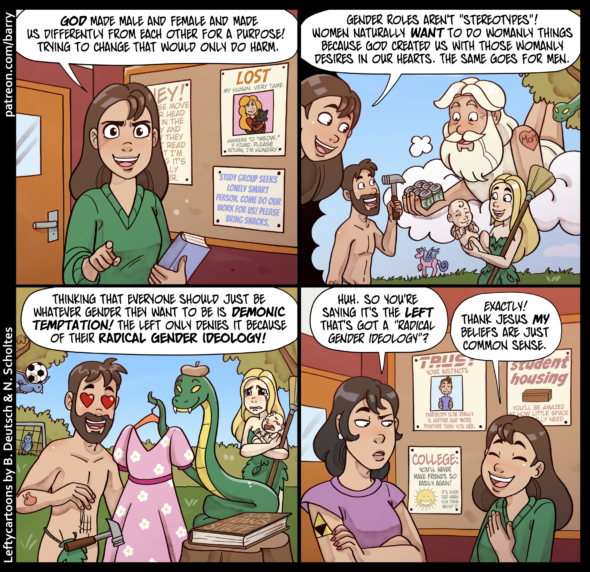
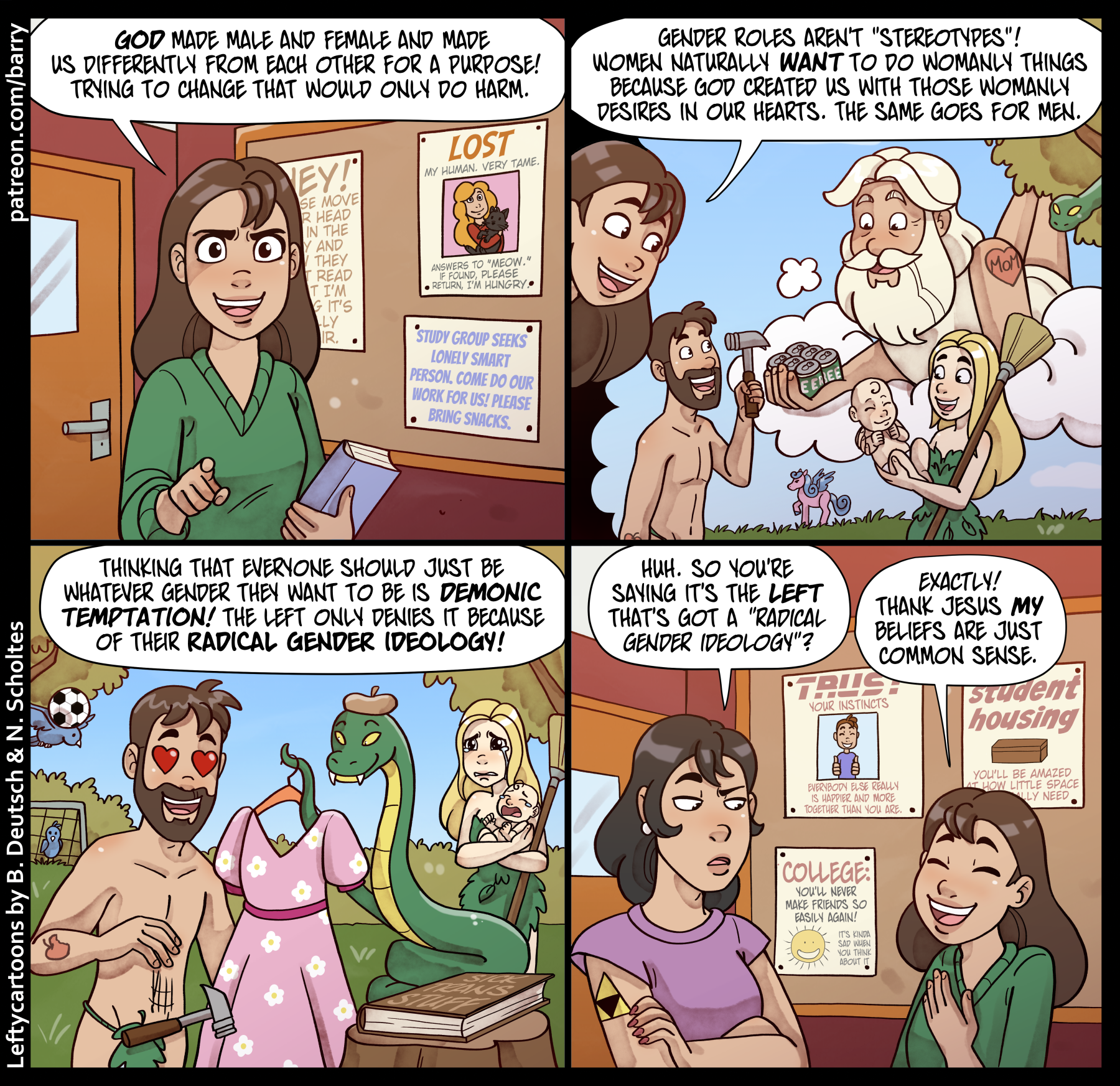
This cartoon is by me and Nadine Scholtes.
In a way, it’s also by Samantha Fulnecky, because a lot of the dialog was swiped verbatim from a paper she wrote. But I don’t think she’d appreciate a co-writing credit.
“Radical gender ideology” is the right’s new boogieman, joining “woke” and “DEI” and “Critical Race Theory” and “cultural Marxists” and “SJWs” on their increasingly deranged hit list. Donald Trump attacks it in executive orders; Pam Bondi told the FBI to offer a bounty for “terrorists
In a way, it’s also by Samantha Fulnecky, because a lot of the dialog was swiped verbatim from a paper she wrote. But I don’t think she’d appreciate a co-writing credit.
“Radical gender ideology” is the right’s new boogieman, joining “woke” and “DEI” and “Critical Race Theory” and “cultural Marxists” and “SJWs” on their increasingly deranged hit list. Donald Trump attacks it in executive orders; Pam Bondi told the FBI to offer a bounty for “terrorists” motived by radical gender ideology; speaker of the House Mike Johnson opened a subcommittee hearing by sneering “the scourge of radical gender ideology is very real.”
The fear of extremist “radical gender ideology” has been the conservative excuse for supporting anti-abortion and anti-trans laws, and generally trying to push the culture back to what they imagine the 1950s were like. The obvious irony is that, in doing this, conservatives are pushing their own radical (and reactionary) gender theories into law.
Hopefully most people have forgotten this (and her), but in November of 2025 University of Oklahoma student Samantha Fulnecky managed to make national news by writing a terrible paper for psychology class. From Wikipedia:
Fulnecky’s essay argued that there were only two genders and that gender roles were created by God, referring to the Bible. She wrote that while she didn’t want kids to be bullied, in the context of gender norm enforcement, it was morally justified. She also used Biblical authority to call social acceptance of transgender people “demonic.” The essay was unrelated to the [assignment]; transgender and nonbinary identities were not presented in the research.
Two different instructors independently gave Fulnecky’s mess a well-deserved failing grade. So Fulnecky quickly filed a discrimination complaint. The University of Oklahoma, egged on by Republican politicians, took Fulnecky’s side, and both instructors were relieved of duty.
My cartoon doesn’t exaggerate Fulnecky’s views. Her paper really was that extreme.
Which made the immediate, nationwide support Fulnecky received striking. The national Turning Point USA org took Fulnecky’s side (and proudly posted her shitastic paper online). Republican politicians and pundits rushed to support her. Fulnecky’s radical ideology about gender isn’t held by all right-wingers, but it’s entirely welcome in their tent – and it’s influencing laws nationwide.
Jill Filipovic, in an article about the endless deluge of Republican anti-trans legislation, writes:
Conservative gender ideology is religiously-based and it goes like this: Men and women are fundamentally different, created by God to compliment each other. There is a clear hierarchy: God, man, woman, boy child, girl child. Women are to serve men, produce children, and maintain the home; and in turn, men are to protect and provide for women and children. For Christians, this is the origin story of humankind; it is foundational, the very first building block of humanity and by extension society. It is, essentially, a “separate but equal” view of gender: Men and women have equal dignity, but not equal rights, roles, or responsibilities.
Nadine did her typically great job dealing with my deranged script requests. I particularly love it when a miscommunication makes things funnier. My script suggested a couple of birds playing soccer in the background of panel three, but I didn’t mention that I was imagining them playing with a miniature, bird-sized ball. So Nadine drew a bird carrying a full-sized ball, which is much more surreal and wonderful than what I had in mind.
TRANSCRIPT OF CARTOON
This cartoon has four panels.
PANEL 1
A pretty young woman carrying a textbook talks cheerfully.
STUDENT: God made male and female and made us different from each other for a purpose! Trying to change that would only do harm.
PANEL 2
As she speaks, a big thought balloon appears. In the thought balloon, we see Adam and Eve, Adam holding a hammer, Eve holding a broom and a baby. God appears from a cloud, offering Adam a six-pack.
STUDENT: Gender roles aren’t “stereotypes”! Women naturally want to do womanly things because God created us with those womanly desires in our hearts. The same goes for men.
PANEL 3
The snake offers Adam a pretty pink dress; Adam is delighted, hearts in his eyes, dropping his hammer to reach for the dress. In the background, Eve watches, holding her baby and crying.
PANEL 4
In the original scene, a second student has appeared, and is giving the first student a skeptical look.
SECOND STUDENT: Huh. So you’re saying it’s the left that’s got a “radical gender ideology”?
FIRST STUDENT: Exactly! Thank Jesus my beliefs are just common sense.
CHICKEN FAT WATCH
“Chicken fat” is obscure cartoonist terminology for silly things we put in the background.
PANEL 1 – There are three flyers on the bulletin board. The first one is incomprehensible because the character’s head is in the way, but it says: “HEY! Please move your head it’s in the way and now they can’t read what I’m saying it’s really unfair.” The second says “LOST” with a picture of a woman holding a cat. Smaller print says “My human. Very tame. Answers to “meow.” If found, please return, I’m hungry.” The third flyer says “Study group seeks lonely smart person. Come do our work for us! Please bring snacks.”
PANEL 2 – God has a “Mom” heart tattoo. There’s a very “My Little Pony” looking Pegasus in the background.
PANEL 3 – Two birds are playing soccer in the background. The snake is wearing a beret. A book on a stump is entitled “Sick Trans Stuff.”
PANEL 4- The second student has a tattoo of the Triforce symbol from the “Legend of Zelda” videogames. There are again three flyers hanging in the background. First flyer: “TRUST YOUR INSTINCTS. Everybody else really is happier and more together than you are.” Second: “STUDENT HOUSING.” There’s a picture of a shoebox, and then “You’ll be amazed at how little space you actually need.” Third: “COLLEGE: You’ll never make friends so easily again! It’s kinda sad when you think about it.”

 Login
Login