Hieu Chau compares his dense, dynamic compositions to his always active mind. Playing with scale and proportion, the Vietnamese artist renders surreal scenes in which flora and fauna converge and figures interact with the outside world as if in a dream. Chau, who was trained as a painter, now works digitally, although his pieces capture the grainy textures and gestures of a physical medium.
The artist recently published a book collecting his projects from the last decade, and you can find
Hieu Chau compares his dense, dynamic compositions to his always active mind. Playing with scale and proportion, the Vietnamese artist renders surreal scenes in which flora and fauna converge and figures interact with the outside world as if in a dream. Chau, who was trained as a painter, now works digitally, although his pieces capture the grainy textures and gestures of a physical medium.
The artist recently published a book collecting his projects from the last decade, and you can find explore an archive of these pieces on Instagram.
For Olaf Hajek, difference isn’t about opposition but rather about identifying connections. The Berlin-based illustrator renders dense, uncanny compositions that nod to Surrealist icons like Leonora Carrington and Remedios Varo. Nature and culture entwine, and magic and mystery veil each scene. These dreamlike moments of intrigue ask the viewer to suspend preconceived notions and instead, enjoy the allure of the ambiguous.
Hajek is an avid traveler and cultural consumer, offering him a vas
For Olaf Hajek, difference isn’t about opposition but rather about identifying connections. The Berlin-based illustrator renders dense, uncanny compositions that nod to Surrealist icons like Leonora Carrington and Remedios Varo. Nature and culture entwine, and magic and mystery veil each scene. These dreamlike moments of intrigue ask the viewer to suspend preconceived notions and instead, enjoy the allure of the ambiguous.
Hajek is an avid traveler and cultural consumer, offering him a vast repository of images from a variety of sources and locales. Folklore, vernacular traditions, spiritual practices, and natural motifs blend into a distinguishable aesthetic. “What interests me is not so much their differences, but the connections between them—the possibility of developing a universal visual language by bringing diverse influences together. This blending becomes a way of transcending cultural boundaries and revealing something shared and timeless,” he says.
Ambiguity is a central point of Hajek’s practice, emerging technically through superimposed florals and figures, dramatic shifts in scale, and a tension between decay and renewal. Gender and conceptions of masculinity, in particular, are depicted with a sense of softness and fluidity, particularly through symbolic, botanical motifs in vibrant color.
Hajek works in parallel, if not complementary, practices, sketching and painting on paper in a looser, more reflexive manner. “I embrace the unexpected—how colors interact, how forms dissolve into one another, and how compositions evolve organically. Especially in works on paper, intuition plays a central role; they feel more immediate, almost like a direct dialogue with the moment,” he tells Colossal.
Shifting to the canvas, though, requires a clearer vision, and the two approaches are an essential pairing in his practice. “They are part of the same artistic process, which constantly moves between intention and surprise, between structure and freedom,” he says.
Hajek is participating in several upcoming exhibitions, including a group show at Feinkunst Krüger in Hamburg and two solo presentations at Museum Franz Xaver Stahl in Erding and Kaplan Projects in Palma de Mallorca. Until then, find more of his work on Instagram.
François & Marie posted a photo:
Au centre, une lune de vert tendre irradie comme un fruit suspendu dans un songe. Autour d'elle, le monde se dissout en une douce mélancolie dorée, zébrée de reflets violets et de secrets d'ambre.
Au centre, une lune de vert tendre irradie comme un fruit suspendu dans un songe. Autour d'elle, le monde se dissout en une douce mélancolie dorée, zébrée de reflets violets et de secrets d'ambre.
When we think of tarot cards, there’s a standout that probably pops to mind right away: the Rider-Waite-Smith deck. It was illustrated by British occultist and artist Pamela Coleman Smith, and more than 100 years after its publication, it remains the most widely used deck by readers. But the cards are far from being the first. Later this month, The Morgan Library & Museum presents Tarot! Renaissance Symbols, Modern Visions, which delves into this centuries-old tradition of divination.
When we think of tarot cards, there’s a standout that probably pops to mind right away: the Rider-Waite-Smith deck. It was illustrated by British occultist and artist Pamela Coleman Smith, and more than 100 years after its publication, it remains the most widely used deck by readers. But the cards are far from being the first. Later this month, The Morgan Library & Museum presents Tarot! Renaissance Symbols, Modern Visions, which delves into this centuries-old tradition of divination.
The exhibition celebrates some of the earliest examples alongside modern artists’ versions. Three surviving decks from the 15th century, commissioned by the Dukes of Milan, tap into the lively Italian court culture that produced the cards, plus how the imagery evolved and laid the groundwork for fortune-telling practices.
A complementary display emphasizes how artists throughout the 20th century reimagined the imagery, including Smith’s iconic deck from 1909, plus iterations by Surrealists André Breton, Victor Brauner, and Remedios Varo. The connection isn’t coincidental; Leonora Carrington devised a gilded deck in the 1950s, and Salvador Dalí also contributed his own version.
Tarot! Renaissance Symbols, Modern Visions highlights how artists have turned to the practice to explore what the museum describes as “an alternative to the strictures of modernist aesthetics, allowing them to explore other universes and imaginative possibilities.” The show is accompanied by a catalog, which you can order from The Morgan’s shop. See the exhibition from June 26 through October 4 in New York.
Manuel Gual posted a photo:
Route 66 Dreams: Classic Cars Across the American Desert
Description
A cinematic visual journey through the mythic atmosphere of Route 66, featuring vintage cars, abandoned gas stations, neon motels, desert highways, red rock landscapes, and golden sunset light. The series blends classic Americana, road trip nostalgia, open-road freedom, and a slightly surreal retro mood, evoking the timeless romance of travel across the American Southwest.
These images were g
Route 66 Dreams: Classic Cars Across the American Desert
Description
A cinematic visual journey through the mythic atmosphere of Route 66, featuring vintage cars, abandoned gas stations, neon motels, desert highways, red rock landscapes, and golden sunset light. The series blends classic Americana, road trip nostalgia, open-road freedom, and a slightly surreal retro mood, evoking the timeless romance of travel across the American Southwest.
These images were generated by Artificial Intelligence.
Manuel Gual posted a photo:
Route 66 Dreams: Classic Cars Across the American Desert
Description
A cinematic visual journey through the mythic atmosphere of Route 66, featuring vintage cars, abandoned gas stations, neon motels, desert highways, red rock landscapes, and golden sunset light. The series blends classic Americana, road trip nostalgia, open-road freedom, and a slightly surreal retro mood, evoking the timeless romance of travel across the American Southwest.
These images were g
Route 66 Dreams: Classic Cars Across the American Desert
Description
A cinematic visual journey through the mythic atmosphere of Route 66, featuring vintage cars, abandoned gas stations, neon motels, desert highways, red rock landscapes, and golden sunset light. The series blends classic Americana, road trip nostalgia, open-road freedom, and a slightly surreal retro mood, evoking the timeless romance of travel across the American Southwest.
These images were generated by Artificial Intelligence.
“Don’t you think it’s dangerous to blur the distinction between abstraction and reality?” asks actress Olivia Vinall in her role as the Surrealist artist and writer Leonora Carrington (1917-2011). The heady line is one of the standout statements in the new biopic documenting Carrington’s life and work.
Directed by Thor Klein and Lena Vurma and produced by Modern Films, Leonora in the Morning Light opens in 1930s Paris, when the artist was enmeshed in an avant-garde community that included
“Don’t you think it’s dangerous to blur the distinction between abstraction and reality?” asks actress Olivia Vinall in her role as the Surrealist artist and writer Leonora Carrington (1917-2011). The heady line is one of the standout statements in the new biopic documenting Carrington’s life and work.
Directed by Thor Klein and Lena Vurma and produced by Modern Films, Leonora in the Morning Light opens in 1930s Paris, when the artist was enmeshed in an avant-garde community that included luminaries like Salvador Dalí and André Breton, along with her partner Max Ernst. When World War II begins, Carrington flees to Spain before eventually re-settling in Mexico, perhaps the location most associated with her work.
The film is based on the biographical novel by Elena Poniatowska and comes at a time when Carrington’s oeuvre is in the spotlight, particularly the fantastical work made while she was confined to a psychiatric hospital in Spain which had been lost for 80 years.
Modern Films is also behind the documentary about pioneering artist Hilma af Klint, along with Boom For Real, which chronicles Jean-Michel Basquiat’s teenage years. Leonora in the Morning Light is slated for release on May 29 in the U.K. and Ireland.
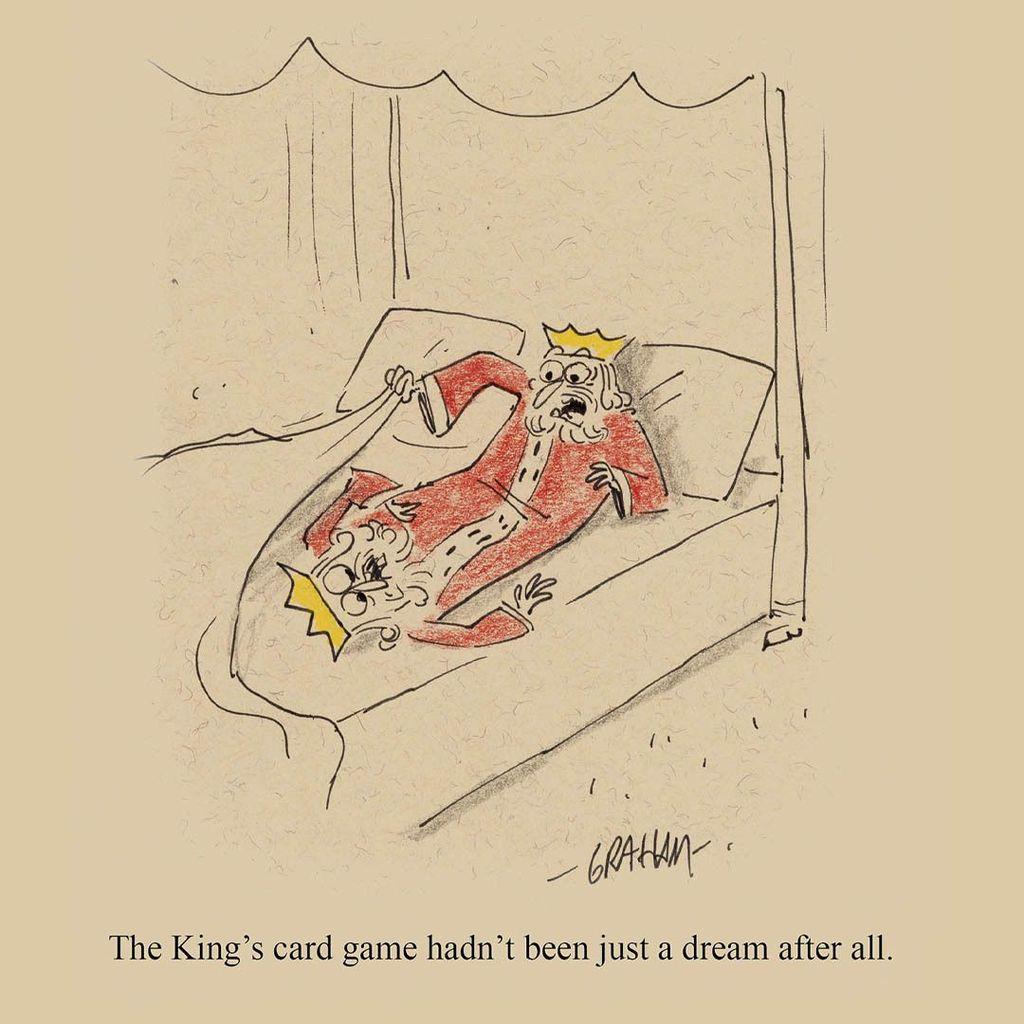
A cartoon illustration of a surprised King waking up in bed and discovering the lower half of his body is an upside down mirror image of himself. Caption reads "The King's card game hadn't been just a dream after all."

 Login
Login