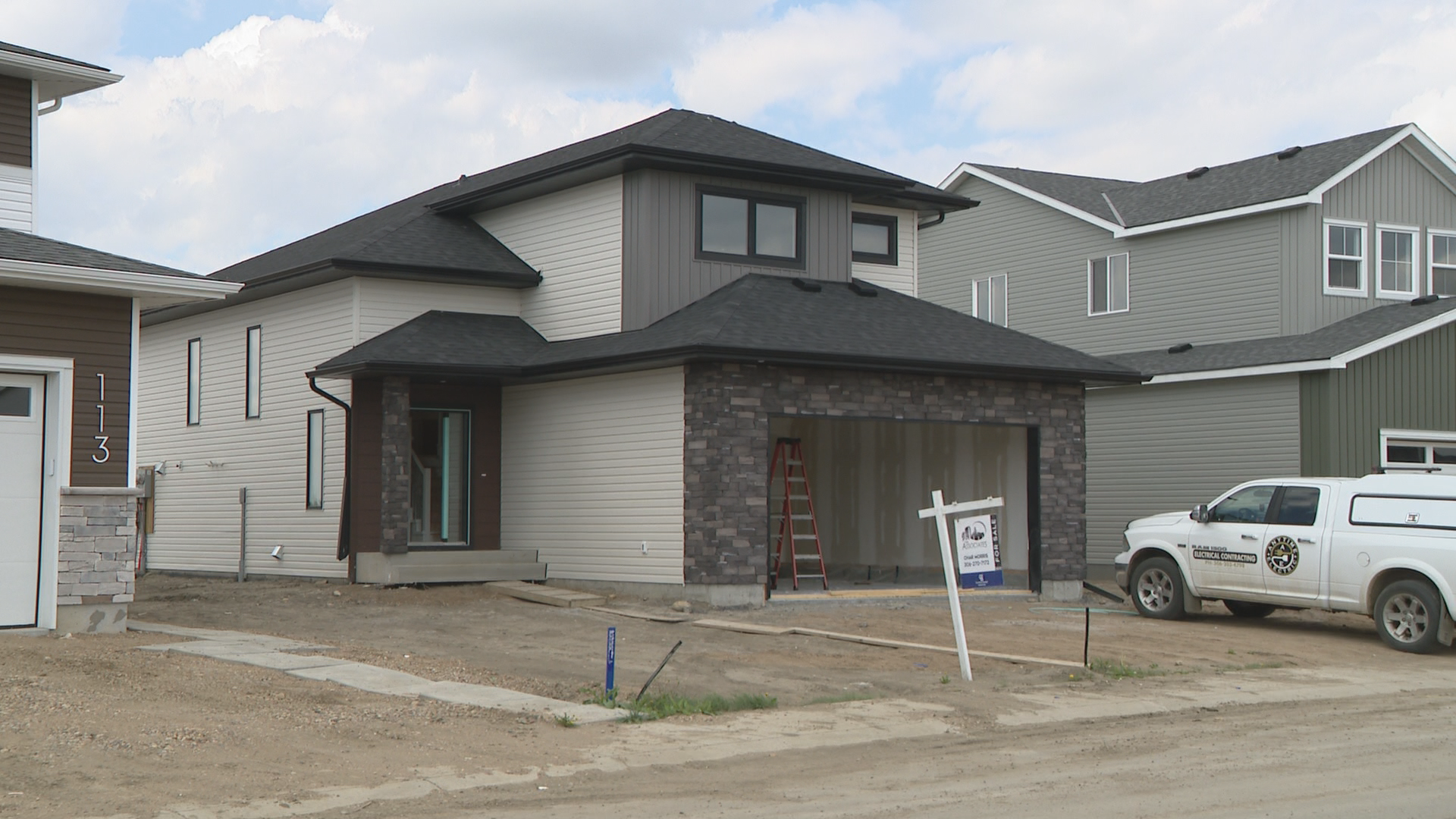
Saskatchewan's Realtors' association is reporting mounting supply pressures and all-time-high benchmark prices for cities across the province last month.
Saskatchewan's Realtors' association is reporting mounting supply pressures and all-time-high benchmark prices for cities across the province last month.
Maintaining a comfortable home can be frustrating when different areas of your house experience uneven temperatures. Some rooms may feel too hot in summer or too cold in winter, while others are just right. Standard HVAC systems often struggle to balance these differences, leading to wasted energy, high utility bills, and constant adjustments. Homeowners may find themselves layering blankets, running extra fans, or constantly changing thermostats. These discomforts highlight the need for smarter
Maintaining a comfortable home can be frustrating when different areas of your house experience uneven temperatures. Some rooms may feel too hot in summer or too cold in winter, while others are just right. Standard HVAC systems often struggle to balance these differences, leading to wasted energy, high utility bills, and constant adjustments. Homeowners may find themselves layering blankets, running extra fans, or constantly changing thermostats. These discomforts highlight the need for smarter heating and cooling solutions that adapt to each space individually.
For residents in Springfield, MO, Redeemed HVAC & Plumbing offers a tailored approach to home comfort through zoning systems. Our team of licensed technicians not only installs and services HVAC equipment but also customizes solutions that address the unique heating and cooling needs of every room. By partnering with Redeemed HVAC & Plumbing, homeowners gain access to expertise in ductwork, thermostats, and system optimization that ensures consistent comfort throughout the home.
Zoning Systems for Residential Comfort
Zoning systems divide a home into distinct areas or “zones,” each controlled independently. Unlike traditional HVAC systems that treat a house as a single space, zoning systems use multiple thermostats and motorized dampers within the ductwork. This allows temperature adjustments for each zone, ensuring personalized comfort. For instance, bedrooms can be cooler at night, while living areas remain warm. Properly installed zoning systems prevent overworking the HVAC unit, improve efficiency, and reduce wear and tear.
Additionally, zoning systems help homeowners manage seasonal temperature differences more effectively, reducing the need for constant thermostat adjustments. They can also address common hot or cold spots in older homes where insulation or design causes uneven heating or cooling. Finally, by giving precise control over each area, zoning systems create a more comfortable environment that adapts to different family routines and lifestyle needs.
Benefits of Working with a Springfield MO HVAC Contractor
Collaborating with a Springfield MO HVAC contractor like Redeemed HVAC & Plumbing brings specialized knowledge to your home. Our technicians evaluate the layout, insulation, and airflow patterns to design a zoning plan that maximizes efficiency. Beyond installation, they provide maintenance, troubleshooting, and upgrades, ensuring that each zone maintains optimal temperature control year-round. Homeowners benefit from reduced energy bills, longer equipment lifespan, and enhanced indoor air quality.
Additional benefits include:
Customized Comfort Plans – Contractors can design a zoning system tailored to your family’s daily schedule and lifestyle preferences.
Expert Equipment Selection – They recommend the most suitable thermostats, dampers, and HVAC components for your home’s size and structure.
Improved System Longevity – Proper installation and professional maintenance prevent strain on HVAC units, reducing breakdowns.
Energy Monitoring and Optimization – Contractors provide guidance on tracking energy usage and adjusting zones for maximum efficiency.
Professional Troubleshooting – Any airflow issues, uneven temperatures, or control malfunctions are quickly diagnosed and resolved.
Safety and Code Compliance – Licensed contractors ensure all modifications meet local building codes and safety standards.
Integrating Zoning Systems with Existing HVAC Equipment
Many homes can adopt zoning systems without a full HVAC replacement. Redeemed HVAC & Plumbing assesses current systems to determine compatibility, identifying whether modifications to ductwork, thermostats, or controls are necessary. Integration allows homeowners to retain their existing furnace or air conditioner while upgrading to more precise control. This approach minimizes upfront costs while still delivering significant comfort improvements.
Technicians carefully examine existing duct layouts to ensure proper airflow reaches each zone, making adjustments where needed to prevent hotspots or cold areas. They also evaluate thermostat and sensor placement to guarantee accurate temperature readings throughout the home.
Zoning systems can often be added to older HVAC units, extending our functionality and providing a flexible upgrade path that homeowners can expand over time. By targeting only the zones in use, the existing system experiences less strain, which improves energy efficiency and lowers utility costs. With professional integration, homeowners enjoy a seamless experience, controlling multiple zones from a single, easy-to-use interface.
Energy Efficiency and Cost Savings
A primary advantage of zoning systems is energy efficiency. By heating or cooling only the areas in use, homeowners reduce unnecessary energy consumption. For example, rooms that remain unoccupied for most of the day can have reduced airflow, leading to lower utility bills. Springfield, MO HVAC contractors understand local energy patterns and can recommend zoning schedules that align with daily routines. Over time, these adjustments translate into noticeable savings without compromising comfort.
Smart Controls and Modern Technology
Modern zoning systems often feature smart thermostats and mobile app controls, allowing users to adjust temperatures remotely. Redeemed HVAC & Plumbing ensures that these systems are configured for seamless operation. Homeowners can create schedules, monitor energy usage, and receive alerts for system maintenance. Advanced sensors also detect humidity levels and occupancy, further optimizing comfort and efficiency.
Common Challenges and Solutions
Installing a zoning system can present challenges, including uneven duct layouts or limited space for dampers. Springfield, MO, HVAC contractors bring experience in overcoming these obstacles through customized designs and innovative solutions. Redeemed HVAC & Plumbing addresses common issues such as inconsistent airflow, thermostat placement, and system compatibility. Our proactive approach ensures that each zone functions as intended, providing reliable comfort without frequent adjustments.
Enhancing Indoor Air Quality
Zoning systems contribute to improved indoor air quality by allowing precise airflow management. By controlling ventilation in each zone, homeowners can reduce allergens, moisture buildup, and stagnant air pockets. Redeemed HVAC & Plumbing also integrates duct cleaning and air filtration services, ensuring that air distribution is not only comfortable but also clean and healthy. This dual focus on temperature and air quality elevates the overall living environment.
Maintenance and Longevity
Regular maintenance is essential to keep zoning systems performing efficiently. Springfield, MO HVAC contractors provide inspection, cleaning, and calibration services to prevent malfunctions and prolong system life. Redeemed HVAC & Plumbing emphasizes preventative care, reducing the likelihood of costly repairs and extending equipment lifespan. Homeowners gain peace of mind knowing our investment continues to deliver reliable comfort for years.
Partnering with Redeemed HVAC & Plumbing for Custom Comfort
A zoning system offers a transformative solution for homeowners struggling with uneven temperatures and high energy costs. By customizing each zone, leveraging smart technology, and maintaining optimal airflow, residents can enjoy consistent comfort throughout our home.
Redeemed HVAC & Plumbing combines local expertise, licensed professionals, and advanced HVAC solutions to deliver results that go beyond basic heating and cooling. For Springfield, MO residents seeking personalized comfort, energy efficiency, and improved indoor air quality, partnering with Redeemed HVAC & Plumbing ensures every room in the home feels just right.
A Michigan tax foreclosure case will decide whether homeowners get only the cash left after auction or compensation for the equity that was erased by a forced sale.
A Michigan tax foreclosure case will decide whether homeowners get only the cash left after auction or compensation for the equity that was erased by a forced sale.
There is a recurring pattern in the biographies of people who own property in Marbella. Many of them visited first as tourists, either on holiday or accompanying someone who owned property there. They enjoyed the experience. They started thinking about it. They came back. And eventually, sometimes after years of deliberation, they bought.
This pattern reveals something important about how the Marbella property market actually works. It is not primarily a market of spreadsheet-driven investors
There is a recurring pattern in the biographies of people who own property in Marbella. Many of them visited first as tourists, either on holiday or accompanying someone who owned property there. They enjoyed the experience. They started thinking about it. They came back. And eventually, sometimes after years of deliberation, they bought.
This pattern reveals something important about how the Marbella property market actually works. It is not primarily a market of spreadsheet-driven investors calculating cap rates and projected appreciation. It is a market of people who have experienced the place and want to own a piece of it. Understanding the lifestyle dimensions of this market is as important as understanding the financial ones for anyone trying to make sense of why Marbella maintains its gravitational pull decade after decade.
The Experience of Being There
What visitors consistently report about Marbella, and what distinguishes it from other European sun destinations, is the sense of being somewhere that works at a genuinely high level. The infrastructure functions. The hospitality is polished without being pretentious. The range of dining, leisure, and cultural options is broader and deeper than the town’s size would suggest. The climate is generous. And the combination of mountain backdrop and Mediterranean coastline creates a physical setting of real beauty that photographs well but is better experienced in person.
This quality of experience is not accidental. It is the product of decades of investment, both public and private, in the physical and service infrastructure of the town. Marbella has benefited from a virtuous cycle in which the concentration of wealthy international residents and visitors has attracted the businesses, restaurants, and services that those residents and visitors want, which in turn has attracted more of them.
The Social Fabric
One of the features of Marbella that is difficult to communicate in property listings but is among the most valued by those who live there is the social infrastructure. The town has a genuine year-round international community, not simply a summer influx of tourists who vanish in September. There are established networks of residents from across Europe, the Middle East, and elsewhere who have built lives in Marbella and who form the social environment that new arrivals enter.
For buyers who are relocating rather than simply purchasing a holiday property, this community dimension is often the deciding factor. Knowing that there is a ready-made social world to enter, that schools are established and well-regarded, and that the services and support networks necessary for comfortable daily life are in place reduces the friction of the transition considerably.
Crinoa Marbella has been operating in this environment long enough to understand the community dynamics as well as the property market, and they share this contextual knowledge freely with buyers who are navigating both dimensions of the decision.
Seasonal Rhythms
The experience of living in or visiting Marbella changes significantly across the seasons, and buyers benefit from understanding this variation before committing to a property whose appeal may be calibrated to a particular time of year.
July and August are the peak summer months, when the population swells dramatically, the restaurants and beach clubs operate at maximum intensity, and the area has the full beach resort energy that its international reputation is built on. The Golden Mile and Puerto Banus are lively to the point of being overwhelming for some visitors during this period.
Spring and autumn, by contrast, are many long-term residents’ favourite seasons. The temperatures are comfortable rather than hot, the crowds have thinned, and the town’s actual character, rather than its tourist-facing performance, becomes more accessible. October in particular has a loyal following among residents who regard it as the best month of the year.
Winter is mild by Northern European standards and genuinely liveable, with an active local scene, manageable traffic, and easy access to amenities that summer overcrowding can obscure. The outdoor pools may be too cool for swimming, but the walking, golf, dining, and social life continue without significant interruption.
According to Statista, Spain receives more than 80 million international visitors annually, making it one of the world’s most visited countries, and the Costa del Sol accounts for a significant share of those arrivals. This sustained visitor flow underpins both the lifestyle quality and the property values that make Marbella such a consistent destination for international buyers.
Making the Move
For buyers who have reached the point of translating their Marbella interest into an actual property search, the key is approaching the process with the same care and diligence they would bring to any significant acquisition, while also giving themselves the time to experience the market rather than simply study it from a distance.
Visiting different areas in different seasons, spending time in neighbourhoods that represent genuine lifestyle options rather than simply viewing specific properties, and building a relationship with a local team who can offer honest contextual guidance all contribute to a decision that is well-founded rather than simply well-intentioned.
For buyers ready to explore Marbella properties for sale, Crinoa offers the combination of market expertise, portfolio depth, and genuine client focus that makes that exploration productive. Contact their team today to begin the conversation.
The Investment Rationale Alongside the Lifestyle One
It would be incomplete to discuss the pull of Marbella purely in lifestyle terms without acknowledging that many buyers are also motivated, at least in part, by the investment case. The Marbella market has delivered meaningful long-term capital appreciation for buyers who entered at sensible valuations, and the structural factors that have supported that performance, international demand diversity, supply constraint, infrastructure quality, and fiscal incentives for non-resident ownership, remain in place. For buyers who combine a genuine lifestyle motivation with a rational assessment of the investment case, Marbella offers the relatively rare combination of a place they genuinely want to be and an asset that has a reasonable prospect of holding or growing its value over their ownership horizon. Crinoa’s team is ready to help buyers think through both dimensions of the decision and to find properties that serve both objectives well.
Montreal-area home sales fell nearly seven per cent in May as higher unemployment and slower population growth weighed on demand despite rising inventory.
Montreal-area home sales fell nearly seven per cent in May as higher unemployment and slower population growth weighed on demand despite rising inventory.
MJAlford98 posted a photo:
A view of a traditional Wiltshire farm house on the bend of the road, edited with a slight sepia effect to convey a vintage heritage atmosphere.
Promoted Content.As Sales Director for a leading real estate prospecting platform, I’m in constant contact with small business owners. Many of the agents and brokers I speak to manage their own pipelines, their own marketing budgets, and their own day-to-day operations. And the biggest challenges they face are the same ones confronting small business owners across virtually every industry: how to generate leads, and then what to actually do with them once they arrive.Most businesses can acquire
As Sales Director for a leading real estate prospecting platform, I’m in constant contact with small business owners. Many of the agents and brokers I speak to manage their own pipelines, their own marketing budgets, and their own day-to-day operations. And the biggest challenges they face are the same ones confronting small business owners across virtually every industry: how to generate leads, and then what to actually do with them once they arrive.
Most businesses can acquire leads, but adequately working them is often a different story. And since good leads in many industries are getting more expensive, they can’t afford conversion problems. Burning through expensive leads that could have become clients with the right approach is just bad business any way you slice it.
That makes it imperative to work every lead as efficiently as possible. Here’s why I believe it’s vital to create systems that support timely and targeted outreach, and what you should prioritize when doing so.
Rising CPL Makes CRO a Key Priority Across Industries
When revenue growth slows down, the default response for most small businesses is to spend more on lead generation. This instinct is understandable, because the law of averages tells us that more prospecting opportunities will naturally lead to more closes. What it doesn’t consider is the cost of those opportunities, and how unsustainable that cost can become at scale.
If you have a strong process for converting leads, acquiring more of them is a good investment. If you don’t, you’re spending a lot of money on leads you’re just going to burn through.
According to data compiled by Amra & Elma, the average cost per lead (CPL) across industries has risen significantly in recent years. Leads in sectors like financial and legal services typically cost hundreds of dollars each. Real estate is no exception, with an average CPL above $500.
When leads are that expensive, an agent that doesn’t reach them quickly enough or follow up past the first phone call might as well be throwing their money away.
But the solution isn’t necessarily to spend less on lead generation. It’s to ensure that every lead generated has a real shot at converting, which requires an emphasis on conversion rate optimization (CRO) and an honest look at what happens after the lead comes in.
The Window to Reach New Leads Is Shorter Than You Think
One of the most consistent findings in sales research is that the timing of your first contact attempt matters enormously. Research published by the Harvard Business Review found that the odds of successfully contacting a new lead are seven times higher if you respond within the first hour than if you wait until the second hour, and more than 60 times higher than if you wait until the following day.
If a real estate agent (or any other kind of small business) has no formal standard for how quickly a new lead gets contacted, they’re already at a disadvantage. Without policies and tooling in place to ensure a meaningful touchpoint within that first crucial hour, outreach often ends up taking a backseat to other tasks. By the time someone follows up, the lead has often already moved on, not because they weren’t interested but because a faster competitor reached them first.
This is particularly true in real estate, where leads can come in at all hours and the agents who consistently win are the ones who have set up a way to respond immediately. But the underlying principle applies anywhere a prospective customer is shopping around: the first credible response frequently determines who gets the business.
Follow-Up Is Where You Win or Lose Most Deals
Getting to a lead quickly is a necessary first step, but that’s the thing: it’s just one step in what’s usually a long process. Most prospects in high-value transactions don’t convert on the first contact, or even the second. They need multiple meaningful touchpoints before they’re ready to commit, and the research on this is unambiguous.
According to research by Invesp, 80% of sales require more than five follow-up calls to close. Yet 48% of sales reps never follow up with a prospect at all. That gap between what conversion actually requires and what most salespeople actually do is where an enormous number of leads simply disappear.
In my experience working with real estate agents, this pattern is especially visible. An agent will call an expired listing once, get no answer, and move on to the next name on the list. But that homeowner may have been out, or screening calls, or simply not ready to talk that day. What the agent needs is a structured follow-up sequence they can move the contact into instead of just forgetting about them: planned follow-ups over the coming days or weeks that mix phone calls with other outreach channels like email or SMS. This can’t be ad hoc, either; it’s more repeatable and successful when you have it ready to go ahead of time.
For small businesses outside real estate, the same principle holds. Whether you’re following up on a quote request, a trial signup, or an inbound inquiry, a clearly defined sequence of follow-up contacts with a clear goal you’re trying to achieve in each one will consistently outperform getting back to them when you have a chance.
What Successful Prospecting Systems Look Like
Fixing the lead conversion problem doesn’t require a large team or a complex infrastructure. It just requires structure: a set of repeatable practices that ensure every lead gets worked properly, regardless of how busy things are or who is available on a given day.
At minimum, that structure should include:
A speed-to-lead standard. A defined maximum response time for new inquiries that you treat as a hard and fast rule instead of a loose aspiration.
A follow-up sequence. Specific contact attempts at specific intervals and through a variety of channels, with a clear number of attempts before a lead is marked inactive.
Lead prioritization by type. Different leads require various approaches. In real estate, an expired listing (a homeowner who previously attempted selling but didn’t succeed) is more likely to respond to highly motivated agents who are proactive in their communication and who set clear expectations. Conversely, FSBO (For Sale by Owner) prospects who are actively listing their property but haven’t yet decided they want to work with an agent call for a different approach: persistent relationship-building over a longer arc to demonstrate the value professional support can provide. Segmenting your leads this way allows you to tailor your outreach efforts and have more relevant conversations with prospects. The same logic holds true in practically every sector.
The Value of Purpose-Built Tooling
It’s one thing to set targets around how fast you’ll contact new prospects or what follow-up steps you’ll take, but it’s hard to consistently achieve those goals when you’re trying to do everything manually. That’s why purpose-built tools exist to streamline these processes for entrepreneurs and sales teams in different industries.
Working with Vulcan7 has given me a front-row seat to observe the difference this kind of support can make. Real estate agents and teams that use our prospecting platform receive fresh seller leads with verified contact information in their inboxes every morning, and have access to a power dialer that allows them to place calls up to four times faster than manual dialing, drastically improving speed-to-lead times. A built-in CRM also holds contact information and seamlessly updates it based on the results of each contact attempt or follow-up. This allows even small teams or individual agents to create consistent and executable processes for working every lead they acquire.
Features like these shouldn’t be seen as luxuries. Today, they’re table stakes for entrepreneurs who are trying to succeed in an increasingly noisy and competitive world. The reality of modern sales is that the goalposts have moved: potential customers have less time and their problems feel more urgent than ever. They need to be reached faster and engaged more thoroughly than most people—even experienced professionals—are capable of doing without some kind of technological assistance.
Optimizing Your Conversion Process Increases the Potential Value of Every Lead
Optimizing your conversion process doesn’t just give you a better chance to close the leads you already have in your pipeline. It’s an investment in every future lead you acquire as well. Remember, the return on your acquisition spend is directly tied to how well you convert.
Think about it this way. If your current process converts 2% of leads, and each one costs $200 to acquire, then chances are you’ll spend around $10,000 for every customer you actually close. Improve that conversion rate to 4% by working existing leads more thoroughly, and you’ve just cut your effective cost per customer in half.
Every new lead you bring in after that improvement is inherently worth more than it was before. This is why having a system that supports your reps at every stage of your funnel is a much better investment than simply dumping spend into buying leads.
In real estate, I’ve watched agents significantly improve their closing rate without changing their lead source or increasing their marketing budget. When they tighten their response time, commit to a follow-up sequence, and become more deliberate about how they approach different lead types, they have more of the kinds of conversations that actually lead to deals.
The Leads You Have Are Worth More Than You’re Getting Out of Them
Most small businesses are not losing because their leads are bad. They’re losing because they don’t have a system for working them. The solution is faster first contact, structured follow-up, deliberate lead prioritization, and the right tools to support all of it. This is well within reach for any business, regardless of size or budget.
Build the process first, then scale the acquisition. When you work in that order, every lead you generate has a better chance to pay off.
Post sponsored by Vulcan7 Real Estate Leads
About the Author
Post by:
Abby Brennan
Abby Brennan is Sales Director at Vulcan7, a prospecting platform built for real estate professionals. She works with agents and brokers across the country to help them build more consistent, productive sales operations.

 Login
Login