Believe it or not, Ontario’s Endangered Species Act (ESA) was passed with all-party support back in 2007. Subsequently, of course, it was undermined through numerous exemptions and approvals for harmful activities, and now, through Bill 5, the Government of Ontario is tossing it aside completely. It is being replaced by the Species Conservation Act, 2025, (SCA) which is in no way its equal. With a view to eliminating barriers to development, it is claimed the new law will “help speed up project
Under the SCA, no migratory birds, aquatic species or species of special concern will be provincially listed. The rationale for removing protections for migratory birds and aquatic species is that they already receive federal protection under the Species at Risk Act (SARA). In the case of special concern species, the provincial government is not listing them because they were not subject to “prohibitions under the ESA”. The provincial government is thus abandoning responsibility for 106 out of the 270 or so species currently deemed to be at risk in Ontario.
In 1996, federal, provincial and territorial ministers responsible for wildlife committed to a national accord to protect species at risk by agreeing to “establish complementary legislation and programs that provide for effective protection of species at risk throughout Canada.” Canada and Ontario went a step further in 2011 by developing an Agreement on Species at Risk that commits to coordination and cooperation on preventing species from becoming at risk, as well as protecting and recovery identified species.
The Government of Ontario has abandoned these commitments. Species do not recognize arbitrary political boundaries, and cooperative federalism is absolutely necessary to conserve species at risk, especially amid a biodiversity crisis.
The SARA is not equivalent to the ESA and to date, the federal government has been reluctant to exercise its power under the act on non-federal lands. The Government of Ontario has given no indication that the federal government was engaged on the draft SCA or agreed to step in and provide protections for the migratory birds and aquatic species that have lost provincial protections. On the contrary, Minister McCarthy along with the Alberta Environment Minister senta letter to their federal counterpart in June, 2025 that requested the federal government amend SARA “to respect the constitutional jurisdiction of the provinces”, along with request to weaken other environmental regulations.
Further evidence that SARA is not fit to purpose to make up for the once gold standard provincial ESA, is that the backlog of species needing reassessment by Environment and Climate Change Canada will grow to 574 by the end of 2030. Additionally, as of 2022, the Auditor General of Canada found that 10% of federally listed species did not have recovery strategies or management plans in place as required by the act. Furthermore, of the 409 recovery strategies prepared by 2022, 20% did not identify the species’ critical habitat, which is necessary for protections under SARA.
Despite the Government of Ontario’s claims that the protections under the ESA for migratory birds and aquatic species were duplicative with federal protections, it is clear that SARA and the federal government are not equipped to provide equivalent protections.
Ontario’s weakening of protections for species at risk threatens our long-term well-being. Join us in urging the Government of Ontario to repeal Bill 5.
When we think of “invasive species,” perhaps zebra mussels or kudzu vine spring to mind. Both have flourished in their non-native environments and continue to threaten other native organisms. Invasive species aren’t inherently bad—they’re just trying to survive—but by definition, they’re likely to disrupt local ecosystems and even cause billions of dollars worth of damage each year. So, what does one California city have to say about its burgeoning population of… peacocks?
Introduced by a
When we think of “invasive species,” perhaps zebra mussels or kudzu vine spring to mind. Both have flourished in their non-native environments and continue to threaten other native organisms. Invasive species aren’t inherently bad—they’re just trying to survive—but by definition, they’re likely to disrupt local ecosystems and even cause billions of dollars worth of damage each year. So, what does one California city have to say about its burgeoning population of… peacocks?
Introduced by a businessman and land baron named Elias Lucky Baldwin more than a century ago, the avian population has long called the area home. Over the years, though, as the originally open area filled with homes and commercial strips, efforts by local residents end up at odds, as some would like to protect the birds and others would prefer to see them sent away altogether. In a short film titled “Our Neighbors, the Peacocks,” filmmaker Callie Barlow traces the unusual history of peafowl in Los Angeles County through the eyes of some of its current residents.
Arcadia, California, sits in the San Gabriel Valley about 45 minutes from downtown Los Angeles. Dozens of peacocks, which are carefully watched over by some and detested by others, meander through residents’ yards, traipse around on rooftops, peck at cars, call from trees, and of course, display their beautiful feathers—especially during mating season.
In her short documentary, Barlow invites locals to share their love—or loathing—for the vibrant birds as she highlights how Arcadia’s history of protecting the birds has perhaps led to something of an overpopulation problem. Nearby neighborhoods participate in relocation programs, while Arcadia’s birds are protected, and opinions about how to deal with growing numbers land all along the spectrum.
“‘Our Neighbors, the Peacocks’ resists the urge to resolve the tension it so clearly lays out,” says Jason Sondhi, who selected the film for Short of the Week. “Instead, it leans into a modest but resonant idea articulated by its director that living alongside these animals might require ‘putting aside your own discomforts to find a deeper meaning in nature.'”
Children’s Peace Monument is going to be a quieter place for a while.
Hiroshima Peace Memorial Park is located in the center of Hiroshima City, right across the street from where the atomic bomb was dropped on August 6, 1945. Aside from being a tranquil green space, the park contains several monuments to those who lost their lives in or after the bombing, one of which is the Children’s Peace Monument.
The Children’s Peace Monument was built in 1958, following the death of Sadako Sasaki, who wa
Children’s Peace Monument is going to be a quieter place for a while.
Hiroshima Peace Memorial Park is located in the center of Hiroshima City, right across the street from where the atomic bomb was dropped on August 6, 1945. Aside from being a tranquil green space, the park contains several monuments to those who lost their lives in or after the bombing, one of which is the Children’s Peace Monument.
The Children’s Peace Monument was built in 1958, following the death of Sadako Sasaki, who was a 2-year-old girl living in Hiroshima when the bomb was dropped and died from leukemia 10 years later. The monument’s central structure consists of a statue of a child standing atop a stone dome, and suspended underneath it is a bell that visitors can ring as a symbol of their wish for peace.
As of May 18, though, the bell has been silenced, but not because of vandalism or a change in public opinion. The reason why is something much more heartwarming: a family of sparrows is moving into it.
A pair of sparrows has been seen gathering branches and placing them inside the bell in order to build a nest. The animals’ activity was first reported by a visitor to the park on May 18, and once administrators confirmed the nest’s presence, the decision was made to detach the chain by which the bell can be rung, in order to keep the nest from being shaken apart or its eventual eggs and hatchlings from being damaged.
▼ The bell’s design has a folded paper crane motif, as the tradition of folding 1,000 cranes to have one’s wish granted is heavily associated with Sasaki.
With Japan’s rainy season on the way, the bell provides a nesting spot that’s protected from the elements and also out of the line of sight of crows and other predators. The Hiroshima City government has said the sparrows are welcome to stay for as long as they need for their babies to grow large enough to leave the nest, at which time workers will remove it and replace the bell’s chain. A similar situation unfolded five years ago, when a different nest was discovered inside the bell and was left in place until its avian occupants vacated it.
Online reactions to the park’s decision have been overwhelmingly positive, and providing a place for new life to come into the world dovetails with Peace Memorial Park’s mission of being not just a place of remembrance, but also a symbol of hope for a compassionate future, and the Hiroshima City government has asked that parkgoers “Please be kind to the sparrows during your visit.”
The Black Skimmer’s Latin name is Rynchops niger
Ryn = Nose or Beak Chops = Cut off
They leave a lasting impression – these comical, gregarious shorebirds.
Black skimmers gather in large social colonies on flat, sandy Atlantic beaches. Lined up, each one facing into the wind. As I sit and watch, I’m struck by the effort in scattering, the whole flock taking to the air, swerving, banking, veering on long wings each time beach walkers pass through. It wouldn’t take a significan
They leave a lasting impression – these comical, gregarious shorebirds.
Black skimmers gather in large social colonies on flat, sandy Atlantic beaches. Lined up, each one facing into the wind. As I sit and watch, I’m struck by the effort in scattering, the whole flock taking to the air, swerving, banking, veering on long wings each time beach walkers pass through. It wouldn’t take a significant arc in a person’s path to avoid them and allow them to rest, to conserve their precious energy.
Their brilliantly colored orange and black bills, with the top abruptly shorter than the bottom, are their hallmark.
With this feature, they are uniquely equipped for “tactile foraging.” They skim the surface of the ocean with their lower bill stuck straight down into the water.
Image from birdz-world.blogspot.com
When they feel a fish hit their bill, they snap their mouth shut with such speed as to catch the minnow without slowing their flight. Just a quick nod of their head as they grab their prey. Have you ever tried to catch a minnow in your hands? Then you can appreciate their extraordinary feats.
Black skimmers’ long, forked wings allow for efficient gliding. Their cat-like, vertical pupils enable them to see through the glare of the sun and in the dark of night. If you ever have the opportunity to watch a skimmer, take the time to be awe-struck.
If you’re interested in purchasing or licensing any images you see here, please email me at SNewenham at exploringnaturephotos.com, and I’ll make it happen.
Subscribe here to receive an email whenever a new blog posts.
While turkeys are more associated with the fall, spring is the season of the baby turkey just like with most birds. When two turkeys were left without a mother, staff at Raven Ridge Wildlife Center in Pennsylvania resorted to a surprising replacement: a feather duster.
It might sound like a Disney-esque solution, but rehabilitation animals won’t start healing until they are relaxed, and these two chicks—just a day or two old—were very stressed. According to Raven Ridge’s Game Warden, a man f
While turkeys are more associated with the fall, spring is the season of the baby turkey just like with most birds. When two turkeys were left without a mother, staff at Raven Ridge Wildlife Center in Pennsylvania resorted to a surprising replacement: a feather duster.
It might sound like a Disney-esque solution, but rehabilitation animals won’t start healing until they are relaxed, and these two chicks—just a day or two old—were very stressed. According to Raven Ridge’s Game Warden, a man found them running down the same road where their mother and a sibling were killed.
Turkeys are precocial birds, meaning they’re pretty independent soon after they hatch. Unlike baby blue jays or robins, turkey and pheasant chicks eat and move on their own. However, they do rely on their mother for warmth and protection. So when these two chicks arrived at the wildlife rehabilitation center in southeastern Pennsylvania, the staff put them in an incubator to keep them warm.
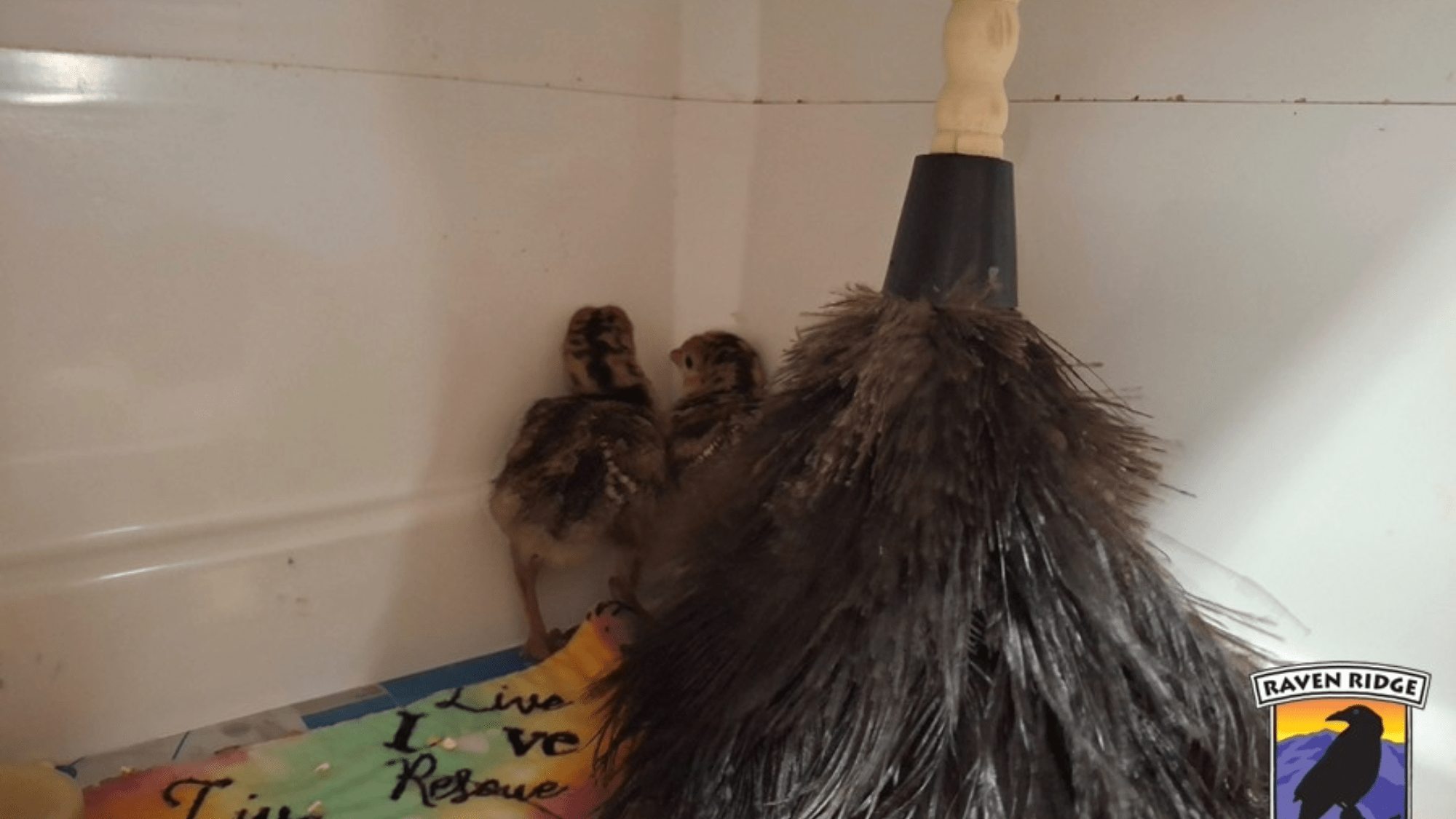
This particular incubator hosts a third presence. The staff put in a feather duster with the chickens, that they can hide under as if it were their mother.
The chicks were found after one of their siblings and mother were likely hit by a car. Image: Raven Ridge Wildlife Center.
“The incubator is nice and warm, which would be just like mom,” Tracie Young, director of the Raven Ridge Wildlife Center, tells Popular Science. “And to cut down their stress, the feather duster is hanging from the inside of the incubator. It’s more natural, more something that they’re going to recognize, and they’re able to hide under it. So it’s just like mom. It’s safety, it’s warmth. And that really does help with these animals in rehabilitation.”
Interestingly, Young and her colleagues also put pictures of adult turkeys in the incubator so that, in the absence of a real one, the chicks can still see a sort of adult role model. It’s not unusual for wildlife centers to resort to off-beat solutions for orphaned babies in rehabilitation. In 2024, wildlife care staff wore fox masks while caring for a juvenile red fox so that it doesn’t get used to humans.
Young says that when dealing with one or just a few ducklings at Raven Ridge, they give them adult duck decoys. As for turkey chicks, “a turkey decoy is not going to fit into an incubator,” she explains, so that’s where the pictures come in.
This isn’t the first time the team has reached for the feather duster in such a scenario, nor will it be the last. In fact, the wildlife center also just received another baby bird—its first ever ruffed grouse (Bonasa umbellus). That means they’ll have to procure another feather duster.
The baby chicks will likely be at the wildlife center until closer to the fall, when they’ll be returned to the wild. Once the birds become bigger and able to keep themselves warm, the team will transfer them into a larger cage and then outside. For now, however, the featherduster is helping.
“They were running out from underneath their duster, running back underneath the feather duster,” she says, “but we noticed, too, that after putting the feather duster in they were a lot calmer, they were eating more, and their weight is going up.”
Humans often announce the biological sex of their offspring before the baby even enters the world. For bald eagles, the process can take a bit longer. After nine weeks, Friends of Big Bear Valley (FOBBV) announced on Tuesday that Jackie and Shadow’s 2026 chicks are likely a boy and a girl.
The two chicks hatched in early April. Their names, Sandy and Luna, were bestowed on May 1. Now we know that Sandy is a female and Luna is male. Or at least we can confidentially guess. FOBBV, the non-prof
Humans often announce the biological sex of their offspring before the baby even enters the world. For bald eagles, the process can take a bit longer. After nine weeks, Friends of Big Bear Valley (FOBBV) announced on Tuesday that Jackie and Shadow’s 2026 chicks are likely a boy and a girl.
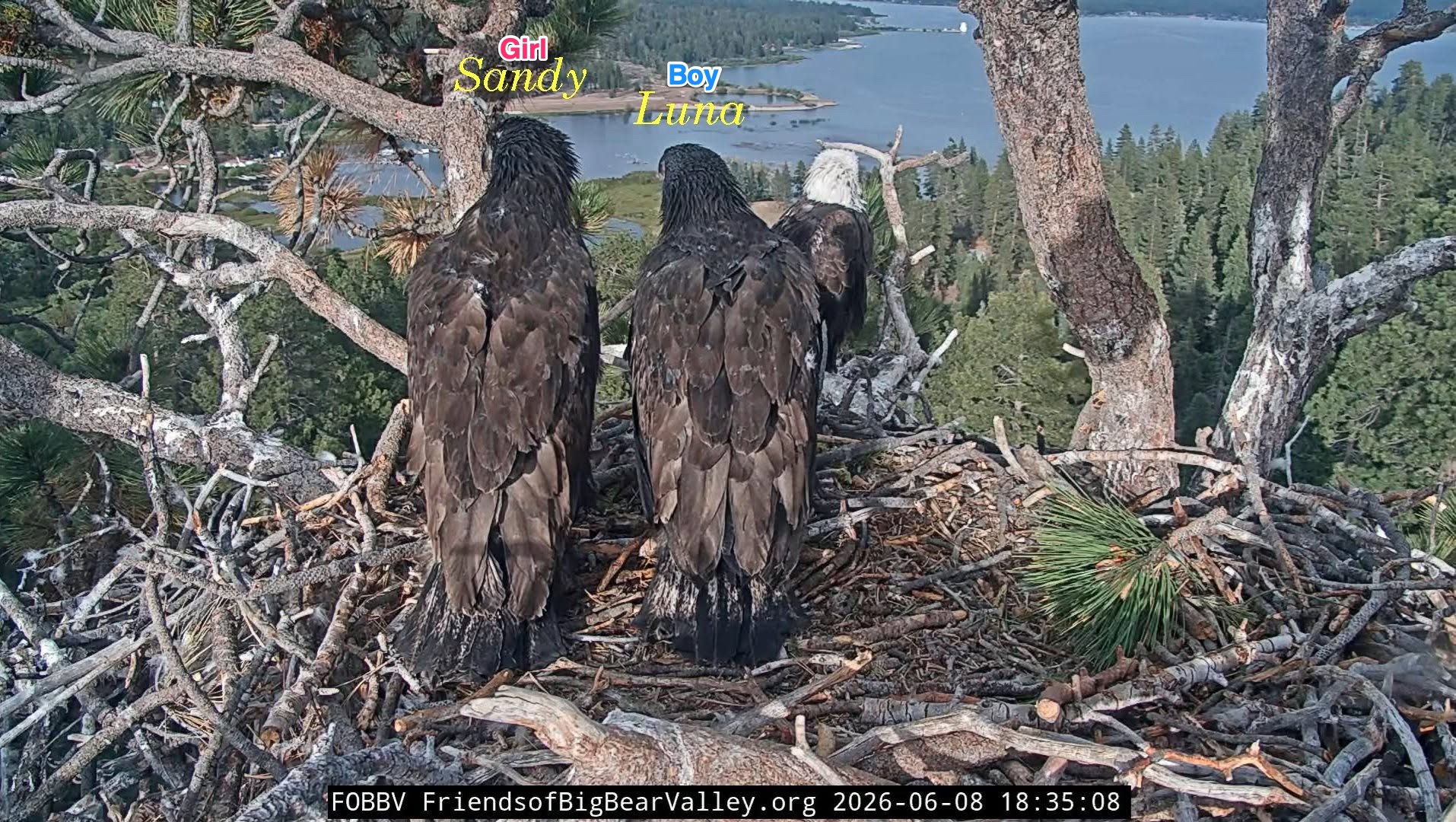
The two chicks hatched in early April. Their names, Sandy and Luna, were bestowed on May 1. Now we know that Sandy is a female and Luna is male. Or at least we can confidentially guess. FOBBV, the non-profit who runs Jackie and Shadow’s 24/7 livecam, closely observed the duo since birth and noted traits that offered clues to the birds’ sexes.
Luna (L), Sandy (R) in their nest on June 9. Image: FOBBV
“Male and female bald eagles have significant differences in vocal pitch; we have all heard the difference in vocals with Jackie and Shadow,” FOBBV wrote on Facebook. “Females are larger than males and so are their voice boxes (Syrinx), which results in deeper lower-pitched vocalizations We used frequency applications to record and analyze Sandy and Luna’s vocals and there were consistent differences in vocal pitch.”
FOBBV also notes that the only way to confirm Sandy and Luna’s sexes would be a blood test. But at 9 weeks old, the eaglets’ bone structure and foot pads have fully grown (and they can even see as well as their parents), so FOBBV can be confident in their assessment.
It’s been another roller coaster nesting season for Jackie and Shadow, a pair of internet-famous bald eagle parents living in San Bernardino National Forest in Southern California. After ravensdestroyedtwo of their eggs in January, Jackie and Shadow laid two new eggs that successfully hatched.
Chick 1 hatched on April 4 at 9:33 p.m. PDT, while Chick 2 followed on April 5 at 8:30 a.m. PDT. Their large nest in Big Bear Valley east of Los Angeles is livestreamed 24 hours a day by nonprofit Friends of Big Bear Valley (FOBBV) and has captivated millions.
On May 1, FOBBV announced the chicks’ names: Sandy and Luna. The names were selected by elementary school students after thousands of submissions from fans.
How long will the chicks stay in the nest?
Chicks usually stay in the nest until 10 to 14 weeks of age. This year’s chicks will likely fledge sometime between mid-June and mid-July.
What challenges do the eaglets face?
Before leaving the nest, the chicks face threats from other birds of prey, including hawks, ravens, other eagles, and owls. Inclement weather can also present challenges for the chicks. In 2025, a March snowstorm resulted in the death of one of Jackie and Shadow’s three chicks.
During fledging, only 70 percent of eaglets survive. One of the greatest threats is from cars that can injure or kill the birds while they scavenge for food on roadkill.
Who are Jackie and Shadow?
The pair first got together in 2018 and successfully raised chicks in 2019 and 2022. However, their eggs failed to hatch in 2023 and 2024. Only 50 percent of eagle eggs successfully hatch, so this pair has already beaten the odds.
What happened to Jackie and Shadow’s 2025 eaglets?
In 2025, Jackie laid three eggs that all hatched in early March. On March 13, a strong snowstorm dumped up to two feet of snow and battered the nest with strong winds. Only two of the chicks were visible on the live cam when the storm passed by the next morning. FOBBV later confirmed the passing of one of the chicks. The two surviving chicks were later named Sunny and Gizmo after 54,000 names were submitted by fans.
What happens after chicks fledge?
Young eagles usually fledge–or leave the nest and fly–when they can flatten their wings and have feathers capable of flight. This typically occurs when the birds hit 10 to 14 weeks of age. Males also tend to take their first flight a little sooner than females. So we might expect to see Luna take flight first.
According to FOBBV, fledglings from Southern California have been spotted as far south as Baja California, as far north as British Columbia, and as far east as Yellowstone National Park.
About 70 percent of bald eagles survive the fledgling stage. FOBBV does not tag their eagles, so it’s not possible to follow the chicks’ journeys after they flee the nest.
Can I help Jackie and Shadow?
Yes. Environmental groups are currently fundraising $10 million to protect Jackie and Shadow’s foraging area from development. Learn more at SaveMoonCamp.org.
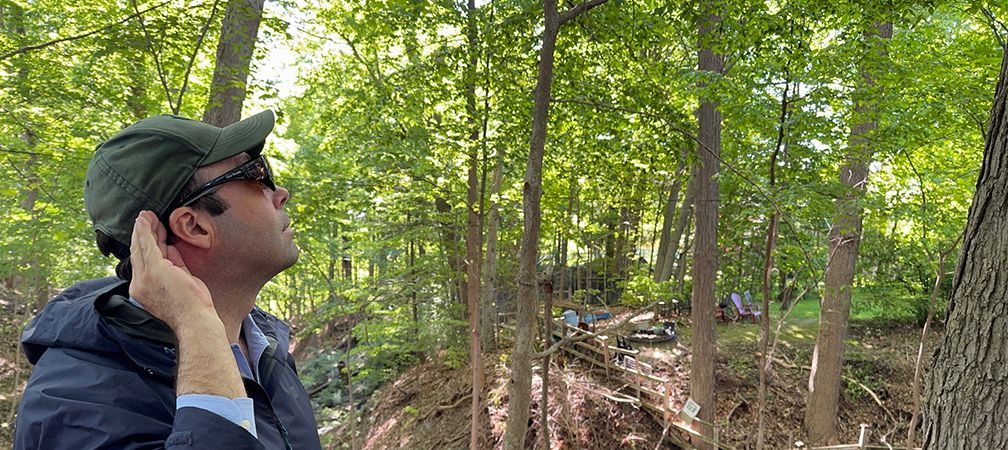
The first time someone called me a birder, I was startled, not only because I’m completely Blind. I had accumulated bits of knowledge here and there over the years and felt smug when I could identify birds by their songs, but I’d never studied, and it had never even occurred to me to go on an outing. Birders get up early, which wasn’t my habit, and I believed falsely that birding was entirely centred on vision. While some are, many birders I’ve spoken to describe listening as one of the key too
The first time someone called me a birder, I was startled, not only because I’m completely Blind. I had accumulated bits of knowledge here and there over the years and felt smug when I could identify birds by their songs, but I’d never studied, and it had never even occurred to me to go on an outing. Birders get up early, which wasn’t my habit, and I believed falsely that birding was entirely centred on vision. While some are, many birders I’ve spoken to describe listening as one of the key tools in finding birds to identify, especially in high summer when the foliage is at maximum density.
So on a sunny day in late summer, I accompanied Steve Garrett of the Toronto Ornithological Club (TOC), a Nature Network member group, to hear what was to be heard in Toronto’s High Park (mostly it was goldfinches and chickadees). We had our expectations set appropriately, as anyone who can distinguish a house sparrow from a bluejay can tell you, late summer isn’t the best time for birding.
Despite the season, I learned a lot. I got acquainted with the Merlin Bird ID app, and grilled Steve about birders and their ways.
Things I learned:
A “spark bird” is the bird that first catches someone’s attention and turns them into a birder
A “lifer” is a first-ever sighting of a bird that a birder may have been chasing for years
And the best way to get a bird to stop singing is by turning on your ID app microphone
Steve told me the image of the classic birder has changed. The classic birder, armed with field glasses and reference manuals, isn’t quite as conspicuous anymore, because the smart phone offers options both for viewing, photographing, identifying and documenting.
Also, the idea of who a birder is has consciously shifted. “The birding community has followed the cultural shift towards diversity, equity and inclusion,” Steve told me. “When it was founded, way back in 1934, the Toronto Ornithological Club was exclusively men. Of course that’s not true anymore, and we’re actively interested in including people with a wide range of ages, backgrounds and abilities.”
This led to a discussion about an event involving the TOC and a group of Blind adults brought together by Balance for Blind Adults. One participant was Alex Bulmer, a Blind actor and director, who lives near High Park.
Alex, who lost her sight in her 20s, explained that one of the biggest barriers for Blind birding is access. “It’s one thing to walk down the street,” she says, “That’s good, cause there’re birds out on the street in the city and you can travel with your cane or your dog down the street, but you’re limited. Unless you can get into a woodland or a place that’s less navigable, I mean I can’t get into the depths of High Park with my cane or my dog, I just can’t without a sighted guide.”
I also think it’s important to tackle a common myth. Blind people have better hearing than sighted people. My conclusion is that, as a Blind person, I’m no more likely to excel at a hearing test than anyone else, but also as a Blind person, I rely heavily on sounds around me to make my way through the world and perceive what I can about it. This means that I often notice sounds my sighted friends don’t, not because I have quantitatively better hearing, but because I give more energy to processing what I hear.
Technology has also changed birding for Blind people. Gone are the days when sighted birders carried around reference books or paper journals. As a Blind person it’s all about the phone now. And as a totally Blind person, I rely on the voiceover feature on my iPhone which reads screen text aloud as synthetic speech. If an app developer has built accessibility features into their app, my experience will be as smooth as anyone else’s.
I’ve appreciated the opportunity the Merlin Bird ID app gives me to participate in community science by sharing recordings with research databases. Jim Halilton, a retired Blind tech user, became interested in identifying birds through a course called Birdability: Birding By Ear, designed and offered by Birds Canada. I asked him about the Merlin ID app. “It has helped me answer bird-song questions which I have had for decades. since having this app, and recognizing more birds as a result, I now pay more attention to birds I hear, to try to identify those I have not heard before.”
As a Blind birder I won’t be taking photos of birds, but learning their songs and calls helps me fill in the auditory landscape in a way that centres nature rather than just the human-made sounds I hear in my urban life. That persistent trill in my backyard, I discovered, is not a dying squirrel but a dark-eyed junco; I looked it up.
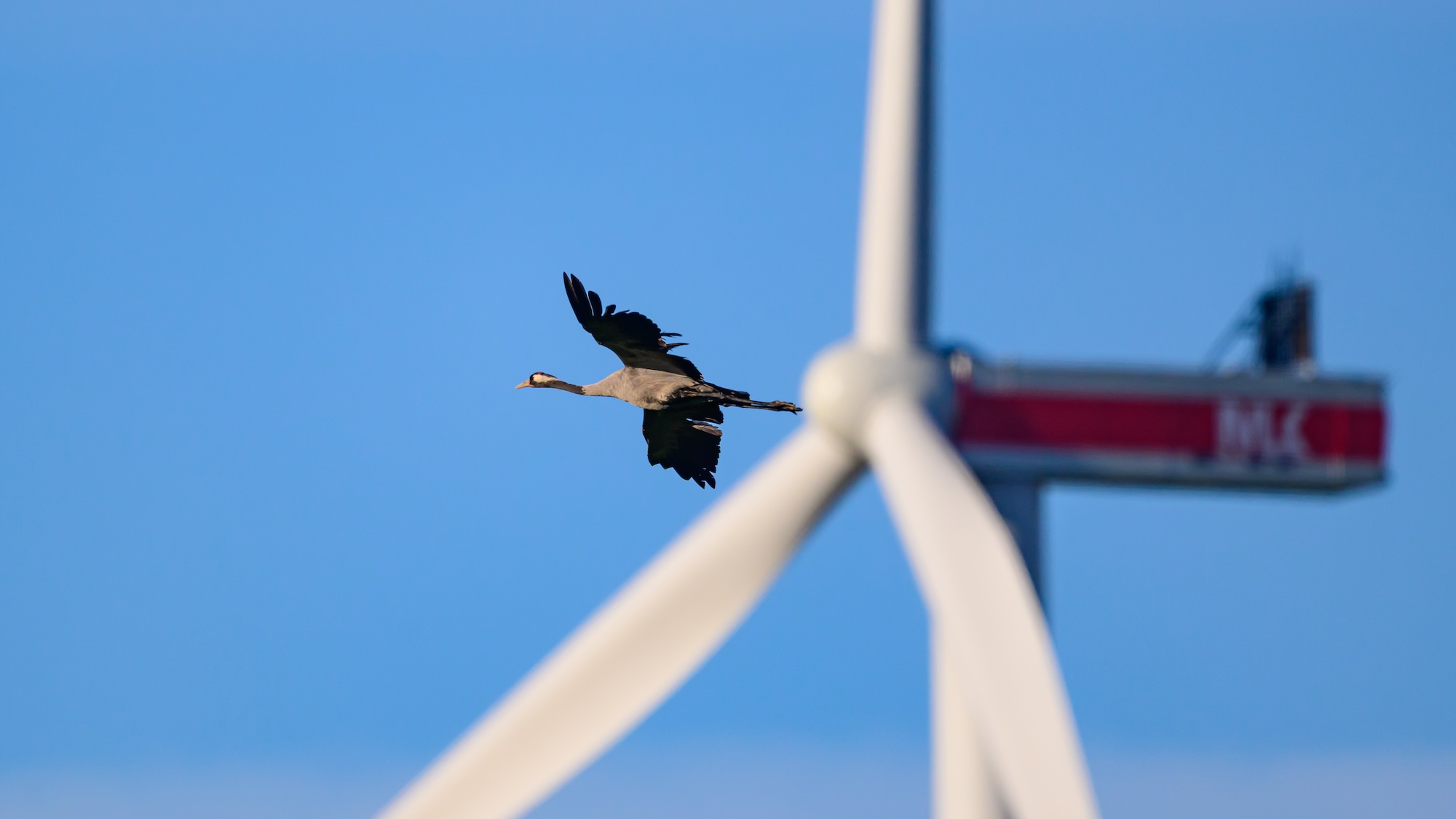
Wind turbines are a net positive for a sustainable society, but that doesn’t mean they don’t have an environmental impact. Apart from their material requirements, those giant, spinning blades can be lethal to unsuspecting winged animals like birds and bats. Although some reports dramatically overplay wind farms’ danger to flying species, there is no denying they can unintentionally kill anywhere from two-to-six birds and four-to-seven bats per megawatt every year. That may not seem like many fat
Wind turbines are a net positive for a sustainable society, but that doesn’t mean they don’t have an environmental impact. Apart from their material requirements, those giant, spinning blades can be lethal to unsuspecting winged animals like birds and bats. Although some reports dramatically overplay wind farms’ danger to flying species, there is no denying they can unintentionally kill anywhere from two-to-six birds and four-to-seven bats per megawatt every year. That may not seem like many fatalities, but every animal counts for an endangered species.
To lower these risks, engineers are devising new ways to make wind turbines more visible and avoidable. One potential solution may involve taking a cue from some of nature’s most dangerous creatures. According to a study published in the journal Behavioral Ecology, more bats and birds will steer clear of wind turbines when their blades are painted with colors similar to animals like venomous coral snakes and poison dart frogs.
A drone photograph of a wind turbine in southern Finland, digitally modified with a biologically inspired warning pattern under natural light conditions. Credit: Eric Lehtonen
“White blades, which are the most frequently used pattern around the world, turned out to be the worst option for birds,” Johanna Mappes, a University of Helsinki environmental scientist and study co-author, said in a statement. “This suggests that a relatively simple visual change could reduce bird mortality in connection with wind power.”
To test how birds respond to various turbine designs, Mappes and her colleagues placed test subjects in front of a video screen in a controlled laboratory environment. They then played clips of wind blades with multiple color palettes spinning at different speeds. These included turbines featuring classic white blades, one blade painted black, blades with red-and-white stripes, or blades with a newly designed, biomimetic red-black-yellow pattern.
“By using a touchscreen especially designed for birds, we can use games to explore their behavior and ecology by simulating real-world scenarios, without putting the birds at risk,” explained University of Exeter ecologist and study co-author George Hancock.
In nearly every trial, the birds were far more likely to approach white blades than any of the colored options. However, the test subjects were the most avoidant of the team’s novel, biomimetic striped blades.
“We’ve known for a long time that birds change how they respond to objects with warning colors, but to see such a large effect was remarkable,” Hancock added.
There is no way to completely prevent wind turbines from ever accidentally harming or killing animals. That said, the study’s authors believe a wider industry adoption of evolutionarily inspired color schemes could be an easy, cheap way to make the technology safer. They also suggest that similar approaches be developed for other human-made avian dangers like power lines and building windows.
“If the results are repeated in practical conditions in different countries and with different bird species, it could be a significant change for the entire wind power industry,” said Mappes.
A pattern of birds and clouds from the magazine <i>Art–Goût–Beauté</i>, 1928.
<i>Art–Goût–Beauté, Feuillets de l'élégance féminine</i>, aka <i>AGB</i>, and later on <i>AGB Voici la mode</i>, was a french luxury magazine about women's fashion, published in Paris, and active from 1920 to 1937.
This very expensively made magazine was published by the owner of a textile factory, and it shows in the endpapers, which displayed fabric patterns in color. T
A pattern of birds and clouds from the magazine <i>Art–Goût–Beauté</i>, 1928.
<i>Art–Goût–Beauté, Feuillets de l'élégance féminine</i>, aka <i>AGB</i>, and later on <i>AGB Voici la mode</i>, was a french luxury magazine about women's fashion, published in Paris, and active from 1920 to 1937.
This very expensively made magazine was published by the owner of a textile factory, and it shows in the endpapers, which displayed fabric patterns in color. This one was printed only in blue, and comes from issue No. 99 (November 1928).
Found in the Wikimedia Commons repository, here: https://commons.wikimedia.org/wiki/File:Art_-_Go%C3%BBt_-_Beaut%C3%A9,_Feuillets_de_l%27_%C3%A9l%C3%A9gance_f%C3%A9minine,_Novembre_1928,_No._99,_9e_Ann%C3%A9e,_schutblad,_RP-P-2009-1921-1A.jpg
...placed under a Creative Commons CC0 1.0 Universal Public Domain Dedication license.
With a little extra work, this pattern can be made to tile.
Every year, there are two major migration events. Birds, insects, fish, and many mammals head north in the spring to nest and breed and return south in the winter to feed and raise their young. Using BirdCast, a tool that’s active seasonally and allows anyone to see bird migration “heat maps” around the U.S., ornithologists tracked a record-breaking one billion birds migrating on a single October night in 2023 (last year, that number reached 1.2 billion). But on the night spanning October 4 t
Every year, there are two major migration events. Birds, insects, fish, and many mammals head north in the spring to nest and breed and return south in the winter to feed and raise their young. Using BirdCast, a tool that’s active seasonally and allows anyone to see bird migration “heat maps” around the U.S., ornithologists tracked a record-breaking one billion birds migrating on a single October night in 2023 (last year, that number reached 1.2 billion). But on the night spanning October 4 to 5, something else really big happened: nearly 1,000 birds died in Chicago after hitting a single building.
McCormick Place Lakeside Center is situated along the Lake Michigan shoreline, set apart from other buildings in a park-like space, and it has roughly enough windows to cover two football fields. As birds cruise along the shore, flitting over greenery, they sometimes mistake the reflections of nature in glass for the real thing. On the morning of October 5, hundreds of birds fell victim to architecture.
When artist and educator Holly Greenberg heard this news, she was stunned. No stranger to nature and long interested in sustainability and the environment, she was nevertheless totally unaware of the scale of bird collisions in the U.S. During a day out in a Chicagoland arboretum, on sabbatical from her role as assistant professor at Syracuse University, she worked with a group to remove invasive buckthorn and make room for native trees. A fellow volunteer rued the sad irony of planting new bird habitat when the feathered creatures try to fly into their reflections in glass instead.
“That was the first time that I’d heard that these birds were crashing into windows in Chicago,” Greenberg says. When she later read about the mass collision at McCormick Place, she thought, “Oh man, something needs to be done.” That’s when the multi-year project Bird Collisions in the Anthropocene was born.
Greenberg launched the initiative in 2024 to not only raise awareness of the problem but also to educate people about preventing incidents. Using data from the Chicago Field Museum and with the help of its lead ornithologist Dave Willard, Greenberg landed on a specific number: 10,863. That’s how many were found dead after hitting Chicago buildings in 2023 alone.
It’s estimated that around one billion birds die in window collisions annually throughout North America. One of the organizations working to collect this data and—just as importantly—to protect, rescue, and advocate for avians is the Chicago Bird Collision Monitors (CBCM) program. Every morning, volunteers walk the streets of the city to count and collect fallen individuals, taking them to wildlife sanctuaries for treatment or rehabilitation where possible. Most, however, don’t survive the impact.
Bird specimens at the Field Museum
Paul Groleau, president of a company called Feather Friendly that makes bird-safe window treatments, suggests that many more die from window impacts than we realize. Greenberg hears people at her workshops say things like, “I heard a bird hit my window, but it flew off, so it’s fine.” Groleau, however, posits that about 60 percent of birds that are stunned do not survive. Their skulls are paper-thin, and if they don’t hemorrhage, they may sit under some shrubbery as they try to recover, which makes them more vulnerable as prey.
When CBCM volunteers find dead specimens, they take them to the Field Museum, where the bodies become part of an archive Willard has overseen for decades. Many are preserved in the museum’s collection, each tagged and identified. At the very least, they are added to a carefully tended data set, which lists thousands upon thousands specifically killed by impacting windows at speed.
10,863 is the number Willard had recorded in 2023. Of course, the actual number of birds that collided with windows that year is exponentially higher, but the figure reflects the number that Willard and the CBCM volunteers found. And it’s the exact number that Greenberg is getting thousands of people to help recreate from fabric and glue. At the same time, she’s sharing knowledge about collisions with others through craft, science, advocacy, and social practice.
Starting with a small grant and a group of interns at Syracuse University, Bird Collisions in the Anthropocene began with the list of avians from the Field Museum, some basic crafting supplies, and photographs of individual birds so that makers could replicate the actual species. Eventually, Greenberg relocated to Evanston, Illinois, a suburb of Chicago, and opened a studio where she hosts workshops and processes birds that are sent in from all over North America.
Workshops are facilitated across the U.S. and Canada, and so far, a total of more than 140 have been held. Materials can be downloaded from the website, and anyone can host a workshop. Popular locations include public libraries and schools. Cornell Lab of Ornithology, which is behind the BirdCast tool, has even launched a pilot program to send hundreds of sew-a-bird kits to biology teachers in New York State in order to help students complete a core education requirement.
The hands-on, participatory, and very communal aspect of the bird workshops is fundamental to the project’s success. Greenberg opens her studio to the public on the first Saturday of every month as part of the Evanston Made program, and private gatherings can be organized, too. “People get into the flow, no one is touching their phone, and everyone is super concentrated,” Greenberg says. “They’re working with awkward materials, and it’s a mess, but it’s a good creative mindset.”
Studies have shown that hands-on or experiential learning is linked to greater knowledge retention, attentiveness, and experimentation. As people create their house sparrows, dark-eyed juncos, golden-crowned kinglets, and many more—and one’s level of technical skill is no matter—a sense of camaraderie builds around a common pursuit. Greenberg then provides resources about how to help prevent bird collisions, such as information about remediation technologies.
Businesses like Feather Friendly make products that can be applied directly to any window, most commonly in the form of small vinyl dots. It also offers Bird Divert, which uses clear dots that are actually hard for us to see, but due to the way birds’ vision works, the application helps them to differentiate between architecture and nature. Fritted glass is another method, which involves ceramic details baked right onto the surface of the glass.
Artist Taro Takizawa in front of the ‘Bird Collisions in the Anthropocene’ studio in Evanston
Greenberg sees the artistic potential in the remedial window coverings, and she has previously invited artist Taro Takizawa to apply beautiful organic lines made of hand-cut vinyl on the top windows of her Evanston studio. For a forthcoming social project this summer, Greenberg plans to install different types of remediation dots on the large storefront windows of the space, plus an installation by artist Alice Hargrave, who creates abstract works using the sound waves of bird calls.
While the official number of finished birds is currently at 3,451, Greenberg estimates there are at least 1,000 more awaiting tagging and entry into the project’s handwritten ledger, which is reminiscent of museum catalogues before computerized records came into widespread use. With the help of a team of interns, she labels each bird individually with its species name, its artist, and where it “flew” in from. And installation opportunities abound.
Eventually, the birds will create one giant “carpet” to illustrate not only the poignant and urgent reality of bird collision deaths, but the power of collective action. In the meantime, groups of the fabric critters go on view occasionally in other exhibitions. One of these is Chicago Architecture Center’s forthcoming show, Flyway City, which “aims to catalyze positive change on making cities safer and more welcoming for birds and diverse wildlife” by focusing on how architecture can help to protect avians from the get-go.
The exhibition is organized by Studio Gang, whose lead architect, Jeanne Gang, has also encouraged the city of Chicago to enact building codes that are more bird-friendly. While Evanston has an ordinance that requires bird-friendly building design, Chicago does not yet, although it’s been on the table many times. Greenberg hopes that continued advocacy and information-sharing empowers others to speak up, too, so that these types of changes will be seen in more communities all over North America.
Flyway City runs from June 11 to January 3, 2027, in Chicago. Keep updated about workshops and other ways to get involved by following Greenberg’s Instagram.

 Login
Login