Normal view

  • ✇Ontario Nature Blog
  • Conservation Groups Strengthen 2SLGBTQIA+ Inclusion in Nature Cristina Murano
    Recently, there has been an increase in the number of conservation groups working with the 2SLGBTQIA+ (Two-Spirit, lesbian, gay, bisexual, transgender, queer, intersex and asexual) community to host events. This has signalled a new wave of support for 2SLGBTQIA+ people in the environmental movement; and not only is there a growing demand for this programming, but it is also essential. 2SLGBTQIA+ Positivity in Wild Spaces Ontario Nature spoke with conservation organizations hosting 2SLGBTQIA+
     

Conservation Groups Strengthen 2SLGBTQIA+ Inclusion in Nature

4 June 2026 at 18:48

Recently, there has been an increase in the number of conservation groups working with the 2SLGBTQIA+ (Two-Spirit, lesbian, gay, bisexual, transgender, queer, intersex and asexual) community to host events. This has signalled a new wave of support for 2SLGBTQIA+ people in the environmental movement; and not only is there a growing demand for this programming, but it is also essential.

2SLGBTQIA+ Positivity in Wild Spaces

Ontario Nature spoke with conservation organizations hosting 2SLGBTQIA+ events, gaining valuable insights into how these initiatives are being developed and delivered.

Conservation Halton was established more than 60 years ago to protect our communities from flooding and erosion. Ontario Nature spoke with their Communications Specialist, Tamanna Kohi, about their approach to 2SLGBTQIA+ inclusivity, “When we received the accreditation from Canada’s 2SLGBTQIA+ Chamber of Commerce, we placed Rainbow Registered window decals at our park visitor centres. A park visitor pointed out how proud they are to support [our] parks and added that they felt seen and safe knowing we are committed to building a culture of inclusivity for all our communities.”

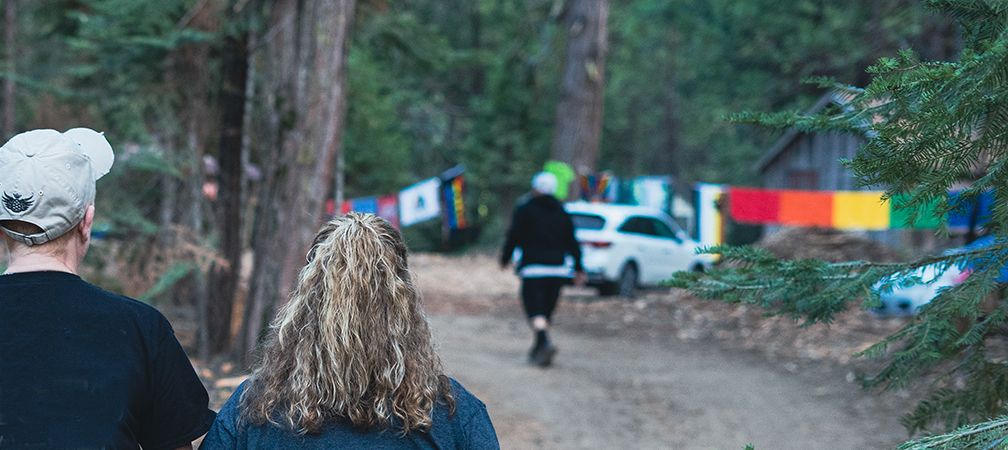
Enjoying a walk during an LGBTQ2SIA+ camping event, Pride, Lesbian Gay Bisexual Transgender Queer Two-spirited Intersex and Asexual +
Enjoying a walk during an LGBTQ2SIA+ camping event © David Prasad CC BY 2.0

This year, the Bruce Trail Conservancy (BTC) and its nine Bruce Trail Clubs also received Rainbow Registered designation. In a press release announcing the accreditation, Laura Tuohy, Manager of Community Engagement at the BTC, emphasized the importance of ensuring everyone feels welcome on the trail.

“People in 2SLGBTQIA+ communities deserve to feel safe, comfortable, and welcome to explore the Bruce Trail and be part of its future, whether that be through self-guided adventures, joining guided hikes, or taking part in volunteer activities,” says Tuohy.

Tuohy told Ontario Nature that participating in Pride events helped BTC better understand barriers people face when accessing outdoor recreation. “Attending Pride events has given us the opportunity to hear peoples’ apprehensions about going on organized group hikes and have direct conversations with people in the 2SLGBTQIA+ community,” she says, “With that feedback, we started our Rainbow Hike program the following year to provide a safe space for 2SLGBTQIA+ folks and allies.”

2SLGBTQIA+ Groups Break Through

If nature is to be for everyone, it must make itself so through active facilitation. Naming 2SLGBTQIA+ positivity and engaging in events, media and outreach that supports the community is a step forward.

The BTC’s approach is yielding impressive results. Tuohy shared, “We are inspired each day by [our] mission ‘preserving a ribbon of wilderness, for everyone, forever.’ … But we recognize that it’s not enough to say, ‘for everyone’, we have to demonstrate it, invite participation, facilitate safe spaces, and work to remove barriers to inclusion.”

As Rosalyn Endlich, Natural Environment Specialist with the City of Toronto elaborated, “Relationship building and supporting existing community networks is essential … we were grateful to partner with Friends of Hanlan’s, a queer landscape-based community advocacy group. Collaborating with them helped us reach additional people and support those that had already laid groundwork and built demand for engagement events.”

A large group of people support LGBTQ2SIA+ rights under the canopy of mature trees in a park or naturalized space, a large-scale Pride gathering
A large Pride gathering © Fibonacci Blue CC BY 2.0

Building Inclusive Spaces in Nature

The groups operating at the intersection of sexual identity, gender identity, and nature programming are filling a gap for 2SLGBTQIA+ people and offering a service to the community.

“We also use the natural world as our guide … as natural ecosystems are more resilient and better able to adapt to change when they are biologically diverse, organizations and movements are stronger when they are diverse and inclusive,” says Tuohy, “When we are facing parallel crises of climate change, biodiversity loss and loss of connection to nature, we need to come together and involve as many people as possible in finding solutions.”

Endlich echoes, “For queer people to come together in a community event to plant and care for a queer space was something special. Now, whenever folks visit this beach, they hopefully will feel even more connected and invested in the space. Also, it was meaningful on a personal level both for our 2SLGBTQIA+ staff and folks who attended this event to all get to work together and see ourselves represented in forestry and environmental stewardship.”

And Kohi adds, “Conservation Halton’s Pride in Nature kick-off event, Birds of All Feathers, is hosted at Mountsberg Conservation Area. Staff, volunteers and event attendees are always excited to attend the event dressed up in their Pride gear,” Kohi adds. “The event features educational signage with animal facts that represent Pride out in nature — for example, the endangered species, Jefferson Salamander is a species with ‘unisexual reproduction’, meaning that females reproduce through cloning. … This was a great opportunity to showcase the diversity of nature.”

To learn more about 2SLGBTQIA+ organizing, visit Queer Ecology by Network in Canadian History & Environment, Making space for LGBTQ+ and wildlife communities by CBC and Five ways to become a better ally to 2SLGBTQ+ communities by Kristopher Wells.
  • ✇Ontario Nature Blog
  • Over 100 Species at Risk Lose Protection Under the Species Conservation Act Tony Morris
    Believe it or not, Ontario’s Endangered Species Act (ESA) was passed with all-party support back in 2007. Subsequently, of course, it was undermined through numerous exemptions and approvals for harmful activities, and now, through Bill 5, the Government of Ontario is tossing it aside completely. It is being replaced by the Species Conservation Act, 2025, (SCA) which is in no way its equal. With a view to eliminating barriers to development, it is claimed the new law will “help speed up project
     

Over 100 Species at Risk Lose Protection Under the Species Conservation Act

28 January 2026 at 16:57

Believe it or not, Ontario’s Endangered Species Act (ESA) was passed with all-party support back in 2007. Subsequently, of course, it was undermined through numerous exemptions and approvals for harmful activities, and now, through Bill 5, the Government of Ontario is tossing it aside completely. It is being replaced by the Species Conservation Act, 2025, (SCA) which is in no way its equal. With a view to eliminating barriers to development, it is claimed the new law will “help speed up project timelines and provide greater certainty for proponents.”

Devastating Changes

Under the SCA, no migratory birds, aquatic species or species of special concern will be provincially listed. The rationale for removing protections for migratory birds and aquatic species is that they already receive federal protection under the Species at Risk Act (SARA). In the case of special concern species, the provincial government is not listing them because they were not subject to “prohibitions under the ESA”. The provincial government is thus abandoning responsibility for 106 out of the 270 or so species currently deemed to be at risk in Ontario.

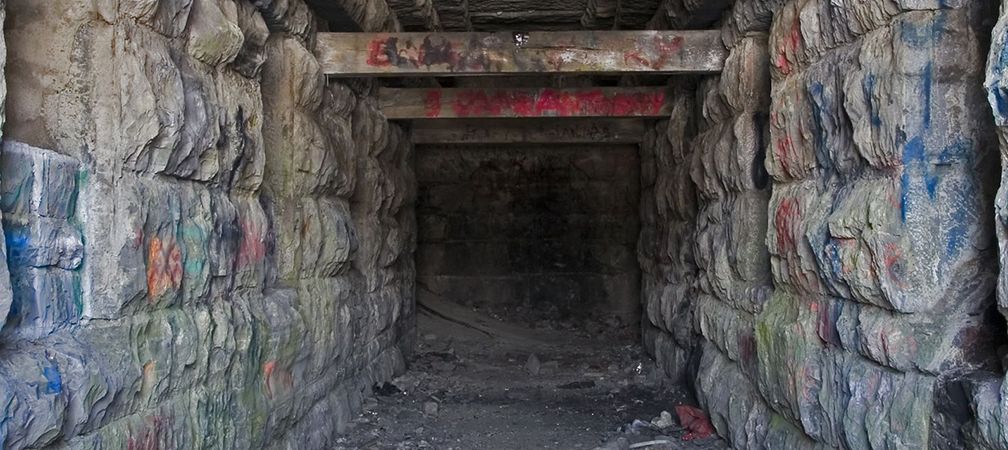
Former mine entrance
Former mine entrance © Brian Killmore CC BY 2.0

National Accord

In 1996, federal, provincial and territorial ministers responsible for wildlife committed to a national accord to protect species at risk by agreeing to “establish complementary legislation and programs that provide for effective protection of species at risk throughout Canada.” Canada and Ontario went a step further in 2011 by developing an Agreement on Species at Risk that commits to coordination and cooperation on preventing species from becoming at risk, as well as protecting and recovery identified species.

The Government of Ontario has abandoned these commitments. Species do not recognize arbitrary political boundaries, and cooperative federalism is absolutely necessary to conserve species at risk, especially amid a biodiversity crisis.

Prothonotary warbler, Endangered species, species at risk in Ontario, population declines, fewer of these birds, habitat loss, habitat degradation, negative human impacts, biodiversity loss, insectivore loss
Prothonotary warbler, Endangered species © Bill Majoros CC BY-SA 2.0

Limitations of SARA

The SARA is not equivalent to the ESA and to date, the federal government has been reluctant to exercise its power under the act on non-federal lands. The Government of Ontario has given no indication that the federal government was engaged on the draft SCA or agreed to step in and provide protections for the migratory birds and aquatic species that have lost provincial protections. On the contrary, Minister McCarthy along with the Alberta Environment Minister sent a letter to their federal counterpart in June, 2025 that requested the federal government amend SARA “to respect the constitutional jurisdiction of the provinces”, along with request to weaken other environmental regulations.

Further evidence that SARA is not fit to purpose to make up for the once gold standard provincial ESA, is that the backlog of species needing reassessment by Environment and Climate Change Canada will grow to 574 by the end of 2030. Additionally, as of 2022, the Auditor General of Canada found that 10% of federally listed species did not have recovery strategies or management plans in place as required by the act. Furthermore, of the 409 recovery strategies prepared by 2022, 20% did not identify the species’ critical habitat, which is necessary for protections under SARA.

New subdivisions and retail development displaces farmland, habitat and natural systems as well as degrading the environment with visual disturbance, noise, emissions and pollution nearby a watershed, Stayner, Ontario
New subdivision replaces previous farmland, Stayner © Noah Cole

Despite the Government of Ontario’s claims that the protections under the ESA for migratory birds and aquatic species were duplicative with federal protections, it is clear that SARA and the federal government are not equipped to provide equivalent protections.

Call to Action

Extinction threatens one million of approximately 8 million plants and animals worldwide. Responding effectively requires cooperation across all levels of government, as previously agreed to under the national accord and Canada-Ontario agreement.

Ontario’s weakening of protections for species at risk threatens our long-term well-being. Join us in urging the Government of Ontario to repeal Bill 5.

❌
Subscriptions